

ISO 18402:2016
(Main)Timber structures — Structural insulated panel roof construction — Test methods
General Information
- Abstract
ISO 18402:2016 specifies test methods for determining, for use in roofs, the structural properties of double-sided load bearing structural insulated panels having - two face layers, at least one of which is a wood-based structural panel, and - a core made of a thermally insulating material having sufficient shear strength to cause the face layers to act together structurally.
- Status
- Published
- Publication Date
- 01-Sep-2016
- Technical Committee
- ISO/TC 165 - Timber structures
- Drafting Committee
- ISO/TC 165/WG 7 - Connections and assemblies
- Current Stage
- 9093 - International Standard confirmed
- Start Date
- 25-Feb-2022
- Completion Date
- 29-Aug-2026
Buy Documents

ISO 18402:2016 - Timber structures -- Structural insulated panel roof construction -- Test methods

ISO 18402:2016 - Timber structures — Structural insulated panel roof construction — Test methods/2/2016



ISO 18402:2016 - Structures en bois -- Panneaux sandwich porteurs isolants pour toitures -- Méthode d’essais

ISO 18402:2016 - Structures en bois — Panneaux sandwich porteurs isolants pour toitures — Méthode d’essais/21/2016
Overview
ISO 18402:2016 - Timber structures - Structural insulated panel roof construction - Test methods specifies laboratory test methods to determine the structural properties of double‑sided load‑bearing structural insulated panels (SIPs) intended for roof use. The standard applies to SIPs with two face layers (at least one wood‑based structural panel) and a thermally insulating core with sufficient shear strength to make the faces act together structurally. ISO 18402 focuses on mechanical performance tests relevant to roof panels rather than factory quality control or conformity assessment.
Key topics and requirements
- Scope and definitions
- Applies to double‑skin SIPs (including slabstock and box‑type with internal framing) used as roof elements.
- Defines terms such as structural insulated panel, bonded, slabstock and core types.
- Conditioning
- Standard conditioning: 65 ± 5% RH and 20 ± 2 °C until constant mass (stabilized moisture content).
- Allows alternative and elevated temperature conditioning (example: 80 °C for some tests).
- Primary test methods
- Tensile test of core and bond - specimen size typically 150 mm × 150 mm; assesses tensile strength of core and adhesion between core and faces.
- Shear test on panel assembly - typical specimen 1 000 mm × 150 mm; measures core shear strength and bond under short‑term loading.
- Out‑of‑plane bending - stiffness and strength tests for uniform, concentrated and combined loads to evaluate roof bending performance.
- In‑plane diaphragm (racking) tests - monotonic racking stiffness and strength for horizontal load resistance.
- Creep testing - long‑term deflection under sustained loads.
- Accelerated ageing / durability testing - assesses long‑term performance (references ASTM methods where applicable).
- Reporting requirements
- Sampling, specimen dimensions, conditioning, test setup, failure modes, measured strengths and mean results must be documented.
Applications and users
ISO 18402 is practical for:
- SIP manufacturers developing and validating roof panel products.
- Independent test laboratories performing structural characterization of SIP roofs.
- Structural and façade engineers who need test‑based data for design or performance verification.
- Building authorities, specifiers and certifiers assessing safety, durability and performance claims for SIP roof systems.
- R&D and material suppliers evaluating adhesive systems, core materials and face panel assemblies.
Typical applications include roof design validation, comparative product evaluation, durability studies and providing input data for structural calculations and design codes.
Related standards
ISO 18402 references and aligns with other standards for SIPs and structural testing, including:
- ISO 22452 (SIP walls - test methods)
- ISO 21581 (shearwalls testing)
- ISO 16670 (mechanical fastener joint testing)
- EN 594, EN 14509 and ASTM standards such as ASTM C480, ASTM D7446, ASTM E72 and ASTM E1803.
Keywords: ISO 18402:2016, structural insulated panels, SIP roof test methods, timber structures, shear test, tensile test, out‑of‑plane bending, creep testing, SIP durability.
Buy Documents
ISO 18402:2016 - Timber structures -- Structural insulated panel roof construction -- Test methods
ISO 18402:2016 - Timber structures — Structural insulated panel roof construction — Test methods/2/2016
ISO 18402:2016 - Structures en bois -- Panneaux sandwich porteurs isolants pour toitures -- Méthode d’essais
ISO 18402:2016 - Structures en bois — Panneaux sandwich porteurs isolants pour toitures — Méthode d’essais/21/2016
Get Certified
Connect with accredited certification bodies for this standard

DIBt (Deutsches Institut für Bautechnik)
German Institute for Building Technology.
DIN CERTCO
DIN Group product certification.

Aboma Certification B.V.
Specialized in construction, metal, and transport sectors.
Sponsored listings
Frequently Asked Questions
ISO 18402:2016 is a standard published by the International Organization for Standardization (ISO). Its full title is "Timber structures — Structural insulated panel roof construction — Test methods". This standard covers: ISO 18402:2016 specifies test methods for determining, for use in roofs, the structural properties of double-sided load bearing structural insulated panels having - two face layers, at least one of which is a wood-based structural panel, and - a core made of a thermally insulating material having sufficient shear strength to cause the face layers to act together structurally.
ISO 18402:2016 specifies test methods for determining, for use in roofs, the structural properties of double-sided load bearing structural insulated panels having - two face layers, at least one of which is a wood-based structural panel, and - a core made of a thermally insulating material having sufficient shear strength to cause the face layers to act together structurally.
ISO 18402:2016 is classified under the following ICS (International Classification for Standards) categories: 91.080.20 - Timber structures. The ICS classification helps identify the subject area and facilitates finding related standards.
ISO 18402:2016 is available in PDF format for immediate download after purchase. The document can be added to your cart and obtained through the secure checkout process. Digital delivery ensures instant access to the complete standard document.
Standards Content (Sample)
INTERNATIONAL ISO
STANDARD 18402
First edition
2016-09-01
Timber structures — Structural
insulated panel roof construction —
Test methods
Structures en bois — Panneaux sandwich porteurs isolants pour
toitures — Méthode d’essais
Reference number
©
ISO 2016
© ISO 2016, Published in Switzerland
All rights reserved. Unless otherwise specified, no part of this publication may be reproduced or utilized otherwise in any form
or by any means, electronic or mechanical, including photocopying, or posting on the internet or an intranet, without prior
written permission. Permission can be requested from either ISO at the address below or ISO’s member body in the country of
the requester.
ISO copyright office
Ch. de Blandonnet 8 • CP 401
CH-1214 Vernier, Geneva, Switzerland
Tel. +41 22 749 01 11
Fax +41 22 749 09 47
copyright@iso.org
www.iso.org
ii © ISO 2016 – All rights reserved
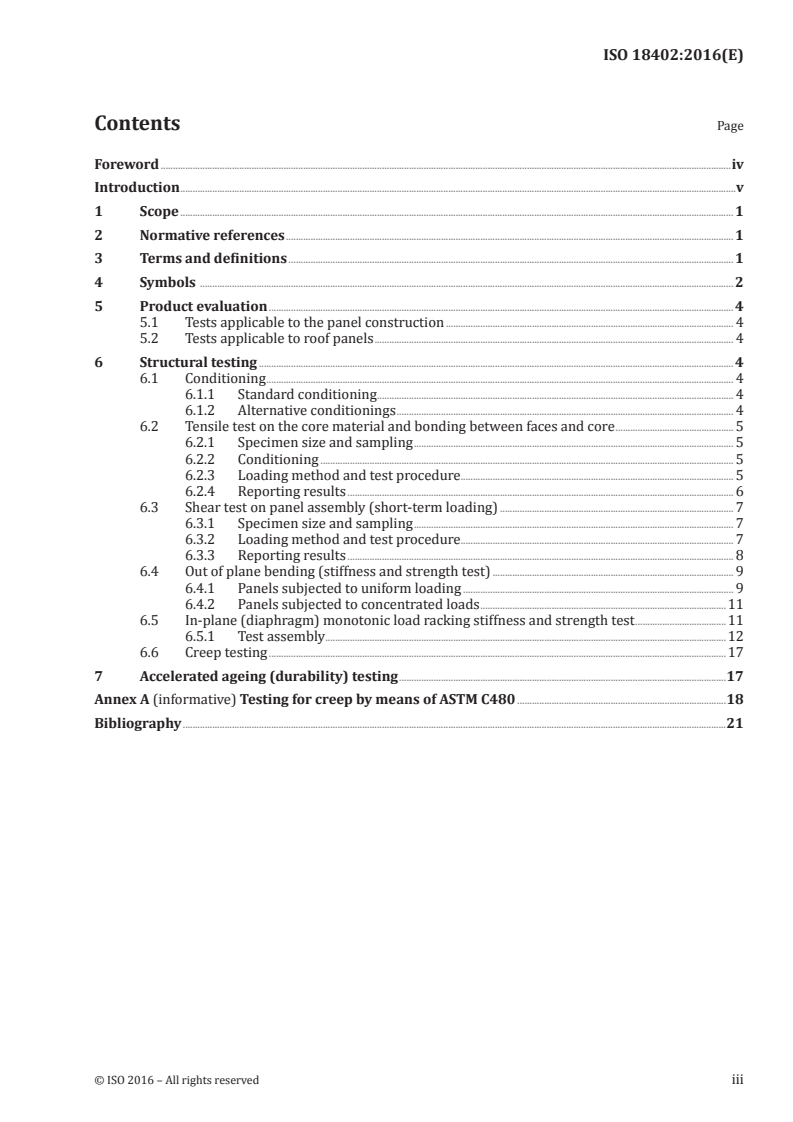
Contents Page
Foreword .iv
Introduction .v
1 Scope . 1
2 Normative references . 1
3 Terms and definitions . 1
4 Symbols . 2
5 Product evaluation . 4
5.1 Tests applicable to the panel construction . 4
5.2 Tests applicable to roof panels . 4
6 Structural testing . 4
6.1 Conditioning . 4
6.1.1 Standard conditioning . . 4
6.1.2 Alternative conditionings . 4
6.2 Tensile test on the core material and bonding between faces and core . 5
6.2.1 Specimen size and sampling . 5
6.2.2 Conditioning . 5
6.2.3 Loading method and test procedure. 5
6.2.4 Reporting results . 6
6.3 Shear test on panel assembly (short-term loading) . 7
6.3.1 Specimen size and sampling . 7
6.3.2 Loading method and test procedure. 7
6.3.3 Reporting results . 8
6.4 Out of plane bending (stiffness and strength test) . 9
6.4.1 Panels subjected to uniform loading . 9
6.4.2 Panels subjected to concentrated loads .11
6.5 In-plane (diaphragm) monotonic load racking stiffness and strength test .11
6.5.1 Test assembly .12
6.6 Creep testing .17
7 Accelerated ageing (durability) testing .17
Annex A (informative) Testing for creep by means of ASTM C480 .18
Bibliography .21
Foreword
ISO (the International Organization for Standardization) is a worldwide federation of national standards
bodies (ISO member bodies). The work of preparing International Standards is normally carried out
through ISO technical committees. Each member body interested in a subject for which a technical
committee has been established has the right to be represented on that committee. International
organizations, governmental and non-governmental, in liaison with ISO, also take part in the work.
ISO collaborates closely with the International Electrotechnical Commission (IEC) on all matters of
electrotechnical standardization.
The procedures used to develop this document and those intended for its further maintenance are
described in the ISO/IEC Directives, Part 1. In particular the different approval criteria needed for the
different types of ISO documents should be noted. This document was drafted in accordance with the
editorial rules of the ISO/IEC Directives, Part 2 (see www.iso.org/directives).
Attention is drawn to the possibility that some of the elements of this document may be the subject of
patent rights. ISO shall not be held responsible for identifying any or all such patent rights. Details of
any patent rights identified during the development of the document will be in the Introduction and/or
on the ISO list of patent declarations received (see www.iso.org/patents).
Any trade name used in this document is information given for the convenience of users and does not
constitute an endorsement.
For an explanation on the meaning of ISO specific terms and expressions related to conformity assessment,
as well as information about ISO’s adherence to the World Trade Organization (WTO) principles in the
Technical Barriers to Trade (TBT) see the following URL: www.iso.org/iso/foreword.html.
The committee responsible for this document is ISO/TC 165, Timber structures.
iv © ISO 2016 – All rights reserved
Introduction
This International Standard includes tests for tensile bonding strength of the panels, ageing, shear,
creep performance, horizontal in-plane performance and out-of-plane bending performance. The tests
applicable to panels for particular applications are indicated, while the test requirements include
laboratory conditions, some advice is given in notes on the numbers of samples to be tested and the
reporting of results.
This International Standard is not intended for quality control testing or for conformity assessment.
INTERNATIONAL STANDARD ISO 18402:2016(E)
Timber structures — Structural insulated panel roof
construction — Test methods
1 Scope
This International Standard specifies test methods for determining, for use in roofs, the structural
properties of double-sided load bearing structural insulated panels having
— two face layers, at least one of which is a wood-based structural panel, and
— a core made of a thermally insulating material having sufficient shear strength to cause the face
layers to act together structurally.
NOTE 1 Gypsum-based structural boards can be used as one face layer.
NOTE 2 Panels can contain internal framing or bracing.
NOTE 3 The performance of panels with non-structural insulation is generally calculable according to design
codes such as EN 1995–1-1, or tested according to appropriate standards.
2 Normative references
The following documents are referred to in the text in such a way that some or all of their content
constitutes requirements of this document. For dated references, only the edition cited applies. For
undated references, the latest edition of the referenced document (including any amendments) applies.
ASTM D7446-09, Standard Specification for Structural Insulated Panel (SIP) Adhesive for Laminating
Oriented Strand Board (OSB) to Rigid Cellular Polystyrene Thermal Insulation Core materials
ASTM D1183, Standard Practices for Resistance of Adhesives to Cyclic Laboratory Aging Conditions
3 Terms and definitions
For the purposes of this document, the following terms and definitions apply.
3.1
structural insulated panel
SIP
panel with two load bearing skins, one bonded (3.4) to each face of a rigid, lightweight, homogenous
core material with sufficient shear strength to cause the face layers to act together structurally
Figure 1 — Cross section of a structural insulated panel
Note 1 to entry: Homogenous core is made of one material with no internal joints requiring bonding.
3.2
double skin box with structural core type structural insulated panel
panel with a rigid core surrounded by a structural frame, with or without internal ribs, and two skins
mechanically fastened and/or bonded (3.4) to the frame and core forming a closed box
Note 1 to entry: The skins, core and frame all contribute to the load bearing capacity of the panel.
Key
1 core
2 internal structural frame
Figure 2 — Structural insulated panel with internal structural frame
3.3
slabstock
core material pre-formed into slabs of thickness equal to the required depth of the core and then bonded
(3.4) with a suitable adhesive
Note 1 to entry: When the length and width of a slab of core material is less than or equal to the length and width
of the SIP, they may be internally bonded.
3.4
bonded
components of a structural insulated panel (3.1) that have been joined together, usually by adhesive
Note 1 to entry: Alternatively, some foams used for cores are foamed in situ and are self-adhesive whilst
expanding and curing, thus, bonding automatically to the enveloping components.
4 Symbols
area of cross-section of the faces of the test panel, in square millimetres
AA
FF12
distance, in mm
ab,,c
B width of full panel, in mm
Young’s modulus of faces of the test panel, in N/mm
EE
FF12
load, in N
F
maximum load, in N
F
max
ultimate load, in N
F
u
estimated maximum load, in N
F
max,est
applied vertical load, in N
F
V
2 © ISO 2016 – All rights reserved
panel thickness, in mm
D
real shear deformation, in mm
Ds
apparent shear deformation, in mm
Ds′
shear modulus of core, in N/mm
Gc
apparent shear stiffness, in N/mm
′
G
self weight of loading element
F
g
self weight of the panel in N
F
g
applied permanent load, in N
F
g
weight of lever arm, in N
F
lever
weight of loading plate and rod, in N
F
plate
variable load, in N
F
Q
height of full panel, in mm
H
span, in mm
L
l length of panel sample, in mm
mass, in kg
M
ultimate moment capacity, in kNm
M
U
P load, in kN
R stiffness, in N/mm; strength, in N/mm
maximum reaction at failure, in kN
R
U
ultimate shear strength, in N/mm
S
U
T loading time, in seconds
recovery time, in seconds
T
r
impact energy, in J
W
width of panel sample, in mm
b
depth (thickness) of core, in mm
d
c
e depth between the centroids of the faces, in mm
shear strength of core material, in N/mm
f
cv
tensile strength of core material, in N/mm
f
ct
overall thickness of the face in mm
ttt,,
12 3
Δt total deflection under vertical diaphragm load, in mm
w deformations, in mm;
ultimate deformation, in mm
w
u
total deflection under constant load at time t, in mm;
w
t
initial static deflection under constant load and temperature, in mm;
w
η
factor of less than unity modifying F
max,est
v panel racking deformation, in mm
5 Product evaluation
5.1 Tests applicable to the panel construction
The following test regimes described in this International Standard relate to tests applicable to the
panel construction:
a) tensile test on core and its bond to faces;
b) shear strength of solid core and its bond to faces.
5.2 Tests applicable to roof panels
The following test regimes described in this International Standard relate to tests applicable to the
roof panel:
a) out of plane bending (stiffness and strength);
b) horizontal in-plane loading (racking stiffness and strength);
c) creep test;
d) long-term ageing/durability.
6 Structural testing
6.1 Conditioning
6.1.1 Standard conditioning
With the exception of 6.1.2, all test pieces in 6.2 to 6.6 shall be conditioned to constant mass in an
atmosphere of relative humidity (65 ± 5) % and temperature (20 ± 2) °C. Constant mass is deemed to
be attained when the results of at least three successive weighings indicate the moisture content has
stabilized to within ±0,5 % for at least 48 h period.
If the conditions of the testing room are not the same as those in the conditioning chamber, test pieces
shall remain in the conditioning chamber until testing and the test completed within 4 h.
6.1.2 Alternative conditionings
Test pieces may be differently conditioned and/or unconditioned.
4 © ISO 2016 – All rights reserved
Unless otherwise noted in the test report, results shall be corrected to reflect conditioning in accordance
with 6.1.1. The procedure for correcting structural properties shall be technically sound and shall be
recorded in the test report.
6.2 Tensile test on the core material and bonding between faces and core
6.2.1 Specimen size and sampling
The depth of the specimen shall be equal to the thickness of the panel (D). The width (b) shall be
150 mm and the length (l) shall be 150 mm.
NOTE The purpose of the test is to determine the tensile strength and critical failure mechanism, in the core
or glue line, of the SIP.
The test specimens should be sampled from a range of positions covering the width and length of the
panel, including the middle and the outer 10 % of the panel perimeter, as shown in Figure 3 below.
Figure 3 — Specimen sampling from panel
6.2.2 Conditioning
Specimens shall be conditioned in accordance with either 6.1 or to a specified elevated temperature
conditioning. Specimens shall be tested immediately after removal from the conditioning chamber
when performing an elevated temperature test.
Testing at elevated temperature may be appropriate for certain SIP applications. The performance of the
panel unit should be verified at these conditions. If uncertain of in-service temperature levels, elevated
temperature test specimens should be conditioned at 80 °C for at least 4 h. No further temperature
measurement is required after conditioning.
6.2.3 Loading method and test procedure
Specimens shall be bonded, using a suitable adhesive, to platens of sufficient stiffness to ensure a
uniform tensile stress over the area of specimen. When conditioned in accordance with 6.1, platens shall
be bonded to the specimen after conditioning. Specimens of square cross-section shall be prepared as
shown in Figure 4.
F
d
c
b
F
Key
1 load distributing platen
2 panel face
3 core
Figure 4 — Test arrangements in the tension test of the core
Load (F) shall be applied in increments or continuously such as to reach maximum load in 1 min to 5 min.
For structural insulated panels with OSB and polystyrene thermal insulation core materials,
ASTM D7446-09, 13.2 should be reviewed and considered for use, where appropriate.
NOTE This test is not intended for paper-faced lining materials.
6.2.4 Reporting results
The tensile strength, f , of the core material shall be calculated from the maximum load attained in a
ct
specimen failing in tension as follows:
F
u
f = (1)
ct
bl
where
F is the ultimate load (kN) carried by the specimen failing in tension;
u
b is the specimen width (mm);
l is the specimen length (mm).
The test report shall include the following information:
a) sampling procedure;
6 © ISO 2016 – All rights reserved
b) number of specimens tested;
c) the specification for the test panel construction;
d) the specification of the materials used in the manufacture of the test panels;
e) a detailed description of the test specimens, including any deviations from the specification;
f) type of any failure stating whether failure was in adhesion, cohesion or other mode; failure of the
bond between board face and loading platen should be recorded separately.
g) any conditioning applied to the specimens, and the test laboratory conditions;
h) the tensile strength, f (MPa), of each specimen and the mean of all test results;
ct
i) any other information believed to be appropriate.
6.3 Shear test on panel assembly (short-term loading)
This test shall be applied to SIPs with no additional internal frames. The behaviour of panels with
internal frames or internal ribs shall be established from the out of plane bending test (see 6.4).
6.3.1 Specimen size and sampling
Specimens (1 000 mm × 150 mm) shall be cut from full-size SIPs (single panel units before
assembly/jointing, often 1,2 m × 2,4 m). Specimens shall be conditioned in accordance with 6.1.
The test specimens shall be taken from a range of positions covering the width of the panel. At least one
specimen shall be taken at a minimum distance from an outside edge of 10 % of the cover width of the
panel and at least one specimen from the middle of the panel (see Figure 3).
NOTE The intent is to induce a shear failure in the specimen. If the recommended span does not result in a
shear failure, the span is reduced in increments of 100 mm until a shear failure is obtained. Subsequent tests are
then carried out at the reduced span.
6.3.2 Loading method and test procedure
F
L/3 L/3
L/3
L = 1 000 mm
NOTE 1 The width of metal strips or similar at the support and load points is typically 60 mm with the length
of the strip matching the panel width. The size is increased, when necessary, to avoid local crushing of the core.
The radius of the ball bearings is typically 15 mm.
NOTE 2 If the SIP has two dissimilar faces, the weaker of the two board materials is placed in the compression
zone because the intent is to induce shear failure.
Figure 5 — Test arrangements in the shear test on SIP (no internal frame)
b
e
D
d
c
Key
1 core
2 panel faces t , t
1 2
Figure 6 — Illustration of depths of components of panel
The depths (D and d ), width (b) and the net face thickness of both faces (t , t ) of each test specimen
C 1 2
shall be measured.
The loading rate shall be such as to result in failure between 1 min and 5 min after the commencement
of the test.
6.3.3 Reporting results
The ultimate shear stress, f (MPa), of the core material shall be calculated from the maximum load
Cv
attained in a specimen failing in shear as follows:
F
u
f = (2)
Cv
2be
where load, F (kN), is the ultimate load carried by the specimen failing in shear.
u
The test report shall include the following information:
a) sampling procedure;
b) number of specimens tested;
c) the specification for the test panels;
d) the specification of the materials used in the manufacture of the test panels;
e) a detailed description of the test specimens and setup including any deviations from the
specification;
f) the direction of greater strength of the facing material, if applicable;
g) type and position of any failure;
h) moisture content of the timber-based materials as tested;
i) any conditioning applied to the specimens, and the test laboratory conditions;
j) the ultimate shear stress, f , of the core material for each specimen, and the mean;
Cv
k) any other information believed to be appropriate.
8 © ISO 2016 – All rights reserved
6.4 Out of plane bending (stiffness and strength test)
This test is used to determine the bending stiffness and strength of panels in which the span, L, is
sufficiently large to ensure a bending failure based on EN 14509. Alternative methods for evaluating
out of plane bending capacity are presented in ASTM E72-15, Section 11 and ASTM E1803-14, Section 6.
6.4.1 Panels subjected to uniform loading
The test shall be carried out by subjecting a simply supported panel to four line loads (see Figure 7 or
8) extending across the full width of the panel, or to air pressure caused by either a partial vacuum
chamber test apparatus or air bags (see Figure 9). The total applied load (including weight of load
distribution rig and the specimen) shall be measured by load cells located at the supports.
NOTE There are a number of alternative load systems which simulate a uniformly distributed load on a
panel. These all give similar results for the bending strength and stiffness of the panel.
F/4 F/4
F/4
F/4
L/8 L/4 L/4
L/4 L/8
Figure 7 — Loading system 1
F/4 F/4
F/4 F/4
0,1 L 0,3 L
0,2 L 0,3 L 0,1 L
Figure 8 — Loading system 2
F = wL
L
Key
w load per unit strength
deflection measured at L/2
Figure 9 — Loading system 3
6.4.1.1 Support conditions
A suitable panel support detail is shown in Figure 10. The width of the supports shall be within the
range of 38 mm to 100 mm and shall be sufficiently large to prevent local crushing of the core.
38 - 100 mm
Figure 10 — Support condition
...
INTERNATIONAL ISO
STANDARD 18402
First edition
2016-09-01
Timber structures — Structural
insulated panel roof construction —
Test methods
Structures en bois — Panneaux sandwich porteurs isolants pour
toitures — Méthode d’essais
Reference number
©
ISO 2016
© ISO 2016, Published in Switzerland
All rights reserved. Unless otherwise specified, no part of this publication may be reproduced or utilized otherwise in any form
or by any means, electronic or mechanical, including photocopying, or posting on the internet or an intranet, without prior
written permission. Permission can be requested from either ISO at the address below or ISO’s member body in the country of
the requester.
ISO copyright office
Ch. de Blandonnet 8 • CP 401
CH-1214 Vernier, Geneva, Switzerland
Tel. +41 22 749 01 11
Fax +41 22 749 09 47
copyright@iso.org
www.iso.org
ii © ISO 2016 – All rights reserved
Contents Page
Foreword .iv
Introduction .v
1 Scope . 1
2 Normative references . 1
3 Terms and definitions . 1
4 Symbols . 2
5 Product evaluation . 4
5.1 Tests applicable to the panel construction . 4
5.2 Tests applicable to roof panels . 4
6 Structural testing . 4
6.1 Conditioning . 4
6.1.1 Standard conditioning . . 4
6.1.2 Alternative conditionings . 4
6.2 Tensile test on the core material and bonding between faces and core . 5
6.2.1 Specimen size and sampling . 5
6.2.2 Conditioning . 5
6.2.3 Loading method and test procedure. 5
6.2.4 Reporting results . 6
6.3 Shear test on panel assembly (short-term loading) . 7
6.3.1 Specimen size and sampling . 7
6.3.2 Loading method and test procedure. 7
6.3.3 Reporting results . 8
6.4 Out of plane bending (stiffness and strength test) . 9
6.4.1 Panels subjected to uniform loading . 9
6.4.2 Panels subjected to concentrated loads .11
6.5 In-plane (diaphragm) monotonic load racking stiffness and strength test .11
6.5.1 Test assembly .12
6.6 Creep testing .17
7 Accelerated ageing (durability) testing .17
Annex A (informative) Testing for creep by means of ASTM C480 .18
Bibliography .21
Foreword
ISO (the International Organization for Standardization) is a worldwide federation of national standards
bodies (ISO member bodies). The work of preparing International Standards is normally carried out
through ISO technical committees. Each member body interested in a subject for which a technical
committee has been established has the right to be represented on that committee. International
organizations, governmental and non-governmental, in liaison with ISO, also take part in the work.
ISO collaborates closely with the International Electrotechnical Commission (IEC) on all matters of
electrotechnical standardization.
The procedures used to develop this document and those intended for its further maintenance are
described in the ISO/IEC Directives, Part 1. In particular the different approval criteria needed for the
different types of ISO documents should be noted. This document was drafted in accordance with the
editorial rules of the ISO/IEC Directives, Part 2 (see www.iso.org/directives).
Attention is drawn to the possibility that some of the elements of this document may be the subject of
patent rights. ISO shall not be held responsible for identifying any or all such patent rights. Details of
any patent rights identified during the development of the document will be in the Introduction and/or
on the ISO list of patent declarations received (see www.iso.org/patents).
Any trade name used in this document is information given for the convenience of users and does not
constitute an endorsement.
For an explanation on the meaning of ISO specific terms and expressions related to conformity assessment,
as well as information about ISO’s adherence to the World Trade Organization (WTO) principles in the
Technical Barriers to Trade (TBT) see the following URL: www.iso.org/iso/foreword.html.
The committee responsible for this document is ISO/TC 165, Timber structures.
iv © ISO 2016 – All rights reserved
Introduction
This International Standard includes tests for tensile bonding strength of the panels, ageing, shear,
creep performance, horizontal in-plane performance and out-of-plane bending performance. The tests
applicable to panels for particular applications are indicated, while the test requirements include
laboratory conditions, some advice is given in notes on the numbers of samples to be tested and the
reporting of results.
This International Standard is not intended for quality control testing or for conformity assessment.
INTERNATIONAL STANDARD ISO 18402:2016(E)
Timber structures — Structural insulated panel roof
construction — Test methods
1 Scope
This International Standard specifies test methods for determining, for use in roofs, the structural
properties of double-sided load bearing structural insulated panels having
— two face layers, at least one of which is a wood-based structural panel, and
— a core made of a thermally insulating material having sufficient shear strength to cause the face
layers to act together structurally.
NOTE 1 Gypsum-based structural boards can be used as one face layer.
NOTE 2 Panels can contain internal framing or bracing.
NOTE 3 The performance of panels with non-structural insulation is generally calculable according to design
codes such as EN 1995–1-1, or tested according to appropriate standards.
2 Normative references
The following documents are referred to in the text in such a way that some or all of their content
constitutes requirements of this document. For dated references, only the edition cited applies. For
undated references, the latest edition of the referenced document (including any amendments) applies.
ASTM D7446-09, Standard Specification for Structural Insulated Panel (SIP) Adhesive for Laminating
Oriented Strand Board (OSB) to Rigid Cellular Polystyrene Thermal Insulation Core materials
ASTM D1183, Standard Practices for Resistance of Adhesives to Cyclic Laboratory Aging Conditions
3 Terms and definitions
For the purposes of this document, the following terms and definitions apply.
3.1
structural insulated panel
SIP
panel with two load bearing skins, one bonded (3.4) to each face of a rigid, lightweight, homogenous
core material with sufficient shear strength to cause the face layers to act together structurally
Figure 1 — Cross section of a structural insulated panel
Note 1 to entry: Homogenous core is made of one material with no internal joints requiring bonding.
3.2
double skin box with structural core type structural insulated panel
panel with a rigid core surrounded by a structural frame, with or without internal ribs, and two skins
mechanically fastened and/or bonded (3.4) to the frame and core forming a closed box
Note 1 to entry: The skins, core and frame all contribute to the load bearing capacity of the panel.
Key
1 core
2 internal structural frame
Figure 2 — Structural insulated panel with internal structural frame
3.3
slabstock
core material pre-formed into slabs of thickness equal to the required depth of the core and then bonded
(3.4) with a suitable adhesive
Note 1 to entry: When the length and width of a slab of core material is less than or equal to the length and width
of the SIP, they may be internally bonded.
3.4
bonded
components of a structural insulated panel (3.1) that have been joined together, usually by adhesive
Note 1 to entry: Alternatively, some foams used for cores are foamed in situ and are self-adhesive whilst
expanding and curing, thus, bonding automatically to the enveloping components.
4 Symbols
area of cross-section of the faces of the test panel, in square millimetres
AA
FF12
distance, in mm
ab,,c
B width of full panel, in mm
Young’s modulus of faces of the test panel, in N/mm
EE
FF12
load, in N
F
maximum load, in N
F
max
ultimate load, in N
F
u
estimated maximum load, in N
F
max,est
applied vertical load, in N
F
V
2 © ISO 2016 – All rights reserved
panel thickness, in mm
D
real shear deformation, in mm
Ds
apparent shear deformation, in mm
Ds′
shear modulus of core, in N/mm
Gc
apparent shear stiffness, in N/mm
′
G
self weight of loading element
F
g
self weight of the panel in N
F
g
applied permanent load, in N
F
g
weight of lever arm, in N
F
lever
weight of loading plate and rod, in N
F
plate
variable load, in N
F
Q
height of full panel, in mm
H
span, in mm
L
l length of panel sample, in mm
mass, in kg
M
ultimate moment capacity, in kNm
M
U
P load, in kN
R stiffness, in N/mm; strength, in N/mm
maximum reaction at failure, in kN
R
U
ultimate shear strength, in N/mm
S
U
T loading time, in seconds
recovery time, in seconds
T
r
impact energy, in J
W
width of panel sample, in mm
b
depth (thickness) of core, in mm
d
c
e depth between the centroids of the faces, in mm
shear strength of core material, in N/mm
f
cv
tensile strength of core material, in N/mm
f
ct
overall thickness of the face in mm
ttt,,
12 3
Δt total deflection under vertical diaphragm load, in mm
w deformations, in mm;
ultimate deformation, in mm
w
u
total deflection under constant load at time t, in mm;
w
t
initial static deflection under constant load and temperature, in mm;
w
η
factor of less than unity modifying F
max,est
v panel racking deformation, in mm
5 Product evaluation
5.1 Tests applicable to the panel construction
The following test regimes described in this International Standard relate to tests applicable to the
panel construction:
a) tensile test on core and its bond to faces;
b) shear strength of solid core and its bond to faces.
5.2 Tests applicable to roof panels
The following test regimes described in this International Standard relate to tests applicable to the
roof panel:
a) out of plane bending (stiffness and strength);
b) horizontal in-plane loading (racking stiffness and strength);
c) creep test;
d) long-term ageing/durability.
6 Structural testing
6.1 Conditioning
6.1.1 Standard conditioning
With the exception of 6.1.2, all test pieces in 6.2 to 6.6 shall be conditioned to constant mass in an
atmosphere of relative humidity (65 ± 5) % and temperature (20 ± 2) °C. Constant mass is deemed to
be attained when the results of at least three successive weighings indicate the moisture content has
stabilized to within ±0,5 % for at least 48 h period.
If the conditions of the testing room are not the same as those in the conditioning chamber, test pieces
shall remain in the conditioning chamber until testing and the test completed within 4 h.
6.1.2 Alternative conditionings
Test pieces may be differently conditioned and/or unconditioned.
4 © ISO 2016 – All rights reserved
Unless otherwise noted in the test report, results shall be corrected to reflect conditioning in accordance
with 6.1.1. The procedure for correcting structural properties shall be technically sound and shall be
recorded in the test report.
6.2 Tensile test on the core material and bonding between faces and core
6.2.1 Specimen size and sampling
The depth of the specimen shall be equal to the thickness of the panel (D). The width (b) shall be
150 mm and the length (l) shall be 150 mm.
NOTE The purpose of the test is to determine the tensile strength and critical failure mechanism, in the core
or glue line, of the SIP.
The test specimens should be sampled from a range of positions covering the width and length of the
panel, including the middle and the outer 10 % of the panel perimeter, as shown in Figure 3 below.
Figure 3 — Specimen sampling from panel
6.2.2 Conditioning
Specimens shall be conditioned in accordance with either 6.1 or to a specified elevated temperature
conditioning. Specimens shall be tested immediately after removal from the conditioning chamber
when performing an elevated temperature test.
Testing at elevated temperature may be appropriate for certain SIP applications. The performance of the
panel unit should be verified at these conditions. If uncertain of in-service temperature levels, elevated
temperature test specimens should be conditioned at 80 °C for at least 4 h. No further temperature
measurement is required after conditioning.
6.2.3 Loading method and test procedure
Specimens shall be bonded, using a suitable adhesive, to platens of sufficient stiffness to ensure a
uniform tensile stress over the area of specimen. When conditioned in accordance with 6.1, platens shall
be bonded to the specimen after conditioning. Specimens of square cross-section shall be prepared as
shown in Figure 4.
F
d
c
b
F
Key
1 load distributing platen
2 panel face
3 core
Figure 4 — Test arrangements in the tension test of the core
Load (F) shall be applied in increments or continuously such as to reach maximum load in 1 min to 5 min.
For structural insulated panels with OSB and polystyrene thermal insulation core materials,
ASTM D7446-09, 13.2 should be reviewed and considered for use, where appropriate.
NOTE This test is not intended for paper-faced lining materials.
6.2.4 Reporting results
The tensile strength, f , of the core material shall be calculated from the maximum load attained in a
ct
specimen failing in tension as follows:
F
u
f = (1)
ct
bl
where
F is the ultimate load (kN) carried by the specimen failing in tension;
u
b is the specimen width (mm);
l is the specimen length (mm).
The test report shall include the following information:
a) sampling procedure;
6 © ISO 2016 – All rights reserved
b) number of specimens tested;
c) the specification for the test panel construction;
d) the specification of the materials used in the manufacture of the test panels;
e) a detailed description of the test specimens, including any deviations from the specification;
f) type of any failure stating whether failure was in adhesion, cohesion or other mode; failure of the
bond between board face and loading platen should be recorded separately.
g) any conditioning applied to the specimens, and the test laboratory conditions;
h) the tensile strength, f (MPa), of each specimen and the mean of all test results;
ct
i) any other information believed to be appropriate.
6.3 Shear test on panel assembly (short-term loading)
This test shall be applied to SIPs with no additional internal frames. The behaviour of panels with
internal frames or internal ribs shall be established from the out of plane bending test (see 6.4).
6.3.1 Specimen size and sampling
Specimens (1 000 mm × 150 mm) shall be cut from full-size SIPs (single panel units before
assembly/jointing, often 1,2 m × 2,4 m). Specimens shall be conditioned in accordance with 6.1.
The test specimens shall be taken from a range of positions covering the width of the panel. At least one
specimen shall be taken at a minimum distance from an outside edge of 10 % of the cover width of the
panel and at least one specimen from the middle of the panel (see Figure 3).
NOTE The intent is to induce a shear failure in the specimen. If the recommended span does not result in a
shear failure, the span is reduced in increments of 100 mm until a shear failure is obtained. Subsequent tests are
then carried out at the reduced span.
6.3.2 Loading method and test procedure
F
L/3 L/3
L/3
L = 1 000 mm
NOTE 1 The width of metal strips or similar at the support and load points is typically 60 mm with the length
of the strip matching the panel width. The size is increased, when necessary, to avoid local crushing of the core.
The radius of the ball bearings is typically 15 mm.
NOTE 2 If the SIP has two dissimilar faces, the weaker of the two board materials is placed in the compression
zone because the intent is to induce shear failure.
Figure 5 — Test arrangements in the shear test on SIP (no internal frame)
b
e
D
d
c
Key
1 core
2 panel faces t , t
1 2
Figure 6 — Illustration of depths of components of panel
The depths (D and d ), width (b) and the net face thickness of both faces (t , t ) of each test specimen
C 1 2
shall be measured.
The loading rate shall be such as to result in failure between 1 min and 5 min after the commencement
of the test.
6.3.3 Reporting results
The ultimate shear stress, f (MPa), of the core material shall be calculated from the maximum load
Cv
attained in a specimen failing in shear as follows:
F
u
f = (2)
Cv
2be
where load, F (kN), is the ultimate load carried by the specimen failing in shear.
u
The test report shall include the following information:
a) sampling procedure;
b) number of specimens tested;
c) the specification for the test panels;
d) the specification of the materials used in the manufacture of the test panels;
e) a detailed description of the test specimens and setup including any deviations from the
specification;
f) the direction of greater strength of the facing material, if applicable;
g) type and position of any failure;
h) moisture content of the timber-based materials as tested;
i) any conditioning applied to the specimens, and the test laboratory conditions;
j) the ultimate shear stress, f , of the core material for each specimen, and the mean;
Cv
k) any other information believed to be appropriate.
8 © ISO 2016 – All rights reserved
6.4 Out of plane bending (stiffness and strength test)
This test is used to determine the bending stiffness and strength of panels in which the span, L, is
sufficiently large to ensure a bending failure based on EN 14509. Alternative methods for evaluating
out of plane bending capacity are presented in ASTM E72-15, Section 11 and ASTM E1803-14, Section 6.
6.4.1 Panels subjected to uniform loading
The test shall be carried out by subjecting a simply supported panel to four line loads (see Figure 7 or
8) extending across the full width of the panel, or to air pressure caused by either a partial vacuum
chamber test apparatus or air bags (see Figure 9). The total applied load (including weight of load
distribution rig and the specimen) shall be measured by load cells located at the supports.
NOTE There are a number of alternative load systems which simulate a uniformly distributed load on a
panel. These all give similar results for the bending strength and stiffness of the panel.
F/4 F/4
F/4
F/4
L/8 L/4 L/4
L/4 L/8
Figure 7 — Loading system 1
F/4 F/4
F/4 F/4
0,1 L 0,3 L
0,2 L 0,3 L 0,1 L
Figure 8 — Loading system 2
F = wL
L
Key
w load per unit strength
deflection measured at L/2
Figure 9 — Loading system 3
6.4.1.1 Support conditions
A suitable panel support detail is shown in Figure 10. The width of the supports shall be within the
range of 38 mm to 100 mm and shall be sufficiently large to prevent local crushing of the core.
38 - 100 mm
Figure 10 — Support condition
...
NORME ISO
INTERNATIONALE 18402
Première édition
2016-09-01
Structures en bois — Panneaux
sandwich porteurs isolants pour
toitures — Méthode d’essais
Timber structures — Structural insulated panel roof construction —
Test methods
Numéro de référence
©
ISO 2016
DOCUMENT PROTÉGÉ PAR COPYRIGHT
© ISO 2016, Publié en Suisse
Droits de reproduction réservés. Sauf indication contraire, aucune partie de cette publication ne peut être reproduite ni utilisée
sous quelque forme que ce soit et par aucun procédé, électronique ou mécanique, y compris la photocopie, l’affichage sur
l’internet ou sur un Intranet, sans autorisation écrite préalable. Les demandes d’autorisation peuvent être adressées à l’ISO à
l’adresse ci-après ou au comité membre de l’ISO dans le pays du demandeur.
ISO copyright office
Ch. de Blandonnet 8 • CP 401
CH-1214 Vernier, Geneva, Switzerland
Tel. +41 22 749 01 11
Fax +41 22 749 09 47
copyright@iso.org
www.iso.org
ii © ISO 2016 – Tous droits réservés
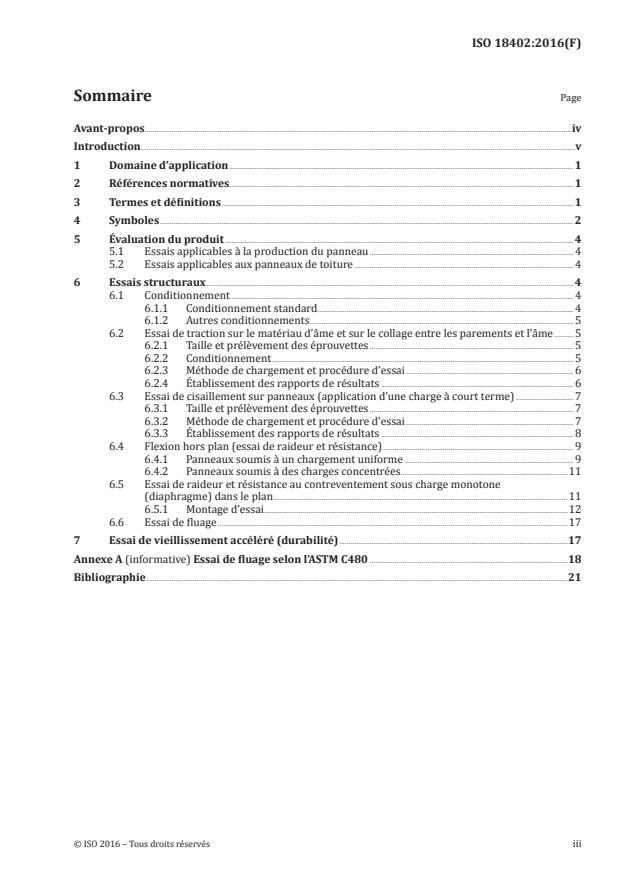
Sommaire Page
Avant-propos .iv
Introduction .v
1 Domaine d’application . 1
2 Références normatives . 1
3 Termes et définitions . 1
4 Symboles . 2
5 Évaluation du produit . 4
5.1 Essais applicables à la production du panneau . 4
5.2 Essais applicables aux panneaux de toiture . 4
6 Essais structuraux . 4
6.1 Conditionnement . 4
6.1.1 Conditionnement standard . 4
6.1.2 Autres conditionnements . 5
6.2 Essai de traction sur le matériau d’âme et sur le collage entre les parements et l’âme . 5
6.2.1 Taille et prélèvement des éprouvettes . 5
6.2.2 Conditionnement . 5
6.2.3 Méthode de chargement et procédure d’essai . 6
6.2.4 Établissement des rapports de résultats . 6
6.3 Essai de cisaillement sur panneaux (application d’une charge à court terme) . 7
6.3.1 Taille et prélèvement des éprouvettes . 7
6.3.2 Méthode de chargement et procédure d’essai . 7
6.3.3 Établissement des rapports de résultats . 8
6.4 Flexion hors plan (essai de raideur et résistance) . 9
6.4.1 Panneaux soumis à un chargement uniforme . 9
6.4.2 Panneaux soumis à des charges concentrées.11
6.5 Essai de raideur et résistance au contreventement sous charge monotone
(diaphragme) dans le plan .11
6.5.1 Montage d’essai.12
6.6 Essai de fluage .17
7 Essai de vieillissement accéléré (durabilité) .17
Annexe A (informative) Essai de fluage selon l’ASTM C480 .18
Bibliographie .21
Avant-propos
L’ISO (Organisation internationale de normalisation) est une fédération mondiale d’organismes
nationaux de normalisation (comités membres de l’ISO). L’élaboration des Normes internationales est
en général confiée aux comités techniques de l’ISO. Chaque comité membre intéressé par une étude
a le droit de faire partie du comité technique créé à cet effet. Les organisations internationales,
gouvernementales et non gouvernementales, en liaison avec l’ISO participent également aux travaux.
L’ISO collabore étroitement avec la Commission électrotechnique internationale (IEC) en ce qui
concerne la normalisation électrotechnique.
Les procédures utilisées pour élaborer le présent document et celles destinées à sa mise à jour sont
décrites dans les Directives ISO/IEC, Partie 1. Il convient, en particulier de prendre note des différents
critères d’approbation requis pour les différents types de documents ISO. Le présent document a été
rédigé conformément aux règles de rédaction données dans les Directives ISO/IEC, Partie 2 (voir www.
iso.org/directives).
L’attention est appelée sur le fait que certains des éléments du présent document peuvent faire l’objet de
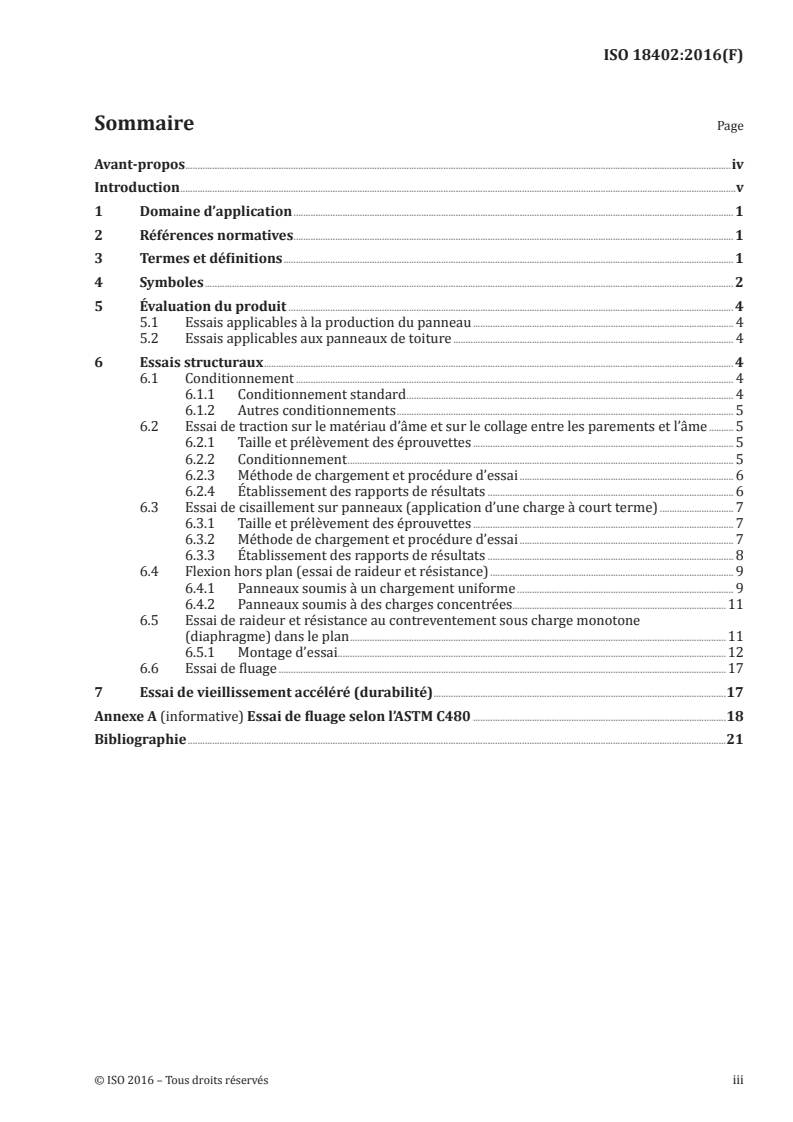
droits de propriété intellectuelle ou de droits analogues. L’ISO ne saurait être tenue pour responsable
de ne pas avoir identifié de tels droits de propriété et averti de leur existence. Les détails concernant
les références aux droits de propriété intellectuelle ou autres droits analogues identifiés lors de
l’élaboration du document sont indiqués dans l’Introduction et/ou dans la liste des déclarations de
brevets reçues par l’ISO (voir www.iso.org/brevets).
Les appellations commerciales éventuellement mentionnées dans le présent document sont données
pour information, par souci de commodité, à l’intention des utilisateurs et ne sauraient constituer un
engagement.
Pour une explication de la signification des termes et expressions spécifiques de l’ISO liés à l’évaluation
de la conformité, ou pour toute information au sujet de l’adhésion de l’ISO aux principes de l’Organisation
mondiale du commerce (OMC) concernant les obstacles techniques au commerce (OTC), voir le lien
suivant: www.iso.org/iso/fr/avant-propos.html
Le comité chargé de l’élaboration du présent document est l’ISO/165, Structures en bois.
iv © ISO 2016 – Tous droits réservés
Introduction
La présente Norme internationale comprend des essais de résistance à la traction des liaisons
des panneaux, des performances de vieillissement, de cisaillement et de fluage, des performances
horizontales dans le plan et des performances de flexion hors plan. Les essais applicables aux panneaux
destinés à des applications spécifiques sont indiqués; les exigences d’essais comprennent les conditions
en laboratoire, et certaines recommandations sont données dans les notes concernant le nombre
d’échantillons à soumettre à essais et l’établissement de rapports de résultats.
La présente Norme internationale n’est pas destinée aux essais de contrôle qualité ou pour l’évaluation
de la conformité.
NORME INTERNATIONALE ISO 18402:2016(F)
Structures en bois — Panneaux sandwich porteurs isolants
pour toitures — Méthode d’essais
1 Domaine d’application
La présente Norme internationale spécifie les méthodes d’essai de détermination, pour utilisation en
toitures, des caractéristiques mécaniques des panneaux sandwich porteurs isolants ayant
— deux couches de parement, dont l’une au moins est un panneau structurel à base de bois, et
— une âme en matériau d’isolation thermique ayant une résistance au cisaillement suffisante pour
faire en sorte que les couches de parement agissent structurellement ensemble.
NOTE 1 Des plaques structurelles à base de plâtre peuvent être utilisées pour l’une des couches de parement.
NOTE 2 Les panneaux peuvent contenir des ossatures et renforcements internes.
NOTE 3 La performance des panneaux avec une isolation non-structurelle peut généralement être calculée
d’après les codes de conceptions tels que l’EN 1995–1-1, ou soumis à essai conformément aux normes appropriées.
2 Références normatives
Les documents suivants cités dans le texte constituent, pour tout ou partie de leur contenu, des
exigences du présent document. Pour les références datées, seule l’édition citée s’applique. Pour les
références non datées, la dernière édition du document de référence s’applique (y compris les éventuels
amendements).
ASTM D7446-09, Standard Specification for Structural Insulated Panel (SIP) Adhesive for Laminating
Oriented Strand Board (OSB) to Rigid Cellular Polystyrene Thermal Insulation Core materials
ASTM D1183, Standard Practices for Resistance of Adhesives to Cyclic Laboratory Aging Conditions
3 Termes et définitions
Pour les besoins du présent document, les termes et définitions suivants s’appliquent.
3.1
panneau isolant structurel
SIP
panneau avec deux peaux travaillantes, chacune collée (3.4) sur chaque parement d’un matériau d’âme
rigide, léger et homogène avec une résistance au cisaillement suffisante pour faire en sorte que les
couches de parement agissent structurellement ensemble
Légende
1 âme rigide
Figure 1 — Section transversale d’un panneau isolant structurel
Note 1 à l’article: L’âme homogène est constituée d’un unique matériau sans assemblages internes nécessitant un
collage.
3.2
caisson double peau avec panneau structurel de type âme isolante structurelle
panneau à âme rigide entourée par une ossature structurelle, avec ou sans nervures internes, et deux
peaux fixées mécaniquement et/ou collées (3.4) à l’ossature et à l’âme, formant un caisson fermé
Note 1 à l’article: Les peaux, l’âme et l’ossature contribuent toutes à la capacité portante du panneau.
Légende
1 âme
2 ossature structurelle interne
Figure 2 — Panneau isolant structurel avec ossature structurelle interne
3.3
bloc d’isolant
matériau d’âme pré-formé en blocs d’épaisseur égale à l’épaisseur requise de l’âme, puis collé (3.4) à
l’aide d’un adhésif approprié
Note 1 à l’article: Lorsque la longueur et la largeur d’un bloc de matériau d’âme sont inférieures ou égales à la
longueur et à la largeur du SIP, elles peuvent être collées à l’intérieur.
3.4
collé
composants d’un panneau isolant structurel (3.1) qui ont été assemblés, généralement à l’aide d’un adhésif
Note 1 à l’article: Egalement, certaines mousses utilisées pour les âmes sont moussées sur place et deviennent
auto-collantes pendant leur dilatation et durcissement/séchage, se collant ainsi automatiquement aux
composants enveloppants.
4 Symboles
aire de la section transversale des parements du panneau d’essai, en millimètres carrés
AA
FF12
distance, en mm
ab,,c
B largeur du panneau complet, en mm
Module d‘Young des parements du panneau d’essai, en N/mm
EE
FF12
F charge, en N
charge maximale, en N
F
max
charge de rupture, en N
F
u
charge maximale estimée, en N
F
max,est
2 © ISO 2016 – Tous droits réservés
charge verticale appliquée, en N
F
V
D épaisseur de panneau, en mm
déformation par cisaillement réelle, en mm
Ds
déformation par cisaillement apparente, en mm
′
Ds
module de cisaillement de l’âme, en N/mm
Gc
rigidité en cisaillement apparente, en N/mm
G′
poids propre de mise en charge
F
g
poids propre du panneau en N
F
g
charge permanente appliquée, en N
F
g
poids du bras de levier, en N
F
lever
poids de la plaque de répartition et de la tige de chargement, en N
F
plate
charge variable, en N
F
Q
H hauteur du panneau complet, en mm
L portée, en mm
l longueur d’échantillon de panneau, en mm
masse, en kg
M
moment résistant ultime, en kNm
M
U
P charge, in kN
rigidité, en N/mm; résistance, en N/mm
R
réaction maximale à la rupture, en kN
R
U
résistance limite au cisaillement, en N/mm
S
U
T durée de chargement, en secondes
temps de récupération, en secondes
T
r
énergie d’impact, en J
W
largeur d’échantillon de panneau, en mm
b
épaisseur de l’âme, en mm
d
c
e distance entre les centres de gravité des parements, en mm
résistance au cisaillement du matériau d’âme, en N/mm
f
cv
résistance à la traction du matériau d’âme, en N/mm
f
ct
épaisseur totale du parement en mm
ttt,,
12 3
Δt flèche totale sous charge verticale de diaphragme, en mm
w déformations, en mm
déformation à la rupture, en mm
w
u
flèche totale sous charge constante à un temps t, en mm
w
t
flèche statique initiale sous charge et température constantes, en mm
w
η
facteur inférieur à l’unité modifiant F
max,est
v déformation de contreventement du panneau, en mm
5 Évaluation du produit
5.1 Essais applicables à la production du panneau
Les essais suivants décrits dans la présente Norme internationale se rapportent aux essais applicables
à la production du panneau:
a) essai de traction sur âme et son collage aux parements;
b) résistance au cisaillement de l’âme pleine et de son collage aux parements.
5.2 Essais applicables aux panneaux de toiture
Les essais suivants décrits dans la présente Norme internationale se rapportent aux essais applicables
au panneau de toiture:
a) flexion hors plan (raideur et résistance);
b) chargement horizontal dans le plan (raideur et résistance au contreventement);
c) essai de fluage;
d) vieillissement/durabilité à long terme.
6 Essais structuraux
6.1 Conditionnement
6.1.1 Conditionnement standard
À l’exception du 6.1.2, toutes les éprouvettes du 6.2 au 6.6 doivent être conditionnées dans une
atmosphère avec une humidité relative de (65 ± 5) % et une température de (20 ± 2) °C jusqu’à masse
constante. La masse constante est considérée comme atteinte lorsque les résultats d’au moins trois
pesées successives indiquent que la teneur en humidité s’est stabilisée à ±0,5 % pour une période de
48 h minimum.
Si les conditions de la salle d’essai ne sont pas les mêmes que dans l’enceinte de conditionnement, les
éprouvettes doivent rester dans l’enceinte de conditionnement jusqu’au moment de l’essai, et l’essai doit
être terminé dans les 4 h.
4 © ISO 2016 – Tous droits réservés
6.1.2 Autres conditionnements
Les éprouvettes peuvent être conditionnées et/ou déconditionnées différemment.
Sauf indication contraire dans le rapport d’essai, les résultats doivent être corrigés pour tenir compte du
conditionnement conformément au 6.1.1. La procédure de correction des caractéristiques mécaniques
doit être techniquement éprouvée et doit être consignée dans le rapport d’essai.
6.2 Essai de traction sur le matériau d’âme et sur le collage entre les parements et l’âme
6.2.1 Taille et prélèvement des éprouvettes
L’épaisseur de l’éprouvette doit être égale à l’épaisseur du panneau (D). La largeur (b) doit être de
150 mm et la longueur (l) doit être de 150 mm.
NOTE Le but de l’essai est de déterminer la résistance à la traction et le mécanisme de défaillance critique,
dans l’âme ou la ligne de collage, du SIP.
Il convient que les éprouvettes soient prélevées en plusieurs endroits répartis sur toute la largeur et
la longueur du panneau, y compris le milieu, et au-delà des 10 % de la zone extérieure au périmètre du
panneau, comme illustré à la Figure 3 ci-dessous.
Légende
1 largeur de panneau X 0,1 3 largeur de panneau
2 zone de prélèvement 4 longueur de panneau
Figure 3 — Prélèvement d’éprouvettes sur le panneau
6.2.2 Conditionnement
Les éprouvettes doivent être conditionnées soit conformément au 6.1, soit selon un conditionnement
à température élevée spécifié. Les éprouvettes doivent être soumises à essai immédiatement après
retrait de l’enceinte de conditionnement lors de l’exécution d’un essai à température élevée.
L’essai à température élevée peut être approprié pour certaines applications de SIP. Il convient que la
performance du panneau soit vérifiée dans ces conditions. Si les niveaux de température en service
ne sont pas connus avec certitude, il convient que les éprouvettes d’essai à température élevée soient
conditionnées à 80 °C pendant 4 h minimum. Aucune autre mesure de température n’est nécessaire
après le conditionnement.
6.2.3 Méthode de chargement et procédure d’essai
Les éprouvettes doivent être collées à l’aide d’un adhésif adéquat à des plaques d’une raideur suffisante
pour garantir une contrainte de traction uniforme sur la surface de l’éprouvette. Lorsqu’elles
sont conditionnées conformément au 6.1, les plaques doivent être collées à l’éprouvette après
conditionnement. Les éprouvettes de section carrée doivent être préparées comme illustré à la Figure 4.
Légende
1 plaque de distribution de charge
2 parement de panneau
3 âme
Figure 4 — Configurations d’essai pour l’essai de traction de l’âme
La charge (F) doit être appliquée par paliers ou en continu de manière à atteindre une charge maximale
en 1 min à 5 min.
Pour les panneaux isolants structurels avec OSB et matériaux d’âme d’isolation thermique en
polystyrène, il convient que l’ASTM D7446-09, 13.2 soit revue et son utilisation envisagée le cas échéant.
NOTE Cet essai n’est pas destiné aux matériaux à doublage de papier.
6.2.4 Établissement des rapports de résultats
La résistance à la traction, f , du matériau d’âme, obtenue à partir de la charge maximale atteinte pour
ct
qu’il y ait rupture par traction d’une éprouvette, doit être calculée comme suit:
F
u
f = (1)
ct
bl
où
F est la charge de rupture (kN) supportée par l’éprouvette qui subit la rupture par traction;
u
b est la largeur de l’éprouvette (mm);
l est la longueur de l’éprouvette (mm);
6 © ISO 2016 – Tous droits réservés
Le rapport d’essai doit indiquer les informations suivantes:
a) le mode opératoire d’échantillonnage;
b) le nombre d’éprouvettes soumises à essai;
c) la spécification de la fabrication du panneau d’essai;
d) la spécification des matériaux utilisés pour la fabrication des panneaux d’essai;
e) une description détaillée des éprouvettes, y compris tout écart par rapport à la spécification;
f) le type de rupture, quel qu’il soit, en précisant s’il s’agissait d’une rupture adhésive, cohésive, ou
d’un autre mode; il convient que la rupture de l’adhérence entre le parement de plaque et la plaque
de répartition soit enregistrée séparément.
g) tout conditionnement appliqué aux éprouvettes, et les conditions d’essai en laboratoire;
h) la résistance à la traction, f (MPa), de chaque éprouvette et la moyenne de tous les résultats
ct
d’essai;
i) toute autre information considérée comme utile.
6.3 Essai de cisaillement sur panneaux (application d’une charge à court terme)
Cet essai doit être appliqué aux SIP sans ossatures internes supplémentaires. Le comportement des
panneaux à ossatures internes ou nervures internes doit être établi sur la base de l’essai de flexion hors
plan (voir 6.4).
6.3.1 Taille et prélèvement des éprouvettes
Les éprouvettes (1 000 mm × 150 mm) doivent être coupées sur des SIP en vraies dimensions (éléments
de panneau uniques avant assemblage/jointage, souvent 1,2 m × 2,4 m). Les éprouvettes doivent être
conditionnées conformément au 6.1.
Les éprouvettes doivent être prélevées en plusieurs endroits répartis sur toute la largeur du panneau.
Au moins une éprouvette doit être prélevée à une distance minimale de 10 % d’un bord extérieur de la
largeur de couverture du panneau, et au moins une éprouvette du milieu du panneau (voir la Figure 3).
NOTE Le but est d’induire une rupture par cisaillement dans l’éprouvette. Si la portée recommandée ne
génère pas de rupture par cisaillement, elle est réduite par paliers de 100 mm jusqu’à ce qu’il y ait rupture par
cisaillement. Les essais suivants utilisent alors cette portée réduite.
6.3.2 Méthode de chargement et procédure d’essai
NOTE 1 La largeur des bandes de métal ou similaire aux points d’appui et de charge est généralement de
60 mm, la longueur de la bande étant égale à la largeur du panneau. La taille est augmentée, si nécessaire, pour
éviter un écrasement local de l’âme. Le rayon des roulements à billes est généralement de 15 mm.
NOTE 2 Si le SIP a deux parements différents, le plus faible des deux matériaux de plaque est placé dans la
zone de compression, étant donné que le but est d’induire une rupture par cisaillement.
Figure 5 — Configurations d’essai pour l’essai de cisaillement sur SIP (sans ossature interne)
Légende
1 âme
2 parements de panneau t , t
1 2
Figure 6 — Illustration des épaisseurs des composants du panneau
Les épaisseurs (D et d ), la largeur (b) et l’épaisseur nette des deux parements (t , t ) de chaque
C 1 2
éprouvette doivent être mesurées.
La vitesse de chargement doit être suffisante pour provoquer une rupture entre 1 min et 5 min après le
début de l’essai.
6.3.3 Établissement des rapports de résultats
La contrainte maximale de cisaillement f (MPa) du matériau d’âme, obtenue à partir de la charge
Cv
maximale atteinte pour qu’il y ait rupture par cisaillement d’une éprouvette, doit être calculée
comme suit:
F
u
f = (2)
Cv
2be
où la charge, F (kN), est la charge de rupture supportée par l’éprouvette qui subit la rupture par
u
cisaillement.
Le rapport d’essai doit indiquer les informations suivantes:
a) le mode opératoire d’échantillonnage;
b) le nombre d’éprouvettes soumises à essai;
c) la spécification des panneaux d’essai;
d) la spécification des matériaux utilisés pour la fabrication des panneaux d’essai;
e) une description détaillée des éprouvettes et de l’installation, y compris tout écart par rapport à la
spécification;
f) la direction de la résistance maximale du matériau de parement, si cela est applicable;
8 © ISO 2016 – Tous droits réservés
g) le type et l’emplacement des éventuelles défaillances;
h) la teneur en humidité des matériaux à base de bois soumis à essai;
i) tout conditionnement appliqué aux éprouvettes, et les conditions d’essai en laboratoire;
j) la contrainte maximale de cisaillement, f , du matériau d’âme de chaque éprouvette, et la moyenne;
Cv
k) toute autre information considérée comme utile.
6.4 Flexion hors plan (essai de raideur et résistance)
Cet essai permet de déterminer la raideur et la résistance en flexion des panneaux dans lesquels la
portée, L, est suffisamment importante pour assurer une rupture en flexion sur la base de l’EN 14509.
D’autres méthodes d’évaluation de la capacité en flexion hors plan sont présentées dans l’ASTM E72-15,
Section 11 et l’ASTM E1803-14, Section 6.
6.4.1 Panneaux soumis à un chargement uniforme
L’essai doit être effectué en soumettant un panneau sur appui simple à quatre charges linéiques (voir
la Figure 7 ou 8) appliquées sur la pleine largeur du panneau, ou à une pression d’air générée par un
appareillage avec chambre d’essai à vide partiel ou par des baudruches (voir la Figure 9). La charge
totale appliquée (y compris le poids du banc de répartition de la charge et de l’éprouvette) doit être
mesurée par des capteurs de mesure de la force placés à l’emplacement des appuis.
NOTE Il existe un certain nombre de systèmes de charge qui peuvent être utilisés pour simuler une charge
uniformément répartie sur un panneau. Ils donnent tous des résultats similaires pour la résistance à la flexion et
la raideur du panneau.
Légende
flèche mesurée à L/2
Figure 7 — Système de chargement 1
Légende
flèche mesurée à L/2
Figure 8 — Système de chargement 2
Légende
w charge par résistance unitaire
flèche mesurée à L/2
Figure 9 — Système de chargement 3
6.4.1.1 Conditions d’appui
Les détails d’un appui de panneau convenable sont illustrés à la Figure 10. La largeur des appuis doit se
situer dans une plage de 38 mm à 100 mm et être suffisamment grande pour éviter un écrasement local
de l’âme.
Figure 10 — Condition d’appui
6.4.1.2 Éprouvettes
La portée nécessaire dépend de plusieurs facteurs, y compris la hauteur hors tout, D, du panneau, et
doit être choisie pour entraîner une rupture en flexion. La largeur minimale du panneau doit être de
610 mm. Si la portée choisie donne lieu à une rupture par cisaillement du panneau, la portée doit être
augmentée par paliers de 1,0 m jusqu’à obtention d’une rupture en flexion.
Dans le cas de panneaux de la même famille (conception), les panneaux les plus épais et les moins épais
doivent être
...
NORME ISO
INTERNATIONALE 18402
Première édition
2016-09-01
Structures en bois — Panneaux
sandwich porteurs isolants pour
toitures — Méthode d’essais
Timber structures — Structural insulated panel roof construction —
Test methods
Numéro de référence
©
ISO 2016
DOCUMENT PROTÉGÉ PAR COPYRIGHT
© ISO 2016, Publié en Suisse
Droits de reproduction réservés. Sauf indication contraire, aucune partie de cette publication ne peut être reproduite ni utilisée
sous quelque forme que ce soit et par aucun procédé, électronique ou mécanique, y compris la photocopie, l’affichage sur
l’internet ou sur un Intranet, sans autorisation écrite préalable. Les demandes d’autorisation peuvent être adressées à l’ISO à
l’adresse ci-après ou au comité membre de l’ISO dans le pays du demandeur.
ISO copyright office
Ch. de Blandonnet 8 • CP 401
CH-1214 Vernier, Geneva, Switzerland
Tel. +41 22 749 01 11
Fax +41 22 749 09 47
copyright@iso.org
www.iso.org
ii © ISO 2016 – Tous droits réservés
Sommaire Page
Avant-propos .iv
Introduction .v
1 Domaine d’application . 1
2 Références normatives . 1
3 Termes et définitions . 1
4 Symboles . 2
5 Évaluation du produit . 4
5.1 Essais applicables à la production du panneau . 4
5.2 Essais applicables aux panneaux de toiture . 4
6 Essais structuraux . 4
6.1 Conditionnement . 4
6.1.1 Conditionnement standard . 4
6.1.2 Autres conditionnements . 5
6.2 Essai de traction sur le matériau d’âme et sur le collage entre les parements et l’âme . 5
6.2.1 Taille et prélèvement des éprouvettes . 5
6.2.2 Conditionnement . 5
6.2.3 Méthode de chargement et procédure d’essai . 6
6.2.4 Établissement des rapports de résultats . 6
6.3 Essai de cisaillement sur panneaux (application d’une charge à court terme) . 7
6.3.1 Taille et prélèvement des éprouvettes . 7
6.3.2 Méthode de chargement et procédure d’essai . 7
6.3.3 Établissement des rapports de résultats . 8
6.4 Flexion hors plan (essai de raideur et résistance) . 9
6.4.1 Panneaux soumis à un chargement uniforme . 9
6.4.2 Panneaux soumis à des charges concentrées.11
6.5 Essai de raideur et résistance au contreventement sous charge monotone
(diaphragme) dans le plan .11
6.5.1 Montage d’essai.12
6.6 Essai de fluage .17
7 Essai de vieillissement accéléré (durabilité) .17
Annexe A (informative) Essai de fluage selon l’ASTM C480 .18
Bibliographie .21
Avant-propos
L’ISO (Organisation internationale de normalisation) est une fédération mondiale d’organismes
nationaux de normalisation (comités membres de l’ISO). L’élaboration des Normes internationales est
en général confiée aux comités techniques de l’ISO. Chaque comité membre intéressé par une étude
a le droit de faire partie du comité technique créé à cet effet. Les organisations internationales,
gouvernementales et non gouvernementales, en liaison avec l’ISO participent également aux travaux.
L’ISO collabore étroitement avec la Commission électrotechnique internationale (IEC) en ce qui
concerne la normalisation électrotechnique.
Les procédures utilisées pour élaborer le présent document et celles destinées à sa mise à jour sont
décrites dans les Directives ISO/IEC, Partie 1. Il convient, en particulier de prendre note des différents
critères d’approbation requis pour les différents types de documents ISO. Le présent document a été
rédigé conformément aux règles de rédaction données dans les Directives ISO/IEC, Partie 2 (voir www.
iso.org/directives).
L’attention est appelée sur le fait que certains des éléments du présent document peuvent faire l’objet de
droits de propriété intellectuelle ou de droits analogues. L’ISO ne saurait être tenue pour responsable
de ne pas avoir identifié de tels droits de propriété et averti de leur existence. Les détails concernant
les références aux droits de propriété intellectuelle ou autres droits analogues identifiés lors de
l’élaboration du document sont indiqués dans l’Introduction et/ou dans la liste des déclarations de
brevets reçues par l’ISO (voir www.iso.org/brevets).
Les appellations commerciales éventuellement mentionnées dans le présent document sont données
pour information, par souci de commodité, à l’intention des utilisateurs et ne sauraient constituer un
engagement.
Pour une explication de la signification des termes et expressions spécifiques de l’ISO liés à l’évaluation
de la conformité, ou pour toute information au sujet de l’adhésion de l’ISO aux principes de l’Organisation
mondiale du commerce (OMC) concernant les obstacles techniques au commerce (OTC), voir le lien
suivant: www.iso.org/iso/fr/avant-propos.html
Le comité chargé de l’élaboration du présent document est l’ISO/165, Structures en bois.
iv © ISO 2016 – Tous droits réservés
Introduction
La présente Norme internationale comprend des essais de résistance à la traction des liaisons
des panneaux, des performances de vieillissement, de cisaillement et de fluage, des performances
horizontales dans le plan et des performances de flexion hors plan. Les essais applicables aux panneaux
destinés à des applications spécifiques sont indiqués; les exigences d’essais comprennent les conditions
en laboratoire, et certaines recommandations sont données dans les notes concernant le nombre
d’échantillons à soumettre à essais et l’établissement de rapports de résultats.
La présente Norme internationale n’est pas destinée aux essais de contrôle qualité ou pour l’évaluation
de la conformité.
NORME INTERNATIONALE ISO 18402:2016(F)
Structures en bois — Panneaux sandwich porteurs isolants
pour toitures — Méthode d’essais
1 Domaine d’application
La présente Norme internationale spécifie les méthodes d’essai de détermination, pour utilisation en
toitures, des caractéristiques mécaniques des panneaux sandwich porteurs isolants ayant
— deux couches de parement, dont l’une au moins est un panneau structurel à base de bois, et
— une âme en matériau d’isolation thermique ayant une résistance au cisaillement suffisante pour
faire en sorte que les couches de parement agissent structurellement ensemble.
NOTE 1 Des plaques structurelles à base de plâtre peuvent être utilisées pour l’une des couches de parement.
NOTE 2 Les panneaux peuvent contenir des ossatures et renforcements internes.
NOTE 3 La performance des panneaux avec une isolation non-structurelle peut généralement être calculée
d’après les codes de conceptions tels que l’EN 1995–1-1, ou soumis à essai conformément aux normes appropriées.
2 Références normatives
Les documents suivants cités dans le texte constituent, pour tout ou partie de leur contenu, des
exigences du présent document. Pour les références datées, seule l’édition citée s’applique. Pour les
références non datées, la dernière édition du document de référence s’applique (y compris les éventuels
amendements).
ASTM D7446-09, Standard Specification for Structural Insulated Panel (SIP) Adhesive for Laminating
Oriented Strand Board (OSB) to Rigid Cellular Polystyrene Thermal Insulation Core materials
ASTM D1183, Standard Practices for Resistance of Adhesives to Cyclic Laboratory Aging Conditions
3 Termes et définitions
Pour les besoins du présent document, les termes et définitions suivants s’appliquent.
3.1
panneau isolant structurel
SIP
panneau avec deux peaux travaillantes, chacune collée (3.4) sur chaque parement d’un matériau d’âme
rigide, léger et homogène avec une résistance au cisaillement suffisante pour faire en sorte que les
couches de parement agissent structurellement ensemble
Légende
1 âme rigide
Figure 1 — Section transversale d’un panneau isolant structurel
Note 1 à l’article: L’âme homogène est constituée d’un unique matériau sans assemblages internes nécessitant un
collage.
3.2
caisson double peau avec panneau structurel de type âme isolante structurelle
panneau à âme rigide entourée par une ossature structurelle, avec ou sans nervures internes, et deux
peaux fixées mécaniquement et/ou collées (3.4) à l’ossature et à l’âme, formant un caisson fermé
Note 1 à l’article: Les peaux, l’âme et l’ossature contribuent toutes à la capacité portante du panneau.
Légende
1 âme
2 ossature structurelle interne
Figure 2 — Panneau isolant structurel avec ossature structurelle interne
3.3
bloc d’isolant
matériau d’âme pré-formé en blocs d’épaisseur égale à l’épaisseur requise de l’âme, puis collé (3.4) à
l’aide d’un adhésif approprié
Note 1 à l’article: Lorsque la longueur et la largeur d’un bloc de matériau d’âme sont inférieures ou égales à la
longueur et à la largeur du SIP, elles peuvent être collées à l’intérieur.
3.4
collé
composants d’un panneau isolant structurel (3.1) qui ont été assemblés, généralement à l’aide d’un adhésif
Note 1 à l’article: Egalement, certaines mousses utilisées pour les âmes sont moussées sur place et deviennent
auto-collantes pendant leur dilatation et durcissement/séchage, se collant ainsi automatiquement aux
composants enveloppants.
4 Symboles
aire de la section transversale des parements du panneau d’essai, en millimètres carrés
AA
FF12
distance, en mm
ab,,c
B largeur du panneau complet, en mm
Module d‘Young des parements du panneau d’essai, en N/mm
EE
FF12
F charge, en N
charge maximale, en N
F
max
charge de rupture, en N
F
u
charge maximale estimée, en N
F
max,est
2 © ISO 2016 – Tous droits réservés
charge verticale appliquée, en N
F
V
D épaisseur de panneau, en mm
déformation par cisaillement réelle, en mm
Ds
déformation par cisaillement apparente, en mm
′
Ds
module de cisaillement de l’âme, en N/mm
Gc
rigidité en cisaillement apparente, en N/mm
G′
poids propre de mise en charge
F
g
poids propre du panneau en N
F
g
charge permanente appliquée, en N
F
g
poids du bras de levier, en N
F
lever
poids de la plaque de répartition et de la tige de chargement, en N
F
plate
charge variable, en N
F
Q
H hauteur du panneau complet, en mm
L portée, en mm
l longueur d’échantillon de panneau, en mm
masse, en kg
M
moment résistant ultime, en kNm
M
U
P charge, in kN
rigidité, en N/mm; résistance, en N/mm
R
réaction maximale à la rupture, en kN
R
U
résistance limite au cisaillement, en N/mm
S
U
T durée de chargement, en secondes
temps de récupération, en secondes
T
r
énergie d’impact, en J
W
largeur d’échantillon de panneau, en mm
b
épaisseur de l’âme, en mm
d
c
e distance entre les centres de gravité des parements, en mm
résistance au cisaillement du matériau d’âme, en N/mm
f
cv
résistance à la traction du matériau d’âme, en N/mm
f
ct
épaisseur totale du parement en mm
ttt,,
12 3
Δt flèche totale sous charge verticale de diaphragme, en mm
w déformations, en mm
déformation à la rupture, en mm
w
u
flèche totale sous charge constante à un temps t, en mm
w
t
flèche statique initiale sous charge et température constantes, en mm
w
η
facteur inférieur à l’unité modifiant F
max,est
v déformation de contreventement du panneau, en mm
5 Évaluation du produit
5.1 Essais applicables à la production du panneau
Les essais suivants décrits dans la présente Norme internationale se rapportent aux essais applicables
à la production du panneau:
a) essai de traction sur âme et son collage aux parements;
b) résistance au cisaillement de l’âme pleine et de son collage aux parements.
5.2 Essais applicables aux panneaux de toiture
Les essais suivants décrits dans la présente Norme internationale se rapportent aux essais applicables
au panneau de toiture:
a) flexion hors plan (raideur et résistance);
b) chargement horizontal dans le plan (raideur et résistance au contreventement);
c) essai de fluage;
d) vieillissement/durabilité à long terme.
6 Essais structuraux
6.1 Conditionnement
6.1.1 Conditionnement standard
À l’exception du 6.1.2, toutes les éprouvettes du 6.2 au 6.6 doivent être conditionnées dans une
atmosphère avec une humidité relative de (65 ± 5) % et une température de (20 ± 2) °C jusqu’à masse
constante. La masse constante est considérée comme atteinte lorsque les résultats d’au moins trois
pesées successives indiquent que la teneur en humidité s’est stabilisée à ±0,5 % pour une période de
48 h minimum.
Si les conditions de la salle d’essai ne sont pas les mêmes que dans l’enceinte de conditionnement, les
éprouvettes doivent rester dans l’enceinte de conditionnement jusqu’au moment de l’essai, et l’essai doit
être terminé dans les 4 h.
4 © ISO 2016 – Tous droits réservés
6.1.2 Autres conditionnements
Les éprouvettes peuvent être conditionnées et/ou déconditionnées différemment.
Sauf indication contraire dans le rapport d’essai, les résultats doivent être corrigés pour tenir compte du
conditionnement conformément au 6.1.1. La procédure de correction des caractéristiques mécaniques
doit être techniquement éprouvée et doit être consignée dans le rapport d’essai.
6.2 Essai de traction sur le matériau d’âme et sur le collage entre les parements et l’âme
6.2.1 Taille et prélèvement des éprouvettes
L’épaisseur de l’éprouvette doit être égale à l’épaisseur du panneau (D). La largeur (b) doit être de
150 mm et la longueur (l) doit être de 150 mm.
NOTE Le but de l’essai est de déterminer la résistance à la traction et le mécanisme de défaillance critique,
dans l’âme ou la ligne de collage, du SIP.
Il convient que les éprouvettes soient prélevées en plusieurs endroits répartis sur toute la largeur et
la longueur du panneau, y compris le milieu, et au-delà des 10 % de la zone extérieure au périmètre du
panneau, comme illustré à la Figure 3 ci-dessous.
Légende
1 largeur de panneau X 0,1 3 largeur de panneau
2 zone de prélèvement 4 longueur de panneau
Figure 3 — Prélèvement d’éprouvettes sur le panneau
6.2.2 Conditionnement
Les éprouvettes doivent être conditionnées soit conformément au 6.1, soit selon un conditionnement
à température élevée spécifié. Les éprouvettes doivent être soumises à essai immédiatement après
retrait de l’enceinte de conditionnement lors de l’exécution d’un essai à température élevée.
L’essai à température élevée peut être approprié pour certaines applications de SIP. Il convient que la
performance du panneau soit vérifiée dans ces conditions. Si les niveaux de température en service
ne sont pas connus avec certitude, il convient que les éprouvettes d’essai à température élevée soient
conditionnées à 80 °C pendant 4 h minimum. Aucune autre mesure de température n’est nécessaire
après le conditionnement.
6.2.3 Méthode de chargement et procédure d’essai
Les éprouvettes doivent être collées à l’aide d’un adhésif adéquat à des plaques d’une raideur suffisante
pour garantir une contrainte de traction uniforme sur la surface de l’éprouvette. Lorsqu’elles
sont conditionnées conformément au 6.1, les plaques doivent être collées à l’éprouvette après
conditionnement. Les éprouvettes de section carrée doivent être préparées comme illustré à la Figure 4.
Légende
1 plaque de distribution de charge
2 parement de panneau
3 âme
Figure 4 — Configurations d’essai pour l’essai de traction de l’âme
La charge (F) doit être appliquée par paliers ou en continu de manière à atteindre une charge maximale
en 1 min à 5 min.
Pour les panneaux isolants structurels avec OSB et matériaux d’âme d’isolation thermique en
polystyrène, il convient que l’ASTM D7446-09, 13.2 soit revue et son utilisation envisagée le cas échéant.
NOTE Cet essai n’est pas destiné aux matériaux à doublage de papier.
6.2.4 Établissement des rapports de résultats
La résistance à la traction, f , du matériau d’âme, obtenue à partir de la charge maximale atteinte pour
ct
qu’il y ait rupture par traction d’une éprouvette, doit être calculée comme suit:
F
u
f = (1)
ct
bl
où
F est la charge de rupture (kN) supportée par l’éprouvette qui subit la rupture par traction;
u
b est la largeur de l’éprouvette (mm);
l est la longueur de l’éprouvette (mm);
6 © ISO 2016 – Tous droits réservés
Le rapport d’essai doit indiquer les informations suivantes:
a) le mode opératoire d’échantillonnage;
b) le nombre d’éprouvettes soumises à essai;
c) la spécification de la fabrication du panneau d’essai;
d) la spécification des matériaux utilisés pour la fabrication des panneaux d’essai;
e) une description détaillée des éprouvettes, y compris tout écart par rapport à la spécification;
f) le type de rupture, quel qu’il soit, en précisant s’il s’agissait d’une rupture adhésive, cohésive, ou
d’un autre mode; il convient que la rupture de l’adhérence entre le parement de plaque et la plaque
de répartition soit enregistrée séparément.
g) tout conditionnement appliqué aux éprouvettes, et les conditions d’essai en laboratoire;
h) la résistance à la traction, f (MPa), de chaque éprouvette et la moyenne de tous les résultats
ct
d’essai;
i) toute autre information considérée comme utile.
6.3 Essai de cisaillement sur panneaux (application d’une charge à court terme)
Cet essai doit être appliqué aux SIP sans ossatures internes supplémentaires. Le comportement des
panneaux à ossatures internes ou nervures internes doit être établi sur la base de l’essai de flexion hors
plan (voir 6.4).
6.3.1 Taille et prélèvement des éprouvettes
Les éprouvettes (1 000 mm × 150 mm) doivent être coupées sur des SIP en vraies dimensions (éléments
de panneau uniques avant assemblage/jointage, souvent 1,2 m × 2,4 m). Les éprouvettes doivent être
conditionnées conformément au 6.1.
Les éprouvettes doivent être prélevées en plusieurs endroits répartis sur toute la largeur du panneau.
Au moins une éprouvette doit être prélevée à une distance minimale de 10 % d’un bord extérieur de la
largeur de couverture du panneau, et au moins une éprouvette du milieu du panneau (voir la Figure 3).
NOTE Le but est d’induire une rupture par cisaillement dans l’éprouvette. Si la portée recommandée ne
génère pas de rupture par cisaillement, elle est réduite par paliers de 100 mm jusqu’à ce qu’il y ait rupture par
cisaillement. Les essais suivants utilisent alors cette portée réduite.
6.3.2 Méthode de chargement et procédure d’essai
NOTE 1 La largeur des bandes de métal ou similaire aux points d’appui et de charge est généralement de
60 mm, la longueur de la bande étant égale à la largeur du panneau. La taille est augmentée, si nécessaire, pour
éviter un écrasement local de l’âme. Le rayon des roulements à billes est généralement de 15 mm.
NOTE 2 Si le SIP a deux parements différents, le plus faible des deux matériaux de plaque est placé dans la
zone de compression, étant donné que le but est d’induire une rupture par cisaillement.
Figure 5 — Configurations d’essai pour l’essai de cisaillement sur SIP (sans ossature interne)
Légende
1 âme
2 parements de panneau t , t
1 2
Figure 6 — Illustration des épaisseurs des composants du panneau
Les épaisseurs (D et d ), la largeur (b) et l’épaisseur nette des deux parements (t , t ) de chaque
C 1 2
éprouvette doivent être mesurées.
La vitesse de chargement doit être suffisante pour provoquer une rupture entre 1 min et 5 min après le
début de l’essai.
6.3.3 Établissement des rapports de résultats
La contrainte maximale de cisaillement f (MPa) du matériau d’âme, obtenue à partir de la charge
Cv
maximale atteinte pour qu’il y ait rupture par cisaillement d’une éprouvette, doit être calculée
comme suit:
F
u
f = (2)
Cv
2be
où la charge, F (kN), est la charge de rupture supportée par l’éprouvette qui subit la rupture par
u
cisaillement.
Le rapport d’essai doit indiquer les informations suivantes:
a) le mode opératoire d’échantillonnage;
b) le nombre d’éprouvettes soumises à essai;
c) la spécification des panneaux d’essai;
d) la spécification des matériaux utilisés pour la fabrication des panneaux d’essai;
e) une description détaillée des éprouvettes et de l’installation, y compris tout écart par rapport à la
spécification;
f) la direction de la résistance maximale du matériau de parement, si cela est applicable;
8 © ISO 2016 – Tous droits réservés
g) le type et l’emplacement des éventuelles défaillances;
h) la teneur en humidité des matériaux à base de bois soumis à essai;
i) tout conditionnement appliqué aux éprouvettes, et les conditions d’essai en laboratoire;
j) la contrainte maximale de cisaillement, f , du matériau d’âme de chaque éprouvette, et la moyenne;
Cv
k) toute autre information considérée comme utile.
6.4 Flexion hors plan (essai de raideur et résistance)
Cet essai permet de déterminer la raideur et la résistance en flexion des panneaux dans lesquels la
portée, L, est suffisamment importante pour assurer une rupture en flexion sur la base de l’EN 14509.
D’autres méthodes d’évaluation de la capacité en flexion hors plan sont présentées dans l’ASTM E72-15,
Section 11 et l’ASTM E1803-14, Section 6.
6.4.1 Panneaux soumis à un chargement uniforme
L’essai doit être effectué en soumettant un panneau sur appui simple à quatre charges linéiques (voir
la Figure 7 ou 8) appliquées sur la pleine largeur du panneau, ou à une pression d’air générée par un
appareillage avec chambre d’essai à vide partiel ou par des baudruches (voir la Figure 9). La charge
totale appliquée (y compris le poids du banc de répartition de la charge et de l’éprouvette) doit être
mesurée par des capteurs de mesure de la force placés à l’emplacement des appuis.
NOTE Il existe un certain nombre de systèmes de charge qui peuvent être utilisés pour simuler une charge
uniformément répartie sur un panneau. Ils donnent tous des résultats similaires pour la résistance à la flexion et
la raideur du panneau.
Légende
flèche mesurée à L/2
Figure 7 — Système de chargement 1
Légende
flèche mesurée à L/2
Figure 8 — Système de chargement 2
Légende
w charge par résistance unitaire
flèche mesurée à L/2
Figure 9 — Système de chargement 3
6.4.1.1 Conditions d’appui
Les détails d’un appui de panneau convenable sont illustrés à la Figure 10. La largeur des appuis doit se
situer dans une plage de 38 mm à 100 mm et être suffisamment grande pour éviter un écrasement local
de l’âme.
Figure 10 — Condition d’appui
6.4.1.2 Éprouvettes
La portée nécessaire dépend de plusieurs facteurs, y compris la hauteur hors tout, D, du panneau, et
doit être choisie pour entraîner une rupture en flexion. La largeur minimale du panneau doit être de
610 mm. Si la portée choisie donne lieu à une rupture par cisaillement du panneau, la portée doit être
augmentée par paliers de 1,0 m jusqu’à obtention d’une rupture en flexion.
Dans le cas de panneaux de la même famille (conception), les panneaux les plus épais et les moins épais
doivent être
...