

ISO 23467:2020
(Main)Ice plug isolation of piping in nuclear power plant
General Information
- Abstract
This document specifies requirements for the ice plug technique with liquid nitrogen or dry ice as refrigerant (cryogenic medium) on metal pipes of nuclear power plants. The freezing liquid can be water or water mixture (e.g. boric acid mixture). This document specifies technical requirements of ice plug generation, formation judgment and removal, measures before, during and after ice plugging and requirements for personnel and non-destructive testing. The application of the ice plug isolation technique is principally not allowed on cladded pipes or pipes with internal coatings. The application for pressure test is not in the scope of this document and will be qualified separately.
- Status
- Published
- Publication Date
- 30-Nov-2020
- Technical Committee
- ISO/TC 85/SC 6 - Reactor technology
- Current Stage
- 9093 - International Standard confirmed
- Start Date
- 04-Sep-2026
- Completion Date
- 12-Sep-2026
Buy Documents

ISO 23467:2020 - Ice plug isolation of piping in nuclear power plant

ISO 23467:2020 - Ice plug isolation of piping in nuclear power plant/1/2020
Overview
ISO 23467:2020 - "Ice plug isolation of piping in nuclear power plant" defines requirements and safe practices for using the ice plug technique to temporarily isolate metal piping in nuclear power plants. The standard covers ice plug generation, formation judgment and removal, measures before/during/after ice plugging, personnel qualifications, equipment, and non‑destructive testing. It applies to cryogenic refrigerants such as liquid nitrogen and dry ice, and to freezing liquids (e.g., water or boric acid mixtures). Pressure testing and cladded or internally coated pipes are principally excluded.
Key topics and technical requirements
- Personnel & training
- Qualified, professionally trained staff only; specialized contractors recommended.
- Equipment & safety
- Use purpose-designed ice plug jackets, liquid nitrogen/dry‑ice chambers, hoses, PPE, oxygen meters and calibrated thermometers/pressure gauges; provide anti‑asphyxia protection.
- Preconditions
- Pipes must be filled with a freezable liquid and free of air; flow rate should be minimized (ideally near zero).
- Ambient and pipe surface temperature limits and mock‑up tests for validation are required in some cases.
- Material and structural limits
- Applicable to metallic pipes (carbon or stainless steel); cladded pipes, internal coatings, cast iron/copper and lining pipes are excluded.
- Avoid ice plugging over welds unless validated; vibration and mechanical shock must be prevented.
- Refrigerant selection and size limits
- Liquid nitrogen (≈ −196 °C) recommended up to DN 400 (ferritic) or DN 300 (austenitic) unless mock‑up validated.
- Dry ice (≈ −78 °C) suitable up to DN 100.
- Other refrigerants (e.g., freon) only for very small diameters.
- Positioning rules
- Maintain distance from fittings, valves or welds (greater than 20 × outer diameter or 600 mm, whichever is larger), and provide pressure‑relief arrangements between ice plugs.
- Testing & QA
- Non‑destructive testing methods referenced: penetrant (ISO 3452), magnetic particle (ISO 9934), ultrasonic (ISO 16810), visual weld inspection (ISO 17637) and radiographic inspection (ISO 20769).
- Quality assurance before, during and after ice plugging; record keeping and reports required.
Applications and users
- Practical for on‑line isolation during maintenance, outages and component replacement where permanent isolation fittings are not available.
- Main users: nuclear plant maintenance and outage planners, piping engineers, NDT specialists, safety officers and qualified contractors involved in cryogenic pipe isolation.
Related standards & next steps
- Normative references within ISO 23467 include ISO 3452, ISO 9934, ISO 16810, ISO 17637 and ISO 20769 for NDT methods.
- For implementation: obtain the full ISO 23467:2020 text, consult referenced NDT standards, run mock‑up validation tests, and align procedures with local regulatory requirements.
Buy Documents
ISO 23467:2020 - Ice plug isolation of piping in nuclear power plant
ISO 23467:2020 - Ice plug isolation of piping in nuclear power plant/1/2020
Get Certified
Connect with accredited certification bodies for this standard

DNV
DNV is an independent assurance and risk management provider.

Lloyd's Register
Lloyd's Register is a global professional services organisation specialising in engineering and technology.
DNV Energy Systems
Energy and renewable energy certification.
Sponsored listings
Frequently Asked Questions
ISO 23467:2020 is a standard published by the International Organization for Standardization (ISO). Its full title is "Ice plug isolation of piping in nuclear power plant". This standard covers: This document specifies requirements for the ice plug technique with liquid nitrogen or dry ice as refrigerant (cryogenic medium) on metal pipes of nuclear power plants. The freezing liquid can be water or water mixture (e.g. boric acid mixture). This document specifies technical requirements of ice plug generation, formation judgment and removal, measures before, during and after ice plugging and requirements for personnel and non-destructive testing. The application of the ice plug isolation technique is principally not allowed on cladded pipes or pipes with internal coatings. The application for pressure test is not in the scope of this document and will be qualified separately.
This document specifies requirements for the ice plug technique with liquid nitrogen or dry ice as refrigerant (cryogenic medium) on metal pipes of nuclear power plants. The freezing liquid can be water or water mixture (e.g. boric acid mixture). This document specifies technical requirements of ice plug generation, formation judgment and removal, measures before, during and after ice plugging and requirements for personnel and non-destructive testing. The application of the ice plug isolation technique is principally not allowed on cladded pipes or pipes with internal coatings. The application for pressure test is not in the scope of this document and will be qualified separately.
ISO 23467:2020 is classified under the following ICS (International Classification for Standards) categories: 27.120.20 - Nuclear power plants. Safety. The ICS classification helps identify the subject area and facilitates finding related standards.
ISO 23467:2020 is available in PDF format for immediate download after purchase. The document can be added to your cart and obtained through the secure checkout process. Digital delivery ensures instant access to the complete standard document.
Standards Content (Sample)
INTERNATIONAL ISO
STANDARD 23467
First edition
2020-11
Ice plug isolation of piping in nuclear
power plant
Mise en œuvre de la technique d’obturation cryogénique sur les
tuyauteries de centrales nucléaires
Reference number
©
ISO 2020
© ISO 2020
All rights reserved. Unless otherwise specified, or required in the context of its implementation, no part of this publication may
be reproduced or utilized otherwise in any form or by any means, electronic or mechanical, including photocopying, or posting
on the internet or an intranet, without prior written permission. Permission can be requested from either ISO at the address
below or ISO’s member body in the country of the requester.
ISO copyright office
CP 401 • Ch. de Blandonnet 8
CH-1214 Vernier, Geneva
Phone: +41 22 749 01 11
Email: copyright@iso.org
Website: www.iso.org
Published in Switzerland
ii © ISO 2020 – All rights reserved
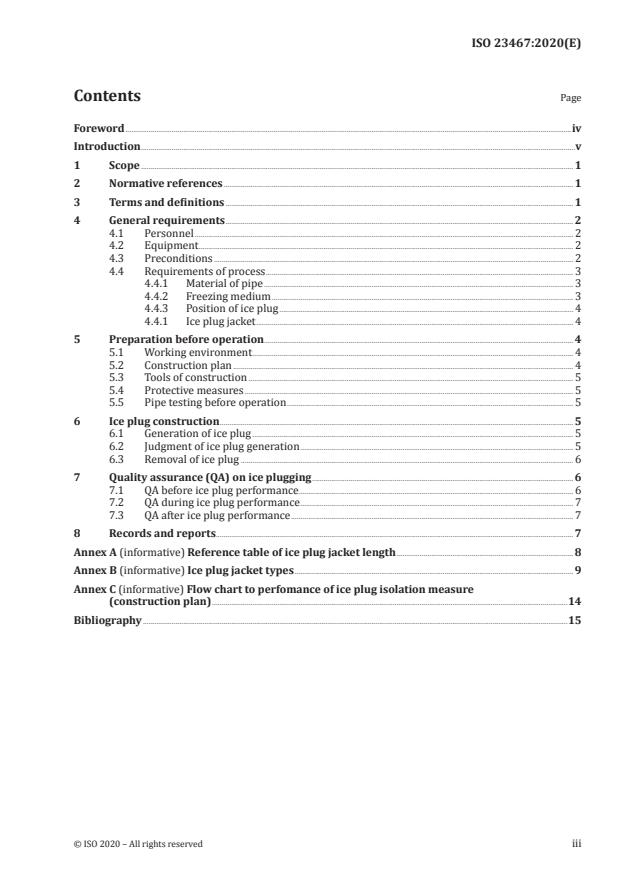
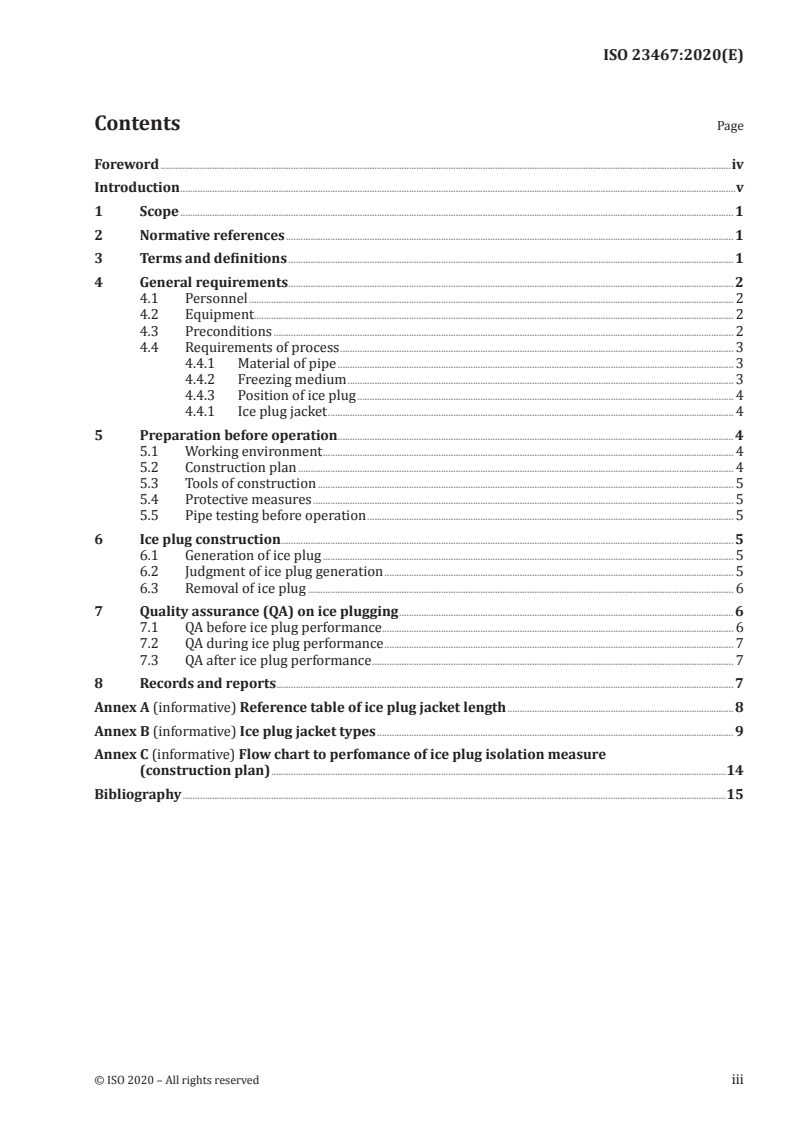
Contents Page
Foreword .iv
Introduction .v
1 Scope . 1
2 Normative references . 1
3 Terms and definitions . 1
4 General requirements . 2
4.1 Personnel . 2
4.2 Equipment . 2
4.3 Preconditions . 2
4.4 Requirements of process . 3
4.4.1 Material of pipe . 3
4.4.2 Freezing medium . 3
4.4.3 Position of ice plug . 4
4.4.1 Ice plug jacket . 4
5 Preparation before operation. 4
5.1 Working environment . 4
5.2 Construction plan . 4
5.3 Tools of construction . 5
5.4 Protective measures . 5
5.5 Pipe testing before operation . 5
6 Ice plug construction . 5
6.1 Generation of ice plug . 5
6.2 Judgment of ice plug generation . 5
6.3 Removal of ice plug . 6
7 Quality assurance (QA) on ice plugging . 6
7.1 QA before ice plug performance. 6
7.2 QA during ice plug performance . 7
7.3 QA after ice plug performance . 7
8 Records and reports . 7
Annex A (informative) Reference table of ice plug jacket length . 8
Annex B (informative) Ice plug jacket types . 9
Annex C (informative) Flow chart to perfomance of ice plug isolation measure
(construction plan) .14
Bibliography .15
Foreword
ISO (the International Organization for Standardization) is a worldwide federation of national standards
bodies (ISO member bodies). The work of preparing International Standards is normally carried out
through ISO technical committees. Each member body interested in a subject for which a technical
committee has been established has the right to be represented on that committee. International
organizations, governmental and non-governmental, in liaison with ISO, also take part in the work.
ISO collaborates closely with the International Electrotechnical Commission (IEC) on all matters of
electrotechnical standardization.
The procedures used to develop this document and those intended for its further maintenance are
described in the ISO/IEC Directives, Part 1. In particular, the different approval criteria needed for the
different types of ISO documents should be noted. This document was drafted in accordance with the
editorial rules of the ISO/IEC Directives, Part 2 (see www .iso .org/ directives).
Attention is drawn to the possibility that some of the elements of this document may be the subject of
patent rights. ISO shall not be held responsible for identifying any or all such patent rights. Details of
any patent rights identified during the development of the document will be in the Introduction and/or
on the ISO list of patent declarations received (see www .iso .org/ patents).
Any trade name used in this document is information given for the convenience of users and does not
constitute an endorsement.
For an explanation of the voluntary nature of standards, the meaning of ISO specific terms and
expressions related to conformity assessment, as well as information about ISO's adherence to the
World Trade Organization (WTO) principles in the Technical Barriers to Trade (TBT), see www .iso .org/
iso/ foreword .html.
This document was prepared by Technical Committee ISO/TC 85, Nuclear energy, nuclear technologies,
and radiological protection, Subcommittee SC 6, Reactor technology.
Any feedback or questions on this document should be directed to the user’s national standards body. A
complete listing of these bodies can be found at www .iso .org/ members .html.
iv © ISO 2020 – All rights reserved
Introduction
This document provides terms and definitions for basic concepts of nuclear energy, nuclear technologies,
and radiological protection. Terminological data are taken from ISO standards developed by ISO/TC 85
sub-committees and other technically validated documents.
In the field of nuclear power, when the equipment or pipeline is to be disassembled or removed to
overhaul, it is often necessary to isolate the equipment or pipeline. Under normal circumstances, the
upstream and downstream of the equipment will be isolated or the internal media will be sprinkled.
Taking into account the safety (some reactor systems like the hot trap needs to be filled at any time and
care need to be taken as some liquid systems are radioactive) and economy (system mass, sparse for a
long time, heavy water degradation, etc.) during the maintenance it is necessary that there will be no
isolation equipment or isolation equipment near the equipment or pipeline.
Based on years of practical experience, the development of this document is feasible. At the theoretical
level, the relevant literature has been studied and reported on the ice plug isolation technology. In the
actual maintenance work, the use of ice plug technology to the pipeline equipment isolation achieve
good results. Based on these theoretical and practical experiences, it is recommended that some
technical indicators in the process of ice plug operation be standardized.
This document is designed to provide a standardized procedure for on-line isolation through the
freezing of the internal medium of the pipeline. This document includes methods for technologies to
isolate equipment without isolation facilities by ice plug technology. Standardized ice plug isolation
technology will facilitate the maintenance work.
INTERNATIONAL STANDARD ISO 23467:2020(E)
Ice plug isolation of piping in nuclear power plant
1 Scope
This document specifies requirements for the ice plug technique with liquid nitrogen or dry ice as
refrigerant (cryogenic medium) on metal pipes of nuclear power plants. The freezing liquid can be
water or water mixture (e.g. boric acid mixture).
This document specifies technical requirements of ice plug generation, formation judgment and
removal, measures before, during and after ice plugging and requirements for personnel and non-
destructive testing.
The application of the ice plug isolation technique is principally not allowed on cladded pipes or pipes
with internal coatings. The application for pressure test is not in the scope of this document and will be
qualified separately.
2 Normative references
The following documents are referred to in the text in such a way that some or all of their content
constitutes requirements of this document. For dated references, only the edition cited applies. For
undated references, the latest edition of the referenced document (including any amendments) applies.
ISO 3452 (all parts), Non-destructive testing — Penetrant testing
ISO 9934 (all parts), Non-destructive testing — Magnetic particle testing
ISO 16810, Non-destructive testing — Ultrasonic testing — General principles
ISO 17637, Non-destructive testing of welds — Visual testing of fusion-welded joints
ISO 20769 (all parts), Non-destructive testing — Radiographic inspection of corrosion and deposits in pipes
by X- and gamma rays
3 Terms and definitions
For the purposes of this document the following apply.
ISO and IEC maintain terminological databases for use in standardization at the following addresses:
— ISO Online browsing platform: available at https:// www .iso .org/ obp
— IEC Electropedia: available at http:// www .electropedia .org/
3.1
ice plug
solid block of ice in the pipe that can withstand a certain system pressure to isolate the pipeline
temporarily
Note 1 to entry: The ice plug can be used for the convenience of maintaining downstream pipelines, valves and
other equipment.
3.2
ice plug jacket
set of device wrapped outside the pipe and containing a refrigerant capable of freezing internal medium
of the pipe to form an ice plug (3.1) for a period necessary for the isolation
Note 1 to entry: The length of jacket depends on the diameter of pipe. See Annex A for the length of jacket.
3.3
ice plug area
defined area on the pipe excluding the ice plug affected zone
3.4
refrigerant
cryogenic medium
medium which is used to generate an ice plug (3.1) inside of the pipes
3.5
freezing medium
freezing liquid
medium inside of pipes and components which have to be frozen
3.6
UT
ultrasonic testing
non-destructive testing of solid material using ultrasonic waves, for defects such as cavities,
nonbonding, and strength variations
3.7
RT
radiographic testing
non-destructive testing method of inspecting materials for hidden flaws by using the ability of short
wavelength electromagnetic radiation (high energy photons) to penetrate various materials
4 General requirements
4.1 Personnel
Managers and operators engaged in ice plug isolation construction shall undergo professional training
and safety training. For the implementation, only qualified and trained personnel should be deployed
(e.g. workers from specialized companies).
4.2 Equipment
4.2.1 Special ice plug jacket, other equipment (such as liquid nitrogen chamber, hoses, joints,
antifreeze gloves, protective masks, protective glasses) and tools shall be used. Measurement tools (such
as thermometers, pressure gauges, oxygen meters, etc.) shall be calibrated and validated.
4.2.2 Anti-freezing, anti-asphyxia and other related safety protection products shall be provided.
4.3 Preconditions
4.3.1 Pipes shall be filled with any fluids that can be frozen, and free of air.
4.3.2 The flow rate of liquid in the pipe should be as low as possible, preferably close to zero. Excessive
flow rate is not conducive to the formation of ice plug.
2 © ISO 2020 – All rights reserved
4.3.3 When the ambient temperature is lower than 43 °C, the surface temperature of pipe shall be
lower than 50 °C. If the refrigerant is liquid nitrogen and shall be lower than 30 °C if the refrigerant is dry
ice. This is not required if validity is confirmed by mock-up test.
4.3.4 The distance between ice plug and heat source nearby (including welding parts) shall be
determined based on heat input and pipe diameter.
4.3.5 The pipe to be isolated with an ice plug shall not be affected by the vibration and shock during
the operation.
4.3.6 Ice plug operation is prohibited for the pipe sections containing the following defects:
a) Crack affecting the strength;
b) Pitting affecting the strength;
c) Thickness of pipe thinned to an unacceptable level;
d) Breach;
e) Other conditions that could cause a burst of the pipe.
4.3.7 Ice plug operation is prohibited in the following pipe structures or fittings:
a) Pipe parts, such as plugs, thermocouples;
b) Pipe fittings, such as movable joints.
4.4 Requirements of process
4.4.1 Material of pipe
The pipe shall be made of metal (carbon steel or stainless steel). Welds are not allowed in the area of
the ice plug (no circumferential neither longitudinal weld). Unless it can be demonstrated that there
is no better solution, and that there are no defects in the welds, ice plug operations on welds can be
done. Cast copper pipe, cast iron pipe, cladded pipe and lining pipe shall not be subject to ice plugging
isolation.
Material inspection certificate or alternative consideration should be confirmed in order to avoid low
temperature brittle fracture, when applying ice plugs on carbon steel piping, which is connected to
most important components or piping for safety.
Vibration and external shock like falling parts (e.g. tools) or mechanical stress (e.g. moving of valves,
starting of pumps) shall be avoided during ice plug generation. In addition, stainless steel pipe shall be
protected from contact with halogen-containing medium to prevent stress corrosion.
4.4.2 Freezing medium
The f
...
INTERNATIONAL ISO
STANDARD 23467
First edition
2020-11
Ice plug isolation of piping in nuclear
power plant
Mise en œuvre de la technique d’obturation cryogénique sur les
tuyauteries de centrales nucléaires
Reference number
©
ISO 2020
© ISO 2020
All rights reserved. Unless otherwise specified, or required in the context of its implementation, no part of this publication may
be reproduced or utilized otherwise in any form or by any means, electronic or mechanical, including photocopying, or posting
on the internet or an intranet, without prior written permission. Permission can be requested from either ISO at the address
below or ISO’s member body in the country of the requester.
ISO copyright office
CP 401 • Ch. de Blandonnet 8
CH-1214 Vernier, Geneva
Phone: +41 22 749 01 11
Email: copyright@iso.org
Website: www.iso.org
Published in Switzerland
ii © ISO 2020 – All rights reserved
Contents Page
Foreword .iv
Introduction .v
1 Scope . 1
2 Normative references . 1
3 Terms and definitions . 1
4 General requirements . 2
4.1 Personnel . 2
4.2 Equipment . 2
4.3 Preconditions . 2
4.4 Requirements of process . 3
4.4.1 Material of pipe . 3
4.4.2 Freezing medium . 3
4.4.3 Position of ice plug . 4
4.4.1 Ice plug jacket . 4
5 Preparation before operation. 4
5.1 Working environment . 4
5.2 Construction plan . 4
5.3 Tools of construction . 5
5.4 Protective measures . 5
5.5 Pipe testing before operation . 5
6 Ice plug construction . 5
6.1 Generation of ice plug . 5
6.2 Judgment of ice plug generation . 5
6.3 Removal of ice plug . 6
7 Quality assurance (QA) on ice plugging . 6
7.1 QA before ice plug performance. 6
7.2 QA during ice plug performance . 7
7.3 QA after ice plug performance . 7
8 Records and reports . 7
Annex A (informative) Reference table of ice plug jacket length . 8
Annex B (informative) Ice plug jacket types . 9
Annex C (informative) Flow chart to perfomance of ice plug isolation measure
(construction plan) .14
Bibliography .15
Foreword
ISO (the International Organization for Standardization) is a worldwide federation of national standards
bodies (ISO member bodies). The work of preparing International Standards is normally carried out
through ISO technical committees. Each member body interested in a subject for which a technical
committee has been established has the right to be represented on that committee. International
organizations, governmental and non-governmental, in liaison with ISO, also take part in the work.
ISO collaborates closely with the International Electrotechnical Commission (IEC) on all matters of
electrotechnical standardization.
The procedures used to develop this document and those intended for its further maintenance are
described in the ISO/IEC Directives, Part 1. In particular, the different approval criteria needed for the
different types of ISO documents should be noted. This document was drafted in accordance with the
editorial rules of the ISO/IEC Directives, Part 2 (see www .iso .org/ directives).
Attention is drawn to the possibility that some of the elements of this document may be the subject of
patent rights. ISO shall not be held responsible for identifying any or all such patent rights. Details of
any patent rights identified during the development of the document will be in the Introduction and/or
on the ISO list of patent declarations received (see www .iso .org/ patents).
Any trade name used in this document is information given for the convenience of users and does not
constitute an endorsement.
For an explanation of the voluntary nature of standards, the meaning of ISO specific terms and
expressions related to conformity assessment, as well as information about ISO's adherence to the
World Trade Organization (WTO) principles in the Technical Barriers to Trade (TBT), see www .iso .org/
iso/ foreword .html.
This document was prepared by Technical Committee ISO/TC 85, Nuclear energy, nuclear technologies,
and radiological protection, Subcommittee SC 6, Reactor technology.
Any feedback or questions on this document should be directed to the user’s national standards body. A
complete listing of these bodies can be found at www .iso .org/ members .html.
iv © ISO 2020 – All rights reserved
Introduction
This document provides terms and definitions for basic concepts of nuclear energy, nuclear technologies,
and radiological protection. Terminological data are taken from ISO standards developed by ISO/TC 85
sub-committees and other technically validated documents.
In the field of nuclear power, when the equipment or pipeline is to be disassembled or removed to
overhaul, it is often necessary to isolate the equipment or pipeline. Under normal circumstances, the
upstream and downstream of the equipment will be isolated or the internal media will be sprinkled.
Taking into account the safety (some reactor systems like the hot trap needs to be filled at any time and
care need to be taken as some liquid systems are radioactive) and economy (system mass, sparse for a
long time, heavy water degradation, etc.) during the maintenance it is necessary that there will be no
isolation equipment or isolation equipment near the equipment or pipeline.
Based on years of practical experience, the development of this document is feasible. At the theoretical
level, the relevant literature has been studied and reported on the ice plug isolation technology. In the
actual maintenance work, the use of ice plug technology to the pipeline equipment isolation achieve
good results. Based on these theoretical and practical experiences, it is recommended that some
technical indicators in the process of ice plug operation be standardized.
This document is designed to provide a standardized procedure for on-line isolation through the
freezing of the internal medium of the pipeline. This document includes methods for technologies to
isolate equipment without isolation facilities by ice plug technology. Standardized ice plug isolation
technology will facilitate the maintenance work.
INTERNATIONAL STANDARD ISO 23467:2020(E)
Ice plug isolation of piping in nuclear power plant
1 Scope
This document specifies requirements for the ice plug technique with liquid nitrogen or dry ice as
refrigerant (cryogenic medium) on metal pipes of nuclear power plants. The freezing liquid can be
water or water mixture (e.g. boric acid mixture).
This document specifies technical requirements of ice plug generation, formation judgment and
removal, measures before, during and after ice plugging and requirements for personnel and non-
destructive testing.
The application of the ice plug isolation technique is principally not allowed on cladded pipes or pipes
with internal coatings. The application for pressure test is not in the scope of this document and will be
qualified separately.
2 Normative references
The following documents are referred to in the text in such a way that some or all of their content
constitutes requirements of this document. For dated references, only the edition cited applies. For
undated references, the latest edition of the referenced document (including any amendments) applies.
ISO 3452 (all parts), Non-destructive testing — Penetrant testing
ISO 9934 (all parts), Non-destructive testing — Magnetic particle testing
ISO 16810, Non-destructive testing — Ultrasonic testing — General principles
ISO 17637, Non-destructive testing of welds — Visual testing of fusion-welded joints
ISO 20769 (all parts), Non-destructive testing — Radiographic inspection of corrosion and deposits in pipes
by X- and gamma rays
3 Terms and definitions
For the purposes of this document the following apply.
ISO and IEC maintain terminological databases for use in standardization at the following addresses:
— ISO Online browsing platform: available at https:// www .iso .org/ obp
— IEC Electropedia: available at http:// www .electropedia .org/
3.1
ice plug
solid block of ice in the pipe that can withstand a certain system pressure to isolate the pipeline
temporarily
Note 1 to entry: The ice plug can be used for the convenience of maintaining downstream pipelines, valves and
other equipment.
3.2
ice plug jacket
set of device wrapped outside the pipe and containing a refrigerant capable of freezing internal medium
of the pipe to form an ice plug (3.1) for a period necessary for the isolation
Note 1 to entry: The length of jacket depends on the diameter of pipe. See Annex A for the length of jacket.
3.3
ice plug area
defined area on the pipe excluding the ice plug affected zone
3.4
refrigerant
cryogenic medium
medium which is used to generate an ice plug (3.1) inside of the pipes
3.5
freezing medium
freezing liquid
medium inside of pipes and components which have to be frozen
3.6
UT
ultrasonic testing
non-destructive testing of solid material using ultrasonic waves, for defects such as cavities,
nonbonding, and strength variations
3.7
RT
radiographic testing
non-destructive testing method of inspecting materials for hidden flaws by using the ability of short
wavelength electromagnetic radiation (high energy photons) to penetrate various materials
4 General requirements
4.1 Personnel
Managers and operators engaged in ice plug isolation construction shall undergo professional training
and safety training. For the implementation, only qualified and trained personnel should be deployed
(e.g. workers from specialized companies).
4.2 Equipment
4.2.1 Special ice plug jacket, other equipment (such as liquid nitrogen chamber, hoses, joints,
antifreeze gloves, protective masks, protective glasses) and tools shall be used. Measurement tools (such
as thermometers, pressure gauges, oxygen meters, etc.) shall be calibrated and validated.
4.2.2 Anti-freezing, anti-asphyxia and other related safety protection products shall be provided.
4.3 Preconditions
4.3.1 Pipes shall be filled with any fluids that can be frozen, and free of air.
4.3.2 The flow rate of liquid in the pipe should be as low as possible, preferably close to zero. Excessive
flow rate is not conducive to the formation of ice plug.
2 © ISO 2020 – All rights reserved
4.3.3 When the ambient temperature is lower than 43 °C, the surface temperature of pipe shall be
lower than 50 °C. If the refrigerant is liquid nitrogen and shall be lower than 30 °C if the refrigerant is dry
ice. This is not required if validity is confirmed by mock-up test.
4.3.4 The distance between ice plug and heat source nearby (including welding parts) shall be
determined based on heat input and pipe diameter.
4.3.5 The pipe to be isolated with an ice plug shall not be affected by the vibration and shock during
the operation.
4.3.6 Ice plug operation is prohibited for the pipe sections containing the following defects:
a) Crack affecting the strength;
b) Pitting affecting the strength;
c) Thickness of pipe thinned to an unacceptable level;
d) Breach;
e) Other conditions that could cause a burst of the pipe.
4.3.7 Ice plug operation is prohibited in the following pipe structures or fittings:
a) Pipe parts, such as plugs, thermocouples;
b) Pipe fittings, such as movable joints.
4.4 Requirements of process
4.4.1 Material of pipe
The pipe shall be made of metal (carbon steel or stainless steel). Welds are not allowed in the area of
the ice plug (no circumferential neither longitudinal weld). Unless it can be demonstrated that there
is no better solution, and that there are no defects in the welds, ice plug operations on welds can be
done. Cast copper pipe, cast iron pipe, cladded pipe and lining pipe shall not be subject to ice plugging
isolation.
Material inspection certificate or alternative consideration should be confirmed in order to avoid low
temperature brittle fracture, when applying ice plugs on carbon steel piping, which is connected to
most important components or piping for safety.
Vibration and external shock like falling parts (e.g. tools) or mechanical stress (e.g. moving of valves,
starting of pumps) shall be avoided during ice plug generation. In addition, stainless steel pipe shall be
protected from contact with halogen-containing medium to prevent stress corrosion.
4.4.2 Freezing medium
The f
...