

ISO 19842:2025
(Main)Traditional Chinese medicine — Dioscorea opposita rhizome
General Information
- Abstract
This document specifies the quality and safety requirements and test methods of Dioscorea opposita rhizome (dried rhizome of Dioscorea opposita Thunb.). It is applicable to Dioscorea opposita rhizomes that are sold and used as natural medicines in international trade, including Chinese materia medica (whole medicinal material) and decoction pieces derived from this plant.
- Status
- Published
- Publication Date
- 08-May-2025
- Technical Committee
- ISO/TC 249 - Traditional Chinese medicine
- Drafting Committee
- ISO/TC 249 - Traditional Chinese medicine
- Current Stage
- 6060 - International Standard published
- Start Date
- 09-May-2025
- Due Date
- 15-Mar-2026
- Completion Date
- 09-May-2025
Overview
ISO 19842:2025 - Traditional Chinese medicine - Dioscorea opposita rhizome establishes internationally harmonized quality and safety requirements and test methods for the dried rhizome of Dioscorea opposita Thunb. (also used as Chinese materia medica and decoction pieces). The standard applies to rhizomes sold and used as natural medicines in international trade and supports consistent product quality, safety and regulatory compliance across markets.
Key topics and technical requirements
- General requirements: material must be clean, free from leaves, visible contaminants, mould or live insects before sampling.
- Morphology & microscopy: macroscopic description (15–30 cm length; 1.5–6 cm diameter; yellowish-white surface, powdery white section) and microscopic features (starch granules 8–35 μm, vessels 12–48 μm, calcium oxalate needle bundles ≈240 μm).
- Limits:
- Moisture: mass fraction ≤ 16.0 %.
- Total ash: mass fraction ≤ 6.0 %.
- Water‑soluble extractives: to be determined (method specified).
- Contaminants & residues:
- Heavy metals: determination of arsenic, mercury, lead and cadmium.
- Pesticide residues: determination per specified methods.
- Sulfur dioxide: determination required.
- Identity testing: Thin-layer chromatography (TLC) identification - extract must show spot/band matching reference solution in color and Rf. (Annex A provides TLC details.)
- Sampling & test methods: sampling follows ISO 23723; macroscopic ID samples not less than 500 g; test methods reference several ISO standards for microscopy, heavy metals, pesticides, sulfur dioxide and other measures.
- Packaging, storage & transport: requirements to protect material from light, moisture and contamination; storage and packaging reference ISO 22217 and ISO 23723.
Practical applications and who uses this standard
ISO 19842:2025 is intended for:
- Manufacturers and processors of Dioscorea opposita rhizome and decoction pieces - for quality control and product specification.
- Testing laboratories and QC analysts - for validated sampling and test procedures (TLC, moisture, ash, contaminants).
- Regulatory authorities and customs - to assess imported/exported TCM raw materials against harmonized safety limits.
- Suppliers, exporters/importers and purchasers - to ensure consistent international trade quality.
- Pharmacopeial bodies and standards developers - to align national regulations with an international baseline.
Related standards
Key referenced ISO documents include: ISO 23723, ISO/TS 21310, ISO 18664, ISO 22258, ISO 22590, ISO 22217, and ISO 21371 - covering sampling, microscopy, heavy metals, pesticide residues, sulfur dioxide, storage and labelling.
Get Certified
Connect with accredited certification bodies for this standard

BSI Group
BSI (British Standards Institution) is the business standards company that helps organizations make excellence a habit.

TÜV Rheinland
TÜV Rheinland is a leading international provider of technical services.

TÜV SÜD
TÜV SÜD is a trusted partner of choice for safety, security and sustainability solutions.
Sponsored listings
Frequently Asked Questions
ISO 19842:2025 is a standard published by the International Organization for Standardization (ISO). Its full title is "Traditional Chinese medicine — Dioscorea opposita rhizome". This standard covers: This document specifies the quality and safety requirements and test methods of Dioscorea opposita rhizome (dried rhizome of Dioscorea opposita Thunb.). It is applicable to Dioscorea opposita rhizomes that are sold and used as natural medicines in international trade, including Chinese materia medica (whole medicinal material) and decoction pieces derived from this plant.
This document specifies the quality and safety requirements and test methods of Dioscorea opposita rhizome (dried rhizome of Dioscorea opposita Thunb.). It is applicable to Dioscorea opposita rhizomes that are sold and used as natural medicines in international trade, including Chinese materia medica (whole medicinal material) and decoction pieces derived from this plant.
ISO 19842:2025 is classified under the following ICS (International Classification for Standards) categories: 11.120.10 - Medicaments. The ICS classification helps identify the subject area and facilitates finding related standards.
ISO 19842:2025 is available in PDF format for immediate download after purchase. The document can be added to your cart and obtained through the secure checkout process. Digital delivery ensures instant access to the complete standard document.
Standards Content (Sample)
International
Standard
ISO 19842
First edition
Traditional Chinese medicine —
2025-05
Dioscorea opposita rhizome
Médecine traditionnelle Chinoise — Rhizome de Dioscorea
opposita
Reference number
© ISO 2025
All rights reserved. Unless otherwise specified, or required in the context of its implementation, no part of this publication may
be reproduced or utilized otherwise in any form or by any means, electronic or mechanical, including photocopying, or posting on
the internet or an intranet, without prior written permission. Permission can be requested from either ISO at the address below
or ISO’s member body in the country of the requester.
ISO copyright office
CP 401 • Ch. de Blandonnet 8
CH-1214 Vernier, Geneva
Phone: +41 22 749 01 11
Email: copyright@iso.org
Website: www.iso.org
Published in Switzerland
ii
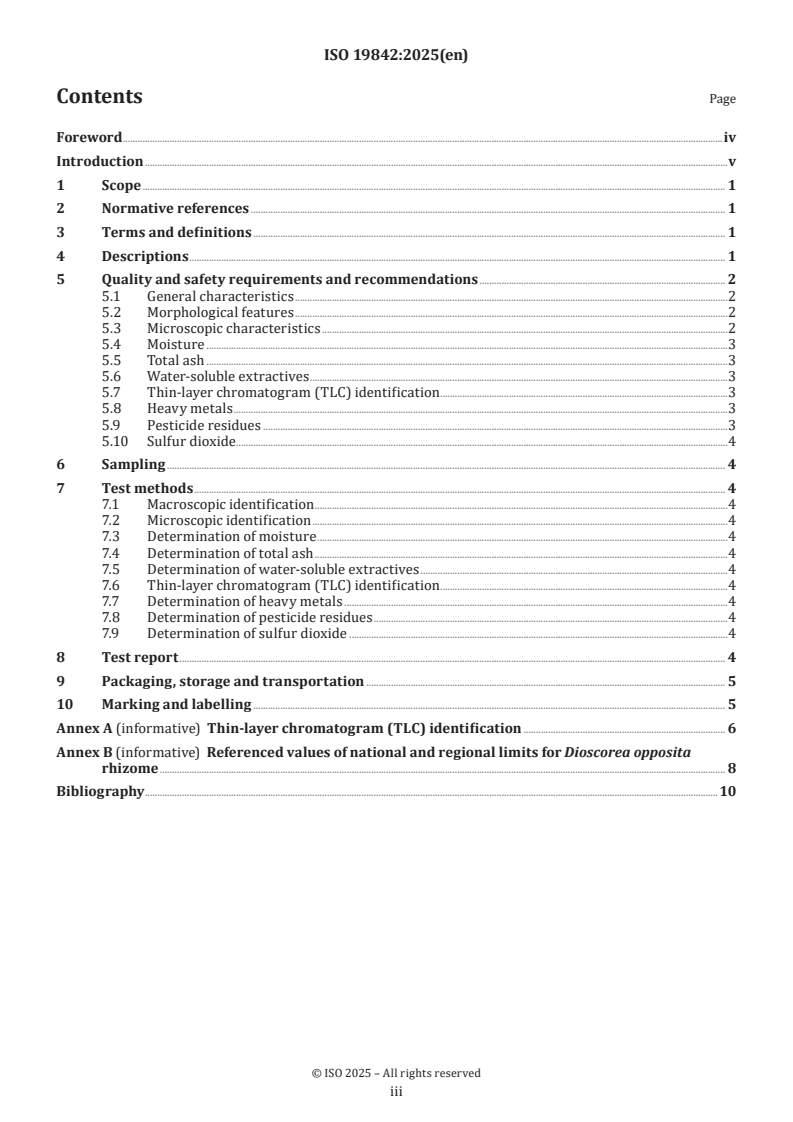
Contents Page
Foreword .iv
Introduction .v
1 Scope . 1
2 Normative references . 1
3 Terms and definitions . 1
4 Descriptions . 1
5 Quality and safety requirements and recommendations . 2
5.1 General characteristics .2
5.2 Morphological features .2
5.3 Microscopic characteristics .2
5.4 Moisture .3
5.5 Total ash .3
5.6 Water-soluble extractives .3
5.7 Thin-layer chromatogram (TLC) identification .3
5.8 Heavy metals .3
5.9 Pesticide residues .3
5.10 Sulfur dioxide . .4
6 Sampling . 4
7 Test methods . 4
7.1 Macroscopic identification .4
7.2 Microscopic identification .4
7.3 Determination of moisture .4
7.4 Determination of total ash .4
7.5 Determination of water-soluble extractives .4
7.6 Thin-layer chromatogram (TLC) identification .4
7.7 Determination of heavy metals .4
7.8 Determination of pesticide residues .4
7.9 Determination of sulfur dioxide .4
8 Test report . 4
9 Packaging, storage and transportation . 5
10 Marking and labelling . 5
Annex A (informative) Thin-layer chromatogram (TLC) identification . 6
Annex B (informative) Referenced values of national and regional limits for Dioscorea opposita
rhizome . 8
Bibliography .10
iii
Foreword
ISO (the International Organization for Standardization) is a worldwide federation of national standards
bodies (ISO member bodies). The work of preparing International Standards is normally carried out through
ISO technical committees. Each member body interested in a subject for which a technical committee
has been established has the right to be represented on that committee. International organizations,
governmental and non-governmental, in liaison with ISO, also take part in the work. ISO collaborates closely
with the International Electrotechnical Commission (IEC) on all matters of electrotechnical standardization.
The procedures used to develop this document and those intended for its further maintenance are described
in the ISO/IEC Directives, Part 1. In particular, the different approval criteria needed for the different types
of ISO document should be noted. This document was drafted in accordance with the editorial rules of the
ISO/IEC Directives, Part 2 (see www.iso.org/directives).
ISO draws attention to the possibility that the implementation of this document may involve the use of (a)
patent(s). ISO takes no position concerning the evidence, validity or applicability of any claimed patent
rights in respect thereof. As of the date of publication of this document, ISO had not received notice of (a)
patent(s) which may be required to implement this document. However, implementers are cautioned that
this may not represent the latest information, which may be obtained from the patent database available at
www.iso.org/patents. ISO shall not be held responsible for identifying any or all such patent rights.
Any trade name used in this document is information given for the convenience of users and does not
constitute an endorsement.
For an explanation of the voluntary nature of standards, the meaning of ISO specific terms and expressions
related to conformity assessment, as well as information about ISO's adherence to the World Trade
Organization (WTO) principles in the Technical Barriers to Trade (TBT), see www.iso.org/iso/foreword.html.
This document was prepared by Technical Committee ISO/TC 249, Traditional Chinese medicine.
Any feedback or questions on this document should be directed to the user’s national standards body. A
complete listing of these bodies can be found at www.iso.org/members.html.
iv
Introduction
Dioscorea opposita rhizome is the dried rhizome of Dioscorea opposita Thunb. It has a long history of
application as a traditional Chinese herb in China, the Republic of Korea, Japan, etc. It is widely used clinically
for its efficacy in nourishing the spleen and stomach, generating body fluid and benefiting the lungs, and
tonifying the kidneys and acting as an astringent essence. Dioscorea opposita rhizome is mostly processed
into Dioscorea opposita rhizome decoction pieces, bran-fried Dioscorea opposita rhizome and other products
circulating in the market. Dioscorea opposita rhizome has a long history of cultivation and is grown all over
the world. In 2020, the global Dioscorea opposita rhizome cultivation area is about 9,205 million hectares and
Dioscorea opposita rhizome production is about 76,031 million tonnes, both of which are on a growing trend.
To date, Dioscorea opposita rhizome has been widely recorded in established pharmacopoeias such
as the Chinese Pharmacopoeia, Korean Pharmacopoeia, Japanese Pharmacopoeia, and the European
Pharmacopoeia. But different quality requirements in different countries and regions, different packaging,
transportation and storage conditions can affect the quality of Dioscorea opposita rhizome. Meanwhile,
Dioscorea opposita rhizome occupies the No. 65 place on the priority list of ISO/TR 23975. Therefore, it is
urgent and necessary to establish a unified international standard for Dioscorea opposita rhizome to ensure
its quality and safety.
As national implementation can differ, national standards bodies are invited to modify the values given in
5.4 and 5.5 in their national standards. Examples of national and regional values are given in Annex B.
v
International Standard ISO 19842:2025(en)
Traditiona
...