

ISO 19012-3:2015
(Main)Microscopes — Designation of microscope objectives — Part 3: Spectral transmittance
General Information
- Abstract
ISO 19012-3:2015 specifies the relation of spectral characteristics between optical design and the description to microscope users for the spectral transmittance of objectives, as the guideline. NOTE This part of ISO 19012 does not apply to objectives exclusively used on stereomicroscopes.
- Status
- Published
- Publication Date
- 12-Apr-2015
- Technical Committee
- ISO/TC 172/SC 5 - Microscopes and endoscopes
- Drafting Committee
- ISO/TC 172/SC 5/WG 9 - Optical performance of microscope components
- Current Stage
- 9093 - International Standard confirmed
- Start Date
- 15-Jan-2026
- Completion Date
- 29-Aug-2026
Buy Documents
ISO 19012-3:2015 - Microscopes -- Designation of microscope objectives
ISO 19012-3:2015 - Microscopes — Designation of microscope objectives — Part 3: Spectral transmittance/13/2015
Overview
ISO 19012-3:2015 provides guidelines for reporting the spectral transmittance of microscope objectives, defined as the objective spectral transmittance by design (OSTD). The standard connects optical design characteristics to clear, consistent transmittance information so users can select objectives for imaging, fluorescence, laser and multiwavelength work. Note: this part does not apply to objectives used exclusively on stereomicroscopes.
Key Topics
- Definition of OSTD: Spectral transmittance calculated under specified conditions:
- on-axis light path;
- internal absorption of transparent materials according to manufacturer specifications is included;
- reflectance of thin-film coatings on optical surfaces according to nominal values is included;
- internal absorption and surface reflectance of immersion media and specimen covering are neglected.
- Labeling requirement: Transmittance data published in catalogues, instruction manuals, websites or other sources shall be labelled as OSTD.
- Presentation formats: OSTD shall be made either as a spectral transmittance table or diagram, or as a standardized OSTD description (see Table 1 examples).
- Example designations: The standard provides sample textual designations such as:
- “High OSTD in 400–700 (τ ≥ 80%)” or “High OSTD at 1064 (τ ≥ 80%)”;
- “Nominal OSTD in 340–1100 (τ ≥ 25%)” or “Nominal OSTD at 340 (τ ≥ 25%).”
Applications
ISO 19012-3 is intended to increase clarity and comparability of spectral transmittance data for microscope objectives. Typical applications include:
- Manufacturers: Present consistent OSTD diagrams or textual descriptions in product literature and online catalogs to communicate expected transmission behavior from design.
- Microscope users: Compare objectives by spectral performance to choose lenses optimized for imaging, fluorescence excitation/emission, laser coupling, or broad-spectrum illumination needs.
- System integrators and procurement teams: Specify OSTD requirements for multiwavelength instruments to ensure predictable transmission across required bands.
Practical value: standardized OSTD reporting reduces ambiguity when matching objectives to light sources, filters, detectors, and specific wavelength-dependent applications.
Related Standards
- ISO 10934-1 - Optics and optical instruments: Vocabulary for microscopy (normative reference).
- ISO 20473:2007 - Optics and photonics: Spectral bands (bibliographic reference).
- ISO 19012 Part 1 - Flatness of field / Plan.
- ISO 19012 Part 2 - Chromatic correction.
For implementation, include OSTD-labelled spectral diagrams or the standardized textual OSTD description alongside objective specifications so end users can reliably assess spectral transmittance performance for their optical application.
Relations
- Consolidated By
ISO 4126-1:2013/Amd 1:2016 - Safety devices for protection against excessive pressure — Part 1: Safety valves — Amendment 1 - Effective Date
- 06-Jun-2022
Buy Documents
ISO 19012-3:2015 - Microscopes -- Designation of microscope objectives
ISO 19012-3:2015 - Microscopes — Designation of microscope objectives — Part 3: Spectral transmittance/13/2015
Frequently Asked Questions
ISO 19012-3:2015 is a standard published by the International Organization for Standardization (ISO). Its full title is "Microscopes — Designation of microscope objectives — Part 3: Spectral transmittance". This standard covers: ISO 19012-3:2015 specifies the relation of spectral characteristics between optical design and the description to microscope users for the spectral transmittance of objectives, as the guideline. NOTE This part of ISO 19012 does not apply to objectives exclusively used on stereomicroscopes.
ISO 19012-3:2015 specifies the relation of spectral characteristics between optical design and the description to microscope users for the spectral transmittance of objectives, as the guideline. NOTE This part of ISO 19012 does not apply to objectives exclusively used on stereomicroscopes.
ISO 19012-3:2015 is classified under the following ICS (International Classification for Standards) categories: 37.020 - Optical equipment. The ICS classification helps identify the subject area and facilitates finding related standards.
ISO 19012-3:2015 has the following relationships with other standards: It is inter standard links to ISO 4126-1:2013/Amd 1:2016. Understanding these relationships helps ensure you are using the most current and applicable version of the standard.
ISO 19012-3:2015 is available in PDF format for immediate download after purchase. The document can be added to your cart and obtained through the secure checkout process. Digital delivery ensures instant access to the complete standard document.
Standards Content (Sample)
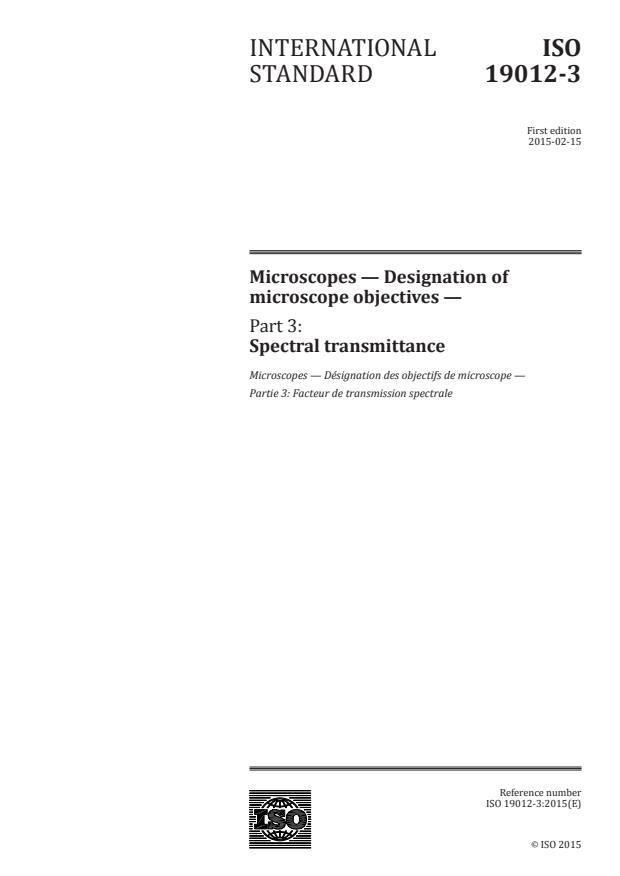
INTERNATIONAL ISO
STANDARD 19012-3
First edition
2015-02-15
Microscopes — Designation of
microscope objectives —
Part 3:
Spectral transmittance
Microscopes — Désignation des objectifs de microscope —
Partie 3: Facteur de transmission spectrale
Reference number
©
ISO 2015
© ISO 2015
All rights reserved. Unless otherwise specified, no part of this publication may be reproduced or utilized otherwise in any form
or by any means, electronic or mechanical, including photocopying, or posting on the internet or an intranet, without prior
written permission. Permission can be requested from either ISO at the address below or ISO’s member body in the country of
the requester.
ISO copyright office
Case postale 56 • CH-1211 Geneva 20
Tel. + 41 22 749 01 11
Fax + 41 22 749 09 47
E-mail copyright@iso.org
Web www.iso.org
Published in Switzerland
ii © ISO 2015 – All rights reserved
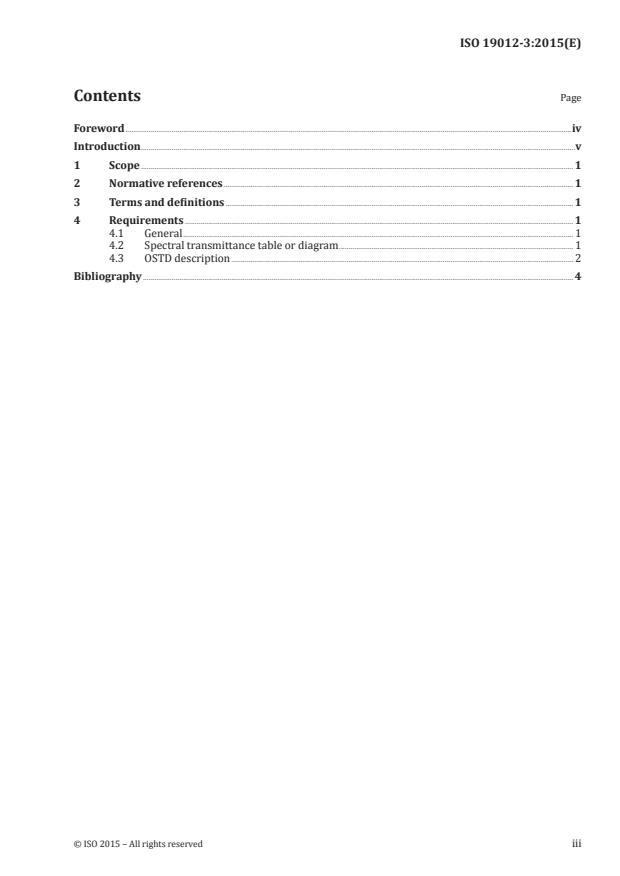
Contents Page
Foreword .iv
Introduction .v
1 Scope . 1
2 Normative references . 1
3 Terms and definitions . 1
4 Requirements . 1
4.1 General . 1
4.2 Spectral transmittance table or diagram . 1
4.3 OSTD description . 2
Bibliography . 4
Foreword
ISO (the International Organization for Standardization) is a worldwide federation of national standards
bodies (ISO member bodies). The work of preparing International Standards is normally carried out
through ISO technical committees. Each member body interested in a subject for which a technical
committee has been established has the right to be represented on that committee. International
organizations, governmental and non-governmental, in liaison with ISO, also take part in the work.
ISO collaborates closely with the International Electrotechnical Commission (IEC) on all matters of
electrotechnical standardization.
The procedures used to develop this document and those intended for its further maintenance are
described in the ISO/IEC Directives, Part 1. In particular the different approval criteria needed for the
different types of ISO documents should be noted. This document was drafted in accordance with the
editorial rules of the ISO/IEC Directives, Part 2 (see www.iso.org/directives).
Attention is drawn to the possibility that some of the elements of this document may be the subject of
patent rights. ISO shall not be held responsible for identifying any or all such patent rights. Details of any
patent rights identified during the development of the document will be in the Introduction and/or on
the ISO list of patent declarations received (see www.iso.org/patents).
Any trade name used in this document is information given for the convenience of users and does not
constitute an endorsement.
For an explanation on the meaning of ISO specific terms and expressions related to conformity
assessment, as well as information about ISO’s adherence to the WTO principles in the Technical Barriers
to Trade (TBT), see the following URL: Foreword — Supplementary inform
...
INTERNATIONAL ISO
STANDARD 19012-3
First edition
2015-02-15
Microscopes — Designation of
microscope objectives —
Part 3:
Spectral transmittance
Microscopes — Désignation des objectifs de microscope —
Partie 3: Facteur de transmission spectrale
Reference number
©
ISO 2015
© ISO 2015
All rights reserved. Unless otherwise specified, no part of this publication may be reproduced or utilized otherwise in any form
or by any means, electronic or mechanical, including photocopying, or posting on the internet or an intranet, without prior
written permission. Permission can be requested from either ISO at the address below or ISO’s member body in the country of
the requester.
ISO copyright office
Case postale 56 • CH-1211 Geneva 20
Tel. + 41 22 749 01 11
Fax + 41 22 749 09 47
E-mail copyright@iso.org
Web www.iso.org
Published in Switzerland
ii © ISO 2015 – All rights reserved
Contents Page
Foreword .iv
Introduction .v
1 Scope . 1
2 Normative references . 1
3 Terms and definitions . 1
4 Requirements . 1
4.1 General . 1
4.2 Spectral transmittance table or diagram . 1
4.3 OSTD description . 2
Bibliography . 4
Foreword
ISO (the International Organization for Standardization) is a worldwide federation of national standards
bodies (ISO member bodies). The work of preparing International Standards is normally carried out
through ISO technical committees. Each member body interested in a subject for which a technical
committee has been established has the right to be represented on that committee. International
organizations, governmental and non-governmental, in liaison with ISO, also take part in the work.
ISO collaborates closely with the International Electrotechnical Commission (IEC) on all matters of
electrotechnical standardization.
The procedures used to develop this document and those intended for its further maintenance are
described in the ISO/IEC Directives, Part 1. In particular the different approval criteria needed for the
different types of ISO documents should be noted. This document was drafted in accordance with the
editorial rules of the ISO/IEC Directives, Part 2 (see www.iso.org/directives).
Attention is drawn to the possibility that some of the elements of this document may be the subject of
patent rights. ISO shall not be held responsible for identifying any or all such patent rights. Details of any
patent rights identified during the development of the document will be in the Introduction and/or on
the ISO list of patent declarations received (see www.iso.org/patents).
Any trade name used in this document is information given for the convenience of users and does not
constitute an endorsement.
For an explanation on the meaning of ISO specific terms and expressions related to conformity
assessment, as well as information about ISO’s adherence to the WTO principles in the Technical Barriers
to Trade (TBT), see the following URL: Foreword — Supplementary inform
...