

ISO 12739:2006
(Main)Zinc sulfide concentrates — Determination of zinc — Ion-exchange/EDTA titrimetric method
General Information
- Abstract
ISO 12739:2006 specifies an ion-exchange/EDTA titrimetric method for the determination of the mass fraction of zinc in zinc concentrates. The method is applicable to zinc sulfide concentrates having a mass fraction of zinc in the range from 11 % to 62 %.
- Status
- Published
- Publication Date
- 04-Jul-2006
- Technical Committee
- ISO/TC 183 - Copper, lead, zinc and nickel ores and concentrates
- Drafting Committee
- ISO/TC 183 - Copper, lead, zinc and nickel ores and concentrates
- Current Stage
- 9092 - International Standard to be revised
- Start Date
- 24-Nov-2023
- Completion Date
- 29-Aug-2026
Overview
ISO 12739:2006 specifies an analytical procedure - the ion‑exchange / EDTA titrimetric method - for the determination of the mass fraction of zinc in zinc sulfide concentrates. The method is applicable to concentrates containing 11 % to 62 % zinc and covers reagents, apparatus, sample preparation, the ion‑exchange separation, EDTA titration and reporting. The standard includes precision statements, blank tests and normative annexes for resins, sample drying and related procedures.
Key topics and technical requirements
- Scope and applicability: Designed specifically for zinc in zinc sulfide concentrates (11–62 % Zn).
- Principle: Dissolve a representative test portion in acids, adjust acidity, selectively adsorb zinc onto a strongly basic anion‑exchange resin, remove interferences, elute zinc with an ammonia/ammonium chloride solution and determine zinc by EDTA titration at about pH 5.5–5.7.
- Reagents and indicators: Analytical‑grade acids, ammonia/ammonium chloride eluent, EDTA standard solution (0.1 mol/L), xylenol‑orange and para‑nitrophenol used for end‑point/pH adjustment.
- Apparatus: Class A volumetric glassware, precision balance, ion‑exchange columns and resin (details and typical column dimensions in Annex A).
- Sample preparation: Air‑equilibrated test samples per ISO 9599; procedures for dissolving, dealing with acid‑insoluble residues and preparing predried test portions (Annex B).
- Quality control and precision: Requires duplicate determinations where possible, reagent blanks, titration factor determination for EDTA, and procedures for precision, trueness checks and interlaboratory performance (precision annexes).
- Safety: The standard warns about hazardous chemicals and advises following appropriate laboratory safety and regulatory limits.
Applications and who uses it
- Mining companies and concentrator labs performing zinc analysis for product quality control and metallurgical accounting.
- Analytical laboratories providing assay services for zinc sulfide concentrates.
- Metallurgists and process control engineers who need reliable, standardized zinc assays for process optimization and material valuation.
- Regulatory bodies and auditors requiring traceable, repeatable zinc mass‑fraction determinations.
Practical benefits include a reproducible, standardized workflow for selective zinc separation (via ion‑exchange) and robust quantification (EDTA titration), making comparisons between laboratories and batches consistent.
Related standards
Normative references cited in ISO 12739:2006 include:
- ISO 9599 - hygroscopic moisture in sulfide concentrates (sample prep)
- ISO 3696 - laboratory water quality
- ISO 385, ISO 648, ISO 1042, ISO 4787 - laboratory volumetric glassware and use/testing guidance
Keywords: ISO 12739, zinc sulfide concentrates, determination of zinc, ion‑exchange EDTA titration, zinc analysis, ion‑exchange resin, EDTA titrimetric method, concentrate assay.
Relations
- Consolidated By
ISO 12402-4:2020 - Personal flotation devices — Part 4: Lifejackets, performance level 100 — Safety requirements - Effective Date
- 06-Jun-2022
- Effective Date
- 15-Apr-2008
Get Certified
Connect with accredited certification bodies for this standard

Bureau Veritas Chile
Bureau Veritas certification services in Chile.
Bureau Veritas Peru
Bureau Veritas certification services in Peru.
BVQI Peru
Bureau Veritas certification in Peru.
Sponsored listings
Frequently Asked Questions
ISO 12739:2006 is a standard published by the International Organization for Standardization (ISO). Its full title is "Zinc sulfide concentrates — Determination of zinc — Ion-exchange/EDTA titrimetric method". This standard covers: ISO 12739:2006 specifies an ion-exchange/EDTA titrimetric method for the determination of the mass fraction of zinc in zinc concentrates. The method is applicable to zinc sulfide concentrates having a mass fraction of zinc in the range from 11 % to 62 %.
ISO 12739:2006 specifies an ion-exchange/EDTA titrimetric method for the determination of the mass fraction of zinc in zinc concentrates. The method is applicable to zinc sulfide concentrates having a mass fraction of zinc in the range from 11 % to 62 %.
ISO 12739:2006 is classified under the following ICS (International Classification for Standards) categories: 73.060.99 - Other metalliferous minerals. The ICS classification helps identify the subject area and facilitates finding related standards.
ISO 12739:2006 has the following relationships with other standards: It is inter standard links to ISO 12402-4:2020, ISO 12739:1997. Understanding these relationships helps ensure you are using the most current and applicable version of the standard.
ISO 12739:2006 is available in PDF format for immediate download after purchase. The document can be added to your cart and obtained through the secure checkout process. Digital delivery ensures instant access to the complete standard document.
Standards Content (Sample)
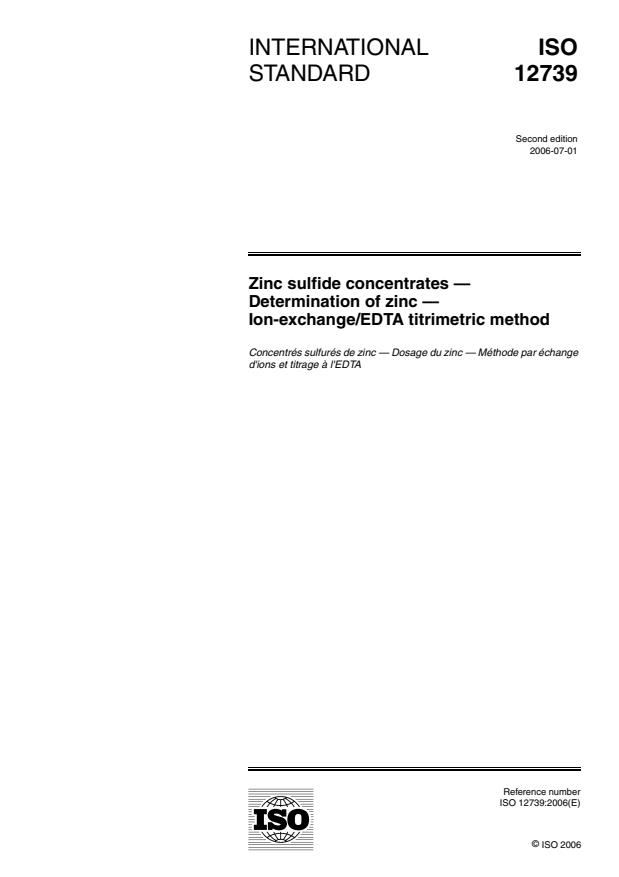
INTERNATIONAL ISO
STANDARD 12739
Second edition
2006-07-01
Zinc sulfide concentrates —
Determination of zinc —
Ion-exchange/EDTA titrimetric method
Concentrés sulfurés de zinc — Dosage du zinc — Méthode par échange
d'ions et titrage à l'EDTA
Reference number
©
ISO 2006
PDF disclaimer
This PDF file may contain embedded typefaces. In accordance with Adobe's licensing policy, this file may be printed or viewed but shall
not be edited unless the typefaces which are embedded are licensed to and installed on the computer performing the editing. In
downloading this file, parties accept therein the responsibility of not infringing Adobe's licensing policy. The ISO Central Secretariat
accepts no liability in this area.
Adobe is a trademark of Adobe Systems Incorporated.
Details of the software products used to create this PDF file can be found in the General Info relative to the file; the PDF-creation
parameters were optimized for printing. Every care has been taken to ensure that the file is suitable for use by ISO member bodies. In the
unlikely event that a problem relating to it is found, please inform the Central Secretariat at the address given below.
All rights reserved. Unless otherwise specified, no part of this publication may be reproduced or utilized in any form or by any means,
electronic or mechanical, including photocopying and microfilm, without permission in writing from either ISO at the address below or
ISO's member body in the country of the requester.
ISO copyright office
Case postale 56 CH-1211 Geneva 20
Tel. + 41 22 749 01 11
Fax + 41 22 749 09 47
E-mail copyright@iso.org
Web www.iso.org
Published in Switzerland
©
ii ISO 2006 – All rights reserved
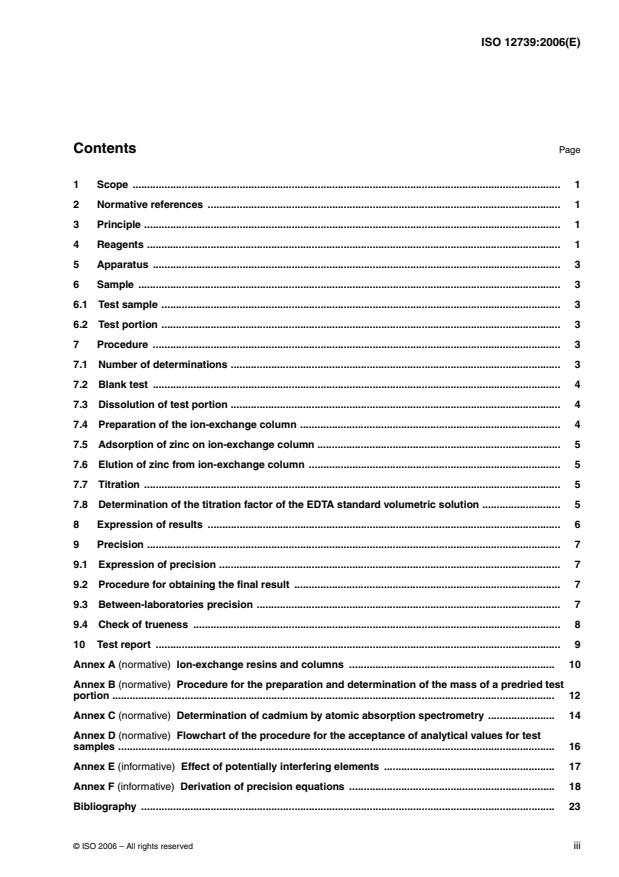
Contents Page
1 Scope . 1
2 Normative references . 1
3 Principle . 1
4 Reagents . 1
5 Apparatus . 3
6 Sample . 3
6.1 Test sample . 3
6.2 Test portion . 3
7 Procedure . 3
7.1 Number of determinations . 3
7.2 Blank test . 4
7.3 Dissolution of test portion . 4
7.4 Preparation of the ion-exchange column . 4
7.5 Adsorption of zinc on ion-exchange column . 5
7.6 Elution of zinc from ion-exchange column . 5
7.7 Titration . 5
7.8 Determination of the titration factor of the EDTA standard volumetric solution . 5
8 Expression of results . 6
9 Precision . 7
9.1 Expression of precision . 7
9.2 Procedure for obtaining the final result . 7
9.3 Between-laboratories precision . 7
9.4 Check of trueness . 8
10 Test report . 9
Annex A (normative) Ion-exchange resins and columns . 10
Annex B (normative) Procedure for the preparation and determination of the mass of a predried test
portion . 12
Annex C (normative) Determination of cadmium by atomic absorption spectrometry . 14
Annex D (normative) Flowchart of the procedure for the acceptance of analytical values for test
samples . 16
Annex E (informative) Effect of potentially interfering elements . 17
Annex F (informative) Derivation of precision equations . 18
Bibliography . 23
©
ISO 2006 – All rights reserved iii
Foreword
ISO (the International Organization for Standardization) is a worldwide federation of national standards bodies
(ISO member bodies). The work of preparing International Standards is normally carried out through ISO
technical committees. Each member body interested in a subject for which a technical committee has been
established has the right to be represented on that committee. International organizations, governmental and
non-governmental, in liaison with ISO, also take part in the work. ISO collaborates closely with the International
Electrotechnical Commission (IEC) on all matters of electrotechnical standardization.
International Standards are drafted in accordance with the rules given in the ISO/IEC Directives, Part 2.
The main task of technical committees is to prepare International Standards. Draft International Standards
adopted by the technical committees are circulated to the member bodies for voting. Publication as an
International Standard requires approval by at least 75 % of the member bodies casting a vote.
Attention is drawn to the possibility that some of the elements of this document may be the subject of patent
rights. ISO shall not be held responsible for identifying any or all such patent rights.
ISO12739 was prepared by Technical Committee ISO/TC183, Copper, lead, zinc and nickel ores and
concentrates.
This second edition cancels and replaces the first edition (ISO 12739:1997), which has been technically
revised.
©
iv ISO 2006 – All rights reserved
INTERNATIONAL STANDARD ISO 12739:2006(E)
Zinc sulfide concentrates — Determination of zinc —
Ion-exchange/EDTA titrimetric method
WARNING — This International Standard may involve hazardous materials, operations and equipment.
It is the responsibility of the user of this International Standard to establish appropriate health and
safety practices and determine the applicability of regulatory limitations prior to use.
1Scope
This International Standard specifies an ion-exchange/EDTA titrimetric method for the determination of the
mass fraction of zinc in zinc concentrates. The method is applicable to zinc sulfide concentrates having a mass
fraction of zinc in the range from 11 % to 62 %.
2 Normative references
The following referenced documents are indispensable for the application of this document. For dated
references, only the edition cited applies. For undated references, the latest edition of the referenced document
(including any amendments) applies.
ISO 385, Laboratory glassware — Burettes
ISO 648, Laboratory glassware — One-mark pipettes
ISO 1042, Laboratory glassware — One-mark volumetric flasks
ISO 3696, Water for analytical laboratory use — Specification and test methods
ISO 4787, Laboratory glassware — Volumetric glassware — Methods for use and testing of capacity
ISO 9599, Copper, lead and zinc sulfide concentrates — Determination of hygroscopic moisture in the analysis
sample — Gravimetric method
3 Principle
The test portion of zinc concentrate is dissolved in hydrochloric, nitric and sulfuric acids. The acidity is adjusted
to about 2 mol/l with respect to hydrochloric acid. Zinc is adsorbed on a strongly basic anion-exchange resin.
2 mol/l
Some interfering ions are removed by elution with dilute hydrochloric acid. Zinc is eluted with an
ammonia/ammonium chloride solution. Zinc is determined in the eluate by titration with EDTA at a pH of
approximately 5,6 using xylenol-orange indicator.
4Reagents
During the analysis, only reagents of recognized analytical grade and water that complies with grade 2 of
ISO 3696 shall be used.
4.1 Zinc, 99,99 % minimum purity, free from oxide prior to use.
©
ISO 2006 – All rights reserved 1
The surface of the metal may be cleaned by immersing the metal in hydrochloric acid (4.3) diluted 1 + 9, for
◦
1 min, then washed well with water followed by an acetone rinse and dried in an oven at 50 C.
4.2 Xylenol-orange indicator ()0,1 % m/m
Mix 0,1 g of the sodium salt of xylenol orange with 100 g of potassium nitrate crystals by gently grinding in a
ceramic mortar with a pestle. Mixing is considered complete when the colour is uniform throughout.
4.3 Hydrochloric acid (ρ 1,16 g/ml to 1,19 g/ml)
4.4 Hydrochloric acid, diluted (1 + 1)
Add 500 ml of hydrochloric acid (4.3) to 500 ml of water.
4.5 Hydrochloric acid, diluted (1 + 5)
Add 100 ml of hydrochloric acid (4.3) to 500 ml of water.
4.6 Nitric acid ()ρ 1,42 g/ml
4.7 Nitric acid, diluted (1 + 1)
Add 500 ml of nitric acid (4.6) to 500 ml of water.
4.8 Sulfuric acid, diluted (1 + 1)
Add carefully and slowly, while stirring, 500 ml of sulfuric acid (ρ 1,84 g/ml) to 500 ml of water.
4.9 Sulfuric acid, diluted (1 + 100)
Add 20 ml of dilute sulfuric acid (4.8) to 1 000 ml of water.
4.10 Hydrofluoric acid (ρ 1,13 g/ml to 1,15 g/ml)
4.11 Ammonia solution, diluted (7 + 100)
Add 70 ml of aqueous ammonia solution (ρ 0,89 g/ml) to 1 000 ml of water.
4.12 Ammonia/ammonium chloride solution
Dissolve 20 g of ammonium chloride in 1l of dilute ammonia solution (4.11).
4.13 Hydrochloric acid/ascorbic acid solution
Dissolve 0,25 g of ascorbic acid in 100 ml of dilute hydrochloric acid (4.5). Prepare fresh on the day of use.
4.14 Ammonium fluoride solution ()50 g/l
Dissolve 50 g of ammonium fluoride in water and dilute to 1l.
4.15 Sodium thiosulfate solution ()
100 g/l
Dissolve 100 g of sodium thiosulfate pentahydrate in water and dilute to 1l.
4.16 Buffer solution ()pH = 5,5
Dissolve 250 g of ammonium acetate and 25 ml of concentrated acetic acid (ρ 1,05 g/ml) in water and dilute
to .1l
©
2 ISO 2006 – All rights reserved
4.17 Para-nitrophenol indicator solution ()2 g/l
Dissolve 0,2 g of para-nitrophenol in water and dilute to 100 ml.
4.18 EDTA standard volumetric solution ()0,1 mol/l
Dissolve 37,2 g of the di-sodium salt of ethylenediaminetetraacetic acid dihydrate (EDTA) in water and dilute to
.
1l
5 Apparatus
5.1 Class A volumetric glassware complying with ISO 385, ISO 648 and ISO 1042, and used in accordance
with ISO 4787.
5.2 Balance, capable of being read to 0,1 mg.
5.3 Laboratory hotplate
◦
5.4 Muffle furnace, capable of operating at 800 C.
5.5 Platinum crucibles, of capacity 25 ml.
5.6 Ion exchange columns, having typical dimensions as shown in Annex A.
6Sample
6.1 Test sample
Prepare an air-equilibrated test sample in accordance with ISO 9599.
NOTE A test sample is not required if predried test portions are to be used (see Annex B).
6.2 Test portion
Taking multiple increments, extract a test portion of 0,5 g, weighed to the nearest 0,1 mg, from the test sample,
in such a manner that it is representative of the contents of the dish or tray. At the same time as the test portion
is weighed, weigh test portions for the determination of hygroscopic moisture in accordance with ISO 9599.
Alternatively, the method specified in Annex B may be used to prepare predried test portions directly from the
laboratory sample.
7 Procedure
7.1 Number of determinations
Carry out the determinations at least in duplicate, as far as possible under repeatability conditions, on each test
sample.
NOTE Repeatability conditions exist where mutually independent test results are obtained with the same method on
identical test material in the same laboratory, by the same operator using the same equipment, within short intervals of time.
©
ISO 2006 – All rights reserved 3
7.2 Blank test
Determine a reagent blank. It is advisable to perform duplicate blank determinations every time an analysis is
carried out on a laboratory sample. The blank samples are carried through the whole procedure, apart from
where no laboratory sample test portion is required. The volume of EDTA titrant used is V .
b
7.3 Dissolution of test portion
Place the test portion in a 300 ml conical beaker. Add 25 ml of hydrochloric acid (4.3). Cover with a watch glass
and heat the beaker and contents gently for 5 min.
Add 20 ml of dilute nitric acid (4.7) and 15 ml of dilute sulfuric acid (4.8). Heat and evaporate the solution to
about 5ml. Cool and add, with caution, about 50 ml of water and boil the solution.
Cool the solution to room temperature and filter it into a 300 ml beaker through a medium-speed cellulose filter
paper. Wash the beaker and filter paper thoroughly with dilute sulfuric acid (4.9), collecting the washings in the
same beaker.
If an acid-insoluble material is present, place the filter and insoluble residue in a platinum crucible (5.5) (see the
last five paragraphs of this subclause) and gently reduce the paper to ashes in the muffle furnace (5.4) at
◦
800 C. Allow the crucible and residue to cool to ambient temperature. Add 2ml of dilute sulfuric acid (4.8), 2ml
of nitric acid (4.6) and 2ml of hydrofluoric acid (4.10) and evaporate the solution nearly to dryness. Cool and
add water in small quantities to dissolve the soluble salts. Filter through a medium-speed cellulose filter paper
and add the filtrate and washing solution to the initial solution obtained above as described in paragraphs 1 to 3.
60 ml 80 ml 16 ml
Heat to evaporate the combined filtrates to a volume of to . Cool and add of hydrochloric acid
(4.3). Dilute to 100 ml with water.
If the sample contains lead, damage to the platinum crucible may occur. In this case, acid-insoluble material
should be treated as follows.
Rinse the insoluble residues into a polytetrafluoroethylene beaker with a fine jet of water. Place the filter in a
◦ ◦
porcelain crucible and gently ash the paper in the muffle furnace at 600 C to 700 C. Allow the crucible to cool
to ambient temperature.
Rinse the material from the crucible by washing with a small quantity of water into the polytetrafluoroethylene
beaker used above. Add 2ml of dilute sulfuric acid (4.8), 2ml of nitric acid (4.6) and 2ml of hydrofluoric acid
(4.10), and evaporate the solution nearly to dryness.
Cool and add water in small quantities to dissolve the soluble salts. Filter through a medium-speed cellulose
filter paper and add the filtrate and washing solution to the initial solution obtained above.
Should it be confirmed that the filter paper contains no zinc, the procedure of ashing the filter paper may be
omitted.
7.4 Preparation of the ion-exchange column
Examples of ion-exchange columns that are suitable for use are shown in Annex A. Pack water-soaked cotton
or glass-wool pads into the bottom of the column to a thickness of about 5mm. This will retain resin in the
column during use.
Soak the resin overnight in distilled water to make a slurry. With the stopcock open, carefully transfer the slurry
into the column to form a settled bed. This resin bed is formed by about 16 ml of the swollen resin. Close the
stopcock and put about a 5mm thickness of water-soaked glass wool or cotton wool on top of the resin.
It is essential to ensure that the resin is covered by liquid at all times, because air trapped in a resin causes
“channelling”, i.e. uneven flow rate and poor efficiency in the ion exchanger. If air enters the resin bed, it is
recommended that the column be emptied and then repacked.
©
4 ISO 2006 – All rights reserved
Pass about 100 ml of hydrochloric acid (4.5) through the column ensuring that the resin is covered at all times.
Adjust the flow rate to about 5 ml/min using the stopcock control. The resin can be rapidly regenerated at any
time by passing 100 ml of water and then 100 ml of dilute hydrochloric acid (4.5) through the column, ensuring
that the resin is always covered with liquid.
7.5 Adsorption of zinc on ion-exchange column
Quantitatively transfer the test solution obtained in 7.3 to the ion-exchange column at a flow rate of about
5 ml/min.
Rinse the beaker with small increments of dilute hydrochloric acid (4.5) and transfer the washings to the column.
A total washing volume of 100 ml should be sufficient. Continue to drain the column until the liquid is 5mm
above the top wool plug.
Pass 100 ml of hydrochloric acid/ascorbic acid solution (4.13) through the column in small quantities. Then pass
100 ml of dilute hydrochloric acid (4.5) through the column. Collect the eluate in a 500 ml beaker and discard.
7.6 Elution of zinc from ion-exchange column
Elute the adsorbed zinc from the column by passing 180 ml of ammonia/ammonium chloride solution (4.12)
through the resin at a flow rate of less than 5 ml/min. Collect the eluate in a 500 ml beaker.
The column should now be regenerated in preparation for the next test solution, using the procedure described
in 7.4.
7.7 Titration
Add 2 to 3 drops of para-nitrophenol indicator solution (4.17) to the column eluate obtained in 7.6. Add dilute
hydrochloric acid (4.4) until the colour of the solution changes from yellow to colourless.
A pH-meter may be used to adjust the pH to a value of 5,5 to 5,7 instead of using the para-nitrophenol indicator.
Care should be taken to ensure that the electrodes are washed off with water before continuing the procedure.
Add successively to the solution, 20 ml of buffer solution (4.16), 3ml of ammonium fluoride solution (4.14) and
5ml of sodium thiosulfate solution (4.15). Add 0,5 g of xylenol-orange indicator (4.2) and swirl to dissolve.
Titrate with EDTA standard volumetric solution (4.18) until the colour changes from red to yellow. Record the
volume, V , of EDTA standard volumetric solution required.
t
NOTE If the test sample contains cadmium, it will be eluted with the zinc and will be titrated during the procedure in this
subclause. The cadmium concentration must be determined separately and a correction made for its presence. The method
for the determination of cadmium is given in Annex C. The effect of other elements commonly found in zinc concentrates is
discussed in Annex E.
7.8 Determination of the titration factor of the EDTA standard volumetric solution
NOTE In order to obtain a relative accuracy of between 0,1 % and 0,2 %, it is necessary to standardize the EDTA standard
volumetric solution with zinc at the same time and under the same conditions as the analysis. It is thus advisable for the
calibration to follow the complete set of operating conditions set down for the analysis. Likewise, to improve the repeatability
of the calibration, it is useful to prepare several zinc reference solutions.
The EDTA standard volumetric solution should be standardized as follows:
— Weigh into three separate 500 ml beakers between 0,055 g and 0,31 g of high-purity zinc metal (4.1), to the
nearest 0,000 1 g, depending on the mass fraction of zinc i
...