

ISO 21771-2:2025
(Main)Cylindrical involute gears and gear pairs — Part 2: Calculation and measurement of tooth thickness and backlash
General Information
- Abstract
This document establishes the calculation procedures for determining specification limits for external and internal cylindrical involute gearing with constant gear ratio when the desired tooth thickness is known. It also shows the relationships between backlash and the tooth thickness, centre distance, and tooth deviations in a pinion and gear mesh. This document applies to the following types of gears: — external and internal parallel axis cylindrical involute spur and helical gears; — involute worms and crossed axis gears; — spur and helical racks; — involute spur and helical sector gears. The formulae in this document apply to gears of all sizes and materials, and to all manufacturing methods. This document does not provide guidance on selecting the tooth thickness or the tolerance on the thickness.
- Status
- Published
- Publication Date
- 17-Dec-2025
- Technical Committee
- ISO/TC 60 - Gears
- Drafting Committee
- ISO/TC 60/WG 2 - Accuracy of gears
- Current Stage
- 9092 - International Standard to be revised
- Start Date
- 02-Jul-2026
- Completion Date
- 29-Aug-2026
Buy Documents

ISO 21771-2:2025 - Cylindrical involute gears and gear pairs — Part 2: Calculation and measurement of tooth thickness and backlash Released:18. 12. 2025

ISO 21771-2:2025 - Roues dentées et engrenages cylindriques en développante de cercle — Partie 2: Calcul et mesurage de l'épaisseur de dent et du jeu de battement Released:18. 12. 2025
Overview
ISO 21771-2:2025, "Cylindrical involute gears and gear pairs - Part 2: Calculation and measurement of tooth thickness and backlash," establishes calculation procedures and measurement relationships for determining specification limits when a desired tooth thickness is known. The standard links backlash to tooth thickness, centre distance and tooth deviations in pinion–gear meshes and applies to a broad range of gear types and configurations. Its formulae are applicable to gears of all sizes, materials and manufacturing methods. Note: the document does not prescribe how to select the nominal tooth thickness or its tolerance.
Key topics
- Scope and terminology: definitions, symbols, units and conventions used for tooth thickness and backlash calculations.
- Gear types covered: external and internal parallel-axis spur and helical gears, involute worms and crossed-axis gears, spur and helical racks, and sector gears.
- Calculation methods: formulae for tooth thickness, space width and relationships with transverse/normal pressure angles, helix/lead angles and reference diameters.
- Measurement methods:
- Measurement by pitch (index)
- Double-flank testing with a master gear (radial composite measurement)
- Single-flank composite measurement
- Span measurement (including angle of rock)
- Three-ball span device and measurements over/between balls or pins
- Datum and specification systems: axis-related vs non-datum-related tooth thickness systems and how measurement methods map to these systems.
- Practical limits and assumptions: selection of measurement diameter, tight-mesh centre distance limits, master gear design considerations, test radii, and applicability constraints.
Applications
ISO 21771-2:2025 is essential for professionals involved in gear design, production and inspection who need rigorous, repeatable procedures to calculate and measure tooth thickness and backlash:
- Gear designers and mechanical engineers ensuring correct tooth engagement and backlash budgets.
- Manufacturing engineers specifying measurement methods after production (single- or double-flank, span or three-ball tests).
- Metrologists and quality assurance personnel establishing acceptance criteria and interpreting test results.
- Suppliers of gear testing equipment and master gears who must design test hardware to the standard’s limits and recommendations.
Practical value & SEO keywords
Using ISO 21771-2:2025 helps ensure consistent measurement of tooth thickness, accurate backlash calculation, and compatibility between design intent and inspection results for cylindrical involute gears, helical gears, pinion and gear mesh, and crossed-axis gears. The standard improves traceability in gear manufacturing and supports reliable gear pair performance.
Related standards
Refer to other ISO and industry standards covering gear design, gear quality, and measurement practice (gear geometry, tolerance systems and metrology) to complement ISO 21771-2:2025 when developing specifications or inspection plans.
Buy Documents
ISO 21771-2:2025 - Cylindrical involute gears and gear pairs — Part 2: Calculation and measurement of tooth thickness and backlash Released:18. 12. 2025
ISO 21771-2:2025 - Roues dentées et engrenages cylindriques en développante de cercle — Partie 2: Calcul et mesurage de l'épaisseur de dent et du jeu de battement Released:18. 12. 2025
Frequently Asked Questions
ISO 21771-2:2025 is a standard published by the International Organization for Standardization (ISO). Its full title is "Cylindrical involute gears and gear pairs — Part 2: Calculation and measurement of tooth thickness and backlash". This standard covers: This document establishes the calculation procedures for determining specification limits for external and internal cylindrical involute gearing with constant gear ratio when the desired tooth thickness is known. It also shows the relationships between backlash and the tooth thickness, centre distance, and tooth deviations in a pinion and gear mesh. This document applies to the following types of gears: — external and internal parallel axis cylindrical involute spur and helical gears; — involute worms and crossed axis gears; — spur and helical racks; — involute spur and helical sector gears. The formulae in this document apply to gears of all sizes and materials, and to all manufacturing methods. This document does not provide guidance on selecting the tooth thickness or the tolerance on the thickness.
This document establishes the calculation procedures for determining specification limits for external and internal cylindrical involute gearing with constant gear ratio when the desired tooth thickness is known. It also shows the relationships between backlash and the tooth thickness, centre distance, and tooth deviations in a pinion and gear mesh. This document applies to the following types of gears: — external and internal parallel axis cylindrical involute spur and helical gears; — involute worms and crossed axis gears; — spur and helical racks; — involute spur and helical sector gears. The formulae in this document apply to gears of all sizes and materials, and to all manufacturing methods. This document does not provide guidance on selecting the tooth thickness or the tolerance on the thickness.
ISO 21771-2:2025 is classified under the following ICS (International Classification for Standards) categories: 21.200 - Gears. The ICS classification helps identify the subject area and facilitates finding related standards.
ISO 21771-2:2025 is available in PDF format for immediate download after purchase. The document can be added to your cart and obtained through the secure checkout process. Digital delivery ensures instant access to the complete standard document.
Standards Content (Sample)
International
Standard
ISO 21771-2
First edition
Cylindrical involute gears and gear
2025-12
pairs —
Part 2:
Calculation and measurement of
tooth thickness and backlash
Roues dentées et engrenages cylindriques en développante de
cercle —
Partie 2: Calcul et mesurage de l'épaisseur de dent et du jeu de
battement
Reference number
© ISO 2025
All rights reserved. Unless otherwise specified, or required in the context of its implementation, no part of this publication may
be reproduced or utilized otherwise in any form or by any means, electronic or mechanical, including photocopying, or posting on
the internet or an intranet, without prior written permission. Permission can be requested from either ISO at the address below
or ISO’s member body in the country of the requester.
ISO copyright office
CP 401 • Ch. de Blandonnet 8
CH-1214 Vernier, Geneva
Phone: +41 22 749 01 11
Email: copyright@iso.org
Website: www.iso.org
Published in Switzerland
ii
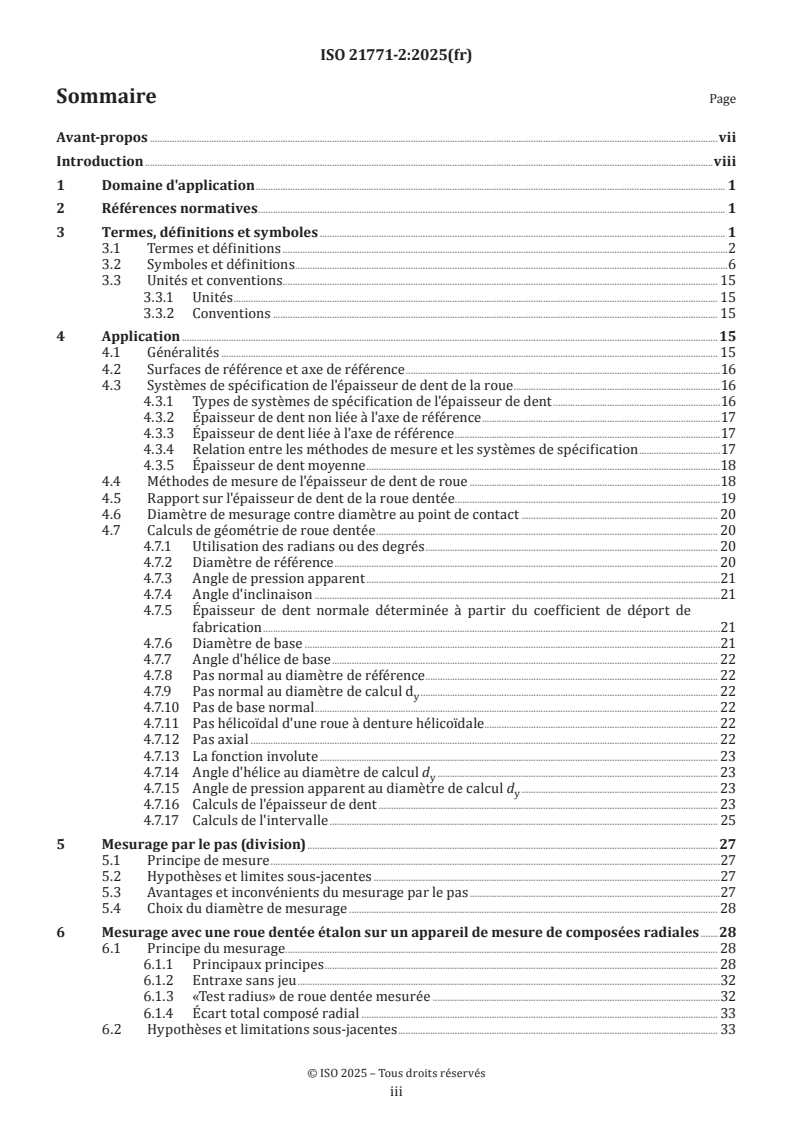
Contents Page
Foreword .vii
Introduction .viii
1 Scope . 1
2 Normative references . 1
3 Terms, definition and symbols . 1
3.1 Terms and definitions .1
3.2 Symbols and definitions .6
3.3 Units and conventions . 13
3.3.1 Units . . 13
3.3.2 Conventions . 13
4 Application .13
4.1 General . 13
4.2 Datum surfaces and the datum axis .14
4.3 Gear tooth thickness specification systems .14
4.3.1 Types of tooth thickness specification systems .14
4.3.2 Non-datum related tooth thickness . 15
4.3.3 Axis related tooth thickness . 15
4.3.4 Relationship between the measurement methods and specification systems . 15
4.3.5 Mean tooth thickness . 15
4.4 Gear tooth thickness measurement methods .16
4.5 Reporting of gear tooth thickness .17
4.6 Measurement diameter versus contact diameter .17
4.7 Gear geometry calculations .17
4.7.1 Use of radians or degrees .17
4.7.2 Reference diameter .18
4.7.3 Transverse pressure angle .18
4.7.4 Lead angle . .18
4.7.5 Normal tooth thickness from manufacturing profile shift coefficient .18
4.7.6 Base diameter .19
4.7.7 Base helix angle .19
4.7.8 Normal pitch at the reference diameter .19
4.7.9 Normal pitch at calculation diameter d .19
y
4.7.10 Normal base pitch .19
4.7.11 Lead of a helical gear .19
4.7.12 Axial pitch . . 20
4.7.13 The involute function . 20
4.7.14 Helix angle at calculation diameter d . 20
y
4.7.15 Transverse pressure angle at calculation diameter d . 20
y
4.7.16 Tooth thickness calculations . 20
4.7.17 Space width calculations . 22
5 Measurement by pitch (index) .24
5.1 Principle of measurement .24
5.2 Underlying assumptions and limitations .24
5.3 Advantages and disadvantages of measurement by pitch .24
5.4 Selection of measurement diameter . 25
6 Measurement with a master gear on a double flank tester .25
6.1 Principle of measurement . 25
6.1.1 Main principles . 25
6.1.2 Tight mesh centre distance . . 28
6.1.3 Product gear test radius . 29
6.1.4 Total radial composite deviation . 29
6.2 Underlying assumptions and limitations . 29
6.3 Advantages and disadvantages of double flank radial composite measurement . 30
iii
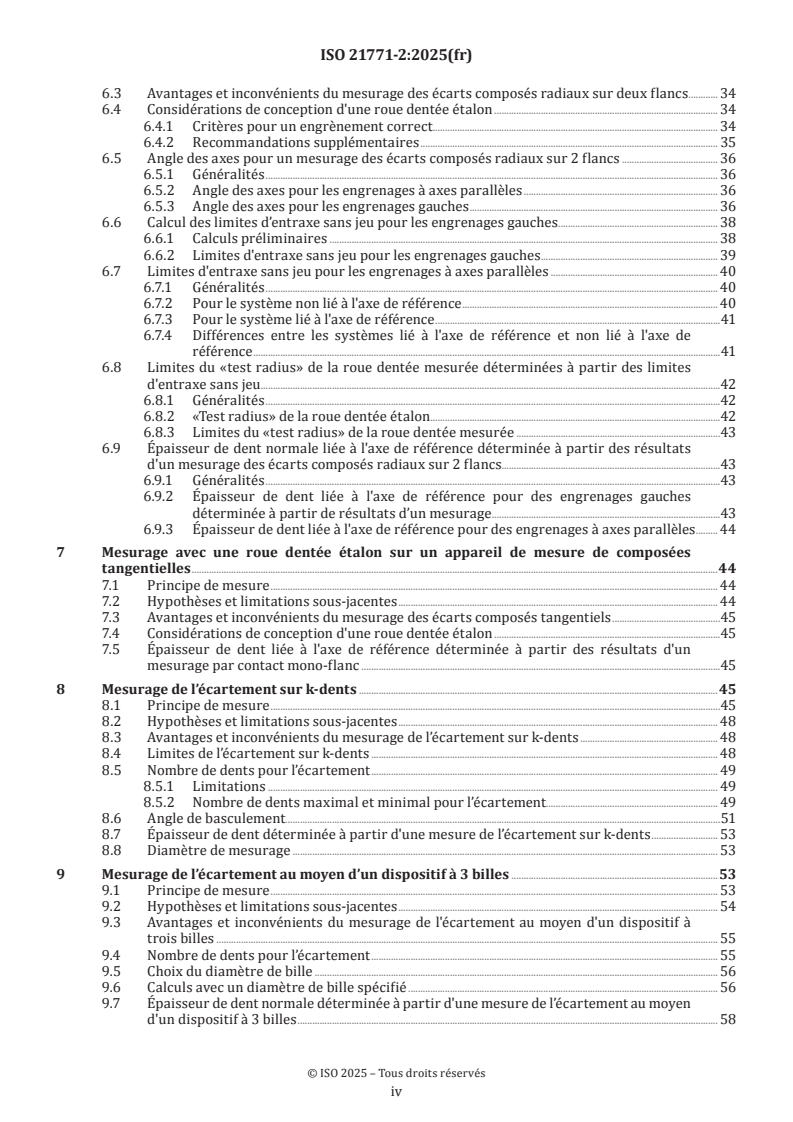
6.4 Master gear design considerations . 30
6.4.1 Criteria for proper meshing . 30
6.4.2 Additional recommendations .31
6.5 Skew angle for double flank testing .32
6.5.1 General .32
6.5.2 Skew angle for parallel axis gear pairs.32
6.5.3 Skew angle for crossed axis gear pairs .32
6.6 Calculation of tight mesh centre distance limits for crossed axis gears . 34
6.6.1 Preliminary calculations . 34
6.6.2 Tight mesh centre distance limits for crossed axis gears . 34
6.7 Tight mesh centre distance limits for parallel axis gears: . 35
6.7.1 General . 35
6.7.2 For the non-datum related system: . 36
6.7.3 For the axis related system: . 36
6.7.4 Differences between axis related and non-datum related systems . 36
6.8 Product gear test radius limits from tight mesh centre distance limits .37
6.8.1 General .37
6.8.2 Master gear test radius .37
6.8.3 Product gear test radius limits . 38
6.9 Axis related normal tooth thickness from double flank test results . 38
6.9.1 General . 38
6.9.2 Crossed axis external gear axis related tooth thickness from test results . 38
6.9.3 Parallel axis gear axis related tooth thickness . 38
7 Measurement with a master gear on a single flank tester.39
7.1 Principle of measurement . 39
7.2 Underlying assumptions and limitations . 39
7.3 Advantages and disadvantages of single flank composite measurement . 39
7.4 Master gear design considerations . 40
7.5 Axis related tooth thickness from single flank test results . 40
8 Span measurement .40
8.1 Principle of measurement . 40
8.2 Underlying assumptions and limitations .42
8.3 Advantages and disadvantages of span measurement .42
8.4 Span measurement limits .43
8.5 Number of teeth spanned .43
8.5.1 Limitations .43
8.5.2 Maximum and minimum number of teeth spanned .43
8.6 Angle of rock .45
8.7 Tooth thickness from span measurement .47
8.8 Measurement diameter .47
9 Measurement using three ball span device . 47
9.1 Principle of measurement .47
9.2 Underlying assumptions and limitations . 48
9.3 Advantages and disadvantages of three ball span device measurement. 48
9.4 Number of teeth spanned . 49
9.5 Selection of the ball diameter . 49
9.6 Calculations with specified ball diameter . 49
9.7 Normal tooth thickness from a measurement using a three ball span device .51
10 Measurement over or between balls or pins . 51
10.1 Principle of measurement .51
10.2 Underlying assumptions and limitations . 54
10.3 Advantages and disadvantages of over balls or pins measurement . 54
10.4 Selection of the ball or pin diameter . 55
10.4.1 General . 55
10.4.2 Transverse base space width half angles . 55
10.4.3 Maximum ball or pin diameter . 55
10.4.4 Ball or pin diameter for contact at the root involute limit diameter . 56
iv
10.4.5 Ball or pin diameter that will be tangent to the tip diameter . 56
10.4.6 Ball or pin diameter that will be tangent to the root diameter .57
10.4.7 Minimum usable ball diameter .57
10.4.8 Selection of ball or pin diameter to specify .57
10.4.9 Calculation for racks . 58
10.5 Calculations with specified ball or pin diameter (symmetric pressure angles) . 60
10.6 Gears with asymmetric pressure angles .61
10.6.1 General .61
10.6.2 Calculations with specified ball or pin diameter .61
10.7 Measurement over one ball or pin . .62
10.7.1 General .62
10.7.2 Basic inspection limits for measurement over one ball or pin . 63
10.7.3 Axis related normal tooth thickness from one ball or pin measurement . 64
10.7.4 Contact diameter from the measurement over one ball or pin . 64
10.8 Measurement over two balls or pins . 64
10.8.1 General . 64
10.8.2 Basic inspection limits for measurement over two balls or pins . 65
10.8.3 Normal tooth thickness from a measurement over two balls or pins . 66
10.8.4 Contact diameter from the measurement over two balls or pins . 66
10.9 Two pin transverse measurement on helical gear, odd number of teeth . 66
10.9.1 General . 66
10.9.2 Transverse measurement with two free floating pins . 66
10.9.3 Measurement with two pins rotating around the micrometer axis . 68
10.9.4 Basic inspection limits for the two-pin transverse method .70
10.9.5 Normal tooth thickness from a two-pin transverse method measurement .70
10.10 Free pin measurement over two pins, helical gear, odd number of teeth .70
10.10.1 General .70
10.10.2 Basic inspection limits for the free pin method .71
10.10.3 Non-datum related normal tooth thickness from free pin measurement . 72
10.11 Transverse plane measurement method over three balls or pins . 72
10.11.1 General . 72
10.11.2 Factors for gears with even or odd numbers of teeth .74
10.11.3 Measurement limits using the transverse plane method for three balls or pins .74
10.11.4 Normal tooth thickness from a transverse plane method measurement .74
10.11.5 Contact diameter from the transverse plane method.74
10.12 Axial plane three pin method .74
10.12.1 General .74
10.12.2 Measurement limits using the axial plane three pin method . 75
10.12.3 Normal tooth thickness from axial plane method measurement .76
10.12.4 Contact diameter from the axial plane three pin method .76
11 Measurement with measuring blocks . . 76
11.1 Principle of measurement .76
11.2 Underlying assumptions and limitations .76
11.3 Advantages and disadvantages of using blocks . 77
11.4 Measuring block sets. 77
11.5 Measurement limits for blocks . . 78
11.6 Tooth thickness from block measurements . 79
12 Chordal measurement.79
12.1 General . 79
12.2 Measurements with a gear tooth calliper (in the normal plane) . 80
12.2.1 Principle of measurement . 80
12.2.2 Underlying assumptions and limitations . 81
12.2.3 Advantages and disadvantages of chordal measurement . 81
12.2.4 Method for calculation . 82
12.2.5 Preliminary calculations for chordal measurements . 82
12.2.6 Chordal addendum . 83
12.2.7 Minimum contact diameter . 83
12.2.8 Minimum normal tooth thickness at diameter d . 83
y min
v
12.2.9 Normal chordal tooth thickness measurement limits . 83
12.2.10 Adjustment of chordal addendum at time of measurement. 84
12.2.11 Normal tooth thickness from a chordal measurement . 84
12.3 Chordal measurement with an optical device (in the transverse plane) . 84
12.3.1 Principle of measurement . 84
12.3.2 Underlying assumptions and limitations . 85
12.3.3 Advantages and disadvantages of chordal measurement with optical device . 85
12.3.4 Method for calculation . 85
12.3.5 Transverse pressure angle at the desired contact diameter. 86
12.3.6 Maximum transverse tooth thickness . 86
12.3.7 Chordal radius . 86
12.3.8 Minimum contact diameter . 86
12.3.9 Minimum transverse tooth thickness at diameter, d . 86
yt min
12.3.10 Transverse chordal tooth thickness measurement limits. 86
12.3.11 Conversion of chordal radius to chordal addendum . 87
12.3.12 Normal tooth thickness from a chordal measurement . 87
12.4 Chordal measurement with a coordinate measurement machine . 88
13 Backlash in parallel axis and crossed axis gear pairs .88
13.1 General . 88
13.2 Factors that influence backlash . . 89
13.3 Backlash for parallel axis gears in the axis related system . 90
13.4 Backlash for parallel axis gears in the non-datum related system .91
13.5 Backlash in crossed axis gears . 93
13.6 Other potential influences on backlash . 95
13.7 Ways to express backlash . 96
13.7.1 Circumferential backlash . 96
13.7.2 Transverse backlash . 96
13.7.3 Normal backlash . 96
13.7.4 Axial backlash . 97
13.7.5 Radial backlash . 97
13.7.6 Angular backlash . 97
13.8 Variations in backlash . 97
Annex A (informative) Tooth thickness measurement using analytical machines .99
Annex B (informative) Establishing tooth thickness specifications in the non-datum related
system.100
Annex C (informative) Establishing tooth thickness specifications in the axis related system .102
Annex D (informative) Calculation method for the inverse involute function .103
Annex E (informative) Example calculations .104
Bibliography .140
vi
Foreword
ISO (the International Organization for Standardization) is a worldwide federation of national standards
bodies (ISO member bodies). The work of preparing International Standards is normally carried out through
ISO technical committees. Each member body interested in a subject for which a technical committee
has been established has the right to be represented on that committee. International organizations,
governmental and non-governmental, in liaison with ISO, also take part in the work. ISO collaborates closely
with the International Electrotechnical Commission (IEC) on all matters of electrotechnical standardization.
The procedures used to develop this document and those intended for its further maintenance are described
in the ISO/IEC Directives, Part 1. In particular, the different approval criteria needed for the different types
of ISO documents should be noted. This document was drafted in accordance with the editorial rules of the
ISO/IEC Directives, Part 2 (see www.iso.org/directives).
ISO draws attention to the possibility that the implementation of this document may involve the use of (a)
patent(s). ISO takes no position concerning the evidence, validity or applicability of any claimed patent
rights in respect thereof. As of the date of publication of this document, ISO had not received notice of (a)
patent(s) which may be required to implement this document. However, implementers are cautioned that
this may not represent the latest information, which may be obtained from the patent database available at
www.iso.org/patents. ISO shall not be held responsible for identifying any or all such patent rights.
Any trade name used in this document is information given for the convenience of users and does not
constitute an endorsement.
For an explanation of the voluntary nature of standards, the meaning of ISO specific terms and expressions
related to conformity assessment, as well as information about ISO's adherence to the World Trade
Organization (WTO) principles in the Technical Barriers to Trade (TBT) see www.iso.org/iso/foreword.html.
This document was prepared by Technical Committee ISO/TC 60, Gears.
A list of all parts in the ISO 21771 series can be found on the ISO website.
Any feedback or questions on this document should be directed to the user’s national standards body. A
complete listing of these bodies can be found at www.iso.org/members.html.
vii
Introduction
This document replaces the sections of ISO/TR-10064-1 and ISO 21771-1 that used to provide information
on calculation and measurement of tooth thickness. It is based on AGMA 2002, along with some material
1)
from ISO 21771-1:2007 Annex A and ISO/TR 10064-2, and some new information on crossed axis gears and
measurement using a three ball span device. Example calculations are provided in Annex E.
1) Withdrawn.
viii
International Standard ISO 21771-2:2025(en)
Cylindrical involute gears and gear pairs —
Part 2:
Calculation and measurement of tooth thickness and
backlash
1 Scope
This document establishes the calculation procedures for determining specification limits for external and
internal cylindrical involute gearing with constant gear ratio when the desired tooth thickness is known. It
also shows the relationships between backlash and the tooth thickness, centre distance, and tooth deviations
in a pinion and gear mesh.
This document applies to the following types of gears:
— external and internal parallel axis cylindrical involute spur and helical gears;
— involute worms and crossed axis gears;
— spur and helical racks;
— involute spur and helical sector gears.
The formulae in this document apply to gears of all sizes and materials, and to all manufacturing methods.
This document does not provide guidance on selecting the tooth thickness or the tolerance on the thickness.
2 Normative references
There are no normative references in this document.
3 Terms, definition and symbols
For the purposes of this document, the following terms and definitions apply.
ISO and IEC maintain terminology databases for use in standardization at the following addresses:
— ISO Online browsing platform: available at https:// www .iso .org/ obp
— IEC Electropedia: available at https:// www .electropedia .org/
3.1 Terms and definitions
3.1.1
backlash
amount by which the width of a tooth space exceeds the thickness of the engaging tooth on the working
pitch circles, i.e. the clearance between mating gear teeth
Note 1 to entry: See Clause 13 for further information.
Note 2 to entry: Backlash can be defined in either a normal or a transverse section and either perpendicular to the
flank or in a circumferential direction (tangential) at a specified diameter.
3.1.2
ball
calibrated gauge artifact which is spherical and has a known diameter and very tight tolerances on roundness
and profile of surface
Note 1 to entry: See ISO 1101 for further information.
Note 2 to entry: For comparison, see the definition of pin (3.1.14).
3.1.3
addendum
h
a
radial distance from the reference diameter to the tip diameter of the gear
Note 1 to entry: See Figure 1.
Figure 1 — External gear transverse tooth thickness and base transverse tooth thickness
3.1.4
chordal addendum
h
cy
radial distance from the mid point of the chordal measurement line to tip diameter of a gear
Note 1 to entry: See Figure 2.
3.1.5
chordal radius
r
cy
radial distance from the datum axis to the midpoint of the chordal measurement line
Note 1 to entry: The chordal radius is normally found by subtracting the chordal addendum (3.1.4) from the tip radius.
NOTE 1 normal, chordal and base tooth thickness are shown
NOTE 2 The normal surface is shown projected onto a plane
Figure 2 — Tooth thickness on external helical gear normal surface
3.1.6
datum axis
theoretical gear axis defined by the datum surfaces
Note 1 to entry: The datum axis cannot be directly defined; it only exists in relation to the datum surfaces. It is the axis
to which the gear details, and in particular the pitch, profile, and helix tolerances are defined. It should correspond to
the rotational axis. See ISO/TR 10064-3 for additional information.
3.1.7
tip involute limit diameter
d
La
diameter where the involute ends near the gear tip
Note 1 to entry: It is the smaller of the minimum tip relief diameter, d , the minimum tip form diameter, d , or the
Ca Fa
minimum tip diameter, d .
a min
Note 2 to entry: For internal gears, the minimum tip (minor) diameter, d has an absolute value greater than the
a min
absolute value of the maximum tip (major) diameter, d .
a max
Note 3 to entry: In many cases, at the beginning of tip relief zone, the deviation from the involute is so small that it
often can be ignored in tooth thickness measurements. In these cases, the value used for the limit diameter can be
within the tip relief zone.
3.1.8
root involute limit diameter
d
Lf
diameter where the involute ends near the gear root
Note 1 to entry: It is the greater of the profile control diameter, d , maximum root relief diameter, d , or the maximum
Cf Cαf
root form diameter, d .
Ff
Note 2 to entry: In many cases, at the beginning of root relief zone, the deviation from the involute is so small that it
often can be ignored in tooth thickne
...
Norme
internationale
ISO 21771-2
Première édition
Roues dentées et engrenages
2025-12
cylindriques en développante de
cercle —
Partie 2:
Calcul et mesurage de l'épaisseur de
dent et du jeu de battement
Cylindrical involute gears and gear pairs —
Part 2: Calculation and measurement of tooth thickness and
backlash
Numéro de référence
DOCUMENT PROTÉGÉ PAR COPYRIGHT
© ISO 2025
Tous droits réservés. Sauf prescription différente ou nécessité dans le contexte de sa mise en œuvre, aucune partie de cette
publication ne peut être reproduite ni utilisée sous quelque forme que ce soit et par aucun procédé, électronique ou mécanique,
y compris la photocopie, ou la diffusion sur l’internet ou sur un intranet, sans autorisation écrite préalable. Une autorisation peut
être demandée à l’ISO à l’adresse ci-après ou au comité membre de l’ISO dans le pays du demandeur.
ISO copyright office
Case postale 401 • Ch. de Blandonnet 8
CH-1214 Vernier, Genève
Tél.: +41 22 749 01 11
E-mail: copyright@iso.org
Web: www.iso.org
Publié en Suisse
ii
Sommaire Page
Avant-propos .vii
Introduction .viii
1 Domaine d'application . 1
2 Références normatives . 1
3 Termes, définitions et symboles . 1
3.1 Termes et définitions .2
3.2 Symboles et définitions .6
3.3 Unités et conventions. 15
3.3.1 Unités . 15
3.3.2 Conventions . 15
4 Application .15
4.1 Généralités . 15
4.2 Surfaces de référence et axe de référence .16
4.3 Systèmes de spécification de l'épaisseur de dent de la roue .16
4.3.1 Types de systèmes de spécification de l'épaisseur de dent .16
4.3.2 Épaisseur de dent non liée à l'axe de référence .17
4.3.3 Épaisseur de dent liée à l'axe de référence .17
4.3.4 Relation entre les méthodes de mesure et les systèmes de spécification .17
4.3.5 Épaisseur de dent moyenne .18
4.4 Méthodes de mesure de l'épaisseur de dent de roue .18
4.5 Rapport sur l'épaisseur de dent de la roue dentée.19
4.6 Diamètre de mesurage contre diamètre au point de contact . 20
4.7 Calculs de géométrie de roue dentée . 20
4.7.1 Utilisation des radians ou des degrés . 20
4.7.2 Diamètre de référence . 20
4.7.3 Angle de pression apparent .21
4.7.4 Angle d'inclinaison .21
4.7.5 Épaisseur de dent normale déterminée à partir du coefficient de déport de
fabrication .21
4.7.6 Diamètre de base .21
4.7.7 Angle d'hélice de base . 22
4.7.8 Pas normal au diamètre de référence . 22
4.7.9 Pas normal au diamètre de calcul d . 22
y
4.7.10 Pas de base normal . 22
4.7.11 Pas hélicoïdal d'une roue à denture hélicoïdale . 22
4.7.12 Pas axial . 22
4.7.13 La fonction involute . 23
4.7.14 Angle d'hélice au diamètre de calcul d . 23
y
4.7.15 Angle de pression apparent au diamètre de calcul d . 23
y
4.7.16 Calculs de l'épaisseur de dent . 23
4.7.17 Calculs de l'intervalle . 25
5 Mesurage par le pas (division) .27
5.1 Principe de mesure .27
5.2 Hypothèses et limites sous-jacentes .27
5.3 Avantages et inconvénients du mesurage par le pas .27
5.4 Choix du diamètre de mesurage . 28
6 Mesurage avec une roue dentée étalon sur un appareil de mesure de composées radiales .28
6.1 Principe du mesurage . 28
6.1.1 Principaux principes . 28
6.1.2 Entraxe sans jeu .32
6.1.3 «Test radius» de roue dentée mesurée .32
6.1.4 Écart total composé radial . 33
6.2 Hypothèses et limitations sous-jacentes . 33
iii
6.3 Avantages et inconvénients du mesurage des écarts composés radiaux sur deux flancs . 34
6.4 Considérations de conception d'une roue dentée étalon . 34
6.4.1 Critères pour un engrènement correct. 34
6.4.2 Recommandations supplémentaires . 35
6.5 Angle des axes pour un mesurage des écarts composés radiaux sur 2 flancs . 36
6.5.1 Généralités . 36
6.5.2 Angle des axes pour les engrenages à axes parallèles . 36
6.5.3 Angle des axes pour les engrenages gauches . 36
6.6 Calcul des limites d’entraxe sans jeu pour les engrenages gauches . 38
6.6.1 Calculs préliminaires . 38
6.6.2 Limites d'entraxe sans jeu pour les engrenages gauches . 39
6.7 Limites d'entraxe sans jeu pour les engrenages à axes parallèles . 40
6.7.1 Généralités . 40
6.7.2 Pour le système non lié à l'axe de référence . 40
6.7.3 Pour le système lié à l'axe de référence .41
6.7.4 Différences entre les systèmes lié à l'axe de référence et non lié à l'axe de
référence .41
6.8 Limites du «test radius» de la roue dentée mesurée déterminées à partir des limites
d'entraxe sans jeu . . .42
6.8.1 Généralités .42
6.8.2 «Test radius» de la roue dentée étalon .42
6.8.3 Limites du «test radius» de la roue dentée mesurée .43
6.9 Épaisseur de dent normale liée à l'axe de référence déterminée à partir des résultats
d'un mesurage des écarts composés radiaux sur 2 flancs.43
6.9.1 Généralités .43
6.9.2 Épaisseur de dent liée à l'axe de référence pour des engrenages gauches
déterminée à partir de résultats d’un mesurage .43
6.9.3 Épaisseur de dent liée à l'axe de référence pour des engrenages à axes parallèles . 44
7 Mesurage avec une roue dentée étalon sur un appareil de mesure de composées
tangentielles .44
7.1 Principe de mesure . 44
7.2 Hypothèses et limitations sous-jacentes . 44
7.3 Avantages et inconvénients du mesurage des écarts composés tangentiels .45
7.4 Considérations de conception d'une roue dentée étalon .45
7.5 Épaisseur de dent liée à l'axe de référence déterminée à partir des résultats d'un
mesurage par contact mono-flanc .45
8 Mesurage de l’écartement sur k-dents .45
8.1 Principe de mesure .45
8.2 Hypothèses et limitations sous-jacentes . 48
8.3 Avantages et inconvénients du mesurage de l’écartement sur k-dents . 48
8.4 Limites de l’écartement sur k-dents . 48
8.5 Nombre de dents pour l’écartement . 49
8.5.1 Limitations . 49
8.5.2 Nombre de dents maximal et minimal pour l’écartement. 49
8.6 Angle de basculement.51
8.7 Épaisseur de dent déterminée à partir d'une mesure de l’écartement sur k-dents . 53
8.8 Diamètre de mesurage . 53
9 Mesurage de l’écartement au moyen d’un dispositif à 3 billes .53
9.1 Principe de mesure . 53
9.2 Hypothèses et limitations sous-jacentes . 54
9.3 Avantages et inconvénients du mesurage de l'écartement au moyen d'un dispositif à
trois billes . 55
9.4 Nombre de dents pour l’écartement . 55
9.5 Choix du diamètre de bille . 56
9.6 Calculs avec un diamètre de bille spécifié . 56
9.7 Épaisseur de dent normale déterminée à partir d'une mesure de l’écartement au moyen
d'un dispositif à 3 billes . 58
iv
10 Mesurage de cotes sur ou entre billes ou piges .58
10.1 Principe de mesure . 58
10.2 Hypothèses et limitations sous-jacentes .61
10.3 Avantages et inconvénients du mesurage de cote sur billes ou sur piges.62
10.4 Choix du diamètre de bille ou de pige .62
10.4.1 Généralités .62
10.4.2 Demi-angles apparent de l'intervalle au cercle de base . 63
10.4.3 Diamètre maximal de bille ou de pige . 63
10.4.4 Diamètre de bille ou de pige pour un contact au diamètre limite de pied . 64
10.4.5 Diamètre de bille ou de pige tangent au diamètre de tête . 64
10.4.6 Diamètre de bille ou de pige tangent au diamètre de pied . 65
10.4.7 Diamètre de bille minimal utilisable . 65
10.4.8 Choix du diamètre de bille ou de pige à spécifier . 65
10.4.9 Calcul pour les crémaillères . 66
10.5 Calculs avec un diamètre de bille ou de pige spécifié (angles de pression symétriques) . 68
10.6 Roues ayant des angles de pression asymétriques . 69
10.6.1 Généralités . 69
10.6.2 Calculs avec un diamètre de bille ou de pige spécifié.70
10.7 Mesurage de cote sur 1 bille ou 1 pige .71
10.7.1 Généralités .71
10.7.2 Limites de mesure de base pour le mesurage de cote sur 1 bille ou 1 pige .71
10.7.3 Épaisseur de dent normale liée à l'axe de référence déterminée à partir d'une
mesure sur 1 bille ou 1 pige . 72
10.7.4 Diamètre au point de contact déterminé à partir de la cote sur 1 bille ou 1 pige . 72
10.8 Mesurage de cote sur 2 billes ou 2 piges . 73
10.8.1 Généralités . 73
10.8.2 Limites de mesure de base pour une cote sur 2 billes ou 2 piges . 73
10.8.3 Épaisseur de dent normale déterminée à partir d'une mesure sur 2 billes
ou 2 piges.74
10.8.4 Diamètre au point de contact déterminé à partir de la cote sur 2 billes ou 2 piges . 75
10.9 Mesurage au plan apparent sur 2 piges sur une roue à denture hélicoïdale ayant un
nombre de dents impair . 75
10.9.1 Généralités . 75
10.9.2 Mesurage au plan apparent avec 2 piges flottantes libres . 75
10.9.3 Mesurage avec 2 piges libres en rotation autour de l'axe de micromètre .76
10.9.4 Limites de mesure de base pour la méthode au plan apparent avec 2 piges . 78
10.9.5 Épaisseur de dent normale déterminée à partir d'une méthode de mesure au
plan apparent avec 2 piges . 78
10.10 Mesurage de cote sur piges libres sur 2 piges sur une roue à denture hélicoïdale ayant
un nombre de dents impair . 78
10.10.1 Généralités . 78
10.10.2 Limites de mesure de base pour la méthode de piges libres . 79
10.10.3 Épaisseur de dent normale non liée à l'axe de référence déterminée à partir de
mesure sur piges libres . 80
10.11 Méthode de mesure au plan apparent sur 3 billes ou 3 piges . 80
10.11.1 Généralités . 80
10.11.2 Facteurs pour des roues dentées ayant des nombres de dents pairs ou impairs . 82
10.11.3 Limites de mesure utilisant la méthode au plan apparent pour 3 billes ou 3 piges . 82
10.11.4 Épaisseur de dent normale déterminée à partir d'une mesure obtenue par une
méthode au plan apparent . 82
10.11.5 Diamètre au point de contact déterminé à partir de la méthode au plan apparent . 83
10.12 Méthode au plan axial sur 3 piges . 83
10.12.1 Généralités . 83
10.12.2 Cotes limites utilisant la méthode des 3 piges au plan axial . 84
10.12.3 Épaisseur de dent normale déterminée à partir d'une mesure obtenue par la
méthode au plan axial . 84
10.12.4 Diamètre au point de contact déterminé à partir de la cote sur 3 piges au plan
axial . 84
v
11 Mesurage avec des enclumes trapézoïdales .85
11.1 Principe de mesure . 85
11.2 Hypothèses et limitations sous-jacentes . 85
11.3 Avantages et inconvénients de l'utilisation d'enclumes . 86
11.4 Ensembles d’enclumes trapézoïdales . 86
11.5 Limites de mesure pour des enclumes trapézoïdales . 87
11.6 Épaisseur de dent déterminée à partir de mesures avec des enclumes . 88
12 Mesurage à la corde .88
12.1 Généralités . 88
12.2 Mesurages avec un pied module (dans le plan normal) . 89
12.2.1 Principe de mesure . 89
12.2.2 Hypothèses et limitations sous-jacentes . 90
12.2.3 Avantages et inconvénients d'un mesurage à la corde . 90
12.2.4 Méthode de calcul .91
12.2.5 Calculs préliminaires pour des mesurages à la corde .91
12.2.6 Saillie à la corde . 92
12.2.7 Diamètre au point de contact minimal . 92
12.2.8 Épaisseur de dent normale minimale au diamètre d . 92
y min
12.2.9 Limites de mesure d'épaisseur de dent à la corde normale . 93
12.2.10 Ajustement de la saillie à la corde au moment du mesurage . 93
12.2.11 Épaisseur de dent normale déterminée à partir d’une mesure à la corde . 94
12.3 Mesurage à la corde avec un dispositif optique (dans le plan apparent) . 94
12.3.1 Principe de mesure . 94
12.3.2 Hypothèses et limitations sous-jacentes . 94
12.3.3 Avantages et inconvénients du mesurage à la corde avec un dispositif optique . 95
12.3.4 Méthode de calcul . 95
12.3.5 Angle de pression apparent au diamètre au point de contact souhaité . 95
12.3.6 Épaisseur de dent apparente maximale . 95
12.3.7 Rayon à la corde . 95
12.3.8 Diamètre au point de contact minimal . 96
12.3.9 Épaisseur de dent apparente minimale au diamètre, d . 96
yt min
12.3.10 Limites de mesure d'épaisseur de dent à la corde apparente . 96
12.3.11 Conversion d'un rayon à la corde en saillie à la corde . 96
12.3.12 Épaisseur de dent normale déterminée à partir d’une mesure à la corde . 97
12.4 Mesurage à la corde avec une machine à mesurer tridimensionnelle . 97
13 Jeu de battement dans les engrenages à axes parallèles et les engrenages gauches .98
13.1 Généralités . 98
13.2 Facteurs qui influencent le jeu de battement . 99
13.3 Jeu de battement pour les engrenages à axes parallèles dans le système liée à l'axe de
référence . 100
13.4 Jeu de battement pour les engrenages à axes parallèles dans le système non lié à l'axe
de référence . 102
13.5 Jeu de battement dans les engrenages gauches . 104
13.6 Autres influences potentielles sur le jeu de battement . 106
13.7 Moyens d'exprimer un jeu de battement . 107
13.7.1 Jeu de battement circulaire . 107
13.7.2 Jeu de battement apparent . 107
13.7.3 Jeu de battement normal . 108
13.7.4 Jeu de battement axial . 108
13.7.5 Jeu de battement radial . 108
13.7.6 Jeu de battement angulaire . 109
13.8 Variations de jeu de battement . 109
Annexe A (informative) Mesurage de l'épaisseur de dent au moyen de machines 3D .110
Annexe B (informative) Établissement de spécifications d'épaisseur de dent dans le système
non lié à l'axe de référence .112
vi
Avant-propos
L'ISO (Organisation internationale de normalisation) est une fédération mondiale d'organismes nationaux
de normalisation (comités membres de l'ISO). L'élaboration des Normes internationales est en général
confiée aux comités techniques de l'ISO. Chaque comité membre intéressé par une étude a le droit de faire
partie du comité technique créé à cet effet. Les organisations internationales, gouvernementales et non
gouvernementales, en liaison avec l'ISO participent également aux travaux. L'ISO collabore étroitement avec
la Commission électrotechnique internationale (IEC) en ce qui concerne la normalisation électrotechnique.
Les procédures utilisées pour élaborer le présent document et celles destinées à sa mise à jour sont
décrites dans les Directives ISO/IEC, Partie 1. Il convient, en particulier, de prendre note des différents
critères d'approbation requis pour les différents types de documents ISO. Le présent document
a été rédigé conformément aux règles de rédaction données dans les Directives ISO/IEC, Partie 2
(voir www.iso.org/directives).
L’ISO attire l’attention sur le fait que la mise en application du présent document peut entraîner l’utilisation
d’un ou de plusieurs brevets. L’ISO ne prend pas position quant à la preuve, à la validité et à l’applicabilité de
tout droit de propriété revendiqué à cet égard. À la date de publication du présent document, l’ISO n'avait pas
reçu notification qu’un ou plusieurs brevets pouvaient être nécessaires à sa mise en application. Toutefois,
il y a lieu d’avertir les responsables de la mise en application du présent document que des informations
plus récentes sont susceptibles de figurer dans la base de données de brevets, disponible à l'adresse
www.iso.org/brevets. L'ISO ne saurait être tenue pour responsable de ne pas avoir identifié de tels droits de
propriété et averti de leur existence.
Les appellations commerciales éventuellement mentionnées dans le présent document sont données pour
information, par souci de commodité, à l'intention des utilisateurs et ne sauraient constituer un engagement.
Pour une explication de la nature volontaire des normes, la signification des termes et expressions
spécifiques de l'ISO liés à l'évaluation de la conformité, ou pour toute information au sujet de l'adhésion de
l'ISO aux principes de l'Organisation mondiale du commerce (OMC) concernant les obstacles techniques au
commerce (OTC), voir www.iso.org/avant-propos.
Le présent document a été élaboré par le comité technique ISO/TC 60, Engrenages.
Une liste de toutes les parties de la série ISO 21771 se trouve sur le site web de l'ISO.
Il convient que l'utilisateur adresse tout retour d'information ou toute question concernant le présent
document à l'organisme national de normalisation de son pays. Une liste exhaustive desdits organismes se
trouve à l'adresse www.iso.org/fr/members.html.
vii
Introduction
Le présent document remplace les sections de l’ISO/TR 10064-1 et de l'ISO 21771-1 qui fournissaient des
informations sur le calcul et le mesurage de l’épaisseur de dent. Il est basé sur l’AGMA 2002, ainsi que sur
1)
certains éléments de l’ISO 2177-1:2007 , Annexe A et de l’ISO/TR 10064-2, et sur de nouvelles informations
concernant les engrenages gauches et le mesurage au moyen d'un dispositif à 3 billes pour mesurer
l'écartement. Des exemples de calculs sont fournis dans l'Annexe E.
1) Annulée.
viii
Norme internationale ISO 21771-2:2025(fr)
Roues dentées et engrenages cylindriques en développante
de cercle —
Partie 2:
Calcul et mesurage de l'épaisseur de dent et du jeu de
battement
1 Domaine d'application
Le présent document établit les méthodes de calcul permettant de déterminer les limites de spécification
pour les engrenages cylindriques à dentures extérieure et intérieure en développante de cercle ayant un
rapport d'engrenage constant lorsque l'épaisseur de dent souhaitée est connue. Il montre également les
relations entre le jeu de battement, l'épaisseur de dent, l'entraxe et les écarts de dent dans un engrènement
de pignon et de roue.
Le présent document s'applique aux types d'engrenages suivants:
— engrenages cylindriques à axes parallèles à dentures extérieure et intérieure, droite et hélicoïdale en
développante de cercle;
— vis en développante de cercle et engrenages gauches en développante de cercle;
— crémaillères à dentures droite et hélicoïdale;
— secteurs dentés à dentures droite et hélicoïdale en développante de cercle.
Les formules du présent document s'appliquent aux engrenages de toutes les tailles et quelque soit les
matériaux, et à toutes les méthodes de fabrication.
Le présent document ne fournit pas de recommandation sur le choix de l'épaisseur de dent ou de la tolérance
sur l'épaisseur.
2 Références normatives
Le présent document ne contient aucune référence normative.
3 Termes, définitions et symboles
Pour les besoins du présent document, les termes et définitions suivants s'appliquent.
L’ISO et l’IEC tiennent à jour des bases de données terminologiques destinées à être utilisées en normalisation,
consultables aux adresses suivantes:
— ISO Online browsing platform: disponible à l’adresse https:// www .iso .org/ obp
— IEC Electropedia: disponible à l’adresse https:// www .electropedia .org/
3.1 Termes et définitions
3.1.1
jeu de battement
quantité par laquelle la valeur de l'entredent dépasse l'épaisseur de dent en prise au niveau des cercles
primitifs de fonctionnement, c'est-à-dire le jeu entre les dents des roues conjuguées
Note 1 à l'article: Voir Article 13 pour plus d’informations.
Note 2 à l'article: Le jeu de battement peut être défini dans une section normale ou apparente et soit perpendiculaire
au flanc, soit dans une direction circonférentielle (tangentielle) au niveau d'un diamètre spécifié.
3.1.2
bille
calibre de mesure étalonné de forme sphérique ayant un diamètre connu avec des tolérances très serrées
sur la circularité et le profil de surface
Note 1 à l'article: Voir l'ISO 1101 pour plus d’informations.
Note 2 à l'article: Pour une comparaison, voir la définition de pige (3.1.14).
3.1.3
saillie
h
a
distance radiale entre le diamètre de référence et le diamètre de tête de la roue dentée
Note 1 à l'article: Voir Figure 1.
Figure 1 — Épaisseur de dent apparente et épaisseur de dent de base apparente d’une roue à
denture extérieure
3.1.4
saillie à la corde
h
cy
distance radiale entre le milieu de la ligne de mesure à la corde et le diamètre de tête d'une roue dentée
Note 1 à l'artic
...