


ISO 19085-6:2017
(Main)Woodworking machines — Safety — Part 6: Single spindle vertical moulding machines ("toupies")
Woodworking machines — Safety — Part 6: Single spindle vertical moulding machines ("toupies")
ISO 19085-6:2017 gives the safety requirements and measures for stationary and displaceable hand-fed single spindle vertical moulding machines, hereinafter referred to as "machines", designed to cut wood and materials with similar physical characteristics to wood. NOTE 1 For the definitions of stationary and displaceable machines, see ISO 19085‑1:2017, 3.4 and 3.5. It deals with all significant hazards, hazardous situations and events as listed in Clause 4, relevant to the machines when they are operated, adjusted and maintained as intended and under the conditions foreseen by the manufacturer including reasonably foreseeable misuse. Also, transport, assembly, dismantling, disabling and scrapping phases are taken into account. NOTE 2 For relevant but not significant hazards, e.g. sharp edges of the machine frame, see ISO 12100:2010.
Machines à bois — Sécurité — Partie 6: Toupies monobroches à arbre vertical
L'ISO 19085-6 :2017 donne les exigences et les mesures de sécurité pour les toupies monobroches à arbre vertical à avance manuelle fixes et transportables, ci-après désignées «machines», conçues pour la coupe de bois et de matériau ayant des caractéristiques physiques similaires à celles du bois. NOTE 1 Pour les définitions de machines fixes et transportables, voir l'ISO 19085-1:2017, 3.4 et 3.5. Il traite de tous les phénomènes dangereux, situations et événements dangereux significatifs, tels qu'énumérés à l'Article 4, applicables aux machines lorsqu'elles sont utilisées, réglées et entretenues comme prévu et dans les conditions prévues par le fabricant, incluant une mauvaise utilisation raisonnablement prévisible. Les phases de transport, d'assemblage, de démontage, de mise hors service et de mise au rebut sont également prises en compte.
General Information
- Status
- Withdrawn
- Publication Date
- 01-Nov-2017
- Technical Committee
- ISO/TC 39/SC 4 - Woodworking machines
- Drafting Committee
- ISO/TC 39/SC 4 - Woodworking machines
- Current Stage
- 9599 - Withdrawal of International Standard
- Start Date
- 09-Apr-2024
- Completion Date
- 12-Feb-2026
Relations
- Effective Date
- 09-Feb-2026
- Effective Date
- 12-Feb-2026
- Effective Date
- 17-Jul-2021
Get Certified
Connect with accredited certification bodies for this standard

NSF International
Global independent organization facilitating standards development and certification.

CIS Institut d.o.o.
Personal Protective Equipment (PPE) certification body. Notified Body NB-2890 for EU Regulation 2016/425 PPE.
Gozdarski inštitut Slovenije
Slovenian Forestry Institute. Forest management certification support, timber testing.
Sponsored listings
Frequently Asked Questions
ISO 19085-6:2017 is a standard published by the International Organization for Standardization (ISO). Its full title is "Woodworking machines — Safety — Part 6: Single spindle vertical moulding machines ("toupies")". This standard covers: ISO 19085-6:2017 gives the safety requirements and measures for stationary and displaceable hand-fed single spindle vertical moulding machines, hereinafter referred to as "machines", designed to cut wood and materials with similar physical characteristics to wood. NOTE 1 For the definitions of stationary and displaceable machines, see ISO 19085‑1:2017, 3.4 and 3.5. It deals with all significant hazards, hazardous situations and events as listed in Clause 4, relevant to the machines when they are operated, adjusted and maintained as intended and under the conditions foreseen by the manufacturer including reasonably foreseeable misuse. Also, transport, assembly, dismantling, disabling and scrapping phases are taken into account. NOTE 2 For relevant but not significant hazards, e.g. sharp edges of the machine frame, see ISO 12100:2010.
ISO 19085-6:2017 gives the safety requirements and measures for stationary and displaceable hand-fed single spindle vertical moulding machines, hereinafter referred to as "machines", designed to cut wood and materials with similar physical characteristics to wood. NOTE 1 For the definitions of stationary and displaceable machines, see ISO 19085‑1:2017, 3.4 and 3.5. It deals with all significant hazards, hazardous situations and events as listed in Clause 4, relevant to the machines when they are operated, adjusted and maintained as intended and under the conditions foreseen by the manufacturer including reasonably foreseeable misuse. Also, transport, assembly, dismantling, disabling and scrapping phases are taken into account. NOTE 2 For relevant but not significant hazards, e.g. sharp edges of the machine frame, see ISO 12100:2010.
ISO 19085-6:2017 is classified under the following ICS (International Classification for Standards) categories: 13.110 - Safety of machinery; 79.120.10 - Woodworking machines. The ICS classification helps identify the subject area and facilitates finding related standards.
ISO 19085-6:2017 has the following relationships with other standards: It is inter standard links to EN ISO 19085-11:2020, EN ISO 19085-6:2017, ISO 19085-6:2024. Understanding these relationships helps ensure you are using the most current and applicable version of the standard.
ISO 19085-6:2017 is available in PDF format for immediate download after purchase. The document can be added to your cart and obtained through the secure checkout process. Digital delivery ensures instant access to the complete standard document.
Standards Content (Sample)
INTERNATIONAL ISO
STANDARD 19085-6
First edition
2017-11
Woodworking machines — Safety —
Part 6:
Single spindle vertical moulding
machines ("toupies")
Machines à bois — Sécurité —
Partie 6: Toupies monobroches à arbre vertical
Reference number
©
ISO 2017
© ISO 2017, Published in Switzerland
All rights reserved. Unless otherwise specified, no part of this publication may be reproduced or utilized otherwise in any form
or by any means, electronic or mechanical, including photocopying, or posting on the internet or an intranet, without prior
written permission. Permission can be requested from either ISO at the address below or ISO’s member body in the country of
the requester.
ISO copyright office
Ch. de Blandonnet 8 • CP 401
CH-1214 Vernier, Geneva, Switzerland
Tel. +41 22 749 01 11
Fax +41 22 749 09 47
copyright@iso.org
www.iso.org
ii © ISO 2017 – All rights reserved
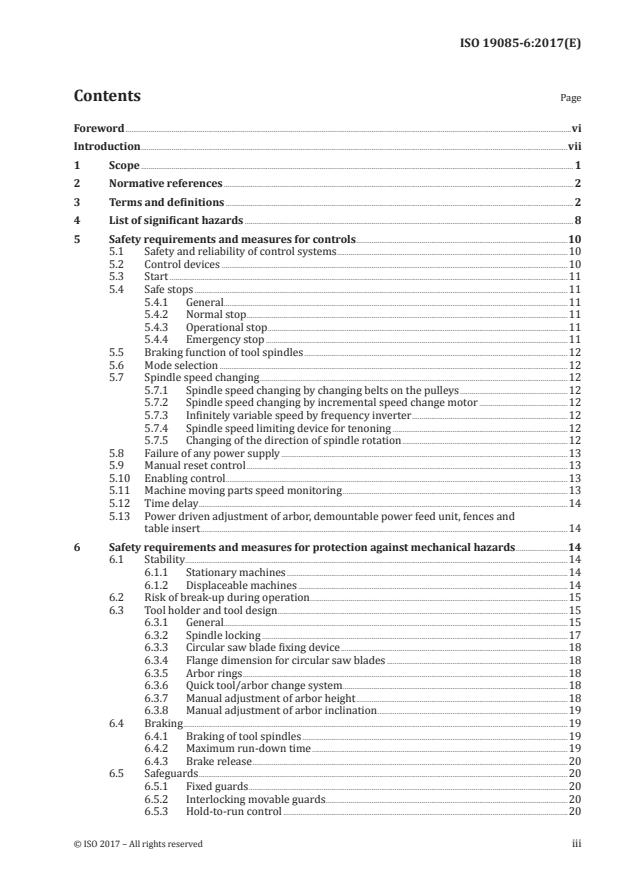
Contents Page
Foreword .vi
Introduction .vii
1 Scope . 1
2 Normative references . 2
3 Terms and definitions . 2
4 List of significant hazards . 8
5 Safety requirements and measures for controls .10
5.1 Safety and reliability of control systems .10
5.2 Control devices .10
5.3 Start .11
5.4 Safe stops .11
5.4.1 General.11
5.4.2 Normal stop .11
5.4.3 Operational stop .11
5.4.4 Emergency stop .11
5.5 Braking function of tool spindles .12
5.6 Mode selection .12
5.7 Spindle speed changing .12
5.7.1 Spindle speed changing by changing belts on the pulleys .12
5.7.2 Spindle speed changing by incremental speed change motor .12
5.7.3 Infinitely variable speed by frequency inverter .12
5.7.4 Spindle speed limiting device for tenoning .12
5.7.5 Changing of the direction of spindle rotation .12
5.8 Failure of any power supply .13
5.9 Manual reset control .13
5.10 Enabling control .13
5.11 Machine moving parts speed monitoring .13
5.12 Time delay .14
5.13 Power driven adjustment of arbor, demountable power feed unit, fences and
table insert .14
6 Safety requirements and measures for protection against mechanical hazards .14
6.1 Stability .14
6.1.1 Stationary machines .14
6.1.2 Displaceable machines .14
6.2 Risk of break-up during operation .15
6.3 Tool holder and tool design.15
6.3.1 General.15
6.3.2 Spindle locking .17
6.3.3 Circular saw blade fixing device .18
6.3.4 Flange dimension for circular saw blades .18
6.3.5 Arbor rings .18
6.3.6 Quick tool/arbor change system .18
6.3.7 Manual adjustment of arbor height .18
6.3.8 Manual adjustment of arbor inclination .19
6.4 Braking .19
6.4.1 Braking of tool spindles .19
6.4.2 Maximum run-down time .19
6.4.3 Brake release .20
6.5 Safeguards .20
6.5.1 Fixed guards .20
6.5.2 Interlocking movable guards.20
6.5.3 Hold-to-run control .20
6.5.4 Two-hand control .20
6.5.5 Electro-sensitive protective equipment (ESPE) .20
6.5.6 Pressure-sensitive protective equipment (PSPE).20
6.6 Prevention of access to moving parts .20
6.6.1 General.20
6.6.2 Guarding of tools .20
6.6.3 Guarding of drives .24
6.6.4 Guarding of shearing and/or crushing zones .24
6.7 Impact hazard .24
6.8 Clamping devices .24
6.9 Measures against ejection .25
6.9.1 General.25
6.9.2 Guards materials and characteristics.25
6.9.3 Anti-kickback devices .25
6.10 Work-piece supports and guides .27
6.10.1 Table .27
6.10.2 Work-piece guiding for straight work .30
6.10.3 Work-piece guiding for curved work .30
6.11 Safety appliances .31
7 Safety requirements and measures for protection against other hazards .32
7.1 Fire . .32
7.2 Noise .32
7.2.1 Noise reduction at the design stage .32
7.2.2 Noise emission measurement .32
7.3 Emission of chips and dust .32
7.4 Electricity .33
7.4.1 General.33
7.4.2 Displaceable machines .33
7.5 Ergonomics and handling .33
7.6 Lighting .33
7.7 Pneumatics .33
7.8 Hydraulics .33
7.9 Electromagnetic compatibility .33
7.10 Laser .34
7.11 Static electricity .34
7.12 Errors of fitting .34
7.13 Isolation .34
7.14 Maintenance .34
8 Information for use .34
8.1 Warning devices .34
8.2 Marking .34
8.2.1 General.34
8.2.2 Additional markings .34
8.3 Instruction handbook .34
8.3.1 General.34
8.3.2 Additional information .34
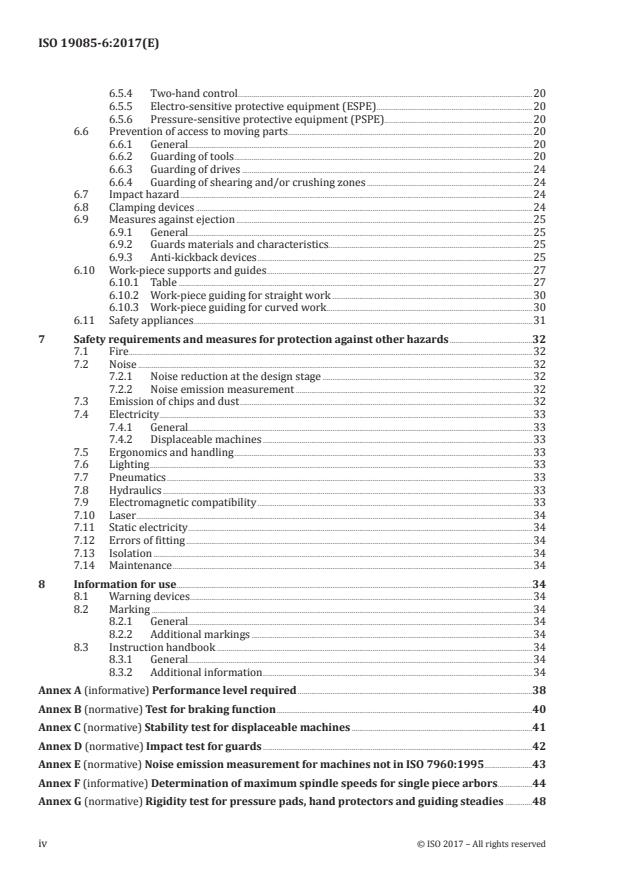
Annex A (informative) Performance level required .38
Annex B (normative) Test for braking function .40
Annex C (normative) Stability test for displaceable machines .41
Annex D (normative) Impact test for guards .42
Annex E (normative) Noise emission measurement for machines not in ISO 7960:1995 .43
Annex F (informative) Determination of maximum spindle speeds for single piece arbors .44
Annex G (normative) Rigidity test for pressure pads, hand protectors and guiding steadies .48
iv © ISO 2017 – All rights reserved
Bibliography .53
Foreword
ISO (the International Organization for Standardization) is a worldwide federation of national standards
bodies (ISO member bodies). The work of preparing International Standards is normally carried out
through ISO technical committees. Each member body interested in a subject for which a technical
committee has been established has the right to be represented on that committee. International
organizations, governmental and non-governmental, in liaison with ISO, also take part in the work.
ISO collaborates closely with the International Electrotechnical Commission (IEC) on all matters of
electrotechnical standardization.
The procedures used to develop this document and those intended for its further maintenance are
described in the ISO/IEC Directives, Part 1. In particular the different approval criteria needed for the
different types of ISO documents should be noted. This document was drafted in accordance with the
editorial rules of the ISO/IEC Directives, Part 2 (see www.iso.org/directives).
Attention is drawn to the possibility that some of the elements of this document may be the subject of
patent rights. ISO shall not be held responsible for identifying any or all such patent rights. Details of
any patent rights identified during the development of the document will be in the Introduction and/or
on the ISO list of patent declarations received (see www.iso.org/patents).
Any trade name used in this document is information given for the convenience of users and does not
constitute an endorsement.
For an explanation on the voluntary nature of standards, the meaning of ISO specific terms and
expressions related to conformity assessment, as well as information about ISO's adherence to the
World Trade Organization (WTO) principles in the Technical Barriers to Trade (TBT) see the following
URL: www.iso.org/iso/foreword.html.
This document was prepared by Technical Committee ISO/TC 39, Machine tools, Subcommittee SC 4
Woodworking machines.
This document is intended to be used in conjunction with ISO 19085-1:2017, which gives requirements
common to different machine types.
A list of all parts in the ISO 19085 series can be found on the ISO website.
vi © ISO 2017 – All rights reserved
Introduction
The ISO 19085 series of International Standards provides technical safety requirements for the design
and construction of woodworking machinery. It concerns designers, manufacturers, suppliers and
importers of the machines specified in the Scope. It also includes a list of informative items that the
manufacturer will need to give to the user.
This document is a type-C standard as stated in ISO 12100.
The machinery concerned and the extent to which hazards, hazardous situations or hazardous events
are covered are indicated in the Scope of this document.
When requirements of this type-C standard are different from those which are stated in type-A or
type-B standards, the requirements of this type-C standard take precedence over the requirements of
the other standards for machines that have been designed and built according to the requirements of
this type-C standard.
The full set of requirements for a particular type of woodworking machine are those given in the part
of ISO 19085 applicable to that type, together with the relevant requirements from ISO 19085-1:2017, to
the extent specified in the Scope of the applicable part of ISO 19085.
As far as possible, in parts of ISO 19085 other than ISO 19085-1:2017, safety requirements are referenced
to the relevant sections of ISO 19085-1:2017, to avoid repetition and reduce their length. The other parts
contain replacements and additions to the common requirements given in ISO 19085-1:2017.
Thus, Clauses 5, 6, 7 and 8, with their subclauses and the annexes of this document, can either
— confirm as a whole,
— confirm with additions,
— exclude in total, or
— replace with specific text
the corresponding subclauses or annexes of ISO 19085-1:2017.
This interrelation is indicated in the first paragraph of each subclause or annex right after the title by
one of the following statements:
— “This subclause of ISO 19085-1:2017 applies.”;
— “This subclause of ISO 19085-1:2017 applies with the following additions.”, or “This subclause of
ISO 19085-1:2017 applies with the following additions, subdivided into further specific subclauses.”;
— “This subclause of ISO 19085-1:2017 does not apply.”;
— “This subclause of ISO 19085-1:2017 is replaced by the following text.”, or “This subclause of
ISO 19085-1:2017 is replaced by the following text, subdivided into further specific subclauses.”.
Specific subclauses and annexes in this part of ISO 19085 without correspondent in ISO 19085-1:2017
are indicated by the introductory sentence: “Subclause (or annex) specific to this part of ISO 19085.”
Clauses 1, 2, 4 replace the correspondent clauses of ISO 19085-1:2017, with no need for indication since
they are specific to each part of the series.
NOTE Requirements for tools are given in EN 847-1:2013 and EN 847-2:2013.
INTERNATIONAL STANDARD ISO 19085-6:2017(E)
Woodworking machines — Safety —
Part 6:
Single spindle vertical moulding machines ("toupies")
1 Scope
This document gives the safety requirements and measures for stationary and displaceable hand-fed
single spindle vertical moulding machines, hereinafter referred to as “machines”, designed to cut wood
and materials with similar physical characteristics to wood.
NOTE 1 For the definitions of stationary and displaceable machines, see ISO 19085-1:2017, 3.4 and 3.5.
It deals with all significant hazards, hazardous situations and events as listed in Clause 4, relevant to
the machines when they are operated, adjusted and maintained as intended and under the conditions
foreseen by the manufacturer including reasonably foreseeable misuse. Also, transport, assembly,
dismantling, disabling and scrapping phases are taken into account.
NOTE 2 For relevant but not significant hazards, e.g. sharp edges of the machine frame, see ISO 12100:2010.
It is also applicable to machines fitted with one or more of the following devices/additional working
units, whose hazards have been dealt with:
a) device for the arbor to be vertically adjustable relative to the table;
b) device to tilt the arbor;
c) device to fit a manually operated tenoning sliding table;
d) glass bead saw unit;
e) adjustable table insert;
f) device for changing the direction of rotation of the spindle;
g) device for fixing shank mounted tools on the arbor;
h) interchangeable arbor;
i) quick tool/arbor change system;
j) demountable power feed unit;
k) support for the demountable power feed unit with power driven adjustments.
This document does not apply to
1) machines equipped with outboard bearings,
2) machines equipped with powered movements of a front extension table and/or a tenoning sliding
table, and
3) machines with an intended maximum tool diameter of less than or equal to 180 mm.
NOTE 3 Hand-held motor-operated electric tools are dealt with in IEC 60745-1 together with IEC 60745-2-17.
NOTE 4 Transportable motor-operated electric tools are dealt with in IEC 61029-1:1990, IEC 61029-2-
8:1995/AMD1:1999 and IEC 61029-2-8:1995/AMD2:2001
This document is not applicable to machines intended for use in potentially explosive atmospheres or to
machines manufactured prior to the date of its publication.
2 Normative references
The following documents are referred to in the text in such a way that some or all of their content
constitutes requirements of this document. For dated references, only the edition cited applies. For
undated references, the latest edition of the referenced document (including any amendments) applies.
ISO 7960:1995, Airborne noise emitted by machine tools — Operating conditions for woodworking
machines
ISO 12100:2010, Safety of machinery — General principles for design — Risk assessment and risk reduction
ISO 13849-1:2015, Safety of machinery — Safety-related parts of control systems — Part 1: General
principles for design
ISO 19085-1:2017, Woodworking machines — Safety — Part 1: common requirements
EN 847-1:2013, Tools for woodworking — Safety requirements — Part 1: Milling tools, circular saw blades
EN 847-2:2013, Tools for woodworking — Safety requirements — Part 2: Requirements for shanks of shank
mounted milling tools
EN 847-3:2013, Tools for woodworking — Safety requirements — Part 3: Clamping devices
IEC 60204-1:2005, Safety of machinery — Electrical equipment of machines — Part 1: General requirements
IEC 61800-5-2:2007, Adjustable speed electrical power drive systems — Part 5-2: Safety requirements —
Functional
3 Terms and definitions
For the purposes of this document, the terms and definitions given in ISO 12100:2010, ISO 13849-1:2015,
and ISO 19085-1:2017 and the following apply.
ISO and IEC maintain terminological databases for use in standardization at the following addresses:
— ISO Online browsing platform: available at https://www.iso.org/obp
— IEC Electropedia: available at http://www.electropedia.org/
3.1
single spindle vertical moulding machine
hand-fed machine fitted with a single vertical arbor (interchangeable or not interchangeable), which is
fixed in position during the cutting operation and a horizontal table, which is fixed in total or in part
during the cutting operation
Note 1 to entry: The arbor passes through the table and its drive is situated beneath the table.
Note 2 to entry: The main parts of the machine and their terminology are shown in Figure 1.
Note 3 to entry: These machines are also known as shapers in the USA and toupie in Europe.
2 © ISO 2017 – All rights reserved
a) Example of a single spindle vertical moulding machine equipped for straight work
b) Example of a single spindle vertical moulding machine equipped for curved work
c) Example of a tool safeguard for tenoning with fixed and adjustable guards mounted on the
machine and on the sliding table
Key
1 main frame 12 bonnet guard
2 speed indicator 13 table pressure pad
3 spindle lock 14 sliding table
4 start and stop controls 15 work-piece clamping device
5 tool 16 adjustable guard
6 table rings 17 de-mountable power feed unit
7 fence pressure pad 18 push stick
8 fence plates connected to straight work guard 19 guards fixed to the sliding table
9 enclosure 20 extension table
10 hinged cover 21 adjustable end stop
11 curved work guard
Figure 1 — Single spindle vertical moulding machine terminology
3.2
straight work
profiling or grooving of a work-piece with one face in contact with the table and a second with the
fence, and where the work starts at one end of the work-piece and continues through to the other end
Note 1 to entry: See Figures 1 a) and 2.
3.3
stopped straight work
machining of only a part of the work-piece length
4 © ISO 2017 – All rights reserved
Figure 2 — Example of straight work
3.4
curved work
profiling or grooving of a curve on a work-piece by having one side in contact with the table (or if held
in a jig with the jig in contact with the table) and the other in contact with the vertical reference of a
steady or ball ring guide when using a jig
Note 1 to entry: See Figures 1 b) and 3.
Figure 3 — Example of curved work
3.5
tenoning
machining of tenons and slots at the end of a work-piece to facilitate the joining of work-pieces
Note 1 to entry: See Figures 1 c), 4 and 5.
Key
1 tenon
2 slot
Figure 4 — Example of work-piece with tenon/slot
Key
1 manually adjustable guard
2 self-adjusting guard
3 device with double function: to adjust part no. 1 and to guide part no. 2
Figure 5 — Example of a tool safeguard for tenoning with manually and automatically
adjustable guards
3.6
glass bead saw unit
work unit fitted with a saw blade to cut out a glass bead from the machined profile of the work-piece
Note 1 to entry: Example is given in Figure 13.
3.7
single piece arbor
system where the arbor cannot be changed without dismounting the bearings
Note 1 to entry: See Figure 6.
6 © ISO 2017 – All rights reserved
Key
1 arbor
2 bearings
Figure 6 — Examples of a single piece arbor
3.8
interchangeable arbor
arbor, connected to the drive spindle, which can be changed either with (removable arbor) or without
(quick change arbor) the aid of a tool
Note 1 to entry: See Figures 7 a) and b).
3.9
quick tool/arbor change system
system for quick change of the arbor or of shank mounted tools without the aid of a tool
Note 1 to entry: See key 3 in Figure 7 b).
Note 2 to entry: A pre-mounted combination of tool and arbor is called shank mounted tool (see EN 847-3:2013,
Clause 1).
a) Removable arbor b) Quick change arbor
Key
1 arbor
2 connecting device
3 quick tool/arbor change system
Figure 7 — Examples of interchangeable arbors
3.10
initiation control
control which, after actuation, enables providing power to specific machine actuators, e.g. by a
programmable logic control
4 List of significant hazards
This clause contains all significant hazards, hazardous situations and events (see ISO 12100:2010),
identified by risk assessment as significant for the machines as defined in Clause 1, and which require
actions to eliminate or reduce the risk. This document deals with these significant hazards by defining
safety requirements and measures or by reference to relevant standards. These hazards are listed in
Table 1.
8 © ISO 2017 – All rights reserved
Table 1 — List of significant hazards
Hazards, hazardous situations and Relevant section of
No. ISO 12100:2010
hazardous events ISO 19085-6:2017
1 Mechanical hazards related to
— Machine parts or work-pieces due to
a) shape 6.3, 6.6, 6.9.2, 6.10, 6.11
b) relative location 6.2.2.1, 6.2.2.2, 6.3 5.2, 6.6, 7.5
c) mass and stability (potential energy of elements 6.1, 6.6, 6.10
which may move under effect of gravity)
d) mass and velocity (kinetic energy of elements in 5.13, 6.4, 6.6
controlled or uncontrolled motion)
e) mechanical strength 6.2, 6.3, 6.4, 6.6, 6.9, 6.10,
Annex D, Annex F, Annex G
— Accumulation of energy inside the machinery due to
f) elastic elements (springs) 6.2.10, 6.3.5.4 6.6, 6.10, 7.5
g) liquids and gases under pressure 7.7, 7.8
1.1 Crushing hazard 6.6.4, 6.10.1.2
1.2 Shearing hazard 6.6.4, 6.10.1.2
1.3 Cutting or severing hazard 6.3, 6.6, 8.3.2
1.4 Entanglement hazard 6.6, 8.3.2
1.5 Drawing-in or trapping hazard 6.6, 8.3.2
1.6 Impact hazard 6.10, 8.3.2
1.9 High pressure fluid injection or ejection hazard 7.8
2 Electrical hazards due to
2.1 Contact of persons with live parts (direct contact) 6.2.9, 6.3.5.4 7.4
2.2 Contact of persons with parts which have become 6.2.9 7.4
live under faulty conditions (indirect contact)
4 Hazards generated by noise, resulting in
4.1 Hearing loss (deafness), other physiological disor- 6.2.2.2, 6.3 7.2
ders (loss of balance, loss of awareness)
4.2 Interference with speech communication, acous- 7.2, 8.3
tic signals
7 Hazards generated by materials and substances (and their constituent elements) processed or used
by the machinery
7.1 Hazards from contact with or inhalation of harmful 6.2.3, 6.2.4 7.3, 8.3
fluids and dusts
7.2 Fire hazard 6.2.4 7.1
8 Hazards generated by neglecting ergonomic principles in machinery design
8.1 Unhealthy postures or excessive effort 6.2.7, 6.2.8, 6.2.11.12, 5.2, 7.5, 8.3
6.3.5.5, 6.3.5.6
8.2 Hand-arm or foot-leg anatomy 6.2.8.3 5.2, 6.6, 7.5
8.4 Local lighting 6.2.8.6 8.3
8.5 Mental overload and underload, stress 6.2.8.5 8.3
8.6 Human error, human behaviour 6.2.8, 6.2.11.8, 8.3
6.2.11.10, 6.3.5.2, 6.4
8.7 Design, location or identification of manual controls 6.2.8 f), 6.2.11.8 5.2, 7.5
8.8 Design or location of visual display units 6.2.8, 6.4.2 5.2, 7.5
9 Combination of hazards 6.3.2.1 5.1, 6.6, 7.13, 7.14
10 Unexpected start-up, unexpected overrun/overspeed (or any similar malfunction) from
Table 1 (continued)
Hazards, hazardous situations and Relevant section of
No. ISO 12100:2010
hazardous events ISO 19085-6:2017
10.1 Failure/disorder of the control system 6.2.11, 6.3.5.4 5.1, 7.13
10.2 Restoration of energy supply after an interruption 6.2.11.4 5.8, 7.7
10.3 External influences on electrical equipment 6.2.11.11 5.1, 7.9
10.5 Errors in the software 6.2.11.7 5.1
10.6 Errors made by the operator (due to a mismatch of 6.2.8, 6.2.11.8, 7.5, 8.3
machinery with human characteristics and abili- 6.2.11.10, 6.3.5.2, 6.4
ties; see 8.6)
11 Impossibility of stopping the machine in the 6.2.11.1, 6.2.11.3, 5.4, 7.12
best possible conditions 6.3.5.2
13 Failure of the power supply 6.2.11.1, 6.2.11.4 5.8
14 Failure of the control circuit 6.2.11, 6.3.5.4 5.1
15 Errors of fitting 6.2.7, 6.4.5 7.12, 8.2
16 Break-up during operation 6.2.3 6.2, 6.9, Annex G
17 Falling or ejected objects or fluids 6.2.3, 6.2.10 6.9
18 Loss of stability/overturning of machinery 6.3.2.6 6.1, 8.3, Annex C
5 Safety requirements and measures for controls
5.1 Safety and reliability of control systems
This subclause of ISO 19085-1:2017 applies.
5.2 Control devices
This subclause of ISO 19085-1:2017 applies with the following additions.
The main electrical control devices for start, normal stop, emergency stop (if required, see 5.4.4), arbor
adjustment (see 5.13), spindle speed changing (see 5.7) and direction of rotation (see 5.7.5) shall be
located as follows:
a) on the front side of the machine in the shaded area as shown in Figure 8 a) and at least 50 mm
below the table top; or
b) on the front side of a fixed or movable control panel at a maximum distance of 700 mm from the
front edge of the table [see Figure 8 b)].
Machines fitted with a side tenoning sliding table or a front extension table shall be provided with an
additional emergency stop control device, which shall be located on the sliding table or its support.
10 © ISO 2017 – All rights reserved
Dimensions in millimetres
1 2
a) Front view b) Top view
Key
1 location area for controls
2 fixed or movable control panel
Figure 8 — Position of controls
Verification: By checking the relevant drawings and/or circuit diagrams, measurements, inspection of
the machine.
5.3 Start
This subclause of ISO 19085-1:2017 applies with the following additions.
Starting of a demountable power feed unit shall only be possible when the arbor and saw blade of the
glass bead saw unit are running or when the arbor is running and the glass bead saw unit is retracted
or dismounted.
The SRP/CS for interlocking between the starting of the demountable power feed unit and spindle drive
and/or glass bead saw drive shall achieve PL = c.
r
Verification: By checking the relevant drawings and/or circuit diagrams, inspection of the machine and
relevant functional testing of the machine.
5.4 Safe stops
5.4.1 General
This subclause of ISO 19085-1:2017 applies.
5.4.2 Normal stop
This subclause of ISO 19085-1:2017 applies.
5.4.3 Operational stop
This subclause of ISO 19085-1:2017 does not apply.
5.4.4 Emergency stop
This subclause of ISO 19085-1:2017 applies.
600 min.
50 min.
1 800 max.
700 max.
5.5 Braking function of tool spindles
This subclause of ISO 19085-1:2017 applies.
5.6 Mode selection
This subclause of ISO 19085-1:2017 does not apply.
5.7 Spindle speed changing
5.7.1 Spindle speed changing by changing belts on the pulleys
This subclause of ISO 19085-1:2017 applies.
5.7.2 Spindle speed changing by incremental speed change motor
This subclause of ISO 19085-1:2017 applies.
5.7.3 Infinitely variable speed by frequency inverter
This subclause of ISO 19085-1:2017 applies.
5.7.4 Spindle speed limiting device for tenoning
Subclause specific to this part of ISO 19085.
Machines designed to be fitted with a sliding table for tenoning, which are capable of spindle speeds
−1
in excess of 4 800 min , shall have a speed limiting device which will prevent the spindle rotating
−1
faster than 4 800 min while tenoning with tooling of a diameter greater than 275 mm. This shall be
achieved by interlocking the guarding system described in 6.6.2.4.2 with the speed monitoring system
described in 5.7.3.
The SRP/CS for the interlocking of the guarding system with the speed monitoring system shall achieve
PL = c.
r
See also IEC 61800-5-2:2007, 4.2.3.4 [safely-limited speed (SLS)].
Verification: By checking the relevant drawings and/or circuit diagrams, inspection of the machine and
relevant functional testing of the machine.
5.7.5 Changing of the direction of spindle rotation
Subclause specific to this part of ISO 19085.
When the machine is equipped with a spindle which is capable of rotating in only one direction, the
spindle shall always rotate in an anticlockwise direction when viewed from the top.
Where spindles are designed to run in two directions of rotation, the following requirements shall be met:
a) a selector of direction of rotation shall be fitted. See 5.2 for the position of this device;
b) a visible warning device shall inform the machine operator when the clockwise direction of rotation
is selected;
c) the colour of the warning device shall be yellow. The visible warning device may be supplemented
by an audible one;
d) start-up of the spindle rotation shall not be possible with the selector of the direction of rotation;
12 © ISO 2017 – All rights reserved
e) the selector of the direction of rotation shall be either
1) a two position selector fitted with a blocking device such that
i) the “normal” position, without blocking, corresponds to the anticlockwise direction of
rotation;
ii) the “non-normal” position, with blocking, corresponds to the clockwise direction of
rotation;
iii) selection of the clockwise direction of rotation shall only be possible after manual override
of the blocking device;
iv) the selector of direction of rotation shall indicate the selected direction of rotation and be
consistent with it;
2) a three position selector, with one neutral position and without blocking device. When the
spindle has been started in the clockwise direction of rotation, the selector shall automatically
return to its neutral position; or
3) a combination of manually operated push buttons such that
i) the anticlockwise direction of rotation is started by the start button of the spindle drive; or
ii) the clockwise direction of rotation is started by the start button of the spindle drive
together with an initiation control device (e.g. push button), which is positioned so that
both hands are necessary for starting the spindle drive.
The SRP/CS for selection of the direction of rotation and for initiation control shall achieve PL = b.
r
See also 8.3.2 f) 4) i).
Verification: By checking the relevant drawings and/or circuit diagrams, inspection of the machine and
relevant functional testing of the machine.
5.8 Failure of any power supply
This subclause of ISO 19085-1:2017 applies.
5.9 Manual reset control
This subclause of ISO 19085-1:2017 does not apply.
5.10 Enabling control
This subclause of ISO 19085-1:2017 does not apply.
5.11 Machine moving parts speed monitoring
...
NORME ISO
INTERNATIONALE 19085-6
Première édition
2017-11
Machines à bois — Sécurité —
Partie 6:
Toupies monobroches à arbre vertical
Woodworking machines — Safety —
Part 6: Single spindle vertical moulding machines ("toupies")
Numéro de référence
©
ISO 2017
DOCUMENT PROTÉGÉ PAR COPYRIGHT
© ISO 2017, Publié en Suisse
Droits de reproduction réservés. Sauf indication contraire, aucune partie de cette publication ne peut être reproduite ni utilisée
sous quelque forme que ce soit et par aucun procédé, électronique ou mécanique, y compris la photocopie, l’affichage sur
l’internet ou sur un Intranet, sans autorisation écrite préalable. Les demandes d’autorisation peuvent être adressées à l’ISO à
l’adresse ci-après ou au comité membre de l’ISO dans le pays du demandeur.
ISO copyright office
Ch. de Blandonnet 8 • CP 401
CH-1214 Vernier, Geneva, Switzerland
Tel. +41 22 749 01 11
Fax +41 22 749 09 47
copyright@iso.org
www.iso.org
ii © ISO 2017 – Tous droits réservés
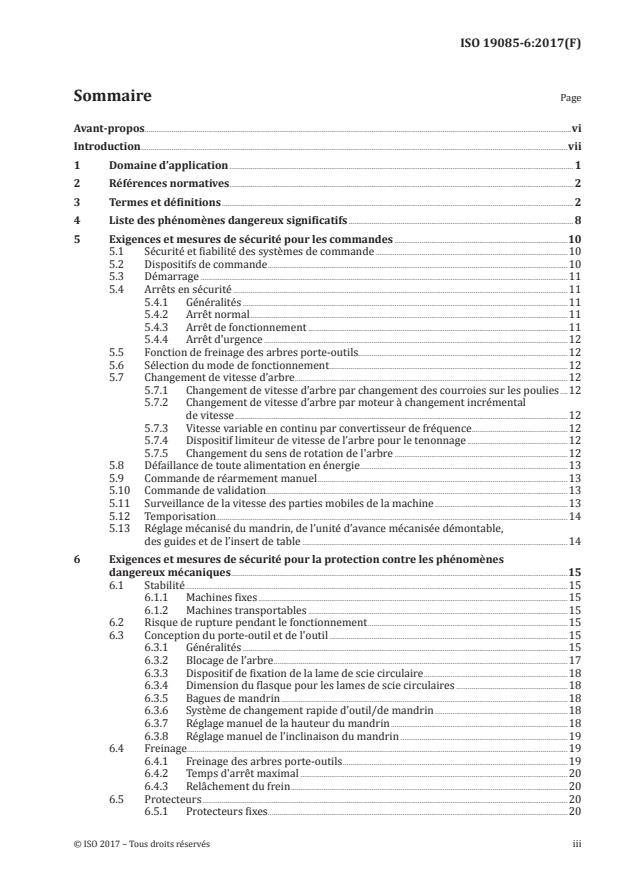
Sommaire Page
Avant-propos .vi
Introduction .vii
1 Domaine d’application . 1
2 Références normatives . 2
3 Termes et définitions . 2
4 Liste des phénomènes dangereux significatifs . 8
5 Exigences et mesures de sécurité pour les commandes .10
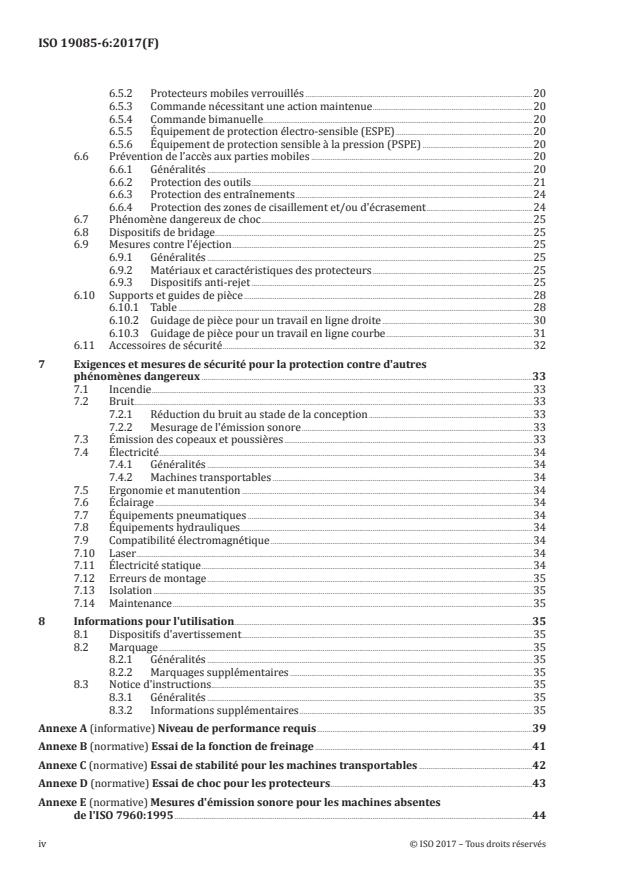
5.1 Sécurité et fiabilité des systèmes de commande .10
5.2 Dispositifs de commande .10
5.3 Démarrage .11
5.4 Arrêts en sécurité .11
5.4.1 Généralités .11
5.4.2 Arrêt normal .11
5.4.3 Arrêt de fonctionnement .11
5.4.4 Arrêt d'urgence .12
5.5 Fonction de freinage des arbres porte-outils.12
5.6 Sélection du mode de fonctionnement .12
5.7 Changement de vitesse d’arbre.12
5.7.1 Changement de vitesse d’arbre par changement des courroies sur les poulies .12
5.7.2 Changement de vitesse d’arbre par moteur à changement incrémental
de vitesse .12
5.7.3 Vitesse variable en continu par convertisseur de fréquence .12
5.7.4 Dispositif limiteur de vitesse de l’arbre pour le tenonnage .12
5.7.5 Changement du sens de rotation de l'arbre .12
5.8 Défaillance de toute alimentation en énergie .13
5.9 Commande de réarmement manuel .13
5.10 Commande de validation.13
5.11 Surveillance de la vitesse des parties mobiles de la machine .13
5.12 Temporisation.14
5.13 Réglage mécanisé du mandrin, de l’unité d’avance mécanisée démontable,
des guides et de l’insert de table .14
6 Exigences et mesures de sécurité pour la protection contre les phénomènes
dangereux mécaniques .15
6.1 Stabilité .15
6.1.1 Machines fixes .15
6.1.2 Machines transportables .15
6.2 Risque de rupture pendant le fonctionnement .15
6.3 Conception du porte-outil et de l'outil .15
6.3.1 Généralités .15
6.3.2 Blocage de l’arbre .17
6.3.3 Dispositif de fixation de la lame de scie circulaire .18
6.3.4 Dimension du flasque pour les lames de scie circulaires .18
6.3.5 Bagues de mandrin .18
6.3.6 Système de changement rapide d’outil/de mandrin .18
6.3.7 Réglage manuel de la hauteur du mandrin .18
6.3.8 Réglage manuel de l’inclinaison du mandrin .19
6.4 Freinage .19
6.4.1 Freinage des arbres porte-outils .19
6.4.2 Temps d'arrêt maximal .20
6.4.3 Relâchement du frein .20
6.5 Protecteurs .20
6.5.1 Protecteurs fixes . .20
6.5.2 Protecteurs mobiles verrouillés .20
6.5.3 Commande nécessitant une action maintenue .20
6.5.4 Commande bimanuelle.20
6.5.5 Équipement de protection électro-sensible (ESPE) .20
6.5.6 Équipement de protection sensible à la pression (PSPE) .20
6.6 Prévention de l’accès aux parties mobiles .20
6.6.1 Généralités .20
6.6.2 Protection des outils .21
6.6.3 Protection des entraînements .24
6.6.4 Protection des zones de cisaillement et/ou d'écrasement .24
6.7 Phénomène dangereux de choc .25
6.8 Dispositifs de bridage . .25
6.9 Mesures contre l'éjection .25
6.9.1 Généralités .25
6.9.2 Matériaux et caractéristiques des protecteurs .25
6.9.3 Dispositifs anti-rejet .25
6.10 Supports et guides de pièce .28
6.10.1 Table .28
6.10.2 Guidage de pièce pour un travail en ligne droite .30
6.10.3 Guidage de pièce pour un travail en ligne courbe .31
6.11 Accessoires de sécurité .32
7 Exigences et mesures de sécurité pour la protection contre d'autres
phénomènes dangereux .33
7.1 Incendie .33
7.2 Bruit .33
7.2.1 Réduction du bruit au stade de la conception .33
7.2.2 Mesurage de l'émission sonore .33
7.3 Émission des copeaux et poussières .33
7.4 Électricité .34
7.4.1 Généralités .34
7.4.2 Machines transportables .34
7.5 Ergonomie et manutention .34
7.6 Éclairage .34
7.7 Équipements pneumatiques .34
7.8 Équipements hydrauliques .34
7.9 Compatibilité électromagnétique .34
7.10 Laser .34
7.11 Électricité statique .34
7.12 Erreurs de montage .35
7.13 Isolation .35
7.14 Maintenance .35
8 Informations pour l'utilisation .35
8.1 Dispositifs d'avertissement .35
8.2 Marquage .35
8.2.1 Généralités .35
8.2.2 Marquages supplémentaires .35
8.3 Notice d'instructions .35
8.3.1 Généralités .35
8.3.2 Informations supplémentaires .35
Annexe A (informative) Niveau de performance requis .39
Annexe B (normative) Essai de la fonction de freinage .41
Annexe C (normative) Essai de stabilité pour les machines transportables .42
Annexe D (normative) Essai de choc pour les protecteurs .43
Annexe E (normative) Mesures d'émission sonore pour les machines absentes
de l'ISO 7960:1995 .44
iv © ISO 2017 – Tous droits réservés
Annexe F (informative) Détermination des vitesses maximales d'arbre pour
les mandrins monoblocs .45
Annexe G (normative) Essai de rigidité pour les patins presseurs, les protecteurs
de la main et les guides à lunette .49
Bibliographie .54
Avant-propos
L'ISO (Organisation internationale de normalisation) est une fédération mondiale d'organismes
nationaux de normalisation (comités membres de l'ISO). L'élaboration des Normes internationales est
en général confiée aux comités techniques de l'ISO. Chaque comité membre intéressé par une étude
a le droit de faire partie du comité technique créé à cet effet. Les organisations internationales,
gouvernementales et non gouvernementales, en liaison avec l'ISO participent également aux travaux.
L'ISO collabore étroitement avec la Commission électrotechnique internationale (IEC) en ce qui
concerne la normalisation électrotechnique.
Les procédures utilisées pour élaborer le présent document et celles destinées à sa mise à jour sont
décrites dans les Directives ISO/IEC, Partie 1. Il convient, en particulier de prendre note des différents
critères d'approbation requis pour les différents types de documents ISO. Le présent document a été
rédigé conformément aux règles de rédaction données dans les Directives ISO/IEC, Partie 2 (voir www.
iso.org/directives).
L'attention est attirée sur le fait que certains des éléments du présent document peuvent faire l'objet de
droits de propriété intellectuelle ou de droits analogues. L'ISO ne saurait être tenue pour responsable
de ne pas avoir identifié de tels droits de propriété et averti de leur existence. Les détails concernant
les références aux droits de propriété intellectuelle ou autres droits analogues identifiés lors de
l'élaboration du document sont indiqués dans l'Introduction et/ou dans la liste des déclarations de
brevets reçues par l'ISO (voir www.iso.org/brevets).
Les appellations commerciales éventuellement mentionnées dans le présent document sont données
pour information, par souci de commodité, à l’intention des utilisateurs et ne sauraient constituer un
engagement.
Pour une explication de la nature volontaire des normes, la signification des termes et expressions
spécifiques de l'ISO liés à l'évaluation de la conformité, ou pour toute information au sujet de l'adhésion
de l'ISO aux principes de l’Organisation mondiale du commerce (OMC) concernant les obstacles
techniques au commerce (OTC), voir le lien suivant: www.iso.org/avant-propos.
Le présent document a été élaboré par le comité technique ISO/TC 39, Machines-outils, sous-comité SC 4,
Machines à bois.
Ce document est destiné à être utilisé conjointement avec l’ISO 19085-1:2017, qui donne les exigences
communes aux différents types de machines.
Une liste de toutes les parties de la série de normes ISO 19085 peut être trouvée sur le site de l’ISO.
vi © ISO 2017 – Tous droits réservés
Introduction
La série de Normes internationales ISO 19085 donne les exigences techniques de sécurité pour
la conception et la fabrication des machines à bois. Elle concerne les concepteurs, les fabricants, les
fournisseurs et les importateurs des machines spécifiées dans le Domaine d'application. Elle comprend
également une liste de points informatifs que le fabricant aura à fournir à l'utilisateur.
Le présent document est une norme de type C tel que mentionné dans l’ISO 12100.
Les machines concernées et l'étendue des phénomènes dangereux, situations dangereuses ou
événements dangereux couverts sont indiquées dans le Domaine d’application du présent document.
Lorsque des exigences de la présente norme de type C sont différentes de celles énoncées dans les
normes de type A ou de type B, les exigences de la présente norme de type C ont priorité sur les exigences
des autres normes pour les machines ayant été conçues et fabriquées conformément aux exigences de la
présente norme de type C.
L'ensemble des exigences pour un type particulier de machine à bois sont celles données dans la partie
de l'ISO 19085 applicable à ce type, conjointement avec les exigences pertinentes de l'ISO 19085-1:2017,
dans l'étendue spécifiée dans le Domaine d'application de la partie applicable de l'ISO 19085.
Dans la mesure du possible, dans les parties de l'ISO 19085 autres que l'ISO 19085-1:2017, les exigences
de sécurité font référence aux sections pertinentes de l'ISO 19085-1:2017, pour éviter les répétitions et
réduire leur longueur. Les autres parties contiennent des remplacements et des ajouts aux exigences
communes données dans l'ISO 19085-1:2017.
Ainsi, les paragraphes des Articles 5, 6, 7 et 8 et les annexes du présent document peuvent soit
— confirmer dans leur intégralité,
— confirmer avec des ajouts,
— exclure en totalité, soit
— remplacer par un texte spécifique
les paragraphes ou annexes correspondants de l'ISO 19085-1:2017.
Cette interdépendance est indiquée dans le premier alinéa de chaque paragraphe ou annexe, juste après
le titre, par l'un des énoncés suivants:
— «Ce paragraphe de l'ISO 19085-1:2017 s'applique.»;
— «Ce paragraphe de l'ISO 19085-1:2017 s'applique avec les ajouts suivants.» ou «Ce paragraphe
de l'ISO 19085-1:2017 s'applique avec les ajouts suivants, divisés en de nouveaux paragraphes
spécifiques.»;
— «Ce paragraphe de l'ISO 19085-1:2017 ne s'applique pas.»;
— «Ce paragraphe de l'ISO 19085-1:2017 est remplacé par le texte suivant.» ou «Ce paragraphe de
l'ISO 19085-1:2017 est remplacé par le texte suivant, divisé en de nouveaux paragraphes spécifiques.».
Les paragraphes et annexes spécifiques de la présente partie de l'ISO 19085 sans correspondance dans
l'ISO 19085-1:2017 sont indiqués par la phrase introductive: «Paragraphe (ou annexe) spécifique à la
présente partie de l'ISO 19085.».
Les Articles 1, 2, 4 remplacent les articles correspondants de l'ISO 19085-1:2017, sans qu'il soit
nécessaire de l'indiquer, car ils sont spécifiques à chaque partie de la série.
NOTE Les exigences pour les outils sont données dans l'EN 847-1:2013 et l'EN 847-2:2013.
NORME INTERNATIONALE ISO 19085-6:2017(F)
Machines à bois — Sécurité —
Partie 6:
Toupies monobroches à arbre vertical
1 Domaine d’application
Le présent document donne les exigences et les mesures de sécurité pour les toupies monobroches à
arbre vertical à avance manuelle fixes et transportables, ci-après désignées «machines», conçues pour
la coupe de bois et de matériau ayant des caractéristiques physiques similaires à celles du bois.
NOTE 1 Pour les définitions de machines fixes et transportables, voir l'ISO 19085-1:2017, 3.4 et 3.5.
Il traite de tous les phénomènes dangereux, situations et événements dangereux significatifs, tels
qu'énumérés à l'Article 4, applicables aux machines lorsqu'elles sont utilisées, réglées et entretenues
comme prévu et dans les conditions prévues par le fabricant, incluant une mauvaise utilisation
raisonnablement prévisible. Les phases de transport, d'assemblage, de démontage, de mise hors service
et de mise au rebut sont également prises en compte.
NOTE 2 Pour les phénomènes dangereux pertinents mais non significatifs, par exemple, les arêtes vives du
bâti de la machine, voir l'ISO 12100.
Il est également applicable aux machines équipées d'un ou plusieurs des dispositifs/unités de travail
supplémentaires suivants, dont les phénomènes dangereux ont été traités:
a) dispositif pour régler verticalement le mandrin par rapport à la table;
b) dispositif pour incliner le mandrin;
c) dispositif pour monter une table mobile de tenonnage à commande manuelle;
d) unité de sciage de parclose;
e) insert de table réglable;
f) dispositif pour changer le sens de rotation de l'arbre;
g) dispositif pour fixer des outils à queue sur le mandrin;
h) mandrin interchangeable;
i) système de changement rapide d’outil/de mandrin;
j) unité d'avance mécanisée démontable;
k) support pour l’unité d’avance mécanisée démontable avec réglages mécanisés.
Le présent document ne s’applique pas:
1) aux machines équipées de paliers extérieurs;
2) aux machines avec mouvements mécanisés d’une rallonge de table avant et/ou d’une table mobile
de tenonnage, et
3) aux machines dont le diamètre d’outil maximal prévu est inférieur ou égal à 180 mm.
NOTE 3 Les outils électroportatifs à moteur sont traités dans l’IEC 60745-1 conjointement avec l’IEC 60745-2-17.
NOTE 4 Les machines-outils électriques transportables sont traitées dans les IEC 61029-1:1990, IEC 61029-2-
8:1995/AMD1:1999 et IEC 61029-2-8:1995/AMD2:2001.
Le présent document n’est pas applicable aux machines prévues pour une utilisation en atmosphères
explosibles, ni aux machines fabriquées avant sa date de publication.
2 Références normatives
Les documents suivants cités dans le texte constituent, pour tout ou partie de leur contenu, des
exigences du présent document. Pour les références datées, seule l'édition citée s'applique. Pour les
références non datées, la dernière édition du document de référence s'applique (y compris les éventuels
amendements).
ISO 7960:1995, Bruit aérien émis par les machines-outils — Conditions de fonctionnement des machines à bois
ISO 12100:2010, Sécurité des machines — Principes généraux de conception — Appréciation du risque et
réduction du risque
ISO 13849-1:2015, Sécurité des machines — Parties des systèmes de commande relatives à la sécurité —
Partie 1: Principes généraux de conception
ISO 19085-1:2017, Machines à bois — Sécurité — Partie 1: Exigences communes
EN 847-1:2013, Outils pour le travail du bois — Prescriptions de sécurité — Partie 1: Outils de fraisage,
lames de scies circulaires
EN 847-2:2013, Outils pour le travail du bois — Prescriptions de sécurité — Partie 2: Prescriptions pour les
queues des fraises à queue
EN 847-3:2013, Outils pour le travail du bois — Prescriptions de sécurité — Partie 3: Outils de serrage
IEC 60204-1:2005, Sécurité des machines — Équipement électrique des machines — Partie 1: Règles
générales
IEC 61800-5-2:2007, Entraînements électriques de puissance à vitesse variable — Partie 5-2: Exigences de
sécurité — Fonctionnalité
3 Termes et définitions
Pour les besoins du présent document, les termes et définitions donnés dans l’ISO 12100:2010,
l’ISO 13849-1:2015, l’ISO 19085-1:2017 ainsi que les suivants s'appliquent.
L'ISO et l'IEC tiennent à jour des bases de données terminologiques pour l'utilisation en normalisation
aux adresses suivantes:
— ISO Online browsing platform: disponible à https://www.iso.org/obp
— IEC Electropedia: disponible à http://www.electropedia.org/
3.1
toupie monobroche à arbre vertical
machine à avance manuelle équipée d’un seul mandrin vertical (interchangeable ou non interchangeable),
qui est fixe en position pendant l’opération de coupe et d’une table horizontale, qui est fixe en totalité ou
en partie pendant l’opération de coupe
Note 1 à l'article: Le mandrin traverse la table et son entraînement est situé sous la table.
Note 2 à l'article: Les principales parties de la machine et leur terminologie sont illustrées à la Figure 1.
Note 3 à l'article: Ces machines sont également connues en tant que shapers aux États-Unis et toupies en Europe.
2 © ISO 2017 – Tous droits réservés
a) Exemple d’une toupie monobroche à arbre vertical équipée pour le travail en ligne droite
b) Exemple d’une toupie monobroche à arbre vertical équipée pour le travail en ligne courbe
c) Exemple d’une protection d’outil pour le tenonnage, avec protecteurs fixes et réglables fixés
sur la machine et sur la table mobile
Légende
1 bâti principal 12 capot protecteur
2 indicateur de vitesse 13 patin presseur de table
3 blocage de l'arbre 14 table mobile
4 commandes de démarrage et d’arrêt 15 dispositif de bridage de la pièce
5 outil 16 protecteur réglable
6 bagues de table 17 unité d'avance mécanisée démontable
7 patin presseur de guide 18 poussoir de fin de passe
8 plaques de guidage raccordées au protecteur pour travail 19 protecteurs fixés à la table mobile
en ligne droite
9 enceinte 20 rallonge de table
10 capot articulé 21 butée réglable
11 protecteur pour travail en ligne courbe
Figure 1 — Terminologie de la toupie monobroche à arbre vertical
3.2
travail en ligne droite
profilage ou rainurage d'une pièce dont une face est en contact avec la table et une deuxième avec le
guide, et dans lequel le travail débute à une extrémité de la pièce et se poursuit jusqu'à l'autre extrémité
Note 1 à l'article: Voir Figures 1 a) et 2.
3.3
travail arrêté en ligne droite
usinage d'une partie seulement de la longueur de la pièce
4 © ISO 2017 – Tous droits réservés
Figure 2 — Exemple de travail en ligne droite
3.4
travail en ligne courbe
profilage ou rainurage d'une courbe sur une pièce dont une face est en contact avec la table (ou, si elle est
maintenue dans un gabarit, avec le gabarit en contact avec la table) et l'autre en contact avec la référence
verticale d'un guide à lunette ou d'un guide à roulement à billes en cas d'utilisation d'un gabarit
Note 1 à l'article: Voir Figures 1 b) et 3.
Figure 3 — Exemple de travail en ligne courbe
3.5
tenonnage
usinage de tenons et d’encoches sur l'extrémité d'une pièce pour faciliter l'assemblage de pièces
Note 1 à l'article: Voir Figures 1 c), 4 et 5.
Légende
1 tenon
2 rainure
Figure 4 — Exemple de pièce avec tenon/rainure
Légende
1 protecteur à réglage manuel
2 protecteur à réglage automatique
3 dispositif à double fonction: pour régler la partie n° 1 et guider la partie n° 2
Figure 5 — Exemple d’un protecteur d'outil pour tenonnage avec protecteurs à réglage manuel
et automatique
3.6
unité de sciage de parclose
unité de travail équipée d'une lame de scie pour découper une parclose dans le profil usiné de la pièce
Note 1 à l'article: Un exemple est donné à la Figure 13.
3.7
mandrin monobloc
système où le mandrin ne peut être remplacé sans démonter les paliers
Note 1 à l'article: Voir Figure 6.
6 © ISO 2017 – Tous droits réservés
Légende
1 mandrin
2 paliers
Figure 6 — Exemples d’un mandrin monobloc
3.8
mandrin interchangeable
mandrin relié à l'arbre d’entraînement, qui peut être remplacé soit avec (mandrin amovible) ou sans
(mandrin à changement rapide) l’aide d’un outil
Note 1 à l'article: Voir Figures 7 a) et b).
3.9
système de changement rapide d’outil/de mandrin
système conçu pour un remplacement rapide du mandrin ou des outils à queue sans l’aide d’un outil
Note 1 à l'article: Voir la légende 3 de la Figure 7 b).
Note 2 à l'article: Un ensemble prémonté de l’outil et du mandrin est appelé outil à queue (voir l’EN 847-3:2013,
Article 1).
a) Mandrin amovible b) Mandrin à changement rapide
Légende
1 mandrin
2 dispositif de raccordement
3 système de changement rapide d’outil/de mandrin
Figure 7 — Exemples de mandrins interchangeables
3.10
commande de déclenchement
commande qui, après actionnement, permet de fournir l'alimentation à des actionneurs spécifiques de
la machine, par exemple, par un automate programmable
4 Liste des phénomènes dangereux significatifs
Le présent article contient tous les phénomènes dangereux, situations et événements dangereux
significatifs (voir l’ISO 12100:2010), identifiés par l'appréciation du risque comme étant significatifs
pour les machines telles que définies à l'Article 1 et qui requièrent des actions pour éliminer ou réduire
le risque. Le présent document traite de ces phénomènes dangereux significatifs en définissant les
exigences et les mesures de sécurité ou en faisant référence aux normes appropriées. Ces phénomènes
dangereux sont énumérés dans le Tableau 1.
8 © ISO 2017 – Tous droits réservés
Tableau 1 — Liste des phénomènes dangereux significatifs
Phénomènes dangereux,
Section correspondante
N° situations dangereuses et ISO 12100:2010
de l’ISO 19085-6:2017
événements dangereux
1 Phénomènes dangereux mécaniques liés
— Aux parties de la machine ou aux pièces résultant de:
a) la forme 6.3, 6.6, 6.9.2, 6.10, 6.11
b) la position relative 6.2.2.1, 6.2.2.2, 6.3 5.2, 6.6, 7.5
c) la masse et la stabilité (énergie potentielle d'élé- 6.1, 6.6, 6.10
ments qui peuvent bouger sous l'effet de la pesanteur)
d) la masse et la vitesse (énergie cinétique des élé- 5.13, 6.4, 6.6
ments en mouvement contrôlé ou non contrôlé); et
e) la résistance mécanique 6.2, 6.3, 6.4, 6.6, 6.9, 6.10,
Annexe D, Annexe F,
Annexe G
— A l'accumulation d'énergie à l'intérieur des machines sous l’effet:
f) des éléments élastiques (ressorts) 6.2.10, 6.3.5.4 6.6, 6.10, 7.5
g) des liquides et gaz sous pression 7.7, 7.8
1.1 Phénomène dangereux d’écrasement 6.6.4, 6.10.1.2
1.2 Phénomène dangereux de cisaillement 6.6.4, 6.10.1.2
1.3 Phénomène dangereux de coupure ou de sectionne- 6.3, 6.6, 8.3.2
ment
1.4 Phénomène dangereux de happement 6.6, 8.3.2
1.5 Phénomène dangereux d’entraînement ou d’empri- 6.6, 8.3.2
sonnement
1.6 Phénomène dangereux de choc 6.10, 8.3.2
1.9 Phénomène dangereux d'injection ou d'éjection de 7.8
fluide sous haute pression
2 Phénomènes dangereux électriques engendrés par:
2.1 Contact des personnes avec des parties sous tension 6.2.9, 6.3.5.4 7.4
(contact direct)
2.2 Contact des personnes avec des parties devenues 6.2.9 7.4
actives à la suite d’une défaillance (contact indirect)
4 Phénomènes dangereux engendrés par le bruit, ayant pour effets:
4.1 Perte de l'audition (surdité), autres troubles physio- 6.2.2.2, 6.3 7.2
logiques (perte de l'équilibre, perte de la vigilance)
4.2 Interférences avec la communication orale, les 7.2, 8.3
signaux acoustiques
7 Phénomènes dangereux engendrés par des matériaux et des produits
(et leurs éléments constitutifs) traités ou utilisés par la machine
7.1 Phénomènes dangereux résultant du contact ou de 6.2.3, 6.2.4 7.3, 8.3
l’inhalation de fluides et poussières nocifs
7.2 Risque d’incendie 6.2.4 7.1
8 Phénomènes dangereux engendrés par le non-respect des principes ergonomiques
lors de la conception des machines
8.1 Mauvaises postures ou effort excessif 6.2.7, 6.2.8, 5.2, 7.5, 8.3
6.2.11.12, 6.3.5.5,
6.3.5.6
8.2 Anatomie main-bras ou pied-jambe 6.2.8.3 5.2, 6.6, 7.5
8.4 Éclairage local 6.2.8.6 8.3
8.5 Surcharge ou sous-charge mentale, stress 6.2.8.5 8.3
Tableau 1 (suite)
Phénomènes dangereux,
Section correspondante
N° situations dangereuses et ISO 12100:2010
de l’ISO 19085-6:2017
événements dangereux
8.6 Erreur humaine, comportement humain 6.2.8, 6.2.11.8, 8.3
6.2.11.10, 6.3.5.2,
6.4
8.7 Conception, emplacement ou identification des 6.2.8 f), 6.2.11.8 5.2, 7.5
organes de service
8.8 Conception ou emplacement des unités de signalisa- 6.2.8, 6.4.2 5.2, 7.5
tion visuelle
9 Combinaison de phénomènes dangereux 6.3.2.1 5.1, 6.6, 7.13, 7.14
10 Démarrage intempestif, emballement/survitesse inattendus (ou tout dysfonctionnement similaire)
provenant de:
10.1 Défaillance/dysfonctionnement du système de 6.2.11, 6.3.5.4 5.1, 7.13
commande
10.2 Rétablissement de l’alimentation en énergie après 6.2.11.4 5.8, 7.7
une coupure
10.3 Influences extérieures sur l’équipement électrique 6.2.11.11 5.1, 7.9
10.5 Erreurs dans le logiciel 6.2.11.7 5.1
10.6 Erreurs commises par l’opérateur (en raison d’une 6.2.8, 6.2.11.8, 7.5, 8.3
inadaptation des machines aux caractéristiques et 6.2.11.10, 6.3.5.2,
aptitudes humaines; voir 8.6 du Tableau 1) 6.4
11 Impossibilité d’arrêter la machine dans 6.2.11.1, 6.2.11.3, 5.4, 7.12
les meilleures conditions possibles 6.3.5.2
13 Défaillance de l’alimentation en énergie 6.2.11.1, 6.2.11.4 5.8
14 Défaillance du circuit de commande 6.2.11, 6.3.5.4 5.1
15 Erreurs de montage 6.2.7, 6.4.5 7.12, 8.2
16 Rupture pendant le fonctionnement 6.2.3 6.2, 6.9, Annexe G
17 Chute ou éjection d’objets ou de fluides 6.2.3, 6.2.10 6.9
18 Perte de stabilité/renversement de la machine 6.3.2.6 6.1, 8.3, Annexe C
5 Exigences et mesures de sécurité pour les commandes
5.1 Sécurité et fiabilité des systèmes de commande
Ce paragraphe de l'ISO 19085-1:2017 s'applique.
5.2 Dispositifs de commande
Ce paragraphe de l'ISO 19085-1:2017 s'applique avec les ajouts suivants.
Les principaux dispositifs de commande électrique pour le démarrage, l’arrêt normal, l’arrêt d’urgence
(si requis, voir 5.4.4), le réglage du mandrin (voir 5.13), le changement de la vitesse de l'arbre (voir 5.7)
et le sens de rotation (voir 5.7.5) doivent être positionnés comme suit:
a) à l’avant de la machine, dans la zone grisée tel qu’illustré à la Figure 8 a) et à au moins 50 mm en
dessous de la face supérieure de la table; ou
b) sur la face avant d’un panneau de commande fixe ou mobile, à une distance maximale de 700 mm
du bord avant de la table [voir Figure 8 b)].
10 © ISO 2017 – Tous droits réservés
Les machines équipées d’une table mobile de tenonnage latérale ou d’une rallonge de table avant doivent
être munies d’un dispositif de commande d’arrêt d’urgence supplémentaire qui doit être situé sur la
table mobile ou sur son support.
Dimensions en millimètres
1 2
a) Vue de face b) Vue de dessus
Légende
1 zone d’emplacement pour les commandes
2 panneau de commande fixe ou mobile
Figure 8 — Position des commandes
Vérification: Par contrôle des plans et/ou schémas de circuit correspondants, mesurages, inspection de
la machine.
5.3 Démarrage
Ce paragraphe de l'ISO 19085-1:2017 s'applique avec les ajouts suivants.
Le démarrage d'une unité d'avance mécanisée démontable doit être uniquement possible lorsque le
mandrin et la lame de scie de l'unité de sciage de parclose fonctionnent ou lorsque le mandrin fonctionne
et que l'unité de sciage de parclose est rétractée ou démontée.
Les SRP/CS pour le verrouillage entre le démarrage de l’unité d’avance mécanisée démontable et
l’entraînement de l'arbre et/ou l’entraînement de l’unité de sciage de parclose doivent atteindre PL = c.
r
Vérification: Par contrôle des plans et/ou schémas de circuit correspondants, inspection de la machine
et essais de fonctionnement appropriés de la machine.
5.4 Arrêts en sécurité
5.4.1 Généralités
Ce paragraphe de l'ISO 19085-1:2017 s'applique.
5.4.2 Arrêt normal
Ce paragraphe de l'ISO 19085-1:2017 s'applique.
5.4.3 Arrêt de fonctionnement
Ce paragraphe de l'ISO 19085-1:2017 ne s’applique pas.
600 min.
50 min.
1 800 max.
700 max.
5.4.4 Arrêt d'urgence
Ce paragraphe de l'ISO 19085-1:2017 s'applique.
5.5 Fonction de freinage des arbres porte-outils
Ce paragraphe de l'ISO 19085-1:2017 s'applique.
5.6 Sélection du mode de fonctionnement
Ce paragraphe de l'ISO 19085-1:2017 ne s’applique pas.
5.7 Changement de vitesse d’arbre
5.7.1 Changement de vitesse d’arbre par changement des courroies sur les poulies
Ce paragraphe de l'ISO 19085-1:2017 s'applique.
5.7.2 Changement de vitesse d’arbre par moteur à changement incrémental de vitesse
Ce paragraphe de l'ISO 19085-1:2017 s'applique.
5.7.3 Vitesse variable en continu par convertisseur de fréquence
Ce paragraphe de l'ISO 19085-1:2017 s'applique.
5.7.4 Dispositif limiteur de vitesse de l’arbre pour le tenonnage
Paragraphe spécifique à la présente partie de l’ISO 19085.
Les machines conçues pour être équipées d’une table mobile pour le tenonnage et qui peuvent atteindre
−1
des vitesses d’arbre supérieures à 4 800 min doivent comporter un dispositif limiteur de vitesse qui
−1
empêchera l’arbre de tourner à plus de 4 800 min pendant le tenonnage avec un outil de diamètre
supérieur à 275 mm. Ceci doit être obtenu en verrouillant le système de protection décrit en 6.6.2.4.2
avec la surveillance de la vitess
...
Questions, Comments and Discussion
Ask us and Technical Secretary will try to provide an answer. You can facilitate discussion about the standard in here.
Loading comments...