


ISO 11979-7:2018
(Main)Ophthalmic implants — Intraocular lenses — Part 7: Clinical investigations of intraocular lenses for the correction of aphakia
Ophthalmic implants — Intraocular lenses — Part 7: Clinical investigations of intraocular lenses for the correction of aphakia
ISO 11979-7:2018 specifies the particular requirements for the clinical investigations of intraocular lenses that are implanted in the eye in order to correct aphakia.
Implants ophtalmiques — Lentilles intraoculaires — Partie 7: Investigations cliniques de lentilles intraoculaires pour la correction de l'aphakie
L'ISO 11979-7:2018 spécifie les exigences particulières applicables aux investigations cliniques de lentilles intraoculaires destinées à être implantées dans l'?il pour corriger l'aphakie.
General Information
- Status
- Withdrawn
- Publication Date
- 22-Mar-2018
- Technical Committee
- ISO/TC 172/SC 7 - Ophthalmic optics and instruments
- Drafting Committee
- ISO/TC 172/SC 7/WG 7 - Ophthalmic implants
- Current Stage
- 9599 - Withdrawal of International Standard
- Start Date
- 12-Jan-2024
- Completion Date
- 12-Feb-2026
Relations
- Effective Date
- 12-Feb-2026
- Effective Date
- 06-Jun-2022
- Effective Date
- 23-Apr-2020
- Revises
ISO 11979-9:2006 - Ophthalmic implants — Intraocular lenses — Part 9: Multifocal intraocular lenses - Effective Date
- 10-Dec-2016
- Effective Date
- 10-Dec-2016
- Revises
ISO 11979-7:2014 - Ophthalmic implants — Intraocular lenses — Part 7: Clinical investigations - Effective Date
- 05-Nov-2015


Get Certified
Connect with accredited certification bodies for this standard

BSI Group
BSI (British Standards Institution) is the business standards company that helps organizations make excellence a habit.

TÜV Rheinland
TÜV Rheinland is a leading international provider of technical services.

TÜV SÜD
TÜV SÜD is a trusted partner of choice for safety, security and sustainability solutions.
Sponsored listings
Frequently Asked Questions
ISO 11979-7:2018 is a standard published by the International Organization for Standardization (ISO). Its full title is "Ophthalmic implants — Intraocular lenses — Part 7: Clinical investigations of intraocular lenses for the correction of aphakia". This standard covers: ISO 11979-7:2018 specifies the particular requirements for the clinical investigations of intraocular lenses that are implanted in the eye in order to correct aphakia.
ISO 11979-7:2018 specifies the particular requirements for the clinical investigations of intraocular lenses that are implanted in the eye in order to correct aphakia.
ISO 11979-7:2018 is classified under the following ICS (International Classification for Standards) categories: 11.040.70 - Ophthalmic equipment. The ICS classification helps identify the subject area and facilitates finding related standards.
ISO 11979-7:2018 has the following relationships with other standards: It is inter standard links to EN ISO 11979-7:2018, ISO 20474-8:2017, ISO 11979-7:2024, ISO 11979-9:2006, ISO 11979-9:2006/Amd 1:2014, ISO 11979-7:2014. Understanding these relationships helps ensure you are using the most current and applicable version of the standard.
ISO 11979-7:2018 is available in PDF format for immediate download after purchase. The document can be added to your cart and obtained through the secure checkout process. Digital delivery ensures instant access to the complete standard document.
Standards Content (Sample)
INTERNATIONAL ISO
STANDARD 11979-7
Fourth edition
2018-03
Ophthalmic implants — Intraocular
lenses —
Part 7:
Clinical investigations of intraocular
lenses for the correction of aphakia
Implants ophtalmiques — Lentilles intraoculaires —
Partie 7: Investigations cliniques de lentilles intraoculaires pour la
correction de l'aphakie
Reference number
©
ISO 2018
© ISO 2018
All rights reserved. Unless otherwise specified, or required in the context of its implementation, no part of this publication may
be reproduced or utilized otherwise in any form or by any means, electronic or mechanical, including photocopying, or posting
on the internet or an intranet, without prior written permission. Permission can be requested from either ISO at the address
below or ISO’s member body in the country of the requester.
ISO copyright office
CP 401 • Ch. de Blandonnet 8
CH-1214 Vernier, Geneva
Phone: +41 22 749 01 11
Fax: +41 22 749 09 47
Email: copyright@iso.org
Website: www.iso.org
Published in Switzerland
ii © ISO 2018 – All rights reserved
Contents Page
Foreword .iv
Introduction .v
1 Scope . 1
2 Normative references . 1
3 Terms, definitions and abbreviated terms . 1
3.1 Terms and definitions . 1
3.2 Abbreviated terms . 1
4 Justification for a clinical investigation . 2
5 Ethical considerations . 2
6 General requirements . 2
6.1 General . 2
6.2 Design of a clinical investigation . 2
6.2.1 Requirements for all types of IOLs . 2
6.2.2 Additional requirements for toric IOLs (TIOLs) . 3
6.2.3 Additional requirements for multifocal IOLs (MIOLs) . 3
6.2.4 Additional requirements for accommodating IOLs (AIOLs) . 3
6.2.5 Additional requirements for anterior chamber IOLs . 3
6.3 Characteristics of clinical investigations . 4
6.3.1 General. 4
6.3.2 Characteristics to be studied for all types of IOLs . 4
6.3.3 Additional characteristics to be studied for TIOLs . 4
6.3.4 Additional characteristics to be studied for MIOLs . 5
6.3.5 Additional characteristics to be studied for AIOLs . . 5
6.3.6 Additional characteristics applying to anterior chamber IOLs . 5
6.3.7 Additional characteristics . 5
6.4 Duration of the investigations . 5
6.5 Enrolment . 6
6.6 Bilateral implantation . 6
6.7 Surgical technique . 6
6.8 Examination and treatment of subjects. 6
6.9 Adverse events reports . 7
6.10 Inclusion and exclusion criteria . 7
6.10.1 General. 7
6.10.2 Additional inclusion criteria for TIOLs . 7
6.10.3 Additional exclusion criteria for MIOLs . 7
6.10.4 Additional exclusion criteria for anterior chamber IOLs . 8
Annex A (informative) General elements in the clinical investigation of IOLs .9
Annex B (informative) Additional elements for the clinical investigation of TIOLs.14
Annex C (informative) Additional elements for the clinical investigation of multifocal IOLs .19
Annex D (informative) Additional elements in the clinical investigation of accommodating IOLs .22
Annex E (informative) Evaluation of post-operative adverse events and visual acuity rates.27
Annex F (informative) Clinical tests .31
Annex G (informative) Statistical methods and sample size calculations .37
Bibliography .42
Foreword
ISO (the International Organization for Standardization) is a worldwide federation of national standards
bodies (ISO member bodies). The work of preparing International Standards is normally carried out
through ISO technical committees. Each member body interested in a subject for which a technical
committee has been established has the right to be represented on that committee. International
organizations, governmental and non-governmental, in liaison with ISO, also take part in the work.
ISO collaborates closely with the International Electrotechnical Commission (IEC) on all matters of
electrotechnical standardization.
The procedures used to develop this document and those intended for its further maintenance are
described in the ISO/IEC Directives, Part 1. In particular the different approval criteria needed for the
different types of ISO documents should be noted. This document was drafted in accordance with the
editorial rules of the ISO/IEC Directives, Part 2 (see www .iso .org/ directives).
Attention is drawn to the possibility that some of the elements of this document may be the subject of
patent rights. ISO shall not be held responsible for identifying any or all such patent rights. Details of
any patent rights identified during the development of the document will be in the Introduction and/or
on the ISO list of patent declarations received (see www .iso .org/ patents).
Any trade name used in this document is information given for the convenience of users and does not
constitute an endorsement.
For an explanation on the voluntary nature of standards, the meaning of ISO specific terms and
expressions related to conformity assessment, as well as information about ISO's adherence to the
World Trade Organization (WTO) principles in the Technical Barriers to Trade (TBT) see the following
URL: www .iso .org/ iso/ foreword .html.
This document was prepared by Technical Committee ISO/TC 172, Optics and photonics, Subcommittee
SC 7, Ophthalmic optics and instruments.
This fourth edition cancels and replaces the third edition (ISO 11979-7:2014). It also cancels and
replaces the first edition of ISO 11979-9:2006 and its amendment ISO 11979-9:2006/Amd 1:2014.
The main changes compared to the previous edition are as follows:
— Integration of the multifocal intraocular lens document (ISO 11979-9:2006);
— Technical updates concerning the safety and efficacy of the intraocular lens subtypes monofocal,
multifocal, toric and accommodating;
— Recommendations for the clinical investigations of novel lens models; and
— The separation of guidance for intraocular lenses used in cases of aphakia, and intraocular lens used
for the correction of ametropia in phakic patients.
A list of all parts in the ISO 11979 series can be found on the ISO website.
iv © ISO 2018 – All rights reserved
Introduction
Intraocular lenses (IOLs) are used to correct residual refractive errors in subjects who have aphakia.
Such residual refractive errors typically include sphere and astigmatism, but can also include
accommodation. Different designs of IOLs can be used to correct for specific refractive errors. In the
case where an IOL is designed to provide more than one type of refractive correction, that IOL will have
to satisfy each of the separate requirements of those correction designs.
This document provides requirements and recommendations for intraocular lens investigations of new
IOL models. In the case where an IOL model is a modification of a parent IOL model, a risk analysis can
be used in order to determine the appropriate level of testing.
INTERNATIONAL STANDARD ISO 11979-7:2018(E)
Ophthalmic implants — Intraocular lenses —
Part 7:
Clinical investigations of intraocular lenses for the
correction of aphakia
1 Scope
This document specifies the particular requirements for the clinical investigations of intraocular lenses
that are implanted in the eye in order to correct aphakia.
2 Normative references
The following documents are referred to in the text in such a way that some or all of their content
constitutes requirements of this document. For dated references, only the edition cited applies. For
undated references, the latest edition of the referenced document (including any amendments) applies.
ISO 11979-1, Ophthalmic implants — Intraocular lenses — Part 1: Vocabulary
ISO 11979-10:2018, Ophthalmic implants — Intraocular lenses — Part 10: Clinical investigations of
intraocular lenses for correction of ametropia in phakic eyes
ISO 14155, Clinical investigation of medical devices for human subjects — Good clinical practice
ISO 14971, Medical devices — Application of risk management to medical devices
3 Terms, definitions and abbreviated terms
3.1 Terms and definitions
For the purposes of this document the terms and definitions given in ISO 11979-1 and ISO 14155 apply.
ISO and IEC maintain terminological databases for use in standardization at the following addresses:
— IEC Electropedia: available at http:// www .electropedia .org/
— ISO Online browsing platform: available at https:// www .iso .org/ obp
3.2 Abbreviated terms
UDVA uncorrected distance visual acuity
UIVA uncorrected intermediate visual acuity
UNVA uncorrected near visual acuity
CDVA corrected distance visual acuity
CIVA corrected intermediate visual acuity
CNVA corrected near visual acuity
DCIVA distance corrected intermediate visual acuity
DCNVA distance corrected near visual acuity
4 Justification for a clinical investigation
A risk analysis shall be implemented in accordance with ISO 14971. If the risk analysis identifies the
need for a clinical investigation, the requirements of ISO 14155 shall apply, with additional requirements
given in this document.
If a new IOL model is a modification of a parent IOL for which the safety and performance have already
been established through clinical investigation in accordance with this document, then a limited or
[1]
no additional clinical investigation can suffice. ISO/TR 22979 provides guidance in determining the
need for a clinical investigation.
5 Ethical considerations
For clinical investigations of medical devices for human subjects, the ethical requirements in
ISO 14155 apply.
6 General requirements
6.1 General
There are four main categories of intraocular lenses that are determined by optical design:
a) monofocal (IOL);
b) multifocal (MIOL);
c) toric (TIOL); and
d) accommodating (AIOL).
The same basic requirements apply to all of the IOL types. Additional requirements apply to MIOL,
TIOL, and AIOL.
There is a further subdivision depending on anatomic placement of the IOL:
— posterior chamber; and
— anterior chamber.
Posterior chamber lenses are placed behind (posterior to) the iris. Anterior chamber lenses are placed
in front of (anterior to) the iris. Additional requirements apply in the case of anterior chamber lenses.
6.2 Design of a clinical investigation
6.2.1 Requirements for all types of IOLs
A clinical investigation shall be designed to compare the rates of adverse events and visual acuities
above defined thresholds of the model IOL to the results of historical data. Annex A provides general
guidance for the design of a clinical investigation of IOLs. Historical data can be found in Annex E.
2 © ISO 2018 – All rights reserved
6.2.2 Additional requirements for toric IOLs (TIOLs)
Prior to any clinical investigation of a toric intraocular lens, the rotational stability of a mechanically
and geometrically equivalent non-toric version of that IOL model shall be demonstrated.
The following performance criteria for rotational stability shall be fulfilled.
The IOL rotation is defined as the difference in postoperative orientation of the meridian defined by the
IOL axis indicator between that intended on the day of surgery (Form 0) and that measured at Form 4
and subsequent Forms. (See A.3 for recommendations on reporting periods). The absolute value of the
rotation shall be less than 10° in 90 % of the cases and less than 20° in 95 % of the cases.
Subsequently, if found necessary by risk analysis (e.g. to assess the clinical performance of low cylinder
power TIOLs), a clinical investigation can be performed using the toric version of the model.
Subjects that undergo a secondary surgery to correct postoperative IOL rotational misalignment shall
have their clinical results prior to the secondary surgery carried forward as the final results for that
subject, and examinations scheduled later in the clinical investigation shall be performed prior to the
secondary surgery, wherever possible. (See Annex D.)
Additional elements for investigations of TIOLs are outlined in Annex B.
6.2.3 Additional requirements for multifocal IOLs (MIOLs)
For multifocal designs with two or more intended foci, a clinical investigation shall evaluate the safety
and performance of vision at far as well as any additional intended focal distances.
The clinical investigation plan shall include a defocus evaluation.
A phased enrolment as outlined in Annex C shall be considered.
Additional elements for MIOLs are outlined in Annex C.
6.2.4 Additional requirements for accommodating IOLs (AIOLs)
A controlled clinical investigation of an AIOL shall evaluate the accommodative amplitude and the
additional safety and performance aspects related to the risk assessment. Annex D identifies safety
and performance aspects for consideration. The clinical investigation plan shall include at least one
objective method to measure accommodative amplitude.
The investigation enrolment shall consist of two phases (see Annex D). The second phase shall begin
only if the first phase has demonstrated that the IOL design provides an average of at least 1,0 D of
objective accommodation. In order for the design to be designated as an AIOL, the overall investigation
shall demonstrate objective accommodation of 1,0 D or more at the point of accommodative stability
(see Annex D).
Additional elements for AIOLs are outlined in Annex D.
6.2.5 Additional requirements for anterior chamber IOLs
A clinical investigation of an anterior chamber IOL shall evaluate the change in endothelial cell density,
hexagonality and coefficient of variation of endothelial cell area, the clearance between the surfaces
of the anterior chamber IOL and the posterior surface of the cornea and the iris, the anterior chamber
angle (including observations of pigment and synechiae), and any additional safety and performance
aspects related to the risk assessment.
6.3 Characteristics of clinical investigations
6.3.1 General
The clinical investigation plan shall provide information regarding characteristics to be studied, and
instructions regarding the methods and documentation of these characteristics. Whenever possible,
objective methods, such as photographic imaging, shall be used.
If additional claims are to be made, additional corresponding characteristics shall be studied.
If several types of IOLs are combined, the characteristics of each IOL subtype in the combination shall
be fully considered.
6.3.2 Characteristics to be studied for all types of IOLs
The following characteristics shall be considered:
a) CDVA;
b) visual acuity at all intended distances with far correction;
c) intraocular pressure;
d) corneal status;
e) signs of inflammation:
— anterior chamber cells,
— anterior chamber flare,
— cystoid macular oedema,
— hypopyon, and
— endophthalmitis.
f) pupillary block;
g) retinal detachment;
h) status of anterior and posterior capsule;
[2]
i) IOL decentration ;
[2]
j) IOL tilt ;
k) IOL discoloration; and
l) IOL opacity.
6.3.3 Additional characteristics to be studied for TIOLs
a) IOL rotational stability; and
b) corneal astigmatism:
— prior to surgery;
— intended surgical position (Form 0); and
— post-surgical.
4 © ISO 2018 – All rights reserved
6.3.4 Additional characteristics to be studied for MIOLs
a) uncorrected visual acuity at all intended focal distances;
b) contrast sensitivity;
c) defocus evaluation;
d) pupil size under photopic and mesopic conditions; and
e) fundus visualization.
6.3.5 Additional characteristics to be studied for AIOLs
a) objective accommodative amplitude;
b) uncorrected visual acuity at distance, intermediate and near;
c) visual acuity at near and intermediate using far correction;
d) additional refraction (over distance correction) required to achieve any improvement in near
visual acuity;
e) contrast sensitivity;
f) defocus evaluation; and
g) pupil size.
6.3.6 Additional characteristics applying to anterior chamber IOLs
a) specular microscopy;
b) anterior chamber depth measurement; and
c) gonioscopy.
6.3.7 Additional characteristics
If justified by the risk analysis, the following additional characteristics shall be considered:
a) cycloplegic refraction;
b) specular microscopy;
c) gonioscopic examination;
d) pupil size; and
e) anterior chamber depth measurement.
6.4 Duration of the investigations
[1]
Consult ISO/TR 22979 for guidance on investigation duration for modifications of lens models for
which safety and performance have previously been established through clinical investigation.
For posterior chamber IOLs that are not modifications of a model for which safety and performance
data have been previously established through clinical investigation, the minimum duration of the
clinical investigations shall be Form 5 (see Annex A for recommended visit window tolerances).
For anterior chamber IOLs that are not modifications of a model for which safety and performance data
have been previously established through clinical investigation, the minimum duration of the clinical
investigations shall be 3 years (see Annex A for recommended visit window tolerances).
For all TIOLs, a study of the non-toric version of the IOL shall be performed to ensure rotational stability
through Form 4. TIOLs that are not a modification of a respective parent IOL shall require a full clinical
investigation through Form 5 for posterior chamber IOLs, and 3 years duration for anterior chamber IOLs.
For TIOLs that are a modification of an IOL parent, the rotational stability assessment shall have a
duration through Form 4. If a subsequent clinical investigation of the TIOL is performed, it shall also
have a duration through Form 4.
For all AIOLs, the minimum clinical study duration shall be Form 5, but can require up to 3 years, based
on accommodative stability.
All subjects in a clinical investigation that have not been discontinued shall complete all visits of the
investigation. The clinical investigation shall be considered completed when all subjects who have been
enrolled in the investigation, including subjects whose IOL was removed repositioned or replaced, have
either completed follow up according to protocol or have passed the final visit window.
6.5 Enrolment
To minimize the risks associated with the clinical investigation of a new IOL, subject enrolment shall
occur in stages. The subject data from each stage shall be evaluated and found acceptable by the
sponsor and the coordinating investigator (and by the regulatory body, where applicable) prior to the
continuation of the next phase of the clinical investigation. Guidance on phased enrolment is included in
Annex A (monofocal IOLs), Annex B (TIOLs), Annex C (MIOLs), and Annex D (AIOLs).
A risk analysis shall be performed to determine if an earlier additional phase (before Phase 1 listed in
the Annexes above) is needed to address specific safety issues associated with the IOL design.
6.6 Bilateral implantation
Any plans for fellow eye implantation shall be clearly described in the clinical investigation plan. Only
the first eye of each subject shall be included in the primary statistical analysis. When implantation
of fellow eyes is permitted, the clinical investigation plan shall specify the time period between
implantation of the first eye and the fellow eye. A risk analysis shall be used to guide necessary safety
and efficacy data requirements.
Bilateral implantation shall not be implemented until initial safety and performance data have been
collected, evaluated and found acceptable by the sponsor and coordinating investigator (and regulatory
body, where applicable).
The review of data from at least 50 eyes with six months of follow-up is recommended prior to fellow
eye implantation. Risk analysis can allow an earlier implantation in fellow eyes if sufficiently justified
by previous clinical experience.
6.7 Surgical technique
The clinical investigation plan shall contain descriptions of the surgical technique, the intraoperative
use of ophthalmic viscosurgical devices, and the use of preoperative, intraoperative and postoperative
medications. Any deviations shall be recorded on the case report forms.
6.8 Examination and treatment of subjects
The reporting periods are described in Annex A.
The clinical investigation plan shall describe how subject visits and ophthalmic adverse events that
occur between standard reporting periods will be handled in the data analyses.
6 © ISO 2018 – All rights reserved
6.9 Adverse events reports
Refer to ISO 14155.
6.10 Inclusion and exclusion criteria
6.10.1 General
The general inclusion criteria in 6.10.1.1 and the general exclusion criteria in 6.10.1.2 shall be
considered. Additional criteria as given in 6.10.2, 6.10.3 and 6.10.4 shall be considered depending on
the risk analysis for the particular IOL model.
6.10.1.1 General inclusion criteria
a) adult;
b) cataract;
c) calculated IOL power is within the range of the investigational IOL;
d) signed informed consent form; and
e) clear intraocular media other than cataract.
6.10.1.2 General exclusion criteria
a) previous intraocular or corneal surgery;
b) traumatic cataract;
c) pregnancy or lactation;
d) concurrent participation in another drug or device investigation;
e) instability of keratometry or biometry measurements; and
f) irregular astigmatism.
Subjects shall be discontinued when certain conditions are present at the time of surgery, including:
— zonular instability;
— need for iris manipulation;
— capsular fibrosis or other opacity; and
— inability to fixate IOL in desired position.
In such cases, the subject shall be followed until the condition has stabilized.
6.10.2 Additional inclusion criteria for TIOLs
a) corneal astigmatism within the range defined in the clinical investigation plan;
b) stability of the corneal astigmatism (for a minimum of 4 weeks); and
c) dilated pupil size large enough to visualize TIOL axis markings postoperatively.
6.10.3 Additional exclusion criteria for MIOLs
a) more than 1 D of pre-operative corneal astigmatism.
6.10.4 Additional exclusion criteria for anterior chamber IOLs
The criteria for the specific anterior chamber IOL platform shall comply with the specific intended IOL
design as described in this subclause, including TIOL, AIOL and MIOL.
a) angle abnormalities;
b) glaucoma or ocular hypertension;
c) angle or anterior chamber anatomy unsuitable to accept IOL design safely;
d) minimum anterior chamber depth related to design;
e) endothelial issues:
— endothelial cell density less than listed in ISO 11979-10:2018, Table 1;
— percent hexagonality of endothelial cell shape ≥45 %;
— coefficient of variation of endothelial cell area <0,45;
— any endothelial conditions putting the cornea at risk of failure.
f) corneal oedema.
8 © ISO 2018 – All rights reserved
Annex A
(informative)
General elements in the clinical investigation of IOLs
A.1 General
This Annex provides elements of a clinical investigation plan (CIP) which can assist in collecting data
for the purpose of determining the safety and performance of all types of IOLs.
A.2 Investigation design and duration
A.2.1 General
The suggested clinical investigation design is an uncontrolled study to compare outcomes with the
historical safety and performance endpoints in Annex E at the final follow-up.
NOTE 1 In case of an investigation with a concurrent control group, the number of subjects will have to be
calculated to be sufficient to detect differences in the safety and performance endpoints in Annex E with similar
statistical power to the study mentioned above.
NOTE 2 Any additional claims beyond those for safety and performance require separate calculations of an
appropriate sample size for each of such claims.
To take into account that some subjects are lost to follow-up during the course of the clinical
investigation (including deceased subjects and subjects who have the IOL explanted), enrol as a target
(see also 6.4):
a) 340 subjects in the one-year investigation;
b) 420 subjects in the three-year investigation.
[1]
If risk analysis determines that a limited clinical investigation is sufficient (see ISO/TR 22979 ), then
enrol a target of 115 subjects to achieve a goal of 100 completed subjects.
In order to minimize exposure to the risks of a new IOL, significantly larger numbers of subjects than
above should not be enrolled.
To assist in achieving a balance in the number of subjects from each investigator, each surgeon should
contribute a minimum of 20 subjects, but no more than 25 % of the total subjects in the investigation.
A.2.2 Enrolment
To minimize potential risks, the clinical investigation consists of two phases:
a) Phase 1: A maximum of 100 subjects are included for the initial investigation. After at least 50 of
those have reached case report Form 4, their data are evaluated. If the results are acceptable, the
next phase can begin.
b) Phase 2: The remainder of the subjects are included.
In the case of the limited clinical investigation, the investigation is not phased.
A.2.3 Standardization of procedures
Define criteria for evaluation of all studied variables. Define testing conditions for all measurements.
Before commencing the investigation, instruct and train all investigators to use these in order to obtain
data that can be combined for the purpose of statistical analysis.
The minimum number of completed case report forms for each reporting period is the minimum
number required for the investigation.
A.3 Reporting periods
The time frames for the reporting periods are defined below:
a) Case Report Form 0: Pre-operative/Operative reporting;
b) Case Report Form 1: Post-operative reporting 1 d to 2 d post-operatively;
c) Case Report Form 2: Post-operative reporting 7 d to 14 d post-operatively;
d) Case Report Form 3: Post-operative reporting 30 d to 60 d post-operatively;
e) Case Report Form 4: Post-operative reporting 120 d to 180 d post-operatively;
f) Case Report Form 5: Post-operative reporting 330 d to 420 d post-operatively;
g) Case Report Form 6: Post-operative reporting 630 d to 780 d post-operatively;
h) Case Report Form 7: Post-operative reporting 990 d to 1 140 d post-operatively.
A.4 Clinical tests
Slit lamp examination is performed at all Forms except Form 0 during surgery.
Uncorrected and corrected visual acuities are measured in logMAR under photopic conditions, and
performed at all Forms except for Form 0 during surgery. Methods are outlined in Annex F.
A.5 Outcomes
The outcomes to be considered are those listed in Annex E for comparison with historical data.
A.6 Data analyses
Besides comparisons with the historical data in Annex E, consider the following analyses:
a) Visual Acuity (VA) stratified by age (<65 and ≥65 years);
b) best-case VA;
c) VA stratified by adverse event;
d) VA stratified by investigator;
e) subject-by-subject analysis of reasons why subject failed to achieve 0,3 logMAR CDVA;
f) rates of, and the causes of loss of visual acuity of 0,2 logMAR;
g) rates of cumulative adverse events stratified by age (<65 and ≥65 years);
h) rates of persistent adverse events stratified by age (<65 and ≥65 years);
10 © ISO 2018 – All rights reserved
i) adverse events stratified by investigator;
j) percentage of eyes that achieve intended vs. achieved SE within:
— ±0,50 D, and
— ±1,00 D.
k) percentage of eyes that achieve uncorrected visual acuity within:
— 0,0 logMAR or better, and
— 0,3 logMAR or better.
l) percentage of eyes that achieve corrected visual acuity within:
— 0,0 logMAR or better, and
— 0,3 logMAR or better.
m) serious ocular adverse events and adverse device events.
For the primary analyses of adverse events, the primary statistical analyses is performed using only the
first implanted eye for each subject; secondary analyses include all implanted eyes. For performance
endpoints, the primary analyses is performed using only the first implanted eye for each subject.
A.7 Subject accountability
The general requirements for the accountability of subjects are given in ISO 14155. Specific guidance
for subject accountability at each of the post-operative visits in IOL clinical investigation designs are
provided in Table A.1.
Table A.1 — Accountability by post-operative visit
Total
number
a
Enrolled (N)
b
Implanted (N)
Form 1 Form 2, etc. Final Form
Subject status
(n, %) (n, %) (n, %)
c
Available for analysis
d
Discontinued
e
Missing at scheduled visit but seen later
f
Not seen but accounted for
g
Lost to follow-up
h
Active
a
Enrolled — represents the total number of subjects enrolled in the investigation.
b
Implanted — represents the total number of subjects implanted with the IOL.
c
Available for analysis — represents the total number of subjects for whom data is available at the Form.
d
Discontinued — represents the total number of subjects that have discontinued treatment prior to the Form for any
reason (e.g. death or device replacement, screen failure, or discontinued following not being implanted), but does not
include subjects that are lost to follow-up.
e
Missing at scheduled visit but seen later — represents the total number of subjects that were seen outside the time
window associated with the Form.
f
Not seen but accounted for — represents the total number of subjects that were missing at the scheduled visit but were
accounted for by being contacted (e.g. by phone).
g
Lost to follow-up — represents the total number of subjects that have missed the Form and there is no information
available about them.
h
Active — represents the total number of subjects that have not reached the time associated with the Form. The
investigation at the Form is considered completed when the number of active subjects is zero.
The following equation is used to determine the percent accountability for the investigation.
% Accountability = (Available for analysis)/(Enrolled – Discontinued − Active)
Depending upon the clinical investigation, the total number of subjects might not necessarily represent
the total number of eyes. However, for the purposes of this guidance, it is assumed that treatment is
unilateral and that the total number of subjects is equivalent to the total number of eyes.
Methods are outlined in Annex F.
A.8 Monofocal IOL recommended examination schedule
Use the tests and schedules outlined in Table A.2 for anterior and posterior monofocal IOLs.
12 © ISO 2018 – All rights reserved
Table A.2 — Monofocal IOL examination schedule
Form 0
a a
Examination Preop Op Form 1 Form 2 Form 3 Form 4 Form 5 Form 6 Form 7
a a
Distance UCVA X X X X X X X X
a a
Distance BSCVA X X X X X X X
a a
Subjective refraction X X X X X X X
a a
IOL tilt and X X X X X X X
decentration
a a
Slit lamp examination X X X X X X X X
a a
Fundus examination X X X X
with dilated pupil
Keratometry X
a a a a
Pachymetry of corneal X X X X X
thickness
Axial length X
a a
Anterior chamber X X X
depth
a a a a a
Gonioscopic exam. X X X X X X
a a
Intraocular pressure X X X X X X X X
a a a a a a
Specular microscopy X X X X X X
Sub-studies
a,b a a
Clearance analysis X X
a
For anterior chamber IOLs only.
b
See ISO 11979–10 for guidance.
Annex B
(informative)
Additional elements for the clinical investigation of TIOLs
B.1 General
The following additional elements for a TIOL clinical investigation plan (CIP) can assist in collecting
data for the purpose of determining the safety and performance of this device.
If the toric feature is being applied to a previously approved non-toric parent IOL, then a study of
rotational stability of the non-toric IOL model is performed.
If the TIOL is not associated with any previously approved model, then an initial study of rotational
stability of a non-toric version of the new model is performed, followed by a full clinical investigation as
described in Annex A. This full clinical investigation may include only non-toric IOLs or a combination
of TIOLs and non-toric IOLs.
Requirements for rotational stability are given in 6.2.2.
If risk assessment indicates the need, additional clinical investigation of the TIOL model is performed as
described in B.3.
B.2 Rotational predictability investigation of non-toric IOLs
A rotational predictability investigation is performed on a non-toric version of a proposed TIOL model
to determine if the design is sufficiently stable to be used as a TIOL by using a test sample of non-
toric IOLs with orientation marks as intended for the toric design. The positions of the IOL orientation
marks are recorded by viewing the eye from anterior to posterior; negative signed values are used for
counter-clockwise rotation and positive signed values are used for clockwise rotation.
The initial IOL orientation is recorded as the intended surgical position at Form 0 during surgery
using a registration photograph or other technique in order to document the rotational position of the
IOL. Additional orientations are measured and recorded at each Form. (See A.3 for definition of Form
durations.) The IOL position differences between Form 0 and Form 4 as well as between Form 0 and
later Forms after Form 4 are used to determine the performance criteria.
For this investigation, at least 100 subjects are analysed in which all of the following examinations are
performed:
a) Documentation of the implanted IOL position (with visible IOL axis marks) taken on the day of
surgery, with concurrent visible structures of the eye (in the same image) that are fixed and stable
in time, and thus allow a determination of the IOL orientation of the IOL around the optical axis
relative to the said fixed structures of the eye. Preferred fixed structures are limbal vessels. The
pupil is dilated if necessary to visualize the IOL axis marks. Methods to measure IOL axis mark
position are given in References [3], [4] and [5].
b) The image analysis method, either conducted subjectively by an examiner or automatically
by image analysis software, is provided to quantitatively document any changes in the IOL axis
relative to the fixed eye reference structures.
c) The rotational angle differences between the day of surgery and each of the appropriate follow-up
examinations are statistically examined. The criteria to assess rotational stability are given in 6.2.2.
14 © ISO 2018 – All rights reserved
If risk analysis indicates that rotational stability might be a function of the axis of implantation, then
rotational stability is investigated by using several different implanted rotational orientations. This is
of particular importance for ciliary sulcus and anterior chamber implantations.
B.3 Clinical investigation of TIOLs
B.3.1 General
The following clauses describe additional assessments that is performed if deemed necessary by risk
analysis (e.g. to assess the clinical performance of low cylinder power TIOLs).
B.3.2 Investigation design
In the case where the TIOL does not have a parent IOL, a two phase study is performed. In order to
evaluate a minimum of 300 implanted subjects at the final form, a summary total of 340 subjects
for both phases are enrolled. The first phase enrols 100 subjects in order to assess TIOL safety and
performance. The second phase enrols the remaining subjects, and all subjects are then followed for a
minimum of one year.
In the case where the toric surface is added to a parent IOL, a Level B study with a minimum enrolled
sample size of 125 unilateral eyes is performed, with the goal to complete 100 implanted eyes. At least
65 subjects who receive the TIOL with the lowest cylinder power should complete the study. Enrolment
is adjusted to account for the expected lost-to-follow-up rate.
For the TIOL with the lowest cylindrical power, the distribution of subject’s astigmatism should support
the intended range for that TIOL as defined in the CIP.
In the case where IOL toric cylinder powers above 1,5 D are provided, a non-controlled clinical
investigation to assess the ability of the TIOL to reduce preoperative cylinder is performed.
In the case where TIOL cylinder powers of 1,5 D or below are provided, a controlled clinical investigation
of the lowest cylinder power provided against a zero cylinder power IOL of the same model is performed.
A minimum sample size of 65 subjects is recommended for analysis, with corneal cylinder within
the range indicated for the lowest cylinder power being investigated. The statistical calculation (see
G.4.1) demonstrates that a sample size of 65 implanted subjects should be sufficient to demonstrate
performance.
B.3.3 Investigation duration
The subjects are followed to Form 4.
B.3.4 Clinical tests
Use the clinical tests and schedules outlined in Table B.1.
Table B.1 — Recommended examination schedule
Form 0
Examination Preop Postop Form 1 Form 2 Form 3 Form 4
UDVA x x x x x
CDVA x x x x
SE x x x x
Slit lamp examination x x x x x
a
For subjects with aphakic anterior chamber IOLs without a parent IOL or where specular microscopy was not
performed for the parent IOL. Evaluation beyond Form 4 may be necessary to adequately characterize endothelial cell
changes. Refer to Annex F for additional information.
Table B.1 (continued)
Form 0
Examination Preop Postop Form 1 Form 2 Form 3 Form 4
Fundus examination with
x x x x x
dilated pupil
Keratometry x x x
Axial length x
Anterior chamber depth x
Intraocular pressure x
IOL axis orientation x x x x x
a
Specular microscopy x x
a
For subjects with aphakic anterior chamber IOLs without a parent IOL or where specular microscopy was not
performed for the parent IOL. Evaluation beyond Form 4 may be necessary to adequately characterize endothelial cell
changes. Refer to Annex F for additional information.
B.3.5 Performance
...
NORME ISO
INTERNATIONALE 11979-7
Quatrième édition
2018-03
Implants ophtalmiques — Lentilles
intraoculaires —
Partie 7:
Investigations cliniques de lentilles
intraoculaires pour la correction de
l'aphakie
Ophthalmic implants — Intraocular lenses —
Part 7: Clinical investigations of intraocular lenses for the correction
of aphakia
Numéro de référence
©
ISO 2018
DOCUMENT PROTÉGÉ PAR COPYRIGHT
© ISO 2018
Tous droits réservés. Sauf prescription différente ou nécessité dans le contexte de sa mise en oeuvre, aucune partie de cette
publication ne peut être reproduite ni utilisée sous quelque forme que ce soit et par aucun procédé, électronique ou mécanique,
y compris la photocopie, ou la diffusion sur l’internet ou sur un intranet, sans autorisation écrite préalable. Une autorisation peut
être demandée à l’ISO à l’adresse ci-après ou au comité membre de l’ISO dans le pays du demandeur.
ISO copyright office
Case postale 401 • Ch. de Blandonnet 8
CH-1214 Vernier, Geneva
Tél.: +41 22 749 01 11
Fax: +41 22 749 09 47
E-mail: copyright@iso.org
Web: www.iso.org
Publié en Suisse
ii © ISO 2018 – Tous droits réservés
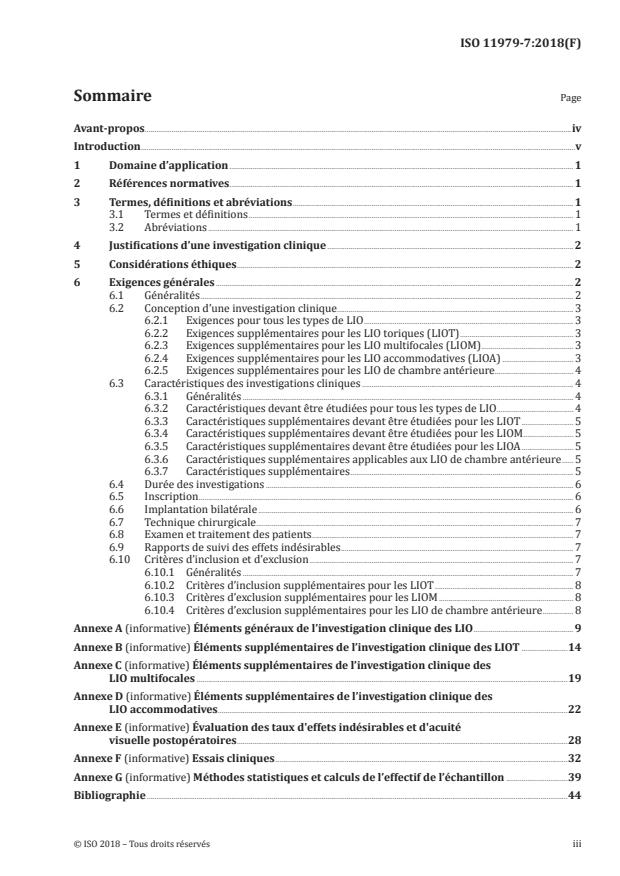
Sommaire Page
Avant-propos .iv
Introduction .v
1 Domaine d’application . 1
2 Références normatives . 1
3 Termes, définitions et abréviations . 1
3.1 Termes et définitions . 1
3.2 Abréviations . 1
4 Justifications d’une investigation clinique . 2
5 Considérations éthiques . 2
6 Exigences générales . 2
6.1 Généralités . 2
6.2 Conception d’une investigation clinique. 3
6.2.1 Exigences pour tous les types de LIO . 3
6.2.2 Exigences supplémentaires pour les LIO toriques (LIOT) . 3
6.2.3 Exigences supplémentaires pour les LIO multifocales (LIOM) . 3
6.2.4 Exigences supplémentaires pour les LIO accommodatives (LIOA) . 3
6.2.5 Exigences supplémentaires pour les LIO de chambre antérieure. 4
6.3 Caractéristiques des investigations cliniques . 4
6.3.1 Généralités . 4
6.3.2 Caractéristiques devant être étudiées pour tous les types de LIO . 4
6.3.3 Caractéristiques supplémentaires devant être étudiées pour les LIOT . 5
6.3.4 Caractéristiques supplémentaires devant être étudiées pour les LIOM . 5
6.3.5 Caractéristiques supplémentaires devant être étudiées pour les LIOA . 5
6.3.6 Caractéristiques supplémentaires applicables aux LIO de chambre antérieure . 5
6.3.7 Caractéristiques supplémentaires . 5
6.4 Durée des investigations . 6
6.5 Inscription . 6
6.6 Implantation bilatérale . 6
6.7 Technique chirurgicale . 7
6.8 Examen et traitement des patients . 7
6.9 Rapports de suivi des effets indésirables . 7
6.10 Critères d’inclusion et d’exclusion . 7
6.10.1 Généralités . 7
6.10.2 Critères d’inclusion supplémentaires pour les LIOT . 8
6.10.3 Critères d’exclusion supplémentaires pour les LIOM . 8
6.10.4 Critères d’exclusion supplémentaires pour les LIO de chambre antérieure . 8
Annexe A (informative) Éléments généraux de l’investigation clinique des LIO .9
Annexe B (informative) Éléments supplémentaires de l’investigation clinique des LIOT .14
Annexe C (informative) Éléments supplémentaires de l’investigation clinique des
LIO multifocales .19
Annexe D (informative) Éléments supplémentaires de l’investigation clinique des
LIO accommodatives .22
Annexe E (informative) Évaluation des taux d'effets indésirables et d'acuité
visuelle postopératoires .28
Annexe F (informative) Essais cliniques .32
Annexe G (informative) Méthodes statistiques et calculs de l’effectif de l’échantillon .39
Bibliographie .44
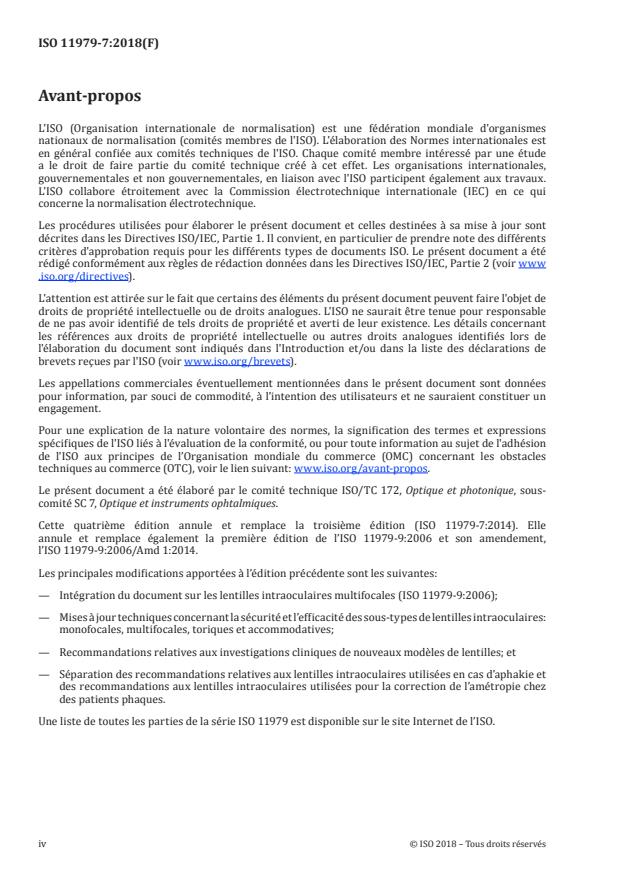
Avant-propos
L'ISO (Organisation internationale de normalisation) est une fédération mondiale d'organismes
nationaux de normalisation (comités membres de l'ISO). L'élaboration des Normes internationales est
en général confiée aux comités techniques de l'ISO. Chaque comité membre intéressé par une étude
a le droit de faire partie du comité technique créé à cet effet. Les organisations internationales,
gouvernementales et non gouvernementales, en liaison avec l'ISO participent également aux travaux.
L'ISO collabore étroitement avec la Commission électrotechnique internationale (IEC) en ce qui
concerne la normalisation électrotechnique.
Les procédures utilisées pour élaborer le présent document et celles destinées à sa mise à jour sont
décrites dans les Directives ISO/IEC, Partie 1. Il convient, en particulier de prendre note des différents
critères d'approbation requis pour les différents types de documents ISO. Le présent document a été
rédigé conformément aux règles de rédaction données dans les Directives ISO/IEC, Partie 2 (voir www
.iso .org/ directives).
L'attention est attirée sur le fait que certains des éléments du présent document peuvent faire l'objet de
droits de propriété intellectuelle ou de droits analogues. L'ISO ne saurait être tenue pour responsable
de ne pas avoir identifié de tels droits de propriété et averti de leur existence. Les détails concernant
les références aux droits de propriété intellectuelle ou autres droits analogues identifiés lors de
l'élaboration du document sont indiqués dans l'Introduction et/ou dans la liste des déclarations de
brevets reçues par l'ISO (voir www .iso .org/ brevets).
Les appellations commerciales éventuellement mentionnées dans le présent document sont données
pour information, par souci de commodité, à l’intention des utilisateurs et ne sauraient constituer un
engagement.
Pour une explication de la nature volontaire des normes, la signification des termes et expressions
spécifiques de l'ISO liés à l'évaluation de la conformité, ou pour toute information au sujet de l'adhésion
de l'ISO aux principes de l’Organisation mondiale du commerce (OMC) concernant les obstacles
techniques au commerce (OTC), voir le lien suivant: www .iso .org/ avant -propos.
Le présent document a été élaboré par le comité technique ISO/TC 172, Optique et photonique, sous-
comité SC 7, Optique et instruments ophtalmiques.
Cette quatrième édition annule et remplace la troisième édition (ISO 11979-7:2014). Elle
annule et remplace également la première édition de l’ISO 11979-9:2006 et son amendement,
l’ISO 11979-9:2006/Amd 1:2014.
Les principales modifications apportées à l’édition précédente sont les suivantes:
— Intégration du document sur les lentilles intraoculaires multifocales (ISO 11979-9:2006);
— Mises à jour techniques concernant la sécurité et l’efficacité des sous-types de lentilles intraoculaires:
monofocales, multifocales, toriques et accommodatives;
— Recommandations relatives aux investigations cliniques de nouveaux modèles de lentilles; et
— Séparation des recommandations relatives aux lentilles intraoculaires utilisées en cas d’aphakie et
des recommandations aux lentilles intraoculaires utilisées pour la correction de l’amétropie chez
des patients phaques.
Une liste de toutes les parties de la série ISO 11979 est disponible sur le site Internet de l’ISO.
iv © ISO 2018 – Tous droits réservés
Introduction
Les lentilles intraoculaires (LIO) sont utilisées pour corriger les erreurs réfractives résiduelles chez
des patients souffrant d’aphakie. Ces erreurs réfractives résiduelles comprennent généralement la
sphère et l’astigmatisme, mais peuvent également inclure l’accommodation. Différentes conceptions de
LIO peuvent être utilisées pour corriger les erreurs réfractives spécifiques. Dans le cas où une LIO est
conçue pour assurer plusieurs types de correction réfractive, cette LIO devra répondre à chacune des
exigences de ces conceptions de correction.
Le présent document fournit des exigences et des recommandations applicables aux investigations de
nouveaux modèles de lentilles intraoculaires. Dans le cas où un modèle de LIO est une modification d’un
modèle de LIO parente, une analyse des risques peut être utilisée pour déterminer le niveau d’essai
approprié.
NORME INTERNATIONALE ISO 11979-7:2018(F)
Implants ophtalmiques — Lentilles intraoculaires —
Partie 7:
Investigations cliniques de lentilles intraoculaires pour la
correction de l'aphakie
1 Domaine d’application
Le présent document spécifie les exigences particulières applicables aux investigations cliniques de
lentilles intraoculaires destinées à être implantées dans l’œil pour corriger l’aphakie.
2 Références normatives
Les documents suivants cités dans le texte constituent, pour tout ou partie de leur contenu, des
exigences du présent document. Pour les références datées, seule l’édition citée s’applique. Pour les
références non datées, la dernière édition du document de référence s'applique (y compris les éventuels
amendements).
ISO 11979-1, Implants ophtalmiques — Lentilles intraoculaires — Partie 1: Vocabulaire
ISO 11979-10:2018, Implants ophtalmiques — Lentilles intraoculaires — Partie 10: Investigations cliniques
de lentilles intraoculaires pour la correction de l’amétropie des yeux phaques
ISO 14155, Investigation clinique des dispositifs médicaux pour sujets humains — Bonnes pratiques cliniques
ISO 14971, Dispositifs médicaux — Application de la gestion des risques aux dispositifs médicaux
3 Termes, définitions et abréviations
3.1 Termes et définitions
Pour les besoins du présent document, les termes et définitions donnés dans l’ISO 11979-1 et
l’ISO 14155 s’appliquent.
L’ISO et l’IEC tiennent à jour des bases de données terminologiques destinées à être utilisées en
normalisation, consultables aux adresses suivantes:
— IEC Electropedia: disponible à l’adresse http:// www .electropedia .org/
— ISO Online browsing platform: disponible à l’adresse https:// www .iso .org/ obp
3.2 Abréviations
AVLsc acuité visuelle de loin sans correction
AVIsc acuité visuelle intermédiaire sans correction
AVPsc acuité visuelle de près sans correction
AVLac acuité visuelle de loin avec correction
AVIac acuité visuelle intermédiaire avec correction
AVPac acuité visuelle de près avec correction
AVIacl acuité visuelle intermédiaire avec correction de loin
AVPacl acuité visuelle de près avec correction de loin
4 Justifications d’une investigation clinique
Une analyse des risques doit être mise en œuvre conformément à l’ISO 14971. Si l’analyse des risques
identifie la nécessité d’une investigation clinique, les exigences de l’ISO 14155 doivent s’appliquer, ainsi
que les exigences supplémentaires indiquées dans le présent document.
Si un nouveau modèle de LIO est une modification d’un modèle de LIO parente dont la sécurité et les
performances ont déjà été établies par le biais d'une investigation clinique conformément au présent
document, aucune investigation supplémentaire n'est nécessaire ou seulement une investigation limitée.
[1]
L’ISO/TR 22979 fournit des recommandations pour déterminer la nécessité d’une investigation
clinique.
5 Considérations éthiques
Pour les investigations cliniques des dispositifs médicaux destinés à des patients humains, les exigences
éthiques indiquées dans l'ISO 14155 s’appliquent.
6 Exigences générales
6.1 Généralités
Il existe quatre principales catégories de lentilles intraoculaires déterminées par la configuration
optique:
a) monofocales (LIO);
b) multifocales (LIOM);
c) toriques (LIOT); et
d) accommodatives (LIOA).
Les mêmes exigences de base s’appliquent à tous les types de LIO. Des exigences supplémentaires
s’appliquent aux LIOM, aux LIOT et aux LIOA.
Il existe une autre sous-division selon le positionnement anatomique de la LIO:
— chambre postérieure; et
— chambre antérieure.
Les lentilles de chambre postérieure sont positionnées derrière (postérieurement à) l’iris. Les lentilles de
chambre antérieure sont positionnées devant (antérieurement à) l’iris. Des exigences supplémentaires
s’appliquent dans le cas de lentilles de chambre antérieure.
2 © ISO 2018 – Tous droits réservés
6.2 Conception d’une investigation clinique
6.2.1 Exigences pour tous les types de LIO
Une investigation clinique doit être conçue pour comparer la fréquence des effets indésirables et les
activités visuelles supérieures au seuil défini du modèle de LIO par rapport aux résultats de données
historiques. L'Annexe A donne des recommandations générales pour la conception d'une investigation
clinique des LIO. Des données historiques sont indiquées dans l’Annexe E.
6.2.2 Exigences supplémentaires pour les LIO toriques (LIOT)
Avant toute investigation clinique d’une lentille intraoculaire torique, la stabilité en rotation d’une
version non torique mécaniquement et géométriquement équivalente de ce modèle de LIO doit être
démontrée.
Les critères de performance suivants relatifs à la stabilité en rotation doivent être réunis.
La rotation de la LIO est définie comme étant la différence d’orientation postopératoire du méridien
défini par l’indicateur d’axe de la LIO entre celle prévue le jour de l’intervention (Rapport 0) et celle
mesurée dans le Rapport 4 et dans les Rapports suivants. (Voir A.3 pour des recommandations sur les
périodes de suivi). La rotation absolue doit être inférieure à 10° dans 90 % des cas et inférieure à 20°
dans 95 % des cas.
Ensuite, si l’analyse des risques le juge utile (par exemple, pour évaluer les performances cliniques des
LIOT de faible puissance cylindrique), une investigation clinique doit alors être effectuée en utilisant la
version torique du modèle.
Les résultats cliniques des patients qui subissent une intervention secondaire pour corriger un défaut
d’alignement de rotation de la LIO postopératoire doivent être transmis avant l’intervention secondaire
en tant que résultats finaux pour ces patients, et les examens programmés à un stade ultérieur de
l’investigation clinique doivent être effectués avant l’intervention secondaire, dans la mesure du
possible. (Voir l'Annexe D.)
L’Annexe B indique des éléments supplémentaires relatifs aux investigations de LIOT.
6.2.3 Exigences supplémentaires pour les LIO multifocales (LIOM)
Pour les conceptions multifocales équipées de deux foyers ou plus, une investigation clinique doit
évaluer la sécurité et la performance de la vision de loin ainsi qu’à d’autres distances focales prévues.
Le plan d’investigation clinique doit inclure une évaluation de défocalisation.
Une inscription par phases telle que décrite dans l’Annexe C doit être envisagée.
L’Annexe C indique des éléments supplémentaires relatifs aux LIOM.
6.2.4 Exigences supplémentaires pour les LIO accommodatives (LIOA)
Une investigation clinique contrôlée d’une LIOA doit évaluer l’amplitude accommodative et les aspects
supplémentaires de sécurité et de performance associés à l’évaluation des risques. L’Annexe D identifie
les aspects de sécurité et de performance étudiés. Le plan d’investigation clinique doit inclure au moins
une méthode objective pour mesurer une amplitude accommodative.
L’inscription par phases doit comporter deux phases (voir l’Annexe D). La deuxième phase doit
commencer uniquement après que la première phase a démontré que la conception de LIO donne une
moyenne d’au moins 1,0 D d’accommodation objective. Pour que la conception soit conçue comme une
LIOA, l’investigation globale doit démontrer une accommodation objective de 1,0 D ou plus au niveau du
point de stabilité accommodative (voir l’Annexe D).
L’Annexe D indique des éléments supplémentaires relatifs aux LIOA.
6.2.5 Exigences supplémentaires pour les LIO de chambre antérieure
Une investigation clinique d’une LIO de chambre antérieure doit évaluer la variation de densité des
cellules endothéliales, l’hexagonalité et le coefficient de variation de la surface des cellules endothéliales,
l’espace entre les surfaces de la LIO de chambre antérieure et la surface postérieure de la cornée et de
l’iris, l’angle de la chambre antérieure (y compris les observations de pigment et de synéchie), ainsi que
tous les aspects de sécurité et de performance supplémentaires associés à l’évaluation des risques.
6.3 Caractéristiques des investigations cliniques
6.3.1 Généralités
Le plan d'investigation clinique doit fournir des informations concernant les caractéristiques à étudier
ainsi que des instructions sur les méthodes et la documentation de ces caractéristiques. Si cela est
possible, des méthodes objectives telles que l'imagerie photographique doivent être utilisées.
Toute déclaration supplémentaire requiert l’étude de caractéristiques correspondantes
supplémentaires.
Si plusieurs types de LIO sont combinés, les caractéristiques de chaque sous-type de LIO de l’ensemble
d’entre eux doivent être prises en compte.
6.3.2 Caractéristiques devant être étudiées pour tous les types de LIO
Les caractéristiques suivantes doivent être prises en compte:
a) l’AVLac;
b) l’acuité visuelle à toutes les distances prévues avec correction de loin;
c) la pression intraoculaire;
d) l’état de la cornée;
e) les signes d’inflammation:
— cellules de la chambre antérieure,
— flare de la chambre antérieure,
— œdème maculaire cystoïde,
— hypopion, et
— endophtalmie;
f) le blocage pupillaire;
g) le décollement de la rétine;
h) l’état des capsules postérieure et antérieure;
[2]
i) le décentrement de la LIO ;
[2]
j) l’inclinaison de la LIO ;
k) la décoloration de la LIO; et
l) l’opacité de la LIO.
4 © ISO 2018 – Tous droits réservés
6.3.3 Caractéristiques supplémentaires devant être étudiées pour les LIOT
a) Stabilité en rotation de la LIO; et
b) astigmatisme cornéen:
— avant l’intervention;
— position chirurgicale prévue (Rapport 0); et
— après l’intervention.
6.3.4 Caractéristiques supplémentaires devant être étudiées pour les LIOM
a) Acuité visuelle sans correction à toutes les distances focales prévues;
b) sensibilité au contraste;
c) évaluation de défocalisation;
d) taille de pupille en conditions photopiques et mésopiques; et
e) visualisation du fond d’œil.
6.3.5 Caractéristiques supplémentaires devant être étudiées pour les LIOA
a) Amplitude accommodative objective;
b) acuité visuelle sans correction de loin, intermédiaire et de près;
c) acuité visuelle de près et intermédiaire avec correction de loin;
d) réfraction supplémentaire (sur correction de loin) requise pour obtenir une amélioration de l’acuité
visuelle de près;
e) sensibilité au contraste;
f) évaluation de défocalisation; et
g) taille de pupille.
6.3.6 Caractéristiques supplémentaires applicables aux LIO de chambre antérieure
a) Microscopie spéculaire;
b) mesurage de la profondeur de la chambre antérieure; et
c) gonioscopie.
6.3.7 Caractéristiques supplémentaires
En cas de justification par l’analyse des risques, les caractéristiques supplémentaires suivantes doivent
être prises en compte:
a) réfraction cycloplégique;
b) microscopie spéculaire;
c) gonioscopie;
d) taille de pupille; et
e) mesurage de la profondeur de la chambre antérieure.
6.4 Durée des investigations
[1]
Consulter l’ISO/TR 22979 pour connaître les recommandations relatives à la durée d’investigation
concernant les modifications des modèles de lentilles pour lesquels des données de sécurité et de
performance ont été préalablement établies lors de l’investigation clinique.
Pour les LIO de chambre postérieure qui ne sont pas des modifications d’un modèle pour lequel des
données de sécurité et de performance ont été préalablement établies lors de l’investigation clinique, la
durée minimale des investigations cliniques doit être le Rapport 5 (voir l’Annexe A pour la tolérance de
la fenêtre de visite recommandée).
Pour les LIO de chambre antérieure qui ne sont pas des modifications d’un modèle pour lequel des
données de sécurité et de performance ont été préalablement établies lors de l’investigation clinique,
la durée minimale des investigations cliniques doit être de 3 ans (voir l’Annexe A pour la tolérance de la
fenêtre de visite recommandée).
Pour toutes les LIOT, une étude de la version non torique de la LIO doit être effectuée pour garantir la
stabilité en rotation jusqu’au Rapport 4. Les LIOT qui ne sont pas une modification d’une LIO parente
correspondante doivent nécessiter une investigation clinique complète jusqu’au Rapport 5 pour les LIO
de chambre postérieure et d’une durée de 3 ans pour les LIO de chambre antérieure.
Pour les LIOT qui sont une modification d’une LIO parente, l’évaluation de la stabilité en rotation doit
durer jusqu’au Rapport 4. Si une investigation clinique ultérieure de la LIOT est effectuée, elle doit
également durer jusqu’au Rapport 4.
Pour toutes les LIOA, la durée d’investigation clinique minimale doit être le Rapport 5, mais peut
nécessiter jusqu’à 3 ans, selon la stabilité accommodative.
Tous les patients d’une investigation clinique qui n’ont pas abandonné l’investigation doivent se
soumettre à toutes les visites de l’investigation. L'investigation clinique doit être considérée comme
terminée lorsque tous les patients inscrits, y compris ceux dont la LIO a été retirée, repositionnée ou
remplacée, sont arrivés à la fin de la période de suivi conformément au protocole ou ont dépassé la
dernière fenêtre de visite.
6.5 Inscription
Pour réduire le plus possible les risques associés à l'investigation clinique d'une nouvelle LIO,
l'inscription du patient doit s'effectuer par étapes. Les données concernant le patient doivent être
évaluées à chaque étape et doivent convenir au promoteur et à l'investigateur chargé de la coordination
(ainsi qu’à l’organisme de réglementation, le cas échéant), avant que la phase suivante de l'investigation
clinique ne se poursuive. Les Annexes A (LIO monofocale), B (LIOT), C (LIOM) et D (LIOA) spécifient les
recommandations relatives à l’inscription par phase.
Une analyse des risques doit être effectuée pour déterminer si une phase antérieure supplémentaire
(avant la phase 1 indiquée dans les annexes ci-dessus) est nécessaire pour résoudre les problèmes de
sécurité associés à la conception de LIO.
6.6 Implantation bilatérale
Tout projet d'implantation dans l'autre œil doit être clairement décrit dans le plan d'investigation
clinique. Un seul œil doit être pris en compte pour chaque patient examiné lors de la première analyse
statistique. En cas d’autorisation d’implantation dans l’autre œil, le plan d’investigation clinique doit
spécifier la période de temps entre l’implantation dans le premier œil et dans l’autre œil. Une analyse
des risques doit être utilisée pour orienter les exigences relatives aux données de sécurité et de
performance.
L'implantation bilatérale ne doit pas être mise en œuvre tant que les données de sécurité et de
performance initiales n'ont pas été recueillies, évaluées et jugées acceptables par le promoteur et
l’investigateur chargé de la coordination (ainsi que par l’organisme de réglementation, le cas échéant).
6 © ISO 2018 – Tous droits réservés
Des résultats sur un minimum de 50 yeux et un suivi postopératoire de six mois sont recommandés
avant l’implantation dans l’autre œil. L’analyse des risques peut permettre une implantation précoce
dans l’autre œil si elle est suffisamment justifiée par des expériences cliniques antérieures.
6.7 Technique chirurgicale
Le plan d'investigation clinique doit contenir une description de la technique chirurgicale, de
l'utilisation intra-opératoire des dispositifs viscochirurgicaux ophtalmiques et de l'utilisation des
médications préopératoires, intra-opératoires et postopératoires. Tout écart doit être enregistré dans
le rapport de suivi.
6.8 Examen et traitement des patients
Les périodes de suivi sont décrites dans l’Annexe A.
Le plan d'investigation clinique doit décrire la façon de prendre en compte dans l'analyse de données
les visites des patients et les effets ophtalmiques indésirables entre chaque période de suivi standard.
6.9 Rapports de suivi des effets indésirables
Voir l’ISO 14155.
6.10 Critères d’inclusion et d’exclusion
6.10.1 Généralités
Les critères d’inclusion généraux indiqués en 6.10.1.1 et les critères d’exclusion généraux indiqués en
6.10.1.2 doivent être pris en compte. Des critères supplémentaires tels que ceux indiqués en 6.10.2,
6.10.3 et 6.10.4 peuvent être pris en compte selon l’analyse des risques applicable au modèle de LIO
spécifique.
6.10.1.1 Critères d’inclusion généraux
a) adulte;
b) cataracte;
c) puissance calculée de la LIO dans la gamme de la LIO examinée;
d) formulaire de consentement éclairé signé; et
e) milieu intraoculaire transparent autre que la cataracte.
6.10.1.2 Critères d’exclusion généraux
a) antécédent de chirurgie intraoculaire ou de la cornée;
b) cataracte traumatique;
c) grossesse ou allaitement;
d) participation simultanée à une autre investigation sur un médicament ou un dispositif;
e) instabilité des mesures de kératométrie ou de biométrie; et
f) astigmatisme irrégulier.
Les patients doivent être exclus lorsque certaines conditions sont présentes au moment de l’intervention,
notamment:
— instabilité zonulaire;
— nécessité de manipulation de l’iris;
— fibrose capsulaire ou autre opacité; et
— incapacité à fixer la LIO dans la position souhaitée.
Dans ces cas, le patient doit être suivi jusqu’à ce que la condition se stabilise.
6.10.2 Critères d’inclusion supplémentaires pour les LIOT
a) astigmatisme cornéen dans la gamme définie dans le plan d'investigation clinique;
b) stabilité de l’astigmatisme cornéen (pendant au moins 4 semaines); et
c) taille de pupille dilatée suffisamment importante pour visualiser les repères d’axe de la LIOT après
l’intervention.
6.10.3 Critères d’exclusion supplémentaires pour les LIOM
a) Astigmatisme cornéen post-opératoire supérieur à 1 D.
6.10.4 Critères d’exclusion supplémentaires pour les LIO de chambre antérieure
Les critères applicables à la plateforme de la LIO de chambre antérieure doivent être conformes à la
conception de LIO prévue spécifique telle que décrite dans ce paragraphe, notamment les LIOT, les LIOA
et les LIOM.
a) Anomalies angulaires;
b) glaucome ou hypertension oculaire;
c) anatomie de l’angle ou de la chambre antérieure inadaptée pour accepter en toute sécurité la
conception de LIO;
d) profondeur de chambre antérieure minimale associée à la conception;
e) problèmes endothéliaux;
— densité des cellules endothéliales inférieure à celle indiquée dans l’ISO 11979-10:2018, Tableau 1
— pourcentage d’hexagonalité de forme des cellules endothéliales ≥45 %
— coefficient de variation de la surface des cellules endothéliales <0,45
— toute pathologie endothéliale créant un risque de dysfonctionnement de la cornée
f) œdème de la cornée.
8 © ISO 2018 – Tous droits réservés
Annexe A
(informative)
Éléments généraux de l’investigation clinique des LIO
A.1 Généralités
La présente annexe donne les éléments d'un plan d'investigation clinique (PIC) qui peuvent aider à
recueillir les données permettant de déterminer la sécurité et les performances de tous les types de LIO.
A.2 Conception et durée de l’investigation
A.2.1 Généralités
La conception d’investigation clinique suggérée est une étude non contrôlée visant à comparer les
résultats avec les critères de sécurité et de performance historiques dans l’Annexe E lors du dernier suivi.
NOTE 1 Dans le cas d’une investigation portant sur un groupe témoin, le nombre de patients calculé devra
être suffisant pour détecter toute différence au niveau des critères de sécurité et de performance dans l’Annexe E
avec une puissance statistique similaire à celle de l’étude susmentionnée.
NOTE 2 Toute déclaration supplémentaire, en dehors de celles relatives à la sécurité et aux performances,
requiert un effectif d’échantillon calculé à cet effet.
Pour tenir compte du fait que certains patients sont perdus au cours des investigations cliniques
jusqu’au suivi (y compris suite à leur décès ou à l'extraction de la LIO), le nombre d'inscriptions doit être
d'environ (voir également en 6.4):
a) 340 patients pour une investigation d'une durée d'un an;
b) 420 patients pour une investigation d'une durée de trois ans.
Si l’analyse des risques détermine qu’une investigation clinique limitée est suffisante (voir
[1]
l’ISO/TR 22979 ), le nombre de patients à inscrire est de 115 pour atteindre un objectif de 100 patients.
Pour réduire le plus possible l’exposition aux risques d’une nouvelle LIO, il convient de ne pas inscrire
beaucoup plus de patients que le nombre indiqué ci-dessus.
Pour permettre d'équilibrer le nombre de patients entre les investigateurs, il convient que chaque
chirurgien présente un minimum de 20 patients, mais pas plus de 25 % des patients soumis à une même
investigation.
A.2.2 Inscription
Pour réduire le plus possible les risques potentiels, l'investigation clinique doit se dérouler en deux phases:
a) Phase 1: un nombre maximal de 100 patients est inscrit pour l’investigation initiale. Dès que
50 patients au moins ont atteint le Rapport de suivi 4, leurs données sont évaluées. Si les résultats
sont acceptables, la phase suivante démarre.
b) Phase 2: les patients participants restants sont inscrits.
En cas d’investigation clinique limitée, l’investigation n’est pas divisée en phases.
A.2.3 Normalisation des modes opératoires
Définir des critères d'évaluation de toutes les variables étudiées. Définir des conditions d’essai pour
tous les mesurages. Avant de démarrer l'investigation, donner des instructions à tous les investigateurs
et les former aux mesurages afin d'obtenir des données pouvant être combinées pour les besoins de
l'analyse statistique.
Le nombre minimal de rapports de suivi remplis pour chaque période de suivi est égal au nombre
minimal requis pour l’investigation.
A.3 Périodes de suivi
Les intervalles entre les périodes de suivi sont définis ci-après:
a) Rapport de suivi 0: suivi préopératoire/opératoire;
b) Rapport de suivi 1: suivi postopératoire, 1 jours à 2 jours après l'intervention;
c) Rapport de suivi 2: suivi postopératoire, 7 jours à 14 jours après l'intervention;
d) Rapport de suivi 3: suivi postopératoire, 30 jours à 60 jours après l'intervention;
e) Rapport de suivi 4: suivi postopératoire, 120 jours à 180 jours après l'intervention;
f) Rapport de suivi 5: suivi postopératoire, 330 jours à 420 jours après l'intervention;
g) Rapport de suivi 6: suivi postopératoire, 630 jours à 780 jours après l'intervention;
h) Rapport de suivi 7: suivi postopératoire, 990 jours à 1 140 jours après l’intervention.
A.4 Essais cliniques
La biomicroscopie est effectuée dans tous les rapports sauf dans le Rapport 0 pendant l’intervention.
Les acuités visuelles sans correction et avec correction sont mesurées en unités logMAR en conditions
photopiques, et réalisées dans tous les rapports sauf dans le Rapport 0 pendant l’intervention. Les
méthodes sont décrites dans l’Annexe F.
A.5 Résultats
Les résultats à prendre en compte sont ceux indiqués dans l’Annexe E pour la comparaison avec les
données historiques.
A.6 Analyses des données
Outre les comparaisons avec les données historiques indiquées dans l’Annexe E, prendre en compte les
analyses suivantes:
a) l’acuité visuelle (AV) en fonction de l'âge (<65 ans et >65 ans);
b) l’AV optimale;
c) l’AV selon les effets indésirables;
d) l’AV selon l’investigateur;
e) l’analyse patient par patient des raisons pour lesquelles le patient n’atteint pas une AVLac de
0,3 logMAR;
f) la fréquence et les causes de la perte d’acuité visuelle de 0,2 logMAR;
10 © ISO 2018 – Tous droits réservés
g) la fréquence des effets indésirables cumulés selon l’âge (<65 ans et >65 ans);
h) la fréquence des effets indésirables persistants selon l’âge (<65 ans et >65 ans);
i) les effets indésirables selon l'investigateur;
j) le pourcentage d’yeux atteignant un équivalent sphérique recherché en fonction d’obtenu de:
— ±0,50 D, et
— ±1,00 D.
k) le pourcentage d’yeux atteignant une acuité visuelle sans correction de:
— 0,0 logMAR ou plus; et
— 0,3 logMAR ou plus.
l) le pourcentage d’yeux atteignant une acuité visuelle avec correction de:
— 0,0 logMAR ou plus; et
— 0,3 logMAR ou plus.
m) les effets oculaires indésirables graves et les effets indésirables liés au dispositif.
Pour les analyses primaires des effets indésirables, les analyses statistiques primaires sont effectuées
en utilisant uniquement le premier œil implanté pour chaque patient; les analyses secondaires incluent
tous les yeux implantés. Pour les critères de performance, les analyses primaires sont effectuées en
utilisant uniquement le premier œil implanté pour chaque patient.
A.7 Prise en compte des patients
Les exigences générales relatives à la prise en compte des patients sont indiquées dans l'ISO 14155. Des
recommandations spécifiques concernant cette prise en compte à chacune des visites postopératoires
durant les conceptions d’investigation clinique de la LIO sont fournies dans le Tableau A.1.
Tableau A.1 — Prise en compte par visite postopératoire
Nombre
total
a
Inscrits (N)
b
Implantés (N)
Rapport 1 Rapport 2 Rapport final
État des patients
(n, %)) (n, %)) (n, %))
c
Disponibles pour l'analyse
d
Interrompus
Absents à une visite programmée mais
e
examinés plus tard
f
Non examinés mais pris en compte
g
Perdus au suivi
h
Actifs
a
Inscrits — représente le nombre total de patients soumis à l’investigation.
b
Implantés — représente le nombre total de patients implantés avec la LIO.
c
Disponibles pour l'analyse — représente le nombre total de patients dont les données sont disponibles dans le rapport.
d
Interrompus — représente le nombre total de patients qui ont interrompu le traitement avant le rapport pour une
quelconque raison (par exemple, décès ou remplacement du dispositif, panne d’écran ou interruption après une absence
d’implantation), mais n’inclut pas les patients perdus au suivi.
e
Absents à la visite programmée mais examinés plus tard — représente le nombre total de patients examinés en dehors
de la période de temps associée au rapport.
f
Non examinés mais pris en compte — représente le nombre total de patients manquant à la visite programmée mais
qui ont été pris en compte après avoir été contactés (par exemple par téléphone).
g
Perdus au suivi — représente le nombre total de patients non présents dans le rapport et à propos desquels on ne
dispose donc d'aucune information.
h
Actifs — représente le nombre total de patients n'ayant pas atteint la durée associée au rapport. Dans le rapport,
l’investigation est considérée comme terminée lorsque le nombre de patients actifs est de zéro.
L’équation suivante est utilisée pour déterminer le pourcentage de prise en compte pour l’investigation.
% de prise en compte = (Disponibles pour l’analyse) / (Inscrits – Interrompus – Actifs)
Selon l'investigation clinique, il est possible que le nombre total de patients ne représente pas
nécessairement le nombre total d'yeux. Cependant, pour les besoins de la présente recommandation, on
suppose que le traitement est unilatéral et que le nombre total de patients est égal au nombre total d'yeux.
Les méthodes sont décrites dans l’Annexe F.
A.8 Programme d’examen recommandé pour les LIO monofocales
Utiliser les essais et les programmes indiqués dans le Tableau A.2 pour les LIO monofocales de chambres
antérieure et postérieure.
12 © ISO 2018 – Tous droits réservés
Tableau A.2 — Programme d’examen pour les LIO monofocales
Rapport 0
Rapport Rapport Rapport Rapport Rapport Rapport Rapport
Examen Préop. Op.
a a
1 2 3 4 5 6 7
a a
AVsc de loin X X X X X X X X
a a
AVOac de loin X X X X X X X
a a
Réfraction subjective X X X X X X X
a a
Inclinaison et décen- X X X X X X X
trement de la LIO
a a
Biomicroscopie X X X X X X X X
a a
Ophtalmoscopie avec X X X X
pupille dilatée
Kératométrie X
a a a a
Pachymétrie cor- X X X X X
néenne
Longueur axiale X
a a
Profondeur de la X X X
chambre antérieure
a a a a a
Gonioscopie X X X X X X
a a
Pression intraoculaire X X X X X X X X
a a a a a a
Microscopie spéculaire X X X X X X
Sous-études
Analyse de l’espace
a a
X X
a,b
libre
a
Pour les LIO de chambre antérieure uniquement.
b
Voir l’ISO 11979-10 pour les recommandations.
Annexe B
(informative)
Éléments supplémentaires de l’investigation clinique des LIOT
B.1 Généralités
Les éléments supplémentaires suivants du plan d'investigation clinique (PIC) d'une LIOT peuvent aider
à recueillir les données permettant de déterminer la sécurité et la performance de ce dispositif.
Si l'élément torique est appliqué sur une LIO parente non torique préalablement homologuée, alors une
étude de stabilité en rotation du modèle de LIO non torique est effectuée.
Si la LIOT n’est associée à aucun modèle préalablement homologué, alors une étude initiale de stabilité
en rotation d’une version non torique du nouveau modèle est effectuée, suivie d’une investigation
clinique complète telle que décrite dans l’Annexe A. Cette investigation clinique complète peut inclure
uniquement des LIO non toriques ou une combinaison de LIOT et de LIO non toriques.
Les exigences relatives à la stabilité en rotation sont données en 6.2.2.
Si l’évaluation des risques en prouve la nécessité, une investigation clinique supplémentaire du modèle
de LIOT est effectuée comme il est décrit en B.3.
B.2 Étude de prévisibilité de rotation d’une LIO non torique
Une étude de prévisibilité en rotation est effectuée sur une version non torique du modèle de LIOT
proposé pour déterminer si la conception est suffisamment stable pour être utilisée comme LIOT, en
utilisant un échantillon pour essai de LIO non toriques dont les repères d'orientation sont adaptés à la
conception torique. Les positions des repères d’orientation de la LIO sont consignées en visualisant l’œil
du segment antérieur au segment postérieur; les valeurs négatives sont utilisées pour la rotation dans
le sens antihoraire et les valeurs positives sont utilisées pour la rotation horaire.
L’orientation initiale de la LIO est consignée en tant que position chirurgicale prévue dans le Rapport 0
pendant l’intervention à l’aide d’une photographie d’enregistrement ou d’une autre technique afin de
documenter la position de rotation de la LIO. D’autres orientations sont mesurées et enregistrées dans
chaque rapport. (V
...
Questions, Comments and Discussion
Ask us and Technical Secretary will try to provide an answer. You can facilitate discussion about the standard in here.
Loading comments...