

ISO/TS 16975-2:2016
(Main)Respiratory protective devices — Selection, use and maintenance — Part 2: Condensed guidance to establishing and implementing a respiratory protective device programme
General Information
- Abstract
ISO/TS 16975-2:2016 provides brief guidance to assist persons responsible for establishing and implementing a programme for respiratory protective devices (RPD) that meet the performance requirements. There are special applications where the selection of suitable RPD using this guide is not appropriate. These are: a) Fire Fighting ? structural and wildland firefighting, hazardous materials and rescue applications; b) CBRN (Chemical, Biological, Radiological and Nuclear agents); c) Marine ? shipboard or off-shore firefighting or hazardous materials applications; d) Mining ? underground mining or firefighting and rescue applications; and e) Escape ? general, fire, CBRN, marine and mining. NOTE 1 For more detailed information relating to the special applications, refer to ISO/TS 16975‑1. This guidance does not apply to selecting RPD against bio aerosols. NOTE 2 Reference [3] addresses selection of RPD for bio aerosols that are capable of causing infection or adverse or allergic response but for which no occupational exposure limits have been established. This guidance does not apply to RPD programmes for RPD used exclusively under water, in aircraft, and medical life support respirators and resuscitators.
- Status
- Published
- Publication Date
- 29-May-2016
- Technical Committee
- ISO/TC 94/SC 15 - Respiratory protective devices
- Drafting Committee
- ISO/TC 94/SC 15/WG 6 - Selection and use
- Current Stage
- 9060 - Close of review
- Completion Date
- 04-Mar-2027
Buy Documents

ISO/TS 16975-2:2016 - Respiratory protective devices — Selection, use and maintenance — Part 2: Condensed guidance to establishing and implementing a respiratory protective device programme Released:5/30/2016

ISO/TS 16975-2:2016 - Appareils de protection respiratoire — Choix, utilisation et entretien — Partie 2: Directives condensées pour l'élaboration et la mise en ouvre d'un programme pour les appareils de protection respiratoire Released:9/9/2016
Overview
ISO/TS 16975-2:2016 provides condensed guidance for establishing and implementing a respiratory protective device (RPD) programme. Intended as a practical, step‑wise technical specification, it helps employers and safety professionals select, use and maintain RPD that meet performance requirements. The document is especially aimed at small and medium enterprises and complements the more detailed ISO/TS 16975-1. It focuses on risk assessment, selection procedures, training, programme management and record keeping for respiratory protection.
Key topics and requirements
- Risk assessment: Identify hazardous substances, oxygen deficiency and task-specific exposure information (e.g., from SDS/MSDS and OELs). Use assessment results to determine the need for RPD.
- Selection process: A structured ten‑step approach including organization information, task description, hazard definition, protection class determination, work rate assessment, filter identification, supplied gas capacity, task and wearer factors, and final selection.
- Protection metrics: Guidance on using national Assigned Protection Factors (APF) or the ISO Protection Levels (PL) when determining adequate protection; APF are preferred where available.
- RPD types and classes: Distinguishes filtering RPD (filters, cartridges, powered units) and supplied breathable gas RPD (self‑contained or remote supply). Classification covers protection class (PC1–PC6), work rate (W1–W4) and interface type (tight‑fitting vs loose‑fitting).
- Training and use: Requirements for wearer training, correct donning/doffing, filter replacement and use of supplied air systems.
- Programme management and records: Ongoing management, maintenance schedules and retention of RPD selection records (Annex A provides a selection record template).
Practical applications and who uses it
- Employers and safety managers designing or improving an RPD programme
- Occupational hygienists and health & safety consultants advising on respiratory protection
- RPD programme administrators responsible for compliance, training and records
- RPD suppliers/manufacturers assisting customers with selection and fit considerations
Use this technical specification when selecting respiratory protection for workplace hazards (chemicals, particulates, vapours) except where specialist guidance applies.
Limitations / exclusions
ISO/TS 16975-2 is not suitable for: structural and wildland firefighting, CBRN incidents, certain marine and mining operations, escape devices, RPD for bioaerosols that cause infection, RPD used exclusively underwater, in aircraft, or medical life‑support respirators. For these, refer to ISO/TS 16975-1 and other specialist standards.
Related standards
- ISO/TS 16975-1 - Establishing and implementing RPD programmes (detailed guidance)
- ISO 16972 - Terms, definitions and symbols for RPD
- ISO/TS 16973 (classification guidance) and performance standards referenced within the ISO 16975 series
Keywords: ISO/TS 16975-2, respiratory protective devices, RPD programme, respiratory protection, selection use maintenance, APF, ISO protection levels, risk assessment.
Buy Documents
ISO/TS 16975-2:2016 - Respiratory protective devices — Selection, use and maintenance — Part 2: Condensed guidance to establishing and implementing a respiratory protective device programme Released:5/30/2016
ISO/TS 16975-2:2016 - Appareils de protection respiratoire — Choix, utilisation et entretien — Partie 2: Directives condensées pour l'élaboration et la mise en ouvre d'un programme pour les appareils de protection respiratoire Released:9/9/2016
Get Certified
Connect with accredited certification bodies for this standard

CIS Institut d.o.o.
Personal Protective Equipment (PPE) certification body. Notified Body NB-2890 for EU Regulation 2016/425 PPE.

Kiwa BDA Testing
Building and construction product certification.
Kmetijski inštitut Slovenije
Agricultural Institute of Slovenia. Soil testing, plant health, agricultural product analysis.
Sponsored listings
Frequently Asked Questions
ISO/TS 16975-2:2016 is a technical specification published by the International Organization for Standardization (ISO). Its full title is "Respiratory protective devices — Selection, use and maintenance — Part 2: Condensed guidance to establishing and implementing a respiratory protective device programme". This standard covers: ISO/TS 16975-2:2016 provides brief guidance to assist persons responsible for establishing and implementing a programme for respiratory protective devices (RPD) that meet the performance requirements. There are special applications where the selection of suitable RPD using this guide is not appropriate. These are: a) Fire Fighting ? structural and wildland firefighting, hazardous materials and rescue applications; b) CBRN (Chemical, Biological, Radiological and Nuclear agents); c) Marine ? shipboard or off-shore firefighting or hazardous materials applications; d) Mining ? underground mining or firefighting and rescue applications; and e) Escape ? general, fire, CBRN, marine and mining. NOTE 1 For more detailed information relating to the special applications, refer to ISO/TS 16975‑1. This guidance does not apply to selecting RPD against bio aerosols. NOTE 2 Reference [3] addresses selection of RPD for bio aerosols that are capable of causing infection or adverse or allergic response but for which no occupational exposure limits have been established. This guidance does not apply to RPD programmes for RPD used exclusively under water, in aircraft, and medical life support respirators and resuscitators.
ISO/TS 16975-2:2016 provides brief guidance to assist persons responsible for establishing and implementing a programme for respiratory protective devices (RPD) that meet the performance requirements. There are special applications where the selection of suitable RPD using this guide is not appropriate. These are: a) Fire Fighting ? structural and wildland firefighting, hazardous materials and rescue applications; b) CBRN (Chemical, Biological, Radiological and Nuclear agents); c) Marine ? shipboard or off-shore firefighting or hazardous materials applications; d) Mining ? underground mining or firefighting and rescue applications; and e) Escape ? general, fire, CBRN, marine and mining. NOTE 1 For more detailed information relating to the special applications, refer to ISO/TS 16975‑1. This guidance does not apply to selecting RPD against bio aerosols. NOTE 2 Reference [3] addresses selection of RPD for bio aerosols that are capable of causing infection or adverse or allergic response but for which no occupational exposure limits have been established. This guidance does not apply to RPD programmes for RPD used exclusively under water, in aircraft, and medical life support respirators and resuscitators.
ISO/TS 16975-2:2016 is classified under the following ICS (International Classification for Standards) categories: 13.340.30 - Respiratory protective devices. The ICS classification helps identify the subject area and facilitates finding related standards.
ISO/TS 16975-2:2016 is available in PDF format for immediate download after purchase. The document can be added to your cart and obtained through the secure checkout process. Digital delivery ensures instant access to the complete standard document.
Standards Content (Sample)
TECHNICAL ISO/TS
SPECIFICATION 16975-2
First edition
2016-06-15
Respiratory protective devices —
Selection, use and maintenance —
Part 2:
Condensed guidance to establishing
and implementing a respiratory
protective device programme
Appareils de protection respiratoire — Choix, utilisation et
entretien —
Partie 2: Directives condensées pour établir et améliorer un
programme de dispositif de protection respiratoire
Reference number
©
ISO 2016
© ISO 2016, Published in Switzerland
All rights reserved. Unless otherwise specified, no part of this publication may be reproduced or utilized otherwise in any form
or by any means, electronic or mechanical, including photocopying, or posting on the internet or an intranet, without prior
written permission. Permission can be requested from either ISO at the address below or ISO’s member body in the country of
the requester.
ISO copyright office
Ch. de Blandonnet 8 • CP 401
CH-1214 Vernier, Geneva, Switzerland
Tel. +41 22 749 01 11
Fax +41 22 749 09 47
copyright@iso.org
www.iso.org
ii © ISO 2016 – All rights reserved
Contents Page
Foreword .iv
Introduction .v
1 Scope . 1
2 Normative references . 1
3 Terms and definitions . 1
4 Basic information . 2
4.1 General . 2
4.2 Risk assessment . 2
4.3 Use of assigned protection factors (APF) and ISO protection levels (PL) . 2
4.4 Types and classes of RPD . 3
4.4.1 Types of RPD . 3
4.4.2 Classes of RPD . 3
5 RPD programme elements . 3
6 Selection procedure . 4
6.1 General . 4
6.2 Step 1: Organization information . 4
6.3 Step 2: Description of the task . 4
6.4 Step 3: Define the hazards . 4
6.5 Step 4: Determination of the protection class . 5
6.6 Step 5: Work rate assessment . 5
6.7 Step 6: Filter identification . 5
6.8 Step 7: Supplied breathable gas RPD capacity. 5
6.9 Step 8: Task related factors . 5
6.10 Step 9: Wearer related factors . 5
6.11 Step 10: Final selection . 6
7 Training of the RPD wearer . 7
8 Using RPD . 7
8.1 General . 7
8.2 Using Filtering RPD . 8
8.3 Replacing filters. 8
8.4 Using supplied breathable gas RPD . 8
9 Management of the RPD programme . 8
10 Records . 9
Annex A (normative) Respiratory protective device (RPD) selection process and record .10
Bibliography .15
Foreword
ISO (the International Organization for Standardization) is a worldwide federation of national standards
bodies (ISO member bodies). The work of preparing International Standards is normally carried out
through ISO technical committees. Each member body interested in a subject for which a technical
committee has been established has the right to be represented on that committee. International
organizations, governmental and non-governmental, in liaison with ISO, also take part in the work.
ISO collaborates closely with the International Electrotechnical Commission (IEC) on all matters of
electrotechnical standardization.
The procedures used to develop this document and those intended for its further maintenance are
described in the ISO/IEC Directives, Part 1. In particular the different approval criteria needed for the
different types of ISO documents should be noted. This document was drafted in accordance with the
editorial rules of the ISO/IEC Directives, Part 2 (see www.iso.org/directives).
Attention is drawn to the possibility that some of the elements of this document may be the subject of
patent rights. ISO shall not be held responsible for identifying any or all such patent rights. Details of
any patent rights identified during the development of the document will be in the Introduction and/or
on the ISO list of patent declarations received (see www.iso.org/patents).
Any trade name used in this document is information given for the convenience of users and does not
constitute an endorsement.
For an explanation on the meaning of ISO specific terms and expressions related to conformity assessment,
as well as information about ISO’s adherence to the World Trade Organization (WTO) principles in the
Technical Barriers to Trade (TBT) see the following URL: www.iso.org/iso/foreword.html.
The committee responsible for this document is ISO/TC 94, Personal safety — Protective clothing and
equipment, Subcommittee SC 15, Respiratory protective devices.
ISO 16975 consists of the following parts, under the general title Respiratory protective devices —
Selection, use and maintenance:
— Part 1: Establishing and implementing a respiratory protective device programme [Technical
Specification]
— Part 2: Condensed guide to establishing and implementing a respiratory protective device programme
[Technical Specification]
— Part 3: Fit testing procedures
iv © ISO 2016 – All rights reserved
Introduction
Respiratory protective devices (RPD) should only be used after all practicable control measures have
been taken or while they are being implemented, and the risk assessment indicates the presence or
potential presence of a hazardous atmosphere.
When RPD is required to control exposure, then the RPD needs to be correctly selected, used and
maintained.
This Technical Specification provides a condensed guide for establishing and implementing a complete
respiratory protective device programme for RPD that meet the requirements of the performance
standards. It is designed for employers especially in small and medium sized enterprises.
This Technical Specification provides basic information on risk assessment, selection procedure,
training, use and maintenance. Assistance from the RPD supplier/manufacturer or health and safety
professional to establish and implement the programme may be required.
It provides guidance on how to do this together with a table to assist in the selection process. It follows
a simple step-by-step approach to deciding the minimum level of protection required from the RPD and
the most suited to the wearers, the task and workplace conditions.
It is the responsibility of the employer, to correctly select adequate and suitable RPD based on a risk
assessment.
TECHNICAL SPECIFICATION ISO/TS 16975-2:2016(E)
Respiratory protective devices — Selection, use and
maintenance —
Part 2:
Condensed guidance to establishing and implementing a
respiratory protective device programme
1 Scope
This Technical Specification provides brief guidance to assist persons responsible for establishing
and implementing a programme for respiratory protective devices (RPD) that meet the performance
requirements. There are special applications where the selection of suitable RPD using this guide is not
appropriate. These are:
a) Fire Fighting – structural and wildland firefighting, hazardous materials and rescue applications;
b) CBRN (Chemical, Biological, Radiological and Nuclear agents);
c) Marine – shipboard or off-shore firefighting or hazardous materials applications;
d) Mining – underground mining or firefighting and rescue applications; and
e) Escape – general, fire, CBRN, marine and mining.
NOTE 1 For more detailed information relating to the special applications, refer to ISO/TS 16975-1.
This guidance does not apply to selecting RPD against bio aerosols.
NOTE 2 Reference [3] addresses selection of RPD for bio aerosols that are capable of causing infection or
adverse or allergic response but for which no occupational exposure limits have been established.
This guidance does not apply to RPD programmes for RPD used exclusively under water, in aircraft, and
medical life support respirators and resuscitators.
2 Normative references
The following documents, in whole or in part, are normatively referenced in this document and are
indispensable for its application. For dated references, only the edition cited applies. For undated
references, the latest edition of the referenced document (including any amendments) applies.
ISO 16972, Respiratory protective devices — Terms, definitions, graphical symbols and units of
measurement
ISO/TS 16975-1, Respiratory protective devices — Selection use and maintenance — Part 1: Establishing
and implementing a respiratory protective device programme
3 Terms and definitions
For the purposes of this document, the terms and definitions given in ISO 16972 and ISO/TS 16975-1 apply.
4 Basic information
4.1 General
RPD should only be used after all other reasonably practicable control measures have been taken.
4.2 Risk assessment
To select adequate and suitable RPD, first, complete a risk assessment which considers the hazardous
substance(s) being used or generated, the possible lack of oxygen, the task(s) being undertaken and
the person performing the task(s) (i.e. the wearer). Information on hazardous substance(s), such as
occupational exposure limits (OEL) can be found in their safety data sheets (SDS) or material safety
data sheets (MSDS) or other published documentation. Information on process generated substances,
if applicable, shall be followed. Such information may be available in substance-specific regulations or
guidance (e.g. for asbestos).
Existing regulations that direct to a specific type and class of RPD shall be followed, e.g. asbestos.
Once the risk assessment is completed and the required information gathered, the RPD selection
process and record (Annex A) can be used.
Depending upon the workplace circumstances and the information gathered for the risk assessment,
the output of the RPD Selection Record may be either the classification of suitable RPD, or sufficient
information to enable the RPD supplier to recommend suitable RPD.
[1]
NOTE Further information on RPD classification is given in ISO/TS 16973 .
The record of RPD selection should be retained.
Where the RPD selection record recommends seeking professional advice, RPD manufacturers/suppliers
and safety and health consultants are good sources of information.
4.3 Use of assigned protection factors (APF) and ISO protection levels (PL)
National or local regulations may require that RPD be selected using APF. Where this is the case, the
adequacy assessment (Annex A, Step 4) provides a method for using APF.
This part of ISO/TS 16975 provides an option of using either the nationally accepted assigned protection
factors (APF) or ISO protection levels (PL).
However, it should be noted that APF relate to specific design types and classes of RPD and that these
will be different to the ISO RPD classifications. RPD complying with the performance standards of the
same basic design may have different laboratory performance and may therefore fall into a different
protection class (PC).
Where nationally accepted APF are to be used, select RPD having an APF greater than the hazard ratio
(HR) calculated in Annex A, Step 3. The PL is used in the selection process in the same manner as APF.
IMPORTANT — The proposed ISO protection levels that are proposed, have been derived
from professional judgement based on previous assigned protection factors, their associated
nominal protection factors (NPF) and expert knowledge of differences between laboratory and
workplace protection performance of current products. The values will be validated when RPD
conforming to the requirements of the performance standards are available and, until then, are
for information only. In the interim period, APF’s should be used, if available. Where PLs are
used prior to their validation, it is the responsibility of the RPD programme administrator to
determine the suitability of the PL values.
2 © ISO 2016 – All rights reserved
4.4 Types and classes of RPD
4.4.1 Types of RPD
There are two types of respiratory protective devices: filtering RPD and supplied breathable gas RPD.
a) Filtering RPD
Filtering RPD remove (by e.g. filtration, adsorption, or chemical reaction) hazardous substances
present in the ambient air before being inhaled by the wearer. The air is drawn through the filter(s)
either by the wearer’s inhalation action or with the assistance of a blower unit.
b) Supplied breathable gas RPD
Supplied breathable gas RPD supply the wearer with breathable gas from a source independent of
the ambient atmosphere either individually carried (self-contained) or from a remote source.
4.4.2 Classes of RPD
All RPD are classified by protection class (PC1 to PC6), the work rate class (W1 to W4) and the
respiratory interface class. Additionally, filtering RPD are classified by the type and class of filters and
supplied breathable gas RPD are classified by breathing gas capacity.
RPD are available with a range of respiratory interfaces. They are categorized by areas of coverage of
the wearer’s body and by fitting characteristics. These are mouth only, mouth and nose, face, head and
body. Respiratory interfaces can be tight fitting (type T), those that have a complete seal with the skin,
or loose fitting (type L), those that do not have a complete seal to the wearer’s skin.
Examples of various respiratory interfaces and type of RPD are given in ISO/TS 16975-1.
5 RPD programme elements
The RPD programme elements are specified in Table 1.
Table 1 — RPD programme elements
Programme elements Actions Relevant clauses
Carry out a risk assessment
Risk assessment Apply control measures if required 4.2
Establish the need for RPD
Consider the requirements of the workplace environment, the
Environment 6.2 and 6.3
task(s) and the wearer(s)
Measure or estimate its concentration and its form in the air –
particulate, gas, vapour
Hazardous substances 6.4
Consider the potential for oxygen-deficiency
Protection class Identify the minimum protection level required 6.5
Use the information gathered in the assessment to select the
Selection 6.6 to 6.10
appropriate RPD
Fit testing Ensure tight-fitting RPD (Class T) are fit tested 6.11
Training of the RPD wearer Provide training in the use, checking and maintenance of the RPD Clause 7
Include a filter change routine, battery charging, cleaning,
Implementation Clause 8
breathable gas quality checking as appropriate
Management Include regular supervision and regular reminders to wearers Clause 9, 9 a
Table 1 (continued)
Programme elements Actions Relevant clauses
Maintain reusable RPD
Maintenance Replace parts as recommended by the manufacturer. 9 b
Correct any faults promptly
Review at suitable intervals to ensure that any change in
Review conditions, hazardous substance, wearers, etc. are adequately 9 c
addressed
Records Keep records of the RPD programme Clause 10
6 Selection procedure
6.1 General
Follow the steps below and complete the RPD selection process and record as given in Annex A.
Information from the hazards assessment concerning the hazardous substances, the working
environment including the potential for oxygen-deficiency, the task and the wearer(s) is required.
Where the table in Annex A recommends seeking professional advice RPD manufacturers/suppliers
and safety consultants are a good source of information.
6.2 Step 1: Organization information
Fill in the details of the organization and location of where the task is to be undertaken, and the details
and job title of the person completing the selection procedure.
6.3 Step 2: Description of the task
Describe the task and the environment in which the task will be conducted.
NOTE Not all RPD are suitable for wearing for long periods of time or suitable for cold or hot environments, etc.
6.4 Step 3: Define the hazards
The contaminant(s) should be identified by chemical name or Chemical Abstract Number (CAS number)
and its airborne concentration(s) measured or estimated. The potential for oxygen deficiency in the
working area shall be considered.
The information on the occupational exposure limits (OEL) and the immediately dangerous to life
or health (IDLH) concentrations (if applicable) can be found by reference to SDS or existing national
regulations, publications or guidance.
For each of the contaminants, enter in the RPD selection process and record (see Annex A):
a) the concentration in Column A;
b) the IDLH level in Column B;
c) the OEL in Column C;
d) the calculated hazard ratio in Column D;
e) the highest hazard ratio in Column E.
If the contaminant is not known and/or the concentration not known or it is uncertain whether there
is the potential for oxygen-deficiency then seek professional advice or follow national, local or industry
guidance.
4 © ISO 2016 – All rights reserved
When multiple contaminants are present that have additive health effects, the HR should be calculated
for the mixture using the mixture formula (see ISO/TS 16975-1). This result is the required PL.
When multiple contaminants are present that do not have additive health effects, the HR should be
calculated for each contaminant and the highest HR should be used to determine the required PL.
6.5 Step 4: Determination of the protection class
When national regulations specify the use of APF, select the APF which is greater than the highest
hazard ratio calculated.
When no national regulations are specified, the use of ISO protection levels (PL) is recommended.
Determine the PC required by comparing the highest hazard ratio calculated in Step 3 with the PL listed.
6.6 Step 5: Work rate assessment
In order to select RPD that is suitable for the work rate at which the wearer will be working during the
task, co
...
SPÉCIFICATION ISO/TS
TECHNIQUE 16975-2
Première édition
2016-06-15
Appareils de protection
respiratoire — Choix, utilisation et
entretien —
Partie 2:
Directives condensées pour
l’élaboration et la mise en œuvre d’un
programme pour les appareils de
protection respiratoire
Respiratory protective devices — Selection, use and maintenance —
Part 2: Condensed guidance to establishing and implementing a
respiratory protective device programme
Numéro de référence
©
ISO 2016
DOCUMENT PROTÉGÉ PAR COPYRIGHT
© ISO 2016, Publié en Suisse
Droits de reproduction réservés. Sauf indication contraire, aucune partie de cette publication ne peut être reproduite ni utilisée
sous quelque forme que ce soit et par aucun procédé, électronique ou mécanique, y compris la photocopie, l’affichage sur
l’internet ou sur un Intranet, sans autorisation écrite préalable. Les demandes d’autorisation peuvent être adressées à l’ISO à
l’adresse ci-après ou au comité membre de l’ISO dans le pays du demandeur.
ISO copyright office
Ch. de Blandonnet 8 • CP 401
CH-1214 Vernier, Geneva, Switzerland
Tel. +41 22 749 01 11
Fax +41 22 749 09 47
copyright@iso.org
www.iso.org
ii © ISO 2016 – Tous droits réservés
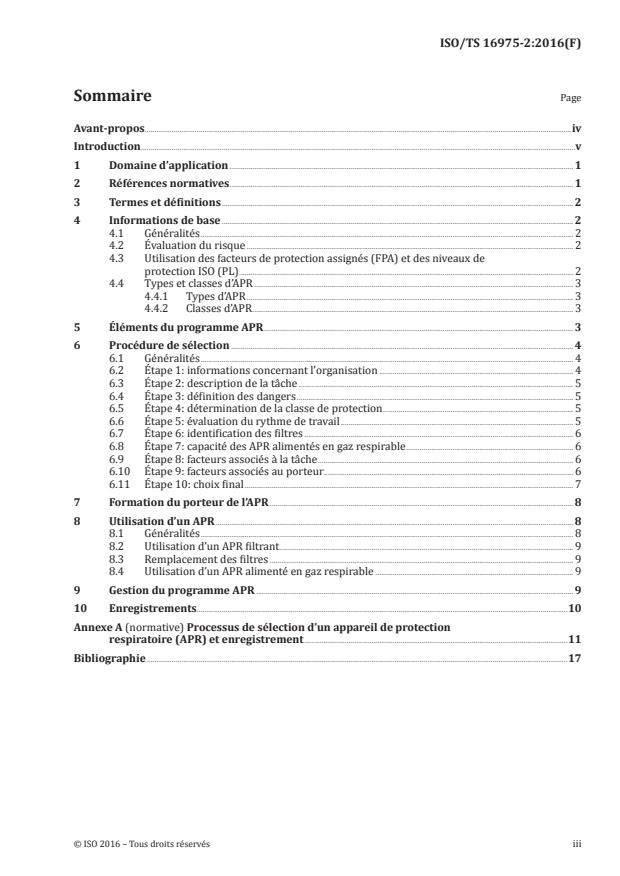
Sommaire Page
Avant-propos .iv
Introduction .v
1 Domaine d’application . 1
2 Références normatives . 1
3 Termes et définitions . 2
4 Informations de base . 2
4.1 Généralités . 2
4.2 Évaluation du risque . 2
4.3 Utilisation des facteurs de protection assignés (FPA) et des niveaux de
protection ISO (PL) . 2
4.4 Types et classes d’APR . 3
4.4.1 Types d’APR . 3
4.4.2 Classes d’APR . 3
5 Éléments du programme APR . 3
6 Procédure de sélection . 4
6.1 Généralités . 4
6.2 Étape 1: informations concernant l’organisation . 4
6.3 Étape 2: description de la tâche . 5
6.4 Étape 3: définition des dangers . 5
6.5 Étape 4: détermination de la classe de protection . 5
6.6 Étape 5: évaluation du rythme de travail . 5
6.7 Étape 6: identification des filtres . 6
6.8 Étape 7: capacité des APR alimentés en gaz respirable . 6
6.9 Étape 8: facteurs associés à la tâche . 6
6.10 Étape 9: facteurs associés au porteur. 6
6.11 Étape 10: choix final . 7
7 Formation du porteur de l’APR . 8
8 Utilisation d’un APR . 8
8.1 Généralités . 8
8.2 Utilisation d’un APR filtrant . 9
8.3 Remplacement des filtres . 9
8.4 Utilisation d’un APR alimenté en gaz respirable . 9
9 Gestion du programme APR . 9
10 Enregistrements .10
Annexe A (normative) Processus de sélection d’un appareil de protection
respiratoire (APR) et enregistrement .11
Bibliographie .17
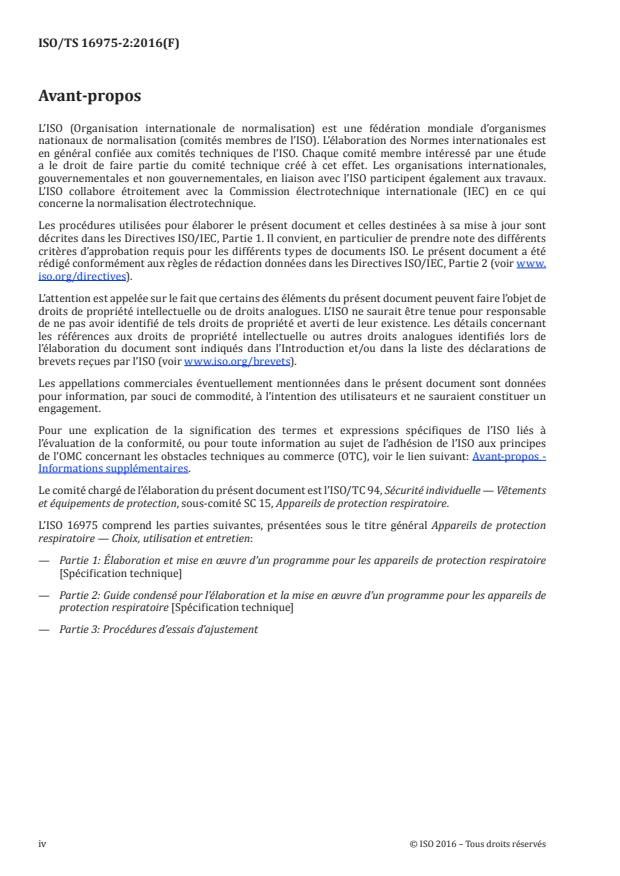
Avant-propos
L’ISO (Organisation internationale de normalisation) est une fédération mondiale d’organismes
nationaux de normalisation (comités membres de l’ISO). L’élaboration des Normes internationales est
en général confiée aux comités techniques de l’ISO. Chaque comité membre intéressé par une étude
a le droit de faire partie du comité technique créé à cet effet. Les organisations internationales,
gouvernementales et non gouvernementales, en liaison avec l’ISO participent également aux travaux.
L’ISO collabore étroitement avec la Commission électrotechnique internationale (IEC) en ce qui
concerne la normalisation électrotechnique.
Les procédures utilisées pour élaborer le présent document et celles destinées à sa mise à jour sont
décrites dans les Directives ISO/IEC, Partie 1. Il convient, en particulier de prendre note des différents
critères d’approbation requis pour les différents types de documents ISO. Le présent document a été
rédigé conformément aux règles de rédaction données dans les Directives ISO/IEC, Partie 2 (voir www.
iso.org/directives).
L’attention est appelée sur le fait que certains des éléments du présent document peuvent faire l’objet de
droits de propriété intellectuelle ou de droits analogues. L’ISO ne saurait être tenue pour responsable
de ne pas avoir identifié de tels droits de propriété et averti de leur existence. Les détails concernant
les références aux droits de propriété intellectuelle ou autres droits analogues identifiés lors de
l’élaboration du document sont indiqués dans l’Introduction et/ou dans la liste des déclarations de
brevets reçues par l’ISO (voir www.iso.org/brevets).
Les appellations commerciales éventuellement mentionnées dans le présent document sont données
pour information, par souci de commodité, à l’intention des utilisateurs et ne sauraient constituer un
engagement.
Pour une explication de la signification des termes et expressions spécifiques de l’ISO liés à
l’évaluation de la conformité, ou pour toute information au sujet de l’adhésion de l’ISO aux principes
de l’OMC concernant les obstacles techniques au commerce (OTC), voir le lien suivant: Avant-propos -
Informations supplémentaires.
Le comité chargé de l’élaboration du présent document est l’ISO/TC 94, Sécurité individuelle — Vêtements
et équipements de protection, sous-comité SC 15, Appareils de protection respiratoire.
L’ISO 16975 comprend les parties suivantes, présentées sous le titre général Appareils de protection
respiratoire — Choix, utilisation et entretien:
— Partie 1: Élaboration et mise en œuvre d’un programme pour les appareils de protection respiratoire
[Spécification technique]
— Partie 2: Guide condensé pour l’élaboration et la mise en œuvre d’un programme pour les appareils de
protection respiratoire [Spécification technique]
— Partie 3: Procédures d’essais d’ajustement
iv © ISO 2016 – Tous droits réservés
Introduction
Il convient d’utiliser les appareils de protection respiratoire (APR) uniquement après que toutes les
autres mesures de prévention possibles ont été prises ou lorsqu’elles sont en cours de mise en œuvre
et que l’évaluation du risque indique la présence effective ou potentielle d’une atmosphère dangereuse.
Si un APR est nécessaire pour maîtriser l’exposition, celui-ci doit être correctement choisi, utilisé et
entretenu.
La présente Spécification technique fournit un guide condensé pour l’élaboration et la mise en œuvre
d’un programme complet pour les APR, destiné aux APR qui satisfont aux exigences des normes de
performance. Elle s’adresse aux employeurs, en particulier dans les petites et moyennes entreprises.
La présente Spécification technique fournit des informations de base sur l’évaluation du risque,
la procédure de sélection, la formation, l’utilisation et l’entretien. Une assistance de la part du
fournisseur/fabricant d’APR ou d’un professionnel en matière de santé et de sécurité peut s’avérer
nécessaire pour élaborer et mettre en œuvre le programme.
La présente Spécification technique fournit des préconisations sur la démarche à adopter ainsi qu’un
tableau d’aide au processus de sélection. Elle suit une approche simple, pas à pas, qui permet de décider
du niveau minimal de protection requis de la part de l’APR et de l’appareil le plus adapté aux porteurs, à
la tâche et aux conditions du lieu de travail.
Il est de la responsabilité de l’employeur de choisir correctement un APR adéquat et approprié sur la
base d’une évaluation du risque.
SPÉCIFICATION TECHNIQUE ISO/TS 16975-2:2016(F)
Appareils de protection respiratoire — Choix, utilisation et
entretien —
Partie 2:
Directives condensées pour l’élaboration et la mise en
œuvre d’un programme pour les appareils de protection
respiratoire
1 Domaine d’application
La présente Spécification technique est un document d’orientation succinct qui vise à aider les personnes
responsables de l’élaboration et de la mise en œuvre d’un programme pour les appareils de protection
respiratoire (APR) qui satisfont aux exigences de performance. Il existe des applications particulières
où le choix d’APR appropriés sur la base du présent guide n’est pas pertinent, à savoir:
a) lutte contre l’incendie: lutte contre les feux de structure et de forêt, matières dangereuses et
sauvetage,
b) agents NRBC (Nucléaire, Radiologique, Biologique et Chimique),
c) applications maritimes: lutte contre les feux à bord de navires ou de plateformes en mer, ou
matières dangereuses,
d) applications minières: exploitation minière souterraine ou lutte contre l’incendie et sauvetage, et
e) évacuation: cas général, incendie, NRBC, maritime et minier.
NOTE 1 Pour des informations plus détaillées concernant les applications particulières, voir ISO/TS 16975-1.
Le présent document d’orientation ne s’applique pas au choix d’APR contre les bioaérosols.
NOTE 2 La Référence [2] traite du choix d’APR pour les bioaérosols capables de provoquer des infections ou
des réactions indésirables ou allergiques mais pour lesquels aucune limite d’exposition professionnelle n’a été
établie.
Le présent document d’orientation ne s’applique pas aux programmes destinés aux APR utilisés
exclusivement sous l’eau, à bord des aéronefs et aux appareils d’assistance respiratoire et de réanimation
employés à des fins médicales.
2 Références normatives
Les documents ci-après, dans leur intégralité ou non, sont des références normatives indispensables à
l’application du présent document. Pour les références datées, seule l’édition citée s’applique. Pour les
références non datées, la dernière édition du document de référence s’applique (y compris les éventuels
amendements).
ISO 16972, Appareils de protection respiratoire — Termes, définitions, symboles graphiques et unités
de mesure
ISO/TS 16975-1, Appareils de protection respiratoire — Choix, utilisation et entretien — Partie 1:
Élaboration et mise en oeuvre d’un programme pour les appareils de protection respiratoire
3 Termes et définitions
Pour les besoins du présent document, les termes et définitions donnés dans l’ISO 16972 et
l’ISO/TS 16975-1 s’appliquent.
4 Informations de base
4.1 Généralités
Il convient d’utiliser des APR uniquement après que toutes les autres mesures de prévention
raisonnablement envisageables ont été prises.
4.2 Évaluation du risque
Pour choisir un APR adéquat et approprié, commencer par réaliser une évaluation du risque prenant
en compte la/les substance(s) dangereuse(s) utilisée(s) ou produite(s), le manque possible d’oxygène,
la/les tâche(s) exécutée(s) et la personne chargée d’effectuer cette/ces tâche(s) (c’est-à-dire le porteur).
Des informations sur la/les substance(s) dangereuse(s), telles que les valeurs limites d’exposition
professionnelle (VLEP), sont mentionnées dans les fiches de données de sécurité (FDS) correspondantes
ou dans d’autres documents publiés. Les informations relatives aux substances produites par des
procédés doivent, le cas échéant, être prises en compte. Ces informations peuvent être disponibles dans
des réglementations ou des préconisations spécifiques aux substances (par exemple, pour l’amiante).
Les réglementations existantes qui s’adressent à un type et une classe spécifiques d’APR, par exemple
pour l’amiante, doivent être respectées.
Une fois l’évaluation du risque terminée et les informations nécessaires obtenues, il est possible de
réaliser le processus de sélection de l’APR et de l’enregistrer (Annexe A).
Selon les conditions régnant sur le lieu de travail et les informations recueillies lors de l’évaluation du
risque, le processus de sélection de l’APR peut aboutir à l’obtention soit de la classification de l’APR
approprié, soit d’informations suffisantes pour permettre au fournisseur de l’APR de recommander
l’APR approprié.
[1]
NOTE De plus amples informations sur la classification des APR est donnée dans l ISO/TS 16973 .
Il convient de conserver la fiche de sélection de l’APR.
Si la fiche de sélection de l’APR recommande de demander l’avis d’un spécialiste, les
fabricants/fournisseurs d’APR et les conseillers en santé et sécurité constituent de bonnes sources
d’information.
4.3 Utilisation des facteurs de protection assignés (FPA) et des niveaux de
protection ISO (PL)
Les réglementations nationales ou locales peuvent imposer de choisir un APR sur la base du FPA. Si tel
est le cas, l’évaluation de l’adéquation (Annexe A, étape 4) présente une méthode d’utilisation des FPA.
La présente partie de l’ISO/TS 16975 propose une option permettant d’utiliser soit les facteurs de
protection assignés (FPA) adoptés à l’échelle nationale, soit les niveaux de protection ISO (PL).
Toutefois, il convient de noter que les FPA se réfèrent à des types de conception et des classes spécifiques
d’APR, qui diffèrent des classifications ISO des APR. Bien que respectant les normes de performance
d’une même conception de base, des APR peuvent présenter des performances en laboratoire différentes
et donc être affectés à une classe de protection (PC) différente.
Lorsque des FPA adoptés à l’échelle nationale doivent être utilisés, choisir un APR ayant un FPA
supérieur au coefficient de risque (HR) calculé à l’Annexe A, étape 3. Le PL est utilisé dans le processus
de sélection de la même manière que le FPA.
2 © ISO 2016 – Tous droits réservés
IMPORTANT — Les niveaux de protection ISO proposés sont dérivés de jugements de
professionnels basés sur de précédents facteurs de protection assignés, sur les facteurs de
protection nominaux (FPN) associés et sur la connaissance, par des experts, des différences
constatées entre les performances de protection des produits actuels en laboratoire et sur le
lieu de travail. Les valeurs seront validées lorsque des APR conformes aux exigences des normes
de performance seront disponibles; en attendant, elles ne sont fournies qu’à titre informatif.
Durant la période intermédiaire, il conviendra d’utiliser les FPA, lorsqu’ils existent. Si des PL
sont utilisés avant validation, il est de la responsabilité de l’administrateur du programme APR
de déterminer l’adéquation des valeurs associées.
4.4 Types et classes d’APR
4.4.1 Types d’APR
Il existe deux types d’appareils de protection respiratoire: les APR filtrants et les APR alimentés en gaz
respirable.
a) APR filtrants
Les APR filtrants éliminent (par exemple, par filtration, adsorption ou réaction chimique) les
substances dangereuses présentes dans l’air ambiant avant qu’elles ne soient inhalées par le
porteur. L’air circule à travers le(s) filtre(s) sous l’effet de l’inspiration du porteur ou sous l’action
d’un ventilateur.
b) APR alimentés en gaz respirable
Les APR alimentés en gaz respirable fournissent au porteur du gaz respirable provenant d’une
source indépendante de l’atmosphère ambiante qui, soit est transportée de manière autonome
(individuelle), soit provient d’une source distante.
4.4.2 Classes d’APR
Tous les APR sont classés par classe de protection (PC1 à PC6), classe de rythme de travail (W1 à W4) et
classe d’interface respiratoire. En outre, les APR filtrants sont classés par type et classe de filtres, et les
APR alimentés en gaz respirable par capacité de gaz respirable.
Les APR sont proposés avec toute une gamme d’interfaces respiratoires. Elles sont classées en fonction
des zones du corps couvertes chez le porteur et des caractéristiques d’ajustement. Il s’agit de la bouche
seule, de la bouche et du nez, du visage, de la tête et du corps. Les interfaces respiratoires peuvent être à
ajustement serré (type T), lorsqu’elles assurent parfaitement l’étanchéité avec la peau, ou à ajustement
lâche (type L), lorsqu’elles ne présentent pas une étanchéité totale avec la peau du porteur.
L’ISO/TS 16975-1 fournit des exemples de différentes interfaces respiratoires et différents types d’APR.
5 Éléments du programme APR
Les éléments du programme APR sont spécifiés dans le Tableau 1.
Tableau 1 — Éléments du programme APR
Articles, para-
Éléments du programme Actions graphes perti-
nents
Réaliser une évaluation du risque
Évaluation du risque Appliquer des mesures de prévention, si nécessaire 4.2
Établir la nécessité d’un APR
Prendre en compte les exigences de l’environnement de travail,
Environnement 6.2 et 6.3
de la/des tâche(s) et du/des porteur(s)
Mesurer ou estimer leur concentration et la forme sous laquelle
elles se présentent dans l’air: particules, gaz, vapeur
Substances dangereuses 6.4
Prendre en compte l’éventualité d’un appauvrissement en oxygène
Classe de protection Déterminer le niveau de protection minimal requis 6.5
Utiliser les informations recueillies lors de l’évaluation pour
Choix 6.6 à 6.10
choisir l’APR approprié
Veiller à ce que les APR à ajustement serré (classe T) fassent
Essais d’ajustement 6.11
l’objet d’un essai d’ajustement
Dispenser une formation couvrant l’utilisation, la vérification
Formation du porteur de l’APR Article 7
et l’entretien de l’APR
Inclure, le cas échéant, une procédure de remplacement du/
Mise en œuvre des filtre(s), de chargement de la batterie, de nettoyage, de Article 8
contrôle de la qualité du gaz respirable
Inclure un suivi régulier et des rappels régulièrement adressés
Gestion Article 9, 9 a
aux porteurs
Entretenir les APR réutilisables
Entretien Remplacer les pièces selon les recommandations du fabricant 9 b
Corriger tout défaut rapidement
Procéder à des revues à intervalles appropriés pour garantir que
Revue tous les changements au niveau des conditions, de la substance 9 c
dangereuse, des porteurs, etc., sont traités de manière adéquate
Enregistrements Conserver les enregistrements du programme APR Article 10
6 Procédure de sélection
6.1 Généralités
Suivre les étapes ci-dessous, réaliser le processus de sélection de l’APR et l’enregistrer comme
indiqué à l’Annexe A. Les résultats de l’évaluation des risques concernant les substances dangereuses,
l’environnement de travail, y compris l’éventualité d’un appauvrissement en oxygène, la tâche et le(s)
porteur(s) sont nécessaires.
Si le tableau dans l’Annexe A recommande de demander l’avis d’un spécialiste, les fabricants/fournisseurs
d’APR et les conseillers en sécurité constituent une bonne source d’information.
6.2 Étape 1: informations concernant l’organisation
Entrer les informations concernant l’organisation et le lieu où la tâche doit être exécutée ainsi que
l’identité et l’intitulé du poste de la personne en charge de la procédure de sélection.
4 © ISO 2016 – Tous droits réservés
6.3 Étape 2: description de la tâche
Décrire la tâche et l’environnement dans lequel elle sera effectuée.
NOTE Certains APR ne sont pas appropriés en cas de port prolongé ou dans des environnements froids ou
chauds, etc.
6.4 Étape 3: définition des dangers
Il convient d’identifier les contaminants par leur nom chimique ou leur numéro CAS (Chemical Abstract
Number) et de mesurer ou estimer leur concentration dans l’air. L’éventualité d’un appauvrissement en
en oxygène dans la zone de travail doit être prise en compte.
Les informations relatives aux valeurs limites d’exposition professionnelle (VLEP) et, le cas échéant,
aux concentrations présentant un danger immédiat pour la vie ou la santé (IDLH) sont disponibles dans
les fiches de données de sécurité (FDS) et dans les réglementations nationales, publications ou guides
existants.
Pour chacun des contaminants, réaliser le processus de sélection de l’APR et enregistrer les éléments
suivants (voir Annexe A):
a) la concentration dans la colonne A;
b) le niveau IDLH dans la colonne B;
c) les VLEP dans la colonne C;
d) le coefficient de risque calculé dans la colonne D;
e) le coefficient de risque le plus élevé dans la colonne E.
Si le contaminant et/ou sa concentration sont inconnus ou si l’éventualité d’un appauvrissement en
oxygène ne peut être exclue, demander l’avis d’un spécialiste ou suivre les préconisations nationales,
locales ou sectorielles.
Si plusieurs contaminants ayant des effets additifs sur la santé sont présents, il convient de calculer le
coefficient de risque (HR) pour le mélange en utilisant la formule de mélange (voir ISO/TS 16975-1). Le
résultat est le niveau de protection (PL) requis.
Si plusieurs contaminants n’ayant pas d’effets additifs sur la santé sont présents, il convient de calculer
le HR pour chaque contaminant et de déterminer le PL requis à partir du HR le plus élevé.
6.5 Étape 4: détermination de la classe de protection
Si des réglementations nationales spécifient l’utilisation des FPA, choisir le FPA supérieur au coefficient
de risque le plus élevé calculé.
En l’absence de réglementations nationales, il est recommandé d’utiliser les niveaux de protection
ISO (PL). Déterminer la classe de protection (PC) requise en comparant le coefficient de risque le plus
élevé calculé à l’étape 3 au PL indiqué.
6.6 Étape 5: évaluation du rythme de travail
Pour choisir l’APR approprié compte tenu du rythme auquel le porteur travaillera durant la tâche,
comparer les exigences de la tâche aux descriptions du tableau pour W1, W2, W3 et W4.
a) Si la tâche ne nécessite qu’un travail manuel léger à modéré, choisir W1; par exemple, d’un travail
manuel léger jusqu’à un travail soutenu des mains et des bras.
b) Si la tâche exige un travail intense à très intense, choisir W2; par exemple, d’un travail intense des
bras et du tronc jusqu’au pelletage ou forage intensif.
c) Si la tâche exige un travail manuel très très intense à extrêmement intense, choisir W3; par exemple,
de la marche rapide ou course avec des équipements de protection et/ou des outils et produits
lourds jusqu’au franchissement d’obstacles (en rampant et grimpant).
d) Si la tâche nécessite un travail d’une intensité maximale, choisir W4; par exemple, montée très
rapide d’escaliers et d’échelles.
6.7 Étape 6: identification des filtres
Si le choix se porte sur un APR filtrant, il faut utiliser le
...