

ISO/TS 16710-1:2024
(Main)Ergonomics methods — Part 1: Feedback method — A method to understand how end users perform their work with machines
General Information
- Abstract
This document describes the “Feedback Method”, a method designed specifically to collect the contribution of machinery end-users by reconstructing and understanding how work is actually performed (i.e. the real work). This method can help to improve technical standards, as well as the design, manufacturing, and use of machinery. By collecting the experiences of skilled users, this method can be used to reconstruct their actual work activities under different operating conditions and with any kind of machine. This helps to identify all the critical aspects having an impact on health and safety, or associated with ergonomic principles. Moreover, it makes it possible to identify some basic elements for defining the standards for machines and for their revision and improvement. It can also improve production efficiency and identify any need for additional study and research. The method is designed to minimize the influence of the subjectivity of the facilitators and researchers in reconstructing and describing the reality of work, and to maximize the “objective” contribution of the skilled users of the machine. The method combines a high level of reproducibility, sensitivity, and user-friendliness with low demands in term of resources, which makes it attractive to micro, small and medium-sized enterprises. This document is addressed to standards writers, designers and manufacturers, employers-buyers, end users, craftsmen and workers, market surveillance and authorities.
- Status
- Published
- Publication Date
- 29-Sep-2024
- Technical Committee
- ISO/TC 159/SC 1 - General ergonomics principles
- Drafting Committee
- ISO/TC 159/SC 1 - General ergonomics principles
- Current Stage
- 6060 - International Standard published
- Start Date
- 30-Sep-2024
- Completion Date
- 30-Sep-2024

Overview
ISO/TS 16710-1:2024 - Feedback method is a technical specification in ergonomics that defines a structured method to collect and reconstruct how end users actually perform work with machines (the "real work"). The standard describes the Feedback Method for gathering skilled user experience to identify ergonomic, safety and usability issues, support revisions to technical standards, and inform design, manufacturing and workplace practices. The method emphasizes reproducibility, low resource needs, and minimization of facilitator bias, making it suitable for micro, small and medium-sized enterprises.
Key topics
- Feedback Method steps: selection of machine, collection of documentation (machine dossier), identification of workplaces, inspections, skilled-user work groups, reporting and final technical report.
- Feedback Method Work Group (FMWG): 5–9 skilled end users led by a facilitator to reconstruct tasks and conditions using a standardized Feedback Method sheet.
- Terminology and roles: definitions for expert/skilled end-user, facilitator, machine dossier, real work, and final technical report.
- Data collection and analysis: guided discussions, workplace inspection, documentation review, and reproducible recording to identify critical ergonomic and safety aspects.
- Outputs: validated FMWG reports and a consolidated final technical report highlighting risks, ergonomic concerns, improvement proposals, and research needs.
- Design principles: reduces subjectivity of researchers, increases sensitivity to real-world use, and supports risk assessment and risk reduction.
Applications
ISO/TS 16710-1:2024 is practical for:
- Standards writers and technical committees seeking user-driven evidence to revise or create harmonized machine safety and ergonomics standards.
- Designers and manufacturers aiming to improve machine ergonomics, instructions for use, and maintain CE conformity.
- Employers, buyers and safety professionals choosing or evaluating machinery for safer, more efficient operations.
- Workers, craftsmen and user representatives documenting real-use issues and proposing corrective actions.
- Market surveillance authorities investigating incidents and prioritizing enforcement or guidance.
The method supports ergonomic analysis, usability improvements, productivity gains and targeted research by revealing how machines are used under varied real-life conditions.
Related standards
- ISO 12100 (Safety of machinery - risk assessment and reduction) - normative reference.
- ISO 6385 (Ergonomic principles of work system design) and ISO 9241-210 (human-centred design) - commonly associated ergonomics guidance.
- CEN Guide 414 and other machine-specific standards may be informed by Feedback Method findings.
For implementation and the full normative text, consult ISO/TS 16710-1:2024 via ISO or your national standards body.
Relations
- Effective Date
- 12-Feb-2026
Get Certified
Connect with accredited certification bodies for this standard

CIS Institut d.o.o.
Personal Protective Equipment (PPE) certification body. Notified Body NB-2890 for EU Regulation 2016/425 PPE.

Kiwa BDA Testing
Building and construction product certification.
Kmetijski inštitut Slovenije
Agricultural Institute of Slovenia. Soil testing, plant health, agricultural product analysis.
Sponsored listings
Frequently Asked Questions
ISO/TS 16710-1:2024 is a technical specification published by the International Organization for Standardization (ISO). Its full title is "Ergonomics methods — Part 1: Feedback method — A method to understand how end users perform their work with machines". This standard covers: This document describes the “Feedback Method”, a method designed specifically to collect the contribution of machinery end-users by reconstructing and understanding how work is actually performed (i.e. the real work). This method can help to improve technical standards, as well as the design, manufacturing, and use of machinery. By collecting the experiences of skilled users, this method can be used to reconstruct their actual work activities under different operating conditions and with any kind of machine. This helps to identify all the critical aspects having an impact on health and safety, or associated with ergonomic principles. Moreover, it makes it possible to identify some basic elements for defining the standards for machines and for their revision and improvement. It can also improve production efficiency and identify any need for additional study and research. The method is designed to minimize the influence of the subjectivity of the facilitators and researchers in reconstructing and describing the reality of work, and to maximize the “objective” contribution of the skilled users of the machine. The method combines a high level of reproducibility, sensitivity, and user-friendliness with low demands in term of resources, which makes it attractive to micro, small and medium-sized enterprises. This document is addressed to standards writers, designers and manufacturers, employers-buyers, end users, craftsmen and workers, market surveillance and authorities.
This document describes the “Feedback Method”, a method designed specifically to collect the contribution of machinery end-users by reconstructing and understanding how work is actually performed (i.e. the real work). This method can help to improve technical standards, as well as the design, manufacturing, and use of machinery. By collecting the experiences of skilled users, this method can be used to reconstruct their actual work activities under different operating conditions and with any kind of machine. This helps to identify all the critical aspects having an impact on health and safety, or associated with ergonomic principles. Moreover, it makes it possible to identify some basic elements for defining the standards for machines and for their revision and improvement. It can also improve production efficiency and identify any need for additional study and research. The method is designed to minimize the influence of the subjectivity of the facilitators and researchers in reconstructing and describing the reality of work, and to maximize the “objective” contribution of the skilled users of the machine. The method combines a high level of reproducibility, sensitivity, and user-friendliness with low demands in term of resources, which makes it attractive to micro, small and medium-sized enterprises. This document is addressed to standards writers, designers and manufacturers, employers-buyers, end users, craftsmen and workers, market surveillance and authorities.
ISO/TS 16710-1:2024 is classified under the following ICS (International Classification for Standards) categories: 13.180 - Ergonomics. The ICS classification helps identify the subject area and facilitates finding related standards.
ISO/TS 16710-1:2024 has the following relationships with other standards: It is inter standard links to CEN/TR 16710-1:2015. Understanding these relationships helps ensure you are using the most current and applicable version of the standard.
ISO/TS 16710-1:2024 is available in PDF format for immediate download after purchase. The document can be added to your cart and obtained through the secure checkout process. Digital delivery ensures instant access to the complete standard document.
Standards Content (Sample)
Technical
Specification
ISO/TS 16710-1
First edition
Ergonomics methods —
2024-09
Part 1:
Feedback method — A method to
understand how end users perform
their work with machines
Ergonomie —
Partie 1: Méthode de retour d'expérience — Méthode permettant
de comprendre la manière dont les utilisateurs finaux effectuent
leur travail au moyen de machines
Reference number
© ISO 2024
All rights reserved. Unless otherwise specified, or required in the context of its implementation, no part of this publication may
be reproduced or utilized otherwise in any form or by any means, electronic or mechanical, including photocopying, or posting on
the internet or an intranet, without prior written permission. Permission can be requested from either ISO at the address below
or ISO’s member body in the country of the requester.
ISO copyright office
CP 401 • Ch. de Blandonnet 8
CH-1214 Vernier, Geneva
Phone: +41 22 749 01 11
Email: copyright@iso.org
Website: www.iso.org
Published in Switzerland
ii
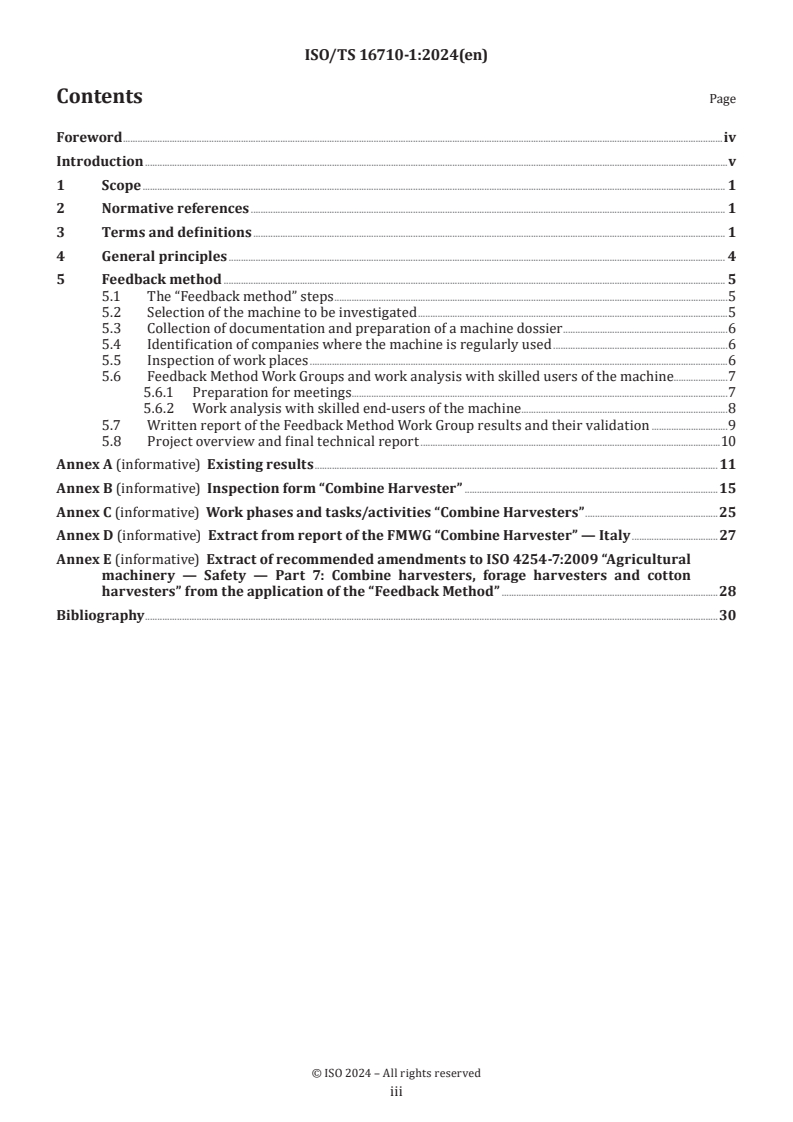
Contents Page
Foreword .iv
Introduction .v
1 Scope . 1
2 Normative references . 1
3 Terms and definitions . 1
4 General principles . 4
5 Feedback method . 5
5.1 The “Feedback method” steps .5
5.2 Selection of the machine to be investigated .5
5.3 Collection of documentation and preparation of a machine dossier .6
5.4 Identification of companies where the machine is regularly used .6
5.5 Inspection of work places .6
5.6 Feedback Method Work Groups and work analysis with skilled users of the machine.7
5.6.1 Preparation for meetings.7
5.6.2 Work analysis with skilled end-users of the machine.8
5.7 Written report of the Feedback Method Work Group results and their validation .9
5.8 Project overview and final technical report .10
Annex A (informative) Existing results .11
Annex B (informative) Inspection form “Combine Harvester” .15
Annex C (informative) Work phases and tasks/activities “Combine Harvesters” .25
Annex D (informative) Extract from report of the FMWG “Combine Harvester” — Italy .27
Annex E (informative) Extract of recommended amendments to ISO 4254-7:2009 “Agricultural
machinery — Safety — Part 7: Combine harvesters, forage harvesters and cotton
harvesters” from the application of the “Feedback Method” .28
Bibliography .30
iii
Foreword
ISO (the International Organization for Standardization) is a worldwide federation of national standards
bodies (ISO member bodies). The work of preparing International Standards is normally carried out through
ISO technical committees. Each member body interested in a subject for which a technical committee
has been established has the right to be represented on that committee. International organizations,
governmental and non-governmental, in liaison with ISO, also take part in the work. ISO collaborates closely
with the International Electrotechnical Commission (IEC) on all matters of electrotechnical standardization.
The procedures used to develop this document and those intended for its further maintenance are described
in the ISO/IEC Directives, Part 1. In particular, the different approval criteria needed for the different types
of ISO document should be noted. This document was drafted in accordance with the editorial rules of the
ISO/IEC Directives, Part 2 (see www.iso.org/directives).
ISO draws attention to the possibility that the implementation of this document may involve the use of (a)
patent(s). ISO takes no position concerning the evidence, validity or applicability of any claimed patent
rights in respect thereof. As of the date of publication of this document, ISO had not received notice of (a)
patent(s) which may be required to implement this document. However, implementers are cautioned that
this may not represent the latest information, which may be obtained from the patent database available at
www.iso.org/patents. ISO shall not be held responsible for identifying any or all such patent rights.
Any trade name used in this document is information given for the convenience of users and does not
constitute an endorsement.
For an explanation of the voluntary nature of standards, the meaning of ISO specific terms and expressions
related to conformity assessment, as well as information about ISO's adherence to the World Trade
Organization (WTO) principles in the Technical Barriers to Trade (TBT), see www.iso.org/iso/foreword.html.
This document was prepared by the European Committee for Standardization (CEN) (as CEN/TR 16710-
1:2015) and was adopted without modification other than those given below. It was assigned to Technical
Committee ISO/TC 159, Ergonomics, Subcommittee SC 1, General ergonomics principles, and adopted under
the “fast-track procedure”.
— Source documents for 3.8, 3.18, 3.19 have been updated to ISO 6385:2016.
— Definition 3.16 has been supplemented by Note to Entry 1 to 3.
A list of all parts in the ISO 16710 series can be found on the ISO website.
Any feedback or questions on this document should be directed to the user’s national standards body. A
complete listing of these bodies can be found at www.iso.org/members.html.
iv
Introduction
The importance of involving users in the design of machinery is recognized in most standards that deal with
ergonomic design principles. In fact, i.e. EN 614-1 strongly recommends user involvement because it helps to
identify measures and improvements for future design.
CEN Guide 414, ISO 6385, ISO 9241-210 and ISO 12100 also provide for feedback from the end-users of
machinery, and affirm the need to continue monitoring the effect of the system in order to safeguard against
long-term deterioration in the performance or health of the users.
Collecting users’ experiences by reconstructing their activities, how they perform their work in different
real-life operating conditions, will yield knowledge of the problems that emerge from common, everyday
use and help to identify possible corrections and improvements to harmonized technical standards and
machinery design and manufacture.
In the context of machinery safety, it is widely accepted that end-users possess extensive knowledge of
[15]
the equipment they work with every day. Collecting this information as feedback from end-users,
mainly workers, provides a basis not just for improving machinery standards by incorporating ergonomics
[17]
principles, but also for putting standards to work and monitoring their quality over the years. Those who
can benefit from such knowledge include:
— CEN and ISO and national standardization committees and working groups who can become aware of
the problems relating to the real use of specific machine in different work contexts, and will thus be able
to draw up new or to revise existing standards accordingly;
— designers (who are involved in the design or redesign) and manufacturers enabling them to produce
better, more comfortable and safer machines and to provide precise, clear and exhaustive instructions
for use;
— employers/buyers to help them choose the best available machinery on the market;
— the end users, employers, artisans and workers for training purposes and for defining appropriate work
procedures;
— market surveillance, authorities to enhance their knowledge and improve the efficiency of their
interventions;
— the machinery working group (MWG) chaired by the European Commission, whenever they need to
collect further details on machinery design problems tabled during the MWG meetings.
Studies have shown that the “Feedback Method” described in this document has a high level of repeatability,
as demonstrated by the results obtained in many different production contexts in seven different European
member states from applying this method to five CE-marked machines manufactured in conformity with
their specific C-standard (see Annex A).
The full participation and support of employees, employers, users and buyers of machinery, technicians
and market surveillance personnel in putting the “Feedback Method“ into practice is key to its successful
application.
Within these studies, a detailed ergonomic analysis of the work with each machine, involving a number of
work groups, yielded a large body of valuable information on the specific characteristics of machine use in
different work contexts and socio-cultural, climatic and microclimatic environments.
Using the standardized method described in this document, that makes little demand on time and resources,
multiple work groups can easily be set up to collect skilled users’ experiences with a specific machine and to
use this valuable information to:
a) identify failings in the appropriate technical standard or the design rather than in its use;
b) validate the results already obtained;
v
c) monitor improvements in the work activity and the efficacy of the ergonomic and safety solutions
applied.
The outcomes of the method described in this document can also be used for evaluating and/or designing
new machinery similar to the one under study.
EXAMPLE When dealing with the roll-over risk of any self-propelled machinery with a driver on board during use
on uneven or lose ground.
The method can be used by workers’ representatives or, more generally, representatives of consumers
and users, to collect evidence for making improvements to various types of machinery, possibly after
the occurrence of unwanted events during the use of a machine, so as to identify the causes and possible
solutions.
Where appropriate, recommendations can then be forwarded to the appropriate ISO/IEC Technical
Committees. For example, one important safety recommendation for any revision of ISO 21281 is to
standardize the position of the main foot pedals to avoid the risk of confusion and accidents. Figure 1 shows
the differences in pedal layout identified during the application of the “Feedback Method” to fork-lift trucks.
Right-foot-operated se-
Manual selector of direc- Left-foot-operated selector Foot-operated selector of
lector of direction and
tion. Right-foot-operated of direction. Right-foot-op- direction and accelerator
right-foot-operated accel-
(car-like) accelerator. erated accelerator. (both left and right feet).
erator.
A = Accelerator
B = Brake and/or approach at reduced speed
C = Clutch coupling (if present) or approach at reduced speed
Figure 1 — Illustration of the various foot pedal layouts identified in different fork-lift trucks
vi
Technical Specification ISO/TS 16710-1:2024(en)
Ergonomics methods —
Part 1:
Feedback method — A method to understand how end users
perform their work with machines
1 Scope
This document describes the “Feedback Method”, a method designed specifically to collect the contribution
of machinery end-users by reconstructing and understanding how work is actually performed (i.e. the real
work). This method can help to improve technical standards, as well as the design, manufacturing, and use
of machinery.
By collecting the experiences of skilled users, this method can be used to reconstruct their actual work
activities under different operating conditions and with any kind of machine. This helps to identify all the
critical aspects having an impact on health and safety, or associated with ergonomic principles. Moreover,
it makes it possible to identify some basic elements for defining the standards for machines and for their
revision and improvement. It can also improve production efficiency and identify any need for additional
study and research.
The method is designed to minimize the influence of the subjectivity of the facilitators and researchers in
reconstructing and describing the reality of work, and to maximize the “objective” contribution of the skilled
users of the machine.
The method combines a high level of reproducibility, sensitivity, and user-friendliness with low demands in
term of resources, which makes it attractive to micro, small and medium-sized enterprises.
This document is addressed to standards writers, designers and manufacturers, employers-buyers, end
users, craftsmen and workers, market surveillance and authorities.
2 Normative references
The following documents are referred to in the text in such a way that some or all of their content constitutes
requirements of this document. For dated references, only the edition cited applies. For undated references,
the latest edition of the referenced document (including any amendments) applies.
ISO 12100:2010, Safety of machinery — General principles for design — Risk assessment and risk reduction
3 Terms and definitions
For the purposes of this document, the terms and definitions given in ISO 12100 and the following apply.
ISO and IEC maintain terminology databases for use in standardization at the following addresses:
— ISO Online browsing platform: available at https:// www .iso .org/ obp
— IEC Electropedia: available at https:// www .electropedia .org/
3.1
end-user feedback
information given back by end-users
3.2
expert
skilled end-user
person who has habitually used the machine under investigation for an extended period; normally he has
received specific training in the use of the machine through professional courses or directly at the workplace
by a tutor, often by the employer or expert co-worker; he is often in charge of training of co-workers in the
use of the machine under investigation; he may be considered expert in the installation, use and maintenance
of the machine
Note 1 to entry: In micro and small-sized enterprises the expert/skilled end-user is often the employer.
3.3
facilitator
person, who leads the “Feedback Method” Work Groups and collects the contributions of the skilled users of
the machinery
Note 1 to entry: The facilitator is competent in leading groups, and in occupational health and safety and the
ergonomics of machinery, or is supported by experts in such disciplines.
3.4
Feedback Method
specific method designed and applied to collect the contribution of machinery end-users by reconstructing
and understanding the real work, in order to improve technical standards, together with the design, the
manufacture and use of machinery
Note 1 to entry: See also [11].
3.5
Feedback Method sheet
document used by the facilitator to guide the discussions of the FMWG and to record the collected
information
Note 1 to entry: See 5.6.2.
3.6
Feedback Method Work Group
FMWG
group composed of five to nine experts/skilled end users, coming from different enterprises, which, under
the direction of a facilitator, provides the reconstruction and understanding of the real work with a specific
machine by means of the “Feedback Method” sheet
3.7
final technical report
synthesis of the results of all the processes of the “Feedback Method” to a specific machine, written by
the researcher from the reports of the FMWG meetings with the help, if needed, of other ergonomists/
technicians/consultants
Note 1 to entry: The main contents are represented by the critical aspects identified, risks and disorders as well as by
the possible solutions and or any need for further research.
3.8
job
organization and sequence in time and space of an individual's work tasks or the combination of all human
performance by one worker within a work system
[SOURCE: ISO 6385:2016, 2.16]
3.9
machine dossier
collection of technical documentation and data on the machine, so as to be aware of the main safety issues
(i. e. normal and abnormal use, residual risks) and ergonomic requirements as well as health effects and
wellbeing of the end users
Note 1 to entry: Information on the productivity, efficiency and efficacy of the machine is also included.
3.10
real work
work as actually performed by workers
Note 1 to entry: Real as opposed to formal work reflects the difference between the formal/designed description of
the activities and what is really performed at the workplace.
3.11
report of the FMWG meeting
“Feedback Method” sheets compiled by the facilitator/researcher during the FMWG meetings and validated
by each participant
3.12
researcher
person competent in occupational health and safety and ergonomics of the machine, cooperating with others
in the planning, execution and reporting of the “Feedback Method”, including helping the facilitator to lead
the FMWGs
Note 1 to entry: The researcher also contributes to the application of the outcomes to the standardization, design,
manufacture and use of the machinery studied.
Note 2 to entry: Market surveillance bodies may also benefit from the outcomes.
3.13
safeguard clause
clause in Article 11 of Directive 2006/42/EC providing for a procedure whereby any measure taken by a
Member State (on the grounds of non-compliance with the Essential Health and Safety Requirements, and
where it is deemed that equipment is liable to endanger persons, animals or property) for the purpose of
withdrawing from the market, prohibiting the placing on the market or restricting the free movement,
of equipment accompanied by one of the means of attestation provided for in the Directive and therefore
bearing the CE marking, must be immediately notified to the Commission by the Member State, which has
taken it
Note 1 to entry: See also [10].
3.14
task
specific activity performed by one or more persons on, or in the vicinity of, the machine during its life cycle
3.15
technical action
elementary manual action required to complete the operations within the cycle
EXAMPLE Holding, turning pushing or cutting.
[SOURCE: ISO 11228-3:2007, 3.1.4]
3.16
user
person who interacts with a system, product or service
Note 1 to entry: Adapted from ISO 9241-110:2008, 3.8, and ISO 9241-11:1998, 3.7.
Note 2 to entry: The person who uses a service provided by a work system, such as a customer in a shop or passenger
on a train, can be considered a user.
Note 3 to entry: A user who is using a system is not a component of that system. However, both the user and the system
used can be considered as components of a higher-level system.
[SOURCE: ISO 26800:2011, 1, 2.10]
3.17
work phase
set of tasks required to achieve an intended part of the whole outcome of a work process
3.18
work process
sequence in time and space of the interaction of workers, work equipment, materials, energy and information
within a work system
[SOURCE: ISO 6385:2016, 2.7]
3.19
work task
activity or set of activities required by the worker to achieve an intended outcome
[SOURCE: ISO 6385:2016, 2.17]
4 General principles
ISO 12100 requires risk assessments to be based on the experience of users of similar machines and,
whenever practicable, an exchange of information with the potential users. It also provides a schematic
representation of the risk-reduction process that includes a three-step iterative method. Each step concludes
by asking whether the planned risk reduction is obtained.
This question is currently answered at the design stage, whereas a more exhaustive and practical answer
could be provided by the collection of the experiences of actual users, not only of similar machines, as
required in ISO 12100:2010, 5.2, but also of the same machines already in use.
This requires a structured and standardized method that can also be used by designers; and used
systematically to add to their knowledge and provide a clear and unequivocal answer.
A number of standards provide for workers to be involved, both in risk assessment and in the design phase,
through the use of prototypes, mock-ups, models and/or laboratory simulations. In simulations, operator
feedback can be obtained in various ways including: group discussions, interviews, questionnaires,
checklists, and observational studies, see EN 614-2.
Although in principle their value is uncontested, the question remains as to whether simulations can ever
capture the complex reality of working with machinery in real life. Simulations with models and prototypes:
— are often confined to pre-defined environments which cannot reflect the real work environment with its
multiple variables;
— are time-limited, whereas problems from prolonged actual use of machinery may only arise over longer
timeframes;
— are limited to restricted circles of users that are not necessarily reliable and sufficiently heterogeneous
samples of the population of real users;
— using machinery in a laboratory inevitably conditions the ways it is used and the worker’s responsiveness,
thereby rendering his impressions of the machinery unreliable;
— are unable to predict all the possible circumstances that may occur during real use in various production,
social and economic contexts.
In contrast, the “Feedback Method” uses a different approach that aims at avoiding these shortcomings.
In this approach, the reconstruction and knowledge of working practices is obtained by researchers and
facilitators through a detailed ergonomics analysis of end-user feedback, following a specific procedure
with the participation of skilled end-users working in different companies.
Emphasis is placed on evaluating the working conditions through observation at the workplace and the need
to plan studies to that end with the involvement of workers in the real environment of use. In reality, only
the skilled and experienced end-user, the operator at the workplace, is able to provide relevant feedback on
real work with a machine.
CEN Guide 414, for the drafting of safety standards, raises the question: “Is there sufficient feedback on the
use of the existing safety standard?”. The “Feedback Method” is appropriately designed to collect users’ input
in reply to this question.
The description of work activities identifies omissions or issues that are of high intrinsic value for depicting
what actually happens in daily real work in different workplaces, as described by those most immediately
concerned, skilled machine users. It is important to note that activity descriptions are not those of one
individual skilled worker or even the aggregate of many individual skilled workers but the collective product
of a group of skilled/expert workers interacting with one another, coordinated by a facilitator.
The work activity may be performed differently in other companies or in other production contexts. The
best results are therefore obtained when the same machine and work activity are analysed by more than one
work group, possibly in different geographical areas and socio-economic contexts. The description created
will need to incorporate this diversity. This enables every user to compare the acquired knowledge against
their specific reality and to update and expand the content in a way adapted to their working environment.
5 Feedback method
5.1 The “Feedback method” steps
The “Feedback Method” involves the following seven main steps:
— selection of the machine to be investigated;
— collection of documentation, and preparation of a machine dossier;
— identification of companies where the machine is regularly used;
— inspection of workplaces;
— work groups and work analysis with skilled users of the machine;
— written report of the FMWG results and their validation;
— project overview and final technical report.
5.2 Selection of the machine to be investigated
The “Feedback Method” may be applied whenever stakeholders identify a machine and a corresponding
harmonized standard, which merits closer examination and analysis. The principal criteria for selecting the
machine to study are:
— number and severity of accidents;
— lack of safety and ergonomic requirements;
— number and geographical dissemination of the machine;
— revision or definition of the machine's standard.
The interest and cooperation of the social partners, workers and employers, manufacturers, buyers and end-
users are key requirements for the selection of the machine and the success of the study.
Having selected the type of machine to be studied, it is then necessary to identify the industrial sectors in
which it is used and the type of production to be analysed. It is recommended to start with a single sector
and production type before widening the scope of the study as appropriate.
5.3 Collection of documentation and preparation of a machine dossier
The next step of the “Feedback Method” is to collect any available technical documentation and data on the
machine and its use, so as to be aware of the main safety features (i.e. normal and abnormal use, residual
risks) and ergonomic requirements. In this preliminary phase researchers prepare a “machine dossier”, that
includes:
— relevant harmonized standards;
— safety guidelines elaborated by technical bodies or research organisations;
— accident statistics or records of undesired events associated with the machine (together with any specific
accident investigations);
— any safeguard clauses relating to the machine or the related standard;
— market surveillance data;
— information provided by manufacturer about the territorial/geographical distribution of the machine
and its different models and/or configurations;
— instruction handbooks accompanying the machine;
— other documentation (publications, journals, testimonies, etc.) and materials (films, photographs,
miniature models of the machine, etc.).
The machine dossier may be implemented and updated with any further new information. It is the source
and the reference for all the information presented and discussed in the FMWGs.
For transnational studies, the same dossier may be translated into the different languages. Then it may be
used by each FMWG examining the same machine. In such a way all those participating will have the same
background information and questions to answer.
5.4 Identification of companies where the machine is regularly used
After selecting the machine to be studied it is necessary to identify where this machine is used. It is
recommended that machines used in one region are studied at first and then to widen the scope of the study
to other regions and countries as appropriate. Trade unions and employers’ associations can help to identify
suitable companies willing to take part.
Attention should be paid to the size of companies using the machine. Micro and small-sized enterprises,
where the traditional ergonomic, safety and hygiene approach is difficult to apply, should normally be
included.
5.5 Inspection of work places
The active collaboration of all the stakeholders (employers, technicians/staff, company occupational
physician, workers and their health and safety representatives) is essential for the best conduct of the study.
Meetings with the stakeholders of each enterprise, in which the objectives of the study should be clearly
explained and discussed, are appropriate both before and during the workplace inspections.
Workplace inspections are carried out with the cooperation of the stakeholders and include the observation
of: the environment, the workplace and the work process, together with open discussions with workers
engaged in the different jobs and activities performed in the company.
The more relevant phases of the work process are identified with the advice of the stakeholders, particularly
skilled workers, and, if possible, by direct observation.
During the inspection, data and information are collected on forms containing the following items:
— general company data, sector, number of employees;
— description of the working environment (noise, vibration, dust, illumination, microclimate, chemicals,
etc.) where the machine under investigation is used and of the relevant working methods and procedures;
— characteristics of the machines used in the company (manufacturer, model, year of manufacture,
maintenance, safety devices);
— risk assessments relating to the machine;
— description (with the help of the workers or by direct observation) of the work process and of the job;
— identification of the main work phases and of the single activities/tasks. All the work phases should
be considered, not only those directly observable, including the installation and preparation of the
machine before its use, up to its storage at the end of the work shift, as well as planned and unplanned
maintenance;
— information on near-misses and accidents which have occurred in the company relating to the use of the
machine in question;
— information about the training provided for the workers assigned to operate the machine.
The inspection form should be designed to reflect the specific characteristics of the machine to be studied
and, for multicentre studies, translated into the languages of the various participating countries. If needed,
some items may be added to the “basic” form to collect regional differences in the use of the machine. Annex A
shows an example of such a form, designed and used for collecting information during a specific study.
If possible, during the inspection, it is also appropriate to collect films, photographs, etc. of the machinery, the
environment, the workplace and of the individual activities/tasks performed by the machine operator and
coworkers. If needed, and if the available resources allow, further inspections or more detailed investigations
may be conducted to collect more information through the use of suitable tools and methods selected from
the relevant disciplines (e.g. ergonomics, occupational health and safety, cognitive psychology).
The information and documentation collected during the workplace inspection will be included in the
machine dossier. It enables the researchers to understand better the context where the machinery operates
and its functions. It also facilitates the ergonomics analysis of the work, the reconstruction of the real-work
and activities, and the identification of the more critical aspects of the use of the machine.
Elaboration of the collected data will also enable the accurate description of the sample of companies
involved and the machine studied.
5.6 Feedback Method Work Groups and work analysis with skilled users of the machine
5.6.1 Preparation for meetings
FMWGs are formed of five to nine users. The choice of users should be made from skilled users of the machine
(workers, technicians, artisans or even employers of the micro and small sized enterprises). These should be
those who use and/or maintain the machine. The number of participants in each group should be limited
to facilitate the dialogue and the comparison, and to allow everyone to contribute actively. Participants
in any one group should have experience of the same specific use of that machine. At least three different
companies should be involved, in order to minimize the influence of working practices in any individual
company. This selection should enable a job reconstruction to be formulated which is representative of the
daily tasks involved in that use across different working contexts.
The facilitators of the FMWGs should be:
— those who have worked on the machine dossier and have performed the inspections in the companies;
— knowledgeable about relevant machine standards;
— competent in leading work groups.
For each type and use of machine analysed it is preferable to form more than one FMWG in order to compare
the results and to strengthen their validity.
For a successful meeting it is necessary to:
— prepare the meeting place and equipment needed;
— collate documentation and other material (taken from the machine dossier) in order to supply the
workers with the base information (existing technical standards, important residual risks indicated by
the manufacturers, description of the most important accidents, etc.) and the necessary information for
the development of the group job;
— identify the main work phases to be analysed by the groups – all the work phases to be analysed should
be taken into account.
NOTE The identified work phases can change with the uses of the machine and can be defined from information
collected during the inspections.
5.6.2 Work analysis with skilled end-users of the machine
The FMWG activity is based on two preliminary steps:
— The participants are provided with the collated documentation and other material.
— Each work phase is split into elementary operational tasks, from the set-up of the machine to the
maintenance and cleaning operations.
NOTE Normally, no more than four hours are necessary for such a meeting.
Thereafter the facilitators introduce the job ergonomic analysis through which the group will reconstruct in
detail the work activities and then carry out a systematic analysis of each work activity/phase.
For each work phase, the tasks/activities are identified, and for each of them the following elements are
recorded:
— Operating Procedure;
— Competence required for the execution of the task;
— Critical aspects: hazards/risks; disorders/diseases/injuries;
— Solutions and suggestions for prevention and need of further research.
These are recorded using the FMWG sheet, as shown in Table 1. It is important to note that the facilitators
leading the discussion should allow the workers to act as key players in evaluating their own working
environment. Their role consists of supplying information, speeding up the participants’ contribution to
the reconstruction of the phases of the job and the activities associated with each phase, and guiding the
end users’ evaluations of the safety and health issues, any critical aspects of their work with the machine,
and any possible preventive action. The description should be as detailed and unbiased as possible, paying
particular attention to those operations which the documentation, experience and knowledge have clearly
shown as hazardous.
The FMWG analysis is based on a detailed and meticulous description of each activity and their temporal
and spatial sequence.
The facilitators should encourage the active participation of all the participants. They should ask the group
to characterize and define the necessary competence for the execution of the single tasks, the current
problems and risks and suggestions for practical improvements. The group should not just consider health
and safety issues but also explore opportunities for improving the effective and efficient use of the machine.
Suggestions for improvement should be addressed primarily to the search for possible improvements to
the machine itself (design, manufacture). However, attention should also be paid to the related aspects of
organizational choices, of operating procedures and/or of the “correct” behaviour of the single workers.
Opportunities for the promotion of health and wellbeing through better design of machinery and tasks
should also be considered.
It will be necessary to guide the group to deepen the analysis of how they perform the single activities since
the participants will tend to simplify the description because, although for them this may be well-known
and banal information it may not be apparent to those without their level of knowledge and experience.
It will be useful, to facilitate the participation and the analysis, to describe the dynamics of any accidents or
incidents which have occurred (these can be drawn from the experiences of the companies visited during
the inspections, the FMWG participants, or their colleagues), or to show images or movies of other incidents
or dangerous situations.
When descriptions of unexpected operating modalities or unforeseen hazardous situations emerge during
the FMWG activity, they should be recorded in detail.
Table 1 — “Feedback Method” Work Group sheet
Sequence Critical aspects: hazards/ Solutions, suggestions
of tasks/ Operating Procedure Competence risks; disorders/diseas- for prevention; need of
a
activities es/injuries further research
[Identification of: (1) the
critical aspects affecting the
[Information about
[Identification of solutions/
health and safety of workers
the competence
suggestions on how to elimi-
or limiting the efficient per-
required for: (1) op-
nate or minimize the identi-
formance and reliability of
timal execution of
fied problems, hazards and
[Detailed description of tasks and actions; (2) every
the task/activity and
risks and apply the relevant
each action, procedure hazard and risk; (3) intrin-
each action (use of
ergonomic principles to:
and method of execut- sically safe machinery and
equipment; choice,
machines, equipment, safety
ing each task/activity, equipment; (4) awkward
use, and handling of
devices, PPE, work proce-
1) with information on postures, incorrect work
materials); (2) the
dures, work organization,
the equipment used, practices, environmental
organization and
environment, etc.;
safety devices and conditions (microclimate,
disposition of work/
personal protective dust lighting, layout, etc.); Guidance on: Training,
workplace and layout
equipment (PPE).] (5) fatigue, complaints, Inspection, Instruction
and environment;
occupational diseases, ac- handbooks.
(3) understanding
cidents or injuries; (6) work
Proposals for further re-
and applying the in-
related stress or problems
search to find new solutions]
struction handbook]
linked to organizational as-
pects (rhythm, shifts, etc.).]
2)
a
Each column should be completed for each activity in the work phase.
The annotations on the sheet – readable and concise – should reflect as much as possible the discussion within
the FMWG, and clearly represent the connections (rows in Table 1) between the work tasks, the necessary
competence to carry out such tasks, the critical aspects and suggestions for improvement. If there is not
complete consensus, the majority opinion should be reported. The minority opinion should also be noted.
The facilitator’s and researcher’s knowledge and opinions should not be recorded on the form if not
discussed and verified by the FMWG in all the aspects (from the description of the tasks to the suggestions
for improvement). The facilitator’s and researcher’s point of view can be reported in the final report,
although the fact that this is the contribution of the facilitators and researchers and not of the end-users
should be noted. In this way it is possible to avoid or reduce the common mistake of attributing to workers
statements that represent the thinking of the researchers.
5.7 Written report of the Feedback Method Work Group results and their validation
At the end of the process, the facilitators and researchers transfer the results onto a “readable copy” of
the sheet and deliver it to every participant for their validation and/or for any corrections/additions. (an
example of this is shown in Annex D). This further step, that could seem superfluous, is important for at least
two reasons:
a) The end users who have participated should have the opportunity to verify:
— that the outcome is an unbiased report of the argument;
— that their contribution has been understood;
— and that it has been understood in a correct way.
b) The more reticent users and those who don’t feel themselves sufficiently involved have a further
opportunity to supply their contribution, to propose observations or to suggest additions.
The additional indications that users provide through this process will be adopted and marked in the final report.
5.8 Project overview and final technical report
The final phase of the “Feedback Method” consists of the drafting of the project overview and the final
technical report. The project overview describes all the different project phases (including the methods
and the materials used in the research, the activities carried out and the collected information: data on
the machine, general statistics of accidents, their gravity, eventual prevailing dynamics, etc.) and outcomes,
from the assembling of the machine dossier to the consolidation and validation of the FMWG report.
It should describe:
— the sample of participating companies;
— the data collected concerning the working environments;
— the activities carried out;
— the characteristics of examined machinery.
The activities carried out in the FMWG with the end-users will
...