

ISO 15638-1:2012
(Main)Intelligent transport systems — Framework for collaborative Telematics Applications for Regulated commercial freight Vehicles (TARV) — Part 1: Framework and architecture
General Information
- Abstract
ISO 15638-1:2012 provides the following for cooperative telematics applications for regulated commercial freight vehicles: A framework for the provision of cooperative telematics application services for regulated commercial freight vehicles; A description of the concept of operation, regulatory aspects and options and the role models; A conceptual architecture using an on-board platform and wireless communications to a regulator or his agent; References for the key documents on which the architecture is based; Details of the architecture of the facilities layer; A taxonomy of the organisation of generic procedures; Common terminology for the ISO 15638 family of standards. ISO 15638-1:2012 is based on a (multiple) service provider oriented approach.
- Status
- Published
- Publication Date
- 13-Nov-2012
- Technical Committee
- ISO/TC 204 - Intelligent transport systems
- Drafting Committee
- ISO/TC 204/WG 7 - General fleet management and commercial/freight
- Current Stage
- 9092 - International Standard to be revised
- Start Date
- 31-Oct-2023
- Completion Date
- 29-Aug-2026

Overview
ISO 15638-1:2012 - “Intelligent transport systems - Framework for collaborative Telematics Applications for Regulated commercial freight Vehicles (TARV) - Part 1: Framework and architecture” defines the high-level framework and conceptual architecture for cooperative telematics services aimed at regulated commercial freight vehicles. The standard establishes a multiple service‑provider oriented approach based on an on‑board ITS platform and wireless communications between vehicles and a regulator (or regulator’s agent). It sets out the concept of operations, role models, common terminology, a facilities‑layer architecture and a taxonomy to support interoperable, cost‑effective delivery of regulatory and commercial telematics services.
Key topics and technical requirements
- Concept of operations & regulatory aspects: Goals, stakeholders, organisational roles, approval authority guidance and operational processes for regulated services.
- Conceptual and elaborated architecture: Role‑model architecture for on‑board platforms, service definitions and communications between vehicle, service providers and regulators.
- Facilities layer details: Architecture and functional description of the TARV “facilities” layer required to host multiple applications on a single vehicle platform.
- Multiple service‑provider model: Business architecture that enables competitive, multi‑provider implementations and approval/auditing provisions for providers.
- Interoperability & communications: Guidance on integration with cooperative ITS systems, communications architecture and use of referenced technologies (e.g., CALM and OSGi where applicable).
- Taxonomy & common terminology: Standardized definitions to ensure consistent implementation across jurisdictions.
- Privacy, QoS, testing and compliance: Privacy considerations (personal, commercial, communications), quality‑of‑service requirements, test requirements, marking/labeling and intellectual property declarations.
- Support material: Typical use cases, local data tree concepts, distributed directory services and reference documents.
Practical applications and who uses this standard
ISO 15638-1 is intended for organizations designing, specifying or approving telematics systems for regulated freight operations:
- Government regulators defining approval and enforcement schemes for regulated services (e.g., digital tachographs, vehicle access control).
- Telematics service providers & system integrators implementing multi‑service platforms and back‑office systems.
- Vehicle OEMs and hardware/platform vendors building compliant on‑board ITS platforms.
- Freight operators and fleet managers seeking interoperable solutions to meet regulatory obligations.
- Test houses and certification bodies assessing conformance and interoperability.
Typical applications include electronic on‑board recorders, heavy vehicle charging (mass/location/time), on‑board mass monitoring, speed/fatigue monitoring, hazardous goods tracking and e‑call.
Related standards and references
- ISO 15638 series (Parts 2–7) - platform parameters, operating requirements, security, vehicle information and application definitions.
- ISO/TR 12859 - privacy aspects in ITS.
- CALM and OSGi are referenced technologies for communications and service hosting; ISO 17000 / ISO/IEC 17065 are suggested guidance for approval procedures.
ISO 15638-1 provides the architectural foundation to build interoperable, regulated telematics ecosystems for freight vehicles across jurisdictions.
Relations
- Consolidated By
ISO 13854:2017 - Safety of machinery — Minimum gaps to avoid crushing of parts of the human body - Effective Date
- 06-Jun-2022
Get Certified
Connect with accredited certification bodies for this standard

BSI Group
BSI (British Standards Institution) is the business standards company that helps organizations make excellence a habit.

Great Wall Tianjin Quality Assurance Center
Established 1993, first batch to receive national accreditation with IAF recognition.
Hong Kong Quality Assurance Agency (HKQAA)
Hong Kong's leading certification body.
Sponsored listings
Frequently Asked Questions
ISO 15638-1:2012 is a standard published by the International Organization for Standardization (ISO). Its full title is "Intelligent transport systems — Framework for collaborative Telematics Applications for Regulated commercial freight Vehicles (TARV) — Part 1: Framework and architecture". This standard covers: ISO 15638-1:2012 provides the following for cooperative telematics applications for regulated commercial freight vehicles: A framework for the provision of cooperative telematics application services for regulated commercial freight vehicles; A description of the concept of operation, regulatory aspects and options and the role models; A conceptual architecture using an on-board platform and wireless communications to a regulator or his agent; References for the key documents on which the architecture is based; Details of the architecture of the facilities layer; A taxonomy of the organisation of generic procedures; Common terminology for the ISO 15638 family of standards. ISO 15638-1:2012 is based on a (multiple) service provider oriented approach.
ISO 15638-1:2012 provides the following for cooperative telematics applications for regulated commercial freight vehicles: A framework for the provision of cooperative telematics application services for regulated commercial freight vehicles; A description of the concept of operation, regulatory aspects and options and the role models; A conceptual architecture using an on-board platform and wireless communications to a regulator or his agent; References for the key documents on which the architecture is based; Details of the architecture of the facilities layer; A taxonomy of the organisation of generic procedures; Common terminology for the ISO 15638 family of standards. ISO 15638-1:2012 is based on a (multiple) service provider oriented approach.
ISO 15638-1:2012 is classified under the following ICS (International Classification for Standards) categories: 03.220.20 - Road transport; 35.240.60 - IT applications in transport. The ICS classification helps identify the subject area and facilitates finding related standards.
ISO 15638-1:2012 has the following relationships with other standards: It is inter standard links to ISO 13854:2017. Understanding these relationships helps ensure you are using the most current and applicable version of the standard.
ISO 15638-1:2012 is available in PDF format for immediate download after purchase. The document can be added to your cart and obtained through the secure checkout process. Digital delivery ensures instant access to the complete standard document.
Standards Content (Sample)
INTERNATIONAL ISO
STANDARD 15638-1
First edition
2012-11-15
Intelligent transport systems —
Framework for collaborative Telematics
Applications for Regulated commercial
freight Vehicles (TARV) —
Part 1:
Framework and architecture
Systèmes intelligents de transport — Cadre pour applications
télématiques collaboratives pour véhicules de fret commercial
réglementé (TARV) —
Partie 1: Cadre et architecture
Reference number
©
ISO 2012
© ISO 2012
All rights reserved. Unless otherwise specified, no part of this publication may be reproduced or utilized in any form or by any means,
electronic or mechanical, including photocopying and microfilm, without permission in writing from either ISO at the address below or
ISO's member body in the country of the requester.
ISO copyright office
Case postale 56 CH-1211 Geneva 20
Tel. + 41 22 749 01 11
Fax + 41 22 749 09 47
E-mail copyright@iso.org
Web www.iso.org
Published in Switzerland
ii © ISO 2012 – All rights reserved
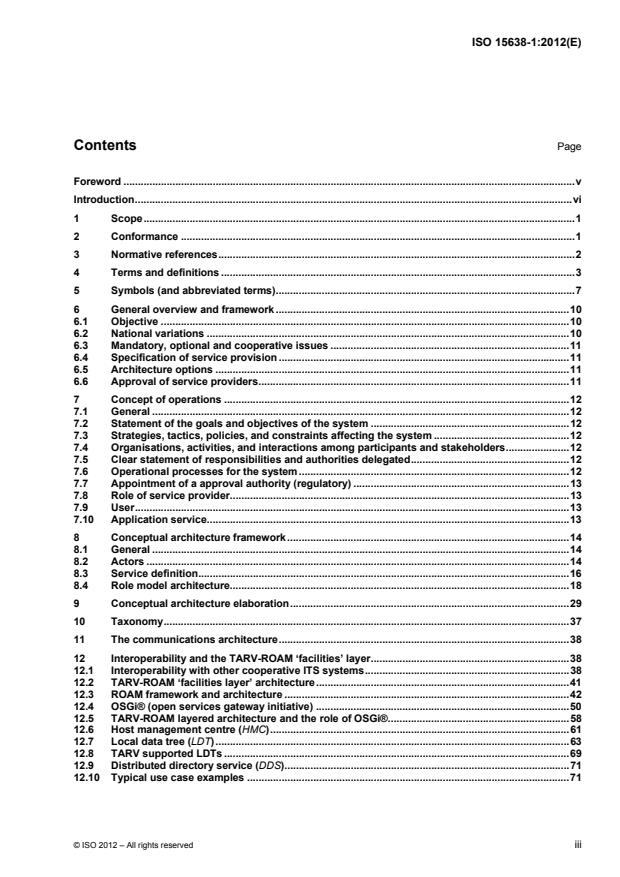
Contents Page
Foreword . v
Introduction . vi
1 Scope . 1
2 Conformance . 1
3 Normative references . 2
4 Terms and definitions . 3
5 Symbols (and abbreviated terms) . 7
6 General overview and framework . 10
6.1 Objective . 10
6.2 National variations . 10
6.3 Mandatory, optional and cooperative issues . 11
6.4 Specification of service provision . 11
6.5 Architecture options . 11
6.6 Approval of service providers . 11
7 Concept of operations . 12
7.1 General . 12
7.2 Statement of the goals and objectives of the system . 12
7.3 Strategies, tactics, policies, and constraints affecting the system . 12
7.4 Organisations, activities, and interactions among participants and stakeholders . 12
7.5 Clear statement of responsibilities and authorities delegated . 12
7.6 Operational processes for the system . 12
7.7 Appointment of a approval authority (regulatory) . 13
7.8 Role of service provider . 13
7.9 User . 13
7.10 Application service . 13
8 Conceptual architecture framework . 14
8.1 General . 14
8.2 Actors . 14
8.3 Service definition . 16
8.4 Role model architecture. 18
9 Conceptual architecture elaboration . 29
10 Taxonomy . 37
11 The communications architecture . 38
12 Interoperability and the TARV-ROAM ‘facilities’ layer . 38
12.1 Interoperability with other cooperative ITS systems . 38
12.2 TARV-ROAM ‘facilities layer’ architecture . 41
12.3 ROAM framework and architecture . 42
12.4 OSGi® (open services gateway initiative) . 50
12.5 TARV-ROAM layered architecture and the role of OSGi®. 58
12.6 Host management centre (HMC) . 61
12.7 Local data tree (LDT) . 63
12.8 TARV supported LDTs . 69
12.9 Distributed directory service (DDS) . 71
12.10 Typical use case examples . 71
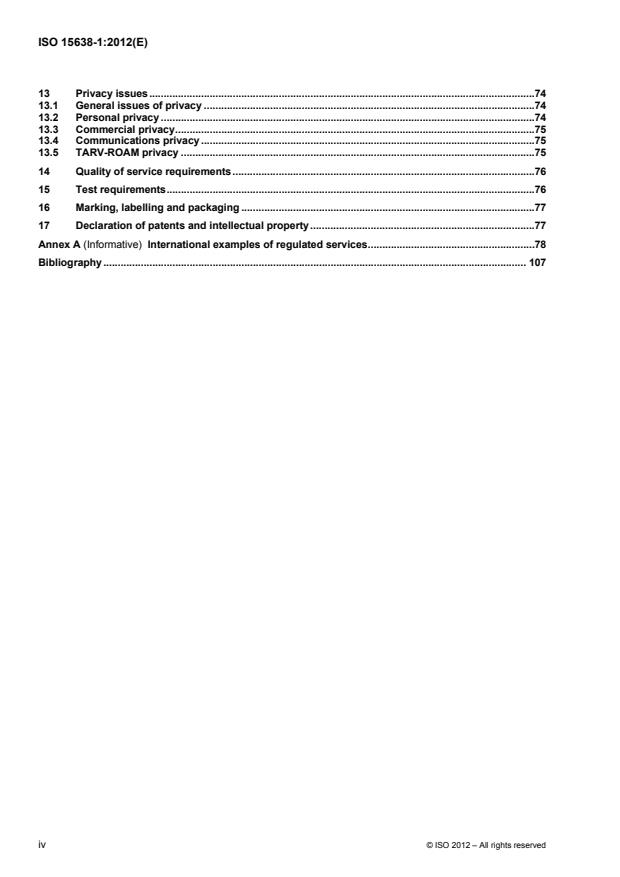
13 Privacy issues .74
13.1 General issues of privacy .74
13.2 Personal privacy .74
13.3 Commercial privacy .75
13.4 Communications privacy .75
13.5 TARV-ROAM privacy .75
14 Quality of service requirements .76
15 Test requirements .76
16 Marking, labelling and packaging .77
17 Declaration of patents and intellectual property .77
Annex A (Informative) International examples of regulated services .78
Bibliography . 107
iv © ISO 2012 – All rights reserved
Foreword
ISO (the International Organization for Standardization) is a worldwide federation of national standards bodies
(ISO member bodies). The work of preparing International Standards is normally carried out through ISO
technical committees. Each member body interested in a subject for which a technical committee has been
established has the right to be represented on that committee. International organizations, governmental and
non-governmental, in liaison with ISO, also take part in the work. ISO collaborates closely with the
International Electrotechnical Commission (IEC) on all matters of electrotechnical standardization.
International Standards are drafted in accordance with the rules given in the ISO/IEC Directives, Part 2.
The main task of technical committees is to prepare International Standards. Draft International Standards
adopted by the technical committees are circulated to the member bodies for voting. Publication as an
International Standard requires approval by at least 75 % of the member bodies casting a vote.
Attention is drawn to the possibility that some of the elements of this document may be the subject of patent
rights. ISO shall not be held responsible for identifying any or all such patent rights.
ISO 15638-1 was prepared by Technical Committee ISO/TC 204, Intelligent transport systems.
ISO 15638 consists of the following parts, under the general title Intelligent transport systems — Framework
for collaborative Telematics Applications for Regulated commercial freight Vehicles (TARV):
Part 1: Framework and architecture
The following parts are to be published:
Part 2: Common platform parameters using CALM
Part 3: Operating requirements, 'Approval Authority' procedures, and enforcement provisions for the
providers of regulated services
Part 4: System security requirements
Part 5: Generic vehicle information
Part 6: Regulated applications
Part 7: Other applications
Subsequent parts of ISO 15638 will provide definitions for specific TARV application services.
Introduction
Many ITS technologies have been embraced by commercial transport operators and freight owners, in the
areas of fleet management, safety and security. Telematics applications have also been developed for
governmental use. Such regulatory services in use or being considered vary from country to country, but
include electronic on-board recorders, vehicle charging, digital tachograph, on-board mass monitoring, vehicle
access monitoring, hazardous goods tracking and e-call. Additional applications with a regulatory impact being
developed include, fatigue management, speed monitoring and heavy vehicle charging based on mass,
location, distance and time.
In such an emerging environment of regulatory and commercial applications (4.15), it is timely to consider an
overall architecture (4.7) (business and functional) that could support these functions from a single platform
within a commercial freight vehicle that operates within such regulations. International standards will allow for
a speedy development and specification (4.40) of new applications that build upon the functionality of a generic
specification platform. A suite of standards deliverables is required to describe and define the framework (4.20)
and requirements so that the on-board equipment and back office (4.9) systems can be commercially designed
in an open market to meet common requirements of jurisdictions (4.24).
This suite of standards addresses and defines the framework (4.20) for a range of cooperative telematics
applications for regulated commercial freight vehicles (4.37) (such as access monitoring, driver fatigue
management, speed monitoring, on-board mass monitoring and charging). The overall scope includes the
concept of operation, legal and regulatory issues, and the generic cooperative provision of services to
regulated commercial freight vehicles (4.37), using an on-board ITS platform. The framework (4.20) is based on
a (multiple) service provider (4.39) oriented approach provisions for the approval and auditing of service
providers (4.40).
This suite of standards deliverables:
provides the basis for future development of cooperative telematics applications for regulated commercial
freight vehicles (4.37). Many elements to accomplish this are already available. Existing relevant standards
will be referenced, and the specifications (4.41) will use existing standards (such as CALM) wherever
practicable.
allows for a powerful platform for highly cost-effective delivery of a range of telematics applications for
regulated commercial freight vehicles (4.37).
presents a business architecture (4.7) based on a (multiple) service provider (4.39) oriented approach.
addresses legal and regulatory aspects for the approval and auditing of service providers (4.40).
This suite of standards deliverables is timely as many governments (Europe, North America, Asia and
Australia/New Zealand) are considering the use of telematics for a range of regulatory purposes. Ensuring that
a single in-vehicle platform can deliver a range of services to both government and industry through open
standards and competitive markets is a strategic objective.
This part of the ISO 15638 provides the overall framework (4.20) description and architecture (4.7) for TARV,
including the detailed architecture (4.7) specification (4.40) of the facilities layer.
NOTE 1 The definition of what comprises a ‘regulated’ vehicle is regarded as an issue for National decision, and may
vary from country to country. This suite of standards deliverables does not impose any requirements on nations in respect
of how they define a regulated commercial freight vehicle.
NOTE 2 The definition of what comprises a ‘regulated’ service is regarded as an issue for National decision, and may
vary from country to country. This suite of standards deliverables does not impose any requirements on nations in respect
vi © ISO 2012 – All rights reserved
of which services for regulated commercial freight vehicles countries will require, or support as an option, but provides
standardised sets of requirements descriptions for identified services to enable consistent and cost efficient
implementations where implemented.
NOTE 3 Cooperative ITS (4.14) applications, in this context, are defined as the use of an in-vehicle ITS platform to meet
both commercial and regulatory needs from a (functionally) single on-board platform.
INTERNATIONAL STANDARD ISO 15638-1:2012(E)
Intelligent transport systems — Framework for collaborative
Telematics Applications for Regulated commercial freight
Vehicles (TARV) —
Part 1:
Framework and architecture
1 Scope
This part of ISO 15638 provides the following for cooperative telematics applications for regulated commercial
freight vehicles (4.37):
a) A framework (4.20) for the provision of cooperative telematics application services for regulated
commercial freight vehicles;
b) A description of the concept of operation, regulatory aspects and options and the role models;
c) A conceptual architecture (4.7) using an on-board platform and wireless communications to a regulator
(4.25) or his agent;
d) References for the key documents on which the architecture (4.7) is based;
e) Details of the architecture (4.7) of the facilities layer;
f) A taxonomy of the organisation of generic procedures;
g) Common terminology for the ISO 15638 family of standards.
This part of ISO 15638 is based on a (multiple) service provider (4.39) oriented approach.
ISO 15638 has been developed for use in the context of regulated commercial freight vehicles. There is
nothing however to prevent a jurisdiction extending or adapting the scope to include other types of regulated
vehicles, as it deems appropriate.
NOTE The specific ‘approval’ procedures for specific application services are a matter for the jurisdiction (4.24) and
are outside the scope of this (or any) part of 15638. However approval authorities (4.6) are encouraged to use the
guidance of ISO 17000 and ISO/IEC 17065:2012 when developing and implementing such procedures.
2 Conformance
This part of ISO 15638 defines a general architecture (4.7), and has no specific conformance tests defined
herein. Some aspects defined within may have conformance tests defined in other parts of ISO 15638.
Conformance declarations for the various parts of a CALM-compliant system shall be based on the relevant
CALM-related international standards.
Conformance to any other international standard or specification (4.40) referenced in this part of ISO 15638
shall be ascertained according to the requirements of the referenced deliverable.
Conformance to this part of ISO 15638 is therefore a matter of self declaration of compliance, or by
submission to a test house to ascertain that the provisions of the clauses of this part of ISO 15638 have been
adhered to.
3 Normative references
The following referenced documents are indispensable for the application of this document. For dated
references, only the edition cited applies. For undated references, the latest edition of the referenced
document (including any amendments) applies.
ISO/TR 12859, Intelligent transport systems — System architecture — Privacy aspects in ITS standards and
systems
ISO 15638-2 , Intelligent transport systems — Framework for collaborative Telematics Applications for
Regulated commercial freight Vehicles (TARV) — Common platform parameters using CALM
ISO 15638-3 , Intelligent transport systems — Framework for collaborative Telematics Applications for
Regulated commercial freight Vehicles (TARV) — Operating requirements, 'Approval Authority' procedures,
and enforcement provisions for the providers of regulated services
ISO 15638-5 , Intelligent transport systems — Framework for collaborative Telematics Applications for
Regulated commercial freight Vehicles (TARV) — Generic vehicle information
ISO/TS 15638-6 , Intelligent transport systems — Framework for collaborative Telematics Applications for
Regulated commercial freight Vehicles (TARV) — Regulated applications
ISO 15638-7 , Intelligent transport systems — Framework for collaborative Telematics Applications for
Regulated commercial freight Vehicles (TARV) — Other applications
ISO 21210, Intelligent transport systems — Communications access for land mobiles (CALM) — IPv6
Networking
ISO 21217, Intelligent transport systems — Communications access for land mobiles (CALM) — Architecture
ISO 21218, Intelligent transport systems — Communications access for land mobiles (CALM) — Medium
service access points
ISO 24102, Intelligent transport systems — Communications access for land mobiles (CALM) — Management
ETSI TS 102 665, Digital Enhanced Cordless Telecommunications (DECT); DECT access to IP networks
NOTE 1 Subsequent parts of ISO 15638 will provide definitions for specific TARV application services.
NOTE 2 See Bibliography for references to other parts of ISO 15638 which are in various stages of ballot, but not yet
published at the date of publication of this International Standard.
To be published.
To be published.
To be published.
To be published. Full International Standard approval procedures are in process.
To be published.
2 © ISO 2012 – All rights reserved
4 Terms and definitions
For the purposes of this document, the following terms and definitions apply.
NOTE This clause contains all definitions generally used within the ISO 15638 suite of standards.
4.1
applicant
party which has applied for approval as a service provider (4.39)
4.2
application service
service provided by a service provider (4.39) accessing data from the IVS (4.23) of a regulated commercial
freight vehicle (4.37) via a wireless communications network
4.3
appoint/appointment/appointed
assign officially to take responsibility for a role
4.4
approval
formal affirmation that an applicant (4.1) has satisfied all the requirements for appointment (4.3) as a service
provider (4.39)
4.5
approval agreement
written agreement made between an approval authority (regulatory) (4.6) and a service provider (4.39)
NOTE An approval agreement (4.5) recognises the fact that a ‘service provider’ (4.39) having satisfied the ‘approval
authority (regulatory) (4.6) requirements for appointment (4.3) as a ‘service provider’, is appointed (4.3) in that capacity, and
sets out the legal obligations of the parties with respect to the on-going role of the ‘service provider’.
4.6
approval authority (regulatory)
organisation (usually independent) which conducts approval (4.4) and ongoing audit (4.8) for service providers
(4.39)
4.7
architecture
formalised description of the design of the structure of TARV and its framework (4.20)
4.8
audit
review of a party’s capacity to meet, or continue to meet, the initial and ongoing approval agreements (4.5) as
a service provider (4.39)
4.9
back office
generic term for the computing and communication facilities of a service provider (4.39) or an approval
authority (regulatory) (4.6) or jurisdiction regulator (4.25)
4.10
basic vehicle data
data that shall be maintained/provided by all IVS (4.23), regardless of jurisdiction (4.24)
4.11
Controller Area Networking bus
CAN bus
network designed for use in automotives; it uses a single terminated twisted pair cable; is multi master;
maximum signal frequency used is 1 Mbit/sec; length is typically 40M at 1Mbit/sec up to 10KM at 5Kbits/sec; it
has high reliability with extensive error checking; typical maximum data rate achievable is 40KBytes/sec;
maximum latency of high priority message <120 µsec at 1Mbit/sec
NOTE CAN is unusual in that the entities on the network, called nodes, are not given specific addresses. Instead, it is
the messages themselves that have an identifier which also determines the messages' priority. For this reason there is no
theoretical limit to the number of nodes although in practice it is ~64.
4.12
certification authority (digital)
organization which issues digital certificates for use by other parties (specifically in the context of
communications security)
4.13
cmpn
OSGi® (open services gateway initiative) service platform specifications
[OSGi®]
4.14
cooperative ITS
C-ITS
ITS applications in regulated commercial freight vehicles (4.37) for both regulatory and commercial purposes
that require the exchange of data between uncontracted parties using ITS stations
4.15
commercial applications
ITS applications in regulated commercial freight vehicles (4.37) for commercial (non-regulated) purposes
Example Asset tracking, vehicle and engine monitoring, cargo security, driver management etc.
4.16
condition
set of rules determined by the jurisdiction (4.24) to trigger the generation of reports
EXAMPLE Compliance or non-compliance reports, exception reports (4.19), condition reports, events, alarms and
passage reports.
4.17
core application data
basic vehicle data (4.10) plus any additional data required to provide an implemented regulated application
service (4.36)
4.18
enrolment
official registration to participate
4.19
exception report
report that is generated according to the condition(s) (4.16) in an application, and forwarded to a jurisdiction
(4.24) by a service provider (4.39)
4.20
framework
particular set of beliefs or ideas referred to in order to describe a scenario or solve a problem
4 © ISO 2012 – All rights reserved
4.21
global navigation satellite system
GNSS
comprises several networks of satellites that transmit radio signals containing time and distance data that can
be picked up by a receiver, allowing the user to identify the location of its receiver anywhere around the globe
4.22
global positioning system
GPS
instantiation of GNSS (4.21) controlled by the US Department of Defence
4.23
in-vehicle system (IVS)
ITS-station and connected equipment on board a vehicle
4.24
jurisdiction
government, road or traffic authority which owns the regulatory applications (4.35)
Example Country, state, city council, road authority, government department (customs, treasury, transport), etc.
4.25
jurisdiction regulator
regulator
agent of the jurisdiction (4.24) appointed (4.3) to regulate and manage TARV within the domain of the
jurisdiction
NOTE May or may not be the approval authority (regulatory) (4.6).
4.26
map
spatial dataset that defines the road system
4.27
on-board unit
OBU
integrated telematics unit installed on board which provides the specified telematics functionality required for
the IVS (4.23)
4.28
OSGi® Bundles
OSGi® components made by the developers
4.29
OSGi® Execution environment
defines what methods and classes are available in a specific platform
4.30
OSGi® Life-cycle
application programming interface (API) to install, start, stop, update, and uninstall bundles
4.31
OSGi® Modules
layer that defines how a bundle can import and export code
4.32
OSGi® Security
layer that handles the security aspects
4.33
OSGi® Services
connect bundles in a dynamic way by offering a publish-find-bind model for plain old JAVA® objects
4.34
prime service provider
service provider (4.39) who is the first contractor to provide regulated application services (4.36) to the regulated
commercial freight vehicle (4.37), or a nominated successor on termination of that initial contract
NOTE The prime service provider is also responsible for maintaining the installed IVS (4.23); if the IVS was not
installed during the manufacture of the vehicle, the prime service provider is also responsible for installing and
commissioning the IVS.
4.35
regulated/regulatory application
approval arrangement utilised by jurisdictions (4.24) for granting certain categories of commercial vehicle rights
to operate in regulated circumstances subject to certain conditions (4.16
NOTE Each jurisdiction may use their own terminology including, but not limited to, permit, application, scheme,
concession, exemption, gazettal and notice.
4.36
regulated application service
TARV application service (4.2) that is mandated by a regulation imposed by a jurisdiction (4.24), or an option
supported by a jurisdiction
4.37
regulated commercial freight vehicle
vehicle (often but not always designed to haul commercial freight) that is subject to regulations determined by
the jurisdiction (4.24) as to its use on the road system of the jurisdiction in regulated circumstances, subject to
certain conditions (4.16), and in compliance with specific regulations for that class of vehicle
NOTE At the option of jurisdictions this may require the provision of information via TARV or provide the option to do
so.
4.38
regime for open application management
ROAM
facilities and open application execution and its management for TARV systems
4.39
service provider
party which is certified by an approval authority (regulatory) (4.6) as suitable to provide regulated or
commercial ITS application services (4.2)
4.40
specification
explicit and detailed description of the nature and functional requirements and minimum performance of
equipment, service or a combination of both
4.41
tamper
conduct towards IVS (4.23) or a service provider’s (4.39) system which is intended to prevent the IVS or the
service provider’s system from functioning correctly
4.42
Unified Modeling Language
UML
graphical language for visualizing, specifying, constructing, and documenting the artifacts of a software-
intensive system
6 © ISO 2012 – All rights reserved
NOTE UML offers a standard way to write a system's blueprints, including conceptual things such as business
processes and system functions as well as concrete things such as programming language statements, database
schemas, and reusable software components, and is standardised as ISO/IEC 19501.
4.43
uniform resource identifier
URI
string of characters used to identify a name or a resource on the Internet
NOTE Such identification enables interaction with representations of the resource over a network (typically the World
Wide Web) using specific protocols; schemes specifying a concrete syntax and associated protocols define each URI.
4.44
uniform resource locator
URL
uniform resource identifier [URI (4.43)] that specifies where an identified resource is available and the
mechanism for retrieving it
NOTE In popular usage and in many technical documents and verbal discussions it is often incorrectly used as a
synonym for URI (4.43) (The best-known example of the use of URLs is for the addresses of web pages on the World Wide
Web, such as http://www.example.com/).
4.45
user
individual or party that enrols in and operates within a regulated or commercial application service (4.2)
Example Driver, transport operator, freight owner, etc.
5 Abbreviated terms
For the purposes of this part of ISO 15638 and the ISO 15638 suite of standards deliverables, the following
abbreviated terms apply.
API
application programming interface
app
application programme
CALM
communications access for land mobiles
CAD
core application data (4.17)
CAN
controller area network (4.11)
C-ITS
cooperative intelligent transport systems
CDS
charging data services
DDS
distributed directory service
DMT
device management tree
DSRC
dedicated short range communication
FA
interface between the facilities layer and the ITS-S applications entity
[ISO 21217]
FOAM
framework for open applications
[project CVIS]
G
gravitational force
GNSS
global navigation satellite system (4.21)
GPS
global positioning system (4.22)
HMC
host management centre
HMI
human/machine interface
I2I
infrastructure to infrastructure
ID
identity
IETF
internet engineering task force
IN
interface between the access layer and the networking and transport layer
[ISO 21217]
ITS
intelligent transport system
IVS
in-vehicle system (4.23)
JAR
JAVA® archive retrieval (file format)
LDT
local data tree
LDM
local dynamic map
LTE
long term evolution (mobile phone generation after 3G)
8 © ISO 2012 – All rights reserved
MA
interface between the communication and station management entity and the ITS-S applications entity
[ISO 21217]
MF
interface between the communication and station management entity and the facilities layer
[ISO 21217]
MI
interface between the communication and station management entity and the access layer
[ISO 21217]
MN
interface between the communication and station management entity and the networking and transport layer
[ISO 21217]
MS
interface between the communication and station management entity and the security entity
[ISO 21217]
NF
interface between the networking and transport layer and the facilities layer
[ISO 21217]
OMA
open mobile alliance
OBU
on-board unit (4.27)
OEM
original equipment manufacturer
OSGi®
open services gateway initiative
RAM
random access memory
ROAM
regime for open application management (4.38)
RSE
roadside equipment
RSI
roadside Infrastructure
SAP
service access point
SF
interface between the security entity and the facilities layer
[ISO 21217]
SI
interface between the security entity and the access layer
[ISO 21217]
SN
interface between the security entity and the networking and transport layer
[ISO 21217]
SOA
service oriented architecture
SSO
single sign-on
TARV
telematics applications for regulated commercial freight vehicles
UML
Unified Modeling Language (4.42)
(ISO 19501)
URI
uniform resource identifier (4.43)
URL
uniform resource locator (4.44)
UTC
universal time coordinated
V2I
vehicle to infrastructure (communication)
V2V
vehicle to vehicle communication
6 General overview and framework
6.1 Objective
This Clause describes a generic framework (4.20) for the provision of cooperative telematics application
services (4.2) for regulated commercial freight vehicles (4.37). Clause 7 provides the general concept of
operations for which this architecture (4.7) is designed. Clauses 8 and 9 provide a framework, role definition
and elaboration of the architecture at a conceptual level. Clause 10 provides the taxonomy of the architecture
(4.7) and Clause 11 defines the communications architecture. Clause 12 defines the facilities layer and its
interoperability.
Annex A provides some informative examples from telematics systems for regulated commercial freight
vehicles, cited from Jurisdictions around the world.
6.2 National variations
6.2.1 As stated in the scope, the definition of what comprises a ‘regulated’ vehicle is regarded as an issue for
National decision, and may vary from country to country.
10 © ISO 2012 – All rights reserved
6.2.2 The instantiation of interoperable on-board platforms for regulated commercial freight vehicles with
common features is expected to vary from country to country, as will the provision of regulated, or supported,
services.
6.2.3 It is possible that some countries will mandate the use of such a platform, others will offer it as an option
to meet the requirements of the regulation with minimum administration and paperwork (providing a good
business case for operators to fit and use the equipment).
6.2.4 Some countries may implement a single, government operated, controlled, or contracted service
provider (4.39) which is the single communication manager between the vehicle and the service. Other
countries may provide a market based solution with multiple service providers competing for the business of
vehicle operators.
6.3 Mandatory, optional and cooperative issues
6.3.1 As stated in 6.2.1, the definition of what comprises a ‘regulated’ service is regarded as an issue for
National decision, and may vary from country to country. Further, services may be ‘required’ by a regulator
(4.25), or may be supported by a regulator, but not required. (There may for example be a choice between
using electronic means to plan, approve and monitor the movement of a hazardous cargo journey, or to use
traditional paper request, approval and monitoring).
6.3.2 The IVS (4.23) may also support the provision of other commercial application services (4.2) that are not
required by the regulator (4.25).
6.3.3 This suite of standards deliverables does not impose any requirements on Nations in respect of which
services for regulated commercial freight vehicles countries will require, or which they will support as an option,
but this suite of standards deliverables will provide a generic common architecture (4.7) within which countries
can achieve their own objectives in respect of application services (4.2) for regulated commercial freight
vehicles (4.37), and provide standardised sets of requirements descriptions for identified services to enable
consistent and cost efficient implementations where instantiated.
6.3.4 Cooperative ITS (4.14) applications, in this context, is the use of a common on-board platform to meet
both regulated and commercial service provision.
6.4 Specification of service provision
Cooperative ITS (4.14) applications for regulated commercial freight vehicles (both regulated services and
commercial services) are specified in terms of the service provision, and not in terms of the hardware and
software.
6.5 Architecture options
Architecturally, it needs to be possible for a vehicle operator to use the services of different service providers
(4.40) in different geographical areas, or for the provision of different services within the same geographical
area. In these circumstances, where there is a market of competing service providers, the most likely solution
may be expected to be that the user (4.45) will choose a single service provider who will install and maintain
the in-vehicle system (4.23) into the regulated commercial freight vehicle and deliver all services that the user
to which the user chooses to subscribe. In future years however, the in-vehicle system may be a vehicle
original equipment specification (4.40) option, inbuilt at the time of manufacture of the vehicle, with service
provider selection being a subsequent user choice (much as we select an internet service provider today).
Other options are possible and should be able to be supported within the conceptual architecture (4.7).
6.6 Approval of service providers
As determined by the regulatory jurisdiction (4.24), the service provider (4.39) may need to be certified by the
regulator (4.25), and so some form of ‘Approval authority (regulatory) (4.6)’ role forms an essential part of the
architecture (4.7), but the role may and will be instantiated differently by different jurisdictions.
7 Concept of operations
7.1 General
This Clause describes the characteristics of a proposed system from the viewpoint of an individual who will
use that system. Its objective is to communicate the quantitative and qualitative system characteristics to all
stakeholders.
This part of ISO 15638 describes the roles and responsibilities of the classes and actors involved in the
provision of regulated services for regulated commercial freight vehicles using telematics.
This part of ISO 15638 recognises that there will be variations between jurisdictions (4.24). It does not attempt,
nor recommend, homogeneity between jurisdictions, simply it is designed to provide common standard
features to enable equipment of common specification (4.40) to be used, and the common features of service
provision to be able to be referenced by a jurisdiction in its regulatory and/or legislative regime simply by
reference to an International Standards deliverable (requiring it to specify in detail only the particular additional
requirements of a jurisdiction).
A ‘concept of operations’ (CONOPS) generally evolves from a concept and is a description of how a set of
capabilities may be employed to achieve desired objectives.
7.2 Statement of the goals and objectives of the system
The overall objective of TARV is the assessment, monitoring etc. of regulated commercial freight vehicles to
meet the requirements of the jurisdiction within it is operating, using telematics.
This is achieved by the provision of application services (4.2) for specific aspects of the control and
management of regulated commercial freight vehicles (4.37). These services are provided by agreement with
the user (4.45), and using an approved service provider (4.39) to meet the requirements of the jurisdiction using
in-vehicle system (4.23) with communications capability between the vehicle and the service provider, and
access to relevant data from the regulated commercial freight vehicle.
7.3 Strategies, tactics, policies, and constraints affecting the system
Strategies, tactics, policies and constraints, and indeed, the services that are regulated as mandatory or
optionally supported, may vary from jurisdiction 4.24) to jurisdiction. (Clause 6 provides detail of the options of
such aspects.
7.4 Organisations, activities, and interactions among participants and stakeholders
The classes, attributes and key relationships are described in Clause 8, and are some high level conceptual
architectural detail is elaborated in Clause 9. Clause 10 provides the taxonomy of the architecture (4.7) and
Clause 11 defines the communications architecture. Clause 12 defines the facilities layer and its
interoperability.
7.5 Clear statement of responsibilities and authorities delegated
Clause 6 describes the high level options and issues. The actors, their responsibilities and authorities are
described in Clause 8 below, and the roles are described in Clause 8 and in this Clause (Clause 7).
7.6 Operational processes for the system
The following description of operational processes is at a high abstracted level (above that of any particular
application service). Specific services may have additional requirements not described herein, but guidance
and specification (4.40) for some aspects may be obtained from ISO 15638-6 and ISO 15638-7.
12 © ISO 2012 – All rights reserved
7.6.1 Service requirements definition
A jurisdiction passes legislation/regulation to require or support the provision of a particular application service
(4.2). The legislation/regulation needs to provide clear and unambiguous definition of what is required.
7.7 Appointment of an approval authority (regulatory)
The jurisdiction creates or appoints (4.3) an authority to approve and audit (4.8) the process. The structure of
that authority is a matter for the jurisdiction and it may be a separate appointed organisation, or a department
of the jurisdiction. (4.24). Within the context of this part of ISO 15638, it is the actor ‘role’ of ‘approval authority’
that is important, not its structure, ownership or business model.
An approval authority (regulatory) (4.6) may only preside over the instantiation and operation of one particular
application service (4.2), or may preside over the instantiation and operation of some or all application services
for regulated commercial freight vehicles (at the discretion of the jurisdiction).
The approval authority (regulatory) (4.6) will approve service providers (4.40), IVS (4.23), and will provide audit
(4.8) as described in Clause 6 above, in accordance with the requirements of the jurisdiction (4.24).
NOTE: The TARV approval authority is described throughout as the ‘approval authority (regulatory) (4.6) to
clearly disti
...