

ISO 12101:2025
(Main)Industrial valves — Measurement, test and qualification procedures for fugitive emissions — Classification system and qualification procedures for type testing of stem seals for valves
General Information
- Abstract
This document covers the type testing of valve stem seals using a test fixture that is designed and fully defined to be representative of the performance of a valve using similar geometry. This document is applicable to stem seals for multi-turn, linear and quarter turn valves. It is intended to provide comparative type test results confirming the performance of seal manufacturers’ stem seal designs. This document is not intended to replace type testing of complete valve assemblies or valve production testing. Compliance with this document is not intended to be a mandatory qualification test to be completed for a stem seal design prior to testing a valve to the requirements of ISO 15848-1. Compressible seals with and without live loading, elastomers and pressure energized seals are in the scope of this document. Corrosion tests are not included in this document.
- Status
- Published
- Publication Date
- 12-Jun-2025
- Technical Committee
- ISO/TC 153 - Valves
- Drafting Committee
- ISO/TC 153 - Valves
- Current Stage
- 6060 - International Standard published
- Start Date
- 13-Jun-2025
- Due Date
- 16-Jun-2025
- Completion Date
- 13-Jun-2025
Buy Documents


ISO 12101:2025 - Industrial valves — Measurement, test and qualification procedures for fugitive emissions — Classification system and qualification procedures for type testing of stem seals for valves Released:13. 06. 2025
Overview
ISO 12101:2025 - Industrial valves: type testing of stem seals for fugitive emissions defines a classification system and test procedures for evaluating valve stem seals using a standardized test fixture that reproduces valve-like geometry. The standard applies to multi-turn, linear and quarter-turn valves and covers compressible packings (with and without live loading), elastomers and pressure‑energized seals. It is designed to provide comparative type‑test results for seal manufacturers and test laboratories. Note: ISO 12101:2025 does not replace type testing of complete valve assemblies, is not a mandatory pre‑condition for ISO 15848-1 valve testing, and excludes corrosion tests.
Key topics and technical requirements
- Test fixture design: A fully defined test fixture representative of valve geometry (NRRS, RNRS, RRS, QT movement simulations) is required to produce comparative results.
- Stem seal types in scope: Compression packings (adjustable and live‑loaded), non‑adjustable spring/pressure‑energized seal stacks, and elastomer seals.
- Test facility requirements: Demonstrated capability for required tests, qualified personnel, appropriate equipment, a quality management system (QMS) and health, safety & environment (HSE) controls, and familiarity with pressure and leakage testing and reporting.
- Test procedures and parameters:
- Defined test fluids, temperatures and pressures (document references helium and methane in the context of tightness classes).
- Leakage measurement methods and instrumentation to quantify fugitive emissions.
- Mechanical endurance testing (cycle classes) to simulate isolating and control valve stem movements, including full rated travel (stroke/angle).
- Safety rules, equipment calibration and test reporting requirements.
- Performance classification: Tightness classes, endurance classes, temperature range and rules for stem seal performance class designation and extension of qualification to untested but related seal designs.
- Informative annex: Example test fixture constructions are provided to guide implementation.
Practical applications and users
ISO 12101:2025 is intended for:
- Seal manufacturers seeking comparative type‑test qualification of stem seal designs.
- Valve manufacturers selecting stem seal systems for compliance with fugitive emission objectives.
- Independent test laboratories that perform type testing and issue qualification reports.
- End users and asset operators (oil & gas, petrochemical, chemical plants, power generation, environmental compliance teams) assessing valve fugitive emission performance for procurement, maintenance and regulatory reporting.
Benefits include reproducible fugitive emissions testing, informed valve/packing selection, and clearer performance claims for stem seals.
Related standards
- ISO 15848-1:2015 - Industrial valves - Measurement, test and qualification procedures for fugitive emissions - Part 1: qualification procedures for type testing of valves (referenced for valve-level testing).
Buy Documents
ISO 12101:2025 - Industrial valves — Measurement, test and qualification procedures for fugitive emissions — Classification system and qualification procedures for type testing of stem seals for valves Released:13. 06. 2025
Get Certified
Connect with accredited certification bodies for this standard

Institut za varilstvo d.o.o. (Welding Institute)
Slovenia's leading welding institute since 1952. ISO 3834, EN 1090, pressure equipment certification, NDT personnel, welder qualification. Only IIW Au
Sponsored listings
Frequently Asked Questions
ISO 12101:2025 is a standard published by the International Organization for Standardization (ISO). Its full title is "Industrial valves — Measurement, test and qualification procedures for fugitive emissions — Classification system and qualification procedures for type testing of stem seals for valves". This standard covers: This document covers the type testing of valve stem seals using a test fixture that is designed and fully defined to be representative of the performance of a valve using similar geometry. This document is applicable to stem seals for multi-turn, linear and quarter turn valves. It is intended to provide comparative type test results confirming the performance of seal manufacturers’ stem seal designs. This document is not intended to replace type testing of complete valve assemblies or valve production testing. Compliance with this document is not intended to be a mandatory qualification test to be completed for a stem seal design prior to testing a valve to the requirements of ISO 15848-1. Compressible seals with and without live loading, elastomers and pressure energized seals are in the scope of this document. Corrosion tests are not included in this document.
This document covers the type testing of valve stem seals using a test fixture that is designed and fully defined to be representative of the performance of a valve using similar geometry. This document is applicable to stem seals for multi-turn, linear and quarter turn valves. It is intended to provide comparative type test results confirming the performance of seal manufacturers’ stem seal designs. This document is not intended to replace type testing of complete valve assemblies or valve production testing. Compliance with this document is not intended to be a mandatory qualification test to be completed for a stem seal design prior to testing a valve to the requirements of ISO 15848-1. Compressible seals with and without live loading, elastomers and pressure energized seals are in the scope of this document. Corrosion tests are not included in this document.
ISO 12101:2025 is classified under the following ICS (International Classification for Standards) categories: 23.060.01 - Valves in general. The ICS classification helps identify the subject area and facilitates finding related standards.
ISO 12101:2025 is available in PDF format for immediate download after purchase. The document can be added to your cart and obtained through the secure checkout process. Digital delivery ensures instant access to the complete standard document.
Standards Content (Sample)
International
Standard
ISO 12101
First edition
Industrial valves — Measurement,
2025-06
test and qualification procedures
for fugitive emissions —
Classification system and
qualification procedures for type
testing of stem seals for valves
Robinetterie industrielle — Mesurage, essais et modes
opératoires de qualification pour émissions fugitives — Système
de classification et modes opératoires de qualification pour les
essais de type des dispositifs d'étanchéité de la tige des appareils
de robinetterie
Reference number
© ISO 2025
All rights reserved. Unless otherwise specified, or required in the context of its implementation, no part of this publication may
be reproduced or utilized otherwise in any form or by any means, electronic or mechanical, including photocopying, or posting on
the internet or an intranet, without prior written permission. Permission can be requested from either ISO at the address below
or ISO’s member body in the country of the requester.
ISO copyright office
CP 401 • Ch. de Blandonnet 8
CH-1214 Vernier, Geneva
Phone: +41 22 749 01 11
Email: copyright@iso.org
Website: www.iso.org
Published in Switzerland
ii
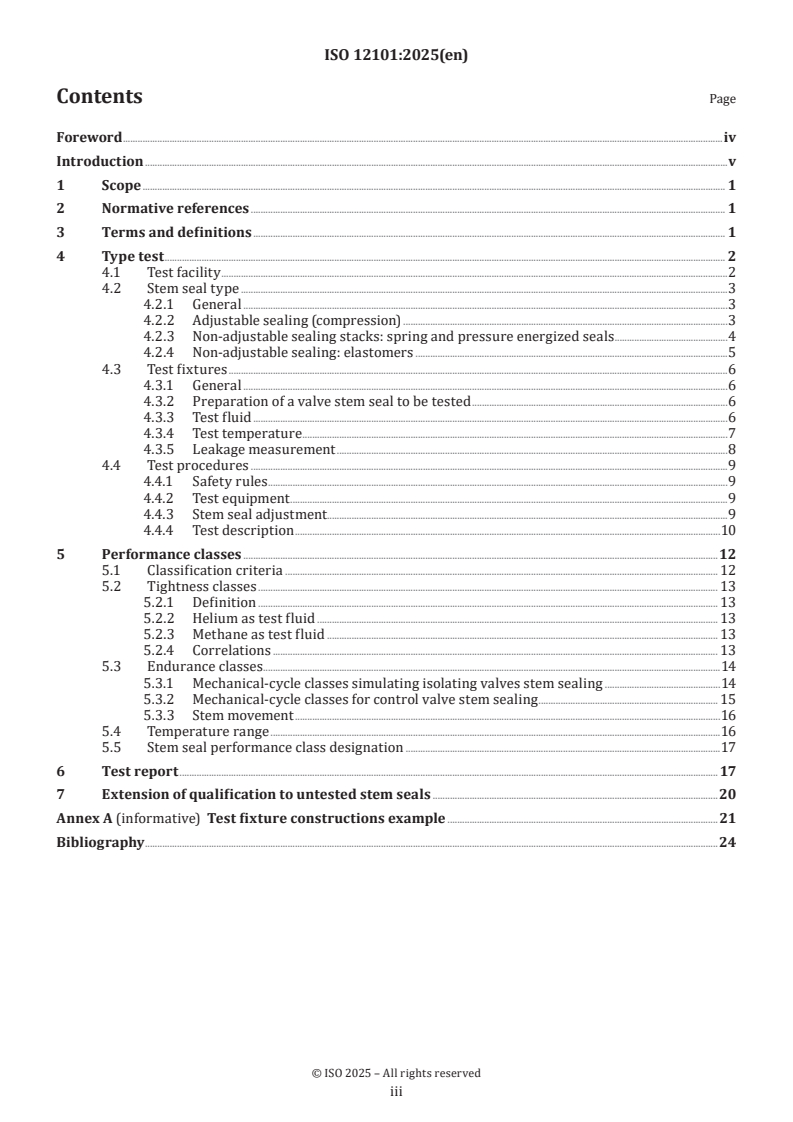
Contents Page
Foreword .iv
Introduction .v
1 Scope . 1
2 Normative references . 1
3 Terms and definitions . 1
4 Type test . 2
4.1 Test facility .2
4.2 Stem seal type .3
4.2.1 General .3
4.2.2 Adjustable sealing (compression) .3
4.2.3 Non-adjustable sealing stacks: spring and pressure energized seals .4
4.2.4 Non-adjustable sealing: elastomers .5
4.3 Test fixtures .6
4.3.1 General .6
4.3.2 Preparation of a valve stem seal to be tested .6
4.3.3 Test fluid .6
4.3.4 Test temperature . .7
4.3.5 Leakage measurement .8
4.4 Test procedures .9
4.4.1 Safety rules .9
4.4.2 Test equipment .9
4.4.3 Stem seal adjustment.9
4.4.4 Test description .10
5 Performance classes .12
5.1 Classification criteria . 12
5.2 Tightness classes . 13
5.2.1 Definition . 13
5.2.2 Helium as test fluid . 13
5.2.3 Methane as test fluid . 13
5.2.4 Correlations . 13
5.3 Endurance classes.14
5.3.1 Mechanical-cycle classes simulating isolating valves stem sealing .14
5.3.2 Mechanical-cycle classes for control valve stem sealing . 15
5.3.3 Stem movement .16
5.4 Temperature range .16
5.5 Stem seal performance class designation .17
6 Test report . 17
7 Extension of qualification to untested stem seals .20
Annex A (informative) Test fixture constructions example .21
Bibliography .24
iii
Foreword
ISO (the International Organization for Standardization) is a worldwide federation of national standards
bodies (ISO member bodies). The work of preparing International Standards is normally carried out through
ISO technical committees. Each member body interested in a subject for which a technical committee
has been established has the right to be represented on that committee. International organizations,
governmental and non-governmental, in liaison with ISO, also take part in the work. ISO collaborates closely
with the International Electrotechnical Commission (IEC) on all matters of electrotechnical standardization.
The procedures used to develop this document and those intended for its further maintenance are described
in the ISO/IEC Directives, Part 1. In particular, the different approval criteria needed for the different types
of ISO document should be noted. This document was drafted in accordance with the editorial rules of the
ISO/IEC Directives, Part 2 (see www.iso.org/directives).
ISO draws attention to the possibility that the implementation of this document may involve the use of (a)
patent(s). ISO takes no position concerning the evidence, validity or applicability of any claimed patent
rights in respect thereof. As of the date of publication of this document, ISO had not received notice of (a)
patent(s) which may be required to implement this document. However, implementers are cautioned that
this may not represent the latest information, which may be obtained from the patent database available at
www.iso.org/patents. ISO shall not be held responsible for identifying any or all such patent rights.
Any trade name used in this document is information given for the convenience of users and does not
constitute an endorsement.
For an explanation of the voluntary nature of standards, the meaning of ISO specific terms and expressions
related to conformity assessment, as well as information about ISO's adherence to the World Trade
Organization (WTO) principles in the Technical Barriers to Trade (TBT), see www.iso.org/iso/foreword.html.
This document was prepared by Technical Committee ISO/TC 153, Valves.
Any feedback or questions on this document should be directed to the user’s national standards body. A
complete listing of these bodies can be found at www.iso.org/members.html.
iv
Introduction
The objective of this document is to establish test methods to evaluate the performance of different designs
and constructions of stem sealing for valves in order to reduce fugitive emissions.
The results from the testing provide a means of classification and qualification under various test conditions.
This classification will help valve manufacturers to choose a suitable stem seal system to allow valve testing
in accordance with ISO 15848-1.
The procedures of this document can only be used with the application of necessary precautions for testing
with flammable or inert gas at temperature and under pressure.
v
International Standard ISO 12101:2025(en)
Industrial valves — Measurement, test and qualification
procedures for fugitive emissions — Classification system and
qualification procedures for type testing of stem seals for valves
1 Scope
This document covers the type testing of valve stem seals using a test fixture that is designed and fully
defined to be representative of the performance of a valve using similar geometry.
This document is applicable to stem seals for multi-turn, linear and quarter turn valves. It is intended to
provide comparative type test results confirming the performance of seal manufacturers’ stem seal designs.
This document is not intended to replace type testing of complete valve assemblies or valve production
testing.
Compliance with this document is not intended to be a mandatory qualification test to be completed for a
stem seal design prior to testing a valve to the requirements of ISO 15848-1.
Compressible seals with and without live loading, elastomers and pressure energized seals are in the scope
of this document.
Corrosion tests are not included in this document.
2 Normative references
The following documents are referred to in the text in such a way that some or all of their content constitutes
requirements of this document. For dated references, only the edition cited applies. For undated references,
the latest edition of the referenced document (including any amendments) applies.
ISO 15848-1:2015, Industrial valves — Measurement, test and qualification procedures for fugitive emissions —
Part 1: Classification system and qualification procedures for type testing of valves
3 Terms and definitions
For the purposes of this document, the terms and definitions given in ISO 15848-1 and the following apply.
ISO and IEC maintain terminology databases for use in standardization at the following addresses:
— ISO Online browsing platform: available at https:// www .iso .org/ obp
— IEC Electropedia: available at https:// www .electropedia .org/
3.1
live loading
application of a load to the gland follower of adjustable compression stem seals using a stored energy device
such as a spring
3.2
quarter-turn stem
QT
test fixture designed to simulate movement of a valve to the fully open or close position with approximately
90° rotation of the stem
3.3
non-rotating rising stem
NRRS
test fixture designed to simulate valve stem movement in an axial direction, with no rotation
3.4
rotating non-rising stem
RNRS
test fixture designed to simulate a valve in which the stem movement consists of one or multiple rotations
but with no movement of the stem in an axial direction
3.5
rotating rising stem
RRS
test fixture designed to simulate a valve in which the movement of the stem is in an axial direction, with
rotation
3.6
seal housing
metallic component(s) containing non-adjustable elastomer, spring and pressure energized seal stack (3.7)
3.7
seal stack
several individual sealing elements, at least one of which is energized by a spring or elastomer, which
can have different profiles arranged in a defined sequence to form a non-adjustable spring and pressure
energized stem seal assembly
3.8
stem movement
stroke/angle for stroking the stem
3.9
test fixture
test stand packing gland and/or seal housing constructed as a fixture designed to simulate a typical valve
3.10
temperature range
minimum and maximum temperatures at which a stem seal is tested to assess its performance, behaviour,
suitability and tightness
3.11
full rated travel of stem
maximum stroke/angle movement of the stem to open and close the fixture in which the seal has been tested
Note 1 to entry: Full rated travel is defined as two times the stroke.
4 Type test
4.1 Test facility
The tests shall be carried out at the manufacturing facilities or at an external facility. However, a single set of
minimum requirements shall be established for both facilities. These requirements can include, but are not
limited to:
— demonstration of the capability to perform required tests, inspections, analysis and examinations, in
terms of both personnel qualification and equipment availability;
— a quality management system;
— a health, safety and environment management system;
— familiarity with pressure and leakage testing standards, as well as the reporting of the test results (in
appropriate formats).
4.2 Stem seal type
4.2.1 General
Compression packing is a widely used stem seal type in industrial valves. But a significant number of
industrial valves uses stem seal designs other than compression packing, e.g. part turn rotary valves, high
pressure globe valves.
Many industrial valve applications where fugitive emissions are critical use pressure energised seal systems
(e.g. elastomers, pressure energised lip seals), due to the high sealing performance and low maintenance
requirements of these designs.
A standardized or specially manufactured test fixture shall be used to test stem seals by performing tests at
the experimental conditions specified by this document. If the capability of the test fixture does not meet the
specified test conditions, only temperature and pressure conditions covered by the test fixture performance
shall be tested.
4.2.2 Adjustable sealing (compression)
4.2.2.1 Description
Made from relatively soft, pliant materials, compression or mechanical packings consist of a number of rings,
which are inserted into the annular space (stuffing box) between the rotating or reciprocating stem and the
body or bonnet of a valve.
By tightening a follower or packing gland against the top or end ring, pressure is transmitted to the packing
set. This expands the rings radially against the side of the stuffing box and the reciprocating or rotating
stem creating an effective seal.
Adjustable compression packing sealing designs can include live loaded types where the follower will
continue to load the packing in order to compensate for packing compression loss by thermal cycling,
friction, extrusion, creep, relaxation, consolidation etc. as the valve operates. These live loaded compression
seal designs apply the load to the packing by using a stored energy device such as a spring.
Compression packing seals or gland seals are used to seal a variety of fluids under a range of conditions.
They are used to help contain water, acids, solvents, gases, oil and other chemicals that are subjected to
various temperatures and pressures.
4.2.2.2 Specification and materials
The most common type of compression packing is braided compression packing.
This type of packing is typically installed by cutting rings of the required size from rope packing, or using
pre-formed rings, inserting them into a stuffing box and tightening them to achieve the right density.
However, alternative installation processes may also be used.
Depending on the service, construction materials can be as diverse as plants or animal derivatives, mineral
fibres or synthetic plastics, and even metal.
Typical materials for compressible packing include, but are not limited to
— PTFE (polytetrafluoroethylene)/graphite
— PTFE
— aramide/PTFE
— aramide
— braided or pre-formed graphite
A combination of different packing materials is allowed.
When the stem sealing material or material manufacturer is changed, manufacturing location, or there is
a change in the method of manufacture of the sealing or stem seal assembly, an entirely new type test is
required.
An example test fixture is given in Annex A.
4.2.3 Non-adjustable sealing stacks: spring and pressure energized seals
4.2.3.1 Description
Non-adjustable spring and pressure energized seal stacks are used to seal a variety of fluids under a range
of conditions. They are used to help contain water, acids, solvents, gases, oil and other chemicals that are
subjected to various temperatures and pressures. They are often used in emission critical or high-pressure
stem sealing, particularly when consistent sealing performance, over large numbers of operating cycles and
without routine maintenance adjustments, is required.
Non-adjustable spring and pressure energized sealing stacks are designed to function as a complete
pressure energized seal assembly. The spring-loaded sealing elements ensure effective low-pressure sealing
performance whilst all elements combine to provide higher pressure sealing capability by utilising the
internal fluid pressure acting on the stack to generate the necessary sealing loads. Pressure energized seals
of this type do not require adjustment in service as the pressure generated sealing load acting on the stack
compensates for the effects of seal wear during the lifetime of the seal.
Once installed in the assembly, spring or pressure energised seals require no further adjustment to operate.
4.2.3.2 Specification and materials
There are many different designs of seal stacks intended for a wide variety of applications. The various
separate elements of the seal stack can have different surface profiles and cross sections intended to ensure
effective sealing performance without excessive deformation, extrusion or creep over the rated pressure
and temperature range. Several different materials can be used within a single seal stack, e.g. a combination
of filled and unfilled polymers and elastomers. The performance of the seal stack is sensitive to the surface
finish, geometry and geometric tolerances of the seal housing components as well as the stem. Users
shall therefore follow the seal manufacturer’s specified geometry, surface roughness requirements and
installation instructions.
Examples of typical materials for non-adjustable sealing include, but are not limited to:
— PTFE
— PTFE/carbon/glass/aramide mixes
— FKM (fluoro rubber having substituent fluoro, perfluoroalkyl, or perfluoroalkoxy groups on the
polymer chain)
— NBR (acrylonitrile-butadiene rubber)
— HNBR (hydrogenated nitrile-butadiene rubber)
— XNBR (carboxylic-acrylonitrile-butadiene rubber)
— FEP (fluorinated ethylene propylene)
— FVMQ (fluoro silicone rubber)
— ACM (acrylic rubber)
— PEEK (polyether ether ketone)
A combination of different metallic and non-metallic materials within the seal stack is allowed.
When there is a change in the seal stack materials, grade, component(s), material manufacturer or
manufacturing location, or there is a change in the design of the seal housing, an entirely new type test is
required. Machining methods for the seal housing and stem along with the requirements of surface finishes,
including the process used to achieve them, shall be specified.
An example test fixture is given in Annex A.
4.2.4 Non-adjustable sealing: elastomers
4.2.4.1 Description
Non-adjustable elastomeric stem seals are a type of pressure energized seal used for a variety of fluids
under a range of conditions. They are capable of sealing water, acids, solvents, gases, oil and other chemicals
that are compatible with the elastomeric material. Non-adjustable elastomeric seals differ from the seals
described in 4.2.3 because they do not contain a metallic spring and rely solely on the resilient properties of
the elastomer to achieve a pressure energized seal.
They are often used in part turn sealing applications for isolating valves at pressure and temperature
conditions appropriate to the operating limits of the elastomer materials utilized. They offer consistent
pressure energised sealing performance without the need for routine maintenance adjustments.
Elastomeric seals are contained within the seal housing or groove using the compressive assembly loads
to generate an initial fluid tightness between the seal elements and the stem and seal housing. A further
pressure energised sealing load is generated by the effects of internal fluid pressure acting on the seal and
supplementing the initial assembly loads.
Once correctly installed in the assembly, the elastomer seal requires no additional load or adjustment to
operate.
4.2.4.2 Specification and materials
There are many different designs of non-adjustable elastomeric stem seals intended for a wide variety of
pressure ranges and dynamic applications. Non-adjustable elastomeric seals can be used as single rings or
in combination with other non-elastomeric, typically polymeric, components.
The sections of the elastomeric seal can feature specialised profiles intended to reduce friction forces and
minimise seal wear as the stem moves. The non-elastomeric components, often known as anti-extrusion
or back up rings, support the elastomers and prevent fluid pressure extruding them into the operating
clearances between the metallic components of the stem and seal housing assembly.
Several different materials can be used within a single non-adjustable elastomeric seal assembly. The
performance of the seal is sensitive to the surface finish, geometry and geometric tolerances of the seal
housing components as well as the stem. Users shall therefore follow the seal manufacturer’s specified
requirements and installation instructions.
Examples of typical materials used for non-adjustable elastomeric stem sealing include, but are not limited to:
— NBR
— XNBR
— FKM
— FFKM
— FEP
— FVMQ
— HNBR
— ACM
When there is a change in any of the seal stack materials, grade, component(s), material manufacturer or
manufacturing location, or there is a change in the design of the seal housing, an entirely new type test is
required. Machining methods for the seal housing and stem along with the requirements of surface finishes,
including the process used to achieve them, shall be specified.
4.3 Test fixtures
4.3.1 General
This document allows sealing system manufacturers to continue to develop the best technology to meet the
increasingly arduous sealing requirements of modern industrial valves.
To achieve this, the stem sealing system manufacturer has the freedom to specify the best design, in all its
details, for the test fixture to demonstrate the best possible performance.
All relevant design details for the test fixture shall be specified in the test report to allow valve manufacturers
to understand the details necessary to reproduce the tested seal performance in a valve.
A standardized test fixture can be used to test stem seals and shall be able to perform tests at all experimental
conditions specified by this document. If the fixture cannot achieve all specified experimental conditions,
only temperature and pressure classes covered by fixture performance may be tested.
The test fixture shall be equipped with an actuator capable of stroking the stem of the test fixture to simulate
the mechanical cycle of a valve.
For compression packing the amount of sealing load relaxation (relaxation factor) is a good indication of
performance. It is recommended to estimate the relaxation factor by measuring the torque of the gland bush
bolting at the beginning and at the end of the test and before each SSA.
4.3.2 Preparation of a valve stem seal to be tested
A stem seal packing or sample shall be selected from standard production at random with a reference to the
sampling plan and procedures used where these are relevant to the validity or application of the results.
The stem seal is installed in the test fixture by the test laboratory or seal manufacturer according to the
mounting instructions provided by the seal manufacturer.
A test fixture shall be equipped with a measurement system suitable for high- and low temperatures which
allows the required sensitivity of measurement by using a global measurement method if required for the
applied tightness class.
Additional seal arrangements to allow the stem sealing system leakage measurement are permitted and
shall not affect the sealing performance.
The test fixture shall be clean and free of water, oil and dust and any lubricants.
If a test fixture is equipped with a manually adjustable stem seal(s), it shall be initially adjusted according to
the seal manufacturer’s instructions and recorded in the test report as provided in Clause 7.
The test laboratory or stem seal manufacturer shall select the appropriate actuating device.
4.3.3 Test fluid
The test fluid shall be helium gas of 97 % minimum purity or methane of 97 % minimum purity. The same
test fluid shall be used throughout the test.
4.3.4 Test temperature
4.3.4.1 General
Mechanical cycling is carried out when the test fixture temperature is stable and complies with the test
temperature requirements in 4.3.4.2.
The temperature of the test fixture shall be measured at two locations (minimum), as shown in Figure 1, and
shall be recorded for each leakage measurement in a test report.
The temperature at location 1 in Figure 1 (the stem seal) is defined as the temperature reference.
Any use of insulation shall be detailed in the test report.
NOTE There is no correlation intended between measurements of temperature, as described in ISO 15848-1 and
this document.
4.3.4.2 Measurement of stem seal temperatures test fixture
Key
1 location 1: stem seal (temperature T ) ≤13 mm radially from the outside diameter of the seal and approximately at
the mid-height or length of the seals under test
2 location 2: (temperature T ) bonnet/housing where the stem enters the housing
NOTE Temperature T is for information only.
Figure 1 — Measurements of test temperatures
The precise location of the temperature measurement points on the diagrams shall be documented.
The temperature at location T (see Figure 2) shall be stabilized prior to commencing leakage measurements
or mechanical cycles. T shall be ±5 % of the set temperature with a maximum of 15 °C for a minimum of
...