


ISO/DGuide 84.2
(Main)Guidelines for addressing climate change in standards
Guidelines for addressing climate change in standards
This document provides guidance to standards developers on how to take account of climate change in the planning, drafting, revision and updating of ISO standards and other deliverables. It outlines a framework and general principles that standards developers can use to develop their own approach to addressing climate change on a subject-specific basis. It aims to enable standards developers to include adaptation to climate change (ACC) and climate change mitigation (CCM) considerations in their standardization work. Considerations related to ACC are intended to contribute to increasing preparedness and disaster reduction as well as impacting the resilience of organizations and their technologies, activities or products (TAPs). Considerations related to CCM consist primarily of approaches that seek to avoid, reduce or limit the release of GHG emissions and/or increase GHG removals.
Lignes directrices pour la prise en compte des changements climatiques dans les normes
General Information
- Status
- Not Published
- Technical Committee
- ISO/TMBG - Technical Management Board - groups
- Current Stage
- 4060 - Close of voting
- Start Date
- 26-Feb-2026
- Completion Date
- 25-Feb-2026
Relations
- Effective Date
- 01-Jun-2024
Overview
ISO/DGuide 84.2 provides practical guidance for standards developers on integrating climate change considerations into the planning, drafting, revision and updating of ISO standards and other deliverables. The guide aims to enable the systematic inclusion of both climate change mitigation (CCM) and adaptation (ACC) elements so that standards contribute to preparedness, disaster reduction, organizational resilience and reduced greenhouse gas (GHG) emissions. This document is circulated as a draft for comment; its framework and principles are intended to be applied on a subject-specific basis by technical committees.
Key Topics
The guide frames a consistent approach to addressing climate change across standards work. Key topics include:
- Principles for inclusion: interactivity, clarity, transparency, fairness, equity and future orientation to ensure standards are performance-driven and stakeholder-aware.
- Approaches to response: systems thinking, life cycle approach, risk-based and precautionary approaches that help define boundaries and scope for ACC and CCM.
- Identifying issues: procedures for identifying and prioritizing relevant and significant climate change issues for a given technology, activity or product (TAP).
- Mitigation pathways: considerations for reducing GHGs from energy use, industrial processes, transport, agriculture, waste and fluorinated gases, as well as options such as energy efficiency, low‑carbon energy, electrification and circular economy practices.
- Adaptation measures: guidance for incorporating adaptation actions into process and product standards, and addressing health, safety and resilience impacts.
- Management system alignment: integrating adaptation and mitigation into management system standards and strategic business planning for standards development.
- Monitoring and finance: roles for inventories, project monitoring, verification, and financing instruments to support the low‑carbon transition.
Applications
Standards developers, committee chairs and technical experts can apply ISO/DGuide 84.2 to:
- Incorporate ACC and CCM considerations during early-stage standard planning and committee formation.
- Use life cycle and systems approaches to set meaningful normative or informative guidance without over-prescription.
- Embed resilience and GHG reduction measures in product, process and management system standards to support stakeholders across industry, infrastructure and public sectors.
- Inform revision cycles and strategic business plans to keep standards aligned with evolving climate science and policy.
Benefits include improved preparedness, reduced operational and supply-chain risks, clearer pathways for GHG reductions, and better alignment between standards and climate policy objectives.
Related Standards
Relevant standards and guidance referenced in ISO/DGuide 84.2 include ISO management system standards and existing ISO guidance on adaptation and mitigation practices (for example, life cycle and risk-based standards). Committees should consider cross-references to ISO work on energy management, life cycle assessment, and sector-specific standards when applying the guide.
Buy Documents
ISO/DGuide 84 - Guidelines for addressing climate change in standards Released:30. 09. 2024

ISO/DGuide 84.2 - Guidelines for addressing climate change in standards Released:17. 12. 2025
Get Certified
Connect with accredited certification bodies for this standard

BSI Group
BSI (British Standards Institution) is the business standards company that helps organizations make excellence a habit.

Bureau Veritas
Bureau Veritas is a world leader in laboratory testing, inspection and certification services.

DNV
DNV is an independent assurance and risk management provider.
Sponsored listings
Frequently Asked Questions
ISO/DGuide 84.2 is a draft published by the International Organization for Standardization (ISO). Its full title is "Guidelines for addressing climate change in standards". This standard covers: This document provides guidance to standards developers on how to take account of climate change in the planning, drafting, revision and updating of ISO standards and other deliverables. It outlines a framework and general principles that standards developers can use to develop their own approach to addressing climate change on a subject-specific basis. It aims to enable standards developers to include adaptation to climate change (ACC) and climate change mitigation (CCM) considerations in their standardization work. Considerations related to ACC are intended to contribute to increasing preparedness and disaster reduction as well as impacting the resilience of organizations and their technologies, activities or products (TAPs). Considerations related to CCM consist primarily of approaches that seek to avoid, reduce or limit the release of GHG emissions and/or increase GHG removals.
This document provides guidance to standards developers on how to take account of climate change in the planning, drafting, revision and updating of ISO standards and other deliverables. It outlines a framework and general principles that standards developers can use to develop their own approach to addressing climate change on a subject-specific basis. It aims to enable standards developers to include adaptation to climate change (ACC) and climate change mitigation (CCM) considerations in their standardization work. Considerations related to ACC are intended to contribute to increasing preparedness and disaster reduction as well as impacting the resilience of organizations and their technologies, activities or products (TAPs). Considerations related to CCM consist primarily of approaches that seek to avoid, reduce or limit the release of GHG emissions and/or increase GHG removals.
ISO/DGuide 84.2 is classified under the following ICS (International Classification for Standards) categories: 01.120 - Standardization. General rules; 13.020.01 - Environment and environmental protection in general. The ICS classification helps identify the subject area and facilitates finding related standards.
ISO/DGuide 84.2 has the following relationships with other standards: It is inter standard links to ISO Guide 84:2020. Understanding these relationships helps ensure you are using the most current and applicable version of the standard.
ISO/DGuide 84.2 is available in PDF format for immediate download after purchase. The document can be added to your cart and obtained through the secure checkout process. Digital delivery ensures instant access to the complete standard document.
Standards Content (Sample)
DRAFT
Guide
ISO/DGUIDE 84
ISO/TMBG
Guidelines for addressing climate
Secretariat: ISO
change in standards
Voting begins on:
Lignes directrices pour la prise en compte des changements
2024-11-25
climatiques dans les normes
Voting terminates on:
ICS: 13.020.01; 01.120
2025-02-17
THIS DOCUMENT IS A DRAFT CIRCULATED
FOR COMMENTS AND APPROVAL. IT
IS THEREFORE SUBJECT TO CHANGE
AND MAY NOT BE REFERRED TO AS AN
INTERNATIONAL STANDARD UNTIL
PUBLISHED AS SUCH.
IN ADDITION TO THEIR EVALUATION AS
BEING ACCEPTABLE FOR INDUSTRIAL,
TECHNOLOGICAL, COMMERCIAL AND
USER PURPOSES, DRAFT INTERNATIONAL
STANDARDS MAY ON OCCASION HAVE TO
This document is circulated as received from the committee secretariat.
BE CONSIDERED IN THE LIGHT OF THEIR
POTENTIAL TO BECOME STANDARDS TO
WHICH REFERENCE MAY BE MADE IN
NATIONAL REGULATIONS.
RECIPIENTS OF THIS DRAFT ARE INVITED
TO SUBMIT, WITH THEIR COMMENTS,
NOTIFICATION OF ANY RELEVANT PATENT
RIGHTS OF WHICH THEY ARE AWARE AND TO
PROVIDE SUPPORTING DOCUMENTATION.
Reference number
ISO/DGUIDE 84:2024(en)
DRAFT
ISO/DGUIDE 84:2024(en)
Guide
ISO/DGUIDE 84
ISO/TMBG
Guidelines for addressing climate
Secretariat: ISO
change in standards
Voting begins on:
Lignes directrices pour la prise en compte des changements
climatiques dans les normes
Voting terminates on:
ICS: 13.020.01; 01.120
THIS DOCUMENT IS A DRAFT CIRCULATED
FOR COMMENTS AND APPROVAL. IT
IS THEREFORE SUBJECT TO CHANGE
AND MAY NOT BE REFERRED TO AS AN
INTERNATIONAL STANDARD UNTIL
PUBLISHED AS SUCH.
IN ADDITION TO THEIR EVALUATION AS
BEING ACCEPTABLE FOR INDUSTRIAL,
© ISO 2024
TECHNOLOGICAL, COMMERCIAL AND
USER PURPOSES, DRAFT INTERNATIONAL
All rights reserved. Unless otherwise specified, or required in the context of its implementation, no part of this publication may
STANDARDS MAY ON OCCASION HAVE TO
be reproduced or utilized otherwise in any form or by any means, electronic or mechanical, including photocopying, or posting on
This document is circulated as received from the committee secretariat. BE CONSIDERED IN THE LIGHT OF THEIR
the internet or an intranet, without prior written permission. Permission can be requested from either ISO at the address below
POTENTIAL TO BECOME STANDARDS TO
WHICH REFERENCE MAY BE MADE IN
or ISO’s member body in the country of the requester.
NATIONAL REGULATIONS.
ISO copyright office
RECIPIENTS OF THIS DRAFT ARE INVITED
CP 401 • Ch. de Blandonnet 8
TO SUBMIT, WITH THEIR COMMENTS,
CH-1214 Vernier, Geneva
NOTIFICATION OF ANY RELEVANT PATENT
Phone: +41 22 749 01 11
RIGHTS OF WHICH THEY ARE AWARE AND TO
PROVIDE SUPPORTING DOCUMENTATION.
Email: copyright@iso.org
Website: www.iso.org
Published in Switzerland Reference number
ISO/DGUIDE 84:2024(en)
ii
ISO/DGUIDE 84:2024(en)
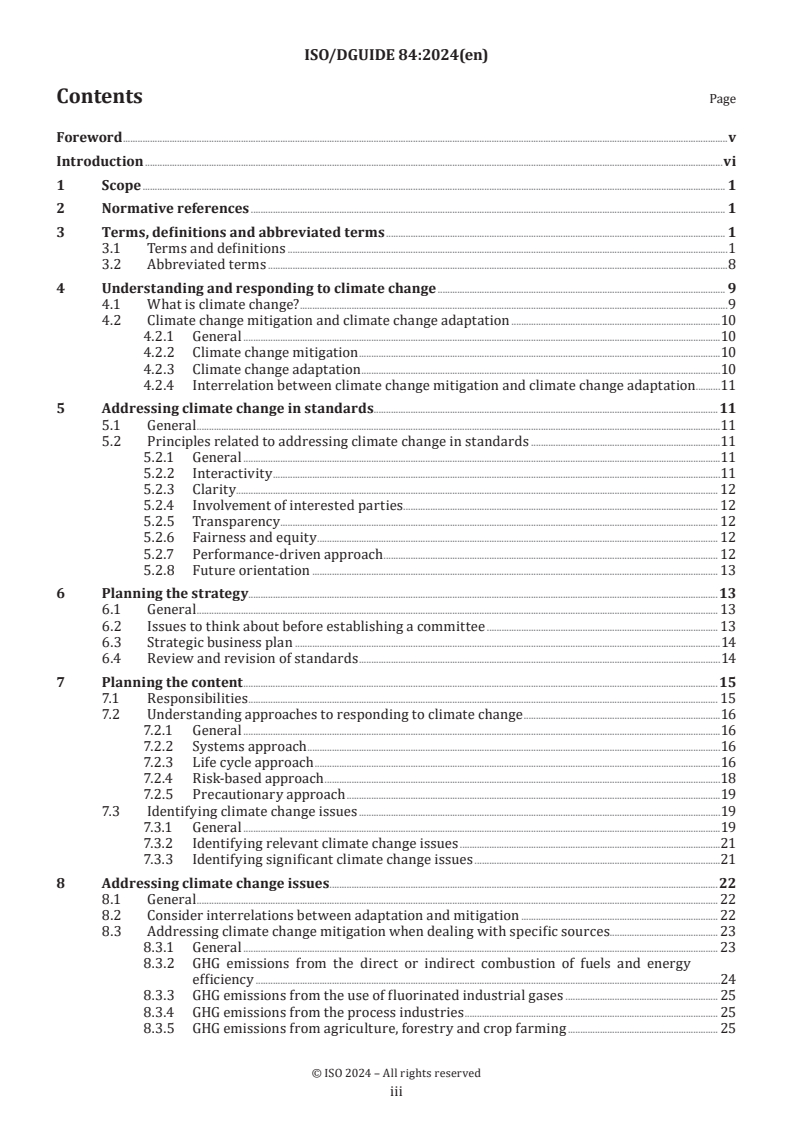
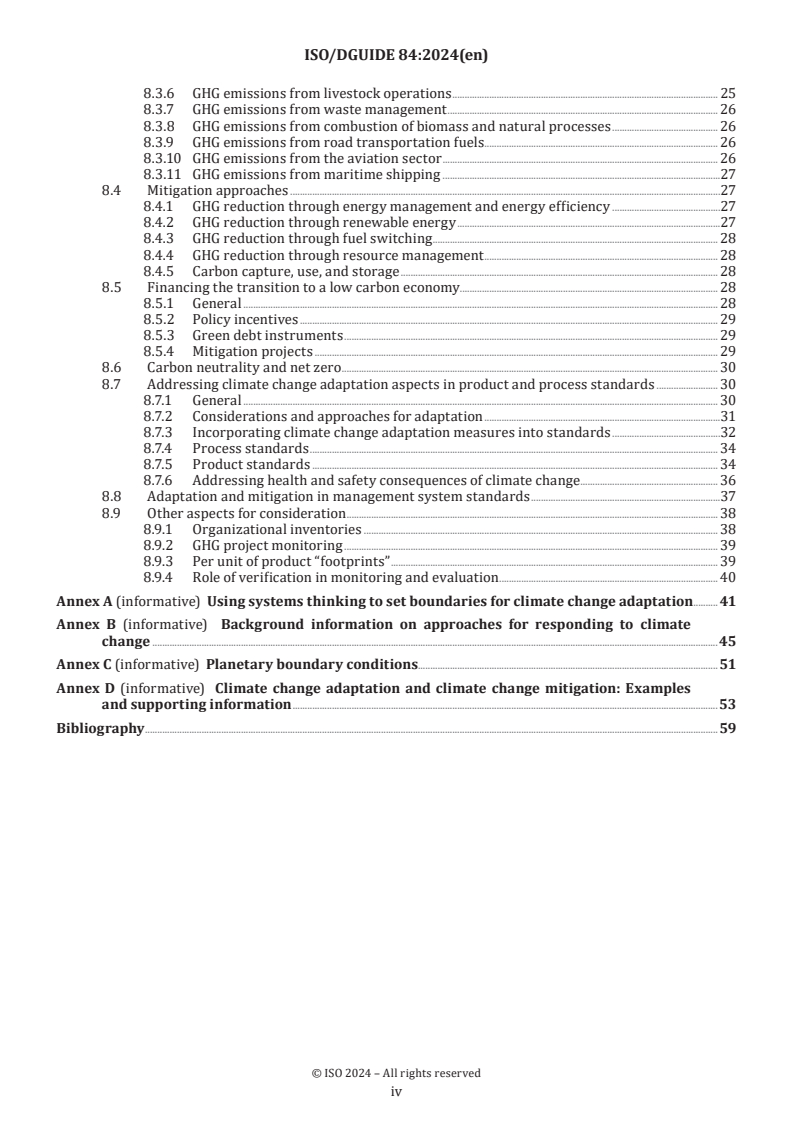
Contents Page
Foreword .v
Introduction .vi
1 Scope . 1
2 Normative references . 1
3 Terms, definitions and abbreviated terms . 1
3.1 Terms and definitions .1
3.2 Abbreviated terms .8
4 Understanding and responding to climate change . 9
4.1 What is climate change? .9
4.2 Climate change mitigation and climate change adaptation .10
4.2.1 General .10
4.2.2 Climate change mitigation .10
4.2.3 Climate change adaptation .10
4.2.4 Interrelation between climate change mitigation and climate change adaptation .11
5 Addressing climate change in standards .11
5.1 General .11
5.2 Principles related to addressing climate change in standards .11
5.2.1 General .11
5.2.2 Interactivity .11
5.2.3 Clarity . . . 12
5.2.4 Involvement of interested parties . 12
5.2.5 Transparency . . . 12
5.2.6 Fairness and equity . 12
5.2.7 Performance-driven approach . 12
5.2.8 Future orientation . 13
6 Planning the strategy.13
6.1 General . 13
6.2 Issues to think about before establishing a committee . 13
6.3 Strategic business plan .14
6.4 Review and revision of standards .14
7 Planning the content .15
7.1 Responsibilities . 15
7.2 Understanding approaches to responding to climate change .16
7.2.1 General .16
7.2.2 Systems approach .16
7.2.3 Life cycle approach .16
7.2.4 Risk-based approach .18
7.2.5 Precautionary approach .19
7.3 Identifying climate change issues .19
7.3.1 General .19
7.3.2 Identifying relevant climate change issues .21
7.3.3 Identifying significant climate change issues .21
8 Addressing climate change issues .22
8.1 General . 22
8.2 Consider interrelations between adaptation and mitigation . 22
8.3 Addressing climate change mitigation when dealing with specific sources. 23
8.3.1 General . 23
8.3.2 GHG emissions from the direct or indirect combustion of fuels and energy
efficiency .24
8.3.3 GHG emissions from the use of fluorinated industrial gases . 25
8.3.4 GHG emissions from the process industries . 25
8.3.5 GHG emissions from agriculture, forestry and crop farming . 25
iii
ISO/DGUIDE 84:2024(en)
8.3.6 GHG emissions from livestock operations . 25
8.3.7 GHG emissions from waste management . 26
8.3.8 GHG emissions from combustion of biomass and natural processes . 26
8.3.9 GHG emissions from road transportation fuels . 26
8.3.10 GHG emissions from the aviation sector . 26
8.3.11 GHG emissions from maritime shipping .27
8.4 Mitigation approaches .27
8.4.1 GHG reduction through energy management and energy efficiency .27
8.4.2 GHG reduction through renewable energy .27
8.4.3 GHG reduction through fuel switching . 28
8.4.4 GHG reduction through resource management . 28
8.4.5 Carbon capture, use, and storage . 28
8.5 Financing the transition to a low carbon economy. 28
8.5.1 General . 28
8.5.2 Policy incentives . 29
8.5.3 Green debt instruments . 29
8.5.4 Mitigation projects . 29
8.6 Carbon neutrality and net zero . 30
8.7 Addressing climate change adaptation aspects in product and process standards . 30
8.7.1 General . 30
8.7.2 Considerations and approaches for adaptation .31
8.7.3 Incorporating climate change adaptation measures into standards .32
8.7.4 Process standards . 34
8.7.5 Product standards . 34
8.7.6 Addressing health and safety consequences of climate change. 36
8.8 Adaptation and mitigation in management system standards .37
8.9 Other aspects for consideration . 38
8.9.1 Organizational inventories . 38
8.9.2 GHG project monitoring . 39
8.9.3 Per unit of product “footprints” . 39
8.9.4 Role of verification in monitoring and evaluation . 40
Annex A (informative) Using systems thinking to set boundaries for climate change adaptation . 41
Annex B (informative) Background information on approaches for responding to climate
change .45
Annex C (informative) Planetary boundary conditions. 51
Annex D (informative) Climate change adaptation and climate change mitigation: Examples
and supporting information .53
Bibliography .59
iv
ISO/DGUIDE 84:2024(en)
Foreword
ISO (the International Organization for Standardization) is a worldwide federation of national standards
bodies (ISO member bodies). The work of preparing International Standards is normally carried out through
ISO technical committees. Each member body interested in a subject for which a technical committee
has been established has the right to be represented on that committee. International organizations,
governmental and non-governmental, in liaison with ISO, also take part in the work. ISO collaborates closely
with the International Electrotechnical Commission (IEC) on all matters of electrotechnical standardization.
The procedures used to develop this document and those intended for its further maintenance are described
in the ISO/IEC Directives, Part 1. In particular, the different approval criteria needed for the different types
of ISO document should be noted. This document was drafted in accordance with the editorial rules of the
ISO/IEC Directives, Part 2 (see www.iso.org/directives).
ISO draws attention to the possibility that the implementation of this document may involve the use of (a)
patent(s). ISO takes no position concerning the evidence, validity or applicability of any claimed patent
rights in respect thereof. As of the date of publication of this document, ISO had not received notice of (a)
patent(s) which may be required to implement this document. However, implementers are cautioned that
this may not represent the latest information, which may be obtained from the patent database available at
www.iso.org/patents. ISO shall not be held responsible for identifying any or all such patent rights.
Any trade name used in this document is information given for the convenience of users and does not
constitute an endorsement.
For an explanation of the voluntary nature of standards, the meaning of ISO specific terms and expressions
related to conformity assessment, as well as information about ISO's adherence to the World Trade
Organization (WTO) principles in the Technical Barriers to Trade (TBT), see www.iso.org/iso/foreword.html.
This second edition cancels and replaces the first edition (ISO Guide 84:2020) which has been technically
revised.
The main changes are as follows:
— context of the London Declaration;
— new requirements regarding management system standards (MSS);
— health and safety consequences of climate change.
This document was prepared by the ISO Technical Management Board Task Force on Climate Change
Coordination.
Any feedback or questions on this document should be directed to the user’s national standards body. A
complete listing of these bodies can be found at www.iso.org/members.html.
v
ISO/DGUIDE 84:2024(en)
Introduction
This document is intended for developers of ISO standards and other deliverables to encourage the inclusion
of provisions in standards to address climate change impacts, risks and opportunities, and aims to:
— enable standards committees to determine if the standard under consideration should take into account
aspects, issues, impacts, risks and/or opportunities associated with climate change;
— provide standards developers with a systematic approach to address climate change impacts, risks and
opportunities in a coherent and consistent manner, with regard to both new and revised standards, and
in a manner related to the objective and scope of the standard being developed;
— promote consistency and compatibility to the extent practicable among standards that directly or
indirectly address climate change and their wider uptake in support of sustainability.
In February 2024, the IAF/ISO Joint Communiqué on the addition of Climate Change considerations to
Management Systems Standards highlighted new requirements to consider the effect of Climate Change
when revising or developing new ISO Management Systems Standards (MSS).
This document supports ISO’s commitment to accelerate achieving the goals of the Paris Agreement, the UN
SDGs and the UN Call for Action on Adaptation and Resilience, as outlined in the September 2021 ISO London
Declaration. The London Declaration commits ISO to develop processes to enable:
— the active consideration of climate science and associated transitions in the development of all new and
revised International Standards and publications; and to
— facilitate the involvement of civil society and those most vulnerable to climate change in the development
of International Standards and publications.
ISO will develop and publish an Action Plan and Measurement Framework detailing concrete actions and
initiatives and a reporting mechanism to track progress.
NOTE Standards developers are encouraged to consider the mandatory committee-specific policies in the ISO/IEC
Directives, Part 1, for the development of sector-specific environmental management standards and sector-specific
environmental management system standards.
Figure 1 provides a schematic overview of this document as a process for addressing climate change in
standards.
vi
ISO/DGUIDE 84:2024(en)
Figure 1 — Schematic overview of this document
The international community has expressed a commitment to strengthen the global response to the threat
of climate change, in the context of sustainable development, including:
a) holding the increase in the global average temperature to below 2 °C above pre-industrial levels and
pursuing efforts to limit the temperature increase to 1,5 °C above pre-industrial levels, recognizing that
this would significantly reduce the negative climate change impacts;
b) increasing the ability to adapt to the adverse impacts of climate change and foster climate resilience and
low greenhouse gas emissions development, in a manner that does not threaten food production.
Climate change affects many regions of the world and includes significant climate change impacts, risks
and opportunities arising from changing weather patterns, rising sea levels and more extreme weather
events. Rapidly expanding urban areas are recognized to be particularly vulnerable. Climate extremes
affecting urban systems, such as power supplies, can lead to cascading failures in other utilities and services
compromising the safety, health and well-being of the population. The potential consequences of such
climate-related impacts, risks and opportunities include the disruption of different environmental, social
and economic systems within national economies, affecting communities and organizations, as well as
individuals, with the poorest and most vulnerable people expected to be affected the most. Action is needed,
involving both climate change adaptation and mitigation, in order to limit the effects of climate change
impacts, risks and opportunities, while also contributing to the reduction of the world’s average surface
temperature. Against this challenging outlook, the scope, need and opportunity for action on climate change
is extensive.
Climate change is acknowledged as a foremost challenge with regards to the goal of sustainable development,
which encompasses any state of the global system in which the needs of the present are met without
compromising the ability of future generations to meet their own needs.
Standards that take into consideration climate change adaptation and/or mitigation can contribute to the
achievement of sustainability, either directly (where they specifically address sustainability issues such
vii
ISO/DGUIDE 84:2024(en)
as climate change) or indirectly (where they relate to testing, products, procedures, services, terminology,
management systems or assessment). It is recognized that both climate change mitigation (CCM) and
climate change adaptation (CCA)are important for all processes related to a technology, activity or product
(TAP). Although there are very important interactions, the two disciplines are distinct and are addressed
individually within this document.
Standards developers are encouraged to consider climate change issues in their work at all stages in the
standards development process. If climate change issues have not been considered, this can be a valid
reason to start the revision of a standard. In addition, the significance or relevance of specific issues can
have changed since the previous edition of a standard was drafted or reviewed. Whenever a new standard
is drafted, or an existing standard is revised, all standards developers (including project leaders, convenors,
committee chairs, committee managers and secretaries) are encouraged to actively promote the application
of this document, and to involve experts knowledgeable in the subject.
When standards developers address climate change in different existing or new standards, the result can be
an increased awareness of climate change issues among the user community across various market sectors.
Through the application of this document, users of such standards will be better able to address climate
change mitigation and/or adaptation in ways that many would not have expected or considered. And with
entirely new standards, users will realize that there are new opportunities for the market to respond to
these issues in ways not previously considered or contemplated.
viii
DRAFT Guide ISO/DGUIDE 84:2024(en)
Guidelines for addressing climate change in standards
1 Scope
This document provides guidance to standards developers on how to take account of climate change in the
planning, drafting, revision and updating of ISO standards and other deliverables.
It outlines a framework and general principles that standards developers can use to develop their own
approach to addressing climate change on a subject-specific basis.
It aims to enable standards developers to include climate change adaptation (CCA)and climate change
mitigation (CCM) considerations in their standardization work. Considerations related to CCA are intended
to contribute to increasing preparedness and disaster risk reduction as well as impacting the resilience of
organizations and their technologies, activities or products (TAPs). Considerations related to CCM consist
primarily of approaches that seek to avoid, reduce or limit the release of GHG emissions and/or increase GHG
removals.
2 Normative references
There are no normative references in this document.
3 Terms, definitions and abbreviated terms
3.1 Terms and definitions
For the purposes of this document, the following terms and definitions apply.
ISO and IEC maintain terminology databases for use in standardization at the following addresses:
— ISO Online browsing platform: available at https:// www .iso .org/ obp
— IEC Electropedia: available at https:// www .electropedia .org/
3.1.1
climate
statistical description of weather in terms of the mean and variability of relevant quantities over a period of
at least 30 years or a period of time required by relevant authorities
Note 1 to entry: The classical period for averaging these variables is 30 years, as defined by the World Meteorological
Organization.
Note 2 to entry: The relevant quantities are most often near-surface variables such as temperature, precipitation and wind.
[SOURCE: ISO 14090:2019, 3.4, modified — Replaced "time ranging from months to thousands or millions of
years" with "at least 30 years or a period of time required by relevant authorities".]
3.1.2
climate change
change in climate (3.1.1) relevant quantities that persists for an extended period, typically decades or longer
Note 1 to entry: Change in climate can be identified (e.g. by using statistical tests) by changes in the mean and/or the
variability of its properties.
ISO/DGUIDE 84:2024(en)
Note 2 to entry: Climate change might be due to natural processes, internal to the climate system, or external forcings
such as modulations of the solar cycles, volcanic eruptions, and persistent anthropogenic (3.1.36) changes in the
composition of the atmosphere or in land use (3.1.37).
[SOURCE: ISO 14090:2019, 3.5, modified]
3.1.3
climate change adaptation
CCA
process of adjustment to actual or expected climate (3.1.1) and its effects
Note 1 to entry: In human systems, adaptation seeks to moderate or avoid harm or exploit beneficial opportunities.
Note 2 to entry: In some natural systems, human intervention can facilitate adjustment to expected climate and its
effects.
[SOURCE: ISO 14090:2019, 3.1, modified — The preferred term “adaptation” has been added.]
3.1.4
climate change mitigation
mitigation
human intervention to reduce GHG emissions (3.1.13) or enhance GHG removals (3.1.14)
[SOURCE: ISO 14080:2018, 3.1.2.1, modified — The preferred term “mitigation” has been added, and the
words “to reduce the sources or enhance the sinks of greenhouse gases (GHGs)” have been replaced with “to
reduce GHG emissions or enhance GHG removals” in the definition.]
3.1.5
climate change impact
effect on natural or human systems as a result of being exposed to climate change (3.1.2)
Note 1 to entry: Impacts can be adverse or beneficial.
[SOURCE: ISO 14090:2019, 3.8, modified — The preferred term and definition have been contextualized
to directly refer to climate change: the term “impact” has been replaced with “climate change impact”, the
words “as a result of being exposed to climate change” have been added to the definition and the original
Note 1 to entry has been replaced.]
3.1.6
climate change risk
risk (3.1.7) of negative climate change impacts (3.1.5) that reflects the interaction among vulnerability (3.1.8),
exposure (3.1.10) and hazard (3.1.11)
Note 1 to entry: A risk assessment can include the consideration of vulnerabilities, exposure and climate change (3.1.2)
hazards, or the consideration of likelihoods (3.1.44) and consequences (3.1.43).
[SOURCE: ISO 14080:2018, 3.1.3.3, modified — The preferred term has been changed from “climate risk” to
“climate change risk”, the words “potential of negative impacts of climate change” have been replaced with
“risk of negative climate change impacts”, and the original Note 1 to entry has been replaced.]
3.1.7
risk
effect of uncertainty on objectives
Note 1 to entry: An effect is a deviation from the expected. It can be positive, negative or both, and can address, create
or result in opportunities and threats.
Note 2 to entry: Objectives can have different aspects and categories, and can be applied at different levels.
Note 3 to entry: Risk is usually expressed in terms of risk sources (3.1.41), potential events (3.1.42), their consequences
(3.1.43) and their likelihood (3.1.44).
[SOURCE: ISO 31000:2018, 3.1]
ISO/DGUIDE 84:2024(en)
3.1.8
vulnerability
propensity or predisposition to be adversely affected by climate (3.1.1) variability or change (3.1.2)
Note 1 to entry: Vulnerability encompasses a variety of concepts and elements including sensitivity (3.1.9) or
susceptibility to harm and lack of capacity to cope and adapt.
[SOURCE: ISO 14090:2019, 3.15, modified —The definition has been contextualized to directly refer to
climate variability or change: the words “by climate variability or change” have been added to the definition.]
3.1.9
sensitivity
degree to which a system or species is affected, either adversely or beneficially, by climate (3.1.1) variability
or change (3.1.2)
[SOURCE: ISO 14080:2018, 3.1.3.7, modified — The note to entry has been removed.]
3.1.10
exposure
presence of people, livelihoods, species or ecosystems, environmental functions, services, resources,
infrastructure, or economic, social, or cultural assets in places and settings that could be adversely affected
by climate (3.1.1) variability or change (3.1.2)
Note 1 to entry: Exposure can change over time, for example as a result of land use (3.1.37) change.
[SOURCE: ISO 14090:2019, 3.6, modified — The definition has been contextualized to directly refer to effect
of climate change and climate variability: the term “affected” has been replaced by “adversely affected by
climate variability or change” in the definition.]
3.1.11
hazard
potential source of injury or damage to the health of people, or damage to property or the environment
Note 1 to entry: The potential for harm can be in terms of loss of life, injury or other health impacts, as well as damage
and loss to property, infrastructure, livelihoods, service provision, ecosystems and environmental resources.
Note 2 to entry: In this document, the term usually refers to climate-related physical events (3.1.42) or trends or their
physical impacts.
Note 3 to entry: Hazard comprises slow-onset developments (e.g. rising temperatures over the long term) as well as
rapidly developing climatic extremes (e.g. a heatwave or a landslide) or increased variability.
[SOURCE: ISO 14090:2019, 3.7, modified — The word “harm” has been replaced by “injury or damage to the
health of people, or damage to property or the environment” in the definition.]
3.1.12
greenhouse gas
GHG
gaseous constituent of the atmosphere, both natural and anthropogenic (3.1.36), that absorbs and emits
radiation at specific wavelengths within the spectrum of infrared radiation emitted by the Earth’s surface,
the atmosphere, and clouds
[SOURCE: ISO 14064-1:2018, 3.1.1, modified — The Notes to entry have been removed.]
3.1.13
greenhouse gas emission
GHG emission
release of a GHG (3.1.12) into the atmosphere
[SOURCE: ISO 14064-1:2018, 3.1.5]
ISO/DGUIDE 84:2024(en)
3.1.14
greenhouse gas removal
GHG removal
withdrawal of a GHG (3.1.12) from the atmosphere
[SOURCE: ISO 14064-1:2018, 3.1.6, modified — The words “by GHG sinks” have been removed from the
definition.]
3.1.15
greenhouse gas source
GHG source
process (3.1.35) that releases a GHG (3.1.12) into the atmosphere
[SOURCE: ISO 14064-1:2018, 3.1.2]
3.1.16
greenhouse gas sink
GHG sink
process (3.1.35) that removes a GHG (3.1.12) from the atmosphere
[SOURCE: ISO 14064-1:2018, 3.1.3]
3.1.17
carbon dioxide capture and storage
carbon capture and storage
CCS
process (3.1.35) consisting of the separation of CO from industrial and energy-related sources, transportation
and injection into a geological formation, resulting in long-term isolation from the atmosphere
Note 1 to entry: CCS is often referred to as carbon capture and storage. This terminology is not encouraged because it
is inaccurate: the objective is the capture of carbon dioxide and not the capture of carbon. Tree plantation is another
form of carbon capture that does not describe precisely the physical process of removing CO from industrial emission
sources.
Note 2 to entry: The term "sequestration" is also used alternatively to "storage". The term "storage" is preferred since
“sequestration” is more generic and can also refer to biological processes (absorption of carbon by living organisms).
Note 3 to entry: Long-term means the minimum period necessary for geological storage of CO to be considered an
effective and environmentally safe climate change mitigation (3.1.4) option.
[SOURCE: ISO 27917:2017, 3.1.1, modified — The admitted term “carbon capture and storage” has been
added, and Notes 4 and 5 to entry have been removed]
3.1.18
carbon dioxide capture and utilization
CCU
process (3.1.35) of separating (capturing) CO from an industrial or manufacturing process or from air, and
converting it for use as material feedstock within another product system (3.1.30)
Note 1 to entry: CCU is sometimes referred to as CO transformation, CO conversion, CO recycling or CO upcycling.
2 2 2 2
Note 2 to entry: Currently, the CO that is captured is typically converted for use in creating fuels, chemicals, or
material feedstock or used directly for enhancing plant growth in horticulture or as a refrigerant in a liquid form.
3.1.19
greenhouse gas inventory
GHG inventory
list of GHG sources (3.1.15) and GHG sinks (3.1.16), and their quantified GHG emissions (3.1.13) and GHG
removals (3.1.14)
[SOURCE: ISO 14064-1:2018, 3.2.6]
ISO/DGUIDE 84:2024(en)
3.1.20
greenhouse gas programme
GHG programme
voluntary or mandatory international, national, or subnational system or scheme that registers, accounts
or manages GHG emissions (3.1.13), GHG removals (3.1.14), GHG emission reductions (3.1.22) or GHG removal
enhancements (3.1.23) outside the organization (3.1.40) or GHG project (3.1.21)
[SOURCE: ISO 14064-1:2018, 3.2.8]
3.1.21
greenhouse gas project
GHG project
activity or activities that alter the conditions of a GHG baseline (3.1.24) and which cause GHG emission
reductions (3.1.22) or GHG removal enhancements (3.1.23)
[SOURCE: ISO 14064-1:2018, 3.2.7, modified — Note to entry has been removed.]
3.1.22
greenhouse gas emission reduction
GHG emission reduction
quantified decrease in GHG emissions (3.1.13) between a baseline scenario (3.1.25) and the GHG project
(3.1.21)
[SOURCE: ISO 14064-2:2019, 3.1.7]
3.1.23
greenhouse gas removal enhancement
GHG removal enhancement
quantified increase in GHG removals (3.1.14) between a baseline scenario (3.1.25) and the GHG project (3.1.21)
[SOURCE: ISO 14064-2:2019, 3.1.8]
3.1.24
greenhouse gas baseline
GHG baseline
quantitative reference(s) of GHG emissions (3.1.13) and/or GHG removals (3.1.14) that would have occurred in
the absence of a GHG project (3.1.21) and provides the baseline scenario (3.1.25) for comparison with project
GHG emissions and/or GHG removals
[SOURCE: ISO 14064-2:2019, 3.2.5]
3.1.25
baseline scenario
hypothetical reference case that best represents the conditions most likely to occur in the absence of a
proposed GHG project (3.1.21)
[SOURCE: ISO 14064-2:2019, 3.2.6]
3.1.26
life cycle
consecutive and interlinked stages related to a product (3.1.29), from raw material acquisition or generation
from natural resources to end-of-life treatment.
[SOURCE: ISO 14067:2018, 3.1.4.2, modified — Notes to entry have been removed.]
3.1.27
life cycle assessment
compilation and evaluation of the inputs, outputs and the potential environmental impacts of a product
system (3.1.30) throughout its life cycle (3.1.26)
[SOURCE: ISO 14040:2006, 3.2]
ISO/DGUIDE 84:2024(en)
3.1.28
life cycle inventory analysis
LCI
phase of life cycle assessment (3.1.27) involving the compilation and quantification of inputs and outputs for
a product (3.1.29) throughout its life cycle (3.1.26)
[SOURCE: ISO 14040:2006, 3.3]
3.1.29
product
goods or service
[SOURCE: ISO 14067:2018, 3.1.3.1, modified — Notes to entry have been removed.]
3.1.30
product system
collection of unit processes (3.1.31) with elementary flows and product flows, performing one or more
defined functions and which models the life cycle (3.1.26) of a product (3.1.29)
[SOURCE: ISO 14067:2018, 3.1.3.2, modified — Note to entry has been removed.]
3.1.31
unit process
smallest element considered in the life cycle inventory analysis (3.1.28) for which input and output data are
quantified
[SOURCE: ISO 14040:2006, 3.34]
3.1.32
carbon footprint of a product
CFP
sum of GHG emissions (3.1.13) and GHG removals (3.1.14) in a product system (3.1.30), expressed as CO
equivalents (3.1.34) and based on a life cycle assessment (3.1.27) using the single impact category of climate
change (3.1.2)
[SOURCE: ISO 14067:2018, 3.1.1.1, modified — Notes to entry have been removed.]
3.1.33
partial carbon footprint of a product
partial CFP
sum of GHG emissions (3.1.13) and GHG removals (3.1.14) of one or more selected process(es) (3.1.35) in a
product system (3.1.30), expressed as CO equivalents (3.1.34) and based on the selected stages or processes
within the life cycle (3.1.26)
[SOURCE: ISO 14067:2018, 3.1.1.2, modified — Notes to entry have been removed.]
3.1.34
CO equivalent
carbon dioxide equivalent
unit for comparing the radiative forcing of a GHG (3.1.12) to that of carbon dioxide
[SOURCE: ISO 14067:2018, 3.1.2.2, modified — The third preferred term and Notes to entry have been
removed.]
3.1.35
process
set of interrelated or interacting activities that transforms inputs into outputs
[SOURCE: ISO 14067:2018, 3.1.3.5]
ISO/DGUIDE 84:2024(en)
3.1.36
anthropogenic
resulting from or caused by human activity
3.1.37
land use
human use or management of land within the relevant boundary
Note 1 to entry: Typically, the relevant boundary is the product system (3.1.30) under study.
[SOURCE: ISO 14067:2018, 3.1.7.4, modified — The abbreviated term “LU” has been removed and the original
Notes to entry have been replaced with the new Note to entry.]
3.1.38
standards developer
individual or group taking part in the development of a standard
[SOURCE: ISO Guide 82:2019, 3.5]
3.1.39
interested party
stakeholder
person or organization (3.1.40) that can affect, be affected by, or perceive itself to be affected by a decision
or activity
EXAMPLE Customers, communities, suppliers, regulators, non-governmental organizations, investors and
employees.
[SOURCE: ISO 14001:2015
...
DRAFT
Guide
ISO/DGUIDE 84.2
ISO/TMBG
Guidelines for addressing climate
Secretariat: ISO
change in standards
Voting begins on:
Lignes directrices pour la prise en compte des changements
2025-12-31
climatiques dans les normes
Voting terminates on:
ICS: 13.020.01; 01.120
2026-02-25
THIS DOCUMENT IS A DRAFT CIRCULATED
FOR COMMENTS AND APPROVAL. IT
IS THEREFORE SUBJECT TO CHANGE
AND MAY NOT BE REFERRED TO AS AN
INTERNATIONAL STANDARD UNTIL
PUBLISHED AS SUCH.
IN ADDITION TO THEIR EVALUATION AS
BEING ACCEPTABLE FOR INDUSTRIAL,
TECHNOLOGICAL, COMMERCIAL AND
USER PURPOSES, DRAFT INTERNATIONAL
STANDARDS MAY ON OCCASION HAVE TO
This document is circulated as received from the committee secretariat.
BE CONSIDERED IN THE LIGHT OF THEIR
POTENTIAL TO BECOME STANDARDS TO
WHICH REFERENCE MAY BE MADE IN
NATIONAL REGULATIONS.
RECIPIENTS OF THIS DRAFT ARE INVITED
TO SUBMIT, WITH THEIR COMMENTS,
NOTIFICATION OF ANY RELEVANT PATENT
RIGHTS OF WHICH THEY ARE AWARE AND TO
PROVIDE SUPPORTING DOCUMENTATION.
Reference number
DRAFT
Guide
ISO/DGUIDE 84.2
ISO/TMBG
Guidelines for addressing climate
Secretariat: ISO
change in standards
Voting begins on:
Lignes directrices pour la prise en compte des changements
climatiques dans les normes
Voting terminates on:
ICS: 13.020.01; 01.120
THIS DOCUMENT IS A DRAFT CIRCULATED
FOR COMMENTS AND APPROVAL. IT
IS THEREFORE SUBJECT TO CHANGE
AND MAY NOT BE REFERRED TO AS AN
INTERNATIONAL STANDARD UNTIL
PUBLISHED AS SUCH.
IN ADDITION TO THEIR EVALUATION AS
BEING ACCEPTABLE FOR INDUSTRIAL,
© ISO 2025
TECHNOLOGICAL, COMMERCIAL AND
USER PURPOSES, DRAFT INTERNATIONAL
All rights reserved. Unless otherwise specified, or required in the context of its implementation, no part of this publication may
STANDARDS MAY ON OCCASION HAVE TO
be reproduced or utilized otherwise in any form or by any means, electronic or mechanical, including photocopying, or posting on
This document is circulated as received from the committee secretariat. BE CONSIDERED IN THE LIGHT OF THEIR
the internet or an intranet, without prior written permission. Permission can be requested from either ISO at the address below
POTENTIAL TO BECOME STANDARDS TO
WHICH REFERENCE MAY BE MADE IN
or ISO’s member body in the country of the requester.
NATIONAL REGULATIONS.
ISO copyright office
RECIPIENTS OF THIS DRAFT ARE INVITED
CP 401 • Ch. de Blandonnet 8
TO SUBMIT, WITH THEIR COMMENTS,
CH-1214 Vernier, Geneva
NOTIFICATION OF ANY RELEVANT PATENT
Phone: +41 22 749 01 11
RIGHTS OF WHICH THEY ARE AWARE AND TO
PROVIDE SUPPORTING DOCUMENTATION.
Email: copyright@iso.org
Website: www.iso.org
Published in Switzerland Reference number
ii
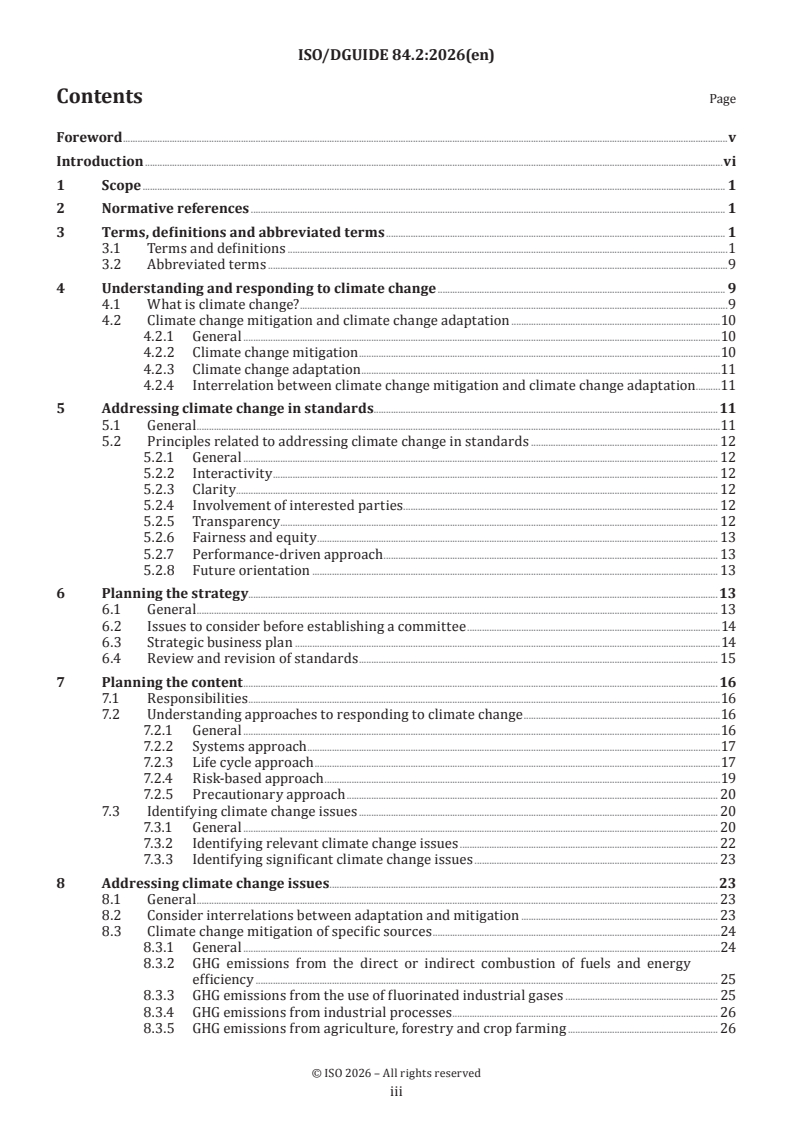
Contents Page
Foreword .v
Introduction .vi
1 Scope . 1
2 Normative references . 1
3 Terms, definitions and abbreviated terms . 1
3.1 Terms and definitions .1
3.2 Abbreviated terms .9
4 Understanding and responding to climate change . 9
4.1 What is climate change? .9
4.2 Climate change mitigation and climate change adaptation .10
4.2.1 General .10
4.2.2 Climate change mitigation .10
4.2.3 Climate change adaptation .11
4.2.4 Interrelation between climate change mitigation and climate change adaptation .11
5 Addressing climate change in standards .11
5.1 General .11
5.2 Principles related to addressing climate change in standards . 12
5.2.1 General . 12
5.2.2 Interactivity . 12
5.2.3 Clarity . . . 12
5.2.4 Involvement of interested parties . 12
5.2.5 Transparency . . . 12
5.2.6 Fairness and equity . 13
5.2.7 Performance-driven approach . 13
5.2.8 Future orientation . 13
6 Planning the strategy.13
6.1 General . 13
6.2 Issues to consider before establishing a committee .14
6.3 Strategic business plan .14
6.4 Review and revision of standards . 15
7 Planning the content . 16
7.1 Responsibilities .16
7.2 Understanding approaches to responding to climate change .16
7.2.1 General .16
7.2.2 Systems approach .17
7.2.3 Life cycle approach .17
7.2.4 Risk-based approach .19
7.2.5 Precautionary approach . 20
7.3 Identifying climate change issues . 20
7.3.1 General . 20
7.3.2 Identifying relevant climate change issues . 22
7.3.3 Identifying significant climate change issues . 23
8 Addressing climate change issues .23
8.1 General . 23
8.2 Consider interrelations between adaptation and mitigation . 23
8.3 Climate change mitigation of specific sources .24
8.3.1 General .24
8.3.2 GHG emissions from the direct or indirect combustion of fuels and energy
efficiency . 25
8.3.3 GHG emissions from the use of fluorinated industrial gases . 25
8.3.4 GHG emissions from industrial processes . 26
8.3.5 GHG emissions from agriculture, forestry and crop farming . 26
iii
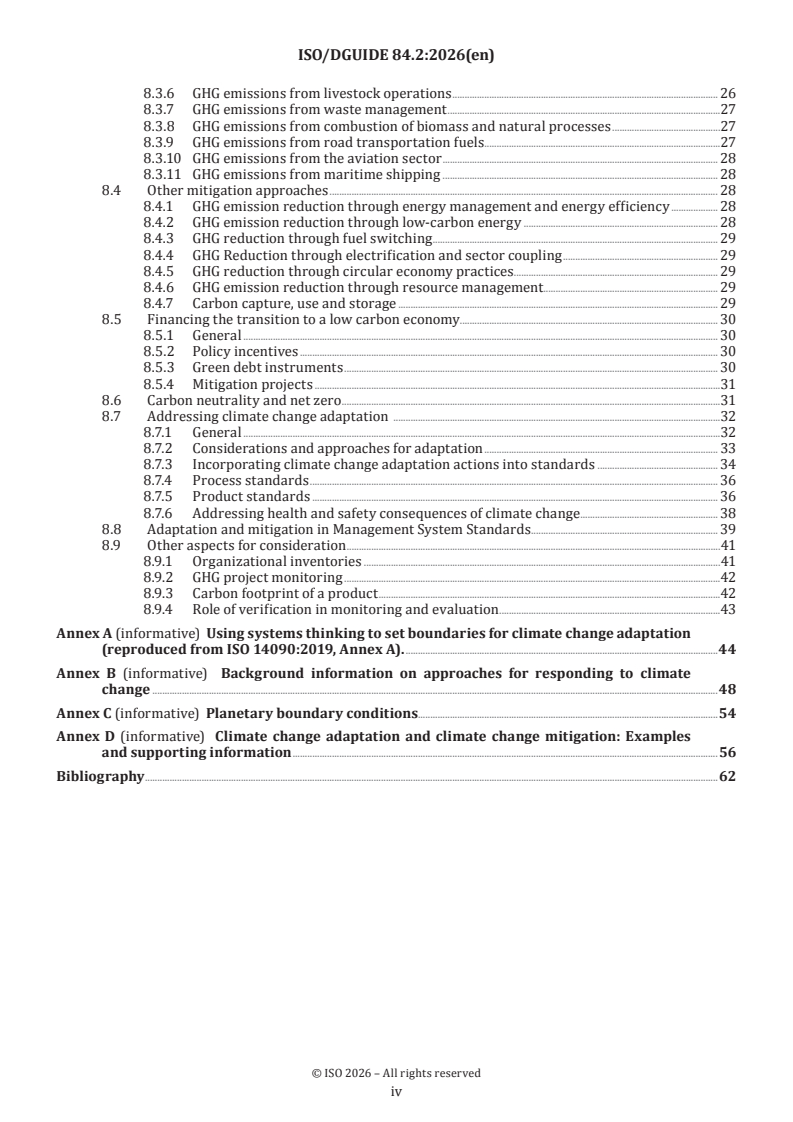
8.3.6 GHG emissions from livestock operations . 26
8.3.7 GHG emissions from waste management .27
8.3.8 GHG emissions from combustion of biomass and natural processes .27
8.3.9 GHG emissions from road transportation fuels .27
8.3.10 GHG emissions from the aviation sector . 28
8.3.11 GHG emissions from maritime shipping . 28
8.4 Other mitigation approaches . 28
8.4.1 GHG emission reduction through energy management and energy efficiency . 28
8.4.2 GHG emission reduction through low-carbon energy . 28
8.4.3 GHG reduction through fuel switching . 29
8.4.4 GHG Reduction through electrification and sector coupling . 29
8.4.5 GHG reduction through circular economy practices . 29
8.4.6 GHG emission reduction through resource management . 29
8.4.7 Carbon capture, use and storage . 29
8.5 Financing the transition to a low carbon economy. 30
8.5.1 General . 30
8.5.2 Policy incentives . 30
8.5.3 Green debt instruments . 30
8.5.4 Mitigation projects .31
8.6 Carbon neutrality and net zero .31
8.7 Addressing climate change adaptation .32
8.7.1 General .32
8.7.2 Considerations and approaches for adaptation . 33
8.7.3 Incorporating climate change adaptation actions into standards . 34
8.7.4 Process standards . 36
8.7.5 Product standards . 36
8.7.6 Addressing health and safety consequences of climate change. 38
8.8 Adaptation and mitigation in Management System Standards . 39
8.9 Other aspects for consideration .41
8.9.1 Organizational inventories .41
8.9.2 GHG project monitoring .42
8.9.3 Carbon footprint of a product .42
8.9.4 Role of verification in monitoring and evaluation .43
Annex A (informative) Using systems thinking to set boundaries for climate change adaptation
(reproduced from ISO 14090:2019, Annex A). .44
Annex B (informative) Background information on approaches for responding to climate
change .48
Annex C (informative) Planetary boundary conditions.54
Annex D (informative) Climate change adaptation and climate change mitigation: Examples
and supporting information .56
Bibliography .62
iv
Foreword
ISO (the International Organization for Standardization) is a worldwide federation of national standards
bodies (ISO member bodies). The work of preparing International Standards is normally carried out through
ISO technical committees. Each member body interested in a subject for which a technical committee
has been established has the right to be represented on that committee. International organizations,
governmental and non-governmental, in liaison with ISO, also take part in the work. ISO collaborates closely
with the International Electrotechnical Commission (IEC) on all matters of electrotechnical standardization.
The procedures used to develop this document and those intended for its further maintenance are described
in the ISO/IEC Directives, Part 1. In particular, the different approval criteria needed for the different types
of ISO document should be noted. This document was drafted in accordance with the editorial rules of the
ISO/IEC Directives, Part 2 (see www.iso.org/directives).
ISO draws attention to the possibility that the implementation of this document may involve the use of (a)
patent(s). ISO takes no position concerning the evidence, validity or applicability of any claimed patent
rights in respect thereof. As of the date of publication of this document, ISO had not received notice of (a)
patent(s) which may be required to implement this document. However, implementers are cautioned that
this may not represent the latest information, which may be obtained from the patent database available at
www.iso.org/patents. ISO shall not be held responsible for identifying any or all such patent rights.
Any trade name used in this document is information given for the convenience of users and does not
constitute an endorsement.
For an explanation of the voluntary nature of standards, the meaning of ISO specific terms and expressions
related to conformity assessment, as well as information about ISO's adherence to the World Trade
Organization (WTO) principles in the Technical Barriers to Trade (TBT), see www.iso.org/iso/foreword.html.
This document was prepared by the ISO Technical Management Board Task Force on Climate Change
Coordination.
This second edition cancels and replaces the first edition (ISO Guide 84:2020), which has been technically
revised.
The main changes are as follows:
— Paris Agreement principles have been incorporated through guidance added in the Introduction on
equity and common but differentiated responsibilities, with a new explanatory note referencing relevant
international agreements;
— terminology has been aligned with international definitions: preference has been given to established
ISO terminology, recognizing its basis in internationally accepted definitions;
— content in the Introduction and subclause 8.7 has been enhanced to address climate change adaptation
alongside mitigation, in order to provide a more balanced focus on mitigation and adaptation strategies;
— guidance on low-carbon energy has been clarified through the revision of subclause 8.4.2 (title and
content) to emphasize GHG emission reduction through low-carbon energy policies and strategies;
— the risk-based approach has been elaborated through expanded guidance in subclauses 5.1 and 7.2.4, and
the addition of consideration of transition risks in product standards in subclause 8.7;
— guidance for inclusive stakeholder participation has been provided through the addition of text in the
Introduction to promote consideration of diverse stakeholders and varying national circumstances;
— finance and implementation aspects have been addressed through the addition of references in the
Introduction and subclause 8.5 to practical implementation support, including the ISO Global Relevance
Policy and financing challenges.
Any feedback or questions on this document should be directed to the user’s national standards body. A
complete listing of these bodies can be found at www.iso.org/members.html.
v
Introduction
This document is intended for developers of ISO International Standards and other deliverables to encourage
the inclusion of provisions in International Standards to address identified climate change impacts, risks and
opportunities, taking into consideration the importance of allowing flexibility based on the local context,
needs and challenges. This document aims to:
— enable committees working in standards development to determine if the standard under consideration
should take into account all aspects, issues, impacts, risks and/or opportunities associated with climate
change;
— provide standards developers with a systematic approach for addressing climate change impacts, risks
and opportunities in a coherent and consistent manner, with regard to both new and revised standards,
and in a manner relevant to the objective and scope of the standard being developed;
— promote consistency and compatibility to the extent practicable among standards that directly or
indirectly address climate change and their wider uptake in support of sustainability.
In February 2024, the IAF/ISO Joint Communiqué on the addition of Climate Change considerations to
Management Systems Standards highlighted new requirements to consider the effect of Climate Change
when revising or developing new ISO Management Systems Standards (MSS).
This document supports ISO’s commitment to accelerate achieving the goals of the Paris Agreement, the UN
SDGs and the UN Call for Action on Adaptation and Resilience, as outlined in the September 2021 ISO London
Declaration. The London Declaration commits ISO to developing processes to:
— enable the active consideration of climate science and associated transitions in the development of all
new and revised International Standards and publications;
— facilitate the involvement of civil society and those most vulnerable to climate change in the development
of International Standards and publications.
ISO will develop and publish an Action Plan and Measurement Framework detailing concrete actions and
initiatives and a reporting mechanism to track progress.
NOTE 1 ISO Guide 82 is currently under revision. The future edition is intended to contain new guiding principles
for consistently assessing climate impacts, risks and opportunities in both new and revised standards involving
digital technologies.
NOTE 2 Standards developers are encouraged to consider the mandatory committee-specific policies in the ISO/
IEC Directives, Part 1, for the development of sector-specific environmental management standards and sector-
specific environmental Management System Standards.
NOTE 3 References to the Paris Agreement, UN SDGs and the London Declaration are available in the Bibliography.
These include several key principles such as the "Just Transition" and "Common and Differentiated Responsibilities",
both of which are referenced in the 2016 Paris Agreement.
Figure 1 provides a schematic overview of this document as a process for addressing climate change in
standards.
vi
Figure 1 — Schematic overview of this document
The international community has expressed a commitment to strengthening the global response to the threat
of climate change in the context of sustainable development, common but differentiated responsibilities,
respective capabilities and different national circumstances, including:
a) holding the increase in the global average temperature to well below 2 °C above pre-industrial levels
and pursuing efforts to limit the temperature increase to 1,5 °C above pre-industrial levels, recognizing
that this will require greenhouse gas (GHG) emissions to be significantly reduced in order to minimize
negative climate change impacts;
b) increasing the ability to mitigate and achieve low greenhouse gas emissions development in the
short term and to achieve net zero GHG emissions in the medium to long term in support of the Paris
Agreement;
c) increasing the ability to adapt to the adverse impacts of climate change and foster climate resilience and
low GHG emissions development, in a manner that does not threaten food production as well as other
global goals as SDGs on adaptation established under the Paris Agreement.
[37]
NOTE 4 The 2018 IPCC Special Report identifies the impacts of global warming of 1,5 °C above pre-industrial
levels and related global GHG emission pathways.
Climate change affects many regions of the world and engenders significant impacts, risks and opportunities
due to changing weather patterns, rising sea levels and more extreme weather events. Rapidly expanding
urban areas are recognized to be particularly vulnerable. Climate extremes affecting urban systems, such
as power supplies, can lead to cascading failures in other utilities and services compromising the safety,
health and well-being of the population. The potential consequences of such climate-related impacts, risks
and opportunities include the disruption of different environmental, social and economic systems within
vii
national economies, affecting communities and organizations, as well as individuals, with the poorest and
most vulnerable people expected to be affected the most.
NOTE 5 Climate change impacts can affect population health, safety and the health of workers in organizations.
Extreme climate events can lead to injuries, disease and ill-health.
Action is needed, involving both climate change mitigation and adaptation, to limit the effects of climate
change impacts and risks and to consider opportunities resulting from climate change, while also
contributing to limiting the increase in the world’s average surface temperature. Against this challenging
outlook, the scope, need and opportunity for action on climate change is extensive.
While the Paris Agreement aims to increase the ability of countries to deal with the impacts of climate
change, the development of standards which incorporate appropriate, climate-relevant actions, should
enhance the ability of organizations to address climate change challenges. Similarly, standards writers
should consider that diverse organizations exist within countries and that climate-relevant actions should
be guided by the key Paris Agreement principle of “equity and common but differentiated responsibilities
and respective capabilities, in the light of different national circumstances”. Climate-relevant actions
within standards can need to consider the relevant scientific and technical developments and disparities
among various countries. Standards writers should act to facilitate positive action, i.e. to favour “preparing
performance rather than prescriptive standards”, as stated in the ISO Global Relevance Policy.
Performance standards should also be preferred when providing guidance on the use of technology
appropriate, accessible tools for measuring climate actions, such as for GHG monitoring and climate
adaptation tracking, including community-based monitoring frameworks.
Climate change is acknowledged as a foremost challenge with regards to the goal of sustainable development,
which encompasses any state of the global system in which the needs of the present are met without
compromising the ability of future generations to meet their own needs.
Standards that take into consideration climate change adaptation or mitigation, or both, can contribute to
the achievement of sustainability, either directly (where they specifically address sustainability issues such
as climate change) or indirectly (where they relate to testing, products, procedures, services, terminology,
management systems or assessment). It is recognized that both climate change mitigation (CCM) and
climate change adaptation (CCA) are important for all processes related to a technology, activity or product
(TAP). Although there are very important interactions between CCM and CCA, the two are distinct and are
addressed individually within this document.
Standards developers are encouraged to consider climate change issues in their work at all stages in the
standards development process. If climate change issues have not been considered, this can be a valid
reason to start the revision of a standard. In addition, the significance or relevance of specific issues can
have changed since the previous edition of a standard was drafted or reviewed. Whenever a new standard
is drafted, or an existing standard is revised, all standards developers (including project leaders, convenors,
committee chairs, committee managers and secretaries) are encouraged to actively promote the application
of this document, and to involve experts who are knowledgeable in the subject.
When standards developers address climate change in different existing or new standards, the result can
be an increased awareness of climate change issues among the user community across various market
sectors. Through the application of this document, users of such standards will be better able to address
climate change mitigation or adaptation, or both, in ways that many would not have expected or considered.
Furthermore, with entirely new standards, users will realize that there are new opportunities for the market
to respond to these issues in ways not previously considered.
NOTE 6 The definitions listed in Clause 3 of this document are primarily taken from the most relevant ISO
documents. There are many definitions also available within sources outlined in bibliography (notably IPCC and
UNFCCC).
viii
DRAFTGuide ISO/DGUIDE 84.2:2026(en)
Guidelines for addressing climate change in standards
1 Scope
This document provides guidelines for standards developers on how to take account of climate change in the
planning, drafting, revision and updating of ISO International Standards and other deliverables.
It outlines a framework and general principles that standards developers can use to develop their own
approach to addressing climate change on a subject-specific basis.
It aims to enable standards developers to include climate change mitigation (CCM) and climate change
adaptation (CCA) considerations in their standardization work. Considerations related to CCM consist
primarily of approaches that seek to avoid, reduce or limit the release of greenhouse gas (GHG) emissions
and/or to increase GHG removals where appropriate. Considerations related to CCA are intended to
contribute to increasing preparedness and disaster risk reduction as well as impacting the resilience of
organizations and their technologies, activities or products (TAPs).
2 Normative references
There are no normative references in this document.
3 Terms, definitions and abbreviated terms
3.1 Terms and definitions
For the purposes of this document, the following terms and definitions apply.
ISO and IEC maintain terminology databases for use in standardization at the following addresses:
— ISO Online browsing platform: available at https:// www .iso .org/ obp
— IEC Electropedia: available at https:// www .electropedia .org/
3.1.1
climate
statistical description of weather in terms of the mean and variability of relevant quantities over a period of
at least 30 (thirty) years or a period of time required by relevant authorities
Note 1 to entry: The classical period for averaging these variables is 30 years, as defined by the World Meteorological
Organization.
Note 2 to entry: The relevant quantities are most often near-surface variables such as temperature, precipitation and
wind.
[SOURCE: ISO 14090:2019, 3.4, modified — In the definition, "over a period of time ranging from months to
thousands or millions of years" has been replaced with "over a period of at least 30 (thirty) years or a period
of time required by relevant authorities".]
3.1.2
climate change
change in climate- (3.1.1) relevant quantities that persists for an extended period, typically decades or longer
Note 1 to entry: Change in climate can be identified (e.g. by using statistical tests) by changes in the mean and/or the
variability of its properties.
Note 2 to entry: Climate change can be due to natural processes, internal to the climate system, or external forces,
such as modulations of the solar cycles, volcanic eruptions, and persistent anthropogenic (3.1.36) changes in the
composition of the atmosphere or in land use (3.1.37).
[SOURCE: ISO 14090:2019, 3.5, modified — In the definition, "change in climate" has been replaced with
"change in climate-relevant quantities". Note 1 to entry has been rephrased.]
3.1.3
climate change adaptation
CCA
process of adjustment to actual or expected climate (3.1.1) and its effects
Note 1 to entry: In human systems, adaptation seeks to moderate or avoid harm or exploit beneficial opportunities.
Note 2 to entry: In some natural systems, human intervention can facilitate adjustment to expected climate and its
effects.
[SOURCE: ISO 14090:2019, 3.1, modified — The preferred term “adaptation to climate change” has been
replaced with "climate change adaptation".]
3.1.4
climate change mitigation
CCM
human intervention to reduce greenhouse gas emissions (3.1.13) or enhance greenhouse gas removals (3.1.14)
[SOURCE: ISO 14080:2018, 3.1.2.1, modified — In the definition, “to reduce the sources or enhance the
sinks of greenhouse gases (GHGs)” has been replaced with “to reduce greenhouse gas emissions or enhance
greenhouse gas removals”.]
3.1.5
climate change impact
effect on natural or human systems as a result of being exposed to climate change (3.1.2)
Note 1 to entry: Climate change impacts can be adverse or beneficial.
[SOURCE: ISO 14090:2019, 3.8, modified — The preferred term and definition have been contextualized
to directly refer to climate change: the preferred term “impact” has been replaced with “climate change
impact”, the words “as a result of being exposed to climate change” have been added to the definition, and
the original Note 1 to entry has been replaced.]
3.1.6
climate change risk
risk (3.1.7) of negative climate change impacts (3.1.5) that reflects the interaction among vulnerability (3.1.8),
exposure (3.1.10) and hazard (3.1.11)
Note 1 to entry: A risk assessment can include the consideration of vulnerabilities, exposure and climate change (3.1.2)
hazards, or the consideration of likelihoods (3.1.44) and consequences (3.1.43).
[SOURCE: ISO 14080:2018, 3.1.3.3, modified — The preferred term has been changed from “climate risk” to
“climate change risk”, the words “potential of negative impacts of climate change” have been replaced with
“risk of negative climate change impacts”, and the original Note 1 to entry has been replaced.]
3.1.7
risk
effect of uncertainty on objectives
Note 1 to entry: An effect is a deviation from the expected. It can be positive, negative or both, and can address, create
or result in opportunities and threats.
Note 2 to entry: Objectives can have different aspects and categories, and can be applied at different levels.
Note 3 to entry: Risk is usually expressed in terms of risk sources (3.1.41), potential events (3.1.42), their consequences
(3.1.43) and their likelihood (3.1.44).
[SOURCE: ISO 31000:2018, 3.1]
3.1.8
vulnerability
propensity or predisposition to be adversely affected by climate (3.1.1) variability or change (3.1.2)
Note 1 to entry: Vulnerability encompasses a variety of concepts and elements including sensitivity (3.1.9) or
susceptibility to harm and lack of capacity to cope and adapt.
[SOURCE: ISO 14090:2019, 3.15, modified — The definition has been contextualized to directly refer to
climate variability or change: the words “by climate variability or change” have been added to the definition.]
3.1.9
sensitivity
degree to which a system or species is affected, either adversely or beneficially, by climate (3.1.1) variability
or change (3.1.2)
[SOURCE: ISO 14080:2018, 3.1.3.7, modified — Note 1 to entry has been removed.]
3.1.10
exposure
presence of people, livelihoods, species or ecosystems, environmental functions, services, resources,
infrastructure, or economic, social or cultural assets in places and settings that could be adversely affected
by climate (3.1.1) variability or change (3.1.2)
Note 1 to entry: Exposure can change over time, for example as a result of land use (3.1.37) change.
[SOURCE: ISO 14090:2019, 3.6, modified — The definition has been contextualized to directly refer to effect
of climate change and climate variability: the word “affected” has been replaced with “adversely affected by
climate variability or change” in the definition.]
3.1.11
hazard
potential source of injury or damage to the health of people, or damage to property or the environment
Note 1 to entry: The potential for harm can be in terms of loss of life, injury or other health impacts, as well as damage
and loss to property, infrastructure, livelihoods, service provision, ecosystems and environmental resources.
Note 2 to entry: In this document, the term usually refers to climate-related physical events (3.1.42) or trends or their
physical impacts.
Note 3 to entry: Hazard comprises slow-onset developments (e.g. rising temperatures over the long term) as well as
rapidly developing climatic extremes (e.g. a heatwave or a landslide) or increased variability.
[SOURCE: ISO 14090:2019, 3.7, modified — In the definition, the word “harm” has been replaced with “injury
or damage to the health of people, or damage to property or the environment”.]
3.1.12
greenhouse gas
GHG
gaseous constituent of the atmosphere, both natural and anthropogenic (3.1.36), that absorbs and emits
radiation at specific wavelengths within the spectrum of infrared radiation emitted by the Earth’s surface,
the atmosphere, and clouds
[SOURCE: ISO 14050:2020, 3.9.1]
3.1.13
greenhouse gas emission
GHG emission
release of a greenhouse gas (3.1.12) into the atmosphere
[SOURCE: ISO 14064-1:2018, 3.1.5]
3.1.14
greenhouse gas removal
GHG removal
withdrawal of a greenhouse gas (3.1.12) from the atmosphere
[SOURCE: ISO 14064-1:2018, 3.1.6, modified — The words “by GHG sinks” have been removed from the
definition.]
3.1.15
greenhouse gas source
GHG source
process (3.1.35) that releases a greenhouse gas (3.1.12) into the atmosphere
[SOURCE: ISO 14064-1:2018, 3.1.2]
3.1.16
greenhouse gas sink
GHG sink
process (3.1.35) that removes a greenhouse gas (3.1.12) from the atmosphere
[SOURCE: ISO 14064-1:2018, 3.1.3]
3.1.17
carbon dioxide capture and storage
carbon capture and storage
CCS
process (3.1.35) consisting of the separation of CO from industrial and energy-related sources, transportation
and injection into a geological formation, resulting in long-term isolation from the atmosphere
Note 1 to entry: CCS is often referred to as "carbon capture and storage". This terminology is not encouraged because
it is inaccurate: the objective is the capture of carbon dioxide and not the capture of carbon. Tree plantation is another
form of carbon capture that does not describe precisely the physical process of removing CO from surrounding air
which could include some CO from industrial emission sources.
Note 2 to entry: The term "sequestration" is also used alternatively to "storage". The term "storage" is preferred since
“sequestration” is more generic and can also refer to biological processes (absorption of carbon by living organisms).
Note 3 to entry: Long-term means the minimum period necessary for geological storage of CO to be considered an
effective and environmentally safe climate change mitigation (3.1.4) option.
[SOURCE: ISO 27917:2017, 3.1.1, modified — The admitted term “carbon capture and storage” has been
added, in Note 1 to entry "removing CO2 from industrial emission sources" has been replaced with "removing
CO from surrounding air which could include some CO from industrial emission sources", and Notes 4 and
2 2
5 to entry have been removed.]
3.1.18
carbon dioxide capture and utilization
CCU
process (3.1.35) of separating (capturing) CO from an industrial or manufacturing process or from air, and
converting it for use as material feedstock within another product system (3.1.30)
Note 1 to entry: CCU is sometimes referred to as CO transformation, CO conversion, CO recycling or CO upcycling.
2 2 2 2
Note 2 to entry: Currently, the CO that is captured is typically converted for use in creating fuels, chemicals or
material feedstock or used directly for enhancing
...
Questions, Comments and Discussion
Ask us and Technical Secretary will try to provide an answer. You can facilitate discussion about the standard in here.
Loading comments...