

ISO 3425:1975
(Main)Sulphur for industrial use — Determination of ash at 850-900 degrees C and of residue at 200 degrees C
General Information
- Abstract
Application to products containing at least 98 % of elemental sulphur, expressed as a percentage by mass, of the product dried at 80 °C for 2 h. The difference between the ash and the residue corresponds to the "non-volatile bituminous matter" content at 200 °C. The principle of ashing consists in slow combustion in air of a test portion of the dried product. Heating in a furnace, controlled at 850 °C to 900 °C, and weighing. The determination of non-volatile matter is carried out by slow evaporation in a furnace, controlled at (200 10) °C, in a flow of nitrogen, of the volatile matter and the sulphur. Weighing of the residue after about 10 h.
- Status
- Published
- Publication Date
- 30-Sep-1975
- Technical Committee
- ISO/TC 47 - Chemistry
- Drafting Committee
- ISO/TC 47 - Chemistry
- Current Stage
- 9093 - International Standard confirmed
- Start Date
- 14-Feb-2025
- Completion Date
- 29-Aug-2026
Buy Documents

ISO 3425:1975 - Sulphur for industrial use -- Determination of ash at 850-900 degrees C and of residue at 200 degrees C
ISO 3425:1975 - Sulphur for industrial use — Determination of ash at 850-900 degrees C and of residue at 200 degrees C/1/1975

ISO 3425:1975 - Soufre a usage industriel -- Détermination des cendres a 850-900 degrés C et du résidu a 200 degrés C
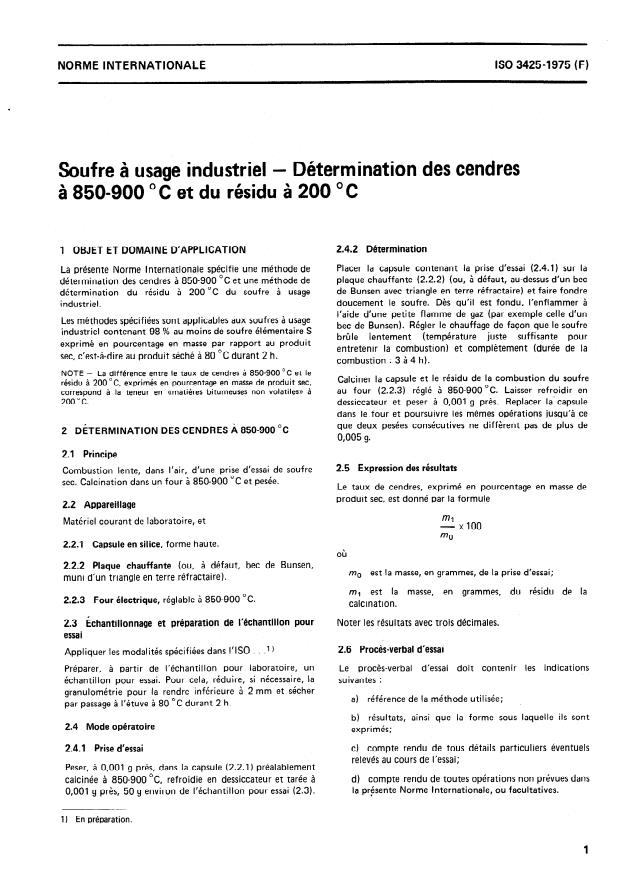

ISO 3425:1975 - Soufre a usage industriel -- Détermination des cendres a 850-900 degrés C et du résidu a 200 degrés C
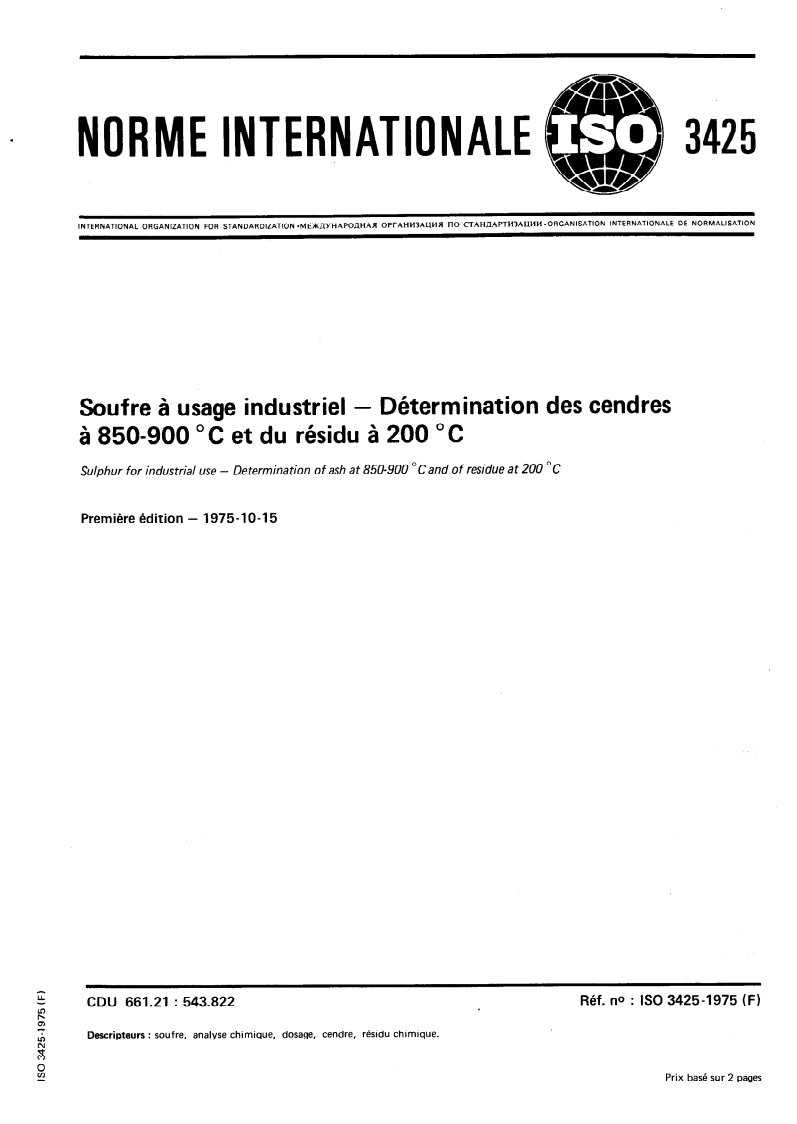
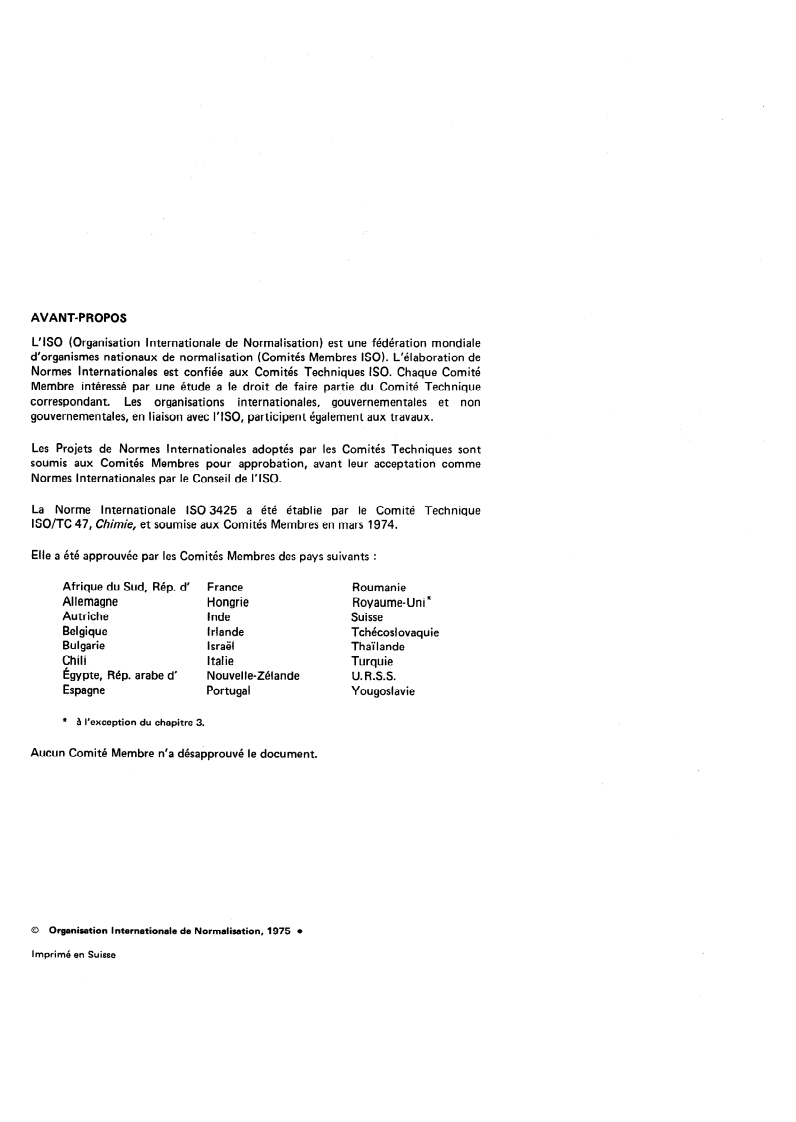
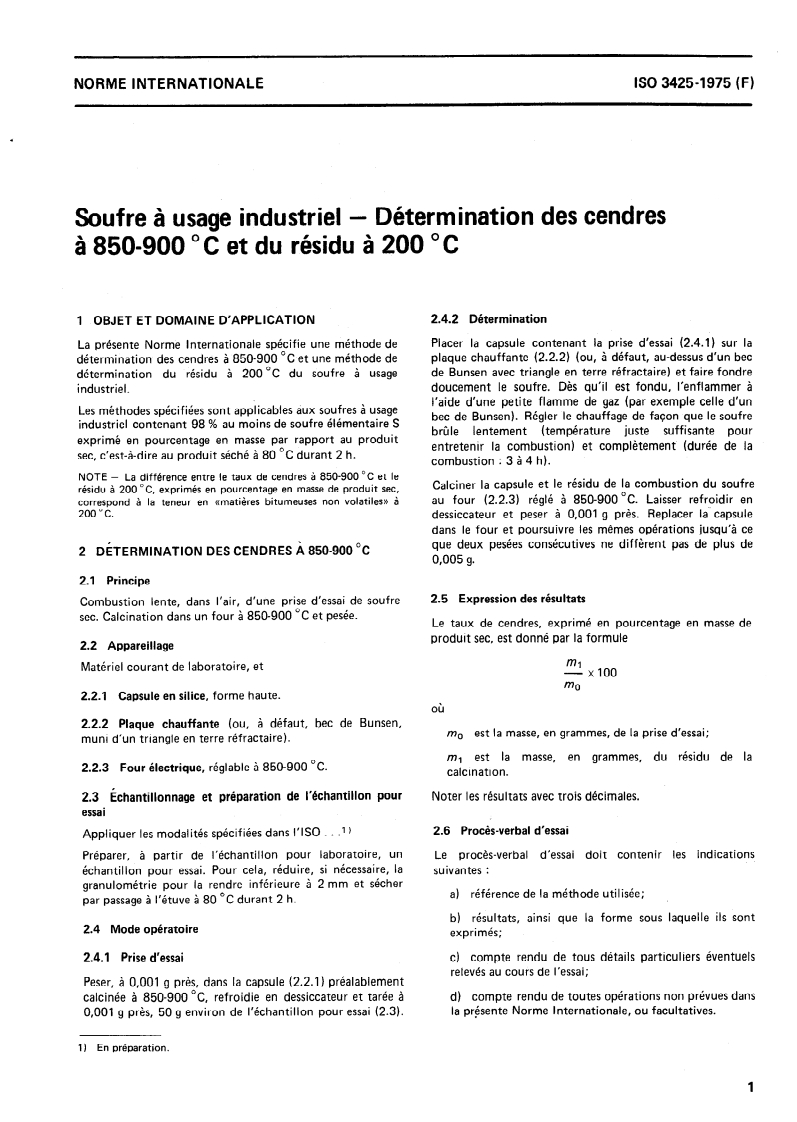
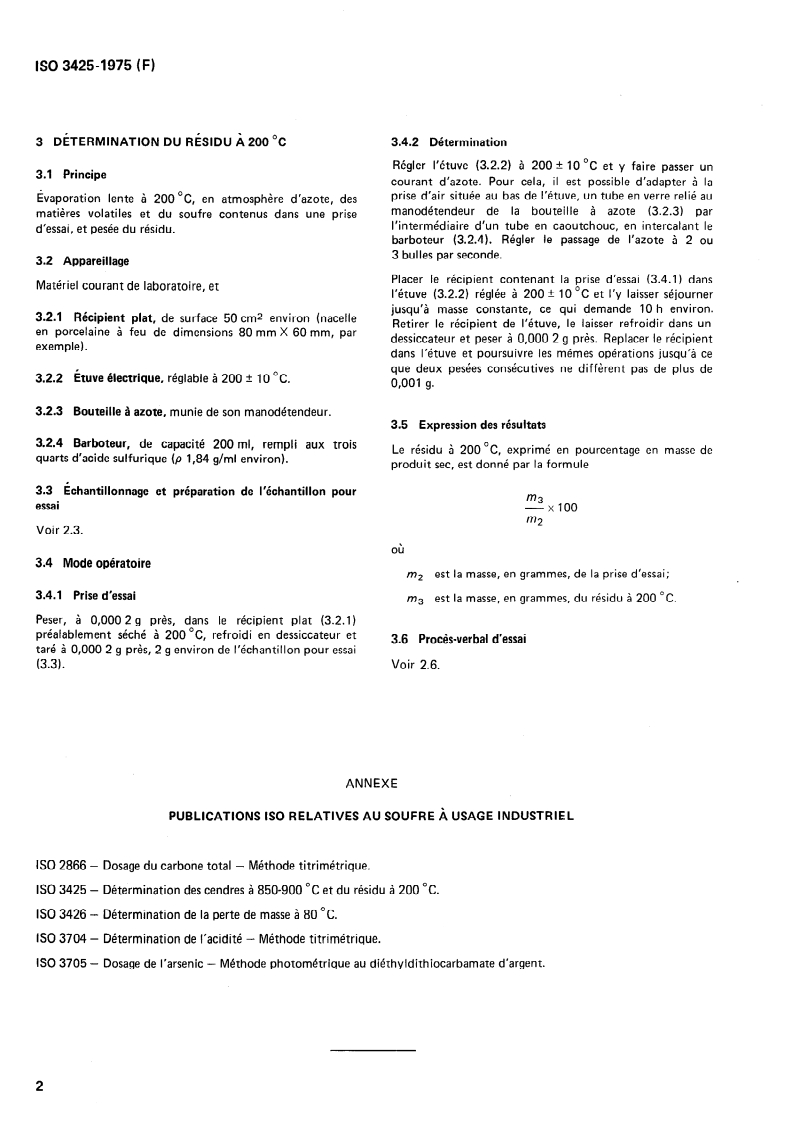
ISO 3425:1975 - Soufre à usage industriel — Détermination des cendres à 850-900 degrés C et du résidu à 200 degrés C/1/1975
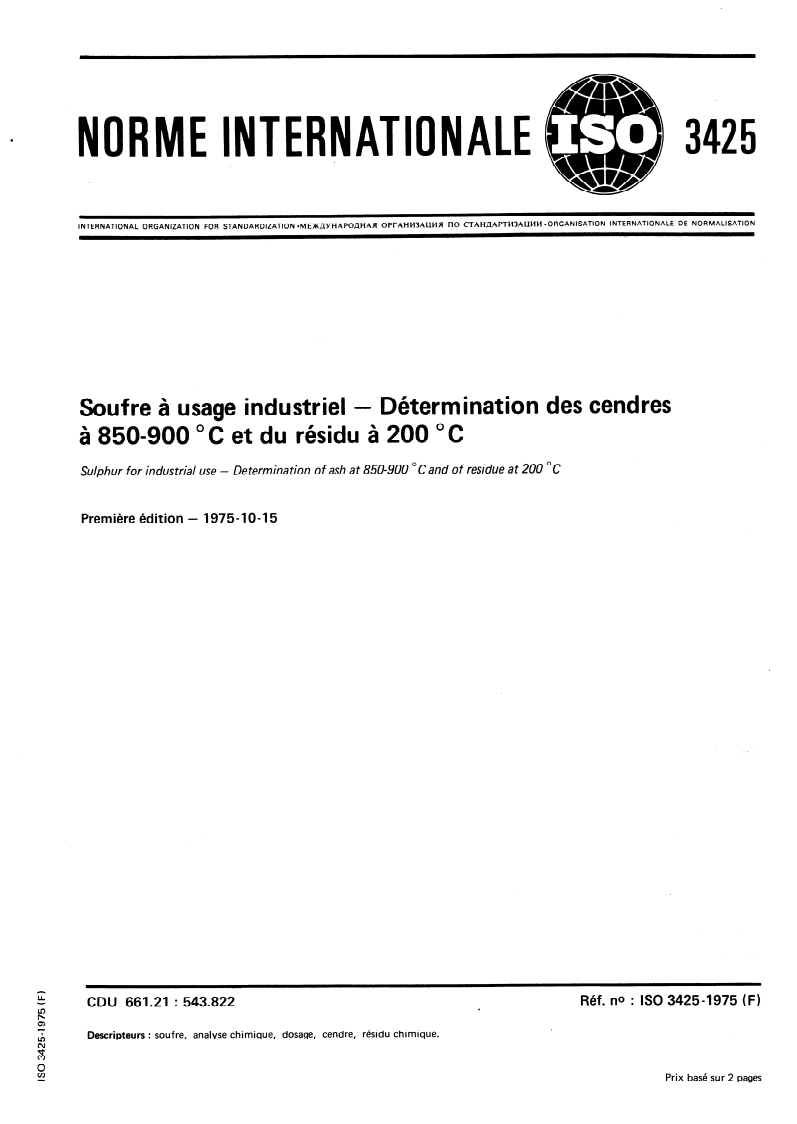
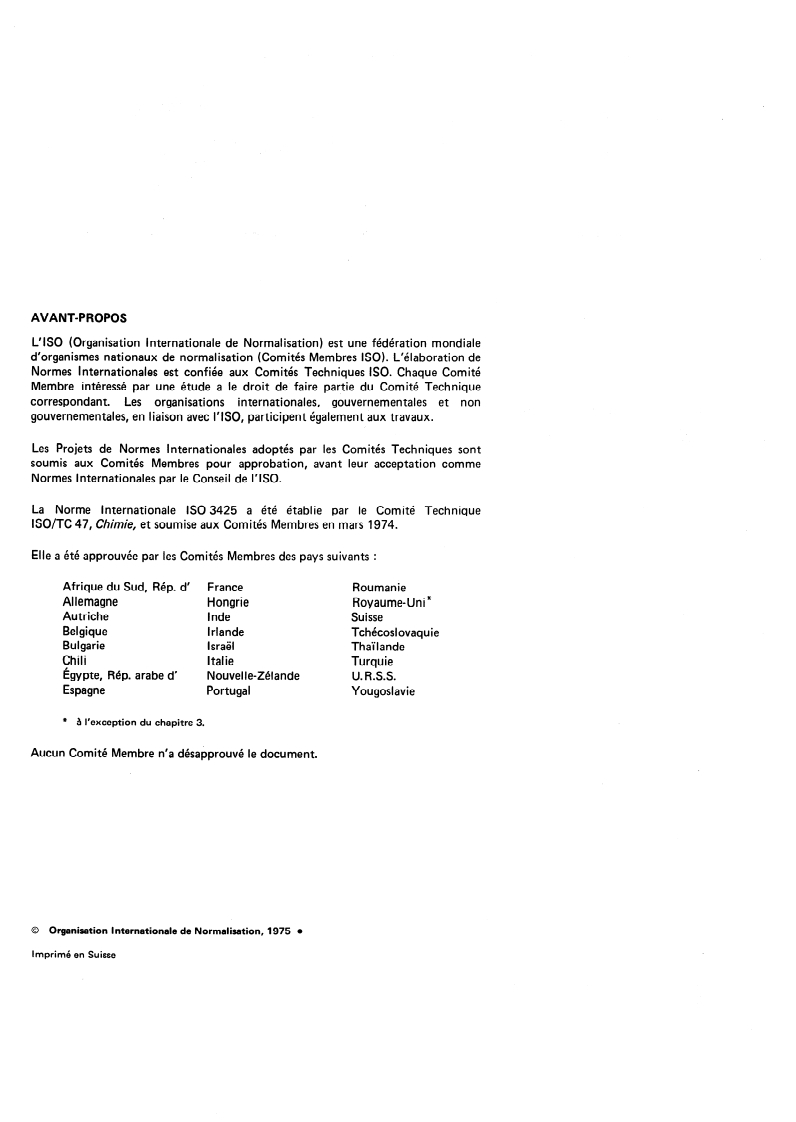
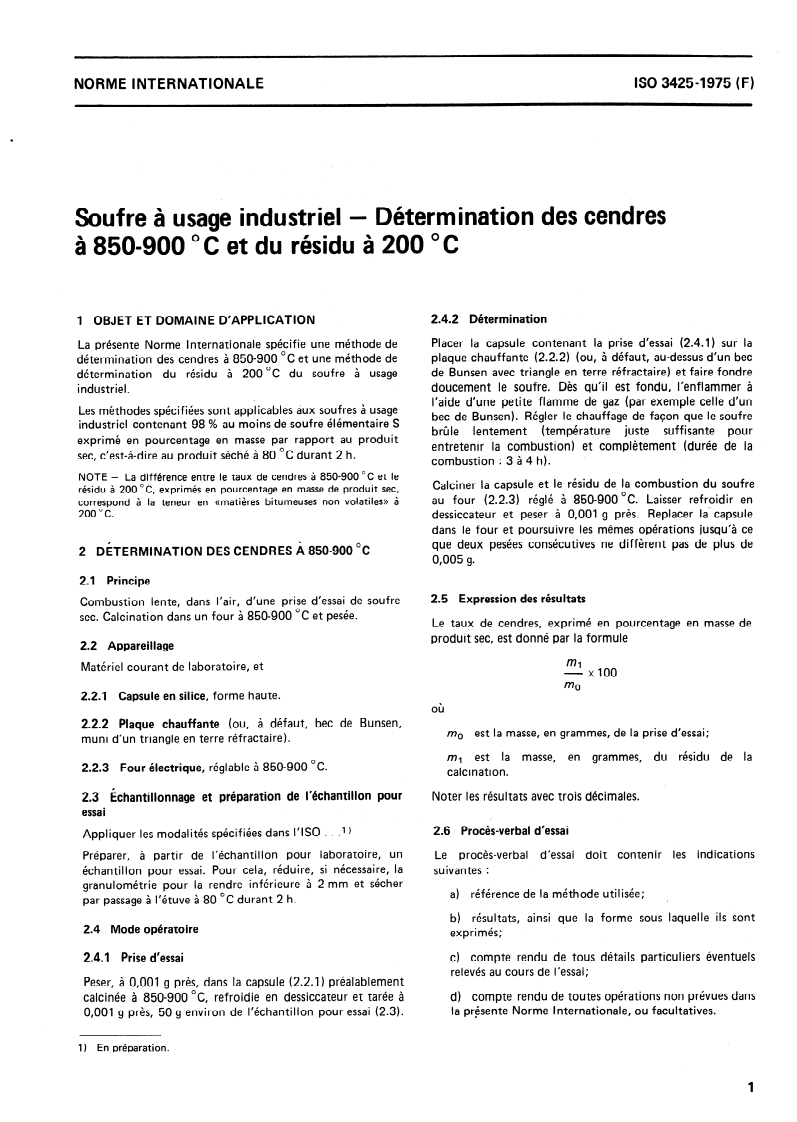
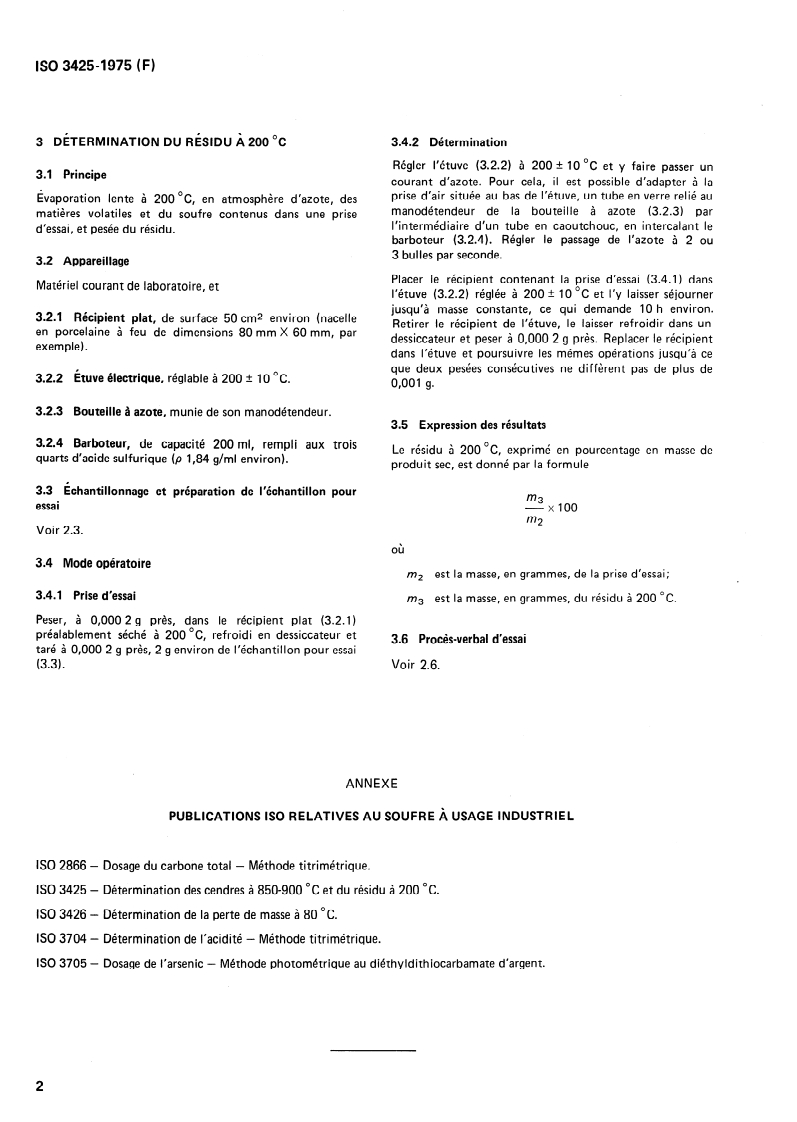
ISO 3425:1975 - Soufre à usage industriel — Détermination des cendres à 850-900 degrés C et du résidu à 200 degrés C/1/1975
Overview
ISO 3425:1975 defines standardized laboratory procedures for the determination of ash at 850–900 °C and residue at 200 °C for sulphur intended for industrial use. The methods apply to products containing at least 98% elemental sulphur, expressed as a percentage by mass of the product dried at 80 °C for 2 h. The difference between the ash and the residue corresponds to the non-volatile bituminous matter content at 200 °C.
Key procedural elements include slow combustion in air, controlled high-temperature ashing, and slow evaporation under nitrogen to remove volatile sulphur and volatile matter prior to weighing.
Key Topics
- Scope and applicability: Intended for industrial sulphur with ≥98% elemental sulphur (dry basis).
- Principle for ash (850–900 °C):
- Slow combustion of a dried test portion in air.
- Final heating in an electric furnace controlled at 850–900 °C and weighing to constant mass.
- Principle for residue (200 °C):
- Slow evaporation at 200 ± 10 °C in a nitrogen atmosphere to remove volatile matter and sulphur.
- Residue weighed after about 10 h until constant mass.
- Sampling & test portions:
- Dry sample at 80 °C for 2 h before testing.
- Typical test portion: about 50 g for ash determination; about 2 g for residue determination.
- Apparatus and control:
- Silica tall-form dishes, electric furnaces and ovens with controlled temperature ranges.
- Nitrogen flow for residue testing (e.g., adjusted to about 2–3 bubbles/sec through a gas-washing bottle).
- Weighing precision & repeatability:
- Ash determinations use weighing to 0.001 g and repeat until two successive weighings differ by ≤ 0.005 g.
- Residue determinations use weighing to 0.0002 g and repeat until two successive weighings differ by ≤ 0.001 g.
- Expression of results:
- Results expressed as percentage by mass of the dry product, to three decimal places for ash where specified.
Applications
- Quality control: Verifies sulphur purity and quantifies incombustible ash and non-volatile bituminous matter.
- Product specification and acceptance: Provides reproducible test methods for suppliers and purchasers of industrial sulphur.
- Process monitoring: Detects changes in impurity levels during refining or handling that affect downstream processes.
- Regulatory and compliance reporting: Supplies standardized data for conformity with contractual or regulatory requirements.
Related Standards
- ISO 2866 – Determination of total carbon content (titrimetric method).
- ISO 3426 – Determination of loss in mass at 80 °C.
- ISO 3704 – Determination of acidity (titrimetric / photometric methods).
- ISO 3705 – Determination of arsenic content.
For laboratory implementation, follow the detailed apparatus, sampling, procedural steps and result expression specified in ISO 3425:1975 to ensure reproducibility and traceability of ash and residue determinations for industrial sulphur.
Buy Documents
ISO 3425:1975 - Sulphur for industrial use -- Determination of ash at 850-900 degrees C and of residue at 200 degrees C
ISO 3425:1975 - Sulphur for industrial use — Determination of ash at 850-900 degrees C and of residue at 200 degrees C/1/1975
ISO 3425:1975 - Soufre a usage industriel -- Détermination des cendres a 850-900 degrés C et du résidu a 200 degrés C
ISO 3425:1975 - Soufre a usage industriel -- Détermination des cendres a 850-900 degrés C et du résidu a 200 degrés C
ISO 3425:1975 - Soufre à usage industriel — Détermination des cendres à 850-900 degrés C et du résidu à 200 degrés C/1/1975
ISO 3425:1975 - Soufre à usage industriel — Détermination des cendres à 850-900 degrés C et du résidu à 200 degrés C/1/1975
Get Certified
Connect with accredited certification bodies for this standard

ECOCERT
Organic and sustainability certification.

Eurofins Food Testing Global
Global leader in food, environment, and pharmaceutical product testing.

Intertek Bangladesh
Intertek certification and testing services in Bangladesh.
Sponsored listings
Frequently Asked Questions
ISO 3425:1975 is a standard published by the International Organization for Standardization (ISO). Its full title is "Sulphur for industrial use — Determination of ash at 850-900 degrees C and of residue at 200 degrees C". This standard covers: Application to products containing at least 98 % of elemental sulphur, expressed as a percentage by mass, of the product dried at 80 °C for 2 h. The difference between the ash and the residue corresponds to the "non-volatile bituminous matter" content at 200 °C. The principle of ashing consists in slow combustion in air of a test portion of the dried product. Heating in a furnace, controlled at 850 °C to 900 °C, and weighing. The determination of non-volatile matter is carried out by slow evaporation in a furnace, controlled at (200 10) °C, in a flow of nitrogen, of the volatile matter and the sulphur. Weighing of the residue after about 10 h.
Application to products containing at least 98 % of elemental sulphur, expressed as a percentage by mass, of the product dried at 80 °C for 2 h. The difference between the ash and the residue corresponds to the "non-volatile bituminous matter" content at 200 °C. The principle of ashing consists in slow combustion in air of a test portion of the dried product. Heating in a furnace, controlled at 850 °C to 900 °C, and weighing. The determination of non-volatile matter is carried out by slow evaporation in a furnace, controlled at (200 10) °C, in a flow of nitrogen, of the volatile matter and the sulphur. Weighing of the residue after about 10 h.
ISO 3425:1975 is classified under the following ICS (International Classification for Standards) categories: 71.060.10 - Chemical elements. The ICS classification helps identify the subject area and facilitates finding related standards.
ISO 3425:1975 is available in PDF format for immediate download after purchase. The document can be added to your cart and obtained through the secure checkout process. Digital delivery ensures instant access to the complete standard document.
Standards Content (Sample)
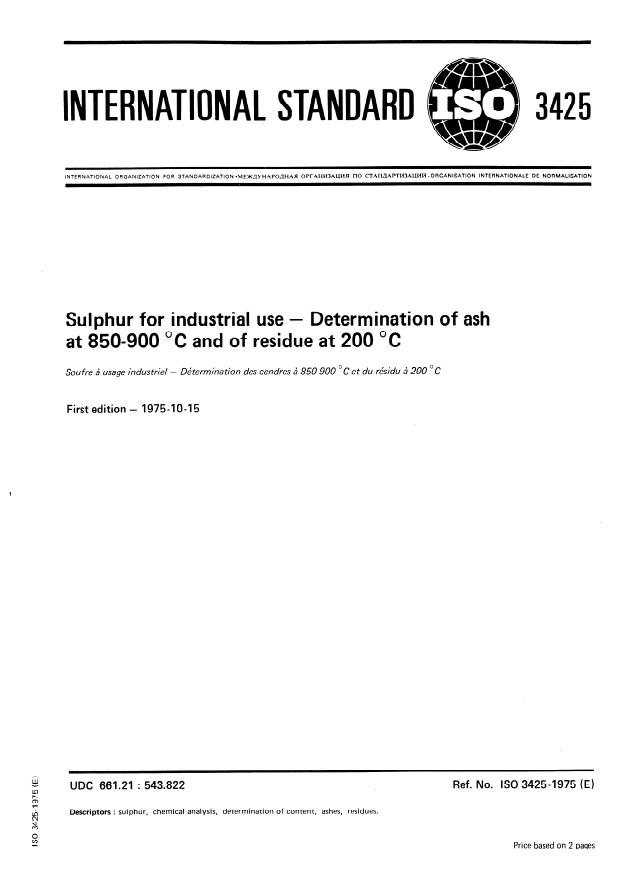
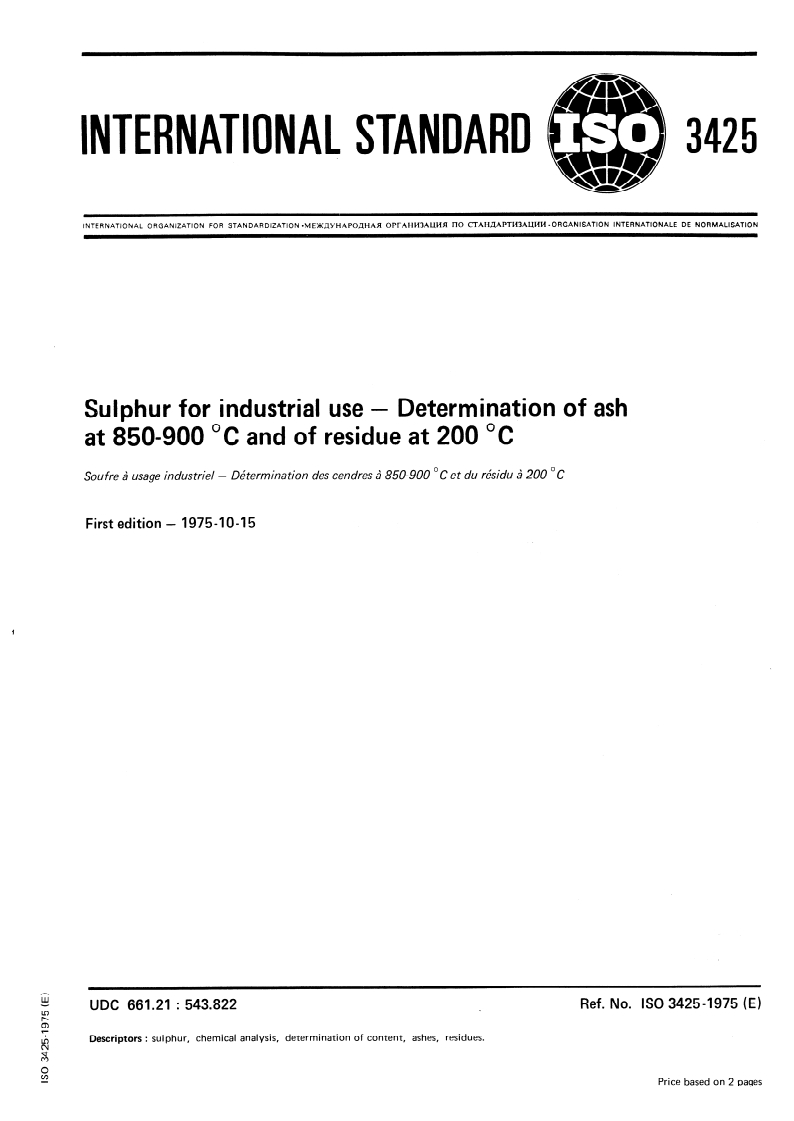
INTERNATIONAL. STANDARD
INTERNATIONAL ORGANIZATION FOR STANDARDIZATION l ME’HCfiYHAPO~HA~ OPI-AHM3ALJM(I l-IO CI-AHAAPTM3AUCIM-ORGANISATION INTERNATIONALE DE NORMALISATION
Sulphur for industrial use - Determination of ash
at 850-900 “C and of residue at 200 “C
Sou fre 5 wage indus triel- Dktermina tion des cendres 5 850-900 o C et du rksidu G 200 ’ C
First edition - 1975-10-15
Ref. No. ISO 3425-1975 (E)
UDC 661.21 : 543.822
.
determination of content, ashes, residues.
Descriptors : sulphur, Chemical analysis,
Price based on 2 pages
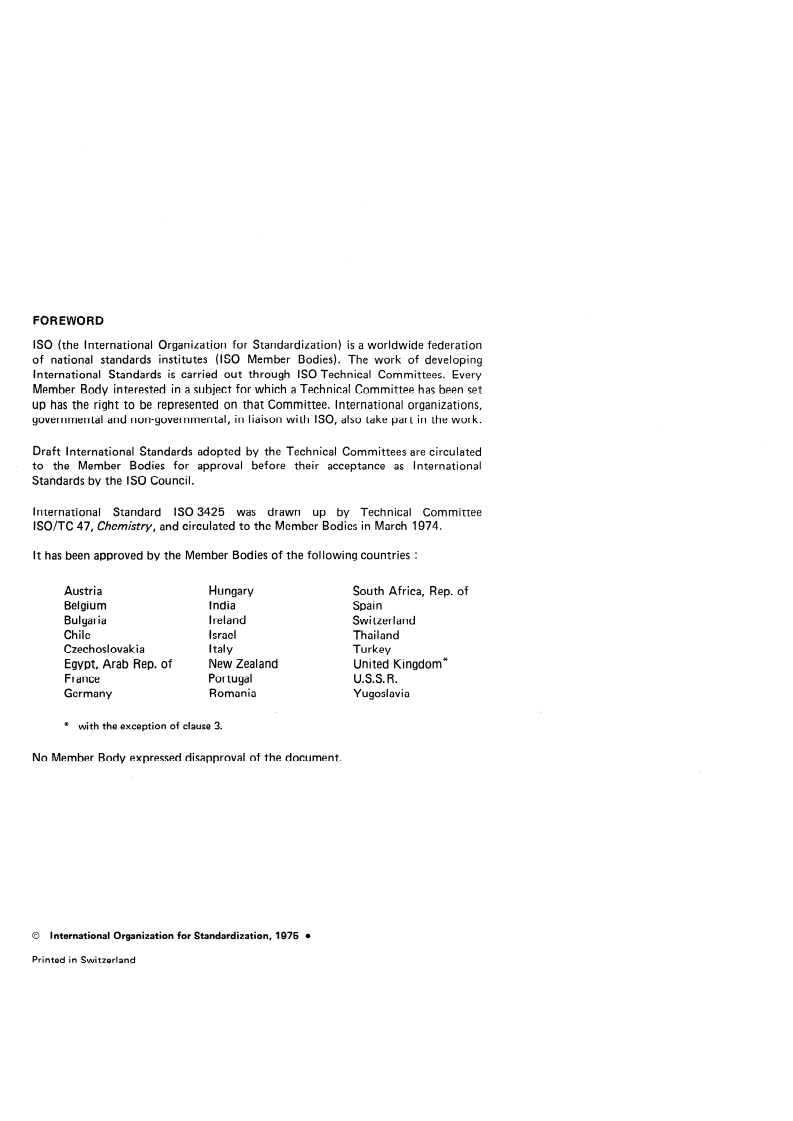
FOREWORD
ISO (the International Organization for Standardization) is a worldwide federation
of national Standards institutes (ISO Member Bodies). The work of developing
international Standards is carried out through ISO Technical Committees. Every
Member Body interested in a subject for which a Technical Committee has been set
up has the right to be represented on that Committee. International organizations,
governmental and non-governmental, in liaison with ISO, also take part in the work.
Draft International Standards adopted by the Technical Committees are circulated
to the Member Bodies for approval before their acceptance as International
Standards by the ISO Council.
International Standard ISO 3425 was drawn up by Technical Committee
lSO/TC 47, Cbemistry, and circulated to the Member Bodies in March 1974.
lt has been approved by the Member Bodies of the following countries :
Hungary
Austria South Africa, Rep. of
Belgium India
Spain
Bulgaria Ireland Switzerland
Chile Israel Thailand
Czechoslovakia Italy Turkey
Egypt, Arab Rep. of New Zealand United Kingdom”
France Portugal U.S.S. R.
Germany Romania Yugoslavia
* with the exception of clause 3.
No Member Body expressed disapproval of the document.
0 International Organkation for Standardkation, 1975 l
Printed in Switzerland
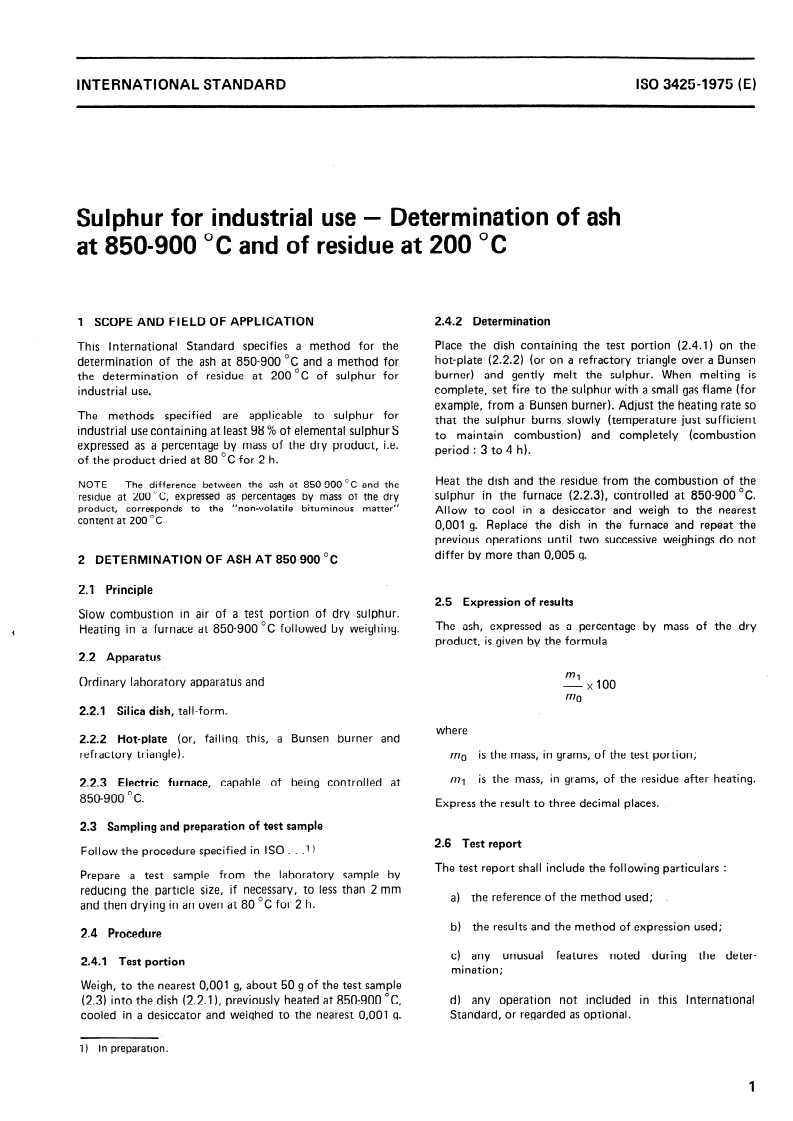
INTERNATIONAL STANDARD ISO 3425-1975 (E)
Sulphur for industrial use - Determination of ash
at 850-900 “C and of residue at 200 “C
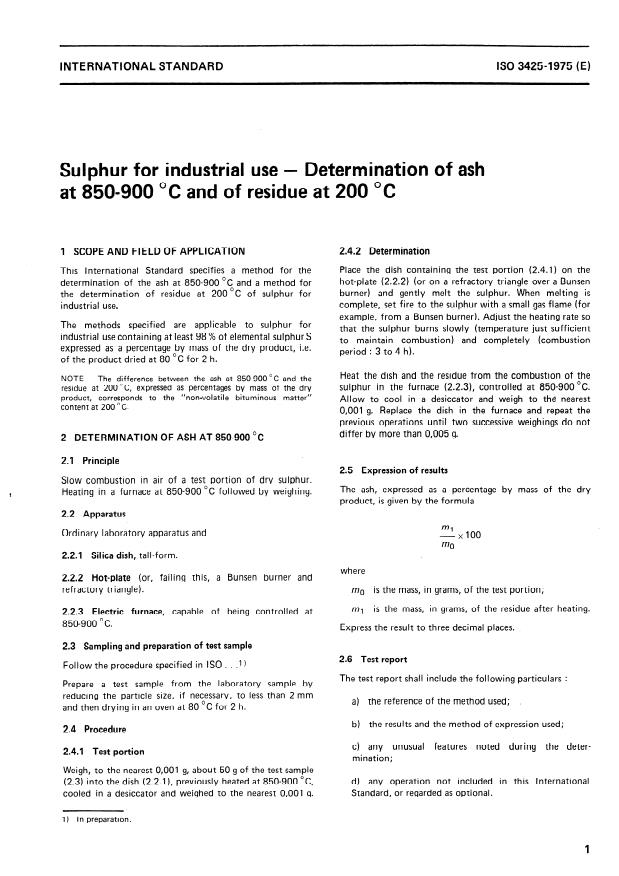
1 SCOPE AND FIELD OF APPLICATION 2.4.2 Determination
Place the dish containing the test Portion (2.4.1) on the
This International Standard specifies a method for the
hot-plate (2.2.2) (or on a refractory triangle over a Bunsen
determination of the ash at 850-900 “C and a method for
burner) and gently melt the sulphur. When melting is
the determination of residue at 200 “C of sulphur for
industrial use. complete, set fire to the sulphur with a small gas flame (for
example, from a Bunsen burner). Adjust the heating rate so
The methods specified are applicable to sulphur for
that the sulphur burns slowly (temperature just sufficient
industrial use containing at least 98 % of elemental sulphur S
to maintain combustion) and completely (combustion
expressed as a percentage by mass of the dry product, i.e.
period : 3 to 4 h).
of the product dried at 80 “C for 2 h.
Heat the dish and the residue from the combustion of the
NOTE - The differente between the ash at 850-900 “C and the
residue at 200 OC, expressed as percentages by mass of the dry sulphur in the furnace (2.2.3), controlled at 850-900 “C.
“non-volatile bituminous matter”
product, corresponds to the
Allow to cool in a desiccator and weigh to the nearest
content at 200 O C-
0,001 g. Replace the dish in the furnace and repeat the
previous operations until two successive weighings do not
differ by more than 0,005 g.
2 DETERMINATION OF ASH AT 850-900 “C
2.1 Principle
2.5 Expression of results
Slow combustion in air of a test Portion of dry sulphur.
The ash, expressed as a percentage by mass of the dry
Heating in a furnace at 850-900 “C followed by wei
...
INTERNATIONAL. STANDARD
INTERNATIONAL ORGANIZATION FOR STANDARDIZATION l ME’HCfiYHAPO~HA~ OPI-AHM3ALJM(I l-IO CI-AHAAPTM3AUCIM-ORGANISATION INTERNATIONALE DE NORMALISATION
Sulphur for industrial use - Determination of ash
at 850-900 “C and of residue at 200 “C
Sou fre 5 wage indus triel- Dktermina tion des cendres 5 850-900 o C et du rksidu G 200 ’ C
First edition - 1975-10-15
Ref. No. ISO 3425-1975 (E)
UDC 661.21 : 543.822
.
determination of content, ashes, residues.
Descriptors : sulphur, Chemical analysis,
Price based on 2 pages
FOREWORD
ISO (the International Organization for Standardization) is a worldwide federation
of national Standards institutes (ISO Member Bodies). The work of developing
international Standards is carried out through ISO Technical Committees. Every
Member Body interested in a subject for which a Technical Committee has been set
up has the right to be represented on that Committee. International organizations,
governmental and non-governmental, in liaison with ISO, also take part in the work.
Draft International Standards adopted by the Technical Committees are circulated
to the Member Bodies for approval before their acceptance as International
Standards by the ISO Council.
International Standard ISO 3425 was drawn up by Technical Committee
lSO/TC 47, Cbemistry, and circulated to the Member Bodies in March 1974.
lt has been approved by the Member Bodies of the following countries :
Hungary
Austria South Africa, Rep. of
Belgium India
Spain
Bulgaria Ireland Switzerland
Chile Israel Thailand
Czechoslovakia Italy Turkey
Egypt, Arab Rep. of New Zealand United Kingdom”
France Portugal U.S.S. R.
Germany Romania Yugoslavia
* with the exception of clause 3.
No Member Body expressed disapproval of the document.
0 International Organkation for Standardkation, 1975 l
Printed in Switzerland
INTERNATIONAL STANDARD ISO 3425-1975 (E)
Sulphur for industrial use - Determination of ash
at 850-900 “C and of residue at 200 “C
1 SCOPE AND FIELD OF APPLICATION 2.4.2 Determination
Place the dish containing the test Portion (2.4.1) on the
This International Standard specifies a method for the
hot-plate (2.2.2) (or on a refractory triangle over a Bunsen
determination of the ash at 850-900 “C and a method for
burner) and gently melt the sulphur. When melting is
the determination of residue at 200 “C of sulphur for
industrial use. complete, set fire to the sulphur with a small gas flame (for
example, from a Bunsen burner). Adjust the heating rate so
The methods specified are applicable to sulphur for
that the sulphur burns slowly (temperature just sufficient
industrial use containing at least 98 % of elemental sulphur S
to maintain combustion) and completely (combustion
expressed as a percentage by mass of the dry product, i.e.
period : 3 to 4 h).
of the product dried at 80 “C for 2 h.
Heat the dish and the residue from the combustion of the
NOTE - The differente between the ash at 850-900 “C and the
residue at 200 OC, expressed as percentages by mass of the dry sulphur in the furnace (2.2.3), controlled at 850-900 “C.
“non-volatile bituminous matter”
product, corresponds to the
Allow to cool in a desiccator and weigh to the nearest
content at 200 O C-
0,001 g. Replace the dish in the furnace and repeat the
previous operations until two successive weighings do not
differ by more than 0,005 g.
2 DETERMINATION OF ASH AT 850-900 “C
2.1 Principle
2.5 Expression of results
Slow combustion in air of a test Portion of dry sulphur.
The ash, expressed as a percentage by mass of the dry
Heating in a furnace at 850-900 “C followed by wei
...
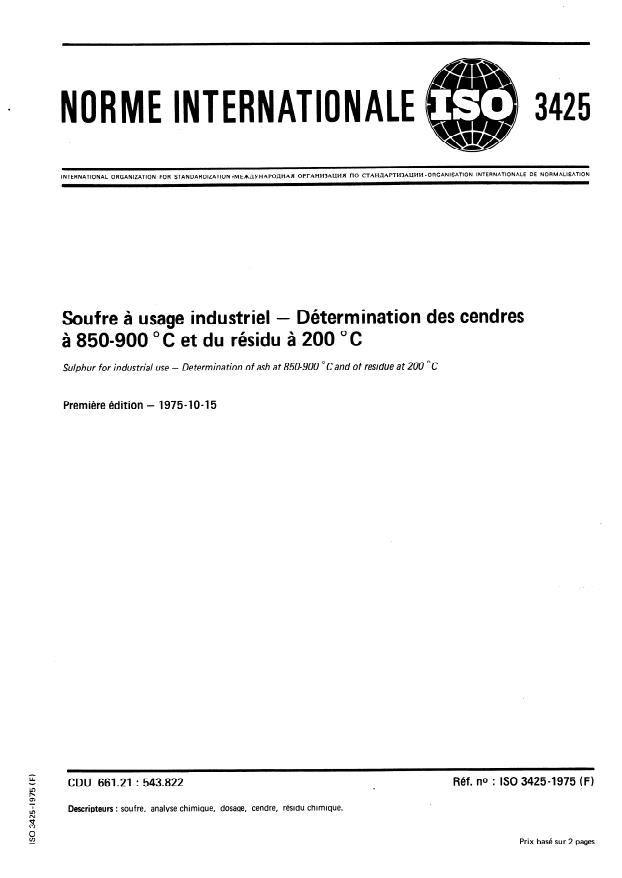
NORME INTERNATIONALE
INTERNATIONAL ORGANIZATION FOR STANDARDIZATION .ME-X~YHAPO~HAII OPI-AHM3ALiMJl Il0 CTAH~APTM~AUMMDORGANISAT~ON INTERNATIONALE DE NORMALISATION
Soufre à usage industriel - Détermination des cendres
à 850-900 o C et du résidu à 200 “C
Sulphur for industrial use - Determination of ash at 850-900 “C and of residue at 200 “C
Première édition - 1975-10-I 5
CDU 661.21 : 543.822 Réf. no : ISO 3425-1975 (F)
.
Descripteurs : soufre, analyse chimique, dosage, cendre, résidu chimique.
Prix basé sur 2 pages
AVANT-PROPOS
L’ISO (Organisation Internationale de Normalisation) est une fédération mondiale
d’organismes nationaux de normalisation (Comités Membres ISO). L’élaboration de
Normes Internationales est confiée aux Comités Techniques ISO. Chaque Comité
Membre intéressé par une étude a le droit de faire partie du Comité Technique
correspondant. Les organisations internationales, gouvernementales et non
gouvernementales, en liaison avec I’ISO, participent également aux travaux.
Les Projets de Normes Internationales adoptés par les Comités Techniques sont
soumis aux Comités Membres pour approbation, avant leur acceptation comme
Normes Internationales par le Conseil de I’ISO.
La Norme Internationale ISO 3425 a été établie par le Comité Technique
lSO/TC 47, Chimie, et soumise aux Comités Membres en mars 1974.
Elle a été approuvée par les Comités Membres des pays suivants :
Afrique du Sud, Rép. d’ France Roumanie
Allemagne Hongrie Royaume-Uni*
Autriche Inde Suisse
Belgique Irlande Tchécoslovaquie
Bulgarie Israël
Thaïlande
Chili Turquie
Italie
Égypte, Rép. arabe d’ Nouvelle-Zélande U.R.S.S.
Espagne Portugal Yougoslavie
* à l’exception du chapitre 3.
Aucun Comité Membre n’a désapprouvé le document.
0 Organisation Internationale de Normalisation, 1975 l
Imprimé en Suisse
NORME INTERNATIONALE
ISO 3425-1975 (F)
Soufre à usage industriel - Détermination des cendres
à 850-900 “C et du résidu à 200 “C
1 OBJET ET DOMAINE D’APPLICATION 2.4.2 Détermination
Placer la capsule contenant la prise d’essai (2.4.1) sur la
La présente Norme Internationale spécifie une méthode de
détermination des cendres à 850-900 “C et une méthode de plaque chauffante (2.2.2) (ou, à défaut, au-dessus d’un bec
détermination du résidu à 200 “C du soufre à usage de Bunsen avec triangle en terre réfractaire) et faire fondre
industriel. doucement le soufre. Dès qu’il est fondu, l’enflammer à
l’aide d’une petite flamme de gaz (par exemple celle d’un
Les méthodes spécifiées sont applicables aux soufres à usage
bec de Bunsen). Régler le chauffage de facon que le soufre
industriel contenant 98 % au moins de soufre élémentaire S
brûle lentement (température juste suffisante pour
exprimé en pourcentage en masse par rapport au produit
entretenir la combustion) et complètement. (durée de la
sec, c’est-à-dire au produit séché à 80 “C durant 2 h.
combustion : 3 à 4 h).
NOTE - La différence entre le taux de cendres à 850-900 “C et le
Calciner la capsule et le résidu de la combustion du soufre
résidu à 200 OC, exprimés en pourcentage en masse de produit sec,
correspond à la teneur en «matières bitumeuses non volatiles» à au four (2.2.3) réglé à 850-900 “C. Laisser refroidir en
200 Oc.
dessiccateur et peser à 0,001 g près. Replacer lakapsule
dans le four et poursuivre les mêmes opérations jusqu’à ce
que deux pesées consécutives ne diffèrent pas de plus de
2 DÉTERMINATION DES CENDRES À 850-900 “C
0,005 g.
2.1 Principe
2.5 Expression des résultats
Combustion lente, dans l’air, d’une prise d’essai de soufre
sec. Calcination dans un four à 850-900 “C et pesée.
Le taux de cendres, exprimé en pourcentage en masse de
produit sec, est donné par la formule
2.2 Appareillage
ml
Matériel courant de l
...
NORME INTERNATIONALE
INTERNATIONAL ORGANIZATION FOR STANDARDIZATION .ME-X~YHAPO~HAII OPI-AHM3ALiMJl Il0 CTAH~APTM~AUMMDORGANISAT~ON INTERNATIONALE DE NORMALISATION
Soufre à usage industriel - Détermination des cendres
à 850-900 o C et du résidu à 200 “C
Sulphur for industrial use - Determination of ash at 850-900 “C and of residue at 200 “C
Première édition - 1975-10-I 5
CDU 661.21 : 543.822 Réf. no : ISO 3425-1975 (F)
.
Descripteurs : soufre, analyse chimique, dosage, cendre, résidu chimique.
Prix basé sur 2 pages
AVANT-PROPOS
L’ISO (Organisation Internationale de Normalisation) est une fédération mondiale
d’organismes nationaux de normalisation (Comités Membres ISO). L’élaboration de
Normes Internationales est confiée aux Comités Techniques ISO. Chaque Comité
Membre intéressé par une étude a le droit de faire partie du Comité Technique
correspondant. Les organisations internationales, gouvernementales et non
gouvernementales, en liaison avec I’ISO, participent également aux travaux.
Les Projets de Normes Internationales adoptés par les Comités Techniques sont
soumis aux Comités Membres pour approbation, avant leur acceptation comme
Normes Internationales par le Conseil de I’ISO.
La Norme Internationale ISO 3425 a été établie par le Comité Technique
lSO/TC 47, Chimie, et soumise aux Comités Membres en mars 1974.
Elle a été approuvée par les Comités Membres des pays suivants :
Afrique du Sud, Rép. d’ France Roumanie
Allemagne Hongrie Royaume-Uni*
Autriche Inde Suisse
Belgique Irlande Tchécoslovaquie
Bulgarie Israël
Thaïlande
Chili Turquie
Italie
Égypte, Rép. arabe d’ Nouvelle-Zélande U.R.S.S.
Espagne Portugal Yougoslavie
* à l’exception du chapitre 3.
Aucun Comité Membre n’a désapprouvé le document.
0 Organisation Internationale de Normalisation, 1975 l
Imprimé en Suisse
NORME INTERNATIONALE
ISO 3425-1975 (F)
Soufre à usage industriel - Détermination des cendres
à 850-900 “C et du résidu à 200 “C
1 OBJET ET DOMAINE D’APPLICATION 2.4.2 Détermination
Placer la capsule contenant la prise d’essai (2.4.1) sur la
La présente Norme Internationale spécifie une méthode de
détermination des cendres à 850-900 “C et une méthode de plaque chauffante (2.2.2) (ou, à défaut, au-dessus d’un bec
détermination du résidu à 200 “C du soufre à usage de Bunsen avec triangle en terre réfractaire) et faire fondre
industriel. doucement le soufre. Dès qu’il est fondu, l’enflammer à
l’aide d’une petite flamme de gaz (par exemple celle d’un
Les méthodes spécifiées sont applicables aux soufres à usage
bec de Bunsen). Régler le chauffage de facon que le soufre
industriel contenant 98 % au moins de soufre élémentaire S
brûle lentement (température juste suffisante pour
exprimé en pourcentage en masse par rapport au produit
entretenir la combustion) et complètement. (durée de la
sec, c’est-à-dire au produit séché à 80 “C durant 2 h.
combustion : 3 à 4 h).
NOTE - La différence entre le taux de cendres à 850-900 “C et le
Calciner la capsule et le résidu de la combustion du soufre
résidu à 200 OC, exprimés en pourcentage en masse de produit sec,
correspond à la teneur en «matières bitumeuses non volatiles» à au four (2.2.3) réglé à 850-900 “C. Laisser refroidir en
200 Oc.
dessiccateur et peser à 0,001 g près. Replacer lakapsule
dans le four et poursuivre les mêmes opérations jusqu’à ce
que deux pesées consécutives ne diffèrent pas de plus de
2 DÉTERMINATION DES CENDRES À 850-900 “C
0,005 g.
2.1 Principe
2.5 Expression des résultats
Combustion lente, dans l’air, d’une prise d’essai de soufre
sec. Calcination dans un four à 850-900 “C et pesée.
Le taux de cendres, exprimé en pourcentage en masse de
produit sec, est donné par la formule
2.2 Appareillage
ml
Matériel courant de l
...
NORME INTERNATIONALE
INTERNATIONAL ORGANIZATION FOR STANDARDIZATION .ME-X~YHAPO~HAII OPI-AHM3ALiMJl Il0 CTAH~APTM~AUMMDORGANISAT~ON INTERNATIONALE DE NORMALISATION
Soufre à usage industriel - Détermination des cendres
à 850-900 o C et du résidu à 200 “C
Sulphur for industrial use - Determination of ash at 850-900 “C and of residue at 200 “C
Première édition - 1975-10-I 5
CDU 661.21 : 543.822 Réf. no : ISO 3425-1975 (F)
.
Descripteurs : soufre, analyse chimique, dosage, cendre, résidu chimique.
Prix basé sur 2 pages
AVANT-PROPOS
L’ISO (Organisation Internationale de Normalisation) est une fédération mondiale
d’organismes nationaux de normalisation (Comités Membres ISO). L’élaboration de
Normes Internationales est confiée aux Comités Techniques ISO. Chaque Comité
Membre intéressé par une étude a le droit de faire partie du Comité Technique
correspondant. Les organisations internationales, gouvernementales et non
gouvernementales, en liaison avec I’ISO, participent également aux travaux.
Les Projets de Normes Internationales adoptés par les Comités Techniques sont
soumis aux Comités Membres pour approbation, avant leur acceptation comme
Normes Internationales par le Conseil de I’ISO.
La Norme Internationale ISO 3425 a été établie par le Comité Technique
lSO/TC 47, Chimie, et soumise aux Comités Membres en mars 1974.
Elle a été approuvée par les Comités Membres des pays suivants :
Afrique du Sud, Rép. d’ France Roumanie
Allemagne Hongrie Royaume-Uni*
Autriche Inde Suisse
Belgique Irlande Tchécoslovaquie
Bulgarie Israël
Thaïlande
Chili Turquie
Italie
Égypte, Rép. arabe d’ Nouvelle-Zélande U.R.S.S.
Espagne Portugal Yougoslavie
* à l’exception du chapitre 3.
Aucun Comité Membre n’a désapprouvé le document.
0 Organisation Internationale de Normalisation, 1975 l
Imprimé en Suisse
NORME INTERNATIONALE
ISO 3425-1975 (F)
Soufre à usage industriel - Détermination des cendres
à 850-900 “C et du résidu à 200 “C
1 OBJET ET DOMAINE D’APPLICATION 2.4.2 Détermination
Placer la capsule contenant la prise d’essai (2.4.1) sur la
La présente Norme Internationale spécifie une méthode de
détermination des cendres à 850-900 “C et une méthode de plaque chauffante (2.2.2) (ou, à défaut, au-dessus d’un bec
détermination du résidu à 200 “C du soufre à usage de Bunsen avec triangle en terre réfractaire) et faire fondre
industriel. doucement le soufre. Dès qu’il est fondu, l’enflammer à
l’aide d’une petite flamme de gaz (par exemple celle d’un
Les méthodes spécifiées sont applicables aux soufres à usage
bec de Bunsen). Régler le chauffage de facon que le soufre
industriel contenant 98 % au moins de soufre élémentaire S
brûle lentement (température juste suffisante pour
exprimé en pourcentage en masse par rapport au produit
entretenir la combustion) et complètement. (durée de la
sec, c’est-à-dire au produit séché à 80 “C durant 2 h.
combustion : 3 à 4 h).
NOTE - La différence entre le taux de cendres à 850-900 “C et le
Calciner la capsule et le résidu de la combustion du soufre
résidu à 200 OC, exprimés en pourcentage en masse de produit sec,
correspond à la teneur en «matières bitumeuses non volatiles» à au four (2.2.3) réglé à 850-900 “C. Laisser refroidir en
200 Oc.
dessiccateur et peser à 0,001 g près. Replacer lakapsule
dans le four et poursuivre les mêmes opérations jusqu’à ce
que deux pesées consécutives ne diffèrent pas de plus de
2 DÉTERMINATION DES CENDRES À 850-900 “C
0,005 g.
2.1 Principe
2.5 Expression des résultats
Combustion lente, dans l’air, d’une prise d’essai de soufre
sec. Calcination dans un four à 850-900 “C et pesée.
Le taux de cendres, exprimé en pourcentage en masse de
produit sec, est donné par la formule
2.2 Appareillage
ml
Matériel courant de l
...
NORME INTERNATIONALE
INTERNATIONAL ORGANIZATION FOR STANDARDIZATION .ME-X~YHAPO~HAII OPI-AHM3ALiMJl Il0 CTAH~APTM~AUMMDORGANISAT~ON INTERNATIONALE DE NORMALISATION
Soufre à usage industriel - Détermination des cendres
à 850-900 o C et du résidu à 200 “C
Sulphur for industrial use - Determination of ash at 850-900 “C and of residue at 200 “C
Première édition - 1975-10-I 5
CDU 661.21 : 543.822 Réf. no : ISO 3425-1975 (F)
.
Descripteurs : soufre, analyse chimique, dosage, cendre, résidu chimique.
Prix basé sur 2 pages
AVANT-PROPOS
L’ISO (Organisation Internationale de Normalisation) est une fédération mondiale
d’organismes nationaux de normalisation (Comités Membres ISO). L’élaboration de
Normes Internationales est confiée aux Comités Techniques ISO. Chaque Comité
Membre intéressé par une étude a le droit de faire partie du Comité Technique
correspondant. Les organisations internationales, gouvernementales et non
gouvernementales, en liaison avec I’ISO, participent également aux travaux.
Les Projets de Normes Internationales adoptés par les Comités Techniques sont
soumis aux Comités Membres pour approbation, avant leur acceptation comme
Normes Internationales par le Conseil de I’ISO.
La Norme Internationale ISO 3425 a été établie par le Comité Technique
lSO/TC 47, Chimie, et soumise aux Comités Membres en mars 1974.
Elle a été approuvée par les Comités Membres des pays suivants :
Afrique du Sud, Rép. d’ France Roumanie
Allemagne Hongrie Royaume-Uni*
Autriche Inde Suisse
Belgique Irlande Tchécoslovaquie
Bulgarie Israël
Thaïlande
Chili Turquie
Italie
Égypte, Rép. arabe d’ Nouvelle-Zélande U.R.S.S.
Espagne Portugal Yougoslavie
* à l’exception du chapitre 3.
Aucun Comité Membre n’a désapprouvé le document.
0 Organisation Internationale de Normalisation, 1975 l
Imprimé en Suisse
NORME INTERNATIONALE
ISO 3425-1975 (F)
Soufre à usage industriel - Détermination des cendres
à 850-900 “C et du résidu à 200 “C
1 OBJET ET DOMAINE D’APPLICATION 2.4.2 Détermination
Placer la capsule contenant la prise d’essai (2.4.1) sur la
La présente Norme Internationale spécifie une méthode de
détermination des cendres à 850-900 “C et une méthode de plaque chauffante (2.2.2) (ou, à défaut, au-dessus d’un bec
détermination du résidu à 200 “C du soufre à usage de Bunsen avec triangle en terre réfractaire) et faire fondre
industriel. doucement le soufre. Dès qu’il est fondu, l’enflammer à
l’aide d’une petite flamme de gaz (par exemple celle d’un
Les méthodes spécifiées sont applicables aux soufres à usage
bec de Bunsen). Régler le chauffage de facon que le soufre
industriel contenant 98 % au moins de soufre élémentaire S
brûle lentement (température juste suffisante pour
exprimé en pourcentage en masse par rapport au produit
entretenir la combustion) et complètement. (durée de la
sec, c’est-à-dire au produit séché à 80 “C durant 2 h.
combustion : 3 à 4 h).
NOTE - La différence entre le taux de cendres à 850-900 “C et le
Calciner la capsule et le résidu de la combustion du soufre
résidu à 200 OC, exprimés en pourcentage en masse de produit sec,
correspond à la teneur en «matières bitumeuses non volatiles» à au four (2.2.3) réglé à 850-900 “C. Laisser refroidir en
200 Oc.
dessiccateur et peser à 0,001 g près. Replacer lakapsule
dans le four et poursuivre les mêmes opérations jusqu’à ce
que deux pesées consécutives ne diffèrent pas de plus de
2 DÉTERMINATION DES CENDRES À 850-900 “C
0,005 g.
2.1 Principe
2.5 Expression des résultats
Combustion lente, dans l’air, d’une prise d’essai de soufre
sec. Calcination dans un four à 850-900 “C et pesée.
Le taux de cendres, exprimé en pourcentage en masse de
produit sec, est donné par la formule
2.2 Appareillage
ml
Matériel courant de l
...