

ISO/TR 8101-10:2024
(Main)Fire safety on lifts — Part 10: Comparison of safety standards worldwide on lifts used by firefighters and for building evacuation
General Information
- Abstract
This document consists of an updated comparison of the requirements of selected topics pertaining to the use of lifts for firefighting and building evacuation, as covered by worldwide safety standards. This document applies to electric traction lifts only, although some sections are also applicable for positive drive lifts and other lifts suspended by rope or chain.
- Status
- Published
- Publication Date
- 26-Nov-2024
- Technical Committee
- ISO/TC 178 - Lifts, escalators and moving walks
- Drafting Committee
- ISO/TC 178/WG 6 - Lift installation
- Current Stage
- 6060 - International Standard published
- Start Date
- 27-Nov-2024
- Completion Date
- 27-Nov-2024
Overview
ISO/TR 8101-10:2024, issued by the International Organization for Standardization (ISO), focuses on fire safety for lifts (elevators) by comparing worldwide safety standards relating to lifts used by firefighters and for building evacuation. The document offers a unique, updated international perspective, providing valuable reference material for national standards committees, fire safety experts, building designers, and lift manufacturers. Its scope primarily centers on electric traction lifts but includes some content applicable to positive drive lifts and lifts suspended by rope or chain.
This technical report supports the ongoing improvement and global alignment of lift safety requirements, addressing both the use of lifts by emergency personnel and their application in emergency building evacuations.
Key Topics
Comparative Requirements: The report analyzes the similarities and differences in fire safety standards for lifts across various countries and regions. It highlights how national codes define and regulate lifts for firefighter use, evacuation procedures, and general fire safety.
Focus on Electric Traction Lifts: Although electric traction lifts are the main focus, select sections provide information relevant to other lift types (e.g., positive drive and rope-suspended lifts).
Evacuation and Firefighter Lifts: The document details critical features such as protected lobbies, smoke control, ambient temperature ranges, fire ratings of doors, and requirements related to safety systems, rescue operations, and power backup.
Design and Performance Criteria:
- Requirements for load, size, and door operation of firefighter lifts
- Standards for electrical protection against water and short circuits
- Standby power supply requirements and performance expectations in emergencies
Harmonization and Reference: Comparison tables allow easy identification of consistent and divergent practices, referencing well-known standards like EN 81-72 and others from Europe, Australia, North America, and Asia.
Applications
ISO/TR 8101-10:2024 is a valuable tool for several stakeholders:
- Standards Developers: Provides a basis for drafting or revising national building and fire safety codes, and encourages convergence toward optimal lift safety practices.
- Building Designers and Architects: Informs design choices when specifying or evaluating lifts for emergency operations in high-rise and complex buildings.
- Lift Manufacturers and Engineers: Offers guidance on compliance and helps in designing lifts that meet multiple international requirements, supporting export and installation in different regulatory environments.
- Fire Safety Consultants and Authorities: Delivers insights into evacuation strategies and minimum technical requirements, assisting with risk assessment and holistic fire protection planning.
- Facility Managers and Owners: Aids understanding of building safety obligations regarding lift use in emergencies, and ensures that evacuation and firefighter lift systems are compliant, reliable, and ready for use.
- Academic and Training Organizations: Serves as a comparative educational resource illustrating the evolution and variety of lift fire safety approaches.
Related Standards
- EN 81-72: European standard specifying lifts used by firefighters, widely adopted across the EU and associated countries.
- ISO/TS 18870: Requirements for lifts used to assist in building evacuation.
- ISO/TR 25743: Guidelines for rescue by lifts and building evacuation using lifts.
- ISO 21542: Accessibility and usability standards that include evacuation requirements.
- EN 81-20 & EN 81-58: Address general safety rules and fire resistance of lift landing doors.
- National Codes: Building/fire codes from participating countries, which include unique standards and regulations highlighted in this comparative report.
Practical Value
By collating and analyzing the safety requirements found in fire codes and lift standards worldwide, ISO/TR 8101-10:2024 improves consultation, design quality, and the harmonization of safety features for lifts used in emergencies. This supports not only the safety of building occupants and rescue personnel but also long-term international collaboration on building fire safety and accessible evacuation solutions.
Keywords: fire safety lifts, firefighter lifts standard, building evacuation lift, ISO lift safety standards, EN 81-72, lift fire codes comparison, emergency building evacuation, electric traction elevators, international lift safety, building code harmonization.
Relations
- Effective Date
- 06-Jun-2022
- Effective Date
- 21-Oct-2017
Get Certified
Connect with accredited certification bodies for this standard

DIBt (Deutsches Institut für Bautechnik)
German Institute for Building Technology.
DIN CERTCO
DIN Group product certification.

Aboma Certification B.V.
Specialized in construction, metal, and transport sectors.
Sponsored listings
Frequently Asked Questions
ISO/TR 8101-10:2024 is a technical report published by the International Organization for Standardization (ISO). Its full title is "Fire safety on lifts — Part 10: Comparison of safety standards worldwide on lifts used by firefighters and for building evacuation". This standard covers: This document consists of an updated comparison of the requirements of selected topics pertaining to the use of lifts for firefighting and building evacuation, as covered by worldwide safety standards. This document applies to electric traction lifts only, although some sections are also applicable for positive drive lifts and other lifts suspended by rope or chain.
This document consists of an updated comparison of the requirements of selected topics pertaining to the use of lifts for firefighting and building evacuation, as covered by worldwide safety standards. This document applies to electric traction lifts only, although some sections are also applicable for positive drive lifts and other lifts suspended by rope or chain.
ISO/TR 8101-10:2024 is classified under the following ICS (International Classification for Standards) categories: 91.140.90 - Lifts. Escalators. The ICS classification helps identify the subject area and facilitates finding related standards.
ISO/TR 8101-10:2024 has the following relationships with other standards: It is inter standard links to ISO 15083:2020/Amd 1:2022, ISO/TR 16765:2003. Understanding these relationships helps ensure you are using the most current and applicable version of the standard.
ISO/TR 8101-10:2024 is available in PDF format for immediate download after purchase. The document can be added to your cart and obtained through the secure checkout process. Digital delivery ensures instant access to the complete standard document.
Standards Content (Sample)
Technical
Report
ISO/TR 8101-10
First edition
Fire safety on lifts —
2024-11
Part 10:
Comparison of safety standards
worldwide on lifts used by
firefighters and for building
evacuation
Sécurité incendie des ascenseurs —
Partie 10: Comparaison des normes de sécurité sur le plan
mondial pour les ascenseurs utilisés par les pompiers et pour
l'évacuation des bâtiments
Reference number
© ISO 2024
All rights reserved. Unless otherwise specified, or required in the context of its implementation, no part of this publication may
be reproduced or utilized otherwise in any form or by any means, electronic or mechanical, including photocopying, or posting on
the internet or an intranet, without prior written permission. Permission can be requested from either ISO at the address below
or ISO’s member body in the country of the requester.
ISO copyright office
CP 401 • Ch. de Blandonnet 8
CH-1214 Vernier, Geneva
Phone: +41 22 749 01 11
Email: copyright@iso.org
Website: www.iso.org
Published in Switzerland
ii
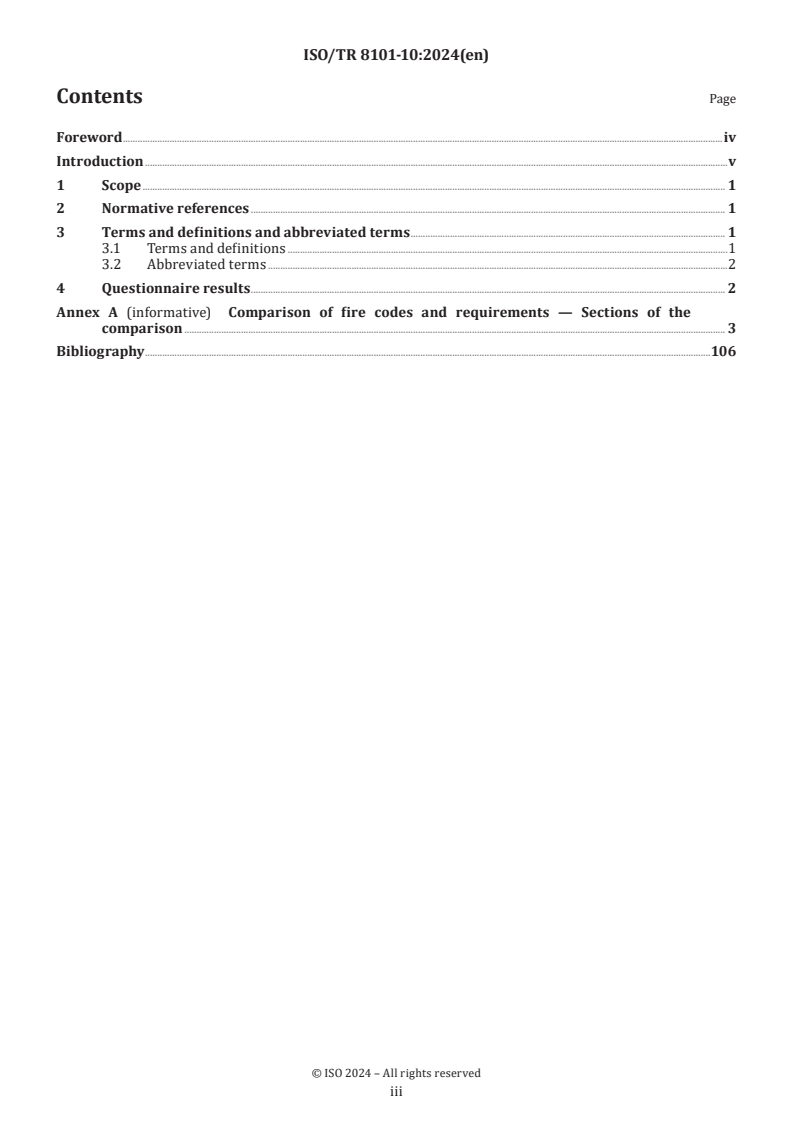
Contents Page
Foreword .iv
Introduction .v
1 Scope . 1
2 Normative references . 1
3 Terms and definitions and abbreviated terms . 1
3.1 Terms and definitions .1
3.2 Abbreviated terms .2
4 Questionnaire results . . 2
Annex A (informative) Comparison of fire codes and requirements — Sections of the
comparison . 3
Bibliography .106
iii
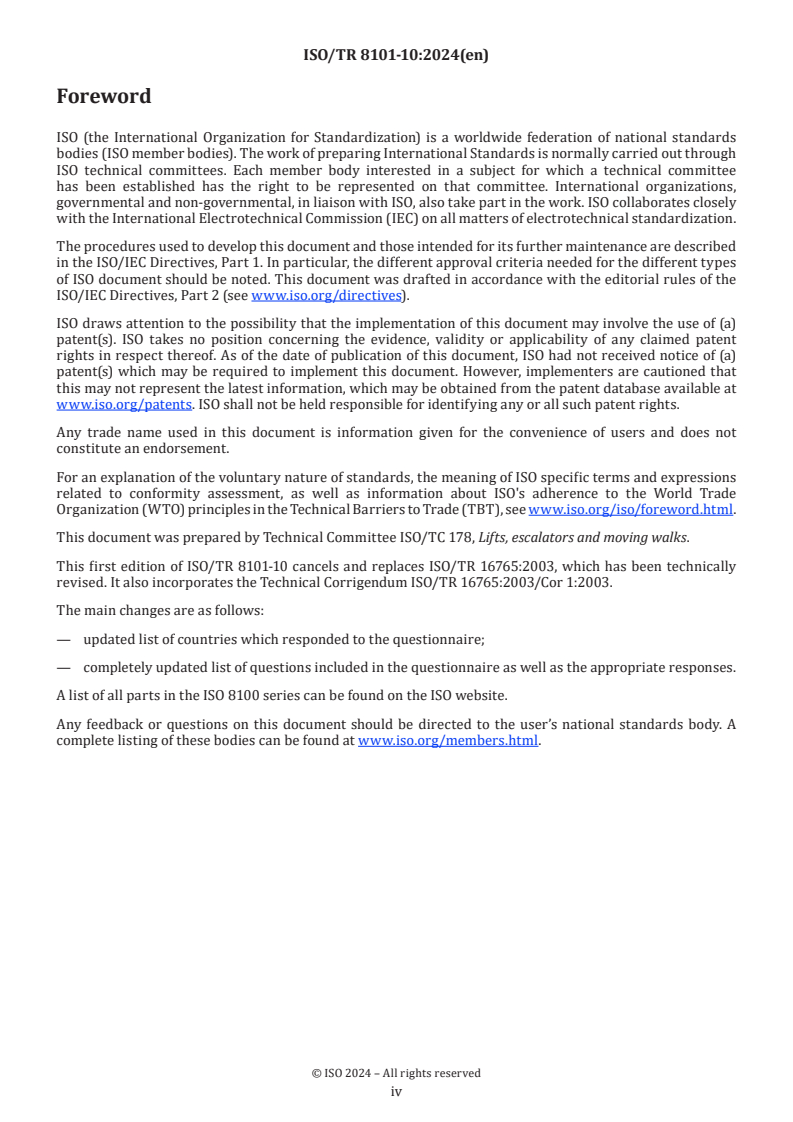
Foreword
ISO (the International Organization for Standardization) is a worldwide federation of national standards
bodies (ISO member bodies). The work of preparing International Standards is normally carried out through
ISO technical committees. Each member body interested in a subject for which a technical committee
has been established has the right to be represented on that committee. International organizations,
governmental and non-governmental, in liaison with ISO, also take part in the work. ISO collaborates closely
with the International Electrotechnical Commission (IEC) on all matters of electrotechnical standardization.
The procedures used to develop this document and those intended for its further maintenance are described
in the ISO/IEC Directives, Part 1. In particular, the different approval criteria needed for the different types
of ISO document should be noted. This document was drafted in accordance with the editorial rules of the
ISO/IEC Directives, Part 2 (see www.iso.org/directives).
ISO draws attention to the possibility that the implementation of this document may involve the use of (a)
patent(s). ISO takes no position concerning the evidence, validity or applicability of any claimed patent
rights in respect thereof. As of the date of publication of this document, ISO had not received notice of (a)
patent(s) which may be required to implement this document. However, implementers are cautioned that
this may not represent the latest information, which may be obtained from the patent database available at
www.iso.org/patents. ISO shall not be held responsible for identifying any or all such patent rights.
Any trade name used in this document is information given for the convenience of users and does not
constitute an endorsement.
For an explanation of the voluntary nature of standards, the meaning of ISO specific terms and expressions
related to conformity assessment, as well as information about ISO's adherence to the World Trade
Organization (WTO) principles in the Technical Barriers to Trade (TBT), see www.iso.org/iso/foreword.html.
This document was prepared by Technical Committee ISO/TC 178, Lifts, escalators and moving walks.
This first edition of ISO/TR 8101-10 cancels and replaces ISO/TR 16765:2003, which has been technically
revised. It also incorporates the Technical Corrigendum ISO/TR 16765:2003/Cor 1:2003.
The main changes are as follows:
— updated list of countries which responded to the questionnaire;
— completely updated list of questions included in the questionnaire as well as the appropriate responses.
A list of all parts in the ISO 8100 series can be found on the ISO website.
Any feedback or questions on this document should be directed to the user’s national standards body. A
complete listing of these bodies can be found at www.iso.org/members.html.
iv
Introduction
This document includes a comparison between CEN Standard EN 81-72 for firefighters’ lifts (elevators) and
the national codes of several countries which responded to a questionnaire circulated to TC 178 members.
The questionnaire results include responses from the responding countries, including the information for
EN 81-72 (which is used by twenty-eight EU countries, Iceland, Macedonia, Norway, Serbia, Switzerland
and Turkey), plus individual responses from Australia, Austria, Canada, China, Denmark, Finland with two
separate responses, Germany, India, Japan, Namibia, Netherlands, Norway, Russia, Switzerland, UK and USA.
The goal was to prepare a technical report which provides reference information to assist national standards
committees when reviewing and revising individual codes and which can initiate a gradual convergence of
the technical requirements worldwide.
The comparison includes reference to national lift (elevator) codes, fire codes and building regulations.
This document is intended to aid standards writers in developing their firefighters lift (elevator)
requirements and to help standards users understand the basis for the requirements as they are applied
throughout the world.
Some information on evacuation procedures and issues is included in this document. Consideration of the
evacuation information can be used in connection with the updating of existing ISO documents on this
subject (e.g. ISO/TS 18870 and ISO/TR 25743).
This document can be read in conjunction with the various lift (elevator), fire and building codes, as it was
often necessary to summarize the requirements for the sake of the comparisons. Further, the information
contained in this document does not necessarily represent the opinions of the standards writing organization
responsible for the developments of the safety standards which are being compared.
This document can be used as a basis together with an appropriate risk assessment when preparing a global
standard for firefighters’ lifts and/or evacuation lifts (elevators).
v
Technical Report ISO/TR 8101-10:2024(en)
Fire safety on lifts —
Part 10:
Comparison of safety standards worldwide on lifts used by
firefighters and for building evacuation
1 Scope
This document consists of an updated comparison of the requirements of selected topics pertaining to the
use of lifts for firefighting and building evacuation, as covered by worldwide safety standards.
This document applies to electric traction lifts only, although some sections are also applicable for positive
drive lifts and other lifts suspended by rope or chain.
2 Normative references
There are no normative references in this document.
3 Terms and definitions and abbreviated terms
3.1 Terms and definitions
For the purposes of this document, the following terms and definitions apply.
ISO and IEC maintain terminological databases for use in standardization at the following addresses:
— ISO Online browsing platform: available at https:// www .iso .org/ obp
— IEC Electropedia: available at https:// www .electropedia .org/
3.1.1
control room
room separate from the lift well, allowing bodily entry and containing the lift controller
3.1.2
control space
space inside the lift well containing the lift controller
3.1.3
evacuation
planned and orderly phased movements to withdraw, or cause to withdraw, users from a building via
accessible routes to one or more accessible places of safety in the event of an emergency
[SOURCE: ISO 21542:2021, 3.10, modified — Fire evacuation shortened to more general term Evacuation.
“All users” changed to “users”.]
3.1.4
machinery space
space in the lift well containing the machine
3.1.5
Phase 1
priority recall for the firefighters’ lift
Note 1 to entry: See EN 81-72-2020, 5.8.7.
3.1.6
Phase 2
use of the lift under firefighters’ control
Note 1 to entry: See EN 81-72-2020, 5.8.8.
3.2 Abbreviated terms
FFL firefighters’ lift See EN 81-72-2020, 3.5.
FSAL fire service access level See EN 81-72-2020, 3.8.
4 Questionnaire results
The countries that responded to the questionnaire are grouped in sections in Annex A, in no particular order.
This document doesn’t state requirements or suggest specific solutions. The results indicate different
solutions for similar problems or issues which have been implemented in the various countries.
This document attempts to provide information on requirements on lifts used for firefighting and evacuation,
particularly when performance-based building codes or building regulations are being applied.
Requirements listed in the tables are valid at the time of the questionnaire and might have been superseded
or updated since that time. The requirements are a moving target and constantly evolving. Building and lift
designers are expected to always check building codes or building regulations and the lift standard in effect
before implementing a specific design. Lifts used as firefighters’ lifts and emergency lifts are defined in the
various applicable building codes or building regulations and lift standards. Users of this document should
refer to the local standards for an understanding of the appropriate description, use and application of the
various types of lifts.
Building evacuation concepts and requirements are being actively discussed or implemented in many
countries and might have evolved beyond the requirements stated in this document. Users of this document
are expected to always verify local requirements and discuss these requirements with the appropriate
experts and authorities. See also ISO/TS 18870 and ISO/TR 25743
Annex A
(informative)
Comparison of fire codes and requirements — Sections of the
comparison
A.1 Table A.1
Table A.1 includes countries using EN 81-72 (which includes twenty-eight EU countries, Iceland, Macedonia,
Serbia, and Turkey), Austria and Australia.
NOTE Australia has not adopted EN 81-72.
A.2 Table A.2
Table A.2 includes Canada, United States and Japan.
A.3 Table A.3
Table A.3 includes China and Finland. Two responses were received from Finland and both are included. One
response was from lift experts and the other response was from firefighting experts in Finland.
A.4 Table A.4
Table A.4 includes India, the United Kingdom and Germany.
A.5 Table A.5
Table A.5 includes Denmark, Russia and Namibia.
A.6 Table A.6
Table A.6 includes Netherlands, Norway and Switzerland.
Table A.1 — Countries using EN 81-72
Country → 28 EU countries, Macedonia, Serbia, Turkey,
Australia Austria
Iceland, Norway and Switzerland
Number Question Answer Code Reference Answer Code Reference Answer Code Reference
1.0 Building Requirements
1.1 (a) What building code is effective Country specific NCC 2019 Country specific EN 1990:2013
in your country?
1.1 (b) Is a protected lobby in front of Yes. It is called as Safe Area. EN 81-72:2020, No Yes. It is called as Safe Area. EN 81-72:2020,
FFL required? 5.1.1 5.1.1
1.2 Is there a particular building
type or minimum building
height requirement for:
(a) Firefighters’ Lift(s)? Country specific Yes NCC2019 Country specific Yes, regulation
Clause E3.4(a)(i) and limits de-
&(ii) pending on the
— Building classifications 2-9c
federal state.
(excluding 9a): 25 m effective
height minimum
— Building classification 9a
(health care), where patient
care areas are not at level with
direct access to road or open
space: Any effective height
(b) Lift Evacuation Systems? – Brief Country specific No Country specific No
Description
(c) Stretcher Use? Country specific Yes NCC2019 Country specific Yes, TRVB 150
Clause E3.2(a)(i) S:2018
In at least one emergency lift, or
&(ii)
where an emergency lift is not
required, in at least one passen-
ger lift that serves any storey
above 12 m
(d) Is there any requirement for No. EN 81-72:2020, Yes NCC2019 No. EN 81-72:2020,
every landing in the building to 1.4 Clause E3.4(b) 1.4
The floors to be served are Country specific
be served by the Firefighters’
assumed to be determined as EN 81-72:2020, TRVB 150
Lift?
part of the design of the building 5.1.1 S:2018
for fire.
1.3 Is smoke control required in:
(a) lift well? No No Yes TRVB 150
S:2018
(b) lobby? No No Yes TRVB 150
S:2018
Table A.1 (continued)
Country → 28 EU countries, Macedonia, Serbia, Turkey,
Australia Austria
Iceland, Norway and Switzerland
Number Question Answer Code Reference Answer Code Reference Answer Code Reference
1.4 Does the building design reduce Yes EN 81-72:2020, No Yes EN 81-72:2020,
water flowing into lift well dur- 5.1.2 1.2
Country specific require-
ing a fire? If yes, is there:
EN 81-72:2020, ment is a minimum pump EN 81-72:2020,
5.3.4 capacity of 300 l/min for a 5.1.2
minimum duration of 90 min
EN 81-72:2020, EN 81-72:2020,
(TRVB 150 S:2018).
Annex E.2 5.3.4
EN 81-72:2020,
Annex E.2
(a) Protection from sprinklers? Sprinklers are not permitted in EN 81-72:2020, Sprinklers are not permitted EN 81-72:2020,
firefighters lift well and machin- 5.2.9 in firefighters lift well and 5.2.9
ery spaces machinery spaces
(b) Protection from FF hoses? No No
1.5 Can lifts other than FFL be used Yes, country specific TS 81-76:2011 Yes NCC2019 DP7 Yes, but only in specific TS 81-76:2011
for evacuation? Evacuation of cases.
As a performance solution to Evacuation of
disabled per-
DP7 disabled per-
sons using lifts
sons using lifts
ISO/TS
18870:2014
Lifts (elevators)
— Require-
ments for lifts
used to assist in
building evacu-
ation
1.6 Can lifts with partial well enclo- Yes, in combination with addi- EN 81-72:2020, No NCC2019 No EN 81-72:2020,
sures be used as FFLs? tional safety means 1.3 Clause E3.4(d)(i) 1.3
1.7 Can FFLs be part of a group of Yes Yes NCC2019 Yes
non-FFLs? If yes: Clause E3.4(b),(c),(d)
(a) What are maximum number of Not specified, country specific. No limit
lifts in one well?
(b) Must there be a solid dividing Yes, country specific No Yes TRVB 150
wall between FFL and rest of S:2018
lifts in a common well?
1.9 What is the required ambient
temperature range?
(a) In machine room? 0-40 °C EN 81-72:2020, 40 C 0-40 °C EN 81-72:2020,
5.2.5 b) 5.2.5 b)
Note: This temperature range is
a requirement for the lift.
(b) In machinery space? 0-40 °C EN 81-72:2020, 40 C 0-40 °C EN 81-72:2020,
5.2.5 b) 5.2.5 b)
Note: This temperature range is
a requirement for the lift.
Table A.1 (continued)
Country → 28 EU countries, Macedonia, Serbia, Turkey,
Australia Austria
Iceland, Norway and Switzerland
Number Question Answer Code Reference Answer Code Reference Answer Code Reference
(c) In control room? 0-40 °C EN 81-72:2020, 40 C 0-40 °C EN 81-72:2020,
5.2.5 b) 5.2.5 b)
Note: This temperature range is
a requirement for the lift.
(d) In control space? 0-40 °C EN 81-72:2020, 40 C 0-40 °C EN 81-72:2020,
5.2.5 b) 5.2.5 b)
Note: This temperature range is
a requirement for the lift.
(e) In lift well 0-40 °C EN 81-72:2020, For glass shafts with solar gain NCC2019 Specifica- 0-40 °C EN 81-72:2020,
5.2.5 b) 5 C above ambient to a maxi- tion E3.1 5.2.5 b)
Note: This temperature range is
mum of 45 C
a requirement for the lift.
(f) On lobby side of landing doors Electrical/electronic lift devices EN 81-72:2020, Devices shall be designed to EN 81-72:2020,
shall be designed to function 5.2.5 a) operate correctly at 0-65 °C 5.2.5 a)
correctly at 0-65 °C or be made or be made non-operational.
non-operational.
1.10 What is the maximum time(s) 60 s. EN 81-72:2020, Not specified 60 s. EN 81-72:2020,
for FFL to travel from fire ser- 5.2.4 5.2.4
if travel height >200 m, permit- if travel height >200 m,
vice access level to top floor?
ted to add 1 s for each 3 m permitted to add 1 s for each
3 m
1.11 Must a single FFL serve all No. EN 81-72:2020, Yes, if more than one lift is used Guide to NCC No. EN 81-72:2020,
floors of a building including 1.4 then transfer floor has to be fire Volume One 2019 1.4
The floors to be served are
those with sky lobbies? isolated and smoke protected. Clause E3.4
assumed to be determined as EN 81-72:2020, TRVB 150
part of the design of the building 5.1.1 More than one emergency lift S:2018
for fire. may be used.
EN 81-72:2020,
“Emergency lifts must serve all 5.1.1
floors in a building served by
passenger lifts”.
“One emergency lift is not
required to serve all floors in a
building. Just as one bank of pas-
senger lifts may serve certain
floors, so may emergency lifts”
1.12 What fire test standard is used EN 81-58 AS1735 part 11 – 1986 NCC2019 C3.10 EN 81-58 EN 81-58
for lift landing doors?
Fire classification of landing Fire classification of landing
doors is defined by national doors is defined by national
building codes. building codes.
1.13 Do lift landing doors of FFLs Not defined, depends on nation- EN 81-72:2020, No NCC2019 C3.10 No
have to be thermally insulated? al regulations. 5.1.2
1.14 What is minimum fire rating Country specific. 60 minutes integrity NCC2019 C3.10 Country specific. TRVB 150
(minutes) of lift landing doors (-/60/-) S:2018
for FFLs?
E90 (90 min)
1.15 Do the lift landing doors resist No No No
smoke penetration?
1.16 Are liquid based sprinklers EN 81-72:2020, NCC2019 E1.5
permitted? 5.2.9
AS2118.1-2017
Table A.1 (continued)
Country → 28 EU countries, Macedonia, Serbia, Turkey,
Australia Austria
Iceland, Norway and Switzerland
Number Question Answer Code Reference Answer Code Reference Answer Code Reference
(a) In the machine room No Yes No
(b) In machinery spaces No Yes No
(c) In control rooms No Yes No
(d) In control spaces No Yes No
(e) In the hoistway top No Yes No
(f) In the lift lobby Yes Yes Yes
(g) In the hoistway pit No Yes No
1.17 Are liquid based sprinklers NCC2019 E1.5
required?
AS2118.1-2017
Clause 5.9.2
(a) In the machine room No Sometimes No
(b) In machinery spaces No Sometimes No
(c) In control rooms No Sometimes No
(d) In control spaces No Sometimes No
(e) In the hoistway top No Sometimes No
(f) In the lift lobby No Sometimes No
(g) In the hoistway pit No Sometimes No
1.18 Are liquid based sprinklers
prohibited?
(a) In the machine room Yes No Yes
(b) In machinery spaces Yes No Yes
(c) In control rooms Yes No Yes
(d) In control spaces Yes No Yes
(e) In the hoistway top Yes No Yes
(f) In the lift lobby No No No
(g) In the hoistway pit Yes No Yes
1.19 Is power to the lifts removed if Yes, according to EN 81-20 but EN 81-20:2020, NCC = NO, EN81-20 = YES Sprinkler are prohibited EN 81-20:2020,
sprinklers are activated in the EN 81-72 do not permit sprin- 5.2.1.2.1 5.2.1.2.1
machine room and/or hoistway? klers in these spaces
Table A.1 (continued)
Country → 28 EU countries, Macedonia, Serbia, Turkey,
Australia Austria
Iceland, Norway and Switzerland
Number Question Answer Code Reference Answer Code Reference Answer Code Reference
1.20 Are there requirements to Yes EN 81-72:2020, No Yes EN 81-72:2020,
prevent water entering the 1.2 1.2
hoistways of lifts used for
EN 81-72:2020, EN 81-72:2020,
evacuation?
5.1.2 5.1.2
EN 81-72:2020, EN 81-72:2020,
5.3.4 5.3.4
EN 81-72:2020, EN 81-72:2020,
Annex E.2 Annex E.2
(a) If yes, how is the water pro- Building design requirement. Building design require- Drain or pump
tection implemented? Is it a ment.
building design requirement or
a lift requirement?
1.21 What is the maximum floor 7 m EN 81-72:2020, NCC = 12,2 m, EN81-20 = 11 NCC2019 Specifica- 7 m EN 81-72:2020,
height in a blind hoistway? 5.2.7 tion E3.1 Clause 6 5.2.7
1.22 Can FFLs also be used for mov- Yes NO Yes EN 81-20:2020,
ing goods (freight)? 1.1
EN 81-20:2020,
1.1 EN 81-72:2020,
Title of the
standard
EN 81-72:2020,
Title of the
standard
(a) As a single lift in a residential Yes Yes
building?
(b) As part of a group installation? Yes Yes
1.23 Are there any situations where No No
Firefighter’s Lifts or lifts used
for evacuation are required to
have machine room, i.e. they are
not permitted to be MRL lifts?
1.24 In the case of MRL lifts used No NO No
as Firefighter’s Lifts or for
evacuation, are there specific
requirements for devices used
for rescue operations to be
located at a specific location?
1.25 Is pressurization of the hoist- Permitted EN 81-72:2020, Lift wells and lobbies - Permit- AS1668.1-2015 Sec- Permitted
ways, stairways and lobbies 5.1.8 ted as a performance solution tion 12 (lift wells)
required or permitted? Stairways – Required according
NCC2019 E2.2
to NCC2019 E2.2 Table E2.2a
Table E2.2a (stair-
ways)
Table A.1 (continued)
Country → 28 EU countries, Macedonia, Serbia, Turkey,
Australia Austria
Iceland, Norway and Switzerland
Number Question Answer Code Reference Answer Code Reference Answer Code Reference
(a) If yes, is there a limit on pres- No, but the pressurization EN 81-72:2020, Yes – 20-50 pascals in AS1668 AS1668.1-2015 but the pressurization shall Yes, TRVB 112 S
surization differentials at lift shall not negatively affect the 5.1.8 Clause 12.3 not affect the opening and
doors? opening and closing of the car closing of the car and land-
and landing doors. No negative ing doors.
impact on swaying of travelling
cables. Max noise level 80 dB(A).
2.0 Firefighters’ lift (elevator) NOTE Australian Building Code
basic requirements uses term “Emergency lift”
2.1 What is minimum rated load 630 kg EN 81-72:2020, For buildings with effective NCC2019 E3.4 (d) 630 kg EN 81-72:2020,
(kg)? 5.2.2 height >75 m: 600 no stretcher, 5.2.2
900 with stretcher
2.2 What are minimum car sizes In 9a buildings only (Health NCC2019 E3.4 (d)
(mm)? Care) (ii)
(a) Internal width 1 100 mm EN 81-72:2020, 1 600 1 100 mm EN 81-72:2020,
5.2.2 5.2.2
(b) Internal depth 1 400 mm EN 81-72:2020, 2 280 1 400 mm EN 81-72:2020,
5.2.2 5.2.2
(c) Internal height 2 m EN 81-20:2020, 2 300 NCC2019 E3.2 (a) 2 m EN 81-20:2020,
5.4. & (b) 5.4.
NCC2019 E3.6
For all other building classifica-
Table E3.6b
tions, where required, at least
one emergency lift must have
clear space of 1 400 (wide) x
2 000 (depth) x 1 400 (height)
for stretcher facility and acces-
sibility requirements
2.3 What are minimum entrance In 9a buildings only (Health
sizes (mm)? Care)
(a) Width 800 mm EN 81-72:2020, 900 standard, 1300 for 9a (Class 9a buildings) 800 mm EN 81-72:2020,
5.2.2 Building NCC2019 E3.4 5.2.2
Table E3.4
(All other build-
ings) NCC2019 E3.6
Table E3.6b
AS1735.12-1999
Section 2
(b) Height 2 m EN 81-20:2020, 2 100 (Class 9a buildings) 2 m EN 81-20:2020,
5.3.2.1 NCC2019 E3.4 5.3.2.1
Table E3.4
2.4 Can the FFL car have decorative Yes Yes Yes
finishes?
Table A.1 (continued)
Country → 28 EU countries, Macedonia, Serbia, Turkey,
Australia Austria
Iceland, Norway and Switzerland
Number Question Answer Code Reference Answer Code Reference Answer Code Reference
(a) If yes, to what standard? EN 81-20 EN 81-20:2020, NCC2019 Specification C1.10 EN 81-20 Yes, TRVB 150
5.4.4 Clause 6 S:2018
AS5637.1 (regarding the
The materials selected for car The materials selected for
opening of any
floor, wall and ceiling finishes AS ISO9239.1 car floor, wall and ceiling
ceiling from
shall meet the requirements of finishes
inside the car
EN 13501-1 as listed:
— Lift car floor linings and
floor coverings must have a
— Flooring: Cfl-s2; critical radiant flux not less
than 2,2.
— Wall: C-s2, d1;
— Lift car wall and ceiling lin-
— Ceiling: C-s2, d0.
ings must be Group 1 or Group
2 materials
2.5 Does the lift car have:
(a) an emergency roof trap door? Yes EN 81-72:2020, Not required but recommended Yes EN 81-72:2020,
If yes; 5.4.1.1 5.4.1.1
(i) is rescue of trapped persons Yes EN 81-72:2020, Yes EN 81-72:2020,
from car top? 5.4.3 5.4.3
(ii) is self-rescue from inside for Yes EN 81-72:2020, Yes EN 81-72:2020,
FFLs? 5.4.4 5.4.4
(iii) What is minimum size (mm) 500 mm × 700 mm EN 81-72:2020, 500 mm × 700 mm EN 81-72:2020,
(630 kg: 400 × 500) 5.4.1.1 (630 kg: 400 × 500) 5.4.1.1
shall be measured with the lad- shall be measured with the
der in the rescue position ladder in the rescue position
(b) Is an emergency side door Yes. EN 81-20:2020, No Yes. EN 81-20:2020,
allowed? 5.4.6.2 5.4.6.2
2.6 Is the electrical equipment pro- Yes EN 81-72:2020, No Yes EN 81-72:2020,
tected against splashing water 5.3.1 5.3.1
entering the hoistway? If yes;
EN 81-72:2020, EN 81-72:2020,
5.3.2 5.3.2
(a) To what method or IPXX rating? IP 67 or IP X3 or IP X1 or no pro- EN 81-72:2020, EN 81-72:2020,
tection depending on the area 5.3 and Annex D Annex D
(b) Which equipment is protected?
(i) Car top, bottom, sides Top and sides IPX3 EN 81-72:2020, Top and sides IPX3 EN 81-72:2020,
5.3.2 5.3.2
(ii) landing doors IPX3 EN 81-72:2020, IPX3 EN 81-72:2020,
5.3.1 5.3.1
(iii) the pit Any electrical equipment which EN 81-72:2020, Any electrical equipment EN 81-72:2020,
is located less than 1,0 m above 5.3.2 which is located less than 5.3.2
the lift pit floor shall be protect- 1,0 m above the lift pit floor
ed to IP67. shall be protected to IP67.
(iv) car buttons No No
Table A.1 (continued)
Country → 28 EU countries, Macedonia, Serbia, Turkey,
Australia Austria
Iceland, Norway and Switzerland
Number Question Answer Code Reference Answer Code Reference Answer Code Reference
(v) car indicators or signals No No
2.7 Do FFLs always have pow- Yes, EN 81-72:2020, Yes Yes, EN 81-72:2020,
er-operated automatic coupled 5.6 5.6
automatically operated hori- automatically operated
sliding car and landing doors?
zontal sliding, (coupled) car and horizontal sliding, (coupled)
landing doors shall be used. car and landing doors shall
be used.
2.8 Can FFLs also be used for mov- Yes EN 81-20:2020, Yes
ing goods (freight) in addition to 1.1
passengers?
EN 81-72:2020,
Title of the
standard
(a) As a single lift in a residential Yes Yes Yes
building
(b) As part of a group installation Yes Yes Yes
2.9 Can the machinery be located
(a) above the hoistway? Yes Yes Yes
(b) under the pit? Yes Yes Yes
(c) at the side of well? Yes Yes Yes
(d) remote from well, e.g. hydraulic? Yes Yes Yes
(e) In the well? Yes Yes Yes
2.10 What FFL drives are allowed?
e.g.
(a) Electric traction Yes EN 81-20:2020, Yes Yes EN 81-20:2020,
5.9.2 5.9.2
(b) Hydraulic Yes, special requirements EN 81-20:2020, Yes Yes EN 81-20:2020,
5.9.3; EN 81- 5.9.3
72:2020, 5.5
(c) Positive drive by drum and Yes EN 81-20:2020, Yes EN 81-20:2020,
ropes or by sprockets and 5.9.2 5.9.2
chains
(d) Rack and pinion/screw No No Yes
(e) Other No Yes
2.11 What are the requirements for Not Specified
self-rescue features related to
Firefighters’ Lifts? e.g.
(a) Use of ladders? Yes EN 81-72:2020, Yes EN 81-72:2020,
5.4.2, 5.4.3, 5.4.4 5.4.4
and 5.4
Table A.1 (continued)
Country → 28 EU countries, Macedonia, Serbia, Turkey,
Australia Austria
Iceland, Norway and Switzerland
Number Question Answer Code Reference Answer Code Reference Answer Code Reference
(b) Maximum floor – floor heights? 7 m EN 81-72:2020, 7 m EN 81-72:2020,
5.2.7 5.2.7
3.0 Control system
3.1 How is Phase 1 initiated? EN 81-72:2020,
5.8.2
(a) Is there a Ph. 1 keyswitch at the Yes EN 81-72:2020, Yes NCC2019 E3.7 & Yes EN 81-72:2020,
fire service access level? 5.8.1 E3.9 5.8.8
(b) Is there a Ph. 1 keyswitch at No Possible NCC2019 E3.9 (a)(i) No
another location?
(c) Recalled automatically by Yes, optional EN 81-72:2020, Not required but possible Yes, optional
smoke detector or other fire Annex A.4
alarm system?
(d) Is it a specific key? Unlocking triangle as defined in EN 81-72:2020, No Special FF key is required. EN 81-72:2020,
EN 81-20:2020, 5.3.9.3. 5.8.2 5.8.2
Other keys may be used to op-
erate the firefighters lift switch
only when a car key switch is
used.
3.2 Is there a Phase 2 switch in the Optional EN 81-72:2020, Yes NCC2019 E3.7 & Mandatory.
car? 5.8.8 h) E3.10
3.3 If the FFL is part of a group:
(a) Do all lifts in-group return to Any lift, which is not required EN 81-72:2020, Yes NCC2019 E3.9 (e) Yes EN 81-73:2016
FSAL? to stay in operation in the event 5.2.8 (vi)
of fire, sharing the same well as
a firefighters lift should be pro-
vided with a fire recall system
according to EN 81-73.
(i) If yes, do doors remain open? No EN 81-73:2016, Yes NCC2019 E3.9 (e) No EN 81-73:2016,
5.3.5 a) (vi) 5.3.5 a)
Doors may remain open if
required by national regu- EN 81-73:2016,
Doors may remain open if re-
lations. 5.3.5 b)
quired by national regulations. EN 81-73:2016,
5.3.5 b)
(b) Do the other lifts in the group No Not all lifts in the group are NCC2019 E3.4 (c) No
have a full FFL control system? required to be emergency lifts
(i) If yes, can they also be used for No
evacuation?
3.4 Are dual entry front and rear Yes EN 81-72:2020, Yes Yes EN 81-72:2020,
entrance doors allowed? 5.8.9.1 5.8.9.1
(Application large main lobbies/
atriums etc.)
3.5 When on phase 2 under fire-
fighters control
Table A.1 (continued)
Country → 28 EU countries, Macedonia, Serbia, Turkey,
Australia Austria
Iceland, Norway and Switzerland
Number Question Answer Code Reference Answer Code Reference Answer Code Reference
(a) Are all landing buttons inoper- Yes EN 81-72:2020, Yes NCC2019 E3.9 Yes EN 81-72:2020,
ative and 5.8.8 5.8.8
(i) isolated from short circuits due Yes EN 81-72:2020, No Yes EN 81-72:2020,
to water? 5.11.1 5.11.1
(ii) isolated from short circuits due Yes EN 81-72:2020, No Yes EN 81-72:2020,
to smoke? 5.11.1 5.11.1
(iii) isolated from short circuits due Yes EN 81-72:2020, No Yes EN 81-72:2020,
to heat? 5.11.1 5.11.1
(b) Does door open button remain Yes EN 81-72:2020, Yes Yes EN 81-72:2020,
operative? 5.8.8 e) 5.8.8 e)
(c) Are door safety devices by- Yes EN 81-72:2020, Yes Yes EN 81-72:2020,
passed if affected by heat or 5.8.8 f) 5.8.8 f)
smoke?
(d) Does the FFL operate separately Yes, but only in case of firefight- EN 81-72:2020, Yes Yes EN 81-72:2020,
from a group? er operation required 5.8.7 d) 5.8.7
(e) Is there a separate fire service Yes EN 81-72:2020, No – EN81-20 Yes EN 81-72:2020,
communication system between 5.12 5.12
FSAL, lift car and machine room
(machinery spaces, control
room/spaces) emergency and
test panel? If yes, what type:
(i) Jacking red phone No No No
(ii) Mobile phone No No No
(iii) Intercom Yes EN 81-72:2020, WIP NCC2019 E4.9 Yes EN 81-72:2020,
5.12 5.12
WIP (Warden Intercom Point)
handset complying with
AS1670.4-2015
AS1670.4-2018 is required.
Clause 5.3.3
The WIP provides direct
communication between the
emergency lift and the EICIE
(Emergency Intercom Control
and Indicating Equipment) only
(iv) Other, please specify Yes, e.g., Central Command point EN 81-72:2020, No
5.12
3.6 Firefighers’ lift operation phase
(a) How are car doors closed?
(i) Constant pressure on car desti- Yes, constant pressure on car EN 81-72:2020, Yes NCC E3.10 Yes, constant pressure on EN 81-72:2020,
nation floor button until doors call button or door close button 5.8.8 d) car call button or door close 5.8.8 d)
have closed? required. button required.
Table A.1 (continued)
Country → 28 EU countries, Macedonia, Serbia, Turkey,
Australia Austria
Iceland, Norway and Switzerland
Number Question Answer Code Reference Answer Code Reference Answer Code Reference
(ii) Constant pressure on door close Yes, constant pressure on car EN 81-72:2020, Yes NCC E3.10 Yes, constant pressure on EN 81-72:2020,
button until doors have closed? call button or door close button 5.8.8 d) car call button or door close 5.8.8 d)
required. button required.
(iii) Other? Yes, 5.8.8 e) doors shall close EN 81-72:2020, No
when releasing door opening 5.8.8 e
buttons before doors are fully
open
(b) Can additional car floor call be Yes, but redirection, no addi- EN 81-72:2020, Yes Yes EN 81-72:2020,
made while car is in motion? tional call 5.11.1 5.8.8 c)
(c) Is there provision to cancel Yes EN 81-72:2020, Yes Yes EN 81-72:2020,
registered car call? 5.8.8 c) 5.8.8 c)
(d) When car arrives at floor, do Yes EN 81-72:2020, Yes Yes EN 81-72:2020,
doors remain closed until door 5.8.8 e) 5.8.8 e)
open button is pressed?
(e) Does it require constant pres- Yes, until doors are within EN 81-72:2020, Yes Yes, until doors are within EN 81-72:2020,
sure on the door open button 50 mm of fully open, 5.8.8 e) 50 mm of fully open 5.8.8 e)
until doors are fully open?
(f) Is there a car call registered Yes EN 81-72:2020, Yes Yes EN 81-72:2020,
indicator in the car? 5.8.8 i) 5.8.8 i)
(g) Is there a car position indicator
in
(i) Car? Yes EN 81-72:2020, Yes Yes EN 81-72:2020,
5.8.8 i) 5.8.8 i)
(ii) The FSAL? Yes EN 81-72:2020, Yes EN 81-72:2020,
5.8.8 i) 5.8.8 i)
3.7 Are there requirements for the Yes EN 81-72:2020, No Yes EN 81-72:2020,
operation of the lifts when there 5.8.6 5.8.6
is a failure of the signals or
interface between the fire alarm
system or manually controlled
signals to the lift controls?
4.0 Emergency/Standby power
4.1 Is an emergency standby power Yes EN 81-72:2020, No Yes
system always required for FFL? 5.9.1
4.2 Can it power the FFL at rated Yes EN 81-72:2020, If supplied Yes Yes
load and speed? 5.9.2
(a) Is it large enough to return all Country specific EN 81-72:2020, No But not all at the same time
lifts in-group (including FFL and Annex C
non-FFLs) to FSAL?
(b) If no, can operation be stag- Not specified Yes Not specified
gered?
Table A.1 (continued)
Country → 28 EU countries, Macedonia, Serbia, Turkey,
Australia Austria
Iceland, Norway and Switzerland
Number Question Answer Code Reference Answer Code Reference Answer Code Reference
4.3 Must it be capable of running No All FFL’s No
additional lifts on phase 2? If
yes, how many?
4.4 Must emergency power source No, No Secondary mains supply No, any other system.
be a generator? system
If not what other system?
4.5 What is time (seconds) for the If capability of emergency EN 81-72:2020, Not specified Not specified
emergency power system to be power system then: 5.9.2
in operation?
EN 81-72:2020, 5.9.2: period
equal to fire resistance of
EN 81-72:2020,
structure
Annex C
EN 81-72:2020, Annex C: typi-
cally 2 h
EN 81-72:2020,
5.10
If time for re-establishing of lift:
EN 81-72:2020, 5.10: within
60 seconds
If time for re-establishing of
emergency power supply:
Not defined
(a) Minimum N/A
(b) Maximum N/A
4.6 Must the position of the lift be Yes EN 81-72:2020, Not specified Yes EN 81-72:2020,
stored? 5.10 5.10
N/A
Or is there a maximum distance
the lift can move to re-establish
position?
(a) On loss of power? No N/A No
(b) On restoration of normal No N/A Yes EN 81-72:2020,
power? 5.10
(c) If no: On restoration of primary or EN 81-72:2020, N/A On restoration of primary or EN 81-72:2020,
secondary power supply, the 5.10 secondary power supply the 5.10
What length of time is it allowed
lift shall not move more than lift shall not move more than
to find its next floor level?
one floor and towards FSAL to one floor and towards FSAL
establish its position, and avail- to establish its position.
able within 1 minute.
(d) Must the correction travel jour- Yes EN 81-72:2020, N/A Yes EN 81-72:2020,
ney automatically (if needed) be 5.10 5.10
towards the FSAF?
Table A.1 (continued)
Country → 28 EU countries, Macedonia, Serbia, Turkey,
Australia Austria
Iceland, Norway and Switzerland
Number Question Answer Code Reference Answer Code Reference Answer Code Reference
4.7 When emergency/standby No Not sure what they want here Yes
power is operational and the
doors are closed should phase 1
be automatically repeated?
4.8 When doors are fully open do Not specified No - must close when on normal Not specified
they stay open when power is service
restored?
5.0 Signals, fixtures, buttons,
notices, etc.
5.1 Can the car controls be operated Not specified Yes Not specified
using firefighters' gloves?
The general response from
firefighters was that they would
only use the firefighter lift if
it was safe to do so. There-
fore, they would be using the
firefighter lift in safe conditions
where it would not be critical
to have gloves on and would
simply remove them.
The removal of personal pro-
tective equipment (PPC) would
be subject to a risk assessment
by the Officer in charge if the
practicality of operating the lift
with gloves on was an issue.
5.2 Are smoke- or heat sensitive No Yes, the correct functioning EN 81-72:2020,
buttons prohibited (e.g. touch of the lift control shall be 5.2.5 c)
buttons) ensured in smoke filled wells
and/or machinery spaces;
(a) in the lift car? No No
(b) on the landing? Yes, devices on landings shall EN 81-72:2020, No
work at 0 - 65 °C or made 5.2.5 a)
non-operational
5.3 Are the car buttons protected No No No
against water?
5.4 Are the landing buttons and in- The landing control panels and EN 81-72:2020, No The landing control panels EN 81-72:2020,
dicators protected against short landing indicators on other lev- 5.11.2 and landing indicators on 5.11.2
circuit and earthing? els than fire service access level other levels than fire service
shall be protected to at least access level shall be protect-
IPX3 according to EN 60529 ed to at least IPX3 according
unless they are electrically to EN 60529 unless they are
disconnected on initiation of the electrically disconnected on
firefighters lift switch. initiation of the firefighters
lift switch.
Table A.1 (continued)
Country → 28 EU countries, Macedonia, Serbia, Turkey,
Australia Austria
Iceland, Norway and Switzerland
Number Question Answer Code Reference Answer Code Reference Answer Code Reference
5.5 Are FFLs required to be Yes, A firefighters lift switch - EN 81-72:2020, No but it’s a good idea Yes, A firefighters lift switch
identified by a sign or other shall be marked with a firefight- 5.8.1 shall be marked with a fire-
identification? ers lift pictogram in accordance fighters lift pictogram in ac-
- EN 81-72:2020,
with Annex G and it shall be cordance with Annex G and
5.8.9.1 b) 1)
clearly indicated to which lift it it shall be clearly indicated
- EN 81-72:2020,
is associated. to which lift it is associated.
5.8.9.2 c) 1)
- EN 81-72:2020,
5.11.4
- Annex G (nor-
mative)
5.6 Is a keypad permitted to be used Yes EN 81-72:2020, Yes Yes
in the FFL? If yes, 5.11.3
(a) Is there a minimum size for the Yes, size and type. EN 81-72:2020, Yes
keypad buttons? 5.11.3
5.7 Are there any special or hidden No No No
controls permitted or required?
6.0 Operational Test
6.1 Are there handover acceptance Yes EN 81-72:2020, Yes Yes EN 81-72:2020,
tests for FFLs? 6 6
TRVB 150
S:2018
6.2 Is an officially signed test certif- Country specific No Yes, TRVB 150
icate necessary? S:2018
6.3 Are there specified testing and Verification of firefighting EN 81-72:2020, Yes Verification of firefighting EN 81-72:2020,
maintenance requirements for operations functionality shall 6 operations functionality 6
the lifts and related evacuation be part of maintenance instruc- shall be part of maintenance
systems such as fire alarms, tions. instructions.
communications, signage?
6.4 Is there a specified frequency Annually Yes, at least every Yes, TRVB 150
for testing? 24 months. S:2018
(a) Specified components or opera- Country specific No Yes
tion to be tested?
(b) Interface between lifts and Country specific No Yes
building systems?
(c) Is it a full or partial test as in Country specific Partial Full
6(a)?
7.0 Firefighting concepts
Table A.1 (continued)
Country → 28 EU countries, Macedonia, Serbia, Turkey,
Australia Austria
Iceland, Norway and Switzerland
Number Question Answer Code Reference Answer Code Reference Answer Code Reference
7.1 Is there an official firefighter's Yes EN 81-72:2020, Yes but ask each states Fire Yes e. g. EN 81-
concept/method for fighting Annex A Fighters 72:2020,
fires in buildings using FFLs? Each fire service agency has Annex A
their own set of operational
Depending on
response guidelines for all
the building
types of incidents. The use of
firefighter lifts generally comes
under the guideline for hi- rise
structure f
...