

ISO 23692:2021
(Main)Microbeam analysis — Electron probe microanalysis — Quantitative analysis of Mn dendritic segregation in continuously cast steel product
General Information
- Abstract
This document specifies procedures for quantitative analysis of Mn dendritic segregation in steel billets, blooms, slabs using electron probe microanalysis (EPMA). This document is mainly applicable to continuously cast products with Mn content more than 0,01 % by mass. It can also be used for steel ingots and steel products, such as cast iron and cast steel. The minimum size of analysable dendrites is totally dependent on the resolution of microscope of EPMA and beam size of filament used for quantitative analysis.
- Status
- Published
- Publication Date
- 08-Apr-2021
- Technical Committee
- ISO/TC 202/SC 2 - Electron probe microanalysis
- Current Stage
- 9060 - Close of review
- Completion Date
- 02-Dec-2031
Buy Documents



ISO 23692:2021 - Microbeam analysis -- Electron probe microanalysis -- Quantitative analysis of Mn dendritic segregation in continuously cast steel product
ISO 23692:2021 - Microbeam analysis — Electron probe microanalysis — Quantitative analysis of Mn dendritic segregation in continuously cast steel product/9/2021
Overview
ISO 23692:2021 specifies procedures for the quantitative analysis of Mn dendritic segregation in continuously cast steel products using electron probe microanalysis (EPMA). The standard covers mapping and line-analysis methods to convert EPMA X‑ray counts into Mn concentration maps, enabling calculation of a segregation ratio (SR) for quality control and process optimization. It applies to billets, blooms and slabs (and can be used for ingots, cast iron and cast steel) with Mn > 0.01 % by mass. The minimum analysable dendrite size depends on EPMA microscope resolution and beam size.
Key topics and requirements
- Principle: Use EPMA mapping or line analysis to obtain X‑ray count distributions, apply a calibration curve from matched reference materials, export quantitative Mn concentration data and compute the dendritic segregation ratio (SR = C_high / C_low).
- Reference materials & calibration: Select certified reference materials with the same matrix and composition range (per ISO 14595, ISO 11938). Establish calibration curves (per ISO 22489) to convert counts to concentration.
- Sampling & specimen preparation:
- Prefer transversal sections; ensure representative sampling (recommend two or more sections).
- Metallographic preparation: careful sectioning, sequential grinding/polishing to ≤1 µm finish, cleaning and drying. Use conductive mounting or provide a conductive path to ground to prevent charging.
- Instrument calibration & stability: Regular checks of beam current, magnification, stage stability and X‑ray intensity; monitor stability over the mapping time (ISO 11938).
- Recommended EPMA parameters (examples from ISO 23692):
- WDS crystal: LIF, Mn Kα
- Accelerating voltage: 15–20 kV
- Beam current: 100–300 nA
- Beam/pixel size: 1–10 µm (pixel size = beam size)
- Mapping dwell: 5 ms–5 s; mapping area ≥1 mm2 including ≥10 dendrites; >10 000 pixels
- Line analysis: dwell 0.1–5 s; pixel number >1 000; line length >1 mm; multiple lines across X/Y
- Data processing: Remove zeros/negatives and MnS inclusion outliers, sort concentrations, compute low/high averages (P recommended 0.15), then compute SR.
- Uncertainty & reporting: Consider specimen prep, calibration, reference material selection and correction methods (see ISO 22309). Reports must reference ISO 23692:2021 and include specimen ID, sampling locations, test conditions, reference materials and SR.
Applications and users
- Primary users: steel producers, metallurgical labs, EPMA laboratories, materials characterization and failure-analysis teams.
- Practical uses: quantify Mn microsegregation to control banded structure, support process optimization in continuous casting, production quality control, R&D into solidification and alloy homogeneity.
Related standards
- ISO 11938, ISO 14594, ISO 14595, ISO 22489, ISO 23833, ISO 22309, ISO/IEC 17025
Keywords: ISO 23692:2021, EPMA, electron probe microanalysis, Mn dendritic segregation, continuously cast steel, quantitative analysis, mapping analysis, line analysis, calibration curve, reference materials.
Buy Documents
ISO 23692:2021 - Microbeam analysis -- Electron probe microanalysis -- Quantitative analysis of Mn dendritic segregation in continuously cast steel product
ISO 23692:2021 - Microbeam analysis — Electron probe microanalysis — Quantitative analysis of Mn dendritic segregation in continuously cast steel product/9/2021
Get Certified
Connect with accredited certification bodies for this standard

ECOCERT
Organic and sustainability certification.

Eurofins Food Testing Global
Global leader in food, environment, and pharmaceutical product testing.

Intertek Bangladesh
Intertek certification and testing services in Bangladesh.
Sponsored listings
Frequently Asked Questions
ISO 23692:2021 is a standard published by the International Organization for Standardization (ISO). Its full title is "Microbeam analysis — Electron probe microanalysis — Quantitative analysis of Mn dendritic segregation in continuously cast steel product". This standard covers: This document specifies procedures for quantitative analysis of Mn dendritic segregation in steel billets, blooms, slabs using electron probe microanalysis (EPMA). This document is mainly applicable to continuously cast products with Mn content more than 0,01 % by mass. It can also be used for steel ingots and steel products, such as cast iron and cast steel. The minimum size of analysable dendrites is totally dependent on the resolution of microscope of EPMA and beam size of filament used for quantitative analysis.
This document specifies procedures for quantitative analysis of Mn dendritic segregation in steel billets, blooms, slabs using electron probe microanalysis (EPMA). This document is mainly applicable to continuously cast products with Mn content more than 0,01 % by mass. It can also be used for steel ingots and steel products, such as cast iron and cast steel. The minimum size of analysable dendrites is totally dependent on the resolution of microscope of EPMA and beam size of filament used for quantitative analysis.
ISO 23692:2021 is classified under the following ICS (International Classification for Standards) categories: 71.040.50 - Physicochemical methods of analysis. The ICS classification helps identify the subject area and facilitates finding related standards.
ISO 23692:2021 is available in PDF format for immediate download after purchase. The document can be added to your cart and obtained through the secure checkout process. Digital delivery ensures instant access to the complete standard document.
Standards Content (Sample)
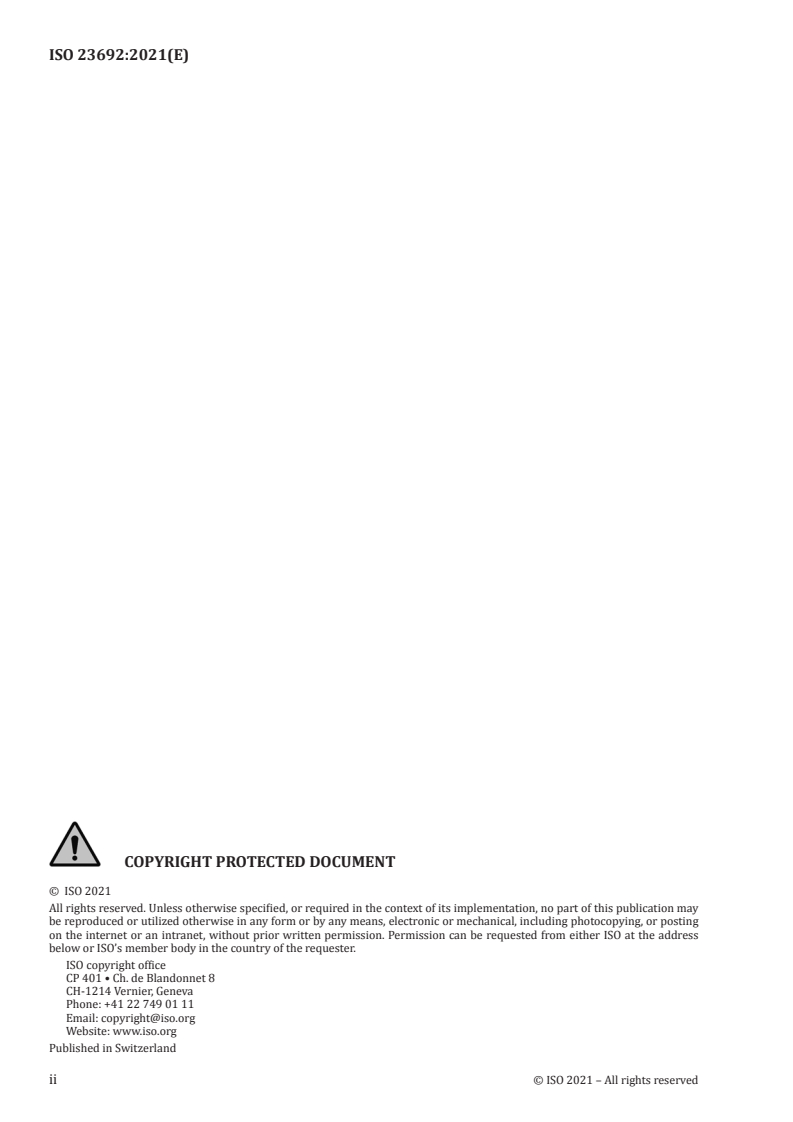
INTERNATIONAL ISO
STANDARD 23692
First edition
2021-04
Microbeam analysis — Electron
probe microanalysis — Quantitative
analysis of Mn dendritic segregation in
continuously cast steel product
Analyse par microfaisceaux — Analyse par microsonde de Castaing
— Analyse quantitative de la ségrégation dendritique du manganèse
dans un produit en acier coulé en continu
Reference number
©
ISO 2021
© ISO 2021
All rights reserved. Unless otherwise specified, or required in the context of its implementation, no part of this publication may
be reproduced or utilized otherwise in any form or by any means, electronic or mechanical, including photocopying, or posting
on the internet or an intranet, without prior written permission. Permission can be requested from either ISO at the address
below or ISO’s member body in the country of the requester.
ISO copyright office
CP 401 • Ch. de Blandonnet 8
CH-1214 Vernier, Geneva
Phone: +41 22 749 01 11
Email: copyright@iso.org
Website: www.iso.org
Published in Switzerland
ii © ISO 2021 – All rights reserved
Contents Page
Foreword .iv
Introduction .v
1 Scope . 1
2 Normative references . 1
3 Terms and definitions . 1
4 Principle . 2
5 Selection of reference material . 2
6 Sampling and specimen preparation . 2
6.1 Sampling . 2
6.2 Specimen preparation . 2
7 Calibration of the instrument . 3
8 Procedure. 3
8.1 Prepare the instrument . 3
8.2 Set up the experiment parameters . 3
8.3 Perform the analysis. 4
8.4 Process the data . 4
9 Uncertainty . 5
10 Report . 5
Annex A (informative) Example of quantitative mapping analysis of dendritic segregation .6
Annex B (informative) Example of quantitative line analysis of dendritic segregation .9
Bibliography .13
Foreword
ISO (the International Organization for Standardization) is a worldwide federation of national standards
bodies (ISO member bodies). The work of preparing International Standards is normally carried out
through ISO technical committees. Each member body interested in a subject for which a technical
committee has been established has the right to be represented on that committee. International
organizations, governmental and non-governmental, in liaison with ISO, also take part in the work.
ISO collaborates closely with the International Electrotechnical Commission (IEC) on all matters of
electrotechnical standardization.
The procedures used to develop this document and those intended for its further maintenance are
described in the ISO/IEC Directives, Part 1. In particular, the different approval criteria needed for the
different types of ISO documents should be noted. This document was drafted in accordance with the
editorial rules of the ISO/IEC Directives, Part 2 (see www .iso .org/ directives).
Attention is drawn to the possibility that some of the elements of this document may be the subject of
patent rights. ISO shall not be held responsible for identifying any or all such patent rights. Details of
any patent rights identified during the development of the document will be in the Introduction and/or
on the ISO list of patent declarations received (see www .iso .org/ patents).
Any trade name used in this document is information given for the convenience of users and does not
constitute an endorsement.
For an explanation of the voluntary nature of standards, the meaning of ISO specific terms and
expressions related to conformity assessment, as well as information about ISO's adherence to the
World Trade Organization (WTO) principles in the Technical Barriers to Trade (TBT), see www .iso .org/
iso/ foreword .html.
This document was prepared by Technical Committee ISO/TC 202, Microbeam analysis, Subcommittee
SC 2, Electron probe microanalysis.
Any feedback or questions on this document should be directed to the user’s national standards body. A
complete listing of these bodies can be found at www .iso .org/ members .html.
iv © ISO 2021 – All rights reserved
Introduction
Electron probe X-ray microanalysis (EPMA) is a modern technique used to qualitatively determine and
quantitatively measure the elemental composition of solid materials, including metal alloys, ceramics,
glasses, minerals, polymers, powders, etc., on a spatial scale of approximately one micrometer laterally
and in depth. EPMA is based on the physical mechanism of electron-stimulated X-ray emission and
X-ray spectrometry (see ISO 23833).
The dendritic segregation rich in Mn is unavoidable during steel solidification, which is the direct cause
of banded structure in steel product formed in the hot rolling process. The toughness and strength of
steel are greatly affected by the banded structure. The quantification of the dendritic segregation can
facilitate steel maker to optimize steel-making process parameters, and therefore control the banded
structure in the final product.
It is a new method to quantify the dendritic segregation through EPMA by measuring inhomogeneity
of Mn with EPMA. In order to obtain comparative and repeatable results it is necessary to standardize
this method. These enable products to be compared and evaluated for the purpose of quality control.
INTERNATIONAL STANDARD ISO 23692:2021(E)
Microbeam analysis — Electron probe microanalysis
— Quantitative analysis of Mn dendritic segregation in
continuously cast steel product
1 Scope
This document specifies procedures for quantitative analysis of Mn dendritic segregation in steel
billets, blooms, slabs using electron probe microanalysis (EPMA).
This document is mainly applicable to continuously cast products with Mn content more than 0,01 % by
mass. It can also be used for steel ingots and steel products, such as cast iron and cast steel.
The minimum size of analysable dendrites is totally dependent on the resolution of microscope of EPMA
and beam size of filament used for quantitative analysis.
2 Normative references
The following documents are referred to in the text in such a way that some or all of their content
constitutes requirements of this document. For dated references, only the edition cited applies. For
undated references, the latest edition of the referenced document (including any amendments) applies.
ISO 11938, Microbeam analysis — Electron probe microanalysis — Methods for elemental-mapping
analysis using wavelength-dispersive spectroscopy
ISO 14594, Microbeam analysis — Electron probe microanalysis — Guidelines for the determination of
experimental parameters for wavelength dispersive spectroscopy
ISO 14595, Microbeam analysis — Electron probe microanalysis — Guidelines for the specification of
certified reference materials (CRMs)
ISO 22489, Microbeam analysis — Electron probe microanalysis — Quantitative point analysis for bulk
specimens using wavelength dispersive X-ray spectroscopy
ISO 23833, Microbeam analysis — Electron probe microanalysis (EPMA) — Vocabulary
3 Terms and definitions
For the purposes of this document, the terms and definitions given in ISO 23833 and the following apply.
ISO and IEC maintain terminological databases for use in standardization at the following addresses:
— ISO Online browsing platform: available at www .iso .org/ obp
— IEC Electropedia: available at www .electropedia .org
3.1
dendritic segregation
phenomenon that element content differs in the first-crystallized dendrite arms and post-crystallized
inter-dendritic spaces during alloy solidification in a dendritic pattern
3.2
mapping analysis
method of analysing element in EPMA, through which element distribution in an area can be obtained
3.3
line analysis
method of analysing element in EPMA, through which element distribution in a specified direction can
be obtained
3.4
ratio of dendritic segregation
SR
ratio of the maximum content in the inter-dendritic spaces and the minimum content in the dendrite
arms of the selected element in the dendritic zone of a specimen
4 Principle
Mapping analysis or line analysis is firstly performed to display the dendritic segregation of Mn
element in a certain area of steel billet. The map or line of X-ray counts can thus be obtained from the
above analysis. The calibration curve generated from a series of Mn reference
...
INTERNATIONAL ISO
STANDARD 23692
First edition
2021-04
Microbeam analysis — Electron
probe microanalysis — Quantitative
analysis of Mn dendritic segregation in
continuously cast steel product
Analyse par microfaisceaux — Analyse par microsonde de Castaing
— Analyse quantitative de la ségrégation dendritique du manganèse
dans un produit en acier coulé en continu
Reference number
©
ISO 2021
© ISO 2021
All rights reserved. Unless otherwise specified, or required in the context of its implementation, no part of this publication may
be reproduced or utilized otherwise in any form or by any means, electronic or mechanical, including photocopying, or posting
on the internet or an intranet, without prior written permission. Permission can be requested from either ISO at the address
below or ISO’s member body in the country of the requester.
ISO copyright office
CP 401 • Ch. de Blandonnet 8
CH-1214 Vernier, Geneva
Phone: +41 22 749 01 11
Email: copyright@iso.org
Website: www.iso.org
Published in Switzerland
ii © ISO 2021 – All rights reserved
Contents Page
Foreword .iv
Introduction .v
1 Scope . 1
2 Normative references . 1
3 Terms and definitions . 1
4 Principle . 2
5 Selection of reference material . 2
6 Sampling and specimen preparation . 2
6.1 Sampling . 2
6.2 Specimen preparation . 2
7 Calibration of the instrument . 3
8 Procedure. 3
8.1 Prepare the instrument . 3
8.2 Set up the experiment parameters . 3
8.3 Perform the analysis. 4
8.4 Process the data . 4
9 Uncertainty . 5
10 Report . 5
Annex A (informative) Example of quantitative mapping analysis of dendritic segregation .6
Annex B (informative) Example of quantitative line analysis of dendritic segregation .9
Bibliography .13
Foreword
ISO (the International Organization for Standardization) is a worldwide federation of national standards
bodies (ISO member bodies). The work of preparing International Standards is normally carried out
through ISO technical committees. Each member body interested in a subject for which a technical
committee has been established has the right to be represented on that committee. International
organizations, governmental and non-governmental, in liaison with ISO, also take part in the work.
ISO collaborates closely with the International Electrotechnical Commission (IEC) on all matters of
electrotechnical standardization.
The procedures used to develop this document and those intended for its further maintenance are
described in the ISO/IEC Directives, Part 1. In particular, the different approval criteria needed for the
different types of ISO documents should be noted. This document was drafted in accordance with the
editorial rules of the ISO/IEC Directives, Part 2 (see www .iso .org/ directives).
Attention is drawn to the possibility that some of the elements of this document may be the subject of
patent rights. ISO shall not be held responsible for identifying any or all such patent rights. Details of
any patent rights identified during the development of the document will be in the Introduction and/or
on the ISO list of patent declarations received (see www .iso .org/ patents).
Any trade name used in this document is information given for the convenience of users and does not
constitute an endorsement.
For an explanation of the voluntary nature of standards, the meaning of ISO specific terms and
expressions related to conformity assessment, as well as information about ISO's adherence to the
World Trade Organization (WTO) principles in the Technical Barriers to Trade (TBT), see www .iso .org/
iso/ foreword .html.
This document was prepared by Technical Committee ISO/TC 202, Microbeam analysis, Subcommittee
SC 2, Electron probe microanalysis.
Any feedback or questions on this document should be directed to the user’s national standards body. A
complete listing of these bodies can be found at www .iso .org/ members .html.
iv © ISO 2021 – All rights reserved
Introduction
Electron probe X-ray microanalysis (EPMA) is a modern technique used to qualitatively determine and
quantitatively measure the elemental composition of solid materials, including metal alloys, ceramics,
glasses, minerals, polymers, powders, etc., on a spatial scale of approximately one micrometer laterally
and in depth. EPMA is based on the physical mechanism of electron-stimulated X-ray emission and
X-ray spectrometry (see ISO 23833).
The dendritic segregation rich in Mn is unavoidable during steel solidification, which is the direct cause
of banded structure in steel product formed in the hot rolling process. The toughness and strength of
steel are greatly affected by the banded structure. The quantification of the dendritic segregation can
facilitate steel maker to optimize steel-making process parameters, and therefore control the banded
structure in the final product.
It is a new method to quantify the dendritic segregation through EPMA by measuring inhomogeneity
of Mn with EPMA. In order to obtain comparative and repeatable results it is necessary to standardize
this method. These enable products to be compared and evaluated for the purpose of quality control.
INTERNATIONAL STANDARD ISO 23692:2021(E)
Microbeam analysis — Electron probe microanalysis
— Quantitative analysis of Mn dendritic segregation in
continuously cast steel product
1 Scope
This document specifies procedures for quantitative analysis of Mn dendritic segregation in steel
billets, blooms, slabs using electron probe microanalysis (EPMA).
This document is mainly applicable to continuously cast products with Mn content more than 0,01 % by
mass. It can also be used for steel ingots and steel products, such as cast iron and cast steel.
The minimum size of analysable dendrites is totally dependent on the resolution of microscope of EPMA
and beam size of filament used for quantitative analysis.
2 Normative references
The following documents are referred to in the text in such a way that some or all of their content
constitutes requirements of this document. For dated references, only the edition cited applies. For
undated references, the latest edition of the referenced document (including any amendments) applies.
ISO 11938, Microbeam analysis — Electron probe microanalysis — Methods for elemental-mapping
analysis using wavelength-dispersive spectroscopy
ISO 14594, Microbeam analysis — Electron probe microanalysis — Guidelines for the determination of
experimental parameters for wavelength dispersive spectroscopy
ISO 14595, Microbeam analysis — Electron probe microanalysis — Guidelines for the specification of
certified reference materials (CRMs)
ISO 22489, Microbeam analysis — Electron probe microanalysis — Quantitative point analysis for bulk
specimens using wavelength dispersive X-ray spectroscopy
ISO 23833, Microbeam analysis — Electron probe microanalysis (EPMA) — Vocabulary
3 Terms and definitions
For the purposes of this document, the terms and definitions given in ISO 23833 and the following apply.
ISO and IEC maintain terminological databases for use in standardization at the following addresses:
— ISO Online browsing platform: available at www .iso .org/ obp
— IEC Electropedia: available at www .electropedia .org
3.1
dendritic segregation
phenomenon that element content differs in the first-crystallized dendrite arms and post-crystallized
inter-dendritic spaces during alloy solidification in a dendritic pattern
3.2
mapping analysis
method of analysing element in EPMA, through which element distribution in an area can be obtained
3.3
line analysis
method of analysing element in EPMA, through which element distribution in a specified direction can
be obtained
3.4
ratio of dendritic segregation
SR
ratio of the maximum content in the inter-dendritic spaces and the minimum content in the dendrite
arms of the selected element in the dendritic zone of a specimen
4 Principle
Mapping analysis or line analysis is firstly performed to display the dendritic segregation of Mn
element in a certain area of steel billet. The map or line of X-ray counts can thus be obtained from the
above analysis. The calibration curve generated from a series of Mn reference
...