

ISO 22834:2022
(Main)Large yachts — Quality assessment of life onboard — Stabilization and sea keeping
General Information
- Abstract
This document provides a comparative scale (no judgement) of motion-related comfort onboard yachts to be used for technical and commercial benefit. The scale consists of a maximum number of 5 stars, the higher the amount of stars, the higher the comfort onboard. It allows the selection of the most suitable yacht for a specific purpose, evaluates the impact of stabilization systems, compares designs and identifies the most comfortable position onboard. The methodology, work flow and criteria proposed in this document are subject to possible improvements and do not take into account certain important aspects that influence the comfort onboard. The following aspects are not covered in this document: jerk, the method to derive roll damping, stern quartering seas, risk of parametric roll, the influence of the steering devices, green water and waves impacts, compensation for yacht size, gender and age dependency, habituation. By explicitly listing the aspects that are not covered in this document, the reader becomes aware of them and can improve the assessment with dedicated considerations.
- Status
- Published
- Publication Date
- 17-Mar-2022
- Technical Committee
- ISO/TC 8/SC 12 - Ships and marine technology - Large yachts
- Drafting Committee
- ISO/TC 8/SC 12/WG 5 - Quality assessment and acceptance criteria
- Current Stage
- 6060 - International Standard published
- Start Date
- 18-Mar-2022
- Due Date
- 15-Mar-2022
- Completion Date
- 18-Mar-2022

Overview
ISO 22834:2022 - "Large yachts - Quality assessment of life onboard - Stabilization and sea keeping" establishes an objective, comparative scale for motion-related comfort on large yachts. The standard defines a 5‑star rating (no judgement) tied to measured motion metrics, enabling technical and commercial comparison of yachts, evaluation of stabilization systems, design comparison and identification of the most comfortable positions onboard.
Key technical topics and requirements
- Primary metrics: Incidence of Motion Sickness (MSI) and Effective Gravity Angle (EGA). MSI predicts percentage of people likely to suffer motion sickness (1‑hour exposure); EGA quantifies combined transversal and vertical acceleration effects (static + dynamic roll).
- Calculation basis: MSI and EGA are calculated in accordance with ISO 2631‑1:1997 (Annex D). The standard requires reporting the methodology used (empirical methods, computer programs or model tests).
- Sea states and spectra: Long‑crested irregular waves with a JONSWAP spectrum. Equivalent scatter diagrams combine western Mediterranean (GWS area 26) and Caribbean (GWS area 47) conditions (Hs 1–2 m specified ranges).
- Operational conditions: Two speeds assessed separately - 0 knots (stationary/DP/anchor) and 12 knots (transit). Standard uses a 135° heading (bow quartering) in a right‑handed coordinate system.
- Areas on board: Minimum five assessment locations: Owners cabin (OC), Dining area (DA), Wheel house (WH), Crew area (CA), Beach club (BC). Coordinates use geometric centers and a +1.2 m Z offset for deck height.
- Star rating and workability: Results map MSI/EGA outcomes to 0–5 stars; fulfilment criteria (EGA RMS < 2°, MSI < 10%) are measured as an up‑time/workability percentage weighted by peak period relevance (see Table B.2 and A.3 for weighting factors).
- Stabilization assessment: Calculations are run with and without an active stabilization system to quantify improvement. Passive external devices contributing damping are excluded from the “without” case per the standard.
- Exclusions: Jerk, roll damping derivation methods, stern-quartering seas, parametric roll risk, steering device influence, green water/wave impacts, yacht size compensation, gender/age dependency and habituation are explicitly not covered.
Practical applications
- Benchmarking and marketing: Brokers and owners can compare comfort levels across yachts using a standard 5‑star scale.
- Design and engineering: Naval architects and yacht designers use the methodology to evaluate hull/form/stabilizer effects on motions and to optimize interior placement.
- Stabilizer manufacturers: Quantify performance gains from active stabilization systems.
- Pre‑purchase surveys and owner decision‑making: Inform selection of vessels for intended use (cruising, charter, passenger comfort).
Who should use this standard
- Yacht designers, naval architects, shipyards
- Stabilization system manufacturers and integrators
- Yacht brokers, owners and managers
- Marine surveyors and technical consultants
Related standards
- ISO 2631‑1:1997 (Mechanical vibration - evaluation of human exposure to whole‑body vibration) - referenced for MSI/EGA calculation methods.
Keywords: ISO 22834:2022, large yachts, stabilization, sea keeping, MSI, EGA, motion sickness, JONSWAP, star rating, yacht comfort, ship motions.
Relations
- Consolidated By
ISO 29461-3:2024 - Air intake filter systems for rotary machinery — Test methods — Part 3: Mechanical integrity of filter elements - Effective Date
- 06-Jun-2022
Get Certified
Connect with accredited certification bodies for this standard

DNV
DNV is an independent assurance and risk management provider.

Lloyd's Register
Lloyd's Register is a global professional services organisation specialising in engineering and technology.

FSC International
Forest Stewardship Council certification.
Sponsored listings
Frequently Asked Questions
ISO 22834:2022 is a standard published by the International Organization for Standardization (ISO). Its full title is "Large yachts — Quality assessment of life onboard — Stabilization and sea keeping". This standard covers: This document provides a comparative scale (no judgement) of motion-related comfort onboard yachts to be used for technical and commercial benefit. The scale consists of a maximum number of 5 stars, the higher the amount of stars, the higher the comfort onboard. It allows the selection of the most suitable yacht for a specific purpose, evaluates the impact of stabilization systems, compares designs and identifies the most comfortable position onboard. The methodology, work flow and criteria proposed in this document are subject to possible improvements and do not take into account certain important aspects that influence the comfort onboard. The following aspects are not covered in this document: jerk, the method to derive roll damping, stern quartering seas, risk of parametric roll, the influence of the steering devices, green water and waves impacts, compensation for yacht size, gender and age dependency, habituation. By explicitly listing the aspects that are not covered in this document, the reader becomes aware of them and can improve the assessment with dedicated considerations.
This document provides a comparative scale (no judgement) of motion-related comfort onboard yachts to be used for technical and commercial benefit. The scale consists of a maximum number of 5 stars, the higher the amount of stars, the higher the comfort onboard. It allows the selection of the most suitable yacht for a specific purpose, evaluates the impact of stabilization systems, compares designs and identifies the most comfortable position onboard. The methodology, work flow and criteria proposed in this document are subject to possible improvements and do not take into account certain important aspects that influence the comfort onboard. The following aspects are not covered in this document: jerk, the method to derive roll damping, stern quartering seas, risk of parametric roll, the influence of the steering devices, green water and waves impacts, compensation for yacht size, gender and age dependency, habituation. By explicitly listing the aspects that are not covered in this document, the reader becomes aware of them and can improve the assessment with dedicated considerations.
ISO 22834:2022 is classified under the following ICS (International Classification for Standards) categories: 47.040 - Seagoing vessels. The ICS classification helps identify the subject area and facilitates finding related standards.
ISO 22834:2022 has the following relationships with other standards: It is inter standard links to ISO 29461-3:2024. Understanding these relationships helps ensure you are using the most current and applicable version of the standard.
ISO 22834:2022 is available in PDF format for immediate download after purchase. The document can be added to your cart and obtained through the secure checkout process. Digital delivery ensures instant access to the complete standard document.
Standards Content (Sample)
INTERNATIONAL ISO
STANDARD 22834
First edition
2022-03
Large yachts — Quality assessment of
life onboard — Stabilization and sea
keeping
Grands yachts — Évaluation de la qualité de la vie à bord —
Stabilisation et tenue en mer
Reference number
© ISO 2022
All rights reserved. Unless otherwise specified, or required in the context of its implementation, no part of this publication may
be reproduced or utilized otherwise in any form or by any means, electronic or mechanical, including photocopying, or posting on
the internet or an intranet, without prior written permission. Permission can be requested from either ISO at the address below
or ISO’s member body in the country of the requester.
ISO copyright office
CP 401 • Ch. de Blandonnet 8
CH-1214 Vernier, Geneva
Phone: +41 22 749 01 11
Email: copyright@iso.org
Website: www.iso.org
Published in Switzerland
ii
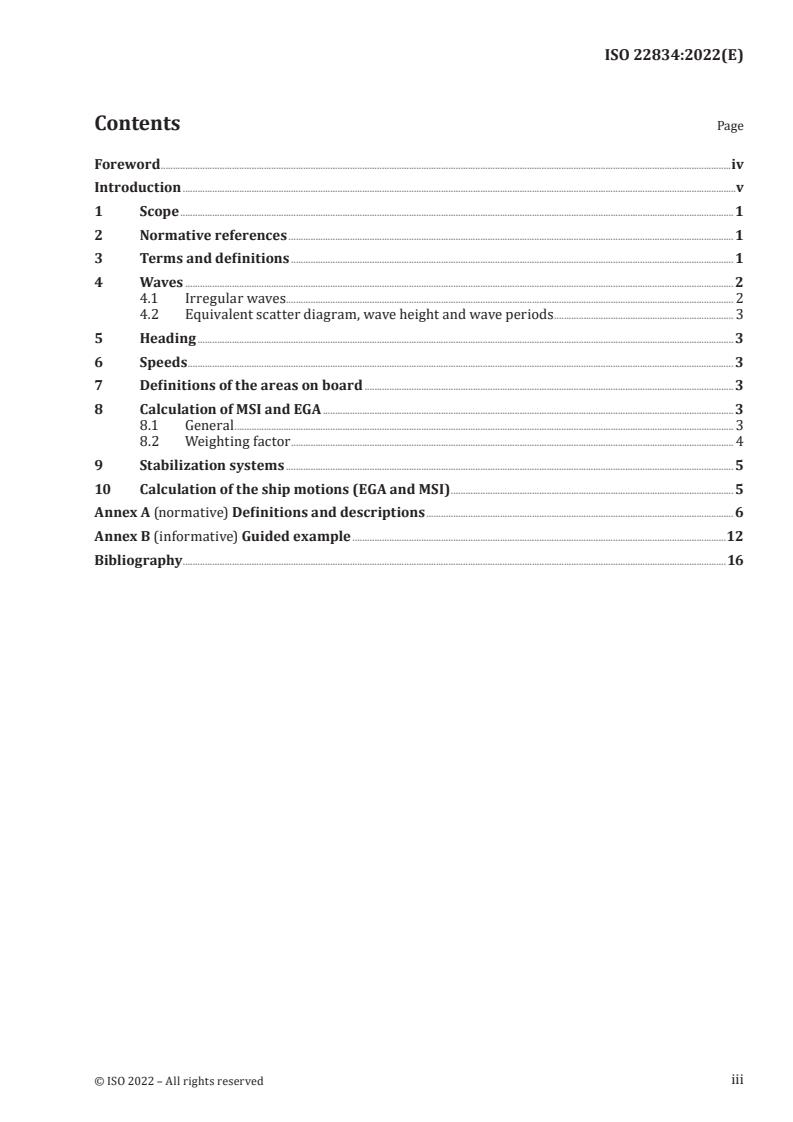
Contents Page
Foreword .iv
Introduction .v
1 Scope . 1
2 Normative references . 1
3 Terms and definitions . 1
4 Waves . 2
4.1 Irregular waves . . 2
4.2 Equivalent scatter diagram, wave height and wave periods . 3
5 Heading . 3
6 Speeds . 3
7 Definitions of the areas on board .3
8 Calculation of MSI and EGA .3
8.1 General . 3
8.2 Weighting factor . 4
9 Stabilization systems . 5
10 Calculation of the ship motions (EGA and MSI) . 5
Annex A (normative) Definitions and descriptions . 6
Annex B (informative) Guided example .12
Bibliography .16
iii
Foreword
ISO (the International Organization for Standardization) is a worldwide federation of national standards
bodies (ISO member bodies). The work of preparing International Standards is normally carried out
through ISO technical committees. Each member body interested in a subject for which a technical
committee has been established has the right to be represented on that committee. International
organizations, governmental and non-governmental, in liaison with ISO, also take part in the work.
ISO collaborates closely with the International Electrotechnical Commission (IEC) on all matters of
electrotechnical standardization.
The procedures used to develop this document and those intended for its further maintenance are
described in the ISO/IEC Directives, Part 1. In particular, the different approval criteria needed for the
different types of ISO documents should be noted. This document was drafted in accordance with the
editorial rules of the ISO/IEC Directives, Part 2 (see www.iso.org/directives).
Attention is drawn to the possibility that some of the elements of this document may be the subject of
patent rights. ISO shall not be held responsible for identifying any or all such patent rights. Details of
any patent rights identified during the development of the document will be in the Introduction and/or
on the ISO list of patent declarations received (see www.iso.org/patents).
Any trade name used in this document is information given for the convenience of users and does not
constitute an endorsement.
For an explanation of the voluntary nature of standards, the meaning of ISO specific terms and
expressions related to conformity assessment, as well as information about ISO's adherence to
the World Trade Organization (WTO) principles in the Technical Barriers to Trade (TBT), see
www.iso.org/iso/foreword.html.
This document was prepared by Technical Committee ISO/TC 8, Ships and marine technology,
Subcommittee SC 12, Large yachts.
Any feedback or questions on this document should be directed to the user’s national standards body. A
complete listing of these bodies can be found at www.iso.org/members.html.
iv
Introduction
The lack of standards and criteria for the assessment of the ship-motion related to the risk of discomfort
onboard of large yachts was reported to be an important issue for the industry, brokers, owners and
representatives. There was not a recognized and accepted procedure, criteria and rating that can
be used to compare yachts among each other and evaluate the impact of stabilization systems in the
improvement of the comfort onboard.
The increased demand for comfort onboard of large yachts led to the development of several types
of stabilization systems and to design large yachts with ship motions in mind. The intention of this
document is to define an objective scale for comparison of different levels of comfort at several areas
onboard of a large yacht in transit and at zero speed (DP or at anchor).
v
INTERNATIONAL STANDARD ISO 22834:2022(E)
Large yachts — Quality assessment of life onboard —
Stabilization and sea keeping
1 Scope
This document provides a comparative scale (no judgement) of motion-related comfort onboard yachts
to be used for technical and commercial benefit. The scale consists of a maximum number of 5 stars,
the higher the amount of stars, the higher the comfort onboard. It allows the selection of the most
suitable yacht for a specific purpose, evaluates the impact of stabilization systems, compares designs
and identifies the most comfortable position onboard.
The methodology, work flow and criteria proposed in this document are subject to possible
improvements and do not take into account certain important aspects that influence the comfort
onboard.
The following aspects are not covered in this document: jerk, the method to derive roll damping, stern
quartering seas, risk of parametric roll, the influence of the steering devices, green water and waves
impacts, compensation for yacht size, gender and age dependency, habituation.
By explicitly listing the aspects that are not covered in this document, the reader becomes aware of
them and can improve the assessment with dedicated considerations.
2 Normative references
The following documents are referred to in the text in such a way that some or all of their content
constitutes requirements of this document. For dated references, only the edition cited applies. For
undated references, the latest edition of the referenced document (including any amendments) applies.
ISO 2631-1:1997, Mechanical vibration and shock — Evaluation of human exposure to whole-body vibration
— Part 1: General requirements
3 Terms and definitions
For the purposes of this document, the following terms and definitions apply.
ISO and IEC maintain terminology databases for use in standardization at the following addresses:
— ISO Online browsing platform: available at https:// www .iso .org/ obp
— IEC Electropedia: available at https:// www .electropedia .org/
3.1
comfort
subjective state of well-being or absence of mechanical disturbance in relation to the
induced environment (mechanical vibration or repetitive shock)
Note 1 to entry: Many of the factors contributing to a comfortable state for crew and passengers are indicated in
Figure 1.
Note 2 to entry: Some of these factors are being assessed and described in existing ISO standards, such as
ISO 2631-1 for the vibrations and several others for the noise with respect to human beings.
Note 3 to entry: The comfort factors addressed in the study presented in this document are the ones related to
motion, postural stability and the motion sea sickness.
Note 4 to entry: Some of the factors influencing comfort are a function of the extension to the exposure to that
specific factor and its intensity, as well as to the gender, age and previous experiences of the subject experiencing
discomfort. The mental state of the subjects plays also a very important role.
Figure 1 — List of elements contributing to comfort onboard
3.2
effective gravity angle
EGA
angle between the transversal acceleration and the sum of the vertical acceleration and the standard
gravitational acceleration containing the static roll angle and also the dynamic components
Note 1 to entry: The EGA is the direct measure of the need to look for support for standing persons, but also for
tipping or sliding of objects.
3.3
incidence of motion sickness
MSI
simple and concise statistically-based measure for predicting the incidence of motion sickness by
exposure to vertical accelerations
Note 1 to entry: MSI expresses the percentage of people on board that suffer from sea sickness after a certain
exposure time. For passengers vessels, a percentage of 10 % seems to be reported in literature.
Note 2 to entry: The duration of exposure is of one hour.
4 Waves
4.1 Irregular waves
Long crested irregular waves with a Jonswap wave spectrum shall be applied.
4.2 Equivalent scatter diagram, wave height and wave periods
The combined equivalent scatter diagrams of the western Mediterranean (area 47 of the global waves
statistics GWS) and Caribbean seas (area 26 GWS) with a significant height between 1 m and 2 m and
the periods indicated in Table A.3 and Figure A.3 shall be used.
5 Heading
A right-handed coordinate system shall be used. The 135° heading (bow quartering) shall be used.
Table A.2 and Figure A.4 indicate the heading convention and reference system.
6 Speeds
The two following speeds shall be used separately:
— 0 knots;
— 12 knots.
7 Definitions of the areas on board
Independently on where they are located onboard, the following five areas shall be used as a minimum:
1. owners cabin (OC)
2. dining area (DA)
3. wheel house (WH)
4. crew area (CA)
5. beach club (BC)
The coordinates of the selected areas shall be obtained by considering the geometrical centre of these
areas with respect to the origin. The origin shall be reported. The Z-coordinate (vertical plane) shall be
determined by considering the deck height of the corresponding area, adding 1,2 m to this height.
When the areas are distributed in a non-symmetrical way, the assessment shall be done for the area
itself but also for the mirrored area with respect to the longitudinal ship’s plane as well. In this way, the
assessment is done for both the windward and leeward side of the non-symmetrical area.
When the destination of the areas onboard is not defined yet, at least five areas without name but
uniquely identified (area 1, area 2, etc.) shall be used for the assessment of the comfort onboard
following the procedure indicated in this document.
8 Calculation of MSI and EGA
8.1 General
For each of the five areas, the MSI and EGA shall be calculated and assessed in accordance with
ISO 2631-1:1997, Annex D.
The EGA shall be calculated using Formula (1):
at()
Y
EGAt()=arctan (1)
at +g
()
Z
where
a transversal acceleration in [m/s ];
Y
a vertical acceleration in [m/s ];
Z
g standard gravitational acceleration in [m/s ].
NOTE The EGA contains not only the static roll angle but also the dynamic components [see Figure 2 and
Formula (1)]. The EGA is a direct measure of the need to look for support for standing persons, but also for tipping
or sliding of objects. Tipping occurs when the EGA is pointing outside the base of the subject. Sliding is dependent
on the friction between the subject and the surface on which it is standing.
Figure 2 — Determination of the EGA
The assessment of these two quantities (MSI and EGA) is done by verifying the simultaneous fulfilment
of the following criteria:
— The root mean square (RMS) of the EGA shall be lower than 2°;
— The MSI shall be lower than 10 %.
As indicated in Table B.2, there is a relation between the results of the calculations of MSI and EGA at
the indicated conditions (the ship’s speed, heading, wave height, periods, etc.) and the amount of stars.
The fulfilment of the criteria is given as percentage of time: the up-time. This term is also known as
workability.
8.2 Weighting factor
The equivalent weighting factors given in Table A.3 shall be used for each of the five areas onboard.
When there is the need to calculate the comfort on more than five areas onboard, equivalent weighting
factors shall be used.
9 Stabilization systems
The calculation process shall be performed both with an active stabilization system and without a
stabilization system, but not with a passive stabilization system. When a yacht is equipped with passive
stabilization systems with elements that remain outside the hull, such a stabilization system contributes
to the generation of damping like a bilge keel. The system is excluded when considering the “without”
stabilization case. One of the purposes of the entire calculation process is to indicate the improvement
in comfort obtainable by adopting a stabilization system with respect to the yacht without any system.
The result is the number of stars per area onboard of the yacht without stabilization, and the number of
stars per area onboard obtainable with an active stabilization system. The difference in the number of
stars is owing to the contribution of the stabilization system to the comfort onboard.
10 Calculation of the ship motions (EGA and MSI)
There are several ways to calculate ship motions and the corresponding EGA and MSI: empirical
methods, computer programmes and physical model testi
...