

ISO 28139:2019
(Main)Equipment for crop protection — Knapsack combustion engine-driven airblast sprayers — Safety and environmental requirements and test methods
General Information
- Abstract
This document specifies safety requirements and their verification, environmental requirements and related test methods, and minimum performance limits, for the design and construction of knapsack combustion engine-driven airblast sprayers as defined in 3.9. It describes methods for the elimination or reduction of hazards arising from their use. In addition, it specifies the type of information on safe working practices to be provided by the manufacturer. It addresses general operating parameters as well as the potential deposition of spray droplets under specified controlled conditions. This document deals with all significant hazards, hazardous situations and events, excepting those arising from vibration transmitted to the back of the operator. It is applicable to knapsack combustion engine-driven airblast sprayers when they are used as intended and under the conditions foreseeable by the manufacturer (see Table A.1). It is not applicable to: — hydraulic pressure sprayers; — thermal sprayers; — cold foggers; — sprayers adapted for the application of dry material. It is not applicable to knapsack combustion engine-driven airblast sprayers manufactured before the date of its publication. The requirements of this document applies to products manufactured 18 months after publication.
- Status
- Published
- Publication Date
- 09-Dec-2019
- Technical Committee
- ISO/TC 23/SC 6 - Equipment for crop protection
- Drafting Committee
- ISO/TC 23/SC 6/WG 5 - Portable sprayers
- Current Stage
- 9093 - International Standard confirmed
- Start Date
- 05-Mar-2025
- Completion Date
- 29-Aug-2026
Buy Documents

ISO 28139:2019 - Equipment for crop protection -- Knapsack combustion engine-driven airblast sprayers -- Safety and environmental requirements and test methods

ISO 28139:2019 - Equipment for crop protection — Knapsack combustion engine-driven airblast sprayers — Safety and environmental requirements and test methods/10/2019
ISO 28139:2019 - Matériel de protection des cultures -- Atomiseurs portés a dos motorisés -- Exigences de sécurité et environnementales et méthodes d'essai
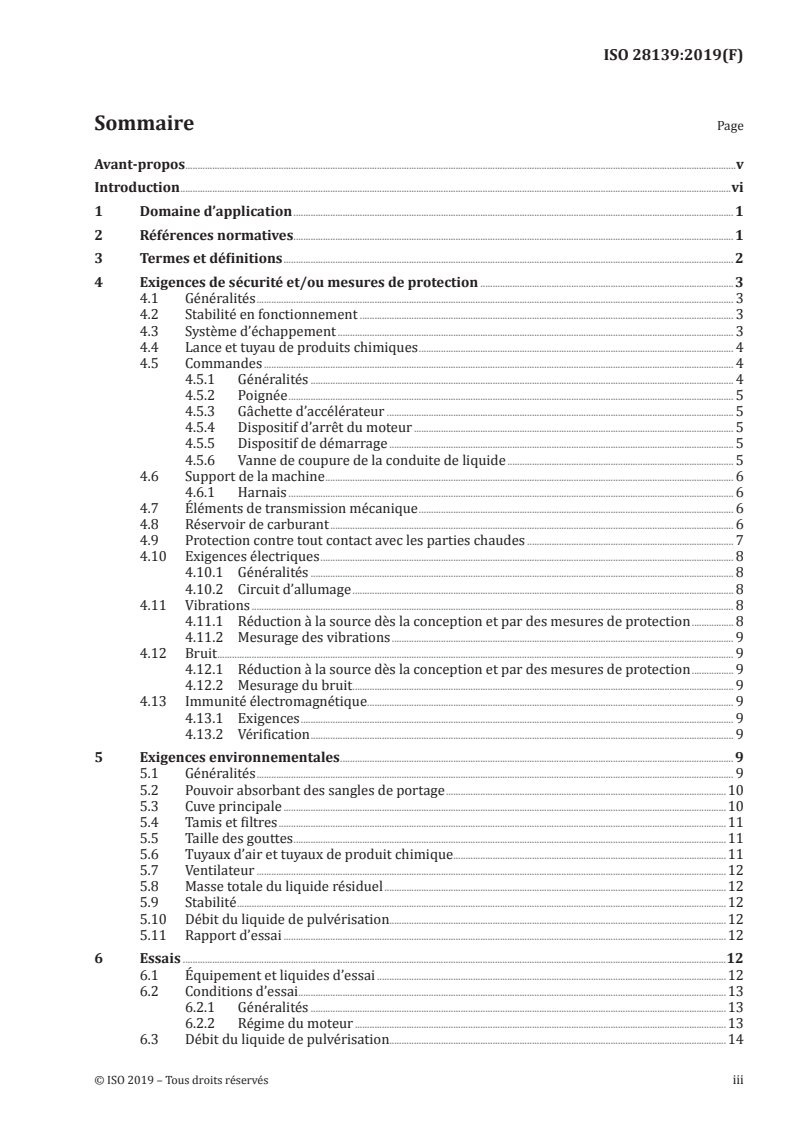
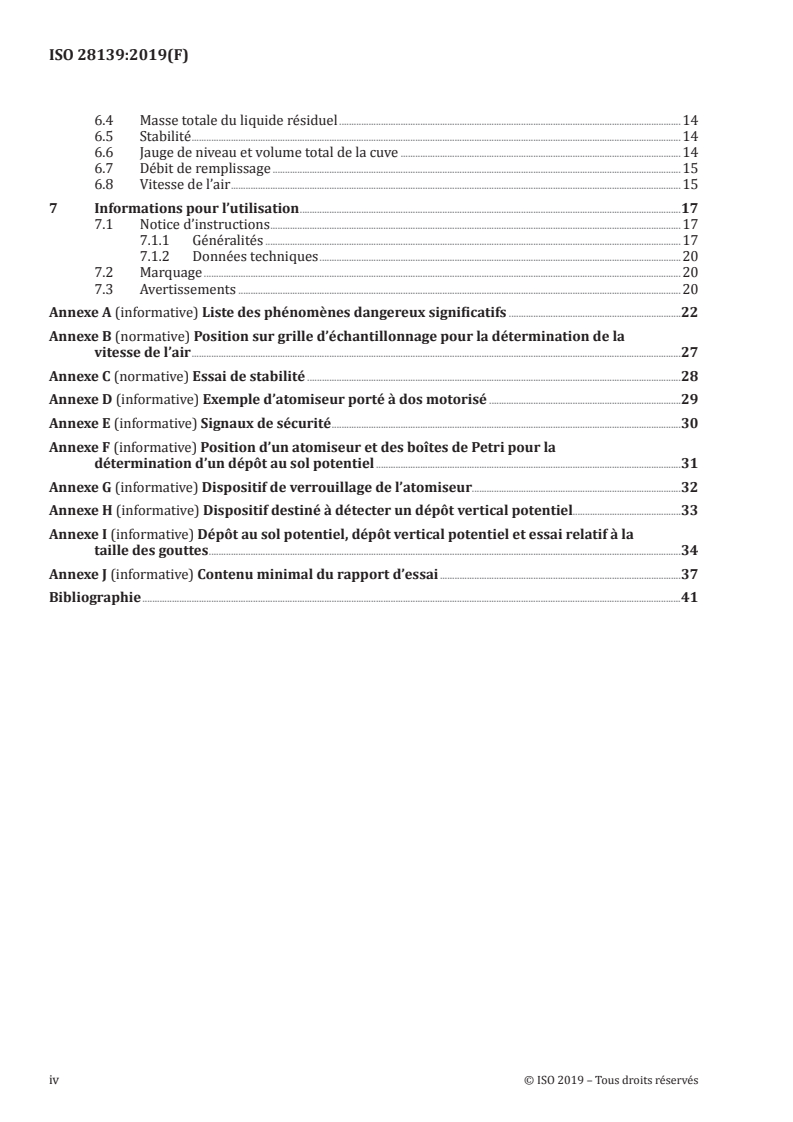
ISO 28139:2019 - Matériel de protection des cultures — Atomiseurs portés à dos motorisés — Exigences de sécurité et environnementales et méthodes d'essai/10/2019
Overview
ISO 28139:2019 - "Equipment for crop protection - Knapsack combustion engine-driven airblast sprayers - Safety and environmental requirements and test methods" is an ISO Type‑C standard that specifies safety, environmental requirements and associated test methods for knapsack combustion engine‑driven airblast sprayers. It covers design and construction, hazard elimination/reduction, minimum performance limits, and the information manufacturers must provide on safe working practices. The standard applies to machines used as intended and under foreseeable conditions (see Table A.1), and its requirements apply to products manufactured 18 months after publication.
Key technical topics and requirements
ISO 28139:2019 addresses a comprehensive set of safety and environmental topics, including:
- Safety requirements and protective measures
- Stability in operation, machine support and harness
- Exhaust system design and protection from hot parts
- Air tubes, chemical hoses, liquid line shut‑off valves
- User controls: handle, throttle trigger, starting and stopping devices
- Fuel tank design and protection of power‑driven components
- Electrical and ignition circuit requirements, electromagnetic immunity
- Vibration and noise reduction and measurement (vibration effects on operator’s back are excluded)
- Environmental requirements
- Spray tank integrity, strainers and filters, air hoses and fan performance
- Droplet size characteristics and tests for potential ground/vertical deposit
- Residual liquid mass limits and requirements for carrying strap absorbency
- Stability and spray liquid flow rate under test conditions
- Test methods
- Defined procedures for spray output, air velocity, stability, residual liquid, droplet size and sampling grids
- Test liquids, test conditions, reporting formats (see Annexes I and J)
- Information for use
- Mandatory instruction handbook content, marking and warning signs for safe operation
(See the standard’s table of contents for full clause breakdown and informative/ normative annexes.)
Practical applications and who uses ISO 28139:2019
ISO 28139:2019 is practical for:
- Manufacturers and designers of knapsack combustion engine‑driven airblast sprayers - to meet safety, environmental and test requirements during design and production.
- Test laboratories and conformity assessment bodies - for standardized test methods and test report content.
- Regulators and market surveillance - to assess compliance and product safety before placing on market.
- Large farm operators, equipment purchasers and safety managers - as a reference for selecting compliant, lower‑risk sprayers and understanding manufacturer information and warnings.
- Health and safety professionals - for risk reduction, PPE planning and environmental impact evaluation.
Related standards and context
- ISO 28139:2019 is a Type‑C machinery safety standard in the framework of ISO 12100 (risk assessment and machine safety).
- It replaces ISO 28139:2009 and ISO 10988:2011 and adds environmental tests and updated state‑of‑the‑art requirements.
Keywords: ISO 28139:2019, knapsack combustion engine-driven airblast sprayers, safety requirements, environmental requirements, test methods, crop protection, sprayer standards.
Relations
- Effective Date
- 09-Feb-2026
- Effective Date
- 12-Feb-2026
- Effective Date
- 18-Dec-2021
- Effective Date
- 11-Oct-2014
- Effective Date
- 11-Oct-2014
Buy Documents
ISO 28139:2019 - Equipment for crop protection -- Knapsack combustion engine-driven airblast sprayers -- Safety and environmental requirements and test methods
ISO 28139:2019 - Equipment for crop protection — Knapsack combustion engine-driven airblast sprayers — Safety and environmental requirements and test methods/10/2019
ISO 28139:2019 - Matériel de protection des cultures -- Atomiseurs portés a dos motorisés -- Exigences de sécurité et environnementales et méthodes d'essai
ISO 28139:2019 - Matériel de protection des cultures — Atomiseurs portés à dos motorisés — Exigences de sécurité et environnementales et méthodes d'essai/10/2019
Get Certified
Connect with accredited certification bodies for this standard

Control Union Certifications
Global certification for agriculture and sustainability.

ECOCERT
Organic and sustainability certification.

FSC International
Forest Stewardship Council certification.
Sponsored listings
Frequently Asked Questions
ISO 28139:2019 is a standard published by the International Organization for Standardization (ISO). Its full title is "Equipment for crop protection — Knapsack combustion engine-driven airblast sprayers — Safety and environmental requirements and test methods". This standard covers: This document specifies safety requirements and their verification, environmental requirements and related test methods, and minimum performance limits, for the design and construction of knapsack combustion engine-driven airblast sprayers as defined in 3.9. It describes methods for the elimination or reduction of hazards arising from their use. In addition, it specifies the type of information on safe working practices to be provided by the manufacturer. It addresses general operating parameters as well as the potential deposition of spray droplets under specified controlled conditions. This document deals with all significant hazards, hazardous situations and events, excepting those arising from vibration transmitted to the back of the operator. It is applicable to knapsack combustion engine-driven airblast sprayers when they are used as intended and under the conditions foreseeable by the manufacturer (see Table A.1). It is not applicable to: — hydraulic pressure sprayers; — thermal sprayers; — cold foggers; — sprayers adapted for the application of dry material. It is not applicable to knapsack combustion engine-driven airblast sprayers manufactured before the date of its publication. The requirements of this document applies to products manufactured 18 months after publication.
This document specifies safety requirements and their verification, environmental requirements and related test methods, and minimum performance limits, for the design and construction of knapsack combustion engine-driven airblast sprayers as defined in 3.9. It describes methods for the elimination or reduction of hazards arising from their use. In addition, it specifies the type of information on safe working practices to be provided by the manufacturer. It addresses general operating parameters as well as the potential deposition of spray droplets under specified controlled conditions. This document deals with all significant hazards, hazardous situations and events, excepting those arising from vibration transmitted to the back of the operator. It is applicable to knapsack combustion engine-driven airblast sprayers when they are used as intended and under the conditions foreseeable by the manufacturer (see Table A.1). It is not applicable to: — hydraulic pressure sprayers; — thermal sprayers; — cold foggers; — sprayers adapted for the application of dry material. It is not applicable to knapsack combustion engine-driven airblast sprayers manufactured before the date of its publication. The requirements of this document applies to products manufactured 18 months after publication.
ISO 28139:2019 is classified under the following ICS (International Classification for Standards) categories: 65.060.40 - Plant care equipment. The ICS classification helps identify the subject area and facilitates finding related standards.
ISO 28139:2019 has the following relationships with other standards: It is inter standard links to EN ISO 22868:2021, EN ISO 28139:2021, ISO 28139:2019/Amd 1:2024, ISO 10988:2011, ISO 28139:2009. Understanding these relationships helps ensure you are using the most current and applicable version of the standard.
ISO 28139:2019 is available in PDF format for immediate download after purchase. The document can be added to your cart and obtained through the secure checkout process. Digital delivery ensures instant access to the complete standard document.
Standards Content (Sample)
INTERNATIONAL ISO
STANDARD 28139
Second edition
2019-12
Equipment for crop protection —
Knapsack combustion engine-driven
airblast sprayers — Safety and
environmental requirements and
test methods
Matériel de protection des cultures — Atomiseurs portés à dos
motorisés — Exigences de sécurité et environnementales et
méthodes d'essai
Reference number
©
ISO 2019
© ISO 2019
All rights reserved. Unless otherwise specified, or required in the context of its implementation, no part of this publication may
be reproduced or utilized otherwise in any form or by any means, electronic or mechanical, including photocopying, or posting
on the internet or an intranet, without prior written permission. Permission can be requested from either ISO at the address
below or ISO’s member body in the country of the requester.
ISO copyright office
CP 401 • Ch. de Blandonnet 8
CH-1214 Vernier, Geneva
Phone: +41 22 749 01 11
Fax: +41 22 749 09 47
Email: copyright@iso.org
Website: www.iso.org
Published in Switzerland
ii © ISO 2019 – All rights reserved
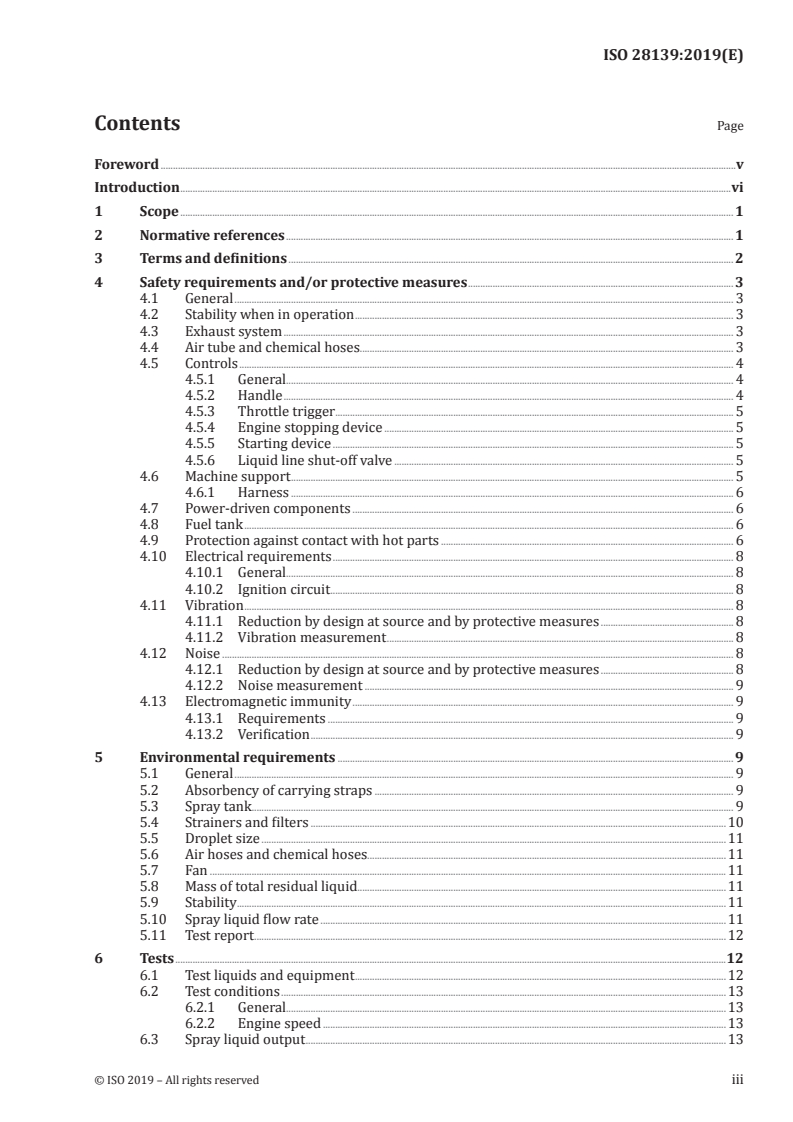
Contents Page
Foreword .v
Introduction .vi
1 Scope . 1
2 Normative references . 1
3 Terms and definitions . 2
4 Safety requirements and/or protective measures . 3
4.1 General . 3
4.2 Stability when in operation . 3
4.3 Exhaust system . 3
4.4 Air tube and chemical hoses. 3
4.5 Controls . 4
4.5.1 General. 4
4.5.2 Handle . 4
4.5.3 Throttle trigger . . . 5
4.5.4 Engine stopping device . 5
4.5.5 Starting device . 5
4.5.6 Liquid line shut-off valve . 5
4.6 Machine support . 5
4.6.1 Harness . 6
4.7 Power-driven components . 6
4.8 Fuel tank . 6
4.9 Protection against contact with hot parts . 6
4.10 Electrical requirements . 8
4.10.1 General. 8
4.10.2 Ignition circuit . 8
4.11 Vibration . 8
4.11.1 Reduction by design at source and by protective measures . 8
4.11.2 Vibration measurement . 8
4.12 Noise . 8
4.12.1 Reduction by design at source and by protective measures . 8
4.12.2 Noise measurement . 9
4.13 Electromagnetic immunity . 9
4.13.1 Requirements . 9
4.13.2 Verification . 9
5 Environmental requirements . 9
5.1 General . 9
5.2 Absorbency of carrying straps . 9
5.3 Spray tank . 9
5.4 Strainers and filters .10
5.5 Droplet size .11
5.6 Air hoses and chemical hoses.11
5.7 Fan .11
5.8 Mass of total residual liquid.11
5.9 Stability .11
5.10 Spray liquid flow rate .11
5.11 Test report .12
6 Tests .12
6.1 Test liquids and equipment .12
6.2 Test conditions .13
6.2.1 General.13
6.2.2 Engine speed .13
6.3 Spray liquid output .13
6.4 Mass of total residual liquid.13
6.5 Stability .14
6.6 Contents gauge scale and total tank volume .14
6.7 Filling rate .14
6.8 Air velocity .15
7 Information for use .16
7.1 Instruction handbook .16
7.1.1 General.16
7.1.2 Technical data .18
7.2 Marking .19
7.3 Warnings .19
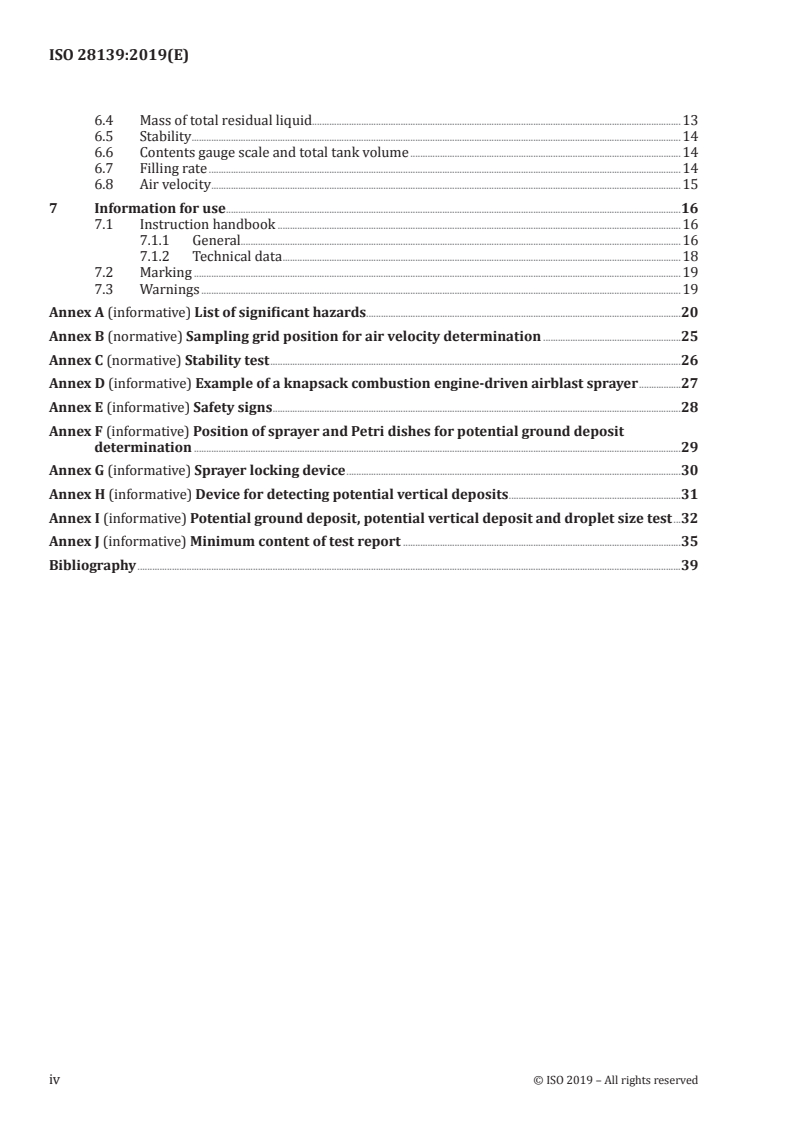
Annex A (informative) List of significant hazards.20
Annex B (normative) Sampling grid position for air velocity determination .25
Annex C (normative) Stability test .26
Annex D (informative) Example of a knapsack combustion engine-driven airblast sprayer .27
Annex E (informative) Safety signs .28
Annex F (informative) Position of sprayer and Petri dishes for potential ground deposit
determination .29
Annex G (informative) Sprayer locking device .30
Annex H (informative) Device for detecting potential vertical deposits .31
Annex I (informative) Potential ground deposit, potential vertical deposit and droplet size test .32
Annex J (informative) Minimum content of test report .35
Bibliography .39
iv © ISO 2019 – All rights reserved
Foreword
ISO (the International Organization for Standardization) is a worldwide federation of national standards
bodies (ISO member bodies). The work of preparing International Standards is normally carried out
through ISO technical committees. Each member body interested in a subject for which a technical
committee has been established has the right to be represented on that committee. International
organizations, governmental and non-governmental, in liaison with ISO, also take part in the work.
ISO collaborates closely with the International Electrotechnical Commission (IEC) on all matters of
electrotechnical standardization.
The procedures used to develop this document and those intended for its further maintenance are
described in the ISO/IEC Directives, Part 1. In particular the different approval criteria needed for the
different types of ISO documents should be noted. This document was drafted in accordance with the
editorial rules of the ISO/IEC Directives, Part 2 (see www .iso .org/ directives).
Attention is drawn to the possibility that some of the elements of this document may be the subject of
patent rights. ISO shall not be held responsible for identifying any or all such patent rights. Details of
any patent rights identified during the development of the document will be in the Introduction and/or
on the ISO list of patent declarations received (see www .iso .org/ patents).
Any trade name used in this document is information given for the convenience of users and does not
constitute an endorsement.
For an explanation on the voluntary nature of standards, the meaning of ISO specific terms and
expressions related to conformity assessment, as well as information about ISO's adherence to the
World Trade Organization (WTO) principles in the Technical Barriers to Trade (TBT) see the following
URL: www .iso .org/ iso/ foreword .html.
This document was prepared by Technical Committee ISO/TC 23, Tractors and machinery for agriculture
and forestry, Subcommittee SC 6, Equipment for crop protection.
This second edition of ISO 28139 cancels and replaces ISO 28139:2009 and ISO 10988:2011, which have
been technically revised. The main changes compared to the previous edition are as follows:
— addition of environmental requirements;
— addition of environmental tests;
— exclusion of ergonomics;
— general update to the state of the art.
Any feedback or questions on this document should be directed to the user’s national standards body. A
complete listing of these bodies can be found at www .iso .org/ members .html.
Introduction
The structure of safety standards in the field of machinery is as follows:
a) type-A standards (basic standards) giving basic concepts, principles for design, and general aspects
that can be applied to machinery;
b) type-B standards (generic safety standards) dealing with one safety aspect or one type of
safeguards that can be used across a wide range of machinery:
— type-B1 standards on particular safety aspects (e.g. safety distances, surface temperature, noise),
— type-B2 standards on safeguards (e.g. two-hand control devices, interlocking devices, pressure
sensitive devices, guards);
c) type-C standards (machinery safety standards) dealing with detailed safety requirements for a
particular machine or group of machines.
This document is a type-C standard as stated in ISO 12100.
This document is of relevance, in particular, for the following stakeholder groups representing the
market players with regard to machinery safety:
— machine manufacturers (small, medium and large enterprises);
— health and safety bodies (regulators, accident prevention organizations, market surveillance, etc.).
Others can be affected by the level of machinery safety achieved with the means of the document by the
above-mentioned stakeholder groups:
— machine users/employers (small, medium and large enterprises);
— machine users/employees (e.g. trade unions, organizations for people with special needs);
— service providers, e.g. for maintenance (small, medium and large enterprises);
— consumers (in case of machinery intended for use by consumers).
The above-mentioned stakeholder groups have been given the possibility to participate at the drafting
process of this document.
The machinery concerned and the extent to which hazards, hazardous situations or hazardous events
are covered are indicated in the Scope of this document.
When requirements of this type-C standard are different from those which are stated in type-A or B
standards, the requirements of this type-C standard take precedence over the requirements of the
other standards for machines that have been designed and built according to the requirements of this
type-C standard.
vi © ISO 2019 – All rights reserved
INTERNATIONAL STANDARD ISO 28139:2019(E)
Equipment for crop protection — Knapsack combustion
engine-driven airblast sprayers — Safety and
environmental requirements and test methods
1 Scope
This document specifies safety requirements and their verification, environmental requirements and
related test methods, and minimum performance limits, for the design and construction of knapsack
combustion engine-driven airblast sprayers as defined in 3.9.
It describes methods for the elimination or reduction of hazards arising from their use. In addition, it
specifies the type of information on safe working practices to be provided by the manufacturer.
It addresses general operating parameters as well as the potential deposition of spray droplets under
specified controlled conditions.
This document deals with all significant hazards, hazardous situations and events, excepting those
arising from vibration transmitted to the back of the operator.
It is applicable to knapsack combustion engine-driven airblast sprayers when they are used as intended
and under the conditions foreseeable by the manufacturer (see Table A.1).
It is not applicable to:
— hydraulic pressure sprayers;
— thermal sprayers;
— cold foggers;
— sprayers adapted for the application of dry material.
It is not applicable to knapsack combustion engine-driven airblast sprayers manufactured before the
date of its publication. The requirements of this document applies to products manufactured 18 months
after publication.
2 Normative references
The following documents are referred to in the text in such a way that some or all of their content
constitutes requirements of this document. For dated references, only the edition cited applies. For
undated references, the latest edition of the referenced document (including any amendments) applies.
ISO 3767-5, Tractors, machinery for agriculture and forestry, powered lawn and garden equipment —
Symbols for operator controls and other displays — Part 5: Symbols for manual portable forestry machines
ISO 3864-1, Graphical symbols — Safety colours and safety signs — Part 1: Design principles for safety
signs and safety markings
ISO 5681, Equipment for crop protection — Vocabulary
ISO 9357:1990, Equipment for crop protection — Agricultural sprayers — Tank nominal volume and filling
hole diameter
ISO 11684, Tractors, machinery for agriculture and forestry, powered lawn and garden equipment — Safety
signs and hazard pictorials — General principles
ISO 12100:2010, Safety of machinery — General principles for design — Risk assessment and risk reduction
ISO 13857:2008, Safety of machinery — Safety distances to prevent hazard zones being reached by upper
and lower limbs
ISO 14982:1998, Agricultural and forestry machinery — Electromagnetic compatibility — Test methods
and acceptance criteria
ISO 19732, Equipment for crop protection — Sprayer filters — Colour coding for identification
ISO 19932-1, Equipment for crop protection — Knapsack sprayers — Part 1: Safety and environmental
requirements
ISO 19932-2:—, Equipment for crop protection — Knapsack sprayers — Part 2: Test methods
ISO 22867, Forestry and gardening machinery — Vibration test code for portable hand-held machines with
internal combustion engine — Vibration at the handles
ISO 22868:2011, Forestry and gardening machinery — Noise test code for portable hand-held machines
with internal combustion engine — Engineering method (Grade 2 accuracy)
IEC 61032:1997, Protection of persons and equipment by enclosures — Probes for verification
3 Terms and definitions
For the purposes of this document, the terms and definitions given in ISO 12100, ISO 5681, ISO 19932-1
and the following apply.
ISO and IEC maintain terminological databases for use in standardization at the following addresses:
— ISO Online browsing platform: available at https:// www .iso .org/ obp
— IEC Electropedia: available at http:// www .electropedia .org/
3.1
harness
adjustable strap(s) used to suspend the machine from the operator
3.2
engine stopping device
control fitted to the machine which stops the engine
3.3
throttle trigger
throttle control
device, usually a lever, activated by the operator’s hand or finger, for controlling the engine speed
3.4
throttle lock
device for temporarily setting the throttle in a partially open position
3.5
throttle trigger lockout
device that prevents unintentional activation of the throttle trigger (3.3)
3.6
air tube
tube for the air flow between the fan and the nozzle
2 © ISO 2019 – All rights reserved
3.7
normal operation
use of the machine that is reasonably foreseeable and which is consistent with such activities as
distribution of chemicals, starting, stopping, fuelling, filling with chemicals and emptying
3.8
throttle limiting device
manually activated device allowing different maximum positions of the throttle provided to facilitate
operation of the engine over a long working period
3.9
knapsack airblast sprayer
self-contained appliance carried on the operator’s back by means of shoulder straps in which spray is
produced by the action a high velocity air stream on the spray mixture
4 Safety requirements and/or protective measures
4.1 General
The machinery shall comply with the safety requirements and/or protective measures of this clause.
In addition, the machine shall be designed according to the principles of ISO 12100 for relevant but not
significant hazards which are not dealt with by this document. (See Annex A for a list of significant
hazards and hazardous situations and Annex D for a functional representation of the machine.)
Wearing parts (such as nozzles, filters, anti-drip valves, valves, diaphragms) specified in the instruction
handbook shall be changeable without special tools, unless provided with the sprayer, by an operator
wearing appropriate PPE (at least protective gloves) and without contamination of the operator and the
environment.
Compliance shall be checked by inspection and function test.
4.2 Stability when in operation
The centre of gravity of the upright sprayer shall not be located at a horizontal distance greater than
150 mm from the back support of the harness with fuel and spray tanks filled to their nominal volume
and with the equipment ready for use.
Compliance shall be checked by measurement as described in ISO 19932-2:—, 5.3.4.
4.3 Exhaust system
The engine exhaust outlet shall be located so as to direct exhaust emissions away from the operator in
the normal operating position.
Compliance shall be checked by inspection and functional testing.
4.4 Air tube and chemical hoses
The air tube shall be fitted with a handle on which a throttle trigger complying with 4.5.3 and an engine
stopping device complying with 4.5.4 are mounted.
To adjust the flow of chemicals to the nozzle, an on-off valve shall be fitted such that it can be easily
reached by the operator in the working position.
The minimum length of the air tube from the middle of the hand grip to the extremity of the air tube
shall be 500 mm as shown in Figure 1.
Dimensions in millimetres
Figure 1 — Length of the air tube
The air tube shall not be detachable without the use of a tool. This requirement does not apply to
machines where detached air tube does not allow the moving elements to be reached in accordance
with ISO 13857:2008, Table 4.
Compliance shall be checked by inspection, functional testing and measurement.
4.5 Controls
4.5.1 General
All controls shall be designed to be operable by an operator wearing appropriate protective gloves.
Compliance shall be checked by functional testing.
Where the purpose of a control might not be obvious to the user, the control's function, direction and/or
method of operation shall be clearly identified by a durable label or mark. Compliance shall be checked
by inspection.
Detailed instructions on the operation of the control(s) shall be provided in the instruction handbook.
Operations when applying plant protection products (PPP) shall be possible wearing appropriate
personal protective equipment (PPE).
Compliance shall be checked by inspection.
4.5.2 Handle
The length of the gripping surface of the handle shall be at least 100 mm.
Compliance shall be checked by measurement.
4 © ISO 2019 – All rights reserved
4.5.3 Throttle trigger
The machine shall be fitted with a throttle trigger that, when released, automatically reverts to the
idling position and is retained in that position by the automatic engagement of a throttle trigger lockout
device (see 3.5).
Two or more independent motions are required to engage the throttle lock.
The throttle trigger shall be positioned so that it can be pressed and released with a hand holding the
handle on which the throttle trigger is mounted while wearing an appropriate protective glove.
If a throttle lock (see 3.4) is provided for starting the engine, it shall be automatically released when the
throttle trigger is operated.
If a throttle limiting device is provided, it shall be positioned so that it can be operated and easily
released by a gloved hand holding the handle to which the device is mounted. The throttle limiting
device shall not prevent the return of the throttle to the idling position.
Compliance shall be checked by inspection, functional testing and measurement.
4.5.4 Engine stopping device
The machine shall be fitted with an engine stopping device by which the engine can be brought to a
full stop and that does not depend on sustained manual effort for its operation. The control for this
device shall be attached adjacent to the throttle control so that it can be activated by the operator when
holding the gripping area with a hand wearing an appropriate protective glove.
The purpose and method of operation of the device shall be clearly and durably marked. The colour of
the control shall clearly contrast with the background.
Compliance shall be checked by inspection and functional testing.
4.5.5 Starting device
A starting device shall be provided to allow starting of the engine without the need for separate,
independent auxiliary assistance (for example, belts or cables).
When the machine is fitted with an electric starting device, two or more independent motions shall be
required to engage the device.
Compliance shall be checked by inspection and functional testing.
4.5.6 Liquid line shut-off valve
Spray liquid lines shall be equipped with a shut-off device, which shall be positioned so that it can be
easily reached by the operator in the normal operating position. No uncontrolled liquid output shall
occur at least when the engine is at idling mode. The volume emitted within 5 s after spray shut-off shall
not be more than 5 ml.
Compliance shall be checked at idle by inspection and measurement.
4.6 Machine support
The machine shall be supported by a backpack frame designed to distribute the load on the operator’s
back and shoulders.
Compliance shall be checked by inspection.
4.6.1 Harness
A double shoulder harness shall be provided to support the machine. It shall be adjustable to fit the size
of the operator.
A double shoulder harness shall be designed so that pressure is evenly distributed on both shoulders of
the operator. The design of the double shoulder harness shall prevent slipping in any direction.
The harness shall be designed and built such that the machine could be quickly released by the operator
in case of emergency.
The straps shall be adjustable in length to meet the needs of the operator while on the operator’s back.
Each shoulder strap shall be adjustable to a length of at least 75 cm, as measured between the fixing
points of the same strap.
Each shoulder strap shall have a load bearing part of a length of at least 250 mm and of a minimum
comfort width of 50 mm.
Compliance shall be checked by inspection, functional testing and measurement.
4.7 Power-driven components
The knapsack combustion engine-driven airblast sprayers shall be constructed to ensure that access
to power-driven components such as pulleys, shafts, gears, flywheels and fan blades, and to drive belts
and chains, is prevented.
For openings, such as in covers and guards preventing access to dangerous parts, the safety distances
shall be in accordance with ISO 13857:2008, Table 4.
Compliance shall be checked by inspection and measurement.
4.8 Fuel tank
The fuel cap shall have a retainer.
The fuel tank opening shall be at least 20 mm in diameter.
Each opening or cap shall be clearly marked to indicate the function of the tank, and if only the caps are
marked, they shall not be interchangeable between tanks.
The design of the fuel tank assembly shall be such that no leakage occurs while the machine is at
its normal stable operating temperature, in all working and transport positions according to the
information for use. The fuel tank shall have a ventilation system.
The filler openings shall be located so that the action of filling the tanks is not obstructed by other
components. It shall be possible to use a funnel.
The cap retainers, opening dimensions and location shall be verified by measurement and inspection.
The tightness of the caps shall be verified by inspection while turning the machine in any direction in
order to simulate the machine unintentionally falling over to a horizontal position. Seepage from fuel
tank ventilation systems is not regarded as leakage.
Compliance shall be checked by inspection, functional testing and measurement.
4.9 Protection against contact with hot parts
The engine cylinder and parts in direct contact with the cylinder or the muffler shall be protected
against unintentional contact during normal operation of the machine.
Such hot surfaces shall be considered accessible if the contactable area exceeds 10 cm when probed by
the test cone as shown in Figure 2.
6 © ISO 2019 – All rights reserved
The temperature for the accessible parts of the machine defined above, including guards or shields
provided to prevent access to such hot surfaces, shall not be more than 80 °C for metallic surfaces or
94 °C for plastic surfaces.
Verification shall be done by determining the accessibility of identified hot surfaces using the test cone
shown in Figure 2 and as follows.
Conduct the temperature test in the shade and with a maximum wind speed of 3 m/s. Operate the
engine at maximum speed and carry out the test after surface temperatures have stabilized.
Identify the hot surface area or areas. Determine temperatures using temperature-measuring
equipment with an accuracy of ±2 °C.
If the test is conducted at an ambient temperature outside of the nominal 20 °C ± 3 °C, the recorded
temperatures shall be corrected using Formula (1):
T = T − T + 20 °C (1)
C O A
where
T is the corrected temperature, in degrees Celsius (°C);
C
T is the observed temperature, in degrees Celsius (°C);
O
T is the ambient temperature, in degrees Celsius (°C).
A
Allow the power source to cool before using the cone. It is not necessary to test the accessibility of hot
parts while they are hot.
Apply the test cone shown in Figure 2 in any direction and with a maximum force of (10 ) N. When
−1
moving the cone, determine whether there is any contact between the hot surface area or areas and the
cone’s tip or the conical surface. Neither tip nor conical surface shall come into contact with any hot
surface area greater than 10 cm .
Dimensions in millimetres
Figure 2 — Test cone
4.10 Electrical requirements
4.10.1 General
Insulated electric wires shall be protected against abrasive contact with metal and hot surfaces and
shall be resistant to, or protected against, vibration and contact with lubricant and fuel.
Compliance shall be checked by inspection.
4.10.2 Ignition circuit
4.10.2.1 Requirement
Ignition interruption or short circuiting shall be provided on the low voltage side.
Access to all high voltage parts of the circuit including spark plug terminals shall be prevented in such a
manner that the operator cannot make accidental contact with them.
Compliance shall be checked by inspection and by the test of 4.10.2.2.
4.10.2.2 Test method
The requirements shall be checked by inspection and using the test probe B of IEC 61032:1997.
Test acceptance: the test probe shall not make contact with high voltage parts of the circuit including
spark plug terminals.
4.11 Vibration
4.11.1 Reduction by design at source and by protective measures
Vibration reduction shall be an integral part of the design process thus specifically taking into account
measures at source. The success of the applied vibration reduction measures is assessed on the basis
of the actual vibration total values for each handle. The main sources causing and influencing vibration
are generally the dynamic forces from engine, unbalanced moving parts, impact in gear sprockets,
bearings and other mechanisms, and the interaction between operator and machine.
NOTE CR 1030-1 gives general technical information on widely recognized technical rules and means, and
provides guidelines for the design of reduced hand-arm vibration machines.
4.11.2 Vibration measurement
Vibration shall be measured in accordance with ISO 22867 using so far as appropriate the measurement
conditions specified by Annex E. The equivalent vibration total value shall be calculated and reported
together with the uncertainty of measurement, k.
4.12 Noise
4.12.1 Reduction by design at source and by protective measures
Noise reduction shall be an integral part of the design process thus specifically taking into account
measures at source. The success of the applied noise reduction measures is assessed on the basis of the
actual noise emission values. The main sources causing and influencing noise are the air intake system,
engine cooling system, engine exhaust system and vibrating surfaces.
8 © ISO 2019 – All rights reserved
ISO/TR 11688-1 gives general technical information and guidance for the design of low-noise machines.
Special care shall be taken in the acoustical design.
NOTE ISO/TR 11688-2 gives useful information on noise generation mechanisms in machinery and
ISO 14163 provides guidelines for noise control by silencers. ISO 11691 and ISO 11820 address the testing of the
silencer.
4.12.2 Noise measurement
The equivalent A-weighted emission sound pressure level at the operator’s position and the A-weighted
sound power level shall be measured using the measurement conditions specified by ISO 22868:2011,
Annex E and reported.
See ISO 22868:2011, Clause 9 for guidance on declaration and verification.
4.13 Electromagnetic immunity
4.13.1 Requirements
All electronic components of the systems used to control the machine shall meet the acceptance criteria
given in ISO 14982:1998, 6.3 and 6.6, concerning the electromagnetic immunity of the machine.
4.13.2 Verification
Electromagnetic immunity shall be verified by testing in accordance with ISO 14982.
5 Environmental requirements
5.1 General
The sprayer shall comply with the following requirements and shall comply with the requirements of
ISO 19932-1 and ISO 19932-2 as specified in the following clauses.
The sprayer shall be designed such that the operator shall be able to pick it up, carry it and put it down
with the tanks filled at nominal volume in accordance with the instruction handbook and without any
spillage.
The sprayer shall be designed such that the filled sprayer can be carried in the upright position.
It shall not be possible to displace any gasket or seal from its seated position by tightening.
Compliance shall be checked by functional test.
5.2 Absorbency of carrying straps
The harness shall be made of non-absorbent material. The increase in mass of the harness having a
mass lower than 100 g shall not exceed 35 g after defined immersion in water. Otherwise, the increase
in mass shall not exceed 35 % of the dry mass.
Compliance shall be tested according to ISO 19932-2:—, 5.3.8.
5.3 Spray tank
The nominal volume shall be specified in whole litres (l). It shall be possible to determine the spray
tank filling level of the sprayer with a minimum resolution of 1 l. If the nominal volume of the sprayer is
at least 10 l, a lower resolution is accepted for a filling level below 4 l.
Compliance shall be checked by inspection.
The volumetric contents gauge scale shall have a maximum error of ±10 % of the reading.
Compliance shall be tested according to ISO 19932-2:—, 5.3.5.
It shall be possible to fill the spray tank to its nominal volume within 60 s. The total volume of all liquid
spillage during filling shall not exceed 5 ml.
Compliance shall be tested according to 6.7 and ISO 19932-2:—, 5.3.6.
In order to avoid chemical spillage during filling, the diameter of the filling opening shall be in
accordance with ISO 9357:1990, Table 1.
Compliance shall be checked by inspection and measurement.
The spray tank shall have a volumetric content gauge scale.
Compliance shall be checked by inspection.
The filling tank opening shall be fitted with a lid, which shall
— be able to be opened and closed without the use of a special tool, and
— be fitted with a holding device ensuring a closed position by means of a positive mechanical action
(e.g. lids fixed by screw action).
Compliance shall be checked by functional test.
It shall be possible to empty the tank of the sprayer without the need to invert the sprayer.
Compliance shall be checked by functional test.
The amount of liquid remaining in the spray tank shall not exceed 50 g when tested in accordance with
ISO 19932-2:—, 5.3.7.
Drainage opening shall not be directed towards the operator.
Compliance shall be checked by inspection.
The emptying device shall be guarded against unintentional opening.
Compliance shall be checked by inspection and functional test.
The emptying device shall be able to be operated without the use of tools when wearing appropriate
protective gloves.
Compliance shall be checked by functional test.
The spray tanks shall have an additional volume of at least 5 % of the nominal volume.
Compliance shall be tested in accordance with 6.6.
5.4 Strainers and filters
The sprayer tank shall have a strainer with a mesh width not greater than 2 mm. Gaps between the
spray tank filling opening and strainer, as well as openings within the strainer, shall not exceed 2 mm.
Compliance shall be checked by measurement.
The mesh width of the filters for the liquid going from the tank to the nozzles, if any, shall be less than
the narrowest diameter of the smallest size of nozzle to be used.
Filters for the liquid going from the tank to the nozzles, if any, shall be installed at a freely accessible
place. They shall be capable of being removed and easily cleaned according to the manufacturer's
instructions without any spray liquid leaking out except for that which may be present in the filter
10 © ISO 2019 – All rights reserved
casing and connected lines. The operator shall be capable of removing and cleaning the filter, while
wearing appropriate protective gloves, and without being contaminated by spray liquid or causing
environmental contamination.
Compliance shall be checked by inspection and function
...
INTERNATIONAL ISO
STANDARD 28139
Second edition
2019-12
Equipment for crop protection —
Knapsack combustion engine-driven
airblast sprayers — Safety and
environmental requirements and
test methods
Matériel de protection des cultures — Atomiseurs portés à dos
motorisés — Exigences de sécurité et environnementales et
méthodes d'essai
Reference number
©
ISO 2019
© ISO 2019
All rights reserved. Unless otherwise specified, or required in the context of its implementation, no part of this publication may
be reproduced or utilized otherwise in any form or by any means, electronic or mechanical, including photocopying, or posting
on the internet or an intranet, without prior written permission. Permission can be requested from either ISO at the address
below or ISO’s member body in the country of the requester.
ISO copyright office
CP 401 • Ch. de Blandonnet 8
CH-1214 Vernier, Geneva
Phone: +41 22 749 01 11
Fax: +41 22 749 09 47
Email: copyright@iso.org
Website: www.iso.org
Published in Switzerland
ii © ISO 2019 – All rights reserved
Contents Page
Foreword .v
Introduction .vi
1 Scope . 1
2 Normative references . 1
3 Terms and definitions . 2
4 Safety requirements and/or protective measures . 3
4.1 General . 3
4.2 Stability when in operation . 3
4.3 Exhaust system . 3
4.4 Air tube and chemical hoses. 3
4.5 Controls . 4
4.5.1 General. 4
4.5.2 Handle . 4
4.5.3 Throttle trigger . . . 5
4.5.4 Engine stopping device . 5
4.5.5 Starting device . 5
4.5.6 Liquid line shut-off valve . 5
4.6 Machine support . 5
4.6.1 Harness . 6
4.7 Power-driven components . 6
4.8 Fuel tank . 6
4.9 Protection against contact with hot parts . 6
4.10 Electrical requirements . 8
4.10.1 General. 8
4.10.2 Ignition circuit . 8
4.11 Vibration . 8
4.11.1 Reduction by design at source and by protective measures . 8
4.11.2 Vibration measurement . 8
4.12 Noise . 8
4.12.1 Reduction by design at source and by protective measures . 8
4.12.2 Noise measurement . 9
4.13 Electromagnetic immunity . 9
4.13.1 Requirements . 9
4.13.2 Verification . 9
5 Environmental requirements . 9
5.1 General . 9
5.2 Absorbency of carrying straps . 9
5.3 Spray tank . 9
5.4 Strainers and filters .10
5.5 Droplet size .11
5.6 Air hoses and chemical hoses.11
5.7 Fan .11
5.8 Mass of total residual liquid.11
5.9 Stability .11
5.10 Spray liquid flow rate .11
5.11 Test report .12
6 Tests .12
6.1 Test liquids and equipment .12
6.2 Test conditions .13
6.2.1 General.13
6.2.2 Engine speed .13
6.3 Spray liquid output .13
6.4 Mass of total residual liquid.13
6.5 Stability .14
6.6 Contents gauge scale and total tank volume .14
6.7 Filling rate .14
6.8 Air velocity .15
7 Information for use .16
7.1 Instruction handbook .16
7.1.1 General.16
7.1.2 Technical data .18
7.2 Marking .19
7.3 Warnings .19
Annex A (informative) List of significant hazards.20
Annex B (normative) Sampling grid position for air velocity determination .25
Annex C (normative) Stability test .26
Annex D (informative) Example of a knapsack combustion engine-driven airblast sprayer .27
Annex E (informative) Safety signs .28
Annex F (informative) Position of sprayer and Petri dishes for potential ground deposit
determination .29
Annex G (informative) Sprayer locking device .30
Annex H (informative) Device for detecting potential vertical deposits .31
Annex I (informative) Potential ground deposit, potential vertical deposit and droplet size test .32
Annex J (informative) Minimum content of test report .35
Bibliography .39
iv © ISO 2019 – All rights reserved
Foreword
ISO (the International Organization for Standardization) is a worldwide federation of national standards
bodies (ISO member bodies). The work of preparing International Standards is normally carried out
through ISO technical committees. Each member body interested in a subject for which a technical
committee has been established has the right to be represented on that committee. International
organizations, governmental and non-governmental, in liaison with ISO, also take part in the work.
ISO collaborates closely with the International Electrotechnical Commission (IEC) on all matters of
electrotechnical standardization.
The procedures used to develop this document and those intended for its further maintenance are
described in the ISO/IEC Directives, Part 1. In particular the different approval criteria needed for the
different types of ISO documents should be noted. This document was drafted in accordance with the
editorial rules of the ISO/IEC Directives, Part 2 (see www .iso .org/ directives).
Attention is drawn to the possibility that some of the elements of this document may be the subject of
patent rights. ISO shall not be held responsible for identifying any or all such patent rights. Details of
any patent rights identified during the development of the document will be in the Introduction and/or
on the ISO list of patent declarations received (see www .iso .org/ patents).
Any trade name used in this document is information given for the convenience of users and does not
constitute an endorsement.
For an explanation on the voluntary nature of standards, the meaning of ISO specific terms and
expressions related to conformity assessment, as well as information about ISO's adherence to the
World Trade Organization (WTO) principles in the Technical Barriers to Trade (TBT) see the following
URL: www .iso .org/ iso/ foreword .html.
This document was prepared by Technical Committee ISO/TC 23, Tractors and machinery for agriculture
and forestry, Subcommittee SC 6, Equipment for crop protection.
This second edition of ISO 28139 cancels and replaces ISO 28139:2009 and ISO 10988:2011, which have
been technically revised. The main changes compared to the previous edition are as follows:
— addition of environmental requirements;
— addition of environmental tests;
— exclusion of ergonomics;
— general update to the state of the art.
Any feedback or questions on this document should be directed to the user’s national standards body. A
complete listing of these bodies can be found at www .iso .org/ members .html.
Introduction
The structure of safety standards in the field of machinery is as follows:
a) type-A standards (basic standards) giving basic concepts, principles for design, and general aspects
that can be applied to machinery;
b) type-B standards (generic safety standards) dealing with one safety aspect or one type of
safeguards that can be used across a wide range of machinery:
— type-B1 standards on particular safety aspects (e.g. safety distances, surface temperature, noise),
— type-B2 standards on safeguards (e.g. two-hand control devices, interlocking devices, pressure
sensitive devices, guards);
c) type-C standards (machinery safety standards) dealing with detailed safety requirements for a
particular machine or group of machines.
This document is a type-C standard as stated in ISO 12100.
This document is of relevance, in particular, for the following stakeholder groups representing the
market players with regard to machinery safety:
— machine manufacturers (small, medium and large enterprises);
— health and safety bodies (regulators, accident prevention organizations, market surveillance, etc.).
Others can be affected by the level of machinery safety achieved with the means of the document by the
above-mentioned stakeholder groups:
— machine users/employers (small, medium and large enterprises);
— machine users/employees (e.g. trade unions, organizations for people with special needs);
— service providers, e.g. for maintenance (small, medium and large enterprises);
— consumers (in case of machinery intended for use by consumers).
The above-mentioned stakeholder groups have been given the possibility to participate at the drafting
process of this document.
The machinery concerned and the extent to which hazards, hazardous situations or hazardous events
are covered are indicated in the Scope of this document.
When requirements of this type-C standard are different from those which are stated in type-A or B
standards, the requirements of this type-C standard take precedence over the requirements of the
other standards for machines that have been designed and built according to the requirements of this
type-C standard.
vi © ISO 2019 – All rights reserved
INTERNATIONAL STANDARD ISO 28139:2019(E)
Equipment for crop protection — Knapsack combustion
engine-driven airblast sprayers — Safety and
environmental requirements and test methods
1 Scope
This document specifies safety requirements and their verification, environmental requirements and
related test methods, and minimum performance limits, for the design and construction of knapsack
combustion engine-driven airblast sprayers as defined in 3.9.
It describes methods for the elimination or reduction of hazards arising from their use. In addition, it
specifies the type of information on safe working practices to be provided by the manufacturer.
It addresses general operating parameters as well as the potential deposition of spray droplets under
specified controlled conditions.
This document deals with all significant hazards, hazardous situations and events, excepting those
arising from vibration transmitted to the back of the operator.
It is applicable to knapsack combustion engine-driven airblast sprayers when they are used as intended
and under the conditions foreseeable by the manufacturer (see Table A.1).
It is not applicable to:
— hydraulic pressure sprayers;
— thermal sprayers;
— cold foggers;
— sprayers adapted for the application of dry material.
It is not applicable to knapsack combustion engine-driven airblast sprayers manufactured before the
date of its publication. The requirements of this document applies to products manufactured 18 months
after publication.
2 Normative references
The following documents are referred to in the text in such a way that some or all of their content
constitutes requirements of this document. For dated references, only the edition cited applies. For
undated references, the latest edition of the referenced document (including any amendments) applies.
ISO 3767-5, Tractors, machinery for agriculture and forestry, powered lawn and garden equipment —
Symbols for operator controls and other displays — Part 5: Symbols for manual portable forestry machines
ISO 3864-1, Graphical symbols — Safety colours and safety signs — Part 1: Design principles for safety
signs and safety markings
ISO 5681, Equipment for crop protection — Vocabulary
ISO 9357:1990, Equipment for crop protection — Agricultural sprayers — Tank nominal volume and filling
hole diameter
ISO 11684, Tractors, machinery for agriculture and forestry, powered lawn and garden equipment — Safety
signs and hazard pictorials — General principles
ISO 12100:2010, Safety of machinery — General principles for design — Risk assessment and risk reduction
ISO 13857:2008, Safety of machinery — Safety distances to prevent hazard zones being reached by upper
and lower limbs
ISO 14982:1998, Agricultural and forestry machinery — Electromagnetic compatibility — Test methods
and acceptance criteria
ISO 19732, Equipment for crop protection — Sprayer filters — Colour coding for identification
ISO 19932-1, Equipment for crop protection — Knapsack sprayers — Part 1: Safety and environmental
requirements
ISO 19932-2:—, Equipment for crop protection — Knapsack sprayers — Part 2: Test methods
ISO 22867, Forestry and gardening machinery — Vibration test code for portable hand-held machines with
internal combustion engine — Vibration at the handles
ISO 22868:2011, Forestry and gardening machinery — Noise test code for portable hand-held machines
with internal combustion engine — Engineering method (Grade 2 accuracy)
IEC 61032:1997, Protection of persons and equipment by enclosures — Probes for verification
3 Terms and definitions
For the purposes of this document, the terms and definitions given in ISO 12100, ISO 5681, ISO 19932-1
and the following apply.
ISO and IEC maintain terminological databases for use in standardization at the following addresses:
— ISO Online browsing platform: available at https:// www .iso .org/ obp
— IEC Electropedia: available at http:// www .electropedia .org/
3.1
harness
adjustable strap(s) used to suspend the machine from the operator
3.2
engine stopping device
control fitted to the machine which stops the engine
3.3
throttle trigger
throttle control
device, usually a lever, activated by the operator’s hand or finger, for controlling the engine speed
3.4
throttle lock
device for temporarily setting the throttle in a partially open position
3.5
throttle trigger lockout
device that prevents unintentional activation of the throttle trigger (3.3)
3.6
air tube
tube for the air flow between the fan and the nozzle
2 © ISO 2019 – All rights reserved
3.7
normal operation
use of the machine that is reasonably foreseeable and which is consistent with such activities as
distribution of chemicals, starting, stopping, fuelling, filling with chemicals and emptying
3.8
throttle limiting device
manually activated device allowing different maximum positions of the throttle provided to facilitate
operation of the engine over a long working period
3.9
knapsack airblast sprayer
self-contained appliance carried on the operator’s back by means of shoulder straps in which spray is
produced by the action a high velocity air stream on the spray mixture
4 Safety requirements and/or protective measures
4.1 General
The machinery shall comply with the safety requirements and/or protective measures of this clause.
In addition, the machine shall be designed according to the principles of ISO 12100 for relevant but not
significant hazards which are not dealt with by this document. (See Annex A for a list of significant
hazards and hazardous situations and Annex D for a functional representation of the machine.)
Wearing parts (such as nozzles, filters, anti-drip valves, valves, diaphragms) specified in the instruction
handbook shall be changeable without special tools, unless provided with the sprayer, by an operator
wearing appropriate PPE (at least protective gloves) and without contamination of the operator and the
environment.
Compliance shall be checked by inspection and function test.
4.2 Stability when in operation
The centre of gravity of the upright sprayer shall not be located at a horizontal distance greater than
150 mm from the back support of the harness with fuel and spray tanks filled to their nominal volume
and with the equipment ready for use.
Compliance shall be checked by measurement as described in ISO 19932-2:—, 5.3.4.
4.3 Exhaust system
The engine exhaust outlet shall be located so as to direct exhaust emissions away from the operator in
the normal operating position.
Compliance shall be checked by inspection and functional testing.
4.4 Air tube and chemical hoses
The air tube shall be fitted with a handle on which a throttle trigger complying with 4.5.3 and an engine
stopping device complying with 4.5.4 are mounted.
To adjust the flow of chemicals to the nozzle, an on-off valve shall be fitted such that it can be easily
reached by the operator in the working position.
The minimum length of the air tube from the middle of the hand grip to the extremity of the air tube
shall be 500 mm as shown in Figure 1.
Dimensions in millimetres
Figure 1 — Length of the air tube
The air tube shall not be detachable without the use of a tool. This requirement does not apply to
machines where detached air tube does not allow the moving elements to be reached in accordance
with ISO 13857:2008, Table 4.
Compliance shall be checked by inspection, functional testing and measurement.
4.5 Controls
4.5.1 General
All controls shall be designed to be operable by an operator wearing appropriate protective gloves.
Compliance shall be checked by functional testing.
Where the purpose of a control might not be obvious to the user, the control's function, direction and/or
method of operation shall be clearly identified by a durable label or mark. Compliance shall be checked
by inspection.
Detailed instructions on the operation of the control(s) shall be provided in the instruction handbook.
Operations when applying plant protection products (PPP) shall be possible wearing appropriate
personal protective equipment (PPE).
Compliance shall be checked by inspection.
4.5.2 Handle
The length of the gripping surface of the handle shall be at least 100 mm.
Compliance shall be checked by measurement.
4 © ISO 2019 – All rights reserved
4.5.3 Throttle trigger
The machine shall be fitted with a throttle trigger that, when released, automatically reverts to the
idling position and is retained in that position by the automatic engagement of a throttle trigger lockout
device (see 3.5).
Two or more independent motions are required to engage the throttle lock.
The throttle trigger shall be positioned so that it can be pressed and released with a hand holding the
handle on which the throttle trigger is mounted while wearing an appropriate protective glove.
If a throttle lock (see 3.4) is provided for starting the engine, it shall be automatically released when the
throttle trigger is operated.
If a throttle limiting device is provided, it shall be positioned so that it can be operated and easily
released by a gloved hand holding the handle to which the device is mounted. The throttle limiting
device shall not prevent the return of the throttle to the idling position.
Compliance shall be checked by inspection, functional testing and measurement.
4.5.4 Engine stopping device
The machine shall be fitted with an engine stopping device by which the engine can be brought to a
full stop and that does not depend on sustained manual effort for its operation. The control for this
device shall be attached adjacent to the throttle control so that it can be activated by the operator when
holding the gripping area with a hand wearing an appropriate protective glove.
The purpose and method of operation of the device shall be clearly and durably marked. The colour of
the control shall clearly contrast with the background.
Compliance shall be checked by inspection and functional testing.
4.5.5 Starting device
A starting device shall be provided to allow starting of the engine without the need for separate,
independent auxiliary assistance (for example, belts or cables).
When the machine is fitted with an electric starting device, two or more independent motions shall be
required to engage the device.
Compliance shall be checked by inspection and functional testing.
4.5.6 Liquid line shut-off valve
Spray liquid lines shall be equipped with a shut-off device, which shall be positioned so that it can be
easily reached by the operator in the normal operating position. No uncontrolled liquid output shall
occur at least when the engine is at idling mode. The volume emitted within 5 s after spray shut-off shall
not be more than 5 ml.
Compliance shall be checked at idle by inspection and measurement.
4.6 Machine support
The machine shall be supported by a backpack frame designed to distribute the load on the operator’s
back and shoulders.
Compliance shall be checked by inspection.
4.6.1 Harness
A double shoulder harness shall be provided to support the machine. It shall be adjustable to fit the size
of the operator.
A double shoulder harness shall be designed so that pressure is evenly distributed on both shoulders of
the operator. The design of the double shoulder harness shall prevent slipping in any direction.
The harness shall be designed and built such that the machine could be quickly released by the operator
in case of emergency.
The straps shall be adjustable in length to meet the needs of the operator while on the operator’s back.
Each shoulder strap shall be adjustable to a length of at least 75 cm, as measured between the fixing
points of the same strap.
Each shoulder strap shall have a load bearing part of a length of at least 250 mm and of a minimum
comfort width of 50 mm.
Compliance shall be checked by inspection, functional testing and measurement.
4.7 Power-driven components
The knapsack combustion engine-driven airblast sprayers shall be constructed to ensure that access
to power-driven components such as pulleys, shafts, gears, flywheels and fan blades, and to drive belts
and chains, is prevented.
For openings, such as in covers and guards preventing access to dangerous parts, the safety distances
shall be in accordance with ISO 13857:2008, Table 4.
Compliance shall be checked by inspection and measurement.
4.8 Fuel tank
The fuel cap shall have a retainer.
The fuel tank opening shall be at least 20 mm in diameter.
Each opening or cap shall be clearly marked to indicate the function of the tank, and if only the caps are
marked, they shall not be interchangeable between tanks.
The design of the fuel tank assembly shall be such that no leakage occurs while the machine is at
its normal stable operating temperature, in all working and transport positions according to the
information for use. The fuel tank shall have a ventilation system.
The filler openings shall be located so that the action of filling the tanks is not obstructed by other
components. It shall be possible to use a funnel.
The cap retainers, opening dimensions and location shall be verified by measurement and inspection.
The tightness of the caps shall be verified by inspection while turning the machine in any direction in
order to simulate the machine unintentionally falling over to a horizontal position. Seepage from fuel
tank ventilation systems is not regarded as leakage.
Compliance shall be checked by inspection, functional testing and measurement.
4.9 Protection against contact with hot parts
The engine cylinder and parts in direct contact with the cylinder or the muffler shall be protected
against unintentional contact during normal operation of the machine.
Such hot surfaces shall be considered accessible if the contactable area exceeds 10 cm when probed by
the test cone as shown in Figure 2.
6 © ISO 2019 – All rights reserved
The temperature for the accessible parts of the machine defined above, including guards or shields
provided to prevent access to such hot surfaces, shall not be more than 80 °C for metallic surfaces or
94 °C for plastic surfaces.
Verification shall be done by determining the accessibility of identified hot surfaces using the test cone
shown in Figure 2 and as follows.
Conduct the temperature test in the shade and with a maximum wind speed of 3 m/s. Operate the
engine at maximum speed and carry out the test after surface temperatures have stabilized.
Identify the hot surface area or areas. Determine temperatures using temperature-measuring
equipment with an accuracy of ±2 °C.
If the test is conducted at an ambient temperature outside of the nominal 20 °C ± 3 °C, the recorded
temperatures shall be corrected using Formula (1):
T = T − T + 20 °C (1)
C O A
where
T is the corrected temperature, in degrees Celsius (°C);
C
T is the observed temperature, in degrees Celsius (°C);
O
T is the ambient temperature, in degrees Celsius (°C).
A
Allow the power source to cool before using the cone. It is not necessary to test the accessibility of hot
parts while they are hot.
Apply the test cone shown in Figure 2 in any direction and with a maximum force of (10 ) N. When
−1
moving the cone, determine whether there is any contact between the hot surface area or areas and the
cone’s tip or the conical surface. Neither tip nor conical surface shall come into contact with any hot
surface area greater than 10 cm .
Dimensions in millimetres
Figure 2 — Test cone
4.10 Electrical requirements
4.10.1 General
Insulated electric wires shall be protected against abrasive contact with metal and hot surfaces and
shall be resistant to, or protected against, vibration and contact with lubricant and fuel.
Compliance shall be checked by inspection.
4.10.2 Ignition circuit
4.10.2.1 Requirement
Ignition interruption or short circuiting shall be provided on the low voltage side.
Access to all high voltage parts of the circuit including spark plug terminals shall be prevented in such a
manner that the operator cannot make accidental contact with them.
Compliance shall be checked by inspection and by the test of 4.10.2.2.
4.10.2.2 Test method
The requirements shall be checked by inspection and using the test probe B of IEC 61032:1997.
Test acceptance: the test probe shall not make contact with high voltage parts of the circuit including
spark plug terminals.
4.11 Vibration
4.11.1 Reduction by design at source and by protective measures
Vibration reduction shall be an integral part of the design process thus specifically taking into account
measures at source. The success of the applied vibration reduction measures is assessed on the basis
of the actual vibration total values for each handle. The main sources causing and influencing vibration
are generally the dynamic forces from engine, unbalanced moving parts, impact in gear sprockets,
bearings and other mechanisms, and the interaction between operator and machine.
NOTE CR 1030-1 gives general technical information on widely recognized technical rules and means, and
provides guidelines for the design of reduced hand-arm vibration machines.
4.11.2 Vibration measurement
Vibration shall be measured in accordance with ISO 22867 using so far as appropriate the measurement
conditions specified by Annex E. The equivalent vibration total value shall be calculated and reported
together with the uncertainty of measurement, k.
4.12 Noise
4.12.1 Reduction by design at source and by protective measures
Noise reduction shall be an integral part of the design process thus specifically taking into account
measures at source. The success of the applied noise reduction measures is assessed on the basis of the
actual noise emission values. The main sources causing and influencing noise are the air intake system,
engine cooling system, engine exhaust system and vibrating surfaces.
8 © ISO 2019 – All rights reserved
ISO/TR 11688-1 gives general technical information and guidance for the design of low-noise machines.
Special care shall be taken in the acoustical design.
NOTE ISO/TR 11688-2 gives useful information on noise generation mechanisms in machinery and
ISO 14163 provides guidelines for noise control by silencers. ISO 11691 and ISO 11820 address the testing of the
silencer.
4.12.2 Noise measurement
The equivalent A-weighted emission sound pressure level at the operator’s position and the A-weighted
sound power level shall be measured using the measurement conditions specified by ISO 22868:2011,
Annex E and reported.
See ISO 22868:2011, Clause 9 for guidance on declaration and verification.
4.13 Electromagnetic immunity
4.13.1 Requirements
All electronic components of the systems used to control the machine shall meet the acceptance criteria
given in ISO 14982:1998, 6.3 and 6.6, concerning the electromagnetic immunity of the machine.
4.13.2 Verification
Electromagnetic immunity shall be verified by testing in accordance with ISO 14982.
5 Environmental requirements
5.1 General
The sprayer shall comply with the following requirements and shall comply with the requirements of
ISO 19932-1 and ISO 19932-2 as specified in the following clauses.
The sprayer shall be designed such that the operator shall be able to pick it up, carry it and put it down
with the tanks filled at nominal volume in accordance with the instruction handbook and without any
spillage.
The sprayer shall be designed such that the filled sprayer can be carried in the upright position.
It shall not be possible to displace any gasket or seal from its seated position by tightening.
Compliance shall be checked by functional test.
5.2 Absorbency of carrying straps
The harness shall be made of non-absorbent material. The increase in mass of the harness having a
mass lower than 100 g shall not exceed 35 g after defined immersion in water. Otherwise, the increase
in mass shall not exceed 35 % of the dry mass.
Compliance shall be tested according to ISO 19932-2:—, 5.3.8.
5.3 Spray tank
The nominal volume shall be specified in whole litres (l). It shall be possible to determine the spray
tank filling level of the sprayer with a minimum resolution of 1 l. If the nominal volume of the sprayer is
at least 10 l, a lower resolution is accepted for a filling level below 4 l.
Compliance shall be checked by inspection.
The volumetric contents gauge scale shall have a maximum error of ±10 % of the reading.
Compliance shall be tested according to ISO 19932-2:—, 5.3.5.
It shall be possible to fill the spray tank to its nominal volume within 60 s. The total volume of all liquid
spillage during filling shall not exceed 5 ml.
Compliance shall be tested according to 6.7 and ISO 19932-2:—, 5.3.6.
In order to avoid chemical spillage during filling, the diameter of the filling opening shall be in
accordance with ISO 9357:1990, Table 1.
Compliance shall be checked by inspection and measurement.
The spray tank shall have a volumetric content gauge scale.
Compliance shall be checked by inspection.
The filling tank opening shall be fitted with a lid, which shall
— be able to be opened and closed without the use of a special tool, and
— be fitted with a holding device ensuring a closed position by means of a positive mechanical action
(e.g. lids fixed by screw action).
Compliance shall be checked by functional test.
It shall be possible to empty the tank of the sprayer without the need to invert the sprayer.
Compliance shall be checked by functional test.
The amount of liquid remaining in the spray tank shall not exceed 50 g when tested in accordance with
ISO 19932-2:—, 5.3.7.
Drainage opening shall not be directed towards the operator.
Compliance shall be checked by inspection.
The emptying device shall be guarded against unintentional opening.
Compliance shall be checked by inspection and functional test.
The emptying device shall be able to be operated without the use of tools when wearing appropriate
protective gloves.
Compliance shall be checked by functional test.
The spray tanks shall have an additional volume of at least 5 % of the nominal volume.
Compliance shall be tested in accordance with 6.6.
5.4 Strainers and filters
The sprayer tank shall have a strainer with a mesh width not greater than 2 mm. Gaps between the
spray tank filling opening and strainer, as well as openings within the strainer, shall not exceed 2 mm.
Compliance shall be checked by measurement.
The mesh width of the filters for the liquid going from the tank to the nozzles, if any, shall be less than
the narrowest diameter of the smallest size of nozzle to be used.
Filters for the liquid going from the tank to the nozzles, if any, shall be installed at a freely accessible
place. They shall be capable of being removed and easily cleaned according to the manufacturer's
instructions without any spray liquid leaking out except for that which may be present in the filter
10 © ISO 2019 – All rights reserved
casing and connected lines. The operator shall be capable of removing and cleaning the filter, while
wearing appropriate protective gloves, and without being contaminated by spray liquid or causing
environmental contamination.
Compliance shall be checked by inspection and function
...
NORME ISO
INTERNATIONALE 28139
Deuxième édition
2019-12
Matériel de protection des
cultures — Atomiseurs portés à dos
motorisés — Exigences de sécurité
et environnementales et méthodes
d'essai
Equipment for crop protection — Knapsack combustion engine-
driven airblast sprayers — Safety and environmental requirements
and test methods
Numéro de référence
©
ISO 2019
DOCUMENT PROTÉGÉ PAR COPYRIGHT
© ISO 2019
Tous droits réservés. Sauf prescription différente ou nécessité dans le contexte de sa mise en œuvre, aucune partie de cette
publication ne peut être reproduite ni utilisée sous quelque forme que ce soit et par aucun procédé, électronique ou mécanique,
y compris la photocopie, ou la diffusion sur l’internet ou sur un intranet, sans autorisation écrite préalable. Une autorisation peut
être demandée à l’ISO à l’adresse ci-après ou au comité membre de l’ISO dans le pays du demandeur.
ISO copyright office
Case postale 401 • Ch. de Blandonnet 8
CH-1214 Vernier, Genève
Tél.: +41 22 749 01 11
Fax: +41 22 749 09 47
E-mail: copyright@iso.org
Web: www.iso.org
Publié en Suisse
ii © ISO 2019 – Tous droits réservés
Sommaire Page
Avant-propos .v
Introduction .vi
1 Domaine d’application . 1
2 Références normatives . 1
3 Termes et définitions . 2
4 Exigences de sécurité et/ou mesures de protection . 3
4.1 Généralités . 3
4.2 Stabilité en fonctionnement . 3
4.3 Système d’échappement . 3
4.4 Lance et tuyau de produits chimiques . 4
4.5 Commandes . 4
4.5.1 Généralités . 4
4.5.2 Poignée . 5
4.5.3 Gâchette d’accélérateur . 5
4.5.4 Dispositif d’arrêt du moteur . 5
4.5.5 Dispositif de démarrage . 5
4.5.6 Vanne de coupure de la conduite de liquide . 5
4.6 Support de la machine . 6
4.6.1 Harnais . 6
4.7 Éléments de transmission mécanique . 6
4.8 Réservoir de carburant . 6
4.9 Protection contre tout contact avec les parties chaudes . 7
4.10 Exigences électriques . 8
4.10.1 Généralités . 8
4.10.2 Circuit d’allumage . 8
4.11 Vibrations . 8
4.11.1 Réduction à la source dès la conception et par des mesures de protection . 8
4.11.2 Mesurage des vibrations . 9
4.12 Bruit . 9
4.12.1 Réduction à la source dès la conception et par des mesures de protection . 9
4.12.2 Mesurage du bruit. 9
4.13 Immunité électromagnétique . 9
4.13.1 Exigences . 9
4.13.2 Vérification . 9
5 Exigences environnementales . 9
5.1 Généralités . 9
5.2 Pouvoir absorbant des sangles de portage .10
5.3 Cuve principale .10
5.4 Tamis et filtres .11
5.5 Taille des gouttes .11
5.6 Tuyaux d’air et tuyaux de produit chimique .11
5.7 Ventilateur .12
5.8 Masse totale du liquide résiduel .12
5.9 Stabilité .12
5.10 Débit du liquide de pulvérisation.12
5.11 Rapport d’essai .12
6 Essais .12
6.1 Équipement et liquides d’essai .12
6.2 Conditions d’essai .13
6.2.1 Généralités .13
6.2.2 Régime du moteur .13
6.3 Débit du liquide de pulvérisation.14
6.4 Masse totale du liquide résiduel .14
6.5 Stabilité .14
6.6 Jauge de niveau et volume total de la cuve .14
6.7 Débit de remplissage .15
6.8 Vitesse de l’air .15
7 Informations pour l’utilisation .17
7.1 Notice d’instructions .17
7.1.1 Généralités .17
7.1.2 Données techniques .20
7.2 Marquage .20
7.3 Avertissements .20
Annexe A (informative) Liste des phénomènes dangereux significatifs .22
Annexe B (normative) Position sur grille d’échantillonnage pour la détermination de la
vitesse de l’air .27
Annexe C (normative) Essai de stabilité .28
Annexe D (informative) Exemple d’atomiseur porté à dos motorisé .29
Annexe E (informative) Signaux de sécurité .30
Annexe F (informative) Position d’un atomiseur et des boîtes de Petri pour la
détermination d’un dépôt au sol potentiel .31
Annexe G (informative) Dispositif de verrouillage de l’atomiseur.32
Annexe H (informative) Dispositif destiné à détecter un dépôt vertical potentiel.33
Annexe I (informative) Dépôt au sol potentiel, dépôt vertical potentiel et essai relatif à la
taille des gouttes .34
Annexe J (informative) Contenu minimal du rapport d’essai .37
Bibliographie .41
iv © ISO 2019 – Tous droits réservés
Avant-propos
L’ISO (Organisation internationale de normalisation) est une fédération mondiale d’organismes
nationaux de normalisation (comités membres de l’ISO). L’élaboration des Normes internationales est
en général confiée aux comités techniques de l’ISO. Chaque comité membre intéressé par une étude
a le droit de faire partie du comité technique créé à cet effet. Les organisations internationales,
gouvernementales et non gouvernementales, en liaison avec l’ISO participent également aux travaux.
L’ISO collabore étroitement avec la Commission électrotechnique internationale (IEC) en ce qui
concerne la normalisation électrotechnique.
Les procédures utilisées pour élaborer le présent document et celles destinées à sa mise à jour sont
décrites dans les Directives ISO/IEC, Partie 1. Il convient, en particulier de prendre note des différents
critères d’approbation requis pour les différents types de documents ISO. Le présent document a été
rédigé conformément aux règles de rédaction données dans les Directives ISO/IEC, Partie 2 (voir www
.iso .org/ directives).
L’attention est attirée sur le fait que certains des éléments du présent document peuvent faire l’objet de
droits de propriété intellectuelle ou de droits analogues. L’ISO ne saurait être tenue pour responsable
de ne pas avoir identifié de tels droits de propriété et averti de leur existence. Les détails concernant
les références aux droits de propriété intellectuelle ou autres droits analogues identifiés lors de
l’élaboration du document sont indiqués dans l’Introduction et/ou dans la liste des déclarations de
brevets reçues par l’ISO (voir www .iso .org/ brevets).
Les appellations commerciales éventuellement mentionnées dans le présent document sont données
pour information, par souci de commodité, à l’intention des utilisateurs et ne sauraient constituer un
engagement.
Pour une explication de la nature volontaire des normes, la signification des termes et expressions
spécifiques de l’ISO liés à l’évaluation de la conformité, ou pour toute information au sujet de l’adhésion
de l’ISO aux principes de l’Organisation mondiale du commerce (OMC) concernant les obstacles
techniques au commerce (OTC), voir le lien suivant: www .iso .org/ iso/ fr/ avant -propos.
Le présent document a été élaboré par le comité technique ISO/TC 23, Tracteurs et matériels agricoles et
forestiers, sous-comité SC 6, Matériel de protection des cultures.
Cette deuxième édition annule et remplace l’ISO 28139:2009 et l’ISO 10988:2011, qui ont fait l’objet
d’une révision technique. Les principales modifications par rapport à l’édition précédente sont les
suivantes:
— ajout d’exigences environnementales;
— ajout d’essais environnementaux;
— exclusion des aspects ergonomiques;
— mise à jour générale reflétant l’état actuel de la technique.
Il convient que l’utilisateur adresse tout retour d’information ou toute question concernant le présent
document à l’organisme national de normalisation de son pays. Une liste exhaustive desdits organismes
se trouve à l’adresse www .iso .org/ fr/ members .html.
Introduction
La structure des normes de sécurité applicables aux machines est la suivante:
a) normes de type A (normes fondamentales de sécurité) contenant des notions fondamentales, des
principes de conception et des aspects généraux relatifs aux machines;
b) normes de type B (normes génériques de sécurité) traitant d’un aspect de la sécurité ou d’un moyen
de protection valable pour une large gamme de machines:
— normes de type B1 traitant d’aspects particuliers de la sécurité (par exemple distances de
sécurité, température superficielle, bruit);
— normes de type B2 traitant de moyens de protection (par exemple commandes bimanuelles,
dispositifs de verrouillage, dispositifs sensibles à la pression, protecteurs);
c) normes de type C (normes de sécurité par catégorie de machines) traitant des exigences de sécurité
détaillées s’appliquant à une machine particulière ou à un groupe de machines particulier.
Le présent document est une norme de type C tel que stipulé dans l’ISO 12100.
Le présent document concerne, en particulier, les groupes de parties prenantes suivants qui
représentent les acteurs du marché en matière de sécurité des machines:
— fabricants de machines (petites, moyennes et grandes entreprises);
— organismes de santé et de sécurité (autorités réglementaires, organismes de prévention des risques
professionnels, surveillance du marché, etc.).
D’autres partenaires peuvent être concernés par le niveau de sécurité des machines atteint à l’aide du
document par les groupes de parties prenantes mentionnés ci-dessus:
— utilisateurs de machines/employeurs (petites, moyennes et grandes entreprises);
— utilisateurs de machines/salariés (par exemple syndicats de salariés, organisations représentant
des personnes ayant des besoins particuliers);
— prestataires de services, par exemple sociétés de maintenance (petites, moyennes et grandes
entreprises);
— consommateurs (dans le cas de machines destinées à être utilisées par des consommateurs).
Les groupes de parties prenantes mentionnés ci-dessus ont eu la possibilité de participer au processus
d’élaboration du présent document.
Les machines concernées et l’étendue des phénomènes, situations et événements dangereux couverts
sont indiquées dans le Domaine d’application du présent document.
Lorsque des exigences de la présente norme de type C diffèrent de celles mentionnées dans des normes de
type A ou de type B, les exigences de la présente norme de type C prévalent sur celles des autres normes,
pour les machines conçues et fabriquées conformément aux exigences de la présente norme de type C.
vi © ISO 2019 – Tous droits réservés
NORME INTERNATIONALE ISO 28139:2019(F)
Matériel de protection des cultures — Atomiseurs
portés à dos motorisés — Exigences de sécurité et
environnementales et méthodes d'essai
1 Domaine d’application
Le présent document spécifie les exigences de sécurité et leur vérification, les exigences
environnementales et les méthodes d’essai associées, ainsi que les limites de performance minimales
pour la conception et la fabrication des atomiseurs portés à dos motorisés tels que définis en 3.9.
Il décrit les méthodes d’élimination ou de réduction des phénomènes dangereux dus à leur utilisation.
En outre, il spécifie le type d’informations à fournir par le fabricant en ce qui concerne les pratiques
d’utilisation sûre.
Il traite des paramètres de fonctionnement général ainsi que du dépôt éventuel de gouttes pulvérisées
dans des conditions maîtrisées et spécifiées.
Le présent document traite de tous les phénomènes dangereux, situations dangereuses et événements
dangereux significatifs, à l’exception des phénomènes dangereux résultant des vibrations transmises
au dos de l’opérateur.
Il est applicable aux atomiseurs portés à dos motorisés, lorsqu’ils sont utilisés normalement et dans les
conditions prévisibles établies par le fabricant (voir Tableau A.1).
Il n’est pas applicable aux:
— atomiseurs à pression de liquide;
— atomiseurs thermiques;
— atomiseurs à froid;
— atomiseurs adaptés pour une application de matière sèche.
Il n’est pas applicable aux atomiseurs portés à dos motorisés qui ont été fabriqués avant sa date de
publication. Les exigences du présent document s’appliquent aux produits fabriqués 18 mois après sa
publication.
2 Références normatives
Les documents suivants sont cités dans le texte de sorte qu’ils constituent, pour tout ou partie de leur
contenu, des exigences du présent document. Pour les références datées, seule l’édition citée s’applique.
Pour les références non datées, la dernière édition du document de référence s’applique (y compris les
éventuels amendements).
ISO 3767-5, Tracteurs, matériels agricoles et forestiers, matériel à moteur pour jardins et pelouses —
Symboles pour les commandes de l'opérateur et autres indications — Partie 5: Symboles pour le matériel
forestier portatif à main
ISO 3864-1, Symboles graphiques — Couleurs de sécurité et signaux de sécurité — Partie 1: Principes de
conception pour les signaux de sécurité et les marquages de sécurité
ISO 5681, Matériel de traitement phytopharmaceutique — Vocabulaire
ISO 9357:1990, Matériel de traitement agropharmaceutique — Pulvérisateurs agricoles — Volume nominal
du réservoir et diamètre du trou de remplissage
ISO 11684, Tracteurs et matériels agricoles et forestiers, matériels à moteur pour jardins et pelouses —
Signaux de sécurité et de danger — Principes généraux
ISO 12100:2010, Sécurité des machines — Principes généraux de conception — Appréciation du risque et
réduction du risque
ISO 13857:2008, Sécurité des machines — Distances de sécurité empêchant les membres supérieurs et
inférieurs d'atteindre les zones dangereuses
ISO 14982:1998, Machines agricoles et forestières — Compatibilité électromagnétique — Méthodes d'essai
et critères d'acceptation
ISO 19732, Matériel de protection des cultures — Filtres de pulvérisateur — Code de couleur pour
l'identification
ISO 19932-1, Matériel de protection des cultures — Pulvérisateurs à dos — Partie 1: Exigences
environnementales et de sécurité
ISO 19932-2:—, Matériel de protection des cultures — Pulvérisateurs à dos — Partie 2: Méthodes d’essai
ISO 22867, Machines forestières et machines de jardin — Code d'essai des vibrations pour machines
portatives tenues à la main à moteur à combustion interne — Vibrations au niveau des poignées
ISO 22868:2011, Machines forestières et machines de jardin — Code d'essai acoustique pour machines
portatives tenues à la main à moteur à combustion interne — Méthode d'expertise (classe de précision 2)
IEC 61032:1997, Protection des personnes et des matériels par les enveloppes — Calibres d’essai pour la
vérification
3 Termes et définitions
Pour les besoins du présent document, les termes et définitions de l’ISO 12100, l’ISO 5681, l’ISO 19932-1
ainsi que les suivants, s’appliquent.
L’ISO et l’IEC tiennent à jour des bases de données terminologiques destinées à être utilisées en
normalisation, consultables aux adresses suivantes:
— ISO Online browsing platform: disponible à l’adresse https:// www .iso .org/ obp;
— IEC Electropedia: disponible à l’adresse http:// www .electropedia .org/ .
3.1
harnais
une ou plusieurs sangles réglables, utilisées par l’opérateur pour soutenir la machine
3.2
dispositif d’arrêt du moteur
commande équipant la machine pour arrêter le moteur
3.3
gâchette d’accélérateur
commande d’accélérateur
dispositif, généralement un levier, actionné par la main ou le doigt de l’opérateur, afin de réguler la
vitesse du moteur
3.4
blocage de l’accélérateur
dispositif destiné à mettre temporairement le papillon des gaz en position d’ouverture partielle
2 © ISO 2019 – Tous droits réservés
3.5
dispositif de blocage de la gâchette d’accélérateur
dispositif empêchant une activation involontaire de la gâchette d’accélérateur (3.3)
3.6
lance
tube permettant la projection de l’air entre le ventilateur et la buse
3.7
fonctionnement normal
usage de la machine qui est raisonnablement prévisible dans le cadre des activités telles que la
distribution des produits chimiques, le démarrage, l’arrêt, l’alimentation en carburant, le remplissage
en produits chimiques et la vidange
3.8
limiteur d’accélération
dispositif activé manuellement permettant le réglage de l’accélérateur sur différentes positions
maximales et destiné à faciliter le fonctionnement du moteur pendant une période d’utilisation longue
3.9
atomiseur porté à dos
appareil autonome porté sur le dos de l’opérateur au moyen de bretelles, dans lequel le jet est produit
par l’action d’un flux d’air à grande vitesse sur la bouillie
4 Exigences de sécurité et/ou mesures de protection
4.1 Généralités
Les machines doivent être conformes aux exigences de sécurité et/ou mesures de protection du présent
article. En outre, la machine doit être conçue conformément aux principes établis de l’ISO 12100 pour
les phénomènes dangereux pertinents mais non significatifs qui ne sont pas couverts par le présent
document. (Voir Annexe A pour la liste des phénomènes dangereux significatifs et l’Annexe D pour une
représentation fonctionnelle de la machine.)
Les pièces soumises à usure (telles que les buses, les filtres, les antigouttes, les clapets, les membranes)
spécifiées dans la notice d’instructions doivent être facilement remplaçables par un opérateur portant
des gants de protection appropriés, sans risque de contamination pour l’opérateur et l’environnement
et sans nécessiter l’utilisation d’outils spéciaux, à moins que ces derniers ne soient fournis avec
l’atomiseur.
La conformité doit être vérifiée par inspection et essai de fonctionnement.
4.2 Stabilité en fonctionnement
Le centre de gravité de l’atomiseur en position verticale ne doit pas être situé à une distance horizontale
de plus de 150 mm par rapport à la surface d’appui dorsale du harnais, avec la cuve principale et le
réservoir de carburant remplis à leur volume nominal et l’équipement prêt à l’emploi.
La conformité doit être vérifiée par mesurage tel que décrit dans l’ISO 19932-2:—, 5.3.4.
4.3 Système d’échappement
En position normale de fonctionnement, la sortie de l’échappement du moteur doit être placée de sorte
que les émissions de gaz d’échappement ne soient pas dirigées vers l’opérateur.
La conformité doit être vérifiée par inspection et essai de fonctionnement.
4.4 Lance et tuyau de produits chimiques
La lance doit être dotée d’une poignée sur laquelle sont montés une gâchette d’accélérateur conforme à
4.5.3 et un dispositif d’arrêt du moteur conforme à 4.5.4.
Afin de régler le débit des produits chimiques vers la buse, un robinet marche/arrêt doit être prévu,
monté de sorte que l’opérateur puisse facilement l’atteindre en position de travail.
La longueur minimale de la lance, du milieu de la poignée jusqu’à l’extrémité de la lance, doit être
de 500 mm comme illustré à la Figure 1.
Dimensions en millimètres
Figure 1 — Longueur de la lance
La lance ne doit pas être détachable sans l’utilisation d’un outil. Cette exigence ne s’applique pas aux
machines dans lesquelles le démontage de la lance ne permet pas l’accès aux éléments en mouvement
conformément à l’ISO 13857:2008, Tableau 4.
La conformité doit être vérifiée par inspection, essais de fonctionnement et mesurages.
4.5 Commandes
4.5.1 Généralités
Toutes les commandes doivent être conçues de manière que l’opérateur puisse les manœuvrer en
portant des gants de protection appropriés.
La conformité doit être vérifiée par essais de fonctionnement.
Les commandes dont l’objet n’est pas évident pour l’utilisateur doivent porter une étiquette ou une
marque résistante identifiant clairement la fonction, le sens et/ou le mode de fonctionnement. La
conformité doit être vérifiée par inspection.
Des instructions détaillées relatives au fonctionnement de la ou des commandes doivent figurer dans la
notice d’instructions.
4 © ISO 2019 – Tous droits réservés
La mise en œuvre d’une commande au cours de l’application d’un produit de protection des plantes
(PPP) doit être possible lorsque l’opérateur porte un équipement de protection individuelle (EPI).
La conformité doit être vérifiée par inspection.
4.5.2 Poignée
La longueur de la surface de prise de la poignée doit être d’au moins 100 mm.
La conformité doit être vérifiée par mesurage.
4.5.3 Gâchette d’accélérateur
La machine doit être équipée d’une gâchette d’accélérateur qui, lorsqu’elle est relâchée, doit
automatiquement revenir en position de ralenti et rester dans cette position grâce à l’action automatique
d’un dispositif de blocage de la gâchette d’accélérateur (voir 3.5).
Deux mouvements indépendants ou plus sont nécessaires pour actionner le blocage de l’accélérateur.
La gâchette d’accélérateur doit être placée de façon à pouvoir être pressée et relâchée d’une main en
tenant la poignée sur laquelle la gâchette est montée, tout en portant un gant de protection approprié.
Si un blocage de l’accélérateur (voir 3.4) est prévu pour le démarrage du moteur, il doit automatiquement
reprendre sa position initiale lorsque la gâchette d’accélérateur est actionnée.
Si la machine est munie d’un limiteur d’accélération, ce dernier doit être placé de façon à pouvoir être
actionné et relâché facilement de la main portant un gant et tenant la poignée sur laquelle le limiteur est
monté. Le limiteur d’accélération ne doit pas empêcher le retour de l’accélérateur en position de ralenti.
La conformité doit être vérifiée par inspection, essais de fonctionnement et mesurages.
4.5.4 Dispositif d’arrêt du moteur
La machine doit être dotée d’un dispositif d’arrêt du moteur permettant de commander son arrêt
complet et dont l’actionnement ne nécessite pas d’effort maintenu. La commande de ce dispositif doit
être fixée à côté de la commande d’accélérateur de façon à pouvoir être actionnée par l’opérateur tenant
la poignée avec une main couverte d’un gant de protection approprié.
Un marquage clair et durable doit indiquer l’objet et la méthode de fonctionnement du dispositif. La
couleur de la commande doit nettement contraster avec le fond.
La conformité doit être vérifiée par inspection et essai de fonctionnement.
4.5.5 Dispositif de démarrage
Un dispositif de démarrage doit être installé pour permettre la mise en marche du moteur sans
utilisation d’éléments auxiliaires séparés (par exemple courroies, câbles).
Lorsque la machine est équipée d’un démarreur électrique, deux mouvements indépendants ou plus
doivent être nécessaires pour actionner ce dernier.
La conformité doit être vérifiée par inspection et essai de fonctionnement.
4.5.6 Vanne de coupure de la conduite de liquide
Les conduites de liquide de pulvérisation doivent être équipées d’un dispositif de coupure qui doit être
placé de sorte que l’opérateur puisse l’atteindre facilement en position de fonctionnement normal. Il
ne doit y avoir aucune sortie de liquide incontrôlée, au moins lorsque le moteur est en mode ralenti. Le
volume émis dans les 5 s qui suivent la coupure de la pulvérisation ne doit pas excéder 5 ml.
La conformité doit être vérifiée par inspection et mesurages, en mode ralenti.
4.6 Support de la machine
La machine doit reposer sur une armature portée à dos, conçue pour répartir la charge sur le dos et les
épaules de l’opérateur.
La conformité doit être vérifiée par inspection.
4.6.1 Harnais
Un harnais double d’épaules doit être fourni pour supporter la machine. Il doit être réglable en fonction
de la taille de l’opérateur.
Un harnais double d’épaules doit être conçu de manière à répartir uniformément la pression sur les
épaules de l’opérateur. La conception du harnais double d’épaules doit empêcher tout glissement dans
n’importe quelle direction.
Le harnais doit être conçu et fabriqué de sorte que la machine puisse être rapidement retirée par
l’opérateur en cas d’urgence.
Les sangles doivent être réglables en longueur afin de répondre aux besoins de l’opérateur lorsqu’il
porte la machine sur son dos. Chaque bretelle doit être réglable sur une longueur d’au moins 75 cm,
mesurée entre les points de fixation de la même sangle.
Chaque bretelle doit comporter un élément supportant la charge ayant une longueur minimale de
250 mm et une largeur minimale de confort de 50 mm.
La conformité doit être vérifiée par inspection, essais de fonctionnement et mesurages.
4.7 Éléments de transmission mécanique
Les atomiseurs portés à dos motorisés doivent être conçus de façon à garantir que l’accès aux éléments
de transmission mécaniques, tels que poulies, arbres, engrenages, volants et ailettes de ventilateur,
ainsi qu’aux courroies et chaînes d’entraînement, est empêché.
Pour les ouvertures, telles que dans les couvercles ou dans les protecteurs empêchant d’atteindre des
parties dangereuses, les distances de sécurité doivent être conformes à l’ISO 13857:2008, Tableau 4.
La conformité doit être vérifiée par inspection et mesurages.
4.8 Réservoir de carburant
Le bouchon du réservoir de carburant doit comporter un dispositif de retenue.
Le diamètre de l’ouverture du réservoir de carburant doit être au moins de 20 mm.
Chaque ouverture ou bouchon doit être clairement identifié pour indiquer la fonction du réservoir. Dans
le cas où seuls les bouchons sont identifiés, ils ne doivent pas être interchangeables.
Le réservoir de carburant doit être conçu de sorte qu’il n’y ait pas de fuite lorsque la machine est à
sa température normale de fonctionnement et ce dans toutes les positions de travail et pendant le
transport conformément aux informations pour l’utilisation. Le réservoir de carburant doit avoir un
système de ventilation.
Les orifices de remplissage doivent être situés de sorte que le remplissage des réservoirs ne soit pas
gêné par d’autres éléments. Il doit être possible d’utiliser un entonnoir.
Les dispositifs de retenue des bouchons, les dimensions et l’emplacement des ouvertures doivent être
vérifiés par mesurage et par inspection. L’étanchéité des bouchons doit être vérifiée par inspection
tout en tournant la machine dans toutes les directions afin de simuler le renversement accidentel de
la machine jusqu’à une position horizontale. Le suintement du système de ventilation du réservoir à
carburant n’est pas considéré comme une fuite.
6 © ISO 2019 – Tous droits réservés
La conformité doit être vérifiée par inspection, essais de fonctionnement et mesurages.
4.9 Protection contre tout contact avec les parties chaudes
Le bloc-cylindre du moteur et les parties directement en contact avec celui-ci ou le silencieux doivent
être protégés contre tout contact accidentel pendant le fonctionnement normal de la machine.
Ces surfaces chaudes doivent être considérées comme accessibles si la surface de contact possible est
supérieure à 10 cm lorsqu’elle est évaluée par le cône d’essai représenté à la Figure 2.
La température des parties accessibles de la machine définies ci-dessus, y compris les protecteurs
ou écrans de protection fournis pour empêcher l’accès à de telles surfaces chaudes, ne doit pas être
supérieure à 80 °C pour les surfaces métalliques ou 94 °C pour les surfaces en matières plastiques.
La vérification doit être effectuée en déterminant l’accessibilité des surfaces chaudes identifiées au
moyen du cône d’essai tel que représenté à la Figure 2 et en procédant comme suit.
Effectuer l’essai à l’ombre et avec une vitesse maximale de vent de 3 m/s. Faire tourner le moteur à la
vitesse maximale et procéder à l’essai une fois que les températures de surface sont stabilisées.
Localiser la ou les surfaces chaudes. Déterminer les températures en utilisant un instrument de mesure
de la température ayant une exactitude de ± 2 °C.
Si l’essai est effectué à une température ambiante en dehors de la plage nominale de 20 °C ± 3 °C, les
températures enregistrées doivent être corrigées à l’aide de la Formule (1):
T = T − T + 20 °C (1)
C O A
où
T est la température corrigée, en degrés Celsius (°C);
C
T est la température observée, en degrés Celsius (°C);
O
T est la température ambiante, en degrés Celsius (°C).
A
Laisser la source motrice refroidir avant d’utiliser le cône. Il n’est pas nécessaire de réaliser l’essai
d’accessibilité des parties chaudes alors que celles-ci sont chaudes.
Appliquer le cône d’essai représenté à la Figure 2 dans n’importe quelle direction et en appliquant une
force maximale de (10 ) N. Pendant le déplacement du cône, déterminer s’il y a contact entre la ou les
−1
surfaces chaudes et le sommet ou la partie conique du cône. Ni le sommet ni la partie conique du cône
d’essai ne doit entrer en contact avec une surface chaude d’une superficie supérieure à 10 cm .
Dimensions en millimètres
Figure 2 — Cône d’essai
4.10 Exigences électriques
4.10.1 Généralités
Les câbles électriques doivent être protégés contre tout contact abrasif avec des surfaces métalliques
et chaudes, et doivent résister aux vibrations et au contact avec le lubrifiant et le carburant, ou être
protégés contre ceux-ci.
La conformité doit être vérifiée par inspection.
4.10.2 Circuit d’allumage
4.10.2.1 Exigences
Un dispositif de coupure de l’allumage ou de mise en court-circuit doit être prévu du côté basse tension.
L’accès à toutes les parties haute tension du circuit, y compris les bornes de bougies, doit être empêché
de sorte que l’opérateur ne puisse pas entrer accidentellement en contact avec elles.
La conformité doit être vérifiée par inspection et par l’essai de 4.10.2.2.
4.10.2.2 Méthode d’essai
Les exigences doivent être vérifiées par inspection et en utilisant la sonde d’essai B de l’IEC 61032:1997.
Acceptation de l’essai: la sonde d’essai ne doit pas entrer en contact avec des parties sous haute tension
du circuit, y compris les bornes de bougie.
4.11 Vibrations
4.11.1 Réduction à la source dès la conception et par des mesures de protection
La réduction des vibrations doit faire partie intégrante du processus de conception en tenant
particulièrement compte des mesures à la source. Le succès des mesures appliquées pour réduire les
vibrations est évalué en se fondant sur les valeurs réelles de vibration totale pour chaque poignée. Les
principales sources provoquant et influençant les vibrations sont généralement les forces dynamiques
8 © ISO 2019 – Tous droits réservés
provenant du moteur, des parties mobiles non équilibrées, du choc dans les engrenages, les paliers et
les autres mécanismes et de l’interaction entre l’opérateur et la machine.
NOTE Le CR 1030-1 fournit des informations techniques d’ordre général sur les règles et moyens techniques
largement reconnus, et donne des lignes directrices pour la conception de machines à faible niveau vibratoire
main-bras.
4.11.2 Mesurage des vibrations
Les vibrations doivent être mesurées conformément à l’ISO 22867, en appliquant dans la mesure du
possible les conditions de mesurage spécifiées à l’Annexe E. La valeur totale équivalente des vibrations
doit être calculée et consignée avec l’incertitude de mesure, k.
4.12 Bruit
4.12.1 Réduction à la source dès la conception et par des mesures de protection
La réduction du bruit doit faire partie intégrante du processus de conception en tenant particulièrement
compte des mesures à la source. Le succès des mesures appliquées pour réduire le bruit est évalué en
se fondant sur les valeurs réelles d’émission sonore. Les principales sources provoquant et influençant
le bruit sont généralement le système d’admission d’air, le système de refroidissement du moteur, le
système d’échappement du moteur et les surfaces vibrantes.
L’ISO/TR 11688-1 fournit des informations techniques générales et des recommandations pour la
conception de machines à bruit réduit. Des précautions particulières doivent être prises lors de la
conception acoustique de la machine.
NOTE L’ISO/TR 11688-2 donne des informations utiles sur les mécanismes de génération du bruit dans
les machines et l’ISO 14163 donne des lignes directrices pour la réduction du bruit au moyen de silencieux.
L’ISO 11691 et l’ISO 11820 traitent des essais du silencieux.
4.12.2 Mesurage du bruit
Le niveau de pression acoustique d’émission équivalent pondéré A à la position de l’opérateur et le
niveau de puissance acoustique pondéré A doivent être mesurés selon les conditions de mesurage
spécifiées par l’ISO 22868:2011, Annexe E, et être consignés.
Voir l’ISO 22868:2011, Article 9 pour des recommandations relatives à la déclaration et à la vérification.
4.13 Immunité électromagnétique
4.13.1 Exigences
Tous les composants électroniques des systèmes utilisés pour commander la machine doivent
répondre aux critères d’acceptation donnés dans l’ISO 14982:1998, 6.3 et 6.6, concernant l’immunité
électromagnétique de la machine.
4.13.2 Vérification
L’immunité électromagnétique doit être vérifiée par des essais conformément à l’ISO 14982.
5 Exigences environnementales
5.1 Généralités
L’atomiseur doit répondre aux exigences suivantes ainsi qu’aux exigences de l’ISO 19932-1 et
l’ISO 19932-2 comme indiqué dans les paragraphes qui suivent.
L’atomiseur doit être conçu de sorte que, la cuve et le réservoir étant remplis à leur volume nominal,
l’opérateur puisse
...
NORME ISO
INTERNATIONALE 28139
Deuxième édition
2019-12
Matériel de protection des
cultures — Atomiseurs portés à dos
motorisés — Exigences de sécurité
et environnementales et méthodes
d'essai
Equipment for crop protection — Knapsack combustion engine-
driven airblast sprayers — Safety and environmental requirements
and test methods
Numéro de référence
©
ISO 2019
DOCUMENT PROTÉGÉ PAR COPYRIGHT
© ISO 2019
Tous droits réservés. Sauf prescription différente ou nécessité dans le contexte de sa mise en œuvre, aucune partie de cette
publication ne peut être reproduite ni utilisée sous quelque forme que ce soit et par aucun procédé, électronique ou mécanique,
y compris la photocopie, ou la diffusion sur l’internet ou sur un intranet, sans autorisation écrite préalable. Une autorisation peut
être demandée à l’ISO à l’adresse ci-après ou au comité membre de l’ISO dans le pays du demandeur.
ISO copyright office
Case postale 401 • Ch. de Blandonnet 8
CH-1214 Vernier, Genève
Tél.: +41 22 749 01 11
Fax: +41 22 749 09 47
E-mail: copyright@iso.org
Web: www.iso.org
Publié en Suisse
ii © ISO 2019 – Tous droits réservés
Sommaire Page
Avant-propos .v
Introduction .vi
1 Domaine d’application . 1
2 Références normatives . 1
3 Termes et définitions . 2
4 Exigences de sécurité et/ou mesures de protection . 3
4.1 Généralités . 3
4.2 Stabilité en fonctionnement . 3
4.3 Système d’échappement . 3
4.4 Lance et tuyau de produits chimiques . 4
4.5 Commandes . 4
4.5.1 Généralités . 4
4.5.2 Poignée . 5
4.5.3 Gâchette d’accélérateur . 5
4.5.4 Dispositif d’arrêt du moteur . 5
4.5.5 Dispositif de démarrage . 5
4.5.6 Vanne de coupure de la conduite de liquide . 5
4.6 Support de la machine . 6
4.6.1 Harnais . 6
4.7 Éléments de transmission mécanique . 6
4.8 Réservoir de carburant . 6
4.9 Protection contre tout contact avec les parties chaudes . 7
4.10 Exigences électriques . 8
4.10.1 Généralités . 8
4.10.2 Circuit d’allumage . 8
4.11 Vibrations . 8
4.11.1 Réduction à la source dès la conception et par des mesures de protection . 8
4.11.2 Mesurage des vibrations . 9
4.12 Bruit . 9
4.12.1 Réduction à la source dès la conception et par des mesures de protection . 9
4.12.2 Mesurage du bruit. 9
4.13 Immunité électromagnétique . 9
4.13.1 Exigences . 9
4.13.2 Vérification . 9
5 Exigences environnementales . 9
5.1 Généralités . 9
5.2 Pouvoir absorbant des sangles de portage .10
5.3 Cuve principale .10
5.4 Tamis et filtres .11
5.5 Taille des gouttes .11
5.6 Tuyaux d’air et tuyaux de produit chimique .11
5.7 Ventilateur .12
5.8 Masse totale du liquide résiduel .12
5.9 Stabilité .12
5.10 Débit du liquide de pulvérisation.12
5.11 Rapport d’essai .12
6 Essais .12
6.1 Équipement et liquides d’essai .12
6.2 Conditions d’essai .13
6.2.1 Généralités .13
6.2.2 Régime du moteur .13
6.3 Débit du liquide de pulvérisation.14
6.4 Masse totale du liquide résiduel .14
6.5 Stabilité .14
6.6 Jauge de niveau et volume total de la cuve .14
6.7 Débit de remplissage .15
6.8 Vitesse de l’air .15
7 Informations pour l’utilisation .17
7.1 Notice d’instructions .17
7.1.1 Généralités .17
7.1.2 Données techniques .20
7.2 Marquage .20
7.3 Avertissements .20
Annexe A (informative) Liste des phénomènes dangereux significatifs .22
Annexe B (normative) Position sur grille d’échantillonnage pour la détermination de la
vitesse de l’air .27
Annexe C (normative) Essai de stabilité .28
Annexe D (informative) Exemple d’atomiseur porté à dos motorisé .29
Annexe E (informative) Signaux de sécurité .30
Annexe F (informative) Position d’un atomiseur et des boîtes de Petri pour la
détermination d’un dépôt au sol potentiel .31
Annexe G (informative) Dispositif de verrouillage de l’atomiseur.32
Annexe H (informative) Dispositif destiné à détecter un dépôt vertical potentiel.33
Annexe I (informative) Dépôt au sol potentiel, dépôt vertical potentiel et essai relatif à la
taille des gouttes .34
Annexe J (informative) Contenu minimal du rapport d’essai .37
Bibliographie .41
iv © ISO 2019 – Tous droits réservés
Avant-propos
L’ISO (Organisation internationale de normalisation) est une fédération mondiale d’organismes
nationaux de normalisation (comités membres de l’ISO). L’élaboration des Normes internationales est
en général confiée aux comités techniques de l’ISO. Chaque comité membre intéressé par une étude
a le droit de faire partie du comité technique créé à cet effet. Les organisations internationales,
gouvernementales et non gouvernementales, en liaison avec l’ISO participent également aux travaux.
L’ISO collabore étroitement avec la Commission électrotechnique internationale (IEC) en ce qui
concerne la normalisation électrotechnique.
Les procédures utilisées pour élaborer le présent document et celles destinées à sa mise à jour sont
décrites dans les Directives ISO/IEC, Partie 1. Il convient, en particulier de prendre note des différents
critères d’approbation requis pour les différents types de documents ISO. Le présent document a été
rédigé conformément aux règles de rédaction données dans les Directives ISO/IEC, Partie 2 (voir www
.iso .org/ directives).
L’attention est attirée sur le fait que certains des éléments du présent document peuvent faire l’objet de
droits de propriété intellectuelle ou de droits analogues. L’ISO ne saurait être tenue pour responsable
de ne pas avoir identifié de tels droits de propriété et averti de leur existence. Les détails concernant
les références aux droits de propriété intellectuelle ou autres droits analogues identifiés lors de
l’élaboration du document sont indiqués dans l’Introduction et/ou dans la liste des déclarations de
brevets reçues par l’ISO (voir www .iso .org/ brevets).
Les appellations commerciales éventuellement mentionnées dans le présent document sont données
pour information, par souci de commodité, à l’intention des utilisateurs et ne sauraient constituer un
engagement.
Pour une explication de la nature volontaire des normes, la signification des termes et expressions
spécifiques de l’ISO liés à l’évaluation de la conformité, ou pour toute information au sujet de l’adhésion
de l’ISO aux principes de l’Organisation mondiale du commerce (OMC) concernant les obstacles
techniques au commerce (OTC), voir le lien suivant: www .iso .org/ iso/ fr/ avant -propos.
Le présent document a été élaboré par le comité technique ISO/TC 23, Tracteurs et matériels agricoles et
forestiers, sous-comité SC 6, Matériel de protection des cultures.
Cette deuxième édition annule et remplace l’ISO 28139:2009 et l’ISO 10988:2011, qui ont fait l’objet
d’une révision technique. Les principales modifications par rapport à l’édition précédente sont les
suivantes:
— ajout d’exigences environnementales;
— ajout d’essais environnementaux;
— exclusion des aspects ergonomiques;
— mise à jour générale reflétant l’état actuel de la technique.
Il convient que l’utilisateur adresse tout retour d’information ou toute question concernant le présent
document à l’organisme national de normalisation de son pays. Une liste exhaustive desdits organismes
se trouve à l’adresse www .iso .org/ fr/ members .html.
Introduction
La structure des normes de sécurité applicables aux machines est la suivante:
a) normes de type A (normes fondamentales de sécurité) contenant des notions fondamentales, des
principes de conception et des aspects généraux relatifs aux machines;
b) normes de type B (normes génériques de sécurité) traitant d’un aspect de la sécurité ou d’un moyen
de protection valable pour une large gamme de machines:
— normes de type B1 traitant d’aspects particuliers de la sécurité (par exemple distances de
sécurité, température superficielle, bruit);
— normes de type B2 traitant de moyens de protection (par exemple commandes bimanuelles,
dispositifs de verrouillage, dispositifs sensibles à la pression, protecteurs);
c) normes de type C (normes de sécurité par catégorie de machines) traitant des exigences de sécurité
détaillées s’appliquant à une machine particulière ou à un groupe de machines particulier.
Le présent document est une norme de type C tel que stipulé dans l’ISO 12100.
Le présent document concerne, en particulier, les groupes de parties prenantes suivants qui
représentent les acteurs du marché en matière de sécurité des machines:
— fabricants de machines (petites, moyennes et grandes entreprises);
— organismes de santé et de sécurité (autorités réglementaires, organismes de prévention des risques
professionnels, surveillance du marché, etc.).
D’autres partenaires peuvent être concernés par le niveau de sécurité des machines atteint à l’aide du
document par les groupes de parties prenantes mentionnés ci-dessus:
— utilisateurs de machines/employeurs (petites, moyennes et grandes entreprises);
— utilisateurs de machines/salariés (par exemple syndicats de salariés, organisations représentant
des personnes ayant des besoins particuliers);
— prestataires de services, par exemple sociétés de maintenance (petites, moyennes et grandes
entreprises);
— consommateurs (dans le cas de machines destinées à être utilisées par des consommateurs).
Les groupes de parties prenantes mentionnés ci-dessus ont eu la possibilité de participer au processus
d’élaboration du présent document.
Les machines concernées et l’étendue des phénomènes, situations et événements dangereux couverts
sont indiquées dans le Domaine d’application du présent document.
Lorsque des exigences de la présente norme de type C diffèrent de celles mentionnées dans des normes de
type A ou de type B, les exigences de la présente norme de type C prévalent sur celles des autres normes,
pour les machines conçues et fabriquées conformément aux exigences de la présente norme de type C.
vi © ISO 2019 – Tous droits réservés
NORME INTERNATIONALE ISO 28139:2019(F)
Matériel de protection des cultures — Atomiseurs
portés à dos motorisés — Exigences de sécurité et
environnementales et méthodes d'essai
1 Domaine d’application
Le présent document spécifie les exigences de sécurité et leur vérification, les exigences
environnementales et les méthodes d’essai associées, ainsi que les limites de performance minimales
pour la conception et la fabrication des atomiseurs portés à dos motorisés tels que définis en 3.9.
Il décrit les méthodes d’élimination ou de réduction des phénomènes dangereux dus à leur utilisation.
En outre, il spécifie le type d’informations à fournir par le fabricant en ce qui concerne les pratiques
d’utilisation sûre.
Il traite des paramètres de fonctionnement général ainsi que du dépôt éventuel de gouttes pulvérisées
dans des conditions maîtrisées et spécifiées.
Le présent document traite de tous les phénomènes dangereux, situations dangereuses et événements
dangereux significatifs, à l’exception des phénomènes dangereux résultant des vibrations transmises
au dos de l’opérateur.
Il est applicable aux atomiseurs portés à dos motorisés, lorsqu’ils sont utilisés normalement et dans les
conditions prévisibles établies par le fabricant (voir Tableau A.1).
Il n’est pas applicable aux:
— atomiseurs à pression de liquide;
— atomiseurs thermiques;
— atomiseurs à froid;
— atomiseurs adaptés pour une application de matière sèche.
Il n’est pas applicable aux atomiseurs portés à dos motorisés qui ont été fabriqués avant sa date de
publication. Les exigences du présent document s’appliquent aux produits fabriqués 18 mois après sa
publication.
2 Références normatives
Les documents suivants sont cités dans le texte de sorte qu’ils constituent, pour tout ou partie de leur
contenu, des exigences du présent document. Pour les références datées, seule l’édition citée s’applique.
Pour les références non datées, la dernière édition du document de référence s’applique (y compris les
éventuels amendements).
ISO 3767-5, Tracteurs, matériels agricoles et forestiers, matériel à moteur pour jardins et pelouses —
Symboles pour les commandes de l'opérateur et autres indications — Partie 5: Symboles pour le matériel
forestier portatif à main
ISO 3864-1, Symboles graphiques — Couleurs de sécurité et signaux de sécurité — Partie 1: Principes de
conception pour les signaux de sécurité et les marquages de sécurité
ISO 5681, Matériel de traitement phytopharmaceutique — Vocabulaire
ISO 9357:1990, Matériel de traitement agropharmaceutique — Pulvérisateurs agricoles — Volume nominal
du réservoir et diamètre du trou de remplissage
ISO 11684, Tracteurs et matériels agricoles et forestiers, matériels à moteur pour jardins et pelouses —
Signaux de sécurité et de danger — Principes généraux
ISO 12100:2010, Sécurité des machines — Principes généraux de conception — Appréciation du risque et
réduction du risque
ISO 13857:2008, Sécurité des machines — Distances de sécurité empêchant les membres supérieurs et
inférieurs d'atteindre les zones dangereuses
ISO 14982:1998, Machines agricoles et forestières — Compatibilité électromagnétique — Méthodes d'essai
et critères d'acceptation
ISO 19732, Matériel de protection des cultures — Filtres de pulvérisateur — Code de couleur pour
l'identification
ISO 19932-1, Matériel de protection des cultures — Pulvérisateurs à dos — Partie 1: Exigences
environnementales et de sécurité
ISO 19932-2:—, Matériel de protection des cultures — Pulvérisateurs à dos — Partie 2: Méthodes d’essai
ISO 22867, Machines forestières et machines de jardin — Code d'essai des vibrations pour machines
portatives tenues à la main à moteur à combustion interne — Vibrations au niveau des poignées
ISO 22868:2011, Machines forestières et machines de jardin — Code d'essai acoustique pour machines
portatives tenues à la main à moteur à combustion interne — Méthode d'expertise (classe de précision 2)
IEC 61032:1997, Protection des personnes et des matériels par les enveloppes — Calibres d’essai pour la
vérification
3 Termes et définitions
Pour les besoins du présent document, les termes et définitions de l’ISO 12100, l’ISO 5681, l’ISO 19932-1
ainsi que les suivants, s’appliquent.
L’ISO et l’IEC tiennent à jour des bases de données terminologiques destinées à être utilisées en
normalisation, consultables aux adresses suivantes:
— ISO Online browsing platform: disponible à l’adresse https:// www .iso .org/ obp;
— IEC Electropedia: disponible à l’adresse http:// www .electropedia .org/ .
3.1
harnais
une ou plusieurs sangles réglables, utilisées par l’opérateur pour soutenir la machine
3.2
dispositif d’arrêt du moteur
commande équipant la machine pour arrêter le moteur
3.3
gâchette d’accélérateur
commande d’accélérateur
dispositif, généralement un levier, actionné par la main ou le doigt de l’opérateur, afin de réguler la
vitesse du moteur
3.4
blocage de l’accélérateur
dispositif destiné à mettre temporairement le papillon des gaz en position d’ouverture partielle
2 © ISO 2019 – Tous droits réservés
3.5
dispositif de blocage de la gâchette d’accélérateur
dispositif empêchant une activation involontaire de la gâchette d’accélérateur (3.3)
3.6
lance
tube permettant la projection de l’air entre le ventilateur et la buse
3.7
fonctionnement normal
usage de la machine qui est raisonnablement prévisible dans le cadre des activités telles que la
distribution des produits chimiques, le démarrage, l’arrêt, l’alimentation en carburant, le remplissage
en produits chimiques et la vidange
3.8
limiteur d’accélération
dispositif activé manuellement permettant le réglage de l’accélérateur sur différentes positions
maximales et destiné à faciliter le fonctionnement du moteur pendant une période d’utilisation longue
3.9
atomiseur porté à dos
appareil autonome porté sur le dos de l’opérateur au moyen de bretelles, dans lequel le jet est produit
par l’action d’un flux d’air à grande vitesse sur la bouillie
4 Exigences de sécurité et/ou mesures de protection
4.1 Généralités
Les machines doivent être conformes aux exigences de sécurité et/ou mesures de protection du présent
article. En outre, la machine doit être conçue conformément aux principes établis de l’ISO 12100 pour
les phénomènes dangereux pertinents mais non significatifs qui ne sont pas couverts par le présent
document. (Voir Annexe A pour la liste des phénomènes dangereux significatifs et l’Annexe D pour une
représentation fonctionnelle de la machine.)
Les pièces soumises à usure (telles que les buses, les filtres, les antigouttes, les clapets, les membranes)
spécifiées dans la notice d’instructions doivent être facilement remplaçables par un opérateur portant
des gants de protection appropriés, sans risque de contamination pour l’opérateur et l’environnement
et sans nécessiter l’utilisation d’outils spéciaux, à moins que ces derniers ne soient fournis avec
l’atomiseur.
La conformité doit être vérifiée par inspection et essai de fonctionnement.
4.2 Stabilité en fonctionnement
Le centre de gravité de l’atomiseur en position verticale ne doit pas être situé à une distance horizontale
de plus de 150 mm par rapport à la surface d’appui dorsale du harnais, avec la cuve principale et le
réservoir de carburant remplis à leur volume nominal et l’équipement prêt à l’emploi.
La conformité doit être vérifiée par mesurage tel que décrit dans l’ISO 19932-2:—, 5.3.4.
4.3 Système d’échappement
En position normale de fonctionnement, la sortie de l’échappement du moteur doit être placée de sorte
que les émissions de gaz d’échappement ne soient pas dirigées vers l’opérateur.
La conformité doit être vérifiée par inspection et essai de fonctionnement.
4.4 Lance et tuyau de produits chimiques
La lance doit être dotée d’une poignée sur laquelle sont montés une gâchette d’accélérateur conforme à
4.5.3 et un dispositif d’arrêt du moteur conforme à 4.5.4.
Afin de régler le débit des produits chimiques vers la buse, un robinet marche/arrêt doit être prévu,
monté de sorte que l’opérateur puisse facilement l’atteindre en position de travail.
La longueur minimale de la lance, du milieu de la poignée jusqu’à l’extrémité de la lance, doit être
de 500 mm comme illustré à la Figure 1.
Dimensions en millimètres
Figure 1 — Longueur de la lance
La lance ne doit pas être détachable sans l’utilisation d’un outil. Cette exigence ne s’applique pas aux
machines dans lesquelles le démontage de la lance ne permet pas l’accès aux éléments en mouvement
conformément à l’ISO 13857:2008, Tableau 4.
La conformité doit être vérifiée par inspection, essais de fonctionnement et mesurages.
4.5 Commandes
4.5.1 Généralités
Toutes les commandes doivent être conçues de manière que l’opérateur puisse les manœuvrer en
portant des gants de protection appropriés.
La conformité doit être vérifiée par essais de fonctionnement.
Les commandes dont l’objet n’est pas évident pour l’utilisateur doivent porter une étiquette ou une
marque résistante identifiant clairement la fonction, le sens et/ou le mode de fonctionnement. La
conformité doit être vérifiée par inspection.
Des instructions détaillées relatives au fonctionnement de la ou des commandes doivent figurer dans la
notice d’instructions.
4 © ISO 2019 – Tous droits réservés
La mise en œuvre d’une commande au cours de l’application d’un produit de protection des plantes
(PPP) doit être possible lorsque l’opérateur porte un équipement de protection individuelle (EPI).
La conformité doit être vérifiée par inspection.
4.5.2 Poignée
La longueur de la surface de prise de la poignée doit être d’au moins 100 mm.
La conformité doit être vérifiée par mesurage.
4.5.3 Gâchette d’accélérateur
La machine doit être équipée d’une gâchette d’accélérateur qui, lorsqu’elle est relâchée, doit
automatiquement revenir en position de ralenti et rester dans cette position grâce à l’action automatique
d’un dispositif de blocage de la gâchette d’accélérateur (voir 3.5).
Deux mouvements indépendants ou plus sont nécessaires pour actionner le blocage de l’accélérateur.
La gâchette d’accélérateur doit être placée de façon à pouvoir être pressée et relâchée d’une main en
tenant la poignée sur laquelle la gâchette est montée, tout en portant un gant de protection approprié.
Si un blocage de l’accélérateur (voir 3.4) est prévu pour le démarrage du moteur, il doit automatiquement
reprendre sa position initiale lorsque la gâchette d’accélérateur est actionnée.
Si la machine est munie d’un limiteur d’accélération, ce dernier doit être placé de façon à pouvoir être
actionné et relâché facilement de la main portant un gant et tenant la poignée sur laquelle le limiteur est
monté. Le limiteur d’accélération ne doit pas empêcher le retour de l’accélérateur en position de ralenti.
La conformité doit être vérifiée par inspection, essais de fonctionnement et mesurages.
4.5.4 Dispositif d’arrêt du moteur
La machine doit être dotée d’un dispositif d’arrêt du moteur permettant de commander son arrêt
complet et dont l’actionnement ne nécessite pas d’effort maintenu. La commande de ce dispositif doit
être fixée à côté de la commande d’accélérateur de façon à pouvoir être actionnée par l’opérateur tenant
la poignée avec une main couverte d’un gant de protection approprié.
Un marquage clair et durable doit indiquer l’objet et la méthode de fonctionnement du dispositif. La
couleur de la commande doit nettement contraster avec le fond.
La conformité doit être vérifiée par inspection et essai de fonctionnement.
4.5.5 Dispositif de démarrage
Un dispositif de démarrage doit être installé pour permettre la mise en marche du moteur sans
utilisation d’éléments auxiliaires séparés (par exemple courroies, câbles).
Lorsque la machine est équipée d’un démarreur électrique, deux mouvements indépendants ou plus
doivent être nécessaires pour actionner ce dernier.
La conformité doit être vérifiée par inspection et essai de fonctionnement.
4.5.6 Vanne de coupure de la conduite de liquide
Les conduites de liquide de pulvérisation doivent être équipées d’un dispositif de coupure qui doit être
placé de sorte que l’opérateur puisse l’atteindre facilement en position de fonctionnement normal. Il
ne doit y avoir aucune sortie de liquide incontrôlée, au moins lorsque le moteur est en mode ralenti. Le
volume émis dans les 5 s qui suivent la coupure de la pulvérisation ne doit pas excéder 5 ml.
La conformité doit être vérifiée par inspection et mesurages, en mode ralenti.
4.6 Support de la machine
La machine doit reposer sur une armature portée à dos, conçue pour répartir la charge sur le dos et les
épaules de l’opérateur.
La conformité doit être vérifiée par inspection.
4.6.1 Harnais
Un harnais double d’épaules doit être fourni pour supporter la machine. Il doit être réglable en fonction
de la taille de l’opérateur.
Un harnais double d’épaules doit être conçu de manière à répartir uniformément la pression sur les
épaules de l’opérateur. La conception du harnais double d’épaules doit empêcher tout glissement dans
n’importe quelle direction.
Le harnais doit être conçu et fabriqué de sorte que la machine puisse être rapidement retirée par
l’opérateur en cas d’urgence.
Les sangles doivent être réglables en longueur afin de répondre aux besoins de l’opérateur lorsqu’il
porte la machine sur son dos. Chaque bretelle doit être réglable sur une longueur d’au moins 75 cm,
mesurée entre les points de fixation de la même sangle.
Chaque bretelle doit comporter un élément supportant la charge ayant une longueur minimale de
250 mm et une largeur minimale de confort de 50 mm.
La conformité doit être vérifiée par inspection, essais de fonctionnement et mesurages.
4.7 Éléments de transmission mécanique
Les atomiseurs portés à dos motorisés doivent être conçus de façon à garantir que l’accès aux éléments
de transmission mécaniques, tels que poulies, arbres, engrenages, volants et ailettes de ventilateur,
ainsi qu’aux courroies et chaînes d’entraînement, est empêché.
Pour les ouvertures, telles que dans les couvercles ou dans les protecteurs empêchant d’atteindre des
parties dangereuses, les distances de sécurité doivent être conformes à l’ISO 13857:2008, Tableau 4.
La conformité doit être vérifiée par inspection et mesurages.
4.8 Réservoir de carburant
Le bouchon du réservoir de carburant doit comporter un dispositif de retenue.
Le diamètre de l’ouverture du réservoir de carburant doit être au moins de 20 mm.
Chaque ouverture ou bouchon doit être clairement identifié pour indiquer la fonction du réservoir. Dans
le cas où seuls les bouchons sont identifiés, ils ne doivent pas être interchangeables.
Le réservoir de carburant doit être conçu de sorte qu’il n’y ait pas de fuite lorsque la machine est à
sa température normale de fonctionnement et ce dans toutes les positions de travail et pendant le
transport conformément aux informations pour l’utilisation. Le réservoir de carburant doit avoir un
système de ventilation.
Les orifices de remplissage doivent être situés de sorte que le remplissage des réservoirs ne soit pas
gêné par d’autres éléments. Il doit être possible d’utiliser un entonnoir.
Les dispositifs de retenue des bouchons, les dimensions et l’emplacement des ouvertures doivent être
vérifiés par mesurage et par inspection. L’étanchéité des bouchons doit être vérifiée par inspection
tout en tournant la machine dans toutes les directions afin de simuler le renversement accidentel de
la machine jusqu’à une position horizontale. Le suintement du système de ventilation du réservoir à
carburant n’est pas considéré comme une fuite.
6 © ISO 2019 – Tous droits réservés
La conformité doit être vérifiée par inspection, essais de fonctionnement et mesurages.
4.9 Protection contre tout contact avec les parties chaudes
Le bloc-cylindre du moteur et les parties directement en contact avec celui-ci ou le silencieux doivent
être protégés contre tout contact accidentel pendant le fonctionnement normal de la machine.
Ces surfaces chaudes doivent être considérées comme accessibles si la surface de contact possible est
supérieure à 10 cm lorsqu’elle est évaluée par le cône d’essai représenté à la Figure 2.
La température des parties accessibles de la machine définies ci-dessus, y compris les protecteurs
ou écrans de protection fournis pour empêcher l’accès à de telles surfaces chaudes, ne doit pas être
supérieure à 80 °C pour les surfaces métalliques ou 94 °C pour les surfaces en matières plastiques.
La vérification doit être effectuée en déterminant l’accessibilité des surfaces chaudes identifiées au
moyen du cône d’essai tel que représenté à la Figure 2 et en procédant comme suit.
Effectuer l’essai à l’ombre et avec une vitesse maximale de vent de 3 m/s. Faire tourner le moteur à la
vitesse maximale et procéder à l’essai une fois que les températures de surface sont stabilisées.
Localiser la ou les surfaces chaudes. Déterminer les températures en utilisant un instrument de mesure
de la température ayant une exactitude de ± 2 °C.
Si l’essai est effectué à une température ambiante en dehors de la plage nominale de 20 °C ± 3 °C, les
températures enregistrées doivent être corrigées à l’aide de la Formule (1):
T = T − T + 20 °C (1)
C O A
où
T est la température corrigée, en degrés Celsius (°C);
C
T est la température observée, en degrés Celsius (°C);
O
T est la température ambiante, en degrés Celsius (°C).
A
Laisser la source motrice refroidir avant d’utiliser le cône. Il n’est pas nécessaire de réaliser l’essai
d’accessibilité des parties chaudes alors que celles-ci sont chaudes.
Appliquer le cône d’essai représenté à la Figure 2 dans n’importe quelle direction et en appliquant une
force maximale de (10 ) N. Pendant le déplacement du cône, déterminer s’il y a contact entre la ou les
−1
surfaces chaudes et le sommet ou la partie conique du cône. Ni le sommet ni la partie conique du cône
d’essai ne doit entrer en contact avec une surface chaude d’une superficie supérieure à 10 cm .
Dimensions en millimètres
Figure 2 — Cône d’essai
4.10 Exigences électriques
4.10.1 Généralités
Les câbles électriques doivent être protégés contre tout contact abrasif avec des surfaces métalliques
et chaudes, et doivent résister aux vibrations et au contact avec le lubrifiant et le carburant, ou être
protégés contre ceux-ci.
La conformité doit être vérifiée par inspection.
4.10.2 Circuit d’allumage
4.10.2.1 Exigences
Un dispositif de coupure de l’allumage ou de mise en court-circuit doit être prévu du côté basse tension.
L’accès à toutes les parties haute tension du circuit, y compris les bornes de bougies, doit être empêché
de sorte que l’opérateur ne puisse pas entrer accidentellement en contact avec elles.
La conformité doit être vérifiée par inspection et par l’essai de 4.10.2.2.
4.10.2.2 Méthode d’essai
Les exigences doivent être vérifiées par inspection et en utilisant la sonde d’essai B de l’IEC 61032:1997.
Acceptation de l’essai: la sonde d’essai ne doit pas entrer en contact avec des parties sous haute tension
du circuit, y compris les bornes de bougie.
4.11 Vibrations
4.11.1 Réduction à la source dès la conception et par des mesures de protection
La réduction des vibrations doit faire partie intégrante du processus de conception en tenant
particulièrement compte des mesures à la source. Le succès des mesures appliquées pour réduire les
vibrations est évalué en se fondant sur les valeurs réelles de vibration totale pour chaque poignée. Les
principales sources provoquant et influençant les vibrations sont généralement les forces dynamiques
8 © ISO 2019 – Tous droits réservés
provenant du moteur, des parties mobiles non équilibrées, du choc dans les engrenages, les paliers et
les autres mécanismes et de l’interaction entre l’opérateur et la machine.
NOTE Le CR 1030-1 fournit des informations techniques d’ordre général sur les règles et moyens techniques
largement reconnus, et donne des lignes directrices pour la conception de machines à faible niveau vibratoire
main-bras.
4.11.2 Mesurage des vibrations
Les vibrations doivent être mesurées conformément à l’ISO 22867, en appliquant dans la mesure du
possible les conditions de mesurage spécifiées à l’Annexe E. La valeur totale équivalente des vibrations
doit être calculée et consignée avec l’incertitude de mesure, k.
4.12 Bruit
4.12.1 Réduction à la source dès la conception et par des mesures de protection
La réduction du bruit doit faire partie intégrante du processus de conception en tenant particulièrement
compte des mesures à la source. Le succès des mesures appliquées pour réduire le bruit est évalué en
se fondant sur les valeurs réelles d’émission sonore. Les principales sources provoquant et influençant
le bruit sont généralement le système d’admission d’air, le système de refroidissement du moteur, le
système d’échappement du moteur et les surfaces vibrantes.
L’ISO/TR 11688-1 fournit des informations techniques générales et des recommandations pour la
conception de machines à bruit réduit. Des précautions particulières doivent être prises lors de la
conception acoustique de la machine.
NOTE L’ISO/TR 11688-2 donne des informations utiles sur les mécanismes de génération du bruit dans
les machines et l’ISO 14163 donne des lignes directrices pour la réduction du bruit au moyen de silencieux.
L’ISO 11691 et l’ISO 11820 traitent des essais du silencieux.
4.12.2 Mesurage du bruit
Le niveau de pression acoustique d’émission équivalent pondéré A à la position de l’opérateur et le
niveau de puissance acoustique pondéré A doivent être mesurés selon les conditions de mesurage
spécifiées par l’ISO 22868:2011, Annexe E, et être consignés.
Voir l’ISO 22868:2011, Article 9 pour des recommandations relatives à la déclaration et à la vérification.
4.13 Immunité électromagnétique
4.13.1 Exigences
Tous les composants électroniques des systèmes utilisés pour commander la machine doivent
répondre aux critères d’acceptation donnés dans l’ISO 14982:1998, 6.3 et 6.6, concernant l’immunité
électromagnétique de la machine.
4.13.2 Vérification
L’immunité électromagnétique doit être vérifiée par des essais conformément à l’ISO 14982.
5 Exigences environnementales
5.1 Généralités
L’atomiseur doit répondre aux exigences suivantes ainsi qu’aux exigences de l’ISO 19932-1 et
l’ISO 19932-2 comme indiqué dans les paragraphes qui suivent.
L’atomiseur doit être conçu de sorte que, la cuve et le réservoir étant remplis à leur volume nominal,
l’opérateur puisse
...