

ISO/TS 14742:2025
(Main)Financial services — Recommendations and requirements on cryptographic algorithms and their use
General Information
- Abstract
This document provides a list of recommended ISO cryptographic algorithms for use within applicable ISO TC 68, Financial services, standards. It also provides strategic guidance on key lengths and associated parameters and usage dates. This document focuses on core algorithms, key lengths and frequently used mechanisms. The included algorithms are considered to be fit for purpose for financial service use. For additional algorithms, see the body of standards produced by ISO/IEC JTC 1 SC 27, Information security, cybersecurity and privacy protection. For standards on key management, see ISO 11568. The categories of algorithms covered are: a) block ciphers and modes of operation; b) stream ciphers; c) message authentication codes (MACs); d) authenticated encryption algorithms; e) format preserving encryption; f) hash functions; g) asymmetric algorithms: 1) digital signature schemes giving message recovery; 2) digital signatures with appendix; 3) asymmetric ciphers. h) authentication mechanisms; i) key derivation, establishment and agreement mechanisms; j) key transport mechanisms: 1) key wrapping. This document does not define any cryptographic algorithms. However, the standards to which this document refers contain necessary implementation information as well as more detailed guidance regarding choice of security parameters, security analysis and other implementation considerations.
- Status
- Published
- Publication Date
- 20-Nov-2025
- Technical Committee
- ISO/TC 68/SC 2 - Financial Services, security
- Drafting Committee
- ISO/TC 68/SC 2 - Financial Services, security
- Current Stage
- 6060 - International Standard published
- Start Date
- 21-Nov-2025
- Due Date
- 29-Mar-2026
- Completion Date
- 21-Nov-2025

Overview
ISO/TS 14742:2025 - "Financial services - Recommendations and requirements on cryptographic algorithms and their use" is a Technical Specification from ISO/TC 68 that gives financial-sector guidance on selecting and using cryptographic algorithms. It lists recommended ISO cryptographic algorithms, provides strategic guidance on key lengths, cryptoperiods, parameters and usage dates, and offers migration advice. The document focuses on core algorithms and frequently used mechanisms considered fit for financial services, while pointing implementers to algorithm definitions and implementation details in other ISO/IEC standards.
Key topics
- Algorithm categories covered (selection guidance only; algorithms themselves are defined in referenced standards):
- Block ciphers and modes of operation (AES, Camellia, SM4, TDEA considerations)
- Stream ciphers
- Message authentication codes (MACs)
- Authenticated encryption (GCM, CCM, etc.)
- Format-preserving encryption
- Hash functions
- Asymmetric algorithms (digital signatures, message recovery, asymmetric ciphers)
- Authentication mechanisms
- Key derivation, establishment and agreement mechanisms
- Key transport and key wrap mechanisms
- Technical guidance:
- Measuring bits of security and mapping to key lengths
- Recommended key cryptoperiods and migration strategies
- Modes of operation, MAC length and message span considerations
- Migration paths (e.g., from TDEA to AES) and post‑quantum algorithm considerations
- Random number generation and implementation caveats
- Limitations: the TS does not define algorithm implementations or provide low‑level cryptographic primitives - those are in ISO/IEC algorithm standards.
Applications and users
- Intended for financial services architects, security engineers, standards authors, implementers, vendors and auditors who need:
- Guidance on selecting cryptographic algorithms and key lengths for payment systems, card schemes, ATM networks, tokenization and other financial applications
- Strategic planning for algorithm migration and lifecycle management (cryptoperiods)
- Alignment with ISO financial services standards and regulatory expectations
- Useful for procurement teams and compliance officers requiring documented, ISO-aligned cryptographic recommendations.
Related standards
- ISO/IEC JTC 1/SC 27 (Information security, cybersecurity and privacy protection) - for additional algorithms and security analysis
- ISO 11568 - key management standards
- ISO 18033 series - definitions of cipher primitives
- Replaces ISO/TR 14742:2010; expands key wrap coverage and considers post‑quantum algorithms
ISO/TS 14742:2025 is a practical reference for secure, standards-aligned cryptographic choices in the financial sector, helping organizations plan secure deployments and migrations without prescribing implementation details.
Relations
- Revises
ISO/TR 14742:2010 - Financial services — Recommendations on cryptographic algorithms and their use - Effective Date
- 06-Jun-2022
Get Certified
Connect with accredited certification bodies for this standard

BSI Group
BSI (British Standards Institution) is the business standards company that helps organizations make excellence a habit.

NYCE
Mexican standards and certification body.
Sponsored listings
Frequently Asked Questions
ISO/TS 14742:2025 is a technical specification published by the International Organization for Standardization (ISO). Its full title is "Financial services — Recommendations and requirements on cryptographic algorithms and their use". This standard covers: This document provides a list of recommended ISO cryptographic algorithms for use within applicable ISO TC 68, Financial services, standards. It also provides strategic guidance on key lengths and associated parameters and usage dates. This document focuses on core algorithms, key lengths and frequently used mechanisms. The included algorithms are considered to be fit for purpose for financial service use. For additional algorithms, see the body of standards produced by ISO/IEC JTC 1 SC 27, Information security, cybersecurity and privacy protection. For standards on key management, see ISO 11568. The categories of algorithms covered are: a) block ciphers and modes of operation; b) stream ciphers; c) message authentication codes (MACs); d) authenticated encryption algorithms; e) format preserving encryption; f) hash functions; g) asymmetric algorithms: 1) digital signature schemes giving message recovery; 2) digital signatures with appendix; 3) asymmetric ciphers. h) authentication mechanisms; i) key derivation, establishment and agreement mechanisms; j) key transport mechanisms: 1) key wrapping. This document does not define any cryptographic algorithms. However, the standards to which this document refers contain necessary implementation information as well as more detailed guidance regarding choice of security parameters, security analysis and other implementation considerations.
This document provides a list of recommended ISO cryptographic algorithms for use within applicable ISO TC 68, Financial services, standards. It also provides strategic guidance on key lengths and associated parameters and usage dates. This document focuses on core algorithms, key lengths and frequently used mechanisms. The included algorithms are considered to be fit for purpose for financial service use. For additional algorithms, see the body of standards produced by ISO/IEC JTC 1 SC 27, Information security, cybersecurity and privacy protection. For standards on key management, see ISO 11568. The categories of algorithms covered are: a) block ciphers and modes of operation; b) stream ciphers; c) message authentication codes (MACs); d) authenticated encryption algorithms; e) format preserving encryption; f) hash functions; g) asymmetric algorithms: 1) digital signature schemes giving message recovery; 2) digital signatures with appendix; 3) asymmetric ciphers. h) authentication mechanisms; i) key derivation, establishment and agreement mechanisms; j) key transport mechanisms: 1) key wrapping. This document does not define any cryptographic algorithms. However, the standards to which this document refers contain necessary implementation information as well as more detailed guidance regarding choice of security parameters, security analysis and other implementation considerations.
ISO/TS 14742:2025 is classified under the following ICS (International Classification for Standards) categories: 35.240.40 - IT applications in banking. The ICS classification helps identify the subject area and facilitates finding related standards.
ISO/TS 14742:2025 has the following relationships with other standards: It is inter standard links to ISO/TR 14742:2010. Understanding these relationships helps ensure you are using the most current and applicable version of the standard.
ISO/TS 14742:2025 is available in PDF format for immediate download after purchase. The document can be added to your cart and obtained through the secure checkout process. Digital delivery ensures instant access to the complete standard document.
Standards Content (Sample)
Technical
Specification
ISO/TS 14742
First edition
Financial services —
2025-11
Recommendations and
requirements on cryptographic
algorithms and their use
Services financiers — Recommandations et exigences relatives
aux algorithmes cryptographiques et leur utilisation
Reference number
© ISO 2025
All rights reserved. Unless otherwise specified, or required in the context of its implementation, no part of this publication may
be reproduced or utilized otherwise in any form or by any means, electronic or mechanical, including photocopying, or posting on
the internet or an intranet, without prior written permission. Permission can be requested from either ISO at the address below
or ISO’s member body in the country of the requester.
ISO copyright office
CP 401 • Ch. de Blandonnet 8
CH-1214 Vernier, Geneva
Phone: +41 22 749 01 11
Email: copyright@iso.org
Website: www.iso.org
Published in Switzerland
ii
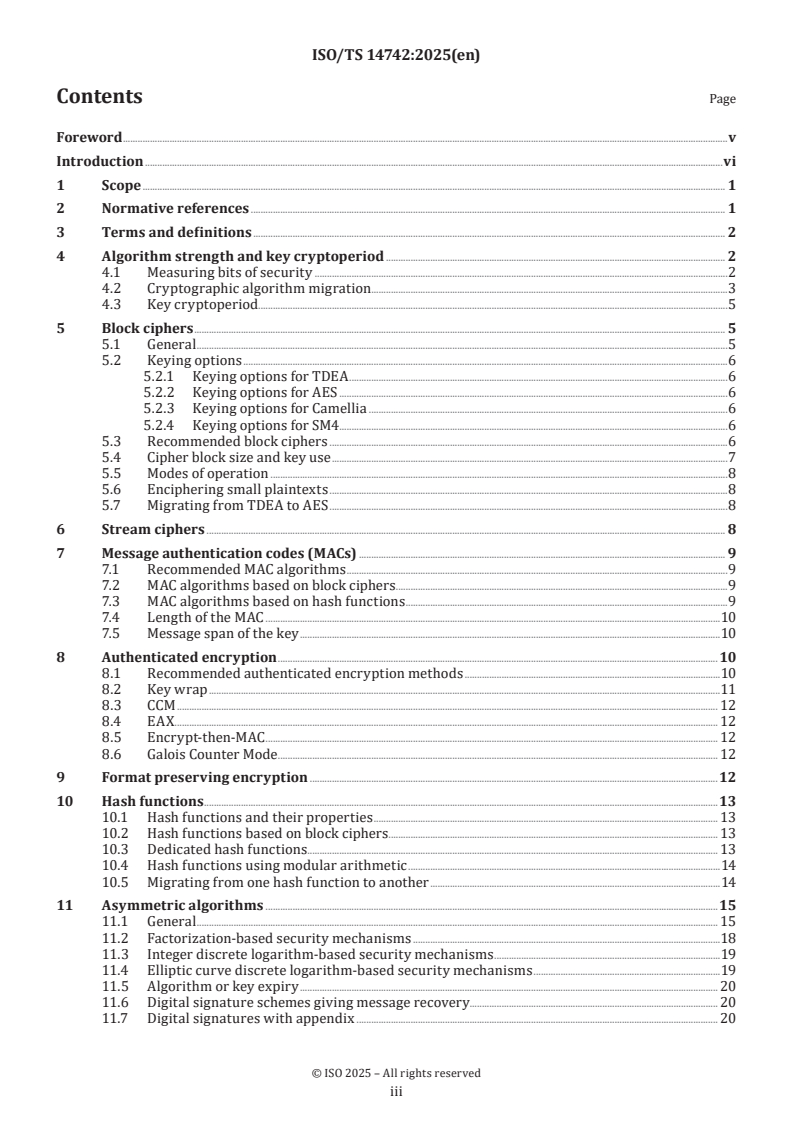
Contents Page
Foreword .v
Introduction .vi
1 Scope . 1
2 Normative references . 1
3 Terms and definitions . 2
4 Algorithm strength and key cryptoperiod . 2
4.1 Measuring bits of security .2
4.2 Cryptographic algorithm migration .3
4.3 Key cryptoperiod.5
5 Block ciphers . 5
5.1 General .5
5.2 Keying options .6
5.2.1 Keying options for TDEA .6
5.2.2 Keying options for AES .6
5.2.3 Keying options for Camellia .6
5.2.4 Keying options for SM4 . .6
5.3 Recommended block ciphers .6
5.4 Cipher block size and key use .7
5.5 Modes of operation .8
5.6 Enciphering small plaintexts .8
5.7 Migrating from TDEA to AES .8
6 Stream ciphers . 8
7 Message authentication codes (MACs) . 9
7.1 Recommended MAC algorithms .9
7.2 MAC algorithms based on block ciphers .9
7.3 MAC algorithms based on hash functions .9
7.4 Length of the MAC .10
7.5 Message span of the key .10
8 Authenticated encryption . 10
8.1 Recommended authenticated encryption methods .10
8.2 Key wrap .11
8.3 CCM . 12
8.4 EAX . 12
8.5 Encrypt-then-MAC . 12
8.6 Galois Counter Mode . . 12
9 Format preserving encryption .12
10 Hash functions .13
10.1 Hash functions and their properties . 13
10.2 Hash functions based on block ciphers. 13
10.3 Dedicated hash functions. 13
10.4 Hash functions using modular arithmetic .14
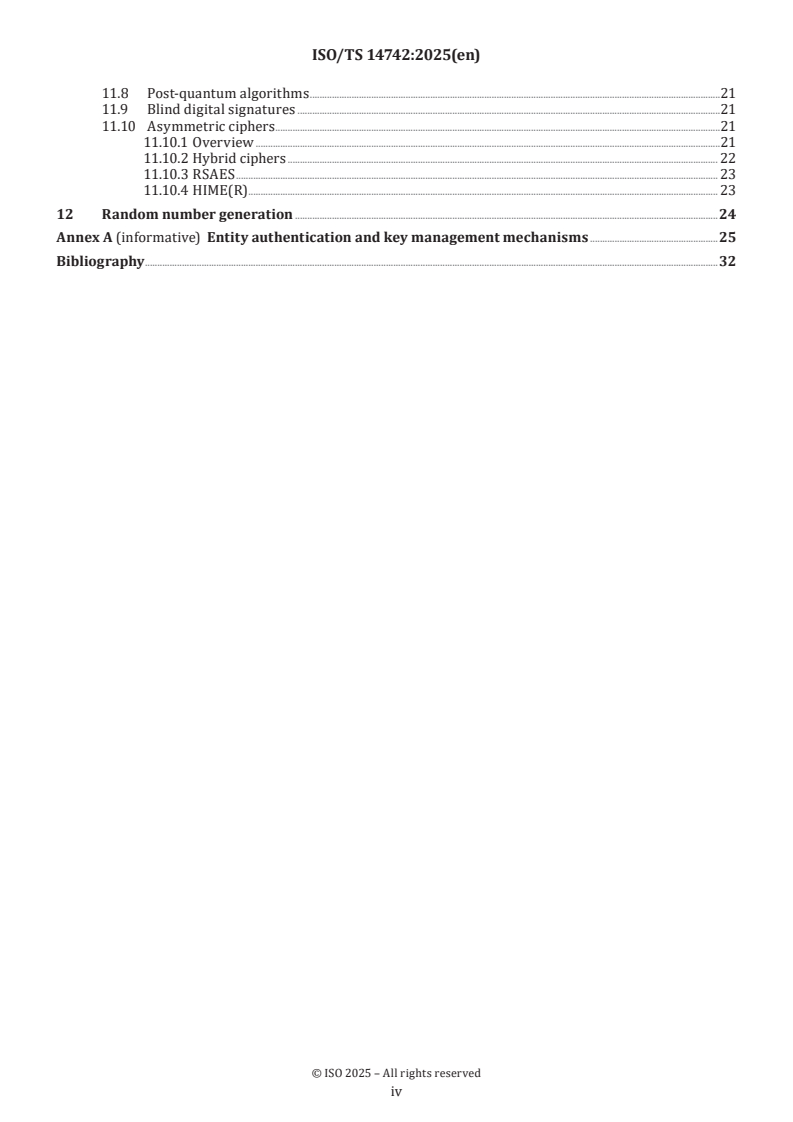
10.5 Migrating from one hash function to another .14
11 Asymmetric algorithms .15
11.1 General . 15
11.2 Factorization-based security mechanisms .18
11.3 Integer discrete logarithm-based security mechanisms .19
11.4 Elliptic curve discrete logarithm-based security mechanisms .19
11.5 Algorithm or key expiry . 20
11.6 Digital signature schemes giving message recovery. 20
11.7 Digital signatures with appendix . 20
iii
11.8 Post-quantum algorithms .21
11.9 Blind digital signatures .21
11.10 Asymmetric ciphers .21
11.10.1 Overview .21
11.10.2 Hybrid ciphers . 22
11.10.3 RSAES . 23
11.10.4 HIME(R) . 23
12 Random number generation .24
Annex A (informative) Entity authentication and key management mechanisms .25
Bibliography .32
iv
Foreword
ISO (the International Organization for Standardization) is a worldwide federation of national standards
bodies (ISO member bodies). The work of preparing International Standards is normally carried out through
ISO technical committees. Each member body interested in a subject for which a technical committee
has been established has the right to be represented on that committee. International organizations,
governmental and non-governmental, in liaison with ISO, also take part in the work. ISO collaborates closely
with the International Electrotechnical Commission (IEC) on all matters of electrotechnical standardization.
The procedures used to develop this document and those intended for its further maintenance are described
in the ISO/IEC Directives, Part 1. In particular, the different approval criteria needed for the different types
of ISO documents should be noted. This document was drafted in accordance with the editorial rules of the
ISO/IEC Directives, Part 2 (see www.iso.org/directives).
ISO draws attention to the possibility that the implementation of this document may involve the use of (a)
patent(s). ISO takes no position concerning the evidence, validity or applicability of any claimed patent
rights in respect thereof. As of the date of publication of this document, ISO had not received notice of (a)
patent(s) which may be required to implement this document. However, implementers are cautioned that
this may not represent the latest information, which may be obtained from the patent database available at
www.iso.org/patents. ISO shall not be held responsible for identifying any or all such patent rights.
Any trade name used in this document is information given for the convenience of users and does not
constitute an endorsement.
For an explanation of the voluntary nature of standards, the meaning of ISO specific terms and expressions
related to conformity assessment, as well as information about ISO's adherence to the World Trade
Organization (WTO) principles in the Technical Barriers to Trade (TBT), see www.iso.org/iso/foreword.html.
This document was prepared by Technical Committee ISO/TC 68, Financial services, Subcommittee SC 2,
Financial services, security.
This first edition of ISO/TS 14742 cancels and replaces ISO/TR 14742:2010, which has been technically
revised.
The main changes are as follows:
— the status of the document has changed from Technical Report (TR) to Technical Specification (TS);
— guidance has been updated in many areas;
— key wrap coverage has been enhanced;
— post quantum cryptographic algorithms have been considered.
Any feedback or questions on this document should be directed to the user’s national standards body. A
complete listing of these bodies can be found at www.iso.org/members.html.
v
Introduction
The financial services industry has a clear need for cryptographic algorithms for a number of different
applications. ISO standards (such as the ISO 18033 series) provide definitions for an extensive and
comprehensive set of such algorithms. However, as the state of the art of cryptology progresses and the
power of computers increases, cryptographic algorithms as well as cryptographic keys of a particular
length all have a limited window of time in which they can be considered secure. Furthermore, as
neither the development of cryptology nor the increase in computing power are entirely predictable, the
collective wisdom of the cryptographic community as to which algorithms and key lengths are secure is
constantly evolving. For this reason, there is an equally clear need in the financial services industry for
guidance regarding the current and up-to-date view in the cryptographic community about the security of
cryptographic algorithms and their keys. There is also a need for appropriate guidance on migration from
one algorithm or key length to another.
Algorithmic vulnerabilities or cryptographic keys of inadequate lengths are less often the cause of security
compromises in the financial industry than are inadequate key management or other procedural flaws,
or mistakes in the implementation of cryptographic algorithms or the protocols that use them. However,
compromises arising from algorithmic vulnerabilities are more systemic and harder to recover from than
other kinds of compromises.
The strength requirements of a security mechanism can vary depending on the application(s) in which the
mechanism is being used and the way it is being used. The recommendations given in this document are
considered to be general purpose recommendations. Although it is accepted that low-risk applications exist
that do not warrant the level of cryptographic strength recommended in this document, deviation from the
recommendations should only be made after appropriate analysis of the risks and in the context of any rules
and policies that can apply.
A special case relates to the lifetime of protection required by the application and its data. For example, if
protection requirements are ephemeral (e.g. confidentiality is required only for one day or authentication
is one-time), then it is possible that this is cause for allowing a deviation from the recommendations.
Conversely, if the data must remain protected for a very long period of time, then the keys and algorithms
used to provide the protection are required to be kept secure for that duration also, even if the keys are no
longer in active use.
This document is not intended to cover privacy issues related to secondary usages of payment data such as
location, kinds of merchant, services or goods purchase.
vi
Technical Specification ISO/TS 14742:2025(en)
Financial services — Recommendations and requirements on
cryptographic algorithms and their use
1 Scope
This document provides a list of recommended ISO cryptographic algorithms for use within applicable
ISO TC 68, Financial services, standards. It also provides strategic guidance on key lengths and associated
parameters and usage dates.
This document focuses on core algorithms, key lengths and frequently used mechanisms. The included
algorithms are considered to be fit for purpose for financial service use. For additional algorithms, see the
body of standards produced by ISO/IEC JTC 1 SC 27, Information security, cybersecurity and privacy protection.
For standards on key management, see ISO 11568.
The categories of algorithms covered are:
a) block ciphers and modes of operation;
b) stream ciphers;
c) message authentication codes (MACs);
d) authenticated encryption algorithms;
e) format preserving encryption;
f) hash functions;
g) asymmetric algorithms:
1) digital signature schemes giving message recovery;
2) digital signatures with appendix;
3) asymmetric ciphers.
h) authentication mechanisms;
i) key derivation, establishment and agreement mechanisms;
j) key transport mechanisms:
1) key wrapping.
This document does not define any cryptographic algorithms. However, the standards to which this
document refers contain necessary implementation information as well as more detailed guidance regarding
choice of security parameters, security analysis and other implementation considerations.
2 Normative references
The following documents are referred to in the text in such a way that some or all of their content constitutes
requirements of this document. For dated references, only the edition cited applies. For undated references,
the latest edition of the referenced document (including any amendments) applies.
1)
ISO/IEC 9796-2:1997 , Information technology — Security techniques – Digital signature schemes giving
message recovery — Part 2: Integer factorization based mechanisms
ISO/IEC 18033-3:2010, Information technology — Security techniques — Encryption algorithms — Part 3:
Block ciphers
3 Terms and definitions
No terms and definitions are listed in this document.
ISO and IEC maintain terminology databases for use in standardization at the following addresses:
— ISO Online browsing platform: available at https:// www .iso .org/ obp
— IEC Electropedia: available at https:// www .electropedia .org/
4 Algorithm strength and key cryptoperiod
4.1 Measuring bits of security
For both block ciphers (Clause 5) and hash algorithms (Clause 10), the notion of "n bits of security" is
introduced (see NIST SP 800-57 Part 1:2020, Clause 5.6.1). For a block cipher to have n bits of security,
n
an estimated 2 operations are necessary to break the block cipher. Given a few plaintext blocks and
n-1
corresponding ciphertext, a block cipher with n bits of security requires an average of 2 T of time to recover
the encryption key, where T is the amount of time it takes to perform one encryption of a plaintext value and
a comparison of the result against the corresponding ciphertext value. For a hash algorithm to have n bits of
n
security with respect to collision resistance, an estimated 2 calls to the hash function are necessary to find
a hash collision, i.e. two messages that when hashed yield the same hash result.
Table 1 — Status of bits of security for symmetric algorithms
Algorithm Attacks Maximum bits of security
Known plain/ciphertext pairs
2-key Triple Data Encryption
112/80/64
8 40 56
Algorithm (TDEA)
2 /2 /2
3-key TDEA Meet in the middle 112
Advanced Encryption Standard
No practical attack known 128
(AES)-128
AES-192 No practical attack known 192
AES-256 No practical attack known 256
Algorithms with 112 bits of security are allowed for legacy use, but new implementations should use keys
with at least 128 bits of security and the corresponding 16-byte block ciphers.
Refer to NIST SP 800-57 part 1 for analysis of the likelihood that an algorithm of a given bit strength remains
secure (that is, unbroken) until at least the year indicated.
[98]
See also section 2 of NIST SP 800-131A REV. 2.
[102]
See also 2016 NIST PQC Competition call for proposals for an overview of algorithmic strength.
It is important to understand the context in which the identified weaknesses are relevant. If a single key is to
be used to encrypt large volumes of data (of the order of 2 bytes), Triple Data Encryption Algorithm (TDEA)
[103]
is a poor choice. However, in EMV 4.4 Book 2 , session keys are specified to form a single cryptogram for
the purposes of a one-off real-time authorization. It can be argued that the weaknesses therefore do not
apply for this use case and there is no immediate danger driving a migration to AES and that the industry
should migrate as the opportunity arises.
1) Cancelled and replaced by ISO/IEC 9796-2:2010.
The efforts of breaking ciphers of different categories can have very different requirements. One algorithm
can require a large amount of computing power and little storage, while another can use a large amount
of storage and less computing power. One effort can be parallelizable, so that the main limitation is the
number of computers that can be recruited to participate. Another can require a single computer with a very
large amount of RAM. Lenstra and Verheul (see Reference [24]) estimated in 1999 that the financial costs
associated with breaking an asymmetric cipher are 2 500 times larger than those associated with breaking
a symmetric cipher, if the computational efforts measured in microprocessor without interlocked pipelined
stages (MIPS) years are the same. See also Reference [18] for comparisons of cryptographic strengths of
symmetric and asymmetric algorithms.
As pertains to the threat due to quantum computers, according to Grover's algorithm (Reference [15]), when
a cryptanalytically relevant quantum computer (CRQC) is built, the number of queries to break a symmetric
n n/2
cipher with key size n drops from 2 trial encryptions to 2 evaluations of the encryption function in
superposition and as many Grover steps.
Further analysis of the small print of Grover's algorithm reveals that pre-quantum security can be
maintained with less effort than doubling key lengths (Reference [14]):
a) Grover’s algorithm does not benefit from linear speed-up through parallelisation. To obtain a thousand-
fold speed-up when using Grover's algorithm, a million quantum computers are necessary.
101 64
b) The quantum attack work function on AES-128 is estimated to be 2 where 2 operations are
performed on a single quantum machine.
This indicates AES-128 can remain fit for purpose in many contexts.
All the conventional asymmetric algorithms mentioned in this document are vulnerable to quantum
computing algorithms (see Reference [35]), and hence any leaps in progress in the area of implementing
quantum computers can void the recommendations in Table 7. However, the commonly established wisdom is
currently that quantum computing on the scale necessary, say, to factor a 1 024-bit Rivest, Shamir Adelman
(RSA) modulus, is likely years away. The largest publicly known quantum computers in 2023 were at the
scale of 1 000 qubits. However, in order to implement Shor's algorithm [attacking RSA and elliptic curve
cryptography (ECC)] or Grover’s algorithm (attacking symmetric keys), a quantum computer requires millions
of qubits able to sustain the necessary level of qubit coherence and fault-tolerance throughout the attack.
For discussion of cryptographic strength and preparation of systems for the threat of CRQCs, see
References [44], [45] and [46].
On the other hand, when large scale quantum computers are realized, it is expected that increases in key
lengths are much less a barrier to compromise than now, so that the mentioned asymmetric algorithms
quickly become obsolete.
4.2 Cryptographic algorithm migration
As the state of the art of cryptology progresses and the power of computers increases, cryptographic
algorithms and key lengths that once were secure can no longer be so. For algorithms that have variable
security parameters, security can be improved by adjusting the security parameters rather than migrating
to a new algorithm. Examples include RSA-based crypto systems, where the RSA key length can be increased,
and AES, where the choice is between key lengths of 128, 192 and 256 bits.
Migration where only the security parameters are changed are simpler than migration where the
cryptographic algorithm itself changes. Although performance in general is expected to decrease with a
more secure choice of security parameters, improvements in computer performance can make up for such a
deterioration.
However, specific applications, implementations, data formats or indeed performance considerations can
impose limits on the values of certain security parameters such that at some point it becomes impossible,
infeasible or uneconomical to maintain adequate security by only adjusting the security parameters.
It can further be assumed that no cryptographic algorithm can continue to provide adequate and cost-
efficient security forever, regardless of the choice of security parameters. Hence it can be assumed that,
although increasing the security parameters for an existing algorithm can buy some time, eventually any
application of a cryptographic algorithm can face a migration from that algorithm to a newer one.
Any such migration is likely to incur both cost and disruption, but it is also an opportunity to take advantage
of cryptographic and technical progress in modernizing the use of cryptographic algorithms, to what is
expected to be a faster, more secure and more cost-effective solution.
Experience gained in migrating from single DES to TDEA has highlighted that the financial industry must
establish a long-term and holistic (as opposed to piecemeal) approach to cryptographic algorithms. These
algorithms are fundamental to all data security systems, which means changes to them are difficult,
sensitive and expensive and take a long time to implement.
Attacks on Triple DES have led to pressure to deprecate its use and replace it with AES. However, it is
important to understand the context in which the identified weaknesses are relevant. Similarly, it is
problematic for multi-target attacks to have short keys when there is a fixed plaintext and the key is used for
confidentiality. The general principle is that the choice of cryptographic algorithm depends greatly on the
strength of the algorithm as deployed in a specific use case, for which the minimum agreed level currently in
industry is 128 bits of effective strength for new deployments.
Thus, apart from identifying and preparing the financial industry for migration to other cryptographic
algorithms and longer key lengths with associated changes in key management, it is also necessary to
ensure that:
— the structure of stored and transmitted data is suitable to be processed by generic cryptographic
algorithms;
— systems are designed to be sufficiently flexible to enable the configuration of cryptographic algorithms
and associated parameters from a lower strength to a higher strength or from a compromised algorithm
or mechanism to one that is not compromised.
For this reason, in order to create systems that are sufficiently flexible to withstand algorithm migration
in the future, it is important to first start migrating to more flexible data structures and methods for
processing such data structures. For example, ISO 8372 was withdrawn and replaced with ISO/IEC 10116.
Also, see ISO 16609.
Because of the complexity of the task and the lifetime of relevant system components, a migration time of 10
to 15 years can well be realistic. Example steps that should be completed are:
a) decision to update a cryptographic algorithm or mechanism;
b) inventory of systems and applications to determine what should change;
c) agreement on algorithms and protocols;
d) development of flexible data structures and APIs;
e) development of plans to ensure interoperability through migration phase;
f) product development and test;
g) product implementation;
h) phased migration, including stopping the use of old algorithms;
i) protected data lifetime. This is the period after any new use of the old algorithms has ceased, but while
data must remain protected by the old algorithms.
Figure 1 — Example of migration from old to new algorithms
Where necessary, this document specifies particular migration issues for the algorithms discussed.
4.3 Key cryptoperiod
The effective strength of a key for a given cryptographic algorithm is influenced by the management of the
key during its lifecycle, which includes consideration of the cryptoperiod or usable life of the key.
Cryptoperiod is the length of time that an individual key can safely be reused. Properly defining a
cryptoperiod is based on the:
— strength of the key;
— importance and amount of data protected by the key:
— restricting the ability to subject a key to crypto analysis;
— limiting the value of a key to a potential attacker.
— risk of compromise for the key.
The cryptoperiod of symmetric key-wrapping keys depends on their intended usage. NIST SP 800-57
part 1 recommends that the originator’s duration of a symmetric key-wrapping key used to wrap a very
large number of keys over a short period of time is one week. If a key-wrapping key protects only a small
number of keys, the period can be up to two years. If a key-wrapping key is used for a single message or
communications session, the cryptoperiod is limited to that session. The recipient’s usage period should be
no longer than three years more than the originator’s usage period.
The risk of compromise includes factors such as how the key is stored, secure hardware storage verses software
usage or insecure hardware, and others. See section 5.3 of NIST SP 800-57 part 1, revision 5 (May 2020).
5 Block ciphers
5.1 General
This clause lists block ciphers that can be used within applicable TC 68, Financial services, standards.
A block cipher maps a block of n plaintext bits to a block of n ciphertext bits using a key of k bits. The block
ciphers listed in Table 2 are defined in ISO/IEC 18033-3.
Table 2 — Block ciphers
Block length Algorithm name Key length
64 bits TDEA 128 or 192 bits
AES
128, 192 or 256 bits
128 bits Camellia
SM4 128 bits
5.2 Keying options
5.2.1 Keying options for TDEA
Keying option 2, also known as 2-key Triple DES: 128-bit key represented as two 64-bit DEA keys, where one
bit in each key byte is not used by the DEA and can be used for error detection.
Keying option 1, also known as 3-key Triple DES: 192-bit key represented as three 64-bit DEA keys, where
one bit in each key byte is not used by the DEA and can be used for error detection.
5.2.2 Keying options for AES
Keying option 1: 128-bit.
Keying option 2: 192-bit.
Keying option 3: 256-bit.
5.2.3 Keying options for Camellia
Keying option 1: 128-bit.
Keying option 2: 192-bit.
Keying option 3: 256-bit.
5.2.4 Keying options for SM4
Keying option 1: 128-bit.
Keying option 2: 256-bit.
5.3 Recommended block ciphers
Table 3 contains a list of recommended block ciphers and their current estimated security in bits. The
recommendations are based on the analyses and recommendations provided in the ECRYPT yearly report
on algorithms and key sizes (see Reference [12]) and NIST SP 800-57, Part 1.
The currently prevalent block cipher algorithm in the payment industry is TDEA, which is increasingly
considered unsafe and should not be used in new implementations, although it remains permissible in legacy
systems.
Table 3 — Security of block ciphers
Algorithm Keying option Key length Security in bits
2 128 bits 80–112
a
TDEA
1 192 bits 112
1 128 bits 128
AES 2 192 bits 192
3 256 bits 256
1 128 bits 128
SM4
2 256 bits 256
a
TDEA is deprecated.
General considerations:
— Implementations of block cipher algorithms should be evaluated for susceptibility to side channel attacks,
especially where shielding and counter-measures are not possible.
— A system that enciphers the same plaintext under many different keys is also dangerous as it exposes
lots of short ciphertexts for a given plaintext. This is the typical issue of Transport Layer Security (TLS)
handshake messages that have a fixed plaintext that gets symmetrically encrypted, so a brute-force key
40 88
search on 2 targets gets one in 2 AES (small-key) trial encryptions.
Considerations on TDEA:
min(112, 120-t) t
— 2-key Triple DES (TDEA with keying option 1) has effective strength 2 , where 2 is the
number of plaintext ciphertext pairs available to an attacker. In this case, the attacker expects to be able
to determine the key of at least one of the plaintext ciphertext pairs but is not able to choose which pair.
See References [29] and [38].
— The externally recommended dates vary widely for ending use of 2-key Triple DES (TDEA with keying
option 2). Which date is appropriate for a given implementation depends on the way in which the keys
are being used in that implementation. If an implementations allows a potential attacker access to a large
number of plaintext ciphertext pairs (e.g. 2 pairs), it is possible that the attacker is able to determine
with substantial but feasible effort (e.g. 2 encryptions) the key used for one of the pairs (the attacker
cannot chose in advance which pair but rather the pair is randomly determined during the course of the
attack). If the implementation ensures that keys are only used once or changed frequently, it is possible
that this attack is not a practical or significant risk and use of 2-key Triple DES can continue. If it is not
possible to so limit the implementation, it is recommended to stop using 2-key Triple DES, especially for
the encryption of long-life sensitive data.
— Attacks on 2-key Triple DES are also possible if plaintexts are only partially known. For example, consider
personal identification number (PIN) entry devices that use a fixed key versus those that use unique keys
per transaction, such as Derived Unique Key Per Transaction (DUKPT) according to x9.24-1. In this case,
the format of the PIN blocks can provide sufficient known plaintext to enable an attacker to determine
the key for one of the encrypted PIN blocks. For fixed-key devices, this provides an attacker with the key
for a large number of plaintext-ciphertext pairs, which weakens the strength of the key. Devices that
use unique key per transaction provide at most one plaintext-ciphertext pair for each session key, so the
attack reveals a single PIN value for a random transaction.
Other symmetric algorithms from specific regions (such as Camellia) should only be used when legacy
applications require it or national requirements apply. In this case, the maximum strength of the algorithm
is expected to be similar to that of AES with the same keying option, and hence the recommendations from
Table 3 can be carried over for those key lengths. However, these algorithms have received significantly less
scrutiny in the cryptographic community than TDEA and AES. There are research papers (e.g. Reference [6])
that propose theoretical related-key attacks against AES using keying options 2 and 3 (192-bit and 256-
bit keys respectively). There are other research papers (e.g. References [5] and [7]) that describe multi-
target attacks that reduce the effective key strength of block ciphers when specially formatted plaintexts
are encrypted with different keys.
5.4 Cipher block size and key use
Besides key length, block size is an important security parameter of block ciphers. The French government
IT Security Agency recommends against using 64-bit block ciphers, for encryption or MACing. The concern
with small block size is mainly that text dictionary attacks and matching ciphertext attacks become feasible,
as outlined in section 2.1.2.1 of Reference [26]. A text dictionary attack builds a dictionary of known
plaintext-ciphertext pairs (each 1 block), and a complete dictionary for a 64-bit block cipher can thus be
built if 2 plaintext-ciphertext pairs are available. Matching ciphertext attacks exploit that the birthday
n/2
paradox implies that once the number of available ciphertexts for an n-bit block cipher reaches 2 , which
for a 64-bit block cipher is ~5 x 10 , one expects to find matching ciphertext blocks. This can reveal partial
information about the plaintexts. For this reason, it is recommended not to use the same key for more than
n/2 20
2 times for an n-bit block cipher and in the case of TDEA to limit it to 2 (see SP 800-67 Rev. 2).
The use of session keys greatly reduces the risks of small block size. See also 7.2 and Reference [32].
5.5 Modes of operation
The modes of operation for block ciphers should follow ISO/IEC 10116. For TDEA, see also ISO/TR 19038.
According to ISO/IEC 10116:2017, B.2.1, a property of electronic code book (ECB) mode is that:
"c) the same plaintext block always produces the same ciphertext block (for the same key) making it vulnerable
to a "dictionary attack", where a dictionary is built up with corresponding plaintext and ciphertext blocks.
[.]
For this reason, the ECB mode is not recommended for messages longer than one block. The use of ECB may only
be specified in future International Standards for those special purposes where the repetition characteristic is
acceptable, blocks have to be accessed individually, or blocks have to be accessed randomly".
Hence, for plaintexts longer than the block size of the block cipher, the following are recommended:
— Cipher Block Chaining (CBC) (see Reference [1]);
— Cipher Feedback (CFB);
— Output Feedback (OFB);
— Counter (CTR) mode.
The mode of operation depends on the specific requirements of the application (such as ability of
parallelizing encryption or decryption, error propagation or requirements to initialization values). See
ISO/IEC 10116:2017, Annex B for properties of the modes of operation. See also Clause 8 for recommended
modes of authenticated encryption.
5.6 Enciphering small plaintexts
When enciphering small plaintexts such as customer PINs, special considerations apply when estimating
the security of a particular mechanism. For example, if the entire plaintext to be enciphered is an 8-byte
PIN block and no random data is added, dictionary attacks are possible regardless of the size of the key used
for encipherment. In this case, it is important to follow established standards, such as ISO 9564-1 for PIN
encipherment, where the formats have been developed with these concerns in mind.
5.7 Migrating from TDEA to AES
In light of the experience of migrating from DES to TDEA in particular, any migration from TDEA to a
replacement symmetric algorithm should be planned well in advance to reduce unnecessary costs.
Aside from the inherent challenges of migrating one symmetric encipherment algorithm to another across
the financial services industry, one important difference between TDEA and AES is the block length of each.
TDEA is a 64-bit block cipher, whereas AES is a 128-bit block cipher. A consequence of this is that today, many
of the data structures used for storage and transmission are 8-byte oriented, prime examples of this being
TDEA keys themselves and associated PIN blocks. Migration should be staged and hence involve parts of
the payment networks using TDEA and other parts using AES, which lead to a temporary but long-lasting
requirement for translations both from TDEA encrypted messages to AES encrypted messages, and vice versa.
AES also supports longer key lengths than TDEA, and as a consequence a migration from TDEA to AES can
also have significant key management impact. New AES based systems should be built flexibly, so that they
can eventually employ all the available key lengths for AES (keying option 1, 2, and 3). See ISO 13492.
6 Stream ciphers
A stream cipher maps bits of plaintext to bits of ciphertext using a key of k bits. It does so by using the k-bit
key to generate a key stream of the same length as the plaintext. The key stream is used (similar to a one-
time pad) to encipher the plaintext, bit by bit (using the XOR operation). Stream ciphers can be based on bit-
oriented mechanisms or block-oriented mechanisms.
For modes of operations of block ciphers, see ISO/IEC 10116. The popular stream cipher ChaCha20 is specified
in IETF RFC 8439. Other stream ciphers are standardized in ISO/IEC 18033-4, inc
...