


ISO 13232-1:1996
(Main)Motorcycles — Test and analysis procedures for research evaluation of rider crash protective devices fitted to motorcycles — Part 1: Definitions, symbols and general considerations
Motorcycles — Test and analysis procedures for research evaluation of rider crash protective devices fitted to motorcycles — Part 1: Definitions, symbols and general considerations
Contains the minimum requirements for research evaluation of rider protective devices fitted to motorcycles, which are intended to protect the rider in the event of a collision. Gives the definitions, abbreviations, symbols, and other general considerations used in all parts of this International Standard.
Motocycles — Méthodes d'essai et d'analyse de l'évaluation par la recherche des dispositifs, montés sur les motocycles, visant à la protection des motocyclistes contre les collisions — Partie 1: Définitions, symboles et généralités
General Information
- Status
- Withdrawn
- Publication Date
- 25-Dec-1996
- Withdrawal Date
- 25-Dec-1996
- Technical Committee
- ISO/TC 22 - Road vehicles
- Drafting Committee
- ISO/TC 22 - Road vehicles
- Current Stage
- 9599 - Withdrawal of International Standard
- Start Date
- 08-Dec-2005
- Completion Date
- 12-Feb-2026
Relations
- Effective Date
- 15-Apr-2008
Get Certified
Connect with accredited certification bodies for this standard

TÜV Rheinland
TÜV Rheinland is a leading international provider of technical services.

TÜV SÜD
TÜV SÜD is a trusted partner of choice for safety, security and sustainability solutions.

AIAG (Automotive Industry Action Group)
American automotive industry standards and training.
Sponsored listings
Frequently Asked Questions
ISO 13232-1:1996 is a standard published by the International Organization for Standardization (ISO). Its full title is "Motorcycles — Test and analysis procedures for research evaluation of rider crash protective devices fitted to motorcycles — Part 1: Definitions, symbols and general considerations". This standard covers: Contains the minimum requirements for research evaluation of rider protective devices fitted to motorcycles, which are intended to protect the rider in the event of a collision. Gives the definitions, abbreviations, symbols, and other general considerations used in all parts of this International Standard.
Contains the minimum requirements for research evaluation of rider protective devices fitted to motorcycles, which are intended to protect the rider in the event of a collision. Gives the definitions, abbreviations, symbols, and other general considerations used in all parts of this International Standard.
ISO 13232-1:1996 is classified under the following ICS (International Classification for Standards) categories: 43.140 - Motorcycles and mopeds. The ICS classification helps identify the subject area and facilitates finding related standards.
ISO 13232-1:1996 has the following relationships with other standards: It is inter standard links to ISO 13232-1:2005. Understanding these relationships helps ensure you are using the most current and applicable version of the standard.
ISO 13232-1:1996 is available in PDF format for immediate download after purchase. The document can be added to your cart and obtained through the secure checkout process. Digital delivery ensures instant access to the complete standard document.
Standards Content (Sample)
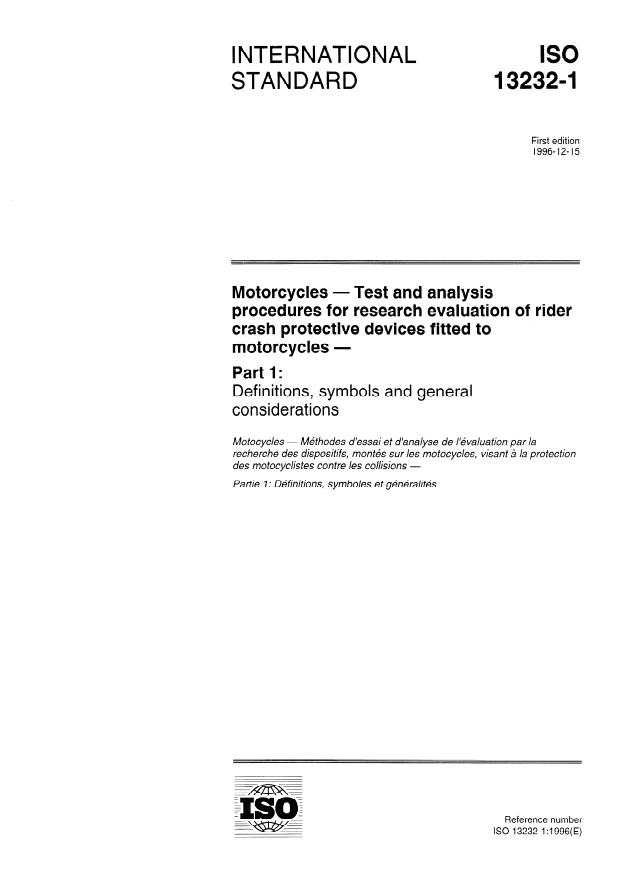
INTERNATIONAL
STANDARD 13232-l
First edition
1996-12-15
Motorcycles
- Test and analysis
procedures for research evaluation of rider
crash protective devices fitted to
motorcycles -
Part 1:
Definitions, symbols and general
considerations
Mo tocycles - M&hodes d ’essai et d ’analyse de I’kvaluation par la
recherche des dispositifs, months sur /es motocycles, visant 2 la protection
des motocyclistes contre /es collisions -
Parfie I: DQfinitions, symboles et g6n&alit&
Reference number
ISQ 13232-l :1996(E)
IS0 13232=1:1996(E)
Page
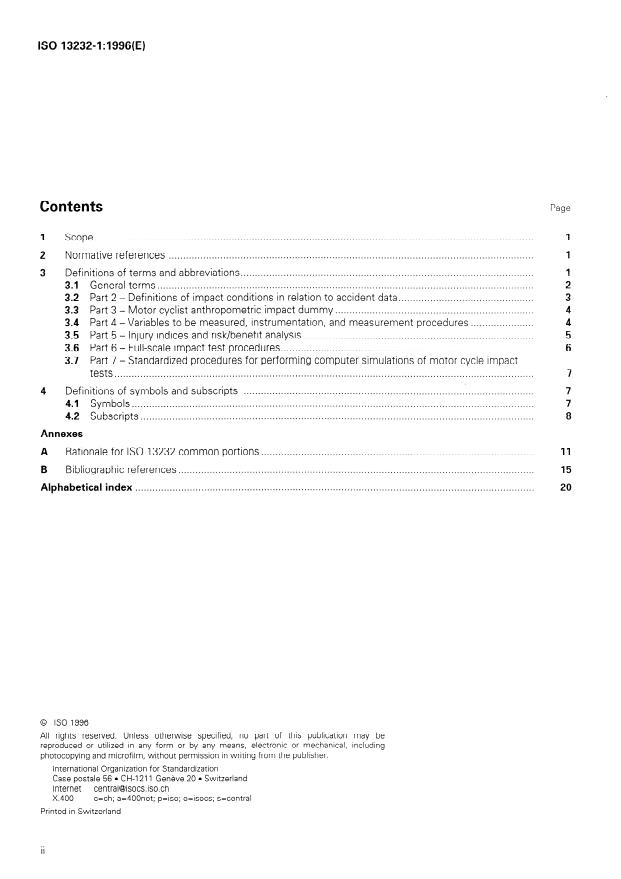
Contents
1 Scope . . . . . . . . . . . . . . . . . . . . . . . . . . . . . . . . . . . . . . . . . . . . . . . . . . . . . . . . . . . . . . . . . . . . . . . . . . . . . . . . . . . . . . . . . . . . . . . . . . . . . . . . . . . . . . . . . . . . . . . . . . . . . . . . . . . . . . . . . . . . . . . . . . . . . . . .
. . . . . . . . . . . . . . . . . . . . . . . . . . . . . . . . . . . . . . . . . . . . . . . . . . . . . “. 1
Normative references . . . . . . . . .*.
..............................................................................................
Definitions of terms and abbreviations .
................................ ...........................................................
3.1 General terms. . .
.............................................
3.2 Part 2 - Definitions of impact conditions in relation to accident data.
...................................................................
3.3 Part 3 - Motor cyclist anthropometric impact dummy.
......................
3.4 Part 4 - Variables to be measured, instrumentation, and measurement procedures
3.5 Part 5 - Injury indices and risk/benefit analysis .
3.6 Part 6 - Full-scale impact test procedures. .
Part 7 - Standardized procedures for performing computer simulations of motor cycle impact
3.7
............................................... ....... .................................... ........................................................
tests
........ .............................................................................................
4 Definitions of symbols and subscripts
.............................................. ..............................................................................................
4.1 Symbols
.............................................................................................. ...........................................
4.2 Subscripts
Annexes
................................ ..................... ........................................
A Rationale for IS0 13232 common portions.
................................................................ ...................................... 15
B Bibliographic references .
................................................................................................... 20
Alphabetical index .
0 IS0 1996
All rights reserved. Unless otherwise specified, no part of this publication may be
reproduced or utilized in any form or by any means, electronic or mechanical, including
photocopying and microfilm, without permission in writing from the publisher.
International Organization for Standardization
Case postale 56 l CH-1211 Geneve 20 l Switzerland
Internet centraI@isocs.iso.ch
c=ch; a=400net; p=iso; o=isocs; s=central
x.400
Printed in Switzerland
ii
IS0 13232=1:1996(E)
Foreword
IS0 (the International Organization for Standardization) is a worldwide federation of national standards bodies (IS0
member bodies). The work of preparing International Standards is normally carried out through IS0 technical
committees. Each member body interested in a subject for which a technical committee has been established has
the right to be represented on that committee. International organizations, governmental and non-governmental, in
liaison with ISO, also take part in the work. IS0 collaborates closely with the International Electrotechnical
Commission (IEC) on all matters of electrotechnical standardization.
ndards adopted by the tee hnical committees are circul
Draft International Sta ated to the member bodies for voting.
Publication as an Inter national Standard requi res approval by at least 75 % of the me mber bodies casting a vote.
This part of IS0 13232 was prepared by Technical Committee ISOnC 22, Road vehicles, Subcommittee SC 22,
Motorcycles.
At the request of the United Nations Economic Commission for Europe, Group for Road Vehicle General Safety
(UN/ECE/TRANS/SCI/VVP29/GRSG), this International Standard has been prepared by lSO/TC Z/SC 22,
Motorcycles, as eight interrelated parts, on the basis of original working documents submitted by the International
Motorcycle Manufacturers Association (IM MA).
This is the first version of the standard.
IS0 13232 consists of the following parts, under the general title Motorcycles - Test and analysis procedures for
research evaluation of rider crash protective devices fitted to motorcycles:
Part I: Definitions, symbols and general considera Cons
Part 2: Definition of impact conditions in relation to accident data
Part 3: Anthropometric impact dummy
- Part 4: Variables to be measured, instrumentation and measurement procedures
- Part 5: Injury indices and risk/benefit analysis
Part 6: Full-scale impact-test procedures
- Part 7: Standardized procedures for performing computer simulations of motorcycle impact tests
Part 8: Documentation and reports
Annexes A and B of this part of IS0 13232 are for information only.
. . .
III
IS0 13232=1:1996(E)
Introduction
This International Standard has been prepared on the basis of existing technology. Its purpose is to define common
research methods and a means for making an overall evaluation of the effect that devices which are fitted to motor
cycles and intended for the crash protection of riders, have on injuries, when assessed over a range of impact
conditions which are based on accident data.
It is intended that all of the methods and recommendations contained in this International Standard should be used
in all basic feasibility research. However, researchers should also consider variations in the specified conditions (for
example, rider size) when evaluating the overall feasibility of any protective device. In addition, researchers may
wish to vary or extend elements of the methodology in order to research issues which are of particular interest to
them. In all such cases which go beyond the basic reseach, if reference is to be made to this International
Standard, a clear explanation of how the used procedures differ from the basic methodology should be provided.
In order to apply this International Standard properly, it is strongly recommended that all eight parts be used
together, particularly if the results are to be published.
iv
IS0 13232=1:1996(E)
INTERNATIONAL STANDARD @ IS0
Motorcycles - Test and analysis procedures for research
evaluation of rider crash protective devices fitted to
mdtorcycles -
Part 1:
Definitions, symbols and general considerations
1 Scope
This International Standard specifies the minimum requirements for research into the feasibility of protective devices
fitted to motor cycles, which are intended to protect the rider in the event of a collision.
This International Standard is applicable to impact tests involving
- two wheeled motor cycles;
- the specified type of opposing vehicle;
- either a stationary and a moving vehicle or two moving vehicles;
- for any moving vehicle, a steady speed and straight line motion immediately prior to impact;
- one helmeted dummy in a normal seating positionon on an upright motor cycle;
- the measurement of the potential for specified types of injury by body region;
- evaluation of the results of paired impact tests (i.e., comparisons between motor cycles fitted and not fitted
with the proposed devices).
This part of IS0 13232 provides the definitions, abbreviations, symbols, and other general considerations used in all
parts of this International Standard.
This International Standard does not apply to testing for regulatory or legislative purposes.
2 Normative references
The following standards contain provisions which, through reference in this text, constitute provisions of this
International Standard. At the time of publication, the editions indicated were valid. All standards are subject to
revision, and parties to agreements based on this part of IS0 13232 are encouraged to investigate the possibility of
applying the most recent editions of the standards indicated below. Members of IEC and IS0 maintain registers of
currently valid International Standards.
IS0 3833: 1977, Road vehicles - Types - Terms and definitions
IS0 13232-2: 1996, Motor cycles - Test and analysis procedures for research evaluation of rider crash protective
devices fitted to motor cycles - Part 2 - Definition of impact conditions in relation to accident data
AIS-90: 1990, American Association of Automotive Medicine (AAAM) The abbreviated injury scale. 1990 revision.
Des Plaines, II.
3 Definitions of terms and abbreviations
For the purposes of all parts of IS0 13232, the following definitions apply. The terms and abbreviations are
presented by part. The symbols and subscripts are presented after the terms.
IS0 13232=1:1996(E)
3.1 General terms
3.1.1 motor cycle; MC: See IS0 3833: 1977, def. 3.5.
3.1.2 opposing vehicle; OV: A saloon type passenger car, into which the MC is impacted.
A device which is intended to reduce the frequency of leg bone fractures
3.1.3 leg protective device:
3.1.4 structural element of the MC: Any substantially rigid component of the MC (examples: forks, brake
assembly, frame).
device: A device which is intended to reduce the frequency or severity of head concussive
3.1.5 head protective
injuries.
Attached in a permanent manner to a structural element of the motor cycle.
3.1.6 fitted to the motor cycle:
3.1.7 crash protection: Reduction of the frequency or severity of rider injuries during impacts.
3.1.8 rider: Operator of a motor cycle.
3.1.9 baseline MC: A MC which has not been fitted with a protective device.
3.1 .lO modified MC: One which has been fitted with a protective device.
ith the only
3.1 .l 1 paired comparison: Testing and comparing resul ts between two or more identical MCs w
experimental variable between or among them bein g the presence of the propose d protecti ve devi ce.
3.1 .l 1 .l single paired comparison: A paired comparison which includes only one test with a modified MC and only
one test with a baseline MC.
A pair ed co mparison which includes more than one test with modified MCs,
3.1 .l 1.2 multiple paired comparison:
er of tests with baseline MCs.
all with the same modification, and an equal numb
tests with the baseline MC and with the modified MC, in a paired comparison
3.1 .11.3 group of tests: All of the
which inv olves more than tw 0 tests.
The five variables which characterize and define the positions,
3.1.12 impact conditions; impact variables:
orientations, and velocities of the MC and OV immediately prior to impact in a full-scale impact test, a computer
simulation of an impact, or in MUOV accident data.
3.1.12.1 relative heading angle; rha: The angle between the MC x axis and the OV x axis measured in a clockwise
direction from the MC x axis as viewed from above, immediately prior to first MUOV contact.
3.1.12.2 OV impact speed; OVS: The magnitude of the OV velocity relative to the ground, immediately prior to
first MC/OV contact.
3.1 .12.3 MC impact speed; MCS: The magnitude of the MC velocity relative to the ground, immediately prior to
first MClOV contact.
3.1 .12.4 OV contact point (for full-scale tests or computer simulations); OVCP: The target or measured point on
the periphery of the OV, when viewed from above, as shown in figure 1 of IS0 13232-2.
nt representing the region of main and presumably initial
3.1.12.5 OV contact point (for accident analysis): A poi
structural damage to the OV in a given accident wit haM C.
3.1 A2.6 MC contact point (for full-scale tests or computer simulations); MCCP: The target point on the MC for the
main impact with the OV, being the foremost point, the rearmost point or the midpoint along the MC overall length.
y initial
3.1.12.7 MC contac accident analysis): A p oint representin g the region of main and pres umabl
t point (for
structural a given accident with a passenger car.
damage to the MC in
3.1.13 first MC/OV contact: The first instant in time when a part of the MC or the dummy contacts the OV.
@ IS0 IS0 13232=1:1996(E)
3.1.14 time of first MC/OV contact; time zero (for film analysis): The first frame on the high speed film which
shows contact between a part of the MC or the dummy and the OV, or the frame immediately before where the first
light emission from a contact sensing system occurs, whichever is sooner.
3.1.15 time of first MWOV contact (for electronic data): The instant of initial contact between a part of the MC or
the dummy and the OV, sensed by a contact switch and indicated by an electronic pulse on one of the data
channels.
3.1 .16 first helmet/OV contact: The first frame on the high speed film which shows contact between the helmet
and the OV.
3.1 .17 primary impact period: The time period from 0,050 s before first MUOV contact until 0,500 s after.
3.1 .18 secondary impact period: The time period from 0,500 s until 3,000 s after first MC/OV contact.
3.4.19 entire impact sequence: The time period from 0,050 s before until 3,000 s after first MUOV contact.
3.1.20 axis systems:
3.1.20.1 vehicle axis system: A mutually perpendicular set of three axes fixed in the plane of symmetry of the
vehicle, with the x axis in the direction of forward straight line motion, the z axis downward parallel to gravity, and
the y axis directed toward the right side of the vehicle.
3.1.20.2 specimen axi ystem: A mutually per pendicula r set of three axes fixed in the specimen, with the axial
ss
axis paral lel to the axis of symmetry or longest d imension of the specim en.
3.1.20.3 inertial axis system: A mutually perpendicular set of three axes fixed to the ground, with the x axis
parallel to the pre-impact path of the MC, the z axis downward parallel to gravity, and the y axis to the right of the
pre-impact path of the MC.
3.1.20.4 head axis system: A mutually perpendicular set of three axes fixed to the head, with x axis forward and
horizontal in the mid-sagittal plane, the z axis downward in the mid-sagittal plane, and the y axis toward the right
side of the head. The origin is located at the Hybrid Ill head centre of gravity.
3.1.20.5 dummy axis system: A mutually perpendicular set of three axes fixed in each component of the dummy,
with the x axis in the forward (anterior) direction, the y axis toward the right side of the dummy, and the z axis in
the downward direction, and, in general, passing through any joint axes present in the component, when the
dummy is in a standing position, with hands and arms at the dummy sides, elbow pivot axes in the forward
direction, palms toward the rear (posterior) of the dummy, knee pivot axes in the lateral direction, and toes in the
forward direction.
3.1.21 feasibility: The capacity of a proposed protective device to reduce injuries to a given body region, and to
reduce injury costs, in a significant percentage of the accident population, without increasing injury costs in more
than a very small percentage of the accident population, where “significant” and “very small” may be defined by the
users of this International Standard.
3.1.22 failure mode and effects analysis; FMEA: An objective identification of those impact configurations from
the accident population in which a given protective device is predicted to cause increased injuries, for purposes of
identifying possible additional full-scale test configurations.
3.1.23 risk/benefit analysis; overall evaluation: An objective calculation of the effects of a protective device, in
comparison to a baseline motor cycle in terms of the percentage of the population of impact configurations in
which the device is beneficial versus the percentage in which it is harmful or in which it has no effect, for various
Injury indices.
3.1.24 normal seating position: The position in which an operator would generally ride on the specified MC.
3.1.25 optional accessories: Original equipment accessories as provided by the vehicle manufacturer.
3.2 Part 2 - Definition of impact conditions in relation to accident data
Q is0
IS0 13232=1:1996(E)
3.2. 1 cell: Region of five-dimensional space in which the dimensions are relative heading angle, OV impact speed,
MC impact speed, OV contact point, a nd MC contact point (for accide nt analysis).
3.2.2 cell range: For each cell, the range of values for each of the five impact variables used to define the cell.
3.2.3 nominal values: For each cell, the value of each of the five impact variables that represents that cell for the
purpose of defining a unique impact condition for use in full-scale tests or computer simulations; typically, but not:
always, defined to be the centre of each cell.
3.2.4 corner of the OV: Point at which a ve rtical plan e, set at 45’ to the vertical longitudinal plane of the OV,
contacts and is surface of the bumper.
tangent to the
3.2.5 centre line of the OV or MC: Any line which is parallel to the ground and in the vertical plane which
intersects the midpoints of the front wheel(s) and the rear wheel(s) of the OV or MC, at its test weight.
3.2.6 overall length of the OV or MC: The horizontal distance between the two vertical planes, each set at 90” to
the plane of symmetry of the OV or MC, one contacting and tangent to the front extremity of the OV or MC, the
other, to the rear extremity of the OV or MC, at its test weight.
3.2.7 MC front unsprung assembly: That portion of the front fork assembly which is not supported by the
suspension; including the forks, front wheel and axle, and possibly including other structural elements which are
attached.
3.3 Part 3 - Motor cyclist anthropometric impact dummy
3.3.1 certification; compliance: To achieve and to document a specified level of performance.
3.3.2 frangible components: Component s of the anthropom etric dummy which are intended to fail mechanically at
prescri bed f orceldef lection va ues in order to simul ate human injur ‘y mechanisms and to record predicted injuries.
3.3.3 knee compliance element: A small, triangular, deformable plastic element which, when mounted in series
with a brass shear pin, simulates the flexibility of knee ligaments. Four such elements are mounted in each injury
indicating knee; two compliance elements simulate human knee flexibility for a standing dummy about the Mx axis,
and two additional elements simulate human knee flexibility for a standing dummy about the M, axis.
3.3.4 abdominal foam insert: A dummy component fabricated from crushable foam which exhibits specified
force/deflection properties and very limited spring back. It is installed in the test dummy abdomen, and is used to
measure the depth of abdominal penetrations to which the dummy is subjected during the course of the impact
sequence.
3.3.5 load cell simulator: A non-instrumented structural replacement for a dummy-mounted load cell. The element
has the same structural attachment configurations as a load cell, and is used during tests in which a particular load
cell and its associated data channels are not required.
Products or devices which have the same critical characteristics as those specified,
3.3.6 alternative products:
within a certain tolerance. Such critical characteristics may include: mass, dimensions, strength, dynamic
depending on the nature of the device. The tolerance also depends on the nature
response, accuracy, range, etc.,
of the device. As a guideline, it is suggested that the manufacturers’ specification for the specified product be the
basis for the equivalence, with the tolerance being O,2 mm on critical dimensions, and otherwise within + 2% of
the named manufacturer ’s specifications, unless otherwise specified in this International Standard.
3.3.7 lot: A number of components produced during a single run of a manufacturing process.
3.3.8 specimen: A frangible bone with one or two rigid extensions attached to the end(s).
3.4 Part 4 - Variables to be measured, instrumentation, and measurement procedures
3.4.1 detachable external cables: Cables which are able to detach from the dummy immediately following first
MC/OV contact.
IS0 132324:1996(E)
@ IS0
photographic process incorporating cameras (typically 16 mm), which can
3.4.2 high speed photography:
of 400 frames per set ond or more.
produce film exposures at the r
*a whi ch is aligned in such a way that the angle between the viewing axis of the
3.4.3 oblique cam era: A tamer
or to p of the OV, MC, or dummy is not 90°.
camera and the fro nt, side, rear,
That point which falls on the horizontal and vertical centre of the image seen in a camera view
3.4.4 aim point:
finder.
3.4.5 digitizing surface: That surface of a film analysis machine on which a photographic image is projected. The
surface may contain an electronic grid which, when used in conjunction with a moveable cursor, allows the operator
to identify electronically the x and y coordinates of a given point on any exposed frame of film.
3.4.6 film analysis frame: Any frame from a high speed film which is used in a film analysis process to identify the
locations of various objects at a given point in time. Typically, not all frames are used for the analysis process, and
only every nth frame is considered a film analysis frame.
3.4.7 frame width: The dista nce between the left and right edge of the field o f view a s seen throug h the camera
view finder and mea sured in a plane containing the nearest visible target on the vehicle of interest.
3.4.8 helmet centroid point: The centre of a circle, on the digitizing surface, which is centred about or within the
outline of the helmet.
3.4.9 leading edge: The foremost edge in the longitudinal direction of the specified component or vehicle.
3.4.10 trailing edge: The rearmost edge in the longitudinal direction of the specified component or vehicle.
3.4.11 motion analyser grid: The working surface of a film analyser used to define the location of points in two
dimens onal space.
3.4.12 visual resolution: The smallest linear dimension which can be differentiated by the film analyst.
3.4.13 magnification: The ratio of the size of the projected image to the size of the film image.
3.4.14 blur: The distance travelled by an image across the surface of a film during an exposure.
3.4.15 cursor: movable index w hich identifies the location of points in two dimensional space, when used in
The
conjunction wit motion analyser grid.
h the
3.4.16 overall accuracy of the film analysis: The sum of the visual resolution of the motion analyser grid plus the
visual resolution of the cursor.
3.4.17 primary axis:
Force or moment axis corresponding to the sensitive or measurement axis of a sensor.
3.4.18 signal gain: Ratio of final amplifier output voltage to sensor output voltage for one data channel.
Voltage at the output of the final amplifier associated with a data channel.
3.4.19 output signal voltage:
3.4.20 off axis: Referring to any load which is not along the primary axis of a sensor.
3.5 Part 5 - Injury indices and risk/benefit analysis
the maximum value) of a kinematic response from a
3.5.1 injury assessment variable: A specific value (e.g.,
specific region of the anthropometric impact dummy, used to establish the probability of injury to that specific
region of the body.
3.5-l .l generalized acceleration model for brain injury tolerance; GAMBIT; G: A weighted function of translational
and rotational acceleration of the head.
3.5.1.2 upper (or lower) sternum maximum normalized compression; C,, max nOrm (C,, max norm): The maximum
value of the upper (or lower) sternal displacement measured in the x dire&ion, normalized by a chest depth
dimension.
IS0 132324:1996(E)
3.5.1.3 upper (or lower) sternum velocity; V,, (V& The upper (or lower) sternum rate of compression.
The time variant product
3.5.1.4 upper ( or lower) sternum maximum velocity-compression; VC,, M8X WC,, max):
I I
of the upper (or lo wer) sternum compression and the upper (or lower) sternum velocity.
permanent deformation
3.5.1.5 abdom en maximum residual pene tration ; pA MBX: The maximum depth of the
I
observed in the abdominal foam inse rt.
region of the anthro lome tric impact test d umm y containing all frangible
3.5.2 lower extremi ties; IE: The body
P
; the femurs, knees, and tibias.
components of both legs
injury index: the probability of a specific injury and/or injury cost, based upon the measured
3.5.3 measure of
values of the injury assessment variables and/or frangible component damage.
3.5.3.1 abbreviated injury scale; AIS: The categorization of injury severity which ranks injury severity from 0 to 6;
0 being no injury to 6 being currently unsurvivable/untreatable, representing a subjective consensus measure of the
probability of dying (see AIS-90).
3.5.3.2 probable AIS; PAIS: rounded to the nearest integer as a measure of the mean AIS.
3.5.3.3 maximum PAIS: The maximum PAIS among those calculated for the head, chest, abdomen, and lower
extremities.
3.5.3.4 total PAIS: Sum of the head, chest, and abdomen PAIS, plus the total number of AIS 2 leg injuries times
two plus the total number of AIS 3 leg injuries times three.
3.5.3.5 permanent partial incapacity; PPI: The percentage of incapacity resulting from injury to the lower
extremities. It serves to further define and prescribe injury costs.
3.5.3.6 probability of fatality; PF: The combined probability of obtaining an AIS 6 level injury and of dying from the
combination of non-AIS 6 injuries.
function: A functional relationship between an injury assessment variable and the AIS of
3.5. 4 injury assessment
that same body region.
variable: A variable whit h suggests the possibility of potential head injury, based on helmet
3.5.5 injury potential
trajectory or velocity, in the proximity of a n OV
3.5.6 injury severity probability; ISP: Probability of obtaining or observing an injury of a specific minimum AIS
injury severity level for a specific body region.
3.5.7 injury costs; IC: The expected costs of an observed or simulated injury, based on bio-economic data.
3.5.7.1 medical costs; MDC: Costs associated with initial and subsequent hospitalization; includes medical,
rehabilitation, chronic care, and vocational rehabilitation costs.
3.5.7.2 ancillary costs; AC: Costs associated with lost wages and legal actions (excluding pain and suffering
contributions.
costs), in addition to the cost of replacing household and workplace
3.5.7.3 cost of fatality; CF: The cost of dying, based on medical and ancillary costs calculated over an average
lifetime.
The costs associated with the predicted injuries if sustained by a live
3.5.7.4 normalized injury cost; I&,,:
human being, normalized by the cost of a fatality.
3.6 Part 6 - Full-scale impact test procedures
3.6.1 secondary test variables: Extraneous, unidentified, and/or undesired variables which can introduce
extraneous variations in the test results and which can lead to erroneous conclusions.
3.6.2 rotate: To turn a part about its longitudinal axis.
IS0 13232=1:1996(E)
0 IS0
3.6.3 pivot: To turn a part in a circu mferential direction about an axis which is perpendicular to the longitudinal
axis and near one end 0 f the part.
3.6.4 dummy K index: A point on the outboard external surface of the dummy knee, on the effective axis of
flexion of the knee joint.
3.6.5 dum index: A point on the outboard surface of the d ummy shoulder, on the effective forward
Imy S
axis of the shoul der join
3.6.6 motor cycle K point A point measured relative to the motor cycle axis sy stem corresponding to the dummy
K index when the du is properly positioned on the M c.
mw
: A measured relative to the motor cycle axis system corresponding to the dummy
3.6.7 motor cycle S point point
d on the MC.
S inde x when the dummy is pr ,operly positione
3.6.8 upper torso reference line: A line parallel to the dummy back rib attachment plane.
The foremost point on the centre line of the knee flesh as viewed from the top, when
3.6.9 knee centre line index:
the dummy is seated on the MC.
3.6.10 hexagonal key tool: The six-sided driver required to adjust the bolts of the Hybrid Ill joints.
3.6.11 weight hanger: The apparatus used to hold ballast weight during the dummy joint adjustment procedure.
3.6.12 clamping fixture: An a atus used to hold the weight hanger during portions of the dummy
lower arm
PPar
joint adj ustment pr ocedure.
hook: An eye-bolt which screws into the top of the Hybrid III head, from which the dummy can be
3.6.13 head
suspended.
3.6.14 dummy preparation areas: All areas where the dummy is kept or prepared during the three hour period prior
to the intended time of the impact test; including areas for storage, assembly, calibration, verification tests, joint
position and tension adjustment, mounting on the motor cycle, and wherever the dummy is at rest prior to impact.
For moving motor cycle tests, the area in which the motor cycle is accelerated toward the impact is excluded.
3.7 Part 7 - Standardized procedures for performing computer simulations of motor cycle impact
tests
3.7.1 system: An interconnected set of components, e.g., the dummy, the MC, or the OV.
3.7.2 motion: Pertinent varia bles which are functions of the linear or angular displacement, velocity, or
acceleration of a system or bo
dY*
3.7.3 body: A portion of a system which has one or more physical degrees of freedom relative to other portions of
the system, for example, as determined by a joint.
3.7.4 maximum thicknes s: The maxi mum x an d also the maximum y dimension of a body, where the z axis of the
body is vertical when the ‘stem is in a nor *mal, stand position.
w
SY
3.7.5 femur mid-span: Midway between the hip joint and the knee pivot joint.
3.7.6 tibia mid-span: Midway between the knee pivot joint and the ankle joint.
4 Definitions of symbols and subscripts
4.1 Symbols
The symbols which are not defined in clause 3, but are used throughout all parts of IS0 13232 are listed with their
definitions in table 1.
IS0 ‘I323201:1996(E)
Table 1 - Definitions of sybmols
Definition
ymbol
Frequency of occurrence
FO
N Number of items defined by the subscript
Distance between two points, defined by the subscripts
d
X Distance to or location of a point in the x direction
Distance to or location of a point in the y direction
Y
Distance to or location of a point in the z direction
i Voltage
L Applied load
Gain Amplifier gain
S/N Signal-to-noise ratio
8 Angular displacement
Width
w
I Length
D Deflection
C Compression
Penetration
P
V Velocity
Velocity-compression: see 3.5.1.4
vc
a Linear acceleration
Angular acceleration
a
F Force
M Moment
GAMBIT; see 3.5.1.1
G
HIC Head injury criterion
P Probability
MAIS Maximum AIS
TAIS Total AIS
MDC Medical costs for the specified body region of the specified AIS severity
level, as defined by the subscripts; see 3.5.7.1
AC Ancillary cost for the specified body region of the specified AIS severity
level, as defined by the subscripts; see 3.5.7.2
cs Cost of survival
MR Mortality rate
4.2 Subscripts
The subscripts used throughout all parts of IS0 13232 and their definitions are given in tables 2 and 3.
IS0 132324:1996(E)
Table 2 - Definitions of subscripts for body regions and parts
Definition
Subscript
Abdomen
A
Arm
arm
Thoracic compression
C
F Femur
H Head
h Helmet centroid point
hH Helmeted head
K Knee
I Lumbar spine
Lower arm
larm
Lower extremities; including the dummy femurs, knees, and tibia
IE
IF Lower femur
Lower leg
lleg
Lower sternum
Is
Lower tibia
IT
Lower thorax
ITh
n Neck
P Pelvis
T Tibia
Th Thorax
uarm Upper arm
UF Upper femur
Upper leg
uleg
us Upper sternum
UT Upper tibia
uTh Upper thorax
vc Thoracic velocity-compression
IS0 13232=1:1996(E)
Table 3 - Definitions of subscripts other than those for body regions and parts
Definition
Subscript
Average
aw
barrier Barrier for MC barrier test
C Camera
ci Correct injuries
Compression
camp
First MC/OV contact point
cP
Computer simulation
cs
Cylinder, laboratory component test impactor
CYl
disc Disc, laboratory component test impactor
Excitation
e
Extension
ext
f Film frame
fatal Fatality
fc First contact
flex Flexion
fork MC front fork
fs Full-scale impact test
Ground or ground target
Index for film frame, time, body region, or country
i
imp Impactor, laboratory component test impactor
Index for AIS severity level
i
k K point on MC, see 3.6.6
L Left
IL, IR Lower left, lower right
m Mass
max Maximum value of a variable. The most positive value of the respective
variable, over the time interval of interest.
MC Motor cycle, see 3.1.1
min Minimum value of variable. The most negative value of the respective
variable, over the time interval of interest.
mtr Meter, as in voltage meter.
norm Normalized
0 output
ov Opposing vehicle; see 3.1.2
Pre-impact
P
peak Peak value of variable. The value which has the largest absolute value,
retaining the appropriate sign, over the time interval of interest.
pend Pendulum, laboratory component test impactor
R Right
r Resultant
rs MC rear spring-damper
S Distance between supports for the frangible component tests
S S point on MC; def 3.6.7
seat MC seat
shear Shear
Sphere, laboratory component test impactor
sphere
Tension
tens
Torsion
tors
Total
tot
uL, uR Upper left, upper right
V Vehicle (either OV or MC) target
In the x, y, or z direction
x, yr z
Resultant of two or three axes
VI yz,
zx, xyz
IS0 13232=1:1996(E)
Annex A
(informative)
Rationale for IS0 13232 common portions
All references cited in annex A are listed in annex B.
A.1 Introduction to the philosophy behind this International Standard
A.1 .l In 1992, the International Motorcycle Manufacturers Association (IMMA) proposed to the United Nations
Economic Commission for Europe, Group for Road Vehicle General Safety (UN/ECETTRANS/SCI/WP29/GRSG) that
an international research methodology for motor cycle crash testing should be developed by IS0 as an urgent
project over a period of 18 months in order to provide a common basis for research into secondary safety devices.
GRSG accepted the proposal and the short time scale because IMMA also offered to make available all of the
This commitment was fulfilled by the preparation and presentation of a full
industry ’s work on methodology.
standard document and the preparation of explanatory presentations on the background research which had gone
into the development of the methodology.
The aim of this International Standard is to provide a common basic research methodology for assessing the
feasibility of crash protective devices fitted to motor cycles (MCs). This International Standard is based on existing
proven technology and it is intended that it should be updated whenever necessary. This International Standard
includes a number of recommended baseline tests and methods which are regarded as the minimum for
internationally comparative purposes. This International Standard is not intended to be used for legislative or
regulatory purposes because the criteria and procedures necessary for a legislative standard are different from those
required for a research standard.
A.l.2 The purpose of this International Standard is to define “common research methods” for assessing the
feasibility of rider crash protective devices fitted to MCs; and a means for making an overall evaluation of the
effects of such devices on injuries, across a range of realistic impact conditions.
A.l.3 The structure of this International Standard reflects scientific research practice in which the research
question is operationalized through the selection of indices, measurement criteria, instrumentation, etc., and then
tested under specified conditions using a representative sample and, in this case, the method of paired comparisons.
Subsequently, inferences concerning the relevance of the sample results for the overall population can be made
using statistical or simulation techniques. There are eight essential interrelated elements to this International
Standard, as shown in figure A.1. Seven of these elements are primarily concerned with the requirements for
testing a sample of devices (the definitions, dummy, the impact conditions in relation to accident data, test
procedures, measurements, injury indices, and documentation and reports).
The eighth part is concerned with computer simulation. It is optional because it can be used for extending the
Computer simulation is regarded as a useful and powerful tool
sample results to the overall population of accidents.
because it reduces the sample size needed to make results representative. It also enables potential failure modes
and other additional test conditions to be identified and subsequently tested in full-scale impacts. (Potential failure
modes are particularly important from a scientific viewpoint because they are possible ‘counter examples’ which
might disprove the hypothesis, thereby requiring a modification of the theory from which the research question has
been formulated.) Each individual part of the standard has its own specific objectives and these are contained in the
scope of each part.
A.l.4 The technical approach used in preparing this International Standard, in addition to being based upon existing
technology, was to provide the simplest procedures which give standardized, repeatable, reproducible, realistic, and
representative test conditions for paired comparison crash tests with and without proposed protective devices.
These criteria were used throughout to determine specific provisions and content.
A.2 Introduction
A.2.1 “Common research methods” are needed because up until 1992, research by different groups, examining
similar or identical protective devices, produced vastly different results using different test and analysis procedures
(IMMA, 1992; TRRL, 1991). A device which one group found to be beneficial to the rider, another group found to
be largely harmful. The two groups used different crash dummies, impact conditions, measurements, test
Concept
r
&~te~S~~t%(cs) 1 Design
I
(7) recess
----B-l-- I p
7 impact configurations
Definition of
impact conditions
in relation to
Potential
accident data
failure
r - - - - -’ 200
,
(2)
rn;des -1
P impact 4
Analyses
i I - I 1 configurations
i ‘CS+II+RBAI 1
Definitions,
1 (7 + 5) J 1
-D-m
abbreviations
I
symbols,
L,,wln I- I
l- references
I
I
Injury indices (II)
(+Risk/benefit analysis) 1 Overall
evaluation
(RBA)
I
(5)
I
r---------
Figure A. 1 - Functional relationships among the parts of IS0 13232
0 IS0 IS0 132324:1996(E)
procedures, indices, and computer si muia tion mode Is. Exchange of data was impeded by dif ferent data formats and
t report.
differences concerni ‘hat compr ed a corn plete tes
w w
A.22 “Feasibility research” is the primary objective, because up until 1992, a motor cycle mounted device had yet
to be found which researchers agreed gave some degree of protection and was not harmful to the rider in crash and
non-crash situations.
A.2.3 Existing technology and information is the basis, so that this International Standard is practical; and so that
this international Standard could be codified in a minimum amount of time (I 8 months to the CD stage), as
requested by the mandating body (UN/ECE/TRANS/SCI/WP29/GRSG). In addition, the methodology had been
documented previously in each of the key technical areas covered by this International Standard, for example:
accident data analysis (Pedder, et al., 1989); motor cycle impact dummy (Gibson, et al., 1992;
1989, 1989a, 1989b); data acquisition and measurement (White and
Newman, et al., 1991; St-Laurent, et al.,
1992); test procedures (IMMA, 1992; Rogers, 1991 a, 1991 b); and
Gustin, 1989); injury indices (Newman, et al.,
computer simulation (Zellner, et al., 1991).
A.3 Scope
A.3.1 This international Standard applies to “two wheeled motor cycles ”. This International Standard is applicable
to the particular types of large angular motion, moving-moving impact conditions characteristic of motor cycle
impacts, as well as the kinds of unrestrained, multi directional, whole body motions of riders during impacts. These
motions and associated injuries are unlike those involved in either car occupant or pedestrian impacts. There has
been no attempt in this International Standard to address three wheeled motor cycles, pedal cycles, or mopeds. On
many points the procedures in this International Standard are not applicable to impact tests with these or other
kinds of vehicles.
A.3.2 This International Standard applies to impacts with the “specified type of opposing vehicle ”. Further
discussed under IS0 13232-6, the specified opposing vehicle is a saloon passenger car, which, along with coupe
cars, is by far the most common opposing vehicle in motor cycle accidents (Hurt, et al., 1981 a, 1981 b; Otte,
et al., 1981; Otte, 1980). The important features which characterize the motor cycle/rider interactions with this
kind of vehicle include the front and rear bumpers, grille/bonnet, boot lid, roof structures (including A, B, C pillars
These features are characteristic of coupe and saloon cars. Interactions with
and roof edge), and wheel arches.
other kinds of opposing objects (e.g., trucks, vans, estate cars, other motor cycles, fixed obstacles) would be
expected to involve potentially other types of motions and injuries, and therefore, potentially different needs in
terms of dummies, injury indices, measurements, test procedures, and proposed protective devices.
A.3.3 This International Standard applies to “steady speed, straight line, motion (of both vehicles) immediately prior
to impact ”. This mainly relates to the capabilities of current impact test facilities. Current impact test facilities have
been designed for steady, unaccelerated motion prior to impact. If one vehicle or both vehicles are accelerating
prior to impact (e.g., non-steady speed, non-straight line, or non-upright), then it is probable that the test variability
(e.g., contact point) would be much larger (i.e., poorer repeatability). Also, with regard to accident data, there is a
general lack of quantitative information regarding the magnitude of such pre-impact “accelerations ”, although there
is some indication that in a considerable fraction of accidents, vehicles are in some kind of accelerated state
(e.g., Hurt, et al., 1981 a, 1981 b). Accident data are available which document the impact speed and cases with
upright motor cycle attitude (Hurt, et al., 1981 a, 1981 b), and the focus is on these “known” conditions in the test
procedures.
A.3.4 This International Standard applies to “one helmeted dummy in a normal seating position ”. The standard
requires that the dummy be fitted with the specified “full face helmet ”. The Hybrid Ill basis dummy chin region,
even as modifi
...
Questions, Comments and Discussion
Ask us and Technical Secretary will try to provide an answer. You can facilitate discussion about the standard in here.
Loading comments...