

ISO 22166-202:2025
(Main)Robotics — Modularity for service robots — Part 202: Information model for software modules
General Information
- Abstract
This document specifies requirements and recommendations for information models for software modules used in service robots. This document specifies the information model for software modules related to nine principles in ISO 22166-1. It specifies a structured method to define the characteristics of a software module, or a module that has a software-related interface (modules with software aspects, as defined in ISO 22166-1). This document is not a safety standard. However, it specifies the information necessary for software modules, including safety-related information. This document focuses on interfaces, properties, composition and execution-specific information, which are related to software modules. The information is utilized in the runtime and design/developing stages. In particular, the interfaces are classified and described into two types such as variables and methods. The document can also be applied to the following software lifecycle stages: the design stage, development stage, operation stage, and maintenance stage.
- Status
- Published
- Publication Date
- 05-Mar-2025
- Technical Committee
- ISO/TC 299 - Robotics
- Drafting Committee
- ISO/TC 299 - Robotics
- Current Stage
- 6060 - International Standard published
- Start Date
- 06-Mar-2025
- Due Date
- 20-May-2025
- Completion Date
- 06-Mar-2025


Overview
ISO 22166-202:2025 - Robotics - Modularity for service robots - Part 202: Information model for software modules defines a structured information model for software modules used in service robots. It specifies the data elements and organization (interfaces, properties, composition and execution-specific information) that module providers should publish and integrators should consume. The standard supports interoperability, reusability and composability across vendors and targets runtime and design/development stages across the software lifecycle (design, development, operation, maintenance). Note: this document is not a safety standard, but it requires inclusion of safety-related information.
Key topics
- Module identification: rules for Module ID and assignment (Annex A).
- Properties and metadata: descriptive fields that function as a digital datasheet for software modules.
- Interfaces: classification into I/O variables and methods (services); how interfaces are modeled and described.
- Status and runtime information: state reporting and execution-specific attributes.
- Services and composition: description of callable services and component composition.
- Infrastructure and middleware considerations: integration aspects, middleware examples and mappings.
- Safety & security metadata: information necessary for safety and security assessments (informational, not prescriptive).
- Modeling & executable forms: representations for model-driven engineering and executable artifacts.
- Data types and mappings: normative list of data types (Annex H) and informative mappings to common robotics middlewares such as ROS 2 and OMG SDO/RTC/OpenRTM (Annexes F and G).
- Normative references: links to ISO 22166-1, ISO 22166-201 and relevant POSIX guidance.
Applications
- Acts as a digital datasheet for software modules, enabling:
- System integrators to compare and select modules from different vendors.
- Faster, more reliable integration of modules into composite systems and service robots.
- Automated tooling for compatibility checks, deployment planning and runtime orchestration.
- Useful in both design-time (selection, architecture, safety assessment) and runtime (monitoring, configuration, lifecycle management).
- Supports module providers (developers, documentation and product teams) in publishing consistent module descriptions and integrators (robot makers, integrators, safety engineers) in making evidence-based decisions.
Who should use it
- Service robot manufacturers and system integrators
- Software module developers and middleware engineers
- System designers, safety and security assessors
- Tool vendors building integration, discovery, and composition tools
Related standards
- ISO 22166-1:2021 - Modularity general requirements
- ISO 22166-201:2024 - Common information model for modules
- IEEE/Open Group POSIX (referenced)
- Informative mappings: ROS 2, OpenRTM/RTC profiles and other middleware (Annexes F–G)
Keywords: ISO 22166-202, robotics modularity, information model for software modules, service robots, interoperability, software lifecycle, ROS 2 mapping.
Get Certified
Connect with accredited certification bodies for this standard

DVS-ZERT GmbH
German welding certification society.
CARES (UK Certification Authority for Reinforcing Steels)
UK certification for reinforcing steels and construction.
EWF/IIW (European/International Welding Federation)
International welding personnel certification.
Sponsored listings
Frequently Asked Questions
ISO 22166-202:2025 is a standard published by the International Organization for Standardization (ISO). Its full title is "Robotics — Modularity for service robots — Part 202: Information model for software modules". This standard covers: This document specifies requirements and recommendations for information models for software modules used in service robots. This document specifies the information model for software modules related to nine principles in ISO 22166-1. It specifies a structured method to define the characteristics of a software module, or a module that has a software-related interface (modules with software aspects, as defined in ISO 22166-1). This document is not a safety standard. However, it specifies the information necessary for software modules, including safety-related information. This document focuses on interfaces, properties, composition and execution-specific information, which are related to software modules. The information is utilized in the runtime and design/developing stages. In particular, the interfaces are classified and described into two types such as variables and methods. The document can also be applied to the following software lifecycle stages: the design stage, development stage, operation stage, and maintenance stage.
This document specifies requirements and recommendations for information models for software modules used in service robots. This document specifies the information model for software modules related to nine principles in ISO 22166-1. It specifies a structured method to define the characteristics of a software module, or a module that has a software-related interface (modules with software aspects, as defined in ISO 22166-1). This document is not a safety standard. However, it specifies the information necessary for software modules, including safety-related information. This document focuses on interfaces, properties, composition and execution-specific information, which are related to software modules. The information is utilized in the runtime and design/developing stages. In particular, the interfaces are classified and described into two types such as variables and methods. The document can also be applied to the following software lifecycle stages: the design stage, development stage, operation stage, and maintenance stage.
ISO 22166-202:2025 is classified under the following ICS (International Classification for Standards) categories: 25.040.30 - Industrial robots. Manipulators. The ICS classification helps identify the subject area and facilitates finding related standards.
ISO 22166-202:2025 is available in PDF format for immediate download after purchase. The document can be added to your cart and obtained through the secure checkout process. Digital delivery ensures instant access to the complete standard document.
Standards Content (Sample)
International
Standard
ISO 22166-202
First edition
Robotics — Modularity for service
2025-03
robots —
Part 202:
Information model for software
modules
Robotique — Modularité des robots de service —
Partie 202: Modèle d'information pour les logiciels
Reference number
© ISO 2025
All rights reserved. Unless otherwise specified, or required in the context of its implementation, no part of this publication may
be reproduced or utilized otherwise in any form or by any means, electronic or mechanical, including photocopying, or posting on
the internet or an intranet, without prior written permission. Permission can be requested from either ISO at the address below
or ISO’s member body in the country of the requester.
ISO copyright office
CP 401 • Ch. de Blandonnet 8
CH-1214 Vernier, Geneva
Phone: +41 22 749 01 11
Email: copyright@iso.org
Website: www.iso.org
Published in Switzerland
ii
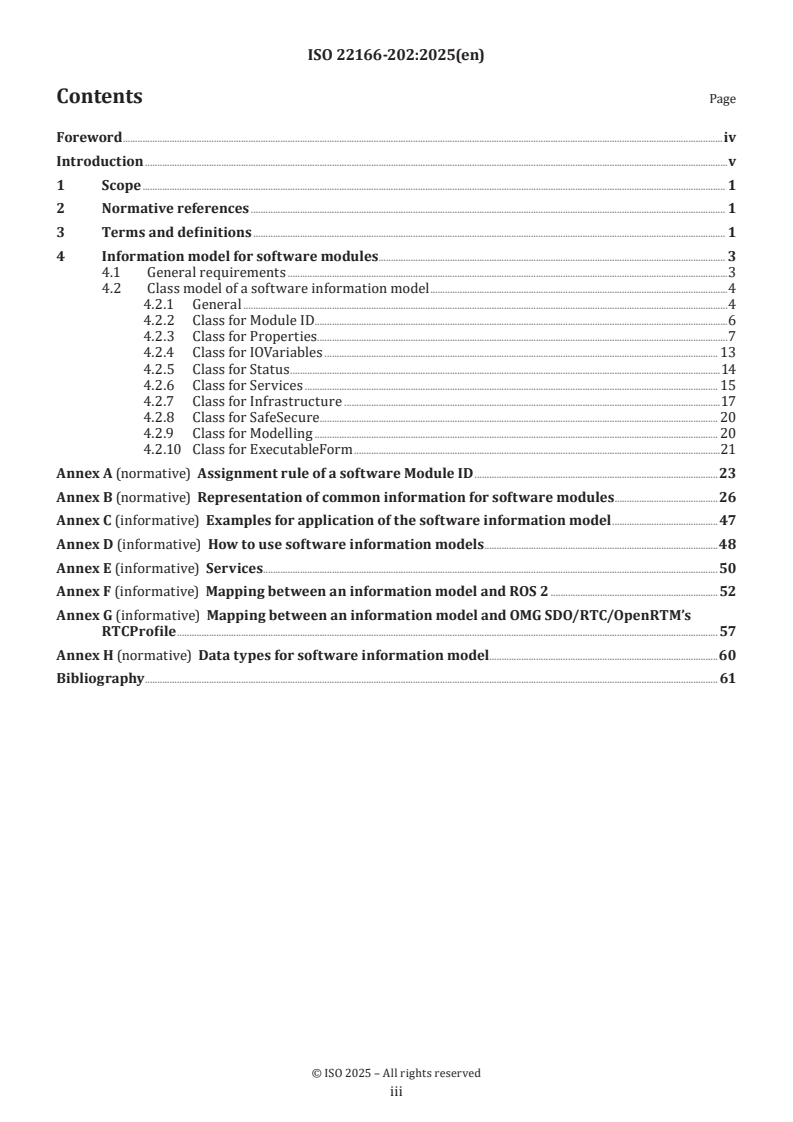
Contents Page
Foreword .iv
Introduction .v
1 Scope . 1
2 Normative references . 1
3 Terms and definitions . 1
4 Information model for software modules . . 3
4.1 General requirements .3
4.2 Class model of a software information model .4
4.2.1 General .4
4.2.2 Class for Module ID .6
4.2.3 Class for Properties.7
4.2.4 Class for IOVariables . 13
4.2.5 Class for Status .14
4.2.6 Class for Services . 15
4.2.7 Class for Infrastructure .17
4.2.8 Class for SafeSecure. 20
4.2.9 Class for Modelling . 20
4.2.10 Class for ExecutableForm .21
Annex A (normative) Assignment rule of a software Module ID .23
Annex B (normative) Representation of common information for software modules .26
Annex C (informative) Examples for application of the software information model . 47
Annex D (informative) How to use software information models .48
Annex E (informative) Services .50
Annex F (informative) Mapping between an information model and ROS 2 .52
Annex G (informative) Mapping between an information model and OMG SDO/RTC/OpenRTM’s
RTCProfile .57
Annex H (normative) Data types for software information model.60
Bibliography . 61
iii
Foreword
ISO (the International Organization for Standardization) is a worldwide federation of national standards
bodies (ISO member bodies). The work of preparing International Standards is normally carried out through
ISO technical committees. Each member body interested in a subject for which a technical committee
has been established has the right to be represented on that committee. International organizations,
governmental and non-governmental, in liaison with ISO, also take part in the work. ISO collaborates closely
with the International Electrotechnical Commission (IEC) on all matters of electrotechnical standardization.
The procedures used to develop this document and those intended for its further maintenance are described
in the ISO/IEC Directives, Part 1. In particular, the different approval criteria needed for the different types
of ISO document should be noted. This document was drafted in accordance with the editorial rules of the
ISO/IEC Directives, Part 2 (see www.iso.org/directives).
ISO draws attention to the possibility that the implementation of this document may involve the use of (a)
patent(s). ISO takes no position concerning the evidence, validity or applicability of any claimed patent
rights in respect thereof. As of the date of publication of this document, ISO had not received notice of (a)
patent(s) which may be required to implement this document. However, implementers are cautioned that
this may not represent the latest information, which may be obtained from the patent database available at
www.iso.org/patents. ISO shall not be held responsible for identifying any or all such patent rights.
Any trade name used in this document is information given for the convenience of users and does not
constitute an endorsement.
For an explanation of the voluntary nature of standards, the meaning of ISO specific terms and expressions
related to conformity assessment, as well as information about ISO's adherence to the World Trade
Organization (WTO) principles in the Technical Barriers to Trade (TBT), see www.iso.org/iso/foreword.html.
This document was prepared by Technical Committee ISO/TC 299, Robotics.
A list of all parts in the ISO 22166 series can be found on the ISO website.
Any feedback or questions on this document should be directed to the user’s national standards body. A
complete listing of these bodies can be found at www.iso.org/members.html.
iv
Introduction
This document provides an information model for software modules based on ISO 22166-1 and ISO 22166-201.
The information model for software modules defined here is based on current industrial practices and
recent research results in model-driven system engineering. It is designed to enhance the interoperability,
reusability and composability of modules. The document presents guidelines for interoperability, reusability
and composability of modules for ensuring their effective connectivity and their correct functionality
providing the relevant information for safety/security.
Using the information model for software modules, robot system builders and developers of composite
modules (as defined in ISO 22166-1) can effectively compare modules from different vendors, identify the
modules matching their requirements and easily integrate them to create a service robot, a subsystem
thereof, or even larger composite modules. The information model can be considered a digital datasheet
for software modules for service robots. This datasheet provides pertinent information for module users.
This, encompasses anyone who integrates the module with other modules and components (as defined in
ISO 22166-1) to develop a service robot or any of its subsystems, like composite modules (as defined in
ISO 22166-1).
It is the task of the module provider to also provide the information described in this document in the form
described herein. And users of such modules, such as robot system integrators, are able to utilize the model
information when designing a service robot and assessing its consistency and suitability. This document
addresses two main user groups: service robot makers, including service robot integrators, and providers
of modules for service robots. Within these user groups, it primarily targets software developers, including
system designers and integrators. For module providers, it further addresses personnel concerned with
technical documentation and technical marketing. In the case of service robot makers and service robot
integrators, it further addresses personnel concerned with safety engineering and personnel concerned
with acquiring modules for use in a robot. Providers of modules for service robots have to provide as
complete and accurate a model as possible for their modules, including information about the module's
runtime requirements, interfaces and information relevant to safety assessments of systems built from
such modules. Robot system integrators have to be able to make design decisions based on the information
provided by the module makers. Third parties can use the information to develop tools to automate or
support aspects of the software system integration process.
The information model of the robot software modules presented in this document is focused on the common
characteristics that all types of software modules have, for example:
a) module ID
b) properties
c) input and output variables
d) status
e) services
f) infrastructure
g) safety and security
h) modelling
i) executable forms
This document focuses on the interfaces, properties, variables, behaviour and status of software modules.
v
International Standard ISO 22166-202:2025(en)
Robotics — Modularity for service robots —
Part 202:
Information model for software modules
1 Scope
This document specifies requirements and recommendations for information models for software modules
used in service robots. This document specifies the information model for software modules related to nine
principles in ISO 22166-1.
It specifies a structured method to define the characteristics of a software module, or a module that has a
software-related interface (modules with software aspects, as defined in ISO 22166-1).
This document is not a safety standard. However, it specifies the information necessary for software
modules, including safety-related information.
This document focuses on interfaces, properties, composition and execution-specific information, which are
related to software modules. The information is utilized in the runtime and design/developing stages. In
particular, the interfaces are classified and described into two types such as variables and methods. The
document can also be applied to the following software lifecycle stages: the design stage, development stage,
operation stage, and maintenance stage.
2 Normative references
The following documents are referred to in the text in such a way that some or all of their content constitutes
requirements of this document. For dated references, only the edition cited applies. For undated references,
the latest edition of the referenced document (including any amendments) applies.
ISO 22166-1:2021, Robotics — Modularity for service robots — Part 1: General requirements
ISO 22166-201:2024, Robotics — Modularity for service robots — Part 201: Common information model for modules
IEEE/Open Group 1003.1-2017, IEEE Standard for Information Technology--Portable Operating System
Interface (POSIX(TM)) Base Specifications, Issue 7
3 Terms and definitions
For the purposes of this document, the following terms and definitions apply:
ISO and IEC maintain terminology databases for use in standardization at the following addresses:
— ISO Online browsing platform: available at https:// www .iso .org/ obp
— IEC Electropedia: available at https:// www .electropedia .org/
3.1
information model
IM
abstraction and representation of the entities in a managed environment, their properties, attributes and
operations, and the way that they relate to each other
[SOURCE: ISO 22166-1:2021, 3.1.11]
3.2
common information model
CIM
information model that modules most frequently use in service robots
Note 1 to entry: This model is a kind of meta model.
[SOURCE: ISO 22166-201:2024, 3.2, modified — Note 1 to entry has been added.]
3.3
module
component or assembly of components with defined interfaces accompanied with property profiles to
facilitate system design, integration, interoperability, and re-use
Note 1 to entry: A module can be an assembly of modules.
[SOURCE: ISO 22166-1:2021, 3.3.12, modified — Notes 1 to 4 to entry have been replaced with a new note.]
3.4
module property
property
attribute or characteristic of a module
[SOURCE: ISO 22166-1:2021, 3.3.14, modified — The example has been deleted and the preferred term
"property" has been added.]
3.5
software module
SW module
module whose implementation consists purely of programmed algorithms
Note 1 to entry: A software module has software aspects. It consists of software components.
[SOURCE: ISO 22166-1:2021, 3.4.4, modified — The preferred term "SW module" has been added.]
3.6
hardware module
HW module
module whose implementation consists purely of physical parts, including mechanical parts, electronic
circuits, and any software, such as firmware, not externally accessible through the communication interface
Note 1 to entry: A hardware module has hardware aspects. It consists of hardware components.
[SOURCE: ISO 22166-1:2021, 3.4.3, modified — Examples 1 and 2 have been deleted.]
3.7
module with hardware aspects and software aspects
hardware-software module
HW-SW module
module whose implementation consists of physical parts, software, and a communication interface that
allows data exchange with other modules
[SOURCE: ISO 22166-201:2024, 3.7, modified — The preferred term "HW-SW module" has been added.]
3.8
instance
particular entity instantiated from a specific software module
Note 1 to entry: In object-oriented programming, “instance” means a specific realization of an object.
[SOURCE: ISO 22166-201:2024, 3.9, modified — The hardware-related part in the definition was removed
and Note 2 to entry was removed.]
3.9
component
part of something that is discrete and identifiable with respect to combining with other parts to produce
something larger
Note 1 to entry: Component can be either software or hardware. A component that is mainly software or hardware
can be referred to as a software or a hardware component, respectively.
Note 2 to entry: Component does not need to have any special properties regarding modularity.
Note 3 to entry: Component and module have been used interchangeably in general terms, but to avoid confusion the
term module is used to refer to a component that meets the guidelines presented in this document.
Note 4 to entry: A module is a component, whereas a component does not need to be a module.
[SOURCE: ISO 22166-1:2021, 3.2.1]
3.10
middleware
software that helps to make communication and data management easy in distributed applications
Note 1 to entry: Middleware provides services to software applications beyond those available from the operating system.
Note 2 to entry: Middleware can be a component on which groups of components and/or modules are executed.
1) [1] [2] [3] [4]
ROS , OpenRTM, and OPRoS , are types of middleware.
3.11
hardware abstraction interface
HAI
abstraction interface for a component/module that contains hardware aspects, with the abstraction
interface providing control of the component/module via a software interface
3.12
sensing software module
software module for collecting or acquiring data about the world around the robot or the state of the robot
for use by other modules to support the robot system in performing its task(s)
Note 1 to entry: The module can access HW-SW modules such as LiDARa, encoders, and cameras using HAI, device
drivers or dedicated drivers.
EXAMPLE LiDAR sensing software modules, camera sensing software modules, force sensing software modules, etc.
4 Information model for software modules
4.1 General requirements
The information model for software modules (or software information model, SIM) shall consist of items
provided in Table 1, which is based on ISO 22166-201, the common information model. In the document, the
symbols ‘M’, ‘O’, and ‘C’ represent Mandatory, Optional, and Conditional, respectively.
1) ROS is a trademark of Open Source Robotics Foundation, Inc. This information is given for the convenience of users
of this document and does not constitute an endorsement by ISO of the product named.
Table 1 — Software information and the corresponding tag
Related group/tag name
No. Items SW module
(abbreviation of each group)
1 Module Name M
2 Description O
GenInfo
3 Manufactures M
4 Examples O
5 Information model version M
6 Module ID M IDnType
7 Software Aspects O
a
8 Module properties M ModuleProp
9 Inputs
b
M IOVariable
10 Outputs
11 Status M -
b
12 Services (capabilities) M Service
13 Infrastructure M Infra
14 Safety/security O SafeSecure
15 Modelling O Modelling
16 ExecutableForm M ExecutableForm
a
This term is only mandatory to properties that can be influenced (set) from the outside or at least to properties that have an
expected effect on other modules.
b
At least one of Inputs/Outputs and Services is mandatory.
The relationship between the common information model (CIM) and the software information model (SIM)
is provided in Figure 1. That is, SIM is inherited from CIM. Like CIM, SIM can be described using the Unified
Modelling Language (UML).
Figure 1 — Relationship between common information model and software information model
NOTE Annex D outlines how to use the SIM and includes information usage among various stakeholders such as
the module maker and system integrator.
4.2 Class model of a software information model
4.2.1 General
The software information model shall inherit from the CIM specified in ISO 22166-201 and use the model
specified in Figure 2. Access specifiers for the attributes used in SIM shall be public, which are the same as
those of CIM.
Figure 2 — Class of the software information model
The class of the software information model shall have attributes given in Figure 2 and the attributes for the
class SIM are provided in Figure 3.
Values of attributes such as ModuleName, Description, Manufacturer, and Examples are provided in Annex B.
The information model version is the version number of the information model used when the module is
specified, and is updated whenever the document is upgraded. IDnType, Properties, IOVariables, Status,
Services, Infrastructure, SafeSecure, Modelling, and ExecutableForm in Figure 3 refer to the class described
in 4.2.2-4.2.10. Most of the information about a module is usually fixed when the module is implemented/
manufactured/produced. The information shall be provided in file format. Hence, the information shall not
be modified during the execution of the module.
The attributes of the class defined in this document shall utilize the data types specified in Annex H to
ensure interoperability and composability.
NOTE 1 The access specifier for an attribute can be one of followings: private (-), protected (*), or public (+). The
attribute name is given first and the data types of attributes are defined next. The separation symbol between the
attribute name and its data type is a colon “:”. If attributes are declared as public, it is not necessary to define the
functions to access those attributes.
NOTE 2 Explanations not presented in this document refer to the corresponding part of the CIM.
Figure 3 — Class diagram of class SIM
EXAMPLE Annex C illustrates an information model for a SLAM (Simultaneous Localization and Mapping)
module, exemplifying the concept of a composite module based on the class SIM.
4.2.2 Class for Module ID
Information for Module ID shall be defined in the class IDnType. Class IDnType shall include attributes
specified in Table 2 and Figure 4. Values of the attribute, “moduleID” and other attributes in Figure 4 and
Table 2 are provided in Annex A and Annex B. SW modules shall be classified into singleton and multiton.
The former means that only one instance is created from a SW module and the latter means that multiple
instances can be created from a SW module. For singleton type modules, Instance ID (or IID) listed in the
class ModuleID in Table 3 shall be zero. For multiton type of modules, IID shall be assigned to an unsigned
integer of 8 bit, starting from 0 and increased by one, whenever a new instance is created.
NOTE 1 Types of instances are process type or thread type.
Table 2 — Description of Class IDnType
Description: Class IDnType for the software information model. Refer to: ISO 22166-201:2024, Table 4.6 (Class IDn-
Type) (Detailed attribute descriptions added)
Derived from: None (Class IDnType of CIM is redefined)
Attributes:
moduleID ModuleID M 1 The module ID of a module. See Table 3.
informationModelVersion String M 1 Version number of the information model
hwAspects ModuleID N.A. N This field is not used in this specification.
An array of IDs of constituent modules, whose root
swAspects ModuleID O N module is located at the first level in Figure 5. This field
is available only for composite module.
NOTE 2 “N.A.” stands for "not available".
Table 3 — Description of Class ModuleID
Description: Class ModuleID consisting ID of module and instance ID
Derived from: None
Attributes:
The ID of a module except instance ID. See Figure A.1
mID Octet M 31 and Table A.1. An array with a data type of Octet and
a size of 31.
Instance ID (IID), default value is 0. See Figure A.1 and
iID Octet M 1
Table A.1
Figure 4 — Relationship between classes for class IDnType
4.2.3 Class for Properties
The class Properties is provided in Table 18 and Figure 6. The class Properties shall consist of three
mandatory and three optional classes. The mandatory classes are OSType, CompilerType and ExecutionType.
The three optional classes are Property, Libraries and Organization. Property shall be defined if a software
module uses additional properties except properties defined in the five classes. The class Property is
modified based on Table 4.8 in ISO 22166-201:2024 and the class DataProfile is provided in Table 4.7 in
ISO 22166-201:2024. Information for the class Property shall be provided using XML or JSON, where the
XML format is provided in Annex B.
The class OSType is provided in Table 6, where:
— The attribute "type” is the type of operating system (OS).
— The attribute “bit” is the number of bit that the operating system supports.
— The attribute “version” is the version of the operating system.
EXAMPLE 1 Consider the following as examples of OSs: Windows, Android, MacOS, iOS; Linux OSs: Debian, Gentoo,
Ubuntu, Mint, Red Hat, CentOS, Fedora, Kali, Arch, OpenSUSE; Real-time OSs: VxWorks, OSE, VRTX, pSOS, Nucleus,
2)
SuperTask, uC/OS, QNX, OS-9, LynxOS, WindowsCE, RTX, Xenomai, RTLinux, and RTAI.
The class Library is provided in Table 7, where:
— The attribute “name” is the name of a library.
— The attribute “version” is the version of that library.
The class Libraries is provided in Table 8, where:
— The attribute “libraries” includes the list of all libraries used in the module.
EXAMPLE 2 If a module uses libraries such as OpenCV 4.5.3 and Boost 1.76.0, these libraries are included in the
class Libraries.
The class CompilerType is provided in Table 10. The class RangeString used in the class CompilerType is
provided in Table 9. For class CompilerType:
— The attribute “osName” is the target operating system name.
— The attribute “verRangeOS” is the supported version range of the OS.
— The attribute “compilerName” is the name of the target compiler/interpreter suite.
— The attribute “verRangeCompiler” is the supported version range of the compiler/interpreter.
— The attribute “bitnCPUarch” is the target bit-size and CPU architecture.
NOTE 1 If verRangeOS or verRangeCompiler has only one value, such as only one available version number, the
attribute “min” is used for storing the version number and the attribute “max” is set to NULL.
NOTE 2 If verRangeOS or verRangeCompiler is available from the specified version number to the higher version
number, the attribute “min” is the specified version number and the attribute “max” is the String “Higher”.
EXAMPLE 3 Consider Table 4 including some values of compilers as examples.
2) Windows, Android, MacOS, iOS; Linux OSs: Debian, Gentoo, Ubuntu, Mint, Red Hat, CentOS, Fedora, Kali, Arch,
OpenSUSE; Real-time OSs: VxWorks, OSE, VRTX, pSOS, Nucleus, SuperTask, uC/OS, QNX, OS-9, LynxOS, WindowsCE, RTX,
Xenomai, RTLinux, and RTAI are examples of suitable products available commercially. This information is given for the
convenience of users of this document and does not constitute an endorsement by ISO of these products.
Table 4 — Examples of attributes used in the class CompilerType
Attribute Example OS type 1 Example OS type 2
osName Windows Ubuntu
verRangeOS (min, max) 7, 10 18.04, 20.04
compilerName Microsoft Visual C++ 2017 GCC
verRangeCompiler (min, max) 14.0, Higher 9.0, Higher
bitnCPUarch 64, X86 (min, max) 32, armv7hf
The class ExecutionType provided in Table 13 has the following five attributes: “opType”, “hardRT”,
“timeConstraint”, “priority” and “instanceType”, where:
— The attribute “opType” is the operation type of a software module, which shall have one of the following
enumeration values: {PERIODIC, EVENTDRIVEN, NONRT}, where “NONRT” means non-real-time, which
is provided in Table 11.
— The attribute “hardRT” is used to set whether the hard real-time property has to be satisfied. If so, the
value is TRUE. Its default value is FALSE.
— The attribute “timeConstraint” is used to set the period for the operation type of “PERIODIC” and the
deadline for the operation types of “EVENTDRIVEN”. Its default value is 0, which means that the related
item is not used.
— The attribute “priority” is used to set the instance’s priority of the software module.
— The attribute “instanceType” is related to the instance of a module and shall have one of the following
enumeration values: {Singleton, MultitonStatic, MultitonCommutative}, as provided in Table 12.
NOTE 3 Singleton means that only one instance is created. MultitonStatic means that one or more instances are
created, but the created instance is linked to only one hardware-software module, such as a sensor module or an
actuator module. MultitonCommutative means that one or more instances are created and can be exchanged between
modules with the same type.
NOTE 4 The attributes “priority” and “timeConstraint” for MultitonStatic and MultitonCommutative instances can
be modified after their creation.
The class Organization, which is related to the composite module, is provided in Table 16. This class has the
following four attributes: “owner”, “member”, “dependency” and “additionalInfo”, where:
— The attribute “owner” is the owner of the module and has the module ID value of the owner.
— The attribute “member” represents the child of the module and contains the module ID value of the child.
— The attribute “dependency” shall have one of following enumeration values: {OWNER, OWNED,
OWNEROWNED, NONE}, as provided in Table 14.
— The attribute “additionalInfo” stores the additional information for the class Organization.
If a module is a composite type, the structure of the module has a hierarchical type. An example is provided
in Figure 5. The attribute “dependency” shall be set using a dependency type in Table 14. All software
modules, which are member modules of a composite module, shall have the class Organization with the
proper dependency type.
NOTE 5 Member modules of a composite module are listed in the attribute “swAspects” of class IDnType in 4.2.2.
EXAMPLE 4 Figure 5 shows an example of a composite module where dependency types are shown. The composite
module consists of two basic modules and one composite module, where the member composite module also consists
of one composite module and two basic modules.
Figure 5 — Example diagram of composite module with dependency type
The class Property is provided in Table 17 and shall inherit the class DataProfile, which is provided in
ISO 22166-201:2024, Figure 4.6. An added attribute for SIM is the attribute “immutable”, which determines
whether it can be changed to a new value during the operation of the module.
Table 5 — Enumeration NoBit
Description: Number of bit processed in OS, enumeration type
Attributes:
BIT16 16 bit
BIT32 32 bit
BIT64 64 bit
Table 6 — Class OSType
Description: Defines the OS type that a module uses
Derived from: None
Attributes:
type String M 1 OS types such as Windows or Linux, case insensitive
bit NoBit M 1 See Table 5
version String M 1 OS version number
Table 7 — Class Library
Description: Defines a library that a module uses
Derived from: None
Attributes:
name String O 1 Library name, case insensitive
version String O 1 Library version number
Table 8 — Class Libraries
Description: Defines libraries using class Library
Derived from: None
Attributes:
libraries Library O N array of libraries, case insensitive
Table 9 — Class RangeString
Description: Class representing a range of minimum and maximum values
Derived from: None
Attributes:
min String M 1 Minimum value
max String M 1 Maximum value
Table 10 — Class CompilerType
Description: Defines a compiler or interpreter that a module uses. This class is related to class ExecutableForm
described in 4.2.10
Derived from: None
Attributes:
osName String M 1 Target OS name
verRangeOS RangeString M 1 Supported version range of OS
compilerName String M 1 Name of the target compiler/interpreter suite
verRangeCompiler RangeString M 1 Supported version range of compiler/ interpreter
bitnCPUarch String M 1 Target bit-size and CPU architecture
Table 11 — Enumeration OpTypes
Description: Operation type of a software module
Attributes:
PERIODIC Instance that operates or runs periodically
Instance that operates or runs sporadically according to an occurrence of
EVENTDRIVEN
events
NONRT Non-real-time instance
Table 12 — Enumeration InstanceType
Description: Instance type that a module can create
Attributes:
Singleton Create only a single instance
Create multiple instances but tied to specific hardware such as robot arms or
MultitonStatic
sensors
Create multiple instances dynamically; its example is just an instance of a module
MultitonComm
for processing.
Table 13 — Class ExecutionType
Description: Class providing the information needed to run an instance of a module
Derived from: None
Attributes:
Operation types that a module instance runs (see
opType OpTypes M 1
Table 11)
If the instance runs with hard real-time, this
value is TRUE. Otherwise FALSE
hardRT Boolean M 1
If opType is NONRT, the value of realtime shall be
FALSE
Unit: micro seconds
timeConstraint Float M 1
This value is the period for Periodic instance or
deadline for Eventdriven instance
Priority of the instance
priority Octet M 1
highest priority: 0
instanceType InstanceType M 1 Instance type of a module (see Table 12)
Table 14 — Enumeration DependencyType
Description: Dependency type between two modules in a composite module. A composite module has
a hierarchical structure (see Figure 5)
Attributes:
OWNER Owner module of a composite module
Owned module (or basic module), which is a member module of the composite
OWNED
module
Owner and owned module (or composite module), which is a member module of
OWNEROWNED
the composite module
NONE Module which is not an element of the composite module
Table 15 — Class OrgMemberType
Description: Class representing the Module ID and its Dependency type of a member within Organization
Derived from: None
Attributes:
member ModuleID M N See Table 3
dependency DependencyType M 1 See Table 14
Table 16 — Class Organization
Description: Class representing the structure of a composite module
Derived from: None
Attributes:
owner ModuleID M 1 See Table 3
dependency DependencyType M 1 See Table 14 (dependency type of owner)
member OrgMemberType M N See Table 15 (members’ IDs and their dependency types)
A list for NameValue for additional information. See ISO
additionalinfo NVList O 1
22166-201:2024, Table 4.14.
Table 17 — Class Property
Description: Class Property for software modules,
Derived from: ISO 22166-201:2024, Table 4.8 (Class Property)
Attributes:
value any M 1 Value of the property
true: immutable
immutable Boolean M 1
false: mutable/configurable
Table 18 — Class Properties
Description: Class Properties for Software modules
Derived from: ISO 22166-201:2024, Table 4.9 (Class Properties)
Attributes:
osType OSType M 1 Type of operating system used in a module (see Table 6)
libs Libraries O 1 Libraries used in a module (see Table 8)
Structure of a composite module. If the module is a kind
organization Organization C 1
of composite module, this attribute is mandatory
Type of compiler/interpreter used for a module (see
compiler CompilerType M 1
Table 10)
Execution types of instances generated from a module.
exeType ExecutionType M N The number of ExecutionType equals to the number of
instances (see Table 13)
Array of attributes generated according to the class
property Property O N
Property (see Table 17)
Figure 6 — Relationships between classes for class Properties
4.2.4 Class for IOVariables
Information for input and output variables of a module shall be defined in the class IOVariables in Table 19
and Figure 7. The class IOVariables for the software information model shall use the class IOVariables for the
common information model defined in ISO 22166-201. For composite modules, the 'moduleID' attribute shall
be incorporated into the IOVariables class for the software information model. For classes not specified in
this document, refer to ISO 22166-201.
Table 19 — Class IOVariables
Description: Class for input and output variables of a module. Refer to: ISO 22166-201:2024, Table 4.13 (Class IOVar-
iables)
Derived from: None
Attributes:
variable Variable O N See Table 20
Table 20 — Class Variable
Description: Class for input and output variables of a module
Derived from: ISO 22166-201:2024, Table 4.12 (Class IOVariables)
Attributes:
List of attributes generated according to the tag Variable
value any M 1
See ISO 22166-201:2024, Table 4.12
This attribute is exclusively used for composite modules and represents
moduleID ModuleID O 1
the module where this method is utilized or generated (see Table 3)
Figure 7 — Relationships between classes for class IOVariables
4.2.5 Class for Status
Information for the status of a module shall be defined in the class Status in Table 22 and Figure 8. The class
Status provides the status of a module which represents the status of the execution life cycle of a SW module
and the error type which occurs in operation.
NOTE 1 The class Status of this document inherits from CIM's class Status, but it does not inherit the “healthCond”
attribute of CIM's class Status defined in ISO 22166-201. This attribute is not used for software modules but rather for
modules with hardware and software aspects.
Error numbers shall use those defined in IEEE/Open Group 1003.1-2017 IEEE Standard for Information
Technology--Portable Operating System Interface (POSIX(TM)) Base Specifications, Issue 7. Additional error
numbers can be defined for each module, which shall not conflict with the error numbers in POSIX.1003.1.
NOTE 2 Examples of error numbers used in ErrorType are as follows: Operation not permitted, Authentication
Error, Bad Parameter, Unsupported Service, out of Range, and Precondition not met.
NOTE 3 ExeStatus can have one of the following values as defined in ISO 22166-1: CREATED, IDLE, EXECUTING,
DESTRUCTED, and ERROR (see Table 21).
Table 21 — Enumeration ExeStatus
Description: ExeStatus represents the execution status of the instance of a module, which is defined in ISO 22166-1
Attributes:
CREATED Created state of an instance
IDLE Idle state of the instance
EXECUTING Executing state of the instance
DESTRUCTED Destructed state of the instance
ERROR Error state of the instance
Table 22 — Class Status
Description: Class for the status of a module
Derived from: None [Class Status of CIM (ISO 22166-201:2024, Table 4.17) is redefined.]
Attributes:
This field is for hardware modules, and this is not used in
healthCond HealthCond N.A. –
this document
executionStatus ExeStatus M 1 See Table 21
errorType Int M 1 A module shall provide values based on POSIX.1003.1
Figure 8 — Class diagram of class Status
4.2.6 Class for Services
Information for services of a module shall be defined in the class Services in Table 23 and Figure 9. The class
Services for the software information model shall use the class Services for the common information model
defined in ISO 22166-201. For composite modules, the "moduleID" attribute shall be incorporated into the
class ServiceMethod for the software information model. For classes not specified in this document, refer to
ISO 22166-201.
Information for the class Service shall be provided using IDL or XML or JSON. The IDL format is provided in
ISO 22166-201 and the XML format is provided in Annex B.
NOTE 1 The JSON format is not provided in this document, but it can be used through XML.
For software modules, the class Service shall provide interfaces or methods that the module uses or provides
in public. Those interfaces are classified into the following two types:
— Interfaces that the module itself provides or uses
[1] [2] [3] [4]
— Interfaces that the module uses for access to middleware such as ROS, OpenRTM, OPRoS, . etc.
This document describes interfaces that the module itself provides or uses, which is utilized in the design,
development and operation stages.
NOTE 2 A brief description of interfaces that the module uses for access to middleware is provided in Annex E.
EXAMPLE An example of an interface that the module itself provides or uses is a ROS service.
[1]
Mapping rules and data types between an information model and ROS 2 are described in Annex F, which is
important when the information model is implemented as ROS 2. Mapping rules and data types between the
[6] [7]
information model and the OMG SDO /RTC/OpenRTM’s RTC profile are described in Annex G, which is
important when the information model is implemented as an RTC and OpenRTM profile.
Table 23 — Class Services
Description: Class for services of a module
Derived from: None
Attributes:
NoOfBasicService UShort M 1 Number of Basic services provided
NoOfOptionalService UShort M 1 Number of Optional services provided
Prototype for basic (mandatory) Services, serviceProfile can
serviceProfile ServiceProfile O N
be a list (see Table 24)
Table 24 — Class ServiceProfile
Description: Class for a profile of services
Derived from: ISO 22166-201:2024, Table 4.20 (Class ServiceProfile)
Attributes:
Name of service profile
id String M 1
One or more service profiles can be provided
URL/path of file defined in IDL (see CIMServicePackage in ISO
ifURL String O 1
22166-201:2024, Table 4.3.6) for service
methodList ServiceMethod O N List of methods for service, defined in XML (see Table 25)
PhysicalVirtual: enumeration data type {Physical, Virtual} (see
ISO 22166-201:2024, Table 4.19)
pvType PhysicalVirtual M 1
Physical (Mechanical/Elec) Method or Virtual (Software) Method
Only one type of two types of ifURL and methodList shall be provided.
TTabablele 2 244 ((ccoonnttiinnueuedd))
MOType: enumeration data type {MANDATORY, OPTIONAL}.
moType MOType M 1
See ISO 22166-201:2024, Table 4.21
This attribute is exclusively used for composite modules and
moduleID ModuleID O 1 represents the module where this method is utilized or gener-
ated (see Table 3)
Arguments and their default initialization values for service.
additionalInfo NVList O 1
See ISO 22166-201:2024, Table 4.14.
Only one type of two types of ifURL and methodList shall be provided.
Table 25 — Class ServiceMethod
Description: Class for a service method
Derived From: ISO22166-201:2024, Table 4.23 (Class ServiceMethod)
Attributes:
methodName String M 1 Method’s name
argType ArgSpec O N Ordered list of arguments used in a method (see T
...