

ISO 4664-3:2021
(Main)Rubber, vulcanized or thermoplastic — Determination of dynamic properties — Part 3: Glass transition temperature (Tg)
General Information
- Abstract
This document specifies a method for determining the glass transition temperature, Tg, of vulcanized rubbers in the hardness range from 30 IRHD to 80 IRHD. The dynamic properties are measured via temperature sweep in sinusoidal deformation at a defined strain and frequency and Tg is determined from the peak in the tan δ versus temperature curve. Glass transition temperature, Tg, determined in this way serves the purpose of a guideline to the service temperature of the material.
- Status
- Published
- Publication Date
- 23-Mar-2021
- Technical Committee
- ISO/TC 45/SC 2 - Testing and analysis
- Drafting Committee
- ISO/TC 45/SC 2/WG 2 - Visco-elastic properties
- Current Stage
- 9093 - International Standard confirmed
- Start Date
- 15-Jun-2026
- Completion Date
- 29-Aug-2026
Buy Documents



ISO 4664-3:2021 - Rubber, vulcanized or thermoplastic -- Determination of dynamic properties


ISO 4664-3:2021 - Rubber, vulcanized or thermoplastic — Determination of dynamic properties — Part 3: Glass transition temperature (Tg)/24/2021



ISO 4664-3:2021 - Caoutchouc vulcanisé ou thermoplastique -- Détermination des propriétés dynamiques


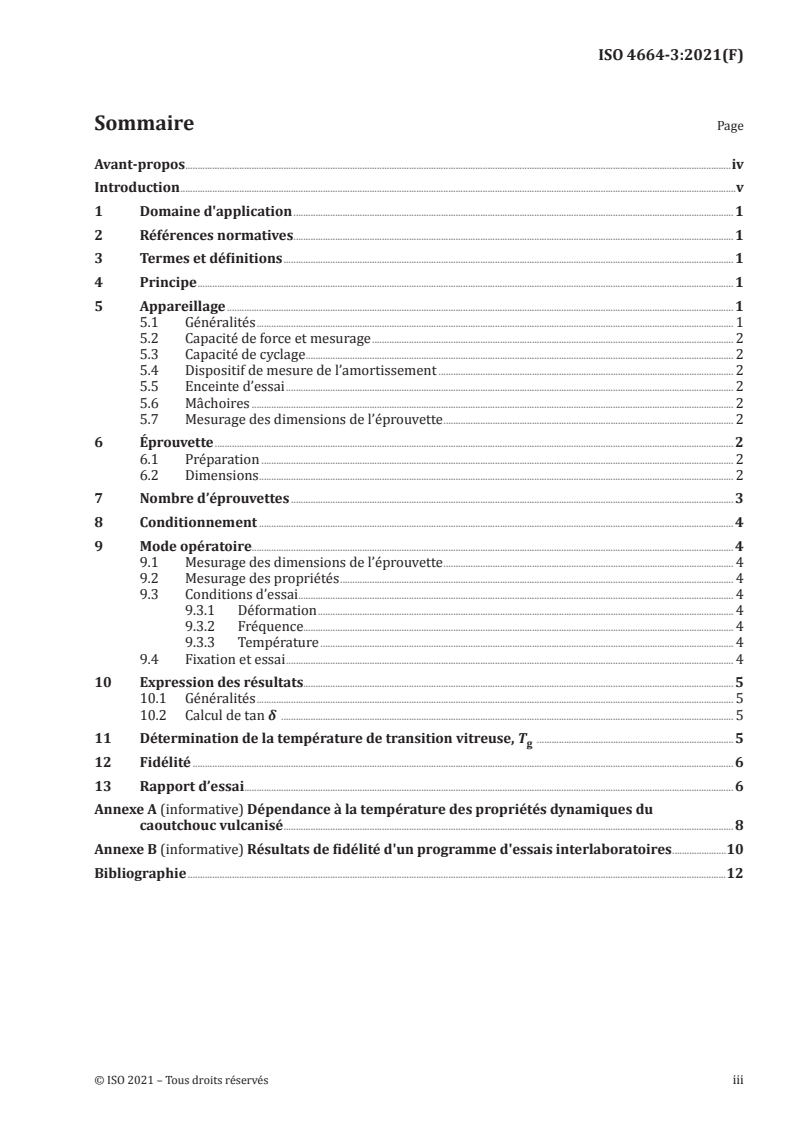
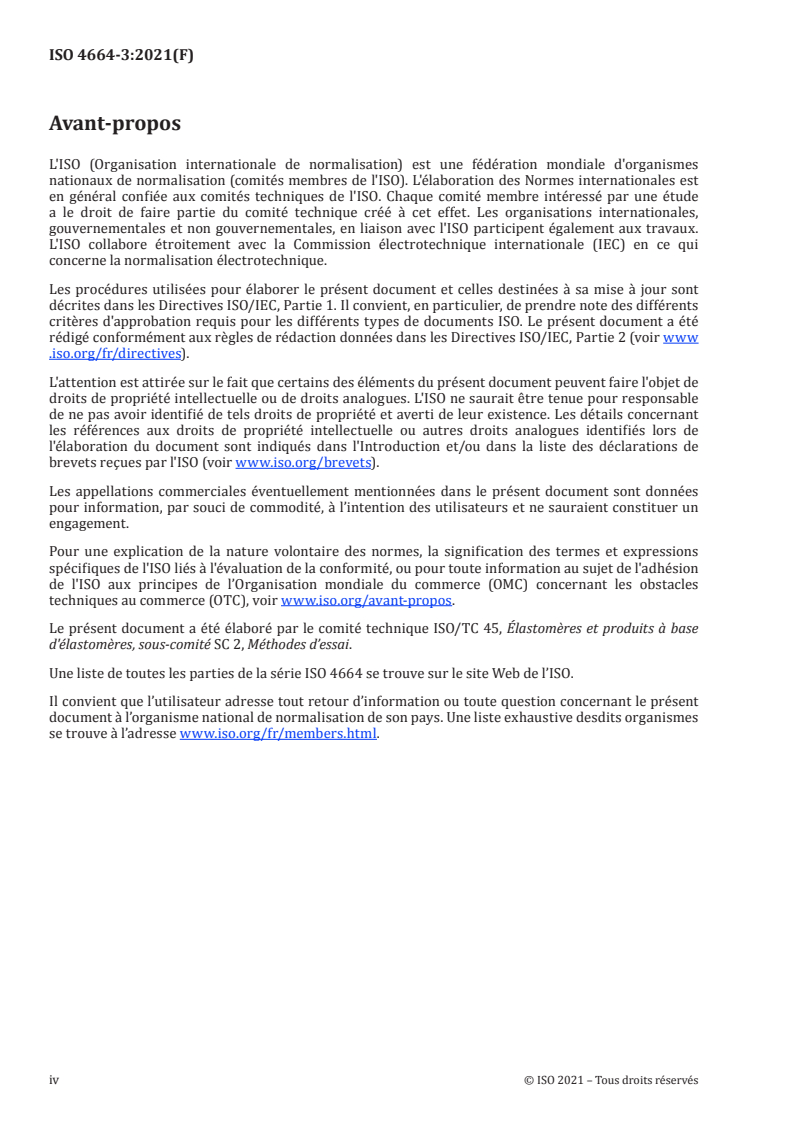
ISO 4664-3:2021 - Caoutchouc vulcanisé ou thermoplastique — Détermination des propriétés dynamiques — Partie 3: Température de transition vitreuse (Tg)/24/2021
Overview
ISO 4664-3:2021 - Rubber, vulcanized or thermoplastic - Determination of dynamic properties - Part 3: Glass transition temperature (Tg) specifies a standardized method to determine the glass transition temperature (Tg) of vulcanized and thermoplastic rubbers in the hardness range 30–80 IRHD. The method uses a temperature sweep under controlled sinusoidal deformation (dynamic mechanical testing) and identifies Tg as the peak in the tan δ (loss factor) versus temperature curve. Tg obtained by this dynamic method is intended as a guideline to the material’s service temperature.
Key topics and requirements
- Measurement principle: Dynamic mechanical analysis (DMA)-style temperature ramp with sinusoidal deformation; Tg = temperature at maximum tan δ.
- Material range: Vulcanized or thermoplastic rubbers, hardness 30–80 IRHD.
- Test modes & specimens:
- Compression cylinder: 10 mm height × 10 mm diameter (preferred).
- Tension strip: preferred dimensions 25 mm length, 10 mm width, 2.0 ± 0.2 mm thickness with 10 mm test length.
- Shear: sandwich construction with rubber elements bonded to metal cylinders.
- Apparatus performance:
- Force readout accuracy ±1.0%.
- Loss factor (tan δ) accuracy ±5% or ±0.02 (whichever smaller).
- Sinusoidal wave with <10% harmonic content.
- Test chamber temperature control to ±0.3 °C and local sample temperature monitoring.
- Test conditions:
- Frequency range 1–15 Hz (recommended values in ISO 4664-1).
- Strain amplitude per equipment manual (tolerance ±0.01%).
- Temperature ramp: if unknown material, −150 °C to +70 °C at 1 or 2 °C/min; otherwise start ≥30 °C below expected Tg.
- Procedure & reproducibility:
- Minimum three test specimens.
- Condition specimens per ISO 23529 (≥3 h at standard laboratory temperature).
- Dynamic measurement after at least six cycles of stress.
Applications
- Assessing service temperature limits and low-temperature performance of elastomers.
- Material selection and specification for automotive seals, vibration isolators, hoses, gaskets, footwear soles, and other rubber components.
- Quality control, R&D and comparative evaluation of compound formulations and curing processes.
- Inputs for finite-element simulations and lifetime/embrittlement assessments where viscoelastic transition matters.
Who uses this standard
- Test laboratories and QA/QC teams performing rubber testing.
- R&D engineers formulating elastomer compounds.
- Manufacturers of rubber components and suppliers verifying material performance.
- Regulatory and specification writers requiring standardized Tg data.
Related standards
- ISO 4664-1:2011 - General guidance for determination of dynamic properties.
- ISO 23529 - Preparation and conditioning of test pieces for physical tests.
Keywords: ISO 4664-3, glass transition temperature, Tg, rubber testing, dynamic mechanical analysis, DMA, tan delta, vulcanized rubber, thermoplastic rubber, IRHD.
Buy Documents
ISO 4664-3:2021 - Rubber, vulcanized or thermoplastic -- Determination of dynamic properties
ISO 4664-3:2021 - Rubber, vulcanized or thermoplastic — Determination of dynamic properties — Part 3: Glass transition temperature (Tg)/24/2021
ISO 4664-3:2021 - Caoutchouc vulcanisé ou thermoplastique -- Détermination des propriétés dynamiques
ISO 4664-3:2021 - Caoutchouc vulcanisé ou thermoplastique — Détermination des propriétés dynamiques — Partie 3: Température de transition vitreuse (Tg)/24/2021
Get Certified
Connect with accredited certification bodies for this standard

DIN CERTCO
DIN Group product certification.

Smithers Quality Assessments
US management systems and product certification.
Sponsored listings
Frequently Asked Questions
ISO 4664-3:2021 is a standard published by the International Organization for Standardization (ISO). Its full title is "Rubber, vulcanized or thermoplastic — Determination of dynamic properties — Part 3: Glass transition temperature (Tg)". This standard covers: This document specifies a method for determining the glass transition temperature, Tg, of vulcanized rubbers in the hardness range from 30 IRHD to 80 IRHD. The dynamic properties are measured via temperature sweep in sinusoidal deformation at a defined strain and frequency and Tg is determined from the peak in the tan δ versus temperature curve. Glass transition temperature, Tg, determined in this way serves the purpose of a guideline to the service temperature of the material.
This document specifies a method for determining the glass transition temperature, Tg, of vulcanized rubbers in the hardness range from 30 IRHD to 80 IRHD. The dynamic properties are measured via temperature sweep in sinusoidal deformation at a defined strain and frequency and Tg is determined from the peak in the tan δ versus temperature curve. Glass transition temperature, Tg, determined in this way serves the purpose of a guideline to the service temperature of the material.
ISO 4664-3:2021 is classified under the following ICS (International Classification for Standards) categories: 83.060 - Rubber. The ICS classification helps identify the subject area and facilitates finding related standards.
ISO 4664-3:2021 is available in PDF format for immediate download after purchase. The document can be added to your cart and obtained through the secure checkout process. Digital delivery ensures instant access to the complete standard document.
Standards Content (Sample)
INTERNATIONAL ISO
STANDARD 4664-3
First edition
2021-03
Rubber, vulcanized or
thermoplastic — Determination of
dynamic properties —
Part 3:
Glass transition temperature (T )
g
Caoutchouc vulcanisé ou thermoplastique — Détermination des
propriétés dynamiques —
Partie 3: Température de transition vitreuse (T )
g
Reference number
©
ISO 2021
© ISO 2021
All rights reserved. Unless otherwise specified, or required in the context of its implementation, no part of this publication may
be reproduced or utilized otherwise in any form or by any means, electronic or mechanical, including photocopying, or posting
on the internet or an intranet, without prior written permission. Permission can be requested from either ISO at the address
below or ISO’s member body in the country of the requester.
ISO copyright office
CP 401 • Ch. de Blandonnet 8
CH-1214 Vernier, Geneva
Phone: +41 22 749 01 11
Email: copyright@iso.org
Website: www.iso.org
Published in Switzerland
ii © ISO 2021 – All rights reserved
Contents Page
Foreword .iv
Introduction .v
1 Scope . 1
2 Normative references . 1
3 Terms and definitions . 1
4 Principle . 1
5 Apparatus . 1
5.1 General . 1
5.2 Force capability and measurement . 2
5.3 Cycling capability . 2
5.4 Damping measuring device . 2
5.5 Test chamber . 2
5.6 Grips . 2
5.7 Measurement of test piece dimensions . 2
6 Test piece . 2
6.1 Preparation . 2
6.2 Dimensions . 2
7 Number of test pieces . 3
8 Conditioning . 3
9 Procedure. 4
9.1 Measurement of the test piece dimensions . 4
9.2 Measurement of properties . 4
9.3 Test conditions . 4
9.3.1 Strain . 4
9.3.2 Frequency . 4
9.3.3 Temperature . 4
9.4 Clamping and testing . 4
10 Expression of results . 4
10.1 General . 4
10.2 Calculation of tan δ . 5
11 Determination of glass transition temperature, T . 5
g
12 Precision . 5
13 Test report . 6
Annex A (informative) Temperature dependence of dynamic properties of vulcanized rubber .7
Annex B (informative) Precision results from an interlaboratory test programme .9
Bibliography .11
Foreword
ISO (the International Organization for Standardization) is a worldwide federation of national standards
bodies (ISO member bodies). The work of preparing International Standards is normally carried out
through ISO technical committees. Each member body interested in a subject for which a technical
committee has been established has the right to be represented on that committee. International
organizations, governmental and non-governmental, in liaison with ISO, also take part in the work.
ISO collaborates closely with the International Electrotechnical Commission (IEC) on all matters of
electrotechnical standardization.
The procedures used to develop this document and those intended for its further maintenance are
described in the ISO/IEC Directives, Part 1. In particular, the different approval criteria needed for the
different types of ISO documents should be noted. This document was drafted in accordance with the
editorial rules of the ISO/IEC Directives, Part 2 (see www .iso .org/ directives).
Attention is drawn to the possibility that some of the elements of this document may be the subject of
patent rights. ISO shall not be held responsible for identifying any or all such patent rights. Details of
any patent rights identified during the development of the document will be in the Introduction and/or
on the ISO list of patent declarations received (see www .iso .org/ patents).
Any trade name used in this document is information given for the convenience of users and does not
constitute an endorsement.
For an explanation of the voluntary nature of standards, the meaning of ISO specific terms and
expressions related to conformity assessment, as well as information about ISO's adherence to the
World Trade Organization (WTO) principles in the Technical Barriers to Trade (TBT), see www .iso .org/
iso/ foreword .html.
This document was prepared by Technical Committee ISO/TC 45, Rubber and rubber products,
Subcommittee SC 2, Testing and analysis.
A list of all parts in the ISO 4664 series can be found on the ISO website.
Any feedback or questions on this document should be directed to the user’s national standards body. A
complete listing of these bodies can be found at www .iso .org/ members .html.
iv © ISO 2021 – All rights reserved
Introduction
Elastomers are viscoelastic in nature hence their response to dynamic stress is a combination of elastic
and viscous response. Glass transition temperature, T , is the temperature at which an amorphous
g
or semi crystalline polymer transforms from a rubbery viscous state to a brittle glass-like state. It is
always lower than the melting temperature.
This document is based on a force induced vibration test from which the stiffness can be determined,
(see Annex A) and modulus and tan δ can be calculated. Tan δ is the ratio of viscous modulus to the
elastic modulus. Tan δ is plotted against temperature and the glass transition temperature is taken as
the peak in the curve.
The measured value of T depends on the experimental conditions and the mode of deformation.
g
Measurement of T in dynamic mode is more sensitive to the temperature dependent physical properties
g
of the material and is relevant to understanding its service temperature.
INTERNATIONAL STANDARD ISO 4664-3:2021(E)
Rubber, vulcanized or thermoplastic — Determination of
dynamic properties —
Part 3:
Glass transition temperature (T )
g
1 Scope
This document specifies a method for determining the glass transition temperature, T , of vulcanized
g
rubbers in the hardness range from 30 IRHD to 80 IRHD. The dynamic properties are measured via
temperature sweep in sinusoidal deformation at a defined strain and frequency and T is determined
g
from the peak in the tan δ versus temperature curve. Glass transition temperature, T , determined in
g
this way serves the purpose of a guideline to the service temperature of the material.
2 Normative references
The following documents are referred to in the text in such a way that some or all of their content
constitutes requirements of this document. For dated references, only the edition cited applies. For
undated references, the latest edition of the referenced document (including any amendments) applies.
ISO 4664-1:2011, Rubber, vulcanized or thermoplastic — Determination of dynamic properties — Part 1:
General guidance
ISO 23529, Rubber — General procedures for preparing and conditioning test pieces for physical test methods
3 Terms and definitions
For the purposes of this document, the terms and definitions given in ISO 4664-1 apply.
ISO and IEC maintain terminological databases for use in standardization at the following addresses:
— ISO Online browsing platform: available at https:// www .iso .org/ obp
— IEC Electropedia: available at http:// www .electropedia .org/
4 Principle
Test pieces are subjected to a temperature scan in a closed chamber at a constant strain and frequency
using a dynamic mechanical analyser and the temperature of maximum tan δ taken as the glass
transition.
5 Apparatus
5.1 General
The test machine used shall comply with the requirements of ISO 4664-1. Care shall be taken to avoid
resonance under operating conditions.
5.2 Force capability and measurement
The force measuring device shall have an adequate range for the materials to be tested and the test
pieces and deformations used. It shall enable the peak force to be read to an accuracy of ± 1,0 %.
5.3 Cycling capability
The test machine shall be able to operate at a defined frequency and with the required dynamic
displacement amplitude. The deformation cycles shall be in the form of a continuous wave train of
sinusoidal shape with less than 10 % harmonic content.
NOTE “Harmonic content” indicates that there is no deviation/deformation of the sine curve due to
equipment contribution, sample effect or any other factors.
5.4 Damping measuring device
The test machine shall be fitted with a device to enable the loss factor of the material under test to be
determined to an accuracy of ± 5 % or ± 0,02 in tan δ whichever is the smaller.
5.5 Test chamber
The test chamber shall be closed and thermostatically controlled to within ± 0,3 °C of the programmed
test temperature. Care shall be taken to reduce heat conduction from the test piece through the test
piece h
...
INTERNATIONAL ISO
STANDARD 4664-3
First edition
2021-03
Rubber, vulcanized or
thermoplastic — Determination of
dynamic properties —
Part 3:
Glass transition temperature (T )
g
Caoutchouc vulcanisé ou thermoplastique — Détermination des
propriétés dynamiques —
Partie 3: Température de transition vitreuse (T )
g
Reference number
©
ISO 2021
© ISO 2021
All rights reserved. Unless otherwise specified, or required in the context of its implementation, no part of this publication may
be reproduced or utilized otherwise in any form or by any means, electronic or mechanical, including photocopying, or posting
on the internet or an intranet, without prior written permission. Permission can be requested from either ISO at the address
below or ISO’s member body in the country of the requester.
ISO copyright office
CP 401 • Ch. de Blandonnet 8
CH-1214 Vernier, Geneva
Phone: +41 22 749 01 11
Email: copyright@iso.org
Website: www.iso.org
Published in Switzerland
ii © ISO 2021 – All rights reserved
Contents Page
Foreword .iv
Introduction .v
1 Scope . 1
2 Normative references . 1
3 Terms and definitions . 1
4 Principle . 1
5 Apparatus . 1
5.1 General . 1
5.2 Force capability and measurement . 2
5.3 Cycling capability . 2
5.4 Damping measuring device . 2
5.5 Test chamber . 2
5.6 Grips . 2
5.7 Measurement of test piece dimensions . 2
6 Test piece . 2
6.1 Preparation . 2
6.2 Dimensions . 2
7 Number of test pieces . 3
8 Conditioning . 3
9 Procedure. 4
9.1 Measurement of the test piece dimensions . 4
9.2 Measurement of properties . 4
9.3 Test conditions . 4
9.3.1 Strain . 4
9.3.2 Frequency . 4
9.3.3 Temperature . 4
9.4 Clamping and testing . 4
10 Expression of results . 4
10.1 General . 4
10.2 Calculation of tan δ . 5
11 Determination of glass transition temperature, T . 5
g
12 Precision . 5
13 Test report . 6
Annex A (informative) Temperature dependence of dynamic properties of vulcanized rubber .7
Annex B (informative) Precision results from an interlaboratory test programme .9
Bibliography .11
Foreword
ISO (the International Organization for Standardization) is a worldwide federation of national standards
bodies (ISO member bodies). The work of preparing International Standards is normally carried out
through ISO technical committees. Each member body interested in a subject for which a technical
committee has been established has the right to be represented on that committee. International
organizations, governmental and non-governmental, in liaison with ISO, also take part in the work.
ISO collaborates closely with the International Electrotechnical Commission (IEC) on all matters of
electrotechnical standardization.
The procedures used to develop this document and those intended for its further maintenance are
described in the ISO/IEC Directives, Part 1. In particular, the different approval criteria needed for the
different types of ISO documents should be noted. This document was drafted in accordance with the
editorial rules of the ISO/IEC Directives, Part 2 (see www .iso .org/ directives).
Attention is drawn to the possibility that some of the elements of this document may be the subject of
patent rights. ISO shall not be held responsible for identifying any or all such patent rights. Details of
any patent rights identified during the development of the document will be in the Introduction and/or
on the ISO list of patent declarations received (see www .iso .org/ patents).
Any trade name used in this document is information given for the convenience of users and does not
constitute an endorsement.
For an explanation of the voluntary nature of standards, the meaning of ISO specific terms and
expressions related to conformity assessment, as well as information about ISO's adherence to the
World Trade Organization (WTO) principles in the Technical Barriers to Trade (TBT), see www .iso .org/
iso/ foreword .html.
This document was prepared by Technical Committee ISO/TC 45, Rubber and rubber products,
Subcommittee SC 2, Testing and analysis.
A list of all parts in the ISO 4664 series can be found on the ISO website.
Any feedback or questions on this document should be directed to the user’s national standards body. A
complete listing of these bodies can be found at www .iso .org/ members .html.
iv © ISO 2021 – All rights reserved
Introduction
Elastomers are viscoelastic in nature hence their response to dynamic stress is a combination of elastic
and viscous response. Glass transition temperature, T , is the temperature at which an amorphous
g
or semi crystalline polymer transforms from a rubbery viscous state to a brittle glass-like state. It is
always lower than the melting temperature.
This document is based on a force induced vibration test from which the stiffness can be determined,
(see Annex A) and modulus and tan δ can be calculated. Tan δ is the ratio of viscous modulus to the
elastic modulus. Tan δ is plotted against temperature and the glass transition temperature is taken as
the peak in the curve.
The measured value of T depends on the experimental conditions and the mode of deformation.
g
Measurement of T in dynamic mode is more sensitive to the temperature dependent physical properties
g
of the material and is relevant to understanding its service temperature.
INTERNATIONAL STANDARD ISO 4664-3:2021(E)
Rubber, vulcanized or thermoplastic — Determination of
dynamic properties —
Part 3:
Glass transition temperature (T )
g
1 Scope
This document specifies a method for determining the glass transition temperature, T , of vulcanized
g
rubbers in the hardness range from 30 IRHD to 80 IRHD. The dynamic properties are measured via
temperature sweep in sinusoidal deformation at a defined strain and frequency and T is determined
g
from the peak in the tan δ versus temperature curve. Glass transition temperature, T , determined in
g
this way serves the purpose of a guideline to the service temperature of the material.
2 Normative references
The following documents are referred to in the text in such a way that some or all of their content
constitutes requirements of this document. For dated references, only the edition cited applies. For
undated references, the latest edition of the referenced document (including any amendments) applies.
ISO 4664-1:2011, Rubber, vulcanized or thermoplastic — Determination of dynamic properties — Part 1:
General guidance
ISO 23529, Rubber — General procedures for preparing and conditioning test pieces for physical test methods
3 Terms and definitions
For the purposes of this document, the terms and definitions given in ISO 4664-1 apply.
ISO and IEC maintain terminological databases for use in standardization at the following addresses:
— ISO Online browsing platform: available at https:// www .iso .org/ obp
— IEC Electropedia: available at http:// www .electropedia .org/
4 Principle
Test pieces are subjected to a temperature scan in a closed chamber at a constant strain and frequency
using a dynamic mechanical analyser and the temperature of maximum tan δ taken as the glass
transition.
5 Apparatus
5.1 General
The test machine used shall comply with the requirements of ISO 4664-1. Care shall be taken to avoid
resonance under operating conditions.
5.2 Force capability and measurement
The force measuring device shall have an adequate range for the materials to be tested and the test
pieces and deformations used. It shall enable the peak force to be read to an accuracy of ± 1,0 %.
5.3 Cycling capability
The test machine shall be able to operate at a defined frequency and with the required dynamic
displacement amplitude. The deformation cycles shall be in the form of a continuous wave train of
sinusoidal shape with less than 10 % harmonic content.
NOTE “Harmonic content” indicates that there is no deviation/deformation of the sine curve due to
equipment contribution, sample effect or any other factors.
5.4 Damping measuring device
The test machine shall be fitted with a device to enable the loss factor of the material under test to be
determined to an accuracy of ± 5 % or ± 0,02 in tan δ whichever is the smaller.
5.5 Test chamber
The test chamber shall be closed and thermostatically controlled to within ± 0,3 °C of the programmed
test temperature. Care shall be taken to reduce heat conduction from the test piece through the test
piece h
...
NORME ISO
INTERNATIONALE 4664-3
Première édition
2021-03
Caoutchouc vulcanisé ou
thermoplastique — Détermination des
propriétés dynamiques —
Partie 3:
Température de transition vitreuse
(T )
g
Rubber, vulcanized or thermoplastic — Determination of dynamic
properties —
Part 3: Glass transition temperature (T )
g
Numéro de référence
©
ISO 2021
DOCUMENT PROTÉGÉ PAR COPYRIGHT
© ISO 2021
Tous droits réservés. Sauf prescription différente ou nécessité dans le contexte de sa mise en œuvre, aucune partie de cette
publication ne peut être reproduite ni utilisée sous quelque forme que ce soit et par aucun procédé, électronique ou mécanique,
y compris la photocopie, ou la diffusion sur l’internet ou sur un intranet, sans autorisation écrite préalable. Une autorisation peut
être demandée à l’ISO à l’adresse ci-après ou au comité membre de l’ISO dans le pays du demandeur.
ISO copyright office
Case postale 401 • Ch. de Blandonnet 8
CH-1214 Vernier, Genève
Tél.: +41 22 749 01 11
E-mail: copyright@iso.org
Web: www.iso.org
Publié en Suisse
ii © ISO 2021 – Tous droits réservés
Sommaire Page
Avant-propos .iv
Introduction .v
1 Domaine d'application . 1
2 Références normatives . 1
3 Termes et définitions . 1
4 Principe . 1
5 Appareillage . 1
5.1 Généralités . 1
5.2 Capacité de force et mesurage . 2
5.3 Capacité de cyclage . 2
5.4 Dispositif de mesure de l’amortissement . 2
5.5 Enceinte d’essai . 2
5.6 Mâchoires . 2
5.7 Mesurage des dimensions de l’éprouvette . 2
6 Éprouvette . 2
6.1 Préparation . 2
6.2 Dimensions . 2
7 Nombre d’éprouvettes . 3
8 Conditionnement . 4
9 Mode opératoire. 4
9.1 Mesurage des dimensions de l’éprouvette . 4
9.2 Mesurage des propriétés . 4
9.3 Conditions d’essai . 4
9.3.1 Déformation . 4
9.3.2 Fréquence. 4
9.3.3 Température . 4
9.4 Fixation et essai . 4
10 Expression des résultats. 5
10.1 Généralités . 5
10.2 Calcul de tan δ . 5
11 Détermination de la température de transition vitreuse, T . 5
g
12 Fidélité . 6
13 Rapport d’essai . 6
Annexe A (informative) Dépendance à la température des propriétés dynamiques du
caoutchouc vulcanisé . 8
Annexe B (informative) Résultats de fidélité d'un programme d'essais interlaboratoires .10
Bibliographie .12
Avant-propos
L'ISO (Organisation internationale de normalisation) est une fédération mondiale d'organismes
nationaux de normalisation (comités membres de l'ISO). L'élaboration des Normes internationales est
en général confiée aux comités techniques de l'ISO. Chaque comité membre intéressé par une étude
a le droit de faire partie du comité technique créé à cet effet. Les organisations internationales,
gouvernementales et non gouvernementales, en liaison avec l'ISO participent également aux travaux.
L'ISO collabore étroitement avec la Commission électrotechnique internationale (IEC) en ce qui
concerne la normalisation électrotechnique.
Les procédures utilisées pour élaborer le présent document et celles destinées à sa mise à jour sont
décrites dans les Directives ISO/IEC, Partie 1. Il convient, en particulier, de prendre note des différents
critères d'approbation requis pour les différents types de documents ISO. Le présent document a été
rédigé conformément aux règles de rédaction données dans les Directives ISO/IEC, Partie 2 (voir www
.iso .org/ fr/ directives).
L'attention est attirée sur le fait que certains des éléments du présent document peuvent faire l'objet de
droits de propriété intellectuelle ou de droits analogues. L'ISO ne saurait être tenue pour responsable
de ne pas avoir identifié de tels droits de propriété et averti de leur existence. Les détails concernant
les références aux droits de propriété intellectuelle ou autres droits analogues identifiés lors de
l'élaboration du document sont indiqués dans l'Introduction et/ou dans la liste des déclarations de
brevets reçues par l'ISO (voir www .iso .org/ brevets).
Les appellations commerciales éventuellement mentionnées dans le présent document sont données
pour information, par souci de commodité, à l’intention des utilisateurs et ne sauraient constituer un
engagement.
Pour une explication de la nature volontaire des normes, la signification des termes et expressions
spécifiques de l'ISO liés à l'évaluation de la conformité, ou pour toute information au sujet de l'adhésion
de l'ISO aux principes de l’Organisation mondiale du commerce (OMC) concernant les obstacles
techniques au commerce (OTC), voir www .iso .org/ avant -propos.
Le présent document a été élaboré par le comité technique ISO/TC 45, Élastomères et produits à base
d'élastomères, sous-comité SC 2, Méthodes d’essai.
Une liste de toutes les parties de la série ISO 4664 se trouve sur le site Web de l’ISO.
Il convient que l’utilisateur adresse tout retour d’information ou toute question concernant le présent
document à l’organisme national de normalisation de son pays. Une liste exhaustive desdits organismes
se trouve à l’adresse www .iso .org/ fr/ members .html.
iv © ISO 2021 – Tous droits réservés
Introduction
Les élastomères étant viscoélastiques par nature, leur réponse aux contraintes dynamiques est une
combinaison de réponse élastique et de réponse visqueuse. La température de transition vitreuse,
T , est la température à laquelle un polymère amorphe ou semi-cristallin passe d’un état visqueux
g
caoutchoutique à un état de type vitreux fragile. Elle est toujours inférieure à la température de fusion.
Le présent document est basé sur un essai de vibrations induites par une force, qui permet de déterminer
la rigidité (voir l’Annexe A), et de calculer le module et tan δ. Tan δ est le rapport du module visqueux au
module élastique. Tan δ est représenté en fonction de la température sur une courbe et la température
de transition vitreuse correspond au pic sur cette courbe.
La valeur mesurée de T dépend des conditions expérimentales et du mode de déformation. Le mesurage
g
de T en mode dynamique est plus sensible aux propriétés physiques du matériau qui dépendent de la
g
température, et ce paramètre est pertinent pour comprendre sa température de service.
NORME INTERNATIONALE ISO 4664-3:2021(F)
Caoutchouc vulcanisé ou thermoplastique —
Détermination des propriétés dynamiques —
Partie 3:
Température de transition vitreuse (T )
g
1 Domaine d'application
Le présent document spécifie une méthode pour déterminer la température de transition vitreuse, T ,
g
des caoutchoucs vulcanisés dans la plage de dureté de 30 DIDC à 80 DIDC. Les propriétés dynamiques
sont mesurées par un balayage en température sous déformation sinusoïdale à une déformation et
une fréquence définies, et T est déterminée à partir du pic sur la courbe de tan δ en fonction de la
g
température. La température de transition vitreuse, T , ainsi déterminée sert de ligne directrice pour la
g
température de service du matériau.
2 Références normatives
Les documents suivants sont référencés dans le texte de sorte qu'une partie ou la totalité de leur
contenu constitue les exigences du présent document. Pour les références datées, seule l'édition citée
s'applique. Pour les références non datées, la dernière édition du document de référence s'applique (y
compris les éventuels amendements).
ISO 4664-1:2011, Caoutchouc vulcanisé ou thermoplastique — Détermination des propriétés dynamiques —
Partie 1: Lignes directrices
ISO 23529, Caoutchouc — Procédures générales pour la préparation et le conditionnement des éprouvettes
pour les méthodes d'essais physiques
3 Termes et définitions
Pour les besoins du présent document, les termes et définitions donnés dans l’ISO 4664-1 s’appliquent.
L’ISO et l’IEC tiennent à jour des bases de données terminologiques destinées à être utilisées en
normalisation, consultables aux adresses suivantes:
— ISO Online browsing platform: disponible à l’adresse https:// www .iso .org/ obp
— IEC Electropedia: disponible à l’adresse http:// www .electropedia .org/
4 Principe
Les éprouvettes sont soumises à un balayage en température dans une enceinte fermée à une
déformation et une fréquence constantes, à l’aide d’un analyseur mécanique dynamique, et la
température du maximum de tan δ est prise comme étant la température de transition vitreuse.
5 Appareillage
5.1 Généralités
La machine d’essai utilisée doit être conforme aux exigences de l’ISO 4664-1. Des précautions doivent
être prises pour éviter la résonance dans les conditions de fonctionnement.
5.2 Capacité de force et mesurage
Le dispositif de mesure de la force doit avoir une plage adaptée aux matériaux soumis à essai et aux
éprouvettes et déformations utilisées. Il doit permettre de lire la force au pic avec une exactitude de
± 1,0 %.
5.3 Capacité de cyclage
La machine d’essai doit pouvoir fonctionner à une fréquence définie et avec l’amplitude de déplacement
dynamique requise. Les cycles de déformation doivent se présenter sous la forme d’un train d’ondes
continu de forme sinusoïdale avec un contenu harmonique inférieur à 10 %.
NOTE Le terme «contenu harmonique» indique qu’il n’y a pas d’écart/de déformation de la courbe de sinus
dus à la contribution de l’équipement, à l’effet de l’échantillon ou à tout autre facteur.
5.4 Dispositif de mesure de l’amortissement
La machine d’essai doit être munie d’un dispositif permettant de déterminer le facteur de perte du
matériau soumis à essai avec une exactitude de ± 5 % ou ± 0,02 sur tan δ, en prenant la plus petite des
deux valeurs.
5.5 Enceinte d’essai
L’enceinte d’essai doit être fermée et sa température doit être contrôlée à ± 0,3 °C de la température
d’essai programmée. Des précautions doivent être prises pour réduire la conduction thermique de
l’éprouvette dans l’environnement extérieur de l’enceinte via les supports de l’éprouvette. Il convient
qu’un moyen de mesure de la température réelle autour de l’échantillon soit prévu. Le contrôle précis
de la température est très important en raison des propriétés dépendantes de la température du
caoutchouc.
5.6 Mâchoires
Des mâchoires doivent être utilisées pour serrer les éprouvettes dans l’équipement de manière qu’elles
ne glissent pas pendant l’essai.
5.7 Mesurage des dimensions de l’éprouvette
Les instruments destinés à mesurer les dimensions de l’éprouvette doivent être conformes à l’ISO 23529.
6 Éprouvette
6.1 Préparation
La méthode normalisée de préparation de
...
NORME ISO
INTERNATIONALE 4664-3
Première édition
2021-03
Caoutchouc vulcanisé ou
thermoplastique — Détermination des
propriétés dynamiques —
Partie 3:
Température de transition vitreuse
(T )
g
Rubber, vulcanized or thermoplastic — Determination of dynamic
properties —
Part 3: Glass transition temperature (T )
g
Numéro de référence
©
ISO 2021
DOCUMENT PROTÉGÉ PAR COPYRIGHT
© ISO 2021
Tous droits réservés. Sauf prescription différente ou nécessité dans le contexte de sa mise en œuvre, aucune partie de cette
publication ne peut être reproduite ni utilisée sous quelque forme que ce soit et par aucun procédé, électronique ou mécanique,
y compris la photocopie, ou la diffusion sur l’internet ou sur un intranet, sans autorisation écrite préalable. Une autorisation peut
être demandée à l’ISO à l’adresse ci-après ou au comité membre de l’ISO dans le pays du demandeur.
ISO copyright office
Case postale 401 • Ch. de Blandonnet 8
CH-1214 Vernier, Genève
Tél.: +41 22 749 01 11
E-mail: copyright@iso.org
Web: www.iso.org
Publié en Suisse
ii © ISO 2021 – Tous droits réservés
Sommaire Page
Avant-propos .iv
Introduction .v
1 Domaine d'application . 1
2 Références normatives . 1
3 Termes et définitions . 1
4 Principe . 1
5 Appareillage . 1
5.1 Généralités . 1
5.2 Capacité de force et mesurage . 2
5.3 Capacité de cyclage . 2
5.4 Dispositif de mesure de l’amortissement . 2
5.5 Enceinte d’essai . 2
5.6 Mâchoires . 2
5.7 Mesurage des dimensions de l’éprouvette . 2
6 Éprouvette . 2
6.1 Préparation . 2
6.2 Dimensions . 2
7 Nombre d’éprouvettes . 3
8 Conditionnement . 4
9 Mode opératoire. 4
9.1 Mesurage des dimensions de l’éprouvette . 4
9.2 Mesurage des propriétés . 4
9.3 Conditions d’essai . 4
9.3.1 Déformation . 4
9.3.2 Fréquence. 4
9.3.3 Température . 4
9.4 Fixation et essai . 4
10 Expression des résultats. 5
10.1 Généralités . 5
10.2 Calcul de tan δ . 5
11 Détermination de la température de transition vitreuse, T . 5
g
12 Fidélité . 6
13 Rapport d’essai . 6
Annexe A (informative) Dépendance à la température des propriétés dynamiques du
caoutchouc vulcanisé . 8
Annexe B (informative) Résultats de fidélité d'un programme d'essais interlaboratoires .10
Bibliographie .12
Avant-propos
L'ISO (Organisation internationale de normalisation) est une fédération mondiale d'organismes
nationaux de normalisation (comités membres de l'ISO). L'élaboration des Normes internationales est
en général confiée aux comités techniques de l'ISO. Chaque comité membre intéressé par une étude
a le droit de faire partie du comité technique créé à cet effet. Les organisations internationales,
gouvernementales et non gouvernementales, en liaison avec l'ISO participent également aux travaux.
L'ISO collabore étroitement avec la Commission électrotechnique internationale (IEC) en ce qui
concerne la normalisation électrotechnique.
Les procédures utilisées pour élaborer le présent document et celles destinées à sa mise à jour sont
décrites dans les Directives ISO/IEC, Partie 1. Il convient, en particulier, de prendre note des différents
critères d'approbation requis pour les différents types de documents ISO. Le présent document a été
rédigé conformément aux règles de rédaction données dans les Directives ISO/IEC, Partie 2 (voir www
.iso .org/ fr/ directives).
L'attention est attirée sur le fait que certains des éléments du présent document peuvent faire l'objet de
droits de propriété intellectuelle ou de droits analogues. L'ISO ne saurait être tenue pour responsable
de ne pas avoir identifié de tels droits de propriété et averti de leur existence. Les détails concernant
les références aux droits de propriété intellectuelle ou autres droits analogues identifiés lors de
l'élaboration du document sont indiqués dans l'Introduction et/ou dans la liste des déclarations de
brevets reçues par l'ISO (voir www .iso .org/ brevets).
Les appellations commerciales éventuellement mentionnées dans le présent document sont données
pour information, par souci de commodité, à l’intention des utilisateurs et ne sauraient constituer un
engagement.
Pour une explication de la nature volontaire des normes, la signification des termes et expressions
spécifiques de l'ISO liés à l'évaluation de la conformité, ou pour toute information au sujet de l'adhésion
de l'ISO aux principes de l’Organisation mondiale du commerce (OMC) concernant les obstacles
techniques au commerce (OTC), voir www .iso .org/ avant -propos.
Le présent document a été élaboré par le comité technique ISO/TC 45, Élastomères et produits à base
d'élastomères, sous-comité SC 2, Méthodes d’essai.
Une liste de toutes les parties de la série ISO 4664 se trouve sur le site Web de l’ISO.
Il convient que l’utilisateur adresse tout retour d’information ou toute question concernant le présent
document à l’organisme national de normalisation de son pays. Une liste exhaustive desdits organismes
se trouve à l’adresse www .iso .org/ fr/ members .html.
iv © ISO 2021 – Tous droits réservés
Introduction
Les élastomères étant viscoélastiques par nature, leur réponse aux contraintes dynamiques est une
combinaison de réponse élastique et de réponse visqueuse. La température de transition vitreuse,
T , est la température à laquelle un polymère amorphe ou semi-cristallin passe d’un état visqueux
g
caoutchoutique à un état de type vitreux fragile. Elle est toujours inférieure à la température de fusion.
Le présent document est basé sur un essai de vibrations induites par une force, qui permet de déterminer
la rigidité (voir l’Annexe A), et de calculer le module et tan δ. Tan δ est le rapport du module visqueux au
module élastique. Tan δ est représenté en fonction de la température sur une courbe et la température
de transition vitreuse correspond au pic sur cette courbe.
La valeur mesurée de T dépend des conditions expérimentales et du mode de déformation. Le mesurage
g
de T en mode dynamique est plus sensible aux propriétés physiques du matériau qui dépendent de la
g
température, et ce paramètre est pertinent pour comprendre sa température de service.
NORME INTERNATIONALE ISO 4664-3:2021(F)
Caoutchouc vulcanisé ou thermoplastique —
Détermination des propriétés dynamiques —
Partie 3:
Température de transition vitreuse (T )
g
1 Domaine d'application
Le présent document spécifie une méthode pour déterminer la température de transition vitreuse, T ,
g
des caoutchoucs vulcanisés dans la plage de dureté de 30 DIDC à 80 DIDC. Les propriétés dynamiques
sont mesurées par un balayage en température sous déformation sinusoïdale à une déformation et
une fréquence définies, et T est déterminée à partir du pic sur la courbe de tan δ en fonction de la
g
température. La température de transition vitreuse, T , ainsi déterminée sert de ligne directrice pour la
g
température de service du matériau.
2 Références normatives
Les documents suivants sont référencés dans le texte de sorte qu'une partie ou la totalité de leur
contenu constitue les exigences du présent document. Pour les références datées, seule l'édition citée
s'applique. Pour les références non datées, la dernière édition du document de référence s'applique (y
compris les éventuels amendements).
ISO 4664-1:2011, Caoutchouc vulcanisé ou thermoplastique — Détermination des propriétés dynamiques —
Partie 1: Lignes directrices
ISO 23529, Caoutchouc — Procédures générales pour la préparation et le conditionnement des éprouvettes
pour les méthodes d'essais physiques
3 Termes et définitions
Pour les besoins du présent document, les termes et définitions donnés dans l’ISO 4664-1 s’appliquent.
L’ISO et l’IEC tiennent à jour des bases de données terminologiques destinées à être utilisées en
normalisation, consultables aux adresses suivantes:
— ISO Online browsing platform: disponible à l’adresse https:// www .iso .org/ obp
— IEC Electropedia: disponible à l’adresse http:// www .electropedia .org/
4 Principe
Les éprouvettes sont soumises à un balayage en température dans une enceinte fermée à une
déformation et une fréquence constantes, à l’aide d’un analyseur mécanique dynamique, et la
température du maximum de tan δ est prise comme étant la température de transition vitreuse.
5 Appareillage
5.1 Généralités
La machine d’essai utilisée doit être conforme aux exigences de l’ISO 4664-1. Des précautions doivent
être prises pour éviter la résonance dans les conditions de fonctionnement.
5.2 Capacité de force et mesurage
Le dispositif de mesure de la force doit avoir une plage adaptée aux matériaux soumis à essai et aux
éprouvettes et déformations utilisées. Il doit permettre de lire la force au pic avec une exactitude de
± 1,0 %.
5.3 Capacité de cyclage
La machine d’essai doit pouvoir fonctionner à une fréquence définie et avec l’amplitude de déplacement
dynamique requise. Les cycles de déformation doivent se présenter sous la forme d’un train d’ondes
continu de forme sinusoïdale avec un contenu harmonique inférieur à 10 %.
NOTE Le terme «contenu harmonique» indique qu’il n’y a pas d’écart/de déformation de la courbe de sinus
dus à la contribution de l’équipement, à l’effet de l’échantillon ou à tout autre facteur.
5.4 Dispositif de mesure de l’amortissement
La machine d’essai doit être munie d’un dispositif permettant de déterminer le facteur de perte du
matériau soumis à essai avec une exactitude de ± 5 % ou ± 0,02 sur tan δ, en prenant la plus petite des
deux valeurs.
5.5 Enceinte d’essai
L’enceinte d’essai doit être fermée et sa température doit être contrôlée à ± 0,3 °C de la température
d’essai programmée. Des précautions doivent être prises pour réduire la conduction thermique de
l’éprouvette dans l’environnement extérieur de l’enceinte via les supports de l’éprouvette. Il convient
qu’un moyen de mesure de la température réelle autour de l’échantillon soit prévu. Le contrôle précis
de la température est très important en raison des propriétés dépendantes de la température du
caoutchouc.
5.6 Mâchoires
Des mâchoires doivent être utilisées pour serrer les éprouvettes dans l’équipement de manière qu’elles
ne glissent pas pendant l’essai.
5.7 Mesurage des dimensions de l’éprouvette
Les instruments destinés à mesurer les dimensions de l’éprouvette doivent être conformes à l’ISO 23529.
6 Éprouvette
6.1 Préparation
La méthode normalisée de préparation de
...