


ISO/IEC 8825-5:2004/Amd 1:2008
(Amendment)Information technology — ASN.1 encoding rules: Mapping W3C XML schema definitions into ASN.1 — Part 5: — Amendment 1: Efficiency enhancements
Information technology — ASN.1 encoding rules: Mapping W3C XML schema definitions into ASN.1 — Part 5: — Amendment 1: Efficiency enhancements
Technologies de l'information — Règles de codage ASN.1: Mappage en ASN.1 des définitions de schéma XML du W3C — Partie 5: — Amendement 1: Mises en évidence de l'efficacité
General Information
- Status
- Withdrawn
- Publication Date
- 17-Mar-2008
- Withdrawal Date
- 17-Mar-2008
- Current Stage
- 9599 - Withdrawal of International Standard
- Start Date
- 15-Dec-2009
- Completion Date
- 12-Feb-2026
Relations
- Effective Date
- 09-Feb-2026
- Effective Date
- 06-Jun-2022
- Effective Date
- 17-Mar-2009
- Effective Date
- 15-Apr-2008
Get Certified
Connect with accredited certification bodies for this standard

BSI Group
BSI (British Standards Institution) is the business standards company that helps organizations make excellence a habit.

NYCE
Mexican standards and certification body.
Sponsored listings
Frequently Asked Questions
ISO/IEC 8825-5:2004/Amd 1:2008 is a standard published by the International Organization for Standardization (ISO). Its full title is "Information technology — ASN.1 encoding rules: Mapping W3C XML schema definitions into ASN.1 — Part 5: — Amendment 1: Efficiency enhancements". This standard covers: Information technology — ASN.1 encoding rules: Mapping W3C XML schema definitions into ASN.1 — Part 5: — Amendment 1: Efficiency enhancements
Information technology — ASN.1 encoding rules: Mapping W3C XML schema definitions into ASN.1 — Part 5: — Amendment 1: Efficiency enhancements
ISO/IEC 8825-5:2004/Amd 1:2008 is classified under the following ICS (International Classification for Standards) categories: 35.100.60 - Presentation layer. The ICS classification helps identify the subject area and facilitates finding related standards.
ISO/IEC 8825-5:2004/Amd 1:2008 has the following relationships with other standards: It is inter standard links to EN ISO 11073-10101:2005, ISO/IEC 8825-5:2004, ISO/IEC 8825-5:2008; is excused to ISO/IEC 8825-5:2004. Understanding these relationships helps ensure you are using the most current and applicable version of the standard.
ISO/IEC 8825-5:2004/Amd 1:2008 is available in PDF format for immediate download after purchase. The document can be added to your cart and obtained through the secure checkout process. Digital delivery ensures instant access to the complete standard document.
Standards Content (Sample)
INTERNATIONAL ISO/IEC
STANDARD 8825-5
First edition
2004-11-15
AMENDMENT 1
2008-03-15
Information technology — ASN.1
encoding rules: Mapping W3C XML
schema definitions into ASN.1
AMENDMENT 1: Efficiency enhancements
Technologies de l'information — Règles de codage ASN.1: Mappage en
ASN.1 des définitions de schéma XML du W3C
AMENDEMENT 1: Mises en évidence de l'efficacité
Reference number
ISO/IEC 8825-5:2004/Amd.1:2008(E)
©
ISO/IEC 2008
ISO/IEC 8825-5:2004/Amd.1:2008(E)
PDF disclaimer
This PDF file may contain embedded typefaces. In accordance with Adobe's licensing policy, this file may be printed or viewed but
shall not be edited unless the typefaces which are embedded are licensed to and installed on the computer performing the editing. In
downloading this file, parties accept therein the responsibility of not infringing Adobe's licensing policy. The ISO Central Secretariat
accepts no liability in this area.
Adobe is a trademark of Adobe Systems Incorporated.
Details of the software products used to create this PDF file can be found in the General Info relative to the file; the PDF-creation
parameters were optimized for printing. Every care has been taken to ensure that the file is suitable for use by ISO member bodies. In
the unlikely event that a problem relating to it is found, please inform the Central Secretariat at the address given below.
© ISO/IEC 2008
All rights reserved. Unless otherwise specified, no part of this publication may be reproduced or utilized in any form or by any means,
electronic or mechanical, including photocopying and microfilm, without permission in writing from either ISO at the address below or
ISO's member body in the country of the requester.
ISO copyright office
Case postale 56 • CH-1211 Geneva 20
Tel. + 41 22 749 01 11
Fax + 41 22 749 09 47
E-mail copyright@iso.org
Web www.iso.org
Published in Switzerland
ii © ISO/IEC 2008 – All rights reserved
ISO/IEC 8825-5:2004/Amd.1:2008(E)
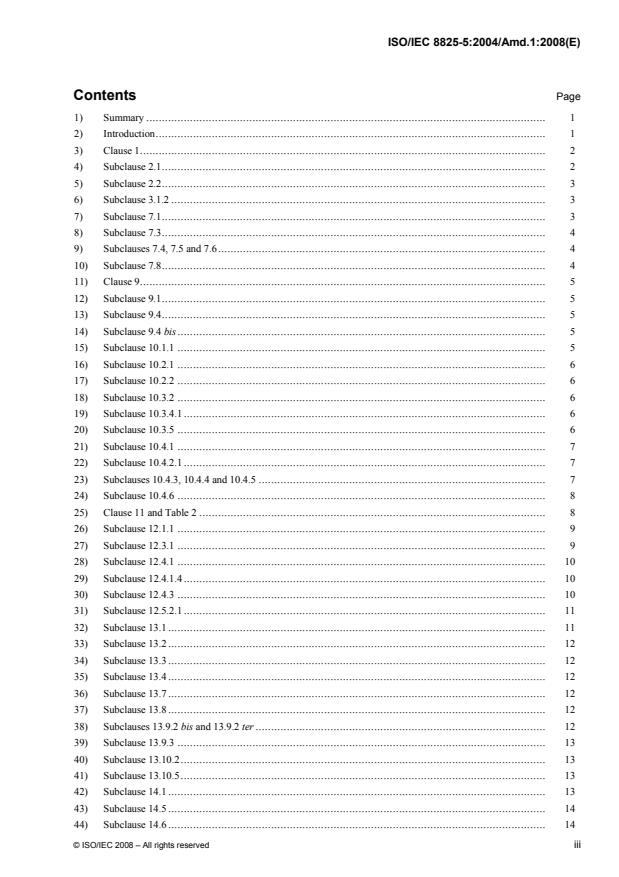
Contents Page
Page
1) Summary . 1
2) Introduction. 1
3) Clause 1. 2
4) Subclause 2.1. 2
5) Subclause 2.2. 3
6) Subclause 3.1.2 . 3
7) Subclause 7.1. 3
8) Subclause 7.3. 4
9) Subclauses 7.4, 7.5 and 7.6. 4
10) Subclause 7.8. 4
11) Clause 9. 5
12) Subclause 9.1. 5
13) Subclause 9.4. 5
14) Subclause 9.4 bis. 5
15) Subclause 10.1.1 . 5
16) Subclause 10.2.1 . 6
17) Subclause 10.2.2 . 6
18) Subclause 10.3.2 . 6
19) Subclause 10.3.4.1. 6
20) Subclause 10.3.5 . 6
21) Subclause 10.4.1 . 7
22) Subclause 10.4.2.1. 7
23) Subclauses 10.4.3, 10.4.4 and 10.4.5 . 7
24) Subclause 10.4.6 . 8
25) Clause 11 and Table 2 . 8
26) Subclause 12.1.1 . 9
27) Subclause 12.3.1 . 9
28) Subclause 12.4.1 . 10
29) Subclause 12.4.1.4. 10
30) Subclause 12.4.3 . 10
31) Subclause 12.5.2.1. 11
32) Subclause 13.1. 11
33) Subclause 13.2. 12
34) Subclause 13.3. 12
35) Subclause 13.4. 12
36) Subclause 13.7. 12
37) Subclause 13.8. 12
38) Subclauses 13.9.2 bis and 13.9.2 ter . 12
39) Subclause 13.9.3 . 13
40) Subclause 13.10.2. 13
41) Subclause 13.10.5. 13
42) Subclause 14.1. 13
43) Subclause 14.5. 14
44) Subclause 14.6. 14
© ISO/IEC 2008 – All rights reserved iii
ISO/IEC 8825-5:2004/Amd.1:2008(E)
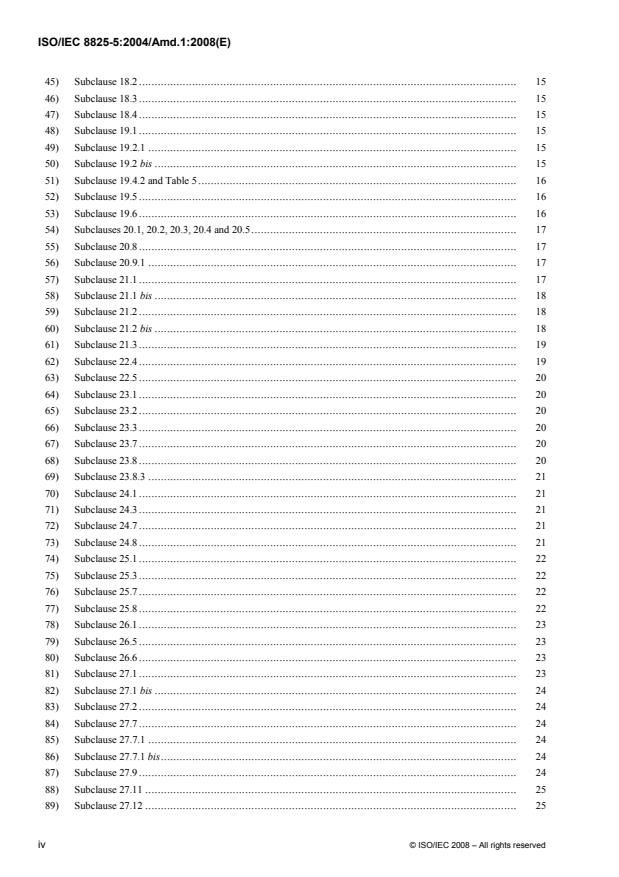
45) Subclause 18.2. 15
46) Subclause 18.3. 15
47) Subclause 18.4. 15
48) Subclause 19.1. 15
49) Subclause 19.2.1 . 15
50) Subclause 19.2 bis . 15
51) Subclause 19.4.2 and Table 5. 16
52) Subclause 19.5. 16
53) Subclause 19.6. 16
54) Subclauses 20.1, 20.2, 20.3, 20.4 and 20.5. 17
55) Subclause 20.8. 17
56) Subclause 20.9.1 . 17
57) Subclause 21.1. 17
58) Subclause 21.1 bis . 18
59) Subclause 21.2. 18
60) Subclause 21.2 bis . 18
61) Subclause 21.3. 19
62) Subclause 22.4. 19
63) Subclause 22.5. 20
64) Subclause 23.1. 20
65) Subclause 23.2. 20
66) Subclause 23.3. 20
67) Subclause 23.7. 20
68) Subclause 23.8. 20
69) Subclause 23.8.3 . 21
70) Subclause 24.1. 21
71) Subclause 24.3. 21
72) Subclause 24.7. 21
73) Subclause 24.8. 21
74) Subclause 25.1. 22
75) Subclause 25.3. 22
76) Subclause 25.7. 22
77) Subclause 25.8. 22
78) Subclause 26.1. 23
79) Subclause 26.5. 23
80) Subclause 26.6. 23
81) Subclause 27.1. 23
82) Subclause 27.1 bis . 24
83) Subclause 27.2. 24
84) Subclause 27.7. 24
85) Subclause 27.7.1 . 24
86) Subclause 27.7.1 bis. 24
87) Subclause 27.9. 24
88) Subclause 27.11 . 25
89) Subclause 27.12 . 25
iv © ISO/IEC 2008 – All rights reserved
ISO/IEC 8825-5:2004/Amd.1:2008(E)
90) Subclause 27.12.2. 25
91) Subclause 28.2. 25
92) Subclause 28.3. 25
93) Subclause 28.4. 25
94) Clause 29. 26
95) Clause 30. 27
96) Subclause 31.2. 28
97) Annex A . 28
98) Annex A bis . 32
99) Annex B . 36
100) Annex C . 36
© ISO/IEC 2008 – All rights reserved v
ISO/IEC 8825-5:2004/Amd.1:2008(E)
Foreword
ISO (the International Organization for Standardization) and IEC (the International Electrotechnical
Commission) form the specialized system for worldwide standardization. National bodies that are members of
ISO or IEC participate in the development of International Standards through technical committees
established by the respective organization to deal with particular fields of technical activity. ISO and IEC
technical committees collaborate in fields of mutual interest. Other international organizations, governmental
and non-governmental, in liaison with ISO and IEC, also take part in the work. In the field of information
technology, ISO and IEC have established a joint technical committee, ISO/IEC JTC 1.
International Standards are drafted in accordance with the rules given in the ISO/IEC Directives, Part 2.
The main task of the joint technical committee is to prepare International Standards. Draft International
Standards adopted by the joint technical committee are circulated to national bodies for voting. Publication as
an International Standard requires approval by at least 75 % of the national bodies casting a vote.
Attention is drawn to the possibility that some of the elements of this document may be the subject of patent
rights. ISO and IEC shall not be held responsible for identifying any or all such patent rights.
Amendment 1 to ISO/IEC 8825-5 was prepared by Joint Technical Committee ISO/IEC JTC 1, Information
technology, Subcommittee SC 6, Telecommunications and information exchange between systems in
collaboration with ITU-T. The identical text is published as ITU-T Rec. X.694/Amd.1 (05/2007).
vi © ISO/IEC 2008 – All rights reserved
ISO/IEC 8825-5:2004/Amd.1:2008 (E)
INTERNATIONAL STANDARD
ITU-T RECOMMENDATION
Information technology – ASN.1 encoding rules:
Mapping W3C XML schema definitions into ASN.1
Amendment 1
Efficiency enhancements
Conventions used in this amendment: Original, unchanged, text is in normal font. Deleted text is struck-through, thus:
deleted text. Inserted text is underlined, thus: inserted text. Text in new clauses is not underlined.
1) Summary
Replace the Summary with the following:
This Recommendation | International Standard defines rules for mapping an XSD Schema (a schema conforming to the
W3C XML Schema specification) to an ASN.1 schema in order to use ASN.1 encoding rules such as the Basic
Encoding Rules (BER), the Distinguished Encoding Rules (DER), the Packed Encoding Rules (PER) or the XML
Encoding Rules (XER) for the transfer of information defined by the XSD Schema.
The use of this Recommendation | International Standard with the ASN.1 Extended XML Encoding Rules
(EXTENDED-XER) provides the same XML representation of values as that defined by the original XSD Schema, but
also provides the ability to encode the specified XML with an efficient binary representation (binary XML). An XML
document can be converted to binary XML (for storage or transfer) using the ASN.1 generated by this mapping, and the
resulting binary can be converted back to the same XML document for further XML processing.
Two versions of the mapping are defined. Version 1 of the mapping was published in 2004, and a Corrigendum was
issued to this Version renaming the types DATE-TIME and DURATION in Annex A (in order to avoid conflict with the
application of ITU-T Rec. X.680/Amd. 3 | ISO/IEC 8824-1/Amd. 3 (known as the time types amendment). The
Version 2 mapping is more efficient in two areas: the ASN.1 time types are used rather than VisibleString for mappings
of dates and times; the Fast Infoset specification (ITU-T Rec. X.891 | ISO/IEC 24824-1) is used for the mapping of
XSD wild-cards. Both these changes to the mapping provide much more compact binary encodings for the XML
specified by the XSD.
NOTE – The specification of the Version 1 mapping (with applicable corrections) will be maintained in the next edition of this
Recommendation | International Standard, but it is expected that subsequent editions will document only the Version 2 mapping.
Application of the ASN.1 extended XML Encoding Rules to both versions of the mapping will produce the same XML
(which is the same as that specified by the XSD). However, application of other ASN.1 encoding rules to the Version 1
mapping results in a verbose character-based encoding of date and time types and of XSD wild-cards, whilst application
to the Version 2 mapping results in a more compact binary encoding using ASN.1 time types and the Fast Infoset
specification.
2) Introduction
Replace the Introduction with the following:
This Recommendation | International Standard specifies Version 1 and Version 2 of a mapping from a W3C XML
Schema definition (an XSD Schema) into an ASN.1 schema. The mappings can be applied to any XSD Schema. Both
mappingsIt specifyies the generation of one or more ASN.1 modules containing type definitions, together with ASN.1
XER encoding instructions. These are jointly described as an ASN.1 schema for XML documents. This ASN.1 schema
(produced by either Version of the mapping), when used with the ASN.1 Extended XML Encoding Rules
(EXTENDED-XER), can be used to generate and to validate the same set of W3C XML 1.0 documents as the original
XSD Schema. The resulting ASN.1 types and encodings support the same semantic content as the XSD Schema.
ITU-T Rec. X.694 (2004)/Amd.1 (05/2007) 1
ISO/IEC 8825-5:2004/Amd.1:2008 (E)
Thus ASN.1 tools can be used interchangeably with XSD tools for the generation and processing of the specified XML
documents.
Other standardized ASN.1 encoding rules, such as the Distinguished Encoding Rules (DER) or the Packed Encoding
Rules (PER), can be used in conjunction with this standardized mapping, but produce encodings for Version 2 of the
mapping that differ from (and are less verbose than) those produced by Version 1 for XSD constructs involving dates
and times or wildcards.
The combination of this Recommendation | International Standard with ASN.1 Encoding Rules provides fully-
standardized and vendor-independent compact and canonical binary encodings for data originally defined using an XSD
Schema.
The ASN.1 schema provides a clear separation between the specification of the information content of messages (their
abstract syntax) and the precise form of the XML document (for example, use of attributes instead of elements). This
results in both a clearer and generally a less verbose schema than the original XSD Schema.
Annex A forms an integral part of this Recommendation | International Standard, and is an ASN.1 module containing a
set of ASN.1 type assignments that correspond to each of the XSD built-in datatypes for Version 1 of the mapping.
Mappings of XSD Schemas into ASN.1 schemas either import the type reference names of those type assignments or
include the type definitions in-line.
Annex A bis also forms an integral part of this Recommendation | International Standard and provides the ASN.1
module for Version 2 of the mapping.
Annex B does not form an integral part of this Recommendation | International Standard, and summarizes the object
identifier values assigned in this Recommendation | International Standard.
Annex C does not form an integral part of this Recommendation | International Standard, and gives examples of the
mapping of XSD Schemas into ASN.1 schemas.
Annex D does not form an integral part of this Recommendation | International Standard, and describes the use of the
mapping defined in this Recommendation | International Standard, in conjunction with standardized ASN.1 Encoding
Rules, to provide compact and canonical encodings for data defined using an XSD Schema.
3) Clause 1
Replace the first paragraph of clause 1 with the following (retaining the remaining paragraphs):
This Recommendation | International Standard specifies two Versions of a mapping from any XSD Schema into an
ASN.1 schema. The ASN.1 schema for both Versions supports the same semantics and validates the same set of XML
documents.
4) Subclause 2.1
Replace subclause 2.1 with the following:
2.1 Identical Recommendations | International Standards
NOTE – The complete set of ASN.1 Recommendations | International Standards are listed below, as they can all be applicable in
particular uses of this Recommendation | International Standard. Where these are not directly referenced in the body of this
Recommendation | International Standard, a † symbol is added to the reference.
– ITU-T Recommendation X.680 (2002) | ISO/IEC 8824-1:2002, Information technology – Abstract
Syntax Notation One (ASN.1): Specification of basic notation.
– ITU-T Recommendation X.680 (2002)/Amd. 3 (2006)| ISO/IEC 8824-1:2002/Amd. 3:2006, Information
technology – Abstract Syntax Notation One (ASN.1): Specification of basic notation – Amendment 3:
Time type support.
– ITU-T Recommendation X.681 (2002) | ISO/IEC 8824-2:2002, Information technology – Abstract
Syntax Notation One (ASN.1): Information object specification. †
– ITU-T Recommendation X.682 (2002) | ISO/IEC 8824-3:2002, Information technology – Abstract
Syntax Notation One (ASN.1): Constraint specification.
– ITU-T Recommendation X.683 (2002) | ISO/IEC 8824-4:2002, Information technology – Abstract
Syntax Notation One (ASN.1): Parameterization of ASN.1 specifications. †
2 ITU-T Rec. X.694 (2004)/Amd.1 (05/2007)
ISO/IEC 8825-5:2004/Amd.1:2008 (E)
– ITU-T Recommendation X.690 (2002) | ISO/IEC 8825-1:2002, Information technology – ASN.1
encoding Rules: Specification of Basic Encoding Rules (BER), Canonical Encoding Rules (CER) and
Distinguished Encoding Rules (DER).
– ITU-T Recommendation X.690 (2002)/Amd.2 (2006) | ISO/IEC 8825-1:2002/Amd.2:2007, Information
technology – ASN.1 encoding rules: Specification of Basic Encoding Rules (BER), Canonical Encoding
Rules (CER) and Distinguished Encoding Rules (DER) – Amendment 2: Time type support.
– ITU-T Recommendation X.691 (2002) | ISO/IEC 8825-2:2002, Information technology – ASN.1
encoding rules: Specification of Packed Encoding Rules (PER).
– ITU-T Recommendation X.691 (2002)/Amd.2 (2006) | ISO/IEC 8825-2:2002/Amd.2:2007, Information
technology – ASN.1 encoding rules: Specification of Packed Encoding Rules (PER) – Amendment 2:
Time type support. †
– ITU-T Recommendation X.692 (2002) | ISO/IEC 8825-3:2002, Information technology – ASN.1
encoding rules: Specification of Encoding Control Notation (ECN). †
– ITU-T Recommendation X.693 (2001) | ISO/IEC 8825-4:2002, Information technology – ASN.1
encoding rules: XML Encoding Rules (XER).
– ITU-T Recommendation X.693 (2001)/Amd.1 (2003) | ISO/IEC 8825-4:2002/Amd.1:2004, Information
technology – ASN.1 encoding rules: XML Encoding Rules (XER) – Amendment 1: XER encoding
instructions and EXTENDED-XER.
– ITU-T Recommendation X.693 (2002)/Amd.2 (2006) | ISO/IEC 8825-4:2002/Amd.2:2006, Information
technology – ASN.1 encoding rules: XML Encoding Rules (XER) – Amendment 2: Time type support.
– ITU-T Recommendation X.891 (2005) | ISO/IEC 24824-1:2007, Information technology – Generic
applications of ASN.1: Fast Infoset.
5) Subclause 2.2
In subclause 2.2, replace "ISO 8601:2000" with "ISO 8601:2004".
6) Subclause 3.1.2
Replace subclause 3.1.2 with the following:
3.1.2 This Recommendation | International Standard also uses the terms defined in W3C XML Schema and
W3C XML Information Set.
NOTE 1 – It is believed that these terms do not conflict with the terms referenced in 3.1.1. If such a conflict occurs, the definition
of the term in 3.1.1 applies.
NOTE 2 – In particular, the terms "schema component" and "property (of a schema component)" are defined in W3C XML
Schema, and the terms "element information item" and "attribute information item" areis defined in W3C XML Information Set.
NOTE 3 – The terms "top-level simple type definition" and "top-level complex type definition" do not include XSD built-in types,
when used in this Recommendation | International Standard.
7) Subclause 7.1
Replace subclause 7.1 with the following:
7.1 A mapping is based on a source XSD Schema, which is a set of schema components (see W3C XML Schema
Part 1, 2.2). No particular representation of schema components or sets of schema components is required or assumed
for the mapping, although it is expected that the source XSD Schema will usually be provided as one or more XML
schema documents (see W3C XML Schema Part 1, 3.15.2).
NOTE 1 – The schema components represented in multiple XML schema documents become part of the same XSD Schema
through the use of the xsd:include xsd:redefine and xsd:import element information items.
NOTE 21 – Since the mapping is defined in terms of schema components (and not in terms of their XML representation), it is not
affected by details of the XML representation, such as the use of multiple schema documents linked by xsd:include and
xsd:redefine element information items, the placement of element information items in one or another schema documents, the
order of xsd:attribute element information items within a xsd:complexType element information item, and so on.
NOTE 32 – Two sets of schema documents that differ in many aspects but represent the same set of schema components generate
the same set of ASN.1 type assignments, with the same final encoding instructions assigned to them and to their components to
any depth.
ITU-T Rec. X.694 (2004)/Amd.1 (05/2007) 3
ISO/IEC 8825-5:2004/Amd.1:2008 (E)
8) Subclause 7.3
Replace subclause 7.3 with the following:
7.3 At least one ASN.1 module (see 7.4) shall be generated for each different target namespace (whether a
namespace name or the keyword absent) that is the target namespace of one or more schema components in the source
XSD Schema. One or more ASN.1 modules shall be generated for a source XSD Schema. The number of ASN.1
modules generated is an implementation option. Each ASN.1 module shall contain one or more type assignments
corresponding to top-level schema components (see 7.9) that have the same target namespace. Each ASN.1 module can
also contain one or more special ASN.1 type assignments whose associated ASN.1 type assignments are in the same
ASN.1 module (see 7.6). Each ASN.1 module shall contain zero or more type assignments corresponding to top-level
schema components (see 7.9), and zero or more special ASN.1 type assignments (see clauses 29, 30 and 31). The
physical order of type assignments within each ASN.1 module is an implementation option. When multiple ASN.1
modules are generated, the way the generated type assignments are distributed across those ASN.1 modules is also an
implementation option.
NOTE –The schema components represented in the multiple schema documents become part of the same XSD Schema through
the use of the xsd:include, xsd:redefine, and xsd:import element information items.
NOTE 1 – The inclusion in the same ASN.1 module of type assignments generated from XSD schema components with different
target namespaces is permitted by this subclause but not recommended. The preferred mapping is to generate one ASN.1 module
per namespace whenever possible. It is also recommended that each special ASN.1 type assignment be inserted in the same
ASN.1 module as its associated ASN.1 type assignment (see 29.4, 30.4 and 31.4).
NOTE 2 – The generation of ASN.1 type assignments (see 7.9 and 10.4) is not affected by the number of ASN.1 modules being
generated (except for the possible use of "ExternalTypeReference" as specified in 10.2.2), nor by the way the generated type
assignments are distributed across those modules, nor by the physical order of the type assignments within each module. In
particular, the type reference names of those type assignments are the same whatever mapping style is used by the
implementation.
NOTE 3 – A full description of the relationship between the namespace concept of W3C XML Namespaces and naming in
ASN.1 is provided in ITU-T Rec. X.693 | ISO/IEC 8825-4, clause 16. Type reference names and identifiers defined in an ASN.1
module are assigned a namespace by means of a NAMESPACE encoding instruction, and otherwise do not have a namespace. The
mapping generates NAMESPACE encoding instructions where needed.
9) Subclauses 7.4, 7.5 and 7.6
Delete subclauses 7.4, 7.5 and 7.6.
10) Subclause 7.8
Replace subclause 7.8 with the following:
7.8 A source XSD Schema shall be processed as follows:
a) for each top-level element declaration, an ASN.1 type assignment shall be generated by applying
clause 14 to the element declaration;
b) for each top-level attribute declaration, an ASN.1 type assignment shall be generated by applying
clause 15 to the attribute declaration;
c) for each user-defined top-level simple type definition, an ASN.1 type assignment shall be generated by
applying clause 13 to the simple type definition;
d) for each top-level complex type definition, an ASN.1 type assignment shall be generated by applying
clause 20 to the complex type definition;
e) for each model group definition whose model group has a compositor of sequence or choice, an ASN.1 type
assignment shall be generated by applying clause 17 to the model group definition.
NOTE 1 – The remaining schema components of the source XSD schema will be processed as a result of mapping these schema
components.
NOTE 2 – The order in which schema components are to be mapped is specified in 10.4. The order of the items of the list above
has no significance for the mapping.
4 ITU-T Rec. X.694 (2004)/Amd.1 (05/2007)
ISO/IEC 8825-5:2004/Amd.1:2008 (E)
11) Clause 9
Replace clause 9 with the following:
9 The ASN.1 modules and namespaces
NOTE – A full description of the relationship between the namespace concept of W3C XML Namespaces and naming in ASN.1
is provided in ITU-T Rec. X.693 | ISO/IEC 8825-4, clause 16. Type reference names and identifiers defined in an ASN.1 module
are assigned a namespace by means of a NAMESPACE encoding instruction, and otherwise do not have a namespace. The mapping
generates NAMESPACE encoding instructions as appropriate.
12) Subclause 9.1
Replace subclause 9.1 with the following:
9.1 The mapping of an XSD Schema generates one or more ASN.1 modules (see 7.3).corresponding to all schema
components in the Schema that have the same target namespace.
13) Subclause 9.4
Replace subclause 9.4 with the following:
9.4 In each ASN.1 module generated by a Version 1 mapping, there shall be an ASN.1 IMPORTS statement
importing the ASN.1 type reference names in the module named XSD {joint-iso-itu-t asn1(1)
specification(0) modules(0) xsd-module(2) version1(1)} specified in Annex A that are referenced in the
ASN.1 module.
14) Subclause 9.4 bis
Add a new subclause 9.4 bis as follows:
9.4 bis In each ASN.1 module generated by a Version 2 mapping, there shall be an ASN.1 IMPORTS statement
importing the ASN.1 type reference names in the module named XSD {joint-iso-itu-t asn1(1)
specification(0) modules(0) xsd-module(2) version2(2)} specified in Annex A bis that are referenced in
the generated ASN.1 module.
NOTE – The term "XSD module" in this Recommendation | International Standard refers to the module defined in Annex A
(Version 1 mapping) or in Annex A bis (Version 2 mapping), according to the version of the mapping.
15) Subclause 10.1.1
Replace subclause 10.1.1 with the following:
10.1.1 This Recommendation | International Standard specifies the generation of:
a) ASN.1 type reference names corresponding to the names of model group definitions, top-level element
declarations, top-level attribute declarations, top-level complex type definitions, and user-defined top-level
simple type definitions;
b) ASN.1 identifiers corresponding to the names of top-level element declarations, top-level attribute
declarations, local element declarations, and local attribute declarations;
c) ASN.1 identifiers for the mapping of certain simple type definitions with an enumeration facet (see 12.4.1
and 12.4.2);
d) ASN.1 type reference names of special type assignments (see clauses 29, 30 and 31); and
e) ASN.1 identifiers of certain sequence components introduced by the mapping (see clause 20).
ITU-T Rec. X.694 (2004)/Amd.1 (05/2007) 5
ISO/IEC 8825-5:2004/Amd.1:2008 (E)
16) Subclause 10.2.1
Replace subclause 10.2.1 with the following:
10.2.1 This subclause applies as explicitly invoked by other clauses of this Recommendation | International Standard
to generate an ASN.1 type (a "DefinedType") definition that is a reference (a "DefinedType") to an ASN.1 type
assignment.
17) Subclause 10.2.2
Replace subclause 10.2.2 with the following:
10.2.2 If an ASN.1 type definition (R, say) that is a "DefinedType" is to be inserted in an ASN.1 module (M, say)
other than the ASN.1 module where the referenced ASN.1 type assignment (TA, say) is being inserted, and the type
reference name of TA is identical to either the type reference name of another ASN.1 type assignment being inserted in
module M or to another type reference name being imported into module M, then R the "DefinedType" shall be an
"ExternalTypeReference" (constructed as appropriate for module M) for TA; for that type assignment, as an
implementation option. Ootherwise, it shall be a "typereference" for TAthat type assignment.
NOTE – All ASN.1 "typereference"s created by the mapping are unique for any legal input schema, so a type defined in another
ASN.1 module does not need to be an "ExternalTypeReference".
18) Subclause 10.3.2
Replace subclause 10.3.2 with the following:
10.3.2 Names of attribute declarations, element declarations, model group definitions, user-defined top-level simple type
definitions, and top-level complex type definitions can be identical to ASN.1 reserved words or can contain characters not
allowed in ASN.1 identifiers or in ASN.1 type reference names. In addition, there are cases in which ASN.1 names are
required to be distinct where the names of the corresponding XSD schema components (from which the ASN.1 names
are mapped) are allowed to be identical.
19) Subclause 10.3.4.1
Replace subclause 10.3.4.1 with the following:
10.3.4.1 If the name being generated is the type reference name of an ASN.1 type assignment and the character string
generated by 10.3.3 is identical to:
a) the type reference name of another ASN.1 type assignment previously (see 10.4) generated by the
mapping (in any ASN.1 module);in the same ASN.1 module or in another ASN.1 module with the same
namespace (including absence of a namespace), or
b) the type reference name of a type assignment in the XSD module (see Annex A); or
c) is one of the reserved words specified in ITU-T Rec. X.680 | ISO/IEC 8824-1, 11.27,
then a suffix shall be appended to the character string generated by 10.3.3. The suffix shall consist of a
HYPHEN-MINUS followed by the canonical lexical representation (see W3C XML Schema Part 2, 2.3.1) of an integer.
This integer shall be the least positive integer such that the new name is different from the type reference name of any
other ASN.1 type assignment previously generated (in any ASN.1 module)in any of those ASN.1 modules.
NOTE – As a consequence of this rule, all type reference names defined in an ASN.1 specification generated from a source XSD
schema (including the standardized type references defined in the XSD module) will be unique within that ASN.1 specification.
This allows maximum flexibility in the way that the generated ASN.1 type assignments are distributed across multiple ASN.1
modules (see 7.3).
20) Subclause 10.3.5
Replace subclause 10.3.5 with the following:
10.3.5 For an ASN.1 type reference name (or identifier) that is generated by applying this subclause 10.3 to the name
of an element declaration, attribute declaration, top-level complex type definition or user-defined top-level simple type
definition, if the type reference name (or identifier) generated is different from the name, a final NAME encoding
instruction shall be assigned to the ASN.1 type assignment with that type reference name (or to the component with that
identifier) as specified in the three following subclauses.
6 ITU-T Rec. X.694 (2004)/Amd.1 (05/2007)
ISO/IEC 8825-5:2004/Amd.1:2008 (E)
21) Subclause 10.4.1
Replace subclause 10.4.1 with the following:
10.4.1 An order is imposed on the top-level schema components of the source XSD Schema on which the mapping is
performed. This applies to model group definitions, top-level complex type definitions, user-defined top-level simple type
definitions, top-level attribute declarations, and top-level element declarations.
NOTE – Other top-level schema components are not mapped to ASN.1, and XSD built-in datatypes are mapped in a special way.
22) Subclause 10.4.2.1
Replace subclause 10.4.2.1 with the following:
10.4.2.1 Top-level schema components shall first be ordered by their target namespace, with the absent namespace
preceding all namespace names specified in the XSD schema in ascending lexicographical order.
23) Subclauses 10.4.3, 10.4.4 and 10.4.5
Replace subclauses 10.4.3, 10.4.4 and 10.4.5 with the following:
10.4.3 The mapping generatesTwo sets of ASN.1 type assignments are generated by the mapping:
a) one set of ASN.1 type assignments (generated by clauses 13, 14, 15, 17 and 20) correspond directly to
top-level schema components, and their type reference names are derived from the name of the schema
component with no suffix appended;
b) another set of ASN.1 type assignments (generated by clauses 29, 30 and 31) correspond to special uses of
top-level schema components, and their type reference names are generated from the name of the schema
component followed by a suffix and (in some cases) by a post-suffix.
NOTE – For each top-level schema component in the source XSD Schema, at most one ASN.1 type assignment in the set in
10.4.3 (a) can be generated, but multiple ASN.1 type assignments in the set in 10.4.3 (b) can be generated.
some ASN.1 type assignments that do not correspond directly to any XSD schema component. These are:
a) choice types (with a final USE-TYPE encoding instruction) corresponding to a type derivation hierarchy;
the type reference names of these types have a "-derivations" suffix (see clause 29);
b) choice types (with a final USE-TYPE encoding instruction on the type and a final USE-NIL encoding
instruction on each alternative) corresponding to a type derivation hierarchy where the user-defined top-
level simple type definition or complex type definition that is the root of the derivation hierarchy is used as
the type definition of one or more element declarations that are nillable; the type reference names of these
types have a "-deriv-nillable" suffix (see clause 29);
c) choice types (with a final USE-TYPE encoding instruction on the type and a final DEFAULT-FOR-EMPTY
encoding instruction on each alternative) corresponding to a type derivation hierarchy where the user-
defined top-level simple type definition or complex type definition that is the root of the derivation hierarchy
is used as the type definition of one or more element declarations that are not nillable and have a value
constraint that is a default value; the type reference names of these types have a "-deriv-default-"
suffix (see clause 29);
d) choice types (with a final USE-TYPE encoding instruction on the type and a final DEFAULT-FOR-EMPTY
encoding instruction on each alternative) corresponding to a type derivation hierarchy where the user-
defined
...
Questions, Comments and Discussion
Ask us and Technical Secretary will try to provide an answer. You can facilitate discussion about the standard in here.
Loading comments...