

ISO 209:2024
(Main)Wrought aluminium and aluminium alloys — Chemical composition
General Information
- Abstract
This document specifies the chemical composition limits of wrought products and ingots intended to be wrought in aluminium and aluminium alloys.
- Status
- Published
- Publication Date
- 18-Dec-2024
- Technical Committee
- ISO/TC 79/SC 6 - Wrought aluminium and aluminium alloys
- Drafting Committee
- ISO/TC 79/SC 6 - Wrought aluminium and aluminium alloys
- Current Stage
- 9092 - International Standard to be revised
- Start Date
- 17-Oct-2025
- Completion Date
- 29-Aug-2026
Buy Documents
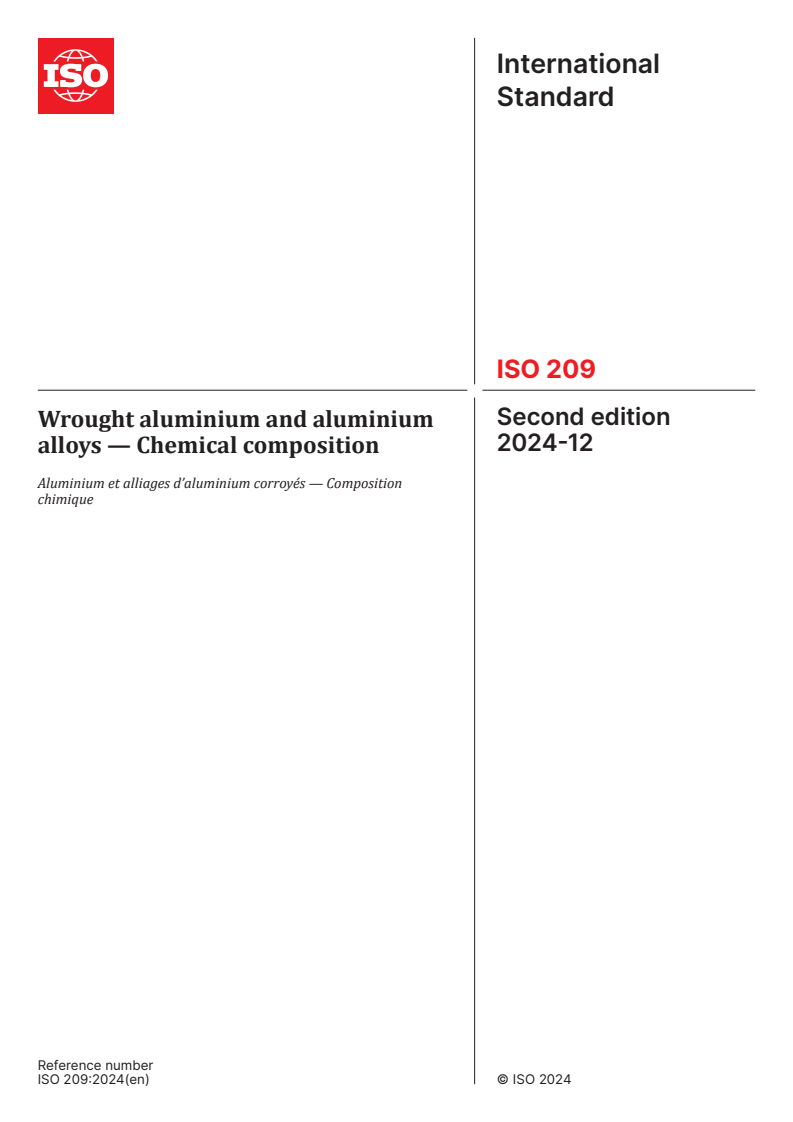
ISO 209:2024 - Wrought aluminium and aluminium alloys — Chemical composition Released:12/19/2024
ISO 209:2024 - Aluminium et alliages d’aluminium corroyés — Composition chimique Released:12/19/2024
Overview
ISO 209:2024 - Wrought aluminium and aluminium alloys - Chemical composition - specifies the chemical composition limits for wrought products and ingots intended to be wrought. This second edition consolidates and updates previous material (including elements from ISO 6361-5 and ISO 6362-7) and aligns alloy designations with the Aluminum Association (Teal sheets). The standard provides composition limits (percent by mass), writing and rounding rules, element sequencing, and guidance on how to treat aluminium as a remainder or minimum for unalloyed grades.
Key topics and requirements
- Scope and applicability: Targets wrought aluminium products and ingots intended for subsequent wrought processing.
- Chemical composition limits: Table 1 lists limits for major wrought alloys (examples include 1050, 1060, 1100, 2024, 3003, 3102 and others), with alloying elements given as ranges and impurities as maximums. Aluminium is specified as a remainder for alloys and as a minimum for unalloyed aluminium.
- Writing rules: Prescribes decimal-place formatting for limits depending on concentration ranges (e.g., different precision for <0.001 %, 0.001–0.01 %, 0.01–0.10 %, etc.). Special rules exist for Si+Fe in 1xxx designations and for refined unalloyed aluminium.
- Rounding rules for determination: Defines exact rounding procedures for test results and conformity assessment (three-point rules for figures after the retained decimal).
- Sequence and notation: Standardized sequence of elements (Si, Fe, Cu, Mn, Mg, Cr, Zn, Ti, remarks, other elements, aluminium) and rules for inserting additional specified elements alphabetically under “Remarks”.
- “Others” handling: Limits on individual “other” metallic elements and on the total of these elements; non-conformance if limits are exceeded.
- Annex A: Informative correspondence between listed alloys and applicable product forms (e.g., sheet, plate, extrusions).
Applications and users
ISO 209:2024 is essential for:
- Aluminium producers and foundries specifying ingot chemistry for wrought processing.
- Extrusion and rolling manufacturers checking incoming material composition.
- Quality control and metallurgical laboratories applying precise rounding and reporting rules.
- Purchasers, designers and spec writers ensuring material selections meet chemical limits for mechanical or corrosion performance.
- Supply chain and conformity assessment teams verifying compliance with international aluminium composition standards.
Related standards
- ISO 6361-1 / -5, ISO 6362-1 / -7 (wrought products) - referenced in the revision history.
- ISO 7271 - additional alloy entries incorporated.
- Aluminum Association Teal sheets - alloy designation system used by ISO 209.
Keywords: ISO 209:2024, wrought aluminium, aluminium alloys, chemical composition limits, alloy designations, material specifications, quality control, metal composition standards.
Relations
- Effective Date
- 15-Mar-2025
- Effective Date
- 28-Jan-2023
Buy Documents
ISO 209:2024 - Wrought aluminium and aluminium alloys — Chemical composition Released:12/19/2024
ISO 209:2024 - Aluminium et alliages d’aluminium corroyés — Composition chimique Released:12/19/2024
Get Certified
Connect with accredited certification bodies for this standard

Element Materials Technology
Materials testing and product certification.

Inštitut za kovinske materiale in tehnologije
Institute of Metals and Technology. Materials testing, metallurgical analysis, NDT.
Sponsored listings
Frequently Asked Questions
ISO 209:2024 is a standard published by the International Organization for Standardization (ISO). Its full title is "Wrought aluminium and aluminium alloys — Chemical composition". This standard covers: This document specifies the chemical composition limits of wrought products and ingots intended to be wrought in aluminium and aluminium alloys.
This document specifies the chemical composition limits of wrought products and ingots intended to be wrought in aluminium and aluminium alloys.
ISO 209:2024 is classified under the following ICS (International Classification for Standards) categories: 77.150.10 - Aluminium products. The ICS classification helps identify the subject area and facilitates finding related standards.
ISO 209:2024 has the following relationships with other standards: It is inter standard links to ISO 209:2024/Amd 1:2026, ISO 209:2007. Understanding these relationships helps ensure you are using the most current and applicable version of the standard.
ISO 209:2024 is available in PDF format for immediate download after purchase. The document can be added to your cart and obtained through the secure checkout process. Digital delivery ensures instant access to the complete standard document.
Standards Content (Sample)
International
Standard
ISO 209
Second edition
Wrought aluminium and aluminium
2024-12
alloys — Chemical composition
Aluminium et alliages d’aluminium corroyés — Composition
chimique
Reference number
© ISO 2024
All rights reserved. Unless otherwise specified, or required in the context of its implementation, no part of this publication may
be reproduced or utilized otherwise in any form or by any means, electronic or mechanical, including photocopying, or posting on
the internet or an intranet, without prior written permission. Permission can be requested from either ISO at the address below
or ISO’s member body in the country of the requester.
ISO copyright office
CP 401 • Ch. de Blandonnet 8
CH-1214 Vernier, Geneva
Phone: +41 22 749 01 11
Email: copyright@iso.org
Website: www.iso.org
Published in Switzerland
ii
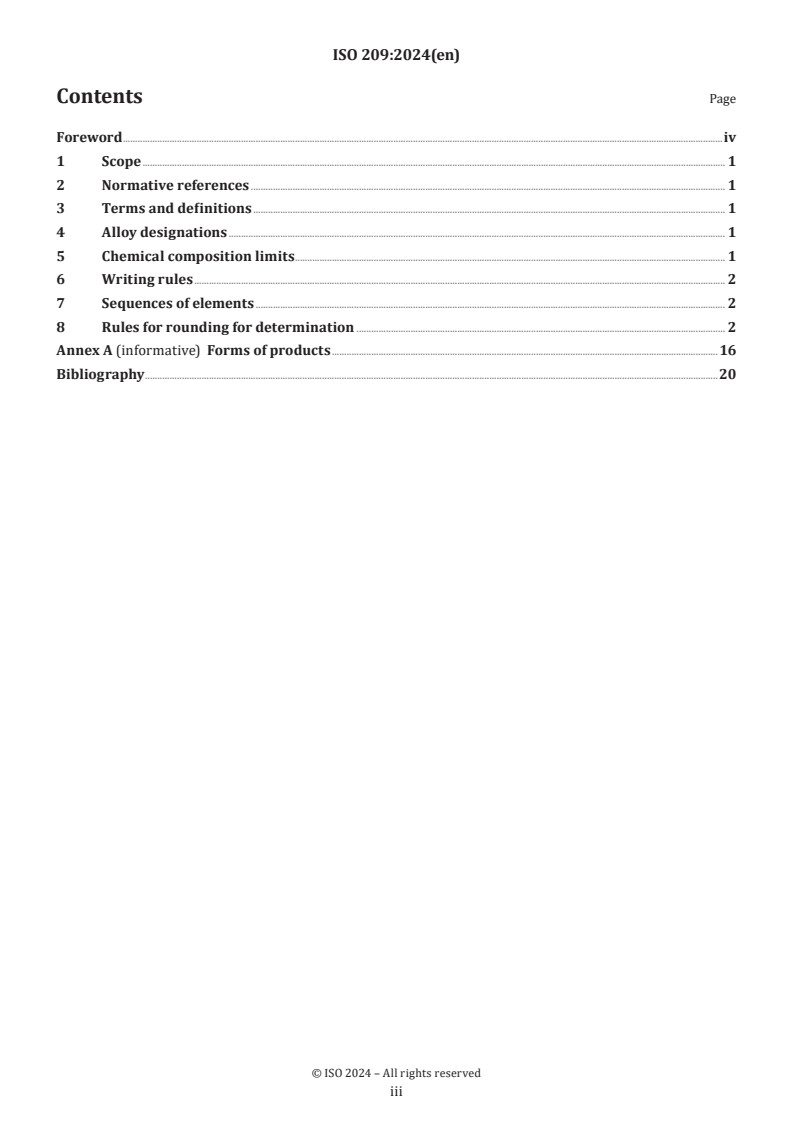
Contents Page
Foreword .iv
1 Scope . 1
2 Normative references . 1
3 Terms and definitions . 1
4 Alloy designations . 1
5 Chemical composition limits . 1
6 Writing rules . 2
7 Sequences of elements . 2
8 Rules for rounding for determination . 2
Annex A (informative) Forms of products .16
Bibliography .20
iii
Foreword
ISO (the International Organization for Standardization) is a worldwide federation of national standards
bodies (ISO member bodies). The work of preparing International Standards is normally carried out through
ISO technical committees. Each member body interested in a subject for which a technical committee
has been established has the right to be represented on that committee. International organizations,
governmental and non-governmental, in liaison with ISO, also take part in the work. ISO collaborates closely
with the International Electrotechnical Commission (IEC) on all matters of electrotechnical standardization.
The procedures used to develop this document and those intended for its further maintenance are described
in the ISO/IEC Directives, Part 1. In particular, the different approval criteria needed for the different types
of ISO document should be noted. This document was drafted in accordance with the editorial rules of the
ISO/IEC Directives, Part 2 (see www.iso.org/directives).
ISO draws attention to the possibility that the implementation of this document may involve the use of (a)
patent(s). ISO takes no position concerning the evidence, validity or applicability of any claimed patent
rights in respect thereof. As of the date of publication of this document, ISO had not received notice of (a)
patent(s) which may be required to implement this document. However, implementers are cautioned that
this may not represent the latest information, which may be obtained from the patent database available at
www.iso.org/patents. ISO shall not be held responsible for identifying any or all such patent rights.
Any trade name used in this document is information given for the convenience of users and does not
constitute an endorsement.
For an explanation of the voluntary nature of standards, the meaning of ISO specific terms and expressions
related to conformity assessment, as well as information about ISO's adherence to the World Trade
Organization (WTO) principles in the Technical Barriers to Trade (TBT), see www.iso.org/iso/foreword.html.
This document was prepared by Technical Committee ISO/TC 79, Light metals and their alloys, Subcommittee
SC 6, Wrought aluminium and aluminium alloys.
This second edition cancels and replaces the first edition (ISO 209:2007), which has been technically revised.
The main changes are as follows:
— Title: changed from “Aluminium and aluminium alloy — Chemical composition” to “Wrought aluminium
and aluminium alloy — Chemical composition”;
— Clause 1: clarification that this document specifies the chemical composition limits of wrought products
and ingots intended to be wrought in aluminium and aluminium alloys;
— Clauses 3 to 8: merging the chemical composition limits and other contents of wrought aluminium and
aluminium alloys specified in ISO 6361-5 and ISO 6362-7 respectively into this standard;
— Clause 5: addition of eight alloys specified in ISO 7271 to Table 1;
— Annex A: addition of information about the correspondence between alloys and forms of products.
— Bibliography: addition of ISO 6361-1, ISO 6362-1, ISO 6363-1 and ISO 7271;
Any feedback or questions on this document should be directed to the user’s national standards body. A
complete listing of these bodies can be found at www.iso.org/members.html.
iv
International Standard ISO 209:2024(en)
Wrought aluminium and aluminium alloys — Chemical
composition
1 Scope
This document specifies the chemical composition limits of wrought products and ingots intended to be
wrought in aluminium and aluminium alloys.
2 Normative references
There are no normative references in this document.
3 Terms and definitions
No terms and definitions are listed in this document.
ISO and IEC maintain terminology databases for use in standardization at the following addresses:
— ISO Online browsing platform: available at https:// www .iso .org/ obp
— IEC Electropedia: available at https:// www .electropedia .org/
4 Alloy designations
Alloy designations is in accordance with the recommendation (Teal sheets) for an International Alloy
Designation and Chemical Composition Limits System for Wrought Aluminum and Wrought Aluminum
Alloys issued by the Aluminum Association.
In order to differentiate from four-digit designation systems for other materials, it is recommended to
introduce a prefix to these registered designations that do not change the registered composition and should
be considered equivalent to these listed in this document.
The correspondence between the alloys listed in this document and their applicable form of products is
provided in Annex A.
5 Chemical composition limits
The chemical composition of wrought aluminium and aluminium alloys is specified in percentage by mass in
Table 1. Limits of impurities are expressed as a maximum. Limits of alloying elements are expressed as a range.
Aluminium is specified as a minimum for unalloyed aluminium, and as a remainder for aluminium alloys.
For the purpose of determining conformance to these limits, an observed value or a calculated value
obtained from analysis is rounded off, in accordance with the rules for rounding, specified in Clause 8.
The conformity does not preclude the possible presence of other elements that are not specified. If the
purchase's requirements necessitate limits for any other element not specified, these shall be agreed upon
between the supplier and purchaser.
"The remainder" is the difference between 100,00 % and the sum of all other metallic elements present in
amounts of 0,010 % or more each, expressed to the second decimal place before determining the sum.
6 Writing rules
6.1 Standard limits for alloying elements and impurities are expressed in percentage by mass to the
following decimal places:
— less than 0,001 %: 0,000X;
— 0,001 % but less than 0,01 %: 0,00X;
— 0,01 % but less than 0,10 %:
— unalloyed aluminium made by a refining process 0,0XX;
— others 0,0X;
— 0,10 % to 0,55 %: 0,XX;
— over 0,55 %: 0,X; X,X; XX,X.
Exception: combined Si + Fe limits for 1xxx designations shall be expressed as 0,XX or 1,XX.
6.2 The mass fraction of aluminium for unalloyed aluminium made by a refining process is the difference
between 100,00 % and the sum of all other metallic elements present in amounts of 0,001 0 % or more each,
expressed to the third decimal place before determining the sum, which is rounded to the second decimal
place before subtracting.
For unalloyed aluminium not made by a refining process, the mass fraction of aluminium is the difference
between 100,00 % and the sum of all other metallic elements present in amounts of 0,010 % or more, each
expressed to the second decimal place before determining the sum.
7 Sequences of elements
Standard limits for alloying elements and impurities are expressed in the following sequence: silicon, iron,
copper, manganese, magnesium, chromium, zinc, titanium, remarks, other elements: each, other elements:
total, aluminium.
Limits of additional specified elements are inserted in alphabetical order of their chemical symbols under
“Remarks”.
8 Rules for rounding for determination
In recording test results, the number representing the result of a test to determine an element concentration
shall be expressed to the same number of decimal places as the corresponding limit in this document.
The following rules shall be used for rounding.
a) When the figure immediately after the last figure to be retained is less than 5, the last figure to be
retained remains unchanged.
b) When the figure immediately after the last figure to be retained is greater than 5, or equal to 5 and
followed by at least one figure other than 0, the last figure to be retained is increased by 1.
c) When the figure immediately after the last figure to be retained is equal to 5 and followed by 0 only, the
last figure to be retained remains unchanged if even and is increased by 1 if odd.
Table 1 — Chemical composition limits (% by mass)
a
Others
Al
Alloy Si Fe Cu Mn Mg Cr Zn Ti Remarks
b
Minimum
Each Total
c
1050 0,25 0,40 0,05 0,05 0,05 — 0,05 0,03 0,05 V 0,03 — 99,50
c
1050A 0,25 0,40 0,05 0,05 0,05 — 0,07 0,05 — 0,03 — 99,50
c
1060 0,25 0,35 0,05 0,03 0,03 — 0,05 0,03 0,05 V 0,03 — 99,60
e c
1070 0,20 0,25 0,04 0,03 0,03 — 0,04 0,03 0,05 V 0,03 — 99,70
c
1070A 0,20 0,25 0,03 0,03 0,03 — 0,07 0,03 — 0,03 — 99,70
0,03 Ga
c
1080 0,15 0,15 0,03 0,02 0,02 — 0,03 0,03 0,02 — 99,80
0,05 V
e c
1080A 0,15 0,15 0,03 0,02 0,02 — 0,06 0,02 0,03 Ga 0,02 — 99,80
0,03 Ga
c
1085 0,10 0,12 0,03 0,02 0,02 — 0,03 0,02 0,01 — 99,85
0,05 V
d
1098 0,010 0,006 0,003 — — — 0,015 0,003 — 0,003 — 99,98
e c
1100 — — 0,05 to 0,20 0,05 — — 0,10 — 0,95 Si+Fe 0,05 0,15 99,00
c
1100A — — 0,05 to 0,20 0,05 0,10 — 0,10 0,10 1,00 Si+Fe 0,05 0,15 99,00
e c
1200 — — 0,05 0,05 — — 0,10 0,05 1,00 Si+Fe 0,05 0,15 99,00
c
1230A — — 0,10 0,05 0,05 — 0,05 — 0,70 Si+Fe 0,03 — 99,30
0,05 V
c
1235 — — 0,05 0,05 0,05 — 0,10 0,06 0,03 — 99,35
0,65 Si+Fe
a
“Others” includes listed elements for which no specific limit is shown, as well as unlisted metallic elements. The producer may analyse samples for trace elements not specified
in the registration or specification. However, such analysis is not required and may not cover all metallic “Other” elements. Should any analysis by the producer or the purchaser
establish that an “Others” element exceeds the limit of “Each” or that the aggregate of several “others” elements exceeds the limit of “Total”, the material shall be considered as non
to conforming.
b
The sum of those “Others”: metallic elements 0,010 % or more, each expressed to the second decimal place before determining the sum.
c
The aluminium content for unalloyed aluminium not made by a refining process is the difference between 100,00 % and the sum of all other metallic elements together with
silicon present in amounts of 0,010 % or more each, expressed to the second decimal before determining the sum. For alloys and unalloyed aluminium not made by a refining
process, when the specified maximum limit is 0,XX, an observed value or a calculated value greater than 0,005 but less than 0,010 % is rounded off and shown as “less than 0,01”.
d
The aluminium content for unalloyed aluminium made by a refining process is the difference between 100,00 % and the sum of all other metallic elements together with silicon
present in amounts of 0,001 0 % or more each, expressed to the third decimal before determining the sum, which is rounded to the second decimal before subtracting. For unalloyed
aluminium made by a refining process, when the specified maximum limit is 0,0XX, an observed value or a calculated value greater than 0,000 5 but less than 0,001 0 % is rounded
off and shown as “less than 0,001”.
e
0,000 3 % maximum Be for welding electrode, welding rod and filler wire.
f
Zr+Ti limit of 0,20 % maximum may be used for extruded products if mutually agreed by the supplier or manufacturer and the purchaser.
g
Zr+Ti limit of 0,25 % maximum may be used for extruded products if mutually agreed by the supplier or manufacturer and the purchaser.
Table 1 (continued)
a
Others
Al
Alloy Si Fe Cu Mn Mg Cr Zn Ti Remarks
b
Minimum
Each Total
0,05 V
c
1145 — — 0,05 0,05 0,05 — 0,05 0,03 0,03 — 99,45
0,55 Si+Fe
0,05 B
c
1350 0,10 0,40 0,05 0,01 — 0,01 0,05 — 0,03 Ga 0,03 0,10 99,50
0,02 V+Ti
0,20 Bi
0,20 Ni
Remain-
2007 0,8 0,8 3,3 to 4,6 0,50 to 1,0 0,40 to 1,8 0,10 0,8 0,20 0,10 0,30
der
0,8 to 1,5 Pb
0,20 Sn
0,20 to 0,6 Bi
Remain-
2011 0,40 0,7 5,0 to 6,0 — — — 0,30 — 0,05 0,15
der
0,20 to 0,6 Pb
0,20 to 0,6 Bi
Remain-
2011A 0,40 0,50 4,5 to 6,0 — — — 0,30 — 0,05 0,15
der
0,20 to 0,6 Pb
Remain-
f
2014 0,50 to 1,2 0,7 3,9 to 5,0 0,40 to 1,2 0,20 to 0,8 0,10 0,25 0,15 0,05 0,15
der
0,10 Ni
Remain-
2014A 0,50 to 0,9 0,50 3,9 to 5,0 0,40 to 1,2 0,20 to 0,8 0,10 0,25 0,15 0,05 0,15
der
0,20 Zr+Ti
Remain-
f
2017 0,20 to 0,8 0,7 3,5 to 4,5 0,40 to 1,0 0,40-0,8 0,10 0,25 0,15 0,05 0,15
der
a
“Others” includes listed elements for which no specific limit is shown, as well as unlisted metallic elements. The producer may analyse samples for trace elements not specified
in the registration or specification. However, such analysis is not required and may not cover all metallic “Other” elements. Should any analysis by the producer or the purchaser
establish that an “Others” element exceeds the limit of “Each” or that the aggregate of several “others” elements exceeds the limit of “Total”, the material shall be considered as non
to conforming.
b
The sum of those “Others”: metallic elements 0,010 % or more, each expressed to the second decimal place before determining the sum.
c
The aluminium content for unalloyed aluminium not made by a refining process is the difference between 100,00 % and the sum of all other metallic elements together with
silicon present in amounts of 0,010 % or more each, expressed to the second decimal before determining the sum. For alloys and unalloyed aluminium not made by a refining
process, when the specified maximum limit is 0,XX, an observed value or a calculated value greater than 0,005 but less than 0,010 % is rounded off and shown as “less than 0,01”.
d
The aluminium content for unalloyed aluminium made by a refining process is the difference between 100,00 % and the sum of all other metallic elements together with silicon
present in amounts of 0,001 0 % or more each, expressed to the third decimal before determining the sum, which is rounded to the second decimal before subtracting. For unalloyed
aluminium made by a refining process, when the specified maximum limit is 0,0XX, an observed value or a calculated value greater than 0,000 5 but less than 0,001 0 % is rounded
off and shown as “less than 0,001”.
e
0,000 3 % maximum Be for welding electrode, welding rod and filler wire.
f
Zr+Ti limit of 0,20 % maximum may be used for extruded products if mutually agreed by the supplier or manufacturer and the purchaser.
g
Zr+Ti limit of 0,25 % maximum may be used for extruded products if mutually agreed by the supplier or manufacturer and the purchaser.
Table 1 (continued)
a
Others
Al
Alloy Si Fe Cu Mn Mg Cr Zn Ti Remarks
b
Minimum
Each Total
Remain-
2017A 0,20 to 0,8 0,7 3,5 to 4,5 0,40 to 1,0 0,40-1,0 0,10 0,25 — 0,25 Zr+Ti 0,05 0,15
der
Remain-
2117 0,8 0,7 2,2 to 3,0 0,20 0,20-0,50 0,10 0,25 — — 0,05 0,15
der
0,8 to 1,4 Ni
Remain-
2618A 0,15 to 0,25 0,9-1,4 1,8 to 2,7 0,25 1,2-1,8 — 0,15 0,20 0,05 0,15
der
0,25 Zr+Ti
0,05 to 0,15 V
Remain-
2219 0,20 0,30 5,8 to 6,8 0,20 to 0,40 0,02 — 0,10 0,02-0,10 0,05 0,15
der
0,10 to 0,25 Zr
Remain-
f
2024 0,50 0,50 3,8 to 4,9 0,30 to 0,9 1,2 to 1,8 0,10 0,25 0,15 0,05 0,15
der
Remain-
f
2124 0,20 0,30 3,8 to 4,9 0,30-0,9 1,2 to 1,8 0,10 0,25 0,15 0,05 0,15
der
0,20 B
Remain-
2030 0,8 0,7 3,3-4,5 0,20 to 1,0 0,50 to 1,3 0,10 0,50 0,20 0,10 0,30
der
0,8 to 1,5 Pb
0,05-0,8 Bi
Remain-
2033 0,10-1,2 0,7 2,2-2,7 0,40 to 1,0 0,20 to 0,6 0,15 0,50 0,10 0,05 0,15
der
0,15 Ni
Remain-
3102 0,40 0,7 0,10 0,05 to 0,40 — — 0,30 0,10 — 0,05 0,15
der
Remain-
3003 0,6 0,7 0,05 to 0,20 1,0 to 1,5 — — 0,10 — 0,05 0,15
der
a
“Others” includes listed elements for which no specific limit is shown, as well as unlisted metallic elements. The producer may analyse samples for trace elements not specified
in the registration or specification. However, such analysis is not required and may not cover all metallic “Other” elements. Should any analysis by the producer or the purchaser
establish that an “Others” element exceeds the limit of “Each” or that the aggregate of several “others” elements exceeds the limit of “Total”, the material shall be considered as non
to conforming.
b
The sum of those “Others”: metallic elements 0,010 % or more, each expressed to the second decimal place before determining the sum.
c
The aluminium content for unalloyed aluminium not made by a refining process is the difference between 100,00 % and the sum of all other metallic elements together with
silicon present in amounts of 0,010 % or more each, expressed to the second decimal before determining the sum. For alloys and unalloyed aluminium not made by a refining
process, when the specified maximum limit is 0,XX, an observed value or a calculated value greater than 0,005 but less than 0,010 % is rounded off and shown as “less than 0,01”.
d
The aluminium content for unalloyed aluminium made by a refining process is the difference between 100,00 % and the sum of all other metallic elements together with silicon
present in amounts of 0,001 0 % or more each, expressed to the third decimal before determining the sum, which is rounded to the second decimal before subtracting. For unalloyed
aluminium made by a refining process, when the specified maximum limit is 0,0XX, an observed value or a calculated value greater than 0,000 5 but less than 0,001 0 % is rounded
off and shown as “less than 0,001”.
e
0,000 3 % maximum Be for welding electrode, welding rod and filler wire.
f
Zr+Ti limit of 0,20 % maximum may be used for extruded products if mutually agreed by the supplier or manufacturer and the purchaser.
g
Zr+Ti limit of 0,25 % maximum may be used for extruded products if mutually agreed by the supplier or manufacturer and the purchaser.
Table 1 (continued)
a
Others
Al
Alloy Si Fe Cu Mn Mg Cr Zn Ti Remarks
b
Minimum
Each Total
Remain-
e
3103 0,50 0,7 0,10 0,9 to 1,5 0,30 0,10 0,20 — 0,10 Zr+Ti 0,05 0,15
der
Remain-
e
3203 0,6 0,7 0,05 1,0 to 1,5 — — 0,10 — 0,05 0,15
der
Remain-
3004 0,30 0,7 0,25 1,0-1,5 0,8-1,3 — 0,25 — — 0,05 0,15
der
0,05 Ga
Remain-
3104 0,6 0,8 0,05 to 0,25 0,8 to 1,4 0,8 to 1,3 — 0,25 0,10 0,05 0,15
der
0,05 V
Remain-
3005 0,6 0,7 0,30 1,0 to 1,5 0,20 to 0,6 0,10 0,25 0,10 — 0,05 0,15
der
Remain-
3105 0,6 0,7 0,30 0,30 to 0,8 0,20 to 0,8 0,20 0,40 0,10 — 0,05 0,15
der
Remain-
3021 0,50 0,7 0,20 to 0,6 0,05 to 0,8 0,10 0,10 0,10 0,10 — 0,05 0,15
der
Remain-
4006 0,8 to 1,2 0,50 to 0,8 0,10 0,05 0,01 0,20 0,05 — — 0,05 0,15
der
0,05 Co
Remain-
4007 1,0 to 1,7 0,40 to 1,0 0,20 0,8 to 1,5 0,20 0,05 to 0,25 0,10 0,10 0,05 0,15
der
0,15 to 0,7 Ni
Remain-
4015 1,4 to 2,2 0,7 0,20 0,6 to 1,2 0,10 to 0,50 — 0,20 — — 0,05 0,15
der
a
“Others” includes listed elements for which no specific limit is shown, as well as unlisted metallic elements. The producer may analyse samples for trace elements not specified
in the registration or specification. However, such analysis is not required and may not cover all metallic “Other” elements. Should any analysis by the producer or the purchaser
establish that an “Others” element exceeds the limit of “Each” or that the aggregate of several “others” elements exceeds the limit of “Total”, the material shall be considered as non
to conforming.
b
The sum of those “Others”: metallic elements 0,010 % or more, each expressed to the second decimal place before determining the sum.
c
The aluminium content for unalloyed aluminium not made by a refining process is the difference between 100,00 % and the sum of all other metallic elements together with
silicon present in amounts of 0,010 % or more each, expressed to the second decimal before determining the sum. For alloys and unalloyed aluminium not made by a refining
process, when the specified maximum limit is 0,XX, an observed value or a calculated value greater than 0,005 but less than 0,010 % is rounded off and shown as “less than 0,01”.
d
The aluminium content for unalloyed aluminium made by a refining process is the difference between 100,00 % and the sum of all other metallic elements together with silicon
present in amounts of 0,001 0 % or more each, expressed to the third decimal before determining the sum, which is rounded to the second decimal before subtracting. For unalloyed
aluminium made by a refining process, when the specified maximum limit is 0,0XX, an observed value or a calculated value greater than 0,000 5 but less than 0,001 0 % is rounded
off and shown as “less than 0,001”.
e
0,000 3 % maximum Be for welding electrode, welding rod and filler wire.
f
Zr+Ti limit of 0,20 % maximum may be used for extruded products if mutually agreed by the supplier or manufacturer and the purchaser.
g
Zr+Ti limit of 0,25 % maximum may be used for extruded products if mutually agreed by the supplier or manufacturer and the purchaser.
Table 1 (continued)
a
Others
Al
Alloy Si Fe Cu Mn Mg Cr Zn Ti Remarks
b
Minimum
Each Total
Remain-
5005 0,30 0,7 0,20 0,20 0,50 to 1,1 0,10 0,25 — — 0,05 0,15
der
Remain-
5005A 0,30 0,45 0,05 0,15 0,7 to 1,1 0,10 0,20 — — 0,05 0,15
der
Remain-
5010 0,40 0,7 0,25 0,10 to 0,30 0,20 to 0,6 0,15 0,30 0,10 — 0,05 0,15
der
Remain-
5110A 0,15 0,25 0,20 0,20 0,20 to 0,6 — 0,03 — — 0,05 0,10
der
0,10 to 0,6 Remain-
5019 0,40 0,50 0,10 0,10 to 0,6 4,5 to 5,6 0,20 0,20 0,20 0,05 0,15
Mn+Cr der
Remain-
5021 0,40 0,50 0,15 0,10 to 0,50 2,2 to 2,8 0,15 0,15 — — 0,05 0,15
der
Remain-
5026 0,55 to 1,4 0,20 to 1,0 0,10 to 0,8 0,6 to 1,8 3,9 to 4,9 0,30 1,0 0,20 0,30 Zr 0,05 0,15
der
Remain-
5040 0,30 0,7 0,25 0,9 to 1,4 1,0 to 1,5 0,10 to 0,30 0,25 — — 0,05 0,15
der
Remain-
5041 0,40 0,40 0,10 0,30 to 1,0 3,0 to 4,0 0,50 0,10 0,20 — 0,05 0,15
der
Remain-
5042 0,20 0,35 0,15 0,20 to 0,50 3,0 to 4,0 0,10 0,25 0,10 — 0,05 0,15
der
a
“Others” includes listed elements for which no specific limit is shown, as well as unlisted metallic elements. The producer may analyse samples for trace elements not specified
in the registration or specification. However, such analysis is not required and may not cover all metallic “Other” elements. Should any analysis by the producer or the purchaser
establish that an “Others” element exceeds the limit of “Each” or that the aggregate of several “others” elements exceeds the limit of “Total”, the material shall be considered as non
to conforming.
b
The sum of those “Others”: metallic elements 0,010 % or more, each expressed to the second decimal place before determining the sum.
c
The aluminium content for unalloyed aluminium not made by a refining process is the difference between 100,00 % and the sum of all other metallic elements together with
silicon present in amounts of 0,010 % or more each, expressed to the second decimal before determining the sum. For alloys and unalloyed aluminium not made by a refining
process, when the specified maximum limit is 0,XX, an observed value or a calculated value greater than 0,005 but less than 0,010 % is rounded off and shown as “less than 0,01”.
d
The aluminium content for unalloyed aluminium made by a refining process is the difference between 100,00 % and the sum of all other metallic elements together with silicon
present in amounts of 0,001 0 % or more each, expressed to the third decimal before determining the sum, which is rounded to the second decimal before subtracting. For unalloyed
aluminium made by a refining process, when the specified maximum limit is 0,0XX, an observed value or a calculated value greater than 0,000 5 but less than 0,001 0 % is rounded
off and shown as “less than 0,001”.
e
0,000 3 % maximum Be for welding electrode, welding rod and filler wire.
f
Zr+Ti limit of 0,20 % maximum may be used for extruded products if mutually agreed by the supplier or manufacturer and the purchaser.
g
Zr+Ti limit of 0,25 % maximum may be used for extruded products if mutually agreed by the supplier or manufacturer and the purchaser.
Table 1 (continued)
a
Others
Al
Alloy Si Fe Cu Mn Mg Cr Zn Ti Remarks
b
Minimum
Each Total
Remain-
5049 0,40 0,50 0,10 0,50 to 1,1 1,6 to 2,5 0,30 0,20 0,10 — 0,05 0,15
der
Remain-
5449 0,40 0,7 0,30 0,6 to 1,1 1,6 to 2,6 0,30 0,30 0,10 — 0,05 0,15
der
Remain-
5050 0,40 0,7 0,20 0,10 1,1 to 1,8 0,10 0,25 — — 0,05 0,15
der
Remain-
5051A 0,30 0,45 0,05 0,25 1,4 to 2,1 0,30 0,20 0,10 — 0,05 0,15
der
Remain-
5251 0,40 0,50 0,15 0,10 to 0,50 1,7 to 2,4 0,15 0,15 0,15 — 0,05 0,15
der
Remain-
5052 0,25 0,40 0,10 0,10 2,2 to 2,8 0,15 to 0,35 0,10 — — 0,05 0,15
der
Remain-
e
5154 0,25 0,40 0,10 0,10 3,1 to 3,9 0,15 to 0,35 0,20 0,20 0,05 0,15
der
0,10 to 0,50 Remain-
5154A 0,50 0,50 0,10 0,50 3,1 to 3,9 0,25 0,20 0,20 0,05 0,15
e
Mn+Cr der
Remain-
5254 — — 0,05 0,01 3,1 to 3,9 0,15 to 0,35 0,20 0,05 0,45 Si+Fe 0,05 0,15
der
Remain-
5454 0,25 0,40 0,10 0,50 to 1,0 2,4 to 3,0 0,05 to 0,20 0,25 0,20 — 0,05 0,15
der
a
“Others” includes listed elements for which no specific limit is shown, as well as unlisted metallic elements. The producer may analyse samples for trace elements not specified
in the registration or specification. However, such analysis is not required and may not cover all metallic “Other” elements. Should any analysis by the producer or the purchaser
establish that an “Others” element exceeds the limit of “Each” or that the aggregate of several “others” elements exceeds the limit of “Total”, the material shall be considered as non
to conforming.
b
The sum of those “Others”: metallic elements 0,010 %
...
Norme
internationale
ISO 209
Deuxième édition
Aluminium et alliages d’aluminium
2024-12
corroyés — Composition chimique
Wrought aluminium and aluminium alloys — Chemical
composition
Numéro de référence
DOCUMENT PROTÉGÉ PAR COPYRIGHT
© ISO 2024
Tous droits réservés. Sauf prescription différente ou nécessité dans le contexte de sa mise en œuvre, aucune partie de cette
publication ne peut être reproduite ni utilisée sous quelque forme que ce soit et par aucun procédé, électronique ou mécanique,
y compris la photocopie, ou la diffusion sur l’internet ou sur un intranet, sans autorisation écrite préalable. Une autorisation peut
être demandée à l’ISO à l’adresse ci-après ou au comité membre de l’ISO dans le pays du demandeur.
ISO copyright office
Case postale 401 • Ch. de Blandonnet 8
CH-1214 Vernier, Genève
Tél.: +41 22 749 01 11
E-mail: copyright@iso.org
Web: www.iso.org
Publié en Suisse
ii
Sommaire Page
Avant-propos .iv
1 Domaine d’application . 1
2 Références normatives . 1
3 Termes et définitions . 1
4 Désignation des alliages . 1
5 Limites de composition chimique . 1
6 Règles d’écriture . 2
7 Ordre des éléments . 2
8 Règles d’arrondissage pour la détermination . 2
Annexe A (informative) Formes des produits . .13
Bibliographie . 17
iii
Avant-propos
L’ISO (Organisation internationale de normalisation) est une fédération mondiale d’organismes nationaux
de normalisation (comités membres de l’ISO). L’élaboration des Normes internationales est en général
confiée aux comités techniques de l’ISO. Chaque comité membre intéressé par une étude a le droit de faire
partie du comité technique créé à cet effet. Les organisations internationales, gouvernementales et non
gouvernementales, en liaison avec l’ISO participent également aux travaux. L’ISO collabore étroitement avec
la Commission électrotechnique internationale (IEC) en ce qui concerne la normalisation électrotechnique.
Les procédures utilisées pour élaborer le présent document et celles destinées à sa mise à jour sont
décrites dans les Directives ISO/IEC, Partie 1. Il convient, en particulier, de prendre note des différents
critères d’approbation requis pour les différents types de documents ISO. Le présent document
a été rédigé conformément aux règles de rédaction données dans les Directives ISO/IEC, Partie 2
(voir www.iso.org/directives).
L’ISO attire l’attention sur le fait que la mise en application du présent document peut entraîner l’utilisation
d’un ou de plusieurs brevets. L’ISO ne prend pas position quant à la preuve, à la validité et à l’applicabilité de
tout droit de brevet revendiqué à cet égard. À la date de publication du présent document, l’ISO n’avait pas
reçu notification qu’un ou plusieurs brevets pouvaient être nécessaires à sa mise en application. Toutefois,
il y a lieu d’avertir les responsables de la mise en application du présent document que des informations
plus récentes sont susceptibles de figurer dans la base de données de brevets, disponible à l’adresse
www.iso.org/brevets. L’ISO ne saurait être tenue pour responsable de ne pas avoir identifié tout ou partie de
tels droits de brevet.
Les appellations commerciales éventuellement mentionnées dans le présent document sont données pour
information, par souci de commodité, à l’intention des utilisateurs et ne sauraient constituer un engagement.
Pour une explication de la nature volontaire des normes, la signification des termes et expressions
spécifiques de l’ISO liés à l’évaluation de la conformité, ou pour toute information au sujet de l’adhésion de
l’ISO aux principes de l’Organisation mondiale du commerce (OMC) concernant les obstacles techniques au
commerce (OTC), voir www.iso.org/avant-propos.
Le présent document a été élaboré par le comité technique ISO/TC 79, Métaux légers et leurs alliages, sous-
comité SC 6, Aluminium et alliages d’aluminium de corroyage.
Cette deuxième édition annule et remplace la première édition (ISO 209:2007), qui a fait l’objet d’une révision
technique. Les principales modifications sont les suivantes:
— Titre: «Aluminium et alliages d’aluminium — Composition chimique» a été remplacé par «Aluminium et
alliages d’aluminium corroyés — Composition chimique»;
— Article 1: clarification du fait que le présent document spécifie les limites de composition chimique des
produits corroyés et des lingots destinés à être corroyés en aluminium et alliages d’aluminium;
— Articles 3 à 8: regroupement dans la présente norme des limites de composition chimique et autres
teneurs d’aluminium et d’alliages d’aluminium corroyés spécifiées dans l’ISO 6361-5 et l’ISO 6362-7
respectivement;
— Article 5: ajout de huit alliages spécifiés dans l’ISO 7271 dans le Tableau 1;
— Annexe A: ajout d’informations sur la correspondance entre les alliages et les formes de produits;
— Bibliographie: ajout de l’ISO 6361-1, l’ISO 6362-1, l’ISO 6363-1 et l’ISO 7271.
Il convient que l’utilisateur adresse tout retour d’information ou toute question concernant le présent
document à l’organisme national de normalisation de son pays. Une liste exhaustive desdits organismes se
trouve à l’adresse www.iso.org/fr/members.html.
iv
Norme internationale ISO 209:2024(fr)
Aluminium et alliages d’aluminium corroyés — Composition
chimique
1 Domaine d’application
Le présent document spécifie les limites de composition chimique des produits corroyés et des lingots
destinés à être corroyés en aluminium et alliages d’aluminium.
2 Références normatives
Le présent document ne contient aucune référence normative.
3 Termes et définitions
Aucun terme n’est défini dans le présent document.
L’ISO et l’IEC tiennent à jour des bases de données terminologiques destinées à être utilisées en normalisation,
consultables aux adresses suivantes:
— ISO Online browsing platform: disponible à l’adresse https:// www .iso .org/ obp
— IEC Electropedia: disponible à l’adresse https:// www .electropedia .org/
4 Désignation des alliages
La désignation des alliages est conforme aux recommandations figurant dans le document «International
Alloy Designation and Chemical Composition Limits System for Wrought Aluminum and Wrought Aluminum
Alloys» (Teal sheets) publié par l’Aluminum Association.
Dans le but de se différencier de systèmes de désignation à quatre chiffres utilisés pour d’autres matériaux,
il est recommandé d’introduire un préfixe aux désignations enregistrées, dont la composition demeure
inchangée et équivalente à celle figurant dans ce document.
La correspondance entre les alliages énumérés dans le présent document et la forme applicable des produits
est fournie dans l’Annexe A.
5 Limites de composition chimique
La composition chimique de l’aluminium et des alliages d’aluminium corroyés est spécifiée en pourcentage
massique dans le Tableau 1. Les limites d’impuretés sont exprimées en tant que maximums. Les limites des
éléments d’alliage sont exprimées sous forme de plages. La teneur en aluminium est exprimée en tant que
minimum pour l’aluminium non allié et en tant que reste pour les alliages d’aluminium.
Dans le but de déterminer le respect de ces limites, la valeur observée ou la valeur calculée obtenue à partir
de l’analyse est arrondie selon les règles d’arrondissage spécifiées à l’Article 8.
La conformité n’exclut pas la présence possible d’autres éléments qui ne sont pas spécifiés. Si les exigences
de l’acheteur nécessitent des limites pour tout autre élément non spécifié, celles-ci doivent faire l’objet d’un
accord entre le fournisseur et l’acheteur.
Le «reste» est la différence entre 100,00 % et la somme de tous les autres éléments métalliques présents à
hauteur de 0,010 % ou plus chacun, exprimée avec deux décimales avant d’effectuer la somme.
6 Règles d’écriture
6.1 Les limites normalisées pour les éléments d’alliage et les impuretés sont exprimées en pourcentage
massique avec les nombres de décimales suivants:
— moins de 0,001 %: 0,000X;
— de 0 001 % à moins de 0,01 %: 0,00X;
— de 0,01 % à moins de 0,10 %:
— aluminium non allié produit par un procédé de 0,0XX;
raffinage
— autres 0,0X;
— de 0,10 % à 0,55 %: 0,XX;
— plus de 0,55 %: 0,X; X,X; XX,X.
Exception: les limites combinées Si + Fe pour les alliages de la série 1xxx doivent être exprimées sous la
forme 0,XX ou 1,XX.
6.2 La fraction massique d’aluminium pour l’aluminium non allié obtenu par un procédé de raffinage est
égale à la différence entre 100,00 % et la somme de tous les autres éléments métalliques présents à hauteur
de 0,001 0 % ou plus chacun, exprimée avec trois décimales avant d’effectuer la somme qui est arrondie à la
deuxième décimale avant soustraction.
Pour l’aluminium non allié qui n’est pas obtenu par un procédé de raffinage, la fraction massique d’aluminium
est la différence entre 100,00 % et la somme de tous les autres éléments métalliques présents à hauteur de
0,010 % ou plus chacun, exprimée avec deux décimales avant d’effectuer la somme.
7 Ordre des éléments
Les limites normalisées pour les éléments d’alliage et les impuretés sont exprimées dans l’ordre suivant:
silicium, fer, cuivre, manganèse, magnésium, chrome, zinc, titane, remarques, autres éléments «chaque»,
autres éléments «total», aluminium.
Les éléments additionnels pour lesquels des limites de composition sont spécifiées sont insérés par ordre
alphabétique de leurs symboles chimiques dans la colonne «Remarques».
8 Règles d’arrondissage pour la détermination
Dans le relevé des résultats d’essai, le nombre représentant le résultat d’un essai pour déterminer la
concentration d’un élément doit être exprimé avec le même nombre de décimales que la limite correspondante
dans le présent document.
Les règles suivantes doivent être appliquées pour l’arrondissage.
a) Quand le chiffre qui suit immédiatement le dernier chiffre à retenir est inférieur à 5, le dernier chiffre à
retenir reste inchangé.
b) Quand le chiffre qui suit immédiatement le dernier chiffre à retenir est supérieur à 5, ou égal à 5 et suivi
par au moins un chiffre autre que 0, le dernier chiffre à retenir est augmenté de 1.
c) Quand le chiffre qui suit immédiatement le dernier chiffre à retenir est égal à 5 et est suivi seulement
par des 0, le dernier chiffre à retenir reste inchangé s’il est pair et est augmenté de 1 s’il est impair.
Tableau 1 — Limites de composition chimique (% en masse)
a
Autres
Al
Alliage Si Fe Cu Mn Mg Cr Zn Ti Remarques
b
Minimum
Chaque Total
c
1050 0,25 0,40 0,05 0,05 0,05 — 0,05 0,03 0,05 V 0,03 — 99,50
c
1050A 0,25 0,40 0,05 0,05 0,05 — 0,07 0,05 — 0,03 — 99,50
c
1060 0,25 0,35 0,05 0,03 0,03 — 0,05 0,03 0,05 V 0,03 — 99,60
e c
1070 0,20 0,25 0,04 0,03 0,03 — 0,04 0,03 0,05 V 0,03 — 99,70
c
1070A 0,20 0,25 0,03 0,03 0,03 — 0,07 0,03 — 0,03 — 99,70
0,03 Ga
c
1080 0,15 0,15 0,03 0,02 0,02 — 0,03 0,03 0,02 — 99,80
0,05 V
e c
1080A 0,15 0,15 0,03 0,02 0,02 — 0,06 0,02 0,03 Ga 0,02 — 99,80
0,03 Ga
c
1085 0,10 0,12 0,03 0,02 0,02 — 0,03 0,02 0,01 — 99,85
0,05 V
d
1098 0,010 0,006 0,003 — — — 0,015 0,003 — 0,003 — 99,98
e c
1100 — — 0,05 à 0,20 0,05 — — 0,10 — 0,95 Si+Fe 0,05 0,15 99,00
c
1100A — — 0,05 à 0,20 0,05 0,10 — 0,10 0,10 1,00 Si+Fe 0,05 0,15 99,00
e c
1200 — — 0,05 0,05 — — 0,10 0,05 1,00 Si+Fe 0,05 0,15 99,00
c
1230A — — 0,10 0,05 0,05 — 0,05 — 0,70 Si+Fe 0,03 — 99,30
0,05 V
c
1235 — — 0,05 0,05 0,05 — 0,10 0,06 0,03 — 99,35
0,65 Si+Fe
a
«Autres» inclut les éléments mentionnés pour lesquels il n’est pas indiqué de limite spécifique et les éléments métalliques non mentionnés. Le producteur peut analyser des
échantillons pour détecter les éléments trace non spécifiés dans le registre ou la spécification. Cependant, une telle analyse n’est pas requise et peut ne pas couvrir tous les «Autres»
éléments métalliques. Si l’analyse par le producteur ou l’acheteur établit qu’un élément «Autres» dépasse la limite «Chaque» ou que la somme de plusieurs éléments «Autres»
dépasse la limite «Total», le matériau doit être considéré comme non conforme.
b
Somme des «Autres» éléments métalliques dont la teneur est de 0,010 % ou plus chacun, exprimée avec deux décimales avant d’effectuer la somme.
c
La teneur en aluminium pour l’aluminium non allié qui n’est pas obtenu par un procédé de raffinage est égale à la différence entre 100,00 % et la somme de tous les autres
éléments métalliques avec le silicium présents à hauteur de 0,010 % ou plus chacun, exprimée avec deux décimales avant d’effectuer la somme. Pour les alliages et l’aluminium
non allié qui ne sont pas obtenus par un procédé de raffinage, lorsque la limite maximale spécifiée est de 0,XX, une valeur observée ou une valeur calculée supérieure à 0,005 mais
inférieure à 0,010 % est arrondie et est indiquée comme étant «inférieure à 0,01».
d
La teneur en aluminium pour l’aluminium non allié obtenu par un procédé de raffinage est égale à la différence entre 100,00 % et la somme de tous les autres éléments
métalliques avec le silicium présents à hauteur de 0,001 0 % ou plus chacun, exprimée avec trois décimales avant d’effectuer la somme, qui est arrondie à la deuxième décimale avant
soustraction. Pour l’aluminium non allié qui est obtenu par un procédé de raffinage, lorsque la limite maximale spécifiée est de 0,0XX, une valeur observée ou une valeur calculée
supérieure à 0,000 5 mais inférieure à 0,001 0 % est arrondie et est indiquée comme étant «inférieure à 0,001».
e
0,000 3 % maximum Be pour l’électrode de soudage, la baguette de soudage et le fil d’apport.
f
Une limite de 0,20 % maximum pour Zr+Ti peut être utilisée pour les produits filés par accord mutuel entre le fournisseur ou le producteur et l’acheteur.
g
Une limite de 0,25 % maximum pour Zr+Ti peut être utilisée pour les produits filés par accord mutuel entre le fournisseur ou le producteur et l’acheteur.
Tableau 1 (suite)
a
Autres
Al
Alliage Si Fe Cu Mn Mg Cr Zn Ti Remarques
b
Minimum
Chaque Total
0,05 V
c
1145 — — 0,05 0,05 0,05 — 0,05 0,03 0,03 — 99,45
0,55 Si+Fe
0,05 B
c
1350 0,10 0,40 0,05 0,01 — 0,01 0,05 — 0,03 Ga 0,03 0,10 99,50
0,02 V+Ti
0,20 Bi
0,20 Ni
2007 0,8 0,8 3,3 à 4,6 0,50 à 1,0 0,40 à 1,8 0,10 0,8 0,20 0,10 0,30 Reste
0,8 à 1,5 Pb
0,20 Sn
0,20 à 0,6 Bi
2011 0,40 0,7 5,0 à 6,0 — — — 0,30 — 0,05 0,15 Reste
0,20 à 0,6 Pb
0,20 à 0,6 Bi
2011A 0,40 0,50 4,5 à 6,0 — — — 0,30 — 0,05 0,15 Reste
0,20 à 0,6 Pb
f
2014 0,50 à 1,2 0,7 3,9 à 5,0 0,40 à 1,2 0,20 à 0,8 0,10 0,25 0,15 0,05 0,15 Reste
0,10 Ni
2014A 0,50 à 0,9 0,50 3,9 à 5,0 0,40 à 1,2 0,20 à 0,8 0,10 0,25 0,15 0,05 0,15 Reste
0,20 Zr+Ti
f
2017 0,20 à 0,8 0,7 3,5 à 4,5 0,40 à 1,0 0,40-0,8 0,10 0,25 0,15 0,05 0,15 Reste
2017A 0,20 à 0,8 0,7 3,5 à 4,5 0,40 à 1,0 0,40-1,0 0,10 0,25 — 0,25 Zr+Ti 0,05 0,15 Reste
a
«Autres» inclut les éléments mentionnés pour lesquels il n’est pas indiqué de limite spécifique et les éléments métalliques non mentionnés. Le producteur peut analyser des
échantillons pour détecter les éléments trace non spécifiés dans le registre ou la spécification. Cependant, une telle analyse n’est pas requise et peut ne pas couvrir tous les «Autres»
éléments métalliques. Si l’analyse par le producteur ou l’acheteur établit qu’un élément «Autres» dépasse la limite «Chaque» ou que la somme de plusieurs éléments «Autres»
dépasse la limite «Total», le matériau doit être considéré comme non conforme.
b
Somme des «Autres» éléments métalliques dont la teneur est de 0,010 % ou plus chacun, exprimée avec deux décimales avant d’effectuer la somme.
c
La teneur en aluminium pour l’aluminium non allié qui n’est pas obtenu par un procédé de raffinage est égale à la différence entre 100,00 % et la somme de tous les autres
éléments métalliques avec le silicium présents à hauteur de 0,010 % ou plus chacun, exprimée avec deux décimales avant d’effectuer la somme. Pour les alliages et l’aluminium
non allié qui ne sont pas obtenus par un procédé de raffinage, lorsque la limite maximale spécifiée est de 0,XX, une valeur observée ou une valeur calculée supérieure à 0,005 mais
inférieure à 0,010 % est arrondie et est indiquée comme étant «inférieure à 0,01».
d
La teneur en aluminium pour l’aluminium non allié obtenu par un procédé de raffinage est égale à la différence entre 100,00 % et la somme de tous les autres éléments
métalliques avec le silicium présents à hauteur de 0,001 0 % ou plus chacun, exprimée avec trois décimales avant d’effectuer la somme, qui est arrondie à la deuxième décimale avant
soustraction. Pour l’aluminium non allié qui est obtenu par un procédé de raffinage, lorsque la limite maximale spécifiée est de 0,0XX, une valeur observée ou une valeur calculée
supérieure à 0,000 5 mais inférieure à 0,001 0 % est arrondie et est indiquée comme étant «inférieure à 0,001».
e
0,000 3 % maximum Be pour l’électrode de soudage, la baguette de soudage et le fil d’apport.
f
Une limite de 0,20 % maximum pour Zr+Ti peut être utilisée pour les produits filés par accord mutuel entre le fournisseur ou le producteur et l’acheteur.
g
Une limite de 0,25 % maximum pour Zr+Ti peut être utilisée pour les produits filés par accord mutuel entre le fournisseur ou le producteur et l’acheteur.
Tableau 1 (suite)
a
Autres
Al
Alliage Si Fe Cu Mn Mg Cr Zn Ti Remarques
b
Minimum
Chaque Total
2117 0,8 0,7 2,2 à 3,0 0,20 0,20-0,50 0,10 0,25 — — 0,05 0,15 Reste
0,8 à 1,4 Ni
2618A 0,15 à 0,25 0,9-1,4 1,8 à 2,7 0,25 1,2-1,8 — 0,15 0,20 0,05 0,15 Reste
0,25 Zr+Ti
0,05 à 0,15 V
2219 0,20 0,30 5,8 à 6,8 0,20 à 0,40 0,02 — 0,10 0,02-0,10 0,05 0,15 Reste
0,10 à 0,25 Zr
f
2024 0,50 0,50 3,8 à 4,9 0,30 à 0,9 1,2 à 1,8 0,10 0,25 0,15 0,05 0,15 Reste
f
2124 0,20 0,30 3,8 à 4,9 0,30-0,9 1,2 à 1,8 0,10 0,25 0,15 0,05 0,15 Reste
0,20 B
2030 0,8 0,7 3,3-4,5 0,20 à 1,0 0,50 à 1,3 0,10 0,50 0,20 0,10 0,30 Reste
0,8 à 1,5 Pb
0,05-0,8 Bi
2033 0,10-1,2 0,7 2,2-2,7 0,40 à 1,0 0,20 à 0,6 0,15 0,50 0,10 0,05 0,15 Reste
0,15 Ni
3102 0,40 0,7 0,10 0,05 à 0,40 — — 0,30 0,10 — 0,05 0,15 Reste
3003 0,6 0,7 0,05 à 0,20 1,0 à 1,5 — — 0,10 — 0,05 0,15 Reste
e
3103 0,50 0,7 0,10 0,9 à 1,5 0,30 0,10 0,20 — 0,10 Zr+Ti 0,05 0,15 Reste
e
3203 0,6 0,7 0,05 1,0 à 1,5 — — 0,10 — 0,05 0,15 Reste
3004 0,30 0,7 0,25 1,0-1,5 0,8-1,3 — 0,25 — — 0,05 0,15 Reste
0,05 Ga
3104 0,6 0,8 0,05 à 0,25 0,8 à 1,4 0,8 à 1,3 — 0,25 0,10 0,05 0,15 Reste
0,05 V
a
«Autres» inclut les éléments mentionnés pour lesquels il n’est pas indiqué de limite spécifique et les éléments métalliques non mentionnés. Le producteur peut analyser des
échantillons pour détecter les éléments trace non spécifiés dans le registre ou la spécification. Cependant, une telle analyse n’est pas requise et peut ne pas couvrir tous les «Autres»
éléments métalliques. Si l’analyse par le producteur ou l’acheteur établit qu’un élément «Autres» dépasse la limite «Chaque» ou que la somme de plusieurs éléments «Autres»
dépasse la limite «Total», le matériau doit être considéré comme non conforme.
b
Somme des «Autres» éléments métalliques dont la teneur est de 0,010 % ou plus chacun, exprimée avec deux décimales avant d’effectuer la somme.
c
La teneur en aluminium pour l’aluminium non allié qui n’est pas obtenu par un procédé de raffinage est égale à la différence entre 100,00 % et la somme de tous les autres
éléments métalliques avec le silicium présents à hauteur de 0,010 % ou plus chacun, exprimée avec deux décimales avant d’effectuer la somme. Pour les alliages et l’aluminium
non allié qui ne sont pas obtenus par un procédé de raffinage, lorsque la limite maximale spécifiée est de 0,XX, une valeur observée ou une valeur calculée supérieure à 0,005 mais
inférieure à 0,010 % est arrondie et est indiquée comme étant «inférieure à 0,01».
d
La teneur en aluminium pour l’aluminium non allié obtenu par un procédé de raffinage est égale à la différence entre 100,00 % et la somme de tous les autres éléments
métalliques avec le silicium présents à hauteur de 0,001 0 % ou plus chacun, exprimée avec trois décimales avant d’effectuer la somme, qui est arrondie à la deuxième décimale avant
soustraction. Pour l’aluminium non allié qui est obtenu par un procédé de raffinage, lorsque la limite maximale spécifiée est de 0,0XX, une valeur observée ou une valeur calculée
supérieure à 0,000 5 mais inférieure à 0,001 0 % est arrondie et est indiquée comme étant «inférieure à 0,001».
e
0,000 3 % maximum Be pour l’électrode de soudage, la baguette de soudage et le fil d’apport.
f
Une limite de 0,20 % maximum pour Zr+Ti peut être utilisée pour les produits filés par accord mutuel entre le fournisseur ou le producteur et l’acheteur.
g
Une limite de 0,25 % maximum pour Zr+Ti peut être utilisée pour les produits filés par accord mutuel entre le fournisseur ou le producteur et l’acheteur.
Tableau 1 (suite)
a
Autres
Al
Alliage Si Fe Cu Mn Mg Cr Zn Ti Remarques
b
Minimum
Chaque Total
3005 0,6 0,7 0,30 1,0 à 1,5 0,20 à 0,6 0,10 0,25 0,10 — 0,05 0,15 Reste
3105 0,6 0,7 0,30 0,30 à 0,8 0,20 à 0,8 0,20 0,40 0,10 — 0,05 0,15 Reste
3021 0,50 0,7 0,20 à 0,6 0,05 à 0,8 0,10 0,10 0,10 0,10 — 0,05 0,15 Reste
4006 0,8 à 1,2 0,50 à 0,8 0,10 0,05 0,01 0,20 0,05 — — 0,05 0,15 Reste
0,05 Co
4007 1,0 à 1,7 0,40 à 1,0 0,20 0,8 à 1,5 0,20 0,05 à 0,25 0,10 0,10 0,05 0,15 Reste
0,15 à 0,7 Ni
4015 1,4 à 2,2 0,7 0,20 0,6 à 1,2 0,10 à 0,50 — 0,20 — — 0,05 0,15 Reste
5005 0,30 0,7 0,20 0,20 0,50 à 1,1 0,10 0,25 — — 0,05 0,15 Reste
5005A 0,30 0,45 0,05 0,15 0,7 à 1,1 0,10 0,20 — — 0,05 0,15 Reste
5010 0,40 0,7 0,25 0,10 à 0,30 0,20 à 0,6 0,15 0,30 0,10 — 0,05 0,15 Reste
5110A 0,15 0,25 0,20 0,20 0,20 à 0,6 — 0,03 — — 0,05 0,10 Reste
0,10 à 0,6
5019 0,40 0,50 0,10 0,10 à 0,6 4,5 à 5,6 0,20 0,20 0,20 0,05 0,15 Reste
Mn+Cr
5021 0,40 0,50 0,15 0,10 à 0,50 2,2 à 2,8 0,15 0,15 — — 0,05 0,15 Reste
5026 0,55 à 1,4 0,20 à 1,0 0,10 à 0,8 0,6 à 1,8 3,9 à 4,9 0,30 1,0 0,20 0,30 Zr 0,05 0,15 Reste
5040 0,30 0,7 0,25 0,9 à 1,4 1,0 à 1,5 0,10 à 0,30 0,25 — — 0,05 0,15 Reste
5041 0,40 0,40 0,10 0,30 à 1,0 3,0 à 4,0 0,50 0,10 0,20 — 0,05 0,15 Reste
a
«Autres» inclut les éléments mentionnés pour lesquels il n’est pas indiqué de limite spécifique et les éléments métalliques non mentionnés. Le producteur peut analyser des
échantillons pour détecter les éléments trace non spécifiés dans le registre ou la spécification. Cependant, une telle analyse n’est pas requise et peut ne pas couvrir tous les «Autres»
éléments métalliques. Si l’analyse par le producteur ou l’acheteur établit qu’un élément «Autres» dépasse la limite «Chaque» ou que la somme de plusieurs éléments «Autres»
dépasse la limite «Total», le matériau doit être considéré comme non conforme.
b
Somme des «Autres» éléments métalliques dont la teneur est de 0,010 % ou plus chacun, exprimée avec deux décimales avant d’effectuer la somme.
c
La teneur en aluminium pour l’aluminium non allié qui n’est pas obtenu par un procédé de raffinage est égale à la différence entre 100,00 % et la somme de tous les autres
éléments métalliques avec le silicium présents à hauteur de 0,010 % ou plus chacun, exprimée avec deux décimales avant d’effectuer la somme. Pour les alliages et l’aluminium
non allié qui ne sont pas obtenus par un procédé de raffinage, lorsque la limite maximale spécifiée est de 0,XX, une valeur observée ou une valeur calculée supérieure à 0,005 mais
inférieure à 0,010 % est arrondie et est indiquée comme étant «inférieure à 0,01».
d
La teneur en aluminium pour l’aluminium non allié obtenu par un procédé de raffinage est égale à la différence entre 100,00 % et la somme de tous les autres éléments
métalliques avec le silicium présents à hauteur de 0,001 0 % ou plus chacun, exprimée avec trois décimales avant d’effectuer la somme, qui est arrondie à la deuxième décimale avant
soustraction. Pour l’aluminium non allié qui est obtenu par un procédé de raffinage, lorsque la limite maximale spécifiée est de 0,0XX, une valeur observée ou une valeur calculée
supérieure à 0,000 5 mais inférieure à 0,001 0 % est arrondie et est indiquée comme étant «inférieure à 0,001».
e
0,000 3 % maximum Be pour l’électrode de soudage, la baguette de soudage et le fil d’apport.
f
Une limite de 0,20 % maximum pour Zr+Ti peut être utilisée pour les produits filés par accord mutuel entre le fournisseur ou le producteur et l’acheteur.
g
Une limite de 0,25 % maximum pour Zr+Ti peut être utilisée pour les produits filés par accord mutuel entre le fournisseur ou le producteur et l’acheteur.
Tableau 1 (suite)
a
Autres
Al
Alliage Si Fe Cu Mn Mg Cr Zn Ti Remarques
b
Minimum
Chaque Total
5042 0,20 0
...