

ISO 4504:2025
(Main)Plastics — Polyethylene (PE) — Determination of co-monomer content by solution state 13C-NMR spectrometry
General Information
- Abstract
This document specifies two methods for the determination of co-monomer contents of polyethylene products by solution state 13C-NMR spectrometry (nuclear magnetic resonance spectrometry): — Method A: inverse gated decoupling method; — Method B: insensitive nuclei enhanced by polarization transfer method. This document is applicable to copolymers of ethylene having a content of other 1-olefinic monomers of less than a mass fraction of 50 %. This document is not applicable to ethylene homopolymers or copolymers in which ethylene is polymerized with two or more type 1-olefin comonomers.
- Status
- Published
- Publication Date
- 12-May-2025
- Technical Committee
- ISO/TC 61/SC 9 - Thermoplastic materials
- Drafting Committee
- ISO/TC 61/SC 9/WG 6 - Polyolefins
- Current Stage
- 6060 - International Standard published
- Start Date
- 13-May-2025
- Due Date
- 28-Sep-2025
- Completion Date
- 13-May-2025

Overview
ISO 4504:2025 specifies laboratory methods for determining co‑monomer content in polyethylene (PE) using solution‑state 13C‑NMR spectrometry. It defines two validated NMR pulse‑program methods - Method A (inverse gated decoupling) and Method B (INEPT: insensitive nuclei enhanced by polarization transfer) - and gives procedural requirements, calculation formulae and reporting guidance for ethylene copolymers containing less than 50% (mass fraction) of a single 1‑olefin comonomer. The standard is explicit that it does not apply to ethylene homopolymers or copolymers with two or more different 1‑olefin comonomers.
Key topics and technical requirements
- Two measurement methods:
- Method A - single pulse with inverse gated proton decoupling (direct 13C excitation).
- Method B - refocused INEPT pulse program (proton→13C polarization transfer for enhanced sensitivity).
- Instrument and conditions:
- Minimum PFT‑NMR magnetic field: 7.05 T (≈75 MHz for 13C / 300 MHz proton equivalent).
- Measurement temperature capability: 120 °C ± 1 °C (samples dissolved in deuterated solvent).
- Sample tubes: 5 mm (≈30 mg sample) or 10 mm (≈120 mg sample) with recommended solvent volumes.
- Sample prep and reagents:
- Use deuterated solvents (o‑DCB‑d4, p‑DCB‑d4, or TCE‑d2) and optional relaxation reagents (e.g., Cr(III) acetylacetonate).
- Dissolution at 120–130 °C and equilibration before acquisition.
- Data quality and limits:
- Signal‑to‑noise (SNR) criteria and LOQ/LOD depend on branch CH‑carbon and methylene peak SNR (standard provides guidance and integration regions in annexes).
- Supporting material:
- Annexes include spectral integration limits, formulae, calculation examples for both methods, relaxation time references, chemical shift regions, precision data and pulse program descriptions.
Practical applications and users
ISO 4504:2025 is intended for:
- Quality control laboratories in polymer manufacturing to quantify comonomer incorporation in PE copolymers.
- R&D and analytical teams developing or characterizing polyethylene grades (e.g., LLDPE, VLDPE).
- Raw material suppliers and downstream compounders who need verified co‑monomer content for specification compliance.
- Regulatory, certification and testing labs requiring standardized 13C‑NMR methods for traceable results.
Benefits: robust, comparable results across labs; options for high‑sensitivity (INEPT) or direct‑quantitation (inverse gated) workflows; detailed annexes for method validation and reporting.
Related standards
- ISO 472 (Plastics - Vocabulary) - definitions referenced.
- ISO 648 (Laboratory glassware - Single‑volume pipettes) - pipette class requirements.
Keywords: ISO 4504, polyethylene (PE), 13C‑NMR, co‑monomer content, solution‑state NMR, INEPT, inverse gated decoupling, polymer analysis, copolymer quantification.
Relations
- Effective Date
- 04-Nov-2023
Get Certified
Connect with accredited certification bodies for this standard

DIN CERTCO
DIN Group product certification.

Smithers Quality Assessments
US management systems and product certification.
Sponsored listings
Frequently Asked Questions
ISO 4504:2025 is a standard published by the International Organization for Standardization (ISO). Its full title is "Plastics — Polyethylene (PE) — Determination of co-monomer content by solution state 13C-NMR spectrometry". This standard covers: This document specifies two methods for the determination of co-monomer contents of polyethylene products by solution state 13C-NMR spectrometry (nuclear magnetic resonance spectrometry): — Method A: inverse gated decoupling method; — Method B: insensitive nuclei enhanced by polarization transfer method. This document is applicable to copolymers of ethylene having a content of other 1-olefinic monomers of less than a mass fraction of 50 %. This document is not applicable to ethylene homopolymers or copolymers in which ethylene is polymerized with two or more type 1-olefin comonomers.
This document specifies two methods for the determination of co-monomer contents of polyethylene products by solution state 13C-NMR spectrometry (nuclear magnetic resonance spectrometry): — Method A: inverse gated decoupling method; — Method B: insensitive nuclei enhanced by polarization transfer method. This document is applicable to copolymers of ethylene having a content of other 1-olefinic monomers of less than a mass fraction of 50 %. This document is not applicable to ethylene homopolymers or copolymers in which ethylene is polymerized with two or more type 1-olefin comonomers.
ISO 4504:2025 is classified under the following ICS (International Classification for Standards) categories: 83.080.20 - Thermoplastic materials. The ICS classification helps identify the subject area and facilitates finding related standards.
ISO 4504:2025 has the following relationships with other standards: It is inter standard links to ISO 4504:2023. Understanding these relationships helps ensure you are using the most current and applicable version of the standard.
ISO 4504:2025 is available in PDF format for immediate download after purchase. The document can be added to your cart and obtained through the secure checkout process. Digital delivery ensures instant access to the complete standard document.
Standards Content (Sample)
International
Standard
ISO 4504
Second edition
Plastics — Polyethylene (PE) —
2025-05
Determination of co-monomer
content by solution state C-NMR
spectrometry
Plastiques — polyéthylène (PE) — Détermination de la teneur en
co-monomères par spectroscopie RMN du carbone 13
Reference number
© ISO 2025
All rights reserved. Unless otherwise specified, or required in the context of its implementation, no part of this publication may
be reproduced or utilized otherwise in any form or by any means, electronic or mechanical, including photocopying, or posting on
the internet or an intranet, without prior written permission. Permission can be requested from either ISO at the address below
or ISO’s member body in the country of the requester.
ISO copyright office
CP 401 • Ch. de Blandonnet 8
CH-1214 Vernier, Geneva
Phone: +41 22 749 01 11
Email: copyright@iso.org
Website: www.iso.org
Published in Switzerland
ii
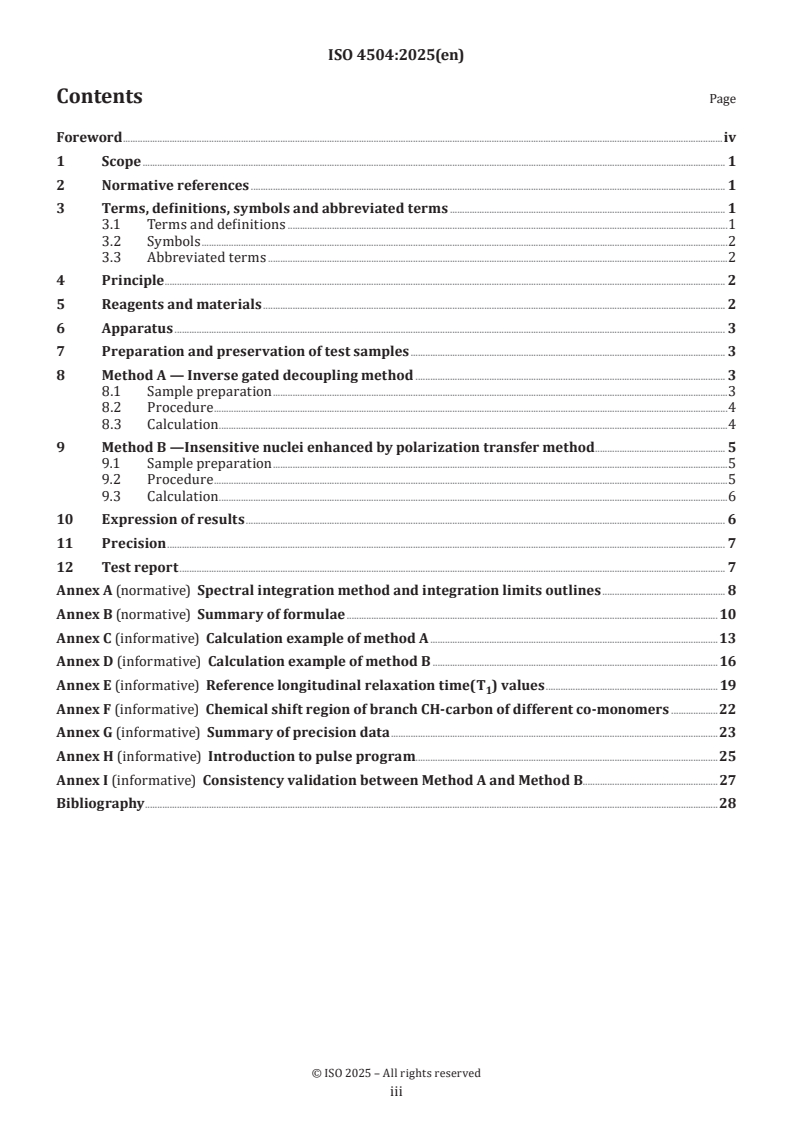
Contents Page
Foreword .iv
1 Scope . 1
2 Normative references . 1
3 Terms, definitions, symbols and abbreviated terms . 1
3.1 Terms and definitions .1
3.2 Symbols .2
3.3 Abbreviated terms .2
4 Principle . 2
5 Reagents and materials . 2
6 Apparatus . 3
7 Preparation and preservation of test samples . 3
8 Method A — Inverse gated decoupling method . 3
8.1 Sample preparation .3
8.2 Procedure .4
8.3 Calculation .4
9 Method B —Insensitive nuclei enhanced by polarization transfer method . 5
9.1 Sample preparation .5
9.2 Procedure .5
9.3 Calculation .6
10 Expression of results . 6
11 Precision . 7
12 Test report . 7
Annex A (normative) Spectral integration method and integration limits outlines . 8
Annex B (normative) Summary of formulae . 10
Annex C (informative) Calculation example of method A .13
Annex D (informative) Calculation example of method B .16
Annex E (informative) Reference longitudinal relaxation time(T ) values . 19
Annex F (informative) Chemical shift region of branch CH-carbon of different co-monomers .22
Annex G (informative) Summary of precision data .23
Annex H (informative) Introduction to pulse program.25
Annex I (informative) Consistency validation between Method A and Method B.27
Bibliography .28
iii
Foreword
ISO (the International Organization for Standardization) is a worldwide federation of national standards
bodies (ISO member bodies). The work of preparing International Standards is normally carried out through
ISO technical committees. Each member body interested in a subject for which a technical committee
has been established has the right to be represented on that committee. International organizations,
governmental and non-governmental, in liaison with ISO, also take part in the work. ISO collaborates closely
with the International Electrotechnical Commission (IEC) on all matters of electrotechnical standardization.
The procedures used to develop this document and those intended for its further maintenance are described
in the ISO/IEC Directives, Part 1. In particular, the different approval criteria needed for the different types
of ISO document should be noted. This document was drafted in accordance with the editorial rules of the
ISO/IEC Directives, Part 2 (see www.iso.org/directives).
ISO draws attention to the possibility that the implementation of this document may involve the use of (a)
patent(s). ISO takes no position concerning the evidence, validity or applicability of any claimed patent
rights in respect thereof. As of the date of publication of this document, ISO had not received notice of (a)
patent(s) which may be required to implement this document. However, implementers are cautioned that
this may not represent the latest information, which may be obtained from the patent database available at
www.iso.org/patents. ISO shall not be held responsible for identifying any or all such patent rights.
Any trade name used in this document is information given for the convenience of users and does not
constitute an endorsement.
For an explanation of the voluntary nature of standards, the meaning of ISO specific terms and expressions
related to conformity assessment, as well as information about ISO's adherence to the World Trade
Organization (WTO) principles in the Technical Barriers to Trade (TBT), see www.iso.org/iso/foreword.html.
This document was prepared by Technical Committee ISO/TC 61, Plastics, Subcommittee SC 9, Thermoplastic
materials.
This second edition cancels and replaces the first edition (ISO 4504:2023), which has been technically
revised.
The main changes are as follows:
— the formula in Annex B has been revised with units of mmol/mol;
— using the revised formula in Annex B, the data in Annex C, Annex D, Annex G and Annex I have been
recalculated;
— the test report has been updated (see Clause 12);
— explanations for the numbers and labels above and below Figure C.1 and Figure D.1 in figure key have
been added;
— figure key has been added in Figure H.1.
Any feedback or questions on this document should be directed to the user’s national standards body. A
complete listing of these bodies can be found at www.iso.org/members.html.
iv
International Standard ISO 4504:2025(en)
Plastics — Polyethylene (PE) — Determination of co-
monomer content by solution state C-NMR spectrometry
WARNING — Persons using this document should be familiar with normal laboratory practice. This
document does not purport to address all of the safety problems, if any, associated with its use. It is
the user’s responsibility to establish appropriate safety and health practices.
1 Scope
This document specifies two methods for the determination of co-monomer contents of polyethylene
products by solution state C-NMR spectrometry (nuclear magnetic resonance spectrometry):
— Method A: inverse gated decoupling method;
— Method B: insensitive nuclei enhanced by polarization transfer method.
This document is applicable to copolymers of ethylene having a content of other 1-olefinic monomers of less
than a mass fraction of 50 %.
This document is not applicable to ethylene homopolymers or copolymers in which ethylene is polymerized
with two or more type 1-olefin comonomers.
2 Normative references
The following documents are referred to in the text in such a way that some or all of their content constitutes
requirements of this document. For dated references, only the edition cited applies. For undated references,
the latest edition of the referenced document (including any amendments) applies.
ISO 472, Plastics — Vocabulary
ISO 648, Laboratory glassware — Single-volume pipettes
3 Terms, definitions, symbols and abbreviated terms
3.1 Terms and definitions
For the purposes of this document, the terms and definitions given in ISO 472 and the following apply.
ISO and IEC maintain terminological databases for use in standardization at the following addresses:
— ISO Online browsing platform: available at https:// www .iso .org/ obp
— IEC Electropedia: available at https:// www .electropedia .org/
3.1.1
INEPT
insensitive nuclei enhanced by polarization transfer
C NMR method in which magnetisation is transferred from sensitive nuclei to directly linked insensitive
nuclei enhanced by polarisation transfer
Note 1 to entry: See Reference [3].
3.1.2
refocused INEPT
INEPT pulse program with a pair of refocus delay and π inversion pulse in both sensitive and insensitive
nuclei resonance channels
3.2 Symbols
T longitudinal relaxation time
T longest T of atom nuclei
1, max 1
C Carbon 13
H Hydrogen 1
T polarization transfer time
p
T refocusing time
R
3.3 Abbreviated terms
NMR nuclear magnetic resonance
C-NMR Carbon 13 Nuclear Magnetic Resonance
PFT-NMR pulse Fourier transform nuclear magnetic resonance spectrometer
LOQ limit of quantitation
LOD limit of detection
SNR signal-to-noise ratio
SW sweep width
4 Principle
Polyethylene samples are dissolved in the deuterated solvent and put in the magnetic field. Radio pulses
are applied to excite the nuclei, and a set of resonance signals are generated from nuclei with different
chemical circumstances. With proper excitation pulse or pulses combination, the intensities of a resonance
signal are proportional to the molar fractions of nuclei with identical or similar chemical circumstances.
A linear relationship is established between the carbon molar content of different chemical shifts and the
comonomer content. In this document, two methods with different NMR pulse programs are established
13 [3]
to acquire C NMR spectra. Method A utilizes the “single pulse with inverse gated proton decoupling”.
NMR pulse program to excite the C nuclei directly. Method B excites the proton initially by the “Refocused
[4][5] 13
INEPT with proton decoupling”. NMR Pulse program to enhance the signal sensitivity of C nuclei. The
principles of two different NMR spectrometer pulse programs are shown in Annex H.
5 Reagents and materials
5.1 Deuterated reagents, deuterated ortho-dichlorobenzene, or para-dichlorobenzene (o-DCB-d4 or
p-DCB-d4), or 1,1,2,2-tetrachloroethane-d2 (TCE-d2), analytical grade.
5.2 Relaxation reagents, chromium (III) acetylacetonate, analytical grade.
6 Apparatus
6.1 PFT-NMR spectrometer, with a minimum magnet field strength of 7,05 Tesla (equivalent proton
resonance frequency at 300 MHz, or C nuclei resonance frequency at 75 MHz), capable of being maintained
at 120 °C ± 1 °C.
6.2 Analytical balance, accurate to 1 mg.
6.3 Sample tube, capped NMR tube with 5 mm or 10 mm outer diameter.
6.4 Adjustable pipette, 5 ml capacity, meet the requirement of Class A defined in ISO 648.
6.5 Supplementary heating equipment, capable of uniformly heating the samples to 130 C ± 1 °C, while
can ensure that the sample tube is kept in a vertical position during the heating process.
7 Preparation and preservation of test samples
Test samples can be obtained from materials in the form of powders, pellets, or moulded parts. To ensure the
required accuracy of sample mass, large samples should be cut into smaller pieces. It is important that the
laboratory receive a sample which is representative and has not been damaged or changed during transport
or storage.
8 Method A — Inverse gated decoupling method
8.1 Sample preparation
8.1.1 Weigh approximately 30 mg of the test sample, put them into a diameter 5 mm sample tube (6.3) or
weigh approximately 120 mg of the test sample, put them into a diameter 10 mm sample tube (6.3).
In some cases, larger sample mass is preferred to get a satisfying result. Any sample mass larger than the
minimum requirement of 8.1.1 should be chosen, as long as the sample is able to be dissolved at 120 °C to 130 °C.
8.1.2 Add 0,4 ml to 0,6 ml of deuterated reagent (5.1) using adjustable pipette (6.4) to 5 mm sample tube
(6.3), or 1,6 ml to 2,0 ml of deuterated reagent (5.1) using adjustable pipette (6.4) to 10 mm sample tube (6.3).
Solution concentration can be modified according to the instrument magnetic field strength, on condition
that the minimum signal to noise ratio shall meet Table 1.
8.1.3 Uniformly heat the sample part in the tube on a supplementary heating device at 120 °C to 130 °C
until the whole sample is well dissolved in deuterated reagent, appropriate mechanical stirring is helpful for
better dissolution of the sample in the deuterated reagent. Keep the sample tube in a vertical position during
the heating step.
NOTE Any method for uniformly dissolution can be acceptable.
8.2 Procedure
8.2.1 Turn on the PFT-NMR spectrometer (6.1) and warm up to readiness. Set up the PFT-NMR
spectrometer and detection instrument parameters. The instrument recommended parameters of method
A are listed in Table 1.
Table 1 — Instrument parameters of method A
Parameters Unit Value
Pulse program — single pulse with inverse gated proton decoupling
Decoupling mode — composite pulse decoupling
Measurement temperature °C 120 °C ± 1 °C
a 13
≥ 5 × T ( C nuclei)
Relaxation delay s
1, max
b
Flip angle degree 90
-1
c
< 4 × SW (Hz)
Pulse width s
Hz/
Sweep width 100
MHz
Hz/
Offset resonance frequency of C nuclei 30
MHz
Window function (exponential) Hz 2
Zero-filling — Equal to the time domain data size
SNR (branch CH-carbon peak): ≥ 20:1 and
d
LOQ —
SNR (isolated methylene carbon peak) : ≥ 4 000:1
SNR (branch CH-carbon peak): ≥ 3:1 and
d
LOD —
SNR (isolated methylene carbon peak) : ≥ 4 000:1
a 13
For most samples, 10 s is enough for method A to get a quantitative result. T of C nuclei can be determined for each sample.
Precise T of different carbon types in polyethylene copolymer are listed in Annex E by inversion recovery method.
b
For most cases, the flip angle should set as 90° to obtain a spectra with sufficient SNR ratio. In the case of high magnetic field
NMR system, the flip angle range can be set from 30° to 90°.
c 13
The sweep width for method A is set based on the 100 MHz nuclear magnetic field strength of C.
d
The limit of quantification and limit of detection depends on the signal-to-noise ratio of the acquired spectrum. The chemical
shift region of branch CH-carbon of different co-monomers have been listed in Annex F. The signal to noise ratio of branch CH-
carbon is defined as the signal intensity for the region which given in Annex F divided by the peak-to-peak noise for the region
from 50 Hz/MHz to 70 Hz/MHz. The signal to noise ratio of isolated methylene carbons is defined as the signal intensity for the
region of 29 Hz/MHz to 31 Hz/MHz peaks divided by the peak to peak noise for the region from 50 Hz/MHz to 70 Hz/MHz.
8.2.2 Transfer the sample tube to the NMR spectrometer and equilibrate 10 min to 30 min.
8.2.3 Calibrate the 90° pulse width of C nuclei before measurement.
8.2.4 Acquire the spectra. Execute phase and baseline correction requirement according to the
[7][8]
spectrometer operation manual.
NOTE Automatic spectra phase and baseline correction program which built-in acquisition software can be used
to get a satisfying result.
8.2.5 Calibrate the maximum intensity peak (isolated methylene carbons) to 30 Hz/MHz.
8.3 Calculation
8.3.1 Use the obtained NMR spectrum to measure and sum the area between the appropriate integration
limits in accordance with Annex A. The result shall be reported in three decimals.
NOTE Integration limits result are two decimals or one decimal can be used to get a satisfying result.
8.3.2 The results are substituted into the formula in accordance with Annex B. The sum of peak integral
is substituted into the corresponding formulae in B.1 [i.e. Formulae (B.1) to (B.5)] to calculate the mole
fraction 1-olefins. For calculation examples of method A, see Annex C.
8.3.3 Use Formula (B.11) to convert the result from the mole fraction of 1-olefin to the number of branches
per 1 000 carbons (br/1 000 C).
9 Method B —Insensitive nuclei enhanced by polarization transfer method
9.1 Sample preparation
9.1.1 See 8.1.1.
9.1.2 See 8.1.2.
9.1.3 See 8.1.3.
9.2 Procedure
9.2.1 Instrument recommended parameters of method B are listed in Table 2. For other content, see 8.2.1.
Table 2 — Instrument parameters of method B
Parameters Unit Value
Pulse program — refocus INEPT with proton decoupling
Decoupling mode — composite pulse decoupling
Measurement temperature °C 120 °C ± 1 °C
a, b
Relaxation delay s ≥ 5× T ( H nuclei)
1, max
b -3
Polarization transfer time s 2×10
b, c -3
Refocus time s 2,15×10
-1
d
< 4 × SW (Hz)
Pulse width s
Hz/
Sweep width 100
MHz
Hz/
Offset resonance frequency of C nuclei 30
MHz
Hz/
Offset resonance frequency of H nuclei 1,2
MHz
NOTE Additional relaxation reagents (chromium (III) acetylacetonate) can be used for sample preparation. The H nuclei T value
of copolymer can be 3 to 5 times reduced by adding 0,35 mg of additional relaxation agent to 5 mm sample tube, or 1,4 mg of
additional relaxation agent to 10 mm tube, in procedure 9.1.2.
a
For most samples, 5 s of relaxation delay is enough by adding relaxation reagent to get a quantitative result. Precise T value
1 1
of different H nuclei can be determined for each sample. T of different H nuclei types in polyethylene copolymer are listed in
Annex E by inversion recovery method.
b
See pulse program diagram in Annex H for more details.
c
Some commercial NMR console do not bear the function of editing the polarization transfer time and refocus time directly
at parameter setting interface, in this case, tests with some deviation on the polarization transfer time at a price of slightly lower
SNR give equally satisfactory results.
d 13
The sweep width for method B is set based on the 100 MHz field strength of C.
e
The limit of quantification and limit of detection depends on the signal-to-noise ratio of the acquired spectrum. The chemical
shift region of branch CH-carbon of different co-monomers have been listed in Annex F. The signal to noise ratio of branch CH-
carbon is defined as the signal intensity for the region which
...