

ISO 8347:2025
(Main)Measurement procedures associated with the chain of custody in native tropical forest management areas
General Information
- Abstract
This document establishes a process to measure wood being logged in native tropical forest management areas following an approved and documented plan. Such a process includes quantifying and monitoring the harvested area to support the chain of custody assessment, helping to ensure the origin of the logged wood. Wood volume measurement is outside the scope of this document. This document proposes indicators that can be used to reinforce the level of confidence with regards to the correct origin of the logged wood, particularly when assessing the transport and commercial documentation of wood-based products, by means of a consistency check with what can be observed as occurring in the forest area declared as the origin of native tropical timber. The indicators will serve as an alert of any eventual inconsistency detected. These indicators are obtained by means of standardized metrics. These metrics are mathematical models that establish a correlation between the area of subtracted vegetation – detected through remote sensing monitoring tools – and the number of extracted trees that generate the amount of declared logged wood. This document is intended to be used to quantify the impact resulting from native vegetation extraction by selective logging in various tropical forest regions of the world, in order to support the long-term maintenance of these forest assets. The scope of this document is limited to native tropical forests, i.e. forests naturally originated and formed by native species (or group) in tropical regions. This document does not apply to planted forests, regardless of the species (or group) being native or exotic, as those forests are subject to varied and particular management practices which depend on the geographical conditions and rules of the country in which they are located. Regarding the limitations of this document, it is not intended to ensure: exact origin (geographical coordinates) of each log; exact volumes of wood extracted from the forest; species (or group) of wood harvested; chain of custody compliance; social and labour compliance of the audited operation; tax compliance of the audited operation. This document does not focus on, and is not oriented towards, biomass and carbon-balance estimations. This document does not cover any aspects of sustainable forest management and focuses on measurement procedures described above. In addition, it is not intended to be a Management Systems Standard (MSS). Furthermore, the national legal requirements and international policies are not repeated in this document, including those related to sustainability aspects, as well as those related to traditional and indigenous communities contained in the principles/articles of the UN Declaration on the rights of Indigenous Peoples (UNDRIP).
- Status
- Published
- Publication Date
- 03-Dec-2025
- Technical Committee
- ISO/TC 287 - Sustainable processes for wood and wood-based products
- Drafting Committee
- ISO/TC 287 - Sustainable processes for wood and wood-based products
- Current Stage
- 6060 - International Standard published
- Start Date
- 04-Dec-2025
- Due Date
- 30-Jun-2025
- Completion Date
- 04-Dec-2025
Buy Documents

ISO 8347:2025 - Measurement procedures associated with the chain of custody in native tropical forest management areas Released:12/4/2025

ISO 8347:2025 - Procédures de mesure associées à la chaîne de contrôle dans les zones de gestion des forêts tropicales indigènes

REDLINE ISO 8347:2025 - Procédures de mesure associées à la chaîne de contrôle dans les zones de gestion des forêts tropicales indigènes
Overview
ISO 8347:2025 - Measurement procedures associated with the chain of custody in native tropical forest management areas - establishes a standardized process to measure and monitor selective logging in native tropical forests to reinforce traceability of timber origin. The standard uses remote sensing, georeferenced documentation and standardized metrics/indicators to perform consistency checks between declared harvesting (forest management plans and transport/commercial documents) and what can be observed on the ground via spatial monitoring. Wood volume measurement, exact coordinates of each log, species identification and compliance audits are outside the scope.
Key topics and technical requirements
- Scope limitation: Applies only to native tropical forests; planted forests are excluded.
- Documentation requirements: Verification relies on approved forest management plans (FMP), harvesting permits and geospatial documentation submitted by the responsible party.
- Remote sensing data & accuracy: Independent georeferenced information (satellite, airborne, other remote sensing) is used with defined accuracy requirements to detect canopy opening and subtracted vegetation.
- Standardized metrics and indicators: Mathematical models correlate the area of vegetation removed (from remote sensing) to the expected number of extracted trees linked to declared logged wood. These indicators act as alerts for inconsistencies.
- Consistency checking procedures: Methods to compare georeferenced data provided by the responsible party with independent observations, evaluate spatial patterns of production areas and assess temporal alignment with declared harvest periods.
- Limitations and exclusions: The standard explicitly does not ensure exact log coordinates, exact wood volumes, species ID, chain-of-custody compliance, social/labour/tax compliance, biomass/carbon accounting, nor does it function as a Management Systems Standard (MSS).
- Additional clauses: Contains provisions for claims and whistleblowing and references to normative terms and remote sensing accuracy criteria.
Practical applications
- Strengthening documentation-based traceability for timber buyers, primary processors and downstream supply-chain actors who need independent assurance of timber origin.
- Supporting auditors, third-party verifiers and certification schemes with geospatial consistency checks that flag potential documentary fraud or illegal harvesting.
- Enabling governments, NGOs and responsible forest managers to monitor selective logging impacts and detect discrepancies between declared harvests and observed canopy changes.
- Informing due-diligence processes for market access requirements where “deforestation-free” proof is required.
Who should use ISO 8347:2025
- Forest managers and operators in native tropical regions (for planning and compliance support)
- Remote sensing and geospatial service providers (to supply validated monitoring products)
- Auditors, certification bodies and regulatory agencies (for independent consistency checks)
- Timber traders, importers and large buyers seeking enhanced origin assurance
Related standards and context
ISO 8347:2025 was prepared by ISO/TC 287 (Sustainable processes for wood and wood-based products) and is designed to complement existing chain-of-custody and certification frameworks by providing a remote-sensing-based methodology for origin verification without replacing legal or social requirements.
Buy Documents
ISO 8347:2025 - Measurement procedures associated with the chain of custody in native tropical forest management areas Released:12/4/2025
ISO 8347:2025 - Procédures de mesure associées à la chaîne de contrôle dans les zones de gestion des forêts tropicales indigènes
REDLINE ISO 8347:2025 - Procédures de mesure associées à la chaîne de contrôle dans les zones de gestion des forêts tropicales indigènes
Get Certified
Connect with accredited certification bodies for this standard

Control Union Certifications
Global certification for agriculture and sustainability.

ECOCERT
Organic and sustainability certification.

FSC International
Forest Stewardship Council certification.
Sponsored listings
Frequently Asked Questions
ISO 8347:2025 is a standard published by the International Organization for Standardization (ISO). Its full title is "Measurement procedures associated with the chain of custody in native tropical forest management areas". This standard covers: This document establishes a process to measure wood being logged in native tropical forest management areas following an approved and documented plan. Such a process includes quantifying and monitoring the harvested area to support the chain of custody assessment, helping to ensure the origin of the logged wood. Wood volume measurement is outside the scope of this document. This document proposes indicators that can be used to reinforce the level of confidence with regards to the correct origin of the logged wood, particularly when assessing the transport and commercial documentation of wood-based products, by means of a consistency check with what can be observed as occurring in the forest area declared as the origin of native tropical timber. The indicators will serve as an alert of any eventual inconsistency detected. These indicators are obtained by means of standardized metrics. These metrics are mathematical models that establish a correlation between the area of subtracted vegetation – detected through remote sensing monitoring tools – and the number of extracted trees that generate the amount of declared logged wood. This document is intended to be used to quantify the impact resulting from native vegetation extraction by selective logging in various tropical forest regions of the world, in order to support the long-term maintenance of these forest assets. The scope of this document is limited to native tropical forests, i.e. forests naturally originated and formed by native species (or group) in tropical regions. This document does not apply to planted forests, regardless of the species (or group) being native or exotic, as those forests are subject to varied and particular management practices which depend on the geographical conditions and rules of the country in which they are located. Regarding the limitations of this document, it is not intended to ensure: exact origin (geographical coordinates) of each log; exact volumes of wood extracted from the forest; species (or group) of wood harvested; chain of custody compliance; social and labour compliance of the audited operation; tax compliance of the audited operation. This document does not focus on, and is not oriented towards, biomass and carbon-balance estimations. This document does not cover any aspects of sustainable forest management and focuses on measurement procedures described above. In addition, it is not intended to be a Management Systems Standard (MSS). Furthermore, the national legal requirements and international policies are not repeated in this document, including those related to sustainability aspects, as well as those related to traditional and indigenous communities contained in the principles/articles of the UN Declaration on the rights of Indigenous Peoples (UNDRIP).
This document establishes a process to measure wood being logged in native tropical forest management areas following an approved and documented plan. Such a process includes quantifying and monitoring the harvested area to support the chain of custody assessment, helping to ensure the origin of the logged wood. Wood volume measurement is outside the scope of this document. This document proposes indicators that can be used to reinforce the level of confidence with regards to the correct origin of the logged wood, particularly when assessing the transport and commercial documentation of wood-based products, by means of a consistency check with what can be observed as occurring in the forest area declared as the origin of native tropical timber. The indicators will serve as an alert of any eventual inconsistency detected. These indicators are obtained by means of standardized metrics. These metrics are mathematical models that establish a correlation between the area of subtracted vegetation – detected through remote sensing monitoring tools – and the number of extracted trees that generate the amount of declared logged wood. This document is intended to be used to quantify the impact resulting from native vegetation extraction by selective logging in various tropical forest regions of the world, in order to support the long-term maintenance of these forest assets. The scope of this document is limited to native tropical forests, i.e. forests naturally originated and formed by native species (or group) in tropical regions. This document does not apply to planted forests, regardless of the species (or group) being native or exotic, as those forests are subject to varied and particular management practices which depend on the geographical conditions and rules of the country in which they are located. Regarding the limitations of this document, it is not intended to ensure: exact origin (geographical coordinates) of each log; exact volumes of wood extracted from the forest; species (or group) of wood harvested; chain of custody compliance; social and labour compliance of the audited operation; tax compliance of the audited operation. This document does not focus on, and is not oriented towards, biomass and carbon-balance estimations. This document does not cover any aspects of sustainable forest management and focuses on measurement procedures described above. In addition, it is not intended to be a Management Systems Standard (MSS). Furthermore, the national legal requirements and international policies are not repeated in this document, including those related to sustainability aspects, as well as those related to traditional and indigenous communities contained in the principles/articles of the UN Declaration on the rights of Indigenous Peoples (UNDRIP).
ISO 8347:2025 is classified under the following ICS (International Classification for Standards) categories: 65.020.01 - Farming and forestry in general. The ICS classification helps identify the subject area and facilitates finding related standards.
ISO 8347:2025 is available in PDF format for immediate download after purchase. The document can be added to your cart and obtained through the secure checkout process. Digital delivery ensures instant access to the complete standard document.
Standards Content (Sample)
International
Standard
ISO 8347
First edition
Measurement procedures
2025-12
associated with the chain of
custody in native tropical forest
management areas
Procédures de mesure associées à la chaîne de contrôle dans les
zones de gestion des forêts tropicales indigènes
Reference number
© ISO 2025
All rights reserved. Unless otherwise specified, or required in the context of its implementation, no part of this publication may
be reproduced or utilized otherwise in any form or by any means, electronic or mechanical, including photocopying, or posting on
the internet or an intranet, without prior written permission. Permission can be requested from either ISO at the address below
or ISO’s member body in the country of the requester.
ISO copyright office
CP 401 • Ch. de Blandonnet 8
CH-1214 Vernier, Geneva
Phone: +41 22 749 01 11
Email: copyright@iso.org
Website: www.iso.org
Published in Switzerland
ii
Contents Page
Foreword .iv
Introduction .v
1 Scope . 1
2 Normative references . 2
3 Terms and definitions . 2
3.1 Terms related to the forest value chain .2
3.2 Terms related to remote sensing technology .5
3.3 Terms related to the accuracy of remote sensing technology .6
4 Forest management documentation and relevant data required from the responsible
party . 7
4.1 Understanding of the native forest area .7
4.1.1 Criterion: wood production capacity .7
4.2 Following an approved forest management plan (FMP) .7
4.2.1 Principle .7
4.2.2 Criterion: harvesting permit .7
4.2.3 Criterion: geospatial documentation related to the forest management plan
(FMP) .8
4.2.4 Criterion: geospatial documentation related to the actual activities .9
4.3 Chain of custody traceability .9
4.3.1 Principle .9
4.3.2 Criterion: chain of custody records .9
5 Information sources and technologies – Independent georeferenced information
derived from remote sensing (and its accuracy requirements) .10
5.1 Consistency checking of the remote sensing technologies availability in the geospatial
industry .10
5.1.1 Principle .10
5.1.2 Criteria .10
5.2 Consistency checking of the remote sensing technologies detection’s relevant capacity.11
5.2.1 Principle .11
5.2.2 Criteria .11
6 Consistency checking procedures .11
6.1 General .11
6.2 Consistency of georeferenced data provided by the responsible party . 12
6.2.1 Principle . 12
6.2.2 Criteria . 12
6.3 Consistency of the production area’s spatial pattern . 13
6.3.1 Principle . 13
6.3.2 Criteria . 13
7 Claims .13
8 Requirements for whistleblowing .13
Bibliography . 14
iii
Foreword
ISO (the International Organization for Standardization) is a worldwide federation of national standards
bodies (ISO member bodies). The work of preparing International Standards is normally carried out through
ISO technical committees. Each member body interested in a subject for which a technical committee
has been established has the right to be represented on that committee. International organizations,
governmental and non-governmental, in liaison with ISO, also take part in the work. ISO collaborates closely
with the International Electrotechnical Commission (IEC) on all matters of electrotechnical standardization.
The procedures used to develop this document and those intended for its further maintenance are described
in the ISO/IEC Directives, Part 1. In particular, the different approval criteria needed for the different types
of ISO documents should be noted. This document was drafted in accordance with the editorial rules of the
ISO/IEC Directives, Part 2 (see www.iso.org/directives-and-policies.html).
ISO draws attention to the possibility that the implementation of this document may involve the use of (a)
patent(s). ISO takes no position concerning the evidence, validity or applicability of any claimed patent
rights in respect thereof. As of the date of publication of this document, ISO had not received notice of (a)
patent(s) which may be required to implement this document. However, implementers are cautioned that
this may not represent the latest information, which may be obtained from the patent database available at
www.iso.org/patents. ISO shall not be held responsible for identifying any or all such patent rights.
Any trade name used in this document is information given for the convenience of users and does not
constitute an endorsement.
For an explanation of the voluntary nature of standards, the meaning of ISO specific terms and expressions
related to conformity assessment, as well as information about ISO's adherence to the World Trade
Organization (WTO) principles in the Technical Barriers to Trade (TBT), see www.iso.org/iso/foreword.html.
This document was prepared by Technical Committee ISO/TC 287, Sustainable processes for wood and wood-
based products.
Any feedback or questions on this document should be directed to the user’s national standards body. A
complete listing of these bodies can be found at www.iso.org/members.html.
iv
Introduction
This document is developed in the context of the challenges that have arisen from the international
commercialization of tropical wood, such as deforestation of native tropical forests through illegal
harvesting and documentary fraud in the chain of custody of tropical wood products. The document is
not intended to be a comprehensive solution to these challenges, but rather offers a methodology that can
be used to monitor these challenges within specific contexts for native tropical forests. Data from remote
sensing increases the validity of volume and areas harvested from which tropical wood products originate,
as described in the text below. The focus of this document is the methodology for using remotely sensed
data and the appropriate contexts in which to do so, rather than the use of a specific remote technology for
data collection. Traceability of the origin of wood extracted through selective logging of native forests in
tropical regions of the world has become a standard requirement by consumers of these wood products,
who increasingly favour purchasing products from areas that have been legally authorized and are managed
and harvested more sustainably. Particularly in markets such as the EU, the USA, Australia and Japan, the
lack of reliable information regarding the practices adopted at the origin of wood extraction and throughout
industrialization can hinder the commercialization of such wood-based products.
[ ]
The upcoming demand in the EU, 10 for instance, for these products that are “deforestation-free” requires
strong evidence that they have originated from a specific location where the forest area under management
has not been subject to forest degradation. In this document, native tropical forests are addressed.
Typically, forest management and chain of custody certification of native tropical forests is based on the
periodic auditing of detailed documentation and a sample of evidence collected on site covering the various
stages of production, from receiving the logged wood originated at the forest management unit (FMU),
through primary processing of logs, further industrialization, and final commercialization of wood-
based products. However, because not all the logged wood from native tropical forests commercialized
internationally will be covered by certification, questions can potentially be raised by consumer markets
with respect to the effectiveness of available information and supporting documentation in ensuring the
origin of the wood-based products being commercialized.
In the last decades, remote sensing technologies have been frequently utilized for native tropical forests with
the purpose of detecting changes in forest coverage and of determining the extent of land use conversion.
As an example, satellite remote sensing integrated into alert mechanisms has helped detect deforestation
in areas of native tropical forest in Brazil. Likewise, progressive effort in monitoring and evaluating canopy
opening by remote sensing tools during selective logging (within a previously informed time period)
suggest the possibility of finding an effective way to correlate the amount of retrieved trees from a declared
origin with the information that accompanies the logged wood that arrives at a mill for primary processing
to support the chain of custody of resulting wood-based products (hence commercialized to a variety of
destinations).
Adding geospatial referenced information at the source of the wood extracted from native tropical forest
areas will strengthen the link between the documentation provided as “proof of origin” of the logged wood
at the mill (beginning of the process) to the documentation that accompanies the wood-based products to
the end of the chain of custody. As a result, remote sensing technologies can then be used to analyse the
native tropical forest management areas and verify consistency between the declared amount of logged
wood and the related selective logging features (geographical location, dates, logged areas, canopy opening
associated to logged trees or infrastructure). Therefore, the field of work of this document is to establish
the guidelines of a methodology to assess the impact on forest coverage resulting from the implementation
of a selective harvest under a forest management plan (FMP) by using remote sensing tools, within a pre-
established region in space and a similarly delimited time interval. The magnitude of the impact thus
determined will be compared to the logged wood’s documentation (formal and georeferenced) extracted
by the organization interested in the commercialization of its wood-based products, to verify consistency
between the two distinct sources of information. This proposed verification methodology will be an
independent means for a variety of stakeholders to monitor the selective logging forest areas, and hence will
significantly enhance the credibility of the overall process. Implementation of this document would generate
a robust data set describing where harvesting activity has occurred. It is highly recommended that this data
set be used to check the potential overlap of harvesting on protected areas, indigenous lands, the described
distributions of IUCN Red List endangered species (or group), and other relevant spatial data layers that
v
exist for the purpose of preventing or observing impacts on conservation areas or areas related to social
justice. However, these additional analyses are not required for conformance to this document.
This document is based on cross checking data from remote sensing with official information, relating to
the planning of management activities approved by the competent authorities (management plan, harvest
authorizations and/or similar). The competent authorities have official information that reports what was
carried out in the harvest (invoices and/or any other documents that have official support that indicate the
movement of logs out of the forest). Nevertheless, the use of this document cannot state that the official
information presented has a high probability of being true and of correctly reporting the origin of the log, as
well as that the forest manager respected the environmental legislation in force in the country.
vi
International Standard ISO 8347:2025(en)
Measurement procedures associated with the chain of
custody in native tropical forest management areas
1 Scope
This document establishes a process to measure wood being logged in native tropical forest management
areas following an approved and documented plan. Such a process includes quantifying and monitoring the
harvested area to support the chain of custody assessment, helping to ensure the origin of the logged wood.
Wood volume measurement is outside the scope of this document.
This document proposes indicators that can be used to reinforce the level of confidence with regards to the
correct origin of the logged wood, particularly when assessing the transport and commercial documentation
of wood-based products, by means of a consistency check with what can be observed as occurring in the
forest area declared as the origin of native tropical timber. The indicators will serve as an alert of any
eventual inconsistency detected.
These indicators are obtained by means of standardized metrics. These metrics are mathematical models
that establish a correlation between the area of subtracted vegetation – detected through remote sensing
monitoring tools – and the number of extracted trees that generate the amount of declared logged wood.
This document is intended to be used to quantify the impact resulting from native vegetation extraction
by selective logging in various tropical forest regions of the world, in order to support the long-term
maintenance of these forest assets.
The scope of this document is limited to native tropical forests, i.e. forests naturally originated and formed
by native species (or group) in tropical regions. This document does not apply to planted forests, regardless
of the species (or group) being native or exotic, as those forests are subject to varied and particular
management practices which depend on the geographical conditions and rules of the country in which they
are located.
Regarding the limitations of this document, it is not intended to ensure:
— exact origin (geographical coordinates) of each log;
— exact volumes of wood extracted from the forest;
— species (or group) of wood harvested;
— chain of custody compliance;
— social and labour compliance of the audited operation;
— tax compliance of the audited operation.
This document does not focus on, and is not oriented towards, biomass and carbon-balance estimations.
This document does not cover any aspects of sustainable forest management and focuses on measurement
procedures described above. In addition, it is not intended to be a Management Systems Standard (MSS).
Furthermore, the national legal requirements and international policies are not repeated in this document,
including those related to sustainability aspects, as well as those related to traditional and indigenous
communities contained in the principles/articles of the UN Declaration on the rights of Indigenous Peoples
(UNDRIP).
2 Normative references
There are no normative references in this document.
3 Terms and definitions
For the purposes of this document, the following terms and definitions apply.
ISO and IEC maintain terminology databases for use in standardization at the following addresses:
— ISO Online browsing platform: available at https:// www .iso .org/ obp
— IEC Electropedia: available at https:// www .electropedia .org/
3.1 Terms related to the forest value chain
3.1.1
native forest area
forest area which comprises native tree species (or group) composition and shows natural dynamics,
occurrence of dead wood, complex age structure and natural regeneration processes
Note 1 to entry: In a native forest area, the naturally regenerated trees are expected to constitute the major part of the
growing stock at stand maturity. If portions of these forests are modified by humans through their actions, they are
expected to be naturally regenerated.
3.1.2
forest management unit
FMU
area of a forest where wood is sourced for wood-based products
Note 1 to entry: An FMU has clearly defined boundaries and can cover different sizes. It can include sites which are not
adjoining.
Note 2 to entry: An FMU can be subject to different land ownership arrangements.
Note 3 to entry: An FMU can be characterized by areas with similar ecology and under similar management practices
(see ISO 13391-2:2025, 4.3).
Note 4 to entry: Forest areas not primarily used for wood production, or set-aside areas for nature conservation or
other purposes, can be included in the FMU.
Note 5 to entry: National definitions or practices can lead to inclusion of additional areas where wood is sourced,
subject to, for example, agroforestry or tree plantations.
Note 6 to entry: The terms “land ownership” and “set-aside areas” are defined in ISO 13391-2:2025, 3.3 and 3.1.
[SOURCE: ISO 13391-1:2025, 3.20]
3.1.3
forest management plan
FMP
document translating forest policies into a coordinated programme for a forest management unit (3.1.2) and
for regulating production, environmental and social activities for a set period of time through the use of
prescriptions, targets, and action and control arrangements
Note 1 to entry: In this document, FMP denotes a set of documents that contains the data required to implement the
methodology described in this document.
Note 2 to entry: The name of the FMP varies regionally.
EXAMPLE Native tropical FMP (used in Brazil).
[9]
[SOURCE: FAO Terminology Portal ]
3.1.4
production area
geographical limits of a subdivision of the native forest management unit (3.1.2) which have been authorized
for harvest during a predetermined period of time, expressed as a polygon of harvestable area where a
consistency checking analysis will be conducted
Note 1 to entry: The consistency checking analysis is explained in Clause 5.
3.1.5
harvesting permit
logging permit
documentation that has been issued by the applicable authorities specifying the level of allowed harvest
within the geographical limits of a specified production area (3.1.4) and a specified duration period (defined
by issue and expiration dates)
Note 1 to entry: The harvested material can be identified by species (or group) and the level of allowed harvest can be
indicated with a metric appropriate to the context of the harvest (e.g. total volume removed, number of trees removed,
residual basal area).
3.1.6
forest access
main roads and logging deck through which the forest management unit (3.1.2) and subdivisions [production
areas (3.1.4)] are accessed and through which the logged wood is moved and stored prior to transportation
to the mills
Note 1 to entry: Forest access also serves for a variety of forest management activities.
3.1.7
harvesting infrastructure
secondary roads and logging deck within a production area (3.1.4) that are directly and specifically
associated with the harvesting (3.1.8) activities
Note 1 to entry: The data captured by remote sensing technologies typically indicate exposed soil, as an area from
which the forest coverage has been removed. However, unlike clearcutting, these changes are clearly associated, on
a temporal and geographical basis, to distinct moments before and after the forest management and logging (3.1.8)
activities have taken place.
3.1.8
harvesting
logging
set of consecutive operations to convert standing trees to desired products for further processing at
manufacturing facilities
Note 1 to entry: The operations of moving the logged wood to outside of the production area (3.1.4) and onwards will
be referred to as transportation.
[SOURCE: ISO 8965:2022, 3.1.1, modified — Note 1 to entry was replaced.]
3.1.9
selective logging
extracting a few trees belonging to one or a few tree species (or group)
Note 1 to entry: Selective logging can maintain the existing canopy structure, age distribution, and species (or group)
mix of the harvest area in a way that does not change the habitats' ecological functioning or prevent the natural
regeneration of the forest to its pre-harvest state.
3.1.10
forest canopy opening due to logging
reduction in vegetation coverage over time directly associated with individually logged trees
Note 1 to entry: When changes are assessed using remote sensing data (3.2.1), misclassifications are possible where
natural changes, such as the natural seasonal fall of leaves or the natural death of a tree, are mistaken for logging
(3.1.8).
3.1.11
harvesting cycle
period of time, commonly in years, between successive harvests of wood within the same production area
(3.1.4)
Note 1 to entry: The extent of this cycle will define the authorized logging intensity (3.1.12) and subsequent annual
allowable cut.
3.1.12
logging intensity
amount of commercial tree species (or group), expressed in terms of trees per hectare, that can be logged
from the production area (3.1.4)
Note 1 to entry: Its value is estimated on the basis of volumetric equations specified within the forest management
plan (FMP) (3.1.3) and based on the full forest inventory.
Note 2 to entry: 1 hectare is equal to 10 000 m .
3.1.13
overharvested area
area in which the logging intensity (3.1.12) estimated through remote sensing-based
consistency analysis surpasses the logging intensity, as specified in the forest management plan (FMP) (3.1.3)
or declared by the responsible party (3.1.17) (within an “agreed percentage” level of tolerance)
3.1.14
underharvested area
area in which the logging intensity (3.1.12) estimated through remote sensing-based
consistency analysis is below the logging intensity, as specified in the forest management plan (FMP) (3.1.3)
or declared by the responsible party (3.1.17) (within an “agreed percentage” level of tolerance)
3.1.15
chain of custody
process by which information linked to materials is transferred, monitored and controlled throughout the
entire supply chain or parts of the supply chain
[SOURCE: ISO 38200:2018, 3.1]
3.1.16
origin
geographical name of a country, region or specific place which serves to designate a product originating
therein, the characteristic qualities of which are due exclusively or essentially to the geographical
environment, including natural and human factors
Note 1 to entry: For the purposes of this document the scale of the origin will be considered the forest management
unit (3.1.2), which can cover different sizes.
[9]
[SOURCE: FAO Terminology Portal ]
3.1.17
responsible party
organization (3.2.5) that will be providing the necessary information related to forest management and
logging (3.1.8) activities and a product’s chain of custody (3.1.15) process that will be subject to consistency
analysis within the scope of this document
Note 1 to entry: This type of organization includes but is not limited to: forest managing and logging companies;
mills and other logged wood processing companies; wood industrialization companies; and product trading or
commercialization companies.
3.2 Terms related to remote sensing technology
3.2.1
remote sensing data
set of georeferenced information pertaining to a given area, collected or processed, or both collected and
processed, remotely
Note 1 to entry: The definition refers to both the raw collected data and the post-processed data.
3.2.2
remote sensing technology
set of defined procedures for remote sensing data (3.2.1) collection, pre-processing, and analysis, which make
use of one or several types of data to obtain a set of results related to a specific region and period, and have
peer-reviewed established attributes of planimetric (3.3.1), temporal (3.3.2), and thematic accuracy (3.3.3)
3.2.3
spatial resolution
level of detail or granula
...
Norme
internationale
ISO 8347
Première édition
Procédures de mesure associées à
2025-12
la chaîne de contrôle dans les zones
de gestion des forêts tropicales
indigènes
Measurement procedures associated with the chain of custody in
native tropical forest management areas
Numéro de référence
DOCUMENT PROTÉGÉ PAR COPYRIGHT
© ISO 2025
Tous droits réservés. Sauf prescription différente ou nécessité dans le contexte de sa mise en œuvre, aucune partie de cette
publication ne peut être reproduite ni utilisée sous quelque forme que ce soit et par aucun procédé, électronique ou mécanique,
y compris la photocopie, ou la diffusion sur l’internet ou sur un intranet, sans autorisation écrite préalable. Une autorisation peut
être demandée à l’ISO à l’adresse ci-après ou au comité membre de l’ISO dans le pays du demandeur.
ISO copyright office
Case postale 401 • Ch. de Blandonnet 8
CH-1214 Vernier, Genève
Tél.: +41 22 749 01 11
E-mail: copyright@iso.org
Web: www.iso.org
Publié en Suisse
ii
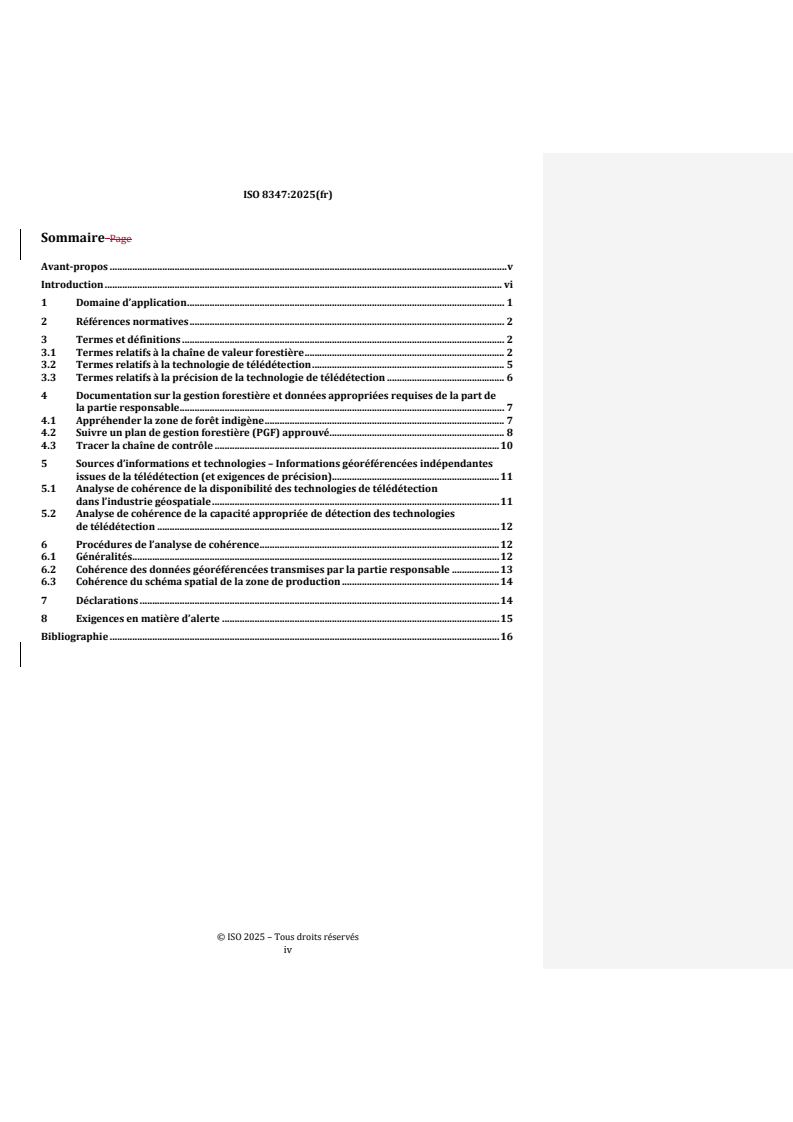
Sommaire Page
Avant-propos .iv
Introduction .v
1 Domaine d’application . 1
2 Références normatives . 2
3 Termes et définitions . 2
3.1 Termes relatifs à la chaîne de valeur forestière .2
3.2 Termes relatifs à la technologie de télédétection .5
3.3 Termes relatifs à la précision de la technologie de télédétection .6
4 Documentation sur la gestion forestière et données appropriées requises de la part de
la partie responsable . 7
4.1 Appréhender la zone de forêt indigène .7
4.1.1 Critère: capacité de production de bois .7
4.2 Suivre un plan de gestion forestière (PGF) approuvé .7
4.2.1 Principe.7
4.2.2 Critère: permis de récolte .7
4.2.3 Critère: documentation géospatiale en phase avec le plan de gestion forestière
(PGF) .8
4.2.4 Critère: documentation géospatiale en lien avec les activités réelles .9
4.3 Tracer la chaîne de contrôle .9
4.3.1 Principe.9
4.3.2 Critère: enregistrements de la chaîne de contrôle .10
5 Sources d’informations et technologies – Informations géoréférencées indépendantes
issues de la télédétection (et exigences de précision) .10
5.1 Analyse de cohérence de la disponibilité des technologies de télédétection
dans l’industrie géospatiale .10
5.1.1 Principe.10
5.1.2 Critères.10
5.2 Analyse de cohérence de la capacité appropriée de détection des technologies
de télédétection .11
5.2.1 Principe.11
5.2.2 Critères.11
6 Procédures de l’analyse de cohérence .12
6.1 Généralités . 12
6.2 Cohérence des données géoréférencées transmises par la partie responsable . 12
6.2.1 Principe. 12
6.2.2 Critères. 13
6.3 Cohérence du schéma spatial de la zone de production . 13
6.3.1 Principe. 13
6.3.2 Critères. 13
7 Déclarations . 14
8 Exigences en matière d’alerte . 14
Bibliographie .15
iii
Avant-propos
L’ISO (Organisation internationale de normalisation) est une fédération mondiale d’organismes nationaux
de normalisation (comités membres de l’ISO). L’élaboration des Normes internationales est en général
confiée aux comités techniques de l’ISO. Chaque comité membre intéressé par une étude a le droit de faire
partie du comité technique créé à cet effet. Les organisations internationales, gouvernementales et non
gouvernementales, en liaison avec l’ISO participent également aux travaux. L’ISO collabore étroitement avec
la Commission électrotechnique internationale (IEC) en ce qui concerne la normalisation électrotechnique.
Les procédures utilisées pour élaborer le présent document et celles destinées à sa mise à jour sont
décrites dans les Directives ISO/IEC, Partie 1. Il convient, en particulier, de prendre note des différents
critères d’approbation requis pour les différents types de documents ISO. Le présent document
a été rédigé conformément aux règles de rédaction données dans les Directives ISO/IEC, Partie 2
(voir www.iso.org/fr/directives-and-policies.html).
L’ISO attire l’attention sur le fait que la mise en application du présent document peut entraîner l’utilisation
d’un ou de plusieurs brevets. L’ISO ne prend pas position quant à la preuve, à la validité et à l’applicabilité
de tout droit de brevet revendiqué à cet égard. À la date de publication du présent document, l’ISO n’avait pas
reçu notification qu’un ou plusieurs brevets pouvaient être nécessaires à sa mise en application. Toutefois,
il y a lieu d’avertir les responsables de la mise en application du présent document que des informations
plus récentes sont susceptibles de figurer dans la base de données de brevets, disponible à l’adresse
www.iso.org/brevets. L’ISO ne saurait être tenue pour responsable de ne pas avoir identifié tout ou partie
de tels droits de brevet.
Les appellations commerciales éventuellement mentionnées dans le présent document sont données pour
information, par souci de commodité, à l’intention des utilisateurs et ne sauraient constituer un engagement.
Pour une explication de la nature volontaire des normes, la signification des termes et expressions
spécifiques de l’ISO liés à l’évaluation de la conformité, ou pour toute information au sujet de l’adhésion de
l’ISO aux principes de l’Organisation mondiale du commerce (OMC) concernant les obstacles techniques au
commerce (OTC), voir www.iso.org/avant-propos.
Le présent document a été élaboré par le comité technique ISO/TC 287, Méthodes contribuant au
développement durable des produits en bois et dérivés du bois.
Il convient que l’utilisateur adresse tout retour d’information ou toute question concernant le présent
document à l’organisme national de normalisation de son pays. Une liste exhaustive desdits organismes
se trouve à l’adresse www.iso.org/fr/members.html.
iv
Introduction
Le présent document est élaboré dans le contexte des défis soulevés par la commercialisation internationale
du bois tropical, tels que la déforestation de forêts tropicales indigènes par la récolte de bois illégale et
la fraude documentaire dans la chaîne de contrôle des produits en bois tropical. Le document ne vise pas
à apporter une solution complète à ces défis, mais propose plutôt une méthodologie qui peut être utilisée
pour surveiller ces défis dans des contextes spécifiques associés aux forêts tropicales indigènes. Les
données issues de la télédétection augmentent la validité du volume et des zones de récolte d’où proviennent
les produits en bois tropical, comme décrit dans le texte ci-dessous. Le présent document est axé sur la
méthodologie d’utilisation des données obtenues par télédétection et les contextes appropriés d’une telle
utilisation, et non sur l’utilisation d’une technologie de télédétection en particulier pour la collecte des
données. La traçabilité de l’origine du bois extrait par abattage sélectif des forêts indigènes dans les régions
tropicales du monde est devenue une exigence de base pour les consommateurs de ces produits en bois,
qui favorisent de plus en plus l’achat de produits issus de régions agréées et qui sont gérées et récoltées
de manière plus durable. En particulier dans des marchés tels que ceux de l’Union européenne, des États-
Unis, de l’Australie et du Japon, le manque d’informations fiables relatives aux pratiques adoptées dans la
zone d’origine de l’extraction du bois et tout au long de l’industrialisation peut entraver la commercialisation
desdits produits à base de bois.
[10]
À titre d’exemple, la demande croissante dans l’Union européenne de ces produits non issus de la
déforestation requiert des justificatifs solides prouvant que les produits proviennent d’un endroit spécifique
où la zone forestière gérée n’est pas sujette à la dégradation forestière. Le présent document traite des forêts
tropicales indigènes.
La certification de la gestion forestière et de la chaîne de contrôle des forêts tropicales indigènes repose
généralement sur un audit régulier de la documentation détaillée et sur des justificatifs collectés sur site
couvrant les différentes étapes de production, depuis la réception du bois abattu provenant de l’unité
de gestion forestière (UGF) jusqu’à la première transformation des rondins, puis l’industrialisation,
et enfin la commercialisation des produits à base de bois. Néanmoins, puisque le bois abattu dans les
forêts tropicales indigènes et commercialisé à l’international n’est pas toujours certifié, les marchés de
consommateurs peuvent potentiellement émettre des doutes sur la capacité des informations disponibles et
de la documentation de référence à garantir l’origine des produits à base de bois dans le commerce.
Les technologies de télédétection ont été souvent utilisées au cours des dernières décennies pour les
forêts tropicales indigènes afin de détecter les changements au niveau du couvert forestier et déterminer
l’étendue des modifications de l’utilisation des sols. À titre d’exemple, la télédétection par satellite intégrée
aux mécanismes d’alerte a contribué à détecter des opérations de déforestation dans les forêts tropicales
indigènes au Brésil. De la même façon, la multiplication des efforts en matière de surveillance et d’évaluation
des trouées forestières par des outils de télédétection pendant l’abattage sélectif (au cours d’une période
indiquée au préalable) suggère qu’il est possible de trouver un moyen efficace de corréler la quantité d’arbres
prélevés dans une zone d’origine déclarée avec les informations qui accompagnent le bois abattu arrivant
dans une usine en vue de sa première transformation, afin de soutenir la chaîne de contrôle des produits à
base de bois obtenus (et commercialisés dans plusieurs endroits).
L’ajout d’informations géospatiales référencées à la source du bois extrait de zones de forêts tropicales
indigènes renforce le lien entre la documentation fournie en guise de «preuve de l’origine» du bois abattu
à l’usine (début de la transformation) et la documentation accompagnant les produits à base de bois jusqu’à
la fin de la chaîne de contrôle. Des technologies de télédétection peuvent ensuite être utilisées pour analyser
les zones de gestion des forêts tropicales indigènes et vérifier la cohérence entre la quantité déclarée de
bois abattu et les données d’abattage sélectif associées (localisation géographique, dates, zones d’abattage,
trouée forestière associée aux arbres abattus ou à l’infrastructure). Le présent document a ainsi pour
objectif d’établir les lignes directrices d’une méthodologie visant à évaluer l’impact sur le couvert forestier
résultant de la mise en œuvre d’une récolte sélective dans le cadre d’un plan de gestion forestière (PGF) en
utilisant des outils de télédétection, dans une région et un délai établis au préalable. L’ampleur de l’impact
ainsi déterminé sera comparée à la documentation relative au bois abattu (officielle et géoréférencée)
fournie par l’organisme cherchant à commercialiser ses produits à base de bois, dans le but de vérifier la
cohérence entre les deux sources d’informations. Pour les différentes parties prenantes, cette méthodologie
de vérification proposée constitue un moyen indépendant de surveiller les zones d’abattage sélectif et
permet d’augmenter ainsi de manière significative la crédibilité du processus dans sa globalité. L’application
v
du présent document permettra de générer un ensemble robuste de données décrivant les emplacements
des activités de récolte de bois. Il est fortement recommandé d’utiliser cet ensemble de données pour vérifier
le potentiel chevauchement de la récolte de bois sur les zones protégées, les territoires autochtones, les
répartitions décrites des essences (ou du groupe d’essences) menacées de la Liste rouge de l’UICN et autres
couches de données spatiales pertinentes existantes, dans le but d’éviter ou d’observer les impacts sur les
zones de conservation ou les zones associées à la justice sociale. Cependant, ces analyses supplémentaires ne
sont pas obligatoires pour garantir la conformité avec le présent document.
Le présent document repose sur le recoupement des données de télédétection avec les informations
officielles, se rapportant à la planification des activités de gestion approuvées par les autorités compétentes
(plan de gestion, autorisations de récolte et/ou similaires). Les autorités compétentes disposent des
informations officielles qui précisent les opérations exécutées dans le cadre de la récolte (factures et/ou
tout autre document officiel indiquant le déplacement de rondins hors de la forêt). Toutefois, l’application
du présent document ne peut pas établir que les informations officielles présentées revêtent un haut niveau
de véracité ou de fiabilité quant à l’origine des rondins, ni que l’exploitant forestier a respecté la législation
environnementale en vigueur dans le pays.
vi
Norme internationale ISO 8347:2025(fr)
Procédures de mesure associées à la chaîne de contrôle dans
les zones de gestion des forêts tropicales indigènes
1 Domaine d’application
Le présent document établit un processus permettant de mesurer le bois abattu dans les zones de gestion
des forêts tropicales indigènes conformément à un plan documenté et approuvé. Un tel processus inclut
la quantification et la surveillance de la zone de récolte pour favoriser l’évaluation de la chaîne de contrôle
et contribuer à garantir l’origine du bois abattu. Le domaine d’application du présent document ne couvre
pas le mesurage du volume de bois.
Le présent document propose des indicateurs pouvant être utilisés pour renforcer le niveau de fiabilité
concernant l’origine exacte du bois abattu, notamment lors de l’évaluation de la documentation relative
au transport et au commerce des produits à base de bois, au moyen d’une analyse de cohérence avec les
activités observables se produisant dans la zone forestière déclarée pour indiquer l’origine du bois tropical
indigène. Les indicateurs serviront à signaler toute incohérence éventuelle détectée.
Ces indicateurs sont obtenus par des métriques normalisées. Lesdites métriques sont des modèles
mathématiques qui établissent une corrélation entre la zone de la végétation extraite, détectée grâce aux
outils de surveillance par télédétection, et le nombre d’arbres abattus qui génèrent la quantité déclarée de
bois abattu.
Le présent document est destiné à quantifier l’impact résultant de l’extraction de la végétation indigène par
l’abattage sélectif dans diverses régions tropicales du monde, de sorte à soutenir l’entretien de ces ressources
forestières sur le long terme.
La portée du présent document se limite aux forêts tropicales indigènes, à savoir les forêts créées et formées
naturellement par les essences (ou le groupe d’essences) indigènes des régions tropicales. Le présent
document ne s’applique pas aux forêts plantées, indépendamment du caractère indigène ou exotique des
essences (ou du groupe d’essences), puisque lesdites forêts sont sujettes à des pratiques de gestion différentes
et spécifiques qui dépendent des conditions géographiques et des lois du pays dans lequel elles se trouvent.
Concernant les limites du présent document, ce dernier n’a pas pour objet de garantir:
— l’origine exacte (coordonnées géographiques) de chaque rondin;
— les volumes exacts de bois extrait de la forêt;
— les essences (ou le groupe d’essences) de bois récoltées;
— la conformité avec la chaîne de contrôle;
— la conformité sociale et avec les normes de travail régissant l’opération faisant l’objet de l’audit;
— la conformité fiscale de l’opération faisant l’objet de l’audit.
Le présent document ne porte pas sur et ne s’articule pas autour des estimations de la biomasse et du
bilan carbone. Le présent document ne couvre pas les aspects de gestion forestière durable et porte
sur les procédures de mesure décrites ci-dessus. Il ne s’agit pas non plus d’une Norme de systèmes de
management (NSM).
Ne sont pas non plus répétées dans le présent document, ni les exigences réglementaires nationales, ni
les politiques internationales relatives aux aspects du développement durable ou encore celles relatives
aux communautés traditionnelles et autochtones mentionnées dans les principes/articles de la Déclaration
des Nations Unies sur les droits des peuples autochtones (UNDRIP).
2 Références normatives
Le présent document ne contient aucune référence normative.
3 Termes et définitions
Pour les besoins du présent document, les termes et définitions suivants s’appliquent.
L’ISO et l’IEC tiennent à jour des bases de données terminologiques destinées à être utilisées en normalisation,
consultables aux adresses suivantes:
— ISO Online browsing platform: disponible à l’adresse https:// www .iso .org/ obp
— IEC Electropedia: disponible à l’adresse https:// www .electropedia .org/
3.1 Termes relatifs à la chaîne de valeur forestière
3.1.1
zone de forêt indigène
zone forestière réunissant une composition d’essences (ou de groupe d’essences) d’arbres indigènes et
présentant une dynamique naturelle, une composante d’arbres morts, une structure complexe d’âge et des
processus de régénération naturels
Note 1 à l'article: Dans une zone de forêt indigène, les arbres qui se régénèrent naturellement sont censés constituer
la majeure partie du stock croissant à la maturité des peuplements. Si des portions de ces forêts sont modifiées par
l’homme et ses activités, elles sont censées se régénérer naturellement.
3.1.2
unité de gestion forestière
UGF
zone d’une forêt d’où le bois est extrait pour la production de produits à base de bois
Note 1 à l'article: Une UGF a des frontières clairement définies et peut couvrir des surfaces variées. Elle peut inclure
des sites non limitrophes.
Note 2 à l'article: Une UGF peut relever de différentes structures de propriété foncière.
Note 3 à l'article: Une UGF peut être caractérisée par des zones similaires sur le plan écologique et soumises à des
pratiques de gestion similaires (voir ISO 13391-2:2025, 4.3).
Note 4 à l'article: Les zones forestières non principalement utilisées pour la production du bois ou les surfaces en
jachère à des fins de conservation de la nature ou à d’autres fins peuvent être incluses dans l’UGF.
Note 5 à l'article: Les définitions ou pratiques nationales peuvent mener à l’inclusion de zones supplémentaires
d’approvisionnement en bois, faisant par exemple l’objet de pratiques d’agroforesterie ou de plantation d’arbres.
Note 6 à l'article: Les termes «propriété foncière» et «surfaces en jachère» sont définis dans l’ISO 13391-2:2025, 3.3
et 3.1.
[SOURCE: ISO 13391-1:2025, 3.20]
3.1.3
plan de gestion forestière
PGF
document traduisant les politiques forestières en programme coordonné d’unité de gestion forestière (3.1.2)
visant à réguler les activités productives, environnementales et sociales pour une période donnée grâce
à l’utilisation de prescriptions, de cibles et de dispositifs d’action et de contrôle
Note 1 à l'article: Dans le présent document, PGF désigne un ensemble de documents contenant les données requises
pour mettre en œuvre la méthodologie décrite dans le présent document.
Note 2 à l'article: Le nom du PGF varie d’une région à l’autre.
EXEMPLE PGF des forêts tropicales indigènes (Brésil).
[9]
[SOURCE: FAO Terminology Portal ]
3.1.4
zone de production
périmètre géographique de la parcelle d’une unité de gestion forestière (3.1.2) indigène dans lequel la récolte
est autorisée pendant une durée prédéterminée, symbolisé par un polygone désignant la zone de récolte
où une analyse de cohérence est effectuée
Note 1 à l'article: L’analyse de cohérence est expliquée à l’Article 5.
3.1.5
permis de récolte
permis d’abattage
documentation émise par les autorités en vigueur spécifiant le niveau de récolte autorisée dans le périmètre
géographique d’une zone de production (3.1.4) spécifiée sur une durée donnée (définie par les dates de
délivrance et d’expiration)
Note 1 à l'article: Les matériaux récoltés peuvent être identifiés selon leur essence (ou groupe d’essences) et le niveau
de récolte autorisée peut être spécifié par un indicateur chiffré approprié au contexte de la récolte (par exemple,
volume total éliminé, nombre d’arbres éliminés, surface terrière résiduelle).
3.1.6
desserte forestière
route principale et place de dépôt desservant l’unité de gestion forestière (3.1.2) et ses parcelles [zones de
production (3.1.4)], et permettant d’acheminer et de stocker le bois abattu avant son transport vers les usines
Note 1 à l'article: Une desserte forestière est également utile à de nombreuses activités de gestion forestière.
3.1.7
infrastructure de récolte de bois
route secondaire et place de dépôt au sein d’une zone de production (3.1.4) associés directement et
spécifiquement aux activités de récolte de bois (3.1.8)
Note 1 à l'article: Les données enregistrées par les technologies de télédétection indiquent généralement le sol exposé
comme une zone dont le couvert forestier a été éliminé. Toutefois, contrairement à une coupe rase, ces modifications
sont clairement associées, sur une base temporelle et géographique, pour distinguer les moments avant et après
les activités d’abattage (3.1.8) et de gestion forestière.
3.1.8
récolte de bois
abattage
ensemble d’opérations successives permettant de transformer des arbres sur pied en produits souhaités
pour une transformation ultérieure dans des installations de fabrication
Note 1 à l'article: On appelle «transport» les opérations consistant à déplacer le bois abattu à l’extérieur de la zone de
production (3.1.4) et au-delà.
[SOURCE: ISO 8965:2022, 3.1.1, modifié — La Note 1 à l’article a été remplacée.]
3.1.9
abattage sélectif
extraction d’un petit nombre d’arbres appartenant à une ou quelques essences (ou à un groupe d’essences)
Note 1 à l'article: L’abattage sélectif peut préserver la structure existante de la canopée, la structure d’âge et la
diversité des essences (du groupe d’essences) de la zone de récolte sans modifier le fonctionnement écologique des
habitats et sans empêcher la régénération naturelle de la forêt à son état d’avant exploitation.
3.1.10
trouée d’abattage
réduction progressive du couvert végétal en lien direct avec les arbres individuellement abattus
Note 1 à l'article: Lorsque des modifications sont évaluées grâce aux données de télédétection (3.2.1), des erreurs de
classification sont possibles lorsque des changements naturels, comme la chute des feuilles en automne ou la mort
naturelle d’un arbre, sont confondus avec l’abattage (3.1.8).
3.1.11
cycle de récolte
intervalle de temps, généralement exprimé en années, entre les récoltes successives de bois dans une même
zone de production (3.1.4)
Note 1 à l'article: La durée de ce cycle définit l’intensité d’exploitation (3.1.12) autorisée et le volume de coupe annuelle
admissible qui en découle.
3.1.12
intensité d’exploitation
quantité d’essences (ou de groupe d’essences) d’arbres destinées au commerce, exprimée en arbres par
hectare, pouvant être abattus dans la zone de production (3.1.4)
Note 1 à l'article: Sa valeur est estimée sur la base d’équations volumétriques spécifiées dans le plan de gestion
forestière (PGF) (3.1.3) et en tenant compte de l’inventaire global de la forêt.
Note 2 à l'article: 1 hectare équivaut à 10 000 m .
3.1.13
zone surexploitée
zone de récolte dans laquelle l’intensité d’exploitation (3.1.12) estimée par l’analyse de
cohérence reposant sur la télédétection est supérieure à l’intensité d’exploitation spécifiée dans le plan de
gestion forestière (PGF) (3.1.3) ou déclarée par la partie responsable (3.1.17) (s’inscrivant dans un niveau de
tolérance sous forme de «pourcentage convenu»)
3.1.14
zone sous-exploitée
zone de récolte dans laquelle l’intensité d’exploitation (3.1.12) estimée par l’analyse de
cohérence reposant sur la télédétection est inférieure à l’intensité d’exploitation spécifiée dans le plan de
gestion forestière (PGF) (3.1.3) ou déclarée par la partie responsable (3.1.17) (s’inscrivant dans un niveau de
tolérance sous forme de «pourcentage convenu»)
3.1.15
chaîne de contrôle
processus par lequel des informations liées aux matériaux sont transmises, suivies et contrôlées tout au long
de la chaîne d’approvisionnement ou sur certaines parties de celle-ci
[SOURCE: ISO 38200:2018, 3.1]
3.1.16
origine
zone d’origine
nom géographique d’un pays, d’une région ou d’un lieu spécifique qui sert à désigner un produit qui en
provient, dont les qualités caractéristiques sont dues exclusivement ou essentiellement à l’environnement
géographique, incluant les facteurs naturels et humains
Note 1 à l'article: Aux fins du présent document, l’échelle de la zone d’origine est considérée comme l’unité de gestion
forestière (3.1.2), qui peut couvrir des surfaces variées.
[9]
[SOURCE: FAO Terminology Portal ]
3.1.17
partie responsable
organisme (3.2.5) qui fournit les informations nécessaires en lien avec les activités de gestion forestière et
d’abattage (3.1.8) et un processus de chaîne de contrôle (3.1.15) des produits faisant l’objet d’une analyse de
cohérence conformément au présent document
Note 1 à l'article: Ce type d’organisme inclut, sans toutefois s’y limiter, les entreprises de gestion forestière et
d’abattage, les usines et autres entreprises de transformation de bois abattu, les entreprises d’industrialisation du
bois et les entreprises de négoce ou de commercialisation de produits.
3.2 Termes relatifs à la technologie de télédétection
3.2.1
données de télédétection
ensemble d’informations géoréférencées en lien avec une zone donnée, collectées ou traitées, ou collectées
et traitées à distance
Note 1 à l'article: La définition fait référence à la fois aux données brutes collectées et aux données post-traitées.
3.2.2
technologie de télédétection
ensemble de procédures définies pour la collecte, le prétraitement et l’analyse de données de télédétection
(3.2.1), qui utilisent un ou plusieurs types de données pour obtenir un ensemble de résultats liés à une zone
et à une période spécifiques, et dont les attributs de précision planimétrique (3.3.1), temporelle (3.3.2) et
thématique (3.3.3) ont fait l’objet d’une revue par des pairs
3.2.3
résolution spatiale
niveau de détail ou de granularité auquel un système de télédétection ou un produit de télédétection, ou les
deux, détectent et enregistrent des objets ou des caractéristiques distincts sur la surface de la Terre
Note 1 à l'article: La résolution spatiale est une caractéristique fondamentale qui détermine la taille du plus petit
élément distinguable dans une image acquise par un instrument de télédétection, et/ou après un traitement adéquat
pour améliorer la résolution spatiale de l’instrumen
...
ISO/TC 287
Date: ISO 2025-12
ISO/TC 287
Secrétariat: ISO
Première édition
2025-12
Date: 2026-02-02
Procédures de mesure associées à la chaîne de contrôle dans les
zones de gestion des forêts tropicales indigènes
Measurement procedures associated with the chain of custody in native tropical forest management areas
Type du document: Norme internationale
Sous-type du document:
Stade du document: (60) Publication
Langue du document: F
ICS: 65.020.01
NORME INTERNATIONALE ISO 8347:2025(fr)
DOCUMENT PROTÉGÉ PAR COPYRIGHT
Droits de reproductionTous droits réservés. Sauf prescription différente ou nécessité dans le contexte de sa mise
en œuvre oeuvre, aucune partie de cette publication ne peut être reproduite ni utilisée sous quelque forme que ce soit et
par aucun procédé, électronique ou mécanique, y compris la photocopie, ou la diffusion sur l’internet ou sur un
Intranetintranet, sans autorisation écrite préalable. Une autorisation peut être demandée à l’ISO à l’adresse ci--après ou
au comité membre de l’ISO dans le pays du demandeur.
ISO copyright office
Case postaleCP 401 • • Ch. de Blandonnet 8
CH--1214 Vernier, GenèveGeneva
Tél.: Phone: + 41 22 749 01 11
E-mail: copyright@iso.org
WebWebsite: www.iso.org
Publié en Suisse
Sommaire Page
Avant-propos . v
Introduction . vi
1 Domaine d’application . 1
2 Références normatives . 2
3 Termes et définitions . 2
3.1 Termes relatifs à la chaîne de valeur forestière . 2
3.2 Termes relatifs à la technologie de télédétection . 5
3.3 Termes relatifs à la précision de la technologie de télédétection . 6
4 Documentation sur la gestion forestière et données appropriées requises de la part de
la partie responsable . 7
4.1 Appréhender la zone de forêt indigène . 7
4.2 Suivre un plan de gestion forestière (PGF) approuvé . 8
4.3 Tracer la chaîne de contrôle . 10
5 Sources d’informations et technologies – Informations géoréférencées indépendantes
issues de la télédétection (et exigences de précision). 11
5.1 Analyse de cohérence de la disponibilité des technologies de télédétection
dans l’industrie géospatiale . 11
5.2 Analyse de cohérence de la capacité appropriée de détection des technologies
de télédétection . 12
6 Procédures de l’analyse de cohérence . 12
6.1 Généralités . 12
6.2 Cohérence des données géoréférencées transmises par la partie responsable . 13
6.3 Cohérence du schéma spatial de la zone de production . 14
7 Déclarations . 14
8 Exigences en matière d’alerte . 15
Bibliographie . 16
iv
Avant-propos
L’ISO (Organisation internationale de normalisation) est une fédération mondiale d’organismes nationaux de
normalisation (comités membres de l’ISO). L’élaboration des Normes internationales est en général confiée
aux comités techniques de l’ISO. Chaque comité membre intéressé par une étude a le droit de faire partie du
comité technique créé à cet effet. Les organisations internationales, gouvernementales et non
gouvernementales, en liaison avec l’ISO participent également aux travaux. L’ISO collabore étroitement avec
la Commission électrotechnique internationale (IEC) en ce qui concerne la normalisation électrotechnique.
Les procédures utilisées pour élaborer le présent document et celles destinées à sa mise à jour sont décrites
dans les Directives ISO/IEC, Partie 1. Il convient, en particulier, de prendre note des différents critères
d’approbation requis pour les différents types de documents ISO. Le présent document a été rédigé
conformément aux règles de rédaction données dans les Directives ISO/IEC, Partie 2
(voir www.iso.org/fr/directives-and-policies.html).
L’ISO attire l’attention sur le fait que la mise en application du présent document peut entraîner l’utilisation
d’un ou de plusieurs brevets. L’ISO ne prend pas position quant à la preuve, à la validité et à l’applicabilité
de tout droit de brevet revendiqué à cet égard. À la date de publication du présent document, l’ISO n’avait pas
reçu notification qu’un ou plusieurs brevets pouvaient être nécessaires à sa mise en application. Toutefois,
il y a lieu d’avertir les responsables de la mise en application du présent document que des informations plus
récentes sont susceptibles de figurer dans la base de données de brevets, disponible à l’adresse
www.iso.org/brevets. L’ISO ne saurait être tenue pour responsable de ne pas avoir identifié tout ou partie
de tels droits de brevet.
Les appellations commerciales éventuellement mentionnées dans le présent document sont données pour
information, par souci de commodité, à l’intention des utilisateurs et ne sauraient constituer un engagement.
Pour une explication de la nature volontaire des normes, la signification des termes et expressions spécifiques
de l’ISO liés à l’évaluation de la conformité, ou pour toute information au sujet de l’adhésion de l’ISO aux
principes de l’Organisation mondiale du commerce (OMC) concernant les obstacles techniques au commerce
(OTC), voir www.iso.org/avant-propos.
Le présent document a été élaboré par le comité technique ISO/TC 287, Méthodes contribuant au
développement durable des produits en bois et dérivés du bois.
Il convient que l’utilisateur adresse tout retour d’information ou toute question concernant le présent
document à l’organisme national de normalisation de son pays. Une liste exhaustive desdits organismes
se trouve à l’adresse www.iso.org/fr/members.html.
v
Introduction
Le présent document est élaboré dans le contexte des défis soulevés par la commercialisation internationale
du bois tropical, tels que la déforestation de forêts tropicales indigènes par la récolte de bois illégale et
la fraude documentaire dans la chaîne de contrôle des produits en bois tropical. Le document ne vise pas
à apporter une solution complète à ces défis, mais propose plutôt une méthodologie qui peut être utilisée pour
surveiller ces défis dans des contextes spécifiques associés aux forêts tropicales indigènes. Les données issues
de la télédétection augmentent la validité du volume et des zones de récolte d’où proviennent les produits
en bois tropical, comme décrit dans le texte ci-dessous. Le présent document est axé sur la méthodologie
d’utilisation des données obtenues par télédétection et les contextes appropriés d’une telle utilisation, et non
sur l’utilisation d’une technologie de télédétection en particulier pour la collecte des données. La traçabilité
de l’origine du bois extrait par abattage sélectif des forêts indigènes dans les régions tropicales du monde est
devenue une exigence de base pour les consommateurs de ces produits en bois, qui favorisent de plus en plus
l’achat de produits issus de régions agréées et qui sont gérées et récoltées de manière plus durable. En
particulier dans des marchés tels que ceux de l’Union européenne, des États-Unis, de l’Australie et du Japon,
le manque d’informations fiables relatives aux pratiques adoptées dans la zone d’origine de l’extraction du
bois et tout au long de l’industrialisation peut entraver la commercialisation desdits produits à base de bois.
[10]]
À titre d’exemple, la demande croissante dans l’Union européenne de ces produits non issus de la
déforestation requiert des justificatifs solides prouvant que les produits proviennent d’un endroit spécifique
où la zone forestière gérée n’est pas sujette à la dégradation forestière. Le présent document traite des forêts
tropicales indigènes.
La certification de la gestion forestière et de la chaîne de contrôle des forêts tropicales indigènes repose
généralement sur un audit régulier de la documentation détaillée et sur des justificatifs collectés sur site
couvrant les différentes étapes de production, depuis la réception du bois abattu provenant de l’unité de
gestion forestière (UGF) jusqu’à la première transformation des rondins, puis l’industrialisation, et enfin
la commercialisation des produits à base de bois. Néanmoins, puisque le bois abattu dans les forêts tropicales
indigènes et commercialisé à l’international n’est pas toujours certifié, les marchés de consommateurs
peuvent potentiellement émettre des doutes sur la capacité des informations disponibles et de la
documentation de référence à garantir l’origine des produits à base de bois dans le commerce.
Les technologies de télédétection ont été souvent utilisées au cours des dernières décennies pour les forêts
tropicales indigènes afin de détecter les changements au niveau du couvert forestier et déterminer l’étendue
des modifications de l’utilisation des sols. À titre d’exemple, la télédétection par satellite intégrée aux
mécanismes d’alerte a contribué à détecter des opérations de déforestation dans les forêts tropicales
indigènes au Brésil. De la même façon, la multiplication des efforts en matière de surveillance et d’évaluation
des trouées forestières par des outils de télédétection pendant l’abattage sélectif (au cours d’une période
indiquée au préalable) suggère qu’il est possible de trouver un moyen efficace de corréler la quantité d’arbres
prélevés dans une zone d’origine déclarée avec les informations qui accompagnent le bois abattu arrivant dans
une usine en vue de sa première transformation, afin de soutenir la chaîne de contrôle des produits à base de
bois obtenus (et commercialisés dans plusieurs endroits).
L’ajout d’informations géospatiales référencées à la source du bois extrait de zones de forêts tropicales
indigènes renforce le lien entre la documentation fournie en guise de «preuve de l’origine» du bois abattu
à l’usine (début de la transformation) et la documentation accompagnant les produits à base de bois jusqu’à
la fin de la chaîne de contrôle. Des technologies de télédétection peuvent ensuite être utilisées pour analyser
les zones de gestion des forêts tropicales indigènes et vérifier la cohérence entre la quantité déclarée de bois
abattu et les données d’abattage sélectif associées (localisation géographique, dates, zones d’abattage,
trouée forestière associée aux arbres abattus ou à l’infrastructure). Le présent document a ainsi pour objectif
d’établir les lignes directrices d’une méthodologie visant à évaluer l’impact sur le couvert forestier résultant
de la mise en œuvre d’une récolte sélective dans le cadre d’un plan de gestion forestière (PGF) en utilisant des
outils de télédétection, dans une région et un délai établis au préalable. L’ampleur de l’impact ainsi déterminé
sera comparée à la documentation relative au bois abattu (officielle et géoréférencée) fournie par l’organisme
vi
cherchant à commercialiser ses produits à base de bois, dans le but de vérifier la cohérence entre les deux
sources d’informations. Pour les différentes parties prenantes, cette méthodologie de vérification proposée
constitue un moyen indépendant de surveiller les zones d’abattage sélectif et permet d’augmenter ainsi de
manière significative la crédibilité du processus dans sa globalité. L’application du présent document
permettra de générer un ensemble robuste de données décrivant les emplacements des activités de récolte de
bois. Il est fortement recommandé d’utiliser cet ensemble de données pour vérifier le potentiel
chevauchement de la récolte de bois sur les zones protégées, les territoires autochtones, les répartitions
décrites des essences (ou du groupe d’essences) menacées de la Liste rouge de l’UICN et autres couches de
données spatiales pertinentes existantes, dans le but d’éviter ou d’observer les impacts sur les zones de
conservation ou les zones associées à la justice sociale. Cependant, ces analyses supplémentaires ne sont pas
obligatoires pour garantir la conformité avec le présent document.
Le présent document repose sur le recoupement des données de télédétection avec les informations officielles,
se rapportant à la planification des activités de gestion approuvées par les autorités compétentes (plan de
gestion, autorisations de récolte et/ou similaires). Les autorités compétentes disposent des informations
officielles qui précisent les opérations exécutées dans le cadre de la récolte (factures et/ou tout autre
document officiel indiquant le déplacement de rondins hors de la forêt). Toutefois, l’application du présent
document ne peut pas établir que les informations officielles présentées revêtent un haut niveau de véracité
ou de fiabilité quant à l’origine des rondins, ni que l’exploitant forestier a respecté la législation
environnementale en vigueur dans le pays.
vii
Procédures de mesure associées à la chaîne de contrôle dans les zones
de gestion des forêts tropicales indigènes
1 Domaine d’application
Le présent document établit un processus permettant de mesurer le bois abattu dans les zones de gestion
des forêts tropicales indigènes conformément à un plan documenté et approuvé. Un tel processus inclut
la quantification et la surveillance de la zone de récolte pour favoriser l’évaluation de la chaîne de contrôle
et contribuer à garantir l’origine du bois abattu. Le domaine d’application du présent document ne couvre pas
le mesurage du volume de bois.
Le présent document propose des indicateurs pouvant être utilisés pour renforcer le niveau de fiabilité
concernant l’origine exacte du bois abattu, notamment lors de l’évaluation de la documentation relative au
transport et au commerce des produits à base de bois, au moyen d’une analyse de cohérence avec les activités
observables se produisant dans la zone forestière déclarée pour indiquer l’origine du bois tropical indigène.
Les indicateurs serviront à signaler toute incohérence éventuelle détectée.
Ces indicateurs sont obtenus par des métriques normalisées. Lesdites métriques sont des modèles
mathématiques qui établissent une corrélation entre la zone de la végétation extraite, détectée grâce aux outils
de surveillance par télédétection, et le nombre d’arbres abattus qui génèrent la quantité déclarée de bois
abattu.
Le présent document est destiné à quantifier l’impact résultant de l’extraction de la végétation indigène par
l’abattage sélectif dans diverses régions tropicales du monde, de sorte à soutenir l’entretien sur le long terme
de ces ressources forestières sur le long terme.
La portée du présent document se limite aux forêts tropicales indigènes, à savoir les forêts créées et formées
naturellement par les essences (ou le groupe d’essences) indigènes des régions tropicales. Le présent
document ne s’applique pas aux forêts plantées, indépendamment du caractère indigène ou exotique des
essences (ou du groupe d’essences), puisque lesdites forêts sont sujettes à des pratiques de gestion différentes
et spécifiques qui dépendent des conditions géographiques et des lois du pays dans lequel elles se trouvent.
Concernant les limites du présent document, ce dernier n’a pas pour objet de garantir:
— l’origine exacte (coordonnées géographiques) de chaque rondin;
— les volumes exacts de bois extrait de la forêt;
— les essences (ou le groupe d’essences) de bois récoltées;
— la conformité avec la chaîne de contrôle;
— la conformité sociale et avec les normes de travail régissant l’opération faisant l’objet de l’audit;
— la conformité fiscale de l’opération faisant l’objet de l’audit.
Le présent document ne porte pas sur et ne s’articule pas autour des estimations de la biomasse et du bilan
carbone. Le présent document ne couvre pas les aspects de gestion forestière durable et porte sur les
procédures de mesure décrites ci-dessus. Il ne s’agit pas non plus d’une Norme de systèmes de
management (NSM).
Ne sont pas non plus répétées dans le présent document, ni les exigences réglementaires nationales, ni
les politiques internationales relatives aux aspects du développement durable ou encore celles relatives
aux communautés traditionnelles et autochtones mentionnées dans les principes/articles de la Déclaration
des Nations Unies sur les droits des peuples autochtones (UNDRIP).
2 Références normatives
Le présent document ne contient aucune référence normative.
3 Termes et définitions
Pour les besoins du présent document, les termes et définitions suivants s’appliquent.
L’ISO et l’IEC tiennent à jour des bases de données terminologiques destinées à être utilisées en normalisation,
consultables aux adresses suivantes:
— ISO Online browsing platform: disponible à l’adresse https://www.iso.org/obp
Field Code Changed
— IEC Electropedia: disponible à l’adresse https://www.electropedia.org/
3.1 Termes relatifs à la chaîne de valeur forestière
3.1.1
zone de forêt indigène
zone forestière réunissant une composition d’essences (ou de groupe d’essences) d’arbres indigènes et
présentant une dynamique naturelle, une composante d’arbres morts, une structure complexe d’âge et des
processus de régénération naturels
Note 1 à l’article: à l'article: Dans une zone de forêt indigène, les arbres qui se régénèrent naturellement
sont censés constituer la majeure partie du stock croissant à la maturité des peuplements. Si des portions de ces forêts
sont modifiées par l’homme et ses activités, elles sont censées se régénérer naturellement.
3.1.2
unité de gestion forestière
UGF
zone d’une forêt d’où le bois est extrait pour la production de produits à base de bois
Note 1 à l’article: l'article: Une UGF a des frontières clairement définies et peut couvrir des surfaces
variées. Elle peut inclure des sites non limitrophes.
Note 2 à l’article: l'article: Une UGF peut relever de différentes structures de propriété foncière.
Note 3 à l’article: l'article: Une UGF peut être caractérisée par des zones similaires sur le plan écologique
et soumises à des pratiques de gestion similaires (voir ISO 13391-2:2025, 4.3).
Note 4 à l’article: l'article: Les zones forestières non principalement utilisées pour la production du bois
ou les surfaces en jachère à des fins de conservation de la nature ou à d’autres fins peuvent être incluses dans l’UGF.
Note 5 à l’article: l'article: Les définitions ou pratiques nationales peuvent mener à l’inclusion de zones
supplémentaires d’approvisionnement en bois, faisant par exemple l’objet de pratiques d’agroforesterie ou de plantation
d’arbres.
Note 6 à l’article: l'article: Les termes «propriété foncière» et «surfaces en jachère» sont définis dans
l’ISO 13391-2:2025, 3.3 et 3.1.
[SOURCE: ISO 13391--1:2025, 3.20]
3.1.3
plan de gestion forestière
PGF
document traduisant les politiques forestières en programme coordonné d’unité de gestion forestière (3.1.2))
visant à réguler les activités productives, environnementales et sociales pour une période donnée grâce
à l’utilisation de prescriptions, de cibles et de dispositifs d’action et de contrôle
Note 1 à l’article: l'article: Dans le présent document, PGF désigne un ensemble de documents contenant
les données requises pour mettre en œuvre la méthodologie décrite dans le présent document.
Note 2 à l’article: l'article: Le nom du PGF varie d’une région à l’autre.
EXEMPLE PGF des forêts tropicales indigènes (Brésil).
[9] ]
[SOURCE: FAO Terminology Portal ] ]
3.1.4
zone de production
périmètre géographique de la parcelle d’une unité de gestion forestière (3.1.2)) indigène dans lequel la récolte
est autorisée pendant une durée prédéterminée, symbolisé par un polygone désignant la zone de récolte
où une analyse de cohérence est effectuée
Note 1 à l’article: l'article: L’analyse de cohérence est expliquée à l’Article 5s.
3.1.5
permis de récolte
permis d’abattage
documentation émise par les autorités en vigueur spécifiant le niveau de récolte autorisée dans le périmètre
géographique d’une zone de production (3.1.4)) spécifiée sur une durée donnée (définie par les dates de
délivrance et d’expiration)
Note 1 à l’article: l'article: Les matériaux récoltés peuvent être identifiés selon leur essence (ou groupe
d’essences) et le niveau de récolte autorisée peut être spécifié par un indicateur chiffré approprié au contexte de la récolte
(par exemple, volume total éliminé, nombre d’arbres éliminés, surface terrière résiduelle).
3.1.53.1.6
desserte forestière
route principale et place de dépôt desservant l’unité de gestion forestière (3.1.2)) et ses parcelles [zones de
production (3.1.4)],)], et permettant d’acheminer et de stocker le bois abattu avant son transport vers les
usines
Note 1 à l’article: à l'article: Une desserte forestière est également utile à de nombreuses activités de
gestion forestière.
3.1.63.1.7
infrastructure de récolte de bois
route secondaire et place de dépôt au sein d’une zone de production (3.1.4)) associés directement et
spécifiquement aux activités de récolte de bois (3.1.8))
Note 1 à l’article: l'article: Les données enregistrées par les technologies de télédétection indiquent
généralement le sol exposé comme une zone dont le couvert forestier a été éliminé. Toutefois, contrairement à une coupe
rase, ces modifications sont clairement associées, sur une base temporelle et géographique, pour distinguer les moments
avant et après les activités d’abattage (3.1.8)) et de gestion forestière.
3.1.73.1.8
récolte de bois
abattage
ensemble d’opérations successives permettant de transformer des arbres sur pied en produits souhaités pour
une transformation ultérieure dans des installations de fabrication
Note 1 à l’article: l'article: On appelle «transport» les opérations consistant à déplacer le bois abattu à
l’extérieur de la zone de production (3.1.4)) et au-delà.
[SOURCE: ISO 8965:2022, 3.1.1, modifié — La Note 1 à l’article a été remplacée.]
3.1.83.1.9
abattage sélectif
extraction d’un petit nombre d’arbres appartenant à une ou quelques essences (ou à un groupe d’essences)
Note 1 à l’article: à l'article: L’abattage sélectif peut préserver la structure existante de la canopée, la
structure d’âge et la diversité des essences (du groupe d’essences) de la zone de récolte sans modifier le fonctionnement
écologique des habitats et sans empêcher la régénération naturelle de la forêt à son état d’avant exploitation.
3.1.93.1.10
trouée d’abattage
réduction progressive du couvert végétal en lien direct avec les arbres individuellement abattus
Note 1 à l’article: l'article: Lorsque des modifications sont évaluées grâce aux données de télédétection
(3.2.1),), des erreurs de classification sont possibles lorsque des changements naturels, comme la chute des feuilles en
automne ou la mort naturelle d’un arbre, sont confondus avec l’abattage (3.1.8).).
3.1.103.1.11
cycle de récolte
intervalle de temps, généralement exprimé en années, entre les récoltes successives de bois dans une même
zone de production (3.1.4))
Note 1 à l’article: l'article: La durée de ce cycle définit l’intensité d’exploitation (3.1.12)) autorisée et le
volume de coupe annuelle admissible qui en découle.
3.1.113.1.12
intensité d’exploitation
quantité d’essences (ou de groupe d’essences) d’arbres destinées au commerce, exprimée en arbres par
hectare, pouvant être abattus dans la zone de production (3.1.4))
Note 1 à l’article: l'article: Sa valeur est estimée sur la base d’équations volumétriques spécifiées dans le
plan de gestion forestière (PGF) (3.1.3)) et en tenant compte de l’inventaire global de la forêt.
Note 2 à l’article: l'article: 1 hectare équivaut à 10 000 m .
3.1.123.1.13
zone surexploitée
zone de récolte dans laquelle l’intensité d’exploitation (3.1.12)) estimée par l’analyse de
cohérence reposant sur la télédétection est supérieure à l’intensité d’exploitation spécifiée dans le plan de
gestion forestière (PGF) (3.1.3)) ou déclarée par la partie responsable (3.1.17)) (s’inscrivant dans un niveau de
tolérance sous forme de «pourcentage convenu»)
3.1.133.1.14
zone sous-exploitée
zone de récolte dans laquelle l’intensité d’exploitation (3.1.12)) estimée par l’analyse de
cohérence reposant sur la télédétection est inférieure à l’intensité d’exploitation spécifiée dans le plan de
gestion forestière (PGF) (3.1.3)) ou déclarée par la partie responsable (3.1.17)) (s’inscrivant dans un niveau de
tolérance sous forme de «pourcentage convenu»)
3.1.143.1.15
chaîne de contrôle
processus par lequel des informations liées aux matériaux sont transmises, suivies et contrôlées tout au long
de la chaîne d’approvisionnement ou sur certaines parties de celle-ci
[SOURCE: ISO 38200:2018, 3.1]
3.1.153.1.16
origine
zone d’origine
nom géographique d’un pays, d’une région ou d’un lieu spécifique qui sert à désigner un produit qui en
provient, dont les qualités caractéristiques sont dues exclusivement ou essentiellement à l’environnement
géographique, incluant les facteurs naturels et humains
Note 1 à l’article: à l'article: Aux fins du présent document, l’échelle de la zone d’origine est considérée
comme l’unité de gestion forestière (3.1.2),), qui peut couvrir des surfaces variées.
[9[9] ]
[SOURCE: FAO Terminology Portal ] ]
3.1.163.1.17
partie responsable
organisme (3.2.5)) qui fournit les informations nécessaires en lien avec les activités de gestion forestière et
d’abattage (3.1.8)) et un processus de chaîne de contrôle (3.1.15)) des produits faisant l’objet d’une analyse de
cohérence conformément au présent document
Note 1 à l’article: l'article: Ce type d’organisme inclut, sans toutefois s’y limiter, les entreprises de gestion
forestière et d’abattage, les usines et autres entreprises de transformation de bois abattu, les entreprises
d’industrialisation du bois et les entreprises de négoce ou de commercialisation de produits.
3.2 Termes relatifs à la technologie de télédétection
3.2.1
données de télédétection
ensemble d’informations géoréférencées en lien avec une zone donnée, collectées ou traitées, ou collectées
et traitées à distance
Note 1 à l’article: à l'article: La définition fait référence à la fois aux données brutes collectées et aux
données post-traitées.
3.2.2
technologie de télédétection
ensemble de procédures définies pour la collecte, le prétraitement et l’analyse de données de télédétection
(3.2.1),), qui utilisent un ou plusieurs types de données pour obtenir un ensemble de résultats liés à une zone
et à une période spécifiques, et dont les attributs de précision planimétrique (3.3.1),), temporelle (3.3.2)) et
thématique (3.3.3)) ont fait l’objet d’une revue par des pairs
3.2.3
résolution spatiale
niveau de détail ou de granularité auquel un système de télédétection ou un produit de télédétection, ou les
deux, détectent et enregistrent des objets ou des caractéristiques distincts sur la surface de la Terre
Note 1 à l’article: à l'article: La résolution spatiale est une caractéristique fondamentale qui détermine la
taille du plus petit élément distinguable dans une image acquise par un instrument de télédétection, et/ou après un
traitement adéquat pour améliorer la résolution spatiale de l’instrument.
3.2.4
résolution temporelle
mesure de l’intervalle de temps le plus faible entre les acquisitions des données de télédétection (3.2.1))
3.2.5
organisme
personne ou groupe de personnes ayant un rôle avec les responsabilités, l’autorité et les relations lui
permettant d’atteindre ses objectifs
Note 1 à l’article: l'article: Le concept d’organisme englobe sans s’y limiter, les travailleurs indépendants,
les compagnies, les sociétés, les firmes, les entreprises, les administrations, les partenariats, les associations, les
organisations caritatives ou les institutions, ou bien une partie ou une combinaison des entités précédentes, à
responsabilité limitée ou ayant un autre statut, de droit public ou privé.
Note 2 à l’article: l'article: Il s’agit de l’un des termes communs et définitions de base pour les normes de
systèmes de management de l’ISO, donnés dans l’Annexe SL du Supplément ISO consolidé aux Directives ISO/IEC,
Partie 1. La définition initiale a fait l’objet d’une modification de la Note 1 à l’article.
[SOURCE: ISO 9000:2015, 3.2.1]
3.2.6
entité de vérification
organisme (3.2.5)) qui réalise l’analyse de cohérence reposant sur la télédétection conformément à la
méthodologie indiquée dans le présent document
Note 1 à l’article: à l'article: Ce type d’organisme inclut, sans toutefois s’y limiter, les entreprises
d’évaluation du devoir de vigilance, les organismes gouvernementaux, les organes de la société civile, les chercheurs ou
les particuliers (à titre de consommateurs), et, dans certains cas, la partie responsable (3.1.17)) elle-même.
3.3 Termes relatifs à la précision
...