


ISO 19135:2005
(Main)Geographic information — Procedures for item registration
Geographic information — Procedures for item registration
ISO 19135:2005 specifies procedures to be followed in establishing, maintaining and publishing registers of unique, unambiguous and permanent identifiers, and meanings that are assigned to items of geographic information. In order to accomplish this purpose, ISO 19135:2005 specifies elements of information that are necessary to provide identification and meaning to the registered items and to manage the registration of these items.
Information géographique — Procédures pour l'enregistrement d'éléments
L'ISO 19135:2005 spécifie les procédures à suivre pour établir, mettre à jour et publier les registres des identifiants uniques, non ambigus et permanents et des significations qui sont attribués aux items de l'information géographique. Afin d'atteindre cet objectif, la présente Norme internationale spécifie les éléments d'information qui sont nécessaires pour conférer l'identification et la signification aux items enregistrés et pour gérer l'enregistrement de ces items.
Geografske informacije - Postopki za registracijo prostorskih postavk
General Information
- Status
- Withdrawn
- Publication Date
- 13-Oct-2005
- Technical Committee
- ISO/TC 211 - Geographic information/Geomatics
- Drafting Committee
- ISO/TC 211/WG 9 - Information management
- Current Stage
- 9599 - Withdrawal of International Standard
- Start Date
- 20-Sep-2023
- Completion Date
- 12-Feb-2026
Relations
- Revised
ISO 19135-1:2015 - Geographic information — Procedures for item registration — Part 1: Fundamentals - Effective Date
- 27-Jun-2009
ISO 19135:2005 - Geographic information -- Procedures for item registration
ISO 19135:2005 - Information géographique -- Procédures pour l'enregistrement d'éléments


ISO 19135:2006
Get Certified
Connect with accredited certification bodies for this standard

BSI Group
BSI (British Standards Institution) is the business standards company that helps organizations make excellence a habit.

NYCE
Mexican standards and certification body.
Sponsored listings
Frequently Asked Questions
ISO 19135:2005 is a standard published by the International Organization for Standardization (ISO). Its full title is "Geographic information — Procedures for item registration". This standard covers: ISO 19135:2005 specifies procedures to be followed in establishing, maintaining and publishing registers of unique, unambiguous and permanent identifiers, and meanings that are assigned to items of geographic information. In order to accomplish this purpose, ISO 19135:2005 specifies elements of information that are necessary to provide identification and meaning to the registered items and to manage the registration of these items.
ISO 19135:2005 specifies procedures to be followed in establishing, maintaining and publishing registers of unique, unambiguous and permanent identifiers, and meanings that are assigned to items of geographic information. In order to accomplish this purpose, ISO 19135:2005 specifies elements of information that are necessary to provide identification and meaning to the registered items and to manage the registration of these items.
ISO 19135:2005 is classified under the following ICS (International Classification for Standards) categories: 35.240.70 - IT applications in science. The ICS classification helps identify the subject area and facilitates finding related standards.
ISO 19135:2005 has the following relationships with other standards: It is inter standard links to ISO 19135-1:2015. Understanding these relationships helps ensure you are using the most current and applicable version of the standard.
ISO 19135:2005 is available in PDF format for immediate download after purchase. The document can be added to your cart and obtained through the secure checkout process. Digital delivery ensures instant access to the complete standard document.
Standards Content (Sample)
INTERNATIONAL ISO
STANDARD 19135
First edition
2005-10-15
Geographic information — Procedures
for item registration
Information géographique — Procédures pour l'enregistrement
d'éléments
Reference number
©
ISO 2005
PDF disclaimer
This PDF file may contain embedded typefaces. In accordance with Adobe's licensing policy, this file may be printed or viewed but
shall not be edited unless the typefaces which are embedded are licensed to and installed on the computer performing the editing. In
downloading this file, parties accept therein the responsibility of not infringing Adobe's licensing policy. The ISO Central Secretariat
accepts no liability in this area.
Adobe is a trademark of Adobe Systems Incorporated.
Details of the software products used to create this PDF file can be found in the General Info relative to the file; the PDF-creation
parameters were optimized for printing. Every care has been taken to ensure that the file is suitable for use by ISO member bodies. In
the unlikely event that a problem relating to it is found, please inform the Central Secretariat at the address given below.
© ISO 2005
All rights reserved. Unless otherwise specified, no part of this publication may be reproduced or utilized in any form or by any means,
electronic or mechanical, including photocopying and microfilm, without permission in writing from either ISO at the address below or
ISO's member body in the country of the requester.
ISO copyright office
Case postale 56 • CH-1211 Geneva 20
Tel. + 41 22 749 01 11
Fax + 41 22 749 09 47
E-mail copyright@iso.org
Web www.iso.org
Published in Switzerland
ii © ISO 2005 – All rights reserved
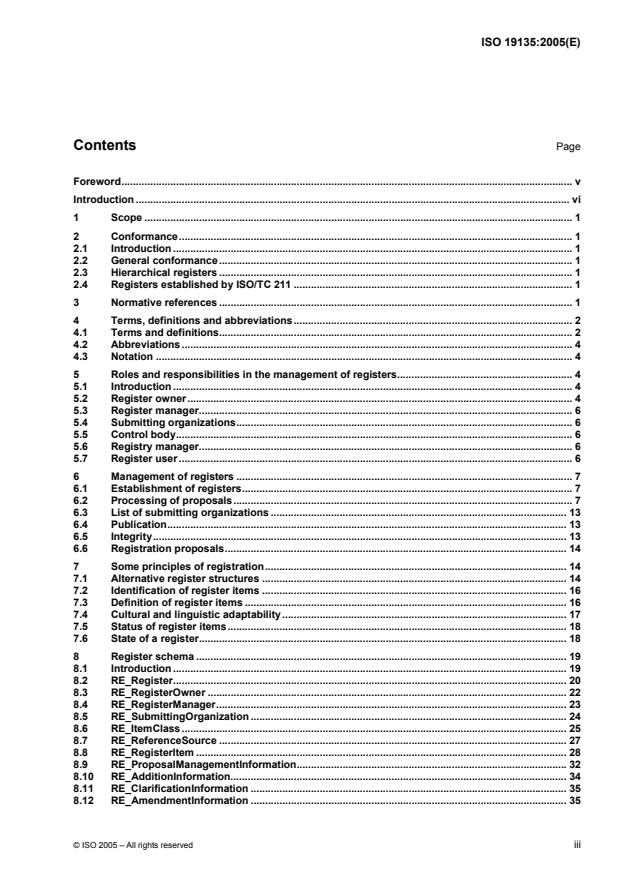
Contents Page
Foreword. v
Introduction . vi
1 Scope . 1
2 Conformance. 1
2.1 Introduction . 1
2.2 General conformance. 1
2.3 Hierarchical registers . 1
2.4 Registers established by ISO/TC 211 . 1
3 Normative references . 1
4 Terms, definitions and abbreviations. 2
4.1 Terms and definitions. 2
4.2 Abbreviations . 4
4.3 Notation . 4
5 Roles and responsibilities in the management of registers. 4
5.1 Introduction . 4
5.2 Register owner. 4
5.3 Register manager. 6
5.4 Submitting organizations. 6
5.5 Control body. 6
5.6 Registry manager. 6
5.7 Register user . 6
6 Management of registers . 7
6.1 Establishment of registers. 7
6.2 Processing of proposals. 7
6.3 List of submitting organizations . 13
6.4 Publication. 13
6.5 Integrity. 13
6.6 Registration proposals. 14
7 Some principles of registration. 14
7.1 Alternative register structures . 14
7.2 Identification of register items . 16
7.3 Definition of register items . 16
7.4 Cultural and linguistic adaptability. 17
7.5 Status of register items. 18
7.6 State of a register. 18
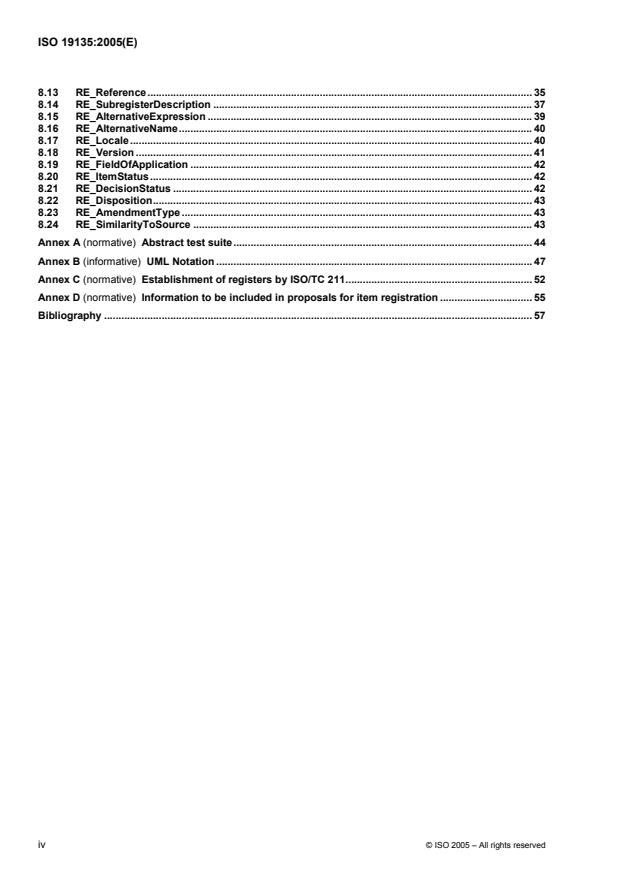
8 Register schema . 19
8.1 Introduction . 19
8.2 RE_Register. 20
8.3 RE_RegisterOwner . 22
8.4 RE_RegisterManager. 23
8.5 RE_SubmittingOrganization . 24
8.6 RE_ItemClass . 25
8.7 RE_ReferenceSource . 27
8.8 RE_RegisterItem . 28
8.9 RE_ProposalManagementInformation. 32
8.10 RE_AdditionInformation. 34
8.11 RE_ClarificationInformation . 35
8.12 RE_AmendmentInformation . 35
8.13 RE_Reference. 35
8.14 RE_SubregisterDescription . 37
8.15 RE_AlternativeExpression . 39
8.16 RE_AlternativeName. 40
8.17 RE_Locale. 40
8.18 RE_Version . 41
8.19 RE_FieldOfApplication . 42
8.20 RE_ItemStatus. 42
8.21 RE_DecisionStatus . 42
8.22 RE_Disposition. 43
8.23 RE_AmendmentType . 43
8.24 RE_SimilarityToSource . 43
Annex A (normative) Abstract test suite. 44
Annex B (informative) UML Notation . 47
Annex C (normative) Establishment of registers by ISO/TC 211. 52
Annex D (normative) Information to be included in proposals for item registration . 55
Bibliography . 57
iv © ISO 2005 – All rights reserved
Foreword
ISO (the International Organization for Standardization) is a worldwide federation of national standards bodies
(ISO member bodies). The work of preparing International Standards is normally carried out through ISO
technical committees. Each member body interested in a subject for which a technical committee has been
established has the right to be represented on that committee. International organizations, governmental and
non-governmental, in liaison with ISO, also take part in the work. ISO collaborates closely with the
International Electrotechnical Commission (IEC) on all matters of electrotechnical standardization.
International Standards are drafted in accordance with the rules given in the ISO/IEC Directives, Part 2.
The main task of technical committees is to prepare International Standards. Draft International Standards
adopted by the technical committees are circulated to the member bodies for voting. Publication as an
International Standard requires approval by at least 75 % of the member bodies casting a vote.
Attention is drawn to the possibility that some of the elements of this document may be the subject of patent
rights. ISO shall not be held responsible for identifying any or all such patent rights.
ISO 19135 was prepared by Technical Committee ISO/TC 211, Geographic information/Geomatics.
Introduction
This International Standard specifies procedures for the registration of items of geographic information.
ISO/IEC JTC 1 defines registration as the assignment of an unambiguous name to an object in a way that
makes the assignment available to interested parties. Items of geographic information that may be registered
are members of object classes specified in technical standards such as those developed by ISO/TC 211.
NOTE In this International Standard, the definition of registration has been changed so that registration is the
assignment of linguistically independent identifiers, rather than names, to items of geographic information.
Registration of items of geographic information offers several benefits to the geographic information
community. Registration:
a) supports wider use of registered items both by providing international recognition to the fact that such
items conform to an ISO International Standard and by making them publicly available to potential users;
b) provides both immediate recognition to extensions of an International Standard and a source for updates
to that International Standard during the regular maintenance cycle;
c) may provide a single mechanism to access information concerning items that are specified in different
standards;
d) provides a mechanism for managing temporal change;
NOTE Items specified in a standard or in a register may change over time either due to changes in technology or for
other reasons. Published standards do not clearly document what changes may have occurred, and do not include
information about earlier versions of specified items. Such information can be maintained in a register
e) may be used to make sets of standardized tags available for encoding of registered items in data sets;
and
f) supports cultural and linguistic adaptability by providing both a means for recording equivalent names of
items used in different languages, cultures, application areas and professions, and a means for making
those equivalent names publicly available.
This International Standard specifies procedures to be followed in preparing and maintaining registers of items
of geographic information. Although any organization may choose to establish registers of items of geographic
information that conform to this International Standard, this International Standard is intended particularly to
apply to registers established under the auspices of ISO/TC 211.
A registration authority is an organization authorized by ISO to maintain a register. ISO discourages the
proliferation of registers, but the maintenance of a single large register places a heavy burden on the
registration authority. A goal of this International Standard is to achieve a balance between minimizing the
number of registers for items of geographic information and minimizing the burden on the registration
authorities.
vi © ISO 2005 – All rights reserved
INTERNATIONAL STANDARD ISO 19135:2005(E)
Geographic information — Procedures for item registration
1 Scope
This International Standard specifies procedures to be followed in establishing, maintaining and publishing
registers of unique, unambiguous and permanent identifiers and meanings that are assigned to items of
geographic information. In order to accomplish this purpose, this International Standard specifies elements of
information that are necessary to provide identification and meaning to the registered items and to manage
the registration of these items.
2 Conformance
2.1 Introduction
To conform to this International Standard, a register of items of geographic information shall satisfy all of the
conditions specified for one of the conformance classes described below.
2.2 General conformance
Any register that claims conformance to this International Standard shall satisfy all of the conditions specified
in the abstract test suite for general conformance (Annex A.1).
2.3 Hierarchical registers
Any hierarchical register that claims conformance to this International Standard shall satisfy all of the
conditions specified in the abstract test suite for general conformance (A.1) and shall, in addition, satisfy the
conditions specified in the abstract test suite for hierarchical registers (A.2).
2.4 Registers established by ISO/TC 211
Any register established by ISO/TC 211 shall satisfy all of the conditions specified in the Abstract Test Suite
for general conformance (A.1), and shall in addition satisfy all of the conditions specified in the abstract test
suite for registers established by ISO/TC 211 (A.3).
3 Normative references
The following referenced documents are indispensable for the application of this document. For dated
references, only the edition cited applies. For undated references, the latest edition of the referenced
document (including any amendments) applies.
ISO 639-2, Codes for the representation of names of languages ⎯ Part 2: Alpha-3 code
ISO 3166-1, Codes for the representation of names of countries and their subdivisions ⎯ Part 1: Country
codes
ISO/TS 19103:2005, Geographic information ⎯ Conceptual schema language
ISO 19115:2003, Geographic information ⎯ Metadata
4 Terms, definitions and abbreviations
4.1 Terms and definitions
For the purposes of this document, the following terms and definitions apply.
4.1.1
clarification
non-substantive change to a register item
NOTE A non-substantive change does not change the semantics or technical meaning of the item. Clarification does
not result in a change to the registration status of the register item.
4.1.2
control body
group of technical experts that makes decisions regarding the content of a register
4.1.3
geographic information
information concerning phenomena implicitly or explicitly associated with a location relative to the Earth
[ISO 19101:2002]
4.1.4
hierarchical register
structured set of registers for a domain of register items, composed of a principal register and a set of
subregisters
EXAMPLE ISO 6523 is associated with a hierarchical register. The principal register contains organization identifier
schemes and each subregister contains a set of organization identifiers that comply with a single organization identifier
scheme.
4.1.5
identifier
linguistically independent sequence of characters capable of uniquely and permanently identifying that with
which it is associated
[adapted from ISO/IEC 11179-3:2003]
4.1.6
item class
set of items with common properties
NOTE Class is used in this context to refer to a set of instances, not the concept abstracted from that set of instances.
4.1.7
locale
cultural and linguistic setting applicable to the interpretation of a character string
4.1.8
principal register
register that contains a description of each of the subregisters in a hierarchical register
4.1.9
register
set of files containing identifiers assigned to items with descriptions of the associated items
NOTE Adapted from Annex E of the ISO/IEC JTC 1, Procedures.
2 © ISO 2005 – All rights reserved
4.1.10
register manager
organization to which management of a register has been delegated by the register owner
NOTE In the case of an ISO register, the register manager performs the functions of the registration authority
specified in the ISO/IEC Directives.
4.1.11
register owner
organization that establishes a register
4.1.12
registration
assignment of a permanent, unique and unambiguous identifier to an item
NOTE Adapted from Annex E of the ISO/IEC JTC 1, Procedures.
4.1.13
registry
information system on which a register is maintained
[adapted from ISO/IEC 11179-3:2003]
4.1.14
retirement
declaration that a register item is no longer suitable for use in the production of new data
NOTE The status of the retired item changes from “valid” to “retired”. A retired item is kept in the register to support
the interpretation of data produced before its retirement.
4.1.15
source reference
reference to the source of an item that has been adopted from a source external to the register
4.1.16
submitting organization
organization authorized by a register owner to propose changes to the content of a register
4.1.17
subregister
part of a hierarchical register that contains items from a partition of a domain of information
4.1.18
supersession
replacement of a register item by one or more new items
NOTE The status of the replaced item changes from “valid” to “superseded”.
4.1.19
technical standard
standard containing the definitions of item classes requiring registration
NOTE Adapted from Annex E of the ISO/IEC JTC 1, Procedures.
4.2 Abbreviations
IEC International Electrotechnical Commission
JTC 1 Joint Technical Committee 1
NWIP New Work Item Proposal
TC Technical Committee
TMB Technical Management Board
UML Unified Modeling Language
4.3 Notation
The conceptual schema specified in this International Standard is described using the Unified Modeling
Language (UML) (ISO/IEC 19501), following the guidance of ISO/TS 19103:2005. UML notation is described
in Annex B.
By convention within ISO/TC 211, names of UML classes, with the exception of basic data type classes,
include a two-letter prefix that identifies the standard and the UML package in which the class is specified.
UML classes specified in this International Standard have the two letter prefix of “RE”. Several model
elements used in this schema are specified in packages specified in ISO 19115:2003, as shown in Table 1.
Table 1 — UML packages from ISO 19115:2003
Prefix Package
CI Citation
EX Extent
MD Metadata
5 Roles and responsibilities in the management of registers
5.1 Introduction
Several organizations play a role in the management of a register (Figure 1). The roles and their relationships
are illustrated as a conceptual model using UML notation. This model is not intended to be implemented in
software and data, but as a set of organizations and the interactions between them.
NOTE Although they are not organizations, register and registry are included in Figure 1 because they are the basis
of the roles played by the organizations included.
5.2 Register owner
A register owner is an organization that:
a) has established one or more registers; and
b) has primary responsibility for the management, dissemination and intellectual content of those registers.
A register owner may serve as the register manager for any register that it has established, or it may appoint
another organization to serve as the register manager (5.3). A register owner shall specify the criteria that
determine which organizations may act as submitting organizations (5.4) to propose changes to the content of
4 © ISO 2005 – All rights reserved
the register. A register owner may serve as the control body (5.5) for any register that it has established, or it
may delegate that role to a subgroup within the organization or to the register manager that it has appointed to
manage that register. The register owner shall establish a procedure to process appeals by submitting
organizations of decisions made by the control body of a register. The specification of this procedure shall
include appropriate time limits for completion of the process.
The register owner shall specify the time interval for reports from the register manager that describe the
proposals received and the decisions taken since the last report. The register owner shall set terms and
conditions for making the contents of the register available to the public.
In the case of a hierarchical register (7.1.4), the register owner shall coordinate the establishment of
subregisters by other organizations.
Figure 1 — Organizational relationships
5.3 Register manager
5.3.1 Appointment of a register manager
A register owner may delegate the role of register manager to another organization. This is the usual case for
registers established by ISO or IEC Technical Committees.
5.3.2 Responsibilities of a register manager
A register manager shall manage a register of items within the item classes for which it is responsible in
conformance with Clause 6. A register manager may manage multiple registers. A register manager may own
and operate the registry that holds a register that it manages, or it may delegate operation of the registry to a
registry manager (5.6). Upon request, the register manager shall distribute an information package containing
a description of the register and how to submit proposals for changes to the content of the register. The
register manager shall accept proposals from submitting organizations and manage the proposals as specified
in 6.2. The register manager shall pass proposals to the control body (5.5) for decisions as to acceptability,
and shall serve as the point of contact between the control body and the submitting organization for
negotiations regarding changes to the proposal. The register manager shall provide reports to the register
owner at intervals specified by the register owner. Each report shall describe the proposals received and the
decisions taken since the last report. The contents of the register shall be available to the public under the
terms and conditions set by the register owner.
5.4 Submitting organizations
5.4.1 Eligible submitting organizations
A submitting organization is an organization that is qualified under criteria determined by the register owner to
propose changes to the content of a register. The register manager shall determine whether a submitting
organization is qualified in accordance with the criteria established by the register owner. A potential
submitting organization may appeal the determination to the register owner.
5.4.2 Responsibilities of submitting organizations
Submitting organizations shall manage the submission of proposals to the register manager or appeals to the
register owner that are initiated from within their respective countries or organizations as specified in 6.2.
5.5 Control body
A control body is a group of technical experts appointed by a register owner to decide on the acceptability of
proposals for changes to the content of a register (6.2.7). The control body shall accept proposals from the
register manager and render a decision regarding each proposal within the time limits specified by the register
owner.
5.6 Registry manager
A registry manager is a person or an organization responsible for the day-to-day management of a registry.
A registry manager may engage a third-party service provider to perform this service. A registry manager shall
ensure the integrity of any register held in the registry (6.5), and shall provide means for electronic access to
the registry (6.4) for register managers, control bodies and register users.
5.7 Register user
Register users access a registry in order to use one or more of the registers held in that register. Register
users include any person or organization interested in accessing or influencing the content of a register. Users
have a variety of registration requirements:
⎯ Developers of standards and specifications want to re-use items specified in a register;
6 © ISO 2005 – All rights reserved
⎯ Data producers want to use in their products items specified in a register;
⎯ Data users want to understand the meaning of register items used by a data producer; and
⎯ System developers want to provide a capability to use register items in data production, interchange or
consumption.
A register owner may set terms and conditions for different levels of access to the register to satisfy the
requirements of different categories of users.
Register users vary in the frequency of access they need, from the occasional data user who may need to
determine the meaning of a register item on a very infrequent basis, to the data producer who may need to
use values from a register many times a day. Register managers shall consider the requirements of different
categories of users in selecting methods for publishing the content of a register (6.4).
6 Management of registers
6.1 Establishment of registers
Any organization may establish a register. A register established by an ISO Technical Committee (TC) or
Subcommittee is an ISO register. Although this International Standard is intended primarily for registers
established by ISO/TC 211, other ISO or IEC Technical Committees may choose to establish registers that
conform to this International Standard. Organizations other than ISO or IEC Technical Committees or
Subcommittees may also choose to establish registers that conform to this International Standard. In
establishing registers, ISO Technical Committees are required to follow the general rules specified in the
ISO/IEC Directives, but may develop detailed rules and procedures to satisfy their own requirements.
The ISO/IEC Directives require a TC, when it is developing an International Standard that may require
registration, to inform the Chief Executive Officer at an early stage in order to permit any necessary
negotiations and allow the ISO/TMB or IEC Council Board to take a decision in advance of the publication of
the International Standard. The ISO/IEC JTC 1 Procedures specify the rules for the establishment of JTC 1
registers. Annex C of this International Standard specifies the rules and procedures for the establishment and
management of registers by ISO/TC 211. Other organizations may specify their own rules and procedures for
establishing registers.
Every register requires a technical standard that specifies the classes of items to be registered. To establish a
register that conforms to this International Standard, an organization shall:
a) be the organization that produced the technical standard that specifies the item classes to be held in the
register; or
b) have the approval of that organization.
6.2 Processing of proposals
6.2.1 Introduction
Submitting organizations may submit requests to add items to a register, to modify items in a register, or to
retire items in a register. Modifications are of two kinds: simple clarifications that cause no substantive change
to an item (6.2.3), and substantive changes that are handled through a supersession process (6.2.4). The
control body shall determine whether a proposed modification is to be handled as a clarification or
supersession.
6.2.2 Addition
Addition is the insertion into a register of an item that describes a concept not described by an item already in
the register.
6.2.3 Clarification
Clarifications correct errors in spelling, punctuation or grammar. A clarification shall not cause any substantive
semantic or technical change to a registered item.
6.2.4 Supersession
Modification of a registered item that results in substantive semantic or technical change shall be
accomplished by including a new item in the register with a new identifier and the date on which it superseded
the original item (8.9.6). The original item shall remain in the register but shall include the date at which it was
superseded, and a reference to the item that superseded it.
6.2.5 Retirement
Submitting organizations may submit requests for retirement of registered items that are no longer useful for
producing data. Retirement shall be accomplished by leaving the item in the register, marking it retired, and
including the date on which it was retired (8.9.6).
6.2.6 Submission of proposals
6.2.6.1 The process for submitting proposals for registration of items of geographic information is
illustrated in Figure 2.
6.2.6.2 Submitting organizations shall:
a) receive proposals for the registration of items that are initiated from within their respective countries or
organizations;
b) ensure that all proposals are complete (6.6);
c) coordinate proposals with other submitting organizations, if desired;
d) forward to the appropriate register manager those proposals that have the support of the submitting
organization; and
e) explain proposals to the register manager or register owner, if necessary.
6.2.6.3 The register manager shall:
a) receive proposals from qualified submitting organizations;
b) review proposals for completeness, and return proposals to the submitting organization if the proposal is
incomplete or if the submitting organization is not qualified;
c) generate a proposal management record (8.9), with the status (8.9.4) set to “pending”; and
d) initiate the approval process (6.2.7).
8 © ISO 2005 – All rights reserved
Figure 2 — Submission of proposals for registration
6.2.7 Approval process
6.2.7.1 The process for determining the acceptability of proposals is illustrated in Figure 3. It shall be
completed within a time period specified by the register owner.
Figure 3 — Approval process
6.2.7.2 The register manager shall:
a) if the proposal is for clarification or retirement of a register item, forward the proposal to the control body;
b) if the proposal is for registration of a new item or modification of an existing register item:
1) insert the new or superseding item into the register;
2) assign an itemIdentifier (8.8.2) to the new or superseding item, as specified in 7.2;
10 © ISO 2005 – All rights reserved
3) set the status (8.8.4) to “notValid”; and
4) forward the proposal to the control body.
6.2.7.3 The control body shall:
a) decide to accept the proposal without change, to accept the proposal subject to changes negotiated with
the submitting organization, or not to accept the proposal. Criteria for not accepting a proposal include:
1) the specification of the item is incomplete or incomprehensible;
2) an identical item already exists in the register;
NOTE In the case of a hierarchical register, an identical item may exist in more than one subregister.
3) the proposed item does not belong to an item class included in this register; or
4) the justification for the proposal is inadequate;
b) inform the register manager of the decision, and the rationale for the decision, within a time limit specified
by the register owner.
6.2.7.4 The register manager shall:
a) serve as point of contact if there is a need for negotiations between the submitting organization and the
control body regarding changes to the proposal that are specified by the control body as a condition of
acceptance; and
b) inform the submitting organization of the results of processing a proposal.
If the decision of the control body is positive, the register manager shall:
a) complete the proposal management record with status (8.9.4) set to “final”, disposition (8.9.5) set to
“accepted”, and dateDisposed (8.9.6) set to the current date;
b) make approved changes to the content of the register item; and
c) set the status (8.8,4) of the register item to “valid”, “superseded” or “retired”, as appropriate.
If the decision of the control body is negative, the register manager shall:
a) update the proposal management record by setting status (8.9.4) to “tentative”, disposition (8.9.5) to
“notAccepted”, and dateDisposed (8.9.6) to the current date;
b) inform the submitting organization of the deadline for appealing the decision of the control body.
The register manager shall disseminate the results of the approval process.
6.2.7.5 Submitting organizations shall:
a) negotiate with the control body with regard to changes to their proposal that are specified by the control
body as a condition of acceptance; and
b) make known within their respective countries or organizations the decisions taken on proposals by the
control body as transmitted to them by the register manager.
6.2.8 Withdrawal
Submitting organizations may decide to withdraw a proposal at any time during the approval process.
The register manager shall:
a) change the status (8.9.4) of the proposal management record from “pending” to “final”; and
b) change the value for disposition (8.9.5) to ”withdrawn” and the value for dateDisposed (8.9.6) to the
current date.
6.2.9 Appeal
6.2.9.1 A submitting organization may appeal to the register owner if it disagrees with the decision of a
control body to reject a proposal. An appeal shall contain at a minimum a description of the situation, a
justification for the appeal, and a statement of the impact if the appeal is not successful. The appeal process is
illustrated in Figure 4.
Figure 4 — Appeal process
6.2.9.2 The submitting organization shall:
a) determine if the decision regarding a proposal for registration is acceptable; and
b) if not, submit an appeal to the register manager.
12 © ISO 2005 – All rights reserved
If there is no appeal by the deadline for submitting an appeal, the register manager shall change the status
(8.9.4) of the proposal management record to “final” and change the dateDisposed (8.9.6) to the current date.
6.2.9.3 The register manager shall forward the appeal to the register owner.
6.2.9.4 The register owner shall:
a) process the appeal in conformance with its established procedures (5.2);
b) decide whether to accept or reject the appeal; and
c) return the result to the register manager.
6.2.9.5 The register manager shall:
a) update the disposition (8.9.5) and dateDisposed (8.9.6) of the proposal management record;
b) update the status (8.8.4) of the register item; and
c) provide the results of the decision to the control body and to the submitting organization.
6.2.9.6 The submitting organization shall:
a) make the results of the appeal known within their country or organization.
6.3 List of submitting organizations
A register manager shall maintain and publish a register-specific list of all qualified submitting organizations
(5.4.1) that have submitted proposals for changes to the content of each register that it manages. Each list
shall include the name and the contact information (8.5.3) for each submitting organization.
6.4 Publication
A registry manager shall ensure that information about valid, superseded or retired items in the register is
readily available to users. The method for providing this information may depend upon the requirements of the
members of the user community (5.7).
A transactional approach is recommended to support users with occasional requirements for information
about specific register items. The register should be accessible to users through an internet web site or other
electronically processable form, within appropriate access constraints. Register services should support
queries based on item names or searches based on keywords occurring in definitions or other elements of
information about the register item.
A transfer approach is recommended to support users with requirements for frequent access to many of the
items in a register. The register manager should be prepared to provide copies of the set of valid items
contained in the register as digital data on a physical distribution medium, or on paper. The register manager
should also support a means for updating distributed copies. The register manager may charge for the cost of
reproduction and distribution of such copies.
6.5 Integrity
A register manager shall ensure, for each register that it manages, that:
a) all aspects of the registration process are handled in accordance with good business practice;
b) the content of the register is accurate;
c) only authorized persons can make changes to the register;
d) the register is secured against loss caused by damage to the system on which that register is maintained;
e) a softcopy of the register is sent to the register owner at least once a year; and
f) confidential information is safeguarded.
6.6 Registration proposals
Annex D specifies the minimum information necessary to submit a proposal to a register manager. Additional
information requirements may be specified for an item class by the technical standard that specifies that item
class. Details may be obtained from the relevant register manager.
7 Some principles of registration
7.1 Alternative register structures
7.1.1 Overview
There are several alternatives for structuring registers:
⎯ a simple register that contains items of a single item class (7.1.2);
⎯ a multi-part register in which different parts contain items from different item classes (7.1.3); or
⎯ a hierarchical register, the upper level of which contains a list of lower level registers (7.1.4).
7.1.2 Simple register
A simple register contains items of a single item class. This is the simplest structure to manage, since the
same elements of information are recorded for all items in the register, and it imposes a smaller cost burden
on any one register manager. A disadvantage, for any organization that wishes to establish registers for
multiple item classes, is that it may scatter such registers across several register managers.
EXAMPLE An ISO/TC 211 terminology register would contain only items of an item class specified in ISO 19104.
7.1.3 Multi-part register
A multi-part register contains items from different item classes. It is organized into sections based on the
different elements of information recorded for each class.
EXAMPLE A feature catalogue that conforms to ISO 19110 may be instantiated as a multi-part register. Such a
register would include distinct item classes for feature types, for feature attributes, for feature associations, and for feature
operations.
7.1.4 Hierarchical register
A hierarchical register is a structured set of registers composed of a principal register and one or more
subregisters. A hierarchical register is associated with a partitioned domain of geographic information
(Figure 5). Depending upon the criteria used to partition a domain, the subdivisions may, but need not be,
mutually exclusive. Identical items may occur in more than one partition, although most items in each should
be unique.
The principal register may be a multi-part register, or it may be one part of a multi-part register. The principal
register contains a set of items that describe the subregisters. Each of the subregisters contains a set of
register items from a partition of the information domain.
A principal register may be an ISO register. However, its su
...
NORME ISO
INTERNATIONALE 19135
Première édition
2005-10-15
Information géographique — Procédures
pour l'enregistrement d'éléments
Geographic information — Procedures for item registration
Numéro de référence
©
ISO 2005
PDF – Exonération de responsabilité
Le présent fichier PDF peut contenir des polices de caractères intégrées. Conformément aux conditions de licence d'Adobe, ce fichier
peut être imprimé ou visualisé, mais ne doit pas être modifié à moins que l'ordinateur employé à cet effet ne bénéficie d'une licence
autorisant l'utilisation de ces polices et que celles-ci y soient installées. Lors du téléchargement de ce fichier, les parties concernées
acceptent de fait la responsabilité de ne pas enfreindre les conditions de licence d'Adobe. Le Secrétariat central de l'ISO décline toute
responsabilité en la matière.
Adobe est une marque déposée d'Adobe Systems Incorporated.
Les détails relatifs aux produits logiciels utilisés pour la création du présent fichier PDF sont disponibles dans la rubrique General Info
du fichier; les paramètres de création PDF ont été optimisés pour l'impression. Toutes les mesures ont été prises pour garantir
l'exploitation de ce fichier par les comités membres de l'ISO. Dans le cas peu probable où surviendrait un problème d'utilisation,
veuillez en informer le Secrétariat central à l'adresse donnée ci-dessous.
DOCUMENT PROTÉGÉ PAR COPYRIGHT
© ISO 2005
Droits de reproduction réservés. Sauf prescription différente, aucune partie de cette publication ne peut être reproduite ni utilisée sous
quelque forme que ce soit et par aucun procédé, électronique ou mécanique, y compris la photocopie et les microfilms, sans l'accord écrit
de l'ISO à l'adresse ci-après ou du comité membre de l'ISO dans le pays du demandeur.
ISO copyright office
Case postale 56 • CH-1211 Geneva 20
Tel. + 41 22 749 01 11
Fax. + 41 22 749 09 47
E-mail copyright@iso.org
Web www.iso.org
Version française parue en 2008
Publié en Suisse
ii © ISO 2005 – Tous droits réservés
Sommaire Page
Avant-propos. v
Introduction . vi
1 Domaine d'application.1
2 Conformité.1
2.1 Introduction.1
2.2 Conformité générale.1
2.3 Registres hiérarchiques.1
2.4 Registres établis par l’ISO/TC 211 .1
3 Références normatives .1
4 Termes, définitions et abréviations .2
4.1 Termes et définitions.2
4.2 Abréviations .4
4.3 Notation .4
5 Rôles et responsabilités dans la gestion des registres .4
5.1 Introduction.4
5.2 Propriétaire du registre .4
5.3 Directeur du registre .6
5.4 Organismes de soumission.6
5.5 Organisme de contrôle.6
5.6 Responsable du bureau d’enregistrement.6
5.7 Utilisateur de registre.7
6 Gestion de registres .7
6.1 Établissements des registres.7
6.2 Traitement des propositions .8
6.3 Liste des organismes de soumission.13
6.4 Publication.13
6.5 Intégrité.14
6.6 Propositions d’enregistrement.14
7 Quelques principes relatifs à l’enregistrement .14
7.1 Les autres structures de registre.14
7.2 Identification des items de registre .16
7.3 Définition des items de registre .16
7.4 Adaptabilité culturelle et linguistique.18
7.5 État des items de registre .18
7.6 État d’un registre .19
8 Schéma de registre.19
8.1 Introduction.19
8.2 RE_Register.19
8.3 RE_RegisterOwner .23
8.4 RE_RegisterManager.24
8.5 RE_SubmittingOrganization.25
8.6 RE_ItemClass.26
8.7 RE_ReferenceSource .27
8.8 RE_RegisterItem .28
8.9 RE_ProposalManagementInformation.33
8.10 RE_AdditionInformation .34
8.11 RE_ClarificationInformation .35
8.12 RE_AmendmentInformation .35
8.13 RE_Reference. 36
8.14 RE_SubregisterDescription . 37
8.15 RE_AlternativeExpression . 39
8.16 RE_AlternativeName. 40
8.17 RE_Locale. 40
8.18 RE_Version . 41
8.19 RE_FieldOfApplication . 42
8.20 RE_ItemStatus. 42
8.21 RE_DecisionStatus . 42
8.22 RE_Disposition. 43
8.23 RE_AmendmentType . 43
8.24 RE_SimilarityToSource . 43
Annexe A (normative) Suite d’essais sommaires . 45
Annexe B (informative) Notation UML . 48
Annexe C (normative) Établissement de registres par l’ISO/TC 211. 53
Annexe D (normative) Informations à inclure dans les propositions d’enregistrement d’items . 56
Bibliographie . 58
iv © ISO 2005 – Tous droits réservés
Avant-propos
L'ISO (Organisation internationale de normalisation) est une fédération mondiale d'organismes nationaux de
normalisation (comités membres de l'ISO). L'élaboration des Normes internationales est en général confiée
aux comités techniques de l'ISO. Chaque comité membre intéressé par une étude a le droit de faire partie du
comité technique créé à cet effet. Les organisations internationales, gouvernementales et non
gouvernementales, en liaison avec l'ISO participent également aux travaux. L'ISO collabore étroitement avec
la Commission électrotechnique internationale (CEI) en ce qui concerne la normalisation électrotechnique.
Les Normes internationales sont rédigées conformément aux règles données dans les Directives ISO/CEI,
Partie 2.
La tâche principale des comités techniques est d'élaborer les Normes internationales. Les projets de Normes
internationales adoptés par les comités techniques sont soumis aux comités membres pour vote. Leur
publication comme Normes internationales requiert l'approbation de 75 % au moins des comités membres
votants.
L'attention est appelée sur le fait que certains des éléments du présent document peuvent faire l'objet de
droits de propriété intellectuelle ou de droits analogues. L'ISO ne saurait être tenue pour responsable de ne
pas avoir identifié de tels droits de propriété et averti de leur existence.
L'ISO 19135 a été élaborée par le comité technique ISO/TC 211, Information géographique/Géomatique.
Introduction
La présente Norme internationale décrit les procédures pour l’enregistrement d’éléments relatifs à
l’information géographique. L’ISO/CEI JTC 1 définit l’enregistrement comme l’attribution d’un nom non ambigu
à un objet, le rendant ainsi disponible pour les parties intéressées. Les items relatifs à l’information
géographique pouvant être enregistrés sont membres de classes d’objets spécifiées dans les normes
techniques telles que celles développées par l’ISO/TC 211.
NOTE Dans la présente Norme internationale, la définition d’enregistrement a été modifiée de sorte que
l’enregistrement correspond à l’attribution d’identifiants linguistiquement indépendants à des éléments relatifs à
l’information géographique au lieu de leur attribuer des noms.
L’enregistrement d’éléments relatifs à l’information géographique offre ne nombreux avantages à l’ensemble
de l’information géographique. L’enregistrement
a) permet une utilisation plus étendue des items enregistrés en conférant une reconnaissance internationale
sur le fait que de tels items sont conformes à une Norme internationale et en les mettant publiquement à
disposition d’utilisateurs potentiels,
b) confère une reconnaissance immédiate aux extensions d’une Norme internationale et une source de
mises à jour pour cette Norme internationale pendant le cycle de mise à jour régulier,
c) peut conférer un mécanisme unique permettant l’accès aux informations concernant les items spécifiés
dans différentes normes,
d) confère un mécanisme de gestion des modifications temporelles,
NOTE Les items spécifiés dans une norme ou dans un registre peuvent changer avec le temps en raison des
avancées technologiques, entre autres. Les normes publiées ne font pas clairement mention des éventuelles
modifications effectuées et n’incluent pas les informations sur les versions antérieures ou sur les items spécifiés. Ces
informations peuvent être mises à jour dans un registre.
e) pouvant être utilisé pour créer des ensembles d’étiquettes normalisées disponibles pour le codage d’items
enregistrés dans des ensembles de données, et
f) pouvant supporter l’adaptabilité culturelle et linguistique en offrant un moyen d’enregistrer des noms
équivalents d’items utilisés dans des langues, des cultures, des champs d’application et des professions
différents, ainsi qu’un moyen de rendre ces noms équivalents publics.
La présente Norme internationale spécifie les procédures à suivre pour la préparation et la mise à jour de
registres d’items relatifs à l’information géographique. Bien que tout organisme puisse choisir d’établir des
registres d’items relatifs à l’information géographique conformes à la présente Norme internationale, cette
dernière est destinée tout particulièrement à s’appliquer aux registres établis sous les auspices de
l’ISO/TC 211.
Une autorité d’enregistrement est une organisation habilitée par l’ISO pour mettre à jour un registre. L’ISO
n’encourage pas la multiplication des registres, mais la mise à jour d’un vaste registre unique représente une
lourde tâche pour l’autorité d’enregistrement. La présente Norme internationale vise notamment à atteindre un
équilibre entre la réduction du nombre de registres pour les items relatifs à l’information géographique et la
réduction de la charge pesant sur les autorités d’enregistrement.
vi © ISO 2005 – Tous droits réservés
NORME INTERNATIONALE ISO 19135:2005(F)
Information géographique — Procédures pour l'enregistrement
d'éléments
1 Domaine d'application
La présente Norme internationale spécifie les procédures à suivre pour établir, mettre à jour et publier les
registres des identifiants uniques, non ambigus et permanents et des significations qui sont attribués aux
items de l'information géographique. Afin d'atteindre cet objectif, la présente Norme internationale spécifie les
éléments d’information qui sont nécessaires pour conférer l'identification et la signification aux items
enregistrés et pour gérer l’enregistrement de ces items.
2 Conformité
2.1 Introduction
Pour être conforme à la présente Norme internationale, un registre d’items relatifs à l'information
géographique doit satisfaire aux conditions spécifiées pour l’une des classes de conformité décrites
ci-dessous.
2.2 Conformité générale
Tout registre déclarant sa conformité à la présente Norme internationale doit satisfaire à toutes le conditions
spécifiées dans la suite d’essais sommaires pour la conformité générale (A.1).
2.3 Registres hiérarchiques
Tout registre hiérarchique déclarant être conforme à la présente Norme internationale doit satisfaire à toutes
les conditions spécifiées dans la suite d’essais sommaires pour la conformité générale (A.1) et doit, en outre,
satisfaire aux conditions spécifiées dans la suite d’essais sommaires pour les registres hiérarchiques (A.2).
2.4 Registres établis par l’ISO/TC 211
Tout registre établi par l’ISO/TC 211 doit satisfaire à toutes les conditions spécifiées dans la suite d’essais
sommaires pour la conformité générale (A.1) et doit, en outre, satisfaire à toutes les conditions spécifiées
dans la suite d’essais sommaires pour les registres établis par l’ISO/TC 211 (A.3).
3 Références normatives
Les documents de référence suivants sont indispensables pour l'application du présent document. Pour les
références datées, seule l'édition citée s'applique. Pour les références non datées, la dernière édition du
document de référence (y compris les éventuels amendements) s'applique.
ISO 639-2, Codes pour la représentation des noms de langue — Partie 2: Code alpha-3
ISO 3166-1, Codes pour la représentation des noms de pays et de leurs subdivisions — Partie 1: Codes de
pays
ISO/TS 19103:2005, Information géographique — Schéma de langage conceptuel
ISO 19115:2003, Information géographique — Métadonnées
4 Termes, définitions et abréviations
4.1 Termes et définitions
Pour les besoins du présent document, les termes et définitions suivants s'appliquent.
4.1.1
clarification
changement non substantiel d’un item du registre
NOTE Un changement non substantiel ne modifie pas la sémantique ou la signification technique de l’item. La
clarification ne résulte pas d’une modification de l’état de l’enregistrement de l’item du registre.
4.1.2
organisme de contrôle
groupe d’experts techniques qui prend les décisions concernant le contenu d'un registre
4.1.3
information géographique
information concernant des phénomènes associés implicitement ou explicitement à un emplacement sur Terre
[ISO 19101:2002]
4.1.4
registre hiérarchique
ensemble structuré de registres pour un domaine d’items du registre, composé d’un registre principal et
d’un ensemble de sous-registres
EXEMPLE L’ISO 6523 est associée à un registre hiérarchique. Le registre principal contient des systèmes
d’identifiants de l’organisation et chaque sous-registre contient un ensemble d’identifiants de l’organisation conforme à un
seul système d’identifiants de l’organisation.
4.1.5
identifiant
séquence de caractères linguistiquement indépendante capable d’identifier de manière exclusive et continue
ce à quoi elle est associée
NOTE Adapté de l’ISO 11179-3:2003.
4.1.6
classe d’items
ensembles d’items aux propriétés communes
NOTE La classe est utilisée dans ce contexte afin de se référer à un ensemble d’instances, et non au concept issu
de cet ensemble d'instances.
4.1.7
emplacement
paramètre culturel et linguistique applicable à l’interprétation d’une chaîne de caractères
4.1.8
registre principal
registre qui contient une description de chacun des sous-registres dans un registre hiérarchique
2 © ISO 2005 – Tous droits réservés
4.1.9
registre
ensemble de fichiers comportant les identifiants attribués aux items et des descriptions qui leur sont
associées
NOTE Adapté de l’ISO/CEI JTC 1, Annexe E, Procédures.
4.1.10
responsable de registre
organisation à laquelle la direction du registre a délégué la gestion d’un registre
NOTE Dans le cas d’un registre ISO, le responsable du registre applique les fonctions de l'autorité de
l'enregistrement, spécifiées dans les Directives ISO/CEI.
4.1.11
propriétaire de registre
organisation qui établit un registre
4.1.12
enregistrement
attribution d’un identifiant permanent, unique et sans ambiguïté à un item
NOTE Adapté de l’ISO/CEI JTC 1, Annexe E, Procédures.
4.1.13
bureau d’enregistrement
système d’information dans lequel un registre est mis à jour
NOTE Adapté de l’ISO 11179:3:2003.
4.1.14
retrait
déclaration indiquant qu’un item de registre n'est plus adapté pour être utilisé dans la production de nouvelles
données
NOTE L’état «valid» («valide») de l’item devient «retired» («retiré»). Un item retiré est conservé dans le registre pour
supporter l’interprétation des données produites avant son retrait.
4.1.15
référence de la source
référence à la source d’un item adopté d’une source externe au registre
4.1.16
organisme de soumission
organisme habilité par un propriétaire de registre, permettant de proposer des modifications au contenu
d’un registre
4.1.17
sous-registre
partie d’un registre hiérarchique contenant des items provenant d'une division d’un domaine d’information
4.1.18
substitution
remplacement d’un item du registre par un ou plusieurs nouveaux items
NOTE L’état «valid» («valide») de l’item remplacé devient «superseded» («substitué»).
4.1.19
norme technique
norme contenant les définitions de classes d’items requérant un enregistrement
NOTE Adapté de l’ISO/CEI JTC 1, Annexe E, Procédures.
4.2 Abréviations
CEI Commission électrotechnique internationale
JTC 1 Joint Technical Committee 1 (Comité technique commun 1)
NWIP New Work Item Proposal (Proposition de nouvel item)
TC Comité technique
TMB Technical Management Board (Conseil d’administration technique)
UML Unified Modelling Language (langage de modélisation unifié)
4.3 Notation
Le schéma conceptuel, spécifié par la présente Norme internationale est décrit à l’aide du langage de
modélisation unifié (UML) (ISO/CEI 19501), suivant les recommandations de l’ISO/TS 19103:2005. La
notation UML est décrite dans l’Annexe B.
Par convention, dans l’ISO/TC 211, les noms de classes UML, à l’exception des classes relatives aux types
de données élémentaires, comportent un préfixe de deux lettres permettant d’identifier la norme et le package
UML dans lequel la classe est spécifiée. Les classes UML spécifiées par la présente Norme internationale
comportent le préfixe de deux lettres «RE». Plusieurs éléments du modèle utilisés dans ce schéma sont
spécifiés dans le package défini dans l'ISO 19115:2003, comme présenté dans le Tableau 1.
Tableau 1 — Packages UML de l’ISO 19115:2003
Préfixe Package
CI Citation
EX Extent (Étendue)
MD Metadata (Métadonnées)
5 Rôles et responsabilités dans la gestion des registres
5.1 Introduction
De nombreuses organisations jouent un rôle dans la gestion d'un registre (Figure 1). Les rôles et leurs
relations sont illustrés par un modèle conceptuel utilisant la notation UML. Ce modèle n’est pas destiné à être
implémenté dans un logiciel et dans des données, mais comme un ensemble d'organismes et leurs
interactions.
NOTE Bien qu’ils ne soient pas des organismes, le registre et le bureau d’enregistrement sont mentionnés dans la
Figure 1, car ils constituent la base des rôles joués par les organismes qui y prennent part.
5.2 Propriétaire du registre
Un propriétaire de registre est un organisme qui
4 © ISO 2005 – Tous droits réservés
a) a établi un ou plusieurs registres, et
b) assume la responsabilité principale quant à la gestion, la diffusion et le contenu intellectuel de ces
registres.
Un propriétaire de registre peut faire fonction de responsable de registre pour tout registre qu’il a établi ou
bien il peut désigner un autre organisme pour assurer cette fonction (5.3). Un propriétaire de registre doit
spécifier les critères déterminant les organisations qui peuvent faire fonction d’organismes de
soumission (5.4) pour soumettre des propositions de modification du contenu du registre. Un propriétaire de
registre peut revêtir la fonction d’organisme de contrôle (5.5) pour tout registre qu’il a établi ou bien il peut
déléguer ce rôle à un sous-groupe de l’organisme ou au responsable de registre qu’il a nommé pour gérer le
registre. Le propriétaire de registre doit mettre en place une procédure pour traiter les appels demandés par
les organismes de soumission, en ce qui concerne les décisions rendues par l’organisme de contrôle d’un
registre. Cette procédure doit inclure dans ses spécifications, les délais appropriés pour la réalisation de ce
processus.
Le propriétaire de registre doit spécifier l'intervalle de temps nécessaire à l'élaboration de rapports par le
responsable de registre; ces rapports décrivent les propositions soumises et les décisions prises depuis le
rapport précédent. Le propriétaire de registre doit fixer les modalités et conditions permettant de mettre le
registre à la disposition du public.
Dans le cas d’un registre hiérarchique (7.1.4), le propriétaire de registre doit coordonner la mise en place des
sous-registres par d'autres organismes.
Figure 1 — Structure formelle
5.3 Directeur du registre
5.3.1 Nomination d’un responsable de registre
Un propriétaire de registre peut déléguer le rôle de responsable de registre à un autre organisme. Ce cas se
présente habituellement pour les registres établis par l’ISO ou les comités techniques CEI.
5.3.2 Responsabilités d’un responsable de registre
Un responsable de registre doit gérer un registre d'items appartenant aux classes d’items dont il est
responsable, conformément à l’Article 6. Un responsable de registre peut gérer de multiples registres. Il peut
posséder et diriger le bureau d’enregistrement comportant un registre qu’il gère ou bien il peut déléguer la
gestion du bureau d’enregistrement à un responsable du bureau d'enregistrement (5.6). Sur demande, le
responsable de registre doit distribuer un ensemble d'informations contenant une description du registre ainsi
que les modalités permettant de soumettre des propositions pour modifier le contenu du registre. Le
responsable du registre doit accepter les propositions émanant des organismes de soumission et gérer les
propositions, comme spécifié en 6.2. Le directeur du registre doit transmettre les propositions à l’organisme
de contrôle (5.5) pour les décisions concernant l'acceptabilité et doit faire office de médiateur entre
l’organisme de contrôle et l’organisme de soumission pour les négociations relatives aux modifications
suggérées dans les propositions. Le responsable de registre doit transmettre les rapports au propriétaire de
registre à des intervalles spécifiés par le propriétaire du registre. Chaque rapport doit décrire les propositions
reçues et les décisions prises depuis le rapport précédent. Les contenus du registre doivent être mis à la
disposition du public dans les modalités et aux conditions fixées par le propriétaire de registre.
5.4 Organismes de soumission
5.4.1 Organismes de soumission éligibles
Un organisme de soumission est un organisme qui est habilité, selon les critères déterminés par le
propriétaire de registre, à proposer des modifications au contenu du registre. Le responsable de registre doit
déterminer si un organisme de soumission présente les qualifications conformes aux critères établis par le
propriétaire de registre. Un organisme de soumission potentiel peut recourir à la détermination du propriétaire
de registre.
5.4.2 Responsabilités des organismes de soumission
Les organismes de soumission doivent gérer la présentation des propositions au responsable de registre ou
les recours au propriétaire de registre qui sont engagés depuis leurs pays ou leurs organismes respectifs,
comme spécifié en 6.2.
5.5 Organisme de contrôle
Un organisme de control est un groupe d’experts techniques nommé par un propriétaire de registre. Il décide
de l’acceptabilité des propositions de modification du contenu d’un registre (6.2.7). L’organisme de contrôle
doit accepter les propositions émanant du responsable de registre et rendre une décision concernant chaque
proposition dans un délai spécifié par le propriétaire de registre.
5.6 Responsable du bureau d’enregistrement
Un responsable du bureau d’enregistrement est une personne ou un organisme, responsable de la gestion
quotidienne du bureau d'enregistrement. Un responsable de bureau d’enregistrement peut embaucher un
prestataire de services tiers pour exécuter ce service. Un responsable de bureau d’enregistrement doit
garantir l’intégrité de tout registre tenu dans le bureau d’enregistrement (6.5) et doit fournir aux responsables
de registre, aux organismes de contrôle et aux utilisateurs du registre, les moyens d’accès électronique au
registre (6.4).
6 © ISO 2005 – Tous droits réservés
5.7 Utilisateur de registre
Les utilisateurs de registre ont accès au bureau d’enregistrement afin d’utiliser un ou plusieurs registres
contenus dans ce registre. Les utilisateurs du registre incluent toute personne ou organisme souhaitant influer
sur le contenu de registre ou y accéder. Les utilisateurs doivent répondre à de nombreuses exigences
d'enregistrement:
⎯ les développeurs de normes et de spécifications veulent réutiliser les items spécifiés dans un registre;
⎯ les producteurs de données veulent utiliser les items des produits spécifiés dans un registre;
⎯ les utilisateurs de données veulent comprendre la signification des items de registre utilisés par un
producteur de données;
⎯ les développeurs système veulent fournir une capacité à utiliser des items de registre dans la production,
l’échange ou la consommation de données.
Un propriétaire de registre peut fixer des modalités et des conditions d’accès aux différents niveaux du
registre afin de satisfaire aux exigences des différentes catégories d’utilisateurs.
Les utilisateurs diffèrent selon la fréquence d’accès dont ils ont besoin, depuis l’utilisateur de données
occasionnel qui peut avoir besoin de déterminer la signification d’un item de registre de temps en temps,
jusqu’au producteur de données qui peut, lui, avoir besoin d’utiliser les valeurs d’un registre plusieurs fois par
jour. Les responsables de registre doivent considérer les exigences des différentes catégories d’utilisateurs
en sélectionnant des méthodes pour publier le contenu d’un registre (6.4).
6 Gestion de registres
6.1 Établissements des registres
Tout organisme est susceptible d’établir un registre. Un registre établi par un comité technique (TC) ISO ou un
sous-comité ISO est un registre ISO. Bien que la présente Norme internationale soit essentiellement destinée
aux registres établis par l’ISO/TC 211, d’autres comités techniques ISO ou CEI peuvent choisir d’établir des
registres conformes à la présente Norme internationale. Les organisations autres que les comités techniques
ou les sous-comités ISO ou CEI peuvent également choisir d’établir des registres conformes à la présente
Norme internationale. Lorsqu’ils mettent en place les registres, les comités techniques ISO sont tenus
d’observer les règles générales spécifiées dans les Directives ISO/CEI, mais peuvent élaborer eux-mêmes
des règles et des procédures détaillées pour satisfaire à leurs propres exigences.
Lors de l'élaboration d’une Norme internationale qui peut nécessiter un enregistrement, les Directives ISO/CEI
requièrent un comité technique pour informer suffisamment tôt le président-directeur général, pour autoriser
toutes les négociations nécessaires et permettre à l'ISO/TMB ou au Conseil de direction CEI de décider à
l'avance de la publication de la Norme internationale. Les Procédures ISO/CEI JTC 1 spécifient les règles
permettant l’établissement des registres JTC 1. L’Annexe C de la présente Norme internationale spécifie les
règles et les procédures pour l’établissement et la gestion des registres par l’ISO/TC 211. D’autres
organismes peuvent spécifier leurs propres règles et procédures pour l’établissement des registres.
Chaque registre requiert une norme technique spécifiant les classes d’items devant être enregistrées. Pour
établir un registre conforme à la présente Norme internationale, un organisme doit
a) être l’organisme qui a produit la norme technique spécifiant les classes d'items à inclure dans le registre,
ou
b) obtenir le consentement de cet organisme.
6.2 Traitement des propositions
6.2.1 Introduction
Les organismes de soumission peuvent soumettre des demandes pour ajouter des items à un registre, pour
modifier les items d'un registre ou bien pour retirer certains items d'un registre. Les modifications sont de deux
ordres: les simples clarifications qui n'entraînent pas de modification substantielle d'un item (6.2.3) et les
modifications substantielles qui font l’objet d’un processus de substitution (6.2.4). L’organisme de contrôle doit
déterminer si une modification proposée doit faire l’objet d’une clarification ou d’une substitution.
6.2.2 Ajout
L’ajout consiste à insérer dans un registre un item décrivant un concept qui n’a pas encore été décrit dans le
registre.
6.2.3 Clarification
Les clarifications consistent à corriger les erreurs d’orthographe, de ponctuation ou de grammaire. Une
clarification ne doit pas entraîner de modification substantielle d’ordre sémantique ou technique d’un item
enregistré.
6.2.4 Substitution
La modification d’un item enregistré qui entraîne une modification substantielle d’ordre sémantique ou
technique doit être effectuée en incluant un nouvel item dans le registre avec un nouvel identifiant et la date à
laquelle il a remplacé l’item initial (8.9.6). L’item initial doit rester dans le registre, mais doit inclure la date à
laquelle il a été remplacé ainsi qu'une référence à l'item de substitution.
6.2.5 Retrait
Les organismes de soumission peuvent soumettre les demandes de retrait des items enregistrés qui sont
devenus inutiles à la production de données. Le retrait doit être effectué en laissant l’item dans le registre, le
marquant comme «retiré» et en mentionnant la date de son retrait (8.9.6).
6.2.6 Soumission des propositions
6.2.6.1 La Figure 2 illustre le processus de soumission des propositions pour l’enregistrement d’items
relatifs à l’information géographique.
6.2.6.2 Les organismes de soumission doivent
a) recevoir les propositions pour enregistrer les items qui sont mis en place depuis leurs pays ou
organismes respectifs,
b) garantir que toutes les propositions sont complètes (6.6),
c) coordonner les propositions avec d’autres organismes de soumission, si nécessaire,
d) transmettre au responsable de registre compétent les propositions bénéficiant du soutien de l’organisme
de soumission, et,
e) le cas échéant, expliquer les propositions au responsable de registre ou au propriétaire de registre.
8 © ISO 2005 – Tous droits réservés
6.2.6.3 Le responsable de registre doit
a) recevoir des propositions des organismes de propositions habilités,
b) revoir les propositions pour les parachever et retourner les propositions à l'organisme de soumission si la
proposition est incomplète ou si l'organisme de proposition n'est pas habilité,
c) élaborer un rapport de gestion des propositions (8.9), dont le status (état) (8.9.4) est «pending» («en
attente»), et
d) engager la procédure d’approbation (6.2.7).
Figure 2 — Soumission des propositions pour l’enregistrement
6.2.7 Procédure d’approbation
6.2.7.1 La Figure 3 illustre la procédure permettant de déterminer l’acceptabilité des propositions. Elle
doit avoir lieu dans une période définie par le propriétaire de registre.
Figure 3 — Procédure d’approbation
10 © ISO 2005 – Tous droits réservés
6.2.7.2 Le responsable de registre doit
a) transmettre la proposition à l'organisme de contrôle, si la proposition concerne la clarification ou le retrait
d'un item du registre,
b) si la proposition concerne l’enregistrement d’un nouvel item ou la modification d’un item existant,
1) insérer le nouvel item ou l'item remplacé dans le registre,
2) attribuer un itemIdentifier (8.8.2) au nouvel item ou à l’item remplacé, comme spécifié en 7.2,
3) définir le status (8.8.4) comme «notValid» («nonValide»), et
4) transmettre la proposition à l’organisme de contrôle.
6.2.7.3 L’organisme de contrôle doit
a) décider d’accepter la proposition sans modification, accepter la proposition soumise à des modifications
négociées avec l’organisme de soumission ou bien ne pas accepter la proposition. Les critères de rejet
d'une proposition incluent
1) la spécification d’un item est incomplète ou incompréhensible,
2) un item identique existe déjà dans le registre,
NOTE Dans le cas d’un registre hiérarchique, un même item peut exister dans plus d’un sous-registre
3) l’item proposé n’appartient pas à une classe d’items dans ce registre, ou
4) la justification apportée à la proposition ne convient pas,
b) informer le responsable de registre de la décision et communiquer les raisons invoquées concernant la
décision, dans un délai spécifié par le propriétaire du registre.
6.2.7.4 Le responsable de registre doit
a) jouer le rôle de médiateur si des négociations sont nécessaires entre l’organisme de soumission et
l’organisme de contrôle quant aux modifications de la proposition spécifiées par l’organisme de contrôle
comme une condition d'acceptation, et
b) informer l’organisme de proposition des résultats obtenus après le traitement d’une proposition.
Si la décision d’un organisme de contrôle est positive, le responsable de registre doit
a) compléter le rapport de gestion de la proposition avec les mentions «final» pour le status (8.9.4)
«accepted» («acceptée»), pour la disposition (8.9.5) et la date du jour pour dateDisposed (8.9.6),
b) appliquer les modifications approuvées au contenu de l’item du registre, et
c) modifier l'état (8.8.4) de l'item du registre en indiquant «valid» («valide»), «superseded» («substitué») ou
bien «retired» («retiré»), selon le cas.
Si la décision d’un organisme de contrôle est négative, le responsable de registre doit
a) mettre à jour le rapport de gestion de la proposition avec les mentions «provisoire» pour le status (8.9.4)
«notAccepted» («pasAccepté»), pour la disposition (8.9.5) et la date du jour dateDisposed (8.9.6),
b) informer l’organisme de soumission du délai pour faire appel de la décision de l’organisme de contrôle.
Le responsable de registre doit diffuser les résultats de la procédure d’approbation.
6.2.7.5 Les organismes de soumission doivent
a) négocier avec l’organisme de contrôle concernant les modifications de leur proposition qui sont spécifiées
par l’organisme de contrôle comme une condition d’acceptation, et
b) communiquer dans leurs pays ou dans leurs organismes respectifs les décisions relatives aux
propositions, prises par l’organisme de contrôle, telles qu’elles leur ont été transmises par le responsable
de registre.
6.2.8 Retrait
Les organismes de soumission peuvent décider de retirer une proposition à tout moment pendant la
procédure d’approbation.
Le responsable de registre doit
a) changer le status (8.9.4) du rapport de gestion de la proposition en remplaçant la mention «pending»
(«attente») par «final», et
b) changer la valeur de la disposition (8.9.5) en remplaçant la mention «withdrawn» («retiré») et la valeur
dateDisposed (8.9.6) par la date du jour.
6.2.9 Appel
6.2.9.1 Un organisme de soumission peut faire appel du propriétaire de registre s’il n’est pas d’accord
avec la décision de l’organisme de contrôle de rejeter une proposition. Un appel doit comporter au moins une
description de la situation, un commentaire justifiant de l’appel et une explication des conséquences si l’appel
échoue. La Figure 4 illustre la procédure d’appel.
6.2.9.2 L’organisme de soumission doit
a) déterminer si la décision concernant une proposition pour l’enregistrement est acceptable, et,
b) si tel n’est pas le cas, soumettre un appel au responsable du registre.
Si l’organisme ne fait pas appel pendant le délai prévu à cet effet, le responsable de registre doit modifier le
status (8.9.4) du rapport de gestion de la proposition par la mention «final» et remplacer la dateDisposed
(8.9.6) par la date du jour.
6.2.9.3 Le responsable de registre doit transmettre l’appel au propriétaire de registre.
6.2.9.4 Le propriétaire de registre doit
a) traiter l’appel conformément aux procédures établies (5.2),
b) décider d’accepter ou de rejeter l’appel, et
c) renvoyer le résultat au responsable de registre.
6.2.9.5 le responsable de registre doit
a) mettre à jour la disposition (8.9.5) et dateDisposed (8.9.6) du rapport de gestion de la proposition,
b) mettre à jour le status (8.8.4) de l’item du registre, et
c) transmettre les résultats de la décision à l’organisme de contrôle et à l’organisme de soumission.
12 © ISO 2005 – Tous droits réservés
Figure 4 — Procédure d’appel
6.2.9.6 L’organisme de soumission doit communiquer les résultats de l’appel dans son pays ou son
organisme.
6.3 Liste des organismes de soumission
Un responsable de registre doit mettre à jour et publier une liste spécifique au registre de tous les organismes
de soumission habilités (5.4.1) qui ont soumis des propositions de modifications au contenu de chaque
registre qu’il gère. Chaque liste doit inclure les informations relatives au nom et au contact (8.5.3) pour
chaque organisme de soumission.
6.4 Publication
Un responsable de registre doit garantir que les informations concernant les items valides, substitués ou
retirés, sont bien mises à la disposition des utilisateurs. La méthode permettant de fournir les informations
peut dépendre des exigences des membres de la communauté des utilisateurs (5.7).
Une approche transactionnelle est recommandée po
...
2003-01.Slovenski inštitut za standardizacijo. Razmnoževanje celote ali delov tega standarda ni dovoljeno.Geographic information -Procedures for item registrationGeografske informacije – Postopki za registracijo prostorskih postavkTa slovenski standard je istoveten z:oSIST ISO 19135:2006en35.240.70Uporabniške rešitve IT v znanostiIT applications in scienceICS:SLOVENSKI
STANDARDoSIST ISO 19135:200601-oktober-2006
Reference numberISO 19135:2005(E)© ISO 2005
INTERNATIONAL STANDARD ISO19135First edition2005-10-15Geographic information — Procedures for item registration Information géographique — Procédures pour l'enregistrement d'éléments
©
ISO 2005 All rights reserved. Unless otherwise specified, no part of this publication may be reproduced or utilized in any form or by any means, electronic or mechanical, including photocopying and microfilm, without permission in writing from either ISO at the address below or ISO's member body in the country of the requester. ISO copyright office Case postale 56 • CH-1211 Geneva 20 Tel.
+ 41 22 749 01 11 Fax
+ 41 22 749 09 47 E-mail
copyright@iso.org Web
www.iso.org Published in Switzerland
ii
iii Contents Page Foreword.v Introduction.vi 1 Scope.1 2 Conformance.1 2.1 Introduction.1 2.2 General conformance.1 2.3 Hierarchical registers.1 2.4 Registers established by ISO/TC 211.1 3 Normative references.1 4 Terms, definitions and abbreviations.2 4.1 Terms and definitions.2 4.2 Abbreviations.4 4.3 Notation.4 5 Roles and responsibilities in the management of registers.4 5.1 Introduction.4 5.2 Register owner.4 5.3 Register manager.6 5.4 Submitting organizations.6 5.5 Control body.6 5.6 Registry manager.6 5.7 Register user.6 6 Management of registers.7 6.1 Establishment of registers.7 6.2 Processing of proposals.7 6.3 List of submitting organizations.13 6.4 Publication.13 6.5 Integrity.13 6.6 Registration proposals.14 7 Some principles of registration.14 7.1 Alternative register structures.14 7.2 Identification of register items.16 7.3 Definition of register items.16 7.4 Cultural and linguistic adaptability.17 7.5 Status of register items.18 7.6 State of a register.18 8 Register schema.19 8.1 Introduction.19 8.2 RE_Register.20 8.3 RE_RegisterOwner.22 8.4 RE_RegisterManager.23 8.5 RE_SubmittingOrganization.24 8.6 RE_ItemClass.25 8.7 RE_ReferenceSource.27 8.8 RE_RegisterItem.28 8.9 RE_ProposalManagementInformation.32 8.10 RE_AdditionInformation.34 8.11 RE_ClarificationInformation.35 8.12 RE_AmendmentInformation.35
Abstract test suite.44 Annex B (informative)
UML Notation.47 Annex C (normative)
Establishment of registers by ISO/TC 211.52 Annex D (normative)
Information to be included in proposals for item registration.55 Bibliography.57
v Foreword ISO (the International Organization for Standardization) is a worldwide federation of national standards bodies (ISO member bodies). The work of preparing International Standards is normally carried out through ISO technical committees. Each member body interested in a subject for which a technical committee has been established has the right to be represented on that committee. International organizations, governmental and non-governmental, in liaison with ISO, also take part in the work. ISO collaborates closely with the International Electrotechnical Commission (IEC) on all matters of electrotechnical standardization. International Standards are drafted in accordance with the rules given in the ISO/IEC Directives, Part 2. The main task of technical committees is to prepare International Standards. Draft International Standards adopted by the technical committees are circulated to the member bodies for voting. Publication as an International Standard requires approval by at least 75 % of the member bodies casting a vote. Attention is drawn to the possibility that some of the elements of this document may be the subject of patent rights. ISO shall not be held responsible for identifying any or all such patent rights. ISO 19135 was prepared by Technical Committee ISO/TC 211, Geographic information/Geomatics.
INTERNATIONAL STANDARD ISO 19135:2005(E) © ISO 2005 – All rights reserved
1 Geographic information — Procedures for item registration 1 Scope This International Standard specifies procedures to be followed in establishing, maintaining and publishing registers of unique, unambiguous and permanent identifiers and meanings that are assigned to items of geographic information. In order to accomplish this purpose, this International Standard specifies elements of information that are necessary to provide identification and meaning to the registered items and to manage the registration of these items. 2 Conformance 2.1 Introduction To conform to this International Standard, a register of items of geographic information shall satisfy all of the conditions specified for one of the conformance classes described below. 2.2 General conformance Any register that claims conformance to this International Standard shall satisfy all of the conditions specified in the abstract test suite for general conformance (Annex A.1). 2.3 Hierarchical registers Any hierarchical register that claims conformance to this International Standard shall satisfy all of the conditions specified in the abstract test suite for general conformance (A.1) and shall, in addition, satisfy the conditions specified in the abstract test suite for hierarchical registers (A.2). 2.4 Registers established by ISO/TC 211 Any register established by ISO/TC 211 shall satisfy all of the conditions specified in the Abstract Test Suite for general conformance (A.1), and shall in addition satisfy all of the conditions specified in the abstract test suite for registers established by ISO/TC 211 (A.3). 3 Normative references The following referenced documents are indispensable for the application of this document. For dated references, only the edition cited applies. For undated references, the latest edition of the referenced document (including any amendments) applies. ISO 639-2, Codes for the representation of names of languages ⎯ Part 2: Alpha-3 code ISO 3166-1, Codes for the representation of names of countries and their subdivisions ⎯ Part 1: Country codes ISO/TS 19103:2005, Geographic information ⎯ Conceptual schema language ISO 19115:2003, Geographic information ⎯ Metadata
3 4.1.10 register manager organization to which management of a register has been delegated by the register owner NOTE In the case of an ISO register, the register manager performs the functions of the registration authority specified in the ISO/IEC Directives. 4.1.11 register owner organization that establishes a register 4.1.12 registration assignment of a permanent, unique and unambiguous identifier to an item NOTE Adapted from Annex E of the ISO/IEC JTC 1, Procedures. 4.1.13 registry information system on which a register is maintained [adapted from ISO/IEC 11179-3:2003] 4.1.14 retirement declaration that a register item is no longer suitable for use in the production of new data NOTE The status of the retired item changes from “valid” to “retired”. A retired item is kept in the register to support the interpretation of data produced before its retirement. 4.1.15 source reference reference to the source of an item that has been adopted from a source external to the register 4.1.16 submitting organization organization authorized by a register owner to propose changes to the content of a register 4.1.17 subregister part of a hierarchical register that contains items from a partition of a domain of information 4.1.18 supersession replacement of a register item by one or more new items NOTE The status of the replaced item changes from “valid” to “superseded”. 4.1.19 technical standard standard containing the definitions of item classes requiring registration NOTE Adapted from Annex E of the ISO/IEC JTC 1, Procedures.
5 the register. A register owner may serve as the control body (5.5) for any register that it has established, or it may delegate that role to a subgroup within the organization or to the register manager that it has appointed to manage that register. The register owner shall establish a procedure to process appeals by submitting organizations of decisions made by the control body of a register. The specification of this procedure shall include appropriate time limits for completion of the process. The register owner shall specify the time interval for reports from the register manager that describe the proposals received and the decisions taken since the last report. The register owner shall set terms and conditions for making the contents of the register available to the public. In the case of a hierarchical register (7.1.4), the register owner shall coordinate the establishment of subregisters by other organizations.
Figure 1 — Organizational relationships
7 ⎯ Data producers want to use in their products items specified in a register; ⎯ Data users want to understand the meaning of register items used by a data producer; and ⎯ System developers want to provide a capability to use register items in data production, interchange or consumption. A register owner may set terms and conditions for different levels of access to the register to satisfy the requirements of different categories of users. Register users vary in the frequency of access they need, from the occasional data user who may need to determine the meaning of a register item on a very infrequent basis, to the data producer who may need to use values from a register many times a day. Register managers shall consider the requirements of different categories of users in selecting methods for publishing the content of a register (6.4). 6 Management of registers 6.1 Establishment of registers Any organization may establish a register. A register established by an ISO Technical Committee (TC) or Subcommittee is an ISO register. Although this International Standard is intended primarily for registers established by ISO/TC 211, other ISO or IEC Technical Committees may choose to establish registers that conform to this International Standard. Organizations other than ISO or IEC Technical Committees or Subcommittees may also choose to establish registers that conform to this International Standard. In establishing registers, ISO Technical Committees are required to follow the general rules specified in the ISO/IEC Directives, but may develop detailed rules and procedures to satisfy their own requirements. The ISO/IEC Directives require a TC, when it is developing an International Standard that may require registration, to inform the Chief Executive Officer at an early stage in order to permit any necessary negotiations and allow the ISO/TMB or IEC Council Board to take a decision in advance of the publication of the International Standard. The ISO/IEC JTC 1 Procedures specify the rules for the establishment of JTC 1 registers. Annex C of this International Standard specifies the rules and procedures for the establishment and management of registers by ISO/TC 211. Other organizations may specify their own rules and procedures for establishing registers. Every register requires a technical standard that specifies the classes of items to be registered. To establish a register that conforms to this International Standard, an organization shall: a) be the organization that produced the technical standard that specifies the item classes to be held in the register; or b) have the approval of that organization. 6.2 Processing of proposals 6.2.1 Introduction Submitting organizations may submit requests to add items to a register, to modify items in a register, or to retire items in a register. Modifications are of two kinds: simple clarifications that cause no substantive change to an item (6.2.3), and substantive changes that are handled through a supersession process (6.2.4). The control body shall determine whether a proposed modification is to be handled as a clarification or supersession. 6.2.2 Addition Addition is the insertion into a register of an item that describes a concept not described by an item already in the register.
Figure 2 — Submission of proposals for registration
Figure 3 — Approval process 6.2.7.2 The register manager shall: a) if the proposal is for clarification or retirement of a register item, forward the proposal to the control body; b) if the proposal is for registration of a new item or modification of an existing register item: 1) insert the new or superseding item into the register; 2) assign an itemIdentifier (8.8.2) to the new or superseding item, as specified in 7.2;
11 3) set the status (8.8.4) to “notValid”; and 4) forward the proposal to the control body. 6.2.7.3 The control body shall: a) decide to accept the proposal without change, to accept the proposal subject to changes negotiated with the submitting organization, or not to accept the proposal. Criteria for not accepting a proposal include: 1) the specification of the item is incomplete or incomprehensible; 2) an identical item already exists in the register; NOTE In the case of a hierarchical register, an identical item may exist in more than one subregister. 3) the proposed item does not belong to an item class included in this register; or 4) the justification for the proposal is inadequate; b) inform the register manager of the decision, and the rationale for the decision, within a time limit specified by the register owner. 6.2.7.4 The register manager shall: a) serve as point of contact if there is a need for negotiations between the submitting organization and the control body regarding changes to the proposal that are specified by the control body as a condition of acceptance; and b) inform the submitting organization of the results of processing a proposal. If the decision of the control body is positive, the register manager shall: a) complete the proposal management record with status (8.9.4) set to “final”, disposition (8.9.5) set to “accepted”, and dateDisposed (8.9.6) set to the current date; b) make approved changes to the content of the register item; and c) set the status (8.8,4) of the register item to “valid”, “superseded” or “retired”, as appropriate. If the decision of the control body is negative, the register manager shall: a) update the proposal management record by setting status (8.9.4) to “tentative”, disposition (8.9.5) to “notAccepted”, and dateDisposed (8.9.6) to the current date; b) inform the submitting organization of the deadline for appealing the decision of the control body. The register manager shall disseminate the results of the approval process. 6.2.7.5 Submitting organizations shall: a) negotiate with the control body with regard to changes to their proposal that are specified by the control body as a condition of acceptance; and b) make known within their respective countries or organizations the decisions taken on proposals by the control body as transmitted to them by the register manager.
Figure 4 — Appeal process 6.2.9.2 The submitting organization shall: a) determine if the decision regarding a proposal for registration is acceptable; and b) if not, submit an appeal to the register manager.
13 If there is no appeal by the deadline for submitting an appeal, the register manager shall change the status (8.9.4) of the proposal management record to “final” and change the dateDisposed (8.9.6) to the current date. 6.2.9.3 The register manager shall forward the appeal to the register owner. 6.2.9.4 The register owner shall: a) process the appeal in conformance with its established procedures (5.2); b) decide whether to accept or reject the appeal; and c) return the result to the register manager. 6.2.9.5 The register manager shall: a) update the disposition (8.9.5) and dateDisposed (8.9.6) of the proposal management record; b) update the status (8.8.4) of the register item; and
c) provide the results of the decision to the control body and to the submitting organization.
6.2.9.6 The submitting organization shall: a) make the results of the appeal known within their country or organization. 6.3 List of submitting organizations A register manager shall maintain and publish a register-specific list of all qualified submitting organizations (5.4.1) that have submitted proposals for changes to the content of each register that it manages. Each list shall include the name and the contact information (8.5.3) for each submitting organization. 6.4 Publication A registry manager shall ensure that information about valid, superseded or retired items in the register is readily available to users. The method for providing this information may depend upon the requirements of the members of the user community (5.7). A transactional approach is recommended to support users with occasional requirements for information about specific register items. The register should be accessible to users through an internet web site or other electronically processable form, within appropriate access constraints. Register services should support queries based on item names or searches based on keywords occurring in definitions or other elements of information about the register item. A transfer approach is recommended to support users with requirements for frequent access to many of the items in a register. The register manager should be prepared to provide copies of the set of valid items contained in the register as digital data on a physical distribution medium, or on paper. The register manager should also support a means for updating distributed copies. The register manager may charge for the cost of reproduction and distribution of such copies. 6.5 Integrity A register manager shall ensure, for each register that it manages, that: a) all aspects of the registration process are handled in accordance with good business practice; b) the content of the register is accurate; c) only authorized persons can make changes to the register;
Figure 5 — A hierarchical register EXAMPLE The ISO/IEC JTC 1, Procedures cite the register for ISO 6523 as an example of a hierarchical register. This hierarchical register consists of a principal register of organization identifier schemes, with a subregister for each scheme that contains organization identifiers that comply with that scheme. The registers for the individual organization identifier schemes are managed by “issuing organizations” that need not be ISO designated registration authorities. An ISO/TC 211 register of feature catalogues would be established as a hierarchical register in which each feature catalogue is established as a subregister owned by the organization that produces that catalogue.
Figure 6 — Example of the distinction between identifiers used in an information technology interface
...
Questions, Comments and Discussion
Ask us and Technical Secretary will try to provide an answer. You can facilitate discussion about the standard in here.
Loading comments...