


ISO 26900:2012
(Main)Space data and information transfer systems — Orbit data messages
Space data and information transfer systems — Orbit data messages
ISO 26900:2012 specifies three standard message formats for use in transferring spacecraft orbit information between space agencies and commercial or governmental spacecraft operators: the Orbit Parameter Message (OPM), the Orbit Mean-Elements Message (OMM), and the Orbit Ephemeris Message (OEM). Such exchanges are used for a) pre-flight planning for tracking or navigation support, b) scheduling tracking support, c) carrying out tracking operations (sometimes called metric predicts), d) performing orbit comparisons, e) carrying out navigation operations such as orbit propagation and orbit reconstruction, f) assessing mutual physical and electromagnetic interference among satellites orbiting the same celestial body (currently primarily Earth, Moon, and Mars), g) performing orbit conjunction (collision avoidance) studies, and h) developing and executing collaborative manoeuvres to mitigate interference or enhance mutual operations. ISO 26900:2012 includes sets of requirements and criteria that the message formats have been designed to meet.
Systèmes de transfert des informations et données spatiales — Messages pour données d'orbites
General Information
- Status
- Withdrawn
- Publication Date
- 12-Jul-2012
- Technical Committee
- ISO/TC 20/SC 14 - Space systems and operations
- Drafting Committee
- ISO/TC 20/SC 14 - Space systems and operations
- Current Stage
- 9599 - Withdrawal of International Standard
- Start Date
- 09-Feb-2024
- Completion Date
- 12-Feb-2026
Relations
- Effective Date
- 27-Aug-2022
- Effective Date
- 12-May-2008


Get Certified
Connect with accredited certification bodies for this standard

DEKRA North America
DEKRA certification services in North America.

Eagle Registrations Inc.
American certification body for aerospace and defense.

Element Materials Technology
Materials testing and product certification.
Sponsored listings
Frequently Asked Questions
ISO 26900:2012 is a standard published by the International Organization for Standardization (ISO). Its full title is "Space data and information transfer systems — Orbit data messages". This standard covers: ISO 26900:2012 specifies three standard message formats for use in transferring spacecraft orbit information between space agencies and commercial or governmental spacecraft operators: the Orbit Parameter Message (OPM), the Orbit Mean-Elements Message (OMM), and the Orbit Ephemeris Message (OEM). Such exchanges are used for a) pre-flight planning for tracking or navigation support, b) scheduling tracking support, c) carrying out tracking operations (sometimes called metric predicts), d) performing orbit comparisons, e) carrying out navigation operations such as orbit propagation and orbit reconstruction, f) assessing mutual physical and electromagnetic interference among satellites orbiting the same celestial body (currently primarily Earth, Moon, and Mars), g) performing orbit conjunction (collision avoidance) studies, and h) developing and executing collaborative manoeuvres to mitigate interference or enhance mutual operations. ISO 26900:2012 includes sets of requirements and criteria that the message formats have been designed to meet.
ISO 26900:2012 specifies three standard message formats for use in transferring spacecraft orbit information between space agencies and commercial or governmental spacecraft operators: the Orbit Parameter Message (OPM), the Orbit Mean-Elements Message (OMM), and the Orbit Ephemeris Message (OEM). Such exchanges are used for a) pre-flight planning for tracking or navigation support, b) scheduling tracking support, c) carrying out tracking operations (sometimes called metric predicts), d) performing orbit comparisons, e) carrying out navigation operations such as orbit propagation and orbit reconstruction, f) assessing mutual physical and electromagnetic interference among satellites orbiting the same celestial body (currently primarily Earth, Moon, and Mars), g) performing orbit conjunction (collision avoidance) studies, and h) developing and executing collaborative manoeuvres to mitigate interference or enhance mutual operations. ISO 26900:2012 includes sets of requirements and criteria that the message formats have been designed to meet.
ISO 26900:2012 is classified under the following ICS (International Classification for Standards) categories: 49.140 - Space systems and operations. The ICS classification helps identify the subject area and facilitates finding related standards.
ISO 26900:2012 has the following relationships with other standards: It is inter standard links to ISO 26900:2024, ISO 22644:2006. Understanding these relationships helps ensure you are using the most current and applicable version of the standard.
ISO 26900:2012 is available in PDF format for immediate download after purchase. The document can be added to your cart and obtained through the secure checkout process. Digital delivery ensures instant access to the complete standard document.
Standards Content (Sample)
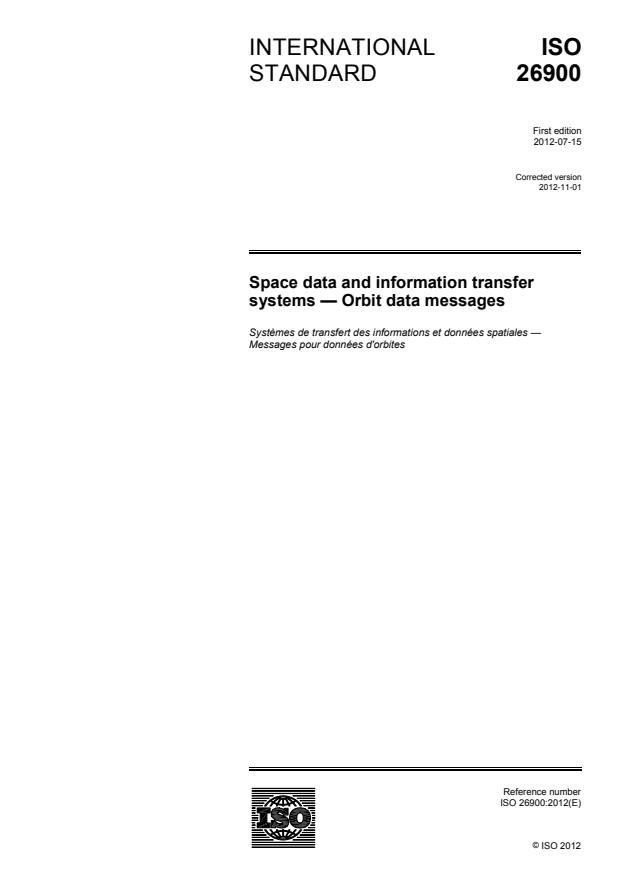
INTERNATIONAL ISO
STANDARD 26900
First edition
2012-07-15
Corrected version
2012-11-01
Space data and information transfer
systems — Orbit data messages
Systèmes de transfert des informations et données spatiales —
Messages pour données d'orbites
Reference number
©
ISO 2012
© ISO 2012
All rights reserved. Unless otherwise specified, no part of this publication may be reproduced or utilized in any form or by any means,
electronic or mechanical, including photocopying and microfilm, without permission in writing from either ISO at the address below or
ISO's member body in the country of the requester.
ISO copyright office
Case postale 56 • CH-1211 Geneva 20
Tel. + 41 22 749 01 11
Fax + 41 22 749 09 47
E-mail copyright@iso.org
Web www.iso.org
Published in Switzerland
ii © ISO 2012 – All rights reserved
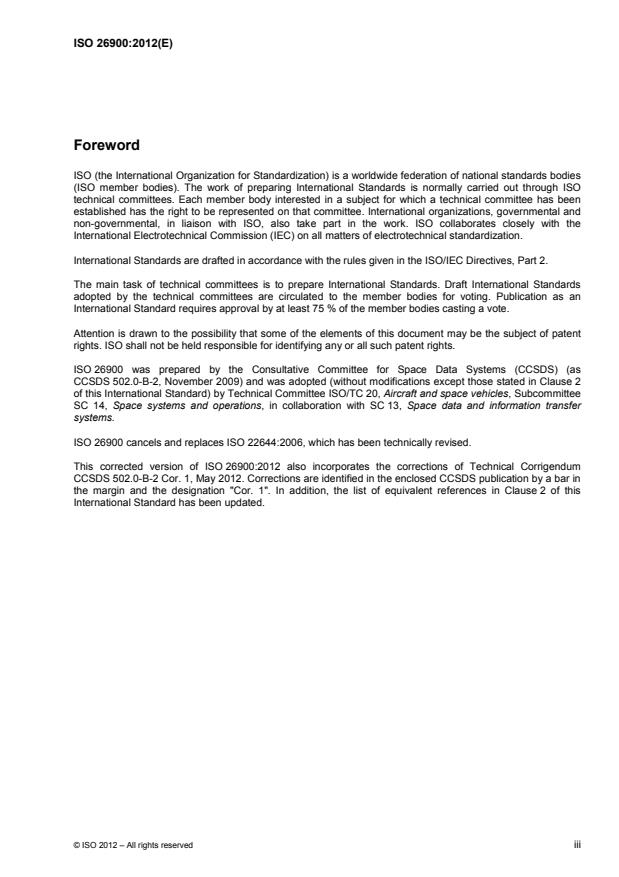
Foreword
ISO (the International Organization for Standardization) is a worldwide federation of national standards bodies
(ISO member bodies). The work of preparing International Standards is normally carried out through ISO
technical committees. Each member body interested in a subject for which a technical committee has been
established has the right to be represented on that committee. International organizations, governmental and
non-governmental, in liaison with ISO, also take part in the work. ISO collaborates closely with the
International Electrotechnical Commission (IEC) on all matters of electrotechnical standardization.
International Standards are drafted in accordance with the rules given in the ISO/IEC Directives, Part 2.
The main task of technical committees is to prepare International Standards. Draft International Standards
adopted by the technical committees are circulated to the member bodies for voting. Publication as an
International Standard requires approval by at least 75 % of the member bodies casting a vote.
Attention is drawn to the possibility that some of the elements of this document may be the subject of patent
rights. ISO shall not be held responsible for identifying any or all such patent rights.
ISO 26900 was prepared by the Consultative Committee for Space Data Systems (CCSDS) (as
CCSDS 502.0-B-2, November 2009) and was adopted (without modifications except those stated in Clause 2
of this International Standard) by Technical Committee ISO/TC 20, Aircraft and space vehicles, Subcommittee
SC 14, Space systems and operations, in collaboration with SC 13, Space data and information transfer
systems.
ISO 26900 cancels and replaces ISO 22644:2006, which has been technically revised.
This corrected version of ISO 26900:2012 also incorporates the corrections of Technical Corrigendum
CCSDS 502.0-B-2 Cor. 1, May 2012. Corrections are identified in the enclosed CCSDS publication by a bar in
the margin and the designation "Cor. 1". In addition, the list of equivalent references in Clause 2 of this
International Standard has been updated.
INTERNATIONAL STANDARD ISO 26900:2012(E)
Space data and information transfer systems — Orbit data
messages
1 Scope
This International Standard specifies three standard message formats for use in transferring spacecraft orbit
information between space agencies and commercial or governmental spacecraft operators: the Orbit
Parameter Message (OPM), the Orbit Mean-Elements Message (OMM), and the Orbit Ephemeris Message
(OEM). Such exchanges are used for
a) pre-flight planning for tracking or navigation support,
b) scheduling tracking support,
c) carrying out tracking operations (sometimes called metric predicts),
d) performing orbit comparisons,
e) carrying out navigation operations such as orbit propagation and orbit reconstruction,
f) assessing mutual physical and electromagnetic interference among satellites orbiting the same celestial
body (currently primarily Earth, Moon, and Mars),
g) performing orbit conjunction (collision avoidance) studies, and
h) developing and executing collaborative manoeuvres to mitigate interference or enhance mutual
operations.
This International Standard includes sets of requirements and criteria that the message formats have been
designed to meet.
NOTE For exchanges where these requirements do not capture the needs of the participating agencies and satellite
operators, another mechanism can be selected.
The scope and field of application are furthermore detailed in subclauses 1.1 and 1.2 of the enclosed CCSDS
publication.
2 Requirements
Requirements are the technical recommendations made in the following publication (reproduced on the
following pages), which is adopted as an International Standard:
CCSDS 502.0-B-2, November 2009, Orbit data messages.
For the purposes of international standardization, the modifications outlined below shall apply to the specific
clauses and paragraphs of publication CCSDS 502.0-B-2.
Pages i to v
This part is information which is relevant to the CCSDS publication only.
Page 1-3
Add the following information to the reference indicated:
[1] Document CCSDS 301.0-B-4, November 2010, is equivalent to ISO 11104:2011.
[4] Document CCSDS 505.0-B-1, December 2010, is equivalent to ISO 17107:2011
Page G-1
Add the following information to the reference indicated:
[G5] Document CCSDS 504.0-B-1, May 2008, is equivalent to ISO 13541:2010.
3 Revision of publication CCSDS 502.0-B-2
It has been agreed with the Consultative Committee for Space Data Systems that Subcommittee
ISO/TC 20/SC 13 will be consulted in the event of any revision or amendment of publication
CCSDS 502.0-B-2. To this end, NASA will act as a liaison body between CCSDS and ISO.
2 © ISO 2012 – All rights reserved
Recommendation for Space Data System Standards
ORBIT DATA
MESSAGES
RECOMMENDED STANDARD
CCSDS 502.0-B-2
Note:
This current
issue includes
all updates through
Technical Corrigendum 1,
dated May 2012.
BLUE BOOK
November 2009
(Blank page)
4 © ISO 2012 – All rights reserved
CCSDS RECOMMENDED STANDARD FOR ORBIT DATA MESSAGES
AUTHORITY
Issue: Recommended Standard, Issue 2
Date: November 2009
Location: Washington, DC, USA
This document has been approved for publication by the Management Council of the
Consultative Committee for Space Data Systems (CCSDS) and represents the consensus
technical agreement of the participating CCSDS Member Agencies. The procedure for
review and authorization of CCSDS documents is detailed in the Procedures Manual for the
Consultative Committee for Space Data Systems, and the record of Agency participation in
the authorization of this document can be obtained from the CCSDS Secretariat at the
address below.
This document is published and maintained by:
CCSDS Secretariat
Space Communications and Navigation Office, 7L70
Space Operations Mission Directorate
NASA Headquarters
Washington, DC 20546-0001, USA
CCSDS 502.0-B-2 Page i November 2009
CCSDS RECOMMENDED STANDARD FOR ORBIT DATA MESSAGES
STATEMENT OF INTENT
The Consultative Committee for Space Data Systems (CCSDS) is an organization officially
established by the management of its members. The Committee meets periodically to address
data systems problems that are common to all participants, and to formulate sound technical
solutions to these problems. Inasmuch as participation in the CCSDS is completely
voluntary, the results of Committee actions are termed Recommended Standards and are
not considered binding on any Agency.
This Recommended Standard is issued by, and represents the consensus of, the CCSDS
members. Endorsement of this Recommendation is entirely voluntary. Endorsement,
however, indicates the following understandings:
o Whenever a member establishes a CCSDS-related standard, this standard will be in
accord with the relevant Recommended Standard. Establishing such a standard
does not preclude other provisions which a member may develop.
o Whenever a member establishes a CCSDS-related standard, that member will
provide other CCSDS members with the following information:
-- The standard itself.
-- The anticipated date of initial operational capability.
-- The anticipated duration of operational service.
o Specific service arrangements shall be made via memoranda of agreement. Neither
this Recommended Standard nor any ensuing standard is a substitute for a
memorandum of agreement.
No later than five years from its date of issuance, this Recommended Standard will be
reviewed by the CCSDS to determine whether it should: (1) remain in effect without change;
(2) be changed to reflect the impact of new technologies, new requirements, or new
directions; or (3) be retired or canceled.
In those instances when a new version of a Recommended Standard is issued, existing
CCSDS-related member standards and implementations are not negated or deemed to be
non-CCSDS compatible. It is the responsibility of each member to determine when such
standards or implementations are to be modified. Each member is, however, strongly
encouraged to direct planning for its new standards and implementations towards the later
version of the Recommended Standard.
CCSDS 502.0-B-2 Page ii November 2009
6 © ISO 2012 – All rights reserved
CCSDS RECOMMENDED STANDARD FOR ORBIT DATA MESSAGES
FOREWORD
This document is a Recommended Standard for Orbit Data Messages (ODMs) and has been
prepared by the Consultative Committee for Space Data Systems (CCSDS). The set of orbit
data messages described in this Recommended Standard is the baseline concept for trajectory
representation in data interchange applications that are cross-supported between Agencies of
the CCSDS.
This Recommended Standard establishes a common framework and provides a common
basis for the interchange of orbit data. It allows implementing organizations within each
Agency to proceed coherently with the development of compatible derived standards for the
flight and ground systems that are within their cognizance. Derived Agency standards may
implement only a subset of the optional features allowed by the Recommended Standard and
may incorporate features not addressed by this Recommended Standard.
Through the process of normal evolution, it is expected that expansion, deletion, or
modification of this document may occur. This Recommended Standard is therefore subject
to CCSDS document management and change control procedures, which are defined in the
Procedures Manual for the Consultative Committee for Space Data Systems. Current
versions of CCSDS documents are maintained at the CCSDS Web site:
http://www.ccsds.org/
Questions relating to the contents or status of this document should be addressed to the
CCSDS Secretariat at the address indicated on page i.
CCSDS 502.0-B-2 Page iii November 2009
CCSDS RECOMMENDED STANDARD FOR ORBIT DATA MESSAGES
At time of publication, the active Member and Observer Agencies of the CCSDS were:
Member Agencies
– Agenzia Spaziale Italiana (ASI)/Italy.
– British National Space Centre (BNSC)/United Kingdom.
– Canadian Space Agency (CSA)/Canada.
– Centre National d’Etudes Spatiales (CNES)/France.
– China National Space Administration (CNSA)/People’s Republic of China.
– Deutsches Zentrum für Luft- und Raumfahrt e.V. (DLR)/Germany.
– European Space Agency (ESA)/Europe.
– Russian Federal Space Agency (RFSA)/Russian Federation.
– Instituto Nacional de Pesquisas Espaciais (INPE)/Brazil.
– Japan Aerospace Exploration Agency (JAXA)/Japan.
– National Aeronautics and Space Administration (NASA)/USA.
Observer Agencies
– Austrian Space Agency (ASA)/Austria.
– Belgian Federal Science Policy Office (BFSPO)/Belgium.
– Central Research Institute of Machine Building (TsNIIMash)/Russian Federation.
– Centro Tecnico Aeroespacial (CTA)/Brazil.
– Chinese Academy of Sciences (CAS)/China.
– Chinese Academy of Space Technology (CAST)/China.
– Commonwealth Scientific and Industrial Research Organization (CSIRO)/Australia.
– CSIR Satellite Applications Centre (CSIR)/Republic of South Africa.
– Danish National Space Center (DNSC)/Denmark.
– European Organization for the Exploitation of Meteorological Satellites
(EUMETSAT)/Europe.
– European Telecommunications Satellite Organization (EUTELSAT)/Europe.
– Geo-Informatics and Space Technology Development Agency (GISTDA)/Thailand.
– Hellenic National Space Committee (HNSC)/Greece.
– Indian Space Research Organization (ISRO)/India.
– Institute of Space Research (IKI)/Russian Federation.
– KFKI Research Institute for Particle & Nuclear Physics (KFKI)/Hungary.
– Korea Aerospace Research Institute (KARI)/Korea.
– Ministry of Communications (MOC)/Israel.
– National Institute of Information and Communications Technology (NICT)/Japan.
– National Oceanic and Atmospheric Administration (NOAA)/USA.
– National Space Organization (NSPO)/Chinese Taipei.
– Naval Center for Space Technology (NCST)/USA.
– Scientific and Technological Research Council of Turkey (TUBITAK)/Turkey.
– Space and Upper Atmosphere Research Commission (SUPARCO)/Pakistan.
– Swedish Space Corporation (SSC)/Sweden.
– United States Geological Survey (USGS)/USA.
CCSDS 502.0-B-2 Page iv November 2009
8 © ISO 2012 – All rights reserved
CCSDS RECOMMENDED STANDARD FOR ORBIT DATA MESSAGES
DOCUMENT CONTROL
Document Title Date Status
CCSDS Orbit Data Messages, September Original issue,
502.0-B-1 Issue 1 2004 superseded
CCSDS Orbit Data Messages, Recommended November Current issue:
502.0-B-2 Standard, Issue 2 2009 – changes from the
original issue are
documented in
annex E
EC 1 Editorial Change 1 April 2012 Corrects erroneous cross
references and table of
contents entries; corrects
typographical anomaly in
annex B; updates
informative references
[G1] and [G2] to current
issues in annex G.
CCSDS Technical Corrigendum 1 May 2012 Corrects/clarifies text;
502.0-B-2 updates references [1] and
Cor. 1 [4] to current issues in 1.7.
CCSDS 502.0-B-2 Cor. 1 CCSDS 502.0-B-2 Page v NovemMaMaber 2009 yy 20122012
CCSDS RECOMMENDED STANDARD FOR ORBIT DATA MESSAGES
CONTENTS
Section Page
1 INTRODUCTION . 1-1
1.1 PURPOSE AND SCOPE . 1-1
1.2 APPLICABILITY . 1-1
1.3 RATIONALE . 1-2
1.4 DOCUMENT STRUCTURE . 1-2
1.5 DEFINITIONS . 1-3
1.6 NOMENCLATURE . 1-3
1.7 REFERENCES . 1-3
2 OVERVIEW . 2-1
2.1 ORBIT DATA MESSAGE TYPES . 2-1
2.2 ORBIT PARAMETER MESSAGE (OPM) . 2-1
2.3 ORBIT MEAN-ELEMENTS MESSAGE (OMM) . 2-1
2.4 ORBIT EPHEMERIS MESSAGE (OEM) . 2-2
2.5 EXCHANGE OF MULTIPLE MESSAGES . 2-2
2.6 DEFINITIONS . 2-2
3 ORBIT PARAMETER MESSAGE (OPM) . 3-1
3.1 GENERAL . 3-1
3.2 OPM CONTENT/STRUCTURE . 3-1
3.3 OPM EXAMPLES . 3-7
4 ORBIT MEAN-ELEMENTS MESSAGE (OMM) . 4-1
4.1 GENERAL . 4-1
4.2 OMM CONTENT/STRUCTURE . 4-2
4.3 OMM EXAMPLES . 4-8
5 ORBIT EPHEMERIS MESSAGE (OEM) . 5-1
5.1 GENERAL . 5-1
5.2 OEM CONTENT/STRUCTURE . 5-1
5.3 OEM EXAMPLES . 5-7
6 ORBIT DATA MESSAGE SYNTAX . 6-1
6.1 OVERVIEW . 6-1
6.2 GENERAL . 6-1
6.3 ODM LINES . 6-1
CCSDS 502.0-B-2 Page vi November 2009
10 © ISO 2012 – All rights reserved
CCSDS RECOMMENDED STANDARD FOR ORBIT DATA MESSAGES
CONTENTS (continued)
Section Page
6.4 KEYWORD = VALUE NOTATION AND ORDER OF ASSIGNMENT
STATEMENTS . 6-1
6.5 VALUES . 6-2
6.6 UNITS IN THE ORBIT DATA MESSAGES . 6-4
6.7 COMMENTS IN THE ORBIT DATA MESSAGES . 6-5
6.8 ORBIT DATA MESSAGE KEYWORDS . 6-6
7 SECURITY . 7-1
7.1 OVERVIEW . 7-1
7.2 SECURITY CONCERNS RELATED TO THIS
RECOMMENDED STANDARD . 7-1
7.3 POTENTIAL THREATS AND ATTACK SCENARIOS . 7-2
7.4 CONSEQUENCES OF NOT APPLYING SECURITY TO
THE TECHNOLOGY . 7-2
7.5 DATA SECURITY IMPLEMENTATION SPECIFICS . 7-2
ANNEX A VALUES FOR TIME_SYSTEM AND FRAME RELATED
KEYWORDS (NORMATIVE) . A-1
ANNEX B ABBREVIATIONS AND ACRONYMS (INFORMATIVE) .B-1
ANNEX C RATIONALE FOR ORBIT DATA MESSAGES (INFORMATIVE) . C-1
ANNEX D ITEMS FOR AN INTERFACE CONTROL DOCUMENT
(INFORMATIVE) . D-1
ANNEX E CHANGES IN ODM VERSION 2 (INFORMATIVE) .E-1
ANNEX F CREATING A VERSION 1.0 COMPLIANT OPM/OEM
(INFORMATIVE) . F-1
ANNEX G INFORMATIVE REFERENCES (INFORMATIVE) . G-1
Figure
3-1 Simple OPM File Example . 3-7
3-2 OPM File Example with Optional Keplerian Elements and Two Maneuvers . 3-8
3-3 OPM File Example with Covariance Matrix . 3-9
3-4 OPM File Example with Optional Keplerian Elements,
Covariance Matrix, and a User Defined Parameter . 3-10
4-1 Example Two Line Element Set (TLE) . 4-8
4-2 OMM File Example without Covariance Matrix . 4-8
CCSDS 502.0-B-2 Cor. 1 CCSDS 502.0-B-2 Page vii NovemMaber 2009 y 2012
Cor. 1
CCSDS RECOMMENDED STANDARD FOR ORBIT DATA MESSAGES
CONTENTS (continued)
Figure Page
4-3 OMM File Example with Covariance Matrix . 4-9
4-4 OMM with Units and a User Defined Parameter . 4-10
5-1 Version 1 OEM Compatible Example (No Acceleration, No Covariance) . 5-8
5-2 Version 2 OEM Example with Optional Accelerations . 5-9
5-3 Version 2 OEM Example with Optional Covariance Matrices . 5-10
Table
3-1 OPM Header . 3-2
3-2 OPM Metadata . 3-3
3-3 OPM Data . 3-4
4-1 OMM Header . 4-2
4-2 OMM Metadata . 4-4
4-3 OMM Data . 4-5
5-1 OEM File Layout Specifications . 5-2
5-2 OEM Header . 5-3
5-3 OEM Metadata . 5-4
C-1 Primary Requirements .C-2
C-2 Heritage Requirements .C-3
C-3 Desirable Characteristics .C-3
C-4 Applicability of the Criteria to Orbit Data Messages .C-4
C-5 Services Available with Orbit Data Messages.C-5
CCSDS 502.0-B-2 Page viii November 2009
12 © ISO 2012 – All rights reserved
CCSDS RECOMMENDED STANDARD FOR ORBIT DATA MESSAGES
1 INTRODUCTION
1.1 PURPOSE AND SCOPE
This Orbit Data Message (ODM) Recommended Standard specifies three standard message
formats for use in transferring spacecraft orbit information between space agencies and
commercial or governmental spacecraft operators: the Orbit Parameter Message (OPM), the
Orbit Mean-Elements Message (OMM), and the Orbit Ephemeris Message (OEM). Such
exchanges are used for:
a) pre-flight planning for tracking or navigation support;
b) scheduling tracking support;
c) carrying out tracking operations (sometimes called metric predicts);
d) performing orbit comparisons;
e) carrying out navigation operations such as orbit propagation and orbit reconstruction;
f) assessing mutual physical and electromagnetic interference among satellites orbiting
the same celestial body (currently primarily Earth, Moon, and Mars);
g) performing orbit conjunction (collision avoidance) studies; and
h) developing and executing collaborative maneuvers to mitigate interference or
enhance mutual operations.
This Recommended Standard includes sets of requirements and criteria that the message
formats have been designed to meet. For exchanges where these requirements do not capture
the needs of the participating agencies and satellite operators, another mechanism may be
selected.
1.2 APPLICABILITY
The rationale behind the design of each orbit data message is described in annex C and may
help the application engineer to select a suitable message. Definition of the orbit accuracy
underlying a particular orbit message is outside of the scope of this Recommended Standard
and should be specified via Interface Control Document (ICD) between data exchange
participants (or specified via COMMENT sections in the message itself). Applicability
information specific to each orbit data message format appears in sections 3, 4, and 5, as well
as in C3.
This Recommended Standard is applicable only to the message format and content, but not to
its transmission. The transmission of the message between agencies and operators is outside
the scope of this document and should be specified in the ICD.
CCSDS 502.0-B-2 Page 1-1 November 2009
CCSDS RECOMMENDED STANDARD FOR ORBIT DATA MESSAGES
Description of the message formats based on the use of Extensible Markup Language (XML)
is detailed in an integrated XML schema document for all Navigation Data Message
Recommended Standards. (See reference [4].)
1.3 RATIONALE
This update to version 1 of the Orbit Data Messages adds a third message type based on
collaboration of the CCSDS Navigation Working Group and the ISO Technical Committee
20, Subcommittee 14, Working Group 3 (ISO TC20/SC14/WG3). Additionally, added to the
messages in the previous version are data structures that provide information regarding the
uncertainty of the orbital states represented in the messages. Such information will increase
the number of applications for which the messages are useful. A full list of the changes in
this document is located in annex E.
1.4 DOCUMENT STRUCTURE
Section 2 provides a brief overview of the CCSDS-recommended Orbit Data Message types,
the Orbit Parameter Message (OPM), Orbit Mean-Elements Message (OMM), and Orbit
Ephemeris Message (OEM).
Section 3 provides details about the structure and content of the OPM.
Section 4 provides details about the structure and content of the OMM.
Section 5 provides details about the structure and content of the OEM.
Section 6 discusses the syntax considerations of the set of Orbit Data Messages (OPM,
OMM, OEM).
Section 7 discusses security requirements for the Orbit Data Messages.
Annex A lists acceptable values for selected ODM keywords.
Annex B is a list of abbreviations and acronyms applicable to the ODM.
Annex C lists a set of requirements that were taken into consideration in the design of the
OPM, OMM, and OEM, along with tables and discussion regarding the applicability of the
three message types to various navigation tasks/functions.
Annex D lists a number of items that should be covered in ICDs prior to exchanging ODMs
on a regular basis. There are several statements throughout the document that refer to the
desirability or necessity of such a document; this annex lists all the suggested ICD items in a
single place in the document. Also provided is a set of generic comment statements that may
be added to one of the Orbit Data Messages to convey supplementary information for
scenarios in which there is no ICD in place.
CCSDS 502.0-B-2 Page 1-2 November 2009
14 © ISO 2012 – All rights reserved
CCSDS RECOMMENDED STANDARD FOR ORBIT DATA MESSAGES
Annex E provides a summary of the changes introduced in this version 2 of the ODM and
documents the differences between ODM version 1 and ODM version 2.
Annex F provides instructions for how to produce a version 2 OPM/OEM that is backwards
compatible to version 1 implementations.
Annex G provides a listing of informative references.
1.5 DEFINITIONS
For the purposes of this document, the following definitions apply:
a) the word ‘agencies’ may also be construed as meaning ‘satellite operators’ or
‘satellite service providers’;
b) the word ‘participant’ denotes an entity that has the ability to acquire or broadcast
navigation messages and/or radio frequencies, for example, a spacecraft, a tracking
station, a tracking instrument, or an agency/operator;
c) the notation ‘n/a’ signifies ‘not applicable’;
d) depending on context, the term ‘ODM’ may be used to refer to this document, or may
be used to refer collectively to the OPM, OMM and OEM messages.
1.6 NOMENCLATURE
The following conventions apply throughout this Recommended Standard:
a) the words ‘shall’ and ‘must’ imply a binding and verifiable specification;
b) the word ‘should’ implies an optional, but desirable, specification;
c) the word ‘may’ implies an optional specification;
d) the words ‘is’, ‘are’, and ‘will’ imply statements of fact.
1.7 REFERENCES
The following documents contain provisions which, through reference in this text, constitute
provisions of this Recommended Standard. At the time of publication, the editions indicated
were valid. All documents are subject to revision, and users of this Recommended Standard
are encouraged to investigate the possibility of applying the most recent editions of the
documents indicated below. The CCSDS Secretariat maintains a register of currently valid
CCSDS Recommended Standards.
[1] Time Code Formats. Recommendation for Space Data System Standards, CCSDS
301.0-B-4. Blue Book. Issue 4. Washington, D.C.: CCSDS, November 2010.
CCSDS 502.0-B-2 Cor. 1 CCSDS 502.0-B-2 Page 1-3 NovemMaber 2009 y 2012
Cor. 1
Cor. 1
CCSDS RECOMMENDED STANDARD FOR ORBIT DATA MESSAGES
[2] Spacewarn Bulletin. Greenbelt, MD, USA: World Data Center for Satellite
Information: WDC-SI.
[3] Information Technology—8-Bit Single-Byte Coded Graphic Character Sets—Part 1:
Latin Alphabet No. 1. International Standard, ISO/IEC 8859-1:1998. Geneva: ISO,
1998.
[4] XML Specification for Navigation Data Messages. Recommendation for Space Data
System Standards, CCSDS 505.0-B-1. Blue Book. Issue 1. Washington, D.C.:
CCSDS, December 2010.
[5] “JPL Solar System Dynamics.” Solar System Dynamics Group.
[6] Paul V. Biron and Ashok Malhotra, eds. XML Schema Part 2: Datatypes. 2nd Edition.
W3C Recommendation. N.p.: W3C, October 2004.
[7] IEEE Standard for Binary Floating-Point Arithmetic. IEEE Std 754-1985. New York:
IEEE, 1985.
CCSDS 502.0-B-2 Cor. 1 CCSDS 502.0-B-2 Page 1-4 NovemMaber 2009 y 2012
16 © ISO 2012 – All rights reserved
CCSDS RECOMMENDED STANDARD FOR ORBIT DATA MESSAGES
2 OVERVIEW
2.1 ORBIT DATA MESSAGE TYPES
Three CCSDS-recommended Orbit Data Messages (ODMs) are described in this
Recommended Standard: the Orbit Parameter Message (OPM), the Orbit Mean-Elements
Message (OMM), and the Orbit Ephemeris Message (OEM).
The recommended orbit data messages are ASCII text format (reference [3]). This ODM
document describes ‘keyword = value notation’ formatted messages, while reference [4]
describes XML formatted messages (the ICD should specify which of these formats will be
exchanged).
NOTE – As currently specified, an OPM, OMM, or OEM file is to represent orbit data for
a single spacecraft. It is possible that the architecture may support multiple
spacecraft per file; this could be considered in the future.
2.2 ORBIT PARAMETER MESSAGE (OPM)
An OPM specifies the position and velocity of a single object at a specified epoch.
Optionally, osculating Keplerian elements may be provided. This message is suited to
exchanges that (1) involve automated interaction and/or human interaction, and (2) do not
require high-fidelity dynamic modeling.
The OPM requires the use of a propagation technique to determine the position and velocity
at times different from the specified epoch, leading to a higher level of effort for software
implementation than for the OEM. A 6x6 position/velocity covariance matrix that may be
used in the propagation process is optional.
The OPM allows for modeling of any number of maneuvers (as both finite and instantaneous
events) and simple modeling of solar radiation pressure and atmospheric drag.
The OPM also contains an optional covariance matrix which reflects the uncertainty of the
orbit state.
Though primarily intended for use by computers, the attributes of the OPM also make it
suitable for applications such as exchanges by email, FAX or voice, or applications where
the message is to be frequently interpreted by humans.
2.3 ORBIT MEAN-ELEMENTS MESSAGE (OMM)
An OMM specifies the orbital characteristics of a single object at a specified epoch,
expressed in mean Keplerian elements. This message is suited to exchanges that (1) involve
automated interaction and/or human interaction, and (2) do not require high-fidelity dynamic
modeling. Such exchanges may be inter-agency exchanges, or ad hoc exchanges among
satellite operators when interface control documents have not been negotiated. Ad hoc
CCSDS 502.0-B-2 Page 2-1 November 2009
CCSDS RECOMMENDED STANDARD FOR ORBIT DATA MESSAGES
interactions usually involve more than one satellite, each satellite controlled and operated by
a different operating authority.
The OMM includes keywords and values that can be used to generate canonical NORAD Two
Line Element Sets (TLEs) to accommodate the needs of heritage users (see reference [G4]).
The OMM also contains an optional covariance matrix which reflects the uncertainty of the
mean Keplerian elements. This information may be used to determine contact parameters
that encompass uncertainties in predicted future states of orbiting objects of interest.
This message is suited for directing antennas and planning contacts with satellites. It is not
recommended for assessing mutual physical or electromagnetic interference among Earth-
orbiting spacecraft, developing collaborative maneuvers, or propagating precisely the orbits
of active satellites, inactive man made objects, and near-Earth debris fragments. It is not
suitable for numerical integration of the governing equations.
Though primarily intended for use by computers, the attributes of the OMM also make it
suitable for applications such as exchanges by email, FAX or voice, or applications where
the message is to be frequently interpreted by humans.
2.4 ORBIT EPHEMERIS MESSAGE (OEM)
An OEM specifies the position and velocity of a single object at multiple epochs contained
within a specified time range. The OEM is suited to exchanges that (1) involve automated
interaction (e.g., computer-to-computer communication where frequent, fast automated time
interpretation and processing is required), and (2) require higher fidelity or higher precision
dynamic modeling than is possible with the OPM.
The OEM allows for dynamic modeling of any number of gravitational and non-gravitational
accelerations. The OEM requires the use of an interpolation technique to interpret the
position and velocity at times different from the tabular epochs.
The OEM also contains an optional covariance matrix which reflects the uncertainty of the
orbit solution used to generate states in the ephemeris.
2.5 EXCHANGE OF MULTIPLE MESSAGES
For a given object, multiple OPM, OMM, or OEM messages may be provided in a message
exchange session to achieve ephemeris fidelity requirements. If ephemeris information for
multiple objects is to be exchanged, then multiple OPM, OMM, or OEM files must be used.
2.6 DEFINITIONS
Definitions of time systems, reference frames, planetary models, maneuvers and other
fundamental topics related to the interpretation and processing of state vectors and spacecraft
ephemerides are provided in reference [G1].
CCSDS 502.0-B-2 Page 2-2 November 2009
18 © ISO 2012 – All rights reserved
CCSDS RECOMMENDED STANDARD FOR ORBIT DATA MESSAGES
3 ORBIT PARAMETER MESSAGE (OPM)
3.1 GENERAL
3.1.1 Orbit information may be exchanged between two participants by sending a state
vector (see reference [G1]) for a specified epoch using an Orbit Parameter Message (OPM).
The message recipient must have an orbit propagator available that is able to propagate the
OPM state vector to compute the orbit at other desired epochs. For this propagation,
additional ancillary information (spacecraft properties such as mass, area, and maneuver
planning data, if applicable) may be included with the message.
3.1.2 Osculating Keplerian elements and Gravitational Coefficient may be included in the
OPM in addition to the Cartesian state to aid the message recipient in performing consistency
checks. If any Keplerian element is included, the entire set of elements must be provided.
3.1.3 If participants wish to exchange mean element information, then the Orbit Mean-
Elements Message (OMM) should be the selected message type. (See section 4.)
3.1.4 The use of the OPM is best applicable under the following conditions:
a) an orbit propagator consistent with the models used to develop the orbit data should
be available at the receiver’s site;
b) the receiver’s modeling of gravitational forces, solar radiation pressure, atmospheric
drag, and thrust phases (see reference [G1]) should fulfill accuracy requirements
established between the exchange partners.
3.1.5 The OPM shall be a plain text file consisting of orbit data for a single object. It shall
be easily readable by both humans and computers.
3.1.6 The OPM file-naming scheme should be agreed to on a case-by-case basis between the
exchange partners, and should be documented in an ICD. The method of exchanging OPMs
should be decided on a case-by-case basis by the exchange partners and documented in an ICD.
NOTE – Detailed syntax rules for the OPM are specified in section 6.
3.2 OPM CONTENT/STRUCTURE
3.2.1 GENERAL
The OPM shall be represented as a combination of the following:
a) a header;
b) metadata (data about data);
c) data; and
d) optional comments (explanatory information).
CCSDS 502.0-B-2 Page 3-1 November 2009
Cor. 1
CCSDS RECOMMENDED STANDARD FOR ORBIT DATA MESSAGES
3.2.2 OPM HEADER
3.2.2.1 Table 3-1 specifies for each header item:
a) the keyword to be used;
b) a short description of the item;
c) examples of allowed values; and
d) whether the item is obligatory or optional.
3.2.2.2 Only those keywords shown in table 3-1 shall be used in an OPM header.
Table 3-1: OPM Header
Keyword Description Examples of Values Obligatory
CCSDS_OPM_VERS 2.0
Format version in the form of ‘x.y’, where ‘y’ is Yes
incremented for corrections and minor changes,
and ‘x’ is incremented for major changes.
COMMENT
Comments (allowed in the OPM Header only No
COMMENT This is a comment
immediately after the OPM version number). (See
6.7 for formatting rules.)
2001-11-06T11:17:33
CREATION_DATE
File creation date/time in UTC. (For format Yes
2002-204T15:56:23Z
specification, see 6.5.9.)
CNES, ESOC, GSFC, GSOC, JPL,
ORIGINATOR
Yes
Creating agency or operator (value should be
JAXA, INTELSAT/USA, USAF,
specified in an ICD). The country of origin should
INMARSAT/UK
also be provided where the originator is not a
national space agency.
3.2.3 OPM METADATA
3.2.3.1 Table 3-2 specifies for each metadata item:
a) the keyword to be used;
b) a short description of the item;
c) examples of allowed values; and
d) whether the item is obligatory or optional.
3.2.3.2 Only those keywords shown in table 3-2 shall be used in OPM metadata.
NOTE – For some keywords (OBJECT_NAME, OBJECT_ID, CENTER_NAME) there
are no definitive lists of authorized values maintained by a control authority; the
references listed in 1.7 are the best known sources for authorized values to date.
For the TIME_SYSTEM and REF_FRAME keywords, the approved values are
listed in annex A.
CCSDS 502.0-B-2 Cor. 1 CCSDS 502.0-B-2 Page 3-2 NovemMaber 2009 y 2012
20 © ISO 2012 – All rights reserved
CCSDS RECOMMENDED STANDARD FOR ORBIT DATA MESSAGES
Table 3-2: OPM Metadata
Keyword Description Examples of Values Obligatory
COMMENT This is a comment
COMMENT No
Comments (allowed at the beginning of the OPM
Metadata). (See 6.7 for formatting rules.)
EUTELSAT W1
OBJECT_NAME Yes
Spacecraft name for which the orbit state is
MARS PATHFINDER
provided. There is no CCSDS-based restriction on
STS 106
the value for this keyword, but it is recommended
NEAR
to use names from the SPACEWARN Bulletin
(reference [2]), which include Object name and
international designator of the participant.
2000-052A
OBJECT_ID Yes
Object identifier of the object for which the orbit
1996-068A
state is provided. There is no CCSDS-based
2000-053A
restriction on the value for this keyword, but it is
1996-008A
recommended that values be the international
spacecraft designator as published in the
SPACEWARN Bulletin (reference [2]).
Recommended values have the format YYYY-
NNNP{PP}, where:
YYYY = Year of launch.
NNN = Three digit serial number of launch in
year YYYY (with leading zeros).
P{PP} = At least one capital letter for the
identification of the part brought into
space by the launch.
In cases where the asset is not listed in the bulletin,
or the SPACEWARN format is not used, the value
should be provided in an ICD.
CENTER_NAME EARTH
Origin of reference frame, which may be a natural Yes
EARTH BARYCENTER
solar system body (planets, asteroids, comets, and
MOON
natural satellites), including any planet barycenter
SOLAR SYSTEM BARYCENTER
or the solar system barycenter, or another
SUN
spacecraft (in this case the value for
JUPITER BARYCENTER
‘CENTER_NAME’ is subject to the same rules as
STS 106
for ‘OBJECT_NAME’). There is no CCSDS-based
EROS
restriction on the value for this keyword, but for
natural bodies it is recommended to use names
from the NASA/JPL Solar System Dynamics
Group at http://ssd.jpl.nasa.gov (reference [5]).
ICRF
REF_FRAME Name of the reference frame in which the state Yes
ITRF-93
vector and optional Keplerian element data are
ITRF-97
given. Use of values other than those in
...
Questions, Comments and Discussion
Ask us and Technical Secretary will try to provide an answer. You can facilitate discussion about the standard in here.
Loading comments...