


ISO 18118:2015
(Main)Surface chemical analysis — Auger electron spectroscopy and X-ray photoelectron spectroscopy — Guide to the use of experimentally determined relative sensitivity factors for the quantitative analysis of homogeneous materials
Surface chemical analysis — Auger electron spectroscopy and X-ray photoelectron spectroscopy — Guide to the use of experimentally determined relative sensitivity factors for the quantitative analysis of homogeneous materials
ISO 18118:2015 gives guidance on the measurement and use of experimentally determined relative sensitivity factors for the quantitative analysis of homogeneous materials by Auger electron spectroscopy and X-ray photoelectron spectroscopy.
Analyse chimique des surfaces — Spectroscopie des électrons Auger et spectroscopie de photoélectrons — Lignes directrices pour l'utilisation de facteurs expérimentaux de sensibilité relative pour l'analyse quantitative de matériaux homogènes
General Information
- Status
- Withdrawn
- Publication Date
- 07-Apr-2015
- Technical Committee
- ISO/TC 201/SC 7 - Electron spectroscopies
- Drafting Committee
- ISO/TC 201/SC 7 - Electron spectroscopies
- Current Stage
- 9599 - Withdrawal of International Standard
- Start Date
- 28-Feb-2024
- Completion Date
- 12-Feb-2026
Relations
- Effective Date
- 06-Jun-2022
- Effective Date
- 23-Aug-2014


ISO 18118:2015 - Surface chemical analysis -- Auger electron spectroscopy and X-ray photoelectron spectroscopy -- Guide to the use of experimentally determined relative sensitivity factors for the quantitative analysis of homogeneous materials
Get Certified
Connect with accredited certification bodies for this standard

ECOCERT
Organic and sustainability certification.

Eurofins Food Testing Global
Global leader in food, environment, and pharmaceutical product testing.

Intertek Bangladesh
Intertek certification and testing services in Bangladesh.
Sponsored listings
Frequently Asked Questions
ISO 18118:2015 is a standard published by the International Organization for Standardization (ISO). Its full title is "Surface chemical analysis — Auger electron spectroscopy and X-ray photoelectron spectroscopy — Guide to the use of experimentally determined relative sensitivity factors for the quantitative analysis of homogeneous materials". This standard covers: ISO 18118:2015 gives guidance on the measurement and use of experimentally determined relative sensitivity factors for the quantitative analysis of homogeneous materials by Auger electron spectroscopy and X-ray photoelectron spectroscopy.
ISO 18118:2015 gives guidance on the measurement and use of experimentally determined relative sensitivity factors for the quantitative analysis of homogeneous materials by Auger electron spectroscopy and X-ray photoelectron spectroscopy.
ISO 18118:2015 is classified under the following ICS (International Classification for Standards) categories: 71.040.40 - Chemical analysis. The ICS classification helps identify the subject area and facilitates finding related standards.
ISO 18118:2015 has the following relationships with other standards: It is inter standard links to ISO 18118:2024, ISO 18118:2004. Understanding these relationships helps ensure you are using the most current and applicable version of the standard.
ISO 18118:2015 is available in PDF format for immediate download after purchase. The document can be added to your cart and obtained through the secure checkout process. Digital delivery ensures instant access to the complete standard document.
Standards Content (Sample)
INTERNATIONAL ISO
STANDARD 18118
Second edition
2015-04-01
Surface chemical analysis — Auger
electron spectroscopy and X-ray
photoelectron spectroscopy —
Guide to the use of experimentally
determined relative sensitivity
factors for the quantitative analysis of
homogeneous materials
Analyse chimique des surfaces — Spectroscopie des électrons Auger
et spectroscopie de photoélectrons — Lignes directrices pour
l’utilisation de facteurs expérimentaux de sensibilité relative pour
l’analyse quantitative de matériaux homogènes
Reference number
©
ISO 2015
© ISO 2015
All rights reserved. Unless otherwise specified, no part of this publication may be reproduced or utilized otherwise in any form
or by any means, electronic or mechanical, including photocopying, or posting on the internet or an intranet, without prior
written permission. Permission can be requested from either ISO at the address below or ISO’s member body in the country of
the requester.
ISO copyright office
Case postale 56 • CH-1211 Geneva 20
Tel. + 41 22 749 01 11
Fax + 41 22 749 09 47
E-mail copyright@iso.org
Web www.iso.org
Published in Switzerland
ii © ISO 2015 – All rights reserved
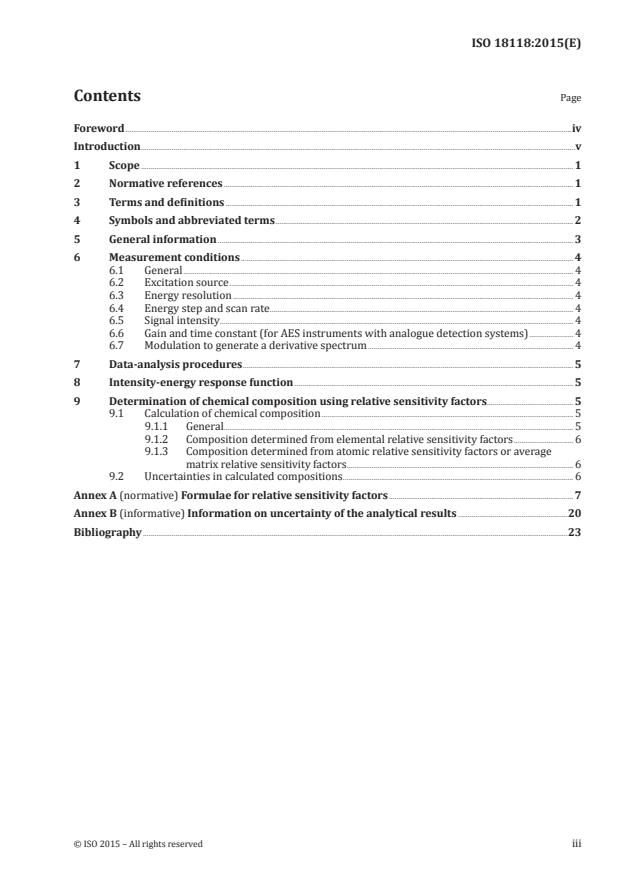
Contents Page
Foreword .iv
Introduction .v
1 Scope . 1
2 Normative references . 1
3 Terms and definitions . 1
4 Symbols and abbreviated terms . 2
5 General information . 3
6 Measurement conditions . 4
6.1 General . 4
6.2 Excitation source . 4
6.3 Energy resolution . 4
6.4 Energy step and scan rate. 4
6.5 Signal intensity . . 4
6.6 Gain and time constant (for AES instruments with analogue detection systems) . 4
6.7 Modulation to generate a derivative spectrum . 4
7 Data-analysis procedures . 5
8 Intensity-energy response function . 5
9 Determination of chemical composition using relative sensitivity factors .5
9.1 Calculation of chemical composition . 5
9.1.1 General. 5
9.1.2 Composition determined from elemental relative sensitivity factors . 6
9.1.3 Composition determined from atomic relative sensitivity factors or average
matrix relative sensitivity factors. 6
9.2 Uncertainties in calculated compositions . 6
Annex A (normative) Formulae for relative sensitivity factors . 7
Annex B (informative) Information on uncertainty of the analytical results .20
Bibliography .23
Foreword
ISO (the International Organization for Standardization) is a worldwide federation of national standards
bodies (ISO member bodies). The work of preparing International Standards is normally carried out
through ISO technical committees. Each member body interested in a subject for which a technical
committee has been established has the right to be represented on that committee. International
organizations, governmental and non-governmental, in liaison with ISO, also take part in the work.
ISO collaborates closely with the International Electrotechnical Commission (IEC) on all matters of
electrotechnical standardization.
The procedures used to develop this document and those intended for its further maintenance are
described in the ISO/IEC Directives, Part 1. In particular the different approval criteria needed for the
different types of ISO documents should be noted. This document was drafted in accordance with the
editorial rules of the ISO/IEC Directives, Part 2 (see www.iso.org/directives).
Attention is drawn to the possibility that some of the elements of this document may be the subject of
patent rights. ISO shall not be held responsible for identifying any or all such patent rights. Details of any
patent rights identified during the development of the document will be in the Introduction and/or on
the ISO list of patent declarations received (see www.iso.org/patents).
Any trade name used in this document is information given for the convenience of users and does not
constitute an endorsement.
For an explanation on the meaning of ISO specific terms and expressions related to conformity
assessment, as well as information about ISO’s adherence to the WTO principles in the Technical Barriers
to Trade (TBT), see the following URL: Foreword — Supplementary information.
The committee responsible for this document is ISO/TC 201, Surface chemical analysis, Subcommittee
SC 7, Electron spectroscopies.
This second edition cancels and replaces the first edition (ISO 18118:2004), which has been
technically revised.
iv © ISO 2015 – All rights reserved
Introduction
Auger electron spectroscopy (AES) and X-ray photoelectron spectroscopy (XPS) are surface-analytical
techniques that are sensitive to the composition in the surface region of a material to depths of, typically,
a few nanometres (nm). Both techniques yield a surface-weighted signal, averaged over the analysis
volume. Most samples have compositional variations, both laterally and with depth, and quantification
is often performed with approximate methods since it can be difficult to determine the magnitude of
any compositional variations and the distance scale over which they might occur. The simplest sample
for analysis is one that is homogeneous. Although this situation occurs infrequently, it is often assumed,
for simplicity in the analysis, that the sample material of interest is homogeneous. This International
Standard provides guidance on the measurement and use of experimentally determined relative
sensitivity factors for the quantitative analysis of homogeneous materials by AES and XPS.
INTERNATIONAL STANDARD ISO 18118:2015(E)
Surface chemical analysis — Auger electron spectroscopy
and X-ray photoelectron spectroscopy — Guide to the use
of experimentally determined relative sensitivity factors
for the quantitative analysis of homogeneous materials
1 Scope
This International Standard gives guidance on the measurement and use of experimentally determined
relative sensitivity factors for the quantitative analysis of homogeneous materials by Auger electron
spectroscopy and X-ray photoelectron spectroscopy.
2 Normative references
The following documents, in whole or in part, are normatively referenced in this document and are
indispensable for its application. For dated references, only the edition cited applies. For undated
references, the latest edition of the referenced document (including any amendments) applies.
ISO 18115, Surface chemical analysis — Vocabulary
ISO 21270, Surface chemical analysis — X-ray photoelectron and Auger electron spectrometers — Linearity
of intensity scale
3 Terms and definitions
For the purposes of this document, the terms and definitions given in ISO 18115 and the following apply.
3.1
absolute elemental sensitivity factor
coefficient for an element by which the measured intensity for that element is divided to yield the atomic
concentration or atomic fraction of the element present in the sample
Note 1 to entry: The choice of use of atomic concentration or atomic fraction should be made clear.
Note 2 to entry: The type of sensitivity factor used should be appropriate for the equations used in the quantification
process and for the type of sample analysed, for example, of homogeneous samples or segregated layers.
Note 3 to entry: The source of the sensitivity factors should be given in order that the correct matrix factors or
other parameters have been used.
Note 4 to entry: Sensitivity factors depend on parameters of the excitation source, the spectrometer, and the
orientation of the sample to these parts of the instrument. Sensitivity factors also depend on the matrix being
analysed and in SIMS, this has a dominating influence.
[SOURCE: ISO 18115:2013, modified]
3.2
relative elemental sensitivity factor
coefficient proportional to the absolute elemental sensitivity factor (3.1), where the constant of
proportionality is chosen such that the value for a selected element and transition is unity
Note 1 to entry: Elements and transitions commonly used are C 1s or F 1s for XPS and Ag M VV for AES.
4,5
Note 2 to entry: The type of sensitivity factor used should be appropriate for the analysis, for example, of
homogeneous samples or segregated layers.
Note 3 to entry: The source of the sensitivity factors should be given in order that the correct matrix factors or
other parameters have been used.
Note 4 to entry: Sensitivity factors depend on parameters of the excitation source, the spectrometer, and the
orientation of the sample to these parts of the instrument. Sensitivity factors also depend on the matrix being
analysed and in SIMS, this has a dominating influence.
[SOURCE: ISO 18115:2013]
3.3
average matrix relative sensitivity factor
coefficient proportional to the intensity calculated for a pure element in an average matrix with which
the measured intensity for that element is divided in calculations to yield the atomic concentration or
atomic fraction of the element present in the sample
Note 1 to entry: The choice of use of atomic concentration or atomic fraction should be made clear.
Note 2 to entry: The type of sensitivity factor used should be appropriate for the equations used in the quantification
process and for the type of sample analysed, for example, of homogeneous samples or segregated layers.
Note 3 to entry: The source of the sensitivity factors should be given. Matrix factors are taken to be unity for
average matrix relative sensitivity factors.
Note 4 to entry: Sensitivity factors depend on parameters of the excitation source, the spectrometer, and the
orientation of the sample to these parts of the instrument.
[SOURCE: ISO 18115:2013, modified]
3.4
pure-element relative sensitivity factor
coefficient proportional to the intensity measured for a pure sample of an element with which the
measured intensity for that element is divided in calculations to yield the atomic concentration or atomic
fraction of the element present in the sample
Note 1 to entry: The choice of use of atomic concentration or atomic fraction should be made clear.
Note 2 to entry: The type of sensitivity factor used should be appropriate for the equations used in the quantification
process and for the type of sample analysed, for example, of homogeneous samples or segregated layers.
Note 3 to entry: The source of the sensitivity factors should be given in order that the correct matrix factors or
other parameters have been used. Matrix factors are significant and should be used with pure-element relative
sensitivity factors.
Note 4 to entry: Sensitivity factors depend on parameters of the excitation source, the spectrometer, and the
orientation of the sample to these parts of the instrument.
[SOURCE: ISO 18115:2013, modified]
4 Symbols and abbreviated terms
AES Auger electron spectroscopy
AMRSF Average matrix relative sensitivity factor
ARSF Atomic relative sensitivity factor
ERSF Elemental relative sensitivity factor
IERF Intensity-energy response function
Atomic relative sensitivity factor for element i
At
S
i
2 © ISO 2015 – All rights reserved
Average matrix relative sensitivity factor for element i
Av
S
i
E Elemental relative sensitivity factor for element i
S
i
RSF Relative sensitivity factor
XPS X-ray photoelectron spectroscopy
5 General information
It is convenient in many quantitative applications of AES and XPS to utilize relative sensitivity
factors (RSFs) for quantitative analyses. Three types of RSF have been used for this purpose: elemental
relative sensitivity factors (ERSFs), atomic relative sensitivity factors (ARSFs), and average matrix
relative sensitivity factors (AMRSFs). Formulae defining these three types of RSF are given in A.3 and
the principles on which these formulae are based on are given in A.2.
While the ERSFs are the simplest and easiest to apply, they are the least accurate because no account is
taken of matrix correction factors (as described in A.3). The matrix correction factors for AES can vary
[1] [2]
between 0,1 and 8 while they can vary between 0,3 and 3 for XPS. The ARSFs are more accurate
than ERSFs in that they take account of differences in atomic densities, generally the largest single
matrix correction. The AMRSFs are the most reliable RSFs in that there is almost complete correction of
matrix effects. It is recommended that ERSFs be used only for semi-quantitative analyses (that is, rough
estimates of composition) and that ARSFs or preferably, AMRSFs be used for quantitative analyses. For
the latter applications, ARSFs shall be used only in situations for which it is not possible to make use of
AMRSFs (for example, measurements involving Auger electrons or photoelectrons at energies for which
inelastic mean free paths cannot be reliably determined).
In analytical applications of AES and XPS, it is essential that Auger-electron and photoelectron
intensities be measured using exactly the same procedure as that used for measurement of the RSFs.
For some applications of AES (e.g. sputter depth profiles), it is convenient to use peak-to-peak heights
of Auger-electron signals in the differential mode as measures of Auger-electron intensities. For other
applications of AES (e.g. scanning Auger microscopy), the Auger-electron intensity can be determined
from the difference between the intensity at a peak maximum in the direct spectrum and the intensity
of a nearby background signal. Finally, for many applications in XPS and for some applications of AES,
areas of peaks in direct spectra are used as measures of photoelectron or Auger-electron intensities.
Relative sensitivity factors depend on the parameters of the excitation source (for example, the incident
electron energy in AES and the choice of X-ray energy in XPS), the spectrometer configuration (for
example, the angle of incidence of the electron beam in AES, the angle between the X-ray source and
the analyser axis in XPS, the sample area viewed by the analyser, and the acceptance solid angle of
[3]
the analyser), and the orientation of the sample to these parts of the instrument. The sample area
viewed by the analyser and the analyser acceptance solid angle can depend on analyser settings (for
example, selection of apertures, whether the analyser is operated in the constant analyser energy
mode or the constant retardation ratio mode, and the corresponding choices of analyser pass energy
or retardation ratio). Finally, the measured Auger-electron or photoelectron intensities can depend on
the instrumental parameters described in Clause 6. Therefore, it is essential that Auger-electron and
photoelectron intensities be determined using exactly the same instrumental settings and the same
sample orientation as those employed for the ERSF measurements. It is also essential that the same
data-analysis procedures (described in Clause 7) be used in measurements of signal-electron intensities
for the unknown sample as those used in the ERSF measurements.
Commercial AES and XPS instruments are generally supplied with a set of ERSFs for one or more common
operating conditions. These ERSFs were typically determined on an instrument of the same type or, in
some cases, on similar instruments. It is recommended that an analyst check the ERSFs supplied with
the instrument for those elements expected to be of analytical interest to ensure that the supplied ERSFs
are correct. In addition, the intensity-energy response function (IERF) of the instrument can change
with time, as described in Clause 8. Such changes can be detected and corrective actions be taken using
[4]
calibration software available from the UK National Physical Laboratory. Alternatively, an analyst
can check for possible changes in IERF with time by measuring selected ERSFs as described in Clause 8.
6 Measurement conditions
6.1 General
The same measurement conditions (for example, instrumental configuration, sample orientation, and
instrumental settings) shall be used for the measurement with the unknown sample as those chosen for
the ERSF measurements. Particular attention shall be given to the following parameters.
6.2 Excitation source
The incident-electron energy in AES and the X-ray source in XPS shall be the same for the measurement
of the unknown sample as that chosen for the measurement of the ERSFs.
6.3 Energy resolution
Unless peak areas are used to measure the signal intensities, the energy resolution of the electron-energy
analyser (that is determined by choice of aperture sizes, pass energy, or retardation ratio) shall be the
[5]
same for the unknown-sample measurement as for the measurement used to generate the ERSFs.
6.4 Energy step and scan rate
The size of the energy step (energy per channel) used to acquire spectral data and the spectral scan
rate shall be chosen so that there is negligible spectral distortion in the acquired data for the selected
energy resolution.
6.5 Signal intensity
The incident-electron current (in AES) or the X-ray intensity (in XPS) shall be adjusted together with
the voltage applied to the detector so that the measured signal intensity is proportional to the incident
current or X-ray intensity to within 1 % as described in ISO 21270. Alternatively, the measured signal
intensity that is corrected for counting losses as described in ISO 21270 shall be proportional to the
incident current or X-ray intensity to within 1 %.
6.6 Gain and time constant (for AES instruments with analogue detection systems)
The settings of the detector system shall be the same in the unknown-sample measurement as in the
[6]
measurement used to generate the ERSFs. The time constant in the measurements shall be sufficiently
short so that shapes of spectral features are not significantly distorted during data acquisition. The gain
of the detector system shall be adjusted so that the intensities measured for the relevant peaks are
within the range for linear detector response.
Procedures to check for linear detector response in pulse-counting systems are described in ISO 21270.
The first method described there may be used for analogue AES systems if there are sufficient
instrumental controls.
6.7 Modulation to generate a derivative spectrum
It is often convenient in AES to utilize the differential spectrum. The derivative spectrum can be acquired
[7][8]
by applying a modulation energy to the analyser or by numerical processing of a measured direct
[9][10]
spectrum. For this purpose, a modulation or numerical differential of between 2 eV and 10 eV
4 © ISO 2015 – All rights reserved
(peak-to-peak) is commonly used. The same modulation energy shall be used for the measurements
with the unknown sample as that used to determine the ERSFs.
NOTE The details of the peak attenuation in numerical differentiation and of the Savitzky and Golay
differentiation method in AES can be obtained from Reference [9] and Reference [10].
7 Data-analysis procedures
The same procedures shall be used for the analysis of the spectra measured for the unknown sample
and for the ERSF measurements.
To obtain a peak area or a peak height from a measured direct spectrum, a background shall be chosen
and subtracted from the measured spectrum (see Reference [11]). The backgrounds most commonly used
[12] [13] [14]
for this purpose are a linear background, a Shirley background, or a Tougaard background.
In AES, it is often convenient to measure a peak-to-peak height or a peak-to-background height in a
differential spectrum. The differential spectrum can be recorded (in analogue detection instruments)
or a measured direct spectrum can be numerically differentiated for this purpose. The same numerical
procedure and choices shall be made in the differentiation of the spectra for the unknown sample and
[11][15]
for the reference samples used to determine the ERSFs. See also 6.7.
NOTE 1 Details of background-subtraction procedures are given in Reference [11].
NOTE 2 Details of peak attenuation in numerical differentiation and of the Savitzky and Golay differentiation
method in AES can be obtained from Reference [9] and Reference [10].
NOTE 3 Reference [16] gives information on procedures to obtain consistent results in the use of differentiation
for measurements with different chemical states of an element. This reference provides similar information for
the determination of peak areas.
8 Intensity-energy response function
The intensity-energy response function (IERF) is a measure of the efficiency of the electron-energy
analyser in transmitting electrons and of the detector system in detecting them as a function of electron
[1][17][18]
energy. In general, the IERF will change if the analyser pass energy, retardation ratio, and
aperture sizes are modified. In addition, different instruments of the same type (and from the same
manufacturer) can have different IERFs for the same instrumental settings because the detector
efficiency as a function of energy will often change during its service life. As a result, it is recommended
that the intensity scale be calibrated at regular intervals (for example, every six months) using calibration
[4]
software available from the UK National Physical Laboratory or that ERSFs be measured for selected
elements (having Auger-electron or photoelectron peaks over the working range of the energy scale).
Such checks should also be made if the detector surface has been exposed to any environment that could
affect its efficiency and if insulating films (e.g. from sputtering of non-conducting samples) have been
deposited on analyser surfaces. Local measurements of ERSFs for selected elements shall be recorded in
the log book for the instrument and plotted as a function of time so that changes can be easily detected.
9 Determination of chemical composition using relative sensitivity factors
9.1 Calculation of chemical composition
9.1.1 General
The chemical composition of an unknown sample may be determined using Formula (A.5) and
Formula (A.6) or one of the other formulae given in Annex A. Formula (A.6) is commonly used but ignores
matrix terms. For some types of relative sensitivity factor, these matrix terms are effectively unity, and
may be ignored but, when other types of sensitivity factor are used, the matrix factors can be as high as
[1] [2]
8 in AES and 3 in XPS. The accuracy of calculated chemical compositions thus depends significantly
on the type of sensitivity factor used. This is discussed in Annex A.
NOTE AES and XPS cannot directly detect hydrogen or helium. A quantitative analysis of an unknown sample
that is likely to contain one of these elements (e.g. organic compounds) will have a systematic error unless some
method is devised to overcome this limitation.
In some applications, it can be satisfactory to determine the composition of an unknown sample if a
reference sample of similar composition is available. For this situation, measurements are made of
signal-electron intensities from the unknown samples and reference samples, and the composition
is calculated using Formula (A.4). If the two materials are close in composition, matrix correction
factors can be ignored and Formula (A.4) is valid. The analyst should nevertheless be aware that it
can be difficult to prepare reference samples of known composition; for example, compounds cleaned
by ion sputtering will generally have a surface composition different from the bulk composition due
to preferential-sputtering effects. This can be helpful if the sample to be analysed has been similarly
sputtered. However, artefacts due to sputtering are beyond the scope of this International Standard.
Scraping, fracturing, or cleaving of the reference sample, where feasible, may be a suitable means of
generating a suitable surface for comparisons with the unknown sample.
9.1.2 Composition determined from elemental relative sensitivity factors
E
The composition of the unknown sample can be obtained from Formula (A.6) using ERSFs, S , supplied
i
by the instrument manufacturer or as measured by the analyst.
9.1.3 Composition determined from atomic relative sensitivity factors or average matrix
relative sensitivity factors
At
The composition of the unknown sample can be obtained from Formula (A.6) using ARSFs, S , or
i
Av
AMRSFs, S .
i
NOTE 1 The ARSFs can be supplied by the instrumental manufacturer or be calculated by the
analyst using Formula (A.9).
NOTE 2 The AMRSFs can be obtained from Formula (A.10) together with Formula (A.11) to Formula (A.34).
9.2 Uncertainties in calculated compositions
[19]
Many factors can contribute to the uncertainty of a chemical composition determined from RSFs.
Information on possible uncertainties in such measurements is given in Annex B.
6 © ISO 2015 – All rights reserved
Annex A
(normative)
Formulae for relative sensitivity factors
A.1 Symbols and abbreviated terms
AES Auger electron spectroscopy
A atomic mass of element i
i
C number of atoms of element i in the molecular formula of the compound
i
E binding energy of core level for element i
b,i
E band-gap energy
g
E kinetic energy of an Auger electron or photoelectron from element i
i
E free-electron plasmon energy
p
E primary electron energy
pr
F matrix correction factor for element i
i
F matrix correction factor for element j
j
H(cosα, ω ) Chandrasekhar function for parameters cosα and ω
i i
unk
I measured intensity of element i in the unknown sample
i
unk
I
measured intensity of element j in the unknown sample
j
ref
I measured intensity of element i in the reference sample
i
ref
I
measured intensity of element j in the reference sample
j
I measured intensity of the key material
key
M molecular mass of the compound containing element i
i
N Avogadro constant
A
N atomic density for the average matrix sample
av
N atomic density of element i
i
N number of valence electrons per atom or molecule
v
key
N atomic density of the key element
ref
N atomic density of the reference sample of element i
i
unk
N atomic density of the unknown sample
n number of identified elements in the unknown sample
Q elastic-scattering correction factor for the average matrix sample
av
Q elastic-scattering correction factor for element i
i
Q (0) elastic-scattering correction factor for element i at emission angle α = 0 with respect to
i
the surface normal
ref
Q
elastic-scattering correction factor for element i in the reference sample
i
unk
Q elastic-scattering correction factor for element i in the unknown sample
i
ref
r backscattering factor for element i in the reference sample
i
unk
r backscattering factor for element i in the unknown sample
i
r backscattering factor for the average matrix sample
av
r backscattering factor for element i
i
RSF relative sensitivity factor
E
S elemental relative sensitivity factor for element i
i
At
S atomic relative sensitivity factor for element i
i
Av
S average matrix relative sensitivity factor for element i
i
RSF
S
relative sensitivity factor for element i
i
RSF
S
relative sensitivity factor for element j
j
Ep
S pure-element relative sensitivity factor for element i
i
Ec
S elemental relative sensitivity factor for element i in a specified compound
i
U over-voltage ratio, given by the ratio of the primary energy to the binding energy of the
electrons in a particular shell or subshell
unk
X atomic fraction of element i in the unknown sample
i
ref
X atomic fraction of element i in the reference sample
i
XPS X-ray photoelectron spectroscopy
8 © ISO 2015 – All rights reserved
Z atomic number
Z atomic number of the average matrix sample
av
α emission angle with respect to the surface normal
ζ ratio of the transport mean free path to the inelastic mean free path for element i
i
−3
ρ density of the solid (kg⋅m )
ω single-scattering albedo for element i
i
θ angle of incidence of electron beam
Γ coefficient for determining ζ for element i
i,0 i
Γ coefficient for determining ζ for element i
i,1 i
Γ coefficient for determining ζ for element i
i,2 i
Γ coefficient for determining ζ for element i
i,3 i
λ electron inelastic mean free path for the average matrix sample
av
λ electron inelastic mean free path for element i
i
ref
λ electron inelastic mean free path for element i in the reference sample
i
unk
λ
electron inelastic mean free path for element i in the unknown sample
i
A.2 Principles
Quantitative analysis of a homogeneous sample can be accomplished through comparison of an Auger-
unk
electron or photoelectron peak intensity, I , from an unknown sample (the sample material whose
i
ref
surface composition is to be determined) with the corresponding peak intensity, I , from a reference
i
sample with known surface composition (either a pure element or a suitable compound) in order to
remove instrumental and, in some cases, matrix factors. This comparison can only be made if the
analytical conditions for both measurements are identical. In the simplest analytical case, when the
sample surface is assumed to consist of a single phase and to be atomically flat, the measured intensity
[1][20][21][22][23][24]
ratio is given by Formula (A.1):
unkunk unkunk unk
unk
XN Qr()1+ λ
I
ii ii
i
= (A.1)
ref refref ref refref
I XN Qr(1+ )λ
i ii i iii
where
is the atomic fraction of the element i in the unknown samples;
unk
X
i
is the atomic fraction of the element i in the reference samples;
ref
X
i
unk is the atomic density of the element i in the unknown samples;
N
ref is the atomic density of the element i in the reference samples;
N
i
[25]
is the correction for elastic-electron scattering in the unknown samples;
unk
Q
i
[25]
is the correction for elastic-electron scattering in the reference samples;
ref
Q
i
unk is the backscattering factors for AES (these terms are zero for XPS) in the unknown samples;
r
i
ref is the backscattering factors for AES (these terms are zero for XPS) in the reference samples;
r
i
is the electron inelastic mean free paths in the unknown samples;
unk
λ
i
is the electron inelastic mean free paths in the reference samples.
ref
λ
i
It should be understood that the elastic-scattering correction terms and the inelastic mean free
paths in Formula (A.1) are determined at the electron energy E for the particular Auger-electron or
i
photoelectron peak of interest. The backscattering factor terms are determined at the electron energy
E for the binding energy E corresponding to the initial ionization that was responsible for the Auger
i b,i
peak of element i being measured.
unk
From Formula (A.1), X can be obtained using Formula (A.2):
i
unk refref refref ref unk
I XN Qr()1+ λ I
unk ref
i ii ii i i
X = =X F (A.2)
i i i
ref unk unkunk unk ref
I NQ ()1+r λ I
i iii i i
where
F is the matrix correction factor for element i in the comparison of measurements made with a
i
particular unknown sample and a particular reference sample.
ref
For AES, if the reference intensities are for pure elements with X values of unity, the F are in the
i
i
[1]
range 0,1 to 8 with one-third of the values outside the range 0,5 to 1,5. For XPS, the F are closer to
i
[2]
unity and range from 0,3 to 3.
10 © ISO 2015 – All rights reserved
The atomic fraction of the element i in an unknown sample with n identified elements is then given by
[1][24]
Formula (A.3):
unk
I
ref
i
X F
i
i
ref
I
i
unk
X = (A.3)
i
unk
n
I
j
ref
X F
∑ j
j
ref
I
j
j=11
This formula should be solved iteratively since the matrix factors depend on the composition of the
material. This composition is, of course, unknown until Formula (A.3) is solved. If, for simplicity, it is
assumed that the atomic densities, elastic-scattering correction factors, backscattering factors, and
inelastic mean free paths are the same for the two samples considered in Formula (A.2) and the reference
sample is pure elemental solids, the matrix correction factors F = 1 , and the reference atomic fractions
i
ref
X =1 . For these assumptions, if the unknown sample consists of n elements, the atomic fractions X of
i
i
[24]
these elements can be obtained from Formula (A.4):
unk
I
i
ref
I
i
unk
X = (A.4)
i
unk
n
I
j
∑
ref
I
j
j=1
While Formula (A.4) is simple and is often used for quantitative surface analysis by AES and XPS, it
should be emphasized that it is based on the simplifying assumption that the matrix correction factors
unk
F for the elements in the unknown sample are unity. In reality, F values (calculated for X for pure
i i
i
[1]
elements) in AES are between 0,1 and 8 (with one-third of the values outside the range 0,5 to 1,5)
[2]
while the F values range from 0,3 to 3 for XPS.
i
ref unk
Values of I are needed for a quantitative analysis to obtain the fractional compositions X from
i i
unk ref
measured values of I for an unknown sample using Formula (A.3) or Formula (A.4). The I values
i i
can be obtained from a series of measurements for those elements that can be conveniently prepared as
solids with a sufficiently high degree of purity (generally better than 99 %) and with clean surfaces in an
AES or XPS instrument. For other elements (e.g. the alkali metals and elements such as oxygen, nitrogen,
ref
and the halogens that are gases at room temperature), the I values can be estimated from similar
i
measurements with compounds containing the desired elements. Unless corrections can be made for
matrix effects [the matrix correction factor F in Formula (A.3) and the additional matrix effects discussed
i
ref
[26][27]
in B.2], values of I for the same element i from different compounds can be different.
i
ref
It is generally convenient in practice to make use of I values that have been normalized to unity for a
i
[1][7][28][29][30][31][32][33]
particular peak from a selected key element. In XPS, the 1s photoelectron line
of fluorine in lithium fluoride has been generally used for this purpose while the silver M4,5VV Auger-
electron line has been commonly used in AES.
A.3 Relative sensitivity factors
A.3.1 Introduction
Defining formulae are given here for three different types of relative sensitivity factor (RSF) that can be
ref RSF
obtained from I values. The RSFs, S , for an element i in an unknown material containing n
i i
unk
elements, can be used to evaluate the atomic fraction, X , of the element i from Formula (A.5):
i
unk
IF
ii
RSF
S
unk i
X = (A.5)
i
unk
n
IF
jj
∑
RSF
S
j=1 j
RSF ref
Formula (A.5) can be obtained from Formula (A.3) by equating S with normalized values of I . If,
i i
for simplicity, the matrix correction factors are neglected, Formula (A.5) becomes Formula (A.6):
unk
I
i
RSF
S
unk i
X = (A.6)
i
unk
n
I
j
∑
RSF
S
j=1 j
The three types of RSF defined below (elemental RSFs, atomic RSFs, and average matrix RSFs that are
E At Av
designated S , S , and S , respectively) give analytical results of increasing accuracy. These RSFs
i i i
RSF
can be used for surface analyses in place of S in Formula (A.6).
i
It should be emphasized that the values of all RSFs depend on how the line intensities are measured and
on the experimental conditions such as the parameters of the excitation source, the spectrometer
configuration, and the orientation of the sample with respect to these parts of the instrument. Surface
analyses made with particular sets of RSFs shall be based on AES or XPS measurements that were made
with the same method of intensity measurement and with identical experimental conditions. Also, a
E At Av
consistent set of RSFs (S , S , or S ) shall be used in an analysis.
i i i
A.3.2 Elemental relative sensitivity factors (with no correction for matrix effects)
A.3.2.1 General
As noted in A.2, elemental RSFs can be obtained from measurements made with pure elements or with
compounds containing the desired element, as indicated in A.3.2.2 and A.3.2.3, respectively.
A.3.2.2 Pure-element relative sensitivity factors
Ep ref
The pure-element relative sensitivity factor (PERSF), S , can be obtained from measurements of S
i
i
for the selected element and a measurement of the peak intensity for the selected key material, I , as
key
given in Formula (A.7):
ref
I
Ep
i
S = (A.7)
i
I
key
The use of these sensitivity factors in Formula (A.5) requires that the matrix factors F given in
i
ref
Formula (A.2) are evaluated for pure elements (i.e. X =1 ). The use of these sensitivity factors in
i
[1] [2]
Formula (A.6) leads to errors in AES between 0,1 and 8 in AES and 0,3 and 3 in XPS.
12 © ISO 2015 – All rights reserved
A.3.2.3 Elemental relative sensitivity factors from measurements with compounds
Ec
The elemental relative sensitivity factor for element i in a specified compound, S , can be obtained
i
ref
from measurements of I for the selected element in that compound and of I for the particular key
i key
material as given in Formula (A.8):
ref
I
Ec i
S = (A.8)
i
ref
XI
i key
where
is the atomic fraction of element i in the compound.
ref
X
i
Ec
As noted in A.2, values of S for the same element i in different compounds might be different due in
i
part to uncorrected matrix factors and in part to limitations of the experimental measurements (such
as different attenuations of peaks of different energies due to surface contamination on un-cleaned
samples or to preferential sputtering effects if the sample surfaces were cleaned by ion bombardment.
It was hoped in early measurements that, by measuring many compounds, the effects of surface
contamination could be averaged out. For example, ratios of RSFs obtained for two elements from
measurements with different compounds containing those elements showed a standard deviation of
[34]
typically 14 %. In addition, evaluations of the RSFs from different data sets indicated a poor
[26][35]
correlation with theoretical predictions.
The use of these sensitivity factors in Formula (A.5) requires that the F matrix factors given in
i
ref
Formula (A.2) are evaluated for compounds where, in each matrix factor, the X values might differ.
i
These matrix factor values might differ from those for pure elements. The use of these sensitivity factors
in Formula (A.6) leads to errors likely to be slightly lower than those given above for pure elements.
A.3.2.4 Sets of elemental relative sensitivity factors
Ep Ec
Measurements of S and S for a particular instrument and for particular experimental conditions
i
i
E
have often been combined to yield a set of elemental RSFs, S .
i
NOTE Instrument suppliers can provide a set of elemental RSFs.
A.3.3 Atomic relative sensitivity factors (with partial correction of matrix effects)
The ratio of atomic densities in Formula (A.2) is generally the most important contribution to the matrix
[20][31]
correction factor F . Atomic relative sensitivity factors (ARSFs) can be defined that include ratios
i
At
of atomic densities to provide in this way a partial correction of matrix effects. The ARSFs, S , can be
i
obtained from the elemental relative sensitivity factors obtained from pure elements and from
E
compounds, S , using Formula (A.9):
i
key
N
At E
S = S (A.9)
i i
N
i
where
key
N is the atomic densities for the key element;
N is the atomic densities for element i.
i
These sensitivity factors are used with Formula (A.6) with errors significantly lower than those for
pure-element relative sensitivity factors.
A.3.4 Average matrix relative sensitivity factors (with nearly complete correction of
matrix ef
...
Questions, Comments and Discussion
Ask us and Technical Secretary will try to provide an answer. You can facilitate discussion about the standard in here.
Loading comments...