


ISO/IEC 11179-6:2005
(Main)Information technology — Metadata registries (MDR) — Part 6: Registration
Information technology — Metadata registries (MDR) — Part 6: Registration
ISO/IEC 11179-6:2005 specifies the procedure by which Administered Items required in various application areas could be registered and assigned an internationally unique identifier. For each Administered Item to be registered, ISO/IEC 11179-6:2005 defines the type of information that is specified, the conditions that are met, and the procedure that is followed. The requirements and procedure contained herein apply to all Administered Items specified in ISO/IEC 11179-3. In addition, administration records that document the common administration and identification, naming and definition details as required by, and associated with, any administered item-specific details are also governed by ISO/IEC 11179-6:2005. ISO/IEC 11179-6:2005 only addresses the metadata that is used to specify all types of Administered Items. Others may want to use ISO/IEC 11179-6:2005 to register and manage locally defined Administered Item types that are not defined in ISO/IEC 11179-3. ISO/IEC 11179-6:2005 does not address the metadata that is used to specify particular types of Administered Items such as data elements and value domains. ISO/IEC 11179-6:2005 does not specify the registry's system design, file organization techniques, storage media, programming languages, etc. to be used in its implementation.
Technologies de l'information — Registres de métadonnées (RM) — Partie 6: Enregistrement
General Information
- Status
- Withdrawn
- Publication Date
- 09-Jan-2005
- Withdrawal Date
- 09-Jan-2005
- Technical Committee
- ISO/IEC JTC 1/SC 32 - Data management and interchange
- Drafting Committee
- ISO/IEC JTC 1/SC 32/WG 2 - MetaData
- Current Stage
- 9599 - Withdrawal of International Standard
- Start Date
- 04-Aug-2015
- Completion Date
- 12-Feb-2026
Relations
- Effective Date
- 10-Feb-2026
- Effective Date
- 10-Feb-2026
- Effective Date
- 10-Feb-2026
- Revised
ISO/IEC 11179-6:2015 - Information technology — Metadata registries (MDR) — Part 6: Registration - Effective Date
- 03-Sep-2011
- Effective Date
- 15-Apr-2008
Get Certified
Connect with accredited certification bodies for this standard

BSI Group
BSI (British Standards Institution) is the business standards company that helps organizations make excellence a habit.

NYCE
Mexican standards and certification body.
Sponsored listings
Frequently Asked Questions
ISO/IEC 11179-6:2005 is a standard published by the International Organization for Standardization (ISO). Its full title is "Information technology — Metadata registries (MDR) — Part 6: Registration". This standard covers: ISO/IEC 11179-6:2005 specifies the procedure by which Administered Items required in various application areas could be registered and assigned an internationally unique identifier. For each Administered Item to be registered, ISO/IEC 11179-6:2005 defines the type of information that is specified, the conditions that are met, and the procedure that is followed. The requirements and procedure contained herein apply to all Administered Items specified in ISO/IEC 11179-3. In addition, administration records that document the common administration and identification, naming and definition details as required by, and associated with, any administered item-specific details are also governed by ISO/IEC 11179-6:2005. ISO/IEC 11179-6:2005 only addresses the metadata that is used to specify all types of Administered Items. Others may want to use ISO/IEC 11179-6:2005 to register and manage locally defined Administered Item types that are not defined in ISO/IEC 11179-3. ISO/IEC 11179-6:2005 does not address the metadata that is used to specify particular types of Administered Items such as data elements and value domains. ISO/IEC 11179-6:2005 does not specify the registry's system design, file organization techniques, storage media, programming languages, etc. to be used in its implementation.
ISO/IEC 11179-6:2005 specifies the procedure by which Administered Items required in various application areas could be registered and assigned an internationally unique identifier. For each Administered Item to be registered, ISO/IEC 11179-6:2005 defines the type of information that is specified, the conditions that are met, and the procedure that is followed. The requirements and procedure contained herein apply to all Administered Items specified in ISO/IEC 11179-3. In addition, administration records that document the common administration and identification, naming and definition details as required by, and associated with, any administered item-specific details are also governed by ISO/IEC 11179-6:2005. ISO/IEC 11179-6:2005 only addresses the metadata that is used to specify all types of Administered Items. Others may want to use ISO/IEC 11179-6:2005 to register and manage locally defined Administered Item types that are not defined in ISO/IEC 11179-3. ISO/IEC 11179-6:2005 does not address the metadata that is used to specify particular types of Administered Items such as data elements and value domains. ISO/IEC 11179-6:2005 does not specify the registry's system design, file organization techniques, storage media, programming languages, etc. to be used in its implementation.
ISO/IEC 11179-6:2005 is classified under the following ICS (International Classification for Standards) categories: 35.040 - Information coding; 35.040.50 - Automatic identification and data capture techniques. The ICS classification helps identify the subject area and facilitates finding related standards.
ISO/IEC 11179-6:2005 has the following relationships with other standards: It is inter standard links to EN IEC 62769-8:2023, EN IEC 62832-1:2020, EN IEC 62541-19:2026, ISO/IEC 11179-6:2015, ISO/IEC 11179-6:1997. Understanding these relationships helps ensure you are using the most current and applicable version of the standard.
ISO/IEC 11179-6:2005 is available in PDF format for immediate download after purchase. The document can be added to your cart and obtained through the secure checkout process. Digital delivery ensures instant access to the complete standard document.
Standards Content (Sample)
INTERNATIONAL ISO/IEC
STANDARD 11179-6
Second edition
2005-01-15
Information technology — Metadata
registries (MDR) —
Part 6:
Registration
Technologies de l'information — Registres de métadonnées (RM) —
Partie 6: Enregistrement
Reference number
©
ISO/IEC 2005
PDF disclaimer
This PDF file may contain embedded typefaces. In accordance with Adobe's licensing policy, this file may be printed or viewed but
shall not be edited unless the typefaces which are embedded are licensed to and installed on the computer performing the editing. In
downloading this file, parties accept therein the responsibility of not infringing Adobe's licensing policy. The ISO Central Secretariat
accepts no liability in this area.
Adobe is a trademark of Adobe Systems Incorporated.
Details of the software products used to create this PDF file can be found in the General Info relative to the file; the PDF-creation
parameters were optimized for printing. Every care has been taken to ensure that the file is suitable for use by ISO member bodies. In
the unlikely event that a problem relating to it is found, please inform the Central Secretariat at the address given below.
© ISO/IEC 2005
All rights reserved. Unless otherwise specified, no part of this publication may be reproduced or utilized in any form or by any means,
electronic or mechanical, including photocopying and microfilm, without permission in writing from either ISO at the address below or
ISO's member body in the country of the requester.
ISO copyright office
Case postale 56 • CH-1211 Geneva 20
Tel. + 41 22 749 01 11
Fax + 41 22 749 09 47
E-mail copyright@iso.org
Web www.iso.org
Published in Switzerland
ii © ISO/IEC 2005 — All rights reserved
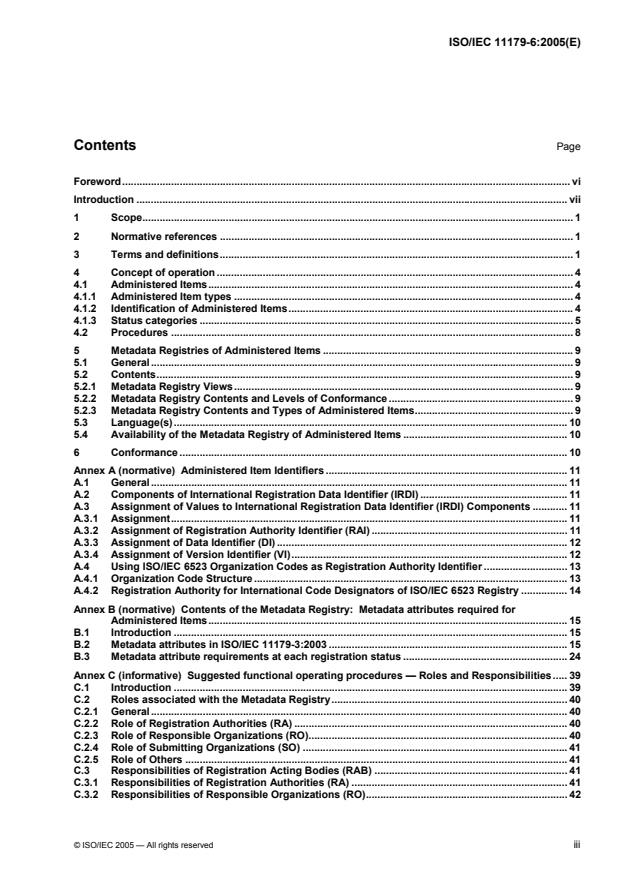
Contents Page
Foreword. vi
Introduction . vii
1 Scope. 1
2 Normative references . 1
3 Terms and definitions. 1
4 Concept of operation . 4
4.1 Administered Items. 4
4.1.1 Administered Item types . 4
4.1.2 Identification of Administered Items. 4
4.1.3 Status categories . 5
4.2 Procedures . 8
5 Metadata Registries of Administered Items .9
5.1 General. 9
5.2 Contents. 9
5.2.1 Metadata Registry Views. 9
5.2.2 Metadata Registry Contents and Levels of Conformance . 9
5.2.3 Metadata Registry Contents and Types of Administered Items. 9
5.3 Language(s). 10
5.4 Availability of the Metadata Registry of Administered Items . 10
6 Conformance . 10
Annex A (normative) Administered Item Identifiers . 11
A.1 General. 11
A.2 Components of International Registration Data Identifier (IRDI) . 11
A.3 Assignment of Values to International Registration Data Identifier (IRDI) Components . 11
A.3.1 Assignment. 11
A.3.2 Assignment of Registration Authority Identifier (RAI) . 11
A.3.3 Assignment of Data Identifier (DI) . 12
A.3.4 Assignment of Version Identifier (VI). 12
A.4 Using ISO/IEC 6523 Organization Codes as Registration Authority Identifier . 13
A.4.1 Organization Code Structure . 13
A.4.2 Registration Authority for International Code Designators of ISO/IEC 6523 Registry . 14
Annex B (normative) Contents of the Metadata Registry: Metadata attributes required for
Administered Items. 15
B.1 Introduction . 15
B.2 Metadata attributes in ISO/IEC 11179-3:2003 . 15
B.3 Metadata attribute requirements at each registration status . 24
Annex C (informative) Suggested functional operating procedures — Roles and Responsibilities. 39
C.1 Introduction . 39
C.2 Roles associated with the Metadata Registry. 40
C.2.1 General. 40
C.2.2 Role of Registration Authorities (RA) . 40
C.2.3 Role of Responsible Organizations (RO).40
C.2.4 Role of Submitting Organizations (SO) . 41
C.2.5 Role of Others . 41
C.3 Responsibilities of Registration Acting Bodies (RAB) . 41
C.3.1 Responsibilities of Registration Authorities (RA) . 41
C.3.2 Responsibilities of Responsible Organizations (RO). 42
© ISO/IEC 2005 — All rights reserved iii
C.3.3 Responsibilities of Submitting Organizations (SO).42
C.4 Responsibilities of Organizations within Registration Acting Bodies .43
C.4.1 Registrar.43
C.4.2 Stewards.44
C.4.3 Submitters.44
C.4.4 Read-only users.44
C.4.5 Control Committee .45
C.4.6 Executive Committee (ExCom) .45
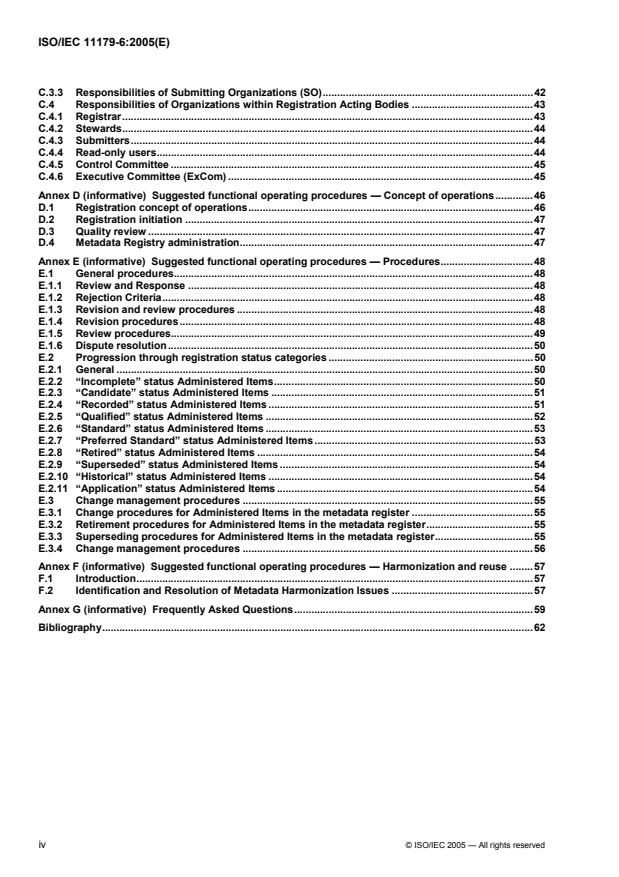
Annex D (informative) Suggested functional operating procedures — Concept of operations.46
D.1 Registration concept of operations.46
D.2 Registration initiation .47
D.3 Quality review .47
D.4 Metadata Registry administration.47
Annex E (informative) Suggested functional operating procedures — Procedures.48
E.1 General procedures.48
E.1.1 Review and Response .48
E.1.2 Rejection Criteria.48
E.1.3 Revision and review procedures .48
E.1.4 Revision procedures.48
E.1.5 Review procedures.49
E.1.6 Dispute resolution.50
E.2 Progression through registration status categories .50
E.2.1 General .50
E.2.2 “Incomplete” status Administered Items.50
E.2.3 “Candidate” status Administered Items .51
E.2.4 “Recorded” status Administered Items .51
E.2.5 “Qualified” status Administered Items .52
E.2.6 “Standard” status Administered Items .53
E.2.7 “Preferred Standard” status Administered Items.53
E.2.8 “Retired” status Administered Items .54
E.2.9 “Superseded” status Administered Items .54
E.2.10 “Historical” status Administered Items .54
E.2.11 “Application” status Administered Items .54
E.3 Change management procedures .55
E.3.1 Change procedures for Administered Items in the metadata register .55
E.3.2 Retirement procedures for Administered Items in the metadata register.55
E.3.3 Superseding procedures for Administered Items in the metadata register.55
E.3.4 Change management procedures .56
Annex F (informative) Suggested functional operating procedures — Harmonization and reuse .57
F.1 Introduction.57
F.2 Identification and Resolution of Metadata Harmonization Issues .57
Annex G (informative) Frequently Asked Questions.59
Bibliography.62
iv © ISO/IEC 2005 — All rights reserved
Figures
Figure A.1 — Structure of International registration Data Identifier (IRDI) . 12
Figure C-1 — Organizational roles to the Metadata Registry and their relationships. 39
Figure D.1 — Registration functional activities . 46
Tables
Table 1 — Registration status levels and criteria. 6
Table A-1 — DUNS Entry from the ISO/IEC 6523 Registry . 14
Table B-1 — Metadata attributes for Administered Items. 16
Table B-2 — Required elementary metadata attributes at each registration status . 24
Table B-3 — “Incomplete Status” — Required Metadata Attributes.29
Table B-4 — “Candidate” Status — Required Metadata Attributes .30
Table B-5 — “Recorded” Status — Required Metadata Attributes.31
Table B-6 — “Qualified” Status — Required Metadata Attributes . 32
Table B-7 — “Standard” Status — Required Metadata Attributes. 33
Table B-8 — “Preferred Standard” Status — Required Metadata Attributes. 34
Table B-9 — “Retired” Status — Required Metadata Attributes . 35
Table B-10 — “Superseded” Status — Required Metadata Attributes . 36
Table B-11 — “Application” Status — Required Metadata Attributes.37
Table B-12 — “Historical” Status — Required Metadata Attributes. 38
© ISO/IEC 2005 — All rights reserved v
Foreword
ISO (the International Organization for Standardization) and IEC (the International Electrotechnical
Commission) form the specialized system for worldwide standardization. National bodies that are members of
ISO or IEC participate in the development of International Standards through technical committees
established by the respective organization to deal with particular fields of technical activity. ISO and IEC
technical committees collaborate in fields of mutual interest. Other international organizations, governmental
and non-governmental, in liaison with ISO and IEC, also take part in the work. In the field of information
technology, ISO and IEC have established a joint technical committee, ISO/IEC JTC 1.
International Standards are drafted in accordance with the rules given in the ISO/IEC Directives, Part 2.
The main task of the joint technical committee is to prepare International Standards. Draft International
Standards adopted by the joint technical committee are circulated to national bodies for voting. Publication as
an International Standard requires approval by at least 75 % of the national bodies casting a vote.
Attention is drawn to the possibility that some of the elements of this document may be the subject of patent
rights. ISO and IEC shall not be held responsible for identifying any or all such patent rights.
ISO/IEC 11179-6 was prepared by Joint Technical Committee ISO/IEC JTC 1, Information technology,
Subcommittee SC 32, Data management and interchange.
This second edition cancels and replaces the first edition (ISO/IEC 11179-6:1997).
ISO/IEC 11179 consists of the following parts, under the general title Information technology — Metadata
registries (MDR):
Part 1: Framework
Part 2: Classification
Part 3: Registry metamodel and basic attributes
Part 4: Formulation of data definitions
Part 5: Naming and identification principles
Part 6: Registration
vi © ISO/IEC 2005 — All rights reserved
Introduction
This part of ISO/IEC 11179 specifies the procedure by which administered items required in various
application areas could be registered and assigned an internationally unique identifier. The uniqueness of the
identification of a registered administered item is determined by a combination of the Registration Authority
Identifier (RAI), the unique identifier assigned to a administered item within a Registration Authority (RA), and
the version under which an administered item registration is submitted or updated. The registered
administered items are included in Registries of Administered Items, maintained by a Registration Authority, to
which the administered items logically and functionally belong. An organization wishing to become a
Registration Authority may do so in accordance with the procedure prescribed in Annex A.
This part of ISO/IEC 11179 has been revised to address other types of Administered Items besides data
elements: data element concepts, conceptual domains and value domains. Each of these types of
Administered Items, including data elements, is represented within a metadata registry by administration
records that document the common administration and identification, naming and definition details together
with their administered item-specific details.
Within this part of ISO/IEC 11179 the use of “Metadata Registry” denotes an implementation of a metadata
registry that is based upon ISO/IEC 11179 and that is managed by a Registration Authority.
© ISO/IEC 2005 — All rights reserved vii
INTERNATIONAL STANDARD ISO/IEC 11179-6:2005(E)
Information technology — Metadata registries (MDR) —
Part 6:
Registration
1 Scope
This part of ISO/IEC 11179 specifies the procedure by which administered items required in various
application areas could be registered and assigned an internationally unique identifier. For each Administered
Item to be registered, this part of ISO/IEC 11179 defines the type of information that is specified, the
conditions that are met, and the procedure(s) that are followed.
The requirements and procedure contained herein apply to all Administered Items specified in
ISO/IEC 11179-3. In addition, administration records that document the common administration and
identification, naming and definition details as required by, and associated with, any administered item-specific
details are also governed by this part of ISO/IEC 11179.
This part of ISO/IEC 11179 only addresses the metadata that is used to specify all types of Administered
Items. Others may want to use this part of ISO/IEC 11179 to register and manage locally defined
Administered Item types that are not defined in ISO/IEC 11179-3.
This part of ISO/IEC 11179 does not address the metadata that is used to specify particular types of
Administered Items such as data elements and value domains. This part of ISO/IEC 11179 does NOT specify
the registry's system design, file organization techniques, storage media, programming languages, etc. to be
used in its implementation.
2 Normative references
The following referenced documents are indispensable for the application of this document. For dated
references, only the edition cited applies. For undated references, the latest edition of the referenced
document (including any amendments) applies.
ISO/IEC 11179-1, Information technology — Metadata registries (MDR) — Part 1: Framework
ISO/IEC 11179-3, Information technology — Metadata registries (MDR) — Part 3: Registry metamodel and
basic attributes
ISO/IEC 6523-1, Information technology — Structure for the identification of organizations and organization
parts — Part 1: Identification of organization identification schemes
3 Terms and definitions
For the purposes of this document, the following terms and definitions apply.
3.1
Administered Item
registry item for which administrative information is recorded in an Administration Record
[ISO/IEC 11179-3:2003, definition 3.3.1]
© ISO/IEC 2005 – All rights reserved 1
3.2
administrative status
designation of the status in the administrative process of a Registration Authority for handling registration
requests
[ISO/IEC 11179-3:2003, definition 3.3.7]
3.3
data identifier
DI
unique identifier for an Administered Item within a Registration Authority
[ISO/IEC 11179-3:2003, definition 3.3.52]
3.4
information interchange
process of sending and receiving data in such a manner that the information content, or meaning assigned to
the data, is not altered during the transmission
3.5
International Code Designator
ICD
identifier of an organization identification scheme
NOTE Based on ISO/IEC 6523-1:1998, definition 3.8.
3.6
International Code Designator value
ICD value
identifier allocated to a particular organization identification scheme
[ISO/IEC 6523-1:1998, definition 3.9]
3.7
international registration data identifier
IRDI
internationally unique identifier for an Administered Item as defined in the framework of ISO/IEC 11179
3.8
item identifier
identifier for an item
[ISO/IEC 11179-3:2003, definition 3.3.76]
3.9
item registration authority identifier
identifier of the Registration Authority registering the item
[ISO/IEC 11179-3:2003, definition 3.3.77]
3.10
metadata item
instance of a metadata object
[ISO/IEC 11179-3:2003, definition 3.2.19]
NOTE In all parts of ISO/IEC 11179, this term is applied only to instances of metadata objects described by the
metamodel in Clause 4 of ISO/IEC 11179-3. Examples include instances of Data Elements, Data Element Concepts,
Permissible Values etc.
3.11
metadata object
object type defined by a metamodel
[ISO/IEC 11179-3:2003, definition 3.2.20]
2 © ISO/IEC 2005 — All rights reserved
3.12
metadata register
information store or database maintained by a Metadata Registry
[ISO/IEC 11179-3:2003, definition 3.2.21]
3.13
Metadata Registry
MDR
information system for registering metadata
[ISO/IEC 11179-3:2003, definition 3.2.22]
NOTE The associated information store or database is known as a metadata register.
3.14
OPI Source Indicator
OPIS
data element used to specify the source for the organization part identifier
[ISO/IEC 6523-1:1998, definition 3.12]
3.15
OPIS value
particular value (digit or capital letter) taken by the OPIS to designate the source of an organization part
identifier
[ISO/IEC 6523-1:1998, definition 3.13]
3.16
organization identifier
identifier assigned to an organization within an organization identification scheme, and unique within that
scheme
[ISO/IEC 6523-1:1998, definition 3.10]
3.17
organization part identifier
OPI
identifier allocated to a particular organization part
[ISO/IEC 6523-1:1998, definition 3.11]
3.18
registration
assignment of an unambiguous identifier to an Administered Item in a way that makes the assignment
available to interested parties
NOTE Adapted from definition in Annex E of the ISO/IEC JTC 1 Directives.
3.19
registration acting body
RAB
type of organizations participating in the registration process of Administered Items
NOTE Currently, there are three RABs: Registration Authorities (RA), Responsible Organizations (RO) and
Submitting Organizations (SO).
3.20
Registration Authority
organization responsible for maintaining a register
[ISO/IEC 11179-3:2003, definition 3.3.121]
© ISO/IEC 2005 — All rights reserved 3
3.21
registration authority identifier
identifier assigned to a Registration Authority
[ISO/IEC 11179-3:2003, definition 3.3.122]
3.22
registration status
designation of the status in the registration life-cycle of an Administered Item
[ISO/IEC 11179-3:2003, definition 3.3.125]
3.23
registry item
metadata item recorded in a Metadata Registry
[ISO/IEC 11179-3:2003, definition 3.2.29]
3.24
responsible organization
RO
organization or unit within an organization that is the authoritative source for attributes of the Administered
Item
3.25
submitting organization
SO
organization or unit within an organization that has submitted requests for registry action
3.26
version identifier
VI
identifier assigned to a version of an Administered Item
4 Concept of operation
4.1 Administered Items
4.1.1 Administered Item types
A conceptual model of a Metadata Registry for describing data is provided in ISO/IEC 11179-3.
ISO/IEC 11179-3 specifies a number of Administered Items. These are: data element, data element concept,
value domain, conceptual domain, classification scheme, context (for administered item), derivation rule,
object class, property, and representation class. ISO/IEC 11179-1 provides the means for understanding and
associating the individual parts and is the foundation for a conceptual understanding of metadata and
metadata registries.
This part of the ISO/IEC 11179 standard addresses the specifics that are common to all Administered Items. It
is envisioned that an organization may extend its Metadata Registry with additional items that are to be
administered. It is also envisioned that the standard may be extended at a later time to administer additional
items. Others may want to use this part of ISO/IEC 11179 to register and manage locally defined administered
item types that are not defined in ISO/IEC 11179-3.
4.1.2 Identification of Administered Items
Administered Items registered under the provisions of this part of ISO/IEC 11179 are each assigned one
International Registration Data Identifier (IRDI). The Registration Authority Identifier (RAI) portion of the
International Registration Data Identifier (IRDI), as specified in ISO/IEC 6523, is optional in those registries
that do not exchange contents with other registries. This identifier value uniquely identifies the Administered
Item within the framework of this part of ISO/IEC 11179. Annex A describes the structure of the International
Registration Data Identifier that is used to identify each Administered Item.
4 © ISO/IEC 2005 — All rights reserved
4.1.3 Status categories
4.1.3.1 General
There are two types of status categories. The registration status is a designation of the level of registration or
quality of metadata or progression of an Administered Item. The administration status is a designation of the
status in the administrative process of a Registration Authority for handling registration requests. Registration
status categories shall apply to individual Administered Items that have been entered into the metadata
register.
An Administration Status specifies the process that an Administered Item is undergoing within a Registration
Status. It identifies the process that is taking place within a registration status. It is very probable that the
permissible administrative status values will be dependent upon the current registration status that an
Administered Item possesses. A Registration Authority will establish the focus of the use of administrative
status. A Registration Authority determines the allowed values of this attribute. It is the responsibility of the
Registration Authority to refine, publish, and implement this administrative feature.
4.1.3.2 Summary of registration status categories
Registration status specifies the state of an Administered Item that is in the metadata register. Registration
status categories shall apply to individual Administered Items that have been entered into the metadata
register. Administered Item registration status categories are of two types, lifecycle and documentation. The
lifecycle registration status categories address improvement and progression towards levels of perfection of
the quality of the metadata of the item and of the preferences of usage of the Administered Item. The
documentation registration status categories are used to denote positions at which there will be no more
progression in quality of metadata or use of the Administered Item. The relationships among these status
categories, along with the requirements for an Administered Item to achieve a particular registration status
level, are presented in Table 1.
© ISO/IEC 2005 — All rights reserved 5
Table 1 — Registration status levels and criteria
Administered Item
registration status Status criteria
category
Lifecycle Statuses
The Registration Authority confirms that the Administered Item is
Preferred Standard
• preferred for use within the community that uses this metadata register.
The Registration Authority confirms that the Administered Item is
• of sufficient quality and
Standard
• of broad interest for use
in the community that uses this metadata register.
The Registration Authority has confirmed that
Qualified • the mandatory metadata attributes are complete and
• the mandatory metadata attributes conform to applicable quality requirements.
The Registration Authority has confirmed that
Recorded
• all mandatory metadata attributes have been completed.
The Administered Item has been proposed for progression through the registration
Candidate
levels.
Submitter wishes to make the community that uses this metadata register aware of
Incomplete
the existence of an Administered Item in their local domain.
The Registration Authority has approved the Administered Item as
• no longer recommended for use in the community that uses this metadata
Retired
register and
• should no longer be used.
The Registration Authority determined that the Administered Item is
• no longer recommended for use by the community that uses this metadata
Superseded
register, and
• a successor Administered Item is now preferred for use.
Documentation Statuses
The Submitter wishes to make the community that uses this metadata register
Historical
aware of the existence of an Administered Item that was used in the past.
The Registration Authority wishes to make the community that uses this metadata
register aware of the existence of an Administered Item in their local domain that is
Application
in an application system and is not specified at the logical level. This item may be
very well described.
While the general intent is to progress as many Administered Items as possible from “Incomplete” to the
“Preferred Standard” registration status, progression to a status higher than “Recorded” or “Qualified” may not
be appropriate. That is, necessary metadata attribute documentation for an Administered Item may not be
available to establish required documentation for the “Recorded” status, may not be of the quality necessary
for the “Qualified” status, or identification as “Preferred Standard” Administered Item may not be appropriate.
Such Administered Items shall be held at their current status level in the metadata register to facilitate
understanding of and access to these Administered Items by the community that uses this metadata register.
The status category of an Administered Item entry shall be based upon the completeness of the data entered,
its accuracy, and its conformance to the established format and syntax. The registration status category shall
be as listed below.
a) Incomplete — An Administered Item with the “Incomplete” status shall indicate that the Submitter wishes
to make the community that uses this metadata register aware of the existence of an Administered Item in
their local domain. An Administered Item in the status of “Incomplete” in the metadata register shall not be
maintained under version control. The minimum metadata attribute documentation for the “Incomplete”
status in the metadata register shall be as follows:
1) administered item identifier,
6 © ISO/IEC 2005 — All rights reserved
2) designation,
3) definition,
4) submitter organization name,
5) submitter contact name, and
6) submitter contact information.
The registered Administered Item may not contain all mandatory attribute values.
b) Candidate — An Administered Item with the “Candidate” status shall indicate that it has been proposed
for progression through the registration levels. Administered Items in the “Candidate” status are
maintained under version control. The minimum metadata attribute documentation for the “Candidate”
status is administered item identifier, designation, definition, submitter organization name, submitter
contact name, submitter contact information, stewardship organization name, stewardship contact name,
and stewardship contact information. The registered Administered Item may not contain all mandatory
attribute values.
c) Recorded — An Administered Item with the “Recorded” status shall mean that all mandatory metadata
attributes have been completed. An Administered Item in the “Recorded” status implies that the
Administered Item may be shared across domains. The contents of the mandatory metadata attributes
may not conform to quality requirements. The Submitter may request the retirement of an Administered
Item in the registration status of “Recorded” at any time. Administered Items in “Recorded” registration
status or higher are maintained under version control.
d) Qualified — An Administered Item with the “Qualified” status shall mean that the Administration Item had
a “Recorded” registration status and the Registration Authority has confirmed that the mandatory
metadata attributes are complete and conform to applicable quality requirements. In the event that an
Administered Item is not approved by the Registration Authority for the “Qualified” registration status level,
it shall remain at the “Recorded” registration status level.
e) Standard — An Administered Item with the “Standard” status indicates that the Administration Item had a
“Qualified” registration status and the Registration Authority confirms that the Administered Item is of
sufficient quality and of broad interest for use in the community that uses this metadata register. There
may be more than one “Standard” Administered Item that addresses the same function, concept etc.
f) Preferred Standard — An Administered Item with the “Preferred Standard” status means that the
Registration Authority confirms that the Administered Item is preferred for use in the community that uses
this metadata register.
g) Retired — An Administered Item with the “Retired” status indicates that the Registration Authority has
determined the Administered Item is no longer recommended for use in the community that uses this
metadata register. A “Retired” Administered Item should no longer be used. Such Administered Items are
retained in the metadata register archival storage facility for historic reference and research purposes.
“Retired” Administered Items should include a reference to replacement Administered Items when
appropriate. Only editorial edits of “Retired” Administered Items are permitted.
h) Superseded — An Administered Item with the “Superseded” status indicates that the Registration
Authority has determined the Administered Item is no longer recommended for use in the community that
uses this metadata register. A “Superseded” Administered Item may be used but the successor
Administered Item is the preferred for use. Such Administered Items are retained in the metadata register
archival storage facility for historic reference purposes. “Superseded” Administered Items should include
a reference to replacement Administered Items when appropriate. Only editorial edits of “Superseded”
Administered Items are permitted.
© ISO/IEC 2005 — All rights reserved 7
i) Historical — An Administered Item with the “Historical” status shall indicate that the Submitter wishes to
make the community that uses this metadata register aware of the existence of an item that was used in
the past and has not been used recently. It is important to record so that related items may be given
additional perspective through knowledge of this item. A “Historical” Administered Item has not passed
through the dynamic registration levels.
j) Application — An Administered Item with the “Application” status shall mean that the Registration
Authority wishes to make the community that uses this metadata register aware of the existence of an
Administered Item in their local domain that is used by an application system. This item may be very well
described. Items with the “Application” status may be from application systems that are in current
development.
4.1.3.3 Description of administration status
There should be administrative statuses that denote the pending changes that are important to the community
that uses this metadata register. These status levels forewarn the community that uses this metadata register
of changes that may have an impact on their area of interest.
4.2 Procedures
The Registration Authority shall establish procedures for necessary activities of the Metadata Registry.
Example functional activities that need procedures are:
a) Submission of Administered Items for registration — Submitters shall submit Administered Items for entry
into the metadata register. These Administered Items may be recorded as “Incomplete” or “Candidate”
registration status, as the Submitter deems appropriate. A registration status of “Incomplete” implies
usage restricted to the Submitter's domain while being posted for informational purposes. The
“Candidate” status implies that the submitter intends to progress the Administered Item to higher
registration status levels. Submitters or Stewards may progress Administered Items in the “Candidate”
status to the “Recorded” registration status by completing all mandatory metadata attributes required of
that Administered Item.
b) Progression of Administered Items — Submitters shall progress Administered Items to “Recorded” status.
Progression of Administered Items to registration status of “Qualified” or higher shall require the
sponsorship of a Steward and approval of the Registration Authority.
c) Harmonization of Administered Items — The objective of harmonization is to resolve any potential
duplicate or overlapping of Administered Items and to understand the justifiable differences that may exist
among the harmonized items. Procedures shall be established to facilitate Administered Item
harmonization and reuse.
d) Modification of Administered Items — Procedures shall be established to change Administered Items.
e) Retirement of Administered Items — Procedures shall be established to retire Administered Items.
f) Administrative processing — The Registrar may assign administrative registration statuses in order to
track an interim state of an Administered Item.
Functional operating procedures are needed for those that develop, operate, and/or maintain a Metadata
Registry. The ISO/IEC 11179:2003 requires organizational participation of certain roles, such as Registration
Authority, Registrar, Submission Contact, and Stewardship Contact. Annex C provides a suggested set of
roles and responsibilities along with suggested functional operating procedures for the use of the Metadata
Registry by role. Annex D provides a suggested concept of operations. Annex E provides suggested
procedures to address these functional requirements and the concept of operations. Annex F provides
suggested procedures for harmonization of Administered Items.
8 © ISO/IEC 2005 — All rights reserved
5 Metadata Registries of Administered Items
5.1 General
The Metadata Registry is for Administered Items that fall under its purview. The Metadata Registry is a system
for registering metadata. A particular Metadata Registry may be used to manage any number of metadata
registers, the information stores or databases of metadata. Each metadata register is maintained by one or
more Registration Authorities. The number of metadata registers and Registration Authorities for any
particular implementation of a Metadata Registry is decision of implementer and/or operator of a particular
Metadata Registry.
Each Administered Item in any metadata register is associated with only one Registration Authority through
the item identifier of that Administered Item.
The principal participants of Metadata Registries are Registration Authorities, Submitting Organizations, and
Responsible Organizations. The Registration Authority has one or more Registrars as its contacts. Submitting
Organizations submit provide items for metadata registers. A submitter is a contact for a Submitting
Organization for an item a particular Administered Item. A Submitting Organization may utilize any number of
submitters. Each Administered Item is associated with only one submitter. Responsible Organizations are
authoritative sources for the attributes of Administered items. A steward is a contact for a Responsible
Organization for an item a particular Administered Item. A Responsible Organization may utilize any number
of steward
...
Questions, Comments and Discussion
Ask us and Technical Secretary will try to provide an answer. You can facilitate discussion about the standard in here.
Loading comments...