

ISO 7240-5:2018
(Main)Fire detection and fire alarm systems — Part 5: Point type heat detectors
General Information
- Abstract
ISO 7240-5:2018 specifies the requirements, test methods and performance criteria for point type heat detectors for use in fire detection and fire alarm systems for buildings (see ISO 7240‑1). For other types of heat detector, or for detectors intended for use in other environments, this document can be used for guidance only. Heat detectors with special characteristics and developed for specific risks are not covered by this document.
- Status
- Published
- Publication Date
- 02-May-2018
- Technical Committee
- ISO/TC 21/SC 3 - Fire detection and alarm systems
- Drafting Committee
- ISO/TC 21/SC 3 - Fire detection and alarm systems
- Current Stage
- 9093 - International Standard confirmed
- Start Date
- 07-Sep-2023
- Completion Date
- 29-Aug-2026
Buy Documents



ISO 7240-5:2018 - Fire detection and fire alarm systems
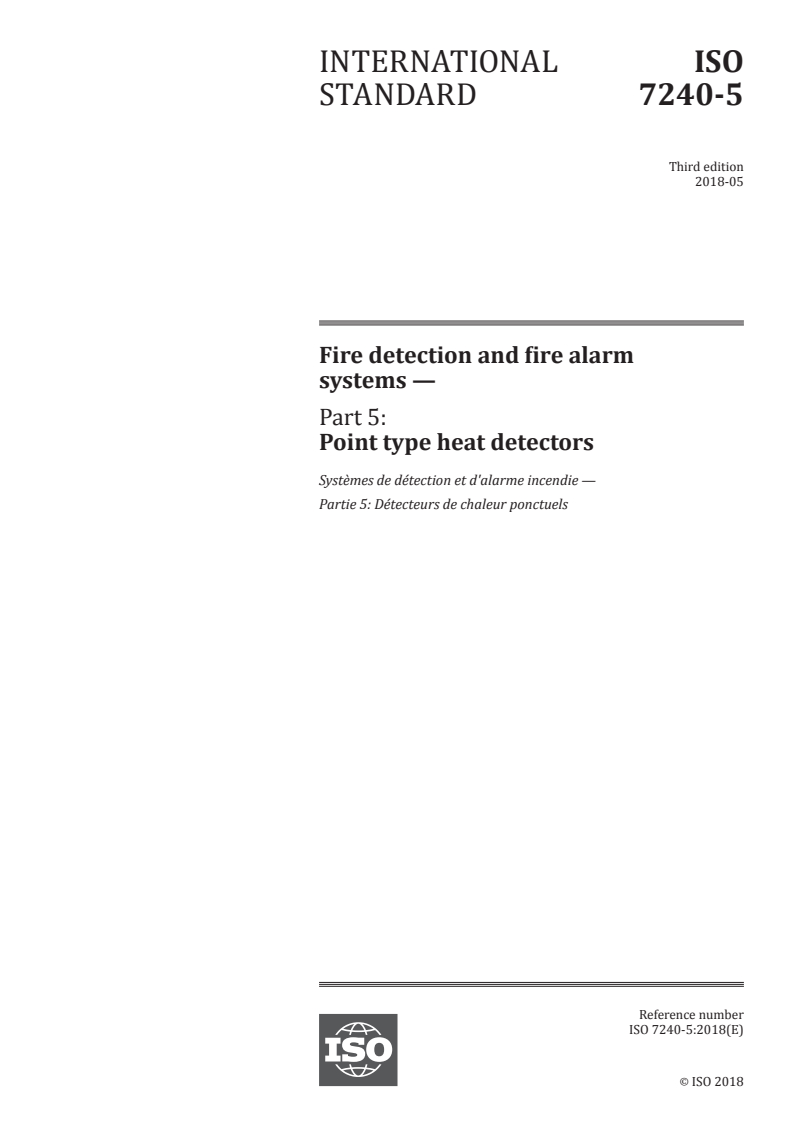

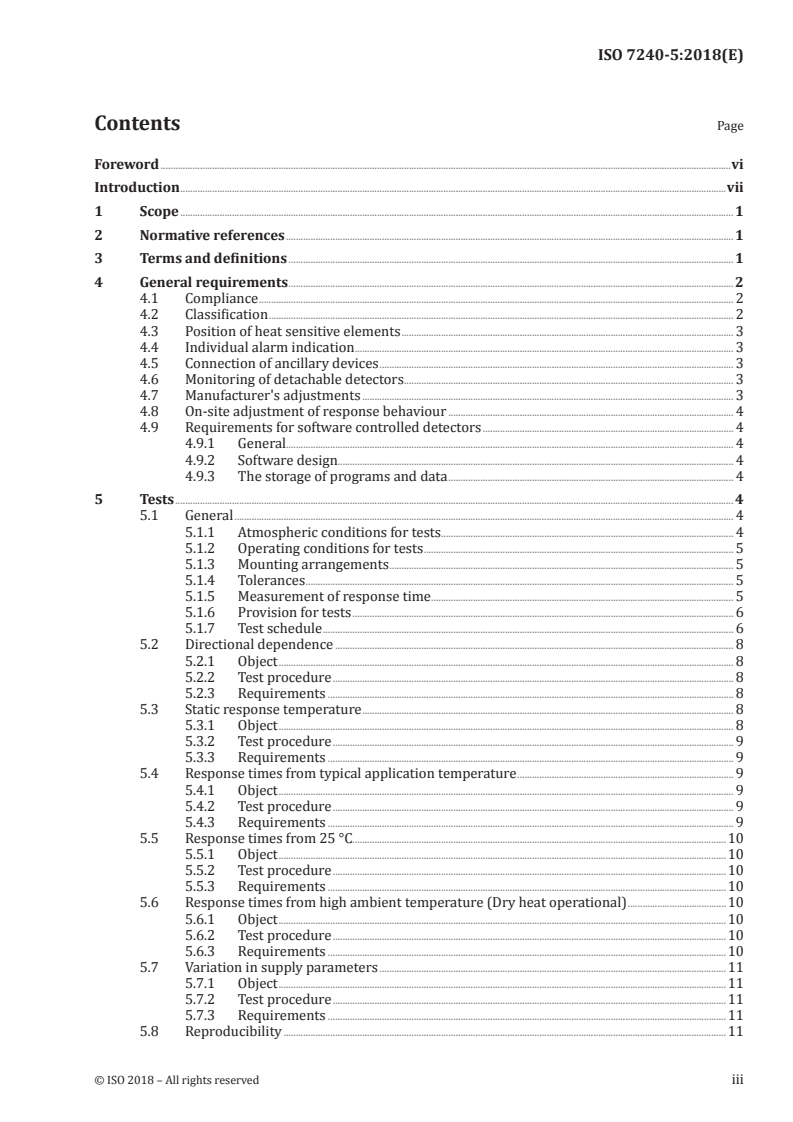
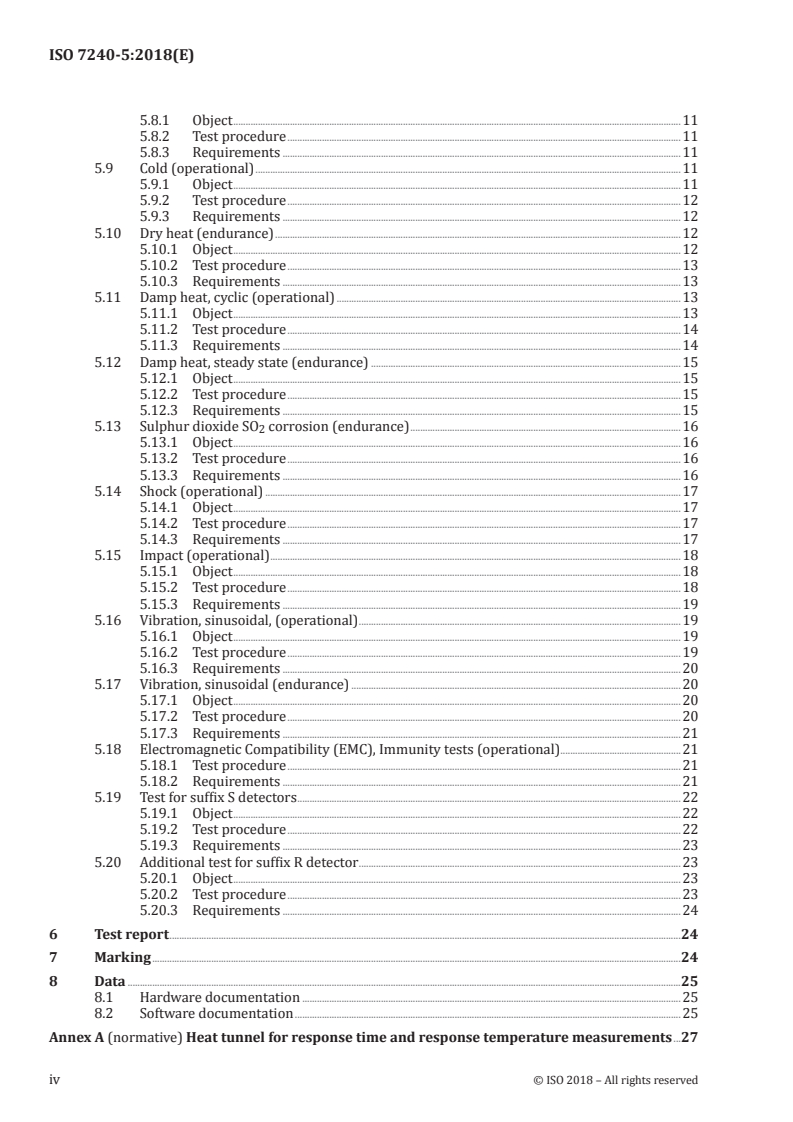
ISO 7240-5:2018 - Fire detection and fire alarm systems — Part 5: Point type heat detectors/3/2018
Overview
ISO 7240-5:2018 - "Fire detection and fire alarm systems - Part 5: Point type heat detectors" specifies requirements, test methods and performance criteria for point-type heat detectors used in building fire detection and fire alarm systems. It applies primarily to conventional point heat detectors installed in buildings (see ISO 7240‑1 for system-level requirements). The standard is a technical reference for manufacturers, test houses, installers and fire safety professionals responsible for design, verification and certification of heat detectors.
Key technical topics and requirements
- Scope and classification: Defines detector classes and their intended application within building fire alarm systems.
- General requirements: Covers positioning of heat sensitive elements, individual alarm indication, connection/monitoring of ancillary devices and detachable detectors, plus manufacturer and on‑site adjustment of detector response.
- Software-controlled detectors: Requirements for software design, program/data storage and related integrity controls for detectors that use firmware or software logic.
- Comprehensive test program: Detailed test types and procedures to verify performance and robustness under realistic conditions. Representative tests include:
- Directional dependence and static response temperature
- Response time measurements (from typical application temperature, from 25 °C, and from high ambient temperatures)
- Variation in supply parameters and reproducibility
- Environmental endurance: cold, dry heat, damp heat (cyclic and steady-state), sulphur dioxide corrosion
- Mechanical robustness: shock, impact, vibration (operational and endurance)
- Electromagnetic compatibility (EMC) immunity tests
- Suffix-specific tests (e.g., additional tests for detectors with specific suffixes such as S or R)
- Test conditions and tolerances: Defines atmospheric and mounting conditions, measurement methods and acceptance criteria for repeatable laboratory testing.
Practical applications and users
ISO 7240-5:2018 is used by:
- Detector manufacturers for product design, quality control and type‑testing before market release.
- Test laboratories and certification bodies to perform standardized performance and endurance testing.
- Fire safety engineers and system designers to select appropriate heat detectors for specific building types, ambient conditions and risk scenarios.
- Installers, facility managers and building owners to ensure installed detectors meet recognized performance standards for reliability and environmental resistance.
Adoption improves detector reliability, interoperability and compliance with fire safety regulations, and supports procurement and specification processes.
Related standards
- ISO 7240‑1 - Fire detection and fire alarm systems: system principles and general requirements (referenced by ISO 7240-5).
- Other parts of the ISO 7240 series cover detectors, alarm devices and system interfaces; consult the series for complementary requirements and system-level guidance.
Keywords: ISO 7240-5:2018, point type heat detectors, fire detection and fire alarm systems, detector testing, performance criteria, EMC immunity, environmental testing, fire safety standards.
Relations
- Effective Date
- 06-Jun-2022
- Effective Date
- 01-Nov-2014
Buy Documents
ISO 7240-5:2018 - Fire detection and fire alarm systems
ISO 7240-5:2018 - Fire detection and fire alarm systems — Part 5: Point type heat detectors/3/2018
Get Certified
Connect with accredited certification bodies for this standard

CIS Institut d.o.o.
Personal Protective Equipment (PPE) certification body. Notified Body NB-2890 for EU Regulation 2016/425 PPE.

Kiwa BDA Testing
Building and construction product certification.
Kmetijski inštitut Slovenije
Agricultural Institute of Slovenia. Soil testing, plant health, agricultural product analysis.
Sponsored listings
Frequently Asked Questions
ISO 7240-5:2018 is a standard published by the International Organization for Standardization (ISO). Its full title is "Fire detection and fire alarm systems — Part 5: Point type heat detectors". This standard covers: ISO 7240-5:2018 specifies the requirements, test methods and performance criteria for point type heat detectors for use in fire detection and fire alarm systems for buildings (see ISO 7240‑1). For other types of heat detector, or for detectors intended for use in other environments, this document can be used for guidance only. Heat detectors with special characteristics and developed for specific risks are not covered by this document.
ISO 7240-5:2018 specifies the requirements, test methods and performance criteria for point type heat detectors for use in fire detection and fire alarm systems for buildings (see ISO 7240‑1). For other types of heat detector, or for detectors intended for use in other environments, this document can be used for guidance only. Heat detectors with special characteristics and developed for specific risks are not covered by this document.
ISO 7240-5:2018 is classified under the following ICS (International Classification for Standards) categories: 13.220.20 - Fire protection. The ICS classification helps identify the subject area and facilitates finding related standards.
ISO 7240-5:2018 has the following relationships with other standards: It is inter standard links to ISO 11746:2020, ISO 7240-5:2012. Understanding these relationships helps ensure you are using the most current and applicable version of the standard.
ISO 7240-5:2018 is available in PDF format for immediate download after purchase. The document can be added to your cart and obtained through the secure checkout process. Digital delivery ensures instant access to the complete standard document.
Standards Content (Sample)
INTERNATIONAL ISO
STANDARD 7240-5
Third edition
2018-05
Fire detection and fire alarm
systems —
Part 5:
Point type heat detectors
Systèmes de détection et d'alarme incendie —
Partie 5: Détecteurs de chaleur ponctuels
Reference number
©
ISO 2018
© ISO 2018
All rights reserved. Unless otherwise specified, or required in the context of its implementation, no part of this publication may
be reproduced or utilized otherwise in any form or by any means, electronic or mechanical, including photocopying, or posting
on the internet or an intranet, without prior written permission. Permission can be requested from either ISO at the address
below or ISO’s member body in the country of the requester.
ISO copyright office
CP 401 • Ch. de Blandonnet 8
CH-1214 Vernier, Geneva
Phone: +41 22 749 01 11
Fax: +41 22 749 09 47
Email: copyright@iso.org
Website: www.iso.org
Published in Switzerland
ii © ISO 2018 – All rights reserved
Contents Page
Foreword .vi
Introduction .vii
1 Scope . 1
2 Normative references . 1
3 Terms and definitions . 1
4 General requirements . 2
4.1 Compliance . 2
4.2 Classification . 2
4.3 Position of heat sensitive elements . 3
4.4 Individual alarm indication . 3
4.5 Connection of ancillary devices . 3
4.6 Monitoring of detachable detectors . 3
4.7 Manufacturer's adjustments . 3
4.8 On-site adjustment of response behaviour . 4
4.9 Requirements for software controlled detectors . 4
4.9.1 General. 4
4.9.2 Software design. 4
4.9.3 The storage of programs and data . 4
5 Tests . 4
5.1 General . 4
5.1.1 Atmospheric conditions for tests. 4
5.1.2 Operating conditions for tests . 5
5.1.3 Mounting arrangements . 5
5.1.4 Tolerances . 5
5.1.5 Measurement of response time . 5
5.1.6 Provision for tests . 6
5.1.7 Test schedule . 6
5.2 Directional dependence . 8
5.2.1 Object . 8
5.2.2 Test procedure . 8
5.2.3 Requirements . 8
5.3 Static response temperature . 8
5.3.1 Object . 8
5.3.2 Test procedure . 9
5.3.3 Requirements . 9
5.4 Response times from typical application temperature . 9
5.4.1 Object . 9
5.4.2 Test procedure . 9
5.4.3 Requirements . 9
5.5 Response times from 25 °C.10
5.5.1 Object .10
5.5.2 Test procedure .10
5.5.3 Requirements .10
5.6 Response times from high ambient temperature (Dry heat operational) .10
5.6.1 Object .10
5.6.2 Test procedure .10
5.6.3 Requirements .10
5.7 Variation in supply parameters .11
5.7.1 Object .11
5.7.2 Test procedure .11
5.7.3 Requirements .11
5.8 Reproducibility .11
5.8.1 Object .11
5.8.2 Test procedure .11
5.8.3 Requirements .11
5.9 Cold (operational) .11
5.9.1 Object .11
5.9.2 Test procedure .12
5.9.3 Requirements .12
5.10 Dry heat (endurance) .12
5.10.1 Object .12
5.10.2 Test procedure .13
5.10.3 Requirements .13
5.11 Damp heat, cyclic (operational) .13
5.11.1 Object .13
5.11.2 Test procedure .14
5.11.3 Requirements .14
5.12 Damp heat, steady state (endurance) .15
5.12.1 Object .15
5.12.2 Test procedure .15
5.12.3 Requirements .15
5.13 Sulphur dioxide SO corrosion (endurance) .16
5.13.1 Object .16
5.13.2 Test procedure .16
5.13.3 Requirements .16
5.14 Shock (operational) .17
5.14.1 Object .17
5.14.2 Test procedure .17
5.14.3 Requirements .17
5.15 Impact (operational) .18
5.15.1 Object .18
5.15.2 Test procedure .18
5.15.3 Requirements .19
5.16 Vibration, sinusoidal, (operational) .19
5.16.1 Object .19
5.16.2 Test procedure .19
5.16.3 Requirements .20
5.17 Vibration, sinusoidal (endurance) .20
5.17.1 Object .20
5.17.2 Test procedure .20
5.17.3 Requirements .21
5.18 Electromagnetic Compatibility (EMC), Immunity tests (operational) .21
5.18.1 Test procedure .21
5.18.2 Requirements .21
5.19 Test for suffix S detectors .22
5.19.1 Object .22
5.19.2 Test procedure .22
5.19.3 Requirements .23
5.20 Additional test for suffix R detector .23
5.20.1 Object .23
5.20.2 Test procedure .23
5.20.3 Requirements .24
6 Test report .24
7 Marking .24
8 Data .25
8.1 Hardware documentation .25
8.2 Software documentation .25
Annex A (normative) Heat tunnel for response time and response temperature measurements .27
iv © ISO 2018 – All rights reserved
Annex B (informative) Information concerning the construction of the heat tunnel .28
Annex C (informative) Derivation of upper and lower limits of response times .31
Annex D (informative) Apparatus for impact test .34
Foreword
ISO (the International Organization for Standardization) is a worldwide federation of national standards
bodies (ISO member bodies). The work of preparing International Standards is normally carried out
through ISO technical committees. Each member body interested in a subject for which a technical
committee has been established has the right to be represented on that committee. International
organizations, governmental and non-governmental, in liaison with ISO, also take part in the work.
ISO collaborates closely with the International Electrotechnical Commission (IEC) on all matters of
electrotechnical standardization.
The procedures used to develop this document and those intended for its further maintenance are
described in the ISO/IEC Directives, Part 1. In particular the different approval criteria needed for the
different types of ISO documents should be noted. This document was drafted in accordance with the
editorial rules of the ISO/IEC Directives, Part 2 (see www .iso .org/directives).
Attention is drawn to the possibility that some of the elements of this document may be the subject of
patent rights. ISO shall not be held responsible for identifying any or all such patent rights. Details of
any patent rights identified during the development of the document will be in the Introduction and/or
on the ISO list of patent declarations received (see www .iso .org/patents).
Any trade name used in this document is information given for the convenience of users and does not
constitute an endorsement.
For an explanation on the voluntary nature of standards, the meaning of ISO specific terms and
expressions related to conformity assessment, as well as information about ISO's adherence to the
World Trade Organization (WTO) principles in the Technical Barriers to Trade (TBT) see the following
URL: www .iso .org/iso/foreword .html.
This document was prepared by Technical Committee ISO/TC 21, Equipment for fire protection and fire
fighting, Subcommittee SC 3, Fire detection and alarm systems.
This third edition cancels and replaces the second edition (ISO 7240-5:2012), which has been technically
revised.
A list of all parts in the ISO 7240 series, published under the general title Fire detection and fire alarm
systems, can be found on the ISO website.
This edition includes the following significant changes with respect to the previous edition:
— in 5.18 (electromagnetic compatibility immunity tests), EN 50130-4 has been replaced by IEC 62599-2;
— marking has been moved to a new Clause 7;
— data and software requirements have been moved to a new Clause 8.
vi © ISO 2018 – All rights reserved
Introduction
A fire detection and alarm system is required to function satisfactorily not only in the event of a fire,
but also during and after exposure to conditions likely to be met in practice such as corrosion, vibration,
direct impact, indirect shock and electromagnetic interference. Some tests specified are intended to
assess the performance of the heat detectors under such conditions.
The performance of heat detectors is assessed from the results obtained in specific tests. This document
is not intended to place any other restrictions on the design and construction of such detectors.
INTERNATIONAL STANDARD ISO 7240-5:2018(E)
Fire detection and fire alarm systems —
Part 5:
Point type heat detectors
1 Scope
This document specifies the requirements, test methods and performance criteria for point type heat
detectors for use in fire detection and fire alarm systems for buildings (see ISO 7240-1).
For other types of heat detector, or for detectors intended for use in other environments, this document
can be used for guidance only. Heat detectors with special characteristics and developed for specific
risks are not covered by this document.
2 Normative references
The following documents are referred to in the text in such a way that some or all of their content
constitutes requirements of this document. For dated references, only the edition cited applies. For
undated references, the latest edition of the referenced document (including any amendments) applies.
ISO 209, Aluminium and aluminium alloys — Chemical composition
ISO 7240-1, Fire detection and alarm systems — Part 1: General and definitions
IEC 60068-1, Environmental testing — Part 1: General and guidance
IEC 60068-2-1, Environmental testing — Part 2-1: Tests. Tests A: Cold
IEC 60068-2-2, Environmental testing — Part 2-2: Tests. Tests B: Dry heat
IEC 60068-2-6, Environmental testing — Part 2-6: Tests — Test Fc: Vibration (sinusoidal)
IEC 60068-2-27, Environmental testing — Part 2-27: Tests. Test Ea and guidance: Shock
IEC 60068-2-30, Environmental testing — Part 2-30: Tests. Test Db and guidance: Damp heat, cyclic
(12 + 12-hour cycle)
IEC 60068-2-42, Environmental testing — Part 2-42: Tests —Test Kc: Sulphur dioxide test for contacts and
connections
IEC 60068-2-78, Environmental testing — Part 2-78: Tests — Test Cab: Damp heat, steady state
IEC 62599-2, Alarm systems — Part 2: Electromagnetic compatibility — Immunity requirements for
components of fire and security alarm systems
3 Terms and definitions
For the purposes of this document, the terms, definitions and abbreviated terms in ISO 7240-1 and the
following apply.
ISO and IEC maintain terminological databases for use in standardization at the following addresses:
— IEC Electropedia: available at https: //www .electropedia .org/
— ISO Online browsing platform: available at https: //www .iso .org/obp
3.1
typical application temperature
temperature that an installed detector may be expected to experience for long periods of time in the
absence of a fire condition
Note 1 to entry: This temperature is deemed to be 29 °C below the minimum static response temperature,
according to the class marked on the detector, as specified in Table 1.
3.2
maximum application temperature
maximum temperature that an installed detector may be expected to experience, even for short periods
of time, in the absence of a fire condition
Note 1 to entry: This temperature is deemed to be 4 °C below the minimum static response temperature,
according to the class marked on the detector, as specified in Table 1.
3.3
static response temperature
temperature at which the detector would produce an alarm signal if subjected to a vanishingly small
rate of rise of temperature
Note 1 to entry: Rates of rise of temperature of approximately 0,2 K/min are normally found to be suitable for
measuring this, however lower rates may be required in some instances (see 5.3).
4 General requirements
4.1 Compliance
In order to comply with this document the detector shall meet the requirements of:
a) Clause 4, which shall be verified by visual inspection or engineering assessment, shall be tested as
described in Clause 5 and shall meet the requirements of the tests.
b) Clauses 7 and 8, which shall be verified by visual inspection.
4.2 Classification
4.2.1 Detectors shall conform to one or more of the following classes: A1, A2, B, C, D, E, F or G according
to the requirements of the tests specified in Clause 5 (see Table 1).
Table 1 — Detector classification temperatures
Detector Typical Maximum Minimum Maximum
class application application static response static response
temperature temperature temperature temperature
°C °C °C °C
A1 25 50 54 65
A2 25 50 54 70
B 40 65 69 85
C 55 80 84 100
D 70 95 99 115
E 85 110 114 130
F 100 125 129 145
G 115 140 144 160
2 © ISO 2018 – All rights reserved
4.2.2 Manufacturers may optionally give additional information concerning the type of response
exhibited by the detector, by adding the suffix S or R to the above classes. Detectors, which are marked
with the letter S or R as a suffix to the class marking, shall be tested in accordance with the applicable
test, specified in Clause 6, and shall meet the requirements of that test, in addition to the tests of Clause 5.
NOTE Detectors, with a suffix S to their class, do not respond below the minimum static response
temperature, applicable to their classification (see Table 1), even at high rates of rise of air temperature.
Detectors with a suffix R to their class, incorporate a rate-of-rise characteristic, which meets the response time
requirements (see Table 4) for high rates of rise of air temperature even when starting at air temperatures
substantially below the typical application temperature.
4.3 Position of heat sensitive elements
Each detector shall be constructed such that at least part of its heat sensitive element(s), except
elements with auxiliary functions (e.g. characteristic correctors), shall be ≥15 mm from the mounting
surface of the detector.
4.4 Individual alarm indication
4.4.1 Class A1, A2, B, C or D detectors shall be provided with an integral red visual indicator, by which
the individual detector which released an alarm, may be identified, until the alarm condition is reset.
Where other conditions of the detector may be visually indicated, they shall be clearly distinguishable
from the alarm indication, except when the detector is switched into a service mode.
4.4.2 For detachable detectors, the indicator may be integral with the base or the detector head. Class
E, F or G detectors shall be provided with either an integral red indicator, or with another means for
locally indicating the alarm status of the detector.
NOTE The alarm condition is reset manually at the control and indicating equipment (See ISO 7240-2).
4.4.3 The visual indicator shall be visible from a distance of 6 m in an ambient light intensity up to
500 lx at an angle of up to
a) 5° from the axis of the detector in any direction, and
b) 45° from the axis of the detector in at least one direction.
4.5 Connection of ancillary devices
Where the detector provides for connections to ancillary devices (e.g. remote indicators, control
relays), open- or short-circuit failures of these connections shall not prevent the correct operation of
the detector.
4.6 Monitoring of detachable detectors
For detachable detectors, a means shall be provided for a remote monitoring system (e.g. the control
and indicating equipment) to detect the removal of the head from the base, in order to give a fault signal.
4.7 Manufacturer's adjustments
It shall not be possible to change the manufacturer's settings except by special means (e.g. a special
code or tool, or by breaking or removing a seal).
4.8 On-site adjustment of response behaviour
If there is provision for on-site adjustment of the response behaviour of the detector then:
a) for each setting, at which the manufacturer claims compliance with this document, he shall declare
a corresponding class, and for each such setting the detector shall comply with the requirements
of this document for the corresponding class, and access to the adjustment means shall only be
possible by the use of a code or special tool or by removing the detector from its base or mounting;
b) any setting(s), at which the manufacturer does not claim compliance with this document, shall only
be accessible by the use of a code or special tool, and it shall be clearly marked on the detector
or in the associated data, that if these setting(s) are used, the detector does not comply with the
document.
NOTE These adjustments can be carried out at the detector or at the control and indicating equipment.
4.9 Requirements for software controlled detectors
4.9.1 General
For detectors which rely on software control in order to fulfil the requirements of this document, the
requirements of 4.9.2 and 4.9.3 shall be met.
4.9.2 Software design
In order to ensure the reliability of the detector, the following requirements for software design
shall apply:
a) the software shall have a modular structure;
b) the design of the interfaces for manually and automatically generated data shall not permit invalid
data to cause error in the program operation;
c) the software shall be designed to avoid the occurrence of deadlock of the programme flow.
4.9.3 The storage of programs and data
4.9.3.1 The program necessary to comply with this document and any pre-set data, such as
manufacturer's settings, shall be held in non-volatile memory. Writing to areas of memory containing
this program and data shall only be possible by the use of some special tool or code and shall not be
possible during normal operation of the detector.
4.9.3.2 Site-specific data shall be held in memory which will retain data for at least 2 weeks without
external power to the detector, unless provision is made for the automatic renewal of such data, following
loss of power, within 1 hour of power being restored.
5 Tests
5.1 General
5.1.1 Atmospheric conditions for tests
Unless otherwise stated in a test procedure, the testing shall be carried out after the test specimen has
been allowed to stabilize in the standard atmospheric conditions for testing as described in IEC 60068-
1 as follows:
a) temperature: (15 to 35) °C;
4 © ISO 2018 – All rights reserved
b) relative humidity: (25 to 75) %;
c) air pressure: (86 to 106) kPa.
NOTE If variations in these parameters have a significant effect on a measurement, then such variations can
be kept to a minimum during a series of measurements carried out as part of one test on one specimen.
5.1.2 Operating conditions for tests
If a test method requires a specimen to be operational, then the specimen shall be connected to suitable
supply and monitoring equipment with characteristics as required by the manufacturer's data. Unless
otherwise specified in the test method, the supply parameters applied to the specimen shall be set
within the manufacturer's specified range(s) and shall remain substantially constant throughout the
tests. The value chosen for each parameter shall normally be the nominal value, or the mean of the
specified range. If a test procedure requires a specimen to be monitored to detect any alarm or fault
signals, then connections shall be made to any necessary ancillary devices (e.g. through wiring to an
end-of-line device for conventional detectors to allow a fault signal to be recognised).
NOTE The details of the supply and monitoring equipment and the alarm criteria used can be given in the
test report.
5.1.3 Mounting arrangements
The specimen shall be mounted by its normal means of attachment in accordance with the
manufacturer's instructions. If these instructions describe more than one method of mounting then the
method considered to be most unfavourable shall be chosen for each test.
5.1.4 Tolerances
5.1.4.1 Unless otherwise stated, the tolerances for the environmental test parameters shall be as given
in the basic reference standards for the test (e.g. the relevant part of IEC 60068).
5.1.4.2 If a specific tolerance or deviation limit is not specified in a requirement or test procedure, then
a deviation limit of ±5 % shall be applied.
5.1.5 Measurement of response time
5.1.5.1 The specimen, for which the response time is to be measured, shall be mounted in a heat tunnel
as described in 5.1.3 and Annex A. It shall be connected to suitable supply and monitoring equipment
in accordance with 5.1.2. The orientation of the specimen, relative to the direction of airflow, shall be
that which gave the maximum response time in the directional dependence test 5.2, unless otherwise
specified.
5.1.5.2 Before the measurement, the temperature of the air stream and the specimen shall be
stabilized to the temperature specified in the applicable test procedure. The measurement is then made
by increasing the air temperature, in the heat tunnel, linearly with respect to time, at the rate of rise
specified in the applicable test procedure until the supply and monitoring equipment indicates an alarm
or until the upper limit of response time for the test is exceeded. During the measurement the air flow
shall be maintained at a constant mass flow, equivalent to (0,8 ± 0,1) m/s at 25 °C, and the air temperature
shall be controlled to within ±2 K of the nominal temperature required at any time during the test (see
Annex A). The response time is the time interval between the start of the temperature increase and the
indication of an alarm from the supply and monitoring equipment.
NOTE 1 Linear extrapolation of the stabilized and the increasing temperature against time lines can be used
to establish the effective start time of the temperature increase.
NOTE 2 Care can be taken not to subject detectors to a damaging thermal shock when transferring them to
and from a stabilization or alarm temperature.
NOTE 3 Details and information concerning the design of the heat tunnel are given in Annexes A and B.
5.1.6 Provision for tests
5.1.6.1 The following shall be provided for testing compliance with this document:
a) For resettable detectors: 15 detectors.
For non-resettable detectors: 62 detectors.
For non-resettable suffix S detectors: 63 detectors.
For non-resettable suffix R detectors: 68 detectors.
b) The data required in 8.
5.1.6.2 The specimens submitted shall be deemed representative of the manufacturer's normal
production with regard to their construction and calibration.
5.1.7 Test schedule
5.1.7.1 Resettable specimens shall be arbitrarily numbered 1 to 15 by the testing organization and
tested according to the test schedule in Table 2.
For detectors with provision for on-site adjustment of their class:
a) tests in accordance with 5.3, 5.4, 5.5, 5.6, 5.8, 5.19 and 5.20 shall be applied for each applicable class;
b) the test in accordance with 5.10 shall be applied for the class with the highest temperature rating;
c) all other tests shall be applied for at least one class.
5.1.7.2 Non-resettable specimens shall be arbitrarily numbered 1 to 62, 1 to 63, or 1 to 68 according to
class, by the testing organization and tested according to the test schedule in Table 3.
Table 2 — Test schedule for resettable detectors
Specimen number(s)
Test Clause Rate of rise of air temperature (K/min)
≤0,2 1 3 5 10 20 30 Plunge
Directional dependence 5.2 1
Static response temperature 5.3 1, 2
Response times from typical
5.4 1, 2 1, 2 1, 2 1, 2 1, 2 1,2
application temperature
Response times from 25 °C 5.5 1 1
Response times from high ambient
5.6 1 1
temperature
Variation in supply parameters 5.7 1, 2 1, 2
Reproducibility (response times
5.8 3 to 15 3 to 15
before environmental tests)
Cold (operational) 5.9 3 3
a
In the interests of test economy, it is permitted to use the same specimen for more than one EMC test. In that case,
intermediate functional test(s) on the specimen(s) used for more than one test can be substituted by a simple check that
the specimen is still capable of raising an alarm, and the full functional test conducted at the end of the sequence of tests.
However it should be noted that in the event of a failure, it may not be possible to identify which test exposure caused the
failure.
6 © ISO 2018 – All rights reserved
Table 2 (continued)
Specimen number(s)
Test Clause Rate of rise of air temperature (K/min)
≤0,2 1 3 5 10 20 30 Plunge
Dry heat (endurance) 5.10 4 4
Damp heat, cyclic (operational) 5.11 5 5
Damp heat, steady state (endurance) 5.12 6 6
Sulphur dioxide SO (endurance) 5.13 7 7
Shock (operational) 5.14 8 8
Impact (operational) 5.15 9 9
Vibration, sinusoidal (operational) 5.16 10 10
Vibration, sinusoidal (endurance) 5.17 10 10
a a
Electrostatic discharge (operational) 5.18 11 11
Radiated electromagnetic fields
a a
5.18 12 12
(operational)
Conducted disturbances induced by
a a
5.18 13 13
electromagnetic fields (operational)
a a
Fast transient burst (operational) 5.18 14 14
Slow high energy voltage surge
a a
5.18 15 15
(operational)
Additional test for suffix S detectors 5.19 1
Additional test for suffix R detectors 5.20 1, 2 1, 2 1, 2
a
In the interests of test economy, it is permitted to use the same specimen for more than one EMC test. In that case,
intermediate functional test(s) on the specimen(s) used for more than one test can be substituted by a simple check that
the specimen is still capable of raising an alarm, and the full functional test conducted at the end of the sequence of tests.
However it should be noted that in the event of a failure, it may not be possible to identify which test exposure caused the
failure.
Table 3 — Test schedule for non-resettable detectors
Specimen number(s)
Test Clause Rate of rise of air temperature (K/min)
≤0,2 1 3 5 10 20 30 Plunge
Directional dependence 5.2 1 to 8
Static response temperature 5.3 9, 10
Response times from typical applica-
5.4 11, 12 13, 14 15, 16 17, 18 19, 20 21, 22
tion temperature
Response times from 25 °C 5.5 23 24
Response times from high ambient
5.6 25 26
temperature
Variation in supply parameters 5.7 27, 28 29, 30
Reproducibility (response times
5.8 31, 32 33, 34
before environmental tests)
Cold (operational) 5.9 35 36
Dry heat (endurance) 5.10 37 38
Damp heat, cyclic (operational) 5.11 39 40
Damp heat, steady state (endurance) 5.12 41 42
a
In the interests of test economy, it is permitted to use the same specimen for more than one EMC test. In that case,
intermediate functional test(s) on the specimen(s) used for more than one test can be deleted, and the full functional test
conducted at the end of the sequence of tests. However it should be noted that in the event of a failure, it may not be possible
to identify which test exposure caused the failure.
Table 3 (continued)
Specimen number(s)
Test Clause Rate of rise of air temperature (K/min)
≤0,2 1 3 5 10 20 30 Plunge
Sulphur dioxide SO (endurance) 5.13 43 44
Shock (operational) 5.14 45 46
Impact (operational) 5.15 47
...
INTERNATIONAL ISO
STANDARD 7240-5
Third edition
2018-05
Fire detection and fire alarm
systems —
Part 5:
Point type heat detectors
Systèmes de détection et d'alarme incendie —
Partie 5: Détecteurs de chaleur ponctuels
Reference number
©
ISO 2018
© ISO 2018
All rights reserved. Unless otherwise specified, or required in the context of its implementation, no part of this publication may
be reproduced or utilized otherwise in any form or by any means, electronic or mechanical, including photocopying, or posting
on the internet or an intranet, without prior written permission. Permission can be requested from either ISO at the address
below or ISO’s member body in the country of the requester.
ISO copyright office
CP 401 • Ch. de Blandonnet 8
CH-1214 Vernier, Geneva
Phone: +41 22 749 01 11
Fax: +41 22 749 09 47
Email: copyright@iso.org
Website: www.iso.org
Published in Switzerland
ii © ISO 2018 – All rights reserved
Contents Page
Foreword .vi
Introduction .vii
1 Scope . 1
2 Normative references . 1
3 Terms and definitions . 1
4 General requirements . 2
4.1 Compliance . 2
4.2 Classification . 2
4.3 Position of heat sensitive elements . 3
4.4 Individual alarm indication . 3
4.5 Connection of ancillary devices . 3
4.6 Monitoring of detachable detectors . 3
4.7 Manufacturer's adjustments . 3
4.8 On-site adjustment of response behaviour . 4
4.9 Requirements for software controlled detectors . 4
4.9.1 General. 4
4.9.2 Software design. 4
4.9.3 The storage of programs and data . 4
5 Tests . 4
5.1 General . 4
5.1.1 Atmospheric conditions for tests. 4
5.1.2 Operating conditions for tests . 5
5.1.3 Mounting arrangements . 5
5.1.4 Tolerances . 5
5.1.5 Measurement of response time . 5
5.1.6 Provision for tests . 6
5.1.7 Test schedule . 6
5.2 Directional dependence . 8
5.2.1 Object . 8
5.2.2 Test procedure . 8
5.2.3 Requirements . 8
5.3 Static response temperature . 8
5.3.1 Object . 8
5.3.2 Test procedure . 9
5.3.3 Requirements . 9
5.4 Response times from typical application temperature . 9
5.4.1 Object . 9
5.4.2 Test procedure . 9
5.4.3 Requirements . 9
5.5 Response times from 25 °C.10
5.5.1 Object .10
5.5.2 Test procedure .10
5.5.3 Requirements .10
5.6 Response times from high ambient temperature (Dry heat operational) .10
5.6.1 Object .10
5.6.2 Test procedure .10
5.6.3 Requirements .10
5.7 Variation in supply parameters .11
5.7.1 Object .11
5.7.2 Test procedure .11
5.7.3 Requirements .11
5.8 Reproducibility .11
5.8.1 Object .11
5.8.2 Test procedure .11
5.8.3 Requirements .11
5.9 Cold (operational) .11
5.9.1 Object .11
5.9.2 Test procedure .12
5.9.3 Requirements .12
5.10 Dry heat (endurance) .12
5.10.1 Object .12
5.10.2 Test procedure .13
5.10.3 Requirements .13
5.11 Damp heat, cyclic (operational) .13
5.11.1 Object .13
5.11.2 Test procedure .14
5.11.3 Requirements .14
5.12 Damp heat, steady state (endurance) .15
5.12.1 Object .15
5.12.2 Test procedure .15
5.12.3 Requirements .15
5.13 Sulphur dioxide SO corrosion (endurance) .16
5.13.1 Object .16
5.13.2 Test procedure .16
5.13.3 Requirements .16
5.14 Shock (operational) .17
5.14.1 Object .17
5.14.2 Test procedure .17
5.14.3 Requirements .17
5.15 Impact (operational) .18
5.15.1 Object .18
5.15.2 Test procedure .18
5.15.3 Requirements .19
5.16 Vibration, sinusoidal, (operational) .19
5.16.1 Object .19
5.16.2 Test procedure .19
5.16.3 Requirements .20
5.17 Vibration, sinusoidal (endurance) .20
5.17.1 Object .20
5.17.2 Test procedure .20
5.17.3 Requirements .21
5.18 Electromagnetic Compatibility (EMC), Immunity tests (operational) .21
5.18.1 Test procedure .21
5.18.2 Requirements .21
5.19 Test for suffix S detectors .22
5.19.1 Object .22
5.19.2 Test procedure .22
5.19.3 Requirements .23
5.20 Additional test for suffix R detector .23
5.20.1 Object .23
5.20.2 Test procedure .23
5.20.3 Requirements .24
6 Test report .24
7 Marking .24
8 Data .25
8.1 Hardware documentation .25
8.2 Software documentation .25
Annex A (normative) Heat tunnel for response time and response temperature measurements .27
iv © ISO 2018 – All rights reserved
Annex B (informative) Information concerning the construction of the heat tunnel .28
Annex C (informative) Derivation of upper and lower limits of response times .31
Annex D (informative) Apparatus for impact test .34
Foreword
ISO (the International Organization for Standardization) is a worldwide federation of national standards
bodies (ISO member bodies). The work of preparing International Standards is normally carried out
through ISO technical committees. Each member body interested in a subject for which a technical
committee has been established has the right to be represented on that committee. International
organizations, governmental and non-governmental, in liaison with ISO, also take part in the work.
ISO collaborates closely with the International Electrotechnical Commission (IEC) on all matters of
electrotechnical standardization.
The procedures used to develop this document and those intended for its further maintenance are
described in the ISO/IEC Directives, Part 1. In particular the different approval criteria needed for the
different types of ISO documents should be noted. This document was drafted in accordance with the
editorial rules of the ISO/IEC Directives, Part 2 (see www .iso .org/directives).
Attention is drawn to the possibility that some of the elements of this document may be the subject of
patent rights. ISO shall not be held responsible for identifying any or all such patent rights. Details of
any patent rights identified during the development of the document will be in the Introduction and/or
on the ISO list of patent declarations received (see www .iso .org/patents).
Any trade name used in this document is information given for the convenience of users and does not
constitute an endorsement.
For an explanation on the voluntary nature of standards, the meaning of ISO specific terms and
expressions related to conformity assessment, as well as information about ISO's adherence to the
World Trade Organization (WTO) principles in the Technical Barriers to Trade (TBT) see the following
URL: www .iso .org/iso/foreword .html.
This document was prepared by Technical Committee ISO/TC 21, Equipment for fire protection and fire
fighting, Subcommittee SC 3, Fire detection and alarm systems.
This third edition cancels and replaces the second edition (ISO 7240-5:2012), which has been technically
revised.
A list of all parts in the ISO 7240 series, published under the general title Fire detection and fire alarm
systems, can be found on the ISO website.
This edition includes the following significant changes with respect to the previous edition:
— in 5.18 (electromagnetic compatibility immunity tests), EN 50130-4 has been replaced by IEC 62599-2;
— marking has been moved to a new Clause 7;
— data and software requirements have been moved to a new Clause 8.
vi © ISO 2018 – All rights reserved
Introduction
A fire detection and alarm system is required to function satisfactorily not only in the event of a fire,
but also during and after exposure to conditions likely to be met in practice such as corrosion, vibration,
direct impact, indirect shock and electromagnetic interference. Some tests specified are intended to
assess the performance of the heat detectors under such conditions.
The performance of heat detectors is assessed from the results obtained in specific tests. This document
is not intended to place any other restrictions on the design and construction of such detectors.
INTERNATIONAL STANDARD ISO 7240-5:2018(E)
Fire detection and fire alarm systems —
Part 5:
Point type heat detectors
1 Scope
This document specifies the requirements, test methods and performance criteria for point type heat
detectors for use in fire detection and fire alarm systems for buildings (see ISO 7240-1).
For other types of heat detector, or for detectors intended for use in other environments, this document
can be used for guidance only. Heat detectors with special characteristics and developed for specific
risks are not covered by this document.
2 Normative references
The following documents are referred to in the text in such a way that some or all of their content
constitutes requirements of this document. For dated references, only the edition cited applies. For
undated references, the latest edition of the referenced document (including any amendments) applies.
ISO 209, Aluminium and aluminium alloys — Chemical composition
ISO 7240-1, Fire detection and alarm systems — Part 1: General and definitions
IEC 60068-1, Environmental testing — Part 1: General and guidance
IEC 60068-2-1, Environmental testing — Part 2-1: Tests. Tests A: Cold
IEC 60068-2-2, Environmental testing — Part 2-2: Tests. Tests B: Dry heat
IEC 60068-2-6, Environmental testing — Part 2-6: Tests — Test Fc: Vibration (sinusoidal)
IEC 60068-2-27, Environmental testing — Part 2-27: Tests. Test Ea and guidance: Shock
IEC 60068-2-30, Environmental testing — Part 2-30: Tests. Test Db and guidance: Damp heat, cyclic
(12 + 12-hour cycle)
IEC 60068-2-42, Environmental testing — Part 2-42: Tests —Test Kc: Sulphur dioxide test for contacts and
connections
IEC 60068-2-78, Environmental testing — Part 2-78: Tests — Test Cab: Damp heat, steady state
IEC 62599-2, Alarm systems — Part 2: Electromagnetic compatibility — Immunity requirements for
components of fire and security alarm systems
3 Terms and definitions
For the purposes of this document, the terms, definitions and abbreviated terms in ISO 7240-1 and the
following apply.
ISO and IEC maintain terminological databases for use in standardization at the following addresses:
— IEC Electropedia: available at https: //www .electropedia .org/
— ISO Online browsing platform: available at https: //www .iso .org/obp
3.1
typical application temperature
temperature that an installed detector may be expected to experience for long periods of time in the
absence of a fire condition
Note 1 to entry: This temperature is deemed to be 29 °C below the minimum static response temperature,
according to the class marked on the detector, as specified in Table 1.
3.2
maximum application temperature
maximum temperature that an installed detector may be expected to experience, even for short periods
of time, in the absence of a fire condition
Note 1 to entry: This temperature is deemed to be 4 °C below the minimum static response temperature,
according to the class marked on the detector, as specified in Table 1.
3.3
static response temperature
temperature at which the detector would produce an alarm signal if subjected to a vanishingly small
rate of rise of temperature
Note 1 to entry: Rates of rise of temperature of approximately 0,2 K/min are normally found to be suitable for
measuring this, however lower rates may be required in some instances (see 5.3).
4 General requirements
4.1 Compliance
In order to comply with this document the detector shall meet the requirements of:
a) Clause 4, which shall be verified by visual inspection or engineering assessment, shall be tested as
described in Clause 5 and shall meet the requirements of the tests.
b) Clauses 7 and 8, which shall be verified by visual inspection.
4.2 Classification
4.2.1 Detectors shall conform to one or more of the following classes: A1, A2, B, C, D, E, F or G according
to the requirements of the tests specified in Clause 5 (see Table 1).
Table 1 — Detector classification temperatures
Detector Typical Maximum Minimum Maximum
class application application static response static response
temperature temperature temperature temperature
°C °C °C °C
A1 25 50 54 65
A2 25 50 54 70
B 40 65 69 85
C 55 80 84 100
D 70 95 99 115
E 85 110 114 130
F 100 125 129 145
G 115 140 144 160
2 © ISO 2018 – All rights reserved
4.2.2 Manufacturers may optionally give additional information concerning the type of response
exhibited by the detector, by adding the suffix S or R to the above classes. Detectors, which are marked
with the letter S or R as a suffix to the class marking, shall be tested in accordance with the applicable
test, specified in Clause 6, and shall meet the requirements of that test, in addition to the tests of Clause 5.
NOTE Detectors, with a suffix S to their class, do not respond below the minimum static response
temperature, applicable to their classification (see Table 1), even at high rates of rise of air temperature.
Detectors with a suffix R to their class, incorporate a rate-of-rise characteristic, which meets the response time
requirements (see Table 4) for high rates of rise of air temperature even when starting at air temperatures
substantially below the typical application temperature.
4.3 Position of heat sensitive elements
Each detector shall be constructed such that at least part of its heat sensitive element(s), except
elements with auxiliary functions (e.g. characteristic correctors), shall be ≥15 mm from the mounting
surface of the detector.
4.4 Individual alarm indication
4.4.1 Class A1, A2, B, C or D detectors shall be provided with an integral red visual indicator, by which
the individual detector which released an alarm, may be identified, until the alarm condition is reset.
Where other conditions of the detector may be visually indicated, they shall be clearly distinguishable
from the alarm indication, except when the detector is switched into a service mode.
4.4.2 For detachable detectors, the indicator may be integral with the base or the detector head. Class
E, F or G detectors shall be provided with either an integral red indicator, or with another means for
locally indicating the alarm status of the detector.
NOTE The alarm condition is reset manually at the control and indicating equipment (See ISO 7240-2).
4.4.3 The visual indicator shall be visible from a distance of 6 m in an ambient light intensity up to
500 lx at an angle of up to
a) 5° from the axis of the detector in any direction, and
b) 45° from the axis of the detector in at least one direction.
4.5 Connection of ancillary devices
Where the detector provides for connections to ancillary devices (e.g. remote indicators, control
relays), open- or short-circuit failures of these connections shall not prevent the correct operation of
the detector.
4.6 Monitoring of detachable detectors
For detachable detectors, a means shall be provided for a remote monitoring system (e.g. the control
and indicating equipment) to detect the removal of the head from the base, in order to give a fault signal.
4.7 Manufacturer's adjustments
It shall not be possible to change the manufacturer's settings except by special means (e.g. a special
code or tool, or by breaking or removing a seal).
4.8 On-site adjustment of response behaviour
If there is provision for on-site adjustment of the response behaviour of the detector then:
a) for each setting, at which the manufacturer claims compliance with this document, he shall declare
a corresponding class, and for each such setting the detector shall comply with the requirements
of this document for the corresponding class, and access to the adjustment means shall only be
possible by the use of a code or special tool or by removing the detector from its base or mounting;
b) any setting(s), at which the manufacturer does not claim compliance with this document, shall only
be accessible by the use of a code or special tool, and it shall be clearly marked on the detector
or in the associated data, that if these setting(s) are used, the detector does not comply with the
document.
NOTE These adjustments can be carried out at the detector or at the control and indicating equipment.
4.9 Requirements for software controlled detectors
4.9.1 General
For detectors which rely on software control in order to fulfil the requirements of this document, the
requirements of 4.9.2 and 4.9.3 shall be met.
4.9.2 Software design
In order to ensure the reliability of the detector, the following requirements for software design
shall apply:
a) the software shall have a modular structure;
b) the design of the interfaces for manually and automatically generated data shall not permit invalid
data to cause error in the program operation;
c) the software shall be designed to avoid the occurrence of deadlock of the programme flow.
4.9.3 The storage of programs and data
4.9.3.1 The program necessary to comply with this document and any pre-set data, such as
manufacturer's settings, shall be held in non-volatile memory. Writing to areas of memory containing
this program and data shall only be possible by the use of some special tool or code and shall not be
possible during normal operation of the detector.
4.9.3.2 Site-specific data shall be held in memory which will retain data for at least 2 weeks without
external power to the detector, unless provision is made for the automatic renewal of such data, following
loss of power, within 1 hour of power being restored.
5 Tests
5.1 General
5.1.1 Atmospheric conditions for tests
Unless otherwise stated in a test procedure, the testing shall be carried out after the test specimen has
been allowed to stabilize in the standard atmospheric conditions for testing as described in IEC 60068-
1 as follows:
a) temperature: (15 to 35) °C;
4 © ISO 2018 – All rights reserved
b) relative humidity: (25 to 75) %;
c) air pressure: (86 to 106) kPa.
NOTE If variations in these parameters have a significant effect on a measurement, then such variations can
be kept to a minimum during a series of measurements carried out as part of one test on one specimen.
5.1.2 Operating conditions for tests
If a test method requires a specimen to be operational, then the specimen shall be connected to suitable
supply and monitoring equipment with characteristics as required by the manufacturer's data. Unless
otherwise specified in the test method, the supply parameters applied to the specimen shall be set
within the manufacturer's specified range(s) and shall remain substantially constant throughout the
tests. The value chosen for each parameter shall normally be the nominal value, or the mean of the
specified range. If a test procedure requires a specimen to be monitored to detect any alarm or fault
signals, then connections shall be made to any necessary ancillary devices (e.g. through wiring to an
end-of-line device for conventional detectors to allow a fault signal to be recognised).
NOTE The details of the supply and monitoring equipment and the alarm criteria used can be given in the
test report.
5.1.3 Mounting arrangements
The specimen shall be mounted by its normal means of attachment in accordance with the
manufacturer's instructions. If these instructions describe more than one method of mounting then the
method considered to be most unfavourable shall be chosen for each test.
5.1.4 Tolerances
5.1.4.1 Unless otherwise stated, the tolerances for the environmental test parameters shall be as given
in the basic reference standards for the test (e.g. the relevant part of IEC 60068).
5.1.4.2 If a specific tolerance or deviation limit is not specified in a requirement or test procedure, then
a deviation limit of ±5 % shall be applied.
5.1.5 Measurement of response time
5.1.5.1 The specimen, for which the response time is to be measured, shall be mounted in a heat tunnel
as described in 5.1.3 and Annex A. It shall be connected to suitable supply and monitoring equipment
in accordance with 5.1.2. The orientation of the specimen, relative to the direction of airflow, shall be
that which gave the maximum response time in the directional dependence test 5.2, unless otherwise
specified.
5.1.5.2 Before the measurement, the temperature of the air stream and the specimen shall be
stabilized to the temperature specified in the applicable test procedure. The measurement is then made
by increasing the air temperature, in the heat tunnel, linearly with respect to time, at the rate of rise
specified in the applicable test procedure until the supply and monitoring equipment indicates an alarm
or until the upper limit of response time for the test is exceeded. During the measurement the air flow
shall be maintained at a constant mass flow, equivalent to (0,8 ± 0,1) m/s at 25 °C, and the air temperature
shall be controlled to within ±2 K of the nominal temperature required at any time during the test (see
Annex A). The response time is the time interval between the start of the temperature increase and the
indication of an alarm from the supply and monitoring equipment.
NOTE 1 Linear extrapolation of the stabilized and the increasing temperature against time lines can be used
to establish the effective start time of the temperature increase.
NOTE 2 Care can be taken not to subject detectors to a damaging thermal shock when transferring them to
and from a stabilization or alarm temperature.
NOTE 3 Details and information concerning the design of the heat tunnel are given in Annexes A and B.
5.1.6 Provision for tests
5.1.6.1 The following shall be provided for testing compliance with this document:
a) For resettable detectors: 15 detectors.
For non-resettable detectors: 62 detectors.
For non-resettable suffix S detectors: 63 detectors.
For non-resettable suffix R detectors: 68 detectors.
b) The data required in 8.
5.1.6.2 The specimens submitted shall be deemed representative of the manufacturer's normal
production with regard to their construction and calibration.
5.1.7 Test schedule
5.1.7.1 Resettable specimens shall be arbitrarily numbered 1 to 15 by the testing organization and
tested according to the test schedule in Table 2.
For detectors with provision for on-site adjustment of their class:
a) tests in accordance with 5.3, 5.4, 5.5, 5.6, 5.8, 5.19 and 5.20 shall be applied for each applicable class;
b) the test in accordance with 5.10 shall be applied for the class with the highest temperature rating;
c) all other tests shall be applied for at least one class.
5.1.7.2 Non-resettable specimens shall be arbitrarily numbered 1 to 62, 1 to 63, or 1 to 68 according to
class, by the testing organization and tested according to the test schedule in Table 3.
Table 2 — Test schedule for resettable detectors
Specimen number(s)
Test Clause Rate of rise of air temperature (K/min)
≤0,2 1 3 5 10 20 30 Plunge
Directional dependence 5.2 1
Static response temperature 5.3 1, 2
Response times from typical
5.4 1, 2 1, 2 1, 2 1, 2 1, 2 1,2
application temperature
Response times from 25 °C 5.5 1 1
Response times from high ambient
5.6 1 1
temperature
Variation in supply parameters 5.7 1, 2 1, 2
Reproducibility (response times
5.8 3 to 15 3 to 15
before environmental tests)
Cold (operational) 5.9 3 3
a
In the interests of test economy, it is permitted to use the same specimen for more than one EMC test. In that case,
intermediate functional test(s) on the specimen(s) used for more than one test can be substituted by a simple check that
the specimen is still capable of raising an alarm, and the full functional test conducted at the end of the sequence of tests.
However it should be noted that in the event of a failure, it may not be possible to identify which test exposure caused the
failure.
6 © ISO 2018 – All rights reserved
Table 2 (continued)
Specimen number(s)
Test Clause Rate of rise of air temperature (K/min)
≤0,2 1 3 5 10 20 30 Plunge
Dry heat (endurance) 5.10 4 4
Damp heat, cyclic (operational) 5.11 5 5
Damp heat, steady state (endurance) 5.12 6 6
Sulphur dioxide SO (endurance) 5.13 7 7
Shock (operational) 5.14 8 8
Impact (operational) 5.15 9 9
Vibration, sinusoidal (operational) 5.16 10 10
Vibration, sinusoidal (endurance) 5.17 10 10
a a
Electrostatic discharge (operational) 5.18 11 11
Radiated electromagnetic fields
a a
5.18 12 12
(operational)
Conducted disturbances induced by
a a
5.18 13 13
electromagnetic fields (operational)
a a
Fast transient burst (operational) 5.18 14 14
Slow high energy voltage surge
a a
5.18 15 15
(operational)
Additional test for suffix S detectors 5.19 1
Additional test for suffix R detectors 5.20 1, 2 1, 2 1, 2
a
In the interests of test economy, it is permitted to use the same specimen for more than one EMC test. In that case,
intermediate functional test(s) on the specimen(s) used for more than one test can be substituted by a simple check that
the specimen is still capable of raising an alarm, and the full functional test conducted at the end of the sequence of tests.
However it should be noted that in the event of a failure, it may not be possible to identify which test exposure caused the
failure.
Table 3 — Test schedule for non-resettable detectors
Specimen number(s)
Test Clause Rate of rise of air temperature (K/min)
≤0,2 1 3 5 10 20 30 Plunge
Directional dependence 5.2 1 to 8
Static response temperature 5.3 9, 10
Response times from typical applica-
5.4 11, 12 13, 14 15, 16 17, 18 19, 20 21, 22
tion temperature
Response times from 25 °C 5.5 23 24
Response times from high ambient
5.6 25 26
temperature
Variation in supply parameters 5.7 27, 28 29, 30
Reproducibility (response times
5.8 31, 32 33, 34
before environmental tests)
Cold (operational) 5.9 35 36
Dry heat (endurance) 5.10 37 38
Damp heat, cyclic (operational) 5.11 39 40
Damp heat, steady state (endurance) 5.12 41 42
a
In the interests of test economy, it is permitted to use the same specimen for more than one EMC test. In that case,
intermediate functional test(s) on the specimen(s) used for more than one test can be deleted, and the full functional test
conducted at the end of the sequence of tests. However it should be noted that in the event of a failure, it may not be possible
to identify which test exposure caused the failure.
Table 3 (continued)
Specimen number(s)
Test Clause Rate of rise of air temperature (K/min)
≤0,2 1 3 5 10 20 30 Plunge
Sulphur dioxide SO (endurance) 5.13 43 44
Shock (operational) 5.14 45 46
Impact (operational) 5.15 47
...