

ISO 11336-1:2023
(Main)Large yachts — Strength, weathertightness and watertightness of glazed openings — Part 1: Design criteria, materials, framing and testing of independent glazed openings
General Information
- Abstract
This document specifies technical requirements for independent glazed openings on large yachts, taking into account navigation conditions, the location of the opening and the materials, framing and testing. Large yachts are yachts with length of the hull, LH, higher or equal to 24 m, used for sport or pleasure and commercial operations. This document is suitable for the design of glazed openings on all large yachts. However, where yachts carry more than 12 passengers, the additional requirements (set by the appropriate marine administration) for fire integrity and damage stability are outside the scope of this standard. The opening and the associated closing appliances considered in this document are only those that are above the deepest waterline (dsw) and are critical for the ship integrity related to weathertightness and watertightness, i.e. those that can lead to ingress of water in the hull in case of rupture, dislocation or loss of the pane or its mounting. This document is related and limited to independent glazed openings in which the pane is supported solely by simple linear support at the edges. Glazing in which the rotation at the edges is constrained more than it would be by a single bond line is not covered by this document. This document, excluding annexes, is limited to glazing of any shape, which is simply supported along all edges. Horizontally positioned glazing is excluded. NOTE This document is based on the experience of ship window and glass manufacturers, shipbuilders and authorities who apply to ships the regulations of SOLAS, as amended[7], and of the International Convention of Load Lines, as amended[6], noting the provisions by the SOLAS Protocol of 1988, Article 8, as agreed by the appropriate Marine Administration, and on the experience gained with application of the Large Commercial Yacht Code and the REG Yacht Code[16].
- Status
- Published
- Publication Date
- 05-Nov-2023
- Technical Committee
- ISO/TC 8/SC 12 - Ships and marine technology - Large yachts
- Drafting Committee
- ISO/TC 8/SC 12/WG 2 - Safety and hull integrity
- Current Stage
- 6060 - International Standard published
- Start Date
- 06-Nov-2023
- Due Date
- 25-Sep-2022
- Completion Date
- 06-Nov-2023

Overview
ISO 11336-1:2023 - Large yachts - Strength, weathertightness and watertightness of glazed openings - Part 1 provides technical requirements for independent glazed openings on large yachts (hull length LH ≥ 24 m). It covers design criteria, materials, framing and testing to ensure glazed openings resist design loads and prevent water ingress. The standard applies to openings above the deepest waterline (dsw) that are critical to hull integrity and excludes horizontally positioned glazing, glazing with constrained edge rotation, and additional fire‑integrity or damage‑stability rules for yachts carrying more than 12 passengers (those are handled by appropriate marine administrations).
Key topics and technical requirements
- Design criteria and loads
- Design pressure models for different locations (end bulkheads of superstructures, side shell, etc.).
- Parameters for strength, weathertightness and watertightness under navigation conditions.
- Scantling and pane sizing
- Procedures for determining basic pane thickness for rectangular and circular equivalents.
- Calculation of design flexural stress and selection of monolithic, laminated and insulating glazing.
- Framing and mounting
- Framing types, dimensions, support pads and material requirements for window frames and closing appliances.
- Clear‑view framing guidelines based on opening size.
- Materials and testing
- Glass and rigid plastic material selection criteria and laboratory testing protocols.
- Hydrostatic structural testing procedures for marine window systems, acceptance criteria and test reporting.
- Storm shutters, deadlights and robustness
- Guidance on storm shutter construction, glazed equivalents, attachment, and testing of secondary barriers.
- Normative and informative annexes
- Worked examples, stiffness calculations, statistical coefficients, direct laminate cross‑section methods and testing guidance (Annexes A–J).
Practical applications
- Use the standard to design and verify yacht glazing that meets safety and performance expectations:
- Ensures structural strength of windows and portals against wave and wind loads.
- Prevents water ingress (weathertightness/watertightness) that can compromise habitability or vessel integrity.
- Provides test methods and acceptance criteria for supplier and factory validation.
- Useful for design documentation, procurement specifications, type‑approval and certification evidence.
Who should use ISO 11336-1:2023
- Naval architects and yacht designers
- Shipbuilders and outfitting yards
- Marine glass and glazing manufacturers
- Test laboratories and quality assurance teams
- Flag administrations and classification societies assessing compliance
Related standards and references
- SOLAS and International Convention on Load Lines (as applied by marine administrations)
- Large Commercial Yacht Code and REG Yacht Code (practical application references)
Keywords: ISO 11336-1:2023, large yachts glazed openings, yacht glazing standard, marine window testing, weathertightness, watertightness, design criteria, framing, laminated glass.
Relations
- Effective Date
- 22-Oct-2022
- Effective Date
- 23-Apr-2020
Get Certified
Connect with accredited certification bodies for this standard

DNV
DNV is an independent assurance and risk management provider.

Lloyd's Register
Lloyd's Register is a global professional services organisation specialising in engineering and technology.

FSC International
Forest Stewardship Council certification.
Sponsored listings
Frequently Asked Questions
ISO 11336-1:2023 is a standard published by the International Organization for Standardization (ISO). Its full title is "Large yachts — Strength, weathertightness and watertightness of glazed openings — Part 1: Design criteria, materials, framing and testing of independent glazed openings". This standard covers: This document specifies technical requirements for independent glazed openings on large yachts, taking into account navigation conditions, the location of the opening and the materials, framing and testing. Large yachts are yachts with length of the hull, LH, higher or equal to 24 m, used for sport or pleasure and commercial operations. This document is suitable for the design of glazed openings on all large yachts. However, where yachts carry more than 12 passengers, the additional requirements (set by the appropriate marine administration) for fire integrity and damage stability are outside the scope of this standard. The opening and the associated closing appliances considered in this document are only those that are above the deepest waterline (dsw) and are critical for the ship integrity related to weathertightness and watertightness, i.e. those that can lead to ingress of water in the hull in case of rupture, dislocation or loss of the pane or its mounting. This document is related and limited to independent glazed openings in which the pane is supported solely by simple linear support at the edges. Glazing in which the rotation at the edges is constrained more than it would be by a single bond line is not covered by this document. This document, excluding annexes, is limited to glazing of any shape, which is simply supported along all edges. Horizontally positioned glazing is excluded. NOTE This document is based on the experience of ship window and glass manufacturers, shipbuilders and authorities who apply to ships the regulations of SOLAS, as amended[7], and of the International Convention of Load Lines, as amended[6], noting the provisions by the SOLAS Protocol of 1988, Article 8, as agreed by the appropriate Marine Administration, and on the experience gained with application of the Large Commercial Yacht Code and the REG Yacht Code[16].
This document specifies technical requirements for independent glazed openings on large yachts, taking into account navigation conditions, the location of the opening and the materials, framing and testing. Large yachts are yachts with length of the hull, LH, higher or equal to 24 m, used for sport or pleasure and commercial operations. This document is suitable for the design of glazed openings on all large yachts. However, where yachts carry more than 12 passengers, the additional requirements (set by the appropriate marine administration) for fire integrity and damage stability are outside the scope of this standard. The opening and the associated closing appliances considered in this document are only those that are above the deepest waterline (dsw) and are critical for the ship integrity related to weathertightness and watertightness, i.e. those that can lead to ingress of water in the hull in case of rupture, dislocation or loss of the pane or its mounting. This document is related and limited to independent glazed openings in which the pane is supported solely by simple linear support at the edges. Glazing in which the rotation at the edges is constrained more than it would be by a single bond line is not covered by this document. This document, excluding annexes, is limited to glazing of any shape, which is simply supported along all edges. Horizontally positioned glazing is excluded. NOTE This document is based on the experience of ship window and glass manufacturers, shipbuilders and authorities who apply to ships the regulations of SOLAS, as amended[7], and of the International Convention of Load Lines, as amended[6], noting the provisions by the SOLAS Protocol of 1988, Article 8, as agreed by the appropriate Marine Administration, and on the experience gained with application of the Large Commercial Yacht Code and the REG Yacht Code[16].
ISO 11336-1:2023 is classified under the following ICS (International Classification for Standards) categories: 47.040 - Seagoing vessels. The ICS classification helps identify the subject area and facilitates finding related standards.
ISO 11336-1:2023 has the following relationships with other standards: It is inter standard links to ISO 25178-604:2025, ISO 11336-1:2012. Understanding these relationships helps ensure you are using the most current and applicable version of the standard.
ISO 11336-1:2023 is available in PDF format for immediate download after purchase. The document can be added to your cart and obtained through the secure checkout process. Digital delivery ensures instant access to the complete standard document.
Standards Content (Sample)
INTERNATIONAL ISO
STANDARD 11336-1
Second edition
2023-11
Large yachts — Strength,
weathertightness and watertightness
of glazed openings —
Part 1:
Design criteria, materials, framing
and testing of independent glazed
openings
Grands yachts — Résistance, étanchéité aux intempéries et étanchéité
à l'eau des ouvertures vitrées —
Partie 1: Critères de conception, matériaux, encadrement et essais des
ouvertures vitrées indépendantes
Reference number
© ISO 2023
All rights reserved. Unless otherwise specified, or required in the context of its implementation, no part of this publication may
be reproduced or utilized otherwise in any form or by any means, electronic or mechanical, including photocopying, or posting on
the internet or an intranet, without prior written permission. Permission can be requested from either ISO at the address below
or ISO’s member body in the country of the requester.
ISO copyright office
CP 401 • Ch. de Blandonnet 8
CH-1214 Vernier, Geneva
Phone: +41 22 749 01 11
Email: copyright@iso.org
Website: www.iso.org
Published in Switzerland
ii
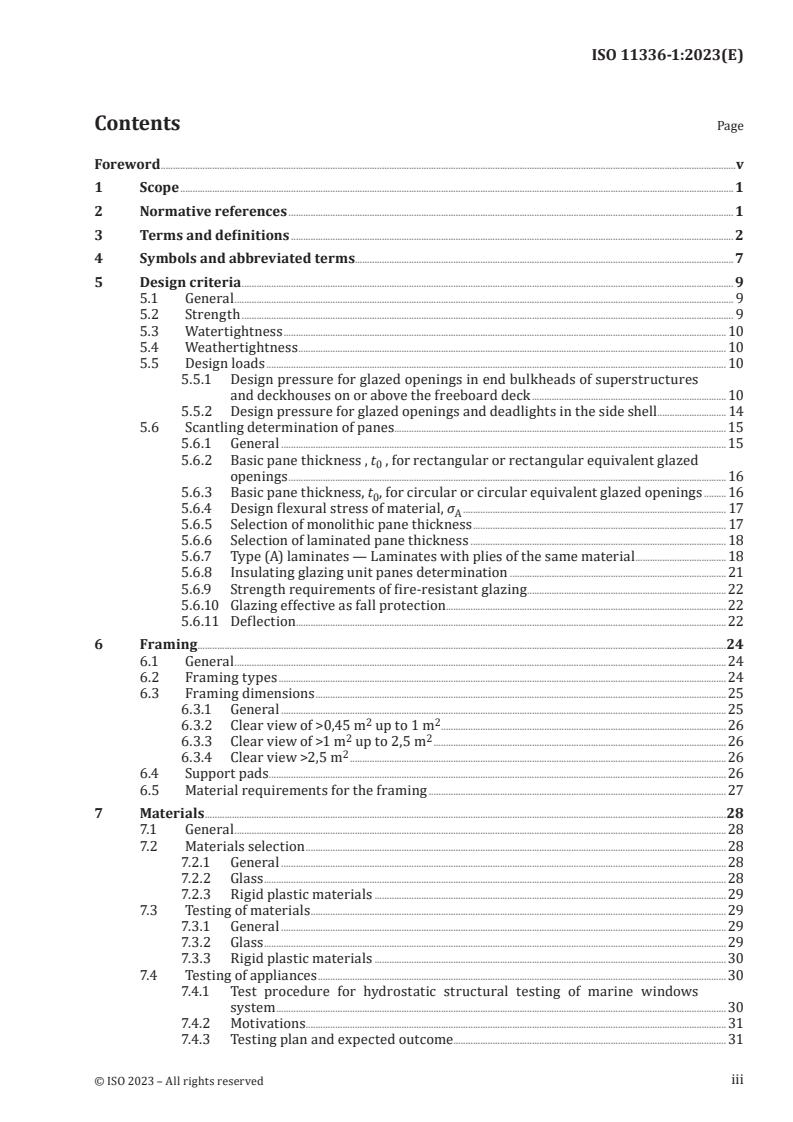
Contents Page
Foreword .v
1 Scope . 1
2 Normative references . 1
3 Terms and definitions . 2
4 Symbols and abbreviated terms.7
5 Design criteria . 9
5.1 General . 9
5.2 Strength . 9
5.3 Watertightness . 10
5.4 Weathertightness . 10
5.5 Design loads . 10
5.5.1 Design pressure for glazed openings in end bulkheads of superstructures
and deckhouses on or above the freeboard deck . 10
5.5.2 Design pressure for glazed openings and deadlights in the side shell . 14
5.6 Scantling determination of panes. 15
5.6.1 General .15
5.6.2 Basic pane thickness , t , for rectangular or rectangular equivalent glazed
openings . 16
5.6.3 Basic pane thickness, t , for circular or circular equivalent glazed openings . 16
5.6.4 Design flexural stress of material, σ . 17
A
5.6.5 Selection of monolithic pane thickness . 17
5.6.6 Selection of laminated pane thickness . 18
5.6.7 Type (A) laminates — Laminates with plies of the same material . 18
5.6.8 Insulating glazing unit panes determination . 21
5.6.9 Strength requirements of fire-resistant glazing . .22
5.6.10 Glazing effective as fall protection . 22
5.6.11 Deflection . .22
6 Framing .24
6.1 General . 24
6.2 Framing types . 24
6.3 Framing dimensions .25
6.3.1 General . 25
2 2
6.3.2 Clear view of >0,45 m up to 1 m . 26
2 2
6.3.3 Clear view of >1 m up to 2,5 m . 26
6.3.4 Clear view >2,5 m .26
6.4 Support pads . 26
6.5 Material requirements for the framing . 27
7 Materials .28
7.1 General .28
7.2 Materials selection .28
7.2.1 General .28
7.2.2 Glass .28
7.2.3 Rigid plastic materials .29
7.3 Testing of materials . 29
7.3.1 General .29
7.3.2 Glass .29
7.3.3 Rigid plastic materials .30
7.4 Testing of appliances . 30
7.4.1 Test procedure for hydrostatic structural testing of marine windows
system . 30
7.4.2 Motivations. 31
7.4.3 Testing plan and expected outcome . 31
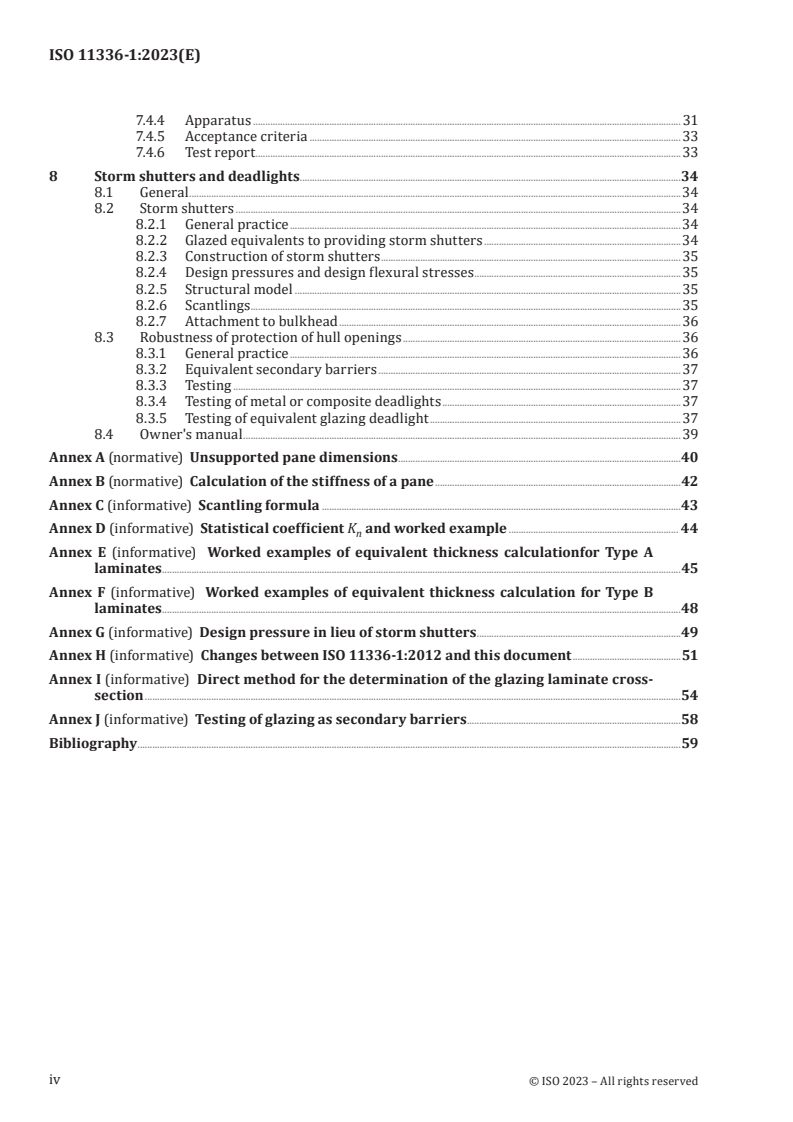
iii
7.4.4 Apparatus . 31
7.4.5 Acceptance criteria . 33
7.4.6 Test report . 33
8 Storm shutters and deadlights.34
8.1 General .34
8.2 Storm shutters .34
8.2.1 General practice .34
8.2.2 Glazed equivalents to providing storm shutters .34
8.2.3 Construction of storm shutters . 35
8.2.4 Design pressures and design flexural stresses . 35
8.2.5 Structural model . 35
8.2.6 Scantlings . . 35
8.2.7 Attachment to bulkhead . 36
8.3 Robustness of protection of hull openings . 36
8.3.1 General practice . 36
8.3.2 Equivalent secondary barriers . 37
8.3.3 Testing . 37
8.3.4 Testing of metal or composite deadlights . 37
8.3.5 Testing of equivalent glazing deadlight . 37
8.4 Owner's manual . 39
Annex A (normative) Unsupported pane dimensions .40
Annex B (normative) Calculation of the stiffness of a pane .42
Annex C (informative) Scantling formula .43
Annex D (informative) Statistical coefficient K and worked example . 44
n
Annex E (informative) Worked examples of equivalent thickness calculationfor Type A
laminates .45
Annex F (informative) Worked examples of equivalent thickness calculation for Type B
laminates .48
Annex G (informative) Design pressure in lieu of storm shutters .49
Annex H (informative) Changes between ISO 11336-1:2012 and this document .51
Annex I (informative) Direct method for the determination of the glazing laminate cross-
section .54
Annex J (informative) Testing of glazing as secondary barriers .58
Bibliography .59
iv
Foreword
ISO (the International Organization for Standardization) is a worldwide federation of national standards
bodies (ISO member bodies). The work of preparing International Standards is normally carried out
through ISO technical committees. Each member body interested in a subject for which a technical
committee has been established has the right to be represented on that committee. International
organizations, governmental and non-governmental, in liaison with ISO, also take part in the work.
ISO collaborates closely with the International Electrotechnical Commission (IEC) on all matters of
electrotechnical standardization.
The procedures used to develop this document and those intended for its further maintenance are
described in the ISO/IEC Directives, Part 1. In particular, the different approval criteria needed for the
different types of ISO document should be noted. This document was drafted in accordance with the
editorial rules of the ISO/IEC Directives, Part 2 (see www.iso.org/directives).
ISO draws attention to the possibility that the implementation of this document may involve the use
of (a) patent(s). ISO takes no position concerning the evidence, validity or applicability of any claimed
patent rights in respect thereof. As of the date of publication of this document, ISO had not received
notice of (a) patent(s) which may be required to implement this document. However, implementers are
cautioned that this may not represent the latest information, which may be obtained from the patent
database available at www.iso.org/patents. ISO shall not be held responsible for identifying any or all
such patent rights.
Any trade name used in this document is information given for the convenience of users and does not
constitute an endorsement.
For an explanation of the voluntary nature of standards, the meaning of ISO specific terms and
expressions related to conformity assessment, as well as information about ISO's adherence to
the World Trade Organization (WTO) principles in the Technical Barriers to Trade (TBT), see
www.iso.org/iso/foreword.html.
This document was prepared by Technical Committee ISO/TC 8, Ships and marine technology,
Subcommittee SC 12, Ships and marine technology — Large yachts.
This second edition cancels and replaces the first edition (ISO 11336-1:2012), which has been technically
revised.
The main changes are as follows:
— the Scope has been expanded to include length, number of passengers and glazing materials;
— the design pressure model has been parameterized and adapted to cover larger yachts;
— more advanced scantling calculation methods have been added;
— a new approach on robustness of superstructure and hull glazing has been added;
— Annex H has been replaced with information on the main changes since the first edition;
— Annexes I and J have been added.
A list of all parts in the ISO 11336 series can be found on the ISO website.
Any feedback or questions on this document should be directed to the user’s national standards body. A
complete listing of these bodies can be found at www.iso.org/members.html.
v
INTERNATIONAL STANDARD ISO 11336-1:2023(E)
Large yachts — Strength, weathertightness and
watertightness of glazed openings —
Part 1:
Design criteria, materials, framing and testing of
independent glazed openings
1 Scope
This document specifies technical requirements for independent glazed openings on large yachts,
taking into account navigation conditions, the location of the opening and the materials, framing and
testing.
Large yachts are yachts with length of the hull, L , higher or equal to 24 m, used for sport or pleasure
H
and commercial operations.
This document is suitable for the design of glazed openings on all large yachts. However, where
yachts carry more than 12 passengers, the additional requirements (set by the appropriate marine
administration) for fire integrity and damage stability are outside the scope of this standard.
The opening and the associated closing appliances considered in this document are only those that are
above the deepest waterline (dsw) and are critical for the ship integrity related to weathertightness and
watertightness, i.e. those that can lead to ingress of water in the hull in case of rupture, dislocation or
loss of the pane or its mounting. This document is related and limited to independent glazed openings in
which the pane is supported solely by simple linear support at the edges. Glazing in which the rotation
at the edges is constrained more than it would be by a single bond line is not covered by this document.
This document, excluding annexes, is limited to glazing of any shape, which is simply supported along
all edges. Horizontally positioned glazing is excluded.
NOTE This document is based on the experience of ship window and glass manufacturers, shipbuilders
[7]
and authorities who apply to ships the regulations of SOLAS, as amended , and of the International Convention
[6]
of Load Lines, as amended , noting the provisions by the SOLAS Protocol of 1988, Article 8, as agreed by the
appropriate Marine Administration, and on the experience gained with application of the Large Commercial
[16]
Yacht Code and the REG Yacht Code .
2 Normative references
The following documents are referred to in the text in such a way that some or all of their content
constitutes requirements of this document. For dated references, only the edition cited applies. For
undated references, the latest edition of the referenced document (including any amendments) applies.
ISO 178, Plastics — Determination of flexural properties
ISO 1751, Ships and marine technology — Ships' side scuttles
ISO 3903, Ships and marine technology — Ships' ordinary rectangular windows
ISO 5797, Ships and marine technology — Windows and side scuttles for fire-resistant constructions
ISO 6345, Shipbuilding and marine structures — Windows and side scuttles — Vocabulary
ISO 12543-1, Glass in building — Laminated glass and laminated safety glass — Part 1: Vocabulary and
description of component parts
ISO/IEC 17025, General requirements for the competence of testing and calibration laboratories
ISO 21005, Ships and marine technology — Thermally toughened safety glass panes for windows and side
scuttles
ISO 6721-10, Plastics — Determination of dynamic mechanical properties — Part 10: Complex shear
viscosity using a parallel-plate oscillatory rheometer
EN 1288-3, Glass in building — Determination of the bending strength of glass — Part 3: Test with specimen
supported at two points (four point bending)
EN 1990:2008, Eurocode — Basis of structural design
EN 12150-1:2000, Glass in building — Thermally toughened soda lime silicate safety glass — Part 1:
Definition and description
EN 12337-1, Glass in building — Chemically toughened soda lime silicate safety glass — Part 1: Definition
and description
EN 13195-1, Aluminium and aluminium alloys. Specifications for wrought and cast products for marine
applications (shipbuilding, marine and offshore)
EN 16612, Glass in building. Determination of the lateral load resistance of glass panes by calculation
ISO 29584, Glass in building — Pendulum impact testing and classification of safety glass
ISO 11336-2, Large yachts — Strength, weathertightness and watertightness of glazed openings — Part 2:
Glazed opening integrated into adjacent structure (elastically bonded to bulkhead or shell) design criteria,
structural support, installation and testing
3 Terms and definitions
For the purposes of this document, the terms and definitions given in ISO 6345 and the following apply.
ISO and IEC maintain terminology databases for use in standardization at the following addresses:
— ISO Online browsing platform: available at https:// www .iso .org/ obp
— IEC Electropedia: available at https:// www .electropedia .org/
3.1
glazed opening
opening in the hull, superstructure (3.26) or deckhouse of a ship structure to be fitted with a transparent
or translucent material
3.2
independent glazed opening
glazed opening (3.1) where the mechanical behaviour of the pane (3.5) can be considered independent
from adjacent structure because the pane is mounted in such a way that it is isolated from deformations
of the supporting structure, and the only loads on the pane are lateral pressure and effect of gravity
and inertia
3.3
not independent glazed opening
glazed opening (3.1) where the mechanical behaviour of the pane (3.5) cannot be considered independent
from adjacent structure, e.g. pane bonded directly into a seat in such a way that it is carrying in-plane
loads or is subjected to out-of-plane deformations of the supporting structure
3.4
appliance
device made of a pane (3.5) and a fixing system, used to cover an opening in the hull, superstructure
(3.26) or deckhouse
3.5
pane
sheet of material fixed within or to a supporting structure
3.6
glazing
transparent or translucent pane (3.5)
3.7
unsupported dimensions
clear dimensions between the supports bearing the pane (3.5)
Note 1 to entry: See Annex A.
3.8
deadlight
secondary watertight closure fitted to a glazed opening (3.1) and which is fitted on the inside of the
vessel
3.9
storm shutter
portable protective closure fitted to a glazed opening (3.1) and which is fitted on the outside
(weatherside) of the vessel
3.10
flag administration
government of the state whose flag the yacht flies
3.11
certifying authority
flag administration (3.10) or organization to whom the flag administration delegates certifying
authority
3.12
service
description of the service limitations for which a yacht is assessed to be suitable
3.13
commercial operation
operation for commercial use, involving yachts carrying no cargo and generally not more than
12 passengers or not needing to comply with passenger ship requirements
3.14
pleasure operation
operation involving private yachts not engaged in trade
3.15
operational range
range for which a yacht is assessed to be suitable
Note 1 to entry: For unrestricted range yachts, the operational range is the extended distance from safe haven
where conditions experienced can exceed wind force 8 (Beaufort scale), excluding extreme conditions.
Note 2 to entry: For intermediate range yachts, the operational range is a distance of not more than 200 nautical
miles from a safe haven.
Note 3 to entry: For a short range yacht, the operational range is a distance of not more than 60 nautical miles
from a safe haven.
3.16
freeboard deck
uppermost complete deck exposed to weather and sea, which has permanent means of closing all
openings in the weather part thereof, and below which all openings in the sides of the ship are fitted
with permanent means of watertight closing
Note 1 to entry: At the decision of the owner and subject to the approval of the administration, a lower deck can
be designated as a freeboard deck, provided it is a complete and permanent deck continuous in a fore and aft
direction at least between the machinery space and peak bulkheads and continuous athwart-ships.
3.17
standard superstructure height
h
std
height parameter expressed in meters (m) which is used for the calculation of the design load
Note 1 to entry: For vessels up to 75 m load line length, the height is taken as 1,8 m.
Note 2 to entry: For vessels over 125 m load line length, the height is taken as 2,3 m.
Note 3 to entry: For vessels of intermediate lengths, the height is obtained by linear interpolation.
3.18
load line length
L
96 % of the total length on a waterline at 85 % of the least moulded depth measured from the top of the
keel, or as the length from the fore side of the stem to the axis of the rudder stock on that waterline, if
that is greater
Note 1 to entry: For ships without a rudder stock, the length, L, is taken as 96 % of the waterline at 85 % of the
least moulded depth.
3.19
limits in glazed openings
maximum size of glazed openings (3.1) below a line 0,05 times ship length, measured from dsw (deepest
seagoing waterline) or less than L/4 aft of a line drawn at the intersection of the 0,05 L and the stem,
and below a line drawn at 0,05 L +h , not exceeding 0,85 m
std
Note 1 to entry: See Figure 1.
Figure 1 — Area in which glazed openings are limited to 0,85 m
3.20
large yacht
yachts in use for sport or pleasure (3.14) and commercial operations (3.13), with a length of the hull, L
H,
higher or equal to 24 m
Note 1 to entry: The length of the hull, L is measured according to ISO 8666.
H
3.21
weathertightness
capacity to prevent that, in any sea conditions, water will penetrate into the ship
Note 1 to entry: This definition has been adapted from the term “weathertight” taken from the International
Convention on Load Lines (ICLL), Annex I, Regulation 3 (12). This is interpreted generally as indicating that
weathertightness is required from the exterior only, as opposed to watertightness (3.22), indicating the ability to
withstand from both inside and outside.
3.22
watertightness
capacity of an appliance to prevent the passage of water through the structure in any direction under a
head of water for which the surrounding structure is designed
3.23
strength
capacity of a structure to maintain full structural integrity under the action of loads
3.24
design loads
external hydrostatic loads according to which glazed openings strength is assessed
3.25
hull
part of the yacht within the envelope of the side shell and decks taken into account for the assignment
of freeboard and for stability evaluation
3.26
superstructure
decked structure on the freeboard deck, extending from side to side of the yacht or with side plating not
being inboard of the shell plating more than 4 % of the yacht breadth
[SOURCE: ICLL 1966, Regulation 3, 10 (a), modified — “ship” replaced with “yacht”.]
3.27
deckhouse
structure enclosing a space that is normally accessible and used for accommodation or service and that
does not qualify as a superstructure (3.26) and that can be positioned on the freeboard deck, and/or the
tiers above
3.28
wheelhouse
control position occupied by the officer of the watch
3.29
glass ply
plate made of an inorganic non-crystalline solid exhibiting a glass transition behaviour
3.30
thermally toughened safety glass
glass where strength increase is obtained by a thermal treatment resulting in the introduction of
permanent compression stress on both sides of its cross section
3.31
chemically toughened glass
glass where strength increase is obtained by chemical treatment resulting in the introduction of
permanent compression stress on both sides of its cross section
3.32
monolithic pane
monolithic construction
glazing (3.6) consisting of one ply of glass
3.33
laminated glass
multi-layer pane (3.5) made of glass plies, plastic plies or other glazing (3.6) materials, which are kept
together by suitable plastic adhesive films or curable resins
3.34
safety glass
monolithic thermally toughened glass, fully tempered, or laminated glass (3.33) built from thermally or
chemically toughened panes (3.5)
3.35
insulating glazing unit
IGU
window panes (3.5) (usually glass) separated by a gas-filled space to reduce heat transfer across a part
of the vessel envelope
Note 1 to entry: Insulating glazing (3.6) units consist of two or more window panes.
Note 2 to entry: A window with insulating glass is commonly known as double glazing or a double-paned window,
triple glazing or a triple-paned window, or quadruple glazing or a quadruple-paned window, depending on how
many panes of glass are used in its construction.
3.36
depth of compression layer
glass case depth
l
CD
depth measured from the surface to the inner cross section point where compression stress is zero,
when a glass ply (3.29) is toughened by the introduction of permanent compression stress on both sides
of its cross section
3.37
glass surface compression
S
C
value of compression stress taken at the surface, when a glass ply (3.29) is toughened by the introduction
of permanent compression stress on both sides of its cross section
3.38
plastic ply
rigid plate, made of a polymeric material, where “rigid” means that the plastic material has a modulus
of elasticity in flexure or, if not applicable, then in tension, greater than 700 MPa
3.39
interlayer
laminating adhesive material that holds together the plies of a laminated glazing (3.6)
Note 1 to entry: It can be a thermoplastic adhesive film or a curable resin.
3.40
characteristic failure strength
σ
C
ultimate flexural strength of glass pane (3.41) or plastic material (3.42)
3.41
glass pane
ultimate flexural strength at rupture of glass measured, on a statistical basis, in a flexural testing
arrangement with a defined method of data reduction taking in account statistical dispersion
3.42
plastic material
ultimate flexural strength at rupture or flexural strength at yield, whichever is lower
Note 1 to entry: The choice between the value at rupture or at yield depends on the mechanical characteristics
of the plastic material; as a general indication brittle plastic material breaks before yielding without apparent
plastic deformation while non-brittle plastic material yields before breaking.
3.43
main structural section
monolithic or laminated pane (3.5) construction that meets strength requirements
Note 1 to entry: to entry The strength requirements are specified in 5.2.
3.44
additional functional plies
additional glass or plastic plies or panes (3.5) not included in the frame that can be coupled to the main
structural section, do not have structural functionalities and do not affect structural functionality of
the main structural section
Note 1 to entry: The flexural modulus/flexural strength, E/σ , is substantially less (50 %) than that of the main
c
structural section.
3.45
deepest seagoing waterline
dsw
assigned waterline for commercial yachts or the deepest seagoing waterline for private yachts
3.46
superstructure type A
superstructure (3.26) not considered buoyant in the stability calculations
3.47
superstructure type B
superstructure (3.26) considered buoyant in the stability calculations
3.48
aft perpendicular
position of the aft end of the deepest seagoing waterline (3.45)
4 Symbols and abbreviated terms
p design pressure following from the location on board the ship
D
p design pressure for engineering the glass panels
DE
p base design pressure
D0
p ultimate limit state pressure - p = γ·p
ULS ULS DE.
a factor relating to location and vessel length
b factor based on longitudinal location
f factor based on vessel length
c factor based on width of superstructure or deckhouse
h height of centre of pane from dsw
h height above the waterline where design pressure equals p
0 D0
h standard superstructure height
std
I shear collaboration factor in laminated glazing
s
k service factor
s
L length of the hull
H
L load line length
L length between perpendiculars on summer load waterline
p
x distance of centre of pane or storm shutter from aft perpendicular
t basic pane thickness
O
a unsupported long side of a rectangular pane or “equivalent long side” of a pane
P
b unsupported short side of a rectangular pane or “equivalent short side” of a pane
P
β pane aspect-ratio coefficient for stress
S
β pane aspect-ratio coefficient for deflection
D
σ allowable design flexural stress of the material
A
d diameter of a circular glazed opening
σ characteristic breaking strength of a material or laminate
C
γ design factor
t actual pane thickness
a
t minimum pane thickness
min
t , t , ., t ply thicknesses of a laminated pane
p1 p2 pn
t equivalent thickness of each ply of the laminate
eq,j
t equivalent thickness of laminated construction
eq
t physical thickness of a laminate
Lam
δ maximum pane deflection
max
M pane stiffness
l depth of compression layer
CD
S glass surface compression
C
N number of test specimens
n number of independent plies
σ breaking stress for each test specimen when tested according to EN 1288-3 for glass or
i
ISO 178 for brittle plastic materials; stress at yield for each test specimen when tested
according to ISO 178 for non-brittle plastic materials
σ average breaking stress or yield stress, whichever is applicable
av
s standard deviation
x
C coefficient of variation
V
K statistic coefficient corresponding to lower half of the 90 % confidence limit
n
E Young’s modulus
ν Poisson’s ratio
Z section modulus
ICLL 1966 International Convention on Load Line 1966, as amended
IACS International Association of Class Societies
TTG thermally toughened safety glass
CTG chemically toughened glass
IGU insulating glazing units
PMMA Poly(methyl methacrylate)
PC Polycarbonate
dsw deepest seagoing waterline
FRP fibre reinforced plastics
5 Design criteria
5.1 General
Other international standards, for example, those dealing with stability, buoyancy, weathertight or
watertight integrity, can have restrictions on the position of appliances which are outside the scope of
this document. However, it is expected that the builder or user ensures that the appliances comply with
other relevant international standards.
It is also possible that national authorities have additional requirements differing from those of this
document. Individual statutory regulations of flag administrations for commercial yachts can apply.
For example, where yachts are complying with the published “Conditions of Assignment” of the
[6]
International Convention on Load Line, 1966, as amended , the maximum size of a glazed opening
below the freeboard deck or in enclosed superstructures is 0,16 m .
5.2 Strength
The strength of glazed openings and associated appliances shall meet the requirements of this
document, ISO 3903 or ISO 1751, depending on the type of glazed opening. For the scope of this
document, strength is considered only with reference to local loads, that is, external hydrostatic loads
coming from weather and sea conditions. Strength requirements are fulfilled according to any of the
following criteria:
— where the glazed opening type is covered by an existing relevant international standard, such as
ISO 3903 or ISO 1751, for ship’s windows and ship’s portlights respectively;
— where the pane thickness is calculated according to the method outlined in 5.6, and the glass is flat
or convex towards the load action direction, the strength requirements of the frame are according
to an existing relevant international standard such as ISO 3903 or ISO 1751;
— when the pane has been tested according to the hydrostatic test procedure outlined in 7.3.
External hydrostatic loads (design loads) shall be the only loads considered for strength requirement
fulfilment according to this document. For a particular application, other requirements and criteria can
be relevant and can apply.
Strength requirements for monolithic and laminated constructions shall be fulfilled only for the main
structural section. Additional functional plies or panes are plies that are not intended to fulfil strength
requirements. Furthermore, they shall not take part in the structural validation of the appliance or in
the hydrostatic test outlined in 7.3. Such plies or panes shall not adversely affect the strength of the
main structural section.
According to qualification by hydrostatic test, any changes to the glazing materials or any change to the
cross-section or larger dimensions of the glazing shall require re-testing. For tolerances, see 7.3.2.
5.3 Watertightness
The appliance shall be designed and mounted to prevent ingress of water into the yacht according to
any of the following criteria:
— where the appliance type is covered by an existing relevant international standard;
— where the pane thickness is calculated in accordance with the methods outlined in 5.6. The pane is
clamped with a rubber gasket or bonded in the frame with the bonding joint in compression. The
strength requirements of the frame are according to ISO 1751 or ISO 3902, depending on their type;
— when tested according to the hydrostatic test procedure outlined in 7.3.
Any changes to the glazing materials or any change to the cross-section or larger dimensions of the
glazing shall require re-testing. For tolerances, see 7.3.2.
5.4 Weathertightness
The weathertightness requirements shall be fulfilled by performing a hose test in the final installation
on board. The hose test consists of hosing the appliance along its perimeter (width of 100 mm) by means
of at least 12,0 mm nominal size hose held at a distance of not more than 1,5 m from the appliance. A
static water pressure (with no water flow) of 200 kPa shall be used and the free height of water from
the hose with stream directed upwards of shall be not less than 10 m.
The hosing shall last at least three minutes, uniformly applied around the periphery for each appliance.
No water shall be detected on the inner side of the appliance.
5.5 Design loads
5.5.1 Design pressure for glazed openings in end bulkheads of superstructures and
deckhouses on or above the freeboard deck
This design pressure shall also be applied to storm shutters and deadlights in the exposed bulkheads of
superstructures and deckhouses, on and above the freeboard deck.
[8]
The design pressure formula in IACS UR S 3 , is adapted to Formulae (3) to (5) to give design pressures
p for glazed openings and storm shutters in the end bulkheads of superstructures, the end bulkheads
D
and side bulkheads of deckhouses on or above the freeboard deck.
The design pressure, p , depends on the position on the vessel and the orientation of the opening. It is a
D
component of the design pressure for engineering, p , (see 5.6), which includes factors for robustness.
DE
Potential consequences of failure and this pressure, p shall be used for design of the scantlings of the
DE,
glazing.
The following apply to Formulae (1) to (8) for the determination of the design pressure use the following
definitions:
y is the transverse distance from centreline;
b is the half beam of vessel;
ϕ is the orientation angle of the window (see Figure 3).
The determination of design pressure requires a preliminary calculation of the base design pressure,
p (kN/m ) according to Formula (1):
D0
L
pf=+()11⋅+max 51;,25 (1)
D0 PD0
20
where
p is the base design pressure expressed in (kN/m );
D0
f is the position factor of the glazed opening (non-dimensional);
PD0
and where the factors are determined using Formula (2) (see Figure 2):
ff=⋅max ff; (2)
()
PD0h dirb
where
f =1 when the centre of the window is up to 1,5 m above the main deck (see Figure 2);
h
f =0 when the centre of the window is 4,0 m or more above the main deck (see Figure 2) interme-
h
diate values of f by linear interpolation;
h
f =1 when y/b = 1;
b 2
f =0 when y/b < 0,85; intermediate values of f by linear interpolation;
2 b
b
f =−cos()φ when ϕ > 90°;
dir
f =0 otherwise.
dir
ISO
...