

ISO/IEC 14496-5:2001
(Main)Information technology — Coding of audio-visual objects — Part 5: Reference software
General Information
- Abstract
Reference software is normative in the sense that any conforming implementation of the software, taking the same conformant bitstreams, using the same output file format, will output the same file. Complying ISO/IEC 14496 implementations are not expected to follow the algorithms or the programming techniques used by the reference software. Although the decoding software is considered normative, it cannot add anything to the textual technical description included in parts 1, 2, 3 and 6 of ISO/IEC 14496. The software contained in this part of ISO/IEC 14496 is divided into three categories: a) Elementary stream decoding software is catalogued in clauses 3, 4 and 5. This software accepts elementary streams encoded according to the normative specification in parts 1, 2, 3 and 6 of ISO/IEC 14496 and decodes the streams into the media types associated with each elementary stream. While this software appears in the normative part of this specification, attention is drawn to the fact that the implementation techniques used in this software are not considered normative ? several different implementations could produce the same result ? but the software is considered normative in that it correctly implements the decoding processes described in parts 1, 2, 3 and 6 of ISO/IEC 14496. b) Elementary stream encoding software is catalogued in Annex A (informative). This software creates elementary streams from associated media types. The encoders are provided as a means to obtain elementary streams with the normative syntax described in parts 1, 2 and 3 of ISO/IEC 14496. The techniques used for encoding are not specified by this specification, and the quality and complexity of these encoders has not been optimized. c) Utility software is catalogued in Annex B (informative). This software was found useful by the developers of the standard, but may not conform to the normative specifications given in parts 1, 2, 3 and 6 of ISO/IEC 14496. File locations given in this part of ISO/IEC 14496 are expressed relative to its location in the source tree.
- Status
- Published
- Publication Date
- 14-Dec-2001
- Current Stage
- 9093 - International Standard confirmed
- Start Date
- 29-Jul-2008
- Completion Date
- 29-Aug-2026
Buy Documents


ISO/IEC 14496-5:2001 - Information technology — Coding of audio-visual objects — Part 5: Reference software Released:12/15/2001


ISO/IEC 14496-5:2001 - Information technology — Coding of audio-visual objects — Part 5: Reference software Released:12/15/2001
Overview - ISO/IEC 14496-5:2001 (Reference software)
ISO/IEC 14496-5:2001, part of the MPEG‑4 family, specifies the reference software used to validate and demonstrate the audio‑visual coding tools defined in other parts of ISO/IEC 14496. This part provides normative decoders (reference implementations) and informative encoders and utility programs. The reference software is normative in the sense that any conforming implementation that consumes the same conformant bitstreams and uses the same output file format should produce the same output files, ensuring reproducible results for MPEG‑4/MP4 development and conformance testing.
Key topics and technical requirements
- Normative decoders: Elementary‑stream decoding software (catalogued in clauses 3–5) implements the decoding processes described in Parts 1, 2, 3 and 6. The software is normative only for behavior/output, not for internal algorithms or programming techniques.
- Informative encoders: Annex A contains bitstream encoding software to generate normative‑syntax bitstreams. Encoders are provided for convenience and are not optimized for quality or performance.
- Utility software: Annex B lists additional tools useful to developers (e.g., renderers, conformance helpers). These utilities may not fully conform to normative specs.
- File and source organization: The document catalogs software by directory (audio/, video/, systems/) and specifies file locations relative to the source tree.
- Copyright and licensing: Each source module includes a mandatory copyright disclaimer; ISO/IEC grants free license for conformance use but warns about possible patent rights.
- Determinism requirement: Given identical conformant bitstreams and output format, conforming implementations must produce identical output files - important for conformance testing and verification.
Practical applications and target users
- Codec implementers and integrators use the reference decoders to validate that their implementations produce correct outputs for MPEG‑4 bitstreams.
- Conformance and interoperability testers rely on deterministic outputs to create test vectors and verify compliance.
- Researchers and educators use the reference software as a baseline for experimentation and teaching MPEG‑4 decoding/encoding concepts.
- Tool and player developers (MP4 file format implementers, MPEG‑J, renderers) use provided systems software and utilities to prototype and debug playback pipelines.
Practical keywords: MPEG‑4 reference software, MP4 file format, elementary stream decoder, encoder, conformance testing, MPEG‑4 tools.
Related standards
- ISO/IEC 14496‑1 (Systems)
- ISO/IEC 14496‑2 (Visual)
- ISO/IEC 14496‑3 (Audio)
- ISO/IEC 14496‑4 (Conformance testing)
- ISO/IEC 14496‑6 (DMIF)
- ISO/IEC 14496‑7 (Optimized visual software)
These parts together define the MPEG‑4 standard set; Part 5 provides the implementation reference to ensure consistent interpretation and testing.
Relations
- Effective Date
- 06-Jun-2022
- Effective Date
- 06-Jun-2022
- Effective Date
- 06-Jun-2022
- Effective Date
- 06-Jun-2022
- Effective Date
- 06-Jun-2022
- Effective Date
- 06-Jun-2022
- Effective Date
- 06-Jun-2022
- Effective Date
- 06-Jun-2022
- Effective Date
- 06-Jun-2022
- Effective Date
- 06-Jun-2022
- Effective Date
- 06-Jun-2022
- Effective Date
- 06-Jun-2022
- Effective Date
- 06-Jun-2022
- Effective Date
- 06-Jun-2022
- Effective Date
- 06-Jun-2022
Buy Documents
ISO/IEC 14496-5:2001 - Information technology — Coding of audio-visual objects — Part 5: Reference software Released:12/15/2001
ISO/IEC 14496-5:2001 - Information technology — Coding of audio-visual objects — Part 5: Reference software Released:12/15/2001
Get Certified
Connect with accredited certification bodies for this standard

BSI Group
BSI (British Standards Institution) is the business standards company that helps organizations make excellence a habit.

NYCE
Mexican standards and certification body.
Sponsored listings
Frequently Asked Questions
ISO/IEC 14496-5:2001 is a standard published by the International Organization for Standardization (ISO). Its full title is "Information technology — Coding of audio-visual objects — Part 5: Reference software". This standard covers: Reference software is normative in the sense that any conforming implementation of the software, taking the same conformant bitstreams, using the same output file format, will output the same file. Complying ISO/IEC 14496 implementations are not expected to follow the algorithms or the programming techniques used by the reference software. Although the decoding software is considered normative, it cannot add anything to the textual technical description included in parts 1, 2, 3 and 6 of ISO/IEC 14496. The software contained in this part of ISO/IEC 14496 is divided into three categories: a) Elementary stream decoding software is catalogued in clauses 3, 4 and 5. This software accepts elementary streams encoded according to the normative specification in parts 1, 2, 3 and 6 of ISO/IEC 14496 and decodes the streams into the media types associated with each elementary stream. While this software appears in the normative part of this specification, attention is drawn to the fact that the implementation techniques used in this software are not considered normative ? several different implementations could produce the same result ? but the software is considered normative in that it correctly implements the decoding processes described in parts 1, 2, 3 and 6 of ISO/IEC 14496. b) Elementary stream encoding software is catalogued in Annex A (informative). This software creates elementary streams from associated media types. The encoders are provided as a means to obtain elementary streams with the normative syntax described in parts 1, 2 and 3 of ISO/IEC 14496. The techniques used for encoding are not specified by this specification, and the quality and complexity of these encoders has not been optimized. c) Utility software is catalogued in Annex B (informative). This software was found useful by the developers of the standard, but may not conform to the normative specifications given in parts 1, 2, 3 and 6 of ISO/IEC 14496. File locations given in this part of ISO/IEC 14496 are expressed relative to its location in the source tree.
Reference software is normative in the sense that any conforming implementation of the software, taking the same conformant bitstreams, using the same output file format, will output the same file. Complying ISO/IEC 14496 implementations are not expected to follow the algorithms or the programming techniques used by the reference software. Although the decoding software is considered normative, it cannot add anything to the textual technical description included in parts 1, 2, 3 and 6 of ISO/IEC 14496. The software contained in this part of ISO/IEC 14496 is divided into three categories: a) Elementary stream decoding software is catalogued in clauses 3, 4 and 5. This software accepts elementary streams encoded according to the normative specification in parts 1, 2, 3 and 6 of ISO/IEC 14496 and decodes the streams into the media types associated with each elementary stream. While this software appears in the normative part of this specification, attention is drawn to the fact that the implementation techniques used in this software are not considered normative ? several different implementations could produce the same result ? but the software is considered normative in that it correctly implements the decoding processes described in parts 1, 2, 3 and 6 of ISO/IEC 14496. b) Elementary stream encoding software is catalogued in Annex A (informative). This software creates elementary streams from associated media types. The encoders are provided as a means to obtain elementary streams with the normative syntax described in parts 1, 2 and 3 of ISO/IEC 14496. The techniques used for encoding are not specified by this specification, and the quality and complexity of these encoders has not been optimized. c) Utility software is catalogued in Annex B (informative). This software was found useful by the developers of the standard, but may not conform to the normative specifications given in parts 1, 2, 3 and 6 of ISO/IEC 14496. File locations given in this part of ISO/IEC 14496 are expressed relative to its location in the source tree.
ISO/IEC 14496-5:2001 is classified under the following ICS (International Classification for Standards) categories: 35.040 - Information coding; 35.040.40 - Coding of audio, video, multimedia and hypermedia information. The ICS classification helps identify the subject area and facilitates finding related standards.
ISO/IEC 14496-5:2001 has the following relationships with other standards: It is inter standard links to ISO/IEC 14496-5:2001/Amd 7:2005, ISO/IEC 14496-5:2001/Amd 15:2010, ISO/IEC 14496-5:2001/Amd 20:2009, ISO/IEC 14496-5:2001/Amd 25:2009, ISO/IEC 14496-5:2001/Amd 10:2007, ISO/IEC 14496-5:2001/Amd 9:2007, ISO/IEC 14496-5:2001/Amd 1:2002, ISO/IEC 14496-5:2001/Amd 8:2006, ISO/IEC 14496-5:2001/Amd 2:2003, ISO/IEC 14496-5:2001/Amd 3:2003, ISO/IEC 14496-5:2001/Amd 16:2008, ISO/IEC 14496-5:2001/Amd 18:2008, ISO/IEC 14496-5:2001/Amd 17:2008, ISO/IEC 14496-5:2001/Amd 23:2010, ISO/IEC 14496-5:2001/Amd 12:2007. Understanding these relationships helps ensure you are using the most current and applicable version of the standard.
ISO/IEC 14496-5:2001 is available in PDF format for immediate download after purchase. The document can be added to your cart and obtained through the secure checkout process. Digital delivery ensures instant access to the complete standard document.
Standards Content (Sample)
INTERNATIONAL ISO/IEC
STANDARD 14496-5
Second edition
2001-12-15
Information technology — Coding of
audio-visual objects —
Part 5:
Reference software
Technologies de l'information — Codage des objets audiovisuels —
Partie 5: Logiciel de référence
Reference number
©
ISO/IEC 2001
PDF disclaimer
This PDF file may contain embedded typefaces. In accordance with Adobe's licensing policy, this file may be printed or viewed but shall not
be edited unless the typefaces which are embedded are licensed to and installed on the computer performing the editing. In downloading this
file, parties accept therein the responsibility of not infringing Adobe's licensing policy. The ISO Central Secretariat accepts no liability in this
area.
Adobe is a trademark of Adobe Systems Incorporated.
Details of the software products used to create this PDF file can be found in the General Info relative to the file; the PDF-creation parameters
were optimized for printing. Every care has been taken to ensure that the file is suitable for use by ISO member bodies. In the unlikely event
that a problem relating to it is found, please inform the Central Secretariat at the address given below.
© ISO/IEC 2001
All rights reserved. Unless otherwise specified, no part of this publication may be reproduced or utilized in any form or by any means, electronic
or mechanical, including photocopying and microfilm, without permission in writing from either ISO at the address below or ISO's member body
in the country of the requester.
ISO copyright office
Case postale 56 • CH-1211 Geneva 20
Tel. + 41 22 749 01 11
Fax + 41 22 749 09 47
E-mail copyright@iso.ch
Web www.iso.ch
Published by ISO in 2002
Printed in Switzerland
ii © ISO/IEC 2001 – All rights reserved
Contents Page
Foreword.iv
Introduction.v
1 Scope.1
2 Copyright disclaimer for software modules .1
3 Audio reference software.2
4 Visual reference software .2
5 Systems reference software.2
Annex A (informative) Bitstream encoding software .3
A.1 Audio encoding software.3
A.2 Visual encoding software.3
A.3 Systems encoding software .3
Annex B (informative) Additional utility software.4
B.1 Audio utility software .4
B.2 Visual utility software.4
B.3 Systems utility software.4
Annex C (informative) Providers of reference software.5
© ISO/IEC 2001 – All rights reserved iii
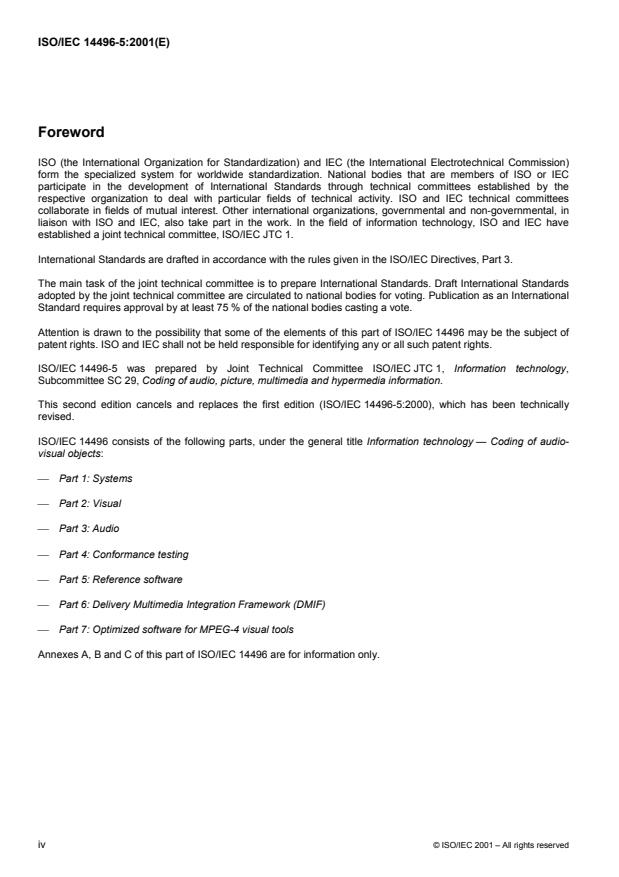
Foreword
ISO (the International Organization for Standardization) and IEC (the International Electrotechnical Commission)
form the specialized system for worldwide standardization. National bodies that are members of ISO or IEC
participate in the development of International Standards through technical committees established by the
respective organization to deal with particular fields of technical activity. ISO and IEC technical committees
collaborate in fields of mutual interest. Other international organizations, governmental and non-governmental, in
liaison with ISO and IEC, also take part in the work. In the field of information technology, ISO and IEC have
established a joint technical committee, ISO/IEC JTC 1.
International Standards are drafted in accordance with the rules given in the ISO/IEC Directives, Part 3.
The main task of the joint technical committee is to prepare International Standards. Draft International Standards
adopted by the joint technical committee are circulated to national bodies for voting. Publication as an International
Standard requires approval by at least 75 % of the national bodies casting a vote.
Attention is drawn to the possibility that some of the elements of this part of ISO/IEC 14496 may be the subject of
patent rights. ISO and IEC shall not be held responsible for identifying any or all such patent rights.
ISO/IEC 14496-5 was prepared by Joint Technical Committee ISO/IEC JTC 1, Information technology,
Subcommittee SC 29, Coding of audio, picture, multimedia and hypermedia information.
This second edition cancels and replaces the first edition (ISO/IEC 14496-5:2000), which has been technically
revised.
ISO/IEC 14496 consists of the following parts, under the general title Information technology — Coding of audio-
visual objects:
Part 1: Systems
Part 2: Visual
Part 3: Audio
Part 4: Conformance testing
Part 5: Reference software
Part 6: Delivery Multimedia Integration Framework (DMIF)
Part 7: Optimized software for MPEG-4 visual tools
Annexes A, B and C of this part of ISO/IEC 14496 are for information only.
iv © ISO/IEC 2001 – All rights reserved
Introduction
This part of ISO/IEC 14496 contains simulation software for tools defined in parts 1, 2, 3 and 6 of ISO/IEC 14496.
This software has been derived from verification models used in the process of developing the standard. Due to the
delay between acceptance of a tool and its availability in source code form, the source for some tools described in
other parts of ISO/IEC 14496 may not be present.
Where bitstream encoding software is provided, attention is called to the fact that these encoders are provided for
the purpose of creating bitstreams with normative syntax. The performance of these encoders should not be taken
as indicative of that which can be obtained from implementations where quality and computational optimization are
given priority. The techniques used for encoding are not specified by this specification.
© ISO/IEC 2001 – All rights reserved v
INTERNATIONAL STANDARD ISO/IEC 14496-5:2001(E)
Information technology — Coding of audio-visual objects —
Part 5:
Reference software
1 Scope
Reference software is normative in the sense that any conforming implementation of the software, taking the same
conformant bitstreams, using the same output file format, will output the same file. Complying ISO/IEC 14496
implementations are not expected to follow the algorithms or the programming techniques used by the reference
software. Although the decoding software is considered normative, it cannot add anything to the textual technical
description include
...
INTERNATIONAL ISO/IEC
STANDARD 14496-5
Second edition
2001-12-15
Information technology — Coding of
audio-visual objects —
Part 5:
Reference software
Technologies de l'information — Codage des objets audiovisuels —
Partie 5: Logiciel de référence
Reference number
ISO/IEC 14496-5-:2001(E)
©
ISO/IEC 2001
PDF disclaimer
This PDF file may contain embedded typefaces. In accordance with Adobe's licensing policy, this file may be printed or viewed but shall not
be edited unless the typefaces which are embedded are licensed to and installed on the computer performing the editing. In downloading this
file, parties accept therein the responsibility of not infringing Adobe's licensing policy. The ISO Central Secretariat accepts no liability in this
area.
Adobe is a trademark of Adobe Systems Incorporated.
Details of the software products used to create this PDF file can be found in the General Info relative to the file; the PDF-creation parameters
were optimized for printing. Every care has been taken to ensure that the file is suitable for use by ISO member bodies. In the unlikely event
that a problem relating to it is found, please inform the Central Secretariat at the address given below.
This CD-ROM contains:
1) the publication ISO/IEC 14496-5 in portable document format (PDF), which can be viewed using Adobe®
Acrobat® Reader;
2) simulation software for tools defined in parts 1, 2, 3 and 6 of ISO/IEC 14496.
Adobe and Acrobat are trademarks of Adobe Systems Incorporated.
This second edition cancels and replaces the first edition (ISO/IEC
...