

ISO/TR 25555:2024
(Main)Ageing societies — Accessibility and usability considerations for home healthcare products, related services and environments
General Information
- Abstract
This document provides a collection of design considerations from existing international standards as well as best practices and observations obtained from the home healthcare field. This document is intended to be used as a reference for designing accessibility and usability of home healthcare products and associated services, and environments designed for non-professional users. This document does not provide information on the use of home healthcare products by healthcare professionals regardless of the place and facility of use.
- Status
- Published
- Publication Date
- 03-Jan-2024
- Technical Committee
- ISO/TC 314 - Ageing societies
- Drafting Committee
- ISO/TC 314 - Ageing societies
- Current Stage
- 6060 - International Standard published
- Start Date
- 04-Jan-2024
- Completion Date
- 04-Jan-2024
Overview
ISO/TR 25555:2024 - Ageing societies - Accessibility and usability considerations for home healthcare products, related services and environments is a Technical Report that collects design considerations, best practices and field observations to improve the accessibility and usability of products, services and environments used for home healthcare by non‑professional users (caregivers and care recipients). Published in 2024 by ISO/TC 314, this document is a practical reference (not a normative standard) intended to support designers, manufacturers, service providers and policymakers working on solutions for ageing societies.
Key technical topics and guidance
The report organizes practical guidance across product, service and environment domains. Major topics include:
General design principles
- Safety and security when professional support is not continuously available
- Cleanliness, disinfection and sterilization practices to reduce infection risk
- Supporting independence and autonomy (self‑use, consent, on‑demand use)
- Broad accessibility for diverse users and contexts
Home healthcare product considerations
- Operation: general and specific ergonomic and interaction considerations for non‑professional users
- Information and marking: readability, multiple information modalities (visual, auditory, tactile), clear labelling and instructions
Service considerations
- Design of related services to support non‑professional use, including training, maintenance and remote support
Environment considerations
- Lighting, sound, thermal and air quality factors for product use in dwellings and non‑clinical settings
- Zoning and layout guidance to limit infection spread and improve usability
Supporting material
- Annex A: classification of major home healthcare products and users
- Annex B: examples of home healthcare products and use contexts
Practical applications and who uses this document
ISO/TR 25555:2024 is valuable to:
- Product designers and manufacturers of medical and non‑medical devices intended for home use
- Service providers offering delivery, maintenance, training or telehealth support
- Facility and home‑environment planners designing accessible living spaces for older adults
- Regulators and procurement teams seeking guidance on usability and accessibility expectations
- Care organisations and caregivers looking for best practices to reduce risk and increase independence
Applications include improving device interfaces for older users, designing instruction materials, planning home modifications (lighting, acoustics), and developing training and support services.
Related standards
- ISO/IEC Guide 71:2014 (accessibility guidance)
- ISO 9241-11:2018 (usability concepts)
- IEC 60601-1-11 (home healthcare environments references)
- ISO/IEEE 11073 family (personal health device communication)
Keywords: ISO/TR 25555:2024, ageing societies, home healthcare, accessibility, usability, home healthcare products, non‑professional users, caregivers, care recipients, design considerations.
Get Certified
Connect with accredited certification bodies for this standard

BSI Group
BSI (British Standards Institution) is the business standards company that helps organizations make excellence a habit.

TÜV Rheinland
TÜV Rheinland is a leading international provider of technical services.

TÜV SÜD
TÜV SÜD is a trusted partner of choice for safety, security and sustainability solutions.
Sponsored listings
Frequently Asked Questions
ISO/TR 25555:2024 is a technical report published by the International Organization for Standardization (ISO). Its full title is "Ageing societies — Accessibility and usability considerations for home healthcare products, related services and environments". This standard covers: This document provides a collection of design considerations from existing international standards as well as best practices and observations obtained from the home healthcare field. This document is intended to be used as a reference for designing accessibility and usability of home healthcare products and associated services, and environments designed for non-professional users. This document does not provide information on the use of home healthcare products by healthcare professionals regardless of the place and facility of use.
This document provides a collection of design considerations from existing international standards as well as best practices and observations obtained from the home healthcare field. This document is intended to be used as a reference for designing accessibility and usability of home healthcare products and associated services, and environments designed for non-professional users. This document does not provide information on the use of home healthcare products by healthcare professionals regardless of the place and facility of use.
ISO/TR 25555:2024 is classified under the following ICS (International Classification for Standards) categories: 11.020.10 - Health care services in general; 13.180 - Ergonomics. The ICS classification helps identify the subject area and facilitates finding related standards.
ISO/TR 25555:2024 is available in PDF format for immediate download after purchase. The document can be added to your cart and obtained through the secure checkout process. Digital delivery ensures instant access to the complete standard document.
Standards Content (Sample)
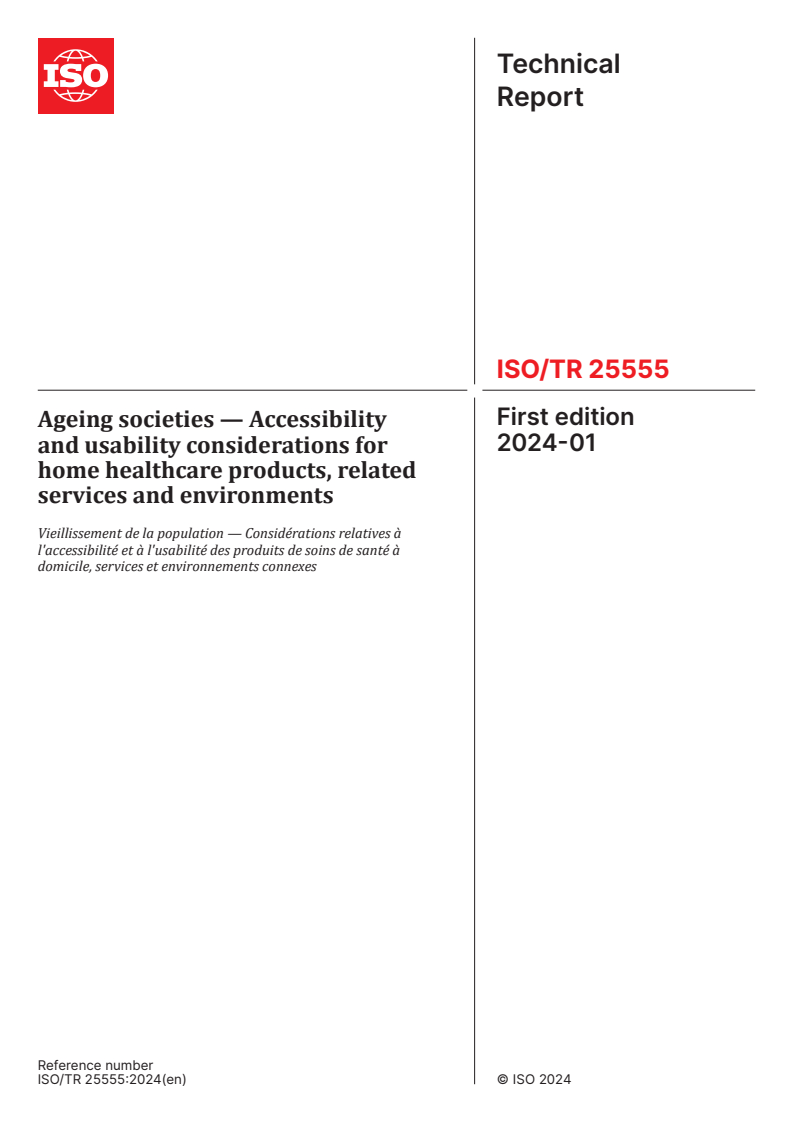
Technical
Report
ISO/TR 25555
First edition
Ageing societies — Accessibility
2024-01
and usability considerations for
home healthcare products, related
services and environments
Vieillissement de la population — Considérations relatives à
l'accessibilité et à l'usabilité des produits de soins de santé à
domicile, services et environnements connexes
Reference number
© ISO 2024
All rights reserved. Unless otherwise specified, or required in the context of its implementation, no part of this publication may
be reproduced or utilized otherwise in any form or by any means, electronic or mechanical, including photocopying, or posting on
the internet or an intranet, without prior written permission. Permission can be requested from either ISO at the address below
or ISO’s member body in the country of the requester.
ISO copyright office
CP 401 • Ch. de Blandonnet 8
CH-1214 Vernier, Geneva
Phone: +41 22 749 01 11
Email: copyright@iso.org
Website: www.iso.org
Published in Switzerland
ii
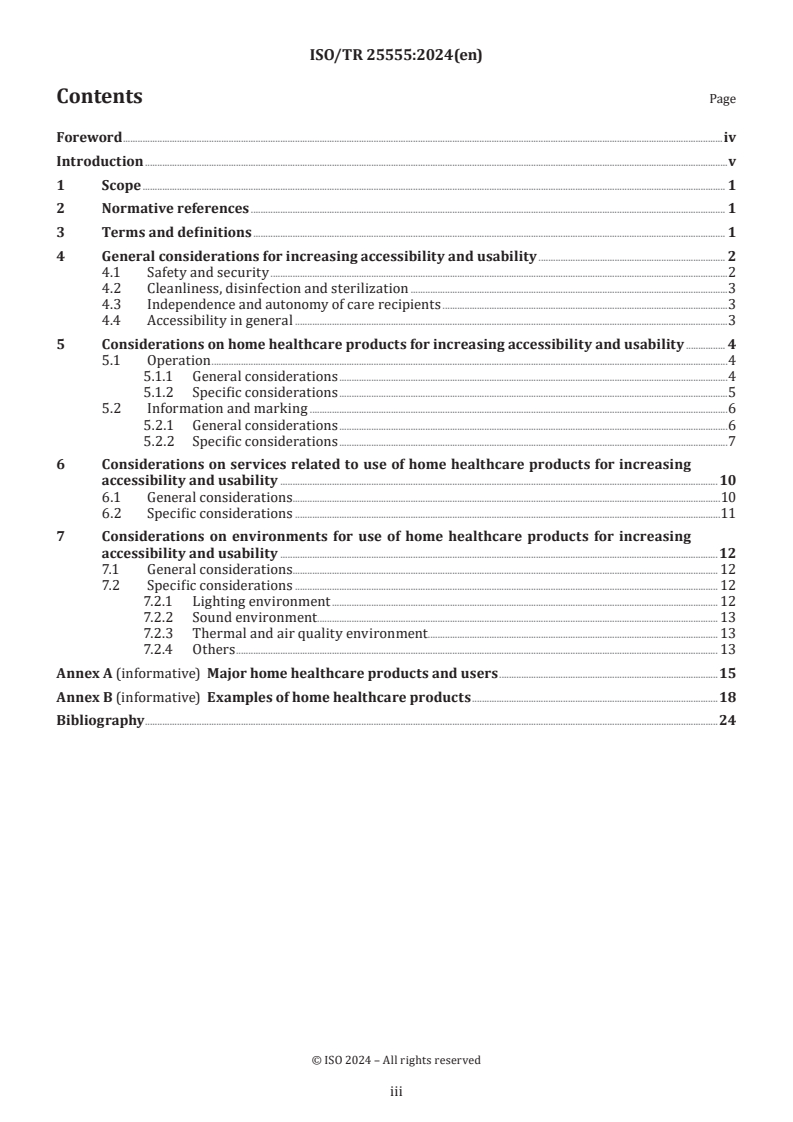
Contents Page
Foreword .iv
Introduction .v
1 Scope . 1
2 Normative references . 1
3 Terms and definitions . 1
4 General considerations for increasing accessibility and usability . 2
4.1 Safety and security .2
4.2 Cleanliness, disinfection and sterilization .3
4.3 Independence and autonomy of care recipients .3
4.4 Accessibility in general .3
5 Considerations on home healthcare products for increasing accessibility and usability . 4
5.1 Operation .4
5.1.1 General considerations .4
5.1.2 Specific considerations .5
5.2 Information and marking .6
5.2.1 General considerations .6
5.2.2 Specific considerations .7
6 Considerations on services related to use of home healthcare products for increasing
accessibility and usability . 10
6.1 General considerations.10
6.2 Specific considerations .11
7 Considerations on environments for use of home healthcare products for increasing
accessibility and usability .12
7.1 General considerations. 12
7.2 Specific considerations . 12
7.2.1 Lighting environment . 12
7.2.2 Sound environment . 13
7.2.3 Thermal and air quality environment . . 13
7.2.4 Others . 13
Annex A (informative) Major home healthcare products and users .15
Annex B (informative) Examples of home healthcare products .18
Bibliography .24
iii
Foreword
ISO (the International Organization for Standardization) is a worldwide federation of national standards
bodies (ISO member bodies). The work of preparing International Standards is normally carried out through
ISO technical committees. Each member body interested in a subject for which a technical committee
has been established has the right to be represented on that committee. International organizations,
governmental and non-governmental, in liaison with ISO, also take part in the work. ISO collaborates closely
with the International Electrotechnical Commission (IEC) on all matters of electrotechnical standardization.
The procedures used to develop this document and those intended for its further maintenance are described
in the ISO/IEC Directives, Part 1. In particular, the different approval criteria needed for the different types
of ISO document should be noted. This document was drafted in accordance with the editorial rules of the
ISO/IEC Directives, Part 2 (see www.iso.org/directives).
ISO draws attention to the possibility that the implementation of this document may involve the use of (a)
patent(s). ISO takes no position concerning the evidence, validity or applicability of any claimed patent
rights in respect thereof. As of the date of publication of this document, ISO had not received notice of (a)
patent(s) which may be required to implement this document. However, implementers are cautioned that
this may not represent the latest information, which may be obtained from the patent database available at
www.iso.org/patents. ISO shall not be held responsible for identifying any or all such patent rights.
Any trade name used in this document is information given for the convenience of users and does not
constitute an endorsement.
For an explanation of the voluntary nature of standards, the meaning of ISO specific terms and expressions
related to conformity assessment, as well as information about ISO's adherence to the World Trade
Organization (WTO) principles in the Technical Barriers to Trade (TBT), see www.iso.org/iso/foreword.html.
This document was prepared by Technical Committee ISO/TC 314, Ageing societies.
Any feedback or questions on this document should be directed to the user’s national standards body. A
complete listing of these bodies can be found at www.iso.org/members.html.
iv
Introduction
With the increasing need for community-based integrated care to meet rapidly ageing societies, medical
activities and healthcare services carried out at a home or a domestic environment have become
commonplace. These activities and services can be referred to as home healthcare, whose aim is to provide
quality of life that includes independence, autonomy, safety and security for older persons.
Various types of products, medical or non-medical, and their related services and environments are being
used in home healthcare. Many older persons and non-professional caregivers are now users of these
products. The variety of products and users can create challenges that are unseen in professional healthcare
facilities. The biggest challenge of them all is that it is difficult to find relevant information from the existing
design fields to accommodate, apply and use home healthcare products.
There is much information on accessibility and usability in existing international standards and guidelines
involving major products’ fields including medical products. However, these documents do not fully cover
the home healthcare products and related services and environments. The problem, in particular, is that it is
difficult and time consuming to locate relevant information from those design fields to accommodate and to
apply home healthcare products.
This document summarizes and catalogues this information into one document for practical use. The
information was obtained from existing International Standards, regional or global guidelines for products
and medical equipment, and also is based on empirical feedback from home healthcare product users.
This document also provides caregivers and care recipients and those who develop and distribute home
healthcare products with information useful for:
— solving problems regarding the use of these products by caregivers and care recipients who might lack
sufficient expertise and skills in handling medical products and activities, and
— solving problems regarding the use of home healthcare products outside of medical facilities.
v
Technical Report ISO/TR 25555:2024(en)
Ageing societies — Accessibility and usability considerations
for home healthcare products, related services and
environments
1 Scope
This document provides a collection of design considerations from existing international standards as well
as best practices and observations obtained from the home healthcare field. This document is intended to
be used as a reference for designing accessibility and usability of home healthcare products and associated
services, and environments designed for non-professional users.
This document does not provide information on the use of home healthcare products by healthcare
professionals regardless of the place and facility of use.
2 Normative references
There are no normative references in this document.
3 Terms and definitions
For the purposes of this document, the following terms and definitions apply.
ISO and IEC maintain terminology databases for use in standardization at the following addresses:
— ISO Online browsing platform: available at https:// www .iso .org/ obp
— IEC Electropedia: available at https:// www .electropedia .org/
3.1
accessibility
extent to which products, systems, services, environments and facilities can be used by people from a
population with the widest range of user (3.9) needs, characteristics and capabilities to achieve identified
goals in identified contexts of use
Note 1 to entry: Context of use includes direct use or use supported by assistive technologies.
[SOURCE: ISO 9241-112:2017, 3.15]
3.2
caregiver
person who provides physical and mental healthcare
3.3
care recipient
person who receives physical and mental healthcare
3.4
home healthcare
healthcare provided in a dwelling place in which a care recipient (3.3) lives or other places where care
recipients are present, excluding professional healthcare facility environments where operators with
medical training are continually available when care recipients are present
Note 1 to entry: Professional healthcare facilities include hospitals, physician offices, freestanding surgical centres,
dental offices, freestanding birthing centres, limited care facilities, first aid rooms or rescue rooms, multiple treatment
facilities and emergency medical services.
Note 2 to entry: For the purpose of this document, nursing homes are considered dwelling places for home healthcare.
Note 3 to entry: Other places where a care recipient is present include the outdoor environments while working and in
vehicles.
[SOURCE: IEC 60601-1-11:2015+AMD1: 2020, 3.1, modified — The term “home healthcare environment”
was replaced with “home healthcare”, “healthcare provided in a” was added at the beginning, “patient”
was replaced with “care recipients”, EXAMPLE was deleted, in the Note 2 to entry “collateral standard” was
replaced with “document” and “home healthcare environments” was replaced with “dwelling places for
home healthcare”.]
3.5
home healthcare product
product used in home healthcare (3.4), related to services and environments
Note 1 to entry: Major home healthcare products are listed and classified in Annex A together with their users (3.9)
and places of use.
3.6
healthcare professional
person who has a professional qualification for providing healthcare
3.7
medical product
product and its accessory intended to use for medical activity
3.8
usability
extent to which a product can be used by specified users (3.9) to achieve specified goals with effectiveness,
efficiency and satisfaction in a specified context of use
[SOURCE: ISO 9241-11:2018, 3.1.1, modified — Notes to entry deleted.]
3.9
user
person who uses home healthcare products (3.5)
Note 1 to entry: User includes healthcare professional (3.6), caregiver (3.2) and care recipient (3.3).
4 General considerations for increasing accessibility and usability
4.1 Safety and security
Safety and security of home healthcare products, related services and environments are of primary
importance in their use by the widest range of caregivers and care recipients, some of whom lack expert
knowledge and skills in handling medical products, equipment and activities. Safety and security are also
important for the widest range of use environments of home healthcare products where professional
healthcare facilities are not available.
4.2 Cleanliness, disinfection and sterilization
Cleanliness, disinfection and sterilization of home healthcare products, related services and environments
have been identified as essential to avoid any risk of disease for the widest range of users and context of use
of them.
The following practices have proven particularly effective in handling home healthcare products.
a) Avoidance of multiple uses of the products among different care recipients and caregivers is effective to
[25]
reduce the risk of infection, in particular for some care recipients who are apt to be infected .
b) Zoning or partitioning of a space or a room for environments for use of home healthcare products and
[25]
for related services is effective to reduce the risks of infection .
NOTE There are some care recipients who are apt to be infected with diseases.
4.3 Independence and autonomy of care recipients
To support the independence and autonomy of care recipients is as important as providing means of self-use,
on-demand-use, and consent-use of home healthcare products by care recipients.
4.4 Accessibility in general
[1]
Accessibility guidance in ISO/IEC Guide 71:2014 , when applied, increases accessibility of home healthcare
products, related services and environments. Among the guidance, the following have proven particularly
effective in using home healthcare products in general.
a) Suitability for the widest range of users and diverse contexts of use.
Designing home healthcare products, related services and environments usable by diverse users as
caregivers and care recipients and in diverse environments, except in professional healthcare facilities
[1]
increases accessibility. See ISO/IEC Guide 71:2014, 6.2.1 .
b) Providing multiple means of information presentation and user interaction.
Home healthcare products, related services and environments that have multiple means of information
presentation and multiple means of operation for use increase accessibility. See ISO/IEC Guide 71:2014,
[1]
8.2.1 .
NOTE 1 Multiple means of information presentation include different sensory information such as seeing, hearing,
and touch, and also different modes of information within one sense such as shape and colour in vision.
NOTE 2 Multiple means of operation for use include different types and modes of actions such as with one hand and
both hands, in standing and sitting positions, or by voice and body movement.
c) Ensuring compatibility.
Home healthcare products, related services and environments that have compatible use with assistive
[1]
products and technology used by care recipients increase accessibility. See ISO/IEC Guide 71:2014, 8.2.7 .
Home healthcare products increase their accessibility for wheelchair users, if they are designed portable,
mobile and compact in size for outdoor use in wheelchair.
Compatibility also concerns software and data transfer of ICT products and health monitoring or measuring
systems. ICT products that can run under different operating systems or measured data that can be
transferred and read by different systems increase accessibility and usability.
NOTE 3 ISO/IEEE 11073-10418 specifies a definition of communication between personal telehealth International
Normalized Ratio (INR) devices and managers (e.g. cell phones, personal computers, personal health appliances) in a
manner that enables plug-and-play interoperability.
d) Harmonization with safety and security.
Harmonization of accessibility with safety and security is important as safety and security protocols that
have a competing situation with accessibility cause accessibility problems.
[24]
EXAMPLE A child resistance operation for an ignition device. As for child safety, see ISO/IEC Guide 50 .
5 Considerations on home healthcare products for increasing accessibility and
usability
5.1 Operation
5.1.1 General considerations
Simple and easy operation of home healthcare products increases accessibility and usability for caregivers
and the recipients, some of whom lack expertized knowledge and skills in handling medical products,
equipment and activities.
The following are general considerations for increasing accessibility and usability regarding operation of
home healthcare products in general.
a) Providing alternative means of operation at least for major operations for home healthcare products
(see 4.4 b).
EXAMPLE 1 The character input system using eye movement or head movement in addition to a keyboard or a
ten-key for an IT device. See B.2.1 a) and b).
b) Avoidance of simultaneous two or more different actions except for special case to keep safety. See
[1]
ISO/IEC Guide 71:2014, 7.4.3 .
c) Facilitation of intuitive understanding of operating procedures from the design of home healthcare
[2]
products or the controls, i.e. shape or marking. See ISO/TR 22411:2021, 8.17.4 .
EXAMPLE 2 The action of peeling off the cover seal of an adhesive plaster (see B.2.2).
d) Arrangement of sequential operations for home healthcare products in a logical and easy-to-understand
[2]
way both spatially and temporally. See ISO/TR 22411:2021, 8.3.3 .
e) Placement of controls in an adjacent area which are functionally related to each other.
f) An illustration that indicates the identical physical layout of controls.
g) Automatic processing of a series of complex and sequential operations.
EXAMPLE 3 An automatic blood pressure meter (see B.2.3).
h) Informing the effects or changes in products caused by operations in multiple means of information
presentation, such as lights and sounds, during or immediately after the operation and in accordance
[2]
with the physical changes by the operation (i.e. direction or amount). See ISO/TR 22411:2021, 8.17.2 .
EXAMPLE 4 Oxygen supplying units (see B.2.5).
i) Designing home healthcare products so that mis-operation can never happen during use.
j) Designing home healthcare products to minimize or to remove the effects of mis-operation when it
1) [3]
happens during use. See ISO/IEC Guide 71:2001 , 8.21 .
1) Withdrawn.
5.1.2 Specific considerations
The following are product- or design-specific considerations for increasing accessibility and usability
regarding operation of home healthcare products.
a) Designing home healthcare products with a compact shape and size that is easy to operate and with a
light mass that is easy to carry.
NOTE 1 Home healthcare products are often used in rooms that are not spacious making operation and
installation of the products difficult.
NOTE 2 A research project in Japan reported that a comfortable mass of an object is less than 4 kg for older
[4]
males and females when a person lifts with two hands .
EXAMPLE 1 An air-pumping device (bag valve mask) easy to operate by hands.
b) Avoidance of an excessive burden of physical strength to the users in their operation of home healthcare
[2]
products. See ISO/TR 22411:2021, 8.12.3 .
EXAMPLE 2 A nurse-call button that is easy to push with appropriate strength.
c) Designing home healthcare products for measuring health conditions such as a thermometer, blood
pressure meter, body weight meter, to accommodate a variety of physical structures and conditions of
users.
NOTE 3 Some people with a lean body have difficulty in tightly holding a thermometer under the arm.
NOTE 4 Some people with slender arms or too thick arms have difficulty in wrapping the sensor belt of a blood
pressure meter.
NOTE 5 Some people are not able to measure the body weight due to the difficulty of keeping a steady standing
posture on a body weight meter.
EXAMPLE 3 A thermometer developed for a lean person to hold it under his/her armpit (see B.2.4).
d) Designing home healthcare products which require stepping or pushing by foot so that they are easy-to-
operate with appropriate size and force.
EXAMPLE 4 A manual aspirator operated by foot in an emergency.
EXAMPLE 5 Lid opening of a garbage container operated by a foot pedal.
e) Avoidance of fine dexterity in operation of home healthcare products.
EXAMPLE 6 A large dial or a large button easy-to-pinch or easy-to-push.
EXAMPLE 7 Spatially sparse arrangement of controls but not tightly packed.
EXAMPLE 8 A large-size injection easy to hold.
EXAMPLE 9 A large dialling of an oxygen supplying device easy to operate (see B.2.6).
f) Keeping home healthcare products clean and disinfected, particularly those that are repeatedly used.
NOTE 6 IEC 60601-1-11:2015+AMD1: 2020, 7.4.7, 8.1 and 8.2 provide requirements for cleaning, disinfection,
[22]
and sterilization .
EXAMPLE 10 An indication of maximum repeated times of use for a tube attached to the aspirator, or a tube-
feeding nutrient.
g) Labelling or making of home healthcare products or parts of the products to show they are used,
cleaned, disinfected, or sterilized.
h) Avoidance of a sharp point, a sharp edge or a rough surface that occasionally causes an injury to user’s
hands or fingers when they operate the home healthcare products.
NOTE 7 People with epidermolysis bullosa and most of older persons with dry skin in the home healthcare
situation have vulnerable skin and can easily be injured by a sharp point, a sharp edge and a rough surface of a
product or even by a seam of clothes.
2) [3]
i) Avoidance allergy in operating home healthcare products. See ISO/IEC Guide 71:2001 , 8.19 .
EXAMPLE 11 Not using materials that cause nickel or rubber allergy.
EXAMPLE 12 Care for air quality to avoid respiratory allergy.
j) Providing easy mechanisms and notification of timing to users for disposal of home healthcare products,
if disposal is necessary.
NOTE 8 IEC 60601-1-11:2015+AMD1: 2020, 7.4.9 provides a requirement for environmental protection for
[22]
disposal of medical goods .
NOTE 9 A used article collection system by companies or proper authorities is relevant for environmental
protection.
EXAMPLE 13 Packaging easy to fold or easy to tear-off for disposal after use.
EXAMPLE 14 Products that can easily detach or tear-off parts for disposal.
k) Ease of opening without any specific tools for tightly-sealed packaging of high cleanliness or disinfected
products.
l) Protection against strangulation or asphyxiation by wires or other similar devices.
NOTE 10 IEC 60601-1-11:2015+AMD1: 2020, Clause 11 provides a requirement for strangulation or asphyxiation
[22]
by wires .
m) Providing easy assemble or connection of parts of home healthcare products by using visual (pictorial),
auditory (spoken) or tactile instruction.
n) Storing home healthcare products at a fixed or a common place for reuse with a marking of conspicuous
labels for easy finding and taking out.
o) Home healthcare products that can be used in mobile environment.
EXAMPLE 15 Use with a wheelchair.
p) Home healthcare products that can be used by a single hand, left-handed or right-handed.
EXAMPLE 16 A walking assisting cane for both right-handed and left-handed grip (see B.2.8).
q) Providing information by multiple means of presentation which is required for the proper working of
home healthcare products, such as changes of working status, refilling consumable items, needs for
maintenance, and scheduled or non-scheduled.
r) Continuous working of home healthcare products without any intermission even in case of disaster or
power service failure (see B.2.6).
5.2 Information and marking
5.2.1 General considerations
Providing information and marking of home healthcare products which are visible, audible, and
understandable increases accessibility and usability of the products. Clear and understandable meaning of
2) Withdrawn.
the information and marking increases accessibility for caregivers and the recipients, some of whom lack
expertized knowledge and skills in handling medical products, equipment and activities.
a) The following are general considerations for increasing accessibility and usability regarding information
and marking of home healthcare products.
b) Providing at least one alternative means of information presentation for major information and
marking of home healthcare products using different sensory information or different modalities
within one sense (see 4.4 b). When possible, providing visual information at least in auditory or spoken
information, or where quiet condition is required, providing auditory and voice information in light or
tactile vibration information.
EXAMPLE 1 Characters information both in print and in Braille.
EXAMPLE 2 Instruction manuals in written (printed) language and in spoken language (CD, etc.).
EXAMPLE 3 A feedback of product operation given both in sound and light.
EXAMPLE 4 Medicine that can be identified by different colours and different shapes.
c) Use of simple and consistent way of expression for information and marking to be provided, and
avoidance of excessive amount of information, redundancy, unnecessarily repeated expressions, and
[1]
ambiguous options for decisions. See ISO/IEC Guide 71:2014, 8.2.4 .
EXAMPLE 5 A short instruction manual.
EXAMPLE 6 Information displayed with a hierarchical structure classified by frequency or need.
EXAMPLE 7 Information using only one way of expression such as the active voice or the passive voice.
d) Designing information and marking easy-to-find and audible. In the case of tactile information, providing
sound or speech guidance to inform the existence of the tactile information.
EXAMPLE 8 A medication information board with days of a week differentiated by colours.
e) Providing simple and readily understandable information and markings for emergency use, safety, and
life support, and providing them in multiple means of presentation.
5.2.2 Specific considerations
5.2.2.1 Visual information
The following are product- or design-specific considerations for increasing accessibility and usability
regarding visual information of home healthcare products.
a) Appropriate luminance and contrast of visual information for seeing and reading, printed or displayed,
taking account of the following considerations.
— Luminance of background above at least several cd/m in printed or displayed information.
NOTE 1 Luminance level above several cd/m or illuminance level above 10 lx assures good visibility
with high visual acuity, high contrast sensitivity, and good colour perception. Below this level, most of visual
functions gradually decline with decrease of luminance or illuminance.
— Contrast above 70 % (in Michelson contrast) of printed or displayed information.
[2]
NOTE 2 Contrast above 70 % (in Michelson contrast) keeps good visibility for letters .
— Avoidance of using blue light on a dark background or vice versa for older persons.
NOTE 3 Blue light becomes less sensitive to human eye with age and difficult to see for older persons.
[11]
NOTE 4 ISO 24502 provides correct estimation of contrast values for coloured light .
— Avoidance of high luminance in the ambient lighting to avoid glare from high-reflection surfaces of a
product or marking or display which reduces contrast.
b) Providing colour for highlighting and differentiating visual information
...