

ISO 15927-3:2009
(Main)Hygrothermal performance of buildings - Calculation and presentation of climatic data — Part 3: Calculation of a driving rain index for vertical surfaces from hourly wind and rain data
General Information
- Abstract
ISO 15927-3:2009 specifies two procedures for providing an estimate of the quantity of water likely to impact on a wall of any given orientation. It takes account of topography, local sheltering and the type of building and wall. The first method, based on coincident hourly rainfall and wind data, defines the method of calculation of the annual average index, which influences the moisture content of an absorbent surface, such as masonry, and the spell index, which influences the likelihood of rain penetration through masonry and joints in other walling systems. The second method, based on average wind data and a qualitative recording of the presence and intensity of rain (the present weather code for rain), defines a method for calculating the spell length during which an absorbent material such as masonry is moistened, having a 10 % probability of being exceeded in any year (commonly referred to as having a mean return period of 10 years). ISO 15927-3:2009 provides a comparison between the two methods. ISO 15927-3:2009 gives procedures to correct the results of both methods for topography, local sheltering and the type of building and wall. The methods included in ISO 15927-3:2009 do not apply in mountainous areas with sheer cliffs or deep gorges, in areas in which more than 25 % of the annual rainfall comes from severe convective storms, and in areas and during periods when a significant proportion of precipitation is made up of snow or hail.
- Status
- Published
- Publication Date
- 09-Mar-2009
- Technical Committee
- ISO/TC 163/SC 2 - Calculation methods
- Drafting Committee
- ISO/TC 163/SC 2 - Calculation methods
- Current Stage
- 9093 - International Standard confirmed
- Start Date
- 17-Sep-2026
- Completion Date
- 26-Sep-2026
Buy Documents


ISO 15927-3:2009 - Hygrothermal performance of buildings - Calculation and presentation of climatic data
ISO 15927-3:2009 - Hygrothermal performance of buildings - Calculation and presentation of climatic data — Part 3: Calculation of a driving rain index for vertical surfaces from hourly wind and rain data/10/2009
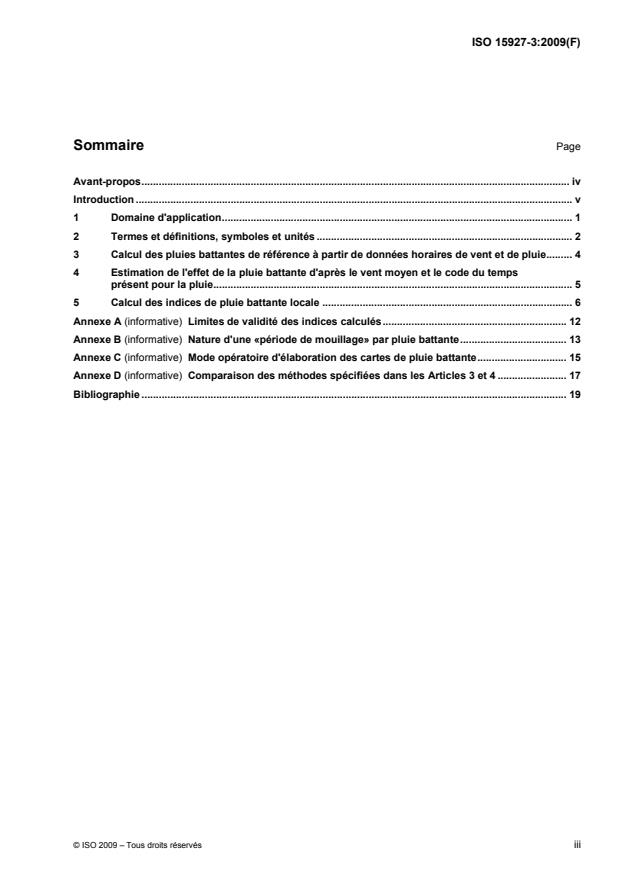

ISO 15927-3:2009 - Performance hygrothermique des bâtiments -- Calcul et présentation des données climatiques
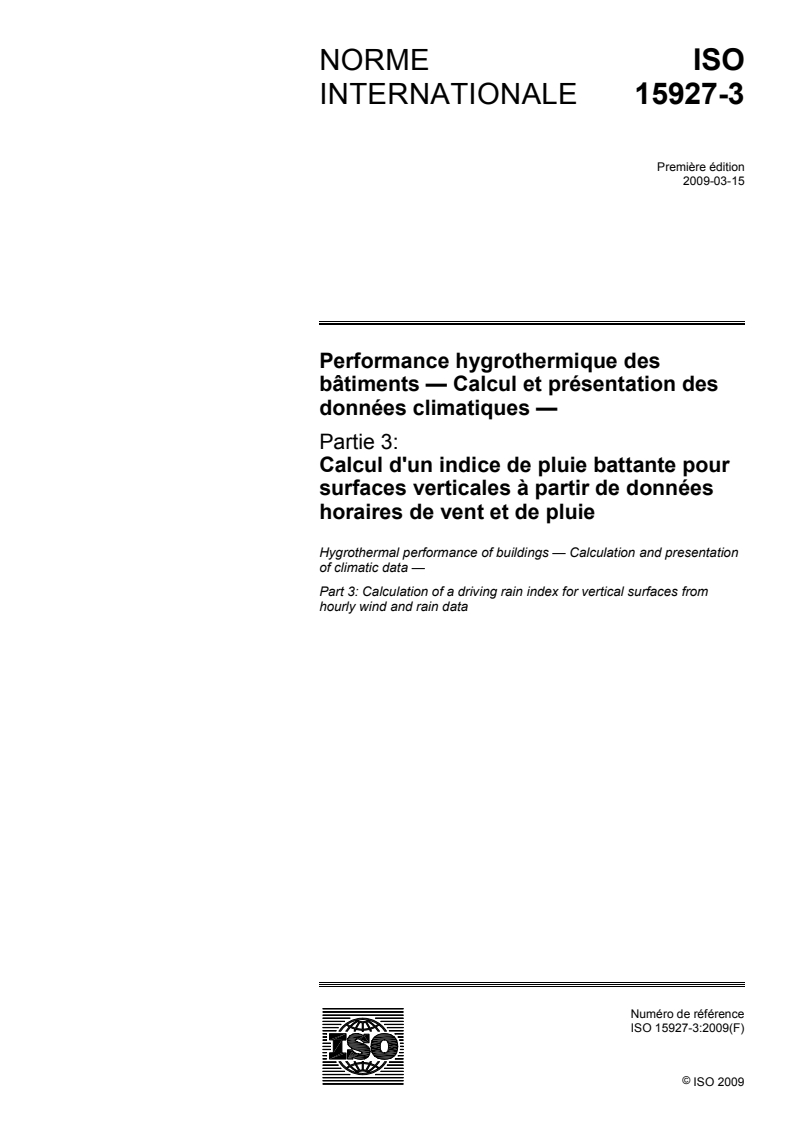
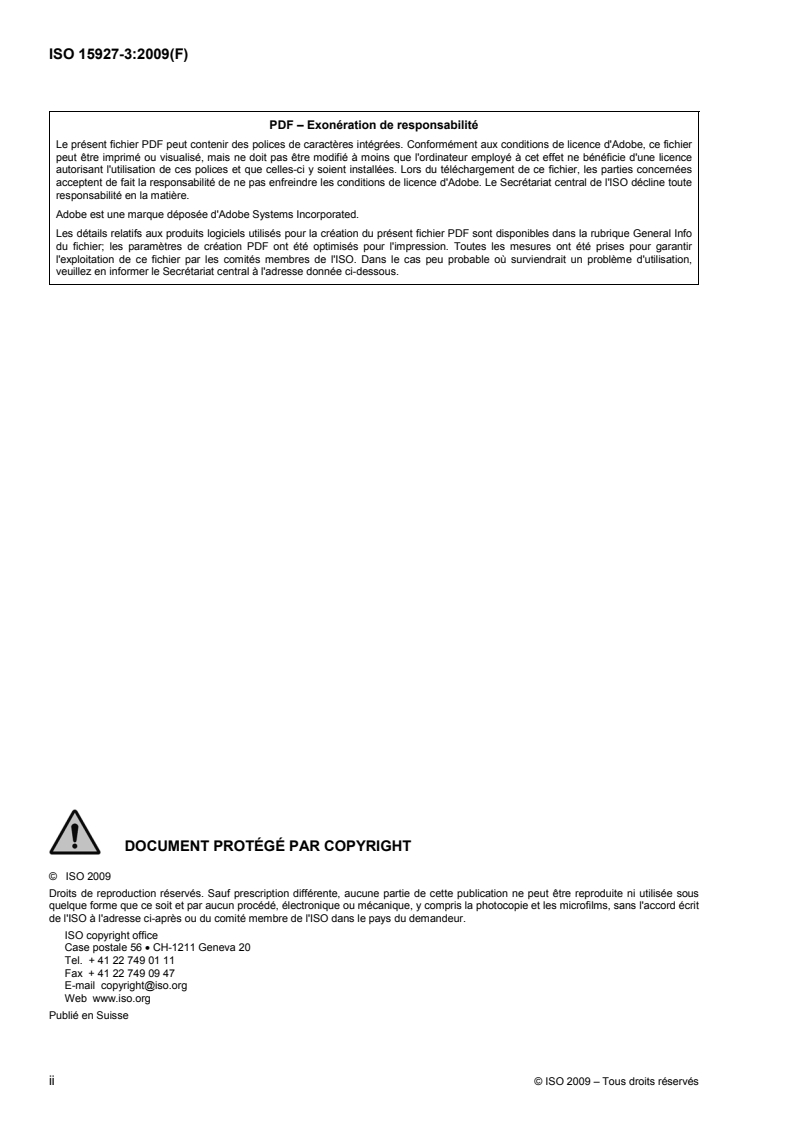
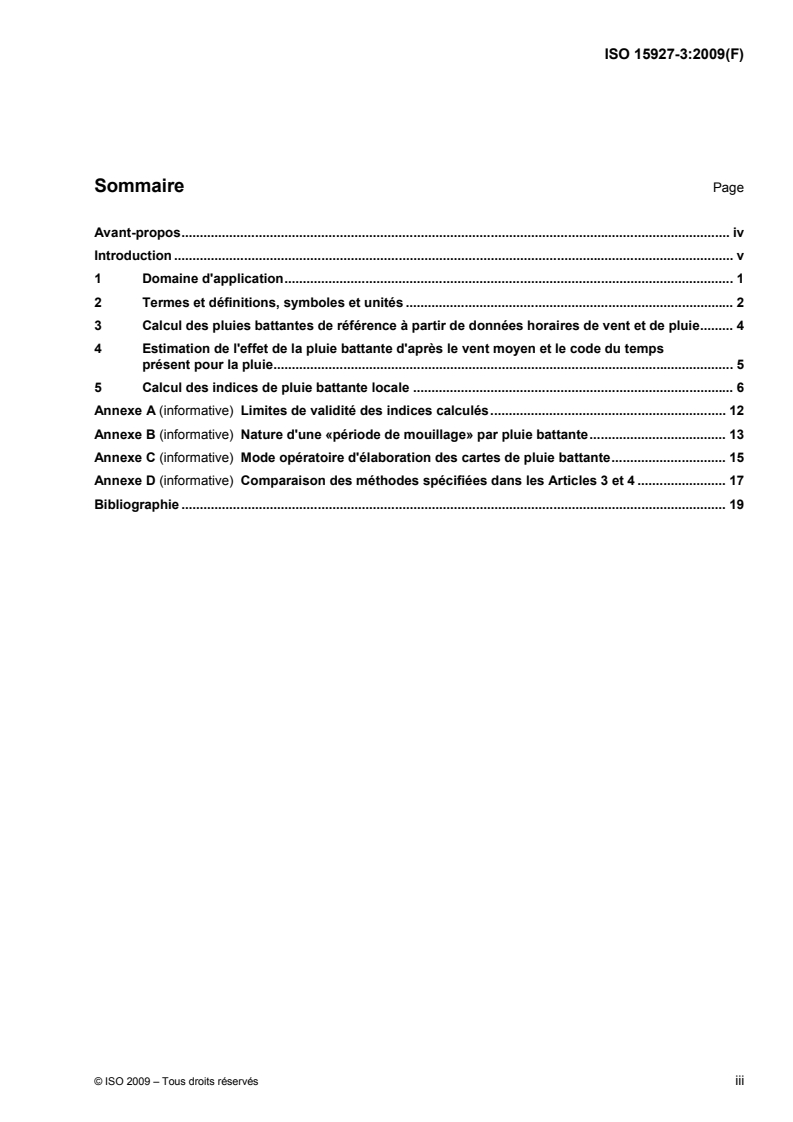

ISO 15927-3:2009 - Performance hygrothermique des bâtiments — Calcul et présentation des données climatiques — Partie 3: Calcul d'un indice de pluie battante pour surfaces verticales à partir de données horaires de vent et de pluie/10/2009
ISO 15927-3:2009 - Driving rain index for vertical surfaces (Overview)
ISO 15927-3:2009 is part of the ISO 15927 series on hygrothermal performance of buildings. It specifies two validated procedures to estimate the quantity of wind-driven (driving) rain impacting vertical building surfaces and to present that information as indices useful for moisture and rain-penetration assessment. The standard covers both an hourly-data method and a coarser method based on average wind and the meteorological present weather code for rain. It also defines corrections for topography, local sheltering and wall/building type.
Key topics and technical requirements
- Two calculation methods:
- Clause 3 (hourly method): Uses coincident hourly wind speed, wind direction and rainfall data to compute
- Airfield annual index (influences moisture content of absorbent surfaces)
- Airfield spell index (influences likelihood of rain penetration during worst spells)
- Requires long-term hourly records (≥10 years; preferably 20–30 years).
- Clause 4 (present-weather method): Uses half-day periods, average wind, and present weather codes to identify moistening and drying half days and to calculate a reference spell with a 10-year return period (Gumbel distribution fit).
- Clause 3 (hourly method): Uses coincident hourly wind speed, wind direction and rainfall data to compute
- Index conversion: Multiply airfield indices by roughness coefficient, topography coefficient, obstruction factor and wall factor to obtain wall annual and wall spell indices (Clause 5).
- Definitions and terms: spell, airfield index, wall index, terrain roughness categories, wall orientation, present weather code.
- Statistical treatment: 67% percentile used for 3-year spell index; Gumbel fitting for 10‑year reference spell.
- Applicability limits: Not suitable for sheer cliffs/deep gorges, regions where >25% annual rainfall comes from severe convective storms, or where precipitation is predominantly snow/hail.
Practical applications and users
Who uses ISO 15927-3:
- Building envelope designers and façade engineers
- Hygrothermal modelers and consultants
- Meteorological data providers and climatologists
- Building code authorities, insurers, and facility managers
Practical uses:
- Assessing moisture risk and likelihood of rain penetration for walls, windows and joints
- Input data for hygrothermal simulation and building performance modeling
- Guiding material selection, detailing and maintenance planning for façades
- Producing driving-rain maps and climate datasets for design
Related standards and references
- ISO 15927 series (Parts 1, 2, 4, 5, 6) - related climatic data and hygrothermal calculation methods
- WMO Guide - recommended measurement methods and present weather code definitions
- Informative annexes in ISO 15927-3:2009 include spell characterization, method comparison, and mapping procedures
Keywords: ISO 15927-3, driving rain index, wind-driven rain, hygrothermal performance, wall annual index, spell index, building envelope.
Relations
- Effective Date
- 12-Feb-2026
Buy Documents
ISO 15927-3:2009 - Hygrothermal performance of buildings - Calculation and presentation of climatic data
ISO 15927-3:2009 - Hygrothermal performance of buildings - Calculation and presentation of climatic data — Part 3: Calculation of a driving rain index for vertical surfaces from hourly wind and rain data/10/2009
ISO 15927-3:2009 - Performance hygrothermique des bâtiments -- Calcul et présentation des données climatiques
ISO 15927-3:2009 - Performance hygrothermique des bâtiments — Calcul et présentation des données climatiques — Partie 3: Calcul d'un indice de pluie battante pour surfaces verticales à partir de données horaires de vent et de pluie/10/2009
Get Certified
Connect with accredited certification bodies for this standard

DIBt (Deutsches Institut für Bautechnik)
German Institute for Building Technology.
DIN CERTCO
DIN Group product certification.

Aboma Certification B.V.
Specialized in construction, metal, and transport sectors.
Sponsored listings
Frequently Asked Questions
ISO 15927-3:2009 is a standard published by the International Organization for Standardization (ISO). Its full title is "Hygrothermal performance of buildings - Calculation and presentation of climatic data — Part 3: Calculation of a driving rain index for vertical surfaces from hourly wind and rain data". This standard covers: ISO 15927-3:2009 specifies two procedures for providing an estimate of the quantity of water likely to impact on a wall of any given orientation. It takes account of topography, local sheltering and the type of building and wall. The first method, based on coincident hourly rainfall and wind data, defines the method of calculation of the annual average index, which influences the moisture content of an absorbent surface, such as masonry, and the spell index, which influences the likelihood of rain penetration through masonry and joints in other walling systems. The second method, based on average wind data and a qualitative recording of the presence and intensity of rain (the present weather code for rain), defines a method for calculating the spell length during which an absorbent material such as masonry is moistened, having a 10 % probability of being exceeded in any year (commonly referred to as having a mean return period of 10 years). ISO 15927-3:2009 provides a comparison between the two methods. ISO 15927-3:2009 gives procedures to correct the results of both methods for topography, local sheltering and the type of building and wall. The methods included in ISO 15927-3:2009 do not apply in mountainous areas with sheer cliffs or deep gorges, in areas in which more than 25 % of the annual rainfall comes from severe convective storms, and in areas and during periods when a significant proportion of precipitation is made up of snow or hail.
ISO 15927-3:2009 specifies two procedures for providing an estimate of the quantity of water likely to impact on a wall of any given orientation. It takes account of topography, local sheltering and the type of building and wall. The first method, based on coincident hourly rainfall and wind data, defines the method of calculation of the annual average index, which influences the moisture content of an absorbent surface, such as masonry, and the spell index, which influences the likelihood of rain penetration through masonry and joints in other walling systems. The second method, based on average wind data and a qualitative recording of the presence and intensity of rain (the present weather code for rain), defines a method for calculating the spell length during which an absorbent material such as masonry is moistened, having a 10 % probability of being exceeded in any year (commonly referred to as having a mean return period of 10 years). ISO 15927-3:2009 provides a comparison between the two methods. ISO 15927-3:2009 gives procedures to correct the results of both methods for topography, local sheltering and the type of building and wall. The methods included in ISO 15927-3:2009 do not apply in mountainous areas with sheer cliffs or deep gorges, in areas in which more than 25 % of the annual rainfall comes from severe convective storms, and in areas and during periods when a significant proportion of precipitation is made up of snow or hail.
ISO 15927-3:2009 is classified under the following ICS (International Classification for Standards) categories: 07.060 - Geology. Meteorology. Hydrology; 91.120.10 - Thermal insulation of buildings. The ICS classification helps identify the subject area and facilitates finding related standards.
ISO 15927-3:2009 has the following relationships with other standards: It is inter standard links to EN ISO 15927-3:2009. Understanding these relationships helps ensure you are using the most current and applicable version of the standard.
ISO 15927-3:2009 is available in PDF format for immediate download after purchase. The document can be added to your cart and obtained through the secure checkout process. Digital delivery ensures instant access to the complete standard document.
Standards Content (Sample)
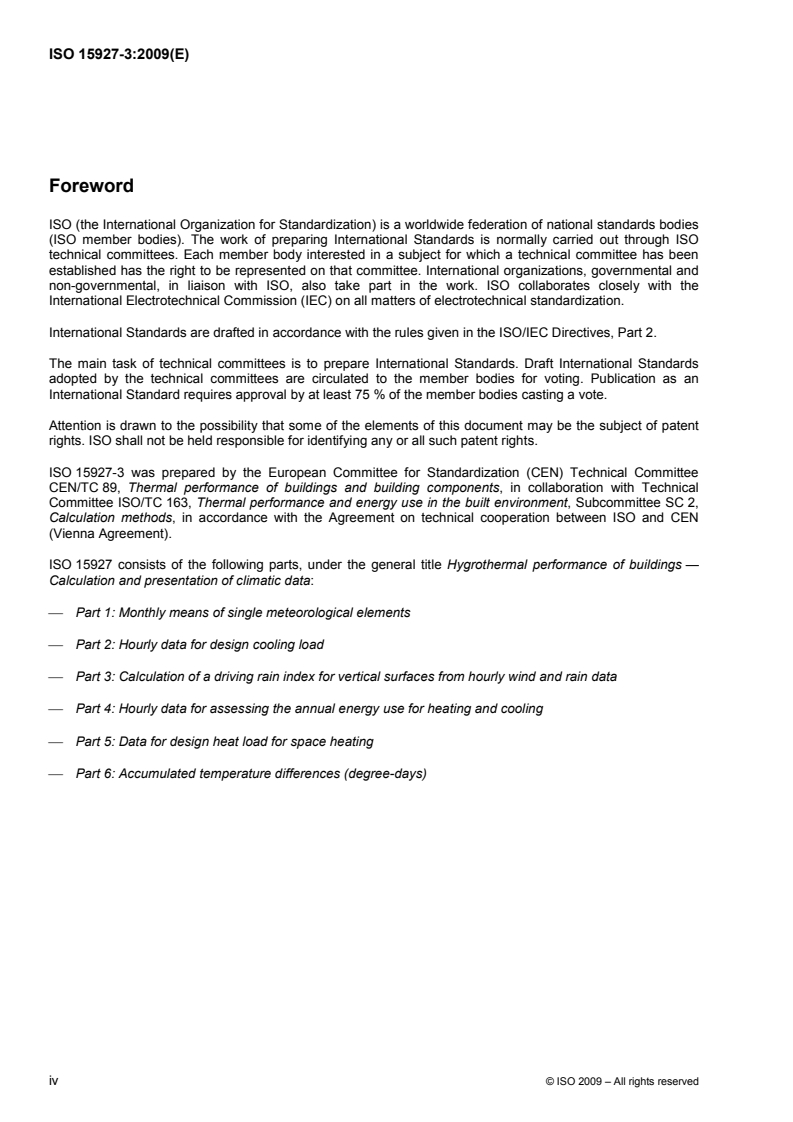
INTERNATIONAL ISO
STANDARD 15927-3
First edition
2009-03-15
Hygrothermal performance of
buildings — Calculation and presentation
of climatic data —
Part 3:
Calculation of a driving rain index for
vertical surfaces from hourly wind and
rain data
Performance hygrothermique des bâtiments — Calcul et présentation
des données climatiques —
Partie 3: Calcul d'un indice de pluie battante pour surfaces verticales à
partir de données horaires de vent et de pluie
Reference number
©
ISO 2009
PDF disclaimer
This PDF file may contain embedded typefaces. In accordance with Adobe's licensing policy, this file may be printed or viewed but
shall not be edited unless the typefaces which are embedded are licensed to and installed on the computer performing the editing. In
downloading this file, parties accept therein the responsibility of not infringing Adobe's licensing policy. The ISO Central Secretariat
accepts no liability in this area.
Adobe is a trademark of Adobe Systems Incorporated.
Details of the software products used to create this PDF file can be found in the General Info relative to the file; the PDF-creation
parameters were optimized for printing. Every care has been taken to ensure that the file is suitable for use by ISO member bodies. In
the unlikely event that a problem relating to it is found, please inform the Central Secretariat at the address given below.
© ISO 2009
All rights reserved. Unless otherwise specified, no part of this publication may be reproduced or utilized in any form or by any means,
electronic or mechanical, including photocopying and microfilm, without permission in writing from either ISO at the address below or
ISO's member body in the country of the requester.
ISO copyright office
Case postale 56 • CH-1211 Geneva 20
Tel. + 41 22 749 01 11
Fax + 41 22 749 09 47
E-mail copyright@iso.org
Web www.iso.org
Published in Switzerland
ii © ISO 2009 – All rights reserved
Contents Page
Foreword. iv
Introduction . v
1 Scope . 1
2 Terms, definitions, symbols and units . 2
3 Calculation of airfield indices from hourly wind and rain data. 4
4 Estimation of the effect of driving rain from average wind and present weather code for
rain. 4
5 Calculation of wall indices. 5
Annex A (informative) Limits to the validity of the calculated indices . 11
Annex B (informative) The nature of a “spell” of driving rain . 12
Annex C (informative) The procedure for generating the driving-rain maps. 13
Annex D (informative) Comparison of methods specified in Clauses 3 and 4 . 15
Bibliography . 17
Foreword
ISO (the International Organization for Standardization) is a worldwide federation of national standards bodies
(ISO member bodies). The work of preparing International Standards is normally carried out through ISO
technical committees. Each member body interested in a subject for which a technical committee has been
established has the right to be represented on that committee. International organizations, governmental and
non-governmental, in liaison with ISO, also take part in the work. ISO collaborates closely with the
International Electrotechnical Commission (IEC) on all matters of electrotechnical standardization.
International Standards are drafted in accordance with the rules given in the ISO/IEC Directives, Part 2.
The main task of technical committees is to prepare International Standards. Draft International Standards
adopted by the technical committees are circulated to the member bodies for voting. Publication as an
International Standard requires approval by at least 75 % of the member bodies casting a vote.
Attention is drawn to the possibility that some of the elements of this document may be the subject of patent
rights. ISO shall not be held responsible for identifying any or all such patent rights.
ISO 15927-3 was prepared by the European Committee for Standardization (CEN) Technical Committee
CEN/TC 89, Thermal performance of buildings and building components, in collaboration with Technical
Committee ISO/TC 163, Thermal performance and energy use in the built environment, Subcommittee SC 2,
Calculation methods, in accordance with the Agreement on technical cooperation between ISO and CEN
(Vienna Agreement).
ISO 15927 consists of the following parts, under the general title Hygrothermal performance of buildings —
Calculation and presentation of climatic data:
⎯ Part 1: Monthly means of single meteorological elements
⎯ Part 2: Hourly data for design cooling load
⎯ Part 3: Calculation of a driving rain index for vertical surfaces from hourly wind and rain data
⎯ Part 4: Hourly data for assessing the annual energy use for heating and cooling
⎯ Part 5: Data for design heat load for space heating
⎯ Part 6: Accumulated temperature differences (degree-days)
iv © ISO 2009 – All rights reserved
Introduction
This part of ISO 15927 specifies two procedures for analysing data derived from hourly observations of wind
and rainfall so as to provide an estimate in terms of both an annual average and short-term spells of the
quantity of water likely to impact on a wall of any given orientation.
[1]
The first method, which uses hourly observations of wind and rainfall, is based closely on BS 8104 , which
originated from a long series of measurements of driving rain on buildings in a wide range of locations within
the UK. As such, the method applies to climates similar to those in the UK; in other regions, with very different
climates, it is recommended that confirmation of its applicability be obtained by measurements of driving rain
on representative buildings.
Where hourly observations of wind and rain are not available, the second procedure, based on the present
weather code for rain and average wind speeds can be used.
In all cases, especially in mountainous areas, it is important that direct measurements of the rain impacting on
building façades be made wherever possible.
Rain penetration around the edges of doors and windows or similar cracks in building façades depends on
shorter periods of heavy rain and strong winds.
INTERNATIONAL STANDARD ISO 15927-3:2009(E)
Hygrothermal performance of buildings — Calculation and
presentation of climatic data —
Part 3:
Calculation of a driving rain index for vertical surfaces from
hourly wind and rain data
1 Scope
This part of ISO 15927 specifies two procedures for providing an estimate of the quantity of water likely to
impact on a wall of any given orientation. It takes account of topography, local sheltering and the type of
building and wall.
The first method, given in Clause 3 and based on coincident hourly rainfall and wind data, defines a means of
calculating
⎯ the annual average index, which influences the moisture content of an absorbent surface, such as
masonry, and
⎯ the spell index, which influences the likelihood of rain penetration through masonry and joints in other
walling systems.
The second method, given in Clause 4 and based on average wind data and a qualitative recording of the
presence and intensity of rain (the present weather code for rain), defines a means of calculating the spell
length during which an absorbent material such as masonry is moistened, which has a 10 % probability of
being exceeded in any year (commonly referred to as having a mean return period of 10 years).
A comparison between the two methods is given in informative Annex D.
Procedures are given to correct the results of both methods for topography, local sheltering and the type of
building and wall.
The methods included in this part of ISO 15927 do not apply in
a) mountainous areas with sheer cliffs or deep gorges,
b) areas in which more than 25 % of the annual rainfall comes from severe convective storms,
c) areas and periods when a significant proportion of precipitation is made up of snow or hail.
2 Terms, definitions, symbols and units
For the purposes of this document, the following terms, definitions, symbols and units apply.
2.1 Definitions
2.1.1
spell
period, or sequence of periods, of wind-driven rain on a vertical surface of given orientation
NOTE Further information about spells is given in Annex B.
2.1.2
airfield hourly index
quantity of driving rain that would occur on a vertical wall of given orientation per square metre of wall during
1 h at a height of 10 m above ground level in the middle of an airfield, at the geographical location of the wall
2.1.3
airfield annual index
airfield index for a given wall orientation totalled over one year
2.1.4
airfield spell index
airfield index for a given wall orientation totalled over the worst spell likely to occur in any three-year period
2.1.5
wall annual index
quantity of wind-driven rain per square metre at a point on a wall of given orientation, based on the airfield
annual index and corrections for roughness, topography, obstruction and wall factors
2.1.6
wall spell index
quantity of wind-driven rain per square metre at a point on a given wall, based on the airfield spell index and
corrections for roughness, topography, obstruction and wall factors
2.1.7
line of sight
horizontal view away from the wall, over a sector spanning about 25° either side of the normal to the wall
2.1.8
terrain roughness category
classification of the surface roughness upwind in terms of the average height and spacing of obstructions such
as buildings, trees or hedges
2.1.9
roughness coefficient
factor that allows for the modification of the wind speed by the roughness of the terrain upwind of a wall
2.1.10
topography coefficient
factor that allows for the effect of local topography on the wind speed
2.1.11
obstruction factor
factor that relates to shelter from the very local environment and allows for obstructions such as buildings,
fences and trees close to, and upwind of, the wall
2.1.12
wall factor
ratio of the quantity of water hitting a wall to the quantity passing through an equivalent unobstructed space,
allowing for the characteristics of the wall
2 © ISO 2009 – All rights reserved
2.1.13
wall orientation
angle between north and line normal to a wall
2.1.14
convective storm
heavy precipitation in the form of showers or thunderstorms generally lasting less than 1 h
2.1.15
reference spell
period during which a wall oriented in any given direction is moistened, having a 10 % probability of being
exceeded in any year
2.1.16
present weather code
numerical code used by meteorological observers to assess the weather conditions at the time of an
observation
[2]
NOTE Present weather codes are given in the WMO Guide .
2.1.17
half day
twelve-hour period including the hours from 07:00 to 18:00 or from 19:00 to 06:00
2.2 Symbols and units
Symbol Quantity Unit
C roughness coefficient —
R
C topography coefficient —
T
D hourly mean wind direction from north °
H effective height of feature m
I airfield annual index l/m
A
I airfield spell index l/m
S
I wall annual index l/m
WA
I wall spell index l/m
WS
K terrain factor —
R
L length m
N number of years of available data —
O obstruction factor —
r hourly rainfall total mm
v hourly mean wind speed m/s
W wall factor —
x horizontal distance m
z height above ground m
z roughness length m
z minimum height m
min
Θ wall orientation relative to north °
3 Calculation of airfield indices from hourly wind and rain data
3.1 Sources of data
Data used for calculations according to this part of ISO 15927 shall have been measured by the methods
[2]
specified by the World Meteorological Organization (see WMO Guide ).
3.2 Airfield annual index
For any location with at least 10 (and preferably 20 or 30) years of hourly values of wind speed, wind direction
and rainfall, the annual index for wall orientation, Θ, is given by Equation (1).
vr cos(D−Θ)
∑
I = (1)
A
9 N
where the summation is taken over all hours for which cos(D − Θ) is positive, i.e. all those occasions when the
wind is blowing against the wall.
As the wind speed during rainfall is not generally the same as in dry weather, calculating the product of hourly
averages of wind and rainfall is not strictly accurate, especially in showery weather. It has been shown,
however, that the error is small and, in any case, several years of data for periods shorter than 1 h are
available from very few places. Taking the product of the averages over days or months does lead to serious
inaccuracies and should not be used for calculating driving rain indices.
3.3 Airfield spell index
For any location with at least 10 (and preferably 20 or 30) years of hourly values of wind speed, wind direction
′
and rainfall, for each wall orientation, Θ, and for each spell of driving rain (see Annex B), calculate I using
S
Equation (2).
Iv′=−r cosD Θ (2)
()
S ∑
where the summation is taken over all hours in the spell for which cos(D − Θ) is positive, i.e. all those
occasions when the wind is blowing against the wall.
The 67 % percentile (i.e. the value for which 33 % of the I′ values are higher) is found from the values of I′
S S
for all the spells within the period of available data.
The 67 % percentile defines the spell index, I (i.e. the maximum value of I′ likely to occur once every three
S S
years).
4 Estimation of the effect of driving rain from average wind and present weather
code for rain
The available data are divided into twelve-hour periods (07:00 – 18:00 and 19:00 – 06:00) called half days.
A half day is defined as “moistening” if all of the following conditions apply.
a) There is more than 4 mm of precipitation on a horizontal surface in the half day.
b) The present weather code reports some precipitation for at least three of the five three-hourly
observations during the half day (i.e. at 06:00, 09:00, 12:00, 15:00 and 18:00 and at 18:00, 21:00, 00:00,
03:00 and 06:00).
NOTE Present weather codes of 50 or above indicate some form of precipitation.
4 © ISO 2009 – All rights reserved
c) The average wind speed during the half day is greater than 2 m/s.
d) The average wind direction during the half day is within ± 60° of the perpendicular to the wal
...
INTERNATIONAL ISO
STANDARD 15927-3
First edition
2009-03-15
Hygrothermal performance of
buildings — Calculation and presentation
of climatic data —
Part 3:
Calculation of a driving rain index for
vertical surfaces from hourly wind and
rain data
Performance hygrothermique des bâtiments — Calcul et présentation
des données climatiques —
Partie 3: Calcul d'un indice de pluie battante pour surfaces verticales à
partir de données horaires de vent et de pluie
Reference number
©
ISO 2009
PDF disclaimer
This PDF file may contain embedded typefaces. In accordance with Adobe's licensing policy, this file may be printed or viewed but
shall not be edited unless the typefaces which are embedded are licensed to and installed on the computer performing the editing. In
downloading this file, parties accept therein the responsibility of not infringing Adobe's licensing policy. The ISO Central Secretariat
accepts no liability in this area.
Adobe is a trademark of Adobe Systems Incorporated.
Details of the software products used to create this PDF file can be found in the General Info relative to the file; the PDF-creation
parameters were optimized for printing. Every care has been taken to ensure that the file is suitable for use by ISO member bodies. In
the unlikely event that a problem relating to it is found, please inform the Central Secretariat at the address given below.
© ISO 2009
All rights reserved. Unless otherwise specified, no part of this publication may be reproduced or utilized in any form or by any means,
electronic or mechanical, including photocopying and microfilm, without permission in writing from either ISO at the address below or
ISO's member body in the country of the requester.
ISO copyright office
Case postale 56 • CH-1211 Geneva 20
Tel. + 41 22 749 01 11
Fax + 41 22 749 09 47
E-mail copyright@iso.org
Web www.iso.org
Published in Switzerland
ii © ISO 2009 – All rights reserved
Contents Page
Foreword. iv
Introduction . v
1 Scope . 1
2 Terms, definitions, symbols and units . 2
3 Calculation of airfield indices from hourly wind and rain data. 4
4 Estimation of the effect of driving rain from average wind and present weather code for
rain. 4
5 Calculation of wall indices. 5
Annex A (informative) Limits to the validity of the calculated indices . 11
Annex B (informative) The nature of a “spell” of driving rain . 12
Annex C (informative) The procedure for generating the driving-rain maps. 13
Annex D (informative) Comparison of methods specified in Clauses 3 and 4 . 15
Bibliography . 17
Foreword
ISO (the International Organization for Standardization) is a worldwide federation of national standards bodies
(ISO member bodies). The work of preparing International Standards is normally carried out through ISO
technical committees. Each member body interested in a subject for which a technical committee has been
established has the right to be represented on that committee. International organizations, governmental and
non-governmental, in liaison with ISO, also take part in the work. ISO collaborates closely with the
International Electrotechnical Commission (IEC) on all matters of electrotechnical standardization.
International Standards are drafted in accordance with the rules given in the ISO/IEC Directives, Part 2.
The main task of technical committees is to prepare International Standards. Draft International Standards
adopted by the technical committees are circulated to the member bodies for voting. Publication as an
International Standard requires approval by at least 75 % of the member bodies casting a vote.
Attention is drawn to the possibility that some of the elements of this document may be the subject of patent
rights. ISO shall not be held responsible for identifying any or all such patent rights.
ISO 15927-3 was prepared by the European Committee for Standardization (CEN) Technical Committee
CEN/TC 89, Thermal performance of buildings and building components, in collaboration with Technical
Committee ISO/TC 163, Thermal performance and energy use in the built environment, Subcommittee SC 2,
Calculation methods, in accordance with the Agreement on technical cooperation between ISO and CEN
(Vienna Agreement).
ISO 15927 consists of the following parts, under the general title Hygrothermal performance of buildings —
Calculation and presentation of climatic data:
⎯ Part 1: Monthly means of single meteorological elements
⎯ Part 2: Hourly data for design cooling load
⎯ Part 3: Calculation of a driving rain index for vertical surfaces from hourly wind and rain data
⎯ Part 4: Hourly data for assessing the annual energy use for heating and cooling
⎯ Part 5: Data for design heat load for space heating
⎯ Part 6: Accumulated temperature differences (degree-days)
iv © ISO 2009 – All rights reserved
Introduction
This part of ISO 15927 specifies two procedures for analysing data derived from hourly observations of wind
and rainfall so as to provide an estimate in terms of both an annual average and short-term spells of the
quantity of water likely to impact on a wall of any given orientation.
[1]
The first method, which uses hourly observations of wind and rainfall, is based closely on BS 8104 , which
originated from a long series of measurements of driving rain on buildings in a wide range of locations within
the UK. As such, the method applies to climates similar to those in the UK; in other regions, with very different
climates, it is recommended that confirmation of its applicability be obtained by measurements of driving rain
on representative buildings.
Where hourly observations of wind and rain are not available, the second procedure, based on the present
weather code for rain and average wind speeds can be used.
In all cases, especially in mountainous areas, it is important that direct measurements of the rain impacting on
building façades be made wherever possible.
Rain penetration around the edges of doors and windows or similar cracks in building façades depends on
shorter periods of heavy rain and strong winds.
INTERNATIONAL STANDARD ISO 15927-3:2009(E)
Hygrothermal performance of buildings — Calculation and
presentation of climatic data —
Part 3:
Calculation of a driving rain index for vertical surfaces from
hourly wind and rain data
1 Scope
This part of ISO 15927 specifies two procedures for providing an estimate of the quantity of water likely to
impact on a wall of any given orientation. It takes account of topography, local sheltering and the type of
building and wall.
The first method, given in Clause 3 and based on coincident hourly rainfall and wind data, defines a means of
calculating
⎯ the annual average index, which influences the moisture content of an absorbent surface, such as
masonry, and
⎯ the spell index, which influences the likelihood of rain penetration through masonry and joints in other
walling systems.
The second method, given in Clause 4 and based on average wind data and a qualitative recording of the
presence and intensity of rain (the present weather code for rain), defines a means of calculating the spell
length during which an absorbent material such as masonry is moistened, which has a 10 % probability of
being exceeded in any year (commonly referred to as having a mean return period of 10 years).
A comparison between the two methods is given in informative Annex D.
Procedures are given to correct the results of both methods for topography, local sheltering and the type of
building and wall.
The methods included in this part of ISO 15927 do not apply in
a) mountainous areas with sheer cliffs or deep gorges,
b) areas in which more than 25 % of the annual rainfall comes from severe convective storms,
c) areas and periods when a significant proportion of precipitation is made up of snow or hail.
2 Terms, definitions, symbols and units
For the purposes of this document, the following terms, definitions, symbols and units apply.
2.1 Definitions
2.1.1
spell
period, or sequence of periods, of wind-driven rain on a vertical surface of given orientation
NOTE Further information about spells is given in Annex B.
2.1.2
airfield hourly index
quantity of driving rain that would occur on a vertical wall of given orientation per square metre of wall during
1 h at a height of 10 m above ground level in the middle of an airfield, at the geographical location of the wall
2.1.3
airfield annual index
airfield index for a given wall orientation totalled over one year
2.1.4
airfield spell index
airfield index for a given wall orientation totalled over the worst spell likely to occur in any three-year period
2.1.5
wall annual index
quantity of wind-driven rain per square metre at a point on a wall of given orientation, based on the airfield
annual index and corrections for roughness, topography, obstruction and wall factors
2.1.6
wall spell index
quantity of wind-driven rain per square metre at a point on a given wall, based on the airfield spell index and
corrections for roughness, topography, obstruction and wall factors
2.1.7
line of sight
horizontal view away from the wall, over a sector spanning about 25° either side of the normal to the wall
2.1.8
terrain roughness category
classification of the surface roughness upwind in terms of the average height and spacing of obstructions such
as buildings, trees or hedges
2.1.9
roughness coefficient
factor that allows for the modification of the wind speed by the roughness of the terrain upwind of a wall
2.1.10
topography coefficient
factor that allows for the effect of local topography on the wind speed
2.1.11
obstruction factor
factor that relates to shelter from the very local environment and allows for obstructions such as buildings,
fences and trees close to, and upwind of, the wall
2.1.12
wall factor
ratio of the quantity of water hitting a wall to the quantity passing through an equivalent unobstructed space,
allowing for the characteristics of the wall
2 © ISO 2009 – All rights reserved
2.1.13
wall orientation
angle between north and line normal to a wall
2.1.14
convective storm
heavy precipitation in the form of showers or thunderstorms generally lasting less than 1 h
2.1.15
reference spell
period during which a wall oriented in any given direction is moistened, having a 10 % probability of being
exceeded in any year
2.1.16
present weather code
numerical code used by meteorological observers to assess the weather conditions at the time of an
observation
[2]
NOTE Present weather codes are given in the WMO Guide .
2.1.17
half day
twelve-hour period including the hours from 07:00 to 18:00 or from 19:00 to 06:00
2.2 Symbols and units
Symbol Quantity Unit
C roughness coefficient —
R
C topography coefficient —
T
D hourly mean wind direction from north °
H effective height of feature m
I airfield annual index l/m
A
I airfield spell index l/m
S
I wall annual index l/m
WA
I wall spell index l/m
WS
K terrain factor —
R
L length m
N number of years of available data —
O obstruction factor —
r hourly rainfall total mm
v hourly mean wind speed m/s
W wall factor —
x horizontal distance m
z height above ground m
z roughness length m
z minimum height m
min
Θ wall orientation relative to north °
3 Calculation of airfield indices from hourly wind and rain data
3.1 Sources of data
Data used for calculations according to this part of ISO 15927 shall have been measured by the methods
[2]
specified by the World Meteorological Organization (see WMO Guide ).
3.2 Airfield annual index
For any location with at least 10 (and preferably 20 or 30) years of hourly values of wind speed, wind direction
and rainfall, the annual index for wall orientation, Θ, is given by Equation (1).
vr cos(D−Θ)
∑
I = (1)
A
9 N
where the summation is taken over all hours for which cos(D − Θ) is positive, i.e. all those occasions when the
wind is blowing against the wall.
As the wind speed during rainfall is not generally the same as in dry weather, calculating the product of hourly
averages of wind and rainfall is not strictly accurate, especially in showery weather. It has been shown,
however, that the error is small and, in any case, several years of data for periods shorter than 1 h are
available from very few places. Taking the product of the averages over days or months does lead to serious
inaccuracies and should not be used for calculating driving rain indices.
3.3 Airfield spell index
For any location with at least 10 (and preferably 20 or 30) years of hourly values of wind speed, wind direction
′
and rainfall, for each wall orientation, Θ, and for each spell of driving rain (see Annex B), calculate I using
S
Equation (2).
Iv′=−r cosD Θ (2)
()
S ∑
where the summation is taken over all hours in the spell for which cos(D − Θ) is positive, i.e. all those
occasions when the wind is blowing against the wall.
The 67 % percentile (i.e. the value for which 33 % of the I′ values are higher) is found from the values of I′
S S
for all the spells within the period of available data.
The 67 % percentile defines the spell index, I (i.e. the maximum value of I′ likely to occur once every three
S S
years).
4 Estimation of the effect of driving rain from average wind and present weather
code for rain
The available data are divided into twelve-hour periods (07:00 – 18:00 and 19:00 – 06:00) called half days.
A half day is defined as “moistening” if all of the following conditions apply.
a) There is more than 4 mm of precipitation on a horizontal surface in the half day.
b) The present weather code reports some precipitation for at least three of the five three-hourly
observations during the half day (i.e. at 06:00, 09:00, 12:00, 15:00 and 18:00 and at 18:00, 21:00, 00:00,
03:00 and 06:00).
NOTE Present weather codes of 50 or above indicate some form of precipitation.
4 © ISO 2009 – All rights reserved
c) The average wind speed during the half day is greater than 2 m/s.
d) The average wind direction during the half day is within ± 60° of the perpendicular to the wal
...
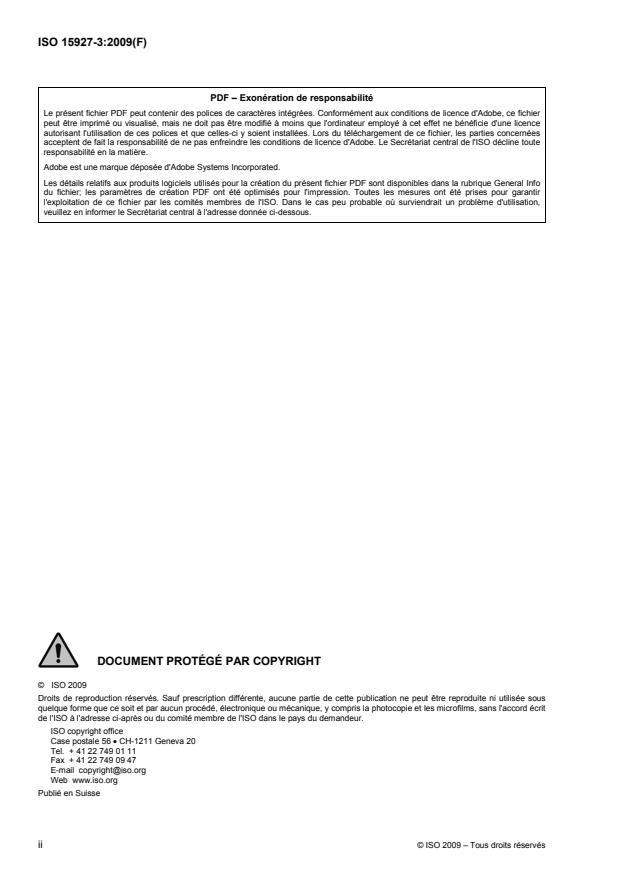
NORME ISO
INTERNATIONALE 15927-3
Première édition
2009-03-15
Performance hygrothermique des
bâtiments — Calcul et présentation des
données climatiques —
Partie 3:
Calcul d'un indice de pluie battante pour
surfaces verticales à partir de données
horaires de vent et de pluie
Hygrothermal performance of buildings — Calculation and presentation
of climatic data —
Part 3: Calculation of a driving rain index for vertical surfaces from
hourly wind and rain data
Numéro de référence
©
ISO 2009
PDF – Exonération de responsabilité
Le présent fichier PDF peut contenir des polices de caractères intégrées. Conformément aux conditions de licence d'Adobe, ce fichier
peut être imprimé ou visualisé, mais ne doit pas être modifié à moins que l'ordinateur employé à cet effet ne bénéficie d'une licence
autorisant l'utilisation de ces polices et que celles-ci y soient installées. Lors du téléchargement de ce fichier, les parties concernées
acceptent de fait la responsabilité de ne pas enfreindre les conditions de licence d'Adobe. Le Secrétariat central de l'ISO décline toute
responsabilité en la matière.
Adobe est une marque déposée d'Adobe Systems Incorporated.
Les détails relatifs aux produits logiciels utilisés pour la création du présent fichier PDF sont disponibles dans la rubrique General Info
du fichier; les paramètres de création PDF ont été optimisés pour l'impression. Toutes les mesures ont été prises pour garantir
l'exploitation de ce fichier par les comités membres de l'ISO. Dans le cas peu probable où surviendrait un problème d'utilisation,
veuillez en informer le Secrétariat central à l'adresse donnée ci-dessous.
DOCUMENT PROTÉGÉ PAR COPYRIGHT
© ISO 2009
Droits de reproduction réservés. Sauf prescription différente, aucune partie de cette publication ne peut être reproduite ni utilisée sous
quelque forme que ce soit et par aucun procédé, électronique ou mécanique, y compris la photocopie et les microfilms, sans l'accord écrit
de l'ISO à l'adresse ci-après ou du comité membre de l'ISO dans le pays du demandeur.
ISO copyright office
Case postale 56 • CH-1211 Geneva 20
Tel. + 41 22 749 01 11
Fax + 41 22 749 09 47
E-mail copyright@iso.org
Web www.iso.org
Publié en Suisse
ii © ISO 2009 – Tous droits réservés
Sommaire Page
Avant-propos. iv
Introduction . v
1 Domaine d'application. 1
2 Termes et définitions, symboles et unités . 2
3 Calcul des pluies battantes de référence à partir de données horaires de vent et de pluie. 4
4 Estimation de l'effet de la pluie battante d'après le vent moyen et le code du temps
présent pour la pluie. 5
5 Calcul des indices de pluie battante locale . 6
Annexe A (informative) Limites de validité des indices calculés. 12
Annexe B (informative) Nature d'une «période de mouillage» par pluie battante. 13
Annexe C (informative) Mode opératoire d'élaboration des cartes de pluie battante. 15
Annexe D (informative) Comparaison des méthodes spécifiées dans les Articles 3 et 4 . 17
Bibliographie . 19
Avant-propos
L'ISO (Organisation internationale de normalisation) est une fédération mondiale d'organismes nationaux de
normalisation (comités membres de l'ISO). L'élaboration des Normes internationales est en général confiée
aux comités techniques de l'ISO. Chaque comité membre intéressé par une étude a le droit de faire partie du
comité technique créé à cet effet. Les organisations internationales, gouvernementales et non
gouvernementales, en liaison avec l'ISO participent également aux travaux. L'ISO collabore étroitement avec
la Commission électrotechnique internationale (CEI) en ce qui concerne la normalisation électrotechnique.
Les Normes internationales sont rédigées conformément aux règles données dans les Directives ISO/CEI,
Partie 2.
La tâche principale des comités techniques est d'élaborer les Normes internationales. Les projets de Normes
internationales adoptés par les comités techniques sont soumis aux comités membres pour vote. Leur
publication comme Normes internationales requiert l'approbation de 75 % au moins des comités membres
votants.
L'attention est appelée sur le fait que certains des éléments du présent document peuvent faire l'objet de
droits de propriété intellectuelle ou de droits analogues. L'ISO ne saurait être tenue pour responsable de ne
pas avoir identifié de tels droits de propriété et averti de leur existence.
L'ISO 15927-3 a été élaborée par le comité technique CEN/TC 89, Performance thermique des bâtiments et
des composants du bâtiment, du Comité européen de normalisation (CEN) en collaboration avec le comité
technique ISO/TC 163, Performance thermique et utilisation de l'énergie en environnement bâti, sous-comité
SC 2, Méthodes de calcul, conformément à l'Accord de coopération technique entre l'ISO et le CEN (Accord
de Vienne).
L'ISO 15927 comprend les parties suivantes, présentées sous le titre général Performance hygrothermique
des bâtiments — Calcul et présentation des données climatiques:
⎯ Partie 1: Moyennes mensuelles des éléments météorologiques simples
⎯ Partie 2: Données horaires pour la charge de refroidissement de conception
⎯ Partie 3: Calcul d'un indice de pluie battante pour surfaces verticales à partir de données horaires de vent
et de pluie
⎯ Partie 4: Données horaires pour l'évaluation du besoin énergétique annuel de chauffage et de
refroidissement
⎯ Partie 5: Données pour la charge calorifique de conception pour le chauffage des locaux
⎯ Partie 6: Écarts de température cumulés (degrés-jour)
iv © ISO 2009 – Tous droits réservés
Introduction
La présente partie de l'ISO 15927 spécifie deux modes opératoires d'analyse des données dérivées des
observations horaires de vent et de pluie, à la fois en termes de moyenne annuelle et de courtes périodes de
mouillage, afin de fournir une estimation de la quantité d'eau susceptible de tomber sur un mur ayant une
orientation donnée.
Le premier mode opératoire, qui utilise les observations horaires de vent et de pluie, est très proche de la
[1]
méthode de la BS 8104 , issue d'une longue série de mesurages de pluie battante sur des bâtiments situés
en de nombreux lieux au Royaume-Uni. Ainsi, la méthode s'applique à des climats similaires à celui du
Royaume-Uni; dans d'autres régions, avec des climats très différents, il est recommandé d'obtenir
confirmation de son applicabilité par des mesurages de pluie battante sur des bâtiments représentatifs.
Si l'on ne dispose pas d'observations horaires de vent et de pluie, il est possible d'utiliser le deuxième mode
opératoire, fondé sur le code du temps présent pour la pluie et les vitesses moyennes du vent.
Dans tous les cas, en particulier dans les zones montagneuses, il est important, dans la mesure du possible,
de mesurer directement la pluie qui tombe sur les façades des bâtiments.
La pénétration de pluie aux encadrements de portes et de fenêtres, ou au niveau de fissures éventuellement
présentes sur la façade d'un bâtiment, est liée à la présence de courtes périodes de forte pluie et de vents
forts.
NORME INTERNATIONALE ISO 15927-3:2009(F)
Performance hygrothermique des bâtiments — Calcul et
présentation des données climatiques —
Partie 3:
Calcul d'un indice de pluie battante pour surfaces verticales à
partir de données horaires de vent et de pluie
1 Domaine d'application
La présente partie de l'ISO 15927 spécifie deux modes opératoires permettant de fournir une estimation de la
quantité d'eau susceptible de tomber sur un mur ayant une orientation donnée. Elle tient compte de la
topographie, de la protection locale et du type de bâtiment et de mur.
Le premier mode opératoire, décrit à l'Article 3 et fondé sur des données horaires concomitantes des
précipitations et de la vitesse du vent, définit une méthode de calcul de:
⎯ l'indice moyen annuel qui influe sur la teneur en eau d'une surface absorbante, comme la maçonnerie;
⎯ l'indice de durée de mouillage qui influe sur la probabilité de pénétration de la pluie dans la maçonnerie et
les joints dans d'autres systèmes d'enduits.
Le deuxième mode opératoire, décrit à l'Article 4 et fondé sur des données de vent moyennes et sur un
enregistrement qualitatif de la présence et de l'intensité de pluie (le code du temps présent pour la pluie),
définit une méthode de calcul de la durée de mouillage d'un matériau absorbant comme la maçonnerie, avec
une probabilité de 10 % d'être dépassée en une année (ou, autrement dit, «avec une période de récurrence
moyenne de 10 ans»).
L'Annexe D fournit une comparaison entre les deux méthodes.
Des modes opératoires sont indiqués pour corriger les résultats des deux méthodes en fonction de la
topographie, de la protection locale et du type de bâtiment et de mur.
Les méthodes indiquées dans la présente partie de l'ISO 15927 ne s'appliquent pas:
a) dans les zones montagneuses avec des falaises abruptes ou des gorges profondes;
b) dans les zones où plus de 25 % des pluies annuelles proviennent de fortes tempêtes convectives;
c) dans les zones et les périodes où une proportion importante des précipitations est constituée de neige ou
de grêle.
2 Termes et définitions, symboles et unités
Pour les besoins du présent document, les termes, définitions, symboles et unités suivants s'appliquent.
2.1 Définitions
2.1.1
période de mouillage
période, ou série de périodes, de pluie poussée par le vent sur une surface verticale d'une orientation donnée
NOTE L'Annexe B fournit de plus amples informations sur les périodes de mouillage.
2.1.2
pluie battante horaire de référence
quantité de pluie battante qui tomberait sur un mur vertical d'orientation donnée par mètre carré de mur
pendant 1 h à une hauteur de 10 m au-dessus du sol au milieu d'un aérodrome, à l'emplacement
géographique du mur
2.1.3
pluie battante annuelle de référence
pluie battante de référence pour une orientation de mur donnée, totalisée sur un an
2.1.4
pluie battante maximale de référence
pluie battante de référence pour une orientation de mur donnée, totalisée sur la pire période de mouillage
susceptible de se produire en trois ans
2.1.5
pluie battante annuelle locale
quantité de pluie poussée par le vent par mètre carré en un point d'un mur d'orientation donnée, fondée sur la
pluie battante annuelle de référence et les corrections pour tenir compte de la rugosité, de la topographie, de
l'obstruction et des facteurs de captation
2.1.6
pluie battante maximale locale
quantité de pluie poussée par le vent par mètre carré en un point d'un mur donné, fondée sur la pluie battante
maximale de référence et les corrections pour tenir compte de la rugosité, de la topographie, de l'obstruction
et des facteurs de captation
2.1.7
ligne de visée
vue horizontale à distance du mur, sur un secteur d'environ 25° de part et d'autre de la perpendiculaire par
rapport au mur
2.1.8
catégorie de rugosité du terrain
classification de la rugosité de surface en amont, en termes de hauteur moyenne et d'espacement
d'obstruction, comme par exemple des bâtiments, des arbres ou des haies
2.1.9
coefficient de rugosité
facteur qui prend en compte la modification de la vitesse du vent en raison de la rugosité du terrain en amont
d'un mur
2.1.10
coefficient topographique
facteur qui prend en compte l'effet de la topographie locale sur la vitesse du vent
2 © ISO 2009 – Tous droits réservés
2.1.11
facteur d'obstruction
facteur relatif à une protection par rapport à l'environnement immédiat et qui tient compte des obstructions,
comme les bâtiments, clôtures et arbres à proximité et en amont du mur
2.1.12
facteur de captation
rapport entre la quantité d'eau qui tombe sur un mur et la quantité qui passe dans un espace équivalent non
obstrué, en tenant compte des caractéristiques du mur
2.1.13
orientation du mur
angle entre le nord et une ligne perpendiculaire à un mur
2.1.14
tempête convective
fortes précipitations sous forme d'averses ou d'orages durant généralement moins de 1 h
2.1.15
période de mouillage de référence
période durant laquelle un mur ayant une orientation donnée est mouillé, avec une probabilité de 10 % d'être
dépassée en une année donnée
2.1.16
code du temps présent
code numérique utilisé par les observateurs météorologistes pour évaluer les conditions climatiques au
moment d'une observation
[2]
NOTE Les codes du temps présent sont donnés dans un guide publié par l'OMM.
2.1.17
demi-journée
période de douze heures incluant les heures de 07:00 à 18:00 ou de 19:00 à 06:00
2.2 Symboles et unités
Symbole Grandeur Unité
C coefficient de rugosité —
R
C coefficient topographique —
T
D direction moyenne horaire du vent à partir du nord °
H hauteur utile du relief m
I pluie battante annuelle de référence l/m
A
I pluie battante maximale de référence l/m
S
I pluie battante annuelle locale l/m
WA
I pluie battante maximale locale l/m
WS
K facteur de terrain —
R
L longueur m
N nombre d'années de données disponibles —
O facteur d'obstruction —
r précipitation horaire cumulée mm
Symbole Grandeur Unité
v vitesse horaire moyenne du vent m/s
W facteur de captation —
x distance horizontale m
z hauteur au-dessus du sol m
z longueur de rugosité m
z hauteur minimale m
min
Θ orientation du mur par rapport au nord °
3 Calcul des pluies battantes de référence à partir de données horaires de vent et
de pluie
3.1 Origine des données
Les données utilisées pour les calculs conformément à la présente partie de l'ISO 15927 doivent avoir été
[2]
mesurées selon les méthodes spécifiées par l'Organisation Mondiale de Météorologie (voir le guide publié
par l'OMM).
3.2 Pluie battante annuelle de référence
Pour tout lieu pour lequel on dispose d'au moins 10 (et de préférence 20 ou 30) années de valeurs horaires
de vitesse du vent, de direction du vent et de chutes de pluie, l'indice annuel pour l'orientation du mur, Θ, est
donné par l'Équation (1).
vr cos D−Θ
()
∑
I = (1)
A
9 N
où la somme porte sur toutes les heures pour lesquelles cos(D − Θ) est positif, c'est-à-dire toutes les fois où le
vent souffle contre le mur.
La vitesse du vent pendant une chute de pluie n'étant généralement pas la même que par temps sec, le calcul
du produit des moyennes horaires de vent et de pluie n'est pas strictement exact, surtout par temps à averses.
Il a été démontré, cependant, que l'erreur est faible et, de toute manière, très peu de lieux sont en mesure de
fournir plusieurs années de données portant sur des périodes de moins de 1 h. Le fait de prendre le produit
des moyennes journalières ou mensuelles conduit à des inexactitudes sérieuses et il convient de ne pas
procéder de la sorte pour calculer les indices de pluie battante.
3.3 Pluie battante maximale de référence
Pour tout lieu pour lequel on dispose d'au moins 10 (et de préférence 20 ou 30) années de valeurs horaires
de vitesse du vent, de direction du vent et de chutes de pluie, pour chaque orientation de mur, Θ, et pour
′
chaque période de mouillage par pluie battante (voir Annexe B), calculer I conformément à l'Équation (2).
S
Iv′=−r cosD Θ (2)
()
S ∑
où la somme porte sur toutes les heures de la période de mouillage pour lesquelles cos(D − Θ) est positif,
c'est-à-dire toutes les fois où le vent souffle contre le mur.
4 © ISO 2009 – Tous droits réservés
ème
′
Le 67 centile (c'est-à-dire la valeur pour laquelle 33 % des valeurs I sont supérieures) est issu des
S
′
valeurs de I pour toutes les périodes de mouillage incluses dans la période où des données sont
S
disponibles.
ème
′
Le 67 centile définit l'indice de durée de mouillage, I (c'est-à-dire la valeur maximale de I susceptible
S
S
de se produire une fois tous les trois ans).
4 Estimation de l'effet de la pluie battante d'après le vent moyen et le code du
temps présent pour la pluie
Les données disponibles sont divisées en périodes de 12 heures (incluant les heures de 07:00 à 18:00 ou de
19:00 à 06:00), appelées demi-journées.
Une demi-journée est définie comme humide si toutes les conditions suivantes sont réunies.
a) Il y a plus de 4 mm de précipitations sur une surface horizontale pendant la demi-journée.
b) Le code du temps présent fait état de précipitations pour au moins trois des cinq observations horaires
pendant la demi-journée (c'est-à-dire à 06:00, 09:00, 12:00, 15:00 et 18:00 et à 18:00, 21:00, 00:00,
03:00 et 06:00).
NOTE Des codes du temps présent de 50 ou plus indiquent une forme de précipitations.
c) La vitesse moyenne du vent pendant la demi-journée est supérieure à 2 m/s.
d) La direction moyenne du vent pendant la demi-journée est à ± 60° par rapport à la perpendiculaire au
mur, c'est-à-dire D−Θ u 60 .
Dans ces conditions, on suppose qu'une surface de mur sera mouillée par une pluie battante et que l'eau
pénètrera ensuite dans le mur par capillarité.
Une demi-journée est définie comme sèche si toutes les conditions suivantes sont réunies.
⎯ L'humidité relative atmo
...
NORME ISO
INTERNATIONALE 15927-3
Première édition
2009-03-15
Performance hygrothermique des
bâtiments — Calcul et présentation des
données climatiques —
Partie 3:
Calcul d'un indice de pluie battante pour
surfaces verticales à partir de données
horaires de vent et de pluie
Hygrothermal performance of buildings — Calculation and presentation
of climatic data —
Part 3: Calculation of a driving rain index for vertical surfaces from
hourly wind and rain data
Numéro de référence
©
ISO 2009
PDF – Exonération de responsabilité
Le présent fichier PDF peut contenir des polices de caractères intégrées. Conformément aux conditions de licence d'Adobe, ce fichier
peut être imprimé ou visualisé, mais ne doit pas être modifié à moins que l'ordinateur employé à cet effet ne bénéficie d'une licence
autorisant l'utilisation de ces polices et que celles-ci y soient installées. Lors du téléchargement de ce fichier, les parties concernées
acceptent de fait la responsabilité de ne pas enfreindre les conditions de licence d'Adobe. Le Secrétariat central de l'ISO décline toute
responsabilité en la matière.
Adobe est une marque déposée d'Adobe Systems Incorporated.
Les détails relatifs aux produits logiciels utilisés pour la création du présent fichier PDF sont disponibles dans la rubrique General Info
du fichier; les paramètres de création PDF ont été optimisés pour l'impression. Toutes les mesures ont été prises pour garantir
l'exploitation de ce fichier par les comités membres de l'ISO. Dans le cas peu probable où surviendrait un problème d'utilisation,
veuillez en informer le Secrétariat central à l'adresse donnée ci-dessous.
DOCUMENT PROTÉGÉ PAR COPYRIGHT
© ISO 2009
Droits de reproduction réservés. Sauf prescription différente, aucune partie de cette publication ne peut être reproduite ni utilisée sous
quelque forme que ce soit et par aucun procédé, électronique ou mécanique, y compris la photocopie et les microfilms, sans l'accord écrit
de l'ISO à l'adresse ci-après ou du comité membre de l'ISO dans le pays du demandeur.
ISO copyright office
Case postale 56 • CH-1211 Geneva 20
Tel. + 41 22 749 01 11
Fax + 41 22 749 09 47
E-mail copyright@iso.org
Web www.iso.org
Publié en Suisse
ii © ISO 2009 – Tous droits réservés
Sommaire Page
Avant-propos. iv
Introduction . v
1 Domaine d'application. 1
2 Termes et définitions, symboles et unités . 2
3 Calcul des pluies battantes de référence à partir de données horaires de vent et de pluie. 4
4 Estimation de l'effet de la pluie battante d'après le vent moyen et le code du temps
présent pour la pluie. 5
5 Calcul des indices de pluie battante locale . 6
Annexe A (informative) Limites de validité des indices calculés. 12
Annexe B (informative) Nature d'une «période de mouillage» par pluie battante. 13
Annexe C (informative) Mode opératoire d'élaboration des cartes de pluie battante. 15
Annexe D (informative) Comparaison des méthodes spécifiées dans les Articles 3 et 4 . 17
Bibliographie . 19
Avant-propos
L'ISO (Organisation internationale de normalisation) est une fédération mondiale d'organismes nationaux de
normalisation (comités membres de l'ISO). L'élaboration des Normes internationales est en général confiée
aux comités techniques de l'ISO. Chaque comité membre intéressé par une étude a le droit de faire partie du
comité technique créé à cet effet. Les organisations internationales, gouvernementales et non
gouvernementales, en liaison avec l'ISO participent également aux travaux. L'ISO collabore étroitement avec
la Commission électrotechnique internationale (CEI) en ce qui concerne la normalisation électrotechnique.
Les Normes internationales sont rédigées conformément aux règles données dans les Directives ISO/CEI,
Partie 2.
La tâche principale des comités techniques est d'élaborer les Normes internationales. Les projets de Normes
internationales adoptés par les comités techniques sont soumis aux comités membres pour vote. Leur
publication comme Normes internationales requiert l'approbation de 75 % au moins des comités membres
votants.
L'attention est appelée sur le fait que certains des éléments du présent document peuvent faire l'objet de
droits de propriété intellectuelle ou de droits analogues. L'ISO ne saurait être tenue pour responsable de ne
pas avoir identifié de tels droits de propriété et averti de leur existence.
L'ISO 15927-3 a été élaborée par le comité technique CEN/TC 89, Performance thermique des bâtiments et
des composants du bâtiment, du Comité européen de normalisation (CEN) en collaboration avec le comité
technique ISO/TC 163, Performance thermique et utilisation de l'énergie en environnement bâti, sous-comité
SC 2, Méthodes de calcul, conformément à l'Accord de coopération technique entre l'ISO et le CEN (Accord
de Vienne).
L'ISO 15927 comprend les parties suivantes, présentées sous le titre général Performance hygrothermique
des bâtiments — Calcul et présentation des données climatiques:
⎯ Partie 1: Moyennes mensuelles des éléments météorologiques simples
⎯ Partie 2: Données horaires pour la charge de refroidissement de conception
⎯ Partie 3: Calcul d'un indice de pluie battante pour surfaces verticales à partir de données horaires de vent
et de pluie
⎯ Partie 4: Données horaires pour l'évaluation du besoin énergétique annuel de chauffage et de
refroidissement
⎯ Partie 5: Données pour la charge calorifique de conception pour le chauffage des locaux
⎯ Partie 6: Écarts de température cumulés (degrés-jour)
iv © ISO 2009 – Tous droits réservés
Introduction
La présente partie de l'ISO 15927 spécifie deux modes opératoires d'analyse des données dérivées des
observations horaires de vent et de pluie, à la fois en termes de moyenne annuelle et de courtes périodes de
mouillage, afin de fournir une estimation de la quantité d'eau susceptible de tomber sur un mur ayant une
orientation donnée.
Le premier mode opératoire, qui utilise les observations horaires de vent et de pluie, est très proche de la
[1]
méthode de la BS 8104 , issue d'une longue série de mesurages de pluie battante sur des bâtiments situés
en de nombreux lieux au Royaume-Uni. Ainsi, la méthode s'applique à des climats similaires à celui du
Royaume-Uni; dans d'autres régions, avec des climats très différents, il est recommandé d'obtenir
confirmation de son applicabilité par des mesurages de pluie battante sur des bâtiments représentatifs.
Si l'on ne dispose pas d'observations horaires de vent et de pluie, il est possible d'utiliser le deuxième mode
opératoire, fondé sur le code du temps présent pour la pluie et les vitesses moyennes du vent.
Dans tous les cas, en particulier dans les zones montagneuses, il est important, dans la mesure du possible,
de mesurer directement la pluie qui tombe sur les façades des bâtiments.
La pénétration de pluie aux encadrements de portes et de fenêtres, ou au niveau de fissures éventuellement
présentes sur la façade d'un bâtiment, est liée à la présence de courtes périodes de forte pluie et de vents
forts.
NORME INTERNATIONALE ISO 15927-3:2009(F)
Performance hygrothermique des bâtiments — Calcul et
présentation des données climatiques —
Partie 3:
Calcul d'un indice de pluie battante pour surfaces verticales à
partir de données horaires de vent et de pluie
1 Domaine d'application
La présente partie de l'ISO 15927 spécifie deux modes opératoires permettant de fournir une estimation de la
quantité d'eau susceptible de tomber sur un mur ayant une orientation donnée. Elle tient compte de la
topographie, de la protection locale et du type de bâtiment et de mur.
Le premier mode opératoire, décrit à l'Article 3 et fondé sur des données horaires concomitantes des
précipitations et de la vitesse du vent, définit une méthode de calcul de:
⎯ l'indice moyen annuel qui influe sur la teneur en eau d'une surface absorbante, comme la maçonnerie;
⎯ l'indice de durée de mouillage qui influe sur la probabilité de pénétration de la pluie dans la maçonnerie et
les joints dans d'autres systèmes d'enduits.
Le deuxième mode opératoire, décrit à l'Article 4 et fondé sur des données de vent moyennes et sur un
enregistrement qualitatif de la présence et de l'intensité de pluie (le code du temps présent pour la pluie),
définit une méthode de calcul de la durée de mouillage d'un matériau absorbant comme la maçonnerie, avec
une probabilité de 10 % d'être dépassée en une année (ou, autrement dit, «avec une période de récurrence
moyenne de 10 ans»).
L'Annexe D fournit une comparaison entre les deux méthodes.
Des modes opératoires sont indiqués pour corriger les résultats des deux méthodes en fonction de la
topographie, de la protection locale et du type de bâtiment et de mur.
Les méthodes indiquées dans la présente partie de l'ISO 15927 ne s'appliquent pas:
a) dans les zones montagneuses avec des falaises abruptes ou des gorges profondes;
b) dans les zones où plus de 25 % des pluies annuelles proviennent de fortes tempêtes convectives;
c) dans les zones et les périodes où une proportion importante des précipitations est constituée de neige ou
de grêle.
2 Termes et définitions, symboles et unités
Pour les besoins du présent document, les termes, définitions, symboles et unités suivants s'appliquent.
2.1 Définitions
2.1.1
période de mouillage
période, ou série de périodes, de pluie poussée par le vent sur une surface verticale d'une orientation donnée
NOTE L'Annexe B fournit de plus amples informations sur les périodes de mouillage.
2.1.2
pluie battante horaire de référence
quantité de pluie battante qui tomberait sur un mur vertical d'orientation donnée par mètre carré de mur
pendant 1 h à une hauteur de 10 m au-dessus du sol au milieu d'un aérodrome, à l'emplacement
géographique du mur
2.1.3
pluie battante annuelle de référence
pluie battante de référence pour une orientation de mur donnée, totalisée sur un an
2.1.4
pluie battante maximale de référence
pluie battante de référence pour une orientation de mur donnée, totalisée sur la pire période de mouillage
susceptible de se produire en trois ans
2.1.5
pluie battante annuelle locale
quantité de pluie poussée par le vent par mètre carré en un point d'un mur d'orientation donnée, fondée sur la
pluie battante annuelle de référence et les corrections pour tenir compte de la rugosité, de la topographie, de
l'obstruction et des facteurs de captation
2.1.6
pluie battante maximale locale
quantité de pluie poussée par le vent par mètre carré en un point d'un mur donné, fondée sur la pluie battante
maximale de référence et les corrections pour tenir compte de la rugosité, de la topographie, de l'obstruction
et des facteurs de captation
2.1.7
ligne de visée
vue horizontale à distance du mur, sur un secteur d'environ 25° de part et d'autre de la perpendiculaire par
rapport au mur
2.1.8
catégorie de rugosité du terrain
classification de la rugosité de surface en amont, en termes de hauteur moyenne et d'espacement
d'obstruction, comme par exemple des bâtiments, des arbres ou des haies
2.1.9
coefficient de rugosité
facteur qui prend en compte la modification de la vitesse du vent en raison de la rugosité du terrain en amont
d'un mur
2.1.10
coefficient topographique
facteur qui prend en compte l'effet de la topographie locale sur la vitesse du vent
2 © ISO 2009 – Tous droits réservés
2.1.11
facteur d'obstruction
facteur relatif à une protection par rapport à l'environnement immédiat et qui tient compte des obstructions,
comme les bâtiments, clôtures et arbres à proximité et en amont du mur
2.1.12
facteur de captation
rapport entre la quantité d'eau qui tombe sur un mur et la quantité qui passe dans un espace équivalent non
obstrué, en tenant compte des caractéristiques du mur
2.1.13
orientation du mur
angle entre le nord et une ligne perpendiculaire à un mur
2.1.14
tempête convective
fortes précipitations sous forme d'averses ou d'orages durant généralement moins de 1 h
2.1.15
période de mouillage de référence
période durant laquelle un mur ayant une orientation donnée est mouillé, avec une probabilité de 10 % d'être
dépassée en une année donnée
2.1.16
code du temps présent
code numérique utilisé par les observateurs météorologistes pour évaluer les conditions climatiques au
moment d'une observation
[2]
NOTE Les codes du temps présent sont donnés dans un guide publié par l'OMM.
2.1.17
demi-journée
période de douze heures incluant les heures de 07:00 à 18:00 ou de 19:00 à 06:00
2.2 Symboles et unités
Symbole Grandeur Unité
C coefficient de rugosité —
R
C coefficient topographique —
T
D direction moyenne horaire du vent à partir du nord °
H hauteur utile du relief m
I pluie battante annuelle de référence l/m
A
I pluie battante maximale de référence l/m
S
I pluie battante annuelle locale l/m
WA
I pluie battante maximale locale l/m
WS
K facteur de terrain —
R
L longueur m
N nombre d'années de données disponibles —
O facteur d'obstruction —
r précipitation horaire cumulée mm
Symbole Grandeur Unité
v vitesse horaire moyenne du vent m/s
W facteur de captation —
x distance horizontale m
z hauteur au-dessus du sol m
z longueur de rugosité m
z hauteur minimale m
min
Θ orientation du mur par rapport au nord °
3 Calcul des pluies battantes de référence à partir de données horaires de vent et
de pluie
3.1 Origine des données
Les données utilisées pour les calculs conformément à la présente partie de l'ISO 15927 doivent avoir été
[2]
mesurées selon les méthodes spécifiées par l'Organisation Mondiale de Météorologie (voir le guide publié
par l'OMM).
3.2 Pluie battante annuelle de référence
Pour tout lieu pour lequel on dispose d'au moins 10 (et de préférence 20 ou 30) années de valeurs horaires
de vitesse du vent, de direction du vent et de chutes de pluie, l'indice annuel pour l'orientation du mur, Θ, est
donné par l'Équation (1).
vr cos D−Θ
()
∑
I = (1)
A
9 N
où la somme porte sur toutes les heures pour lesquelles cos(D − Θ) est positif, c'est-à-dire toutes les fois où le
vent souffle contre le mur.
La vitesse du vent pendant une chute de pluie n'étant généralement pas la même que par temps sec, le calcul
du produit des moyennes horaires de vent et de pluie n'est pas strictement exact, surtout par temps à averses.
Il a été démontré, cependant, que l'erreur est faible et, de toute manière, très peu de lieux sont en mesure de
fournir plusieurs années de données portant sur des périodes de moins de 1 h. Le fait de prendre le produit
des moyennes journalières ou mensuelles conduit à des inexactitudes sérieuses et il convient de ne pas
procéder de la sorte pour calculer les indices de pluie battante.
3.3 Pluie battante maximale de référence
Pour tout lieu pour lequel on dispose d'au moins 10 (et de préférence 20 ou 30) années de valeurs horaires
de vitesse du vent, de direction du vent et de chutes de pluie, pour chaque orientation de mur, Θ, et pour
′
chaque période de mouillage par pluie battante (voir Annexe B), calculer I conformément à l'Équation (2).
S
Iv′=−r cosD Θ (2)
()
S ∑
où la somme porte sur toutes les heures de la période de mouillage pour lesquelles cos(D − Θ) est positif,
c'est-à-dire toutes les fois où le vent souffle contre le mur.
4 © ISO 2009 – Tous droits réservés
ème
′
Le 67 centile (c'est-à-dire la valeur pour laquelle 33 % des valeurs I sont supérieures) est issu des
S
′
valeurs de I pour toutes les périodes de mouillage incluses dans la période où des données sont
S
disponibles.
ème
′
Le 67 centile définit l'indice de durée de mouillage, I (c'est-à-dire la valeur maximale de I susceptible
S
S
de se produire une fois tous les trois ans).
4 Estimation de l'effet de la pluie battante d'après le vent moyen et le code du
temps présent pour la pluie
Les données disponibles sont divisées en périodes de 12 heures (incluant les heures de 07:00 à 18:00 ou de
19:00 à 06:00), appelées demi-journées.
Une demi-journée est définie comme humide si toutes les conditions suivantes sont réunies.
a) Il y a plus de 4 mm de précipitations sur une surface horizontale pendant la demi-journée.
b) Le code du temps présent fait état de précipitations pour au moins trois des cinq observations horaires
pendant la demi-journée (c'est-à-dire à 06:00, 09:00, 12:00, 15:00 et 18:00 et à 18:00, 21:00, 00:00,
03:00 et 06:00).
NOTE Des codes du temps présent de 50 ou plus indiquent une forme de précipitations.
c) La vitesse moyenne du vent pendant la demi-journée est supérieure à 2 m/s.
d) La direction moyenne du vent pendant la demi-journée est à ± 60° par rapport à la perpendiculaire au
mur, c'est-à-dire D−Θ u 60 .
Dans ces conditions, on suppose qu'une surface de mur sera mouillée par une pluie battante et que l'eau
pénètrera ensuite dans le mur par capillarité.
Une demi-journée est définie comme sèche si toutes les conditions suivantes sont réunies.
⎯ L'humidité relative atmo
...