

ISO 8000-117:2023
(Main)Data quality — Part 117: Application of ISO 8000-115 to identifiers in distributed ledgers including blockchains
General Information
- Abstract
This document specifies requirements for using identifiers in distributed ledgers including blockchains. These requirements supplement those of ISO 8000-115. The following are within the scope of this document: — requirements for each identifier in distributed ledgers including blockchains, where the ledger enables supply chains to exchange transaction data; — requirements for the off‑ledger data set that is referenced by an identifier in a distributed ledger; — off-ledger data sets that consist only of property-value tuples, where each tuple is the result of semantic encoding. The following are outside the scope of this document: — requirements for implementing distributed ledger technology including blockchains; — requirements for technology to ensure immutability of data sets; — requirements for the processes of creating identifiers; — requirements for the processes of creating the content of off‑ledger data sets; — requirements for the processes of creating immutable data sets.
- Status
- Published
- Publication Date
- 20-Mar-2023
- Technical Committee
- ISO/TC 184/SC 4 - Industrial data
- Drafting Committee
- ISO/TC 184/SC 4 - Industrial data
- Current Stage
- 6060 - International Standard published
- Start Date
- 21-Mar-2023
- Due Date
- 14-Sep-2023
- Completion Date
- 21-Mar-2023
Overview
ISO 8000-117:2023 - "Data quality - Part 117" defines requirements for using identifiers in distributed ledgers including blockchains, supplementing ISO 8000-115. The standard focuses on ensuring high-quality, verifiable links between on‑ledger identifiers and the larger off‑ledger data sets they reference, primarily in supply‑chain transaction scenarios. It does not prescribe DLT implementation, immutability technology, or the processes for creating identifiers or data content.
Key topics & technical requirements
- Conformance with ISO 8000-115: All on‑ledger identifiers shall meet the syntactic, semantic and resolution requirements established in ISO 8000-115.
- One-to-one mapping: Each on‑ledger identifier must identify a single off‑ledger data set.
- Integrity verification: On‑ledger identifiers must include data sufficient to verify that the off‑ledger data set has not changed since the identifier was created (e.g., hash/checksum approaches - Annex B gives an example).
- Off‑ledger data set rules:
- Must reference and conform to a formal syntax.
- Shall consist of property‑value tuples, where each tuple results from semantic encoding.
- The content must be the exact data used to generate the on‑ledger identifier.
- Normative references: ISO 8000-2 (vocabulary) and ISO 8000-115 (master data identifiers).
Applications and who should use it
ISO 8000-117 is practical for organizations that use distributed ledgers to exchange transaction and master data in supply chains. Typical use cases:
- Ensuring reliable traceability and interoperability between blockchain records and detailed off‑ledger master data.
- Enabling data governance and quality management where immutable ledger entries reference larger, mutable datasets.
- Providing verifiable links for procurement, logistics, and product‑authenticity workflows.
Primary users:
- Data stewards and data governance teams
- Supply‑chain architects and integrators
- Blockchain/DLT solution designers focused on data quality
- Quality managers, procurement and compliance officers
Related standards
- ISO 8000-115 - Master data: exchange of quality identifiers (required baseline for identifier structure and semantics).
- ISO 8000-2 - Vocabulary for data quality (defines terms used throughout the ISO 8000 series). These related parts help implement consistent identifier schemes, semantic encoding, and data quality controls across distributed ledger solutions.
ISO 8000-117 supports robust, verifiable connections between ledger entries and off‑ledger datasets, improving data quality, traceability and trust in blockchain-enabled supply-chain exchanges.
Get Certified
Connect with accredited certification bodies for this standard

DVS-ZERT GmbH
German welding certification society.
CARES (UK Certification Authority for Reinforcing Steels)
UK certification for reinforcing steels and construction.
EWF/IIW (European/International Welding Federation)
International welding personnel certification.
Sponsored listings
Frequently Asked Questions
ISO 8000-117:2023 is a standard published by the International Organization for Standardization (ISO). Its full title is "Data quality — Part 117: Application of ISO 8000-115 to identifiers in distributed ledgers including blockchains". This standard covers: This document specifies requirements for using identifiers in distributed ledgers including blockchains. These requirements supplement those of ISO 8000-115. The following are within the scope of this document: — requirements for each identifier in distributed ledgers including blockchains, where the ledger enables supply chains to exchange transaction data; — requirements for the off‑ledger data set that is referenced by an identifier in a distributed ledger; — off-ledger data sets that consist only of property-value tuples, where each tuple is the result of semantic encoding. The following are outside the scope of this document: — requirements for implementing distributed ledger technology including blockchains; — requirements for technology to ensure immutability of data sets; — requirements for the processes of creating identifiers; — requirements for the processes of creating the content of off‑ledger data sets; — requirements for the processes of creating immutable data sets.
This document specifies requirements for using identifiers in distributed ledgers including blockchains. These requirements supplement those of ISO 8000-115. The following are within the scope of this document: — requirements for each identifier in distributed ledgers including blockchains, where the ledger enables supply chains to exchange transaction data; — requirements for the off‑ledger data set that is referenced by an identifier in a distributed ledger; — off-ledger data sets that consist only of property-value tuples, where each tuple is the result of semantic encoding. The following are outside the scope of this document: — requirements for implementing distributed ledger technology including blockchains; — requirements for technology to ensure immutability of data sets; — requirements for the processes of creating identifiers; — requirements for the processes of creating the content of off‑ledger data sets; — requirements for the processes of creating immutable data sets.
ISO 8000-117:2023 is classified under the following ICS (International Classification for Standards) categories: 25.040.40 - Industrial process measurement and control. The ICS classification helps identify the subject area and facilitates finding related standards.
ISO 8000-117:2023 is available in PDF format for immediate download after purchase. The document can be added to your cart and obtained through the secure checkout process. Digital delivery ensures instant access to the complete standard document.
Standards Content (Sample)
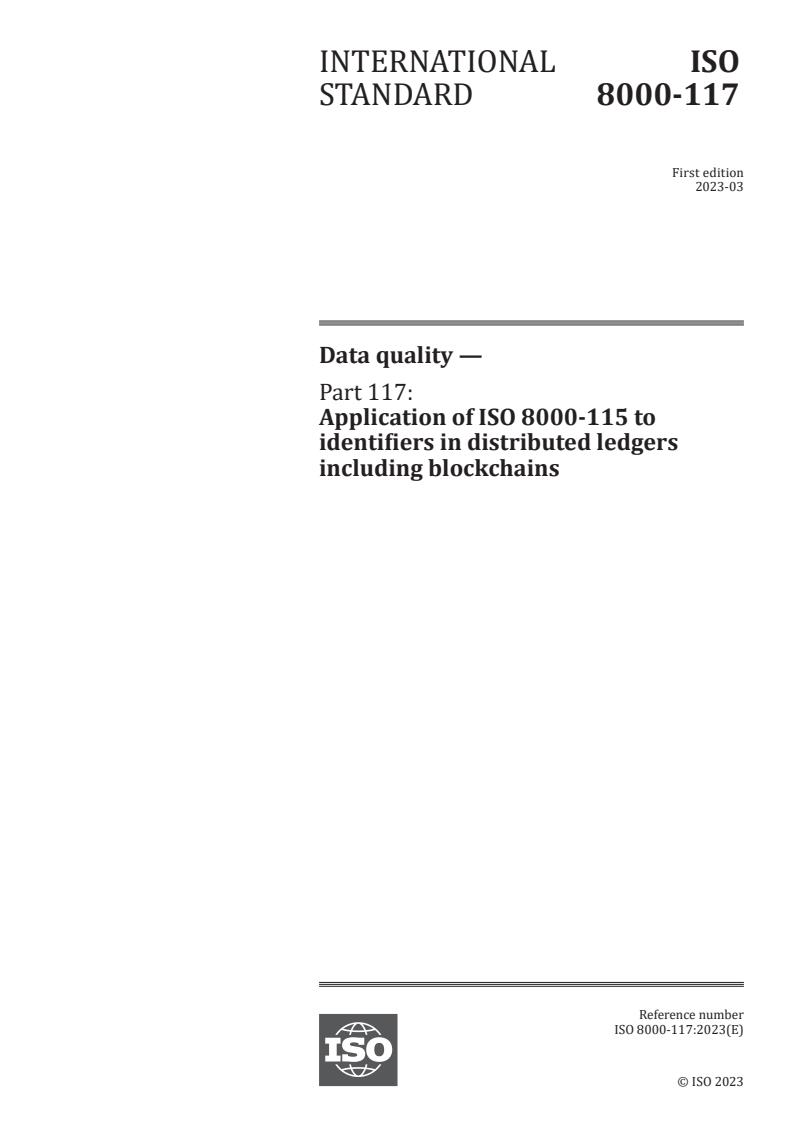
INTERNATIONAL ISO
STANDARD 8000-117
First edition
2023-03
Data quality —
Part 117:
Application of ISO 8000-115 to
identifiers in distributed ledgers
including blockchains
Reference number
© ISO 2023
All rights reserved. Unless otherwise specified, or required in the context of its implementation, no part of this publication may
be reproduced or utilized otherwise in any form or by any means, electronic or mechanical, including photocopying, or posting on
the internet or an intranet, without prior written permission. Permission can be requested from either ISO at the address below
or ISO’s member body in the country of the requester.
ISO copyright office
CP 401 • Ch. de Blandonnet 8
CH-1214 Vernier, Geneva
Phone: +41 22 749 01 11
Email: copyright@iso.org
Website: www.iso.org
Published in Switzerland
ii
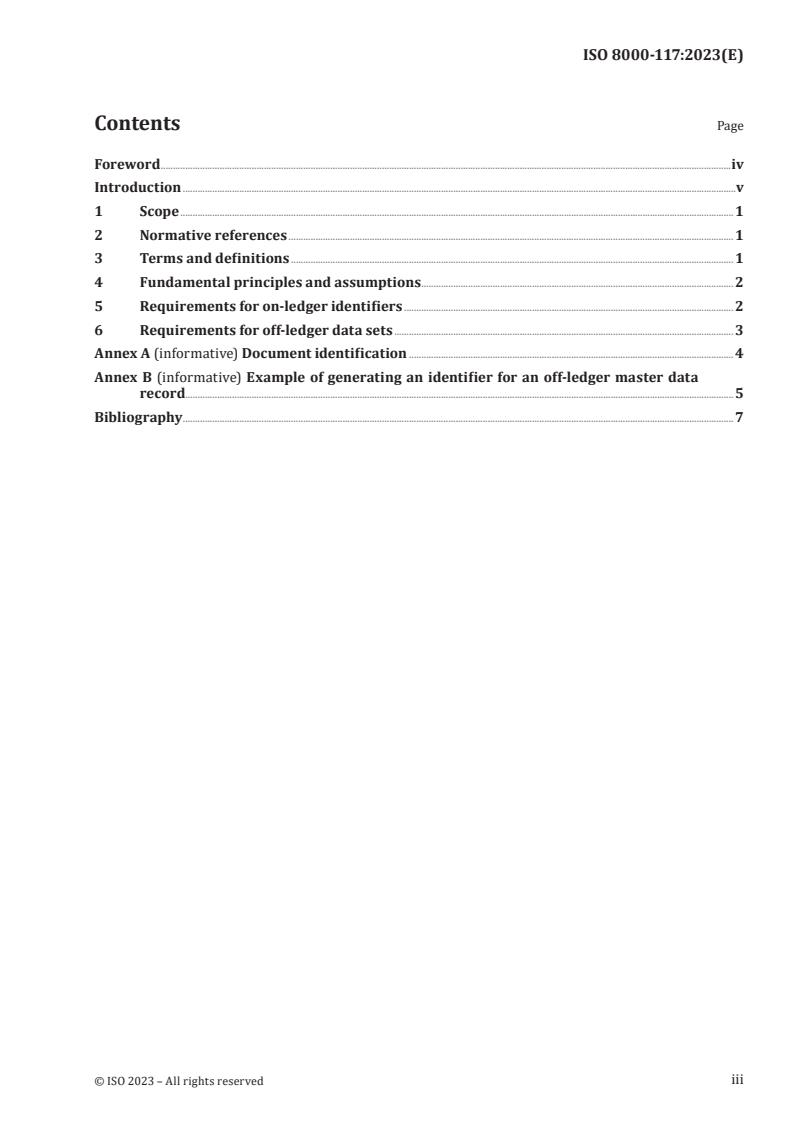
Contents Page
Foreword .iv
Introduction .v
1 Scope . 1
2 Normative references . 1
3 Terms and definitions . 1
4 Fundamental principles and assumptions . 2
5 Requirements for on‑ledger identifiers . 2
6 Requirements for off‑ledger data sets . 3
Annex A (informative) Document identification . 4
Annex B (informative) Example of generating an identifier for an off‑ledger master data
record. 5
Bibliography . 7
iii
Foreword
ISO (the International Organization for Standardization) is a worldwide federation of national standards
bodies (ISO member bodies). The work of preparing International Standards is normally carried out
through ISO technical committees. Each member body interested in a subject for which a technical
committee has been established has the right to be represented on that committee. International
organizations, governmental and non-governmental, in liaison with ISO, also take part in the work.
ISO collaborates closely with the International Electrotechnical Commission (IEC) on all matters of
electrotechnical standardization.
The procedures used to develop this document and those intended for its further maintenance are
described in the ISO/IEC Directives, Part 1. In particular, the different approval criteria needed for the
different types of ISO documents should be noted. This document was drafted in accordance with the
editorial rules of the ISO/IEC Directives, Part 2 (see www.iso.org/directives).
Attention is drawn to the possibility that some of the elements of this document may be the subject of
patent rights. ISO shall not be held responsible for identifying any or all such patent rights. Details of
any patent rights identified during the development of the document will be in the Introduction and/or
on the ISO list of patent declarations received (see www.iso.org/patents).
Any trade name used in this document is information given for the convenience of users and does not
constitute an endorsement.
For an explanation of the voluntary nature of standards, the meaning of ISO specific terms and
expressions related to conformity assessment, as well as information about ISO's adherence to
the World Trade Organization (WTO) principles in the Technical Barriers to Trade (TBT), see
www.iso.org/iso/foreword.html.
This document was prepared by Technical Committee ISO/TC 184, Automation systems and integration,
Subcommittee SC 4 Industrial data.
A list of all parts in the ISO 8000 series can be found on the ISO website.
Any feedback or questions on this document should be directed to the user’s national standards body. A
complete listing of these bodies can be found at www.iso.org/members.html.
iv
Introduction
0.1 Foundations of the ISO 8000 series
Digital data deliver value by enhancing all aspects of organizational performance including:
— operational effectiveness and efficiency;
— safety and security;
— reputation with customers and the wider public;
— compliance with statutory regulations;
— innovation;
— consumer costs, revenues and stock prices.
In addition, many organizations are now addressing these considerations with reference to the United
1)
Nations Sustainable Development Goals .
The influence on performance originates from data being the formalized representation of
2)
information . This information enables organizations to make reliable decisions. This decision making
can be performed by human beings directly and also by automated data processing including artificial
intelligence systems.
Through widespread adoption of digital computing and associated communication technologies,
organizations become dependent on digital data. This dependency amplifies the negative consequences
of lack of quality in these data. These consequences are the decrease of organizational performance.
The biggest impact of digital data comes from two key factors:
— the data having a structure that reflects the nature of the subject matter;
EXAMPLE 1 A research scientist writes a report using a software application for word processing. This report
includes a table that uses a clear, logical layout to show results from an experiment. These results indicate how
material properties vary with temperature. The report is read by a designer, who uses the results to create a
product that works in a range of different operating temperatures.
— the data being computer processable (machine readable) rather than just being for a person to read
and understand.
EXAMPLE 2 A research scientist uses a database system to store the results of experiments on a material.
This system controls the format of different values in the data set. The system generates an output file of digital
data. This file is processed by a software application for engineering analysis. The application determines the
optimum geometry when using the material to make a product.
ISO 9000 explains that quality is not an abstract concept of absolute perfection. Quality is actually
the conformance of characteristics to requirements. This actuality means that any item of data can
be of high quality for one purpose but not for a different purpose. The quality is different because the
requirements are different between the two purposes.
EXAMPLE 3 Time data are processed by calendar applications and also by control systems for propulsion
units on spacecraft. These data include start times for meetings in a calendar application and activation times in
a control system. These start times require less precision than the activation times.
1) https://sdgs.un.org/goals
2) ISO 8000-2 defines information as “knowledge concerning objects, such as facts, events, things, processes, or
ideas, including concepts, that within a certain context has a particular meaning”.
v
The nature of digital data is fundamental to establishing requirements that are relevant to the specific
decisions that are made by each organization.
EXAMPLE 4 ISO 8000-1 identifies that data have syntactic (format), semantic (meaning) and pragmatic
(usefulness) characteristics.
To support the delivery of high-quality data, the ISO 8000 series addresses:
— data governance, data quality management and maturity assessment;
EXAMPLE 5 ISO 8000-61 specifies a process reference model for data quality management.
— creating and applying requirements for data and information;
EXAMPLE 6 ISO 8000-110 specifies how to exchange characteristic data that are master data.
— monitoring and measuring information and data quality;
EXAMPLE 7 ISO 8000-8 specifies approaches to measuring information and data quality.
— improving data and, consequently, information quality;
EXAMPLE 8 ISO/TS 8000-81 specifies an approach to data profiling, which identifies opportunities to improve
data quality.
— issues that are specific to the type of content in a data set.
EXAMPLE 9 ISO/TS 8000-311 specifies how to address quality considerations for product shape data.
Data quality management covers all aspects of data processing, including creating, collecting, storing,
maintaining, transferring, exploiting and presenting data to deliver information.
Effective data quality management is systemic and systematic, requiring an understanding of the
root causes of data quality issues. This understanding is the basis for not just correcting existing
nonconformities but for also implementing solutions that prevent future reoccurrence of those
nonconformities.
EXAMPLE 10 If a data set includes dates in multiple formats including “yyyy-mm-dd”, “mm-dd-yy” and
“dd-mm-yy”, then data cleansing can correct the consistency of the values. Such cleansing requires additional
information, however, to resolve ambiguous entries (such as, “04-05-20”). The cleansing also cannot address any
process issues and people issues, including training, that have caused the inconsistency.
0.2 Understanding more about the ISO 8000 series
ISO 8000-1 provides a detailed explanation of the structure and scope of the whole ISO 8000 series.
3)
ISO 8000-2 specifies the single, common vocabulary for the ISO 8000 series. This vocabulary is ideal
reading material by which to understand the overall subject matter of data quality. ISO 8000-2 presents
the vocabulary structured by a series of topic areas (for example, terms relating to quality and terms
relating to data and information).
4)
ISO has identified ISO 8000-1, ISO 8000-2 and ISO 8000-8 as horizontal deliverables .
0.3 Role of this document
As a contribution to the overall capability of the ISO 8000 series, this document specifies requirements
[12]
to address the data quality of identifiers in distributed ledgers including blockchains .
Organizations exchange data to support transactions in supply chains. These data can include
descriptions of: the parties to the transaction; the goods or services involved; logistics information
3) The content is available on the ISO Online Browsing Platform. https://www.iso.org/obp
4) Deliverable dealing with a subject relevant to a number of committees or sectors or of crucial importance to
ensure coherence across standardization deliverables.
vi
relevant to the transaction (e.g. ship to, ship from and transportation conditions). These descriptions
typically consist of identifiers that are references to other data sets.
Distributed ledgers offer improvements over existing mechanisms to manage data about transactions in
supply chains. These improvements include: greater efficiency of transactions; validation of the identity
of the parties, goods and services involved; security of the data. The improvements are, however, not
achievable unless the identifiers in the ledger are of high quality, providing a re
...