

ISO 19144-2:2023
(Main)Geographic information — Classification systems — Part 2: Land Cover Meta Language (LCML)
General Information
- Abstract
This document specifies a Land Cover Meta Language (LCML) expressed as a UML metamodel that allows different Land Cover classification systems to be described based on physiognomic aspects. This document recognizes that a number of Land Cover classification systems exist. It provides a common reference structure for the comparison and integration of data for any generic Land Cover classification system, but does not intend to replace those classification systems.
- Status
- Published
- Publication Date
- 11-Dec-2023
- Technical Committee
- ISO/TC 211 - Geographic information/Geomatics
- Drafting Committee
- ISO/TC 211 - Geographic information/Geomatics
- Current Stage
- 6060 - International Standard published
- Start Date
- 12-Dec-2023
- Due Date
- 21-Sep-2023
- Completion Date
- 12-Dec-2023
Buy Documents
ISO 19144-2:2023 - Geographic information — Classification systems — Part 2: Land Cover Meta Language (LCML) Released:12. 12. 2023
ISO 19144-2:2023 - Information géographique — Systemes de classification — Partie 2: Métalangage pour l’occupation des sols (LCML) Released:12. 12. 2023
Overview
ISO 19144-2:2023 - Geographic information - Classification systems - Part 2: Land Cover Meta Language (LCML) - defines a standardized UML metamodel (the Land Cover Meta Language) to describe and document land cover classification systems based on physiognomic (physical form) aspects. The LCML provides a common reference structure to compare, map and integrate diverse land cover classification schemes without replacing existing national or thematic systems. The standard supports interoperability, semantic harmonization and robust dataset integration for geographic information and earth observation products.
Key Topics and Requirements
- UML metamodel: LCML is expressed as a UML metamodel with defined object types and relationships for land cover concepts.
- Physiognomic approach: Focus on physical structure (vegetation growth form, surface elements, built-up vs non-built-up surfaces) to enable consistent class definitions.
- Core objects and elements: The metamodel includes structured elements such as LC_Element, LC_VegetationElement, LC_GrowthForm and many subtype/class groupings that capture land cover characteristics.
- Class characteristics and attributes: Mechanisms for expressing class characteristics, name-attribution criteria and numeric value objects to document class rules and thresholds.
- Layering and packages: Supports modular organization of classification components (layers/packages) for flexible representation.
- Conformance and testing: Defines conformance classes (e.g., Class 1 - description of a land cover classification system; Class 2 - comparison of systems) and an abstract test suite (Annex A) for verification.
- Extension and registration: Procedures for extending LCML, registering extensions and ensuring backward compatibility.
- Normative/informative annexes: Includes an abstract test suite (normative) and informative material such as the relationship of LCML to the General Feature Model (ISO 19109) and practical examples.
Applications and Users
- Who uses it: GIS specialists, remote sensing analysts, national mapping agencies, environmental monitoring programs, land-use planners, standards developers, and software vendors.
- Practical uses:
- Harmonizing and comparing different land cover classification schemes for multi-source datasets.
- Enabling semantic mapping and automated translation between class vocabularies.
- Improving interoperability of earth observation products, environmental indicators and land-change analyses.
- Documenting classification rules and metadata for reproducible workflows and data sharing.
- Supporting software implementation of land cover catalogues and conversion tools.
Related Standards
- ISO 19144-1 (Classification systems - Part 1) - related framework for classification systems.
- ISO 19109 (General Feature Model) - LCML’s relationship to the General Feature Model is discussed in informative annex material.
Keywords: ISO 19144-2, LCML, Land Cover Meta Language, land cover classification, UML metamodel, geographic information, data integration, interoperability.
Relations
- Effective Date
- 25-Aug-2026
- Effective Date
- 12-Feb-2026
- Effective Date
- 06-Jun-2022
- Effective Date
- 06-Jun-2022
Buy Documents
ISO 19144-2:2023 - Geographic information — Classification systems — Part 2: Land Cover Meta Language (LCML) Released:12. 12. 2023
ISO 19144-2:2023 - Information géographique — Systemes de classification — Partie 2: Métalangage pour l’occupation des sols (LCML) Released:12. 12. 2023
Get Certified
Connect with accredited certification bodies for this standard

BSI Group
BSI (British Standards Institution) is the business standards company that helps organizations make excellence a habit.

NYCE
Mexican standards and certification body.
Sponsored listings
Frequently Asked Questions
ISO 19144-2:2023 is a standard published by the International Organization for Standardization (ISO). Its full title is "Geographic information — Classification systems — Part 2: Land Cover Meta Language (LCML)". This standard covers: This document specifies a Land Cover Meta Language (LCML) expressed as a UML metamodel that allows different Land Cover classification systems to be described based on physiognomic aspects. This document recognizes that a number of Land Cover classification systems exist. It provides a common reference structure for the comparison and integration of data for any generic Land Cover classification system, but does not intend to replace those classification systems.
This document specifies a Land Cover Meta Language (LCML) expressed as a UML metamodel that allows different Land Cover classification systems to be described based on physiognomic aspects. This document recognizes that a number of Land Cover classification systems exist. It provides a common reference structure for the comparison and integration of data for any generic Land Cover classification system, but does not intend to replace those classification systems.
ISO 19144-2:2023 is classified under the following ICS (International Classification for Standards) categories: 35.240.70 - IT applications in science. The ICS classification helps identify the subject area and facilitates finding related standards.
ISO 19144-2:2023 has the following relationships with other standards: It is inter standard links to CEN ISO/TS 19144-3:2024, EN ISO 19144-2:2023, ISO 23152:2021, ISO 19144-2:2012. Understanding these relationships helps ensure you are using the most current and applicable version of the standard.
ISO 19144-2:2023 is available in PDF format for immediate download after purchase. The document can be added to your cart and obtained through the secure checkout process. Digital delivery ensures instant access to the complete standard document.
Standards Content (Sample)
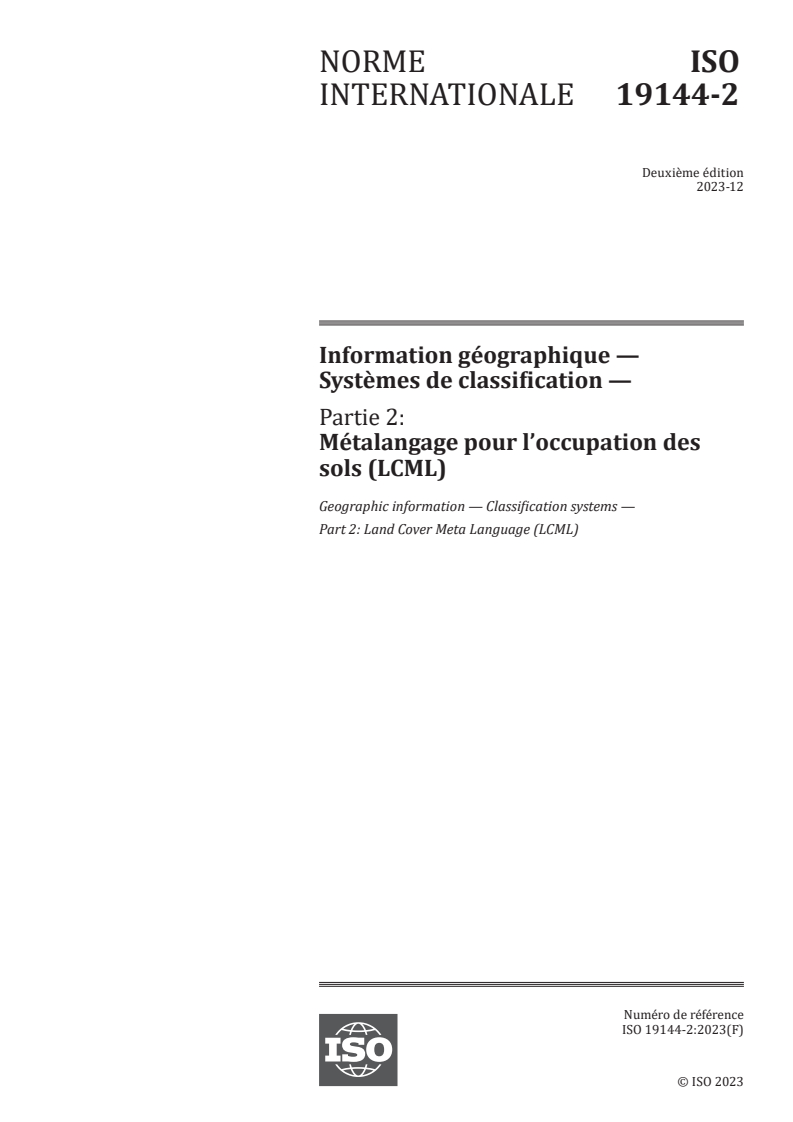
INTERNATIONAL ISO
STANDARD 19144-2
Second edition
2023-12
Geographic information —
Classification systems —
Part 2:
Land Cover Meta Language (LCML)
Information géographique — Systèmes de classification —
Partie 2: Métalangage pour l’occupation des sols (LCML)
Reference number
© ISO 2023
All rights reserved. Unless otherwise specified, or required in the context of its implementation, no part of this publication may
be reproduced or utilized otherwise in any form or by any means, electronic or mechanical, including photocopying, or posting on
the internet or an intranet, without prior written permission. Permission can be requested from either ISO at the address below
or ISO’s member body in the country of the requester.
ISO copyright office
CP 401 • Ch. de Blandonnet 8
CH-1214 Vernier, Geneva
Phone: +41 22 749 01 11
Email: copyright@iso.org
Website: www.iso.org
Published in Switzerland
ii
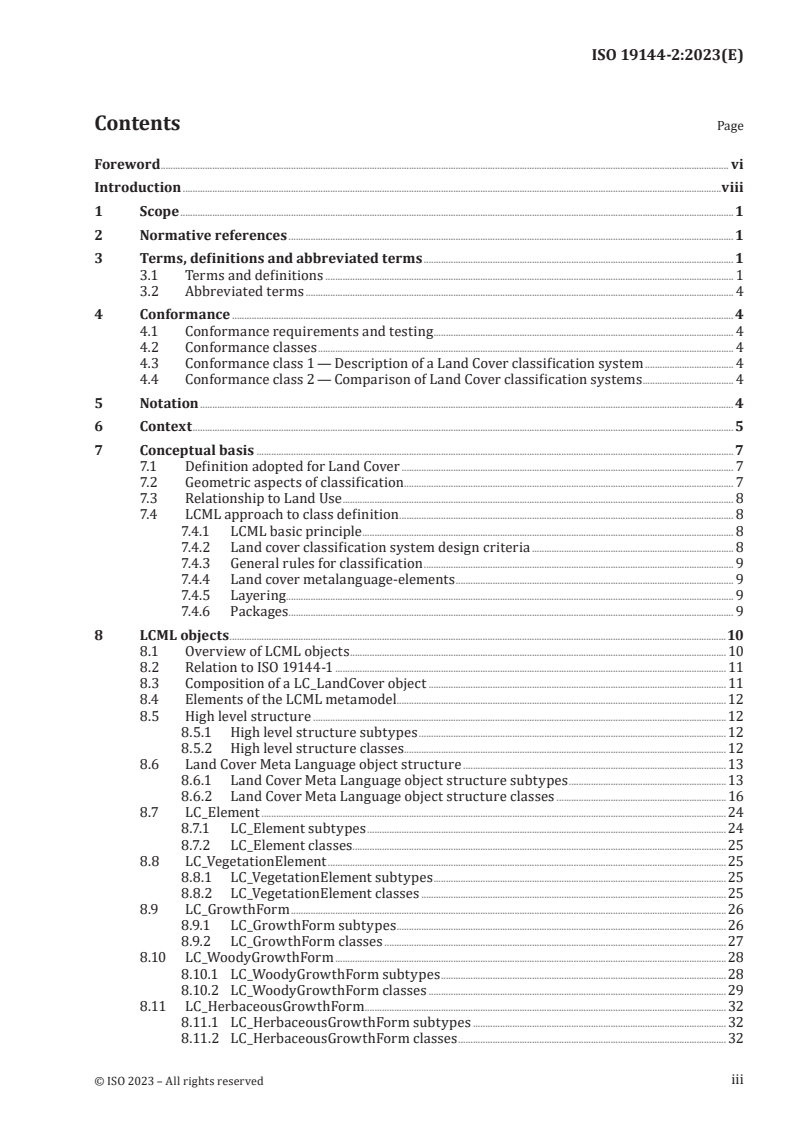
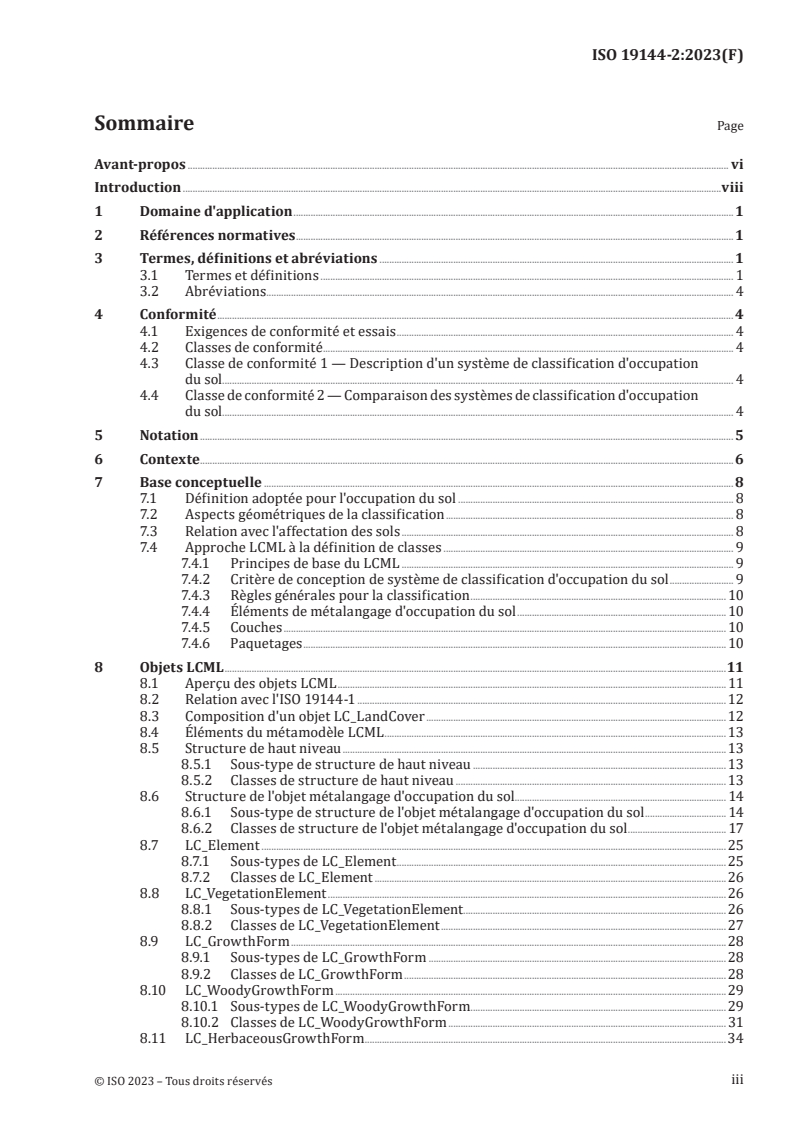
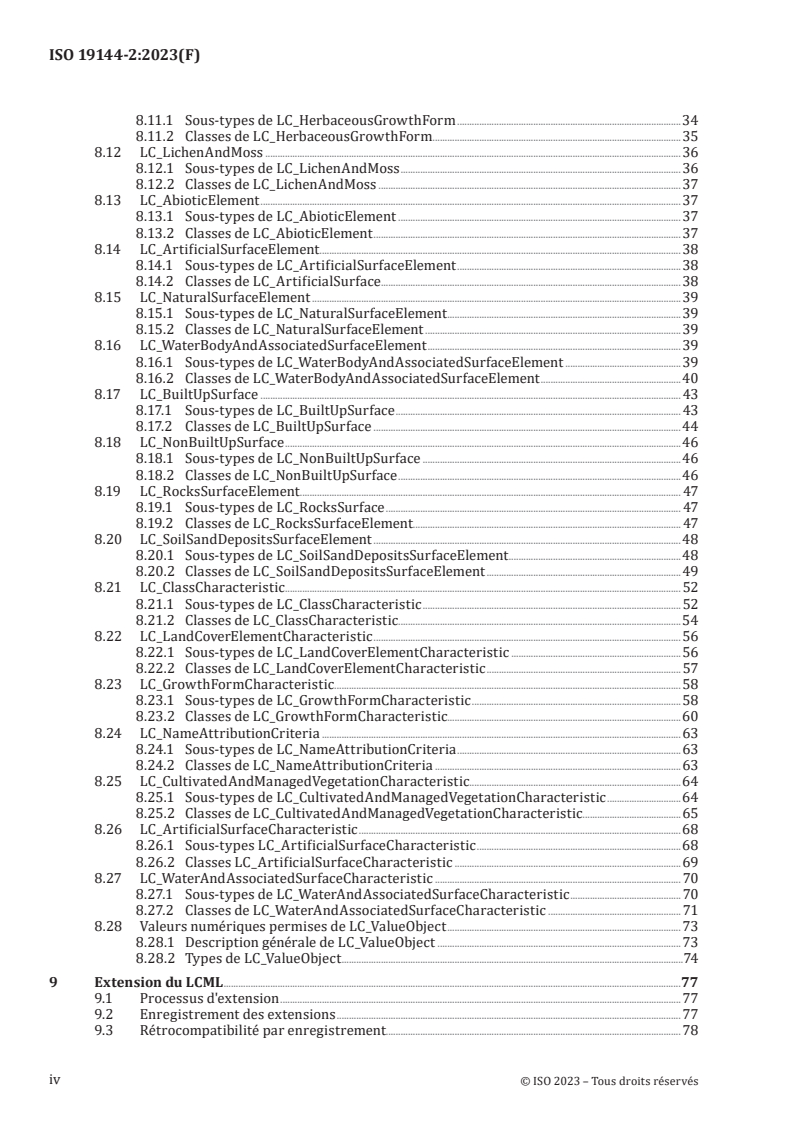
Contents Page
Foreword . vi
Introduction .viii
1 Scope . 1
2 Normative references . 1
3 Terms, definitions and abbreviated terms . 1
3.1 Terms and definitions . 1
3.2 Abbreviated terms . 4
4 Conformance . 4
4.1 Conformance requirements and testing . 4
4.2 Conformance classes . 4
4.3 Conformance class 1 — Description of a Land Cover classification system . 4
4.4 Conformance class 2 — Comparison of Land Cover classification systems . 4
5 Notation . 4
6 Context . 5
7 Conceptual basis .7
7.1 Definition adopted for Land Cover . 7
7.2 Geometric aspects of classification . 7
7.3 Relationship to Land Use . 8
7.4 LCML approach to class definition . 8
7.4.1 LCML basic principle . 8
7.4.2 Land cover classification system design criteria . 8
7.4.3 General rules for classification . 9
7.4.4 Land cover metalanguage-elements . 9
7.4.5 Layering . . . 9
7.4.6 Packages . 9
8 LCML objects .10
8.1 Overview of LCML objects . 10
8.2 Relation to ISO 19144-1 . 11
8.3 Composition of a LC_LandCover object . 11
8.4 Elements of the LCML metamodel .12
8.5 High level structure .12
8.5.1 High level structure subtypes .12
8.5.2 High level structure classes . .12
8.6 Land Cover Meta Language object structure . 13
8.6.1 Land Cover Meta Language object structure subtypes .13
8.6.2 Land Cover Meta Language object structure classes . 16
8.7 LC_Element . 24
8.7.1 LC_Element subtypes . 24
8.7.2 LC_Element classes.25
8.8 LC_VegetationElement . 25
8.8.1 LC_VegetationElement subtypes . 25
8.8.2 LC_VegetationElement classes . 25
8.9 LC_GrowthForm .26
8.9.1 LC_GrowthForm subtypes . 26
8.9.2 LC_GrowthForm classes . 27
8.10 LC_WoodyGrowthForm .28
8.10.1 LC_WoodyGrowthForm subtypes .28
8.10.2 LC_WoodyGrowthForm classes .29
8.11 LC_HerbaceousGrowthForm . 32
8.11.1 LC_HerbaceousGrowthForm subtypes . 32
8.11.2 LC_HerbaceousGrowthForm classes . 32
iii
8.12 LC_LichenAndMoss .34
8.12.1 LC_LichenAndMoss subtypes .34
8.12.2 LC_LichenAndMoss classes .34
8.13 LC_AbioticElement . 35
8.13.1 LC_AbioticElement subtypes . 35
8.13.2 LC_AbioticElement classes . 35
8.14 LC_ArtificialSurfaceElement . 36
8.14.1 LC_ArtificialSurfaceElement subtypes .36
8.14.2 LC_ArtificialSurface classes . 36
8.15 LC_NaturalSurfaceElement .36
8.15.1 LC_NaturalSurfaceElement subtypes .36
8.15.2 LC_NaturalSurfaceElement classes . 37
8.16 LC_WaterBodyAndAssociatedSurfaceElement . 37
8.16.1 LC_WaterBodyAndAssociatedSurfaceElement subtypes . 37
8.16.2 LC_WaterBodyAndAssociatedSurfaceElement classes .38
8.17 LC_BuiltUpSurface . 41
8.17.1 LC_BuiltUpSurface subtypes . 41
8.17.2 LC_BuiltUpSurface classes . 42
8.18 LC_NonBuiltUpSurface . 43
8.18.1 LC_NonBuiltUpSurface subtypes . 43
8.18.2 LC_NonBuiltUpSurface classes .44
8.19 LC_RocksSurfaceElement . 45
8.19.1 LC_RocksSurface subtypes . 45
8.19.2 LC_RocksSurfaceElement classes . 45
8.20 LC_SoilSandDepositsSurfaceElement .46
8.20.1 LC_SoilSandDepositsSurfaceElement subtypes .46
8.20.2 LC_SoilSandDepositsSurfaceElement classes . 47
8.21 LC_ClassCharacteristic . 50
8.21.1 LC_ClassCharacteristic subtypes .50
8.21.2 LC_ClassCharacteristic classes . 51
8.22 LC_LandCoverElementCharacteristic . 53
8.22.1 LC_LandCoverElementCharacteristic subtypes .53
8.22.2 LC_LandCoverElementCharacteristic classes .54
8.23 LC_GrowthFormCharacteristic . . 55
8.23.1 LC_GrowthFormCharacteristic subtypes . 55
8.23.2 LC_GrowthFormCharacteristic classes . 57
8.24 LC_NameAttributionCriteria . 59
8.24.1 LC_NameAttributionCriteria subtypes . 59
8.24.2 LC_NameAttributionCriteria classes .60
8.25 LC_CultivatedAndManagedVegetationCharacteristic . 61
8.25.1 LC_CultivatedAndManagedVegetationCharacteristic subtypes . 61
8.25.2 LC_CultivatedAndManagedVegetationCharacteristic classes . 62
8.26 LC_ArtificialSurfaceCharacteristic .65
8.26.1 LC_ArtificialSurfaceCharacteristic subtypes .65
8.26.2 LC_ArtificialSurfaceCharacteristic classes .66
8.27 LC_WaterAndAssociatedSurfaceCharacteristic . 67
8.27.1 LC_WaterAndAssociatedSurfaceCharacteristic subtypes . 67
8.27.2 LC_WaterAndAssociatedSurfaceCharacteristic classes .68
8.28 LC_ValueObject permitted numeric values . 69
8.28.1 LC_ValueObject general description. 69
8.28.2 LC_ValueObject types . 71
9 Extension of the LCML .74
9.1 Extension process .74
9.2 Registration of extensions .74
9.3 Backward compatibility through registration . 75
Annex A (normative) Abstract test suite .76
iv
Annex B (informative) The relationship of the LCML to the General Feature Model of ISO
19109 .78
Annex C (informative) Examples of the use of LCML .81
Annex D (informative) Glossary of Land Cover meta-elements . 112
Annex E (informative) Backward compatibility . 131
Annex F (informative) The vertical and horizontal characterization of Land Cover features .134
Bibliography . 144
v
Foreword
ISO (the International Organization for Standardization) is a worldwide federation of national standards
bodies (ISO member bodies). The work of preparing International Standards is normally carried out
through ISO technical committees. Each member body interested in a subject for which a technical
committee has been established has the right to be represented on that committee. International
organizations, governmental and non-governmental, in liaison with ISO, also take part in the work.
ISO collaborates closely with the International Electrotechnical Commission (IEC) on all matters of
electrotechnical standardization.
The procedures used to develop this document and those intended for its further maintenance are
described in the ISO/IEC Directives, Part 1. In particular, the different approval criteria needed for the
different types of ISO document should be noted. This document was drafted in accordance with the
editorial rules of the ISO/IEC Directives, Part 2 (see www.iso.org/directives).
ISO draws attention to the possibility that the implementation of this document may involve the use
of (a) patent(s). ISO takes no position concerning the evidence, validity or applicability of any claimed
patent rights in respect thereof. As of the date of publication of this document, ISO had not received
notice of (a) patent(s) which may be required to implement this document. However, implementers are
cautioned that this may not represent the latest information, which may be obtained from the patent
database available at www.iso.org/patents. ISO shall not be held responsible for identifying any or all
such patent rights.
Any trade name used in this document is information given for the convenience of users and does not
constitute an endorsement.
For an explanation of the voluntary nature of standards, the meaning of ISO specific terms and
expressions related to conformity assessment, as well as information about ISO's adherence to
the World Trade Organization (WTO) principles in the Technical Barriers to Trade (TBT), see
www.iso.org/iso/foreword.html.
This document was prepared by Technical Committee ISO/TC 211, Geographic information/Geomatics,
in collaboration with the European Committee for Standardization (CEN) Technical Committee CEN/TC
287, Geographic Information, in accordance with the Agreement on technical cooperation between ISO
and CEN (Vienna Agreement), and in collaboration with the Food and Agriculture Organization of the
United Nations (UN FAO).
This second edition cancels and replaces the first edition (ISO 19144-2:2012), which has been technically
revised.
The main changes are as follows:
— This revision of ISO 19144-2:2012 has divided the original International Standard into additional
parts.
— Material from ISO 19144-2:2012, Clause 9, on registration has been removed and is intended to be
1)
included in ISO 19144-4.
2)
— Material related to Land Use has been removed and is intended to be included in ISO/TS 19144-3.
— The high-level model has been changed to promote the attribute of cover and elementSpreadingGeometry
to the LC_Element level with the addition of the new attribute, density.
— Various changes have been made to certain types and classes (see Annex E).
— Several of the definitions from ISO 19144-2:2012 have been improved in a backward compatible
manner and UML and textual errors in the previous model have been corrected.
1) Under preparation. Stage at the time of publication: ISO/PWI 19144-4:2023.
2) Under preparation. Stage at the time of publication: ISO/AWI TS 19144-3:2023.
vi
— A new Annex E has been added describing the changes to ISO 19144-2:2012 in more detail and
addressing backward compatibility.
A list of all parts in the ISO 19144 series can be found on the ISO website.
Any feedback or questions on this document should be directed to the user’s national standards body. A
complete listing of these bodies can be found at www.iso.org/members.html.
vii
Introduction
Efficient assessment of Land Cover and the ability to monitor change are fundamental to the
sustainable management of natural resources, environmental protection, food security and successful
humanitarian programmes. Such information is also required to help with raising levels of nutrition,
improving agricultural productivity, enhancing the lives of rural populations and contributing to the
sustainable growth of the world economy. However, in the past, policymakers and planners have not
had access to reliable and comparable Land Cover data, both for lower-income countries and sometimes
also at the regional and global levels.
Access has been limited by two factors: lack of mapping activities and lack of commonality between
systems. The solution has been to carry out separate regional mapping projects using national or
regional Land Cover classification systems. However, it has been difficult to compare or to exchange
information between current systems.
The aim of this document is to enable the comparison of information from existing classification
systems in a meaningful way without replacing them. The aim is to complement the development of
future classification systems that can offer more reliable collection methods for particular national or
regional purposes by allowing them to be described in a consistent manner.
A critical factor in implementing such global activities is the availability of an international standard
for the documentation of Land Cover classification systems. This then provides a reliable basis for
interaction without replacing the increasing number of national, regional and global Land Cover
mapping and monitoring activities. This enables comparisons of Land Cover classes to be made
regardless of mapping scale, Land Cover type, data collection method or geographic location.
Another critical factor is the availability of a common reference for Land Cover classification systems.
This document provides a metalanguage expressed as a UML model that allows different Land Cover
classification systems to be described.
This document establishes a metalanguage for a set of objects and rules (language) to describe Land
Cover features based on physiognomy that can be part of different Land Cover Legends (nomenclature).
This provides a framework for comparing different systems and nomenclatures such as CORINE,
Africover, Anderson (USGS), Global Map and national systems, without replacing them. This is not a
description of a nomenclature, nor is it a description of a specific set of classes.
3)
An additional part of the ISO 19144 series (ISO/TS 19144-3) addresses Land Use aspects. Land Use by
human activity is different from Land Cover. Land Cover is based on the physiognomic aspects of the
plants and other elements covering the observed surface of the Earth. Land Use identifies the human
activities, such as agriculture, mining or other actions taken by humans to modify the Earth cover. Land
use is primarily defined in terms of human economic functions which result in a series of different
human activities. In this context, Land Cover defines biophysical Earth objects on which human
activities take place. The two types of classifications are closely related and in some Classification
Systems they are sometimes mixed. The Land Use Metalanguage described in ISO 19144-3 can be used
alone to simply describe Land Use, or it can be combined with the Land Cover Metalanguage to be able
to describe classification systems that have mixed aspects of both Land Cover and Land Use.
4)
Another part of the ISO 19144 series (ISO 19144-4) is intended to include a description of the
registration and implementation aspects for Land Cover Land Use Classification. This allows code
lists and other details used in the Land Cover and Land Use systems to be registered. Code lists allow
attribute values and other characteristics to be open-ended and registration allows these elements to
be defined.
[45]
EXAMPLE Soil types can make use of the UN FAO soil classification list of soil types, or the more recent
[59] [60]
World Reference Base for Soil Resources, or the USDA soil taxonomy or the European Soils Bureau legend.
[19]
3) Under preparation. Stage at the time of publication: ISO/AWI TS 19144-3:2023.
4) Under preparation. Stage at the time of publication: ISO/PWI 19144-4:2023.
viii
Appropriate references to externally managed lists or lists established particularly for the ISO 19144
series can be registered. In addition, whole classification systems described using the Land Cover or
Land Use parts of the ISO 19144 series (i.e. this document and ISO 19144-3) can be registered.
This document is a joint International Standard with the UN Food and Agriculture Organization.
Permission has been granted to ISO by the UN FAO to make a derived work based on any material
developed or copyright UN FAO.
In this document UML attributes names are given in italics.
In accordance with the ISO/IEC Directives, Part 2, 2018, Rules for the structure and drafting of
International Standards, in International Standards the decimal sign is a comma on the line. However,
the General Conference on Weights and Measures (Conférence Générale des Poids et Mesures) at its
meeting in 2003 passed unanimously the following resolution:
“The decimal marker shall be either a point on the line or a comma on the line.”
In practice, the choice between these alternatives depends on customary use in the language concerned.
In the technical areas of geodesy and geographic information it is customary for the decimal point
always to be used, for all languages. That practice is used throughout this document.
ix
INTERNATIONAL STANDARD ISO 19144-2:2023(E)
Geographic information — Classification systems —
Part 2:
Land Cover Meta Language (LCML)
1 Scope
This document specifies a Land Cover Meta Language (LCML) expressed as a UML metamodel that
allows different Land Cover classification systems to be described based on physiognomic aspects. This
document recognizes that a number of Land Cover classification systems exist. It provides a common
reference structure for the comparison and integration of data for any generic Land Cover classification
system, but does not intend to replace those classification systems.
2 Normative references
The following documents are referred to in the text in such a way that some or all of their content
constitutes requirements of this document. For dated references, only the edition cited applies. For
undated references, the latest edition of the referenced document (including any amendments) applies.
ISO 19109, Geographic information — Rules for application schema
ISO 19103, Geographic information — Conceptual schema language
ISO 19123-1, Geographic information — Schema for coverage geometry and functions Part 1: Fundamentals
ISO 19144-1, Geographic information — Classification systems — Part 1: Classification system structure
3 Terms, definitions and abbreviated terms
3.1 Terms and definitions
For the purposes of this document, the terms and definitions given in ISO 19144-1 and the following
apply.
ISO and IEC maintain terminology databases for use in standardization at the following addresses:
— ISO Online browsing platform: available at https:// www .iso .org/ obp
— IEC Electropedia: available at https:// www .electropedia .org/
NOTE 1 The technical terms applying to plant physiognomy, and terms from other disciplines used to establish
the classifiers in the classification system are not defined in this document.
NOTE 2 The term "class" is used in the ISO 19144 series to represent a construct in a classification system.
However, the term has several meanings in other contexts, including in the UML modelling language. Where
possible, attributes or other identifiers are needed to distinguish between the various use of the term "class".
3.1.1
abstract test suite
ATS
set of conformance classes that define tests for all requirements of a specification
Note 1 to entry: Evidence of conformance to all or part of a standard, awarded for passing one or more of the
conformance test classes specified in that standard.
[SOURCE: ISO 19105:2022, 3.3]
3.1.2
area of incidence
substratum area entirely topped by the entire Land Cover Meta Language (LCML) basic element itself
or by its canopy effect
3.1.3
area of pertinence
area where a specific Land Cover Meta Language (LCML) element extends
3.1.4
characteristic
distinguishing qualitive attribute of a metalanguage basic element
3.1.5
class
description of a set of objects that share the same attributes, operations, methods, relationships,
and semantics
[SOURCE: ISO 19103:2015, 4.7]
3.1.6
class
result of a classification process as part of a classification system which subdivides
concepts within a given topic area
3.1.7
cover
area of incidence of a Land Cover Meta Language (LCML) basic element over the
substratum in the area of pertinence of the basic element
3.1.8
element portioning
percent value of the area of pertinence of a single Land Cover Meta Language (LCML)
basic element when two or more LCML basic elements are considered in the same stratum
Note 1 to entry: The sum of the whole portioning values for all elements considered within a stratum must always
be equal to 100 %.
Note 2 to entry: Element portioning is distinct from strata portioning.
3.1.9
grid
covering of a multi-dimensional region using quadrilateral shapes (in the 2D case) or their
n-dimensional generation (in the nD case) with no overlaps and gaps
[SOURCE: ISO 19123-1:2023, 3.1.28, modified — Notes 1 and 2 have been removed.]
3.1.10
land cover
observed (bio)physical cover on the Earth’s surface
Note 1 to entry: Land cover is distinct from land use.
[SOURCE: UN FAO, 2005, LCCS — Land Cover Classification System — Classification concepts and user
[44]
manual]
3.1.11
land cover metalanguage
LCML
logical general model used to describe the characteristics of land cover features used as classifiers and
the more specific rules that constitute a particular classification system
3.1.12
land use
arrangements, activities and inputs people undertake in a certain land cover type to maintain it or
produce change
EXAMPLE “Recreation area” is a land use term that can be applicable to different land cover types, e.g. sandy
surfaces such as a beach; a built-up area such as a pleasure park; woodlands; etc.
Note 1 to entry: The definition of land use in this way establishes a direct link between land cover and the actions
of people in their environment. Multiple land uses can coexist at the same location (e.g. forestry and recreation),
contrary to land cover classes that are mutually exclusive.
[SOURCE: UN FAO. 2005, LCCS — Land Cover Classification System — Classification concepts and user
[44]
manual]
3.1.13
point cloud
collection of data points in 3D space
[SOURCE: ISO/TS 19130-2:2014, 4.51]
3.1.14
physiognomy
general appearance of an object or terrain, without reference to its underlying or
scientific characteristics
3.1.15
property
distinguishing additional physiognomic attribute of a metalanguage basic element
3.1.16
strata portioning
percent value expressing the portion by which a stratum comprises a part of the whole,
where the aggregate of multiple related strata is constrained so that the sum of all of the related strata
(projected in orthogonal plane) equals 100 %
Note 1 to entry: This allows the expression of situations where elements that are obscured by other elements
cannot be seen, for example, the inability to see beneath the tree canopy in views from some types of satellite
imagery.
Note 2 to entry: Strata portioning is distinct from element portioning.
3.1.17
triangulated irregular network
TIN
tessellation composed of triangles
[SOURCE: ISO 19123-1:2023, 3.1.50]
3.2 Abbreviated terms
CEC Commission of the European Communities
CORINE Coordination of Information on the Environment (EU)
LCCS Land Cover Classification System
TDS total dissolved solids
UML unified modeling language
UN FAO United Nations Food and Agriculture Organization
UN FAO LCCS UN FAO Land Cover Classification System
XML Extensible Markup Language
XSD XML Schema
4 Conformance
4.1 Conformance requirements and testing
Conformance to this document consists of alignment with the requirements established in 4.2, 4.3, 4.4,
9.2 and 9.3. The abstract test suite given in Annex A describes the applicable methodology for testing
conformance to these requirements.
4.2 Conformance classes
Two conformance classes are identified in this document, one for the description of a Land Cover
classification system and the other for the comparison between two or more Land Cover classification
systems.
4.3 Conformance class 1 — Description of a Land Cover classification system
Requirement 1: The description of Legends or Land Cover Application Schema using this document
shall consist of a set of UML classes with associated attributes that correspond to instantiations of the
metalanguage classes described in Clause 8 or the extended metalanguage classes described through
the mechanism described in Clause 9.
NOTE The levels of instantiation between the Land Cover Meta Language and a Land Cover Classification
System and Application Schema and the relation to the ISO geographic information General Feature Model of
ISO 19109 is described in Annex B.
4.4 Conformance class 2 — Comparison of Land Cover classification systems
Requirement 2: The process of comparison of two Land Cover classification systems shall be
performed by developing descriptions of the two Land Cover classification systems, each in accordance
with Requirement 1, and then identifying the differences on a class-by-class basis. This can be repeated
for more than two Land Cover classification systems under comparison.
NOTE The level of detail of the comparison is dependent on the use case.
5 Notation
The conceptual schema specified in this document is described using Unified Modeling Language
(UML), in accordance with ISO 19103.
Several model elements used in this schema are defined in other ISO geographic information standards,
in particular ISO 19123-1 and ISO 19103. By convention within ISO/TC 211, names of UML classes, with
the exception of basic data type classes, include a three-letter prefix that identifies the International
Standard and the UML package in which the UML class is defined. UML classes defined in this document
have the three-letter prefix of “LC_”. Examples in this document have the three-letter prefix “EL_”.
The classes in the meta model in Annex B use the prefix “LM_”. Table 1 lists the other International
Standards and packages in which UML classes used in this document have been defined.
Table 1 — Sources of externally defined UML classes
Prefix International Standard Package
CL ISO 19144-1 Classification system
structure
CV ISO 19123-1 Coverage geometry
The stereotype <> is used throughout this document to identify metalanguage objects
that compose the LC_LandCoverClassDescriptor. As illustrated in 8.5.1, LC_LandCoverClassDescriptor
and its components are at a higher level of abstraction than the LC_LandCoverClass that form a Land
Cover Classification System, which are at the Application Schema level. A Legend as described in
ISO 19144-1 is the simplest type of Application Schema.
The stereotype <> applies to a class whose instances are other classes that are
described by the metalanguage class.
The term "class" is an English word with a dictionary definition. However, it also has several meanings
within the ISO 19144 series, dependent upon context. Classification is a process and the results of a
classification process is a “class”. The term "class" (; 3.1.6) is used in the ISO 19144 series
to represent a construct in a classification system. However, the term "class" has several other meanings
in other contexts. A classification system consists of a set of classes subdividing the concepts within a
given topic area. There is an unavoidable conflict with the terminology when a modelling language such
as UML is used to describe a classification system metalanguage such as the LCML. The UML modelling
language uses the term "class" (; 3.1.5) as a construct in an object-oriented programming or
data modelling paradigm, as the template for an object. That is, a UML class describes the properties
associated with the instances of the class called objects. The term "class" is used in normal practice in
both modelling and classification, and it is unreasonable for either modelling or classification to avoid
the term. The term “Item Class” is also used in the process of registration, identifying the item that
is registered. This term occurs in other parts of the ISO 19144 series. Adjectives have been used in
this document where possible to reduce this confusion. For example, UML classes can be called “UML
classes” and classification system classes can be called “classification classes” or “legend classes”. At
times, a UML class describes a classification class and it is possible to dispense with the adjective since
both meanings of "class" are equivalent in the context. The conflict results from the fact that there is a
deep relationship between data modelling and classification as used in other domains.
There is a similar related potential conflict with the associated terms of "attribute" and "object".
Adjectives have been used where possible, but at times it is necessary to derive the meaning from the
context. Other terms where there is a potential for confusion are the terms “element”, “component”,
“characteristic” and especially “attribute”. The use of these terms is potentially confusing as they have
different meanings in different contexts. These terms come from different places and all that can be
controlled is their usage in the ISO 19144 series. Care is taken to use adjectives with these terms to help
to clarify their meaning.
6 Context
The purpose of this document is to define a common reference structure for the description and
comparison of Legends or Application Schema for any generic Land Cover classification system. The
approach has been to define an LCML expressed as a UML model that allows different Land Cover
classification systems to be described. This approach provides a rigorous logical framework for
the description of any Land Cover classification system. This will improve the harmonization and
integration of spatial data sets defined using different Land Cover classifications and the Legends or
nomenclatures developed from these systems and allow them to be compared and integrated.
This document defines an LCML for a Land Cover classification system. It recognizes that a number of
Land Cover classification systems and nomenclatures exist in a number of countries and regions, and
t
...
NORME ISO
INTERNATIONALE 19144-2
Deuxième édition
2023-12
Information géographique —
Systèmes de classification —
Partie 2:
Métalangage pour l’occupation des
sols (LCML)
Geographic information — Classification systems —
Part 2: Land Cover Meta Language (LCML)
Numéro de référence
DOCUMENT PROTÉGÉ PAR COPYRIGHT
© ISO 2023
Tous droits réservés. Sauf prescription différente ou nécessité dans le contexte de sa mise en œuvre, aucune partie de cette
publication ne peut être reproduite ni utilisée sous quelque forme que ce soit et par aucun procédé, électronique ou mécanique,
y compris la photocopie, ou la diffusion sur l’internet ou sur un intranet, sans autorisation écrite préalable. Une autorisation peut
être demandée à l’ISO à l’adresse ci-après ou au comité membre de l’ISO dans le pays du demandeur.
ISO copyright office
Case postale 401 • Ch. de Blandonnet 8
CH-1214 Vernier, Genève
Tél.: +41 22 749 01 11
E-mail: copyright@iso.org
Web: www.iso.org
Publié en Suisse
ii
Sommaire Page
Avant-propos . vi
Introduction .viii
1 Domaine d'application .1
2 Références normatives .1
3 Termes, définitions et abréviations . 1
3.1 Termes et définitions . 1
3.2 Abréviations. 4
4 Conformité . 4
4.1 Exigences de conformité et essais . 4
4.2 Classes de conformité . . 4
4.3 Classe de conformité 1 — Description d'un système de classification d'occupation
du sol. 4
4.4 Classe de conformité 2 — Comparaison des systèmes de classification d'occupation
du sol. 4
5 Notation . 5
6 Contexte . . 6
7 Base conceptuelle . 8
7.1 Définition adoptée pour l'occupation du sol . 8
7.2 Aspects géométriques de la classification . 8
7.3 Relation avec l'affectation des sols . 8
7.4 Approche LCML à la définition de classes . 9
7.4.1 Principes de base du LCML . 9
7.4.2 Critère de conception de système de classification d'occupation du sol . 9
7.4.3 Règles générales pour la classification . 10
7.4.4 Éléments de métalangage d'occupation du sol . 10
7.4.5 Couches . 10
7.4.6 Paquetages . 10
8 Objets LCML .11
8.1 Aperçu des objets LCML . 11
8.2 Relation avec l'ISO 19144-1 . 12
8.3 Composition d'un objet LC_LandCover .12
8.4 Éléments du métamodèle LCML . 13
8.5 Structure de haut niveau .13
8.5.1 Sous-type de structure de haut niveau .13
8.5.2 Classes de structure de haut niveau . 13
8.6 Structure de l'objet métalangage d'occupation du sol . 14
8.6.1 Sous-type de structure de l'objet métalangage d'occupation du sol . 14
8.6.2 Classes de structure de l'objet métalangage d'occupation du sol . 17
8.7 LC_Element . 25
8.7.1 Sous-types de LC_Element . 25
8.7.2 Classes de LC_Element .26
8.8 LC_VegetationElement . 26
8.8.1 Sous-types de LC_VegetationElement. 26
8.8.2 Classes de LC_VegetationElement . 27
8.9 LC_GrowthForm .28
8.9.1 Sous-types de LC_GrowthForm .28
8.9.2 Classes de LC_GrowthForm .28
8.10 LC_WoodyGrowthForm .29
8.10.1 Sous-types de LC_WoodyGrowthForm .29
8.10.2 Classes de LC_WoodyGrowthForm . 31
8.11 LC_HerbaceousGrowthForm .34
iii
8.11.1 Sous-types de LC_HerbaceousGrowthForm .34
8.11.2 Classes de LC_HerbaceousGrowthForm . 35
8.12 LC_LichenAndMoss . 36
8.12.1 Sous-types de LC_LichenAndMoss .36
8.12.2 Classes de LC_LichenAndMoss . 37
8.13 LC_AbioticElement . 37
8.13.1 Sous-types de LC_AbioticElement . 37
8.13.2 Classes de LC_AbioticElement . 37
8.14 LC_ArtificialSurfaceElement .38
8.14.1 Sous-types de LC_ArtificialSurfaceElement .38
8.14.2 Classes de LC_ArtificialSurface.38
8.15 LC_NaturalSurfaceElement .39
8.15.1 Sous-types de LC_NaturalSurfaceElement .39
8.15.2 Classes de LC_NaturalSurfaceElement .39
8.16 LC_WaterBodyAndAssociatedSurfaceElement .39
8.16.1 Sous-types de LC_WaterBodyAndAssociatedSurfaceElement .39
8.16.2 Classes de LC_WaterBodyAndAssociatedSurfaceElement .40
8.17 LC_BuiltUpSurface . 43
8.17.1 Sous-types de LC_BuiltUpSurface . 43
8.17.2 Classes de LC_BuiltUpSurface .44
8.18 LC_NonBuiltUpSurface .46
8.18.1 Sous-types de LC_NonBuiltUpSurface .46
8.18.2 Classes de LC_NonBuiltUpSurface .46
8.19 LC_RocksSurfaceElement . 47
8.19.1 Sous-types de LC_RocksSurface . 47
8.19.2 Classes de LC_RocksSurfaceElement. 47
8.20 LC_SoilSandDepositsSurfaceElement .48
8.20.1 Sous-types de LC_SoilSandDepositsSurfaceElement .48
8.20.2 Classes de LC_SoilSandDepositsSurfaceElement .49
8.21 LC_ClassCharacteristic . 52
8.21.1 Sous-types de LC_ClassCharacteristic . 52
8.21.2 Classes de LC_ClassCharacteristic .54
8.22 LC_LandCoverElementCharacteristic .56
8.22.1 Sous-types de LC_LandCoverElementCharacteristic .56
8.22.2 Classes de LC_LandCoverElementCharacteristic . 57
8.23 LC_GrowthFormCharacteristic . .58
8.23.1 Sous-types de LC_GrowthFormCharacteristic .58
8.23.2 Classes de LC_GrowthFormCharacteristic.60
8.24 LC_NameAttributionCriteria .63
8.24.1 Sous-types de LC_NameAttributionCriteria .63
8.24.2 Classes de LC_NameAttributionCriteria .63
8.25 LC_CultivatedAndManagedVegetationCharacteristic .64
8.25.1 Sous-types de LC_CultivatedAndManagedVegetationCharacteristic .64
8.25.2 Classes de LC_CultivatedAndManagedVegetationCharacteristic.65
8.26 LC_ArtificialSurfaceCharacteristic .68
8.26.1 Sous-types LC_ArtificialSurfaceCharacteristic .68
8.26.2 Classes LC_ArtificialSurfaceCharacteristic .69
8.27 LC_WaterAndAssociatedSurfaceCharacteristic . 70
8.27.1 Sous-types de LC_WaterAndAssociatedSurfaceCharacteristic . 70
8.27.2 Classes de LC_WaterAndAssociatedSurfaceCharacteristic . 71
8.28 Valeurs numériques permises de LC_ValueObject .73
8.28.1 Description générale de LC_ValueObject .73
8.28.2 Types de LC_ValueObject .74
9 Extension du LCML .77
9.1 Processus d'extension .77
9.2 Enregistrement des extensions .77
9.3 Rétrocompatibilité par enregistrement. 78
iv
Annexe A (normative) Suite de tests abstraits .80
Annexe B (informative) Relation du LCML avec le modèle général des entités de l'ISO 19109 .82
Annexe C (informative) Exemples d'utilisation d'un LCML .86
Annexe D (informative) Glossaire des méta-éléments d'occupation du sol . 118
Annexe E (informative) Rétrocompatibilité . 138
Annexe F (informative) Caractérisation horizontale et verticale des entités d'occupation
du sol .141
Bibliographie . 151
v
Avant-propos
L'ISO (Organisation internationale de normalisation) est une fédération mondiale d'organismes
nationaux de normalisation (comités membres de l'ISO). L'élaboration des Normes internationales est
en général confiée aux comités techniques de l'ISO. Chaque comité membre intéressé par une étude
a le droit de faire partie du comité technique créé à cet effet. Les organisations internationales,
gouvernementales et non gouvernementales, en liaison avec l'ISO participent également aux travaux.
L'ISO collabore étroitement avec la Commission électrotechnique internationale (IEC) en ce qui
concerne la normalisation électrotechnique.
Les procédures utilisées pour élaborer le présent document et celles destinées à sa mise à jour sont
décrites dans les Directives ISO/IEC, Partie 1. Il convient, en particulier, de prendre note des différents
critères d'approbation requis pour les différents types de documents ISO. Le présent document a
été rédigé conformément aux règles de rédaction données dans les Directives ISO/IEC, Partie 2 (voir
www.iso.org/directives).
L’ISO attire l’attention sur le fait que la mise en application du présent document peut entraîner
l’utilisation d’un ou de plusieurs brevets. L’ISO ne prend pas position quant à la preuve, à la validité
et à l’applicabilité de tout droit de brevet revendiqué à cet égard. À la date de publication du présent
document, l’ISO n'avait pas reçu notification qu’un ou plusieurs brevets pouvaient être nécessaires à sa
mise en application. Toutefois, il y a lieu d’avertir les responsables de la mise en application du présent
document que des informations plus récentes sont susceptibles de figurer dans la base de données de
brevets, disponible à l'adresse www.iso.org/brevets. L’ISO ne saurait être tenue pour responsable de ne
pas avoir identifié tout ou partie de tels droits de propriété.
Les appellations commerciales éventuellement mentionnées dans le présent document sont données
pour information, par souci de commodité, à l’intention des utilisateurs et ne sauraient constituer un
engagement.
Pour une explication de la nature volontaire des normes, la signification des termes et expressions
spécifiques de l'ISO liés à l'évaluation de la conformité, ou pour toute information au sujet de l'adhésion
de l'ISO aux principes de l’Organisation mondiale du commerce (OMC) concernant les obstacles
techniques au commerce (OTC), voir www.iso.org/avant-propos.
Le présent document a été élaboré par le comité technique ISO/TC 211, Information géographique/
Géomatique, en collaboration avec le comité technique CEN/TC 287, Information géographique, du Comité
européen de normalisation (CEN) conformément à l’Accord de coopération technique entre l’ISO et le
CEN (Accord de Vienne) et en collaboration avec l'Organisation des Nations Unies pour l'alimentation et
l'agriculture (FAO).
Cette deuxième édition annule et remplace la première édition (ISO 19144-2:2012), qui a fait l’objet
d’une révision technique.
Les principales modifications sont les suivantes:
— La présente révision de l'ISO 19144-2:2012 a divisé la norme internationale d'origine en parties
supplémentaires.
— L'Article 9 de l'ISO 19144-2:2012, relatif à l'enregistrement, a été supprimé et sera inclus dans
1)
l'ISO 19144-4.
2)
— Le contenu relatif à l'affectation des sols a été supprimé et sera inclus dans l'ISO/TS 19144-3.
— Le modèle de haut niveau a été changé pour élever l'attribut de cover et elementSpreadingGeometry
au niveau LC_Element avec l'ajout du nouvel attribut density.
— Diverses modifications ont été apportées à certains types et classes (voir Annexe E).
1) En cours d'élaboration. Stade à la date de publication : ISO/PWI 19144-4:2023.
2) En cours d'élaboration. Stade à la date de publication : ISO/AWI TS 19144-3:2023.
vi
— Plusieurs des définitions de l'ISO 19144-2:2012 ont été améliorées de manière rétrocompatible, et
des erreurs d'UML et textuelles du modèle précédent ont été corrigées.
— Une nouvelle Annexe E a été ajoutée afin de décrire plus en détail les modifications apportées à
l'ISO 19144-2:2012 et d'aborder la question de la rétrocompatible.
Une liste de toutes les parties de la série ISO 19144 se trouve sur le site web de l’ISO.
Il convient que l’utilisateur adresse tout retour d’information ou toute question concernant le présent
document à l’organisme national de normalisation de son pays. Une liste exhaustive desdits organismes
se trouve à l’adresse www.iso.org/fr/members.html.
vii
Introduction
Une évaluation efficace de l'occupation du sol et la capacité à contrôler le changement sont essentielles
à une gestion durable des ressources naturelles, à la protection de l'environnement, à la sécurité
alimentaire et au succès des programmes humanitaires. Ces informations sont également nécessaires
pour aider à améliorer les niveaux de nutrition et de productivité agricole, enrichir la vie des populations
rurales et contribuer à la croissance durable de l'économie mondiale. Il n'en reste pas moins que
jusqu'ici, les décideurs politiques et les planificateurs n'ont pas eu accès à des données d'occupation du
sol fiables et comparables, pour les pays à faible revenu et parfois également aux niveaux régional et
mondial.
Cet accès a été limité par deux facteurs: manque de mise en correspondance entre les activités et manque
d'éléments communs entre les systèmes. La solution était de réaliser des mises en correspondance
de projets régionaux séparément en utilisant des systèmes de classification nationaux ou régionaux
d'occupation du sol. Il s'est toutefois avéré difficile de comparer ou d'échanger des informations entre
les systèmes actuels.
Le présent document a pour but de permettre de comparer des informations provenant des systèmes
de classification existants de manière constructive sans les remplacer. Le but est de compléter le
développement des futurs systèmes de classification pouvant offrir des méthodes de recueil plus fiables
pour des applications nationales ou régionales spécifiques en permettant de les décrire de manière
cohérente.
Un facteur critique de la mise en œuvre de telles activités globales est la disponibilité d'une norme
internationale pour la documentation relative aux systèmes de classification d'occupation du sol. Cela
assure une base fiable à l'interaction sans remplacement du nombre croissant d'activités de mise en
correspondance et de surveillance nationales, régionales et globales d'occupation du sol. Ainsi, des
comparaisons de classes d'occupation du sol deviennent possibles, quels que soient les échelles de mise
en correspondance, le type d'occupation du sol, la méthode de recueil de données ou l'emplacement
géographique.
Un autre facteur critique est la disponibilité d'une référence commune pour les systèmes de classification
d'occupation du sol. Le présent document fournit un métalangage exprimé sous forme d'un modèle UML
qui permet de décrire différents systèmes de classification d'occupation du sol.
Le présent document établit un métalangage pour un ensemble d'objets et de règles (langage) destinés
à décrire des entités d'occupation du sol basées sur une physionomie qui peut faire partie de différentes
légendes d'occupation du sol (nomenclature). Cela offre un cadre permettant de comparer différents
systèmes et nomenclatures tels que CORINE, Africover, Anderson (USGS), Global Map et les systèmes
nationaux sans avoir à les remplacer. Il ne s'agit pas d'une description d'une nomenclature ou d'un
ensemble particulier de classes.
3)
Une partie complémentaire de la série ISO 19144 (ISO/TS 19144-3) traite des aspects d'affectation des
sols. L'affectation des sols par l'activité humaine est différente de l'occupation du sol. L'occupation du sol
est basée sur les aspects physionomiques des végétaux et autres éléments couvrant la surface observée
de la Terre. L'affectation des sols identifie les activités humaines telles que l'agriculture, l'exploitation
minière, ou autres actions entreprises par des êtres humains pour modifier la couverture terrestre.
L'affectation des sols est principalement définie en termes de fonctions économiques humaines qui se
traduisent par une série de différentes activités humaines. Dans ce contexte, l'occupation du sol
définit des objets terrestres biophysiques sur lesquels sont menées des activités humaines. Ces
deux types de classifications sont étroitement liés, et dans certains systèmes de classification ils
sont parfois combinés. Le métalangage d'affectation des sols est décrit dans l'ISO 19144-3. Il peut
être utilisé seul pour simplement décrire l'affectation des sols, ou il peut être combiné avec le
Métalangage d'occupation du sol pour pouvoir décrire les systèmes de classification qui combinent les
aspects de l'occupation du sol et de l'affectation des sols.
3) En cours d'élaboration. Stade à la date de publication : ISO/AWI TS 19144-3:2023.
viii
4)
Une autre partie de la série ISO 19144 (ISO 19144-4) est destinée à inclure une description des
aspects relatifs à l'enregistrement et à l'implémentation des classifications de l'occupation du sol et de
l'affectation des sols. Cela permet l'enregistrement des listes de codes et autres détails utilisés dans
les systèmes d'occupation du sol et d'affectation des sols. Les listes de codes permettent aux valeurs
d'attributs et autres caractéristiques d'être ouvertes, et l'enregistrement permet de définir ces
éléments.
[45]
EXEMPLE Les types de sol peuvent utiliser la liste de classification de types de sol de la FAO, ou la base de
[59] [60]
référence mondiale pour les ressources en sols, ou la taxonomie des sols de l'USDA, ou la légende de
[19]
l'European Soils Bureau, plus récentes.
Les références appropriées aux listes gérées en externe ou aux listes établies spécialement pour la série
ISO 19144 peuvent être enregistrées. En outre, l'ensemble des systèmes de classification décrits à l'aide
des parties d'occupation du sol ou d'affectation des sols de la série ISO 19144 (c'est-à-dire le présent
document et l'ISO 19144-3) peut être enregistré.
Le présent document est élaboré en collaboration avec l'Organisation des Nations Unies pour
l'Alimentation et l'Agriculture. L'ISO a été autorisée par la FAO à établir un ouvrage dérivé basé sur tout
document élaboré par ou sous droits d'auteur de la FAO.
Dans le présent document, les noms des attributs UML sont indiqués en italique.
Conformément aux Directives ISO/IEC, Partie 2, 2018, Règles de structure et de rédaction des normes
internationales, le signe décimal est une virgule sur la ligne. Cependant, la Conférence générale des
poids et mesures, réunie en 2003, a adopté à l'unanimité la résolution suivante:
«La marque décimale doit être soit un point sur la ligne, soit une virgule sur la ligne.»
En pratique, le choix entre ces alternatives dépend de l'usage coutumier dans la langue concernée.
Dans les domaines techniques de la géodésie et de l'information géographique, il est d'usage d'utiliser
toujours le point décimal pour toutes les langues. Cette pratique est utilisée tout au long du présent
document.
4) En cours d'élaboration. Stade à la date de publication : ISO/PWI 19144-4:2023.
ix
NORME INTERNATIONALE ISO 19144-2:2023(F)
Information géographique — Systèmes de classification —
Partie 2:
Métalangage pour l’occupation des sols (LCML)
1 Domaine d'application
Le présent document spécifie un métalangage pour l'occupation des sols (LCML) exprimé sous forme
d'un métamodèle UML qui permet de décrire différents systèmes de classification d'occupation du sol
d'après leurs aspects physionomiques. Le présent document reconnaît qu'il existe un grand nombre de
systèmes de classification d'occupation du sol. Il donne une structure de référence commune pour la
comparaison et l'intégration de données pour tout système générique de classification d'occupation du
sol, mais n'est pas destiné à remplacer ces systèmes de classification.
2 Références normatives
Les documents suivants sont cités dans le texte de sorte qu’ils constituent, pour tout ou partie de leur
contenu, des exigences du présent document. Pour les références datées, seule l’édition citée s’applique.
Pour les références non datées, la dernière édition du document de référence s'applique (y compris les
éventuels amendements).
ISO 19109, Information géographique — Règles de schéma d'application
ISO 19103, Information géographique — Langage de schéma conceptuel
ISO 19123-1, Information géographique — Schéma de la géométrie et des fonctions de couverture — Partie
1: Principes de base
ISO 19144-1, Information géographique — Systèmes de classification — Partie 1: Structure de système de
classification
3 Termes, définitions et abréviations
3.1 Termes et définitions
Pour les besoins du présent document, les termes et les définitions de l'ISO 19144-1 ainsi que les
suivants s'appliquent.
L'ISO et l'IEC tiennent à jour des bases de données terminologiques destinées à être utilisées en
normalisation, consultables aux adresses suivantes:
— ISO Online browsing platform: disponible à l'adresse https:// www .iso .org/ obp
— IEC Electropedia: disponible à l'adresse https:// www .electropedia .org/
NOTE 1 Les termes techniques applicables à la physionomie des végétaux, et les termes d'autres disciplines
utilisés pour établir les classificateurs du système de classification ne sont pas définis dans le présent document.
NOTE 2 Le terme «classe» est utilisé dans la série ISO 19144 pour représenter une construction dans un
système de classification. Ce terme a néanmoins plusieurs significations dans d'autres contextes, y compris dans
le langage de modélisation unifié. Lorsque c'est possible, des attributs ou autres identifiants sont nécessaires
pour distinguer les différentes utilisations du terme «classe».
3.1.1
suite de tests abstraits
ATS
ensemble de classes de conformité qui définissent les tests pour toutes les exigences d'une spécification
Note 1 à l'article: Preuve de conformité à tout ou partie d'une norme, accordée pour avoir passé avec succès une
ou plusieurs des classes de test de conformité spécifiées dans la norme.
[SOURCE: ISO 19105:2022, 3.3]
3.1.2
zone d'incidence
zone de substrat complètement recouverte par l'élément de base entier du métalangage pour
l'occupation des sols (LCML) lui-même ou par son effet de canopée
3.1.3
zone de pertinence
zone où un élément spécifique du métalangage pour l'occupation des sols (LCML) s'étend
3.1.4
caractéristique
attribut qualitatif distinctif d'un élément de base d'un métalangage
3.1.5
classe
description d'un ensemble d'objets partageant les mêmes attributs, opérations, méthodes,
relations, et la même sémantique
[SOURCE: ISO 19103:2015, 4.7]
3.1.6
classe
résultat d'un processus de classification dans le cadre d'un système de classification
qui subdivise des concepts dans un domaine thématique donné
3.1.7
couvert
zone d'incidence d'un élément de base du métalangage pour l'occupation des sols
(LCML) par-dessus le substrat dans la zone de pertinence de l'élément de base
3.1.8
partitionnement d'élément
valeur en pourcentage de la zone de pertinence d'un seul élément de base du
métalangage pour l'occupation des sols (LCML) lorsque deux éléments de base du LCML ou plus sont
considérés dans la même strate
Note 1 à l'article: La somme de toutes les valeurs de partitionnement pour tous les éléments considérés dans une
strate doit toujours être égale à 100 %.
Note 2 à l'article: Le partitionnement d'élément est distinct du partitionnement de strate.
3.1.9
grille
couverture d'une région multidimensionnelle à l'aide de formes quadrilatérales (dans le
cas 2D) ou de leur génération à n dimensions (dans le cas nD) sans chevauchements ni espacements
[SOURCE: ISO 19123-1:2023, 3.1.28, modifié — Les Notes 1 et 2 ont été supprimées.]
3.1.10
occupation du sol
occupation (bio)physique observée à la surface de la Terre
Note 1 à l'article: L'occupation du sol est distincte de l'affectation des sols.
[SOURCE: UN FAO, 2005, LCCS — Land Cover Classification System — Classification concepts and user
[44]
manual]
3.1.11
métalangage pour l'occupation des sols
LCML
modèle logique général permettant de décrire les caractéristiques des entités d'occupation du sol
servant de classificateurs, et les règles plus spécifiques qui constituent un système de classification
particulier
3.1.12
affectation des sols
dispositions, activités et apports effectués par des personnes dans un certain type d'occupation du sol
pour le préserver ou réaliser des changements
EXEMPLE «Zone de loisir» est un terme d'affectation des sols qui peut être applicable à différents types
d'occupation du sol, par exemple des surfaces de sable telles qu'une plage, une zone bâtie telle qu'un parc de
plaisance; des terrains boisés; etc.
Note 1 à l'article: Cette définition de l'affectation des sols établit un lien direct entre l'occupation du sol et les
actions des personnes dans leur environnement. Des affectations multiples des sols peuvent coexister au même
endroit (par exemple exploitation forestière et loisir), contrairement aux classes d'occupation du sol, qui sont
entièrement distinctes.
[SOURCE: UN FAO. 2005, LCCS — Land Cover Classification System — Classification concepts and user
[44]
manual]
3.1.13
nuage de points
groupe de points de données dans l'espace en 3D
[SOURCE: ISO/TS 19130-2:2014, 4.51]
3.1.14
physionomie
aspect général d'un objet ou d'un terrain, sans référence à ses caractéristiques sous-
jacentes ou scientifiques
3.1.15
propriété
attribut physionomique supplémentaire distinctif d'un élément de base d'un
métalangage
3.1.16
partitionnement de strates
valeur en pourcentage qui exprime la portion dans laquelle une strate comprend une
partie du tout, où l'agrégat de multiples strates reliées est limité, pour que la somme de toutes les
strates reliées (projetées dans le plan orthogonal) soit égale à 100 %
Note 1 à l'article: Ceci permet d'exprimer les situations dans lesquelles on ne peut pas voir les éléments cachés par
d'autres éléments, par exemple le fait de n'avoir aucune visibilité sous le couvert forestier sur des vues générées
par certains types d'imagerie satellite.
Note 2 à l'article: Le partitionnement des strates est distinct du partitionnement d'éléments.
3.1.17
réseau irrégulier de triangles
TIN
structure en mosaïque composée de triangles
[SOURCE: ISO 19123-1:2023, 3.1.50]
3.2 Abréviations
CCE Commission des Communautés Européennes
CORINE Coordination de l'Information sur l'Environnement (UE)
UN FAO Organisation des Nations Unies pour l'alimentation et l'agriculture
LCCS Système de classification d'occupation du sol (Land Cover Classification System)
MDT matières dissoutes totales
UML langage de modélisation unifié (unified modeling language)
UN FAO LCCS Système de classification d'occupation du sol de la FAO
XML langage de balisage extensible (Extensible Markup Language)
XSD langage de définition de schéma XML (XML Schema Definition)
4 Conformité
4.1 Exigences de conformité et essais
La conformité au présent document consiste en une mise en adéquation avec les exigences établies
aux paragraphes 4.2, 4.3, 4.4, 9.2 et 9.3. La suite de tests abstraits fournie dans l'Annexe A décrit une
méthodologie applicable permettant de tester la conformité à ces exigences.
4.2 Classes de conformité
Deux classes de conformité sont identifiées dans le présent document, l'une pour la description d'un
système de classification d'occupation du sol, et l'autre pour la comparaison entre deux systèmes de
classification d'occupation du sol ou plus.
4.3 Classe de conformité 1 — Description d'un système de classification d'occupation
du sol
Exigence 1: La description des légendes ou du schéma d'application d'occupation du sol utilisant
le présent document doit consister en un ensemble de classes UML avec les attributs associés qui
correspondent à des instanciations des classes de métalangage décrites à l'Article 8 ou à des classes de
métalangage étendues décrites à l'aide du mécanisme présenté à l'Article 9.
NOTE Les niveaux d'instanciation entre le métalangage d'occupation du sol et un système de classification
et schéma d'application d'occupation du sol et la relation avec le modèle général des entités de l'ISO 19109
Information géographique est décrit dans l'Annexe B.
4.4 Classe de conformité 2 — Comparaison des systèmes de classification d'occupation
du sol
Exigence 2: Le processus de comparaison de deux systèmes de classification d'occupation du sol
doit être effectué en établissant des descriptions de ces deux systèmes de classification d'occupation
du sol, chacune étant conforme à l'exigence 1, puis en identifiant les différences pour chaque classe
individuellement. Ce processus peut être répété pour plus de deux systèmes de classification
d'occupation du sol faisant l'objet d'une comparaison.
NOTE Le niveau de détail de la comparaison dépend du cas d'utilisation.
5 Notation
Le schéma conceptuel spécifié dans le présent document est décrit à l'aide du langage de modélisation
unifié (UML), conformément à l'ISO 19103.
Plusieurs éléments de modèle utilisés dans ce schéma sont définis dans d'autres normes ISO relatives
aux informations géographiques, en particulier l'ISO 19123-1 et l'ISO 19103. Par convention, dans
l'ISO/TC 211, les noms des classes UML, à l'exception des classes relatives aux types de données
élémentaires, comportent un préfixe de trois lettres permettant d'identifier la norme internationale
ainsi que le paquetage UML dans lequel la classe UML est définie. Les classes UML définies dans le
présent document comportent le préfixe de trois lettres «LC_». Les exemples du présent document
comportent le préfixe de trois lettres «EL_». Les classes du métamodèle de l'Annexe B utilisent le
préfixe «LM_». Le Tableau 1 répertorie les autres normes internationales et «packages» dans lesquels
les classes UML utilisées dans le présent document ont été définies.
Tableau 1 — Sources des classes UML définies extérieurement
Préfixe Norme internationale Paquetage
CL ISO 19144-1 Structure de système de classification
CV ISO 19123-1 Géométrie de couverture
Le stéréotype < > est utilisé dans l'ensemble du présent document pour identifier
les objets de métalangage qui constituent le LC_LandCoverClassDescriptor. Comme illustré en 8.5.1,
le LC_LandCoverClassDescriptor et ses composants sont situés à un plus haut niveau d'abstraction
que les LC_LandCoverClass qui forment un système de classification d'occupation du sol, qui sont au
niveau du schéma d'application. Une légende telle que décrite dans l'ISO 19144-1 est le type de schéma
d'application le plus simple.
Le stéréotype < > s'applique à une classe dont les instances sont d'autres classes qui
sont décrites par les classes de métalangage.
Le terme «classe» est un mot français normal défini dans le dictionnaire. Cela dit, il a plusieurs
significations dans la série ISO 19144, suivant le contexte. La classification est un processus, et les
résultats du processus de classification sont une «classe». Le terme «clas
...