

ISO 4210-2:2023
(Main)Cycles — Safety requirements for bicycles — Part 2: Requirements for city and trekking, young adult, mountain and racing bicycles
General Information
- Abstract
This document specifies safety and performance requirements for the design, assembly, and testing of bicycles and sub-assemblies, and lays down guidelines for manufacturer’s instructions on the use and care of such bicycles. This document applies to young adult bicycles with maximum saddle height of 635 mm or more and less than 750 mm, city and trekking bicycles, mountain bicycles, and racing bicycles that have a maximum saddle height of 635 mm or more including folding bicycles. This document does not apply to specialized types of bicycle, such as delivery bicycles, recumbent bicycles, tandems, BMX bicycles, and bicycles designed and equipped for use in severe applications such as sanctioned competition events, stunting, or aerobatic manoeuvres. NOTE For bicycles with a maximum saddle height of 435 mm or less, see national regulations for ride-on toys, and with a maximum saddle height of more than 435 mm and less than 635 mm, see ISO 8098.
- Status
- Published
- Publication Date
- 10-Jan-2023
- Technical Committee
- ISO/TC 149/SC 1 - Cycles and major sub-assemblies
- Current Stage
- 6060 - International Standard published
- Start Date
- 11-Jan-2023
- Due Date
- 12-Sep-2022
- Completion Date
- 11-Jan-2023
Buy Documents


ISO 4210-2:2023 - Cycles — Safety requirements for bicycles — Part 2: Requirements for city and trekking, young adult, mountain and racing bicycles Released:11. 01. 2023
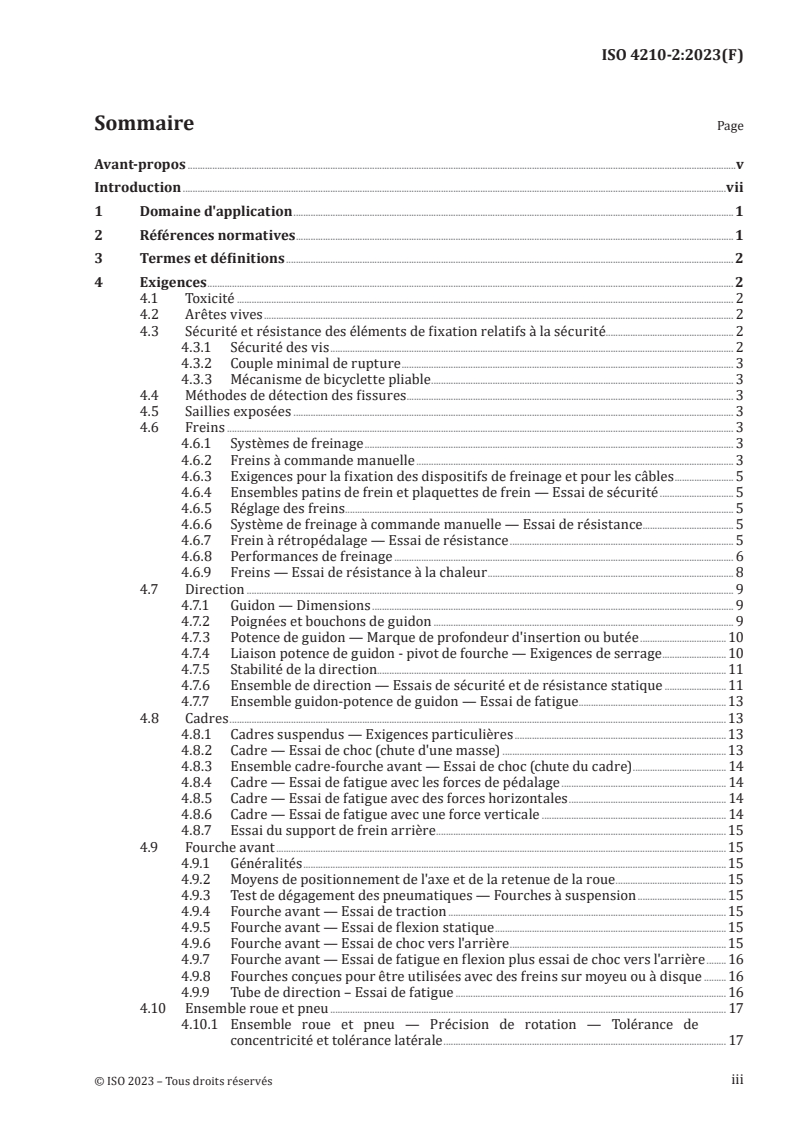
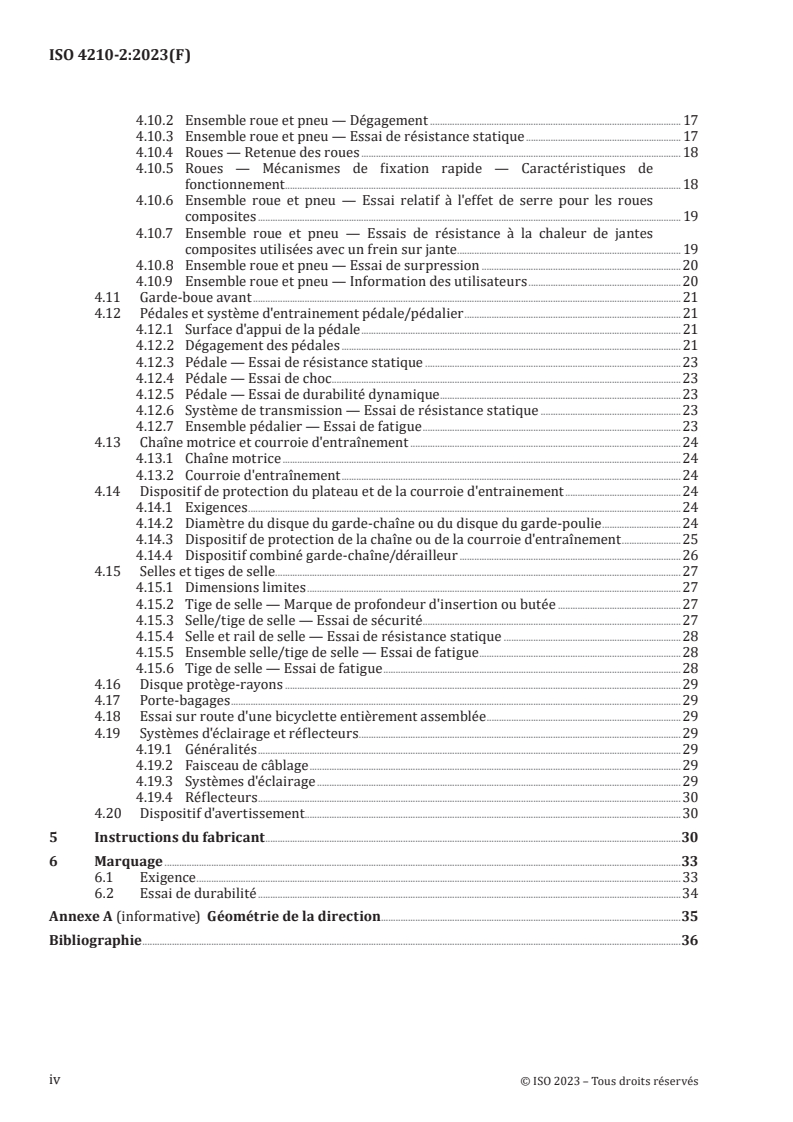
ISO 4210-2:2023 - Cycles — Exigences de sécurité pour les bicyclettes — Partie 2: Exigences pour bicyclettes de ville et tout chemin (trekking), jeunes adultes, tout-terrain et de course/29/2023
Overview - ISO 4210-2:2023 (Bicycle safety for city, trekking, young adult, mountain & racing bikes)
ISO 4210-2:2023 is the third-edition international standard that specifies safety and performance requirements for the design, assembly and testing of a broad range of bicycles: city and trekking, young adult (saddle height ≥ 635 mm and < 750 mm), mountain and racing bicycles (including folding bicycles with saddle height ≥ 635 mm). The standard also sets out guidelines for manufacturer’s instructions on the use and care of these bicycles. It excludes specialized types such as delivery bikes, recumbents, tandems, BMX, and bikes intended for sanctioned competition, stunting or aerobatics. For lower saddle-height categories it refers to ISO 8098 or national ride‑on toy regulations.
Key technical topics and requirements (high level)
ISO 4210-2 covers a comprehensive set of safety topics and mandated tests to reduce risk and ensure reliability. Key areas include:
- Braking systems: braking performance, hand-operated and back-pedal brakes, heat resistance, brake-pad security and strength tests.
- Steering and control: handlebar dimensions, grips, stem insertion marks/positive stops, clamping, steering stability, static strength and fatigue tests.
- Frame and front fork: impact tests, fatigue tests (pedalling, horizontal, vertical), suspension-frame specific requirements, fork tensile/bending and rearward impact tests.
- Wheels and tyres: concentricity, clearance, static strength, retention (axles/quick releases), overpressure and heat tests for composite rims.
- Pedals, crankset and drive train: pedal strength/impact/durability tests, crank fatigue, drive-chain and drive-belt requirements, chain-wheel guards.
- Saddles and seat-posts: limiting dimensions, insertion-depth marks/positive stops, static and fatigue tests.
- Safety-related components and hazards: sharp edges, exposed protrusions, toxicity, security of safety fasteners, crack detection.
- Additional systems: lighting, reflectors, warning device, mudguards, luggage carriers, marking and user instructions.
- Assembly and performance testing: full-assembly road test and information for users.
Practical applications - who uses ISO 4210-2 and why
ISO 4210-2 is used by:
- Bicycle manufacturers and component suppliers for product design, type approval and product development to meet recognized safety expectations.
- Test laboratories and certification bodies to perform standardized static, fatigue, impact and performance tests.
- Quality and safety engineers for production control, failure analysis and conformity assessment.
- Retailers, procurement teams and fleet operators to specify compliant city, trekking, mountain and racing bicycles.
- Regulators and consumer safety organizations to reference objective safety criteria.
Using ISO 4210-2 helps demonstrate conformity with international bicycle safety best practice, reduce warranty/service costs, and improve user safety and product reliability.
Related standards
- ISO 4210 series (other parts of the bicycle safety standard)
- ISO 8098 (bicycles for young children / ride-on toys)
Keywords: ISO 4210-2, bicycle safety, city bicycle standard, trekking bicycle requirements, young adult bicycle, mountain bike safety, racing bicycle testing, bicycle standards, safety requirements for bicycles.
Relations
- Effective Date
- 09-Feb-2026
- Effective Date
- 09-Feb-2026
- Effective Date
- 09-Feb-2026
- Effective Date
- 09-Feb-2026
- Effective Date
- 09-Feb-2026
- Effective Date
- 09-Feb-2026
- Effective Date
- 12-Feb-2026
- Effective Date
- 06-Jun-2022
- Effective Date
- 23-Apr-2020
Buy Documents
ISO 4210-2:2023 - Cycles — Safety requirements for bicycles — Part 2: Requirements for city and trekking, young adult, mountain and racing bicycles Released:11. 01. 2023
ISO 4210-2:2023 - Cycles — Exigences de sécurité pour les bicyclettes — Partie 2: Exigences pour bicyclettes de ville et tout chemin (trekking), jeunes adultes, tout-terrain et de course/29/2023
Get Certified
Connect with accredited certification bodies for this standard

TÜV Rheinland
TÜV Rheinland is a leading international provider of technical services.

TÜV SÜD
TÜV SÜD is a trusted partner of choice for safety, security and sustainability solutions.

DEKRA Certification Inc.
DEKRA US certification services.
Sponsored listings
Frequently Asked Questions
ISO 4210-2:2023 is a standard published by the International Organization for Standardization (ISO). Its full title is "Cycles — Safety requirements for bicycles — Part 2: Requirements for city and trekking, young adult, mountain and racing bicycles". This standard covers: This document specifies safety and performance requirements for the design, assembly, and testing of bicycles and sub-assemblies, and lays down guidelines for manufacturer’s instructions on the use and care of such bicycles. This document applies to young adult bicycles with maximum saddle height of 635 mm or more and less than 750 mm, city and trekking bicycles, mountain bicycles, and racing bicycles that have a maximum saddle height of 635 mm or more including folding bicycles. This document does not apply to specialized types of bicycle, such as delivery bicycles, recumbent bicycles, tandems, BMX bicycles, and bicycles designed and equipped for use in severe applications such as sanctioned competition events, stunting, or aerobatic manoeuvres. NOTE For bicycles with a maximum saddle height of 435 mm or less, see national regulations for ride-on toys, and with a maximum saddle height of more than 435 mm and less than 635 mm, see ISO 8098.
This document specifies safety and performance requirements for the design, assembly, and testing of bicycles and sub-assemblies, and lays down guidelines for manufacturer’s instructions on the use and care of such bicycles. This document applies to young adult bicycles with maximum saddle height of 635 mm or more and less than 750 mm, city and trekking bicycles, mountain bicycles, and racing bicycles that have a maximum saddle height of 635 mm or more including folding bicycles. This document does not apply to specialized types of bicycle, such as delivery bicycles, recumbent bicycles, tandems, BMX bicycles, and bicycles designed and equipped for use in severe applications such as sanctioned competition events, stunting, or aerobatic manoeuvres. NOTE For bicycles with a maximum saddle height of 435 mm or less, see national regulations for ride-on toys, and with a maximum saddle height of more than 435 mm and less than 635 mm, see ISO 8098.
ISO 4210-2:2023 is classified under the following ICS (International Classification for Standards) categories: 43.150 - Cycles. The ICS classification helps identify the subject area and facilitates finding related standards.
ISO 4210-2:2023 has the following relationships with other standards: It is inter standard links to EN ISO 4210-5:2023, EN ISO 4210-9:2023, EN ISO 4210-4:2023, EN ISO 4210-6:2023, EN ISO 4210-3:2023, EN ISO 4210-7:2023, EN ISO 4210-2:2023, ISO 37182:2022, ISO 4210-2:2015. Understanding these relationships helps ensure you are using the most current and applicable version of the standard.
ISO 4210-2:2023 is available in PDF format for immediate download after purchase. The document can be added to your cart and obtained through the secure checkout process. Digital delivery ensures instant access to the complete standard document.
Standards Content (Sample)
INTERNATIONAL ISO
STANDARD 4210-2
Third edition
2023-01
Cycles — Safety requirements for
bicycles —
Part 2:
Requirements for city and trekking,
young adult, mountain and racing
bicycles
Cycles — Exigences de sécurité pour les bicyclettes —
Partie 2: Exigences pour bicyclettes de ville et tout chemin (trekking),
jeunes adultes, tout-terrain et de course
Reference number
© ISO 2023
All rights reserved. Unless otherwise specified, or required in the context of its implementation, no part of this publication may
be reproduced or utilized otherwise in any form or by any means, electronic or mechanical, including photocopying, or posting on
the internet or an intranet, without prior written permission. Permission can be requested from either ISO at the address below
or ISO’s member body in the country of the requester.
ISO copyright office
CP 401 • Ch. de Blandonnet 8
CH-1214 Vernier, Geneva
Phone: +41 22 749 01 11
Email: copyright@iso.org
Website: www.iso.org
Published in Switzerland
ii
Contents Page
Foreword .v
Introduction .vii
1 Scope . 1
2 Normative references . 1
3 Terms and definitions . 2
4 Requirements . 2
4.1 Toxicity . 2
4.2 Sharp edges . 2
4.3 Security and strength of safety-related fasteners . 2
4.3.1 Security of screws . 2
4.3.2 Minimum failure torque . 2
4.3.3 Folding bicycle mechanism . 2
4.4 Crack detection methods . 3
4.5 Exposed protrusions . 3
4.6 Brakes . 3
4.6.1 Braking systems . 3
4.6.2 Hand-operated brakes . 3
4.6.3 Attachment of brake assembly and cable requirements . 4
4.6.4 Brake-block and brake-pad assemblies — Security test . 5
4.6.5 Brake adjustment . 5
4.6.6 Hand-operated braking-system — Strength test . 5
4.6.7 Back-pedal braking system — Strength test. 5
4.6.8 Braking performance . 5
4.6.9 Brakes — Heat-resistance test . . 8
4.7 Steering . 8
4.7.1 Handlebar — Dimensions . 8
4.7.2 Handlebar grips and plugs . 9
4.7.3 Handlebar stem — Insertion-depth mark or positive stop . 9
4.7.4 Handlebar stem to fork steerer — Clamping requirements . 10
4.7.5 Steering stability . 10
4.7.6 Steering assembly — Static strength and security tests . 11
4.7.7 Handlebar and stem assembly — Fatigue test .12
4.8 Frames .12
4.8.1 Suspension-frames — Special requirements .12
4.8.2 Frame — Impact test (falling mass) . 13
4.8.3 Frame and front fork assembly — Impact test (falling frame) .13
4.8.4 Frame — Fatigue test with pedalling forces .13
4.8.5 Frame — Fatigue test with horizontal forces . .13
4.8.6 Frame — Fatigue test with a vertical force .13
4.8.7 Rear brake mount tests . 14
4.9 Front fork . 14
4.9.1 General . 14
4.9.2 Means of location of the axle and wheel retention . 14
4.9.3 Tyre clearance test — Suspension fork . 14
4.9.4 Front fork — Tensile test . 14
4.9.5 Front fork — Static bending test . 14
4.9.6 Front fork — Rearward impact test . 14
4.9.7 Front fork — Bending fatigue test plus rearward impact test .15
4.9.8 Forks intended for use with hub- or disc-brakes. 15
4.9.9 Steerer tube — fatigue test . 15
4.10 Wheels and tyre assembly . 16
4.10.1 Wheels and tyre assembly — Rotational accuracy — Concentricity
tolerance and lateral tolerance . 16
iii
4.10.2 Wheel and tyre assembly — Clearance . 16
4.10.3 Wheel and tyre assembly — Static strength test . 16
4.10.4 Wheels — Wheel retention . 16
4.10.5 Wheels — Quick-release devices — Operating features . 17
4.10.6 Wheel and tyre assembly — Greenhouse effect test for composite wheels . 17
4.10.7 Wheel and tyre assembly — Heat resistance tests for composite rims used
in conjunction with rim brake. 18
4.10.8 Wheel and tyre assembly — Overpressure test . 18
4.10.9 Wheel and tyre assembly —Information for users . 19
4.11 Front mudguard . 19
4.12 Pedals and pedal/crank drive system . 19
4.12.1 Pedal tread . 19
4.12.2 Pedal clearance .20
4.12.3 Pedal — Static strength test . 21
4.12.4 Pedal — Impact test . 21
4.12.5 Pedal — Dynamic durability test . 21
4.12.6 Drive system — Static strength test . 21
4.12.7 Crank assembly — Fatigue test . 22
4.13 Drive-chain and drive belt . 22
4.13.1 Drive-chain .22
4.13.2 Drive belt .22
4.14 Chain-wheel and belt-drive protective device . 22
4.14.1 Requirements .22
4.14.2 Chain-wheel disc and drive pulley disc diameter .23
4.14.3 Chain and drive belt protective device . 24
4.14.4 Combined front gear-change guide . . 25
4.15 Saddles and seat-posts . 25
4.15.1 Limiting dimensions .25
4.15.2 Seat-post — Insertion-depth mark or positive stop . 25
4.15.3 Saddle/seat-post — Security test . 26
4.15.4 Saddle and saddle rail — Static strength test . 26
4.15.5 Saddle and seat-post assembly — Fatigue test . 26
4.15.6 Seat-post — Fatigue test . 26
4.16 Spoke protector . 27
4.17 Luggage carriers . 27
4.18 Road test of a fully assembled bicycle. 27
4.19 Lighting systems and reflectors . 27
4.19.1 General . 27
4.19.2 Wiring harness . 27
4.19.3 Lighting systems .28
4.19.4 Reflectors .28
4.20 Warning device .28
5 Manufacturer's instructions .28
6 Marking . .30
6.1 Requirement .30
6.2 Durability test . 31
Annex A (informative) Steering geometry .32
Bibliography .33
iv
Foreword
ISO (the International Organization for Standardization) is a worldwide federation of national standards
bodies (ISO member bodies). The work of preparing International Standards is normally carried out
through ISO technical committees. Each member body interested in a subject for which a technical
committee has been established has the right to be represented on that committee. International
organizations, governmental and non-governmental, in liaison with ISO, also take part in the work.
ISO collaborates closely with the International Electrotechnical Commission (IEC) on all matters of
electrotechnical standardization.
The procedures used to develop this document and those intended for its further maintenance are
described in the ISO/IEC Directives, Part 1. In particular, the different approval criteria needed for the
different types of ISO documents should be noted. This document was drafted in accordance with the
editorial rules of the ISO/IEC Directives, Part 2 (see www.iso.org/directives).
Attention is drawn to the possibility that some of the elements of this document may be the subject of
patent rights. ISO shall not be held responsible for identifying any or all such patent rights. Details of
any patent rights identified during the development of the document will be in the Introduction and/or
on the ISO list of patent declarations received (see www.iso.org/patents).
Any trade name used in this document is information given for the convenience of users and does not
constitute an endorsement.
For an explanation of the voluntary nature of standards, the meaning of ISO specific terms and
expressions related to conformity assessment, as well as information about ISO's adherence to
the World Trade Organization (WTO) principles in the Technical Barriers to Trade (TBT), see
www.iso.org/iso/foreword.html.
This document was prepared by Technical Committee ISO/TC 149, Cycles, Subcommittee SC 1, Cycles
and major sub-assemblies, in collaboration with the European Committee for Standardization (CEN)
Technical Committee CEN/TC 333, Cycles, in accordance with the Agreement on technical cooperation
between ISO and CEN (Vienna Agreement).
This third edition cancels and replaces the second edition (ISO 4210-2:2015), which has been technically
revised.
The main changes as follows:
— improvement of 4.3.2 Minimum failure torque;
— change in minimum braking performance value in Table 2 of 4.6.8.1.3;
— improvement of 4.6.9;
— improvement of 4.7.2;
— addition of a requirement for angle-adjustable handlebar stem in 4.7.6.3;
— addition of 4.8.7;
— addition of 4.9.8.3;
— addition of 4.9.9;
— re-arrangement of requirements for “Wheel and tyre assembly”, “Rims, tyres, and tubes”;
— improvement of 4.10.2;
— change in test force of 4.10.4.3;
— addition of 4.10.7;
v
— improvement of 4.11;
— change in option c) of 4.14;
— addition of 4.15.4.2;
— improvement of 4.15.6;
— addition of icons in Clause 6.
A list of all parts in the ISO 4210 series can be found on the ISO website.
Any feedback or questions on this document should be directed to the user’s national standards body. A
complete listing of these bodies can be found at www.iso.org/members.html.
vi
Introduction
This document has been developed in response to demand throughout the world, and the aim has been
to ensure that bicycles manufactured in conformity with this document will be as safe as is practically
possible. The tests have been designed to ensure the strength and durability of individual parts as well
as of the bicycle as a whole, demanding high quality throughout and consideration of safety aspects
from the design stage onwards.
The scope has been limited to safety considerations and has specifically avoided standardization of
components.
For the purpose of improving the safety of luggage carriers, revision work of ISO 11243, referenced
in 4.17, is in progress. In case this revision work involves requirements for the entire bicycle, this
document will incorporate those requirements in the next revision.
If the bicycle should be used on public roads, national regulations apply.
vii
INTERNATIONAL STANDARD ISO 4210-2:2023(E)
Cycles — Safety requirements for bicycles —
Part 2:
Requirements for city and trekking, young adult, mountain
and racing bicycles
1 Scope
This document specifies safety and performance requirements for the design, assembly, and testing of
bicycles and sub-assemblies, and lays down guidelines for manufacturer’s instructions on the use and
care of such bicycles.
This document applies to young adult bicycles with maximum saddle height of 635 mm or more and less
than 750 mm, city and trekking bicycles, mountain bicycles, and racing bicycles that have a maximum
saddle height of 635 mm or more including folding bicycles.
This document does not apply to specialized types of bicycle, such as delivery bicycles, recumbent
bicycles, tandems, BMX bicycles, and bicycles designed and equipped for use in severe applications such
as sanctioned competition events, stunting, or aerobatic manoeuvres.
NOTE For bicycles with a maximum saddle height of 435 mm or less, see national regulations for ride-on
[8]
toys, and with a maximum saddle height of more than 435 mm and less than 635 mm, see ISO 8098 .
2 Normative references
The following documents are referred to in the text in such a way that some or all of their content
constitutes requirements of this document. For dated references, only the edition cited applies. For
undated references, the latest edition of the referenced document (including any amendments) applies.
ISO 4210-1, Cycles — Safety requirements for bicycles — Part 1: Vocabulary
ISO 4210-3:2023, Cycles — Safety requirements for bicycles — Part 3: Common test methods
ISO 4210-4:2023, Cycles — Safety requirements for bicycles — Part 4: Braking test methods
ISO 4210-5:2023, Cycles — Safety requirements for bicycles — Part 5: Steering test methods
ISO 4210-6:2023, Cycles — Safety requirements for bicycles — Part 6: Frame and fork test methods
ISO 4210-7:2023, Cycles — Safety requirements for bicycles — Part 7: Wheels and rims test methods
ISO 4210-8:2023, Cycles — Safety requirements for bicycles — Part 8: Pedal and drive system test methods
ISO 4210-9:2023, Cycles — Safety requirements for bicycles — Part 9: Saddles and seat-post test methods
ISO 6742-1, Cycles — Lighting and retro-reflective devices — Part 1: Lighting and light signalling devices
ISO 6742-2, Cycles — Lighting and retro-reflective devices — Part 2: Retro-reflective devices
ISO 6742-3, Cycles — Lighting and retro-reflective devices — Part 3: Installation and use of lighting and
retro-reflective devices
ISO 9633, Cycle chains — Characteristics and test methods
ISO 11243, Cycles — Luggage carriers for bicycles —Requirements and test methods
ISO 14878, Cycles — Audible warning devices — Technical specification and test methods
3 Terms and definitions
For the purposes of this document, the terms and definitions given in ISO 4210-1 apply.
ISO and IEC maintain terminological databases for use in standardization at the following addresses:
— ISO Online browsing platform: available at https:// www .iso .org/ obp
— IEC Electropedia: available at https:// www .electropedia .org/
4 Requirements
4.1 Toxicity
Any items which come into intimate contact with the rider (i.e. causing any hazard due to sucking or
licking) shall conform with any national regulations specific to children's products.
4.2 Sharp edges
Exposed edges that could come into contact with the rider's hands, legs, etc., during normal riding or
normal handling and normal maintenance shall not be sharp, e.g. deburred, broken, rolled, or processed
with comparable techniques.
[9]
NOTE See ISO 13715 .
4.3 Security and strength of safety-related fasteners
4.3.1 Security of screws
Any screws used in the assembly of suspension systems, brackets attached to electric generators, brake
mechanisms and mudguards to the frame or fork shall be provided with suitable locking devices, e.g.
lock-washers, lock-nuts, thread locking compound, or stiff nuts. Fasteners used to assemble hub and
disc brakes shall have heat-resistant locking devices.
[1]
NOTE For example, mechanical and physical properties of bolts are specified in ISO 898-1 .
4.3.2 Minimum failure torque
The minimum failure torque of bolted joints for the fastening of handle bars, handlebar stems, bar ends,
saddle and seat-posts shall be at least 20 % greater than the manufacturer's maximum recommended
tightening torque.
4.3.3 Folding bicycle mechanism
If folding bicycle mechanism is provided, it shall be designed so that the bicycle can be locked for use in
a simple, stable, safe way, and when folded, no damage shall occur to any cables. No locking mechanism
shall contact the wheels or tyres during riding, and it shall be impossible to unintentionally loosen or
unlock the folding mechanisms during riding.
4.4 Crack detection methods
Standardized methods should be used to emphasize the presence of cracks where visible cracks are
specified as criteria of failure in tests specified in this document.
[2] [3]
NOTE For example, suitable dye-penetrant methods are specified in ISO 3452-1 , ISO 3452-2 ,
[4] [5]
ISO 3452-3 , and ISO 3452-4 . In addition, white paint or surface treatment can be used to aid in detection for
composite materials.
4.5 Exposed protrusions
This requirement is intended to address the hazards associated with the users of bicycles falling on
projections or rigid components (e.g. handlebars, levers) on a bicycle, possibly causing internal injury or
skin puncture.
Tubes and rigid components in the form of projections which constitute a puncture hazard to the user
should be protected. The size and shape of the end protection has not been stipulated, but an adequate
shape shall be given to avoid puncturing of the body. Screw threads which constitute a puncture
hazard shall be limited to a protrusion length of one major diameter of the screw beyond the internally
threaded mating part.
NOTE Handlebar ends are covered in 4.7.2.
4.6 Brakes
4.6.1 Braking systems
A bicycle shall be equipped with at least two independently actuated braking systems. At least one
shall operate on the front wheel and one on the rear wheel. The braking systems shall operate without
binding and shall be capable of meeting the braking performance requirements of 4.6.8.
Brake blocks containing asbestos shall not be permitted.
4.6.2 Hand-operated brakes
4.6.2.1 Brake lever position
The brake levers for front and rear brakes shall be positioned according to the legislation or custom and
practice of the country in which the bicycle is to be sold, and the bicycle manufacturer shall state in the
manufacturer’s instructions which levers operate the front and rear brakes [see also Clause 5, item b)].
4.6.2.2 Brake lever grip dimensions
a) The brake lever similar to type A or type B.
The dimension, d, measured at the non-activated position of the brake lever between the outer surfaces
of the brake lever in the region intended for contact with the rider's fingers and the handlebar or
any other covering present shall cover a distance of not less than 40 mm as shown in Figure 1 a) and
Figure 1 b) and conform to the following:
— on bicycles on which the minimum intended height of the saddle is 635 mm or more, d shall not
exceed 90 mm;
— on bicycles on which the minimum intended height of the saddle is less than 635 mm, d shall not
exceed 75 mm.
Conformity shall be established by the method detailed in ISO 4210-4:2023, 4.1.1. The range of
adjustment on the brake lever should permit these dimensions to be obtained.
NOTE See Clause 5, item c) in relation to the minimum intended height of the saddle.
b) The brake lever similar to type C.
It shall be possible to fit the dimension gauge shown in ISO 4210-4:2023, Figure 3 over the brake lever (or
a secondary brake lever) and the handlebar grip or any other covering in at least one position between
points B and C indicated in Figure 1 c), without causing any movement of the brake lever towards the
handlebar. The dimension d shall not exceed 100 mm.
Conformance shall be established by the method detailed in ISO 4210-4:2023, 4.1.2. The range of
adjustment on the brake lever should permit these dimensions to be obtained.
Dimensions in millimetres
a) Type A b) Type B
c) Type C
Key
1 pivot
a distance between the last part of the lever intended for contact with the rider's fingers and the end of the lever
B point of L/2
C point of 20 mm (in case of an extension brake lever, 15 mm) from the end of the lever
d brake lever grip dimension — non activated
L distance between the centre of the lever pivot and the lever tip end
Figure 1 — Brake lever grip dimensions
4.6.3 Attachment of brake assembly and cable requirements
Cable pinch bolts shall not sever any of the cable strands when assembled to the manufacturer's
instructions. In the event of a cable failing, no part of the brake mechanism shall inadvertently inhibit
the rotation of the wheel.
The cable end shall either be protected with a cap that shall withstand a removal force of not less than
20 N or be otherwise treated to prevent unravelling.
NOTE See 4.3 in relation to fasteners.
4.6.4 Brake-block and brake-pad assemblies — Security test
The friction material shall be securely attached to the holder, backing plate, or shoe and there shall be
no failure of the braking system or any component thereof, and the brake shall meet the performance
requirements of 4.6.8 when tested by the method specified in ISO 4210-4:2023, 4.3.
4.6.5 Brake adjustment
Each brake shall be equipped with an adjustment mechanism, either manual or automatic.
Each brake shall be capable of adjustment with or without the use of a tool to an efficient operating
position until the friction material has worn to the point of requiring replacement as recommended in
the manufacturer's instructions. Also, when correctly adjusted, the friction material shall not contact
anything other than the intended braking surface.
The brake blocks of a bicycle with rod brakes shall not come into contact with the rim of the wheels
when the steering angle of the handlebars is set at 60°, nor shall the rods bend, or be twisted after the
handlebars are reset to the central position.
4.6.6 Hand-operated braking-system — Strength test
When tested by the method described in ISO 4210-4:2023, 4.4, there shall be no failure of the braking
system or of any component thereof.
4.6.7 Back-pedal braking system — Strength test
4.6.7.1 General
If the back-pedal braking system is fitted, the brake shall be actuated by the operator's foot applying
force to the pedal in a direction opposite to that of the drive force. The brake mechanism shall function
regardless of any drive gear positions or adjustments. The differential between the drive and brake
positions of the crank shall not exceed 60°.
The measurement shall be taken with the crank held against each position with a pedal force of at least
250 N. The force shall be maintained for 1 min in each position.
4.6.7.2 Requirement
When tested in accordance with ISO 4210-4:2023, 4.5, there shall be no failure of the brake system or
any component thereof.
4.6.8 Braking performance
4.6.8.1 General
4.6.8.1.1 Test method options
Two test methods are specified to determine braking performance and experience has shown that
either method is suitable and either can be used. One test method is the track test in which braking
distance is measured directly with the progressive characteristics of the brakes being self-evident. The
alternative test method is a machine/rig base test in which braking force is measured and, from which,
braking performance values are calculated. The progressive characteristics of the brake are determined
by linearity measurements. A final, simple track test checks for smooth, safe, stopping characteristics.
Whichever method is used, there shall be conformity with 4.6.8.1.2 or 4.6.8.1.3.
NOTE1 See ISO 4210-4:2023, 4.6.5.7 item i), test method — simple track test.
NOTE2 For the purposes of improving repeatability and reproducibility and considering the applicability to
all types of bicycle and the size and influence of the operator, the machine test method reflects today's state of
the art.
4.6.8.1.2 Track test
When tested in accordance with ISO 4210-4:2023, 4.6.3, the bicycle shall fulfil the requirements shown
in Table 1.
Table 1 — Brake test velocities and braking distances
Maximum
Velocity corrected braking
Bicycle type Condition Brake in use
distance
km/h
m
Both 7
Dry 25
Rear only 15
City and trekking
bicycles
Both 5
Wet 16
Rear only 10
Both 7
Dry 25
Rear only 15
Young adult bicycles
Both 5
Wet 16
Rear only 10
Both 6
Dry 25
Rear only 10
Mountain bicycles
Both 5
Wet 16
Rear only 10
Both 6
Dry 25
Rear only 12
Racing bicycles
Both 5
Wet 16
Rear only 10
4.6.8.1.3 Machine test
When tested in accordance with ISO 4210-4:2023, 4.6.5, the bicycle shall fulfil the requirements shown
in Table 2.
Table 2 — Calculated braking performance values
Minimum
braking perfor-
mance
Bicycle type Condition Brake in use
value, B
p
N
Front only 300
Dry
Rear only 200
City and trekking
bicycles
Front only 150
Wet
Rear only 120
TTabablele 2 2 ((ccoonnttiinnueuedd))
Minimum
braking perfor-
mance
Bicycle type Condition Brake in use
value, B
p
N
Front only 180
Dry
Rear only 120
Young adult
bicycles
Front only 90
Wet
Rear only 80
Front only 350
Dry
Rear only 260
Mountain bicycles
Front only 180
Wet
Rear only 120
Front only 350
Dry
Rear only 220
Racing bicycles
Front only 160
Wet
Rear only 120
4.6.8.2 Smooth, safe-stop characteristics
The bicycle shall show smooth, safe-stop characteristics with regard to the intended use of the bicycle
and the ability of the expected user of the bicycle.
a) For the track test, smooth, safe-stop characteristics are defined as stopping within the required
distances without occurrence of any of the following:
1) excessive juddering;
2) front wheel locking;
3) bicycle overturning (rear wheel lifting uncontrollably);
4) rider's loss of control;
5) excessive side-skid causing the rider to put his foot to the ground to retain control.
With certain types of braking system, it might not be possible to avoid entirely some skidding of the
rear wheel and tyre assembly during braking; this is considered acceptable provided that item 4)
or item 5) above do not occur as a result.
Back pedal brakes shall additionally conform with the linearity test of ISO 4210-4:2023, 4.6.4.
b) For the machine test, smooth, safe-stop characteristics are defined by conformity with the
linearity requirements specified in ISO 4210-4:2023, 4.6.5.3 and the simple track test described in
ISO 4210-4:2023, 4.6.5.7 item i).
4.6.8.3 Ratio between wet and dry braking performance
For city and trekking, young adult, and mountain bicycles, in order to ensure safety for both wet and
dry braking, the ratio of braking performance wet/dry shall be greater than 4:10.
The methods for calculating this ratio are given in ISO 4210-4:2023, 4.6.3.11 item c) for the track test
and in ISO 4210-4:2023, 4.6.5.7 item h) for the machine test.
4.6.9 Brakes — Heat-resistance test
4.6.9.1 General
This test applies to all disc and hub brakes, and it also applies to rim brakes where the rim brake
sidewalls are known to be manufactured from or include composite materials.
Each brake on the bicycle shall be tested individually, but where the front and rear brakes are identical,
only one brake needs to be tested. If rims are identical (spoke count, material, design), only one wheel
and tyre assembly needs to be tested.
Prior to this test, 4.6.5 shall be conducted to record the braking performance at the highest operating
force for both dry and wet condition.
4.6.9.2 Requirement
Throughout the test described in ISO 4210-4:2023, 4.7.1, the brake lever shall not touch the handlebar
grip, the operating force shall not exceed 180 N.
When tested by the method described in 4.7.2, the brakes shall achieve at least 60 % of the braking
performance both dry and wet condition which was recorded at the highest operating force used during
the performance tests ISO 4210-4:2023, 4.6.5.7 d) items 1) and 2).
4.7 Steering
4.7.1 Handlebar — Dimensions
The handlebar shall have an overall width between 350 mm and 1 000 mm unless national regulations
dictate otherwise. Adjust the handlebar height to its highest normal riding position and the saddle to
its lowest normal riding position as specified by the manufacturer [see Clause 5, item c)]. Measure the
vertical distance from the centre and top of the handlebar grips to a point where the saddle surface is
intersected by the seat post axis (see Figure 2). This dimension shall not exceed 400 mm.
Figure 2 — Vertical distance between the handlebar grips and the seat surface
4.7.2 Handlebar grips and plugs
4.7.2.1 General
The ends of the handlebar shall be covered according to a) or b) or c);
a) For handlebars with end axes which are oriented within 60° of parallel to the axis of the front
wheel axle, end plugs in conformity with 4.7.2.2 and 4.7.2.3 shall be fitted. Handgrips in conformity
with 4.7.2.2 may additionally be fitted.
b) For drop handlebars, any open handlebar end shall be fitted with a suitable end plug (for example,
of the type used to secure handlebar wrapping tape). Conformity with 4.7.2.2 or 4.7.2.3 is not
required for these end plugs.
c) For handlebars other than a) or b), either handgrips which cover the handlebar end, or end plugs,
shall be fitted. If end plugs are installed, hand grips may additionally be fitted (handgrips which
do not cover the handlebar ends are permitted). All handgrips and end plugs fitted shall be in
conformity with 4.7.2.2.
4.7.2.2 Loosening of grips and plugs
When tested by the method described in ISO 4210-5:2023, 4.1.1 and 4.1.2, the handgrips shall withstand
the specified removal forces.
When tested by the method described in ISO 4210-5:2023, 4.1.1, the plugs shall withstand the specified
removal forces. Plugs installed within handgrips which cover the handlebar end are excluded from this
requirement.
4.7.2.3 Design of end plugs
Unless the handlebar has permanently closed ends (for example metal end plates, welded or otherwise
permanently attached), each handlebar end shall be fitted with a handlebar end plug.
The outside diameter of the handlebar end plug shall match the outside diameter of the handlebar end.
If made from plastic, the handlebar end plug shall have minimum 3 mm thickness for its end as shown
in Figure 3, and have a minimum durometer of 65 Shore A. Alternatively, the handlebar end plug can be
made from a durable material such as metal.
Key
X minimum 3 mm
Figure 3 — handlebar end plug
4.7.3 Handlebar stem — Insertion-depth mark or positive stop
The handlebar stem shall be provided with one of the two following alternative means of ensuring a
safe insertion depth into the fork steerer.
a) It shall contain a permanent, transverse mark, of length not less than the external diameter of the
stem that clearly indicates the minimum insertion depth of the handlebar stem into the fork steerer.
The insertion mark shall be located at a position not less than 2,5 times the external diameter of
the handlebar stem from the bottom of the stem, and there shall be at least one stem diameter's
length of contiguous, circumferential stem material below the mark.
b) It shall incorporate a permanent stop to prevent it from being drawn out of the fork steerer such as
to leave the insertion less than the amount specified in item a).
4.7.4 Handlebar stem to fork steerer — Clamping requirements
The distance, g, (see Figure 4) between the top of the handlebar stem and the top of the fork steerer to
which the handlebar stem is clamped shall not be greater than 5 mm.
The upper part of the fork steerer to which the handlebar stem is clamped shall not be threaded.
The dimension, g, shall also ensure that the proper adjustment of the steering system can be achieved.
Key
1 handlebar stem
2 extended fork steerer
3 spacer rings
4 head set
5 head tube
g distance between the upper clamping part of the handlebar stem and the upper part of the fork steerer
Figure 4 — Clamping between the handlebar stem and fork steerer
4.7.5 Steering stability
The steering shall be free to turn through at least an angle of θ either side of the straight-ahead
position and shall exhibit no tight spots, stiffness, or slackness in the bearings when correctly adjusted.
The values are given in Table 3.
A minimum of 25 % of the total mass of the bicycle and rider shall act on the front wheel and tyre
assembly when the rider is holding the handlebar grips and sitting on the saddle, with the saddle and
rider in their most rearward positions.
NOTE R
...
NORME ISO
INTERNATIONALE 4210-2
Troisième édition
2023-01
Cycles — Exigences de sécurité pour
les bicyclettes —
Partie 2:
Exigences pour bicyclettes de ville
et tout chemin (trekking), jeunes
adultes, tout-terrain et de course
Cycles — Safety requirements for bicycles —
Part 2: Requirements for city and trekking, young adult, mountain
and racing bicycles
Numéro de référence
DOCUMENT PROTÉGÉ PAR COPYRIGHT
© ISO 2023
Tous droits réservés. Sauf prescription différente ou nécessité dans le contexte de sa mise en œuvre, aucune partie de cette
publication ne peut être reproduite ni utilisée sous quelque forme que ce soit et par aucun procédé, électronique ou mécanique,
y compris la photocopie, ou la diffusion sur l’internet ou sur un intranet, sans autorisation écrite préalable. Une autorisation peut
être demandée à l’ISO à l’adresse ci-après ou au comité membre de l’ISO dans le pays du demandeur.
ISO copyright office
Case postale 401 • Ch. de Blandonnet 8
CH-1214 Vernier, Genève
Tél.: +41 22 749 01 11
E-mail: copyright@iso.org
Web: www.iso.org
Publié en Suisse
ii
Sommaire Page
Avant-propos .v
Introduction .vii
1 Domaine d'application .1
2 Références normatives .1
3 Termes et définitions . 2
4 Exigences . 2
4.1 Toxicité . 2
4.2 Arêtes vives . 2
4.3 Sécurité et résistance des éléments de fixation relatifs à la sécurité. 2
4.3.1 Sécurité des vis . 2
4.3.2 Couple minimal de rupture . 3
4.3.3 Mécanisme de bicyclette pliable . 3
4.4 Méthodes de détection des fissures . 3
4.5 Saillies exposées . 3
4.6 Freins . 3
4.6.1 Systèmes de freinage . 3
4.6.2 Freins à commande manuelle . 3
4.6.3 Exigences pour la fixation des dispositifs de freinage et pour les câbles . 5
4.6.4 Ensembles patins de frein et plaquettes de frein — Essai de sécurité . 5
4.6.5 Réglage des freins . . . 5
4.6.6 Système de freinage à commande manuelle — Essai de résistance . . 5
4.6.7 Frein à rétropédalage — Essai de résistance . 5
4.6.8 Performances de freinage . 6
4.6.9 Freins — Essai de résistance à la chaleur . 8
4.7 Direction . 9
4.7.1 Guidon — Dimensions . 9
4.7.2 Poignées et bouchons de guidon . 9
4.7.3 Potence de guidon — Marque de profondeur d'insertion ou butée . 10
4.7.4 Liaison potence de guidon - pivot de fourche — Exigences de serrage . 10
4.7.5 Stabilité de la direction. 11
4.7.6 Ensemble de direction — Essais de sécurité et de résistance statique . 11
4.7.7 Ensemble guidon-potence de guidon — Essai de fatigue .13
4.8 Cadres . 13
4.8.1 Cadres suspendus — Exigences particulières .13
4.8.2 Cadre — Essai de choc (chute d'une masse) .13
4.8.3 Ensemble cadre-fourche avant — Essai de choc (chute du cadre) . 14
4.8.4 Cadre — Essai de fatigue avec les forces de pédalage . 14
4.8.5 Cadre — Essai de fatigue avec des forces horizontales . 14
4.8.6 Cadre — Essai de fatigue avec une force verticale . 14
4.8.7 Essai du support de frein arrière . 15
4.9 Fourche avant . 15
4.9.1 Généralités .15
4.9.2 Moyens de positionnement de l'axe et de la retenue de la roue .15
4.9.3 Test de dégagement des pneumatiques — Fourches à suspension .15
4.9.4 Fourche avant — Essai de traction . 15
4.9.5 Fourche avant — Essai de flexion statique . 15
4.9.6 Fourche avant — Essai de choc vers l'arrière . 15
4.9.7 Fourche avant — Essai de fatigue en flexion plus essai de choc vers l'arrière . 16
4.9.8 Fourches conçues pour être utilisées avec des freins sur moyeu ou à disque . 16
4.9.9 Tube de direction – Essai de fatigue . 16
4.10 Ensemble roue et pneu . 17
4.10.1 Ensemble roue et pneu — Précision de rotation — Tolérance de
concentricité et tolérance latérale . 17
iii
4.10.2 Ensemble roue et pneu — Dégagement . 17
4.10.3 Ensemble roue et pneu — Essai de résistance statique . 17
4.10.4 Roues — Retenue des roues . 18
4.10.5 Roues — Mécanismes de fixation rapide — Caractéristiques de
fonctionnement . 18
4.10.6 Ensemble roue et pneu — Essai relatif à l'effet de serre pour les roues
composites . 19
4.10.7 Ensemble roue et pneu — Essais de résistance à la chaleur de jantes
composites utilisées avec un frein sur jante . 19
4.10.8 Ensemble roue et pneu — Essai de surpression . 20
4.10.9 Ensemble roue et pneu — Information des utilisateurs .20
4.11 Garde-boue avant . 21
4.12 Pédales et système d'entrainement pédale/pédalier . 21
4.12.1 Surface d'appui de la pédale . 21
4.12.2 Dégagement des pédales . 21
4.12.3 Pédale — Essai de résistance statique . 23
4.12.4 Pédale — Essai de choc . .23
4.12.5 Pédale — Essai de durabilité dynamique . 23
4.12.6 Système de transmission — Essai de résistance statique .23
4.12.7 Ensemble pédalier — Essai de fatigue . 23
4.13 Chaîne motrice et courroie d'entraînement . 24
4.13.1 Chaîne motrice . 24
4.13.2 Courroie d'entraînement . 24
4.14 Dispositif de protection du plateau et de la courroie d'entrainement . 24
4.14.1 Exigences . 24
4.14.2 Diamètre du disque du garde-chaîne ou du disque du garde-poulie . 24
4.14.3 Dispositif de protection de la chaîne ou de la courroie d'entraînement .25
4.14.4 Dispositif combiné garde-chaîne/dérailleur . 26
4.15 Selles et tiges de selle . 27
4.15.1 Dimensions limites . 27
4.15.2 Tige de selle — Marque de profondeur d'insertion ou butée . 27
4.15.3 Selle/tige de selle — Essai de sécurité . 27
4.15.4 Selle et rail de selle — Essai de résistance statique .28
4.15.5 Ensemble selle/tige de selle — Essai de fatigue .28
4.15.6 Tige de selle — Essai de fatigue .28
4.16 Disque protège-rayons . 29
4.17 Porte-bagages .29
4.18 Essai sur route d'une bicyclette entièrement assemblée .29
4.19 Systèmes d'éclairage et réflecteurs . .29
4.19.1 Généralités .29
4.19.2 Faisceau de câblage .29
4.19.3 Systèmes d'éclairage .29
4.19.4 Réflecteurs . 30
4.20 Dispositif d'avertissement . .30
5 Instructions du fabricant .30
6 Marquage .33
6.1 Exigence . 33
6.2 Essai de durabilité .34
Annexe A (informative) Géométrie de la direction .35
Bibliographie .36
iv
Avant-propos
L'ISO (Organisation internationale de normalisation) est une fédération mondiale d'organismes
nationaux de normalisation (comités membres de l'ISO). L'élaboration des Normes internationales est
en général confiée aux comités techniques de l'ISO. Chaque comité membre intéressé par une étude
a le droit de faire partie du comité technique créé à cet effet. Les organisations internationales,
gouvernementales et non gouvernementales, en liaison avec l'ISO participent également aux travaux.
L'ISO collabore étroitement avec la Commission électrotechnique internationale (IEC) en ce qui
concerne la normalisation électrotechnique.
Les procédures utilisées pour élaborer le présent document et celles destinées à sa mise à jour sont
décrites dans les Directives ISO/IEC, Partie 1. Il convient, en particulier, de prendre note des différents
critères d'approbation requis pour les différents types de documents ISO. Le présent document a
été rédigé conformément aux règles de rédaction données dans les Directives ISO/IEC, Partie 2 (voir
www.iso.org/directives).
L'attention est attirée sur le fait que certains des éléments du présent document peuvent faire l'objet de
droits de propriété intellectuelle ou de droits analogues. L'ISO ne saurait être tenue pour responsable
de ne pas avoir identifié de tels droits de propriété et averti de leur existence. Les détails concernant
les références aux droits de propriété intellectuelle ou autres droits analogues identifiés lors de
l'élaboration du document sont indiqués dans l'Introduction et/ou dans la liste des déclarations de
brevets reçues par l'ISO (voir www.iso.org/brevets).
Les appellations commerciales éventuellement mentionnées dans le présent document sont données
pour information, par souci de commodité, à l’intention des utilisateurs et ne sauraient constituer un
engagement.
Pour une explication de la nature volontaire des normes, la signification des termes et expressions
spécifiques de l'ISO liés à l'évaluation de la conformité, ou pour toute information au sujet de l'adhésion
de l'ISO aux principes de l’Organisation mondiale du commerce (OMC) concernant les obstacles
techniques au commerce (OTC), voir www.iso.org/avant-propos.
Le présent document a été élaboré par le comité technique ISO/TC 149, Cycles, sous-comité SC 1, Cycles et
ses principaux sous-ensembles, en collaboration avec le comité technique CEN/TC 333, Cycles, du Comité
européen de normalisation (CEN), conformément à l’accord de coopération technique entre l’ISO et le
CEN (Accord de Vienne).
Cette troisième édition annule et remplace la deuxième édition (ISO 4210-2:2015), qui a fait l'objet d'une
révision technique.
Les principales modifications par rapport à l'édition précédente sont les suivantes:
— amélioration de 4.3.2 Couple minimal de rupture;
— modification de la valeur de la performance minimale de freinage dans le Tableau 2 de 4.6.8.1.3;
— amélioration de 4.6.9;
— amélioration de 4.7.2;
— ajout d'une exigence pour la potence de guidon réglable en 4.7.6.3;
— ajout de 4.8.7;
— ajout de 4.9.8.3;
— ajout de 4.9.9;
— réarrangement des exigences relatives à «l'ensemble roue et pneu», «les jantes, les pneus et les
chambres à air»;
v
— amélioration de 4.10.2;
— modification de la force d'essai de 4.10.4.3;
— ajout de 4.10.7;
— amélioration de 4.11;
— modification de l'option c) de 4.14;
— ajout de 4.15.4.2;
— amélioration de 4.15.6;
— ajout de pictogrammes à l’Article 6.
Une liste de toutes les parties de la série ISO 4210 est disponible sur le site web de l'ISO.
Il convient que l’utilisateur adresse tout retour d’information ou toute question concernant le présent
document à l’organisme national de normalisation de son pays. Une liste exhaustive desdits organismes
se trouve à l’adresse www.iso.org/fr/members.html.
vi
Introduction
Le présent document a été élaboré pour répondre à une demande présente dans le monde entier, et son
objectif est de garantir que les bicyclettes fabriquées en conformité avec celui-ci seront aussi sûres que
possible. Les essais ont été conçus pour assurer la résistance et la durabilité des composants et de la
bicyclette dans son ensemble, en exigeant une qualité élevée à tous les niveaux et en prenant en compte
les aspects de sécurité dès la phase de conception.
Le champ d’application a été restreint aux questions de sécurité et a spécifiquement évité la
normalisation des composants.
Dans le but d'améliorer la sécurité des porte-bagages, des travaux de révision de l’ISO 11243, référencée
en 4.17, sont en cours. Si ce travail de révision implique des exigences pour l'ensemble de la bicyclette, le
présent document intégrera ces exigences dans la prochaine révision.
Si la bicyclette est utilisée sur la voie publique, les réglementations nationales s'appliquent.
vii
NORME INTERNATIONALE ISO 4210-2:2023(F)
Cycles — Exigences de sécurité pour les bicyclettes —
Partie 2:
Exigences pour bicyclettes de ville et tout chemin
(trekking), jeunes adultes, tout-terrain et de course
1 Domaine d'application
Le présent document spécifie les exigences de sécurité et de performance à observer lors de la
conception, de l'assemblage et des essais des bicyclettes et de leurs sous-ensembles, et précise les lignes
directrices concernant les instructions d'utilisation et d'entretien fournies par les fabricants de ces
bicyclettes.
Le présent document s'applique aux bicyclettes jeunes adultes ayant une hauteur maximale de selle
supérieure ou égale à 635 mm et inférieure à 750 mm, aux bicyclettes de ville et tout chemin, aux
bicyclettes tout terrain et aux bicyclettes de course ayant une hauteur maximale de selle supérieure ou
égale à 635 mm, y compris les bicyclettes pliantes.
Le présent document ne s'applique pas aux types spécialisés de bicyclettes comme les bicyclettes
de livraison, les bicyclettes couchées, les tandems, les bicyclettes BMX et les bicyclettes conçues et
équipées pour une utilisation dans des usages sévères telles que des compétitions réglementées, des
cascades ou des figures acrobatiques.
NOTE Pour les bicyclettes dont la hauteur maximale de selle est inférieure ou égale à 435 mm, se reporter
aux réglementations nationales sur les jouets à enfourcher, et pour une hauteur maximale de selle supérieure à
[8]
435 mm et inférieure à 635 mm, voir l'ISO 8098 .
2 Références normatives
Les documents suivants sont cités dans le texte de sorte qu’ils constituent, pour tout ou partie de leur
contenu, des exigences du présent document. Pour les références datées, seule l’édition citée s’applique.
Pour les références non datées, la dernière édition du document de référence s'applique (y compris les
éventuels amendements).
ISO 4210-1, Cycles — Exigences de sécurité pour les bicyclettes — Partie 1: Vocabulaire
ISO 4210-3:2023, Cycles — Exigences de sécurité pour les bicyclettes — Partie 3: Méthodes d'essai
communes
ISO 4210-4:2023, Cycles — Exigences de sécurité pour les bicyclettes — Partie 4: Méthodes d'essai de
freinage
ISO 4210-5:2023, Cycles — Exigences de sécurité pour les bicyclettes — Partie 5: Méthodes d'essai de la
direction
ISO 4210-6:2023, Cycles — Exigences de sécurité pour les bicyclettes — Partie 6: Méthodes d'essai du cadre
et de la fourche
ISO 4210-7:2023, Cycles — Exigences de sécurité pour les bicyclettes — Partie 7: Méthodes d'essai des roues
et des jantes
ISO 4210-8:2023, Cycles — Exigences de sécurité pour les bicyclettes — Partie 8: Méthodes d'essai des
pédales et du système de transmission
ISO 4210-9:2023, Cycles — Exigences de sécurité pour les bicyclettes — Partie 9: Méthodes d'essai des selles
et des tiges de selles
ISO 6742-1, Cycles — Éclairage et dispositifs rétroréfléchissants — Partie 1: Équipements de signalisation
et d’éclairage
ISO 6742-2, Cycles — Éclairage et dispositifs rétroréfléchissants — Partie 2: Dispositifs rétroréfléchissants
ISO 6742-3, Cycles — Éclairage et dispositifs rétroréfléchissants — Partie 3: Installation et usage des
éclairages et des dispositifs rétroréfléchissants
ISO 9633, Chaînes pour cycles — Caractéristiques et méthodes de contrôle
ISO 11243, Cycles — Porte-bagages pour bicyclettes — Exigences et méthodes
ISO 14878, Cycles — Dispositifs avertisseurs sonores — Spécifications techniques et méthodes d'essai
3 Termes et définitions
Pour les besoins du présent document, les termes et définitions donnés dans l’ISO 4210-1 s'appliquent.
L’ISO et l’IEC tiennent à jour des bases de données terminologiques destinées à être utilisées en
normalisation, consultables aux adresses suivantes:
— ISO Online browsing platform: disponible à l’adresse https:// www .iso .org/ obp
— IEC Electropedia: disponible à l’adresse https:// www .electropedia .org/
4 Exigences
4.1 Toxicité
Tout élément qui entre en contact étroit avec le cycliste (c'est-à-dire qui engendre un danger par succion
ou par léchage) doit être conforme aux réglementations nationales spécifiques aux produits pour
enfants.
4.2 Arêtes vives
Les arêtes exposées susceptibles de venir en contact avec les mains, les jambes, etc. du cycliste lors
d'une utilisation normale, d'une manipulation normale ou de l’entretien normal ne doivent pas être
tranchantes, par exemple ébavurées, cassées, laminées ou traitées avec des techniques comparables.
[9]
NOTE Voir l'ISO 13715 .
4.3 Sécurité et résistance des éléments de fixation relatifs à la sécurité
4.3.1 Sécurité des vis
Les vis utilisées pour l'assemblage des systèmes de suspension, des supports fixés aux générateurs
électriques, des mécanismes de freinage et des garde-boues sur le cadre ou la fourche, doivent être
munies d'éléments de blocage appropriés, par exemple des rondelles de blocage, des contre-écrous, des
dispositifs de verrouillage par filetage ou des écrous auto freinés. Les dispositifs de fixation utilisés
pour assembler les freins sur moyeu et les freins à disque doivent comporter des éléments de blocage
résistant à la chaleur.
[1]
NOTE Par exemple, les propriétés mécaniques et physiques des boulons sont spécifiées dans l'ISO 898-1 .
4.3.2 Couple minimal de rupture
Le couple minimal de rupture des assemblages boulonnés pour la fixation des guidons, des potences de
guidon, des prolongateurs de guidon, des selles et des tiges de selle doit être supérieur d'au moins 20 %
au couple de serrage maximal recommandé par le fabricant.
4.3.3 Mécanisme de bicyclette pliable
Lorsqu'un mécanisme de bicyclette pliable est prévu, il doit être conçu de manière à ce que la bicyclette
puisse être verrouillée pour être utilisée de manière simple, stable et sûre, et lorsqu'elle est pliée, aucun
câble ne doit être endommagé. Pendant la conduite, aucun mécanisme de verrouillage ne doit entrer
en contact avec les roues ou les pneumatiques, et il doit être impossible de desserrer ou déverrouiller
involontairement les mécanismes de pliage.
4.4 Méthodes de détection des fissures
Il convient d'utiliser des méthodes normalisées pour mettre en évidence la présence de fissures lorsque
la présence de fissures visibles est spécifiée comme critère d'échec dans les essais décrits dans le
présent document.
NOTE À titre d'exemple, des méthodes appropriées de contrôle par ressuage sont spécifiées dans
[2] [3] [4] [5]
l'ISO 3452-1 , l'ISO 3452-2 , l'ISO 3452-3 et l'ISO 3452-4 . En outre, une peinture blanche ou un traitement
de surface peut être utilisé pour faciliter la détection pour les matériaux composites.
4.5 Saillies exposées
La présente exigence est destinée à traiter des phénomènes dangereux associés à la chute des cyclistes
sur des saillies ou des composants rigides (par exemple guidon, leviers) d'une bicyclette, susceptibles
de provoquer des lésions internes ou des perforations de la peau.
Il convient de protéger les tubes et composants rigides saillants qui présentent un risque de perforation
pour l'utilisateur. La taille et la forme de la protection des extrémités n'ont pas été stipulées, mais une
forme adéquate doit être donnée pour éviter toute perforation du corps. Les filetages présentant un
risque de perforation doivent être limités à une longueur de saillie équivalente au diamètre extérieur
de la vis à la sortie du taraudage correspondant.
NOTE Les extrémités du guidon sont traitées en 4.7.2.
4.6 Freins
4.6.1 Systèmes de freinage
Une bicyclette doit être équipée d'au moins deux systèmes de freinage actionnés de manière
indépendante, au moins un devant agir sur la roue avant et un sur la roue arrière. Les systèmes de
freinage doivent fonctionner sans se bloquer et satisfaire aux spécifications relatives aux performances
de freinage spécifiées en 4.6.8.
Les patins de frein contenant de l'amiante ne sont pas autorisés.
4.6.2 Freins à commande manuelle
4.6.2.1 Position du levier de frein
Les leviers de frein pour les freins avant et arrière doivent être positionnés conformément à la législation
ou les pratiques du pays dans lequel la bicyclette est vendue, et le fabricant de bicyclettes doit indiquer
dans le manuel d'utilisation quels leviers actionnent les freins avant et arrière [voir aussi l’Article 5 b)].
4.6.2.2 Dimensions de préhension du levier de frein
a) Levier de frein similaire au type A ou au type B
La dimension, d, mesurée en position non activée du levier de frein entre les surfaces extérieures du
levier de frein dans la zone destinée à être en contact avec les doigts du cycliste et le guidon ou tout
autre revêtement présent, doit couvrir une distance d’au moins 40 mm, comme illustré à la Figure 1 a)
et à la Figure 1 b), et être conforme à:
— pour des bicyclettes dont la hauteur minimale de selle prévue est supérieure ou égale à 635 mm, d
ne doit pas dépasser 90 mm;
— pour des bicyclettes dont la hauteur minimale de selle prévue est inférieure à 635 mm, d ne doit pas
dépasser 75 mm.
La conformité doit être établie par la méthode décrite de manière détaillée dans l'ISO 4210-4:2023,
4.1.1. Il convient que la plage de réglage du levier de frein permette d'obtenir ces dimensions.
NOTE Voir l'Article 5, c) relatif à la hauteur minimale de selle prévue.
b) Levier de frein similaire au type C
Il doit être possible de placer le gabarit illustré dans l'ISO 4210-4:2023, Figure 3, par-dessus le levier
de frein (ou double levier de frein) et la poignée de guidon ou tout autre revêtement en au moins une
position située entre les points B et C indiqués à la Figure 1 c), sans entraîner aucun déplacement du
levier de frein en direction du guidon. La dimension d ne doit pas dépasser 100 mm.
La conformité doit être établie par la méthode décrite de manière détaillée dans l'ISO 4210-4:2023,
4.1.2. Il convient que la plage de réglage du levier de frein permette d'obtenir ces dimensions.
Dimensions en millimètres
a) Type A b) Type B
c) Type C
Légende
1 pivot
a distance entre la partie extrême du levier destinée à être en contact avec les doigts du cycliste et l'extrémité du
levier
B point correspondant à L/2
C point situé à 20 mm (15 mm en cas d'extension du levier de frein) de l'extrémité du levier
d dimension de préhension du levier de frein — non activé
L distance entre le centre du pivot du levier et l'extrémité du levier
Figure 1 — Dimensions de préhension du levier de frein
4.6.3 Exigences pour la fixation des dispositifs de freinage et pour les câbles
Les serre-câbles ne doivent couper aucun brin du câble lorsqu’ils sont montés selon les instructions du
fabricant. En cas de rupture d’un câble, aucune partie du mécanisme de freinage ne doit venir entraver
la rotation de la roue.
L’extrémité du câble doit être soit protégée par un embout qui doit résister à une force de désassemblage
d'au moins 20 N, soit être traitée de manière à empêcher l’effilochement des brins.
NOTE Voir 4.3 au sujet des systèmes de fixation.
4.6.4 Ensembles patins de frein et plaquettes de frein — Essai de sécurité
Le matériau de friction doit être solidement fixé au support, à la plaque d'appui ou au sabot, et il ne
doit pas y avoir de défaillance du système de freinage ou de l'un de ses composants, et le frein doit
satisfaire aux exigences de performance spécifiées en 4.6.8 lors de l'essai selon la méthode spécifiée
dans l'ISO 4210-4:2023, 4.3.
4.6.5 Réglage des freins
Chaque frein doit être équipé d'un mécanisme de réglage, manuel ou automatique.
Chaque frein doit pouvoir être réglé dans une position de fonctionnement efficace, à l'aide ou non d'un
outil, jusqu'à ce que le matériau de friction ait atteint le stade d'usure nécessitant son remplacement,
selon les recommandations du fabricant. En outre, lorsque les freins ont été correctement réglés, le
matériau de friction ne doit pas entrer en contact avec des composants autres que la surface prévue
pour le freinage.
Les patins de frein d’une bicyclette équipés de freins à tringle ne doivent pas entrer en contact avec la
jante des roues lorsque l’angle de braquage du guidon est réglé à 60°. Les tringles ne doivent pas se plier
ni se déformer après le retour du guidon en position centrale.
4.6.6 Système de freinage à commande manuelle — Essai de résistance
Lors de l'essai effectué selon la méthode décrite dans l'ISO 4210-4:2023, 4.4, le système de freinage ou
l'un quelconque de ses composants ne doit présenter aucune défaillance.
4.6.7 Frein à rétropédalage — Essai de résistance
4.6.7.1 Généralités
Lorsque des freins à rétropédalage sont installés, les freins doivent être actionnés par l'application, au
moyen du pied du cycliste, d'une force sur la pédale dans le sens opposé à celui de la force d'entraînement.
Le mécanisme de freinage doit fonctionner indépendamment de la position ou du réglage du dérailleur.
Le différentiel entre les positions d’entrainement et de freinage de la manivelle ne doit pas excéder 60°.
La mesure doit être prise avec le pédalier maintenue dans chaque position avec une force sur la pédale
d'au moins 250 N. La force doit être maintenue pendant 1 min dans chaque position.
4.6.7.2 Exigences
Lorsqu'ils sont soumis à essai conformément à l'ISO 4210-4:2023, 4.5, le système de freinage ou l'un
quelconque de ses composants ne doit présenter aucune défaillance.
4.6.8 Performances de freinage
4.6.8.1 Généralités
4.6.8.1.1 Options de méthode d’essai
Deux méthodes d'essai sont spécifiées pour déterminer les performances de freinage et l'expérience
a montré que les deux méthodes sont appropriées et que l'une ou l'autre peut être utilisée. Une
méthode d'essai est l'essai sur piste durant lequel la distance de freinage est mesurée directement, la
progressivité du freinage étant automatiquement mise en évidence lors de cet essai. L'autre méthode
d'essai est l'essai sur machine/banc d'essai dans lequel la force de freinage est mesurée, puis utilisée
pour calculer les valeurs de performance de freinage. La progressivité du freinage est déterminée par
des mesures de linéarité. Un simple essai final sur piste permet de vérifier que l'arrêt se fait de manière
sûre et sans à-coups.
Quelle que soit la méthode utilisée, il doit y avoir conformité avec 4.6.8.1.2 ou 4.6.8.1.3.
NOTE 1 Voir l'ISO 4210-4:2023, 4.6.5.7, i), méthode d'essai — essai simple sur piste.
NOTE 2 Afin d'améliorer la répétabilité et la reproductibilité, et compte tenu de l'applicabilité à tous les types
de bicyclettes, ainsi que la taille et de l'influence de l'opérateur, la méthode d'essai sur la machine reflète l'état
actuel de la technique
4.6.8.1.2 Essai sur piste
Lorsqu'elle est soumise à essai conformément à l'ISO 4210-4:2023, 4.6.3, la bicyclette doit satisfaire aux
exigences indiquées dans le Tableau 1.
Tableau 1 — Vitesses et distances de freinage pour l'essai de freinage
Distance de frei-
Vitesse nage maximale
Type de bicyclette Conditions Freins actionnés
corrigée
km/h
m
Les deux 7
Sèches 25
Frein arrière unique-
Bicyclettes de ville
ment
Les deux 5
et tout chemin
Humides 16
Frein arrière unique-
ment
Les deux 7
Sèches 25
Frein arrière unique-
ment
Bicyclettes jeunes
adultes
Les deux 5
Humides 16
Frein arrière unique-
ment
TTabableleaauu 1 1 ((ssuuiitte)e)
Distance de frei-
Vitesse nage maximale
Type de bicyclette Conditions Freins actionnés
corrigée
km/h
m
Les deux 6
Sèches 25
Frein arrière unique-
ment
Bicyclettes tout
terrain
Les deux 5
Humides 16
Frein arrière unique-
ment
Les deux 6
Sèches 25
Frein arrière unique-
ment
Bicyclettes de course
Les deux 5
Humides 16
Frein arrière unique-
ment
4.6.8.1.3 Essai sur machine
Lorsqu'elle est soumise à essai conformément à l'ISO 4210-4:2023, 4.6.5, la bicyclette doit satisfaire aux
exigences indiquées dans le Tableau 2.
Tableau 2 — Valeur calculée de performance de freinage
Valeur minimale de per-
formance de freinage, B
Type de bicyclette Conditions Freins actionnés p
N
Frein avant uniquement 300
Sèches
Frein arrière uniquement 200
Bicyclettes de ville et tout
chemin
Frein avant uniquement 150
Humides
Frein arrière uniquement 120
Frein avant uniquement 180
Sèches
Frein arrière uniquement 120
Bicyclettes jeunes adultes
Frein avant uniquement 90
Humides
Frein arrière uniquement 80
Frein avant uniquement 350
Sèches
Frein arrière uniquement 260
Bicyclettes tout terrain
Frein avant uniquement 180
Humides
Frein arrière uniquement 120
Frein avant uniquement 350
Sèches
Frein arrière uniquement 220
Bicyclettes de course
Frein avant uniquement 160
Humides
Frein arrière uniquement 120
4.6.8.2 Caractéristiques d’un arrêt sûr et sans à-coups
La bicyclette doit s'arrêter d'une manière sûre et sans à-coups compte tenu de l’utilisation prévisible et
de l’habileté attendue du cycliste.
a) Pour l'essai sur piste, un arrêt sûr et sans à-coups est défini comme un arrêt sur une distance
inférieure à la distance requise et pendant lequel aucun des événements suivants ne se produit:
1) vibrations excessives;
2) blocage de la roue avant;
3) basculement de la bicyclette (soulèvement incontrôlable de la roue arrière);
4) perte de contrôle du cycliste;
5) dérapage latéral excessif obligeant le cycliste à mettre pied à terre pour conserver le contrôle.
Avec certains types de système de freinage, il peut ne pas être possible d'éviter totalement un
certain dérapage de l’ensemble roue et pneu arrière lors du freinage; cela est considéré comme
acceptable à condition de ne pas entraîner les événements 4) ou 5).
Les freins à rétropédalage doivent en plus être conformes à l'essai de linéarité de l'ISO 4210-4:2023,
4.6.4.
b) Pour l'essai sur machine, l'arrêt sûr et sans à-coups est défini par la conformité aux exigences de
linéarité spécifiées dans l'ISO 4210-4:2023, 4.6.5.3, et dans l'essai simple sur piste décrit dans
l'ISO 4210-4:2023, 4.6.5.7, i).
4.6.8.3 Rapport entre performances de freinage en conditions sèches ou humides
Pour les bicyclettes de ville et tout chemin, jeune adulte et tout terrain, pour garantir la sécurité du
freinage en conditions sèches ou humides, le rapport des performances de freinage humide/sec doit
être supérieur à 4:10.
Les méthodes pour calculer ce rapport sont indiquées dans l'ISO 4210-4:2023, 4.6.3.11, c) pour l'essai
sur piste et dans l'ISO 4210-4:2023, 4.6.5.7, h) pour l'essai sur machine.
4.6.9 Freins — Essai de résistance à la chaleur
4.6.9.1 Généralités
Cet essai s’applique à tous les freins à disque et sur moyeu, et il s'applique également aux freins sur jante
dont on sait que les flancs sont fabriqués à partir de matériaux composites, ou en comprennent.
Chaque frein de la bicyclette doit être soumis à essai individuellement, mais lorsque les freins avant et
arrière sont identiques, un seul frein peut être soumis à essai. Si les jantes sont identiques (nombre de
rayons, matériau, conception), un seul ensemble roue et pneu peut être soumis à l'essai.
Avant cet essai, 4.6.5 doit être effectué pour enregistrer la performance de freinage à la force
d’actionnement la plus élevée, à la fois sur sol sec et sur sol humide.
4.6.9.2 Exigences
Pendant toute la durée de l'essai décrit dans l'ISO 4210-4:2023, 4.7.1, le levier de frein ne doit pas toucher
la poignée du guidon, la force d'actionnement ne doit pas excéder 180 N.
Lorsqu’ils sont testés selon la méthode décrite en 4.7.2, les freins doivent atteindre au moins 60 % des
performances de freinage sur sol sec et sur sol humide qui ont été enregistrées à la force d'actionnement
la plus élevée utilisée durant les essais de performance décrits dans l'ISO 4210-4:2023, 4.6.5.7 d)
points 1) et 2).
4.7 Direction
4.7.1 Guidon — Dimensions
Le guidon doit avoir une largeur totale comprise entre 350 mm et 1 000 mm, sauf si la réglementation
nationale spécifie d'autres valeurs. Régler la hauteur du guidon à sa position d'utilisation normale
la plus élevée et la selle à sa position d'utilisation normale la plus basse, telles que spécifiées par le
fabricant [voir Article 5 c)]. Mesurer la distance verticale entre le point central au sommet des poignées
du guidon et le point d'intersection entre le plan de la surface d'assise de la selle et l'axe de la tige de
selle (voir Figure 2). Cette dimension ne doit pas dépasser 400 mm.
Figure 2 — Distance verticale entre les poignées du guidon et le plan de la surface d'assise
4.7.2 Poignées et bouchons de guidon
4.7.2.1 Généralités
Les extrémités du guidon doivent être recouvertes conformément à a), b) ou c):
a) Pour les guidons dont les axes d'extrémité sont orientés à moins de 60° du parallèle à l'axe de la
roue avant, des bouchons d'extrémité conformes à 4.7.2.2 et 4.7.2.3 doivent être montés. Il est en
outre possible de monter des poignées conformes à 4.7.2.2.
b) Pour les guidons contrés, toute extrémité ouverte du guidon doit être équipée d'un bouchon
approprié (par exemple, du
...