

ISO/TR 21808:2024
(Main)Best practices on the selection and use of personal protective equipment (PPE) designed to provide protection for firefighters
General Information
- Abstract
This document sets out the best practices for the selection and use of PPE designed to provide protection for firefighters while carrying out their duties. The PPE covered in this document is intended for firefighting personnel exposed to risks associated with but not necessarily limited to the following activities: — structural firefighting; — wildland firefighting; — incidents involving hazardous materials; — incidents involving motor vehicle; — urban search and rescue. The purpose of this document is to highlight the main areas that a fire service needs to consider when providing PPE to its members. This document is a supplement to the information provided in the PPE standards or used in conjunction with them. Most paragraphs of the document contain bullet lists, these lists are provided for guidance only and they are not exhaustive. Cleaning, inspection and repair of firefighters' personal protective equipment (including care and maintenance) are covered by ISO 23616.
- Status
- Published
- Publication Date
- 08-Jan-2024
- Technical Committee
- ISO/TC 94/SC 14 - Firefighters' personal equipment
- Drafting Committee
- ISO/TC 94/SC 14 - Firefighters' personal equipment
- Current Stage
- 6060 - International Standard published
- Start Date
- 09-Jan-2024
- Due Date
- 22-Sep-2025
- Completion Date
- 09-Jan-2024


Overview
ISO/TR 21808:2024 - Best practices on the selection and use of personal protective equipment (PPE) designed to provide protection for firefighters - is a technical report that provides guidance for selecting, using and managing PPE for firefighting activities. This third edition (2024) is a revised, comprehensive best-practice document intended to supplement existing PPE product standards. It addresses PPE needs across a range of operations, including structural firefighting, wildland firefighting, hazardous materials incidents, motor-vehicle incidents and urban search and rescue.
Key topics
The report focuses on practical, non-prescriptive guidance rather than new test criteria. Major topics include:
- Risk assessment and procurement: identifying activity scope, assessing hazards and defining minimum protection levels before purchasing PPE.
- Selection and trial fitting: ergonomics, physical compatibility of PPE elements, and trial evaluations to ensure correct sizing and function.
- Compatibility: physical, thermal and chemical interaction between PPE components and other equipment.
- Use and operational management: training before use, routine inspections, selection during mobilization, record keeping and storage.
- Batch testing and certification: guidance on product certification and batch verification practices.
- Manufacturer information: recommended information that suppliers should provide to support safe selection and use.
- Annexes: informative material on risk assessment, practical performance tests, heat/flame performance levels, burn injury risks and labelling guidance.
The document explicitly excludes detailed instructions on cleaning, inspection and repair; those topics are covered by ISO 23616.
Applications
ISO/TR 21808:2024 is practical for:
- Fire services and departments developing PPE procurement policies and PPE management procedures.
- Safety and procurement officers evaluating PPE options and supplier information.
- Trainers and operational leaders preparing PPE-related training and mobilization checklists.
- PPE manufacturers and test labs seeking clarity on end-user expectations, information needs and compatibility issues.
Practical benefits include clearer procurement specifications, improved PPE compatibility and ergonomics, reduced operational risk (including heat-stress considerations), and better documentation and traceability of PPE use.
Related standards
- ISO 23616 - Cleaning, inspection and repair of firefighters’ PPE (care and maintenance).
- ISO/TR 19591 - Standard terms and definitions for firefighters’ PPE.
- Parent/guidance standards under ISO/TC 94 (Personal safety - Protective equipment) may also be relevant as they develop.
Keywords: ISO/TR 21808:2024, PPE for firefighters, selection and use, firefighting PPE, risk assessment, PPE procurement, heat stress, compatibility, ISO 23616.
Relations
- Effective Date
- 24-Sep-2022
Get Certified
Connect with accredited certification bodies for this standard

CIS Institut d.o.o.
Personal Protective Equipment (PPE) certification body. Notified Body NB-2890 for EU Regulation 2016/425 PPE.

Kiwa BDA Testing
Building and construction product certification.
Kmetijski inštitut Slovenije
Agricultural Institute of Slovenia. Soil testing, plant health, agricultural product analysis.
Sponsored listings
Frequently Asked Questions
ISO/TR 21808:2024 is a technical report published by the International Organization for Standardization (ISO). Its full title is "Best practices on the selection and use of personal protective equipment (PPE) designed to provide protection for firefighters". This standard covers: This document sets out the best practices for the selection and use of PPE designed to provide protection for firefighters while carrying out their duties. The PPE covered in this document is intended for firefighting personnel exposed to risks associated with but not necessarily limited to the following activities: — structural firefighting; — wildland firefighting; — incidents involving hazardous materials; — incidents involving motor vehicle; — urban search and rescue. The purpose of this document is to highlight the main areas that a fire service needs to consider when providing PPE to its members. This document is a supplement to the information provided in the PPE standards or used in conjunction with them. Most paragraphs of the document contain bullet lists, these lists are provided for guidance only and they are not exhaustive. Cleaning, inspection and repair of firefighters' personal protective equipment (including care and maintenance) are covered by ISO 23616.
This document sets out the best practices for the selection and use of PPE designed to provide protection for firefighters while carrying out their duties. The PPE covered in this document is intended for firefighting personnel exposed to risks associated with but not necessarily limited to the following activities: — structural firefighting; — wildland firefighting; — incidents involving hazardous materials; — incidents involving motor vehicle; — urban search and rescue. The purpose of this document is to highlight the main areas that a fire service needs to consider when providing PPE to its members. This document is a supplement to the information provided in the PPE standards or used in conjunction with them. Most paragraphs of the document contain bullet lists, these lists are provided for guidance only and they are not exhaustive. Cleaning, inspection and repair of firefighters' personal protective equipment (including care and maintenance) are covered by ISO 23616.
ISO/TR 21808:2024 is classified under the following ICS (International Classification for Standards) categories: 13.340.10 - Protective clothing. The ICS classification helps identify the subject area and facilitates finding related standards.
ISO/TR 21808:2024 has the following relationships with other standards: It is inter standard links to ISO/TR 21808:2021. Understanding these relationships helps ensure you are using the most current and applicable version of the standard.
ISO/TR 21808:2024 is available in PDF format for immediate download after purchase. The document can be added to your cart and obtained through the secure checkout process. Digital delivery ensures instant access to the complete standard document.
Standards Content (Sample)
Technical
Report
ISO/TR 21808
Third edition
Best practices on the selection
2024-01
and use of personal protective
equipment (PPE) designed to
provide protection for firefighters
Meilleures pratiques sur la sélection, l'utilisation, le soin et
l'entretien des équipements de protection individuelle (PPE)
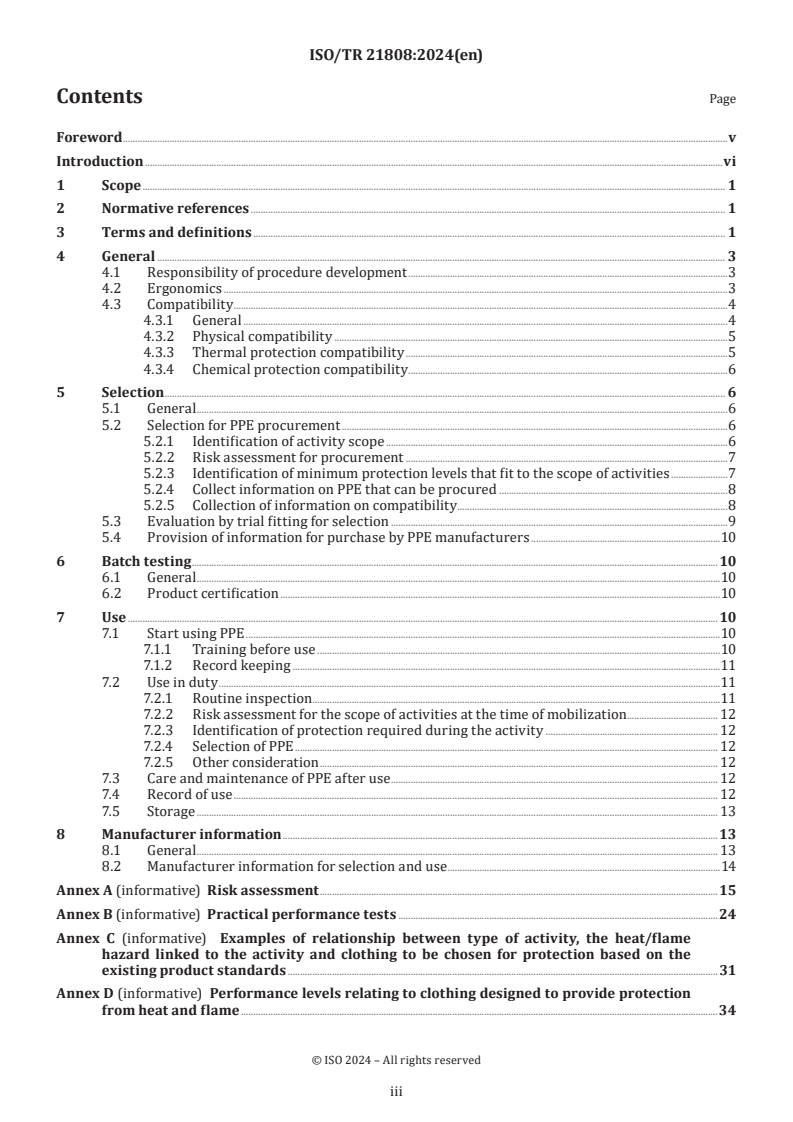
conçus pour pourvoir à la protection des pompiers
Reference number
© ISO 2024
All rights reserved. Unless otherwise specified, or required in the context of its implementation, no part of this publication may
be reproduced or utilized otherwise in any form or by any means, electronic or mechanical, including photocopying, or posting on
the internet or an intranet, without prior written permission. Permission can be requested from either ISO at the address below
or ISO’s member body in the country of the requester.
ISO copyright office
CP 401 • Ch. de Blandonnet 8
CH-1214 Vernier, Geneva
Phone: +41 22 749 01 11
Email: copyright@iso.org
Website: www.iso.org
Published in Switzerland
ii
Contents Page
Foreword .v
Introduction .vi
1 Scope . 1
2 Normative references . 1
3 Terms and definitions . 1
4 General . 3
4.1 Responsibility of procedure development .3
4.2 Ergonomics .3
4.3 Compatibility .4
4.3.1 General .4
4.3.2 Physical compatibility .5
4.3.3 Thermal protection compatibility .5
4.3.4 Chemical protection compatibility.6
5 Selection . 6
5.1 General .6
5.2 Selection for PPE procurement .6
5.2.1 Identification of activity scope .6
5.2.2 Risk assessment for procurement .7
5.2.3 Identification of minimum protection levels that fit to the scope of activities .7
5.2.4 Collect information on PPE that can be procured .8
5.2.5 Collection of information on compatibility .8
5.3 Evaluation by trial fitting for selection .9
5.4 Provision of information for purchase by PPE manufacturers .10
6 Batch testing . 10
6.1 General .10
6.2 Product certification .10
7 Use . 10
7.1 Start using PPE .10
7.1.1 Training before use .10
7.1.2 Record keeping .11
7.2 Use in duty .11
7.2.1 Routine inspection .11
7.2.2 Risk assessment for the scope of activities at the time of mobilization . 12
7.2.3 Identification of protection required during the activity . 12
7.2.4 Selection of PPE . 12
7.2.5 Other consideration . 12
7.3 Care and maintenance of PPE after use . 12
7.4 Record of use . 12
7.5 Storage . 13
8 Manufacturer information .13
8.1 General . 13
8.2 Manufacturer information for selection and use .14
Annex A (informative) Risk assessment .15
Annex B (informative) Practical performance tests .24
Annex C (informative) Examples of relationship between type of activity, the heat/flame
hazard linked to the activity and clothing to be chosen for protection based on the
existing product standards .31
Annex D (informative) Performance levels relating to clothing designed to provide protection
from heat and flame .34
iii
Annex E (informative) Description of burn injury risks .54
Annex F (informative) Best practices on some of the items that may be addressed in labelling,
subject to the required use of the PPE .56
Bibliography .57
iv
Foreword
ISO (the International Organization for Standardization) is a worldwide federation of national standards
bodies (ISO member bodies). The work of preparing International Standards is normally carried out through
ISO technical committees. Each member body interested in a subject for which a technical committee
has been established has the right to be represented on that committee. International organizations,
governmental and non-governmental, in liaison with ISO, also take part in the work. ISO collaborates closely
with the International Electrotechnical Commission (IEC) on all matters of electrotechnical standardization.
The procedures used to develop this document and those intended for its further maintenance are described
in the ISO/IEC Directives, Part 1. In particular, the different approval criteria needed for the different types
of ISO document should be noted. This document was drafted in accordance with the editorial rules of the
ISO/IEC Directives, Part 2 (see www.iso.org/directives).
ISO draws attention to the possibility that the implementation of this document may involve the use of (a)
patent(s). ISO takes no position concerning the evidence, validity or applicability of any claimed patent
rights in respect thereof. As of the date of publication of this document, ISO had not received notice of (a)
patent(s) which may be required to implement this document. However, implementers are cautioned that
this may not represent the latest information, which may be obtained from the patent database available at
www.iso.org/patents. ISO shall not be held responsible for identifying any or all such patent rights.
Any trade name used in this document is information given for the convenience of users and does not
constitute an endorsement.
For an explanation of the voluntary nature of standards, the meaning of ISO specific terms and expressions
related to conformity assessment, as well as information about ISO's adherence to the World Trade
Organization (WTO) principles in the Technical Barriers to Trade (TBT), see www.iso.org/iso/foreword.html.
This document was prepared by Technical Committee ISO/TC 94, Personal safety — Protective equipment,
Subcommittee SC 14, Firefighters personal equipment.
This third edition cancels and replaces the second edition (ISO/TR 21808:2021), which has been technically
revised and completely rewritten.
Any feedback or questions on this document should be directed to the user’s national standards body. A
complete listing of these bodies can be found at www.iso.org/members.html.
v
Introduction
The information in this document has been produced to assist firefighters, fire services and purchasers (or
the person who advises the employer) in making the necessary decisions regarding the selection, use, care
and maintenance of PPE for firefighters.
The purpose of this document is to establish a best practices document for PPE with the goal to evaluate and
reduce the hazards and potential health risks associated with firefighting. This selection and use, guideline
provides basic answers, criteria, and options for the fire service personnel that are selecting or using PPE
through its life cycle with respect to protection it provides related to heat and flame or damaged PPE.
The main topics that the fire service needs to consider are highlighted in this document. This best practices
document goes through the various steps and considerations such as risk assessment, compatibility, testing,
information to be provided with the PPE so that the right management choices can be made for each fire
service. Many paragraphs of the document contain bullet-lists as thought provokers or options that may need
to be considered. The annexes provide additional information that if included, would make the main body of
this document too complicated to read, but are necessary to describe hazards and risks, the value of the test
methods for the end user, for example Annex E and Annex F provide importance guidance information.
The selection of appropriate PPE for heat and flame are based on your own risk assessment and procurement
documents.
In the past 10 years, the world has experienced a rise in temperature due to climate change. As a result of
this temperature rising, firefighters are facing the danger of heat stress, heat stroke and other fatal heat
sicknesses. Many fire departments have begun considering heat stress management, taking into account the
rising temperature and hot and humid climates, and have established new firefighting strategies, including
tactics, training, equipment, and organization. Although some countries are placing more emphasis on
heat and flame protection, the increased frequency and danger of heat stress and heat stroke incidents are
estimated to result from the heavier and thicker PPE required. The risk of these newly generated risks,
including dangerous heat stress/stroke, can not be underestimated. Risk assessments of firefighters' PPE(s)
are to include the risks associated with heavier and thicker PPE(s) under various environmental conditions.
The compatibility in this document focused mainly on the physical compatibility between each element of
PPE and the documentation.
This document is not intended for cleaning, inspection or repair of firefighter PPE. ISO 23616 is used for
cleaning, inspection and repair of firefighters personal protective equipment (PPE).
Currently, TC 94/WG1 works to establish a parent standard for the development of this document. In case of
the parent standard publication, consider the consistency of this document.
vi
Technical Report ISO/TR 21808:2024(en)
Best practices on the selection and use of personal protective
equipment (PPE) designed to provide protection for
firefighters
1 Scope
This document sets out the best practices for the selection and use of PPE designed to provide protection for
firefighters while carrying out their duties.
The PPE covered in this document is intended for firefighting personnel exposed to risks associated with
but not necessarily limited to the following activities:
— structural firefighting;
— wildland firefighting;
— incidents involving hazardous materials;
— incidents involving motor vehicle;
— urban search and rescue.
The purpose of this document is to highlight the main areas that a fire service needs to consider when
providing PPE to its members. This document is a supplement to the information provided in the PPE
standards or used in conjunction with them. Most paragraphs of the document contain bullet lists, these
lists are provided for guidance only and they are not exhaustive.
Cleaning, inspection and repair of firefighters' personal protective equipment (including care and
maintenance) are covered by ISO 23616.
2 Normative references
The following documents are referred to in the text in such a way that some or all of their content constitutes
requirements of this document. For dated references, only the edition cited applies. For undated references,
the latest edition of the referenced document (including any amendments) applies.
ISO/TR 19591, Personal protective equipment for firefighters — Standard terms and definitions
3 Terms and definitions
For the purposes of this document, the terms and definitions given in ISO/TR 19591 and the following apply.
ISO and IEC maintain terminological databases for use in standardization at the following addresses:
— ISO Online browsing platform: available at https:// www .iso .org/ obp
— IEC Electropedia: available at https:// www .electropedia .org/
3.1
base-layer garment
the first layer of a textile structure that is in direct contact with the skin (i.e. briefs, t-shirts, bras, socks)
3.2
care
processes and procedures for cleaning, decontamination, and storage of protective clothing and equipment
[SOURCE: ISO/TR 19591:2018, 3.30]
3.3
cleaning
act of removing soils and contaminants from protective clothing and equipment by a mechanical, chemical,
thermal, or combined processes
[SOURCE: ISO/TR 19591:2018, 3.45]
Note 1 to entry: See ISO 23616 for further information
3.4
compatibility
capability of two or more items or components of personal protective equipment to exist or function in
the same system without modification, adaption or mutual interference with respect to interfaces and
performance
3.5
contaminant
undesirable solid, liquid, gaseous or particulate hazardous substance such as
a) products of combustion (e.g. soot),
b) body fluids,
c) infectious micro-organisms, and
d) chemicals (e.g. asbestos or respirable fibres, flammable, corrosive, carcinogenic, mutagenic, toxic or
sensitizing substances)
Note 1 to entry: Same definition with ISO 23616
3.6
coverall
one-piece garment that completely covers the wearer’s torso, together with arms, and legs, excluding the
head, hands, and feet
3.7
deterioration
downgrading of the effectiveness or physical characteristics of PPE component due to use, care (3.2),
maintenance or storage conditions
3.8
ensemble
combination or assembly of multiple items that are individually compliant with a standard that provide
protection to the head, upper torso including arms and hands and the lower torso including feet
[SOURCE: ISO 11999-1:2015, 3.24]
3.9
ergonomics
scientific discipline concerned with the understanding of interactions among human and other elements of
a system, and the profession that applies theory, principles, data and methods to design in order to optimize
human well-being and overall system performance
[SOURCE: ISO 26800:2011, 2.2, modified — The note has been omitted.]
3.10
flame resistance
property of a material whereby combustion is prevented, terminated, or inhibited following the application
of a source of ignition, with or without subsequent removal of the ignition source
[SOURCE: ISO/TR 19591:2018, 3.114]
Note 1 to entry: Usually flame resistance materials for fire fighter are Index III of ISO 14116, but flame resistance is
denoted by meeting one of the Index of ISO 14416 using the flame spread test method ISO 15025.
3.11
maintenance
the act of preserving PPE from loss or deterioration (3.7) and includes procedures for inspection, repair and
ultimate removal from service, see ISO 23616 for further information
Note 1 to entry: See ISO 23616 for further information
3.12
risk
probability of a specific undesired event (e.g. injury) occurring so that a hazard is realized
[SOURCE: ISO/TR 11610:2004, 3.205]
3.13
risk assessment
overall process that identifies hazards, estimates the potential severity of injury or damage to health,
estimates the likelihood of occurrence of injury or danger to health
3.14
selection
process determining/assessing what PPE is necessary for protection of fire and emergency services response
personnel from an anticipated specific hazard or other activity, the procurement of the appropriate PPE, and
the choice of the proper PPE for a specific hazard or activity at an emergency incident
3.15
use
application of PPE including its limitations
4 General
4.1 Responsibility of procedure development
Fire services develop procedures for selection and use (of SUCAM) for firefighters’ PPE.
NOTE 1 ISO 23616 is a companion to this document which describes detail requirement of cleaning, inspection, and
repair.
NOTE 2 ISO/TS 16975-1 is also a companion to this document which describes SUCAM of RPD.
NOTE 3 ISO/TR 18690 is an additional companion to this document which describes SUCAM of occupational
footwear and other personal protective equipment offering foot and leg protection.
4.2 Ergonomics
Ergonomics for firefighting organizations is a matter of ergonomic approach that firefighters are to consider
when conducting activities, and the main purpose is to reduce the burden on humans.
The following items are to be taken into consideration.
The firefighting organization are to evaluate the compatibility and ergonomics of PPE by practical
performance tests. In addition, the wearers are to try on and evaluate as necessary. Testing is to be
performed by firefighting organizations, manufacturers or other competent organization.
Practical performance tests are conducted in accordance with ISO/TS 20141, Annex B and other applicable
standards.
When conducting trial fitting by the wearer, the following items are considered:
— ease and time required for donning and doffing;
— ease of adjustment and adjustable range;
— comfort and weight tolerance;
— compatibility with other PPE to be used at the same time;
— whether or not all the expected tasks can be carried out without problems;
— protection against all postures during the work;
— identification of risks associated with attaching accessories to PPE.
NOTE Consider the location (e.g. in high risk areas) and material (e.g. flame retardant) of the accessories.
4.3 Compatibility
4.3.1 General
Compatibility is the capability of two or more items or components of personal protective equipment to
exist or function in the same system without modification, adaption or mutual interference with respect to
interfaces and performance. ISO/TS 20141 provides general information of Compatibility. This document
refers to ISO/TS 20141 for basic references and understandings of compatibility. In some specific cases
specified for ER purpose, following information is provided.
This table shows necessity of consideration about compatibility between PPE combinations. For new
equipment, there are cases where it does not apply to the classification of this table, so careful attention is
paid to the compatibility with related equipment.
Table 1 below shows the interactivity with the various parts of PPE, with in addition underwear.
Table 1 — Compatibility of PPE
Compatibility
with
Helmet X X X X X X X X X X
Fire hood X X X X X X X X X
Eye protection X X X X X X X
Hearing protec- X X X X X X X X
tion
RPD X X X X X X X X X X
Neck protec- X X X X X X X X X X
tion
Clothing X X X X X X X X X X X X
Base layer gar- X X X X X X X X X X
ment
Helmet
Fire hood
Eye protec-
tion
Hearing
protection
RPD
Neck pro-
tection
Clothing
Base layer
garment
Over gar-
ment
Gloves
Foot protec-
tion
Fall protec-
tion
Others
TTabablele 1 1 ((ccoonnttiinnueuedd))
Compatibility
with
Over garment X X X X X X X X X X X X
Gloves X X X X X X
Foot protection X X X X
Fall protection X X X X X X X
Others X X X X X X X X X X X X
NOTE PPE samples which are widely used in the current work field include, but are not limited to the following:
— helmet: fire helmet, safety (mechanical protective and electric shock) helmet;
— fire hood: fire hood for firefighting;
— eye protection: safety glasses, goggle, face shield, RPD type;
— hearing protection: earmuff, ear plug;
— RPD: breathing apparatus, non-powered respirator;
— neck protection: SHIKORO, fire hood, stand collar type apart of clothing;
— clothing: firefighting clothing (structural, wildland), rescue activity clothing (RTC, USER);
— base layer garment: briefs, t-shirts, bras, socks, station uniform, radiation protection (head protector), FR
underwear, protective undergarment for cold atmosphere (including foot protection), body cooling device for heat
stroke prevention;
— over garment: chemical (biological) protection, radioactive particle protection, mechanical risk protection (elbow
guard, knee guard, chaps), including partial protective devices for each hazard;
— gloves: firefighting glove, mechanical risk protection (cut resistance), thermal risk protection (low temperature
resistance), chemical (biological) protective glove, including over glove style;
— footwear: chemical (biological) protection, radioactive particle protection, mechanical risk protection, including
partial protective devices for each hazard;
— others: protective equipment excluding above group, multi-functional protective equipment.
4.3.2 Physical compatibility
Physical interactions between the various PPE such that the various pieces of PPE don’t hinder each others
protection properties and reduce/jeopardise the level of protection: In addition, ensuring the overlaps
between the various pieces of PPE are sufficient. Ensure the overlaps, freedom of movement and potential
hindrance are evaluated using practical performance test movements (see Annex B) in addition to specific
ones such as firehoods and gloves that may have specific movements between respectively with respiratory
protective device (RPD) or glove dexterity for handling various tools and PPE. For optimum protection
garments are selected for having a level of ease, or not too tight fitting (air provides additional layer of
protection).
NOTE Guidance for structural firefighters gear can be found in ISO/TS 11999-2.
4.3.3 Thermal protection compatibility
The thermal protective properties of different layers will not have a negative impact on each other, e.g. by
reduction of air layers between different items of PPE. Different items of PPE will not increase the thermal
Helmet
Fire hood
Eye protec-
tion
Hearing
protection
RPD
Neck pro-
tection
Clothing
Base layer
garment
Over gar-
ment
Gloves
Foot protec-
tion
Fall protec-
tion
Others
physiological impact of the PPE on the wearer. Wearers are aware of the materials of the underclothing when
using protective clothing against heat and flame to consider the melting possibility of underwear.
4.3.4 Chemical protection compatibility
The chemical thermal protective properties of the outer layer is critical to providing chemical protection of
the fire fighter whether this is for structural clothing or hazardous materials incidents.
Repellency, in garment such as for structural fire fighting, station wear, rescue clothing, needs to be ensured
after washing through re-impregnation. If not the garment could absorb or let through chemicals during an
incident or cleaning operations. These chemicals (e.g. solvent, oil) may negatively impact the heat and flame
protection of the garment, glove, boot, etc.
Wear and tear, and specifically abrasion, can negatively impact the chemical protection of boots, gloves and
garments. Helmets may lose their robustness if exposed to chemicals (e.g. solvents, acids).
Chemical protection of the ensemble need to ensure, if one part e.g. gloves protect against a specific
chemical, set of chemicals or mixtures, that the other parts (e.g. boots, garments, RPD, visor) provide similar
protection.
5 Selection
5.1 General
On the procurement process of PPE, emergency response organizations are to select appropriate PPE
based on risk assessment. For this purpose, emergency response organizations are to identify the scope of
activity, area of activity and required level of protection, after that, determine appropriate PPE range based
on purpose and performance information of PPE. In addition, incidental information on PPE (compatibility
information, maintenance service information on CIR, information on SDGs, etc.) is to be examined to
determine the optimal PPE within the selected range.
Therefore, emergency response organizations are to develop procedures and plans, etc. for making
selections, and implement the PPE procurement process including feedback information to purchasing
process summarized in Clause 6.
5.2 Selection for PPE procurement
5.2.1 Identification of activity scope
Identifying the scope of activity is an important factor in determining PPE. Emergency response organization
are to identify the purpose of the activities so that firefighters are adequately protected from the risks they
face during their activities and that their activities are not limited by the excessive performance of the PPE.
It also leads correct understanding of the unprotected areas, which can ensure safe activities. Therefore, in
procurement, it is necessary to assume an appropriate scope of activities and perform the following steps.
The scope of activities is to be specified in consideration of the following conditions. However, these are not
limited to
— what kind of activity and act in which working area is to be considered,
— what kind of environment is to be considered (geographical climate, environment at the actual place of
activity (high working place, closed space, gassed place, densely built area, etc.)), and
— duration of work (how often) at each place.
The scope of activities are to be established appropriately, meeting the objective.
5.2.2 Risk assessment for procurement
The risk assessment of PPE selection is to include the following points:
— check the working activity scope, area and environment using PPE;
— alternative actions to mitigate risks (e.g. mitigation measures in place prior to applying PPE, consideration
of organizational knowledge and other organizations experience, training, and understanding of other
management measures);
— geographical location and climate (environmental temperature and conditions);
— list of hazards covered with
— thermal hazards: high temperature and heat flux (e.g. convection, radiation, mixing of heat types),
contact heat, work environment, etc.,
— thermal hazard: low temperature, working environment and/or temperature of the work object
(low temperature, cryogenic temperature, etc.),
— chemicals: phases of chemicals (e.g. gases, liquids, particulates or solids) and which chemicals or
mixtures (e.g. acids/bases, organic solvents, gasoline, chlorine, etc.) , pollutants (e.g. asbestos) and
combustion residues (e.g. smoke, particulates, etc.),
— biological: viral, bacterial, and other biological risks,
— mechanical: wear, cutting, vibration, flying objects, etc.,
— other hazards (e.g. noise, electrical hazards, falls, flashes, etc.);
— assessment of the risks arising from the use of PPE (frequency and duration of PPE use);
— risk quantification;
— identification of protection level of PPE and the scope of protection;
— identification of whether the attachment of accessories to protective clothing increases the risk.
EXAMPLE When a badge is attached, a convex part is formed on the surface of the protective suit, and molten
splashes (droplets) are easily adhered to.
— Feedback from knowledge of accidents, injuries and causes
NOTE Several risk assessment models are available to determine the level of risk associated with a task. Annex A
lists literature on risk assessment.
5.2.3 Identification of minimum protection levels that fit to the scope of activities
The level of protection of PPE for the work to be covered is to be determined, including the following:
— identification of body parts that require protection;
— identification of the protective performance required of PPE (for the target body part);
— confirmation of the existence of standards or test methods that stipulate the necessary protective
performance.
Other evaluations, depending on the risks involved in the operation, may be necessary to determine the
choice, such as the following evaluation items:
— for each item of PPE, determine the level of protection required (to the relevant part of the body) in
relative or absolute terms;
— evaluation of whether previously used PPE meets standards (any problems or concerns that may have
been caused by these, such as comfort, incidents, or inappropriate use));
— identify compatibility issues and requirements for PPE items.
5.2.4 Collect information on PPE that can be procured
Firefighting organizations are to collect information on the acquisition of PPE, including the following:
— conducting market research to determine available products;
— collecting information from suppliers on PPE performance and handling, including compliance
information;
— gathering information on PPE use cases used in similar operations;
— check compatibility between all PPEs used simultaneously.
NOTE The following are examples of other matters that may be necessary to gather information on obtaining
PPE:
— education for users at the time of procurement (including education provided by third parties);
— post-procurement services;
— quality assurance system up to delivery;
— requirements for washing, sanitizing and decontamination;
— requirements for inspection and repair;
— requirements and costs for replacement of parts;
— delivery times for standard and special sizes;
— size availability;
— supplier inventory;
— availability of supplier's stock;
— inventory needs of users;
— means of delivery to wearer after procurement;
— safe disposal methods for PPE;
— assessment of the impact of additional labelling, such as company name, on performance.
If multiple PPEs are provided by the firefighting organization for different tasks, the firefighting organization
may have the PPE wearer select the PPE after providing appropriate training to the PPE wearer. This
selection of PPE by the PPE wearer is based on a risk assessment conducted by the fire service organization
or a risk assessment by the PPE wearer based on the conditions of use.
5.2.5 Collection of information on compatibility
When PPE is worn in a task, physical or performance compatibility between multiple PPE and the
environment in which they are worn may be an issue.
This means that each item of PPE used may not be compatible with each other or may interfere with each
other. When collecting information on the compatibility of items of PPE, the following is considered:
— interfaces: physical interference between the items of PPE is not to limit operation or compromise
protection in the intended operation;
— performance: all PPE used simultaneously is to have a minimum protective performance for the purpose
of protection, and the weakest item of PPE is to provide sufficient level of performance and protection;
— protective performance is reviewed based on the reequipments from a chemical, heat and flame and
mechanical perspective;
— conditions of use: not only is the PPE to be operational for the intended operation, but it is to also be
usable for the local climatic conditions (humidity, temperature, rain, etc.) as well as the length of time
the PPE will be worn and the environment in which the wearer will be using it.
When using PPE containing child devices, the compatibility of the interface between the PPE and external
devices is also to be considered.
Fire service organizations are to obtain information on compatibility (e.g. results of practical performance
tests as defined in ISO/TS 20141) from their suppliers. Since the information provided by suppliers may
not be sufficient for the actual activities and conditions of the activities, fire-fighting organizations are to
ensure the compatibility of the above three requirements, including evaluation by trial fitting with the PPE
to be used.
5.3 Evaluation by trial fitting for selection
The firefighting organization is to evaluate the compatibility and ergonomics of PPE by practical performance
tests. In addition, the wearers are to try on the PPE and evaluate as necessary. Testing is to be performed by
firefighting organizations, manufacturers or other competent organization.
Practical performance tests are to be conducted in accordance with ISO/TS 20141, this document and other
applicable standards.
When conducting trial fitting by the wearer, the following items are considered:
— ease and time required for donning and doffing;
— ease of adjustment and adjustable range;
— comfort and weight tolerance;
— compatibility with other PPE to be used at the same time;
— whether or not all the expected tasks can be carried out without problems;
— protection against all postures during the work;
— identification of risks associated with attaching accessories to PPE.
NOTE Consider the location (e.g. in high risk areas) and material (e.g. flame retardant) of the accessories.
When defining the level of protection required, consideration is given to the following as a minimum, but not
be limited to
— determine which parts of the body require protection,
— identify what kind of protection is required,
— identify the appropriate Standards or methods that provide the required protection,
— determine the level(s) of protection required (for the relevant parts of the body) in relative or absolute
terms for each item of PPE,
— assessment of previously used PPE for meeting standards (any issues and concerns these may have
caused such as comfort, incidents, improper use), and
— identify compatibility issues and requirements of PPE items.
5.4 Provision of information for purchase by PPE manufacturers
Manufacturers are to provide basic performance information on PPE to fire service organizations as selection
considerations for procurement. In addition to this, the compatibility of the equipment, sustainability of the
product (e.g. energy reduction, recycling, use of materials with low environmental impact, etc.), simulation
results of manikin tests, etc. are to be provided to the fire service organization as additional considerations.
NOTE 1 The standard for PPE compatibility is ISO/TS 20141. There are other standards that are considered parallel
to product standards, such as ISO 11999-2, ISO 15384.
NOTE 2 ISO/Guide 64 and ISO/Guide 82 are standards on sustainability of PPE. This document defines the developer
of the product standard as the primary user, but provides guidelines that is to be widely applied in the process of
manufacturing the product. Therefore, information is provided as reference information for this document.
6 Batch testing
6.1 General
In some regions or countries, batch testing is conducted at predetermined times to confirm that the PPE
being supplied and the materials they are made of continue to meet the performance requirements specified
in the original contract.
Batch testing is conducted using a set of predetermined requirements that an item of PPE can be tested
against. These are the same as the performance requirements contained in the relevant Standard, thus
ensuring continual compliance with the specifications.
These tests are conducted according to regional requirement, regulations and specifications.
It is recommendable to make available and submit material certificates and testing results which satisfy the
fire service. Batch testing is a decision for the fire service to make and is not a mandatory requirement.
6.2 Product certification
In some region or countries, as part of the procurement process fire services specify and require that the
selected PPE is independently certified to the relevant Standard (International, Regional or National). The
product certification body is accredited to a national or internationally recognised accreditation system
(e.g. ISO/IEC 17065). At least all testing is carried-out by labs accredited to ISO/IEC 17025 for that test and to
guarantee correct testing and reproducibility.
Product certification is conducted according to regional requirements, regulations and specifications (for
example, NFPA 1971, EU PPE Regulation 2016/425, Brazil CA certification scheme).
7 Use
7.1 Start using PPE
7.1.1 Training before use
The firefighting organization is to conduct training to ensure proper use of the equipment, taking into
account the equipment to be used, the area of operation, the environment, tactics, etc. The training is to be
conducted in a manner that is appropriate to the organization's needs.
Information on individual pieces of equipment is available from the information provided by the
manufacturer, but for the use of multiple pieces of equipment at the same time, the fire service organization
is to take the initiative to determine the necessary training and provide training to fire fighters with the
appropriate information and appropriate implementers.
For CIR of PPE, necessary training is to be conducted to operationalize the implementation method developed
based on ISO 23616. For example, this includes cleaning, inspection, and repair of PPE as well as retirement
of PPE that is no longer suitable
...