

ISO 15531-1:2004
(Main)Industrial automation systems and integration — Industrial manufacturing management data — Part 1: General overview
General Information
- Abstract
ISO 15531-1:2004 provides a general overview of the whole ISO 15531 standard (MANDATE). It specifies its scope and provides a number of basic definitions on which the whole standard is built in accordance with the "General system theory" and the concepts defined in APICS dictionary. Its informative annexes provide a description of the relationships between MANDATE and other standards (especially ISO/TC 184 standards), as well as a clarification of the concepts of "capability and capacity" as they are used in MANDATE and other standards that refer explicitly or implicitly to the system theory. MANDATE address the modelling of manufacturing management data such as: Resources management data (Resource model); Time related features (Time model); Flow management data in manufacturing (Flow management model). MANDATE, in association with STEP, PLIB and other SC 4 (or non SC 4) standards, may be used in any software application that addresses manufacturing management related information such as resources management data, flow management data. As such, the standard is intented at facilitating information exchanges between software applications such as E.R.P., manufacturing management software, maintenance management software, quotation software, etc. MANDATE has been written in EXPRESS. During the development phases of the MANDATE standard, the compatibility of the standard with the ISO 10303 (STEP) standard has been the subject of a thorough analysis.
- Status
- Published
- Publication Date
- 04-Mar-2004
- Technical Committee
- ISO/TC 184/SC 4 - Industrial data
- Current Stage
- 9093 - International Standard confirmed
- Start Date
- 07-Dec-2023
- Completion Date
- 29-Aug-2026
Overview
ISO 15531-1:2004 - part of the MANDATE family - provides a general overview of industrial manufacturing management data and the structure of the ISO 15531 standard. It defines the standard’s scope, key terms and the conceptual foundation (based on General System Theory and APICS concepts). ISO 15531-1 clarifies how ISO 15531 enables neutral, computer-interpretable representation and exchange of manufacturing management information to support interoperability, data sharing, storage and archiving across systems and organizations.
Key Topics
- Scope and purpose: Representation and exchange of manufacturing management information (focused on discrete manufacturing, but not limited to it). Excludes enterprise architecture modelling, product data exchange, parts library representation, cutting-tool data and technical maintenance manuals.
- Core model areas:
- Resource model - resources management data (machines, devices, human resources).
- Time model - time-related features for scheduling and planning.
- Flow management model - material and production flow control.
- Definitions and terminology: Common vocabulary drawn from ISO 10303 (STEP), ISO 13584 (PLIB), ISO 14258, ISO/IEC 2382 and APICS dictionary concepts (e.g., capability vs capacity).
- Standard structure: Describes series of parts (15531-2x: production data for external exchanges; 15531-3x: resource usage; 15531-4x: flow management) and their relationships.
- Technical format and compatibility:
- MANDATE models are expressed in EXPRESS.
- Compatibility and mapping with ISO 10303 (STEP) were analyzed during development.
- Includes ASN.1 identifier and normative references.
Applications and Who Uses It
ISO 15531-1 supports practical manufacturing integration and data interoperability:
- Software vendors & integrators: ERP, MES, maintenance management (MRO), quotation and planning systems can use MANDATE models to exchange data.
- Plant and production planners: Standardized resource, time and flow models improve coordination with suppliers and subcontractors.
- System architects & data modelers: Implement neutral, sharable manufacturing databases and archives.
- Standards implementers: Align implementations with STEP/PLIB and enterprise-control integration activities.
Practical uses include neutral file exchange, shared manufacturing databases, supplier-main-plant information exchange, capacity planning support, and archiving manufacturing records.
Related Standards
ISO 15531-1 references and aligns with key standards for manufacturing data interoperability:
- ISO 10303 (STEP) - product data representation and exchange
- ISO 13584 (PLIB) - parts library
- ISO 14258, ISO 15704 - enterprise models and architecture
- ISO/IEC 2382-24, ISO/IEC 8824-1, ISO/IEC 62264-1
Keywords: ISO 15531-1, MANDATE, manufacturing management data, industrial automation systems, EXPRESS, STEP, PLIB, ERP integration, resource model, flow management model.
Relations
- Effective Date
- 06-Jun-2022
Get Certified
Connect with accredited certification bodies for this standard

DVS-ZERT GmbH
German welding certification society.
CARES (UK Certification Authority for Reinforcing Steels)
UK certification for reinforcing steels and construction.
EWF/IIW (European/International Welding Federation)
International welding personnel certification.
Sponsored listings
Frequently Asked Questions
ISO 15531-1:2004 is a standard published by the International Organization for Standardization (ISO). Its full title is "Industrial automation systems and integration — Industrial manufacturing management data — Part 1: General overview". This standard covers: ISO 15531-1:2004 provides a general overview of the whole ISO 15531 standard (MANDATE). It specifies its scope and provides a number of basic definitions on which the whole standard is built in accordance with the "General system theory" and the concepts defined in APICS dictionary. Its informative annexes provide a description of the relationships between MANDATE and other standards (especially ISO/TC 184 standards), as well as a clarification of the concepts of "capability and capacity" as they are used in MANDATE and other standards that refer explicitly or implicitly to the system theory. MANDATE address the modelling of manufacturing management data such as: Resources management data (Resource model); Time related features (Time model); Flow management data in manufacturing (Flow management model). MANDATE, in association with STEP, PLIB and other SC 4 (or non SC 4) standards, may be used in any software application that addresses manufacturing management related information such as resources management data, flow management data. As such, the standard is intented at facilitating information exchanges between software applications such as E.R.P., manufacturing management software, maintenance management software, quotation software, etc. MANDATE has been written in EXPRESS. During the development phases of the MANDATE standard, the compatibility of the standard with the ISO 10303 (STEP) standard has been the subject of a thorough analysis.
ISO 15531-1:2004 provides a general overview of the whole ISO 15531 standard (MANDATE). It specifies its scope and provides a number of basic definitions on which the whole standard is built in accordance with the "General system theory" and the concepts defined in APICS dictionary. Its informative annexes provide a description of the relationships between MANDATE and other standards (especially ISO/TC 184 standards), as well as a clarification of the concepts of "capability and capacity" as they are used in MANDATE and other standards that refer explicitly or implicitly to the system theory. MANDATE address the modelling of manufacturing management data such as: Resources management data (Resource model); Time related features (Time model); Flow management data in manufacturing (Flow management model). MANDATE, in association with STEP, PLIB and other SC 4 (or non SC 4) standards, may be used in any software application that addresses manufacturing management related information such as resources management data, flow management data. As such, the standard is intented at facilitating information exchanges between software applications such as E.R.P., manufacturing management software, maintenance management software, quotation software, etc. MANDATE has been written in EXPRESS. During the development phases of the MANDATE standard, the compatibility of the standard with the ISO 10303 (STEP) standard has been the subject of a thorough analysis.
ISO 15531-1:2004 is classified under the following ICS (International Classification for Standards) categories: 25.040.40 - Industrial process measurement and control. The ICS classification helps identify the subject area and facilitates finding related standards.
ISO 15531-1:2004 has the following relationships with other standards: It is inter standard links to ISO 27789:2013. Understanding these relationships helps ensure you are using the most current and applicable version of the standard.
ISO 15531-1:2004 is available in PDF format for immediate download after purchase. The document can be added to your cart and obtained through the secure checkout process. Digital delivery ensures instant access to the complete standard document.
Standards Content (Sample)
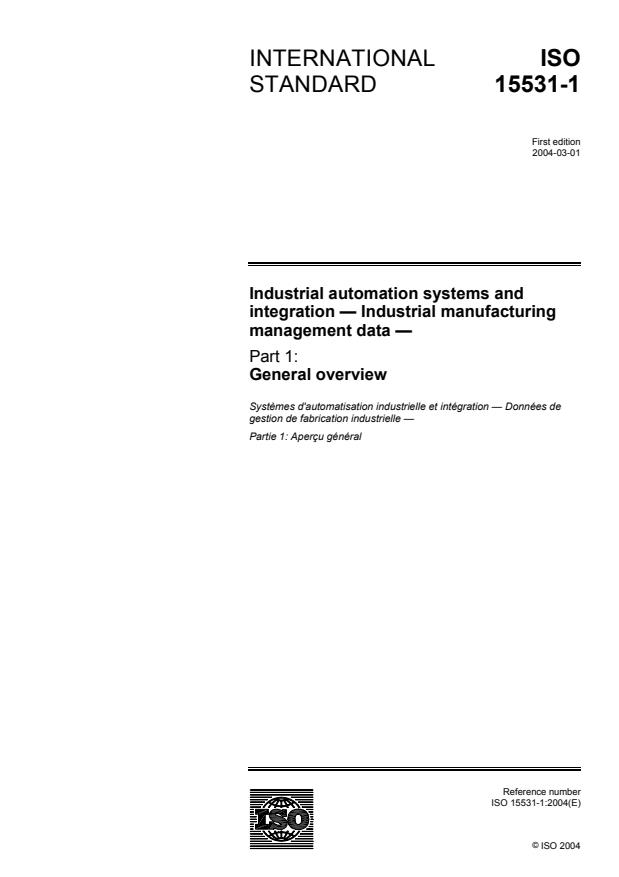
INTERNATIONAL ISO
STANDARD 15531-1
First edition
2004-03-01
Industrial automation systems and
integration — Industrial manufacturing
management data —
Part 1:
General overview
Systèmes d'automatisation industrielle et intégration — Données de
gestion de fabrication industrielle —
Partie 1: Aperçu général
Reference number
©
ISO 2004
PDF disclaimer
This PDF file may contain embedded typefaces. In accordance with Adobe's licensing policy, this file may be printed or viewed but
shall not be edited unless the typefaces which are embedded are licensed to and installed on the computer performing the editing. In
downloading this file, parties accept therein the responsibility of not infringing Adobe's licensing policy. The ISO Central Secretariat
accepts no liability in this area.
Adobe is a trademark of Adobe Systems Incorporated.
Details of the software products used to create this PDF file can be found in the General Info relative to the file; the PDF-creation
parameters were optimized for printing. Every care has been taken to ensure that the file is suitable for use by ISO member bodies. In
the unlikely event that a problem relating to it is found, please inform the Central Secretariat at the address given below.
© ISO 2004
All rights reserved. Unless otherwise specified, no part of this publication may be reproduced or utilized in any form or by any means,
electronic or mechanical, including photocopying and microfilm, without permission in writing from either ISO at the address below or
ISO's member body in the country of the requester.
ISO copyright office
Case postale 56 • CH-1211 Geneva 20
Tel. + 41 22 749 01 11
Fax + 41 22 749 09 47
E-mail copyright@iso.org
Web www.iso.org
Published in Switzerland
ii © ISO 2004 – All rights reserved
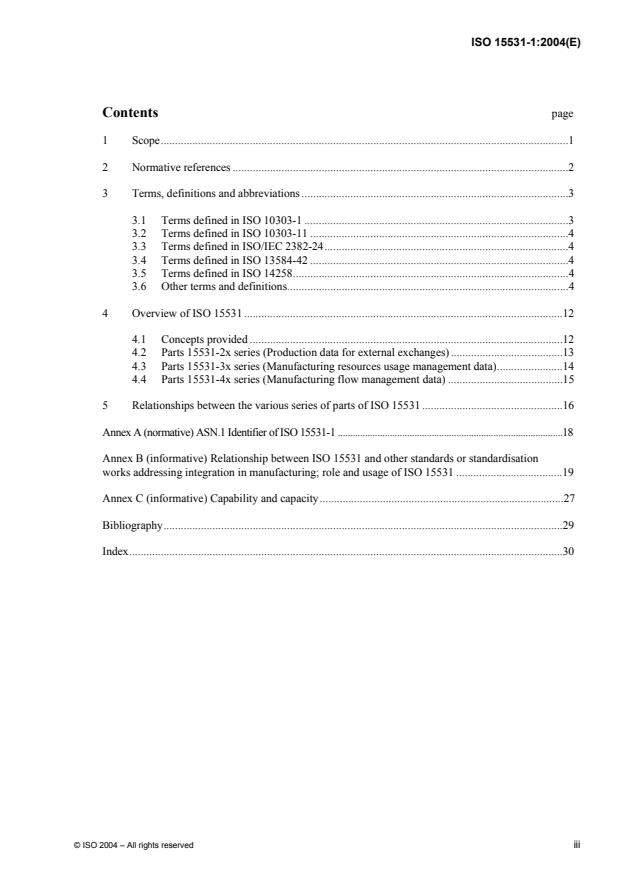
Contents page
1 Scope.1
2 Normative references .2
3 Terms, definitions and abbreviations .3
3.1 Terms defined in ISO 10303-1 .3
3.2 Terms defined in ISO 10303-11 .4
3.3 Terms defined in ISO/IEC 2382-24.4
3.4 Terms defined in ISO 13584-42 .4
3.5 Terms defined in ISO 14258.4
3.6 Other terms and definitions.4
4 Overview of ISO 15531 .12
4.1 Concepts provided .12
4.2 Parts 15531-2x series (Production data for external exchanges) .13
4.3 Parts 15531-3x series (Manufacturing resources usage management data).14
4.4 Parts 15531-4x series (Manufacturing flow management data) .15
Relationships between the various series of parts of ISO 15531 .16
Annex A (normative) ASN.1 Identifier of ISO 15531-1 .18
Annex B (informative) Relationship between ISO 15531 and other standards or standardisation
works addressing integration in manufacturing; role and usage of ISO 15531 .19
Annex C (informative) Capability and capacity.27
Bibliography.29
Index.30
Foreword
ISO (the International Organization for Standardization) is a worldwide federation of national standards bodies
(ISO member bodies). The work of preparing International Standards is normally carried out through ISO technical
committees. Each member body interested in a subject for which a technical committee has been established has the
right to be represented on that committee. International organizations, governmental and non-governmental, in
liaison with ISO, also take part in the work. ISO collaborates closely with the International Electrotechnical
Commission (IEC) on all matters of electrotechnical standardization.
International Standards are drafted in accordance with the rules given in the ISO/IEC Directives, Part 2.
The main task of technical committees is to prepare International Standards. Draft International Standards adopted
by the technical committees are circulated to the member bodies for voting. Publication as an International
Standard requires approval by at least 75 % of the member bodies casting a vote.
Attention is drawn to the possibility that some of the elements of this document may be the subject of patent rights.
ISO shall not be held responsible for identifying any or all such patent rights.
ISO 15531-1 was prepared by Technical Committee ISO/TC 184, Industrial automation systems and integration,
Subcommittee SC 4, Industrial data.
A complete list of parts of ISO 15531 is available from the Internet:
http://www.tc184-sc4.org/titles/Mandate_titles.rtf
iv © ISO 2004 – All rights reserved
Introduction
The information generated about the manufacturing process of an industrial product is very important
for the life cycle of this product, notably in a context of sustainable development. Manufacturing may
be defined as the transformation of raw material or semi-finished components leading to goods
production. Manufacturing management is the function of directing or regulating the flows of goods
through the entire production cycle from requisitioning of raw materials to the delivery of the finished
product, including the impact on resources management.
A manufacturing management system manages the flow of materials and products through the whole
production chain, from suppliers, through manufacturers, assemblers, to distributors and sometimes
customers.
The relations among those partners may be identified and structured in an electronic form with a view
to facilitate electronic exchanges. Then, information handled during these exchanges have to be
identified, modelled and represented in such a way that they may be shared by a maximum of partners
through the usage of standards for product and manufacturing data modelling.
The production planning functions within the supplier plants are assumed to have strong relationships
with the master production scheduling people of the main plant, who share with them information on
the likely pattern of the future demands to allow suppliers to plan in turn their production. On a day-
to-day basis, the operational planning system of the main plant sends orders to the suppliers to ensure
the availability of components, subassemblies and others such as resources needed to its
manufacturing and assembly process.
From this approach, three main categories of data related to manufacturing management may be
distinguished as follows:
information related to the external exchanges, e.g., between main plant and suppliers;
information related to the management of the resources used during the manufacturing processes;
information related to the management of the manufacturing flows.
NOTE This information is usually provided within the main plant, and exchanged among the different machine
tools, or production cells.
ISO 15531 is an International Standard for the computer-interpretable representation and exchange of
industrial manufacturing management data. The objective is to provide a neutral mechanism capable of
describing industrial manufacturing management data throughout the production process within the
same industrial company and with its external environment, independent from any particular system.
The nature of this description makes it suitable not only for neutral file exchange, but also as a basis
for implementing and sharing manufacturing management databases and archiving.
The standard is focused on discrete manufacturing, but not limited to it. Then any modification or
extensions to industrial that do not belong to discrete part manufacturing have always been under
consideration when they did not imply any contradiction or inconsistency with the initial objective of
the standard.
ISO 15531 addresses the three types of data described above. It does not standardise the model of
the manufacturing process. The aim of ISO 15531 is to provide standardised data models for those
three types of manufacturing management data. The purpose of that standard development is to
facilitate the integration between the numerous industrial applications by means of common,
standardised software that are able to represent these three sets of data.
This International Standard is organised as a series of parts, each published separately. The parts of
ISO 15531 fall into the following series: production data for external exchange, manufacturing
resources usage management data, manufacturing flow management data.
This part of ISO 15531 provides a general overview. It specifies the functions of the various series of
parts of ISO 15531 and the relationships among them. It also specifies the relations between
ISO 15531 and other related standards in its Annex B.
vi © ISO 2004 — All rights reserved
INTERNATIONAL STANDARD ISO 15531-1:2004(E)
Industrial automation systems and integration
Industrial manufacturing management data
Part 1:
General overview
1 Scope
ISO 15531 specifies the characteristics for a representation of manufacturing management information
over the entire industrial process. It provides the necessary mechanisms and definitions to enable
manufacturing management data to be shared and exchanged within the factory, with other plants or
companies.
The standard is mainly focused on discrete manufacturing but not limited to it. It may also apply to
any industrial processes that do not imply any contradiction or inconsistency with the basic principle
of the standard.
The following are within the scope of ISO 15531:
the representation of information needed to manage production and resources;
the exchange and sharing of production information and resources information including storing,
transferring, accessing and archiving.
EXAMPLE Information on resources and system capability and capacity, monitoring, maintenance, constraints
and control information.
NOTE Maintenance constraints and relevant maintenance management data are taken into account from the
point of view of their impact on the flow control.
The following are outside the scope of ISO 15531:
architecture and methodologies for the modelling of an enterprise in its whole as well as the
related tools;
representation and exchange of product information;
representation and exchange of computer-interpretable parts library information;
representation of exchange of cutting tool data;
technical maintenance information.
EXAMPLE Technical information that is included in devices repair, operation and maintenance manuals.
More specifically this part of ISO 15531 gives an overview of this International Standard and of the main
principles used. It specifies the characteristics of the various series of parts in ISO 15531 and the relationships
among them.
The following are specifically within the scope of this part of ISO 15531:
general overview of the standard and of the main principles used;
structure of the standard and relationships between the three series of parts which the standard is
made of;
definitions of terms used throughout this International Standard.
The scope of this part includes provisions of explanations addressing the following item that are issued
in Annex B:
how this standard fits with ISO 10303, with ISO 13584, and with other related standardisation
works;
the role and usage of manufacturing systems data exchange and how this standard may be
used in conjunction with other standards to contribute to the integration of manufacturing
applications.
The scope of each of the other parts of ISO 15531 is defined within the relevant part of each series.
2 Normative references
The following referenced documents are indispensable for the application of this document. For
dated references, only the edition cited applies. For undated references, the latest edition of the referenced
document (including any amendments) applies.
ISO/IEC 2382-24:1995, Information technology - Vocabulary - Part 24: Computer-integrated
manufacturing
ISO/IEC 8824-1:1998, Information technology - Abstract Syntax Notation One (ASN.1) -
Part 1: Specification of basic notation
ISO 10303-1:1994, Industrial automation systems and integration - Product data representation
and exchange - Part 1: Overview and fundamental principles
ISO 10303-11:1994, Industrial automation systems and integration - Product data
representation and exchange - Part 11: Description methods: The EXPRESS language reference
manual
ISO 10303-49:1998, Industrial automation systems and integration - Product data
representation and exchange - Part 49: Integrated generic resources: Process structures and
properties
ISO 13584-1:2001, Industrial automation systems and integration - Parts library - Part 1:
Overview and fundamental principles.
ISO 13584-42:1998, Industrial automation systems and integration - Parts library - Part 42:
Description methodology: Methodology for structuring part families
ISO 14258:1998, Industrial automation systems - Concepts and rules for enterprise
models
ISO 15704:2000, Industrial automation systems - Requirements for enterprise-reference
architectures and methodologies
1)
ISO 15926-1: , Industrial automation systems and integration - Integration of life-cycle data for
process plants including oil and gas production facilities - Part 1: Overview and fundamental principles
ISO/TS 16668:2000, Basic Semantics Register (BSR)
ISO/IEC 62264-1:2003, Enterprise-control system integration - Part 1: Models and
terminology
3 Terms, definitions and abbreviations
3.1 Terms defined in ISO 10303-1
This part of ISO 15531 makes use of the following terms defined in ISO 10303-1:
data;
data exchange;
information;
product;
product data.
1)
To be published.
3.2 Terms defined in ISO 10303-11
This part of ISO 15531 makes use of the following terms defined in ISO 10303-11:
entity.
3.3 Terms defined in ISO/IEC 2382-24
This part of ISO 15531 makes use of the following terms defined in ISO/IEC 2382-24:
manufacturing resources planning (MRP II);
material requirement planning (MRP).
3.4 Terms defined in ISO 13584-42
This part of ISO 15531 makes use of the following terms defined on ISO 13584-42:
basic semantic unit (BSU).
3.5 Terms defined in ISO 14258
This part of ISO 15531 makes use of the following terms defined in ISO 14258:
enterprise;
enterprise model.
3.6 Other terms and definitions
For the purposes of this document, the following terms and definitions apply.
3.6.1
basic semantic register
basic register of semantics units.
NOTE Definition adapted from ISO/ TS 16668:2000.
3.6.2
building block; construct
textual or graphical artefact designed to represent in a structured way the various information about
common properties of a collection of objects or enterprise entities.
EXAMPLE Artefact designed for resources, activities, product, event or any phenomena representation.
NOTE Definition adapted from CEN/CENELEC ENV 40003 [1] and CEN/CENELEC ENV 12204 [2].
Building block and construct have the same meaning. Those European standards use the term construct without
qualifier.
3.6.3
capability
quality of being able to perform a given activity.
NOTE The capability is defined by a group of characteristics that describes functional aspects of manufacturing
resources or system.
3.6.4
capacity
capability of a system, subsystem or resource to perform its expected function from a quantitative point of view.
EXAMPLE The capacity of a system or a resource to produce a given quantity of output in a particular time
period.
NOTE For a given system or resource the distinction between capacity available and capacity requested may be
useful.
3.6.5
capacity planning
process of determining the required capacities for expected production.
3.6.6
cost control
application of procedures to monitor expenditures and performance against progress of projects and
manufacturing operations with projected completion to measure variance from authorised budget and
allow effective to be taken to achieve minimal cost.
NOTE That includes the act of gathering and checking cost information elements. The term may also apply to
the function or services. Definition adapted from APICS dictionary [5].
3.6.7
continuous process
production process that lends itself to an endless flow of non discrete product or component.
NOTE This is the opposite of discrete part manufacturing as the material flow is continuous during the
production process.
3.6.8
device
any identified physical equipment, system or subsystem that does not belong to software, data set or
human resource class.
NOTE A device may nevertheless include software.
3.6.9
discrete manufacturing
production of discrete items.
EXAMPLE Cars, appliances or computer.
3.6.10
electronic data interchange (EDI)
automated exchange of predefined and structured data for business purpose among information
systems of two or more partners.
NOTE Definition provided by ISO 16668:2000.
3.6.11
element
static representation of a part of the universe of discourse that may be identified and characterised by
its behaviour and attribute.
NOTE A static representation is a snapshot of the part of the universe of discourse under consideration at a
given time. It may include dynamic attributes as, for example, behaviour. Those attributes characterise the
element as it is or as it is expected to be at a given time.
3.6.12
enterprise entity
any concrete or abstract thing in the universe of discourse of an enterprise.
NOTE The concept provided here belongs to the broader concept of entity as defined in European standards
such as ENV12204 [2]. The concept of entity as defined in those standards has been restricted here to avoid
inconsistency with the term of entity as defined in ISO 10303-11. Then excepted in the definition of universe of
discourse the term entity applies in ISO 15531 with the definition provided by ISO 10303-11.
3.6.13
enterprise modelling
process of developing an enterprise model.
3.6.14
flow
motion of a set of physical or informational objects in space and time.
3.6.15
flow control
specific production control system that is based primarily on setting production rates and feeding work
into production to meet these planned rates, then monitoring and controlling production.
NOTE That includes the act of checking and driving the flow according to a given purpose. The term may also
apply to the function or service. Definition adapted from APICS dictionary [5].
3.6.16
flow model
representation or description of manufacturing related flows describing only the aspects to be relevant
to its purpose.
3.6.17
industrial process
process with the purpose of providing direct contribution to the production of goods and associated
services.
3.6.18
installation
initial process of enabling a resource to perform its requested activity.
3.6.19
inventory control
act or function of checking and maintaining stock items at a desired level.
3.6.20
just in time (JIT)
fact, or the related production organisation, of supplying work desks in due time with the strictly
needed quantity of component and raw material.
NOTE The general definition of JIT is "A collective approach of continuous improvement in manufacturing,
based on detection and progressive elimination of all waste". Only the restricted definition given here, which
provides the most used meaning of JIT, is applicable in this standard.
3.6.21
main plant
primary plant of a company in the manufacturing process.
EXAMPLE The final assembly plant for a given product.
3.6.22
manufacturing
function or act of converting or transforming material from raw material or semi-finished state to a
state of further completion.
NOTE Definition adapted from APICS dictionary [5].
3.6.23
manufacturing management
function or act of directing or regulating the flows of goods through the entire production cycle from
requisitioning of raw materials to the delivery of the finished product, including the impact on
resources management.
3.6.24
manufacturing planning
function of setting appropriate levels or limits to the future manufacturing operations according to
sales forecast, economic constraints and resources requirements and availability.
NOTE Definition adapted from APICS dictionary [5].
3.6.25
manufacturing process
structured set of activities or operations performed upon material to convert it from the raw material or
a semifinished state to a state of further completion.
NOTE Manufacturing processes may be arranged in process layout, product layout, cellular layout or fixed
position layout. Manufacturing processes may be planned to support make-to-stock, make-to-order, assemble-to-
order, etc., based on strategic use and placements of inventories.
3.6.26
master production schedule
representation of what a company plans to produce expressed in specific configurations, quantities and
dates.
NOTE The master production schedule is not a sales forecast. Nevertheless the master production schedule
must take into account this forecast as well as the production plan, the backlog availability of material,
availability of capacity and management policies and goals. Definition adapted from APICS dictionary [5].
3.6.27
master production scheduling
function or the act by which the master production schedule is built, reviewed and adjusted.
3.6.28
model
representation or description of an entity or a system, describing only the aspects considered to be
relevant for its purpose.
NOTE Entity is not used here with the meaning provided by ISO 10303-11 but with the sense usually given in
ENV 12204 [2] (see note in clause 3.6.12).
3.6.29
process
structured set of activities involving various enterprise entities, that is designed and organised for a
given purpose.
NOTE The definition provided here is very close to that given in ISO 10303-49. Nevertheless ISO 15531 needs
the notion of structured set of activities, without any predefined reference to the time or steps. In addition, from
the point of view of flow management, some empty processes may be needed for a synchronisation purpose
although they are not actually doing anything (ghost task).
3.6.30
process control
function of maintaining a process within a given range of capabilities and capacities.
NOTE Definition adapted from APICS dictionary [5].
3.6.31
process plan
package of information needed to enable the achievement of a process.
NOTE Definition provided here is more general as well as more precise than the definition of ISO 10303-49,
which is very close to the definition of «planning list» as proposed by APICS dictionary [5].
3.6.32
process planning
analysis and design of the sequences of processes, resources requirements, needed to produce goods
and services.
NOTE This definition applies to discrete part manufacturing and continuous processes.
3.6.33
production activity control
function of routing and dispatching the work to be achieved through the production facilities.
NOTE Definition adapted from APICS dictionary [5].
3.6.34
production capacity
highest sustainable output rate that can be achieved with the current product specification, production
scheme and available resources.
NOTE The production scheme is the mix of goods and products to be manufactured. Definition adapted from
APICS dictionary [5].
3.6.35
production control
function of monitoring and controlling the movement of goods through the entire manufacturing cycle.
NOTE Definition adapted from APICS dictionary [5].
3.6.36
production cycle
total time required to manufacture an item, exclusive of lower level purchasing lead time
NOTE Definition adapted from APICS dictionary [5].
3.6.37
production facilities; manufacturing facilities
physical plant and equipment
NOTE That includes any kind of resource that is not directly related to the manufacturing process.
EXAMPLE Cooling system, carrying equipment, communication network.
3.6.38
production forecast
marketing expectations translated into meaningful terms for production.
3.6.39
production monitoring
function of checking and driving the status and the progress of production processes and activities.
3.6.40
production order control
control of the progress of each customer order, or stock through the successive operations of the
production cycle.
3.6.41
purchase requisition
request to the purchasing department to purchase specified materials in specific quantities within a
specified time.
NOTE Definition adapted from APICS dictionary [5].
3.6.42
quality assurance
all the planned and systematic activities implemented within the quality system that can be
demonstrated to provide confidence that a product or service will fulfil requirements for expected
quality.
NOTE Definition adapted from APICS dictionary [5].
3.6.43
resource
any device, tool and means, except raw material and final product components, at the disposal of the
enterprise to produce goods or services.
NOTE 1 Resources as they are defined here include human resources considered as specific means with a
given capability and a given capacity. Those means are considered as being able to be involved in the
manufacturing process through assigned tasks. That does not include any modelling of an individual or common
behaviour of human resource except in their capability to perform a given task in the manufacturing process
(e.g.: transformation of raw material or component, provision of logistic services). That means that human
resources are only considered, as the other, from the point of view of their functions, their capabilities and their
status (e.g.: idle, busy). That excludes any modelling or representation of any aspect of individual or common
«social» behaviour.
NOTE 2 This definition includes ISO 10303-49 definition.
3.6.44
resources requirements planning; rough cut capacity planning (RCCP)
process of converting the production plan and/or the master production schedule into capacity needs
for key resources.
NOTE Definition adapted from APICS dictionary [5].
3.6.45
scheduling
act, function or result of planning occurrences of manufacturing activities.
3.6.46
semantic unit
concept unambiguously defined, independently of any particular physical representation and which is
semantically complete.
NOTE 1 In any case the identification of each SU is unique (numerical). In the previous case each SU named in
a particular language by the same expression, has its own identification number.
NOTE 2 This definition is the definition provided in the document ISO/ TS 16668 BSR Rules, guidelines, and
methodology currently submitted for CD ballot by ISO TC154 under the term of basic semantic unit (BSU). The
name has been changed in this standard to avoid any confusion with the concept defined in ISO 13584-42 and
according to the fact that there is proposal in ISO TC 154 to change the name BSU to SU.
3.6.47
semantic information unit
set of consistent information related to a collection of object or enterprise entities.
NOTE Semantic information unit is in this standard a set of information. It may includes several semantic unit.
3.6.48
supplier plant
plant, for a given supplier, which is involved in the manufacturing process.
EXAMPLE The supplier plant that is in charge of engine manufacturing and delivery for car assembly
customer.
3.6.49
time model
model of the enterprise environment feature “time”.
3.6.50
universe of discourse
the collection of concrete or abstract things that belong to an area of the real world, selected according
to its interest for the system to be modelled and for its corresponding environment.
NOTE Definition adapted from CEN/CENELEC ENV 12204 [2].
3.7 Abbreviations
For the purposes of this document, the following abbreviations apply:
BSR Basic Semantic Register
BSU Basic Semantic Unit
CEN Comité Européen de Normalisation
(European Committee for Standardization)
EDI Electronic Data Interchange
ENV European Pre-standard
LAN Local Area Network
JIT Just In Time
MANDATE MANufacturing management DATa Exchange
MMS Manufacturing Message Services
MRP Material Requirement Planning
MRP II Manufacturing Resources Planning
OPT Optimized Production Technology
PERT Planning Evaluation and Review Techniques
P-Lib Parts Library
RCCP Rough Cut Capacity Planning
SGML Standard Generalized Mark-up Language
STEP STandard for the Exchange of Product model data
SU Semantic Unit
WAN Wide Area Network
4 Overview of ISO 15531
Manufacturing management data define information used to manage the way of making products. This
information does not specify any particular product neither any industrial process.
4.1 Concepts provided
ISO 15531 is intended to mainly address industrial discrete manufacturing activities. But ISO 15531 is
not limited to this type of process and is applicable to many other industrial processes and in particular
to continuous processes.
Manufacturing management information includes three main types of data that may have different
kinds of representation since their concerns and usage are different. They have to be consistent
between them and with the other data exchanged in the production process, such as product data,
component data and cutting tools data.
ISO 15531 is divided into three series of parts. These series of ISO 15531 parts are strongly related.
They are checked to preserve the consistency of the whole standard.
ISO 15531 addresses operations dealing with product manufacturing, and makes use of components
descriptions. Since that requires avoiding any contradiction or inconsistency between ISO 15531,
ISO 10303 and ISO 13584, each part of ISO 15531 is checked against ISO 10303 and ISO 13584.
In addition the different parts of ISO 15531 make use of the EXPRESS language.
4.2 Parts 15531-2x series (Production data for external exchanges)
The parts belonging to this series concern the representation of production related information that has
to be exchanged with the external environment of the company during the production process.
NOTE 1 The external environment includes, first, customers and suppliers. It may include other kinds of
partners involved in the manufacturing process.
The aim is to model the main production information exchanged between industrial companies, in
order to improve that exchange and its integration with the usage of various EDI protocols.
The scope of the parts in this series includes all the information and functional requirements necessary
to support quality, and order management. This information may be planning, executing, controlling
and monitoring of product quality, orders and shipments. This includes all the data describing order
flows.
EXAMPLE 1 The EDI protocols used to exchange this information may be chosen among EDIFACT, X12 or
other international, national or business EDI standards.
The input and output data (from an external point of view) needed for planning, executing and
controlling, are taken in account, as well as the data which have to be exchanged with customers,
material and service suppliers.
Then the parts in this series of the standard enable the provision of a formal description of order
information exchange with customer and the supply chain, allowing order management based on
standardised representation of exchanged, archived or shared data.
EXAMPLE 2 Planning, execution, controlling and monitoring of orders.
The same formal description applies to quality information exchange, under the same conditions for
quality management. Of course it also captures the semantics of the previous functions.
NOTE 2 Specific classes, attributes and class libraries may be necessary to satisfy the requirements or the
previous goals.
The parts in this series of the standard deal with modelling of data exchanged between an industrial
manufacturing company and its environment of manufacturing management activities.
These data are needed to manage the whole manufacturing process.
They are required at various stages of that manufacturing process by various departments involved in
it. They especially address the following data:
data exchanged between commercial and manufacturing areas or sectors;
information required for manufacturing planning;
information needed from manufacturing orders;
information needed from purchasing area;
information required to monitor suppliers and subsidiaries;
information required to support receiving and delivering of products.
NOTE 3 Some basic function such as invoicing, logistic function may be performed out of the company. Some
of them may have a direct impact on the manufacturing process. In any case, the management of the
manufacturing process provides data to the environment and needs information from this environment.
Manufacturing orders, for example, include information that may be provided by the environment of the
enterprise such as quantity of product as well as delivery schedule. The requirement of manufacturing
management data exchange between companies is increasing with the development of the «virtual enterprise».
4.3 Parts 15531-3x series (Manufacturing resources usage management data)
The parts in this series address the resource usage management, operation management of
manufacturing devices, installation and facilities. They also include quality features, maintenance
features and safety features.
NOTE 1 Resource usage management includes resource configuration and capabilities.
NOTE 2 Maintenance features are taken into account from the point of view of resource availability.
Three different aspects are considered about the resources:
their description, the way of using and maintaining them;
the description of the activities, operations and functions a resource is able to achieve (its capacity
and capability);
the model of information needed to define, operate, trigger, estimate and monitor the resource.
NOTE 3 The first aspect means resource description and the way of using and maintaining it. The parts in this
series do not address this aspect neither raw material or intermediate product.
The description of capacities, and capabilities of the resources are modelled at a very generic level,
enabling its use to develop more precise resources models aimed at specific industrial activities, or
specific functions.
The parts in this series of the standard deal with data models able to be stored in an industrial
company's resource database. These data stored in those databases may be shared, archived, and
exchanged. They are supposed to be used for resources usage and manufacturing management.
They address the following data:
performance metrics;
input and output resources definition;
capacity and capability;
tools and application software needed, in relation with specific activity;
capacity of internal controls and intelligence;
input and output information requirement and availability;
standard references for resources;
maintenance scheduling and monitoring;
cost elements.
4.4 Parts 15531-4x series (Manufacturing flow management data)
The parts in this series address the material flow control, and provide a standard for the representation
of data and elements which support the control and the monitoring of the flow of material in
manufacturing or industrial processes. This includes all the elements describing the material flow,
including inventory. They are strongly related to resources usage management data.
On the basis of existing standards for process plans, the standard enables the description of:
materials flows in industrial discrete manufacturing processes as well as in other industrial
processes;
all the information necessary for scheduling, controlling and monitoring the flow of material.
NOTE 1 The standard is mainly focused on manufacturing processes. However, other industrial processes may
be addressed by the standard itself or through some potential extensions.
First, this series of parts gives provisions for the definition and description of a data model of a
production process from the point of view of the material and information flows.
The building blocks provided by this data model enable each company to individually model the
relevant monitoring and control information with a maximum of flexibility relative to the changing
situations and the possibility of adapting to changing organisational circumstances. Focused on the
production process, they do not address the whole modelling of the enterprise.
The building blocks encompass the semantics for the support of the interactions between the different
monitoring and control systems. They also support the modelling of interfaces with related
organisational functions.
EXAMPLE Product design, process planning, quality assurance.
The building blocks are semantic information units needed to describe, after specialisation and
instantiation any information relevant to planning, scheduling, monitoring and controlling certain
manufacturing processes in different levels of abstraction.
NOTE 2 It is not the aim of the parts in this series to develop and provide a reference model valid for all the
manufacturing processes or elements at any level of detail, that is role of the specialisation and instantiation
activity.
This series of parts deal with the description and analysis of problem specific algorithms and methods,
in the domain of scheduling. Those algorithms accommodate the special requests of controlling, and
monitoring systems, notably interruption requests, and must allow for the inclusion of the available
knowledge.
Furthermore those series of parts deal with the development of required services, in order to address
the problem of the interruption of scheduling, planning and monitoring processes, notably the
occurrence of unsolicited trouble-messages, and to manage, in an interactive way, the simulation of
different situations.
The parts in this series address, or are concerned with the representation of data supporting partly or
totally manufacturing management processes, such as:
definition of production levels;
production control;
manufacturing planning;
resource requirements planning;
just in time (JIT);
optimised production technology (OPT);
planning evaluation and review techniques (PERT);
production monitoring;
cost accounting;
process planning;
bills of material;
process plans.
5 Relationships between the various series of parts of ISO 15531
As already explained ISO 15531 is divided into three series of parts. Although they are strongly
connected and related, these series of parts address specific concern and are developed separately. This
part of ISO 15531 provides the definitions of the main concepts and the relationships between these
concepts.
Each series of parts includes its own overview document as a specific part. They also include a
detailed development on the relationships between the concerned series and the other ISO 15531
documents.
ISO 15531-2x series of parts address the data exchanged or shared with the environment of the
company or between different plants of the company. Those data that are received from the
environment or sent to it are also used internally for the manufacturing process management and are
strongly involved in the resources management and the flow control.
ISO 15531-3x series of parts addresses the data used to manage all the resources involved in product
manufacturing. Those resources are any manufacturing devices, or facilities that contribute to
enterprise production of goods or services as well as human resources, software and data set. Those
data may sometimes come from outside the enterprise (or the plant), they also may have to be sent
outside. Those data are also a part of the manufacturing information flow.
ISO 15531-4x series of part include data for time modelling as well as any kind of data required to
manage any flow related to manufacturing process. The impact, for consistency, of data used for
...