

ISO 14902:2001
(Main)Animal feeding stuffs — Determination of trypsin inhibitor activity of soya products
General Information
- Abstract
This International Standard specifies a method for the determination of the trypsin inhibitor activity (TIA) of soya products. This trypsin inhibitor activity is indicative of the degree of toasting of these products. The detection limit of the method is 0,5 mg/g.
- Status
- Published
- Publication Date
- 10-Oct-2001
- Technical Committee
- ISO/TC 34/SC 10 - Animal feeding stuffs
- Drafting Committee
- ISO/TC 34/SC 10 - Animal feeding stuffs
- Current Stage
- 9093 - International Standard confirmed
- Start Date
- 08-Apr-2023
- Completion Date
- 29-Aug-2026
Overview
ISO 14902:2001 specifies a laboratory method for the determination of trypsin inhibitor activity (TIA) in soya products intended as animal feeding stuffs. The method is used to assess the degree of toasting or heat treatment of soya ingredients because TIA is indicative of residual anti-nutritional factors. The procedure is spectrophotometric, uses L‑BAPA as substrate and measures released p‑nitroaniline at 410 nm. The method detection limit is 0.5 mg/g.
Key topics and requirements
- Scope: Determines TIA of soya products for feed quality assessment.
- Principle: Extract inhibitors at pH 9.5, incubate with bovine trypsin and L‑BAPA (benzoyl‑L‑arginine‑p‑nitroanilide), quantify released p‑nitroaniline spectrometrically.
- Reagents & equipment: Tris buffer with CaCl2, DMSO for L‑BAPA, bovine trypsin, calibrated pH meter, 410 nm spectrometer, controlled water bath (37 °C), centrifuge and grinding apparatus.
- Sample prep & extraction: Grind representative sample (minimal heat), extract 1 g in NaOH solution, adjust pH to 9.5, refrigerate 15–24 h, dilute and sediment before analysis.
- Calibration & controls: Include blanks and standards; check trypsin activity for each batch (specified absorbance range).
- Calculations: Compute inhibition percentage from absorbance readings, convert to TIA (mg inhibited trypsin per g sample) using sample mass, trypsin mass and dilution factors; account for trypsin purity.
- Performance / precision: Interlaboratory data provided. Example repeatability (r) and reproducibility (R) for tested matrices:
- Soya 1 (TIA 1.53 mg/g): r = 0.18 mg/g, R = 1.11 mg/g
- Soya 2 (TIA 1.30 mg/g): r = 0.09 mg/g, R = 2.11 mg/g
- Toasted soya beans (TIA 2.08 mg/g): r = 1.03 mg/g, R = 1.88 mg/g
Applications and users
Who uses ISO 14902:2001:
- Feed quality control laboratories verifying soya processing (toasting) efficacy.
- Animal feed manufacturers monitoring anti‑nutritional factors to ensure product safety and nutritional value.
- Soy processors and oilseed mills optimizing heat treatment to reduce trypsin inhibitors.
- Regulatory authorities and testing bodies enforcing feed standards or tolerance limits.
- Research laboratories studying protein antinutrients and processing effects.
Practical benefits: standardized TIA results improve comparability between labs, support process control (toasting), and help prevent reduced protein digestibility in feed.
Related standards
- ISO 3696:1987 - Water for analytical laboratory use (referenced for reagent water quality).
- ISO 6497 - Recommended sampling method for animal feeding stuffs (sampling guidance referenced).
For implementation, laboratories should follow the full ISO 14902:2001 text for detailed procedural steps, reagent preparation, dilution schemes and reporting requirements.
Relations
- Effective Date
- 12-Feb-2026
Get Certified
Connect with accredited certification bodies for this standard

Control Union Certifications
Global certification for agriculture and sustainability.

ECOCERT
Organic and sustainability certification.

FSC International
Forest Stewardship Council certification.
Sponsored listings
Frequently Asked Questions
ISO 14902:2001 is a standard published by the International Organization for Standardization (ISO). Its full title is "Animal feeding stuffs — Determination of trypsin inhibitor activity of soya products". This standard covers: This International Standard specifies a method for the determination of the trypsin inhibitor activity (TIA) of soya products. This trypsin inhibitor activity is indicative of the degree of toasting of these products. The detection limit of the method is 0,5 mg/g.
This International Standard specifies a method for the determination of the trypsin inhibitor activity (TIA) of soya products. This trypsin inhibitor activity is indicative of the degree of toasting of these products. The detection limit of the method is 0,5 mg/g.
ISO 14902:2001 is classified under the following ICS (International Classification for Standards) categories: 65.120 - Animal feeding stuffs. The ICS classification helps identify the subject area and facilitates finding related standards.
ISO 14902:2001 has the following relationships with other standards: It is inter standard links to EN ISO 14902:2001. Understanding these relationships helps ensure you are using the most current and applicable version of the standard.
ISO 14902:2001 is available in PDF format for immediate download after purchase. The document can be added to your cart and obtained through the secure checkout process. Digital delivery ensures instant access to the complete standard document.
Standards Content (Sample)
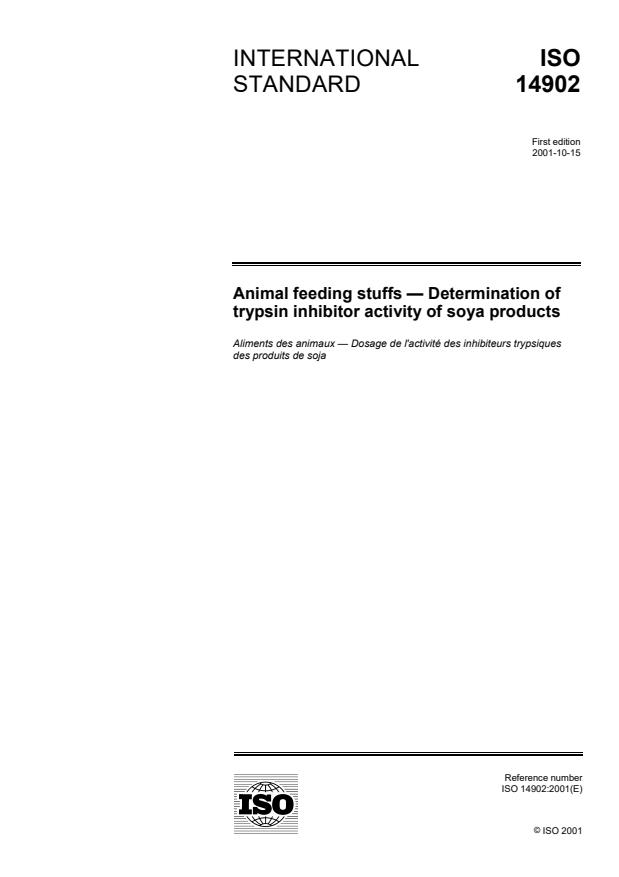
INTERNATIONAL ISO
STANDARD 14902
First edition
2001-10-15
Animal feeding stuffs — Determination of
trypsin inhibitor activity of soya products
Aliments des animaux — Dosage de l'activité des inhibiteurs trypsiques
des produits de soja
Reference number
©
ISO 2001
PDF disclaimer
This PDF file may contain embedded typefaces. In accordance with Adobe's licensing policy, this file may be printed or viewed but shall not
be edited unless the typefaces which are embedded are licensed to and installed on the computer performing the editing. In downloading this
file, parties accept therein the responsibility of not infringing Adobe's licensing policy. The ISO Central Secretariat accepts no liability in this
area.
Adobe is a trademark of Adobe Systems Incorporated.
Details of the software products used to create this PDF file can be found in the General Info relative to the file; the PDF-creation parameters
were optimized for printing. Every care has been taken to ensure that the file is suitable for use by ISO member bodies. In the unlikely event
that a problem relating to it is found, please inform the Central Secretariat at the address given below.
All rights reserved. Unless otherwise specified, no part of this publication may be reproduced or utilized in any form or by any means, electronic
or mechanical, including photocopying and microfilm, without permission in writing from either ISO at the address below or ISO's member body
in the country of the requester.
ISO copyright office
Case postale 56 � CH-1211 Geneva 20
Tel. + 41 22 749 01 11
Fax + 41 22 749 09 47
E-mail copyright@iso.ch
Web www.iso.ch
Printed in Switzerland
ii © ISO 2001 – All rights reserved
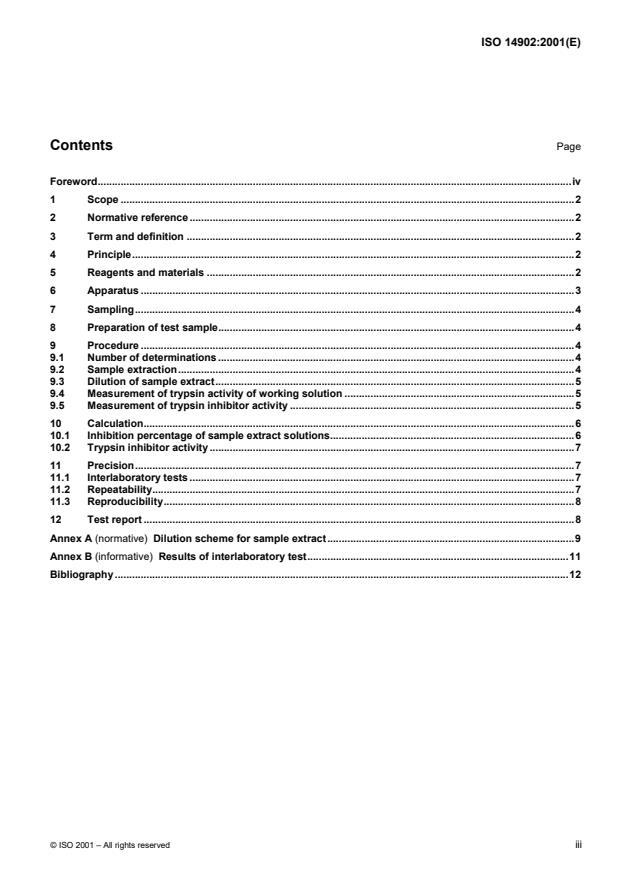
Contents Page
Foreword.iv
1 Scope .2
2 Normative reference .2
3 Term and definition .2
4 Principle.2
5 Reagents and materials .2
6 Apparatus .3
7 Sampling.4
8 Preparation of test sample.4
9 Procedure .4
9.1 Number of determinations .4
9.2 Sample extraction.4
9.3 Dilution of sample extract.5
9.4 Measurement of trypsin activity of working solution .5
9.5 Measurement of trypsin inhibitor activity .5
10 Calculation.6
10.1 Inhibition percentage of sample extract solutions.6
10.2 Trypsin inhibitor activity.7
11 Precision.7
11.1 Interlaboratory tests .7
11.2 Repeatability.7
11.3 Reproducibility.8
12 Test report .8
Annex A (normative) Dilution scheme for sample extract.9
Annex B (informative) Results of interlaboratory test.11
Bibliography.12
Foreword
ISO (the International Organization for Standardization) is a worldwide federation of national standards bodies (ISO
member bodies). The work of preparing International Standards is normally carried out through ISO technical
committees. Each member body interested in a subject for which a technical committee has been established has
the right to be represented on that committee. International organizations, governmental and non-governmental, in
liaison with ISO, also take part in the work. ISO collaborates closely with the International Electrotechnical
Commission (IEC) on all matters of electrotechnical standardization.
International Standards are drafted in accordance with the rules given in the ISO/IEC Directives, Part 3.
Draft International Standards adopted by the technical committees are circulated to the member bodies for voting.
Publication as an International Standard requires approval by at least 75 % of the member bodies casting a vote.
Attention is drawn to the possibility that some of the elements of this International Standard may be the subject of
patent rights. ISO shall not be held responsible for identifying any or all such patent rights.
International Standard ISO 14902 was prepared by Technical Committee ISO/TC 34, Food products,
Subcommittee SC 10, Animal feeding stuffs.
Annex A forms a normative part of this International Standard. Annex B is for information only.
iv © ISO 2001 – All rights reserved
INTERNATIONAL STANDARD ISO 14902:2001(E)
Animal feeding stuffs — Determination of trypsin inhibitor activity
of soya products
1 Scope
This International Standard specifies a method for the determination of the trypsin inhibitor activity (TIA) of soya
products.
This trypsin inhibitor activity is indicative of the degree of toasting of these products.
The detection limit of the method is 0,5 mg/g.
2 Normative reference
The following normative document contains provisions which, through reference in this text, constitute provisions of
this International Standard. For dated references, subsequent amendments to, or revisions of, any of these
publications do not apply. However, parties to agreements based on this International Standard are encouraged to
investigate the possibility of applying the most recent edition of the normative document indicated below. For
undated references, the latest edition of the normative document referred to applies. Members of ISO and IEC
maintain registers of currently valid International Standards.
ISO 3696:1987, Water for analytical laboratory use — Specification and test methods
3 Term and definition
For the purposes of this International Standard, the following term and definition applies.
3.1
trypsin inhibitor activity
TIA
mass of trypsin inhibited by the procedure described in this International Standard, divided by the mass of the test
sample
NOTE The trypsin inhibitor activity is expressed in milligrams per gram.
4Principle
Trypsin inhibitors are extracted from the sample at pH 9,5.
The remaining trypsin activity is measured by adding benzoyl-L-arginine-p-nitroanilide (L-BAPA) as substrate. The
quantity of released p-nitroaniline is measured spectrometrically.
5 Reagents and materials
Use only reagents of recognized analytical grade.
5.1 Water, complying with at least grade 3 in accordance with ISO 3696.
5.2 Sodium hydroxide solution, c(NaOH) = 0,01 mol/l.
5.3 Hydrochloric acid, c(HCl) = 6 mol/l.
5.4 Hydrochloric acid, c(HCl) = 1 mol/l.
5.5 Hydrochloric acid, c(HCl) = 0,1 mol/l.
5.6 Hydrochloric acid, c(HCl) = 0,001 mol/l.
5.7 Acetic acid, c(CH COOH) = 5,3 mol/l.
5.8 Calcium chloride dihydrate,CaCl �2H O.
2 2
5.9 Calcium chloride solution in hydrochloric acid.
Dissolve 735 mg of calcium chloride dihydrate (5.8) in 1 l of hydrochloric acid (5.6) and check the pH. The pH shall
be 3,0 � 0,1.
1)
5.10 Bovine trypsin (Merck No. 24579 or equivalent).
See 9.4 for measurement of the activity. Store in the refrigerator (6.3).
5.11 Trypsin stock solution
Allow the trypsin (5.10) to reach room temperature. Dissolve 27,0 mg of trypsin in the calcium chloride solution
(5.9) in a 100 ml volumetric flask (6.1) and dilute to the mark with the calcium chloride solution. This solution can be
used for 5 days at most when stored in the refrigerator (6.3).
5.12 Trypsin working solution.
Pipette 5 ml of the trypsin stock solution (5.11) into a 100 ml volumetric flask (6.1) and dilute to the mark with
calcium chloride solution (5.9).
5.13 Benzoyl-L-arginine-p-nitroanilide (L-BAPA).
5.14 Tris-(hydroxymethyl)aminomethane (Tris).
5.15 Dimethyl sulfoxide (DMSO).
5.16 Tris buffer/calcium chloride solution.
Dissolve 6,05 g of Tris (5.14) and 735 mg of calcium chloride (5.8) in 900 ml of water in a 1 l graduated measuring
cylinder. Adjust the pH to 8,2 � 0,1 with hydrochloric acid (5.3) and dilute to 1 l with water.
5.17 L-BAPA reagent.
Prepare this reagent on the day of use. Dissolve 60 mg of L-BAPA (5.13) in 1 ml of DMSO (5.15) in a 100 ml
volumetric flask (6.1) and dilute to the mark with Tris buffer/calcium chloride solution (5.16).
1) Merck No. 24579 is an example of a suitable product available commercially. This information is given for the convenience
of users of this International Standard and does not constitute an endorsement by ISO of this product.
2 © ISO 2001 – All rights reserved
6 Apparatus
Usual laboratory apparatus and, in particular, the following.
6.1 Volumetric flasks, of capacity 100 ml.
6.2 Cuvettes, with optical p
...