

ISO 10137:2007
(Main)Bases for design of structures - Serviceability of buildings and walkways against vibrations
General Information
- Abstract
ISO 10137:2007 gives recommendations on the evaluation of serviceability against vibrations of buildings, and walkways within buildings or connecting them or outside of buildings. It covers three recipients of vibrations: human occupancy in buildings and on walkways; the contents of the building; the structure of the building. It does not include bridges that carry vehicular traffic, even in conjunction with pedestrian traffic, nor the design of foundations or supporting structures of machinery.
- Status
- Published
- Publication Date
- 06-Nov-2007
- Technical Committee
- ISO/TC 98/SC 2 - Reliability of structures
- Drafting Committee
- ISO/TC 98/SC 2 - Reliability of structures
- Current Stage
- 9093 - International Standard confirmed
- Start Date
- 15-Feb-2024
- Completion Date
- 29-Aug-2026
Overview
ISO 10137:2007 - Bases for design of structures: Serviceability of buildings and walkways against vibrations - provides internationally recognized recommendations for evaluating and controlling the serviceability of buildings and walkways subject to vibrations. The standard addresses vibration effects on three recipients: human occupants, building contents (equipment/processes), and the structural elements themselves. It excludes vehicular bridges and the design of machinery foundations. ISO 10137:2007 assumes linear structural response and focuses on serviceability (comfort and functional performance), not structural safety.
Key topics and requirements
- Scope and recipients: Clear definition of applicability to buildings and walkways and the three vibration recipients (humans, contents, structure).
- Sources of dynamic actions: Detailed treatment of vibration sources such as machinery (rotating, reciprocating, impacting), vehicular traffic (road and rail), impulsive sources, human activity, wind and earthquakes.
- Transmission path and receivers: Guidance on how vibrations propagate and how receivers (occupants, equipment, structural elements) are affected.
- Evaluation methods:
- Analytical calculation methods for predicting dynamic response, including damping considerations and propagation in continuous vs discrete media.
- Measurement-based assessment, specifying quantities to measure, measurement apparatus and ranges, arrangement of measurement points, and reporting.
- Vibration criteria: Serviceability limit criteria for:
- Human occupancy (including specific guidance for walkways and wind-induced motions),
- Building contents (sensitive equipment and processes), and
- Structural response (including impulses and empirical criteria).
- Vibration control and mitigation: Recommended approaches to control or mitigate unacceptable vibration levels; informative annexes provide mitigation methods and worked examples.
- Documentation: Requirements for measurement reports and analysis results.
Applications
ISO 10137:2007 is used to:
- Predict and limit occupant discomfort in offices, residential buildings, stadiums and pedestrian walkways.
- Ensure functional performance of vibration-sensitive laboratories, hospitals, precision manufacturing and data centers.
- Assess existing buildings for retrofit, and to specify vibration performance during design of lightweight/high-strength structures.
- Guide contractors and consultants when specifying measurement campaigns and interpreting results.
Who should use this standard
- Structural and civil engineers
- Vibration specialists and acoustical consultants
- Architects and building services engineers
- Facility managers and owners of vibration-sensitive installations
- Construction and retrofit project teams
Related standards
- ISO 2394 (serviceability limit states - referenced in introduction)
- Normative references included in the standard (e.g., ISO 2041, ISO 2372) for vibration terminology and measurement practice.
ISO 10137:2007 is a practical reference for designing and evaluating buildings to meet modern expectations for vibration comfort and functional performance.
Relations
- Revises
ISO 10137:1992 - Bases for design of structures — Serviceability of buildings against vibration - Effective Date
- 15-Apr-2008
Get Certified
Connect with accredited certification bodies for this standard

DIBt (Deutsches Institut für Bautechnik)
German Institute for Building Technology.
DIN CERTCO
DIN Group product certification.

Aboma Certification B.V.
Specialized in construction, metal, and transport sectors.
Sponsored listings
Frequently Asked Questions
ISO 10137:2007 is a standard published by the International Organization for Standardization (ISO). Its full title is "Bases for design of structures - Serviceability of buildings and walkways against vibrations". This standard covers: ISO 10137:2007 gives recommendations on the evaluation of serviceability against vibrations of buildings, and walkways within buildings or connecting them or outside of buildings. It covers three recipients of vibrations: human occupancy in buildings and on walkways; the contents of the building; the structure of the building. It does not include bridges that carry vehicular traffic, even in conjunction with pedestrian traffic, nor the design of foundations or supporting structures of machinery.
ISO 10137:2007 gives recommendations on the evaluation of serviceability against vibrations of buildings, and walkways within buildings or connecting them or outside of buildings. It covers three recipients of vibrations: human occupancy in buildings and on walkways; the contents of the building; the structure of the building. It does not include bridges that carry vehicular traffic, even in conjunction with pedestrian traffic, nor the design of foundations or supporting structures of machinery.
ISO 10137:2007 is classified under the following ICS (International Classification for Standards) categories: 91.080.01 - Structures of buildings in general; 91.120.25 - Seismic and vibration protection. The ICS classification helps identify the subject area and facilitates finding related standards.
ISO 10137:2007 has the following relationships with other standards: It is inter standard links to ISO 10137:1992. Understanding these relationships helps ensure you are using the most current and applicable version of the standard.
ISO 10137:2007 is available in PDF format for immediate download after purchase. The document can be added to your cart and obtained through the secure checkout process. Digital delivery ensures instant access to the complete standard document.
Standards Content (Sample)
INTERNATIONAL ISO
STANDARD 10137
Second edition
2007-11-15
Bases for design of structures —
Serviceability of buildings and walkways
against vibrations
Bases du calcul des constructions — Aptitude au service des bâtiments
et des passerelles sous vibrations
Reference number
©
ISO 2007
PDF disclaimer
This PDF file may contain embedded typefaces. In accordance with Adobe's licensing policy, this file may be printed or viewed but
shall not be edited unless the typefaces which are embedded are licensed to and installed on the computer performing the editing. In
downloading this file, parties accept therein the responsibility of not infringing Adobe's licensing policy. The ISO Central Secretariat
accepts no liability in this area.
Adobe is a trademark of Adobe Systems Incorporated.
Details of the software products used to create this PDF file can be found in the General Info relative to the file; the PDF-creation
parameters were optimized for printing. Every care has been taken to ensure that the file is suitable for use by ISO member bodies. In
the unlikely event that a problem relating to it is found, please inform the Central Secretariat at the address given below.
© ISO 2007
All rights reserved. Unless otherwise specified, no part of this publication may be reproduced or utilized in any form or by any means,
electronic or mechanical, including photocopying and microfilm, without permission in writing from either ISO at the address below or
ISO's member body in the country of the requester.
ISO copyright office
Case postale 56 • CH-1211 Geneva 20
Tel. + 41 22 749 01 11
Fax + 41 22 749 09 47
E-mail copyright@iso.org
Web www.iso.org
Published in Switzerland
ii © ISO 2007 – All rights reserved
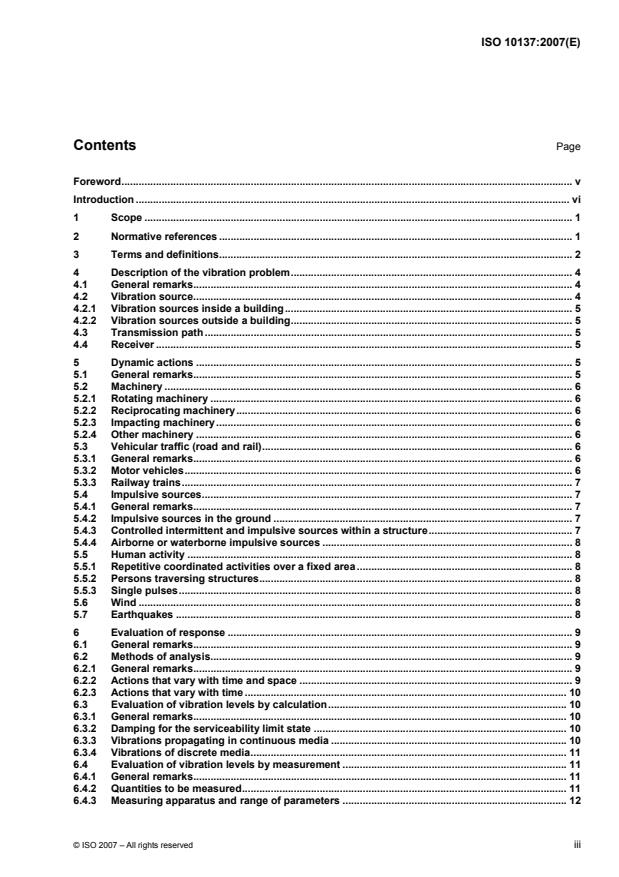
Contents Page
Foreword. v
Introduction . vi
1 Scope . 1
2 Normative references . 1
3 Terms and definitions. 2
4 Description of the vibration problem. 4
4.1 General remarks. 4
4.2 Vibration source. 4
4.2.1 Vibration sources inside a building. 5
4.2.2 Vibration sources outside a building. 5
4.3 Transmission path. 5
4.4 Receiver . 5
5 Dynamic actions . 5
5.1 General remarks. 5
5.2 Machinery . 6
5.2.1 Rotating machinery . 6
5.2.2 Reciprocating machinery. 6
5.2.3 Impacting machinery. 6
5.2.4 Other machinery . 6
5.3 Vehicular traffic (road and rail). 6
5.3.1 General remarks. 6
5.3.2 Motor vehicles. 6
5.3.3 Railway trains. 7
5.4 Impulsive sources. 7
5.4.1 General remarks. 7
5.4.2 Impulsive sources in the ground . 7
5.4.3 Controlled intermittent and impulsive sources within a structure. 7
5.4.4 Airborne or waterborne impulsive sources . 8
5.5 Human activity . 8
5.5.1 Repetitive coordinated activities over a fixed area . 8
5.5.2 Persons traversing structures. 8
5.5.3 Single pulses. 8
5.6 Wind . 8
5.7 Earthquakes . 8
6 Evaluation of response . 9
6.1 General remarks. 9
6.2 Methods of analysis. 9
6.2.1 General remarks. 9
6.2.2 Actions that vary with time and space . 9
6.2.3 Actions that vary with time . 10
6.3 Evaluation of vibration levels by calculation.10
6.3.1 General remarks. 10
6.3.2 Damping for the serviceability limit state . 10
6.3.3 Vibrations propagating in continuous media . 10
6.3.4 Vibrations of discrete media. 11
6.4 Evaluation of vibration levels by measurement . 11
6.4.1 General remarks. 11
6.4.2 Quantities to be measured. 11
6.4.3 Measuring apparatus and range of parameters . 12
6.4.4 Arrangement of measurement points .12
6.4.5 Vibration measurement analysis and results. 13
6.4.6 Measurement report. 13
7 Vibration criteria for the serviceability limit state. 13
7.1 General remarks. 13
7.1.1 Criteria for human occupants. 14
7.1.2 Criteria for building contents. 14
7.1.3 Criteria for building structures . 14
7.2 Vibration criteria for human occupancies .14
7.2.1 General remarks. 14
7.2.2 Requirements for walkways. 15
7.3 Vibration criteria for building contents. 15
7.3.1 General remarks. 15
7.3.2 Vibration criteria for equipment and processes in buildings under design . 16
7.3.3 Evaluation of vibrations in existing buildings . 16
7.4 Vibration criteria for building structures . 16
7.4.1 General remarks. 16
7.4.2 Criteria for vibrations from impacts/impulses . 17
7.4.3 Criteria for vibrations from other actions. 17
7.4.4 Empirical criteria . 17
7.4.5 Application of vibration criteria to measured vibrations . 17
8 Vibration control . 17
9 Vibration mitigation . 18
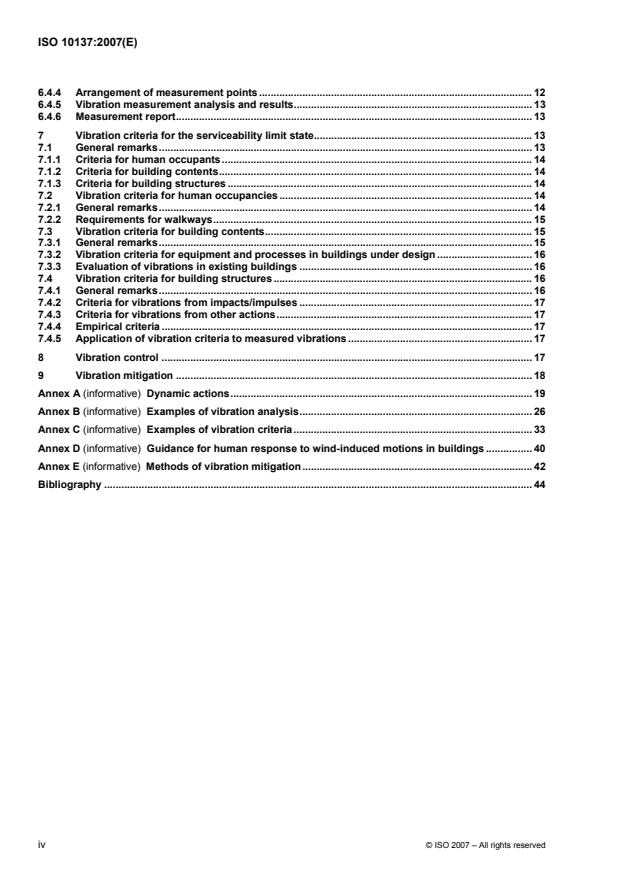
Annex A (informative) Dynamic actions. 19
Annex B (informative) Examples of vibration analysis. 26
Annex C (informative) Examples of vibration criteria. 33
Annex D (informative) Guidance for human response to wind-induced motions in buildings . 40
Annex E (informative) Methods of vibration mitigation. 42
Bibliography . 44
iv © ISO 2007 – All rights reserved
Foreword
ISO (the International Organization for Standardization) is a worldwide federation of national standards bodies
(ISO member bodies). The work of preparing International Standards is normally carried out through ISO
technical committees. Each member body interested in a subject for which a technical committee has been
established has the right to be represented on that committee. International organizations, governmental and
non-governmental, in liaison with ISO, also take part in the work. ISO collaborates closely with the
International Electrotechnical Commission (IEC) on all matters of electrotechnical standardization.
International Standards are drafted in accordance with the rules given in the ISO/IEC Directives, Part 2.
The main task of technical committees is to prepare International Standards. Draft International Standards
adopted by the technical committees are circulated to the member bodies for voting. Publication as an
International Standard requires approval by at least 75 % of the member bodies casting a vote.
Attention is drawn to the possibility that some of the elements of this document may be the subject of patent
rights. ISO shall not be held responsible for identifying any or all such patent rights.
ISO 10137 was prepared by Technical Committee ISO/TC 98, Bases for design of structures, Subcommittee
SC 2, Reliability of structures.
This second edition cancels and replaces the first edition (ISO 10137:1992) and differs from the previous
edition as follows:
⎯ information on relevant International Standards have been updated;
⎯ treatment of vibrations from rock bursts has been added;
⎯ actions due to human activities have been updated (Annex A);
⎯ serviceability criteria for occupants of buildings subjected to wind-induced vibrations have been added
(Annex D);
⎯ the bibliography has been revised and updated;
⎯ editorial changes and clarifications of text have been made.
Introduction
Economic use of high-strength and lightweight materials has resulted in a trend towards more dynamically
responsive structures. This trend is exacerbated by the emergence of new sources of vibration acting on
buildings and walkways, and is compounded by an increasing demand for “vibration free” environments for
proper functioning of industrial and laboratory processes and instruments, and for work efficiency and
personal comfort. In the past, vibrations in buildings have largely been controlled by specified loads or
limitation of static deflections, or they have simply not occurred because of the massive nature of buildings. A
number of unsatisfactory vibration levels in buildings have been observed, however, and this seems to
indicate that the indirect criteria are no longer adequate. Hence, this International Standard was developed
with the objective of presenting the principles for predicting vibrations at the design stage, in addition to
assessing the acceptability of vibrations in existing structures.
The recommendations presented here are for serviceability and not for safety. It is, however, possible that
some vibrations (usually associated with resonance) can become a safety hazard. Therefore, for severe
dynamic loading, a check on the possible occurrence of resonance and associated limit stresses, deflections
and fatigue effects shall be carried out. The vibration effects discussed here represent a serviceability limit
state in accordance with ISO 2394.
The serviceability limit state for vibrations is described by constraints, generally consisting of vibration values
(displacement, velocity or acceleration), usually in combination with frequency or a frequency range and
possibly with other parameters. The constraints can also be connected to stress, strain, cracking occurrence
and duration. The constraints can be determined statistically, but are generally prescribed in codes
deterministically.
The design or evaluation criteria employed for achieving satisfactory vibration behaviour of buildings and
walkways in the serviceability limit state should consider, among others, the following aspects:
a) variability of tolerance of human occupants due to cultural, regional or economic factors;
b) sensitivity of building contents to vibrations and changing use and occupancy;
c) emergence of new dynamic loadings which are not explicitly addressed by this International Standard;
d) use of materials whose dynamic characteristics may change with time;
e) impracticality of analysis due to the complexity of the structure or complexity of the loading;
f) social or economic consequences of unsatisfactory performance.
vi © ISO 2007 – All rights reserved
INTERNATIONAL STANDARD ISO 10137:2007(E)
Bases for design of structures — Serviceability of buildings and
walkways against vibrations
1 Scope
This International Standard gives recommendations on the evaluation of serviceability against vibrations of
buildings, and walkways within buildings or connecting them or outside of buildings.
It covers three recipients of vibrations:
a) human occupancy in buildings and on walkways;
b) the contents of the building;
c) the structure of the building.
It does not include bridges that carry vehicular traffic, even in conjunction with pedestrian traffic, nor the
design of foundations or supporting structures of machinery.
For the purposes of this International Standard, it is assumed that the building structure responds linearly to
the applied loads. This means that the structure does not yield or fail, nor is it subject to significant non-linear
effects.
2 Normative references
The following referenced documents are indispensable for the application of this document. For dated
references, only the edition cited applies. For undated references, the latest edition of the referenced
document (including any amendments) applies.
ISO 2041, Mechanical vibration, shock and condition monitoring — Vocabulary
ISO 2372, Mechanical vibration of machines with operating speeds from 10 to 200 rev/s — Basis for
specifying evaluation standards
ISO 2394:1998, General principles on reliability for structures
ISO 2631-1:1997, Mechanical vibration and shock — Evaluation of human exposure to whole-body
vibration — Part 1: General requirements
ISO 2631-2:2003, Mechanical vibration and shock — Evaluation of human exposure to whole-body
vibration — Part 2: Vibration in buildings (1 Hz to 80 Hz)
ISO 3010:2001, Basis for design of structures — Seismic actions on structures
ISO 3898, Bases for design of structures — Notations — General symbols
ISO 4354, Wind actions on structures
ISO 4866:1990, Mechanical vibration and shock — Vibration of buildings — Guidelines for the measurement
of vibrations and evaluation of their effects on buildings
ISO 6897, Guidelines for the evaluation of the response of occupants of fixed structures, especially buildings
and off-shore structures, to low-frequency horizontal motion (0,063 to 1 Hz)
ISO 8041, Human response to vibration — Measuring instrumentation
ISO 8569, Mechanical vibration and shock — Measurement and evaluation of shock and vibration effects on
sensitive equipment in buildings
ISO 8930, General principles on reliability for structures — List of equivalent terms
ISO/TS 10811-1, Mechanical vibration and shock — Vibration and shock in buildings with sensitive
equipment — Part 1: Measurement and evaluation
ISO/TS 10811-2, Mechanical vibration and shock — Vibration and shock in buildings with sensitive
equipment — Part 2: Classification
ISO 10816 (all parts), Mechanical vibration — Evaluation of machine vibration by measurements on non-
rotating parts
ISO 14837-1, Mechanical vibration — Ground-borne noise and vibration arising from rail systems — Part 1:
General Guidance
3 Terms and definitions
For the purposes of this document, the terms and definitions given in ISO 2041 and ISO 8930 and the
following apply.
NOTE See also ISO 3898 and ISO 2394.
3.1
amplification
increase of vibration amplitudes relative to a reference amplitude
3.2
attenuation
loss of vibration energy along a transmission path
3.3
broadband spectrum
spectrum with the vibration distributed over broad frequency bands (e.g. octave-band spectrum, one-third-
octave band spectrum)
3.4
damping
dissipation of energy in a vibrating system
3.5
dynamic actions
actions varying so quickly that they give rise to vibrations
3.6
dynamic forces
forces varying so quickly that they give rise to vibrations
3.7
Fourier transformation
mathematical procedure that transforms a time record into a complex frequency spectrum (Fourier spectrum)
without loss of information
2 © ISO 2007 – All rights reserved
3.8
frequency components
centre frequencies of narrow bands in which the energy of a spectrum is concentrated
3.9
frequency response function
frequency spectrum function of the output signal divided by the frequency spectrum function of the input signal
NOTE The frequency response is usually given graphically by curves showing the amplitude relationship and, where
applicable, phase shift or phase angle, as a function of frequency. Alternatively, it is the Fourier transformation of the
response of the structure to an impulse.
3.10
geometric spreading
decay of vibration amplitudes with increasing distance from the source as the energy is spread over a larger
volume
3.11
impulsive source
source which gives a dynamic action of a short duration compared with the natural period of the structure
under consideration
3.12
mode of vibration
deflected shape at a particular natural frequency of a system undergoing free vibration
3.13
narrow-band spectrum
spectrum with the vibration concentrated in narrow frequency bands
3.14
natural frequency
frequency at which a mode of vibration will oscillate under free vibrations
3.15
octave-band spectrum
spectrum determined by means of a filter cutting off frequencies outside a band, where the maximum
frequency in each band is equal to the minimum frequency multiplied by 2
3.16
receiver
person, structure or contents of a building subjected to vibrations
3.17
response spectrum
maximum responses of a series of single-degree-of-freedom systems subjected to a given dynamic base
motion, plotted as a function of natural frequencies for specific values of damping
3.18
shock
dynamic action with a duration that is short compared to the natural period of the receiver
3.19
shock spectrum
response spectrum for a shock motion
3.20
source
origin of the vibration
3.21
spectrum
plot of a time-varying function transformed into the frequency domain
3.22
sustained vibration
vibration having a duration of many periods
3.23
third-octave-band spectrum
spectrum determined by means of a filter cutting off frequencies outside a band, where the maximum
⅓
frequency in each band is equal to the minimum frequency multiplied by 2
3.24
transfer function
for a system, a mathematical relation in the frequency domain between the output and the input to the system
3.25
transmission path
path from the source to the receiver
3.26
unbalanced force
force originating from unbalance of a rotating mass at the source
3.27
walkway
footbridge
pedestrian bridge
structure carrying pedestrian traffic, but no motorized vehicles, within buildings, between buildings or outside
of buildings
4 Description of the vibration problem
4.1 General remarks
Vibrations arise from the interaction between time-varying disturbances and the inertia properties of the
affected medium. The disturbance can be in the form of forces or displacement functions; the affected media
can be solids, liquids or gases. The vibration process can be described mathematically by employing
Newton’s laws of motion and incorporating the appropriate deformational properties of the affected medium.
The evaluation of vibrations in buildings and walkways has to take account of the characteristics of the
vibration source, the transmission path and the receiver. The vibration source produces the dynamic forces or
actions. The medium or the structure between the source and receiver constitutes the transmission path, and
the resulting vibrations at the receiver are then subject to the applicable criteria of the specified serviceability
limit state. The dynamic actions are, in general, a function of time and space and are described in Clause 5.
Clause 6 deals with methods of response analysis and Clause 7 with applicable vibration criteria. The values
of actions, effects and criteria presented in this International Standard are some of the other representative
values given in ISO 2394:1998, 6.2.1. Whenever data are available, the method of partial coefficients, in
accordance with ISO 2394, should be employed for verification of the serviceability.
4.2 Vibration source
The vibration source can be inside or outside the building.
4 © ISO 2007 – All rights reserved
4.2.1 Vibration sources inside a building
Vibration sources inside a building include:
⎯ human excitation;
⎯ rotating and reciprocating machinery;
⎯ impact machinery (punches, presses, etc.);
⎯ moving machinery (trolleys, lift trucks, elevators, conveyors, overhead cranes, etc.);
⎯ construction or demolition activity in other parts of the building.
4.2.2 Vibration sources outside a building
Vibration sources outside a building can occur on the ground surface, underground, in the air, or in water,
such as:
⎯ construction, mining or quarry blasting;
⎯ construction activity (pile driving, compaction, excavation, etc.);
⎯ road and rail traffic;
⎯ sonic boom or air blast;
⎯ fluid flow (wind or water);
⎯ punching presses or other machinery in nearby buildings;
⎯ impact of ships on nearby wharves;
⎯ rock bursts,
4.3 Transmission path
The transmission path has the effect of modifying the vibrations from the source to the receiver due to
discontinuities, attenuation due to geometric spreading and material damping, and possible amplification or
attenuation in certain frequency ranges.
4.4 Receiver
The receiver of the vibrations is the object or person for which the vibration effects are to be assessed. This
can encompass the building structure (or components such as beams, slabs, walls, windows, etc.), the
contents of the building (instruments, machines, etc.), or the human occupants of the building.
5 Dynamic actions
5.1 General remarks
The dynamic actions are the forces, displacements, velocities, accelerations or energy associated with the
vibration source. In many cases, the dynamic actions cannot be predicted in a deterministic sense, in which
case it may be appropriate to consider the actions as random.
5.2 Machinery
5.2.1 Rotating machinery
Values for the unbalanced forces of rotating machinery should be supplied by the manufacturers. In the
absence of such data, the maximum acceptable unbalanced forces for the respective category of machines
can be taken from ISO 2372 for electrical machines, or ISO 10816 for large rotating machines, or from other
applicable standards. The forces produced by unbalance change with the flexibility of support conditions, and
whether the operating frequency is above or below the mounted resonance frequency of the machine. There
is also a trend for unbalanced forces to increase as machines age, and allowance for this effect should be
made. Machines and their components can induce large forces during breakdowns or rapid stoppages. These
actions should be considered in assessing the serviceability limit state. Unbalanced forces from attachments
to machines (transmissions, rotors, etc.) also need to be considered.
Start-up and run-down conditions shall be considered when the operating frequency is above any of the
resonance frequencies of the mounted machine or any of the support elements or structures.
5.2.2 Reciprocating machinery
The actions of reciprocating machinery depend on the type and construction of the machine, the operating
conditions such as rotational speed and load, mounting details, and the age and state of maintenance of the
machine. The quantitative descriptions of actions should be available from the manufacturer, but can be
measured or calculated in the form of time histories of forces or displacement functions (accelerations,
velocities or displacements) or the spectra of these quantities.
5.2.3 Impacting machinery
This includes machines such as forge hammers, stamping presses and pile drivers. The forces generated are
usually very large. The action can be described in terms of a displacement (or velocity or acceleration)-time
history or energy per impact. These values should be provided by the manufacturer but can be derived by
measurements or calculations.
5.2.4 Other machinery
Certain machinery (e.g. grinding mills) combine random-type excitations with other types of excitation, such as
rotational or, possibly, impact.
5.3 Vehicular traffic (road and rail)
5.3.1 General remarks
Motor vehicles with pneumatic tyres and trains on rails are two major sources of vibrations. The action can be
described by force-time functions, displacement functions, or by a source spectrum. Stationary point sources,
line sources, area sources, or moving sources shall be considered as applicable. Because of the complexity of
the problem, empirical methods based upon measurements are often required. These may be combined with
analytical and numerical modelling, as appropriate.
5.3.2 Motor vehicles
Vibrations induced by motor vehicles depend on suspension characteristics, mass, speed, traffic density, type
and roughness of the road (including discrete irregularities), and subgrade properties.
The effects of these factors are interrelated and cannot be described by simple formulae.
6 © ISO 2007 – All rights reserved
5.3.3 Railway trains
Major factors that affect vibrations induced by railway trains are the following;
⎯ type of train (high speed, ordinary, subway, etc.);
⎯ weight;
⎯ speed;
⎯ type of track, or type of rail (continuous rails, jointed rails, surface irregularities, etc.);
⎯ ballast, subgrade and general soil conditions.
The effects of these factors are interrelated and cannot be described by simple formulae. General guidance
on vibrations from trains is given in ISO 14837-1.
5.4 Impulsive sources
5.4.1 General remarks
The characteristics of the vibration source are described in terms of the time variation of force, pressure or
displacement function (including velocity and acceleration). Approximate descriptions include the following:
⎯ peak values and duration for impulsive sources;
⎯ root-mean-square (r.m.s.), or peak and frequency content for sustained vibrations;
⎯ statistical descriptions, such as r.m.s., third-octave, octave and narrow-band spectra;
⎯ response (or shock) spectra.
When r.m.s. quantities are used, attention should be paid to the method of averaging. It is assumed that there
are only a few occurrences per day and that the total duration of the activity is of a temporary nature (e.g.
construction). It is recommended to use a 1 s averaging time as given in 6.3.1 of ISO 2631-1:1997.
5.4.2 Impulsive sources in the ground
The main characteristic of impulsive sources, such as construction blasting, surface mining and pile driving is
the energy released into the ground. The ground motion parameters at a given distance from the source can
be obtained by empirical methods based on measurements, resulting in ground motion bounds and estimated
response spectra.
Rock bursts, caused by collapse of underground cavities or localized re-arrangement of rock as a result of
previous or ongoing mining activity, share many characteristics with earthquakes, albeit on a smaller scale.
The ground motion characteristics at a building site can be described by peak values, time series and/or
response spectra. These characteristics will vary with the geology and mining history at or near the building
site. Methods of characterizing ground motions from rock bursts for the serviceability limit state can be found
in ISO 3010.
5.4.3 Controlled intermittent and impulsive sources within a structure
Vibrations can be induced by controlled demolition operations and also by particular production processes
which are not regular in time and intensity. These sources include the following:
⎯ use of heavy equipment (vehicles, vibratory rollers or breakers, wrecking tools, etc.);
⎯ controlled blasting within the structure;
⎯ falling of heavy objects.
Cranes and lifts (elevators) can also induce impulsive forces during starting and stopping operations.
NOTE Accidental explosions or other types of accident which produce vibrations are not considered in this
International Standard.
5.4.4 Airborne or waterborne impulsive sources
For explosive charges, the action is described in terms of the energy release or the overpressure-time
variation. Sonic boom resulting from supersonic aircraft can be described in the form of pressure-time
variations.
5.5 Human activity
5.5.1 Repetitive coordinated activities over a fixed area
For many repetitive coordinated human activities, the dynamic action is distributed more or less uniformly over
a major portion of the structure. The active participants do not change their position, or the entire group of
people moves so as to maintain a more or less uniform loading. This includes gymnastic exercises, dancing,
coordinated jumping, running of a group of people, spectator action in halls or stadiums, or similar activities.
The actions can be described by force-time histories or their spectral components.
5.5.2 Persons traversing structures
The dynamic actions of one or more persons can be presented as force-time histories or as their
corresponding frequency components. This action varies with time and position as the person or persons
traverse the supporting structure.
NOTE Special attention needs to be paid to avoid resonance effects in walkways with low horizontal and vertical
natural frequencies. Some guidance is given in Annex A and Annex C.
5.5.3 Single pulses
Single pulses result from
⎯ persons jumping off objects,
⎯ persons jumping off steps on staircases or in floors,
⎯ accidental or deliberate dropping of objects onto floors, or
⎯ a single coordinated action, such as spectators jumping to their feet (for example at a sports event).
The action can be described in terms of force-time variations (or their Fourier transformation) or the impulse of
the event.
NOTE Some descriptions of dynamic actions from human activities are given in Annex A.
5.6 Wind
The actions induced in structures by wind are specified in ISO 4354.
5.7 Earthquakes
The actions induced in structures by earthquakes are specified in ISO 3010.
8 © ISO 2007 – All rights reserved
6 Evaluation of response
6.1 General remarks
The analysis of response requires a calculation model that incorporates the characteristics of the source and
of the transmission path and which is then solved for the vibration response at the receiver. The type and
complexity of the calculation model depends on the dynamic behaviour it must represent and by the accuracy
required in the prediction of the vibration response. The simplifying assumptions employed in establishing and
solving the calculation model shall be noted. The analysis may concern existing structures or may be a part of
the design of new structures.
Vibrations in existing building structures should be evaluated by measurements, whenever possible, in order
to complete and to check eventual calculations.
Approximate methods for predicting vibrations may be employed where
a) the approximating assumptions correspond closely to known reality, or
b) the overall effect has been verified by field experience and/or more refined calculations.
6.2 Methods of analysis
6.2.1 General remarks
Vibration problems can be classified in many ways, for example by amplitude, duration and frequency content.
The analysis required is, in turn, dictated by the type of vibration source and the transmission path. If the
dynamic actions are random, it may be appropriate to use random vibration theory.
Two broad classes of vibration problems can be identified:
⎯ Class A: the actions of the vibration source change in time and space.
⎯ Class B: the actions of the vibration source change in time but either are, or can be considered to be,
stationary in space.
NOTE Examples of Class A: a vehicle moving along a street, a person walking across a floor; examples of Class B:
vibrations from a mounted piece of machinery, people jumping in unison on a floor; examples of empirical methods:
prediction of blasting vibrations, prediction of traffic vibrations.
Empirical methods are employed when the complete analytical solution of a problem may not be practical.
Empirical methods can be used when they have been derived from a large number of experimental or
theoretical results and where bounds of applicability have been established. When empirical methods and
criteria are used for problems other than those for which they were derived, the applicability to the new
situation needs to be verified.
The exact characteristics of the vibration source, transmission path and receiver may not always be well
defined. This is particularly so when humans are both the vibration source and receivers, and when the very
presence of humans on the structure may change its dynamic properties, as is the case for crowd loading on
assembly structures. Similar uncertainties may exist in other problems involving vibrations. Therefore, some
form of reliability analysis may need to be carried out (ISO 2394).
6.2.2 Actions that vary with time and space
When the action varies both in time and space, vibration problems become very difficult to solve analytically.
For this reason, suitable simplifications are often sought in order to eliminate or uncouple the space variable.
The complexity of these problems is one reason why many of them have been treated by empirical methods,
or by extensive use of measurements on similar existing structures.
6.2.3 Actions that vary with time
When the vibration source does not move in space, many analysis methods can be employed to solve
vibration problems. Common solution techniques involve the derivation of an equivalent single-degree-of-
freedom system or modal analysis for both continuous and discrete systems.
6.3 Evaluation of vibration levels by calculation
6.3.1 General remarks
For the determination of the vibration levels at the receiver, in general, a two-step procedure is necessary:
a) mathematical modelling of the dynamic characteristics of the structure, foundation or component;
b) calculation of the response at the receiver, taking account of the vibration source characteristics.
The mathematical model can either be based on continuous mass distribution or discrete mass distribution
(multi-degree-of-freedom system).
NOTE Some examples of mathematical modelling and response calculations are given in Annex B.
6.3.2 Damping for the serviceability limit state
Damping is an important property that governs the response at or near resonances. Damping depends on the
materials employed, construction details, and the presence of non-structural components, such as floor
coverings, ceilings, mechanical equipment and partitions. Also, people will add to the overall level of damping.
In general, damping cannot be calculated or predicted reliably, and experience with similar types of
construction provides a likely source of appropriate damping data. Whenever possible, the damping data
should be established by measurements. It should be noted that damping in buildings and building
components is often amplitude dependent, and this shall be taken into account when measured data is
employed for calculating dynamic response at various amplitudes. A number of damping mechanisms can be
identified (e.g. viscous, frictional, hysteretic and a combination thereof), and are modelled mathematically in
different ways. Care shall be taken in designating the damping mechanism and the limits associated with it.
NOTE Specific examples of damping values can be found in Annex B. Values of damping for various serviceability
limit states need to be chosen to reflect, among other things, the level of response (e.g. earthquake versus traffic
vibrations; cracked versus uncracked state for concrete).
6.3.3 Vibrations propagating in continuous media
Continuous media (or continua) are those physical systems for which the wavelength of the action is
substantially shorter than the physical dimensions of the medium. For such cases, when calculating
transmission of vibrations one needs to employ principles of wave propagation theory.
When calculating vibrations propagating in continua one needs to consider the following:
a) coupling effects at the source;
b) material properties of transmitting medium:
1) mass (density),
2) degree of saturation,
3) stiffness,
4) damping;
10 © ISO 2007 – All rights reserved
c) geometric spreading of transmitting medium:
1) various forms of layering,
2) discontinuities and shielding,
3) geometric attenuation with distance from the source;
d) effects of interaction of the structure with soil or with a fluid;
e) transmission to the receiver within the building.
Layering and changes in geometry along the propagation path can lead to local amplification or attenuation in
selected frequency ranges. For soils, the degree of compaction, saturation (e.g. location of the water table)
and internal friction of the materials affect the attenuation characteristics of vibration with distance. In general,
these situations are too complicated to be treated quantitatively; consequently they are often assessed by
empirical methods.
The transmission properties shall be determined analytically or experimentally as functions of frequency (i.e.
frequency res
...