

ISO 8066-3:2020
(Main)Rubber and plastics hoses and hose assemblies for automotive air conditioning — Specification — Part 3: Refrigerant 1234yf
General Information
- Abstract
This document specifies the requirements for rubber or thermoplastic hoses and hose assemblies used for circulating liquid and gaseous R1234yf (tetrafluoropropene) in the air-conditioning systems of automobiles. The hoses and hose assemblies are designed in such a way as to restrict losses of refrigerant and contamination of the system. The operational temperature range is −40 °C to +125 °C. Due to the critical relationship between the hose and coupling for this application, a requirement that the coupling to be used in service be used for testing has been laid down.
- Status
- Published
- Publication Date
- 13-Aug-2020
- Technical Committee
- ISO/TC 45/SC 1 - Rubber and plastics hoses and hose assemblies
- Drafting Committee
- ISO/TC 45/SC 1/WG 2 - Automotive hoses
- Current Stage
- 9093 - International Standard confirmed
- Start Date
- 27-Jun-2025
- Completion Date
- 29-Aug-2026
Buy Documents

ISO 8066-3:2020 - Rubber and plastics hoses and hose assemblies for automotive air conditioning -- Specification

ISO 8066-3:2020 - Rubber and plastics hoses and hose assemblies for automotive air conditioning — Specification — Part 3: Refrigerant 1234yf/14/2020
Overview
ISO 8066-3:2020 specifies requirements for rubber and thermoplastic hoses and hose assemblies used to circulate liquid and gaseous R1234yf (tetrafluoropropene) in automotive air‑conditioning systems. The standard focuses on minimizing refrigerant loss and system contamination, and defines an operational temperature range of −40 °C to +125 °C. Because hose performance depends critically on the mating coupling, ISO 8066-3 requires that the coupling intended for service be used during testing.
Key topics and technical requirements
ISO 8066-3 covers classification, dimensions, testing and performance criteria for hoses and assemblies for R1234yf:
- Classification by construction type (examples in the standard: Type A–F: rubber textile‑reinforced, wire‑reinforced, barrier, thermoplastic, veneer types).
- Pressure classes, moisture‑ingression grades, and refrigerant‑permeation grades.
- Dimensional controls (inside diameters, wall thickness variation).
- Extensive testing and performance requirements, including:
- Leakage tests (Method A for type/production, Method B for routine)
- Refrigerant permeation and related test procedures
- Ageing, low‑temperature, vacuum resistance
- Bursting pressure, proof pressure, and length change under pressure
- Extraction by R1234yf, ozone resistance, hose cleanliness
- Impulse test, moisture ingression, and coupling integrity (sealability)
- Marking, test report content, and recommendations for packaging and storage.
- Normative annexes detail methods for permeation, low‑temperature testing, extraction, impulse testing, moisture ingression, coupling sealability, and test frequency.
Practical applications and users
ISO 8066-3 is essential for stakeholders involved with automotive A/C refrigerant systems using R1234yf:
- Hose and hose‑assembly manufacturers - design, material selection, production testing and quality control.
- Automotive OEMs and suppliers - specifying compliant hoses for vehicle HVAC systems and validating supplier claims.
- Testing laboratories and certification bodies - performing leakage, permeation, impulse and durability tests per the standard.
- Quality and compliance managers - ensuring supplier contracts, incoming inspection, and regulatory traceability.
- Design engineers - selecting hose types (rubber vs thermoplastic, barrier layers) according to performance classes.
Related standards
ISO 8066-3 references and complements other standards used in testing and specification, including:
- ISO 8066 series (other parts)
- ISO 8330 (vocabulary)
- ISO 1402 (hydrostatic testing)
- ISO 4671 (dimension measurement)
- ISO 7326 (ozone resistance)
- ISO 23529 and ISO/TR 11340 (conditioning and leakage classification)
Keywords: ISO 8066-3, R1234yf hoses, automotive air conditioning hoses, refrigerant permeation, hose assemblies, coupling integrity, thermoplastic hoses, rubber hoses.
Buy Documents
ISO 8066-3:2020 - Rubber and plastics hoses and hose assemblies for automotive air conditioning -- Specification
ISO 8066-3:2020 - Rubber and plastics hoses and hose assemblies for automotive air conditioning — Specification — Part 3: Refrigerant 1234yf/14/2020
Get Certified
Connect with accredited certification bodies for this standard

TÜV Rheinland
TÜV Rheinland is a leading international provider of technical services.

TÜV SÜD
TÜV SÜD is a trusted partner of choice for safety, security and sustainability solutions.

DEKRA Certification Inc.
DEKRA US certification services.
Sponsored listings
Frequently Asked Questions
ISO 8066-3:2020 is a standard published by the International Organization for Standardization (ISO). Its full title is "Rubber and plastics hoses and hose assemblies for automotive air conditioning — Specification — Part 3: Refrigerant 1234yf". This standard covers: This document specifies the requirements for rubber or thermoplastic hoses and hose assemblies used for circulating liquid and gaseous R1234yf (tetrafluoropropene) in the air-conditioning systems of automobiles. The hoses and hose assemblies are designed in such a way as to restrict losses of refrigerant and contamination of the system. The operational temperature range is −40 °C to +125 °C. Due to the critical relationship between the hose and coupling for this application, a requirement that the coupling to be used in service be used for testing has been laid down.
This document specifies the requirements for rubber or thermoplastic hoses and hose assemblies used for circulating liquid and gaseous R1234yf (tetrafluoropropene) in the air-conditioning systems of automobiles. The hoses and hose assemblies are designed in such a way as to restrict losses of refrigerant and contamination of the system. The operational temperature range is −40 °C to +125 °C. Due to the critical relationship between the hose and coupling for this application, a requirement that the coupling to be used in service be used for testing has been laid down.
ISO 8066-3:2020 is classified under the following ICS (International Classification for Standards) categories: 43.040.60 - Bodies and body components; 83.140.40 - Hoses. The ICS classification helps identify the subject area and facilitates finding related standards.
ISO 8066-3:2020 is available in PDF format for immediate download after purchase. The document can be added to your cart and obtained through the secure checkout process. Digital delivery ensures instant access to the complete standard document.
Standards Content (Sample)
INTERNATIONAL ISO
STANDARD 8066-3
First edition
2020-08
Rubber and plastics hoses and
hose assemblies for automotive air
conditioning — Specification —
Part 3:
Refrigerant 1234yf
Tuyaux et flexibles en caoutchouc et en plastique pour climatisation
des automobiles — Spécifications —
Partie 3: Réfrigérant 1234yf
Reference number
©
ISO 2020
© ISO 2020
All rights reserved. Unless otherwise specified, or required in the context of its implementation, no part of this publication may
be reproduced or utilized otherwise in any form or by any means, electronic or mechanical, including photocopying, or posting
on the internet or an intranet, without prior written permission. Permission can be requested from either ISO at the address
below or ISO’s member body in the country of the requester.
ISO copyright office
CP 401 • Ch. de Blandonnet 8
CH-1214 Vernier, Geneva
Phone: +41 22 749 01 11
Email: copyright@iso.org
Website: www.iso.org
Published in Switzerland
ii © ISO 2020 – All rights reserved
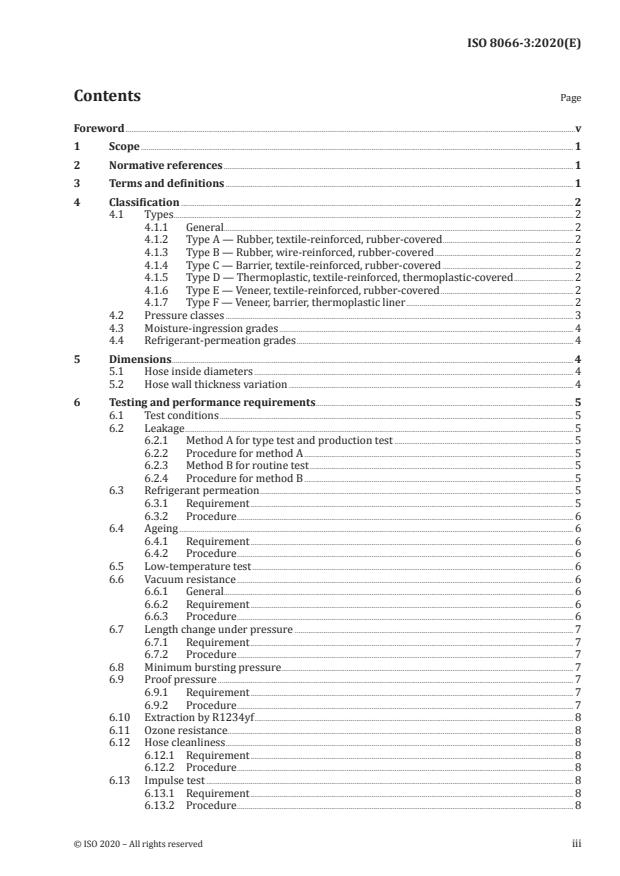
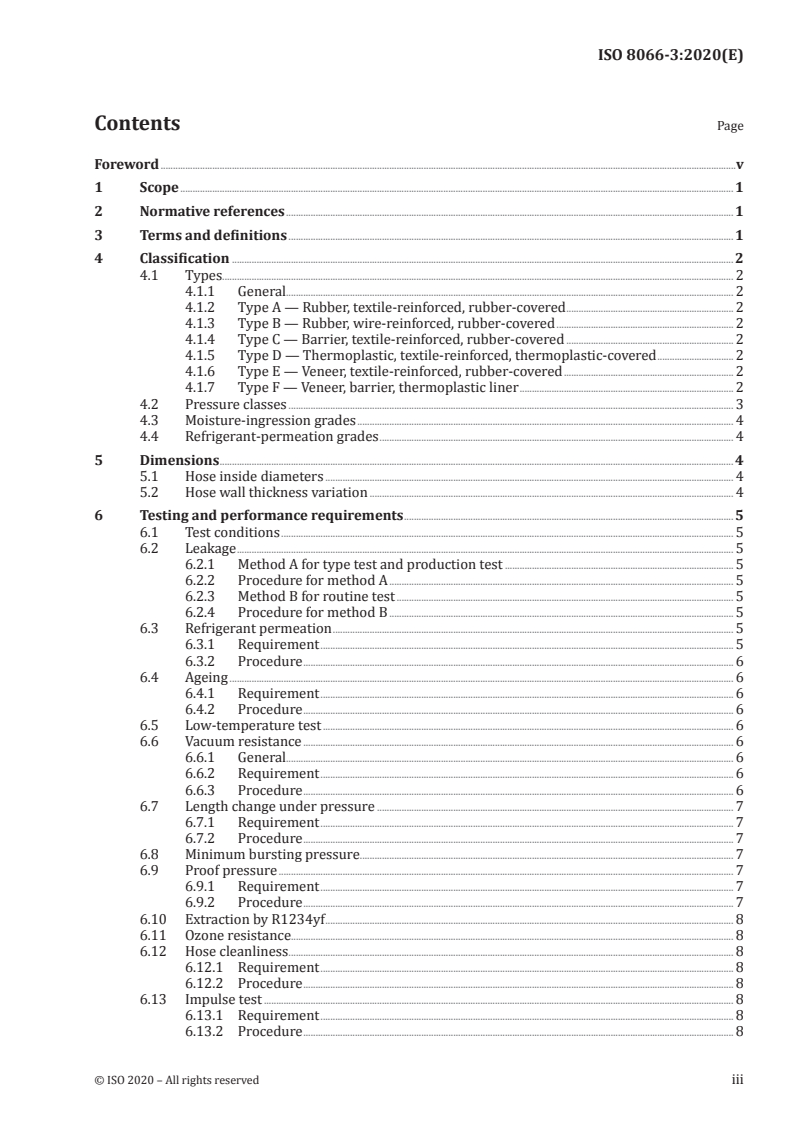
Contents Page
Foreword .v
1 Scope . 1
2 Normative references . 1
3 Terms and definitions . 1
4 Classification . 2
4.1 Types. 2
4.1.1 General. 2
4.1.2 Type A — Rubber, textile-reinforced, rubber-covered . 2
4.1.3 Type B — Rubber, wire-reinforced, rubber-covered . 2
4.1.4 Type C — Barrier, textile-reinforced, rubber-covered . 2
4.1.5 Type D — Thermoplastic, textile-reinforced, thermoplastic-covered . 2
4.1.6 Type E — Veneer, textile-reinforced, rubber-covered . 2
4.1.7 Type F — Veneer, barrier, thermoplastic liner . 2
4.2 Pressure classes . 3
4.3 Moisture-ingression grades . 4
4.4 Refrigerant-permeation grades . 4
5 Dimensions . 4
5.1 Hose inside diameters . 4
5.2 Hose wall thickness variation . 4
6 Testing and performance requirements . 5
6.1 Test conditions . 5
6.2 Leakage . 5
6.2.1 Method A for type test and production test . 5
6.2.2 Procedure for method A . 5
6.2.3 Method B for routine test . 5
6.2.4 Procedure for method B . 5
6.3 Refrigerant permeation . 5
6.3.1 Requirement . 5
6.3.2 Procedure . 6
6.4 Ageing . 6
6.4.1 Requirement . 6
6.4.2 Procedure . 6
6.5 Low-temperature test . 6
6.6 Vacuum resistance . 6
6.6.1 General. 6
6.6.2 Requirement . 6
6.6.3 Procedure . 6
6.7 Length change under pressure . 7
6.7.1 Requirement . 7
6.7.2 Procedure . 7
6.8 Minimum bursting pressure. 7
6.9 Proof pressure . 7
6.9.1 Requirement . 7
6.9.2 Procedure . 7
6.10 Extraction by R1234yf . 8
6.11 Ozone resistance. 8
6.12 Hose cleanliness . 8
6.12.1 Requirement . 8
6.12.2 Procedure . 8
6.13 Impulse test . 8
6.13.1 Requirement . 8
6.13.2 Procedure . 8
6.14 Moisture ingression . 9
6.15 Coupling integrity (sealability) . 9
7 Frequency of testing . 9
8 Marking . 9
9 Test report .10
10 Recommendations for packaging and storage .10
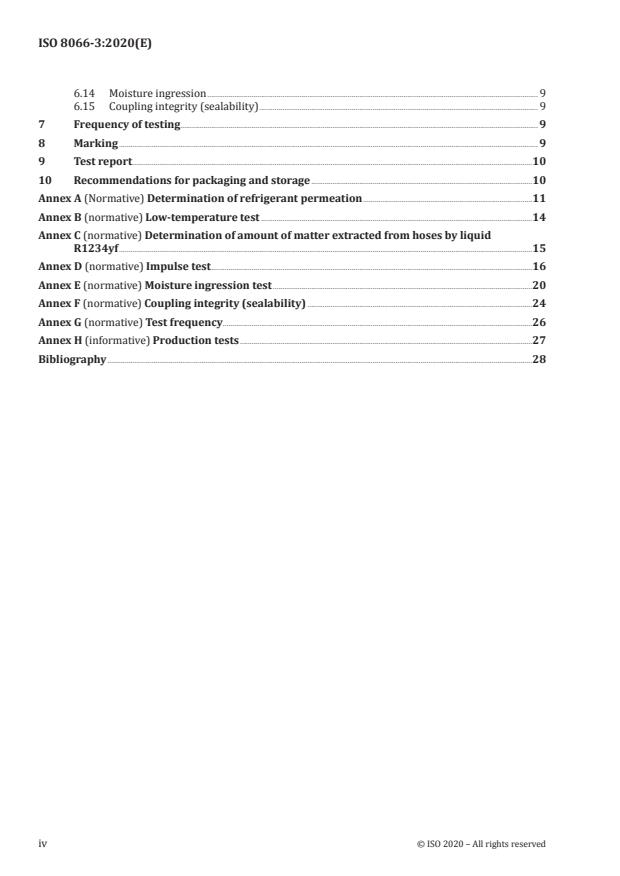
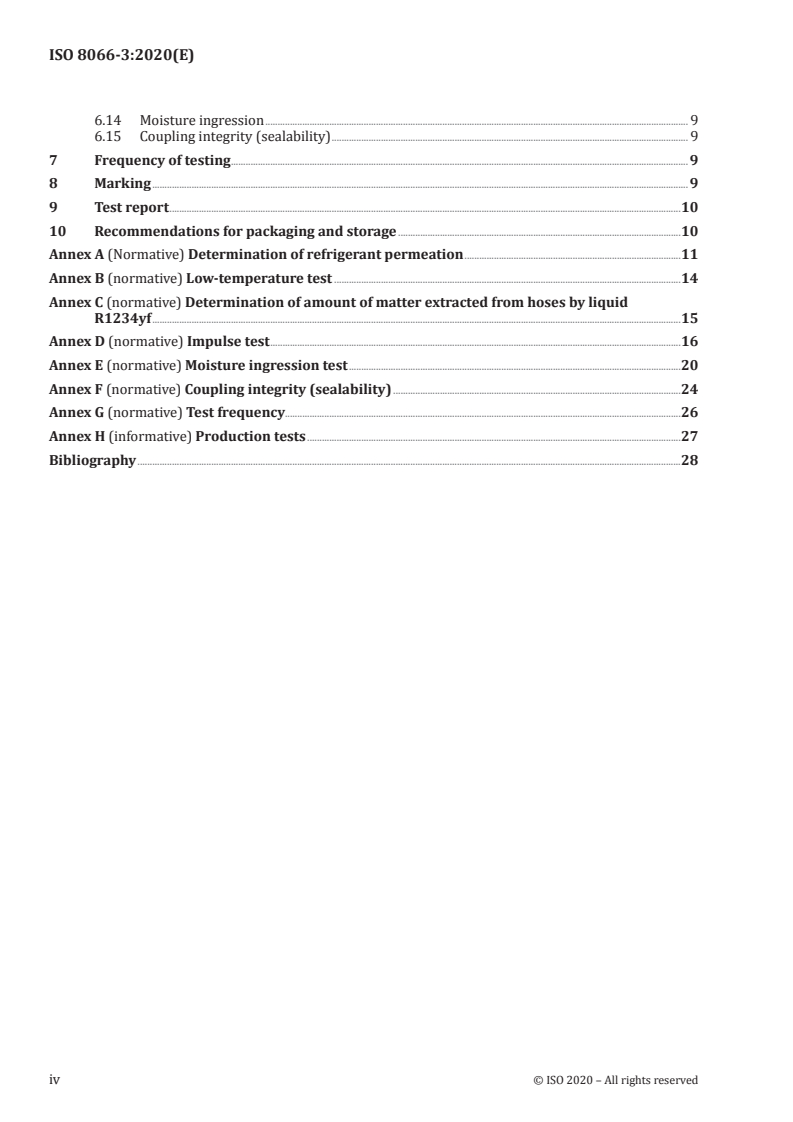
Annex A (Normative) Determination of refrigerant permeation .11
Annex B (normative) Low-temperature test .14
Annex C (normative) Determination of amount of matter extracted from hoses by liquid
R1234yf .15
Annex D (normative) Impulse test .16
Annex E (normative) Moisture ingression test .20
Annex F (normative) Coupling integrity (sealability) .24
Annex G (normative) Test frequency.26
Annex H (informative) Production tests .27
Bibliography .28
iv © ISO 2020 – All rights reserved
Foreword
ISO (the International Organization for Standardization) is a worldwide federation of national standards
bodies (ISO member bodies). The work of preparing International Standards is normally carried out
through ISO technical committees. Each member body interested in a subject for which a technical
committee has been established has the right to be represented on that committee. International
organizations, governmental and non-governmental, in liaison with ISO, also take part in the work.
ISO collaborates closely with the International Electrotechnical Commission (IEC) on all matters of
electrotechnical standardization.
The procedures used to develop this document and those intended for its further maintenance are
described in the ISO/IEC Directives, Part 1. In particular, the different approval criteria needed for the
different types of ISO documents should be noted. This document was drafted in accordance with the
editorial rules of the ISO/IEC Directives, Part 2 (see www .iso .org/ directives).
Attention is drawn to the possibility that some of the elements of this document may be the subject of
patent rights. ISO shall not be held responsible for identifying any or all such patent rights. Details of
any patent rights identified during the development of the document will be in the Introduction and/or
on the ISO list of patent declarations received (see www .iso .org/ patents).
Any trade name used in this document is information given for the convenience of users and does not
constitute an endorsement.
For an explanation of the voluntary nature of standards, the meaning of ISO specific terms and
expressions related to conformity assessment, as well as information about ISO's adherence to
the World Trade Organization (WTO) principles in the Technical Barriers to Trade (TBT), see
w w w . is o . or g / is o/ f or ewor d . ht m l .
This document was prepared by Technical Committee ISO/TC 45, Rubber and rubber products,
Subcommittee SC 1, Rubber and plastics hoses and hose assemblies.
A list of all parts in the ISO 8066 series can be found on the ISO website.
Any feedback or questions on this document should be directed to the user’s national standards body. A
complete listing of these bodies can be found at www .iso .org/ members .html.
INTERNATIONAL STANDARD ISO 8066-3:2020(E)
Rubber and plastics hoses and hose assemblies for
automotive air conditioning — Specification —
Part 3:
Refrigerant 1234yf
WARNING — Persons using this document should be familiar with normal laboratory practice.
This document does not purport to address all of the safety problems, if any, associated with its
use. It is the responsibility of the user to establish appropriate health and safety practices and to
ensure compliance with any national regulatory conditions.
1 Scope
This document specifies the requirements for rubber or thermoplastic hoses and hose assemblies
used for circulating liquid and gaseous R1234yf (tetrafluoropropene) in the air-conditioning systems
of automobiles. The hoses and hose assemblies are designed in such a way as to restrict losses of
refrigerant and contamination of the system. The operational temperature range is −40 °C to +125 °C.
Due to the critical relationship between the hose and coupling for this application, a requirement that
the coupling to be used in service be used for testing has been laid down.
2 Normative references
The following documents are referred to in the text in such a way that some or all of their content
constitutes requirements of this document. For dated references, only the edition cited applies. For
undated references, the latest edition of the referenced document (including any amendments) applies.
ISO 1402, Rubber and plastics hoses and hose assemblies — Hydrostatic testing
ISO 4671:2007, Rubber and plastics hoses and hose assemblies — Methods of measurement of the
dimensions of hoses and the lengths of hose assemblies
ISO 7326:2016, Rubber and plastics hoses — Assessment of ozone resistance under static conditions
ISO 8330, Rubber and plastics hoses and hose assemblies — Vocabulary
ISO 23529, Rubber — General procedures for preparing and conditioning test pieces for physical test methods
ISO/TR 11340, Rubber and rubber products — Hydraulic hose assemblies — External leakage classification
for hydraulic systems
3 Terms and definitions
For the purposes of this document, the terms and definitions given in ISO 8330 apply.
ISO and IEC maintain terminological databases for use in standardization at the following addresses:
— IEC Electropedia: available at http:// www .electropedia .org/
— ISO Online browsing platform: available at https:// www .iso .org/ obp
4 Classification
4.1 Types
4.1.1 General
Including, but not limited to the following.
4.1.2 Type A — Rubber, textile-reinforced, rubber-covered
The hose shall be built having a suitable seamless synthetic rubber tube. The reinforcement shall
consist of textile yarn, cord, or fabric adhered to the tube and cover. The outer cover shall be heat- and
ozone-resistant synthetic rubber.
4.1.3 Type B — Rubber, wire-reinforced, rubber-covered
The hose shall be built having a suitable seamless synthetic rubber tube. The reinforcement shall
consist of steel wire adhered to the rubber tube. The cover shall consist of a heat-resistant textile yarn
impregnated with a synthetic rubber cement.
4.1.4 Type C — Barrier, textile-reinforced, rubber-covered
The hose shall have a suitable thermoplastic barrier between rubber layers. The reinforcement shall
consist of suitable textile yarn, cord, or fabric adhered to the tube and cover. The outer cover shall be
heat- and ozone-resistant synthetic rubber.
4.1.5 Type D — Thermoplastic, textile-reinforced, thermoplastic-covered
The hose shall have a suitable thermoplastic tube. The reinforcement shall consist of a suitable textile
yarn, cord, or fabric adhered to the tube and cover. The outer cover shall be heat- and ozone-resistant
synthetic elastomer.
4.1.6 Type E — Veneer, textile-reinforced, rubber-covered
The hose shall have a suitable thermoplastic veneer lining with a rubber tube outer layer. The
reinforcement shall consist of a textile yarn, cord, or fabric adhered to the tube and cover. The cover
shall be heat- and ozone-resistant synthetic rubber.
4.1.7 Type F — Veneer, barrier, thermoplastic liner
The hose shall have a suitable thermoplastic veneer liner with a thermoplastic barrier between
elastomeric layers. The reinforcement shall consist of a suitable textile yarn, cord, or fabric adhered to
the tube and cover. The cover shall be heat- and ozone-resistant elastomer.
Table 1 gives the figure and applicable pressure class for each type.
2 © ISO 2020 – All rights reserved
Table 1 — Figure and applicable pressure class
Applicable pressure class
Type Figure
High Low
A X X
B X N/A
C X X
D X N/A
E X X
F X X
Key
1 rubber 4 wire X = Applicable
2 cover 5 thermoplastic resin N/A = Not applicable
3 textile
4.2 Pressure classes
4.2.1 High — Discharge and liquid applications.
4.2.2 Low — Suction application.
Working pressures are given in Table 2.
Table 2 — Working pressure
Pressure class Working pressure
MPa (bar)
High 3,28 (32,8)
Low 1,06 (10,6)
4.3 Moisture-ingression grades
4.3.1 ML — Low moisture ingression hose as defined in 6.14.
4.3.2 Mm — Medium moisture ingression hose as defined in 6.14.
4.4 Refrigerant-permeation grades
4.4.1 RU — Ultra low refrigerant permeation hose as defined in 6.3.2.
4.4.2 RL — Low refrigerant permeation hose as defined in 6.3.2.
4.4.3 Rm — Medium refrigerant permeation hose as defined in 6.3.2.
5 Dimensions
5.1 Hose inside diameters
Standard dimensions are given in Table 3, but not limited to the following.
Table 3 — Typical inside diameters
Nominal size Mean inside diameter
mm
8 (5/16) 8
10 (13/32) 10,3
11 11
13 (1/2) 12,7
14 14
15 15
16 (5/8) 15,9
19 (3/4) 19
25 (1) 25,4
NOTE Nominal size in parenthesis is in inches.
5.2 Hose wall thickness variation
When the wall thickness is measured in accordance with method 2 of ISO 4671:2007, the variation in
the wall thickness shall not exceed the values given in Table 4.
4 © ISO 2020 – All rights reserved
Table 4 — Wall thickness variation
Type A, B, C and E Type D and F
Nominal size Maximum departure Nominal size Maximum departure
from concentricity from concentricity
mm mm
Up to and including 13 0,6
Up to and including 19 1,0
Over 13 and including 19 0,8
Over 19 1,3 Over 19 1,0
6 Testing and performance requirements
6.1 Test conditions
The testing room shall be kept at standard temperature in accordance with ISO 23529. The temperature
of the hoses or hose assemblies shall be stabilized for 24 h before testing.
6.2 Leakage
6.2.1 Method A for type test and production test
When determined in accordance with the procedure given in 6.2.2, the loss in mass of refrigerant shall
be no greater than 10 % of the initial mass of the refrigerant and there shall be no visible deterioration
in the hoses or hose assemblies.
6.2.2 Procedure for method A
Test three test pieces. Fill each test piece with R1234yf containing (10 ± 1) % refrigerant compatible
lubrication oil. Maintain each test piece with the pressure listed in Table 2 for 24 h at a temperature of
80 °C ± 2 °C.
This test can be carried out separately or during the 24 h pre-conditioning period for the refrigerant
loss test (see 6.3) at 80 °C ± 2 °C. When the test is carried out separately from 6.3, use the procedure
described in Annex A.
6.2.3 Method B for routine test
When determined in accordance with the procedure given in 6.2.4, there shall be no leak and no
visible deterioration in the hoses or hose assemblies. When pricked hose is tested, gas bubbles which
form on the surface of the hose and decrease gradually after pressurizing may be observed but not be
considered as a leak.
6.2.4 Procedure for method B
Immerse the test assembly in the water bath. Apply gas (air or inert gases) pressure and maintain the
pressure listed in Table 2 for 5 min. Also, a gas leak detector, snoop liquid leak detector may be applied
to check leakage under the pressure listed in Table 2 for 5 min.
6.3 Refrigerant permeation
6.3.1 Requirement
When determined in accordance with the procedure described in 6.3.2, the loss of refrigerant from the
hoses or hose assemblies shall be no greater than the values given in Table 5.
6.3.2 Procedure
Test the hoses or hose assemblies in accordance with the procedure described in Annex A at 80 °C ± 2 °C.
Table 5 — Refrigerant permeation
Refrigerant-permeation grade Maximum allowable loss of refrigerant
kg/m /year
RU 1,5
RL 5
Rm 18
6.4 Ageing
6.4.1 Requirement
When tested in accordance with 6.4.2, there shall be no leak and no cracks in a test hose or hose
assembly.
6.4.2 Procedure
Wind a hose or hose assembly, of length between 300 mm and 1 000 mm, on to a mandrel having a
diameter eight times the outside diameter of the hose. Place the mandrel and hose or hose assembly in a
circulating-air oven for 168 h at 125 °C ± 2 °C.
Take the mandrel and hose or hose assembly out of the oven, allow to cool to ambient temperature,
unwind the hose or hose assembly and examine it externally for any cracks, disintegration or other
defects. Then test the hose or hose assembly in accordance with the procedure given in 6.2.3 and 6.2.4.
6.5 Low-temperature test
When tested in accordance with the method described in Annex B, there shall be no leak or loss due to
cracks or splits.
6.6 Vacuum resistance
6.6.1 General
A hose or hose assembly shall be subjected, consecutively, to the vacuum test, then the length variation
test (6.7), then the burst test (6.8).
6.6.2 Requirement
The decrease in the outside diameter of the hose shall not exceed 20 % of the initial outside diameter
and there shall be no obstruction of flow caused by the hose collapse when the hose or hose assembly
is subjected to a reduced internal pressure (vacuum) of 1,33 kPa ± 0,66 kPa (absolute) for 2 min in
accordance with 6.6.3.
6.6.3 Procedure
The test hose or hose assembly shall have a free length of from 610 mm to 1 000 mm. Bend the hose into
a U shape, whereby the internal radius of the base of the U shall be five times the mean outside diameter
of the hose. Measure the minor axis, d , at the base of the U. Apply a vacuum of 1,33 kPa ± 0,66 kPa
(absolute) to the bent hose for 2 min. At the end of this period and while the vacuum is still being
6 © ISO 2020 – All rights reserved
applied, measure the minor axis, d at the base of the U. The ratio of the decrease in outside diameter R
2 d
shall be calculated as below:
R = (d – d )/d (×100 %)
d 1 2 1
6.7 Length change under pressure
6.7.1 Requirement
When subjected to a pressure listed in Table 2, a hose or hose assembly shall not contract by more than
4 % or extend by more than 2 %.
6.7.2 Procedure
Subject the hose or hose assembly, in a horizontal position, to an internal hydrostatic pressure of 7 kPa
(0,07 bar) and measure the length. Increase the pressure to the prescribed value and measure the
length once again within the following minute. Express the length as a percentage of the length at 7 kPa
(0,07 bar).
Refer to ISO 1402 for additional information.
6.8 Minimum bursting pressure
When determined in accordance with the method described in ISO 1402, using test pieces that have
been subjected to the test for refrigerant loss described in 6.3, the minimum bursting pressure shall be
the value listed in Table 6.
Table 6 — Minimum burst pressure
Pressure class Minimum burst pressure
MPa (bar)
High 13,12 (131,2)
Low 4,24 (42,4)
6.9 Proof pressure
6.9.1 Requirement
When tested in accordance with the procedure described in 6.9.2, a hose or hose assembly shall exhibit
no leakage, cracking, abrupt distortion (indicating irregularity in materials or manufacture) or other
signs of failure.
6.9.2 Procedure
Hydrostatically pressurize a hose or hose assembly to the value listed in Table 7 and hold the pressure
for 2 min ± 30 s. During and after the proof pressure hold period, examine the hose.
Table 7 — Proof pressure
Pressure class Proof pressure
MPa (bar)
High 6,56 (65,6)
Low 2,12 (21,2)
6.10 Extraction by R1234yf
When determined in accordance with Annex C, the quantity of matter extracted from the lining of the
hose by the R1234yf shall not exceed 118 g/m .
NOTE The substances extracted will be of an oily or greasy nature.
6.11 Ozone resistance
This requirement applies only to rubber covered hoses.
Bend the hose around a mandrel with a diameter equal to eight times the mean outside diameter of the
hose and carry out the test in accordance with method 1 of ISO 7326:2016 using an ozone concentration
of 50 mPa ± 5 mPa.
The hose cover shall exhibit no visible cracks when viewed under ×7 magnification.
6.12 Hose cleanliness
6.12.1 Requirement
The tube of the hose shall be dry and clean. When determined in accordance with 6.12.2, the mass of
insoluble matter shall be a maximum of 270 mg/m based on the internal surface area of the hose.
6.12.2 Procedure
Take a hose test piece having a minimum length of 300 mm. Bend the hose into a U-shape, with the legs
of the U of equal length. Place the hose in a vertical position and fill the hose with a suitable solvent.
Immediately empty the hose, filtering the solvent through a prepared Gooch crucible, a sintered-glass
crucible or a 0,4 mm filter of known mass.
After drying the filter and residue at approximately 70 °C for 20 min, determine the mass of insoluble
matter by difference.
6.13 Impulse test
6.13.1 Requirement
When tested in accordance with 6.13.2, hoses or hose assemblies shall not leak or fail prior to
150 000 cycles.
6.13.2 Procedure
...
INTERNATIONAL ISO
STANDARD 8066-3
First edition
2020-08
Rubber and plastics hoses and
hose assemblies for automotive air
conditioning — Specification —
Part 3:
Refrigerant 1234yf
Tuyaux et flexibles en caoutchouc et en plastique pour climatisation
des automobiles — Spécifications —
Partie 3: Réfrigérant 1234yf
Reference number
©
ISO 2020
© ISO 2020
All rights reserved. Unless otherwise specified, or required in the context of its implementation, no part of this publication may
be reproduced or utilized otherwise in any form or by any means, electronic or mechanical, including photocopying, or posting
on the internet or an intranet, without prior written permission. Permission can be requested from either ISO at the address
below or ISO’s member body in the country of the requester.
ISO copyright office
CP 401 • Ch. de Blandonnet 8
CH-1214 Vernier, Geneva
Phone: +41 22 749 01 11
Email: copyright@iso.org
Website: www.iso.org
Published in Switzerland
ii © ISO 2020 – All rights reserved
Contents Page
Foreword .v
1 Scope . 1
2 Normative references . 1
3 Terms and definitions . 1
4 Classification . 2
4.1 Types. 2
4.1.1 General. 2
4.1.2 Type A — Rubber, textile-reinforced, rubber-covered . 2
4.1.3 Type B — Rubber, wire-reinforced, rubber-covered . 2
4.1.4 Type C — Barrier, textile-reinforced, rubber-covered . 2
4.1.5 Type D — Thermoplastic, textile-reinforced, thermoplastic-covered . 2
4.1.6 Type E — Veneer, textile-reinforced, rubber-covered . 2
4.1.7 Type F — Veneer, barrier, thermoplastic liner . 2
4.2 Pressure classes . 3
4.3 Moisture-ingression grades . 4
4.4 Refrigerant-permeation grades . 4
5 Dimensions . 4
5.1 Hose inside diameters . 4
5.2 Hose wall thickness variation . 4
6 Testing and performance requirements . 5
6.1 Test conditions . 5
6.2 Leakage . 5
6.2.1 Method A for type test and production test . 5
6.2.2 Procedure for method A . 5
6.2.3 Method B for routine test . 5
6.2.4 Procedure for method B . 5
6.3 Refrigerant permeation . 5
6.3.1 Requirement . 5
6.3.2 Procedure . 6
6.4 Ageing . 6
6.4.1 Requirement . 6
6.4.2 Procedure . 6
6.5 Low-temperature test . 6
6.6 Vacuum resistance . 6
6.6.1 General. 6
6.6.2 Requirement . 6
6.6.3 Procedure . 6
6.7 Length change under pressure . 7
6.7.1 Requirement . 7
6.7.2 Procedure . 7
6.8 Minimum bursting pressure. 7
6.9 Proof pressure . 7
6.9.1 Requirement . 7
6.9.2 Procedure . 7
6.10 Extraction by R1234yf . 8
6.11 Ozone resistance. 8
6.12 Hose cleanliness . 8
6.12.1 Requirement . 8
6.12.2 Procedure . 8
6.13 Impulse test . 8
6.13.1 Requirement . 8
6.13.2 Procedure . 8
6.14 Moisture ingression . 9
6.15 Coupling integrity (sealability) . 9
7 Frequency of testing . 9
8 Marking . 9
9 Test report .10
10 Recommendations for packaging and storage .10
Annex A (Normative) Determination of refrigerant permeation .11
Annex B (normative) Low-temperature test .14
Annex C (normative) Determination of amount of matter extracted from hoses by liquid
R1234yf .15
Annex D (normative) Impulse test .16
Annex E (normative) Moisture ingression test .20
Annex F (normative) Coupling integrity (sealability) .24
Annex G (normative) Test frequency.26
Annex H (informative) Production tests .27
Bibliography .28
iv © ISO 2020 – All rights reserved
Foreword
ISO (the International Organization for Standardization) is a worldwide federation of national standards
bodies (ISO member bodies). The work of preparing International Standards is normally carried out
through ISO technical committees. Each member body interested in a subject for which a technical
committee has been established has the right to be represented on that committee. International
organizations, governmental and non-governmental, in liaison with ISO, also take part in the work.
ISO collaborates closely with the International Electrotechnical Commission (IEC) on all matters of
electrotechnical standardization.
The procedures used to develop this document and those intended for its further maintenance are
described in the ISO/IEC Directives, Part 1. In particular, the different approval criteria needed for the
different types of ISO documents should be noted. This document was drafted in accordance with the
editorial rules of the ISO/IEC Directives, Part 2 (see www .iso .org/ directives).
Attention is drawn to the possibility that some of the elements of this document may be the subject of
patent rights. ISO shall not be held responsible for identifying any or all such patent rights. Details of
any patent rights identified during the development of the document will be in the Introduction and/or
on the ISO list of patent declarations received (see www .iso .org/ patents).
Any trade name used in this document is information given for the convenience of users and does not
constitute an endorsement.
For an explanation of the voluntary nature of standards, the meaning of ISO specific terms and
expressions related to conformity assessment, as well as information about ISO's adherence to
the World Trade Organization (WTO) principles in the Technical Barriers to Trade (TBT), see
w w w . is o . or g / is o/ f or ewor d . ht m l .
This document was prepared by Technical Committee ISO/TC 45, Rubber and rubber products,
Subcommittee SC 1, Rubber and plastics hoses and hose assemblies.
A list of all parts in the ISO 8066 series can be found on the ISO website.
Any feedback or questions on this document should be directed to the user’s national standards body. A
complete listing of these bodies can be found at www .iso .org/ members .html.
INTERNATIONAL STANDARD ISO 8066-3:2020(E)
Rubber and plastics hoses and hose assemblies for
automotive air conditioning — Specification —
Part 3:
Refrigerant 1234yf
WARNING — Persons using this document should be familiar with normal laboratory practice.
This document does not purport to address all of the safety problems, if any, associated with its
use. It is the responsibility of the user to establish appropriate health and safety practices and to
ensure compliance with any national regulatory conditions.
1 Scope
This document specifies the requirements for rubber or thermoplastic hoses and hose assemblies
used for circulating liquid and gaseous R1234yf (tetrafluoropropene) in the air-conditioning systems
of automobiles. The hoses and hose assemblies are designed in such a way as to restrict losses of
refrigerant and contamination of the system. The operational temperature range is −40 °C to +125 °C.
Due to the critical relationship between the hose and coupling for this application, a requirement that
the coupling to be used in service be used for testing has been laid down.
2 Normative references
The following documents are referred to in the text in such a way that some or all of their content
constitutes requirements of this document. For dated references, only the edition cited applies. For
undated references, the latest edition of the referenced document (including any amendments) applies.
ISO 1402, Rubber and plastics hoses and hose assemblies — Hydrostatic testing
ISO 4671:2007, Rubber and plastics hoses and hose assemblies — Methods of measurement of the
dimensions of hoses and the lengths of hose assemblies
ISO 7326:2016, Rubber and plastics hoses — Assessment of ozone resistance under static conditions
ISO 8330, Rubber and plastics hoses and hose assemblies — Vocabulary
ISO 23529, Rubber — General procedures for preparing and conditioning test pieces for physical test methods
ISO/TR 11340, Rubber and rubber products — Hydraulic hose assemblies — External leakage classification
for hydraulic systems
3 Terms and definitions
For the purposes of this document, the terms and definitions given in ISO 8330 apply.
ISO and IEC maintain terminological databases for use in standardization at the following addresses:
— IEC Electropedia: available at http:// www .electropedia .org/
— ISO Online browsing platform: available at https:// www .iso .org/ obp
4 Classification
4.1 Types
4.1.1 General
Including, but not limited to the following.
4.1.2 Type A — Rubber, textile-reinforced, rubber-covered
The hose shall be built having a suitable seamless synthetic rubber tube. The reinforcement shall
consist of textile yarn, cord, or fabric adhered to the tube and cover. The outer cover shall be heat- and
ozone-resistant synthetic rubber.
4.1.3 Type B — Rubber, wire-reinforced, rubber-covered
The hose shall be built having a suitable seamless synthetic rubber tube. The reinforcement shall
consist of steel wire adhered to the rubber tube. The cover shall consist of a heat-resistant textile yarn
impregnated with a synthetic rubber cement.
4.1.4 Type C — Barrier, textile-reinforced, rubber-covered
The hose shall have a suitable thermoplastic barrier between rubber layers. The reinforcement shall
consist of suitable textile yarn, cord, or fabric adhered to the tube and cover. The outer cover shall be
heat- and ozone-resistant synthetic rubber.
4.1.5 Type D — Thermoplastic, textile-reinforced, thermoplastic-covered
The hose shall have a suitable thermoplastic tube. The reinforcement shall consist of a suitable textile
yarn, cord, or fabric adhered to the tube and cover. The outer cover shall be heat- and ozone-resistant
synthetic elastomer.
4.1.6 Type E — Veneer, textile-reinforced, rubber-covered
The hose shall have a suitable thermoplastic veneer lining with a rubber tube outer layer. The
reinforcement shall consist of a textile yarn, cord, or fabric adhered to the tube and cover. The cover
shall be heat- and ozone-resistant synthetic rubber.
4.1.7 Type F — Veneer, barrier, thermoplastic liner
The hose shall have a suitable thermoplastic veneer liner with a thermoplastic barrier between
elastomeric layers. The reinforcement shall consist of a suitable textile yarn, cord, or fabric adhered to
the tube and cover. The cover shall be heat- and ozone-resistant elastomer.
Table 1 gives the figure and applicable pressure class for each type.
2 © ISO 2020 – All rights reserved
Table 1 — Figure and applicable pressure class
Applicable pressure class
Type Figure
High Low
A X X
B X N/A
C X X
D X N/A
E X X
F X X
Key
1 rubber 4 wire X = Applicable
2 cover 5 thermoplastic resin N/A = Not applicable
3 textile
4.2 Pressure classes
4.2.1 High — Discharge and liquid applications.
4.2.2 Low — Suction application.
Working pressures are given in Table 2.
Table 2 — Working pressure
Pressure class Working pressure
MPa (bar)
High 3,28 (32,8)
Low 1,06 (10,6)
4.3 Moisture-ingression grades
4.3.1 ML — Low moisture ingression hose as defined in 6.14.
4.3.2 Mm — Medium moisture ingression hose as defined in 6.14.
4.4 Refrigerant-permeation grades
4.4.1 RU — Ultra low refrigerant permeation hose as defined in 6.3.2.
4.4.2 RL — Low refrigerant permeation hose as defined in 6.3.2.
4.4.3 Rm — Medium refrigerant permeation hose as defined in 6.3.2.
5 Dimensions
5.1 Hose inside diameters
Standard dimensions are given in Table 3, but not limited to the following.
Table 3 — Typical inside diameters
Nominal size Mean inside diameter
mm
8 (5/16) 8
10 (13/32) 10,3
11 11
13 (1/2) 12,7
14 14
15 15
16 (5/8) 15,9
19 (3/4) 19
25 (1) 25,4
NOTE Nominal size in parenthesis is in inches.
5.2 Hose wall thickness variation
When the wall thickness is measured in accordance with method 2 of ISO 4671:2007, the variation in
the wall thickness shall not exceed the values given in Table 4.
4 © ISO 2020 – All rights reserved
Table 4 — Wall thickness variation
Type A, B, C and E Type D and F
Nominal size Maximum departure Nominal size Maximum departure
from concentricity from concentricity
mm mm
Up to and including 13 0,6
Up to and including 19 1,0
Over 13 and including 19 0,8
Over 19 1,3 Over 19 1,0
6 Testing and performance requirements
6.1 Test conditions
The testing room shall be kept at standard temperature in accordance with ISO 23529. The temperature
of the hoses or hose assemblies shall be stabilized for 24 h before testing.
6.2 Leakage
6.2.1 Method A for type test and production test
When determined in accordance with the procedure given in 6.2.2, the loss in mass of refrigerant shall
be no greater than 10 % of the initial mass of the refrigerant and there shall be no visible deterioration
in the hoses or hose assemblies.
6.2.2 Procedure for method A
Test three test pieces. Fill each test piece with R1234yf containing (10 ± 1) % refrigerant compatible
lubrication oil. Maintain each test piece with the pressure listed in Table 2 for 24 h at a temperature of
80 °C ± 2 °C.
This test can be carried out separately or during the 24 h pre-conditioning period for the refrigerant
loss test (see 6.3) at 80 °C ± 2 °C. When the test is carried out separately from 6.3, use the procedure
described in Annex A.
6.2.3 Method B for routine test
When determined in accordance with the procedure given in 6.2.4, there shall be no leak and no
visible deterioration in the hoses or hose assemblies. When pricked hose is tested, gas bubbles which
form on the surface of the hose and decrease gradually after pressurizing may be observed but not be
considered as a leak.
6.2.4 Procedure for method B
Immerse the test assembly in the water bath. Apply gas (air or inert gases) pressure and maintain the
pressure listed in Table 2 for 5 min. Also, a gas leak detector, snoop liquid leak detector may be applied
to check leakage under the pressure listed in Table 2 for 5 min.
6.3 Refrigerant permeation
6.3.1 Requirement
When determined in accordance with the procedure described in 6.3.2, the loss of refrigerant from the
hoses or hose assemblies shall be no greater than the values given in Table 5.
6.3.2 Procedure
Test the hoses or hose assemblies in accordance with the procedure described in Annex A at 80 °C ± 2 °C.
Table 5 — Refrigerant permeation
Refrigerant-permeation grade Maximum allowable loss of refrigerant
kg/m /year
RU 1,5
RL 5
Rm 18
6.4 Ageing
6.4.1 Requirement
When tested in accordance with 6.4.2, there shall be no leak and no cracks in a test hose or hose
assembly.
6.4.2 Procedure
Wind a hose or hose assembly, of length between 300 mm and 1 000 mm, on to a mandrel having a
diameter eight times the outside diameter of the hose. Place the mandrel and hose or hose assembly in a
circulating-air oven for 168 h at 125 °C ± 2 °C.
Take the mandrel and hose or hose assembly out of the oven, allow to cool to ambient temperature,
unwind the hose or hose assembly and examine it externally for any cracks, disintegration or other
defects. Then test the hose or hose assembly in accordance with the procedure given in 6.2.3 and 6.2.4.
6.5 Low-temperature test
When tested in accordance with the method described in Annex B, there shall be no leak or loss due to
cracks or splits.
6.6 Vacuum resistance
6.6.1 General
A hose or hose assembly shall be subjected, consecutively, to the vacuum test, then the length variation
test (6.7), then the burst test (6.8).
6.6.2 Requirement
The decrease in the outside diameter of the hose shall not exceed 20 % of the initial outside diameter
and there shall be no obstruction of flow caused by the hose collapse when the hose or hose assembly
is subjected to a reduced internal pressure (vacuum) of 1,33 kPa ± 0,66 kPa (absolute) for 2 min in
accordance with 6.6.3.
6.6.3 Procedure
The test hose or hose assembly shall have a free length of from 610 mm to 1 000 mm. Bend the hose into
a U shape, whereby the internal radius of the base of the U shall be five times the mean outside diameter
of the hose. Measure the minor axis, d , at the base of the U. Apply a vacuum of 1,33 kPa ± 0,66 kPa
(absolute) to the bent hose for 2 min. At the end of this period and while the vacuum is still being
6 © ISO 2020 – All rights reserved
applied, measure the minor axis, d at the base of the U. The ratio of the decrease in outside diameter R
2 d
shall be calculated as below:
R = (d – d )/d (×100 %)
d 1 2 1
6.7 Length change under pressure
6.7.1 Requirement
When subjected to a pressure listed in Table 2, a hose or hose assembly shall not contract by more than
4 % or extend by more than 2 %.
6.7.2 Procedure
Subject the hose or hose assembly, in a horizontal position, to an internal hydrostatic pressure of 7 kPa
(0,07 bar) and measure the length. Increase the pressure to the prescribed value and measure the
length once again within the following minute. Express the length as a percentage of the length at 7 kPa
(0,07 bar).
Refer to ISO 1402 for additional information.
6.8 Minimum bursting pressure
When determined in accordance with the method described in ISO 1402, using test pieces that have
been subjected to the test for refrigerant loss described in 6.3, the minimum bursting pressure shall be
the value listed in Table 6.
Table 6 — Minimum burst pressure
Pressure class Minimum burst pressure
MPa (bar)
High 13,12 (131,2)
Low 4,24 (42,4)
6.9 Proof pressure
6.9.1 Requirement
When tested in accordance with the procedure described in 6.9.2, a hose or hose assembly shall exhibit
no leakage, cracking, abrupt distortion (indicating irregularity in materials or manufacture) or other
signs of failure.
6.9.2 Procedure
Hydrostatically pressurize a hose or hose assembly to the value listed in Table 7 and hold the pressure
for 2 min ± 30 s. During and after the proof pressure hold period, examine the hose.
Table 7 — Proof pressure
Pressure class Proof pressure
MPa (bar)
High 6,56 (65,6)
Low 2,12 (21,2)
6.10 Extraction by R1234yf
When determined in accordance with Annex C, the quantity of matter extracted from the lining of the
hose by the R1234yf shall not exceed 118 g/m .
NOTE The substances extracted will be of an oily or greasy nature.
6.11 Ozone resistance
This requirement applies only to rubber covered hoses.
Bend the hose around a mandrel with a diameter equal to eight times the mean outside diameter of the
hose and carry out the test in accordance with method 1 of ISO 7326:2016 using an ozone concentration
of 50 mPa ± 5 mPa.
The hose cover shall exhibit no visible cracks when viewed under ×7 magnification.
6.12 Hose cleanliness
6.12.1 Requirement
The tube of the hose shall be dry and clean. When determined in accordance with 6.12.2, the mass of
insoluble matter shall be a maximum of 270 mg/m based on the internal surface area of the hose.
6.12.2 Procedure
Take a hose test piece having a minimum length of 300 mm. Bend the hose into a U-shape, with the legs
of the U of equal length. Place the hose in a vertical position and fill the hose with a suitable solvent.
Immediately empty the hose, filtering the solvent through a prepared Gooch crucible, a sintered-glass
crucible or a 0,4 mm filter of known mass.
After drying the filter and residue at approximately 70 °C for 20 min, determine the mass of insoluble
matter by difference.
6.13 Impulse test
6.13.1 Requirement
When tested in accordance with 6.13.2, hoses or hose assemblies shall not leak or fail prior to
150 000 cycles.
6.13.2 Procedure
...