

ISO/IEC TS 5147:2023
(Main)Information technology — Computer graphics, image processing and environmental data representation — Guidelines for representation and visualization of smart cities
General Information
- Abstract
This document specifies guidelines for the representation and visualization of smart cities. This document: describes the concepts of a smart city, smart city object and smart city data, describes categories of data associated with smart cities,provides guidance for representation of smart cities, describes guidance for visualization of smart cities, provides guidance in selecting the appropriate representation and visualization technique for different categories of smart city data using standards, and provides use cases for applying standards to the representation and visualization of smart cities.
- Status
- Published
- Publication Date
- 13-Jul-2023
- Current Stage
- 9020 - International Standard under periodical review
- Start Date
- 15-Jul-2026
- Completion Date
- 15-Jul-2026
Buy Documents


ISO/IEC TS 5147:2023 - Information technology — Computer graphics, image processing and environmental data representation — Guidelines for representation and visualization of smart cities Released:14. 07. 2023
Overview
ISO/IEC TS 5147:2023 - "Information technology - Computer graphics, image processing and environmental data representation - Guidelines for representation and visualization of smart cities" provides practical guidance for digitally representing and visualizing smart cities. The technical specification defines core concepts (smart city, smart city object, smart city data), categorizes urban data types, and recommends representation and visualization approaches - including mapping data categories to appropriate standards and techniques. It also contains use cases illustrating how standards can be applied for analysis, simulation and stakeholder communication.
Key topics and technical guidance
- Concepts and terminology: Definitions for 3D city model, spatiotemporal data, analytical data, semantic and physical properties, smart city object and smart city data.
- Standards overview: Discussion of representation and visualization standards and relevant technologies (e.g., BIM, GIS, SEDRIS, image/video formats, AR/VR and mixed reality).
- Representation guidance: How to model built and natural environment, networks, sensors, dynamic entities and semantic properties in digital form.
- Visualization guidance: Best practices for rendering spatiotemporal data, imagery, video, audio, haptics and multidimensional datasets; guidance for selecting charts, 2D/3D views, and immersive displays.
- Data-category mapping: Methods for mapping data categories (natural environment, built environment, sensors, weather, social media, analytics) to presentation and visualization techniques.
- Interoperability & standards application: Advice on selecting standards-based formats and protocols to support integration, simulation, digital twins and analysis.
- Use cases: Practical examples demonstrating application of representation and visualization standards for smart city scenarios.
Practical applications
ISO/IEC TS 5147:2023 is applicable to:
- Urban and regional planning - visualizing redevelopment, land use and scenario analysis.
- Digital twins and simulation - integrating sensor feeds, spatiotemporal models and analytics.
- Infrastructure and asset management - representing networks, built environment and condition data.
- Emergency management and operations - visual situational awareness using live data streams.
- Public engagement and policy - communicating plans through 2D/3D visualizations, AR/VR and dashboards.
Who should use this standard
- City planners and local government ICT teams
- GIS and BIM professionals
- Smart city solution architects and IoT integrators
- Simulation, visualization and UX designers
- Software developers building visualization platforms and digital twins
Related standards and interoperability
While ISO/IEC TS 5147:2023 does not contain normative references, it frames the use of established domain standards (BIM, GIS, SEDRIS, OGC, MPEG and common image/video/3D formats) to achieve interoperable, standards-based smart city representations.
Keywords: ISO/IEC TS 5147:2023, smart cities, representation, visualization, 3D city model, digital twin, GIS, BIM, IoT, spatiotemporal data, sensors, AR/VR.
Buy Documents
ISO/IEC TS 5147:2023 - Information technology — Computer graphics, image processing and environmental data representation — Guidelines for representation and visualization of smart cities Released:14. 07. 2023
Get Certified
Connect with accredited certification bodies for this standard

BSI Group
BSI (British Standards Institution) is the business standards company that helps organizations make excellence a habit.

NYCE
Mexican standards and certification body.
Sponsored listings
Frequently Asked Questions
ISO/IEC TS 5147:2023 is a technical specification published by the International Organization for Standardization (ISO). Its full title is "Information technology — Computer graphics, image processing and environmental data representation — Guidelines for representation and visualization of smart cities". This standard covers: This document specifies guidelines for the representation and visualization of smart cities. This document: describes the concepts of a smart city, smart city object and smart city data, describes categories of data associated with smart cities,provides guidance for representation of smart cities, describes guidance for visualization of smart cities, provides guidance in selecting the appropriate representation and visualization technique for different categories of smart city data using standards, and provides use cases for applying standards to the representation and visualization of smart cities.
This document specifies guidelines for the representation and visualization of smart cities. This document: describes the concepts of a smart city, smart city object and smart city data, describes categories of data associated with smart cities,provides guidance for representation of smart cities, describes guidance for visualization of smart cities, provides guidance in selecting the appropriate representation and visualization technique for different categories of smart city data using standards, and provides use cases for applying standards to the representation and visualization of smart cities.
ISO/IEC TS 5147:2023 is classified under the following ICS (International Classification for Standards) categories: 35.140 - Computer graphics. The ICS classification helps identify the subject area and facilitates finding related standards.
ISO/IEC TS 5147:2023 is available in PDF format for immediate download after purchase. The document can be added to your cart and obtained through the secure checkout process. Digital delivery ensures instant access to the complete standard document.
Standards Content (Sample)
TECHNICAL ISO/IEC TS
SPECIFICATION 5147
First edition
2023-07
Information technology — Computer
graphics, image processing and
environmental data representation
— Guidelines for representation and
visualization of smart cities
Technologies de l'information — Infographie, traitement d'images
et représentation de données environnementales — Lignes
directrices relatives à la représentation et à la visualisation des villes
intelligentes
Reference number
© ISO/IEC 2023
© ISO/IEC 2023
All rights reserved. Unless otherwise specified, or required in the context of its implementation, no part of this publication may
be reproduced or utilized otherwise in any form or by any means, electronic or mechanical, including photocopying, or posting on
the internet or an intranet, without prior written permission. Permission can be requested from either ISO at the address below
or ISO’s member body in the country of the requester.
ISO copyright office
CP 401 • Ch. de Blandonnet 8
CH-1214 Vernier, Geneva
Phone: +41 22 749 01 11
Email: copyright@iso.org
Website: www.iso.org
Published in Switzerland
ii
© ISO/IEC 2023 – All rights reserved
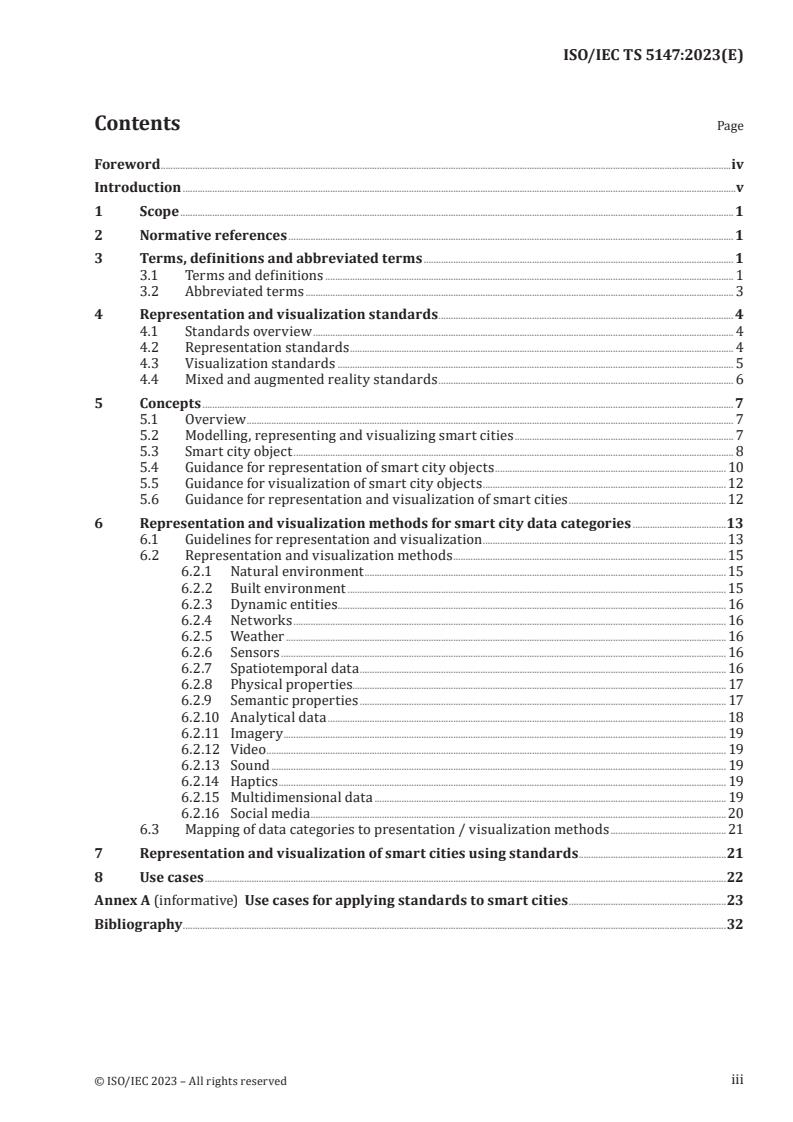
Contents Page
Foreword .iv
Introduction .v
1 Scope . 1
2 Normative references . 1
3 Terms, definitions and abbreviated terms . 1
3.1 Terms and definitions . 1
3.2 Abbreviated terms . 3
4 Representation and visualization standards . 4
4.1 Standards overview . 4
4.2 Representation standards . 4
4.3 Visualization standards . 5
4.4 Mixed and augmented reality standards . 6
5 Concepts . 7
5.1 Overview . 7
5.2 Modelling, representing and visualizing smart cities . 7
5.3 Smart city object . 8
5.4 Guidance for representation of smart city objects . 10
5.5 Guidance for visualization of smart city objects .12
5.6 Guidance for representation and visualization of smart cities .12
6 Representation and visualization methods for smart city data categories .13
6.1 Guidelines for representation and visualization . 13
6.2 Representation and visualization methods . 15
6.2.1 Natural environment . 15
6.2.2 Built environment . 15
6.2.3 Dynamic entities . 16
6.2.4 Networks . 16
6.2.5 Weather . 16
6.2.6 Sensors . 16
6.2.7 Spatiotemporal data . 16
6.2.8 Physical properties. 17
6.2.9 Semantic properties . 17
6.2.10 Analytical data . 18
6.2.11 Imagery . 19
6.2.12 Video . 19
6.2.13 Sound . 19
6.2.14 Haptics . 19
6.2.15 Multidimensional data . 19
6.2.16 Social media .20
6.3 Mapping of data categories to presentation / visualization methods . 21
7 Representation and visualization of smart cities using standards .21
8 Use cases .22
Annex A (informative) Use cases for applying standards to smart cities .23
Bibliography .32
iii
© ISO/IEC 2023 – All rights reserved
Foreword
ISO (the International Organization for Standardization) and IEC (the International Electrotechnical
Commission) form the specialized system for worldwide standardization. National bodies that are
members of ISO or IEC participate in the development of International Standards through technical
committees established by the respective organization to deal with particular fields of technical
activity. ISO and IEC technical committees collaborate in fields of mutual interest. Other international
organizations, governmental and non-governmental, in liaison with ISO and IEC, also take part in the
work.
The procedures used to develop this document and those intended for its further maintenance
are described in the ISO/IEC Directives, Part 1. In particular, the different approval criteria
needed for the different types of document should be noted. This document was drafted in
accordance with the editorial rules of the ISO/IEC Directives, Part 2 (see www.iso.org/directives or
www.iec.ch/members_experts/refdocs).
ISO and IEC draw attention to the possibility that the implementation of this document may involve the
use of (a) patent(s). ISO and IEC take no position concerning the evidence, validity or applicability of
any claimed patent rights in respect thereof. As of the date of publication of this document, ISO and IEC
had not received notice of (a) patent(s) which may be required to implement this document. However,
implementers are cautioned that this may not represent the latest information, which may be obtained
from the patent database available at www.iso.org/patents and https://patents.iec.ch. ISO and IEC shall
not be held responsible for identifying any or all such patent rights.
Any trade name used in this document is information given for the convenience of users and does not
constitute an endorsement.
For an explanation of the voluntary nature of standards, the meaning of ISO specific terms and
expressions related to conformity assessment, as well as information about ISO's adherence to
the World Trade Organization (WTO) principles in the Technical Barriers to Trade (TBT) see
www.iso.org/iso/foreword.html. In the IEC, see www.iec.ch/understanding-standards.
This document was prepared by Joint Technical Committee ISO/IEC JTC 1, Information technology,
Subcommittee SC 24, Computer graphics, image processing and environmental data representation.
Any feedback or questions on this document should be directed to the user’s national standards
body. A complete listing of these bodies can be found at www.iso.org/members.html and
www.iec.ch/national-committees.
iv
© ISO/IEC 2023 – All rights reserved
Introduction
Developers and users of a smart city need tools to evaluate and examine options and trade-offs and
predict outcomes. Parts or all of a smart city may need to be modelled, and smart city functions
need to be simulated to evaluate possible outcomes. The modelling and simulation of smart city
functions and processes require representation and visualization of the data. Representation and
visualization of smart cities enable prototyping, demonstration and analysis of smart city concepts for
further development. Both physical/geometric and semantic data can be represented and visualized.
Representation and visualization of smart cities is a prime application for an integrated approach
to leverage standardization since no single standard may address all requirements. This document
provides guidance as to what needs to be represented for smart cities and how this can be achieved.
This document describes categories of data associated with smart cities and guidelines for their
representation and visualization. It describes how standards can be applied to represent and visualize
urban infrastructure, services and features. Use cases are presented that explore how these standards
could be applied in smart city analysis and visualization applications.
v
© ISO/IEC 2023 – All rights reserved
TECHNICAL SPECIFICATION ISO/IEC TS 5147:2023(E)
Information technology — Computer graphics, image
processing and environmental data representation —
Guidelines for representation and visualization of smart
cities
1 Scope
This document specifies guidelines for the representation and visualization of smart cities. This
document:
a) describes the concepts of a smart city, smart city object and smart city data,
b) describes categories of data associated with smart cities,
c) provides guidance for representation of smart cities,
d) describes guidance for visualization of smart cities,
e) provides guidance in selecting the appropriate representation and visualization technique for
different categories of smart city data using standards, and
f) provides use cases for applying standards to the representation and visualization of smart cities.
2 Normative references
There are no normative references in the document.
3 Terms, definitions and abbreviated terms
3.1 Terms and definitions
For the purposes of this document, the following terms and definitions apply.
ISO and IEC maintain terminology databases for use in standardization at the following addresses:
— ISO Online browsing platform: available at https:// www .iso .org/ obp
— IEC Electropedia: available at https:// www .electropedia .org/
3.1.1
3D city model
representation of an urban environment with a 3D geometry of typical or specific urban objects and
structures, with buildings as the most prominent features
3.1.2
analytical data
data that has been derived from properties or applications of a smart city
Note 1 to entry: Examples of analytical data include data describing car traffic and pedestrian movements
obtained from sensors.
© ISO/IEC 2023 – All rights reserved
3.1.3
big data
extensive datasets, primarily with characteristics of volume, variety, velocity and/or variability, that
require a scalable technology for efficient storage, manipulation and analysis
Note 1 to entry: Big data is commonly used in many different ways, for example as the name of the scalable
technology used to handle big data extensive datasets.
[SOURCE: ISO/IEC 20546:2019, 3.1.2]
3.1.4
built environment
human-made environment that includes buildings, roads, bridges, tunnels and city artefacts
3.1.5
Data Representation Model
DRM
standardized representation of the relationships and organization of environmental objects and
content within SEDRIS
Note 1 to entry: SEDRIS refers to the ISO/IEC 18023 series.
3.1.6
Internet of Things
IoT
infrastructure of interconnected objects, people, systems and information resources together with
intelligent services to allow them to process information of the physical and the virtual world and to
react
[SOURCE: ISO/IEC 23093-1:2022, 3.2.9]
3.1.7
physical property
measurable quantity that describes the state of a system
Note 1 to entry: Physical properties can be categorized as mechanical, electrical, optical or thermal and may be
scalar values (such as temperature) or vector quantities (such as wind flow).
3.1.8
presentation
organization of data into textual, tabular or graphical format
Note 1 to entry: This can include non-visual modes of presentation such as audio and haptics.
3.1.9
representation
description of a real-world event, system, behaviour or natural phenomenon
Note 1 to entry: In this document, representation refers to the digital description of an event, object or system.
3.1.10
semantic property
property that does not have a physical basis
Note 1 to entry: Building ownership is an example of a semantic property.
© ISO/IEC 2023 – All rights reserved
3.1.11
smart city
city that increases the pace at which it provides social, economic and environmental sustainability
outcomes and responds to challenges such as climate change, rapid population growth, and political
and economic instability by fundamentally improving how it engages society, applies collaborative
leadership methods, works across disciplines and city systems, and uses data information and modern
technologies to deliver better services and quality of life to those in the city (residents, businesses,
visitors), now and for the foreseeable future, without unfair disadvantage of others or degradation of
the natural environment
Note 1 to entry: A virtual smart city is its digital/simulated representation.
[SOURCE: ISO 37122:2019, 3.4, modified — The original Notes to entry have been deleted and replaced
by a new Note to entry.]
3.1.12
smart city data
data that is associated with a smart city
Note 1 to entry: This refers to data that may be consumed or produced by a smart city function or application.
3.1.13
smart city object
representation of a distinct object that is part of a real or virtual smart city
Note 1 to entry: A smart city object may not necessarily contain smart technology. It is used as a general
descriptor for a component of a smart city.
3.1.14
spatiotemporal
associated with both space and time
3.1.15
visualization
rendering of an object, situation or set of information as a chart or image
Note 1 to entry: Visualization is a subset of presentation restricted to the visual medium.
3.2 Abbreviated terms
2D two dimensional
3D three dimensional
API application programming interface
AR augmented reality
BIIF basic image interchange format
BIM building information modelling
CCTV closed circuit television
DICOM digital imaging and communications in medicine
DIS distributed interactive simulation
DRM data representation model
EDCS environmental data coding specification
© ISO/IEC 2023 – All rights reserved
GIS geographic information system
GKS graphical kernel system
GPS geospatial positioning system
HAnim humanoid animation
ICT information and communications technology
IoT internet of things
JPEG joint photographic experts group
JSON JavaScript object notation
MAR mixed and augmented reality
MPEG moving picture experts group
OGC open geospatial consortium
PHIGS programmer's hierarchical interactive graphics system
PNG portable network graphics
SEDRIS synthetic environment data representation and interchange specification
SRM spatial reference model
VR virtual reality
VRML virtual reality modeling language
X3D extensible 3D
X3DOM X3D document object model
XML extensible markup language
4 Representation and visualization standards
4.1 Standards overview
ISO standards for imagery, environmental representation, visualization and mixed and augmented
reality can be applied to smart cities. These are described in the following subsections.
4.2 Representation standards
The SEDRIS series (ISO/IEC 18023 series) provides a suite of standards for environmental representation.
SEDRIS is an infrastructure technology that enables information technology applications to express,
understand, share and reuse environmental data. SEDRIS technologies provide the means to represent
integrated environmental data (terrain, ocean, air and space), and promote the unambiguous, loss-less
and non-proprietary interchange of environmental data. It is a means of organising environmental and
1)
feature data, yet leaves the (graphical) presentation of that data to other applications, such as X3D
and other visualization tools. SEDRIS was developed for military training simulation and has mainly
been applied in that domain. An introduction to SEDRIS is provided in Reference [1].
1) X3D is a trademark of the Web3D Consortium. This information is given for the convenience of users of this
document and does not constitute an endorsement by ISO or IEC.
© ISO/IEC 2023 – All rights reserved
The components of SEDRIS are:
— functional specification (ISO/IEC 18023-1)
— abstract transmittal format (ISO/IEC 18023-2)
— transmittal format binary encoding (ISO/IEC 18023-3)
— SEDRIS language bindings – Part 4: C (ISO/IEC 18024-4)
— environmental data coding specification (EDCS) that provides identification (designation) of objects
and their attributes (ISO/IEC 18025)
— spatial reference model (SRM) that handles position, orientation and spatial reference frames
(ISO/IEC 18026)
— data representation model (DRM) that models the relationships between objects and their
representations as described in ISO/IEC 18023 series
— application programming interface (API) as described in ISO/IEC 18023 series
EDCS, DRM and SRM all have ISO/IEC managed registries. The EDCS standard and its corresponding
registry contain entries for environmental concepts, objects and attributes, with about 1 500
classifications (types of environmental objects) and 1 900 attributes. These entries include a wide
range of environmental concepts, from natural phenomena to human-made objects, and a large array
of attributes and units of measure. Many of the EDCS entries are relevant to smart city modelling and
simulation, and new entries can be added through registration to ISO as these are required. Since
SEDRIS was developed primarily for military environments, a considerable number of entries can be
included to populate civilian urban environments.
SEDRIS is extensible through the ISO registration system for EDCS and SRM for new objects, features
and coordinate systems. It includes Levels of Detail and georeferencing. While developed for military
use SEDRIS can also represent civil assets and systems such as a smart city.
[2,3]
The HAnim standard was developed for humanoid representation. HAnim supports a wide variety of
articulated figures, including anatomically correct human models, incorporating haptic and kinematic
interfaces to enable shareable skeletons, bodies and animations. HAnim extensions to facial animation
and internal organs are under development.
4.3 Visualization standards
X3D and HAnim can be used for visualization of smart cities. X3D standards comprise three series:
ISO/IEC 19775 (architecture), ISO/IEC 19776 (encodings), and ISO/IEC 19777 (language bindings).
HAnim standards are ISO/IEC 19774-1 (architecture) and ISO/IEC 19774-2 (motion data animation).
[4]
X3D is a standard for 3D web graphics and is designed for viewing 3D content. Existing models of
cities, such as those using CityGML, can be converted to X3D for viewing on the web. X3D provides
a system for the storage, retrieval and playback of 3D scenes within an open architecture to support
a wide array of domains and user scenarios. It has componentized features that can be tailored for
applications such as engineering and scientific visualization, medical visualization, training and
simulation.
The most basic X3D part is a node. Typical nodes are box, colour and shape. X3D components are groups
of nodes that perform similar operations. The shape component, for example, includes nodes for shape
appearance, material, fill properties, line properties and two-sided material. Profiles are collections of
components.
© ISO/IEC 2023 – All rights reserved
[4]
X3D has a variety of encodings, namely XML, VRML, Compressed Binary and also JSON and has
2) 3) 4)
language bindings for C, C++, C#, JavaScript , Python and Java consistent with app development
[5]
for mobile devices. X3D includes georeferencing, appearance, topology, fast rendering and its node/
component/profile approach leads to extensibility. X3D v4 will use HTML5 while the JavaScript
framework X3D document object model (X3DOM) removes the need for plugins and runs on any
browser.
HAnim can also be considered as a visualization standard supported by X3D as described above.
Many graphics standards such as the graphical kernel system (GKS) ISO 7942 and the programmer's
hierarchical interactive graphics system (PHIGS) ISO/IEC 9592 and ISO/IEC 9593 are supported as they
are still in use although now obsolescent. The most relevant imagery standards that can be used for
smart cities are:
— ISO/IEC 15948 portable network graphics (PNG): a raster graphics file format that is widely used on
[6]
web browsers. It was first standardized in 2004. PNG has advantages over other common graphics
[6]
formats such as GIF and JPEG with wider ranges of transparency options and colour depths .
— ISO/IEC 12087-5 basic image interchange format (BIIF): a standard for image interchange used
[7]
principally for military surveillance applications .
4.4 Mixed and augmented reality standards
MAR spans the spectrum from reality to virtuality. It combines real and virtual data for visualization,
rendering and other uses. The MAR standards implicitly include both representation and visualization.
Several mixed and augmented reality standards are emerging, including:
— sensor representation in MAR (ISO/IEC 18038)
— MAR reference model (ISO/IEC 18039)
— live actor and entity representation in MAR (ISO/IEC 18040)
— information model for MAR content (ISO/IEC 3721-1)
The MAR reference model (ISO/IEC 18039) defines the scope and concepts for representing mixed and
augmented reality, and provides a general system architecture for MAR applications, components,
systems, services and specifications. However, it does not specify how a particular MAR application
should be designed, developed or implemented, nor does it specify MAR implementation bindings to
programming languages.
For a virtual smart city, ISO/IEC 18040 can be applied to include human interaction. A human could be
immersed into a computer representation of a city.
For a real smart city, MAR standards such as the reference model and information model, combined
with the use of SEDRIS and X3D standards, could assist a resident with many tasks such as navigation,
points of interest (for example, restaurant locations and menus) selection, traffic warnings and
shopping through apps on smart phones.
2) JavaScript is a registered trademark of Oracle Corporation. This information is given for the convenience of
users of this document and does not constitute an endorsement by ISO or IEC.
3) Python is a registered trademark of the Python Software Foundation. This information is given for the
convenience of users of this document and does not constitute an endorsement by ISO or IEC.
4) Java is a registered trademark of Oracle Corporation. This information is given for the convenience of users of
this document and does not constitute an endorsement by ISO or IEC.
© ISO/IEC 2023 – All rights reserved
5 Concepts
5.1 Overview
A smart city exploits modern information and communication technology (ICT) capabilities to provide
greater efficiencies for urban areas. The smart city concept integrates ICT and various physical devices
that can be connected to the Internet of Things (IoT) to optimize the efficiency of city operations and
services and connect to citizens. Smart city technology allows city officials to interact directly with
both community and city infrastructure to monitor city activities.
Some smart city concepts are illustrated in Figure 1. The illustration shows smart city concepts such as
smart energy management, smart industry, smart government, smart office, smart traffic management
and parking, smart health and smart buildings. Vast amounts of data can be streamed from devices
embedded in a smart city, such as cameras, wearable health and fitness devices, environmental sensors
and smartphones. Some of this data can be processed and visualized in near real time to aid decision
makers for immediate action. This is an example of big data that requires specialised analysis tools to
process it.
Figure 1 — Smart city concepts
5.2 Modelling, representing and visualizing smart cities
Developers and users of any smart city need tools to evaluate and examine options and predict
outcomes. Parts or all of a smart city may need to be modelled and smart city functions need to be
simulated to evaluate possible results. Such models and simulations may also need to be networked
to produce larger integrated models and simulations. In addition, models and simulations developed
during the design phase may be reused/repurposed during the execution and operation phases.
A smart city collects vast amounts of data through its sensor systems. These data can include weather
readings (temperature, pressure, humidity, precipitation), environmental readings such as air quality,
transport features and parking availability, energy consumption and waste management, solar
irradiance, utility data related to buildings, measures for pedestrian levels and crowd behaviour,
commercial data (such as financial transaction data) and likely air traffic control data for drones and
© ISO/IEC 2023 – All rights reserved
other aerial vehicles. Modern cities already have networks of cameras for security, and this further
creates large quantities of video data for analysis. Data generated from social media and health and
fitness devices can also be considered smart city data and may also need to be visualized. For example,
[8]
analysis of social media data can be used for monitoring sentiment about current issues .
The ability to visualize complex data, events and interactions within a smart city is a key factor in
evaluations and assessments. To interact with pertinent data and parameters, models and simulations
of a smart city should be able to provide access to the underlying information. Therefore, visualizations
are not just a rendered scene.
The simulations may require standardized ways for representing an integrated environment (that
can include weather, terrain, objects, buildings, building interiors and multi-levels, etc.), with rich
attribution of their objects and content. That content can be depicted visually, using AR, VR or traditional
visualization applications. Standards such as the ISO/IEC 18023 series, ISO/IEC 19775 series, and the
ISO/IEC 19774 series focus on solving these representation and visualization problems and are used in
a variety of applications for modelling and simulating complex events, including networked modelling
and simulation with thousands of players/entities.
The term ‘smart city’ is used to refer to a real smart city and ‘virtual smart city’ to describe its digital/
simulated representation. A smart city can be either real (a built functioning smart city), experimental
(a city that is planning and testing smart systems for future integration) or conceptual (referring to a
yet to be built smart city that is in the planning stage). To represent and visualize such a smart city, a
virtual (computer generated) smart city can be developed.
5.3 Smart city object
Smart city objects include representations of ‘smart’ objects such as sensors, smart buildings and smart
cars but can also include the many objects that are not intrinsically ‘smart’ such as naturally occurring
hills, rivers and clouds. These natural and artificial smart city objects can be further decomposed.
Natural objects include terrain, geographic features, life forms, vegetation, water bodies and weather
artefacts while artificial objects include the built environment (buildings, roads, city furniture, lights),
vehicles, sensors and other miscellaneous items.
A real or virtual smart city can then be considered to consist of (real or virtual) smart city objects each
with associated geometry, spatial properties and other attributes. For example, a building’s attributes
could include type of building, height, number of levels and construction details. A smart city object can
also have functions, such as mobility for a vehicle or sensing operation for a sensor.
A virtual smart city is encapsulated in a spatial reference frame with an associated coordinate system.
A virtual smart city object is located and oriented within this reference frame and can be considered
as a base class. In general, a smart city object can be either a naturally occurring object or an artificial
(human-made) object that inherits its properties from the base smart city object as shown in Figure 2.
© ISO/IEC 2023 – All rights reserved
Figure 2 — Concept of smart city object with relation to smart city
The smart city object can be extended to include additional subtypes that need to be represented and
visualized as shown in Figure 3. These smart city objects can be identified as either:
a) An environmental feature representation that includes geographical features of terrain, water
bodies and mountains and also weather such as cloud, rain or fog. Each feature includes spatial
information and also descriptors for its specific characteristics such as extent and strength.
b) A life form representation that includes location/orientation and information such as level of
articulation and animation state. Semantic information could include features such as gender, age,
employment status and role.
c) An urban feature that is typically a building or vehicle. Its representation consists of shape,
material, location/orientation and semantic information. An interactive visualization displays
these geometric and appearance properties as well as the semantic information such as building or
car ownership.
d) A sensor representation that consists of sensor type, function and location/orientation. It is
assumed that material is not generally required for visualization of smart city sensors. Sensors are
generally small so that their appearance is less important than their functionality in a smart city
representation. Semantic information describes the type and function of the sensor.
© ISO/IEC 2023 – All rights reserved
Figure 3 — Further decomposition of smart city objects
5.4 Guidance for representation of smart city objects
To study representation and visualization for smart cities, the state of 3D city modelling is first
reviewed. 3D city modelling is actively being pursued by many nations and being applied to tasks such
as urban planning, visualization, energy use modelling and decision making.
See Reference [9] for an examination of the state of 3D city modelling. This reference defines a
hierarchical terminology (spatial operations, use cases, applications) to develop an approach to segment
and categorize the diverse uses of city models. The computer representations and models are referred
to as (3D) virtual cities.
Representation of a smart city needs to include both physical/geometric data such as buildings, roads,
water bodies, as well as semantic data and physical properties. Semantic data comprises information
such as property ownership, laws and traffic rules. Physical properties comprise quantities such as
air quality, traffic noise, weather state and pedestrian flow. Further, this data needs to be geospatially
associated with the (3D) virtual city.
Smart city data can be categorized as being associated with the following five sources:
a) the natural environment of terrain features such as hills, water bodies and also weather artefacts
(clouds, rain etc)
b) the built environment of city infrastructure, such as buildings, roads, tunnels, bridges and their
physical and semantic properties
c) dynamic entities, such as vehicles and life forms (humans and animals) that move around the urban
environment
d) sensors including IoT sensors, e.g., for pollution, security and traffic noise
e) other sources, such as smart devices that produce and consume online social media data
Table 1 lists the categories of data that may be required and used in representing a smart city, along
with examples. Physical and semantic properties are associated with many of the categories listed,
including natural (such as terrain) and human-made objects (such as buildings). The table also includes
categories of data that may not necessarily be associated with a smart city object, but can be important
in smart city applications. Data from social media networking platforms are examples of such data.
© ISO/IEC 2023 – All rights reserved
Table 1 — Categories of data associated with smart cities
Data source Example
Natural environment entity Hills, water bodies, terrain
Built environment entity Buildings, roads, bridges
Dynamic entity Cars, aircraft, humans, animals
Network Transport systems, utility networks
Sensor Temperature, pressure sensors, bio-
sensors, chemical sensors
Weather Clouds, rain
Physical property Noise levels, pollution readings, wind
flow
Semantic property Legal information, traffic rules
Analytical Traffic as time series, energy use over
time
Imagery Photos, maps
Video CCTV footage
Audio Traffic noise, crowd noise, machinery,
emergency warnings
Haptics Interaction with surfaces in virtual
world
Multidimensional Health data (x, y, z, t, pulse rate.) such
as might be generated by a wearable
health monitor
Social media Twitter™, Facebook™, Instagram™
Twitter™, Facebook™, Instagram™ are examples of suitable products available
commercially. This information is given for the convenience of users of this doc-
ument and does not constitute an endorsement by ISO or IEC of these products.
A means of representing, modelling and simulating smart city objects and their associated data follows
these guidelines:
— Capability of generating digital representations of real-world objects. These can be either 2D or 3D
depending on circumstances.
— Capability of mapping relationships and interactions among objects in the real world into the virtual
world
— Capability of using multiple coordinate systems and reference frames
— Capability of associating semantic data with the relevant smart city object
— Capability of georeferencing virtual smart city objects with their location in the real world
— Ensuring laws of physics are followed; for example, a virtual car drives on the road rather than over
or under it.
An integrated approach to representation is required so that the various (virtual) smart city objects
exhibit the same behaviours or functions and maintain the same inter-relationships as their real-world
counterparts. For example, buildings need to be integrated with both natural and built environments
(in their representation) and dynamic entities need to access that representation to behave properly
during simulations. In the virtual world, significant virtual buildings are located at specific fixed
locations corresponding to their real-world locations; virtual cars obey physical laws and behave the
same way as their real-world counterparts; virtual lamp posts are at ground level on streets; virtual
tunnels are placed underground; virtual water bodies are separate from buildings, and so on.
© ISO/IEC 2023 – All rights reserved
This highlights the importance of an integrated approach to representation, where data categories such
as spatiotemporal and physical properties are associated with the built and natural environment.
5.5 Guidance for visualization of smart city objects
All the items listed in Table 1, once represented digitally, can be visualized/presented (including audio
and haptic rendering) using appropriate techniques that are described below in Clause 6. A visualization
[10,11]
system used in smart city applications follows these guidelines :
a) Capability of representing and rendering virtual smart city objects as sets of geometric polygons.
b) Capability of representing and rendering virtual smart city objects to display properties such as
colours, textures and materials through appropriate graphics functionality.
c) Rotation and translation of virtual smart city objects and/or the user’s viewpoint so that objects can
be viewed from different perspectives. This can allow users to move through a virtual smart city
and view events from different perspectives and under different conditions. 2D and 3D geometric
transformation functionality is required.
d) Interactivity with virtual smart city objects. A user needs to be able to interact with a virtual smart
city object (such as hovering over a building model with a mouse) and querying its properties (for
example, dimensions and occupancy).
e) Animation for many virtual smart city objects/models such as vehicles.
f) Levels of detail (LOD) to enable visualization load balancing for different distances.
g) Support for different coordinate systems and spatial reference frames. For example, a 2D reference
frame may suffice for some applications, while multiple 3D reference frames may be needed for
others.
h) Mathematical functions to enable analysis and visualization of data such as time series.
i) Appropriate lighting / shading functionality to enable visualizations in different weather and at
different times of day.
These guidelines all refer to visual presentation. Other modalities such as audio and haptics have
different modes of presentation.
5.6 Guidance for representation and visualization of smart cities
A smart city is composed of smart city objects. The previous clauses describe guidelines for smart city
object representation (5.4) and visualization (5.5). This clause describes guidelines for representing
and visualizing smart city content.
To represent and visualize a smart city, firstly a virtual (computer generated) smart city needs to be
developed that contains a data representation of all the information related to the smart city. Secondly
a process is required to make the information in the data model available to the end user. This process
is visualization, or more generally presentation to include non-visual information.
To represent and visualize a smart city, these guidelines can be followed:
a) Representation and visualization of smart city objects as described in the previous clauses.
b) Mapping of semantics and functions for each smart city object into the virtual world.
c) Mapping of relationships and interactions among smart city objects into the virtual world.
The first guideline implies the need for accurate spatial and temporal representation of objects in the
virtual world. Objects in the virtual world have identical characteristics (or as close as required for the
fidelity needed) to those in the real world. A building in the virtual world, for example, has the same
© ISO/IEC 2023 – All rights reserved
geometric features, location and orientation as its real-world counterpart relative to the scale in the
virtual world.
The second guideline demands proper definitions, concepts and characteristics for each smart city
object such that it can be recognized and analysed in the virtual world. These can include characteristics
such as materials, units and specified or measured values of the object’s char
...