

ISO 9538:2025
(Main)Aerospace series — Hydraulic tubing joints and fittings — Planar flexure test
General Information
- Abstract
This document specifies a planar flexure test procedure for reconnectable and permanent hydraulic tube joints and fittings. This procedure is intended for conducting flexure tests on fittings with high-strength hydraulic tubes made of corrosion-resisting steel, titanium and aluminium for use on commercial and military aircraft.
- Status
- Published
- Publication Date
- 18-Jun-2025
- Technical Committee
- ISO/TC 20/SC 10 - Aerospace fluid systems and components
- Drafting Committee
- ISO/TC 20/SC 10 - Aerospace fluid systems and components
- Current Stage
- 6060 - International Standard published
- Start Date
- 19-Jun-2025
- Due Date
- 21-Nov-2025
- Completion Date
- 19-Jun-2025
Overview
ISO 9538:2025 - Aerospace series - Hydraulic tubing joints and fittings - Planar flexure test defines a standardized planar flexure test procedure for reconnectable and permanent hydraulic tube joints and fittings used on commercial and military aircraft. Applicable to high‑strength hydraulic tubes made of corrosion‑resisting steel, titanium and aluminium, the standard specifies the test setup, instrumentation, stress determination and the test procedure to assess flexure fatigue performance.
Key topics and requirements
- Scope and purpose: A planar flexure test alternative to the rotary test (see ISO 7257) for qualification and validation of hydraulic fittings used in aerospace systems.
- Test rig and components: Specifies a vibrator, a rigid manifold to mount test specimens, and a hydraulic supply unit that maintains static operating pressure and provides pressure‑drop shutdown monitoring. The vibrator shall allow vibration frequencies up to 300 Hz.
- Specimens: Each specimen comprises the test tube, the fitting under test, and the sealing fitting. The number of specimens is defined by the applicable qualification specification.
- Stress components: Combined stress (σf) = axial tensile stress from internal pressure (σp) + bending stress (σb). Bending stress is demonstrated using strain gauges, with deflection optionally checked by angle gauges.
- Instrumentation & gauge locations: Unidirectional strain gauges mounted on each specimen; location: ~4 mm from tube‑to‑fitting attachment for tube sizes to DN 16, and ~8 mm for DN 20 and above. An accelerometer is used on the header for frequency verification.
- Frequency and natural frequency: Specimen natural frequency should be 110–120 Hz; test frequency performed at roughly 100 Hz (i.e., 10–20% below natural frequency to avoid resonance). Verification uses a sine frequency sweep (5–200 Hz) with ~1 g acceleration peak.
- Calibration and procedure: Calibrate bending stress using a static load (F) then apply nominal pressure and record strain gauge output. During the test set vibrator frequency at 80–90% of measured resonant frequency and increase amplitude until the predetermined stress cycle is achieved.
- Acceptance: Specimens shall withstand 10 cycles with no leakages or failures.
Applications and users
ISO 9538:2025 is intended for:
- Aerospace fluid‑system designers and qualification engineers validating hydraulic fittings and tube assemblies.
- Test laboratories performing flexure fatigue testing and conformity assessment.
- Manufacturers and suppliers of hydraulic fittings and tubes for commercial and military aircraft conducting production or type‑approval testing.
- Maintenance and airworthiness authorities requiring reproducible test evidence for component durability.
Related standards
- ISO 7169 - qualification procedures for separable tube fittings.
- ISO 7257 - rotary flexure test (alternative method).
Keywords: ISO 9538:2025, planar flexure test, hydraulic tubing joints and fittings, aerospace, flexure fatigue, strain gauges, natural frequency, bending stress, hydraulic fittings testing.
Relations
- Revises
ISO 9538:2017 - Aerospace series — Hydraulic tubing joints and fittings — Planar flexure test - Effective Date
- 26-Nov-2022
Get Certified
Connect with accredited certification bodies for this standard

BUREAU VERITAS Certification Germany
Bureau Veritas certification in Germany.

Element Materials Technology
Materials testing and product certification.

AQMS Ltd.
AQMS provides ISO certification to SMEs across the UK.
Sponsored listings
Frequently Asked Questions
ISO 9538:2025 is a standard published by the International Organization for Standardization (ISO). Its full title is "Aerospace series — Hydraulic tubing joints and fittings — Planar flexure test". This standard covers: This document specifies a planar flexure test procedure for reconnectable and permanent hydraulic tube joints and fittings. This procedure is intended for conducting flexure tests on fittings with high-strength hydraulic tubes made of corrosion-resisting steel, titanium and aluminium for use on commercial and military aircraft.
This document specifies a planar flexure test procedure for reconnectable and permanent hydraulic tube joints and fittings. This procedure is intended for conducting flexure tests on fittings with high-strength hydraulic tubes made of corrosion-resisting steel, titanium and aluminium for use on commercial and military aircraft.
ISO 9538:2025 is classified under the following ICS (International Classification for Standards) categories: 49.080 - Aerospace fluid systems and components. The ICS classification helps identify the subject area and facilitates finding related standards.
ISO 9538:2025 has the following relationships with other standards: It is inter standard links to ISO 9538:2017. Understanding these relationships helps ensure you are using the most current and applicable version of the standard.
ISO 9538:2025 is available in PDF format for immediate download after purchase. The document can be added to your cart and obtained through the secure checkout process. Digital delivery ensures instant access to the complete standard document.
Standards Content (Sample)
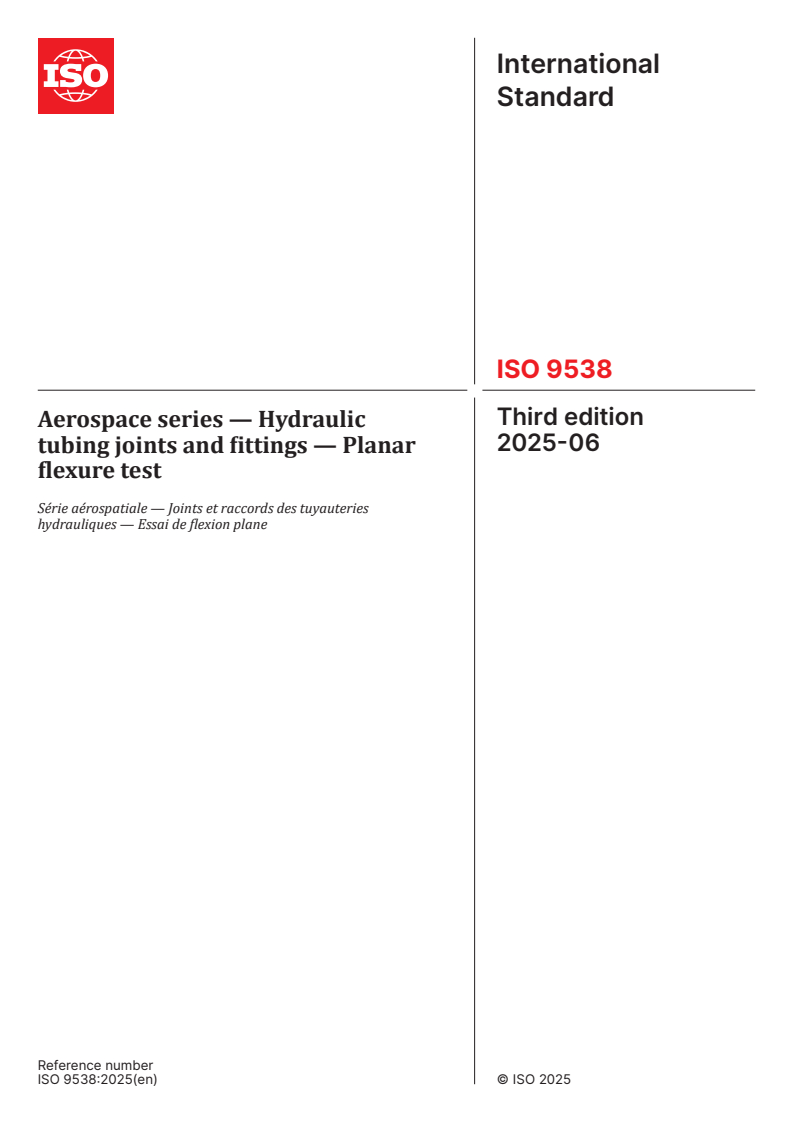
International
Standard
ISO 9538
Third edition
Aerospace series — Hydraulic
2025-06
tubing joints and fittings — Planar
flexure test
Série aérospatiale — Joints et raccords des tuyauteries
hydrauliques — Essai de flexion plane
Reference number
© ISO 2025
All rights reserved. Unless otherwise specified, or required in the context of its implementation, no part of this publication may
be reproduced or utilized otherwise in any form or by any means, electronic or mechanical, including photocopying, or posting on
the internet or an intranet, without prior written permission. Permission can be requested from either ISO at the address below
or ISO’s member body in the country of the requester.
ISO copyright office
CP 401 • Ch. de Blandonnet 8
CH-1214 Vernier, Geneva
Phone: +41 22 749 01 11
Email: copyright@iso.org
Website: www.iso.org
Published in Switzerland
ii
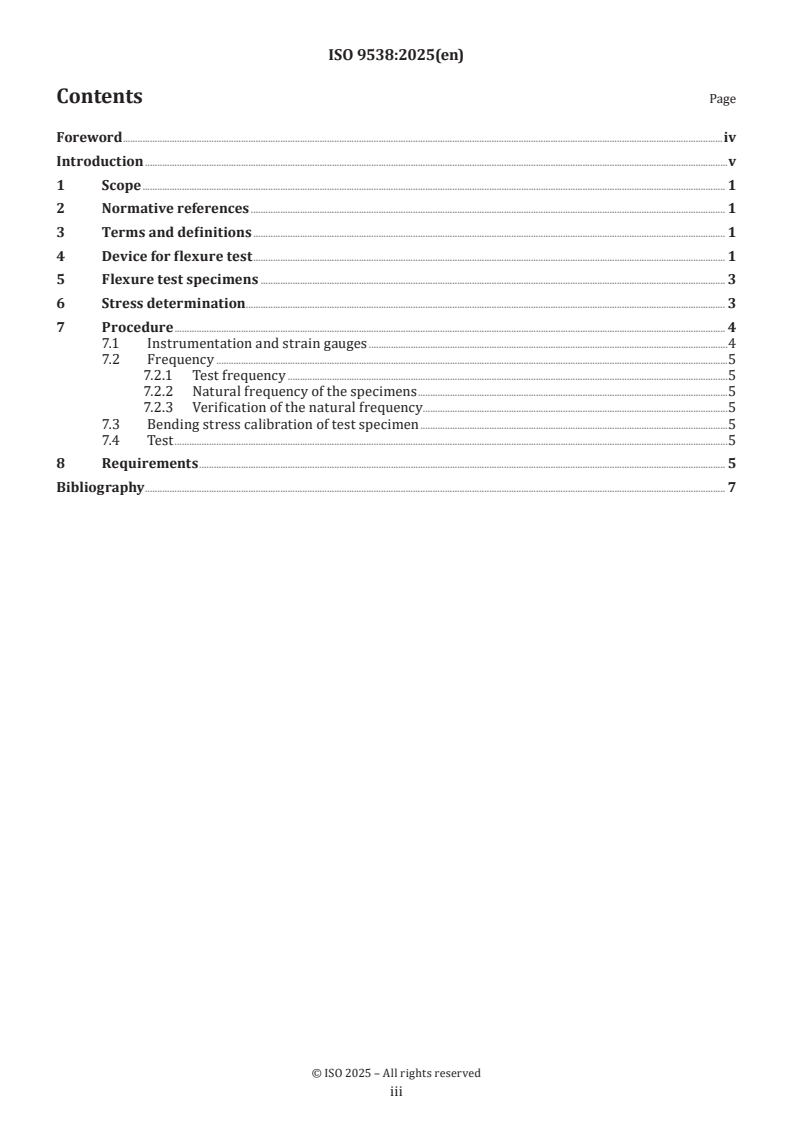
Contents Page
Foreword .iv
Introduction .v
1 Scope . 1
2 Normative references . 1
3 Terms and definitions . 1
4 Device for flexure test . 1
5 Flexure test specimens . 3
6 Stress determination . 3
7 Procedure . 4
7.1 Instrumentation and strain gauges .4
7.2 Frequency .5
7.2.1 Test frequency .5
7.2.2 Natural frequency of the specimens .5
7.2.3 Verification of the natural frequency . .5
7.3 Bending stress calibration of test specimen .5
7.4 Test .5
8 Requirements . 5
Bibliography . 7
iii
Foreword
ISO (the International Organization for Standardization) is a worldwide federation of national standards
bodies (ISO member bodies). The work of preparing International Standards is normally carried out through
ISO technical committees. Each member body interested in a subject for which a technical committee
has been established has the right to be represented on that committee. International organizations,
governmental and non-governmental, in liaison with ISO, also take part in the work. ISO collaborates closely
with the International Electrotechnical Commission (IEC) on all matters of electrotechnical standardization.
The procedures used to develop this document and those intended for its further maintenance are described
in the ISO/IEC Directives, Part 1. In particular, the different approval criteria needed for the different types
of ISO document should be noted. This document was drafted in accordance with the editorial rules of the
ISO/IEC Directives, Part 2 (see www.iso.org/directives).
ISO draws attention to the possibility that the implementation of this document may involve the use of (a)
patent(s). ISO takes no position concerning the evidence, validity or applicability of any claimed patent
rights in respect thereof. As of the date of publication of this document, ISO had not received notice of (a)
patent(s) which may be required to implement this document. However, implementers are cautioned that
this may not represent the latest information, which may be obtained from the patent database available at
www.iso.org/patents. ISO shall not be held responsible for identifying any or all such patent rights.
Any trade name used in this document is information given for the convenience of users and does not
constitute an endorsement.
For an explanation of the voluntary nature of standards, the meaning of ISO specific terms and expressions
related to conformity assessment, as well as information about ISO's adherence to the World Trade
Organization (WTO) principles in the Technical Barriers to Trade (TBT), see www.iso.org/iso/foreword.html.
This document was prepared by Technical Committee ISO/TC 20, Aircraft and space vehicles, Subcommittee
SC 10, Aerospace fluid systems and components.
This third edition cancels and replaces the second edition (ISO 9538:2017), which has been technically
revised.
The main changes are as follows:
— Clause 4 and Clause 7 were updated.
Any feedback or questions on this document should be directed to the user’
...