

ISO 6405-1:2017
(Main)Earth-moving machinery — Symbols for operator controls and other displays — Part 1: Common symbols
General Information
- Abstract
ISO 6405-1:2017 standardizes symbols for use on operator controls and other displays applicable to multiple types of earth-moving machinery as defined in ISO 6165. NOTE 1 ISO 6405‑2 covers symbols for specific types of earth-moving machines, equipment, and accessories. NOTE 2 ISO 7000 and IEC 60417 can be consulted for additional internationally standardized symbols of potential relevance to earth-moving machinery.
- Status
- Published
- Publication Date
- 29-Jan-2017
- Current Stage
- 9093 - International Standard confirmed
- Start Date
- 23-Jun-2022
- Completion Date
- 29-Aug-2026
Buy Documents
ISO 6405-1:2017 - Earth-moving machinery -- Symbols for operator controls and other displays
ISO 6405-1:2017 - Earth-moving machinery — Symbols for operator controls and other displays — Part 1: Common symbols/30/2017
ISO 6405-1:2017 - Engins de terrassement -- Symboles pour les commandes de l'opérateur et autres indicateurs
ISO 6405-1:2017 - Engins de terrassement — Symboles pour les commandes de l'opérateur et autres indicateurs — Partie 1: Symboles communs/6/2017
Overview
ISO 6405-1:2017 - "Earth-moving machinery - Symbols for operator controls and other displays - Part 1: Common symbols" standardizes graphical symbols for operator controls and displays used across multiple types of earth-moving machinery (as defined in ISO 6165). This third edition updates and expands common symbols that appear on control panels, decals, and digital displays in construction and heavy equipment cabs. It is focused on ensuring consistent, language‑independent communication of machine functions, warnings, and system status.
Key topics and technical requirements
- Scope and intent: Standardizes common symbols for multiple earth‑moving machine types; ISO 6405‑2 covers machine‑specific symbols.
- General rules (Clause 4):
- Symbols shall be used as shown unless specific adaptations are allowed.
- Size, contrast, orientation and placement requirements ensure legibility and correct association with controls.
- Minor reproduction modifications (line width, rounded corners) are permitted provided the symbol’s essential characteristics remain.
- Arrow design must follow ISO 80416‑2.
- Colour conventions (Clause 5):
- Red = failure or immediate attention required.
- Yellow/amber = condition outside normal limits.
- Green = normal operating condition.
- Specific uses: blue = high/main beam; red = hazard warning; green = turn signal. Red/blue indicate hot/cold for heating/cooling.
- Creation and maintenance (Clause 6):
- New symbols should be developed following Annex A and existing symbol databases (ISO 7000, IEC 60417).
- Proposed symbols require a short functional description.
- Digital displays (Clause 7):
- Guidance for adapting symbols into pixelated digital display icons while preserving visual impression (see ISO 80416‑4).
- Content structure:
- The standard includes base symbols and categories such as engine, transmission, hydraulics, brakes, fuel, lighting, visibility, climate control, seats, tyres/wheels, steering, etc.
Applications
- Design and specification of operator control panels, decals, and in‑cab graphical user interfaces (GUIs).
- Development of electronic instrument clusters and reconfigurable displays for excavators, loaders, graders, bulldozers, and other earth‑moving machinery.
- Operator manuals, training materials, and safety labeling to ensure consistent interpretation across languages and markets.
- Regulatory and conformity activities where standardized symbols improve usability and safety.
Who should use ISO 6405-1
- Equipment manufacturers (OEMs) and suppliers
- Human‑machine interface (HMI) and UX designers for heavy equipment
- Technical writers and documentation teams
- Safety, compliance, and product certification professionals
- Fleet operators and training organizations seeking consistent operator controls
Related standards
- ISO 6165 - Basic types and terms for earth‑moving machinery
- ISO 7000 / IEC 60417 - Databases of internationally registered graphical symbols
- IEC/ISO 80416 series (Parts 1–4) - Principles for creating, sizing, arrows, and digital icons
Keywords: ISO 6405-1, earth-moving machinery, operator controls, graphical symbols, digital display icons, ISO 7000, IEC 60417, HMI, control panel symbols.
Relations
- Referred By
EN ISO 11850:2011 - Machinery for forestry - General safety requirements (ISO 11850:2011) - Effective Date
- 25-Aug-2026
- Effective Date
- 25-Aug-2026
- Effective Date
- 25-Aug-2026
- Referred By
EN 16228-1:2014+A1:2021 - Drilling and foundation equipment - Safety - Part 1: Common requirements - Effective Date
- 25-Aug-2026
- Effective Date
- 25-Aug-2026
- Referred By
EN ISO 19296:2018 - Mining - Mobile machines working underground - Machine safety (ISO 19296:2018) - Effective Date
- 25-Aug-2026
- Effective Date
- 18-Mar-2026
- Effective Date
- 18-Mar-2026
- Effective Date
- 18-Mar-2026
- Effective Date
- 06-Jun-2022
- Effective Date
- 08-May-2020
- Effective Date
- 05-Nov-2015
- Effective Date
- 04-Nov-2015
Buy Documents
ISO 6405-1:2017 - Earth-moving machinery -- Symbols for operator controls and other displays
ISO 6405-1:2017 - Earth-moving machinery — Symbols for operator controls and other displays — Part 1: Common symbols/30/2017
ISO 6405-1:2017 - Engins de terrassement -- Symboles pour les commandes de l'opérateur et autres indicateurs
ISO 6405-1:2017 - Engins de terrassement — Symboles pour les commandes de l'opérateur et autres indicateurs — Partie 1: Symboles communs/6/2017
Frequently Asked Questions
ISO 6405-1:2017 is a standard published by the International Organization for Standardization (ISO). Its full title is "Earth-moving machinery — Symbols for operator controls and other displays — Part 1: Common symbols". This standard covers: ISO 6405-1:2017 standardizes symbols for use on operator controls and other displays applicable to multiple types of earth-moving machinery as defined in ISO 6165. NOTE 1 ISO 6405‑2 covers symbols for specific types of earth-moving machines, equipment, and accessories. NOTE 2 ISO 7000 and IEC 60417 can be consulted for additional internationally standardized symbols of potential relevance to earth-moving machinery.
ISO 6405-1:2017 standardizes symbols for use on operator controls and other displays applicable to multiple types of earth-moving machinery as defined in ISO 6165. NOTE 1 ISO 6405‑2 covers symbols for specific types of earth-moving machines, equipment, and accessories. NOTE 2 ISO 7000 and IEC 60417 can be consulted for additional internationally standardized symbols of potential relevance to earth-moving machinery.
ISO 6405-1:2017 is classified under the following ICS (International Classification for Standards) categories: 01.080.20 - Graphical symbols for use on specific equipment; 53.100 - Earth-moving machinery. The ICS classification helps identify the subject area and facilitates finding related standards.
ISO 6405-1:2017 has the following relationships with other standards: It is inter standard links to EN ISO 11850:2011, EN ISO 19225:2017, EN 17106-1:2021, EN 16228-1:2014+A1:2021, EN 15746-2:2020, EN ISO 19296:2018, EN 474-10:2022, EN 474-1:2022, EN 15955-2:2025, ISO 20418-3:2020, ISO 6405-1:2017/Amd 1:2022, ISO 6405-1:2004/Amd 1:2010, ISO 6405-1:2004. Understanding these relationships helps ensure you are using the most current and applicable version of the standard.
ISO 6405-1:2017 is available in PDF format for immediate download after purchase. The document can be added to your cart and obtained through the secure checkout process. Digital delivery ensures instant access to the complete standard document.
Standards Content (Sample)
INTERNATIONAL ISO
STANDARD 6405-1
Third edition
2017-02
Earth-moving machinery — Symbols
for operator controls and other
displays —
Part 1:
Common symbols
Engins de terrassement — Symboles pour les commandes de
l’opérateur et autres indicateurs —
Partie 1: Symboles communs
Reference number
©
ISO 2017
© ISO 2017, Published in Switzerland
All rights reserved. Unless otherwise specified, no part of this publication may be reproduced or utilized otherwise in any form
or by any means, electronic or mechanical, including photocopying, or posting on the internet or an intranet, without prior
written permission. Permission can be requested from either ISO at the address below or ISO’s member body in the country of
the requester.
ISO copyright office
Ch. de Blandonnet 8 • CP 401
CH-1214 Vernier, Geneva, Switzerland
Tel. +41 22 749 01 11
Fax +41 22 749 09 47
copyright@iso.org
www.iso.org
ii © ISO 2017 – All rights reserved
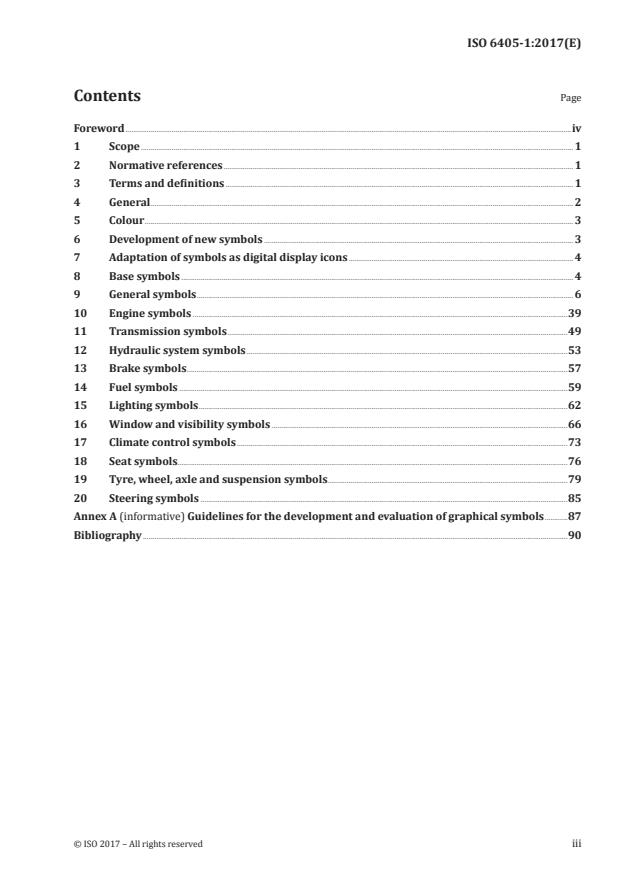
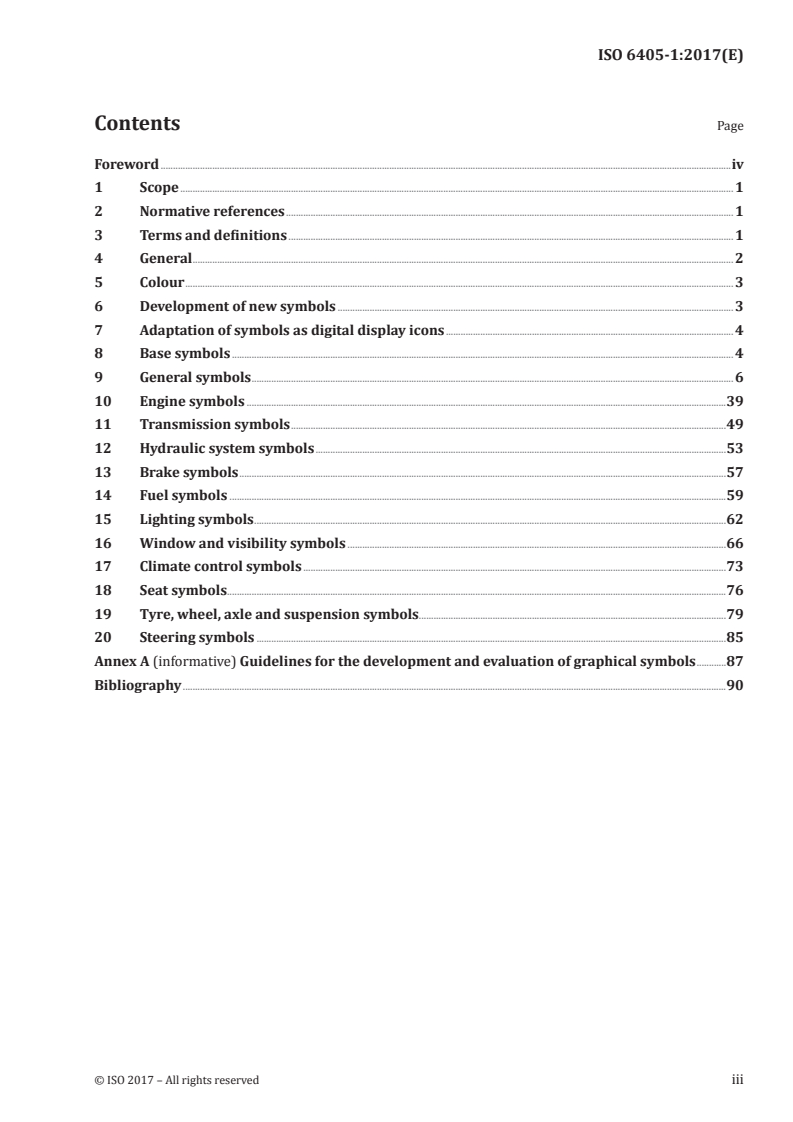
Contents Page
Foreword .iv
1 Scope . 1
2 Normative references . 1
3 Terms and definitions . 1
4 General . 2
5 Colour . 3
6 Development of new symbols . 3
7 Adaptation of symbols as digital display icons . 4
8 Base symbols . 4
9 General symbols . 6
10 Engine symbols .39
11 Transmission symbols .49
12 Hydraulic system symbols .53
13 Brake symbols .57
14 Fuel symbols .59
15 Lighting symbols .62
16 Window and visibility symbols .66
17 Climate control symbols .73
18 Seat symbols.76
19 Tyre, wheel, axle and suspension symbols.79
20 Steering symbols .85
Annex A (informative) Guidelines for the development and evaluation of graphical symbols .87
Bibliography .90
Foreword
ISO (the International Organization for Standardization) is a worldwide federation of national standards
bodies (ISO member bodies). The work of preparing International Standards is normally carried out
through ISO technical committees. Each member body interested in a subject for which a technical
committee has been established has the right to be represented on that committee. International
organizations, governmental and non-governmental, in liaison with ISO, also take part in the work.
ISO collaborates closely with the International Electrotechnical Commission (IEC) on all matters of
electrotechnical standardization.
The procedures used to develop this document and those intended for its further maintenance are
described in the ISO/IEC Directives, Part 1. In particular the different approval criteria needed for the
different types of ISO documents should be noted. This document was drafted in accordance with the
editorial rules of the ISO/IEC Directives, Part 2 (see www .iso .org/ directives).
Attention is drawn to the possibility that some of the elements of this document may be the subject of
patent rights. ISO shall not be held responsible for identifying any or all such patent rights. Details of
any patent rights identified during the development of the document will be in the Introduction and/or
on the ISO list of patent declarations received (see www .iso .org/ patents).
Any trade name used in this document is information given for the convenience of users and does not
constitute an endorsement.
For an explanation on the meaning of ISO specific terms and expressions related to conformity assessment,
as well as information about ISO’s adherence to the World Trade Organization (WTO) principles in the
Technical Barriers to Trade (TBT) see the following URL: www . i so .org/ iso/ foreword .html.
This document was prepared by Technical Committee ISO/TC 127, Earth-moving machinery,
Subcommittee SC 3, Machine characteristics, electrical and electronic systems, operation and maintenance.
This third edition of ISO 6405-1 cancels and replaces the second edition (ISO 6405-1:2004), which
has been technically revised with many new symbols added. It also incorporates the Amendment
ISO 6405-1:2004/Amd 1:2010.
A list of all parts in the ISO 6405 series can be found on the ISO website.
iv © ISO 2017 – All rights reserved
INTERNATIONAL STANDARD ISO 6405-1:2017(E)
Earth-moving machinery — Symbols for operator controls
and other displays —
Part 1:
Common symbols
IMPORTANT — The electronic file of this document contains colours which are considered to be
useful for the correct understanding of the document. Users should therefore consider printing
this document using a colour printer.
1 Scope
This document standardizes symbols for use on operator controls and other displays applicable to
multiple types of earth-moving machinery as defined in ISO 6165.
NOTE 1 ISO 6405-2 covers symbols for specific types of earth-moving machines, equipment, and accessories.
NOTE 2 ISO 7000 and IEC 60417 can be consulted for additional internationally standardized symbols of
potential relevance to earth-moving machinery.
2 Normative references
The following documents are referred to in the text in such a way that some or all of their content
constitutes requirements of this document. For dated references, only the edition cited applies. For
undated references, the latest edition of the referenced document (including any amendments) applies.
ISO 6165, Earth-moving machinery — Basic types — Identification and terms and definitions
IEC 80416-1, Basic principles for graphical symbols for use on equipment — Part 1: Creation of graphical
symbols for registration
ISO 80416-2, Basic principles for graphical symbols for use on equipment — Part 2: Form and use of arrows
IEC 80416-3, Basic principles for graphical symbols for use on equipment — Part 3: Guidelines for the
application of graphical symbols
3 Terms and definitions
For the purposes of this document, the following terms and definitions apply.
ISO and IEC maintain terminological databases for use in standardization at the following addresses:
— ISO Online browsing platform: available at www .iso .org/ obp
— IEC Electropedia: available at www .electropedia .org
3.1
symbol
graphical symbol
visually perceptible figure used to transmit information independent of language
Note 1 to entry: It may be produced by drawing, printing, or other means. Letters, numerals, and mathematical
symbols may be used as symbols or symbol elements. For some specific applications, groups of letters (for
example, AUTO, STOP) are used as symbols or symbol elements.
Note 2 to entry: Letters and numerals are not registered by ISO/TC 145/SC 3 or published in ISO 7000 unless they
are symbol elements embedded in graphical symbols.
3.2
icon
digital display icon
digitized (pixelated) representation of a graphical symbol (3.1), usually used on a reconfigurable
electronic display screen or graphical user interface (GUI)
Note 1 to entry: A single symbol can be represented by multiple icons, each of a different size, pixel count, or
colourization.
4 General
4.1 Except as indicated in subsequent clauses, symbols shall be used as shown in this document.
4.2 Selected symbols, which are shown in outline form in this document, may be filled in actual use for
enhanced clarity of reproduction and improved visual perception by the operator, except as otherwise
specified for individual symbols, and in accordance with IEC 80416-3.
4.3 Limitations inherent in some reproduction and display technologies can require increased line
width or other minor modifications of symbols. Such modifications are allowed, provided that the symbol
remains conceptually unchanged in its basic graphical elements and is easily discernible by the operator.
4.4 To improve the appearance and perceptibility of a graphical symbol, or to coordinate with the
design of the equipment to which it is applied, it can be necessary to modify the symbol as indicated
in IEC 80416-3 (for example, to change the line width or to round the corners of the symbol). Such
modifications are allowed, provided that the essential perceptible characteristics of the symbol are
maintained.
4.5 For actual use, all symbols shall be reproduced large enough to be easily discernible by the operator.
Follow IEC 80416-3 for the proper sizing of symbols. Symbols grouped together in a display or on a set
of controls should be scaled to the same degree relative to the corner marks of the symbol original as
shown in this document in order to maintain the correct visual relationship among the symbols. Symbols
shall be used in the orientation shown in this document, unless rotation or mirror imaging is specifically
allowed for individual symbols.
4.6 Most symbols are constructed using a building block approach in which various symbols and
symbol elements are combined in a logical manner to produce a new symbol.
4.7 In some cases, symbols may be used in conjunction, without being combined into a composite
symbol, to convey the same meaning as the composite symbol.
4.8 Symbols are generally intended to replace a word or words with a graphical image that has the
same meaning for all operators, regardless of their native language. However, the use of a graphical
symbol to identify a control or display does not preclude the use of words in conjunction with that
control or display.
4.9 If a symbol shows a machine or parts of a machine from a side view, a machine moving from right
to left across the symbol area shall be assumed. If a symbol shows a machine or parts of a machine from
an overhead view, a machine moving from bottom to top across the symbol area shall be assumed.
4.10 Symbols on controls and displays shall have a good contrast to their background. A white or light-
coloured symbol on a black or dark-coloured background is preferred for most controls. Displays may
use either a white or light-coloured symbol on a black or dark-coloured background or a black or dark-
2 © ISO 2017 – All rights reserved
coloured symbol on a white or light-coloured background, depending upon which alternative provides
the best visual perception. When a symbol image is reversed (for example, from black-on-white to white-
on-black or vice versa) this reversal shall be done for the entire symbol.
4.11 If symbols are cast, moulded, embossed, or stamped into a surface, the symbols shall be visually
distinct from that surface without dependence on colour.
4.12 Symbols shall be located on or adjacent to the control or display that is being identified. Where
more than one symbol is required for a control, the symbols shall be located in relation to the control
such that movement of the control towards the symbols shall effect the function depicted by that symbol.
4.13 Arrows used in symbols shall conform to the requirements of ISO 80416-2. IEC 80416-1 shall be
consulted for the general principles for creating symbol originals. IEC 80416-3 should be consulted for
guidelines for the application of symbols.
4.14 ISO/IEC registration numbers are shown for symbols which are registered in ISO 7000 or
IEC 60417.
NOTE Symbol originals are approved and registered either by ISO/TC 145/SC 3 and published in ISO 7000
or by IEC/SC 3C and published in IEC 60417. In some cases, modified or application symbols, rather than the
registered symbol originals, are standardized in this document.
4.15 When letters or numerals are used in a symbol, the font shown shall not be considered definitive.
Other fonts may be used so long as the letters and numerals remain legible.
4.16 Symbols in this part of ISO 6405 are shown within marks that delimit the corners of the 75 mm
square basic pattern from IEC 80416-1. Corner marks are not part of the symbol, but are provided to
ensure consistent presentation of all symbol graphics.
5 Colour
5.1 When used on illuminated displays, the following colours shall have the meanings indicated:
— Red denotes a failure, serious malfunction, or operating condition that requires immediate attention;
— Yellow or amber denotes a condition outside normal operating limits;
— Green denotes a normal operating condition.
5.2 In addition, certain colours shall be used for specific applications:
— Blue is used for the high beam; main beam display (see 15.1);
— Red is used for the hazard warning display and for the hazard warning control (see 15.6);
— Green is used for the turn signal display (see 15.10).
5.3 If colour is used on or in association with symbols for heating and cooling systems, the colour red
shall be used to indicate hot, and the colour blue shall be used to indicate cold.
6 Development of new symbols
6.1 Prior to developing a new symbol, a search should be conducted for previously standardized
symbols with the same or similar meaning to what is needed. ISO 7000 and IEC 60417 (both available
in database form) are compilations of internationally standardized symbols which can be useful both for
finding appropriate symbols that do not appear in ISO 6405 and for generating concepts that can be used
in the development of new symbols.
6.2 New symbols shall be developed in accordance with the principles of Annex A of this document.
IEC 80416-1 should be consulted for general principles for the creation of symbols. Arrows shall be in
accordance with ISO 80416-2. Different arrow forms have different meanings according to ISO 80416-
2. Care should be taken to use the correct arrow form. Following the guidelines given in Annex A of this
document makes possible the development of symbols appropriate in graphical form and content for
international standardization and ISO 7000 registration.
6.3 Symbols proposed for standardization in this document shall include a short explanation of the
function or expected use of the symbol.
NOTE IEC 80416-1 uses the term “description” for this type of information and provides guidelines for
writing descriptions for symbols intended for standardization in ISO 7000 or IEC 60417. The descriptions for
symbols standardized in this document can serve as examples.
7 Adaptation of symbols as digital display icons
Symbols can be adapted for use as digital display icons on visual display units, reconfigurable displays,
or other electronic displays. Such adaptations should follow the principles of ISO 80416-4. Special care
should be taken to ensure that digital display icons preserve the visual impression of the symbol from
which the icon is adapted. The same principles regarding use of colour with symbols apply to the use of
colour with digital display icons.
8 Base symbols
ISO/IEC
Graphical symbol Symbol title and description
registration number
8.1 Oil; fluid Application of
ISO 7000–1056
To indicate oil or other non-water-base fluid.
Use as a symbol element in combination with other
symbols to indicate specified types of oil.
This symbol may be used when the type of oil or fluid
is not specified.
8.2 Water; coolant; water-base fluid Application of
ISO 7000–0536
To indicate water, coolant, or other water-base fluid.
Use as a symbol element in combination with other
symbols to indicate specified types of water-base fluid.
This symbol may be used when the type of water-base
fluid is not specified.
8.3 Intake air; air flow through Application of
ISO 7000–1604
To indicate intake air.
To indicate air flow into or through a tube or pipe.
This symbol shall be used outline.
8.4 Exhaust gas ISO 7000–1605
To indicate exhaust gas.
To indicate air flow out of a tube or pipe.
This symbol shall be used filled.
4 © ISO 2017 – All rights reserved
ISO/IEC
Graphical symbol Symbol title and description
registration number
8.5 Pressure ISO 7000–1701
To indicate pressure in general.
Use as a symbol element in combination with other
symbols to indicate the type of material that is under
pressure.
The filled circle may be deleted and an appropriate
symbol inserted between the arrows.
8.6 Level indicator Application of
ISO 7000–0159
To identify the control that adjusts the amount of level
of material in a container.
To indicate the level of, for example, a liquid in a
container.
Use as a symbol element in combination with other
symbols to indicate the type of material whose quan-
tity is measured.
The line at the right of the symbol may be deleted and
an appropriate symbol inserted.
8.7 Filter ISO 7000–1369
To indicate a filter for liquid or gas.
Use as a symbol element in combination with other
symbols to indicate the type of material that is filtered.
8.8 Temperature ISO 7000–0034
To indicate temperature or a function associated with
temperature.
8.9 Malfunction, general; failure ISO 7000–1603B
To indicate that a component or function has failed or
malfunctioned.
Use as a symbol element in combination with other
symbols to indicate the component or function that
has failed or malfunctioned.
ISO/IEC
Graphical symbol Symbol title and description
registration number
8.10 Mass; weight Application of
ISO 7000–1321A
To indicate mass.
To identify a function related to mass.
ISO 7000–1321A and ISO 7000–1321B are alternative
symbols with the same meaning.
8.11 ISO 7000–1321B
8.12 Air, general Application of
ISO7000–0537
To indicate air in general.
To indicate a function related to air in general.
9 General symbols
ISO/IEC
Graphical symbol Symbol title and description registration number
9.1 On; start Application of
IEC 60417–5007
To identify the control that starts a function or operation.
To identify the control that enables a function or oper-
ation to be engaged or activated.
Use independently or in conjunction with other symbols.
Do not use as a graphical element with the meaning “on;
start” within a combined symbol (see 4.6 and 4.7).
9.2 Off; stop Application of
IEC 60417–5008
To identify the control that stops a function or operation.
To identify the control that disables a function or oper-
ation to be engaged or activated.
Use independently or in conjunction with other symbols.
Do not use as a graphical element with the meaning “on;
start” within a combined symbol (see 4.6 and 4.7).
9.3 On and off Application of
IEC 60417–5010
To identify the control that, depending on its position or
last activation, starts or stops a function or operation.
Use independently or in conjunction with other symbols.
Do not use as a graphical element with the meaning “on
and off” within a combined symbol (see 4.6 and 4.7).
6 © ISO 2017 – All rights reserved
ISO/IEC
Graphical symbol Symbol title and description registration number
9.4 Ready ISO 7000–1140
To indicate that the machine or equipment or function
is ready for operation.
9.5 Stand-by IEC 60417–5009
To identify the control by which part of the equipment
is switched on in order to bring the component or
function into the stand-by condition.
9.6 Engage Application of
ISO 7000–0022
To identify the control that effects the engagement of
two machine parts or elements, or the activation of a
mechanical function.
To indicate the engagement function.
This symbol may be rotated 90° or 180° for a clearer
visual representation.
9.7 Disengage Application of
ISO 7000–0023
To identify the control that effects the disengagement
of two machine parts or elements, or the deactivation
of a mechanical function.
To indicate the disengagement function.
This symbol may be rotated 90° or 180° for a clearer
visual representation.
9.8 Plus; increase; positive polarity Application of
IEC 60417–5005
To identify the positive terminals of equipment which
is used with or generates direct current.
To indicate that a quantity is increasing or the direc-
tion of control movement that increases a quantity.
9.9 Minus; decrease; negative polarity Application of
IEC 60417–5006
To identify the negative terminals of equipment which
is used with or generates direct current.
To indicate that a quantity is decreasing or the direc-
tion of control movement that decreases a quantity.
9.10 Lock ISO 7000–1656
To identify the location of a lock.
To identify the control that effects a locking function.
To indicate that the component or function is in its
locked state.
9.11 ISO 7000–1656 and IEC 60417–5569 are alternative Application of
symbols with the same meaning. IEC 60417–5569
Graphical ISO/IEC
symbol Symbol title and description registration number
9.12 Unlock ISO 7000–3305
To identify the control that effects an unlocking
function.
To indicate that the component or function is in its
unlocked state.
ISO 7000–3305 and IEC 60417–5570 are alternative
9.13 Application of
symbols with the same meaning.
IEC 60417–5570
9.14 Horn ISO 7000–0244
To identify the control for the horn.
9.15 Battery charging condition ISO 7000–0247
To indicate whether the battery is charging.
To indicate the operational status of the battery.
When displayed on a red background, this symbol
indicates that the battery has reached a low level
of charge.
9.16 Battery disconnect; battery shut-off ISO 7000–2063
To identify the control that disconnects the battery
from the electrical system.
To indicate that the battery has been disconnected.
9.17 Battery fluid level ISO 7000–2455
To indicate the battery fluid level.
To identify the battery fluid fill point.
9.18 Battery, failure Application of
ISO 7000–2456
To indicate that the battery has failed or malfunc-
tioned.
9.19 Clock; time switch; timer IEC 60417–5184
To identify clock or timer functions.
To identify the control that activates a clock, time
switch, or timer.
To identify the control that allows setting of time
and date on electronic displays.
8 © ISO 2017 – All rights reserved
Graphical ISO/IEC
symbol Symbol title and description registration number
9.20 Clock, malfunction ISO 7000–3395
To indicate that the clock has malfunctioned.
9.21 Hourmeter; elapsed operating hours ISO 7000–1366
To indicate the number of hours that the machine or
component has been operating.
To indicate the operating interval at which service
or maintenance functions should be performed.
Use as a symbol element to indicate a quantity per
9.22 Application of
hour.
ISO 7000–1366
9.23 Volume, empty ISO 7000–1563
To indicate that the container is empty.
To identify the empty reading or indicator position
on the display or container.
9.24 Volume, half-full ISO 7000–1564
To indicate that the container is half-full.
To identify the half-full reading or indicator position
on the display or container.
9.25 Volume, full ISO 7000–1565
To indicate that the container is full.
To identify the full reading or indicator position on
the display or container.
9.26 Control lever operating direction, dual-direction ISO 7000–1436
To indicate that the control operates in two direc-
tions.
To indicate the directions in which the control moves.
This symbol may be rotated to indicate the angle of
control operation in two directions.
Place appropriate symbols at arrowheads to indicate
the action effected by movement of the control.
ISO/IEC
Graphical symbol Symbol title and description registration number
9.27 Control lever operating direction, multiple-direc- ISO 7000–1703
tion
To indicate that the control operates in multiple direc-
tions, generally forward-rearward and left-right.
To indicate the directions in which the control moves.
Place appropriate symbols at arrowheads to indicate
the action effected by movement of the control.
9.28 Joystick control mode ISO 7000–3192
To identify the control that places the machine, equip-
ment, or function in joystick control mode.
To indicate that the machine, equipment, or function
is in joystick control mode.
9.29 Joystick control, lock ISO 7000–3306
To identify the control or control position that deac-
tivates the joystick control and thereby locks out the
functionality of the control.
To indicate that the joystick control is in the locked
condition.
9.30 Joystick control, off or not available ISO 7000–3307
To indicate that the joystick control is not functional.
9.31 Pull switch, switch position pulled out; pull to ISO 7000–1154
activate
To identify a control that is activated by pulling out.
To indicate that the pull switch is pulled out (activated).
9.32 Pull switch, switch position pushed in; push to ISO 7000–1155
deactivate
To identify a control that is deactivated by pushing in.
To indicate that the pull switch is pushed in (deac-
tivated).
9.33 Forward or rearward movement, general ISO 7000–3517
To identify the control or control that moves the ma-
chine in a forward or rearward direction.
To indicate that the machine is moving forward or
rearward.
Use this symbol when identification of the machine
type is not required or when an appropriate machine
representation is not available.
10 © ISO 2017 – All rights reserved
ISO/IEC
Graphical symbol Symbol title and description registration number
9.34 Forward movement, general ISO 7000–0775
To identify the control or control that moves the ma-
chine in a forward direction.
To indicate that the machine is moving forward.
Use this symbol when identification of the machine
type is not required or when an appropriate machine
representation is not available.
9.35 Rearward movement, general ISO 7000–0776
To identify the control that moves the machine in a
rearward direction.
To indicate that the machine is moving rearward.
Use this symbol when identification of the machine
type is not required.
Use this symbol when identification of the machine
type is not required or when an appropriate machine
representation is not available.
9.36 Clockwise rotation ISO 7000–0258
To identify clockwise rotational movement.
9.37 Anti-clockwise rotation ISO 7000–0937
To identify anti-clockwise rotational movement.
9.38 Direction of continuous rotation, clockwise ISO 7000–0440
To indicate continuous clockwise rotational movement.
9.39 Direction of continuous rotation, anti-clockwise ISO 7000–0941
To indicate continuous anti-clockwise rotational
movement.
9.40 Direction of interrupted rotation, clockwise ISO 7000–0942
To indicate interrupted clockwise rotational move-
ment.
ISO/IEC
Graphical symbol Symbol title and description registration number
9.41 Direction of interrupted rotation, anti-clockwise ISO 7000–0943
To indicate interrupted anti-clockwise rotational
movement.
9.42 Rotary repeated positioning ISO 7000–0436
To identify the control that activates repeated posi-
tioning in a rotary direction.
9.43 Rectilinear repeated positioning ISO 7000–0254
To identify the control that activates repeated posi-
tioning in a rectilinear direction.
9.44 Grease lubrication point; lubricate with grease; ISO 7000–0787
grease lubrication
To identify the locations on a machine or equipment
which should be lubricated with grease.
To identify the container for grease.
To indicate the need for service with grease.
This symbol may be combined with ISO 7000–1366
(see 9.22 and 9.23) to indicate service intervals for
components lubricated with grease.
9.45 Grease lubrication system, automatic operation ISO 7000–3396
mode
To identify the automatic grease lubrication system.
To identify the fill point for the automatic grease
lubrication system.
To indicate the operational status of the automatic
grease lubrication system.
9.46 Oil lubrication point; lubricate with oil; lubricat- Application of
ing oil ISO 7000–0391
To identify the locations on a machine or equipment
which should be lubricated with oil.
To indicate the need for service with oil.
This symbol may be combined with ISO 7000–1366
(see 9.22 and 9.23) to indicate service intervals for
components lubricated with oil.
9.47 Lift point ISO 7000–1368
To identify the locations on a machine where a lifting
device can be attached.
12 © ISO 2017 – All rights reserved
ISO/IEC
Graphical symbol Symbol title and description registration number
9.48 Tow point; retrieval point ISO 7000–2686
To identify the locations on a machine where a towing
or retrieval device can be attached.
This symbol may be mirror-imaged to indicate the lo-
cations on a machine where a towing or retrieval de-
vice can be attached for rearward towing or retrieval.
9.49 Jack support point; central support ISO 7000–0542
To identify the locations on a machine where a lifting
jack or support device can be used.
This symbol shall be used filled.
9.50 Tie down point ISO 7000–2069
To indicate the locations on a machine or equipment
which are to be used to secure the machine (for exam-
ple, to a trailer) or to prevent equipment from moving
during transport.
9.51 Reservoir ISO 7000–0359
To identify a reservoir.
The type of reservoir may be indicated by a symbol to
represent the material contained in the reservoir.
9.52 Filling ISO 7000–0028
To indicate the filling of the container.
This symbol does not specify the material with which
the container is being filled.
9.53 Draining; emptying ISO 7000–0029
To indicate the draining or emptying of the container.
This symbol does not specify the material which is
being drained or emptied.
9.54 Read operator’s manual ISO 7000–0790
To indicate that the operator’s manual should be
consulted.
To identify the location where the operator’s manual
is stored.
9.55 Service indicator; read technical manual ISO 7000–1659
To indicate that the technical manual should be
consulted.
To identify the location where the technical manual
is stored.
To indicate that the machine or equipment requires
service.
To identify the control used to select diagnostic op-
tions or to display diagnostic codes.
ISO/IEC
Graphical symbol Symbol title and description registration number
9.56 Cup holder ISO 7000–2583
To identify the location of the cup holder.
9.57 Dipstick ISO 7000–1318
To identify the equipment used to determine the level
of fluid by inserting the equipment into a specified
location, withdrawing the equipment, and examining
the mark left by the residual fluid.
To identify the dipstick location.
This symbol does not specify the fluid that is meas-
ured by the dipstick.
9.58 Moving machine alarm; rearward moving ma- ISO 7000–2104
chine alarm
To identify the control that sounds an alarm to alert
persons when the machine is moving rearward.
To indicate the operational status of the rearward
moving machine alarm.
9.59 Moving machine alarm, cancel; rearward moving ISO 7000–2240
machine alarm, cancel
To identify the control that cancels or switches off the
rearward moving machine alarm.
9.60 Radar sensor Application of
ISO 7000–2241
To identify the control for the radar sensor.
To indicate that data (for example, to determine ma-
chine ground speed) have been obtained using radar.
9.61 Satellite reception mode, general IEC 60417–5464
To identify the control that enables the equipment to
receive satellite broadcasting transmissions.
To indicate that the equipment is in the satellite re-
ception mode.
9.62 Global positioning system (GPS); global navigation ISO 7000-3599
satellite system (GNSS)
To indicate that data (for example, to determine ma-
chine ground speed) have been obtained using one of
the global satellite navigation systems.
To identify the control for the satellite navigation
sensor.
To indicate the operational status of the satellite nav-
igation sensor.
The abbreviations GNSS or GPS may be used in addi-
tion to or as alternatives to this symbol.
14 © ISO 2017 – All rights reserved
ISO/IEC
Graphical symbol Symbol title and description registration number
9.63 Wireless communication ISO 7000–3600
To identify the control that enables or activates wire-
less communications.
To indicate the operational status of the wireless com-
munications function.
9.64 Latitude and longitude ISO 7000–3193
To identify the control that sets the current or default
latitude and longitude.
To indicate latitude and longitude.
9.65 Aerial; antenna IEC 60417–5039
To identify the aerial (antenna).
This symbol should be used unless it is essential to
specify the type of aerial (antenna).
9.66 Urgent alert indicator ISO 7000–2301
To indicate a condition that requires immediate atten-
tion by the operator.
Use as an “urgent alert” indicator to call attention to
another (already existing) symbol.
9.67 Information alert ISO 7000–2760
To indicate that one or more functions or systems on
the machine or equipment are operating outside nor-
mal parameters in such a way as to require that the
operator be alerted, but not necessarily to require ac-
tive attention or monitoring of the function or system.
9.68 When displayed in colour, this symbol shall be Application of
displayed in blue, preferably with blue outer border, ISO 7000–2760
white inner border, blue background, and white letter
(see 9.68).
This symbol is registered in ISO 7000 with the title
“product information; information point” and a differ-
ent description.
May be used in combination with ISO 7000–2813 (see
9.69 and 9.70) and ISO 7000–3308 (see 9.71 and 9.72).
ISO/IEC
Graphical symbol Symbol title and description registration number
9.69 Operator alert ISO 7000–2813
To indicate that one or more functions or systems on
the machine or equipment are operating outside nor-
mal parameters in such a way as to require attention
or further monitoring of the function or system, but
not necessarily to require stopping the machine or
equipment.
9.70 Application of
When displayed in colour, this symbol shall be dis- ISO 7000–2813
played in yellow, preferably with black outline diamond
and black exclamation mark on a yellow background.
The yellow background may be extended beyond the
limit of the black outline diamond (see 9.70).
Do not use this symbol for alerting to personal safety
hazards.
May be used in combination with ISO 7000–2760 (see
9.67 and 9.68) and ISO 7000–3308 (see 9.71 and 9.72).
9.71 Stop operation ISO 7000–3308
To instruct the operator to stop the machine or equip-
ment as soon as possible and to switch off the engine
or perform a requested action before any further
operation is attempted.
To indicate that one or more functions or systems on
9.72 the machine or equipment are operating outside nor- Application of
mal parameters in such a way as to require stopping ISO 7000–3308
the machine or equipment.
When displayed in colour, this symbol shall be
displayed in red with red outer border, white inner
border, red background, and white letters (see 9.72).
May be used in combination with ISO 7000–2760 (see
9.67 and 9.68) and ISO 7000–2813 (see 9.69 and 9.70).
9.73 Manual control; manual operation; manual start ISO 7000–0096
To identify the control that activates manual control.
To indicate that the function is in manual control mode.
Use as a symbol element in a combined symbol or in
conjunction with a function symbol to indicate manu-
al operating mode.
9.74 ISO 7000–2684
ISO 7000–0096 and ISO 7000–2684 are alternative
symbols with the same meaning.
ISO 7000–2684 may be rotated 90° clockwise. Rotat-
ed symbol may be mirror-imaged.
Symbol ISO 7000–2684 is registered with the title
“manual activation control”.
16 © ISO 2017 – All rights reserved
ISO/IEC
Graphical symbol Symbol title and description registration number
9.75 Automatic operation; automatic start Groups of letters used
as symbols
To identify the control that selects the automatic
are not registered.
mode for a function.
To identify the control that activates automatic control.
To indicate that the function is in automatic control
mode.
Use as a symbol element in a combined symbol or in
conjunction with a function symbol to indicate auto-
matic operating mode.
9.76 Counter Application of
ISO 7000–0695
To indicate a counting function.
To indicate the count of a quantity produced in the cur-
rent job or time interval since the last reset.
9.77 Counter reset ISO 7000–2750
To identify the control that sets the count in the coun-
ter to zero.
To identify the control that sets the value of a meas-
ured or displayed quantity to zero.
9.78 Roadway travel mode ISO 7000–2310
To identify the control that brings the machine to a
condition where it can travel on public roadways.
To indicate that the machine is set up for travel on
public roadways.
9.79 Roadway travel mode, cancel Negation of
ISO 7000–2310
To identify the control that takes the machine to a con-
dition where it should not travel on public roadways.
To indicate that the machine is not set up for travel on
public roadways.
9.80 Fast operation ISO 7000–2810
To indicate the fast setting of an operating range.
To identify the control for fast operation.
To identify the control direction of movement that
increases speed of operation.
This symbol shall be used filled.
9.81 Slow operation ISO 7000–2811
To indicate the slow setting of an operating range.
To identify the control for slow operation.
To identify the control direction of movement that
decreases speed of operation.
This symbol shall be used filled.
ISO/IEC
Graphical symbol Symbol title and description registration number
9.82 Very slow operation; creeper gear ISO 7000–2812
To indicate the very slow setting of an operating range.
To identify the control direction of movement that
decreases speed of operation to its slowest setting.
To identify the creeper gear of the transmission.
To indicate that the transmission is operating in its
creeper gear.
This symbol shall be used filled.
9.83 Temperature, high ISO 7000–3397
To identify the high temperature position of a control.
To indicate that the temperature is at a high level.
Colour may be red to signify warm or hot tempera-
tures.
9.84 Temperature, low ISO 7000–3398
To identify the low temperature position of a control.
To indicate that the temperature is at a low level.
Colour may be blue to signify cool or cold temperatures.
9.85 Temperature limit ISO 7000–0632
To identify the control that sets the maximum and
minimum temperature limits.
To indicate the maximum and minimum tempera-
ture limits.
The temperature values may be shown adjacent to the
symbol, preferably with the minimum temperature
on the left side and the maximum temperature on the
right side.
9.86 Upper temperature limit; maximum temperature ISO 7000–0533
To identify the control that sets the maximum temper-
ature limit.
To indicate the maximum temperature limit.
The temperature value may be shown adjacent to the
symbol, preferably on the right side.
9.87 Lower temperature limit; minimum temperature ISO 7000–0534
To identify the control that sets the minimum temper-
ature limit.
To indicate the minimum temperature limit.
The temperature value may be shown adjacent to the
symbol, preferably on the left side.
9.88 Temperature, increasing ISO 7000–0035
To indicate an increase in temperature.
To identify the control that causes the temperature to
increase.
18 © ISO 2017 – All rights reserved
ISO/IEC
Graphical symbol Symbol title and description registration number
9.89 Temperature, decreasing ISO 7000–0036
To indicate a decrease in temperature.
To identify the control that causes the temperature to
decrease.
9.90 Temp
...
INTERNATIONAL ISO
STANDARD 6405-1
Third edition
2017-02
Earth-moving machinery — Symbols
for operator controls and other
displays —
Part 1:
Common symbols
Engins de terrassement — Symboles pour les commandes de
l’opérateur et autres indicateurs —
Partie 1: Symboles communs
Reference number
©
ISO 2017
© ISO 2017, Published in Switzerland
All rights reserved. Unless otherwise specified, no part of this publication may be reproduced or utilized otherwise in any form
or by any means, electronic or mechanical, including photocopying, or posting on the internet or an intranet, without prior
written permission. Permission can be requested from either ISO at the address below or ISO’s member body in the country of
the requester.
ISO copyright office
Ch. de Blandonnet 8 • CP 401
CH-1214 Vernier, Geneva, Switzerland
Tel. +41 22 749 01 11
Fax +41 22 749 09 47
copyright@iso.org
www.iso.org
ii © ISO 2017 – All rights reserved
Contents Page
Foreword .iv
1 Scope . 1
2 Normative references . 1
3 Terms and definitions . 1
4 General . 2
5 Colour . 3
6 Development of new symbols . 3
7 Adaptation of symbols as digital display icons . 4
8 Base symbols . 4
9 General symbols . 6
10 Engine symbols .39
11 Transmission symbols .49
12 Hydraulic system symbols .53
13 Brake symbols .57
14 Fuel symbols .59
15 Lighting symbols .62
16 Window and visibility symbols .66
17 Climate control symbols .73
18 Seat symbols.76
19 Tyre, wheel, axle and suspension symbols.79
20 Steering symbols .85
Annex A (informative) Guidelines for the development and evaluation of graphical symbols .87
Bibliography .90
Foreword
ISO (the International Organization for Standardization) is a worldwide federation of national standards
bodies (ISO member bodies). The work of preparing International Standards is normally carried out
through ISO technical committees. Each member body interested in a subject for which a technical
committee has been established has the right to be represented on that committee. International
organizations, governmental and non-governmental, in liaison with ISO, also take part in the work.
ISO collaborates closely with the International Electrotechnical Commission (IEC) on all matters of
electrotechnical standardization.
The procedures used to develop this document and those intended for its further maintenance are
described in the ISO/IEC Directives, Part 1. In particular the different approval criteria needed for the
different types of ISO documents should be noted. This document was drafted in accordance with the
editorial rules of the ISO/IEC Directives, Part 2 (see www .iso .org/ directives).
Attention is drawn to the possibility that some of the elements of this document may be the subject of
patent rights. ISO shall not be held responsible for identifying any or all such patent rights. Details of
any patent rights identified during the development of the document will be in the Introduction and/or
on the ISO list of patent declarations received (see www .iso .org/ patents).
Any trade name used in this document is information given for the convenience of users and does not
constitute an endorsement.
For an explanation on the meaning of ISO specific terms and expressions related to conformity assessment,
as well as information about ISO’s adherence to the World Trade Organization (WTO) principles in the
Technical Barriers to Trade (TBT) see the following URL: www . i so .org/ iso/ foreword .html.
This document was prepared by Technical Committee ISO/TC 127, Earth-moving machinery,
Subcommittee SC 3, Machine characteristics, electrical and electronic systems, operation and maintenance.
This third edition of ISO 6405-1 cancels and replaces the second edition (ISO 6405-1:2004), which
has been technically revised with many new symbols added. It also incorporates the Amendment
ISO 6405-1:2004/Amd 1:2010.
A list of all parts in the ISO 6405 series can be found on the ISO website.
iv © ISO 2017 – All rights reserved
INTERNATIONAL STANDARD ISO 6405-1:2017(E)
Earth-moving machinery — Symbols for operator controls
and other displays —
Part 1:
Common symbols
IMPORTANT — The electronic file of this document contains colours which are considered to be
useful for the correct understanding of the document. Users should therefore consider printing
this document using a colour printer.
1 Scope
This document standardizes symbols for use on operator controls and other displays applicable to
multiple types of earth-moving machinery as defined in ISO 6165.
NOTE 1 ISO 6405-2 covers symbols for specific types of earth-moving machines, equipment, and accessories.
NOTE 2 ISO 7000 and IEC 60417 can be consulted for additional internationally standardized symbols of
potential relevance to earth-moving machinery.
2 Normative references
The following documents are referred to in the text in such a way that some or all of their content
constitutes requirements of this document. For dated references, only the edition cited applies. For
undated references, the latest edition of the referenced document (including any amendments) applies.
ISO 6165, Earth-moving machinery — Basic types — Identification and terms and definitions
IEC 80416-1, Basic principles for graphical symbols for use on equipment — Part 1: Creation of graphical
symbols for registration
ISO 80416-2, Basic principles for graphical symbols for use on equipment — Part 2: Form and use of arrows
IEC 80416-3, Basic principles for graphical symbols for use on equipment — Part 3: Guidelines for the
application of graphical symbols
3 Terms and definitions
For the purposes of this document, the following terms and definitions apply.
ISO and IEC maintain terminological databases for use in standardization at the following addresses:
— ISO Online browsing platform: available at www .iso .org/ obp
— IEC Electropedia: available at www .electropedia .org
3.1
symbol
graphical symbol
visually perceptible figure used to transmit information independent of language
Note 1 to entry: It may be produced by drawing, printing, or other means. Letters, numerals, and mathematical
symbols may be used as symbols or symbol elements. For some specific applications, groups of letters (for
example, AUTO, STOP) are used as symbols or symbol elements.
Note 2 to entry: Letters and numerals are not registered by ISO/TC 145/SC 3 or published in ISO 7000 unless they
are symbol elements embedded in graphical symbols.
3.2
icon
digital display icon
digitized (pixelated) representation of a graphical symbol (3.1), usually used on a reconfigurable
electronic display screen or graphical user interface (GUI)
Note 1 to entry: A single symbol can be represented by multiple icons, each of a different size, pixel count, or
colourization.
4 General
4.1 Except as indicated in subsequent clauses, symbols shall be used as shown in this document.
4.2 Selected symbols, which are shown in outline form in this document, may be filled in actual use for
enhanced clarity of reproduction and improved visual perception by the operator, except as otherwise
specified for individual symbols, and in accordance with IEC 80416-3.
4.3 Limitations inherent in some reproduction and display technologies can require increased line
width or other minor modifications of symbols. Such modifications are allowed, provided that the symbol
remains conceptually unchanged in its basic graphical elements and is easily discernible by the operator.
4.4 To improve the appearance and perceptibility of a graphical symbol, or to coordinate with the
design of the equipment to which it is applied, it can be necessary to modify the symbol as indicated
in IEC 80416-3 (for example, to change the line width or to round the corners of the symbol). Such
modifications are allowed, provided that the essential perceptible characteristics of the symbol are
maintained.
4.5 For actual use, all symbols shall be reproduced large enough to be easily discernible by the operator.
Follow IEC 80416-3 for the proper sizing of symbols. Symbols grouped together in a display or on a set
of controls should be scaled to the same degree relative to the corner marks of the symbol original as
shown in this document in order to maintain the correct visual relationship among the symbols. Symbols
shall be used in the orientation shown in this document, unless rotation or mirror imaging is specifically
allowed for individual symbols.
4.6 Most symbols are constructed using a building block approach in which various symbols and
symbol elements are combined in a logical manner to produce a new symbol.
4.7 In some cases, symbols may be used in conjunction, without being combined into a composite
symbol, to convey the same meaning as the composite symbol.
4.8 Symbols are generally intended to replace a word or words with a graphical image that has the
same meaning for all operators, regardless of their native language. However, the use of a graphical
symbol to identify a control or display does not preclude the use of words in conjunction with that
control or display.
4.9 If a symbol shows a machine or parts of a machine from a side view, a machine moving from right
to left across the symbol area shall be assumed. If a symbol shows a machine or parts of a machine from
an overhead view, a machine moving from bottom to top across the symbol area shall be assumed.
4.10 Symbols on controls and displays shall have a good contrast to their background. A white or light-
coloured symbol on a black or dark-coloured background is preferred for most controls. Displays may
use either a white or light-coloured symbol on a black or dark-coloured background or a black or dark-
2 © ISO 2017 – All rights reserved
coloured symbol on a white or light-coloured background, depending upon which alternative provides
the best visual perception. When a symbol image is reversed (for example, from black-on-white to white-
on-black or vice versa) this reversal shall be done for the entire symbol.
4.11 If symbols are cast, moulded, embossed, or stamped into a surface, the symbols shall be visually
distinct from that surface without dependence on colour.
4.12 Symbols shall be located on or adjacent to the control or display that is being identified. Where
more than one symbol is required for a control, the symbols shall be located in relation to the control
such that movement of the control towards the symbols shall effect the function depicted by that symbol.
4.13 Arrows used in symbols shall conform to the requirements of ISO 80416-2. IEC 80416-1 shall be
consulted for the general principles for creating symbol originals. IEC 80416-3 should be consulted for
guidelines for the application of symbols.
4.14 ISO/IEC registration numbers are shown for symbols which are registered in ISO 7000 or
IEC 60417.
NOTE Symbol originals are approved and registered either by ISO/TC 145/SC 3 and published in ISO 7000
or by IEC/SC 3C and published in IEC 60417. In some cases, modified or application symbols, rather than the
registered symbol originals, are standardized in this document.
4.15 When letters or numerals are used in a symbol, the font shown shall not be considered definitive.
Other fonts may be used so long as the letters and numerals remain legible.
4.16 Symbols in this part of ISO 6405 are shown within marks that delimit the corners of the 75 mm
square basic pattern from IEC 80416-1. Corner marks are not part of the symbol, but are provided to
ensure consistent presentation of all symbol graphics.
5 Colour
5.1 When used on illuminated displays, the following colours shall have the meanings indicated:
— Red denotes a failure, serious malfunction, or operating condition that requires immediate attention;
— Yellow or amber denotes a condition outside normal operating limits;
— Green denotes a normal operating condition.
5.2 In addition, certain colours shall be used for specific applications:
— Blue is used for the high beam; main beam display (see 15.1);
— Red is used for the hazard warning display and for the hazard warning control (see 15.6);
— Green is used for the turn signal display (see 15.10).
5.3 If colour is used on or in association with symbols for heating and cooling systems, the colour red
shall be used to indicate hot, and the colour blue shall be used to indicate cold.
6 Development of new symbols
6.1 Prior to developing a new symbol, a search should be conducted for previously standardized
symbols with the same or similar meaning to what is needed. ISO 7000 and IEC 60417 (both available
in database form) are compilations of internationally standardized symbols which can be useful both for
finding appropriate symbols that do not appear in ISO 6405 and for generating concepts that can be used
in the development of new symbols.
6.2 New symbols shall be developed in accordance with the principles of Annex A of this document.
IEC 80416-1 should be consulted for general principles for the creation of symbols. Arrows shall be in
accordance with ISO 80416-2. Different arrow forms have different meanings according to ISO 80416-
2. Care should be taken to use the correct arrow form. Following the guidelines given in Annex A of this
document makes possible the development of symbols appropriate in graphical form and content for
international standardization and ISO 7000 registration.
6.3 Symbols proposed for standardization in this document shall include a short explanation of the
function or expected use of the symbol.
NOTE IEC 80416-1 uses the term “description” for this type of information and provides guidelines for
writing descriptions for symbols intended for standardization in ISO 7000 or IEC 60417. The descriptions for
symbols standardized in this document can serve as examples.
7 Adaptation of symbols as digital display icons
Symbols can be adapted for use as digital display icons on visual display units, reconfigurable displays,
or other electronic displays. Such adaptations should follow the principles of ISO 80416-4. Special care
should be taken to ensure that digital display icons preserve the visual impression of the symbol from
which the icon is adapted. The same principles regarding use of colour with symbols apply to the use of
colour with digital display icons.
8 Base symbols
ISO/IEC
Graphical symbol Symbol title and description
registration number
8.1 Oil; fluid Application of
ISO 7000–1056
To indicate oil or other non-water-base fluid.
Use as a symbol element in combination with other
symbols to indicate specified types of oil.
This symbol may be used when the type of oil or fluid
is not specified.
8.2 Water; coolant; water-base fluid Application of
ISO 7000–0536
To indicate water, coolant, or other water-base fluid.
Use as a symbol element in combination with other
symbols to indicate specified types of water-base fluid.
This symbol may be used when the type of water-base
fluid is not specified.
8.3 Intake air; air flow through Application of
ISO 7000–1604
To indicate intake air.
To indicate air flow into or through a tube or pipe.
This symbol shall be used outline.
8.4 Exhaust gas ISO 7000–1605
To indicate exhaust gas.
To indicate air flow out of a tube or pipe.
This symbol shall be used filled.
4 © ISO 2017 – All rights reserved
ISO/IEC
Graphical symbol Symbol title and description
registration number
8.5 Pressure ISO 7000–1701
To indicate pressure in general.
Use as a symbol element in combination with other
symbols to indicate the type of material that is under
pressure.
The filled circle may be deleted and an appropriate
symbol inserted between the arrows.
8.6 Level indicator Application of
ISO 7000–0159
To identify the control that adjusts the amount of level
of material in a container.
To indicate the level of, for example, a liquid in a
container.
Use as a symbol element in combination with other
symbols to indicate the type of material whose quan-
tity is measured.
The line at the right of the symbol may be deleted and
an appropriate symbol inserted.
8.7 Filter ISO 7000–1369
To indicate a filter for liquid or gas.
Use as a symbol element in combination with other
symbols to indicate the type of material that is filtered.
8.8 Temperature ISO 7000–0034
To indicate temperature or a function associated with
temperature.
8.9 Malfunction, general; failure ISO 7000–1603B
To indicate that a component or function has failed or
malfunctioned.
Use as a symbol element in combination with other
symbols to indicate the component or function that
has failed or malfunctioned.
ISO/IEC
Graphical symbol Symbol title and description
registration number
8.10 Mass; weight Application of
ISO 7000–1321A
To indicate mass.
To identify a function related to mass.
ISO 7000–1321A and ISO 7000–1321B are alternative
symbols with the same meaning.
8.11 ISO 7000–1321B
8.12 Air, general Application of
ISO7000–0537
To indicate air in general.
To indicate a function related to air in general.
9 General symbols
ISO/IEC
Graphical symbol Symbol title and description registration number
9.1 On; start Application of
IEC 60417–5007
To identify the control that starts a function or operation.
To identify the control that enables a function or oper-
ation to be engaged or activated.
Use independently or in conjunction with other symbols.
Do not use as a graphical element with the meaning “on;
start” within a combined symbol (see 4.6 and 4.7).
9.2 Off; stop Application of
IEC 60417–5008
To identify the control that stops a function or operation.
To identify the control that disables a function or oper-
ation to be engaged or activated.
Use independently or in conjunction with other symbols.
Do not use as a graphical element with the meaning “on;
start” within a combined symbol (see 4.6 and 4.7).
9.3 On and off Application of
IEC 60417–5010
To identify the control that, depending on its position or
last activation, starts or stops a function or operation.
Use independently or in conjunction with other symbols.
Do not use as a graphical element with the meaning “on
and off” within a combined symbol (see 4.6 and 4.7).
6 © ISO 2017 – All rights reserved
ISO/IEC
Graphical symbol Symbol title and description registration number
9.4 Ready ISO 7000–1140
To indicate that the machine or equipment or function
is ready for operation.
9.5 Stand-by IEC 60417–5009
To identify the control by which part of the equipment
is switched on in order to bring the component or
function into the stand-by condition.
9.6 Engage Application of
ISO 7000–0022
To identify the control that effects the engagement of
two machine parts or elements, or the activation of a
mechanical function.
To indicate the engagement function.
This symbol may be rotated 90° or 180° for a clearer
visual representation.
9.7 Disengage Application of
ISO 7000–0023
To identify the control that effects the disengagement
of two machine parts or elements, or the deactivation
of a mechanical function.
To indicate the disengagement function.
This symbol may be rotated 90° or 180° for a clearer
visual representation.
9.8 Plus; increase; positive polarity Application of
IEC 60417–5005
To identify the positive terminals of equipment which
is used with or generates direct current.
To indicate that a quantity is increasing or the direc-
tion of control movement that increases a quantity.
9.9 Minus; decrease; negative polarity Application of
IEC 60417–5006
To identify the negative terminals of equipment which
is used with or generates direct current.
To indicate that a quantity is decreasing or the direc-
tion of control movement that decreases a quantity.
9.10 Lock ISO 7000–1656
To identify the location of a lock.
To identify the control that effects a locking function.
To indicate that the component or function is in its
locked state.
9.11 ISO 7000–1656 and IEC 60417–5569 are alternative Application of
symbols with the same meaning. IEC 60417–5569
Graphical ISO/IEC
symbol Symbol title and description registration number
9.12 Unlock ISO 7000–3305
To identify the control that effects an unlocking
function.
To indicate that the component or function is in its
unlocked state.
ISO 7000–3305 and IEC 60417–5570 are alternative
9.13 Application of
symbols with the same meaning.
IEC 60417–5570
9.14 Horn ISO 7000–0244
To identify the control for the horn.
9.15 Battery charging condition ISO 7000–0247
To indicate whether the battery is charging.
To indicate the operational status of the battery.
When displayed on a red background, this symbol
indicates that the battery has reached a low level
of charge.
9.16 Battery disconnect; battery shut-off ISO 7000–2063
To identify the control that disconnects the battery
from the electrical system.
To indicate that the battery has been disconnected.
9.17 Battery fluid level ISO 7000–2455
To indicate the battery fluid level.
To identify the battery fluid fill point.
9.18 Battery, failure Application of
ISO 7000–2456
To indicate that the battery has failed or malfunc-
tioned.
9.19 Clock; time switch; timer IEC 60417–5184
To identify clock or timer functions.
To identify the control that activates a clock, time
switch, or timer.
To identify the control that allows setting of time
and date on electronic displays.
8 © ISO 2017 – All rights reserved
Graphical ISO/IEC
symbol Symbol title and description registration number
9.20 Clock, malfunction ISO 7000–3395
To indicate that the clock has malfunctioned.
9.21 Hourmeter; elapsed operating hours ISO 7000–1366
To indicate the number of hours that the machine or
component has been operating.
To indicate the operating interval at which service
or maintenance functions should be performed.
Use as a symbol element to indicate a quantity per
9.22 Application of
hour.
ISO 7000–1366
9.23 Volume, empty ISO 7000–1563
To indicate that the container is empty.
To identify the empty reading or indicator position
on the display or container.
9.24 Volume, half-full ISO 7000–1564
To indicate that the container is half-full.
To identify the half-full reading or indicator position
on the display or container.
9.25 Volume, full ISO 7000–1565
To indicate that the container is full.
To identify the full reading or indicator position on
the display or container.
9.26 Control lever operating direction, dual-direction ISO 7000–1436
To indicate that the control operates in two direc-
tions.
To indicate the directions in which the control moves.
This symbol may be rotated to indicate the angle of
control operation in two directions.
Place appropriate symbols at arrowheads to indicate
the action effected by movement of the control.
ISO/IEC
Graphical symbol Symbol title and description registration number
9.27 Control lever operating direction, multiple-direc- ISO 7000–1703
tion
To indicate that the control operates in multiple direc-
tions, generally forward-rearward and left-right.
To indicate the directions in which the control moves.
Place appropriate symbols at arrowheads to indicate
the action effected by movement of the control.
9.28 Joystick control mode ISO 7000–3192
To identify the control that places the machine, equip-
ment, or function in joystick control mode.
To indicate that the machine, equipment, or function
is in joystick control mode.
9.29 Joystick control, lock ISO 7000–3306
To identify the control or control position that deac-
tivates the joystick control and thereby locks out the
functionality of the control.
To indicate that the joystick control is in the locked
condition.
9.30 Joystick control, off or not available ISO 7000–3307
To indicate that the joystick control is not functional.
9.31 Pull switch, switch position pulled out; pull to ISO 7000–1154
activate
To identify a control that is activated by pulling out.
To indicate that the pull switch is pulled out (activated).
9.32 Pull switch, switch position pushed in; push to ISO 7000–1155
deactivate
To identify a control that is deactivated by pushing in.
To indicate that the pull switch is pushed in (deac-
tivated).
9.33 Forward or rearward movement, general ISO 7000–3517
To identify the control or control that moves the ma-
chine in a forward or rearward direction.
To indicate that the machine is moving forward or
rearward.
Use this symbol when identification of the machine
type is not required or when an appropriate machine
representation is not available.
10 © ISO 2017 – All rights reserved
ISO/IEC
Graphical symbol Symbol title and description registration number
9.34 Forward movement, general ISO 7000–0775
To identify the control or control that moves the ma-
chine in a forward direction.
To indicate that the machine is moving forward.
Use this symbol when identification of the machine
type is not required or when an appropriate machine
representation is not available.
9.35 Rearward movement, general ISO 7000–0776
To identify the control that moves the machine in a
rearward direction.
To indicate that the machine is moving rearward.
Use this symbol when identification of the machine
type is not required.
Use this symbol when identification of the machine
type is not required or when an appropriate machine
representation is not available.
9.36 Clockwise rotation ISO 7000–0258
To identify clockwise rotational movement.
9.37 Anti-clockwise rotation ISO 7000–0937
To identify anti-clockwise rotational movement.
9.38 Direction of continuous rotation, clockwise ISO 7000–0440
To indicate continuous clockwise rotational movement.
9.39 Direction of continuous rotation, anti-clockwise ISO 7000–0941
To indicate continuous anti-clockwise rotational
movement.
9.40 Direction of interrupted rotation, clockwise ISO 7000–0942
To indicate interrupted clockwise rotational move-
ment.
ISO/IEC
Graphical symbol Symbol title and description registration number
9.41 Direction of interrupted rotation, anti-clockwise ISO 7000–0943
To indicate interrupted anti-clockwise rotational
movement.
9.42 Rotary repeated positioning ISO 7000–0436
To identify the control that activates repeated posi-
tioning in a rotary direction.
9.43 Rectilinear repeated positioning ISO 7000–0254
To identify the control that activates repeated posi-
tioning in a rectilinear direction.
9.44 Grease lubrication point; lubricate with grease; ISO 7000–0787
grease lubrication
To identify the locations on a machine or equipment
which should be lubricated with grease.
To identify the container for grease.
To indicate the need for service with grease.
This symbol may be combined with ISO 7000–1366
(see 9.22 and 9.23) to indicate service intervals for
components lubricated with grease.
9.45 Grease lubrication system, automatic operation ISO 7000–3396
mode
To identify the automatic grease lubrication system.
To identify the fill point for the automatic grease
lubrication system.
To indicate the operational status of the automatic
grease lubrication system.
9.46 Oil lubrication point; lubricate with oil; lubricat- Application of
ing oil ISO 7000–0391
To identify the locations on a machine or equipment
which should be lubricated with oil.
To indicate the need for service with oil.
This symbol may be combined with ISO 7000–1366
(see 9.22 and 9.23) to indicate service intervals for
components lubricated with oil.
9.47 Lift point ISO 7000–1368
To identify the locations on a machine where a lifting
device can be attached.
12 © ISO 2017 – All rights reserved
ISO/IEC
Graphical symbol Symbol title and description registration number
9.48 Tow point; retrieval point ISO 7000–2686
To identify the locations on a machine where a towing
or retrieval device can be attached.
This symbol may be mirror-imaged to indicate the lo-
cations on a machine where a towing or retrieval de-
vice can be attached for rearward towing or retrieval.
9.49 Jack support point; central support ISO 7000–0542
To identify the locations on a machine where a lifting
jack or support device can be used.
This symbol shall be used filled.
9.50 Tie down point ISO 7000–2069
To indicate the locations on a machine or equipment
which are to be used to secure the machine (for exam-
ple, to a trailer) or to prevent equipment from moving
during transport.
9.51 Reservoir ISO 7000–0359
To identify a reservoir.
The type of reservoir may be indicated by a symbol to
represent the material contained in the reservoir.
9.52 Filling ISO 7000–0028
To indicate the filling of the container.
This symbol does not specify the material with which
the container is being filled.
9.53 Draining; emptying ISO 7000–0029
To indicate the draining or emptying of the container.
This symbol does not specify the material which is
being drained or emptied.
9.54 Read operator’s manual ISO 7000–0790
To indicate that the operator’s manual should be
consulted.
To identify the location where the operator’s manual
is stored.
9.55 Service indicator; read technical manual ISO 7000–1659
To indicate that the technical manual should be
consulted.
To identify the location where the technical manual
is stored.
To indicate that the machine or equipment requires
service.
To identify the control used to select diagnostic op-
tions or to display diagnostic codes.
ISO/IEC
Graphical symbol Symbol title and description registration number
9.56 Cup holder ISO 7000–2583
To identify the location of the cup holder.
9.57 Dipstick ISO 7000–1318
To identify the equipment used to determine the level
of fluid by inserting the equipment into a specified
location, withdrawing the equipment, and examining
the mark left by the residual fluid.
To identify the dipstick location.
This symbol does not specify the fluid that is meas-
ured by the dipstick.
9.58 Moving machine alarm; rearward moving ma- ISO 7000–2104
chine alarm
To identify the control that sounds an alarm to alert
persons when the machine is moving rearward.
To indicate the operational status of the rearward
moving machine alarm.
9.59 Moving machine alarm, cancel; rearward moving ISO 7000–2240
machine alarm, cancel
To identify the control that cancels or switches off the
rearward moving machine alarm.
9.60 Radar sensor Application of
ISO 7000–2241
To identify the control for the radar sensor.
To indicate that data (for example, to determine ma-
chine ground speed) have been obtained using radar.
9.61 Satellite reception mode, general IEC 60417–5464
To identify the control that enables the equipment to
receive satellite broadcasting transmissions.
To indicate that the equipment is in the satellite re-
ception mode.
9.62 Global positioning system (GPS); global navigation ISO 7000-3599
satellite system (GNSS)
To indicate that data (for example, to determine ma-
chine ground speed) have been obtained using one of
the global satellite navigation systems.
To identify the control for the satellite navigation
sensor.
To indicate the operational status of the satellite nav-
igation sensor.
The abbreviations GNSS or GPS may be used in addi-
tion to or as alternatives to this symbol.
14 © ISO 2017 – All rights reserved
ISO/IEC
Graphical symbol Symbol title and description registration number
9.63 Wireless communication ISO 7000–3600
To identify the control that enables or activates wire-
less communications.
To indicate the operational status of the wireless com-
munications function.
9.64 Latitude and longitude ISO 7000–3193
To identify the control that sets the current or default
latitude and longitude.
To indicate latitude and longitude.
9.65 Aerial; antenna IEC 60417–5039
To identify the aerial (antenna).
This symbol should be used unless it is essential to
specify the type of aerial (antenna).
9.66 Urgent alert indicator ISO 7000–2301
To indicate a condition that requires immediate atten-
tion by the operator.
Use as an “urgent alert” indicator to call attention to
another (already existing) symbol.
9.67 Information alert ISO 7000–2760
To indicate that one or more functions or systems on
the machine or equipment are operating outside nor-
mal parameters in such a way as to require that the
operator be alerted, but not necessarily to require ac-
tive attention or monitoring of the function or system.
9.68 When displayed in colour, this symbol shall be Application of
displayed in blue, preferably with blue outer border, ISO 7000–2760
white inner border, blue background, and white letter
(see 9.68).
This symbol is registered in ISO 7000 with the title
“product information; information point” and a differ-
ent description.
May be used in combination with ISO 7000–2813 (see
9.69 and 9.70) and ISO 7000–3308 (see 9.71 and 9.72).
ISO/IEC
Graphical symbol Symbol title and description registration number
9.69 Operator alert ISO 7000–2813
To indicate that one or more functions or systems on
the machine or equipment are operating outside nor-
mal parameters in such a way as to require attention
or further monitoring of the function or system, but
not necessarily to require stopping the machine or
equipment.
9.70 Application of
When displayed in colour, this symbol shall be dis- ISO 7000–2813
played in yellow, preferably with black outline diamond
and black exclamation mark on a yellow background.
The yellow background may be extended beyond the
limit of the black outline diamond (see 9.70).
Do not use this symbol for alerting to personal safety
hazards.
May be used in combination with ISO 7000–2760 (see
9.67 and 9.68) and ISO 7000–3308 (see 9.71 and 9.72).
9.71 Stop operation ISO 7000–3308
To instruct the operator to stop the machine or equip-
ment as soon as possible and to switch off the engine
or perform a requested action before any further
operation is attempted.
To indicate that one or more functions or systems on
9.72 the machine or equipment are operating outside nor- Application of
mal parameters in such a way as to require stopping ISO 7000–3308
the machine or equipment.
When displayed in colour, this symbol shall be
displayed in red with red outer border, white inner
border, red background, and white letters (see 9.72).
May be used in combination with ISO 7000–2760 (see
9.67 and 9.68) and ISO 7000–2813 (see 9.69 and 9.70).
9.73 Manual control; manual operation; manual start ISO 7000–0096
To identify the control that activates manual control.
To indicate that the function is in manual control mode.
Use as a symbol element in a combined symbol or in
conjunction with a function symbol to indicate manu-
al operating mode.
9.74 ISO 7000–2684
ISO 7000–0096 and ISO 7000–2684 are alternative
symbols with the same meaning.
ISO 7000–2684 may be rotated 90° clockwise. Rotat-
ed symbol may be mirror-imaged.
Symbol ISO 7000–2684 is registered with the title
“manual activation control”.
16 © ISO 2017 – All rights reserved
ISO/IEC
Graphical symbol Symbol title and description registration number
9.75 Automatic operation; automatic start Groups of letters used
as symbols
To identify the control that selects the automatic
are not registered.
mode for a function.
To identify the control that activates automatic control.
To indicate that the function is in automatic control
mode.
Use as a symbol element in a combined symbol or in
conjunction with a function symbol to indicate auto-
matic operating mode.
9.76 Counter Application of
ISO 7000–0695
To indicate a counting function.
To indicate the count of a quantity produced in the cur-
rent job or time interval since the last reset.
9.77 Counter reset ISO 7000–2750
To identify the control that sets the count in the coun-
ter to zero.
To identify the control that sets the value of a meas-
ured or displayed quantity to zero.
9.78 Roadway travel mode ISO 7000–2310
To identify the control that brings the machine to a
condition where it can travel on public roadways.
To indicate that the machine is set up for travel on
public roadways.
9.79 Roadway travel mode, cancel Negation of
ISO 7000–2310
To identify the control that takes the machine to a con-
dition where it should not travel on public roadways.
To indicate that the machine is not set up for travel on
public roadways.
9.80 Fast operation ISO 7000–2810
To indicate the fast setting of an operating range.
To identify the control for fast operation.
To identify the control direction of movement that
increases speed of operation.
This symbol shall be used filled.
9.81 Slow operation ISO 7000–2811
To indicate the slow setting of an operating range.
To identify the control for slow operation.
To identify the control direction of movement that
decreases speed of operation.
This symbol shall be used filled.
ISO/IEC
Graphical symbol Symbol title and description registration number
9.82 Very slow operation; creeper gear ISO 7000–2812
To indicate the very slow setting of an operating range.
To identify the control direction of movement that
decreases speed of operation to its slowest setting.
To identify the creeper gear of the transmission.
To indicate that the transmission is operating in its
creeper gear.
This symbol shall be used filled.
9.83 Temperature, high ISO 7000–3397
To identify the high temperature position of a control.
To indicate that the temperature is at a high level.
Colour may be red to signify warm or hot tempera-
tures.
9.84 Temperature, low ISO 7000–3398
To identify the low temperature position of a control.
To indicate that the temperature is at a low level.
Colour may be blue to signify cool or cold temperatures.
9.85 Temperature limit ISO 7000–0632
To identify the control that sets the maximum and
minimum temperature limits.
To indicate the maximum and minimum tempera-
ture limits.
The temperature values may be shown adjacent to the
symbol, preferably with the minimum temperature
on the left side and the maximum temperature on the
right side.
9.86 Upper temperature limit; maximum temperature ISO 7000–0533
To identify the control that sets the maximum temper-
ature limit.
To indicate the maximum temperature limit.
The temperature value may be shown adjacent to the
symbol, preferably on the right side.
9.87 Lower temperature limit; minimum temperature ISO 7000–0534
To identify the control that sets the minimum temper-
ature limit.
To indicate the minimum temperature limit.
The temperature value may be shown adjacent to the
symbol, preferably on the left side.
9.88 Temperature, increasing ISO 7000–0035
To indicate an increase in temperature.
To identify the control that causes the temperature to
increase.
18 © ISO 2017 – All rights reserved
ISO/IEC
Graphical symbol Symbol title and description registration number
9.89 Temperature, decreasing ISO 7000–0036
To indicate a decrease in temperature.
To identify the control that causes the temperature to
decrease.
9.90 Temp
...
NORME ISO
INTERNATIONALE 6405-1
Troisième édition
2017-02
Engins de terrassement — Symboles
pour les commandes de l’opérateur et
autres indicateurs —
Partie 1:
Symboles communs
Earth-moving machinery — Symbols for operator controls and other
displays —
Part 1: Common symbols
Numéro de référence
©
ISO 2017
DOCUMENT PROTÉGÉ PAR COPYRIGHT
© ISO 2017, Publié en Suisse
Droits de reproduction réservés. Sauf indication contraire, aucune partie de cette publication ne peut être reproduite ni utilisée
sous quelque forme que ce soit et par aucun procédé, électronique ou mécanique, y compris la photocopie, l’affichage sur
l’internet ou sur un Intranet, sans autorisation écrite préalable. Les demandes d’autorisation peuvent être adressées à l’ISO à
l’adresse ci-après ou au comité membre de l’ISO dans le pays du demandeur.
ISO copyright office
Ch. de Blandonnet 8 • CP 401
CH-1214 Vernier, Geneva, Switzerland
Tel. +41 22 749 01 11
Fax +41 22 749 09 47
copyright@iso.org
www.iso.org
ii © ISO 2017 – Tous droits réservés
Sommaire Page
Avant-propos .iv
1 Domaine d’application . 1
2 Références normatives . 1
3 Termes et définitions . 1
4 Généralités . 2
5 Couleur . 4
6 Élaboration de nouveaux symboles . 4
7 Adaptation de symboles sous forme d’icônes d’affichage numérique .4
8 Symboles de base . 5
9 Symboles généraux . 7
10 Symboles relatifs au moteur.39
11 Symboles relatifs à la transmission .50
12 Symboles relatifs au système hydraulique .54
13 Symboles relatifs au freinage .58
14 Symboles relatifs au carburant .61
15 Symboles relatifs à l’éclairage .64
16 Symboles relatifs aux vitres et à la visibilité .68
17 Symboles de commande de la climatisation .76
18 Symboles relatifs au siège .79
19 Symboles relatifs aux pneumatiques, roues, essieux et suspensions .82
20 Symboles relatifs à la direction .88
Annexe A (informative) Lignes directrices pour l’élaboration et l’évaluation de
symboles graphiques .90
Bibliographie .94
Avant-propos
L’ISO (Organisation internationale de normalisation) est une fédération mondiale d’organismes
nationaux de normalisation (comités membres de l’ISO). L’élaboration des Normes internationales est
en général confiée aux comités techniques de l’ISO. Chaque comité membre intéressé par une étude
a le droit de faire partie du comité technique créé à cet effet. Les organisations internationales,
gouvernementales et non gouvernementales, en liaison avec l’ISO participent également aux travaux.
L’ISO collabore étroitement avec la Commission électrotechnique internationale (IEC) en ce qui
concerne la normalisation électrotechnique.
Les procédures utilisées pour élaborer le présent document et celles destinées à sa mise à jour sont
décrites dans les Directives ISO/IEC, Partie 1. Il convient, en particulier de prendre note des différents
critères d’approbation requis pour les différents types de documents ISO. Le présent document a été
rédigé conformément aux règles de rédaction données dans les Directives ISO/IEC, Partie 2 (voir www
.iso .org/ directives).
L’attention est appelée sur le fait que certains des éléments du présent document peuvent faire l’objet de
droits de propriété intellectuelle ou de droits analogues. L’ISO ne saurait être tenue pour responsable
de ne pas avoir identifié de tels droits de propriété et averti de leur existence. Les détails concernant
les références aux droits de propriété intellectuelle ou autres droits analogues identifiés lors de
l’élaboration du document sont indiqués dans l’Introduction et/ou dans la liste des déclarations de
brevets reçues par l’ISO (voir www .iso .org/ brevets).
Les appellations commerciales éventuellement mentionnées dans le présent document sont données
pour information, par souci de commodité à l’intention des utilisateurs et ne sauraient constituer un
engagement.
Pour une explication de la nature volontaire des normes, la signification des termes et expressions
spécifiques de l’ISO liés à l’évaluation de la conformité, ou pour toute information au sujet de l’adhésion
de l’ISO aux principes de l’Organisation mondiale du commerce (OMC) concernant les obstacles
techniques au commerce (OTC) voir le lien suivant: w w w . i s o .org/ iso/ fr/ foreword .html.
Le présent document a été élaboré par le comité technique l’ISO/TC 127 Engins de terrassement, SC 3
Caractéristiques des engins, systèmes électriques et électroniques, mise en service et entretien.
Cette deuxième édition annule et remplace la première édition (ISO 6405-1:2004), qui a fait l’objet
d’une révision technique avec l’ajout de nombreux nouveaux symboles. Elle incorpore également
l’ISO 6405-1:2004/Amd 1:2010.
Une liste de toutes les parties de la série ISO 6405 peut être trouvée sur le site web ISO.
iv © ISO 2017 – Tous droits réservés
NORME INTERNATIONALE ISO 6405-1:2017(F)
Engins de terrassement — Symboles pour les commandes
de l’opérateur et autres indicateurs —
Partie 1:
Symboles communs
IMPORTANT — Le fichier électronique de ce document contient des couleurs qui sont considérées
utiles pour la compréhension du document. Il convient que les utilisateurs prennent en compte
l’impression de ce document en utilisant une imprimante couleur.
1 Domaine d’application
1.1 Le présent document normalise les symboles à utiliser sur les commandes de l’opérateur et autres
indicateurs applicables à plusieurs types d’engins de terrassement tels que définis dans ISO 6165.
NOTE 1 L’ISO 6405-2 couvre les symboles spécifiques aux types d’engins, d’équipements et d’accessoires de
terrassement.
NOTE 2 Il est possible de consulter l’ISO 7000 et l’IEC 60417 pour obtenir d’autres symboles couverts par des
normes internationales pouvant potentiellement s’appliquer aux engins de terrassement.
2 Références normatives
Les documents suivants, en tout ou partie, sont référencés de façon normative dans le présent document
et sont indispensables à son application. Pour les références datées, seule l’édition citée s’applique.
Pour les références non datées, la dernière édition du document de référence s’applique (y compris les
éventuels amendements).
ISO 6165, Engins de terrassement — Principaux types — Identification et termes et définitions
IEC 80416-1, Principes de base pour les symboles graphiques utilisables sur le matériel — Partie 1: Création
des symboles graphiques pour enregistrement
ISO 80416-2, Principes de base pour les symboles graphiques utilisables sur le matériel — Partie 2: Forme
et utilisation des flèches
IEC 80416-3, Principes élémentaires pour les symboles graphiques utilisables sur le matériel — Partie 3:
Guide pour l’application des symboles graphiques
3 Termes et définitions
Pour les besoins du présent document, les termes et définitions suivants, s’appliquent.
L’ISO et l’IEC tiennent à jour des bases de données terminologiques destinées à être utilisées en
normalisation, consultables aux adresses suivantes:
— ISO Online browsing platform: disponible à l’adresse http:// www .iso .org/ obp
— IEC Electropedia: disponible à l’adresse http:// www .electropedia .org/
3.1
symbole
symbole graphique
figure visuellement perceptible utilisée pour transmettre des informations indépendamment de la langue
Note 1 à l’article: Un symbole peut être reproduit par un dessin, une impression ou tout autre moyen. Les lettres,
les caractères numériques et les symboles mathématiques peuvent être employés comme symboles ou éléments
de symbole.
Note 2 à l’article: Pour les besoins de certaines applications spécifiques, des groupes de lettres, comme par
exemple, AUTO, STOP, etc. sont utilisés comme symboles ou éléments de symbole.
Note 3 à l’article: Les lettres et les chiffres ne sont ni enregistrés par le comité technique ISO/TC 145/SC 3, ni
publiés dans l’ISO 7000, sauf s’il s’agit d’éléments de symbole incorporés dans les symboles graphiques.
3.2
icône
icône d’affichage numérique
représentation numérisée (pixélisée) d’un symbole graphique, habituellement utilisée sur un écran
électronique reconfigurable ou sur une interface utilisateur graphique
Note 1 à l’article: Un même symbole peut être représenté par plusieurs icônes, chacune ayant une taille, un
nombre de pixels ou une colorisation différents.
4 Généralités
4.1 Sauf indication contraire dans les articles suivants, les symboles doivent être utilisés conformément
au présent document.
4.2 Les symboles sélectionnés, qui sont présentés sous forme de contour dans le présent document,
peuvent utiliser un remplissage dans l’utilisation réelle, afin de renforcer la clarté de la reproduction
et d’améliorer la perception visuelle de l’opérateur, sauf indication contraire notifiée pour les symboles
individuels, et suivant les préconisations de l’IEC 80416-3.
4.3 Les restrictions propres à certaines technologies de reproduction et de représentation peuvent
nécessiter un épaississement du trait ou d’autres modifications mineures des symboles. De telles
modifications sont autorisées si le symbole reste conceptuellement inchangé dans ses éléments
graphiques de base et s’il demeure facilement perceptible par l’opérateur
4.4 Pour améliorer l’apparence et la perceptibilité d’un symbole graphique ou pour le coordonner avec
la conception du matériel où il sera apposé, il peut être nécessaire de modifier le symbole tel que décrit
dans l’IEC 80416-3 (par exemple, changer l’épaisseur du trait ou arrondir les angles du symbole). Ces
modifications sont autorisées sous réserve que les caractéristiques perceptibles essentielles du symbole
soient conservées.
4.5 Pour l’utilisation réelle, tout symbole doit être reproduit aussi grand que possible afin d’être
facilement perceptible par l’opérateur. Suivre l’IEC 80416-3 pour le dimensionnement approprié des
symboles. Il convient que les symboles regroupés dans un indicateur ou sur un ensemble de commandes
soient à la même échelle que les repères en coin du symbole d’origine, comme illustré dans le présent
document, afin de préserver une bonne relation visuelle entre les symboles. Les symboles doivent être
utilisés dans l’orientation représentée dans le présent document, à moins qu’une rotation ou un effet
d’image inverse ne soient précisément autorisés pour les symboles individuels.
4.6 La plupart des symboles sont créés en utilisant une approche de montage globale dans laquelle
différents symboles et éléments de symbole sont combinés d’une manière logique pour produire un
nouveau symbole.
2 © ISO 2017 – Tous droits réservés
4.7 Dans certains cas, les symboles peuvent être utilisés de façon conjointe, sans toutefois être
combinés dans un symbole composite, afin de véhiculer la même signification que le symbole composite
4.8 Les symboles ont généralement pour but de remplacer un ou plusieurs termes par une image
graphique ayant la même signification pour tous les opérateurs, quelle que soit leur langue maternelle.
Pour autant, l’emploi d’un symbole graphique dans le but d’identifier une commande ou un indicateur
n’interdit pas d’utiliser des termes en parallèle.
4.9 Si le symbole représente une machine ou des parties d’une machine en vue de côté, la machine doit
être présumée comme se déplaçant de la droite vers la gauche dans la zone du symbole. Si le symbole
représente une machine ou des parties d’une machine en vue de dessus, la machine doit être présumée
comme se déplaçant de bas en haut dans la zone du symbole.
4.10 Les symboles sur les commandes et les indicateurs doivent présenter un bon contraste par
rapport au fond. Un symbole blanc ou clair sur un fond noir ou sombre est préférable pour la plupart des
commandes. Les indicateurs peuvent utiliser soit un symbole blanc ou clair sur un fond noir ou sombre,
soit un symbole noir ou sombre sur un fond blanc ou clair, en fonction de l’alternative offrant la meilleure
perception visuelle. Lorsqu’une image de symbole est inversée (par exemple, noir pour blanc et vice
versa), cette inversion doit être réalisée sur l’ensemble du symbole.
4.11 Dans le cas de symboles coulés, moulés, appliqués en relief ou gravés sur une surface, les symboles
doivent pouvoir être dissociés visuellement de la surface quelle que soit la couleur utilisée.
4.12 Les symboles doivent être situés sur ou à côté des commandes ou des indicateurs qu’ils identifient.
Lorsque plusieurs symboles sont nécessaires pour une commande, les symboles doivent être situés, par
rapport à la commande, de sorte que le mouvement de la commande vers le symbole produise l’action
décrite par ce symbole.
4.13 Les flèches utilisées dans les symboles doivent être conformes aux spécifications de l’ISO 80416-2.
L’IEC 80416-1 doit être consultée pour les principes généraux de création des symboles graphiques pour
enregistrement. Il convient de se référer à l’IEC 80416-3 pour obtenir les lignes directrices relatives à
l’application des symboles.
4.14 Les numéros d’enregistrement ISO/IEC sont indiqués pour les symboles enregistrés dans
l’ISO 7000 ou l’IEC 60417.
NOTE Les symboles originaux pour enregistrement sont approuvés et enregistrés par le comité technique
ISO/TC 145/SC 3 et publiés dans l’ISO 7000, et enregistrés par l’IEC/SC 3C et publiés dans l’IEC 60417. Dans
certains cas, des symboles modifiés ou adaptés à l’application sont normalisés dans le présent document en lieu
et place des symboles originaux enregistrés.
4.15 Lorsque des lettres ou des chiffres sont utilisés dans un symbole, la police utilisée ne doit pas être
considérée comme définitive. Il est possible d’appliquer des polices différentes dans la mesure où les
lettres et les chiffres demeurent lisibles.
4.16 Les symboles référencés dans la présente partie de l’ISO 6405 comportent des repères qui
marquent les angles du modèle de base carré de 75 mm de côté de l’IEC 80416-1. Les repères d’angle ne
font pas partie du symbole, mais sont représentés pour assurer une présentation uniforme de tous les
symboles graphiques
5 Couleur
5.1 Lorsqu’elles sont utilisées sur des indicateurs lumineux, les couleurs suivantes doivent avoir la
signification indiquée ci-après:
— Le rouge indique un défaut, un sérieux dysfonctionnement ou un état de fonctionnement nécessitant
une attention immédiate;
— Le jaune ou ambre: indique un état en dehors des limites normales de fonctionnement;
— Le vert indique une condition normale de fonctionnement.
5.2 En outre, certaines couleurs doivent être utilisées pour des fonctions spécifiques:
— Le bleu est utilisé pour les feux de route; indicateur des feux de route (voir 15.1);
— Le rouge est utilisé pour l’indicateur de signal de détresse et pour la commande de signal de détresse
(voir 15.6);
— Le vert est utilisé pour le voyant d’indicateur de direction (voir 15.10).
5.3 Si des couleurs sont utilisées, seules ou associées à des symboles, pour les systèmes de chauffage
et de refroidissement, la couleur rouge doit être utilisée pour indiquer le chaud et la couleur bleue pour
indiquer le froid.
6 Élaboration de nouveaux symboles
6.1 Avant d’élaborer un nouveau symbole, il convient de rechercher les symboles déjà normalisés
ayant une signification identique ou similaire. L’ISO 7000 et l’IEC 60417 (toutes deux disponibles sous
forme de base de données) regroupent les symboles internationalement normalisés et peuvent se révéler
utiles pour rechercher les symboles appropriés qui ne figurent pas dans l’ISO 6405 et pour générer des
concepts exploitables dans l’élaboration de nouveaux symboles.
6.2 Les nouveaux symboles doivent être élaborés conformément aux principes de l’Annexe A. Il
convient de consulter l’IEC 80416-1 pour les principes généraux de la création des symboles. Les flèches
doivent être telles qu’indiquées dans l’ISO 80416-2. Chaque forme de flèche possède une signification
bien précise, conformément à l’ISO 80416-2. Il convient de veiller à utiliser la forme de flèche appropriée.
Se conformer aux lignes directrices de données dans l’Annexe A permet d’élaborer des symboles à la
forme graphique et au contenu compatibles avec une normalisation internationale et un enregistrement
dans l’ISO 7000
6.3 Les symboles proposés en vue de leur normalisation dans le présent document doivent inclure une
brève explication de leur fonction ou utilisation prévue
NOTE L’IEC 80416-1 utilise le terme « description » pour ce type d’information et fournit des lignes
directrices pour la rédaction des descriptions concernant les symboles en attente de normalisation dans
l’ISO 7000 ou l’IEC 60417. Les descriptions des symboles normalisés dans le présent document peuvent être
utilisées comme exemples.
7 Adaptation de symboles sous forme d’icônes d’affichage numérique
Il est possible d’adapter les symboles afin de les utiliser comme icônes d’affichage numérique sur des
unités d’affichage visuel, telles que des indicateurs reconfigurables ou autres indicateurs électroniques.
Il convient que ces adaptations respectent les principes de l’ISO 80416-4. Il convient en outre de veiller
tout particulièrement à ce que les icônes d’affichage numérique conservent l’impression visuelle
du symbole dont elles sont dérivées. Les principes relatifs à l’emploi des couleurs dans les symboles
s’appliquent également à l’emploi des couleurs dans les icônes d’affichage numérique.
4 © ISO 2017 – Tous droits réservés
8 Symboles de base
Numéro d’enregis-
Symbole gra-
Description/application du symbole trement
phique
ISO/IEC
8.1 Huile; fluide Application de
l’ISO 7000-1056
Pour indiquer l’huile ou un autre fluide de base non
aqueux.
Utiliser comme élément de symbole à associer à
d’autres symboles pour indiquer les types d’huile
particuliers.
Ce symbole peut être utilisé lorsqu’aucun type d’huile
ou de fluide n’est spécifié.
8.2 Eau; fluide de refroidissement; fluide de base Application de
aqueux l’ISO 7000-0536
Pour indiquer l’eau, le fluide de refroidissement ou un
autre fluide de base aqueux.
Utiliser comme élément de symbole à associer à
d’autres symboles pour indiquer les types de fluides
de base aqueux particuliers.
Ce symbole peut être utilisé lorsqu’aucun type de
fluide de base aqueux n’est spécifié.
8.3 Admission d’air’; circulation d’air Application de
l’ISO 7000-1604
Pour indiquer l’arrivée d’air.
Pour indiquer la circulation d’air entrant dans ou
traversant un conduit ou un tuyau.
Ce symbole doit être représenté sous forme de
contour.
8.4 Gaz d’échappement ISO 7000-1605
Pour indiquer le gaz d’échappement.
Pour indiquer le flux d’air à la sortie d’un conduit ou
d’un tuyau.
Ce symbole doit être utilisé rempli.
8.5 Pression ISO 7000-1701
Pour indiquer la pression en général.
Utiliser comme élément de symbole à associer à
d’autres symboles pour indiquer le type de matériel
qui se trouve sous pression.
Le cercle rempli peut être supprimé et un symbole
approprié inséré entre les flèches.
8.6 Indicateur de niveau Application de
l’ISO 7000-0159
Pour identifier la commande qui règle le niveau
quantitatif d’un matériau/d’une substance dans un
contenant.
Pour indiquer le niveau, par exemple, d’un liquide
dans un contenant.
Utiliser comme élément de symbole à associer à
d’autres symboles pour indiquer le type de matériau/
de substance dont la quantité est mesurée.
La ligne à droite du symbole peut être supprimée et
un symbole approprié inséré.
Numéro d’enregis-
Symbole gra-
Description/application du symbole trement
phique
ISO/IEC
8.7 Filtre ISO 7000-1369
Pour indiquer le filtre d’un liquide ou d’un gaz.
Utiliser comme élément de symbole à associer à
d’autres symboles pour indiquer le type de matériau/
de substance qui est filtré.
8.8 Température ISO 7000-0034
Pour indiquer la température ou une fonction associée
à la température.
8.9 Avarie, dysfonctionnement général ISO 7000-1603B
Pour indiquer qu’un composant ou qu’une fonction est
défaillant(e) ou ne fonctionne pas correctement.
Utiliser comme élément de symbole à associer à
d’autres symboles pour indiquer le composant ou la
fonction défaillante ou en panne.
8.10 Masse; poids Application de
l’ISO 7000-1321A
Pour indiquer la masse.
Pour identifier une fonction associée à la masse.
L’ISO 7000-1321A et l’ISO 7000-1321B constituent
d’autres symboles de même signification.
8.11 ISO 7000-1321B
8.12 Air, en général Application de
l’ISO 7000-0537
Pour indiquer l’air en général.
Pour indiquer une fonction associée à l’air en général.
6 © ISO 2017 – Tous droits réservés
9 Symboles généraux
Numéro d’enregis-
Symbole gra-
Description/application du symbole trement
phique
ISO/IEC
9.1 Marche; mise sous tension Application de
l’IEC 60417-5007
Pour identifier la commande qui démarre une fonction
ou une opération.
Pour identifier la commande qui permet de mettre en
marche ou d’activer une fonction ou une opération.
Utiliser ce symbole de manière indépendante ou
associé à d’autres symboles. Ne pas utiliser comme
élément graphique avec la signification «marche, mise
sous tension» à l’intérieur d’un symbole combiné (voir
4.6 et 4.7).
9.2 Arrêt; mise hors tension Application de
l’IEC 60417-5008
Pour identifier la commande qui stoppe une fonction
ou une opération.
Pour identifier la commande qui empêche de mettre
en marche ou d’activer une fonction ou une opération.
Utiliser ce symbole de manière indépendante ou
associé à d’autres symboles. Ne pas utiliser comme
élément graphique avec la signification «marche, mise
sous tension» à l’intérieur d’un symbole combiné (voir
4.6 et 4.7).
9.3 Marche et arrêt Application de
l’IEC 60417-5010
Pour identifier la commande qui, selon sa position ou
sa dernière activation, met en marche ou stoppe une
fonction ou une opération.
Utiliser ce symbole de manière indépendante ou asso-
cié à d’autres symboles. Ne pas utiliser comme élé-
ment graphique avec la signification «marche et arrêt»
à l’intérieur d’un symbole combiné (voir 4.6 et 4.7).
9.4 Prêt ISO 7000-1140
Pour indiquer que la machine, l’équipement ou la fonc-
tion est prêt(e) à fonctionner.
9.5 Attente (veille) IEC 60417-5009
Pour identifier la commande par laquelle une partie
de l’équipement est mise en marche afin de mettre le
composant ou la fonction en état de veille.
9.6 Embrayer Application de
l’ISO 7000-0022
Pour identifier la commande qui enclenche l’em-
brayage de deux pièces ou éléments de la machine, ou
pour identifier l’activation d’une fonction mécanique.
Pour indiquer la fonction d’embrayage.
Ce symbole peut pivoter à 90 ou à 180° pour une
représentation visuelle plus claire.
Numéro d’enregis-
Symbole gra-
Description/application du symbole trement
phique
ISO/IEC
9.7 Débrayer Application de
l’ISO 7000-0023
Pour identifier la commande qui enclenche le
débrayage de deux pièces ou éléments de la machine,
ou pour identifier la désactivation d’une fonction
mécanique.
Pour indiquer la fonction de débrayage.
Ce symbole peut pivoter à 90 ou à 180° pour une
représentation visuelle plus claire.
9.8 Plus; augmentation; polarité positive Application de
l’IEC 60417-5005
Pour identifier la borne positive de l’équipement qui
est utilisé avec du courant continu ou qui en produit.
Pour indiquer qu’une quantité augmente ou le sens
du mouvement de la commande qui augmente une
quantité.
9.9 Moins; diminution; polarité négative Application de
l’IEC 60417-5006
Pour identifier la borne négative de l’équipement qui
est utilisé avec du courant continu ou qui en produit.
Pour indiquer qu’une quantité diminue ou le sens du
mouvement de la commande qui diminue une quantité.
9.10 Verrouillage ISO 7000-1656
Pour identifier l’emplacement d’un verrou.
Pour identifier la commande qui enclenche une fonc-
tion de verrouillage.
Pour indiquer que le composant ou la fonction est
verrouillée.
9.11 Application de
l’IEC 60417-5569
L’ISO 7000-1656 et l’IEC 60417-5569 constituent
d’autres symboles de même signification.
9.12 Déverrouillage ISO 7000-3305
Pour identifier la commande qui enclenche une fonc-
tion de déverrouillage.
Pour indiquer que le composant ou la fonction est
déverrouillée.
L’ISO 7000-3305 et l’IEC 60417-5570 constituent
9.13 Application de
d’autres symboles de même signification.
l’IEC 60417-5570
9.14 Avertisseur sonore ISO 7000-0244
Pour identifier la commande de l’avertisseur sonore.
8 © ISO 2017 – Tous droits réservés
Numéro d’enregis-
Symbole gra-
Description/application du symbole trement
phique
ISO/IEC
9.15 Condition de charge de la batterie ISO 7000-0247
Pour indiquer si la batterie est en charge ou non.
Pour indiquer l’état de fonctionnement de la batterie.
Lorsque ce symbole s’affiche sur fond rouge, il indique
que la batterie a atteint un faible niveau de charge.
9.16 Déconnexion de la batterie; coupure de la batterie ISO 7000:2063
Pour identifier la commande qui déconnecte la batte-
rie du système électrique.
Pour indiquer que la batterie est déconnectée.
9.17 Niveau du liquide de batterie ISO 7000-2455
Pour indiquer le niveau du liquide de batterie.
Pour identifier le point de remplissage pour le liquide
de batterie.
9.18 Batterie, défaut de fonctionnement Application de
l’ISO 7000-2456
Pour indiquer que la batterie est défaillante ou ne
fonctionne pas correctement.
9.19 Horloge; commutateur horaire; minuterie IEC 60417-5184
Pour identifier les fonctions d’horloge ou de minuterie.
Pour identifier la commande qui active une horloge,
un commutateur horaire ou une minuterie.
Pour identifier la commande qui permet de régler
l’heure et la date sur un dispositif d’affichage électro-
nique.
9.20 Horloge; dysfonctionnement ISO 7000-3395
Pour indiquer un défaut de fonctionnement de l’hor-
loge.
9.21 Compteur d’heures; heures de fonctionnement ISO 7000-1366
écoulées
Pour indiquer le nombre d’heures de fonctionnement
de la machine ou du composant.
Pour indiquer l’intervalle de fonctionnement auquel
il convient de lancer les fonctions d’entretien ou de
9.22 Application de
maintenance.
l’ISO 7000-1366
Utiliser comme élément de symbole pour indiquer une
quantité par heure.
Numéro d’enregis-
Symbole gra-
Description/application du symbole trement
phique
ISO/IEC
9.23 Volume, vide ISO 7000-1563
Pour indiquer que le contenant est vide.
Pour identifier le relevé ou l’indicateur en position
vide sur l’écran ou le contenant.
9.24 Volume, à moitié plein ISO 7000-1564
Pour indiquer que le contenant est à moitié plein.
Pour identifier le relevé ou l’indicateur en position à
moitié plein sur l’écran ou le contenant.
9.25 Volume, plein ISO 7000-1565
Pour indiquer que le contenant est plein.
Pour identifier le relevé ou l’indicateur en position
remplie sur l’écran ou le contenant.
9.26 Sens de fonctionnement du levier de commande, ISO 7000-1436
double sens
Pour indiquer que la commande fonctionne dans
deux sens.
Pour indiquer les sens de mouvement de la commande.
Ce symbole peut être pivoté afin d’indiquer l’angle de
fonctionnement de la commande dans les deux sens.
Positionner les symboles appropriés au niveau de la
tête des flèches pour indiquer l’action réalisée par le
mouvement de la commande.
9.27 Sens de fonctionnement du levier de commande, ISO 7000-1703
sens multiples
Pour indiquer que la commande fonctionne dans
des sens multiples, généralement avant-arrière et
gauche-droite.
Pour indiquer les sens de mouvement de la commande.
Positionner les symboles appropriés au niveau de la
tête des flèches pour indiquer l’action réalisée par le
mouvement de la commande.
9.28 Mode de commande manuelle ISO 7000-3192
Pour identifier la commande qui bascule la machine,
l’équipement ou la fonction en mode de commande
manuelle.
Pour indiquer que la machine, l’équipement ou la fonc-
tion se trouve en mode de commande manuelle.
9.29 Commande manuelle, verrouillage ISO 7000-3306
Pour identifier la commande ou la position de
commande qui désactive la commande manuelle
et par conséquent verrouille la fonctionnalité de la
commande.
Pour indiquer que la commande manuelle est ver-
rouillée.
10 © ISO 2017 – Tous droits réservés
Numéro d’enregis-
Symbole gra-
Description/application du symbole trement
phique
ISO/IEC
9.30 Commande manuelle, désactivée ou non dispo- ISO 7000-3307
nible
Pour indiquer que la commande manuelle ne fonc-
tionne pas.
9.31 Interrupteur à tirette, activé en position tirée; ISO 7000-1154
tirer pour mettre en marche
Pour identifier une commande qui, pour être activée,
doit être tirée.
Pour indiquer que l’interrupteur à tirette est tiré
(activé).
9.32 Interrupteur à tirette, désactivé en position ISO 7000-1155
appuyée; pousser pour désactiver
Pour identifier une commande qui, pour être désacti-
vée, doit être appuyée.
Pour indiquer que l’interrupteur à tirette est poussé
(désactivé).
9.33 Mouvement avant ou arrière, en général ISO 7000-3517
Pour identifier la commande qui déplace la machine
vers l’avant ou vers l’arrière.
Pour indiquer que la machine avance ou recule.
Utiliser ce symbole lorsqu’il est inutile d’identifier le
type de machine ou en l’absence de représentation
appropriée de la machine.
9.34 Mouvement avant, en général ISO 7000-0775
Pour identifier la commande qui déplace la machine
vers l’avant.
Pour indiquer que la machine avance.
Utiliser ce symbole lorsqu’il est inutile d’identifier le
type de machine ou en l’absence de représentation
appropriée de la machine.
9.35 Mouvement arrière, en général ISO 7000-0776
Pour identifier la commande qui déplace la machine
vers l’arrière.
Pour indiquer que la machine recule.
Utiliser ce symbole lorsqu’il est inutile d’identifier le
type de machine.
Utiliser ce symbole lorsqu’il est inutile d’identifier le
type de machine ou en l’absence de représentation
appropriée de la machine.
9.36 Rotation dans le sens horaire ISO 7000-0258
Pour identifier un mouvement de rotation dans le sens
horaire.
Numéro d’enregis-
Symbole gra-
Description/application du symbole trement
phique
ISO/IEC
9.37 Rotation dans le sens antihoraire ISO 7000-0937
Pour identifier un mouvement de rotation dans le sens
antihoraire.
9.38 Rotation continue dans le sens horaire ISO 7000-0440
Pour indiquer un mouvement de rotation continue
dans le sens horaire.
9.39 Rotation continue dans le sens antihoraire ISO 7000-0941
Pour indiquer un mouvement de rotation continue
dans le sens antihoraire.
9.40 Rotation interrompue dans le sens horaire ISO 7000-0942
Pour indiquer un mouvement de rotation interrompue
dans le sens horaire.
9.41 Rotation interrompue dans le sens antihoraire ISO 7000-0943
Pour indiquer un mouvement de rotation interrompue
dans le sens antihoraire.
9.42 Mise en position par rotation successive ISO 7000-0436
Pour identifier la commande qui active la mise en
position par rotation successive.
9.43 Mise en position par incréments rectilignes ISO 7000-0254
successifs
Pour identifier la commande qui active la mise en
position par incréments rectilignes successifs.
12 © ISO 2017 – Tous droits réservés
Numéro d’enregis-
Symbole gra-
Description/application du symbole trement
phique
ISO/IEC
9.44 Point de lubrification par graisse; lubrification ISO 7000-0787
avec de la graisse; lubrification à la graisse
Pour identifier les emplacements d’une machine
ou d’un équipement qu’il convient de lubrifier à la
graisse.
Pour identifier le réservoir à graisse de lubrification.
Pour indiquer le besoin d’entretien par graissage.
Ce symbole peut être combiné avec l’ISO 7000-1366
(voir 9.22 et 9.23) pour indiquer les intervalles
d’entretien des composants lubrifiés à la graisse.
9.45 Système de lubrification à la graisse, mode de ISO 7000-3396
fonctionnement automatique
Pour identifier le système de lubrification automa-
tique à la graisse.
Pour identifier le point de remplissage du système de
lubrification automatique à la graisse.
Pour indiquer l’état de fonctionnement du système de
lubrification automatique à la graisse.
9.46 Point de lubrification à l’huile; lubrification avec Application de
de l’huile; huile de graissage l’ISO 7000-0391
Pour identifier les emplacements d’une machine ou
d’un équipement qu’il convient de lubrifier à l’huile.
Pour indiquer le besoin d’entretien avec de l’huile.
Ce symbole peut être combiné avec l’ISO 7000-1366
(voir 9.22 et 9.23) pour indiquer les intervalles
d’entretien des composants lubrifiés à l’huile.
9.47 Point de levage ISO 7000-1368
Pour identifier les emplacements d’une machine où un
dispositif de levage peut être fixé.
9.48 Point de remorquage; point de déchargement ISO 7000-2686
Pour identifier les emplacements d’une machine où
un dispositif de remorquage ou de déchargement peut
être fixé.
Ce symbole peut être reproduit par image inversée
pour indiquer les emplacements d’une machine où un
dispositif de remorquage ou de déchargement peut
être fixé pour le remorquage ou le déchargement à
l’arrière.
9.49 Point d’appui pour cric; point d’appui ISO 7000-0542
Pour identifier les emplacements d’une machine où
un cric de levage ou un dispositif d’appui peut être
utilisé.
Ce symbole doit être utilisé rempli.
Numéro d’enregis-
Symbole gra-
Description/application du symbole trement
phique
ISO/IEC
9.50 Point d’ancrage ISO 7000:2069
Pour indiquer les emplacements d’une machine ou
d’un équipement devant être utilisés pour attacher la
machine (par exemple, à une remorque) ou pour em-
pêcher l’équipement de bouger pendant le transport.
9.51 Réservoir ISO 7000-0359
Pour identifier un réservoir.
Le type de réservoir peut être indiqué par un symbole
afin de représenter la substance contenue dans le
réservoir.
9.52 Remplissage ISO 7000-0028
Pour indiquer le remplissage du contenant.
Ce symbole n’indique pas la substance avec laquelle le
contenant est rempli.
9.53 Vidange; vidage ISO 7000-0029
Pour indiquer la vidange ou le vidage du contenant.
Ce symbole n’indique pas la substance qui est vidan-
gée ou vidée.
9.54 Lire le manuel de l’opérateur ISO 7000-0790
Pour indiquer qu’il convient de consulter le manuel de
l’opérateur.
Pour identifier l’emplacement où le manuel de l’opéra-
teur est rangé.
9.55 Indicateur d’entretien; lire le manuel technique ISO 7000-1659
Pour indiquer qu’il convient de consulter le manuel
technique.
Pour identifier l’emplacement où le manuel technique
est rangé.
Pour indiquer que la machine ou l’équipement néces-
site un entretien.
Pour identifier la commande utilisée pour sélection-
ner les options de diagnostic ou pour afficher les
codes de diagnostic.
9.56 Support de tasses ISO 7000-2583
Pour identifier l’emplacement du support de tasses.
14 © ISO 2017 – Tous droits réservés
Numéro d’enregis-
Symbole gra-
Description/application du symbole trement
phique
ISO/IEC
9.57 Jauge ISO 7000-1318
Pour identifier le matériel utilisé pour déterminer
le niveau d’un fluide en insérant ce matériel dans un
emplacement spécifié, en le retirant, puis en exami-
nant la marque laissée par le fluide résiduel.
Pour identifier l’emplacement de la jauge.
Ce symbole ne précise pas le fluide mesuré par la jauge.
9.58 Alarme indiquant que la machine se déplace; ISO 7000-2104
signal d’avertissement de marche arrière
Pour identifier la commande qui fait retentir une
alarme sonore afin d’avertir les personnes que la
machine fait marche arrière.
Pour indiquer l’état de fonctionnement du signal
d’avertissement de marche arrière.
9.59 Alarme indiquant que la machine se déplace, ISO 7000-2240
annulée; signal d’avertissement de marche
arrière, annulé
Pour identifier la commande qui annule ou désactive
le signal d’avertissement de marche arrière.
9.60 Détecteur radar Application de
l’ISO 7000-2241
Pour identifier la commande du détecteur radar.
Pour indiquer que les données (par exemple, pour
déterminer la vitesse au sol de la machine) sont obte-
nues au moyen d’un radar.
9.61 Mode de réception par satellite, en général IEC 60417-5464
Pour identifier la commande qui active l’équipement
pour recevoir les transmissions de radiodiffusion par
satellite.
Pour indiquer que l’équipement fonctionne en mode
de réception par satellite.
9.62 Système de positionnement mondial (GPS); Sys- ISO 7000-3599
tème mondial de navigation par satellite (GNSS)
Pour indiquer que les données (par exemple, pour
déterminer la vitesse au sol de la machine) ont été
obtenues en utilisant l’un des systèmes mondiaux de
navigation par satellite.
Pour identifier la commande du capteur de navigation
par satellite.
Pour indiquer l’état de fonctionnement du capteur de
navigation par satellite.
Les abréviations GNSS ou GPS peuvent être utilisées
en complément ou comme alternative à ce symbole.
9.63 Communication sans fil ISO 7000-3600
Pour identifier la commande qui autorise ou active les
communications sans fil.
Pour indiquer l’état de fonctionnement de la fonction
de communication sans fil
Numéro d’enregis-
Symbole gra-
Description/application du symbole trement
phique
ISO/IEC
9.64 Latitude et longitude ISO 7000-3193
Pour identifier la commande qui règle la latitude et la
longitude réelles ou par défaut.
Pour indiquer la latitude et la longitude.
9.65 Antenne IEC 60417-5039
Pour identifier l’antenne.
Il convient d’utiliser ce symbole sauf si la spécification
du type d’antenne est indispensable.
9.66 Alarme ISO 7000-2301
Pour indiquer un état qui nécessite l’attention immé-
diate de l’opérateur.
À utiliser comme « alarme » pour attirer l’attention
sur un autre symbole (déjà existant).
9.67 Alerte informations ISO 7000-2760
Pour indiquer qu’une ou plusieurs fonctions ou sys-
tèmes de la machine ou du matériel fonctionnent en
dehors des paramètres normaux, ce qui exige d’alerter
l’opérateur, mais ne nécessite pas obligatoirement une
plus grande attention ou une surveillance particulière
de la fonction ou du système.
9.68 Application de
En cas d’affichage en couleur, ce symbole doit être l’ISO 7000-2760
affiché en bleu, de préférence avec une bordure exté-
rieure bleue, une bordure intérieure blanche, un fond
bleu et la lettre en blanc (voir 9.68).
Ce symbole est enregistré dans l’ISO 7000 sous le titre
«information produit; point d’information» avec une
description différente.
Peut être combiné avec l’ISO 7000-2813 (voir 9.69 et
9.70) et l’ISO 7000-3308 (voir 9.71 et 9.72).
9.69 Alerte de l’opérateur ISO 7000-2813
Pour indiquer qu’une ou plusieurs fonctions ou sys-
tèmes de la machine ou du matériel fonctionnent en
dehors des paramètres normaux, ce qui exige une plus
grande attention ou une surveillance particulière de
cette fonction ou de ce système, mais ne nécessite pas
obligatoirement l’arrêt de la machine ou du matériel.
9.70 Application de
l’ISO 7000-2813
En cas d’affichage en couleur, ce symbole doit être
affiché en jaune, de préférence sous forme de losange
aux contours noirs avec un point d’exclamation noir
sur fond jaune. Le fond jaune peut dépasser la limite
du losange noir (voir 9.70).
Ne pas utiliser ce symbole pour alerter sur les risques
pour la sécurité du personnel.
Peut être combiné avec l’ISO 7000-2760 (voir 9.67 et
9.68) et l’ISO 7000-3308 (voir 9.71 et 9.72).
16 © ISO 2017 – Tous droits réservés
Numéro d’enregis-
Symbole gra-
Description/application du symbole trement
phique
ISO/IEC
9.71 Arrêt fonctionnement ISO 7000-3308
Pour donner l’instruction à l’opérateur d’arrêter le
matériel ou l’équipement aussitôt que possible et de
mettre hors tension le moteur ou de procéder à une
action requise avant toute nouvelle tentative de fonc-
tionnement.
9.72 Pour indiquer qu’une ou plusieurs fonctions ou sys- Application de
tèmes de la mac
...
NORME ISO
INTERNATIONALE 6405-1
Troisième édition
2017-02
Engins de terrassement — Symboles
pour les commandes de l’opérateur et
autres indicateurs —
Partie 1:
Symboles communs
Earth-moving machinery — Symbols for operator controls and other
displays —
Part 1: Common symbols
Numéro de référence
©
ISO 2017
DOCUMENT PROTÉGÉ PAR COPYRIGHT
© ISO 2017, Publié en Suisse
Droits de reproduction réservés. Sauf indication contraire, aucune partie de cette publication ne peut être reproduite ni utilisée
sous quelque forme que ce soit et par aucun procédé, électronique ou mécanique, y compris la photocopie, l’affichage sur
l’internet ou sur un Intranet, sans autorisation écrite préalable. Les demandes d’autorisation peuvent être adressées à l’ISO à
l’adresse ci-après ou au comité membre de l’ISO dans le pays du demandeur.
ISO copyright office
Ch. de Blandonnet 8 • CP 401
CH-1214 Vernier, Geneva, Switzerland
Tel. +41 22 749 01 11
Fax +41 22 749 09 47
copyright@iso.org
www.iso.org
ii © ISO 2017 – Tous droits réservés
Sommaire Page
Avant-propos .iv
1 Domaine d’application . 1
2 Références normatives . 1
3 Termes et définitions . 1
4 Généralités . 2
5 Couleur . 4
6 Élaboration de nouveaux symboles . 4
7 Adaptation de symboles sous forme d’icônes d’affichage numérique .4
8 Symboles de base . 5
9 Symboles généraux . 7
10 Symboles relatifs au moteur.39
11 Symboles relatifs à la transmission .50
12 Symboles relatifs au système hydraulique .54
13 Symboles relatifs au freinage .58
14 Symboles relatifs au carburant .61
15 Symboles relatifs à l’éclairage .64
16 Symboles relatifs aux vitres et à la visibilité .68
17 Symboles de commande de la climatisation .76
18 Symboles relatifs au siège .79
19 Symboles relatifs aux pneumatiques, roues, essieux et suspensions .82
20 Symboles relatifs à la direction .88
Annexe A (informative) Lignes directrices pour l’élaboration et l’évaluation de
symboles graphiques .90
Bibliographie .94
Avant-propos
L’ISO (Organisation internationale de normalisation) est une fédération mondiale d’organismes
nationaux de normalisation (comités membres de l’ISO). L’élaboration des Normes internationales est
en général confiée aux comités techniques de l’ISO. Chaque comité membre intéressé par une étude
a le droit de faire partie du comité technique créé à cet effet. Les organisations internationales,
gouvernementales et non gouvernementales, en liaison avec l’ISO participent également aux travaux.
L’ISO collabore étroitement avec la Commission électrotechnique internationale (IEC) en ce qui
concerne la normalisation électrotechnique.
Les procédures utilisées pour élaborer le présent document et celles destinées à sa mise à jour sont
décrites dans les Directives ISO/IEC, Partie 1. Il convient, en particulier de prendre note des différents
critères d’approbation requis pour les différents types de documents ISO. Le présent document a été
rédigé conformément aux règles de rédaction données dans les Directives ISO/IEC, Partie 2 (voir www
.iso .org/ directives).
L’attention est appelée sur le fait que certains des éléments du présent document peuvent faire l’objet de
droits de propriété intellectuelle ou de droits analogues. L’ISO ne saurait être tenue pour responsable
de ne pas avoir identifié de tels droits de propriété et averti de leur existence. Les détails concernant
les références aux droits de propriété intellectuelle ou autres droits analogues identifiés lors de
l’élaboration du document sont indiqués dans l’Introduction et/ou dans la liste des déclarations de
brevets reçues par l’ISO (voir www .iso .org/ brevets).
Les appellations commerciales éventuellement mentionnées dans le présent document sont données
pour information, par souci de commodité à l’intention des utilisateurs et ne sauraient constituer un
engagement.
Pour une explication de la nature volontaire des normes, la signification des termes et expressions
spécifiques de l’ISO liés à l’évaluation de la conformité, ou pour toute information au sujet de l’adhésion
de l’ISO aux principes de l’Organisation mondiale du commerce (OMC) concernant les obstacles
techniques au commerce (OTC) voir le lien suivant: w w w . i s o .org/ iso/ fr/ foreword .html.
Le présent document a été élaboré par le comité technique l’ISO/TC 127 Engins de terrassement, SC 3
Caractéristiques des engins, systèmes électriques et électroniques, mise en service et entretien.
Cette deuxième édition annule et remplace la première édition (ISO 6405-1:2004), qui a fait l’objet
d’une révision technique avec l’ajout de nombreux nouveaux symboles. Elle incorpore également
l’ISO 6405-1:2004/Amd 1:2010.
Une liste de toutes les parties de la série ISO 6405 peut être trouvée sur le site web ISO.
iv © ISO 2017 – Tous droits réservés
NORME INTERNATIONALE ISO 6405-1:2017(F)
Engins de terrassement — Symboles pour les commandes
de l’opérateur et autres indicateurs —
Partie 1:
Symboles communs
IMPORTANT — Le fichier électronique de ce document contient des couleurs qui sont considérées
utiles pour la compréhension du document. Il convient que les utilisateurs prennent en compte
l’impression de ce document en utilisant une imprimante couleur.
1 Domaine d’application
1.1 Le présent document normalise les symboles à utiliser sur les commandes de l’opérateur et autres
indicateurs applicables à plusieurs types d’engins de terrassement tels que définis dans ISO 6165.
NOTE 1 L’ISO 6405-2 couvre les symboles spécifiques aux types d’engins, d’équipements et d’accessoires de
terrassement.
NOTE 2 Il est possible de consulter l’ISO 7000 et l’IEC 60417 pour obtenir d’autres symboles couverts par des
normes internationales pouvant potentiellement s’appliquer aux engins de terrassement.
2 Références normatives
Les documents suivants, en tout ou partie, sont référencés de façon normative dans le présent document
et sont indispensables à son application. Pour les références datées, seule l’édition citée s’applique.
Pour les références non datées, la dernière édition du document de référence s’applique (y compris les
éventuels amendements).
ISO 6165, Engins de terrassement — Principaux types — Identification et termes et définitions
IEC 80416-1, Principes de base pour les symboles graphiques utilisables sur le matériel — Partie 1: Création
des symboles graphiques pour enregistrement
ISO 80416-2, Principes de base pour les symboles graphiques utilisables sur le matériel — Partie 2: Forme
et utilisation des flèches
IEC 80416-3, Principes élémentaires pour les symboles graphiques utilisables sur le matériel — Partie 3:
Guide pour l’application des symboles graphiques
3 Termes et définitions
Pour les besoins du présent document, les termes et définitions suivants, s’appliquent.
L’ISO et l’IEC tiennent à jour des bases de données terminologiques destinées à être utilisées en
normalisation, consultables aux adresses suivantes:
— ISO Online browsing platform: disponible à l’adresse http:// www .iso .org/ obp
— IEC Electropedia: disponible à l’adresse http:// www .electropedia .org/
3.1
symbole
symbole graphique
figure visuellement perceptible utilisée pour transmettre des informations indépendamment de la langue
Note 1 à l’article: Un symbole peut être reproduit par un dessin, une impression ou tout autre moyen. Les lettres,
les caractères numériques et les symboles mathématiques peuvent être employés comme symboles ou éléments
de symbole.
Note 2 à l’article: Pour les besoins de certaines applications spécifiques, des groupes de lettres, comme par
exemple, AUTO, STOP, etc. sont utilisés comme symboles ou éléments de symbole.
Note 3 à l’article: Les lettres et les chiffres ne sont ni enregistrés par le comité technique ISO/TC 145/SC 3, ni
publiés dans l’ISO 7000, sauf s’il s’agit d’éléments de symbole incorporés dans les symboles graphiques.
3.2
icône
icône d’affichage numérique
représentation numérisée (pixélisée) d’un symbole graphique, habituellement utilisée sur un écran
électronique reconfigurable ou sur une interface utilisateur graphique
Note 1 à l’article: Un même symbole peut être représenté par plusieurs icônes, chacune ayant une taille, un
nombre de pixels ou une colorisation différents.
4 Généralités
4.1 Sauf indication contraire dans les articles suivants, les symboles doivent être utilisés conformément
au présent document.
4.2 Les symboles sélectionnés, qui sont présentés sous forme de contour dans le présent document,
peuvent utiliser un remplissage dans l’utilisation réelle, afin de renforcer la clarté de la reproduction
et d’améliorer la perception visuelle de l’opérateur, sauf indication contraire notifiée pour les symboles
individuels, et suivant les préconisations de l’IEC 80416-3.
4.3 Les restrictions propres à certaines technologies de reproduction et de représentation peuvent
nécessiter un épaississement du trait ou d’autres modifications mineures des symboles. De telles
modifications sont autorisées si le symbole reste conceptuellement inchangé dans ses éléments
graphiques de base et s’il demeure facilement perceptible par l’opérateur
4.4 Pour améliorer l’apparence et la perceptibilité d’un symbole graphique ou pour le coordonner avec
la conception du matériel où il sera apposé, il peut être nécessaire de modifier le symbole tel que décrit
dans l’IEC 80416-3 (par exemple, changer l’épaisseur du trait ou arrondir les angles du symbole). Ces
modifications sont autorisées sous réserve que les caractéristiques perceptibles essentielles du symbole
soient conservées.
4.5 Pour l’utilisation réelle, tout symbole doit être reproduit aussi grand que possible afin d’être
facilement perceptible par l’opérateur. Suivre l’IEC 80416-3 pour le dimensionnement approprié des
symboles. Il convient que les symboles regroupés dans un indicateur ou sur un ensemble de commandes
soient à la même échelle que les repères en coin du symbole d’origine, comme illustré dans le présent
document, afin de préserver une bonne relation visuelle entre les symboles. Les symboles doivent être
utilisés dans l’orientation représentée dans le présent document, à moins qu’une rotation ou un effet
d’image inverse ne soient précisément autorisés pour les symboles individuels.
4.6 La plupart des symboles sont créés en utilisant une approche de montage globale dans laquelle
différents symboles et éléments de symbole sont combinés d’une manière logique pour produire un
nouveau symbole.
2 © ISO 2017 – Tous droits réservés
4.7 Dans certains cas, les symboles peuvent être utilisés de façon conjointe, sans toutefois être
combinés dans un symbole composite, afin de véhiculer la même signification que le symbole composite
4.8 Les symboles ont généralement pour but de remplacer un ou plusieurs termes par une image
graphique ayant la même signification pour tous les opérateurs, quelle que soit leur langue maternelle.
Pour autant, l’emploi d’un symbole graphique dans le but d’identifier une commande ou un indicateur
n’interdit pas d’utiliser des termes en parallèle.
4.9 Si le symbole représente une machine ou des parties d’une machine en vue de côté, la machine doit
être présumée comme se déplaçant de la droite vers la gauche dans la zone du symbole. Si le symbole
représente une machine ou des parties d’une machine en vue de dessus, la machine doit être présumée
comme se déplaçant de bas en haut dans la zone du symbole.
4.10 Les symboles sur les commandes et les indicateurs doivent présenter un bon contraste par
rapport au fond. Un symbole blanc ou clair sur un fond noir ou sombre est préférable pour la plupart des
commandes. Les indicateurs peuvent utiliser soit un symbole blanc ou clair sur un fond noir ou sombre,
soit un symbole noir ou sombre sur un fond blanc ou clair, en fonction de l’alternative offrant la meilleure
perception visuelle. Lorsqu’une image de symbole est inversée (par exemple, noir pour blanc et vice
versa), cette inversion doit être réalisée sur l’ensemble du symbole.
4.11 Dans le cas de symboles coulés, moulés, appliqués en relief ou gravés sur une surface, les symboles
doivent pouvoir être dissociés visuellement de la surface quelle que soit la couleur utilisée.
4.12 Les symboles doivent être situés sur ou à côté des commandes ou des indicateurs qu’ils identifient.
Lorsque plusieurs symboles sont nécessaires pour une commande, les symboles doivent être situés, par
rapport à la commande, de sorte que le mouvement de la commande vers le symbole produise l’action
décrite par ce symbole.
4.13 Les flèches utilisées dans les symboles doivent être conformes aux spécifications de l’ISO 80416-2.
L’IEC 80416-1 doit être consultée pour les principes généraux de création des symboles graphiques pour
enregistrement. Il convient de se référer à l’IEC 80416-3 pour obtenir les lignes directrices relatives à
l’application des symboles.
4.14 Les numéros d’enregistrement ISO/IEC sont indiqués pour les symboles enregistrés dans
l’ISO 7000 ou l’IEC 60417.
NOTE Les symboles originaux pour enregistrement sont approuvés et enregistrés par le comité technique
ISO/TC 145/SC 3 et publiés dans l’ISO 7000, et enregistrés par l’IEC/SC 3C et publiés dans l’IEC 60417. Dans
certains cas, des symboles modifiés ou adaptés à l’application sont normalisés dans le présent document en lieu
et place des symboles originaux enregistrés.
4.15 Lorsque des lettres ou des chiffres sont utilisés dans un symbole, la police utilisée ne doit pas être
considérée comme définitive. Il est possible d’appliquer des polices différentes dans la mesure où les
lettres et les chiffres demeurent lisibles.
4.16 Les symboles référencés dans la présente partie de l’ISO 6405 comportent des repères qui
marquent les angles du modèle de base carré de 75 mm de côté de l’IEC 80416-1. Les repères d’angle ne
font pas partie du symbole, mais sont représentés pour assurer une présentation uniforme de tous les
symboles graphiques
5 Couleur
5.1 Lorsqu’elles sont utilisées sur des indicateurs lumineux, les couleurs suivantes doivent avoir la
signification indiquée ci-après:
— Le rouge indique un défaut, un sérieux dysfonctionnement ou un état de fonctionnement nécessitant
une attention immédiate;
— Le jaune ou ambre: indique un état en dehors des limites normales de fonctionnement;
— Le vert indique une condition normale de fonctionnement.
5.2 En outre, certaines couleurs doivent être utilisées pour des fonctions spécifiques:
— Le bleu est utilisé pour les feux de route; indicateur des feux de route (voir 15.1);
— Le rouge est utilisé pour l’indicateur de signal de détresse et pour la commande de signal de détresse
(voir 15.6);
— Le vert est utilisé pour le voyant d’indicateur de direction (voir 15.10).
5.3 Si des couleurs sont utilisées, seules ou associées à des symboles, pour les systèmes de chauffage
et de refroidissement, la couleur rouge doit être utilisée pour indiquer le chaud et la couleur bleue pour
indiquer le froid.
6 Élaboration de nouveaux symboles
6.1 Avant d’élaborer un nouveau symbole, il convient de rechercher les symboles déjà normalisés
ayant une signification identique ou similaire. L’ISO 7000 et l’IEC 60417 (toutes deux disponibles sous
forme de base de données) regroupent les symboles internationalement normalisés et peuvent se révéler
utiles pour rechercher les symboles appropriés qui ne figurent pas dans l’ISO 6405 et pour générer des
concepts exploitables dans l’élaboration de nouveaux symboles.
6.2 Les nouveaux symboles doivent être élaborés conformément aux principes de l’Annexe A. Il
convient de consulter l’IEC 80416-1 pour les principes généraux de la création des symboles. Les flèches
doivent être telles qu’indiquées dans l’ISO 80416-2. Chaque forme de flèche possède une signification
bien précise, conformément à l’ISO 80416-2. Il convient de veiller à utiliser la forme de flèche appropriée.
Se conformer aux lignes directrices de données dans l’Annexe A permet d’élaborer des symboles à la
forme graphique et au contenu compatibles avec une normalisation internationale et un enregistrement
dans l’ISO 7000
6.3 Les symboles proposés en vue de leur normalisation dans le présent document doivent inclure une
brève explication de leur fonction ou utilisation prévue
NOTE L’IEC 80416-1 utilise le terme « description » pour ce type d’information et fournit des lignes
directrices pour la rédaction des descriptions concernant les symboles en attente de normalisation dans
l’ISO 7000 ou l’IEC 60417. Les descriptions des symboles normalisés dans le présent document peuvent être
utilisées comme exemples.
7 Adaptation de symboles sous forme d’icônes d’affichage numérique
Il est possible d’adapter les symboles afin de les utiliser comme icônes d’affichage numérique sur des
unités d’affichage visuel, telles que des indicateurs reconfigurables ou autres indicateurs électroniques.
Il convient que ces adaptations respectent les principes de l’ISO 80416-4. Il convient en outre de veiller
tout particulièrement à ce que les icônes d’affichage numérique conservent l’impression visuelle
du symbole dont elles sont dérivées. Les principes relatifs à l’emploi des couleurs dans les symboles
s’appliquent également à l’emploi des couleurs dans les icônes d’affichage numérique.
4 © ISO 2017 – Tous droits réservés
8 Symboles de base
Numéro d’enregis-
Symbole gra-
Description/application du symbole trement
phique
ISO/IEC
8.1 Huile; fluide Application de
l’ISO 7000-1056
Pour indiquer l’huile ou un autre fluide de base non
aqueux.
Utiliser comme élément de symbole à associer à
d’autres symboles pour indiquer les types d’huile
particuliers.
Ce symbole peut être utilisé lorsqu’aucun type d’huile
ou de fluide n’est spécifié.
8.2 Eau; fluide de refroidissement; fluide de base Application de
aqueux l’ISO 7000-0536
Pour indiquer l’eau, le fluide de refroidissement ou un
autre fluide de base aqueux.
Utiliser comme élément de symbole à associer à
d’autres symboles pour indiquer les types de fluides
de base aqueux particuliers.
Ce symbole peut être utilisé lorsqu’aucun type de
fluide de base aqueux n’est spécifié.
8.3 Admission d’air’; circulation d’air Application de
l’ISO 7000-1604
Pour indiquer l’arrivée d’air.
Pour indiquer la circulation d’air entrant dans ou
traversant un conduit ou un tuyau.
Ce symbole doit être représenté sous forme de
contour.
8.4 Gaz d’échappement ISO 7000-1605
Pour indiquer le gaz d’échappement.
Pour indiquer le flux d’air à la sortie d’un conduit ou
d’un tuyau.
Ce symbole doit être utilisé rempli.
8.5 Pression ISO 7000-1701
Pour indiquer la pression en général.
Utiliser comme élément de symbole à associer à
d’autres symboles pour indiquer le type de matériel
qui se trouve sous pression.
Le cercle rempli peut être supprimé et un symbole
approprié inséré entre les flèches.
8.6 Indicateur de niveau Application de
l’ISO 7000-0159
Pour identifier la commande qui règle le niveau
quantitatif d’un matériau/d’une substance dans un
contenant.
Pour indiquer le niveau, par exemple, d’un liquide
dans un contenant.
Utiliser comme élément de symbole à associer à
d’autres symboles pour indiquer le type de matériau/
de substance dont la quantité est mesurée.
La ligne à droite du symbole peut être supprimée et
un symbole approprié inséré.
Numéro d’enregis-
Symbole gra-
Description/application du symbole trement
phique
ISO/IEC
8.7 Filtre ISO 7000-1369
Pour indiquer le filtre d’un liquide ou d’un gaz.
Utiliser comme élément de symbole à associer à
d’autres symboles pour indiquer le type de matériau/
de substance qui est filtré.
8.8 Température ISO 7000-0034
Pour indiquer la température ou une fonction associée
à la température.
8.9 Avarie, dysfonctionnement général ISO 7000-1603B
Pour indiquer qu’un composant ou qu’une fonction est
défaillant(e) ou ne fonctionne pas correctement.
Utiliser comme élément de symbole à associer à
d’autres symboles pour indiquer le composant ou la
fonction défaillante ou en panne.
8.10 Masse; poids Application de
l’ISO 7000-1321A
Pour indiquer la masse.
Pour identifier une fonction associée à la masse.
L’ISO 7000-1321A et l’ISO 7000-1321B constituent
d’autres symboles de même signification.
8.11 ISO 7000-1321B
8.12 Air, en général Application de
l’ISO 7000-0537
Pour indiquer l’air en général.
Pour indiquer une fonction associée à l’air en général.
6 © ISO 2017 – Tous droits réservés
9 Symboles généraux
Numéro d’enregis-
Symbole gra-
Description/application du symbole trement
phique
ISO/IEC
9.1 Marche; mise sous tension Application de
l’IEC 60417-5007
Pour identifier la commande qui démarre une fonction
ou une opération.
Pour identifier la commande qui permet de mettre en
marche ou d’activer une fonction ou une opération.
Utiliser ce symbole de manière indépendante ou
associé à d’autres symboles. Ne pas utiliser comme
élément graphique avec la signification «marche, mise
sous tension» à l’intérieur d’un symbole combiné (voir
4.6 et 4.7).
9.2 Arrêt; mise hors tension Application de
l’IEC 60417-5008
Pour identifier la commande qui stoppe une fonction
ou une opération.
Pour identifier la commande qui empêche de mettre
en marche ou d’activer une fonction ou une opération.
Utiliser ce symbole de manière indépendante ou
associé à d’autres symboles. Ne pas utiliser comme
élément graphique avec la signification «marche, mise
sous tension» à l’intérieur d’un symbole combiné (voir
4.6 et 4.7).
9.3 Marche et arrêt Application de
l’IEC 60417-5010
Pour identifier la commande qui, selon sa position ou
sa dernière activation, met en marche ou stoppe une
fonction ou une opération.
Utiliser ce symbole de manière indépendante ou asso-
cié à d’autres symboles. Ne pas utiliser comme élé-
ment graphique avec la signification «marche et arrêt»
à l’intérieur d’un symbole combiné (voir 4.6 et 4.7).
9.4 Prêt ISO 7000-1140
Pour indiquer que la machine, l’équipement ou la fonc-
tion est prêt(e) à fonctionner.
9.5 Attente (veille) IEC 60417-5009
Pour identifier la commande par laquelle une partie
de l’équipement est mise en marche afin de mettre le
composant ou la fonction en état de veille.
9.6 Embrayer Application de
l’ISO 7000-0022
Pour identifier la commande qui enclenche l’em-
brayage de deux pièces ou éléments de la machine, ou
pour identifier l’activation d’une fonction mécanique.
Pour indiquer la fonction d’embrayage.
Ce symbole peut pivoter à 90 ou à 180° pour une
représentation visuelle plus claire.
Numéro d’enregis-
Symbole gra-
Description/application du symbole trement
phique
ISO/IEC
9.7 Débrayer Application de
l’ISO 7000-0023
Pour identifier la commande qui enclenche le
débrayage de deux pièces ou éléments de la machine,
ou pour identifier la désactivation d’une fonction
mécanique.
Pour indiquer la fonction de débrayage.
Ce symbole peut pivoter à 90 ou à 180° pour une
représentation visuelle plus claire.
9.8 Plus; augmentation; polarité positive Application de
l’IEC 60417-5005
Pour identifier la borne positive de l’équipement qui
est utilisé avec du courant continu ou qui en produit.
Pour indiquer qu’une quantité augmente ou le sens
du mouvement de la commande qui augmente une
quantité.
9.9 Moins; diminution; polarité négative Application de
l’IEC 60417-5006
Pour identifier la borne négative de l’équipement qui
est utilisé avec du courant continu ou qui en produit.
Pour indiquer qu’une quantité diminue ou le sens du
mouvement de la commande qui diminue une quantité.
9.10 Verrouillage ISO 7000-1656
Pour identifier l’emplacement d’un verrou.
Pour identifier la commande qui enclenche une fonc-
tion de verrouillage.
Pour indiquer que le composant ou la fonction est
verrouillée.
9.11 Application de
l’IEC 60417-5569
L’ISO 7000-1656 et l’IEC 60417-5569 constituent
d’autres symboles de même signification.
9.12 Déverrouillage ISO 7000-3305
Pour identifier la commande qui enclenche une fonc-
tion de déverrouillage.
Pour indiquer que le composant ou la fonction est
déverrouillée.
L’ISO 7000-3305 et l’IEC 60417-5570 constituent
9.13 Application de
d’autres symboles de même signification.
l’IEC 60417-5570
9.14 Avertisseur sonore ISO 7000-0244
Pour identifier la commande de l’avertisseur sonore.
8 © ISO 2017 – Tous droits réservés
Numéro d’enregis-
Symbole gra-
Description/application du symbole trement
phique
ISO/IEC
9.15 Condition de charge de la batterie ISO 7000-0247
Pour indiquer si la batterie est en charge ou non.
Pour indiquer l’état de fonctionnement de la batterie.
Lorsque ce symbole s’affiche sur fond rouge, il indique
que la batterie a atteint un faible niveau de charge.
9.16 Déconnexion de la batterie; coupure de la batterie ISO 7000:2063
Pour identifier la commande qui déconnecte la batte-
rie du système électrique.
Pour indiquer que la batterie est déconnectée.
9.17 Niveau du liquide de batterie ISO 7000-2455
Pour indiquer le niveau du liquide de batterie.
Pour identifier le point de remplissage pour le liquide
de batterie.
9.18 Batterie, défaut de fonctionnement Application de
l’ISO 7000-2456
Pour indiquer que la batterie est défaillante ou ne
fonctionne pas correctement.
9.19 Horloge; commutateur horaire; minuterie IEC 60417-5184
Pour identifier les fonctions d’horloge ou de minuterie.
Pour identifier la commande qui active une horloge,
un commutateur horaire ou une minuterie.
Pour identifier la commande qui permet de régler
l’heure et la date sur un dispositif d’affichage électro-
nique.
9.20 Horloge; dysfonctionnement ISO 7000-3395
Pour indiquer un défaut de fonctionnement de l’hor-
loge.
9.21 Compteur d’heures; heures de fonctionnement ISO 7000-1366
écoulées
Pour indiquer le nombre d’heures de fonctionnement
de la machine ou du composant.
Pour indiquer l’intervalle de fonctionnement auquel
il convient de lancer les fonctions d’entretien ou de
9.22 Application de
maintenance.
l’ISO 7000-1366
Utiliser comme élément de symbole pour indiquer une
quantité par heure.
Numéro d’enregis-
Symbole gra-
Description/application du symbole trement
phique
ISO/IEC
9.23 Volume, vide ISO 7000-1563
Pour indiquer que le contenant est vide.
Pour identifier le relevé ou l’indicateur en position
vide sur l’écran ou le contenant.
9.24 Volume, à moitié plein ISO 7000-1564
Pour indiquer que le contenant est à moitié plein.
Pour identifier le relevé ou l’indicateur en position à
moitié plein sur l’écran ou le contenant.
9.25 Volume, plein ISO 7000-1565
Pour indiquer que le contenant est plein.
Pour identifier le relevé ou l’indicateur en position
remplie sur l’écran ou le contenant.
9.26 Sens de fonctionnement du levier de commande, ISO 7000-1436
double sens
Pour indiquer que la commande fonctionne dans
deux sens.
Pour indiquer les sens de mouvement de la commande.
Ce symbole peut être pivoté afin d’indiquer l’angle de
fonctionnement de la commande dans les deux sens.
Positionner les symboles appropriés au niveau de la
tête des flèches pour indiquer l’action réalisée par le
mouvement de la commande.
9.27 Sens de fonctionnement du levier de commande, ISO 7000-1703
sens multiples
Pour indiquer que la commande fonctionne dans
des sens multiples, généralement avant-arrière et
gauche-droite.
Pour indiquer les sens de mouvement de la commande.
Positionner les symboles appropriés au niveau de la
tête des flèches pour indiquer l’action réalisée par le
mouvement de la commande.
9.28 Mode de commande manuelle ISO 7000-3192
Pour identifier la commande qui bascule la machine,
l’équipement ou la fonction en mode de commande
manuelle.
Pour indiquer que la machine, l’équipement ou la fonc-
tion se trouve en mode de commande manuelle.
9.29 Commande manuelle, verrouillage ISO 7000-3306
Pour identifier la commande ou la position de
commande qui désactive la commande manuelle
et par conséquent verrouille la fonctionnalité de la
commande.
Pour indiquer que la commande manuelle est ver-
rouillée.
10 © ISO 2017 – Tous droits réservés
Numéro d’enregis-
Symbole gra-
Description/application du symbole trement
phique
ISO/IEC
9.30 Commande manuelle, désactivée ou non dispo- ISO 7000-3307
nible
Pour indiquer que la commande manuelle ne fonc-
tionne pas.
9.31 Interrupteur à tirette, activé en position tirée; ISO 7000-1154
tirer pour mettre en marche
Pour identifier une commande qui, pour être activée,
doit être tirée.
Pour indiquer que l’interrupteur à tirette est tiré
(activé).
9.32 Interrupteur à tirette, désactivé en position ISO 7000-1155
appuyée; pousser pour désactiver
Pour identifier une commande qui, pour être désacti-
vée, doit être appuyée.
Pour indiquer que l’interrupteur à tirette est poussé
(désactivé).
9.33 Mouvement avant ou arrière, en général ISO 7000-3517
Pour identifier la commande qui déplace la machine
vers l’avant ou vers l’arrière.
Pour indiquer que la machine avance ou recule.
Utiliser ce symbole lorsqu’il est inutile d’identifier le
type de machine ou en l’absence de représentation
appropriée de la machine.
9.34 Mouvement avant, en général ISO 7000-0775
Pour identifier la commande qui déplace la machine
vers l’avant.
Pour indiquer que la machine avance.
Utiliser ce symbole lorsqu’il est inutile d’identifier le
type de machine ou en l’absence de représentation
appropriée de la machine.
9.35 Mouvement arrière, en général ISO 7000-0776
Pour identifier la commande qui déplace la machine
vers l’arrière.
Pour indiquer que la machine recule.
Utiliser ce symbole lorsqu’il est inutile d’identifier le
type de machine.
Utiliser ce symbole lorsqu’il est inutile d’identifier le
type de machine ou en l’absence de représentation
appropriée de la machine.
9.36 Rotation dans le sens horaire ISO 7000-0258
Pour identifier un mouvement de rotation dans le sens
horaire.
Numéro d’enregis-
Symbole gra-
Description/application du symbole trement
phique
ISO/IEC
9.37 Rotation dans le sens antihoraire ISO 7000-0937
Pour identifier un mouvement de rotation dans le sens
antihoraire.
9.38 Rotation continue dans le sens horaire ISO 7000-0440
Pour indiquer un mouvement de rotation continue
dans le sens horaire.
9.39 Rotation continue dans le sens antihoraire ISO 7000-0941
Pour indiquer un mouvement de rotation continue
dans le sens antihoraire.
9.40 Rotation interrompue dans le sens horaire ISO 7000-0942
Pour indiquer un mouvement de rotation interrompue
dans le sens horaire.
9.41 Rotation interrompue dans le sens antihoraire ISO 7000-0943
Pour indiquer un mouvement de rotation interrompue
dans le sens antihoraire.
9.42 Mise en position par rotation successive ISO 7000-0436
Pour identifier la commande qui active la mise en
position par rotation successive.
9.43 Mise en position par incréments rectilignes ISO 7000-0254
successifs
Pour identifier la commande qui active la mise en
position par incréments rectilignes successifs.
12 © ISO 2017 – Tous droits réservés
Numéro d’enregis-
Symbole gra-
Description/application du symbole trement
phique
ISO/IEC
9.44 Point de lubrification par graisse; lubrification ISO 7000-0787
avec de la graisse; lubrification à la graisse
Pour identifier les emplacements d’une machine
ou d’un équipement qu’il convient de lubrifier à la
graisse.
Pour identifier le réservoir à graisse de lubrification.
Pour indiquer le besoin d’entretien par graissage.
Ce symbole peut être combiné avec l’ISO 7000-1366
(voir 9.22 et 9.23) pour indiquer les intervalles
d’entretien des composants lubrifiés à la graisse.
9.45 Système de lubrification à la graisse, mode de ISO 7000-3396
fonctionnement automatique
Pour identifier le système de lubrification automa-
tique à la graisse.
Pour identifier le point de remplissage du système de
lubrification automatique à la graisse.
Pour indiquer l’état de fonctionnement du système de
lubrification automatique à la graisse.
9.46 Point de lubrification à l’huile; lubrification avec Application de
de l’huile; huile de graissage l’ISO 7000-0391
Pour identifier les emplacements d’une machine ou
d’un équipement qu’il convient de lubrifier à l’huile.
Pour indiquer le besoin d’entretien avec de l’huile.
Ce symbole peut être combiné avec l’ISO 7000-1366
(voir 9.22 et 9.23) pour indiquer les intervalles
d’entretien des composants lubrifiés à l’huile.
9.47 Point de levage ISO 7000-1368
Pour identifier les emplacements d’une machine où un
dispositif de levage peut être fixé.
9.48 Point de remorquage; point de déchargement ISO 7000-2686
Pour identifier les emplacements d’une machine où
un dispositif de remorquage ou de déchargement peut
être fixé.
Ce symbole peut être reproduit par image inversée
pour indiquer les emplacements d’une machine où un
dispositif de remorquage ou de déchargement peut
être fixé pour le remorquage ou le déchargement à
l’arrière.
9.49 Point d’appui pour cric; point d’appui ISO 7000-0542
Pour identifier les emplacements d’une machine où
un cric de levage ou un dispositif d’appui peut être
utilisé.
Ce symbole doit être utilisé rempli.
Numéro d’enregis-
Symbole gra-
Description/application du symbole trement
phique
ISO/IEC
9.50 Point d’ancrage ISO 7000:2069
Pour indiquer les emplacements d’une machine ou
d’un équipement devant être utilisés pour attacher la
machine (par exemple, à une remorque) ou pour em-
pêcher l’équipement de bouger pendant le transport.
9.51 Réservoir ISO 7000-0359
Pour identifier un réservoir.
Le type de réservoir peut être indiqué par un symbole
afin de représenter la substance contenue dans le
réservoir.
9.52 Remplissage ISO 7000-0028
Pour indiquer le remplissage du contenant.
Ce symbole n’indique pas la substance avec laquelle le
contenant est rempli.
9.53 Vidange; vidage ISO 7000-0029
Pour indiquer la vidange ou le vidage du contenant.
Ce symbole n’indique pas la substance qui est vidan-
gée ou vidée.
9.54 Lire le manuel de l’opérateur ISO 7000-0790
Pour indiquer qu’il convient de consulter le manuel de
l’opérateur.
Pour identifier l’emplacement où le manuel de l’opéra-
teur est rangé.
9.55 Indicateur d’entretien; lire le manuel technique ISO 7000-1659
Pour indiquer qu’il convient de consulter le manuel
technique.
Pour identifier l’emplacement où le manuel technique
est rangé.
Pour indiquer que la machine ou l’équipement néces-
site un entretien.
Pour identifier la commande utilisée pour sélection-
ner les options de diagnostic ou pour afficher les
codes de diagnostic.
9.56 Support de tasses ISO 7000-2583
Pour identifier l’emplacement du support de tasses.
14 © ISO 2017 – Tous droits réservés
Numéro d’enregis-
Symbole gra-
Description/application du symbole trement
phique
ISO/IEC
9.57 Jauge ISO 7000-1318
Pour identifier le matériel utilisé pour déterminer
le niveau d’un fluide en insérant ce matériel dans un
emplacement spécifié, en le retirant, puis en exami-
nant la marque laissée par le fluide résiduel.
Pour identifier l’emplacement de la jauge.
Ce symbole ne précise pas le fluide mesuré par la jauge.
9.58 Alarme indiquant que la machine se déplace; ISO 7000-2104
signal d’avertissement de marche arrière
Pour identifier la commande qui fait retentir une
alarme sonore afin d’avertir les personnes que la
machine fait marche arrière.
Pour indiquer l’état de fonctionnement du signal
d’avertissement de marche arrière.
9.59 Alarme indiquant que la machine se déplace, ISO 7000-2240
annulée; signal d’avertissement de marche
arrière, annulé
Pour identifier la commande qui annule ou désactive
le signal d’avertissement de marche arrière.
9.60 Détecteur radar Application de
l’ISO 7000-2241
Pour identifier la commande du détecteur radar.
Pour indiquer que les données (par exemple, pour
déterminer la vitesse au sol de la machine) sont obte-
nues au moyen d’un radar.
9.61 Mode de réception par satellite, en général IEC 60417-5464
Pour identifier la commande qui active l’équipement
pour recevoir les transmissions de radiodiffusion par
satellite.
Pour indiquer que l’équipement fonctionne en mode
de réception par satellite.
9.62 Système de positionnement mondial (GPS); Sys- ISO 7000-3599
tème mondial de navigation par satellite (GNSS)
Pour indiquer que les données (par exemple, pour
déterminer la vitesse au sol de la machine) ont été
obtenues en utilisant l’un des systèmes mondiaux de
navigation par satellite.
Pour identifier la commande du capteur de navigation
par satellite.
Pour indiquer l’état de fonctionnement du capteur de
navigation par satellite.
Les abréviations GNSS ou GPS peuvent être utilisées
en complément ou comme alternative à ce symbole.
9.63 Communication sans fil ISO 7000-3600
Pour identifier la commande qui autorise ou active les
communications sans fil.
Pour indiquer l’état de fonctionnement de la fonction
de communication sans fil
Numéro d’enregis-
Symbole gra-
Description/application du symbole trement
phique
ISO/IEC
9.64 Latitude et longitude ISO 7000-3193
Pour identifier la commande qui règle la latitude et la
longitude réelles ou par défaut.
Pour indiquer la latitude et la longitude.
9.65 Antenne IEC 60417-5039
Pour identifier l’antenne.
Il convient d’utiliser ce symbole sauf si la spécification
du type d’antenne est indispensable.
9.66 Alarme ISO 7000-2301
Pour indiquer un état qui nécessite l’attention immé-
diate de l’opérateur.
À utiliser comme « alarme » pour attirer l’attention
sur un autre symbole (déjà existant).
9.67 Alerte informations ISO 7000-2760
Pour indiquer qu’une ou plusieurs fonctions ou sys-
tèmes de la machine ou du matériel fonctionnent en
dehors des paramètres normaux, ce qui exige d’alerter
l’opérateur, mais ne nécessite pas obligatoirement une
plus grande attention ou une surveillance particulière
de la fonction ou du système.
9.68 Application de
En cas d’affichage en couleur, ce symbole doit être l’ISO 7000-2760
affiché en bleu, de préférence avec une bordure exté-
rieure bleue, une bordure intérieure blanche, un fond
bleu et la lettre en blanc (voir 9.68).
Ce symbole est enregistré dans l’ISO 7000 sous le titre
«information produit; point d’information» avec une
description différente.
Peut être combiné avec l’ISO 7000-2813 (voir 9.69 et
9.70) et l’ISO 7000-3308 (voir 9.71 et 9.72).
9.69 Alerte de l’opérateur ISO 7000-2813
Pour indiquer qu’une ou plusieurs fonctions ou sys-
tèmes de la machine ou du matériel fonctionnent en
dehors des paramètres normaux, ce qui exige une plus
grande attention ou une surveillance particulière de
cette fonction ou de ce système, mais ne nécessite pas
obligatoirement l’arrêt de la machine ou du matériel.
9.70 Application de
l’ISO 7000-2813
En cas d’affichage en couleur, ce symbole doit être
affiché en jaune, de préférence sous forme de losange
aux contours noirs avec un point d’exclamation noir
sur fond jaune. Le fond jaune peut dépasser la limite
du losange noir (voir 9.70).
Ne pas utiliser ce symbole pour alerter sur les risques
pour la sécurité du personnel.
Peut être combiné avec l’ISO 7000-2760 (voir 9.67 et
9.68) et l’ISO 7000-3308 (voir 9.71 et 9.72).
16 © ISO 2017 – Tous droits réservés
Numéro d’enregis-
Symbole gra-
Description/application du symbole trement
phique
ISO/IEC
9.71 Arrêt fonctionnement ISO 7000-3308
Pour donner l’instruction à l’opérateur d’arrêter le
matériel ou l’équipement aussitôt que possible et de
mettre hors tension le moteur ou de procéder à une
action requise avant toute nouvelle tentative de fonc-
tionnement.
9.72 Pour indiquer qu’une ou plusieurs fonctions ou sys- Application de
tèmes de la mac
...