

ISO 9031:1987
(Main)Air cargo equipment — Handling systems for unit load devices (ULDs) — Symbols for pictorial representation
General Information
- Abstract
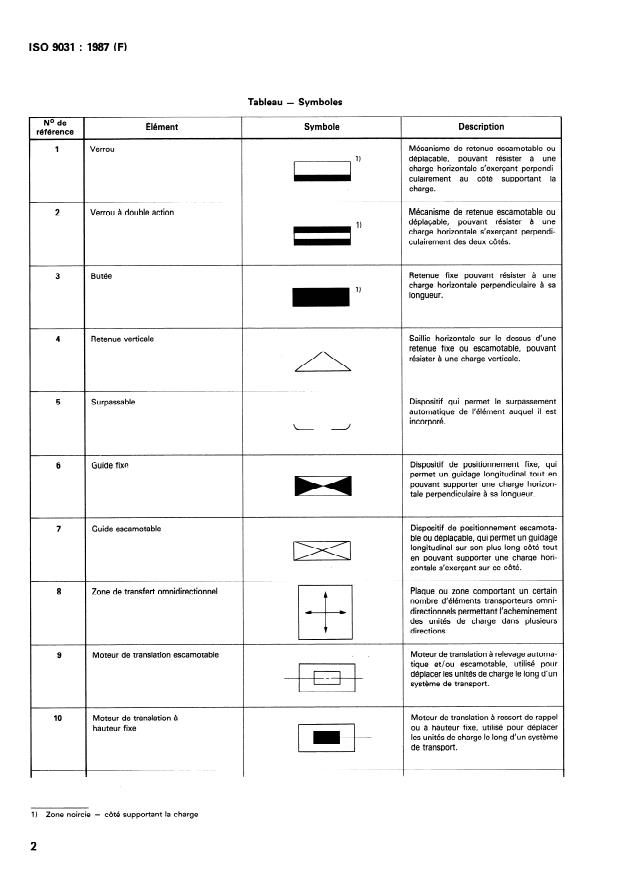
The symbols given herein are applicable to all aircraft cargo-handling systems for underfloor as well as for main-deck systems. The conveyance, guidance, restraint, power drive unit and the degree of automation for the total cargo-handling system can be depicted using the symbols. Each cargo symbol consists of a basic symbol, which represents basic functions. It characterizes a component function, but not the detail design and manufacturing method.
- Status
- Published
- Publication Date
- 24-Jun-1987
- Technical Committee
- ISO/TC 20/SC 9 - Air cargo and ground equipment
- Drafting Committee
- ISO/TC 20/SC 9 - Air cargo and ground equipment
- Current Stage
- 9093 - International Standard confirmed
- Start Date
- 05-Sep-2024
- Completion Date
- 29-Aug-2026
Buy Documents
ISO 9031:1987 - Air cargo equipment — Handling systems for unit load devices (ULDs) — Symbols for pictorial representation Released:6/25/1987
ISO 9031:1987 - Équipement pour le fret aérien — Systemes de manutention des unités de charge — Symboles pour la représentation graphique Released:6/25/1987
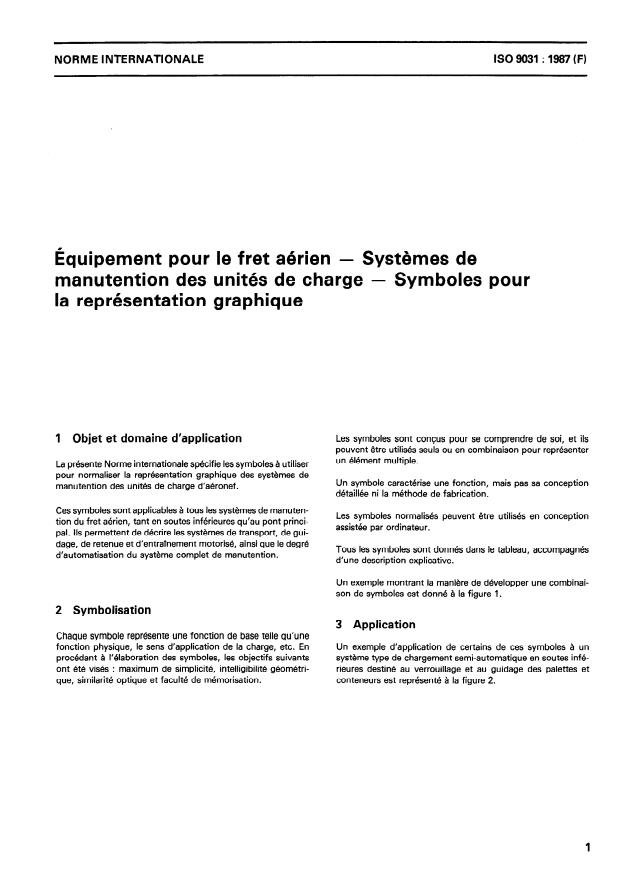
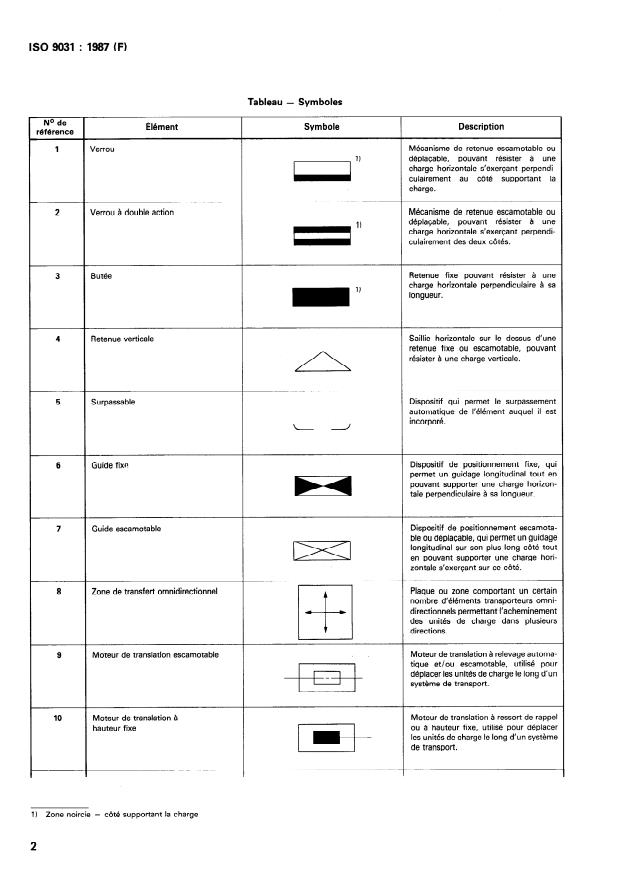
ISO 9031:1987 - Équipement pour le fret aérien — Systemes de manutention des unités de charge — Symboles pour la représentation graphique Released:6/25/1987
Overview
ISO 9031:1987 is an international standard developed by the International Organization for Standardization (ISO) that specifies symbols for pictorial representation of air cargo equipment handling systems for unit load devices (ULDs). These symbols are integral to standardizing the depiction of cargo-handling components and systems aboard aircraft, including both underfloor and main-deck cargo handling systems. The symbols provide a clear, uniform language to represent various functions such as conveyance, guidance, restraint, power drive units, and automation levels. This standard supports effective communication, design, and documentation in the aerospace cargo handling industry.
Key Topics
Standardized Symbols for Cargo Handling: The standard defines a comprehensive set of symbols, each representing a basic function or component within an air cargo-handling system. These include latches, restraints, guides, power drive units, tie-down points, and control panels.
Component Functions Depicted: Symbols characterize essential cargo system functions such as retractable and fixed restraints, omnidirectional transfer areas, power drive units of different types (self-lifting, fixed height, rotatable, shuttle), and braking rollers.
Symbol Combinations: Individual symbols can be combined to form complex representations of system components, allowing for detailed and scalable graphical depictions of cargo handling functions.
Design Principles: The symbols are designed for maximum simplicity, clarity, optical similarity, and ease of recognition. They are suitable for use in technical drawings, computer-aided design (CAD), and documentation.
Automation Indicators: The standard distinguishes between manual, semi-automatic, and fully automatic cargo-loading systems by different symbols for control panels and remote control systems.
Applications
Aircraft Cargo Handling Design: Engineers and designers use ISO 9031:1987 symbols in creating, documenting, and reviewing cargo loading systems for aircraft, ensuring a consistent visual language across projects and manufacturers.
Technical Documentation and Manuals: The standardized symbols facilitate clear communication in maintenance manuals, operational guides, and safety documentation for air cargo equipment.
Computer-Aided Design (CAD): The symbols are optimized for digital use, enabling precise and standardized depictions in CAD software for system modeling and simulation.
Training and Safety: Using universally recognized symbols helps in training personnel on cargo handling equipment and procedures, as well as in conveying safety-related information quickly and unambiguously.
International Collaboration: The standard supports consistent interpretation and application of cargo handling system designs in the international aerospace sector, where cross-border operations are commonplace.
Related Standards
ISO 8300 Series – Aircraft and Space Vehicle Standards: ISO 9031 aligns with related standards under ISO Technical Committee 20 (ISO/TC 20), covering aircraft and space vehicle systems, contributing to a cohesive set of industry specifications.
ISO 7377 – Unit Load Device (ULD) Identification: Works in conjunction with ISO 9031 by defining identification methods for ULDs, supporting handling and tracking consistency.
ICAO and IATA Cargo Handling Standards: Although not ISO standards, the International Civil Aviation Organization (ICAO) and International Air Transport Association (IATA) provide complementary guidelines and regulations for air cargo handling systems.
Keywords: ISO 9031, air cargo equipment, unit load devices, ULD handling systems, cargo handling symbols, aircraft cargo systems, cargo restraint, power drive units, cargo automation, cargo handling design, aircraft cargo symbols, cargo equipment standardization.
Buy Documents
ISO 9031:1987 - Air cargo equipment — Handling systems for unit load devices (ULDs) — Symbols for pictorial representation Released:6/25/1987
ISO 9031:1987 - Équipement pour le fret aérien — Systemes de manutention des unités de charge — Symboles pour la représentation graphique Released:6/25/1987
ISO 9031:1987 - Équipement pour le fret aérien — Systemes de manutention des unités de charge — Symboles pour la représentation graphique Released:6/25/1987
Get Certified
Connect with accredited certification bodies for this standard

BUREAU VERITAS Certification Germany
Bureau Veritas certification in Germany.

Element Materials Technology
Materials testing and product certification.

AQMS Ltd.
AQMS provides ISO certification to SMEs across the UK.
Sponsored listings
Frequently Asked Questions
ISO 9031:1987 is a standard published by the International Organization for Standardization (ISO). Its full title is "Air cargo equipment — Handling systems for unit load devices (ULDs) — Symbols for pictorial representation". This standard covers: The symbols given herein are applicable to all aircraft cargo-handling systems for underfloor as well as for main-deck systems. The conveyance, guidance, restraint, power drive unit and the degree of automation for the total cargo-handling system can be depicted using the symbols. Each cargo symbol consists of a basic symbol, which represents basic functions. It characterizes a component function, but not the detail design and manufacturing method.
The symbols given herein are applicable to all aircraft cargo-handling systems for underfloor as well as for main-deck systems. The conveyance, guidance, restraint, power drive unit and the degree of automation for the total cargo-handling system can be depicted using the symbols. Each cargo symbol consists of a basic symbol, which represents basic functions. It characterizes a component function, but not the detail design and manufacturing method.
ISO 9031:1987 is classified under the following ICS (International Classification for Standards) categories: 01.080.20 - Graphical symbols for use on specific equipment; 49.120 - Cargo equipment. The ICS classification helps identify the subject area and facilitates finding related standards.
ISO 9031:1987 is available in PDF format for immediate download after purchase. The document can be added to your cart and obtained through the secure checkout process. Digital delivery ensures instant access to the complete standard document.
Standards Content (Sample)
Foreword
IS0 (the International Organization for Standardization) is a worldwide federation of
national standards bodies (IS0 member bodies). The work of preparing International
Standards is normally carried out through IS0 technical committees” Each member
body interested in a subject for which a technical committee has been established has
the right to be represented on that committee. International organizations, govern-
mental and non-governmental, in liaison with ISO, also take part in the work.
Draft International Standards adopted by the technical committees are circulated to
the member bodies for approval before their acceptance as International Standards by
the IS0 Council. They are approved in accordance with IS0 procedures requiring at
least 75 % approval by the member bodies voting.
International Standard IS0 903 was prepared by Technical Committee ISO/TC 20,
Aircraft and space vehicles.
Users should note that all International Standards undergo revision from time to time
and that any reference made herein to any other International Standard implies its
latest edition, unless othewise stated.
0 International Organization for Standardization, 198%
Printed in Switzerland
INTERNATIONAL STANDARD IS0 9031 : 1987 (E)
Air cargo equipment - Handling systems for unit
- Symbols for pictorial
load devices (ULDs)
representation
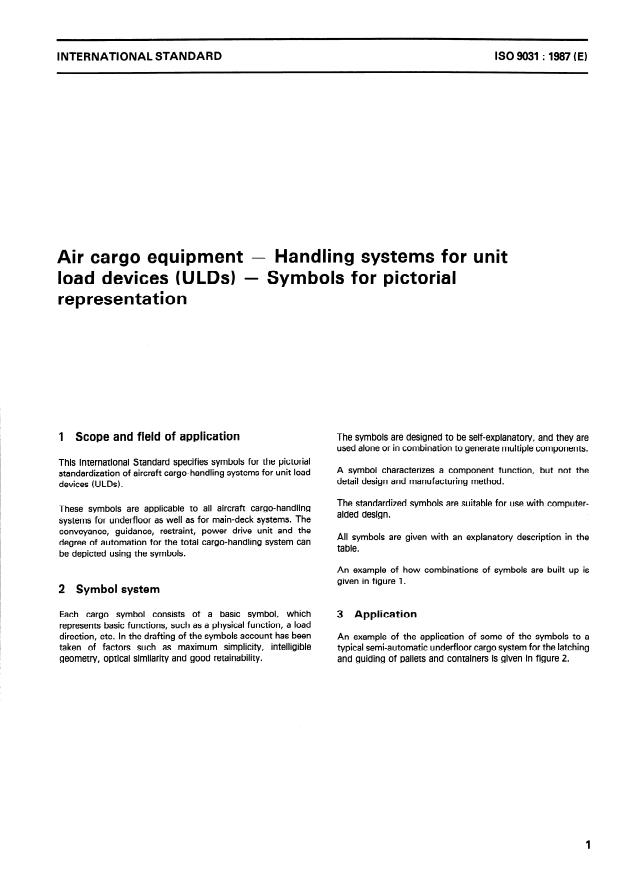
1 Scope and field of application The symbols are designed to be self-explanatory, and they are
used alone or in combination to generate multiple components.
This International Standard specifies symbols for the pictorial
A symbol characterizes a component function, but not the
standardization of aircraft cargo-handling systems for unit load
detail design and manufacturing method.
devices (ULDs).
The standardized symbols are suitable for use with computer-
These symbols are applicable to all aircraft cargo-handling
aided design.
systems for under-floor as well as for main-deck systems. The
restraint, power drive unit and the
conveyance, guidance,
All symbols are given with an explanatory description in the
degree of automation for the total cargo-handling system can
table.
be depicted using the symbols.
An example of how combinations of symbols are built up is
given in figure 1.
2 Symbol system
Each cargo symbol consists of a basic symbol, which
3 Application
represents basic functions, such as a physical function, a load
direction, etc. In the drafting of the symbols account has been An example of the application of some of the symbols to a
taken of factors such as maximum simplicity, intelligible typical semi-automatic underfloor cargo system for the latching
geometry, optical similarity and good retainability. and guiding of pallets and containers is given in figure 2.
IS0 9031 : 1987 (E)
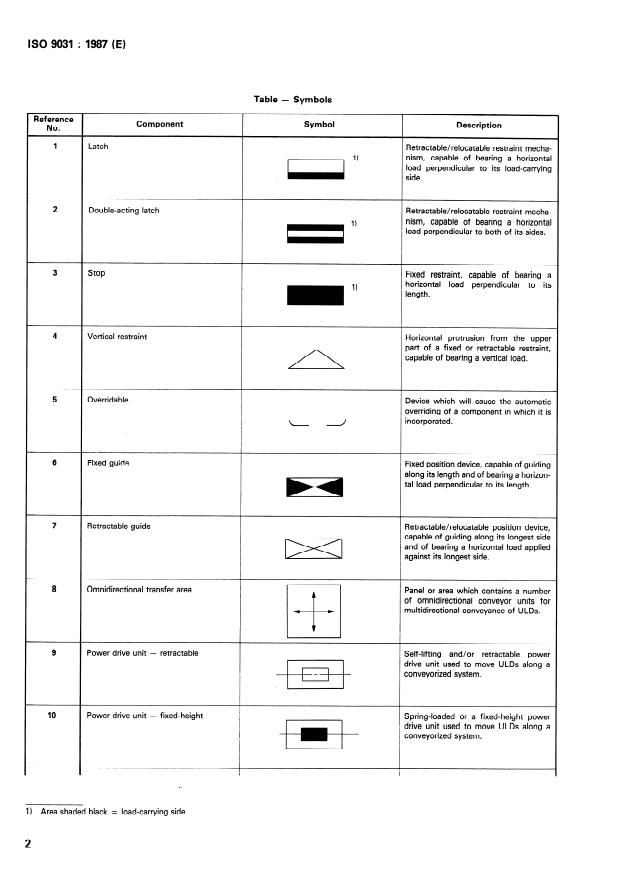
Table - Symbols
Reference
Component Symbol Description
No.
1 Latch Retractable/relocatable restraint mecha-
nism, capable of bearing a horizontal
load perpendicular to its load-carrying
I ”
side.
2 Retractable/relocatable restraint mecha-
Double-acting latch
nism, capable of bearing a horizontal
load perpendicular to both of its sides.
I ”
3 stop Fixed restraint, capable of bearing a
horizontal load perpendicular to its
length.
I ”
Horizontal protrusion from the upper
4 Vertical restraint
part of a fixed or retractable restraint,
capable of bearing a vertical load.
5 Overrida ble Device which will cause the automatic
overriding of a component in which it is
incorporated.
L I
6 Fixed gulrle Fixed position device, capable of guiding
along its length and of bearing a horizon-
tal load perpendicular to its length.
Retractable/relocatable position device,
Retractable guide
capable of guiding a
...
ISO
NORME INTERNATIONALE
Première édition
1987-07-01
INTERNATIONAL ORGANIZATION FOR STANDARDIZATION
ORGANISATION INTERNATIONALE DE NORMALISATION
MEXAYHAPOAHAFI OPI-AHM3A~MR Il0 CTAH)JAPTM3A~MM
Équipement pour le fret aérien - Systèmes de
manutention des unités de charge - Symboles pour
la représentation graphique
Air cargo equipment - Handling systems for unit load devices (ULDs) - Symbols for
pic torial represen ta tion
Numéro de référence
ISO 9031 : 1987 (F)
Avant-propos
L’ISO (Organisation internationale de normalisation) est une fédération mondiale
d’organismes nationaux de normalisation (comités membres de I’ISO). L’élaboration
des Normes internationales est normalement confiée aux comités techniques de I’ISO.
Chaque comité membre intéressé par une étude a le droit de faire partie du comité
technique créé à cet effet. Les organisations internationales, gouvernementales et non
gouvernementales, en liaison avec I’ISO participent également aux travaux.
Les projets de Normes internationales adoptés par les comités techniques sont soumis
aux comités membres pour approbation, avant leur acceptation comme Normes inter-
nationales par le Conseil de I’ISO. Les Normes internationales sont approuvées confor-
mément aux procédures de I’ISO qui requiérent l’approbation de 75 % au moins des
,
comités membres votants.
La Norme internationale ISO 9031 a été élaborée par le comité technique ISO/TC 20,
Aéronautique et espace.
L’attention des utilisateurs est attirée sur le fait que toutes les Normes internationales
sont de temps en tersips soumises à révision et que toute référence faite à une autre
Norme internationale dans le présent document implique qu’il s’agit, sauf indication
contraire, de la dernière édition.
0 Organisation internationale de normalisation, 1987
Imprimé en Suisse
NORME INTERNATIONALE ISOSO31:1987(F)
Équipement pour le fret aérien - Systèmes de
manutention des unités de charge - Symboles pour
la représentation graphique
Les symboles sont concus pour se comprendre de soi, et ils
1 Objet et domaine d’application
peuvent être utilisés se& ou en combinaison pour représenter
un élément multiple.
La présente Norme internationale spécifie les symboles à utiliser
pour normaliser la représentation graphique des systèmes de
Un symbole caractérise une fonction, mais pas sa conception
manutention des unités de charge d’aéronef.
détaillée ni la méthode de fabrication.
Ces symboles sont applicables à tous les systémes de manuten-
Les symboles normalisés peuvent être utilisés en conception
tion du fret aérien, tant en soutes inférieures qu’au pont princi-
assistée par ordinateur.
pal. Ils permettent de décrire les systémes de transport, de gui-
dage, de retenue et d’entraînement motorisé, ainsi que le degré
Tous les symboles sont donnés dans le tableau, accompagnés
d’automatisation du système complet de manutention.
d’une description explicative.
Un exemple montrant la manière de développer une combinai-
son de symboles est donné à la figure 1.
2 Symbolisation
3 Application
Chaque symbole représente une fonction de base telle qu’une
fonction physique, le sens d’application de la charge, etc. En Un exemple d’application de certains de ces symboles a un
procédant à l’élaboration des symboles, les objectifs suivants systéme type de chargement semi-automatique en soutes infé-
rieures destiné au verrouillage et au guidage des palettes et
ont été visés : maximum de simplicité, intelligibilité géométri-
que, similarité optique et faculté de mémorisation. conteneurs est représenté à la figure 2.
ISO 9031 : 1987 (FI
Tableau - Symboles
No de
Symbole Description
Élément
r6fkence
Mécanisme de retenue escamotable ou
1 Verrou
déplaçable, pouvant résister à une
charge horizontale s’exerçant perpendi-
u’) culairement au côté supportant la
,
charge.
Verrou à double action Mécanisme de retenue escamotable ou
déplacable, pouvant résister à une
charge horizontale s’exercant perpendi-
culairement des deux côtés.
0 ”
Retenue fixe pouvant résister à une
3 Butée
charge horizontale perpendiculaire à sa
longueur.
Saillie horizontale sur le dessus d’une
4 Retenue verticale
retenue fixe ou escamotable, pouvant
résister à une charge verticale.
Dispositif qui permet le surpassement
5 Surpassable
automatique de l’élément auquel il est
incorporé.
L -
Dispositif de positionnement fixe, qui
6 Guide fixa‘
permet un guidage longitudinal tout en
pouvant supporter une charge horizon-
...
ISO
NORME INTERNATIONALE
Première édition
1987-07-01
INTERNATIONAL ORGANIZATION FOR STANDARDIZATION
ORGANISATION INTERNATIONALE DE NORMALISATION
MEXAYHAPOAHAFI OPI-AHM3A~MR Il0 CTAH)JAPTM3A~MM
Équipement pour le fret aérien - Systèmes de
manutention des unités de charge - Symboles pour
la représentation graphique
Air cargo equipment - Handling systems for unit load devices (ULDs) - Symbols for
pic torial represen ta tion
Numéro de référence
ISO 9031 : 1987 (F)
Avant-propos
L’ISO (Organisation internationale de normalisation) est une fédération mondiale
d’organismes nationaux de normalisation (comités membres de I’ISO). L’élaboration
des Normes internationales est normalement confiée aux comités techniques de I’ISO.
Chaque comité membre intéressé par une étude a le droit de faire partie du comité
technique créé à cet effet. Les organisations internationales, gouvernementales et non
gouvernementales, en liaison avec I’ISO participent également aux travaux.
Les projets de Normes internationales adoptés par les comités techniques sont soumis
aux comités membres pour approbation, avant leur acceptation comme Normes inter-
nationales par le Conseil de I’ISO. Les Normes internationales sont approuvées confor-
mément aux procédures de I’ISO qui requiérent l’approbation de 75 % au moins des
,
comités membres votants.
La Norme internationale ISO 9031 a été élaborée par le comité technique ISO/TC 20,
Aéronautique et espace.
L’attention des utilisateurs est attirée sur le fait que toutes les Normes internationales
sont de temps en tersips soumises à révision et que toute référence faite à une autre
Norme internationale dans le présent document implique qu’il s’agit, sauf indication
contraire, de la dernière édition.
0 Organisation internationale de normalisation, 1987
Imprimé en Suisse
NORME INTERNATIONALE ISOSO31:1987(F)
Équipement pour le fret aérien - Systèmes de
manutention des unités de charge - Symboles pour
la représentation graphique
Les symboles sont concus pour se comprendre de soi, et ils
1 Objet et domaine d’application
peuvent être utilisés se& ou en combinaison pour représenter
un élément multiple.
La présente Norme internationale spécifie les symboles à utiliser
pour normaliser la représentation graphique des systèmes de
Un symbole caractérise une fonction, mais pas sa conception
manutention des unités de charge d’aéronef.
détaillée ni la méthode de fabrication.
Ces symboles sont applicables à tous les systémes de manuten-
Les symboles normalisés peuvent être utilisés en conception
tion du fret aérien, tant en soutes inférieures qu’au pont princi-
assistée par ordinateur.
pal. Ils permettent de décrire les systémes de transport, de gui-
dage, de retenue et d’entraînement motorisé, ainsi que le degré
Tous les symboles sont donnés dans le tableau, accompagnés
d’automatisation du système complet de manutention.
d’une description explicative.
Un exemple montrant la manière de développer une combinai-
son de symboles est donné à la figure 1.
2 Symbolisation
3 Application
Chaque symbole représente une fonction de base telle qu’une
fonction physique, le sens d’application de la charge, etc. En Un exemple d’application de certains de ces symboles a un
procédant à l’élaboration des symboles, les objectifs suivants systéme type de chargement semi-automatique en soutes infé-
rieures destiné au verrouillage et au guidage des palettes et
ont été visés : maximum de simplicité, intelligibilité géométri-
que, similarité optique et faculté de mémorisation. conteneurs est représenté à la figure 2.
ISO 9031 : 1987 (FI
Tableau - Symboles
No de
Symbole Description
Élément
r6fkence
Mécanisme de retenue escamotable ou
1 Verrou
déplaçable, pouvant résister à une
charge horizontale s’exerçant perpendi-
u’) culairement au côté supportant la
,
charge.
Verrou à double action Mécanisme de retenue escamotable ou
déplacable, pouvant résister à une
charge horizontale s’exercant perpendi-
culairement des deux côtés.
0 ”
Retenue fixe pouvant résister à une
3 Butée
charge horizontale perpendiculaire à sa
longueur.
Saillie horizontale sur le dessus d’une
4 Retenue verticale
retenue fixe ou escamotable, pouvant
résister à une charge verticale.
Dispositif qui permet le surpassement
5 Surpassable
automatique de l’élément auquel il est
incorporé.
L -
Dispositif de positionnement fixe, qui
6 Guide fixa‘
permet un guidage longitudinal tout en
pouvant supporter une charge horizon-
...