

ISO/ASTM 52939:2023
(Main)Additive manufacturing for construction — Qualification principles — Structural and infrastructure elements
General Information
- Abstract
This document specifies quality assurance requirements for additive construction (AC) concerning building and construction projects in which additive manufacturing techniques are used for construction. The requirements are independent of the material(s) and process category used. This document does not apply to metals. This document specifies the criteria for additive construction processes, quality-relevant characteristics, and factors along AC system operations. It further specifies activities and sequences within an AC cell (additive construction site) and project. This document applies to all additive manufacturing technologies in building and construction (load bearing and non-load bearing), structural and infrastructure building elements for residential and commercial applications and follows an approach oriented to the process. This document does not cover environmental, health and safety aspects that apply to printing facility setup, material handling, operating of robotic equipment, and packing of equipment and/or elements for shipping but material supplier guidelines, robotic solution operating guidelines, and local and regional requirements are applicable. This document does not cover design approvals, material properties characterization and testing.
- Status
- Published
- Publication Date
- 03-Dec-2023
- Technical Committee
- ISO/TC 261 - Additive manufacturing
- Drafting Committee
- ISO/TC 261 - Additive manufacturing
- Current Stage
- 6060 - International Standard published
- Start Date
- 04-Dec-2023
- Due Date
- 09-Aug-2024
- Completion Date
- 04-Dec-2023
Buy Documents


ISO/ASTM 52939:2023 - Additive manufacturing for construction — Qualification principles — Structural and infrastructure elements Released:4. 12. 2023

ISO/ASTM 52939:2023 - Fabrication additive pour la construction — Principes de qualification — Éléments de structure et d'infrastructure Released:4. 12. 2023
Overview
ISO/ASTM 52939:2023 - Additive manufacturing for construction: Qualification principles - Structural and infrastructure elements specifies process-oriented quality assurance and qualification requirements for additive construction (AC). The standard covers building and construction projects that use additive manufacturing technologies (excluding metals) for structural and infrastructure elements in residential and commercial applications. It defines criteria for AC processes, quality‑relevant characteristics, and the operational factors within an AC cell (in‑situ or off‑site printing site), aimed at enabling consistent, certifiable production of printed elements such as walls, columns, beams and other load‑bearing and non‑load‑bearing components.
Key topics and requirements
- Scope and exclusions: Applies to all non‑metal AM technologies for construction; does not cover metals, environmental/health & safety facility setup, or design approvals and material characterization/testing.
- Process‑oriented qualification: Defines the sequence of activities from feasibility assessment and validation planning to production and delivery, emphasizing reproducible digital-to-physical workflows.
- AC cell infrastructure: Requirements for the physical production environment, material mixing/delivery, robotic systems, and built/process guidance.
- Data and digital preparation: Controls on digital files, virtual production runs and dry runs to verify toolpaths and buildability before material use.
- Material management: Traceability, storage and handling requirements for cementitious, polymer-modified and composite materials used in AC.
- Built process guidance & post‑processing: In‑process monitoring, default post‑processing steps, and sequences to ensure consistent element quality.
- Process qualification & quality assurance: Defined quality‑relevant process steps, personnel competence, documentation and tracing, inspection and testing routines, and delivery/logistics controls.
- Constructability and validation: Feasibility checks, constructability reviews and validation plans prior to serial production.
Applications
- Qualification and certification of 3D printed structural components for buildings and civil infrastructure.
- Development of factory‑based modular production lines and on‑site AC cells for construction projects.
- Implementation of quality management and traceability systems for additive construction projects.
- Supporting procurement, contractor qualification and regulatory acceptance by documenting process controls and verification steps.
Who should use this standard
- Construction firms and general contractors adopting additive construction
- Structural and materials engineers, architects and design teams
- Project managers and quality assurance personnel for AC projects
- Robotics and automation suppliers, material suppliers and integrators
- Regulators, certification bodies and asset owners evaluating printed elements
Related standards
- ISO/ASTM 52900 - Additive manufacturing - General principles - Fundamentals and vocabulary
- ISO/ASTM 52950 - Additive manufacturing - General principles - Overview of data processing
ISO/ASTM 52939:2023 is part of the ISO/ASTM family of AM standards and supports scalable, auditable practice of 3D construction printing (3DCP) and additive manufacturing for construction (AMC).
Relations
- Effective Date
- 12-Feb-2026
- Consolidates
ISO 179-2:2020 - Plastics — Determination of Charpy impact properties — Part 2: Instrumented impact test - Effective Date
- 06-Jun-2022
Buy Documents
ISO/ASTM 52939:2023 - Additive manufacturing for construction — Qualification principles — Structural and infrastructure elements Released:4. 12. 2023
ISO/ASTM 52939:2023 - Fabrication additive pour la construction — Principes de qualification — Éléments de structure et d'infrastructure Released:4. 12. 2023
Get Certified
Connect with accredited certification bodies for this standard

DVS-ZERT GmbH
German welding certification society.
CARES (UK Certification Authority for Reinforcing Steels)
UK certification for reinforcing steels and construction.
EWF/IIW (European/International Welding Federation)
International welding personnel certification.
Sponsored listings
Frequently Asked Questions
ISO/ASTM 52939:2023 is a standard published by the International Organization for Standardization (ISO). Its full title is "Additive manufacturing for construction — Qualification principles — Structural and infrastructure elements". This standard covers: This document specifies quality assurance requirements for additive construction (AC) concerning building and construction projects in which additive manufacturing techniques are used for construction. The requirements are independent of the material(s) and process category used. This document does not apply to metals. This document specifies the criteria for additive construction processes, quality-relevant characteristics, and factors along AC system operations. It further specifies activities and sequences within an AC cell (additive construction site) and project. This document applies to all additive manufacturing technologies in building and construction (load bearing and non-load bearing), structural and infrastructure building elements for residential and commercial applications and follows an approach oriented to the process. This document does not cover environmental, health and safety aspects that apply to printing facility setup, material handling, operating of robotic equipment, and packing of equipment and/or elements for shipping but material supplier guidelines, robotic solution operating guidelines, and local and regional requirements are applicable. This document does not cover design approvals, material properties characterization and testing.
This document specifies quality assurance requirements for additive construction (AC) concerning building and construction projects in which additive manufacturing techniques are used for construction. The requirements are independent of the material(s) and process category used. This document does not apply to metals. This document specifies the criteria for additive construction processes, quality-relevant characteristics, and factors along AC system operations. It further specifies activities and sequences within an AC cell (additive construction site) and project. This document applies to all additive manufacturing technologies in building and construction (load bearing and non-load bearing), structural and infrastructure building elements for residential and commercial applications and follows an approach oriented to the process. This document does not cover environmental, health and safety aspects that apply to printing facility setup, material handling, operating of robotic equipment, and packing of equipment and/or elements for shipping but material supplier guidelines, robotic solution operating guidelines, and local and regional requirements are applicable. This document does not cover design approvals, material properties characterization and testing.
ISO/ASTM 52939:2023 is classified under the following ICS (International Classification for Standards) categories: 25.030 - Additive manufacturing. The ICS classification helps identify the subject area and facilitates finding related standards.
ISO/ASTM 52939:2023 has the following relationships with other standards: It is inter standard links to EN ISO/ASTM 52939:2023, ISO 179-2:2020. Understanding these relationships helps ensure you are using the most current and applicable version of the standard.
ISO/ASTM 52939:2023 is available in PDF format for immediate download after purchase. The document can be added to your cart and obtained through the secure checkout process. Digital delivery ensures instant access to the complete standard document.
Standards Content (Sample)
INTERNATIONAL ISO/ASTM
STANDARD 52939
First edition
2023-12
Additive manufacturing for
construction — Qualification
principles — Structural and
infrastructure elements
Fabrication additive pour la construction — Principes de
qualification — Éléments de structure et d'infrastructure
Reference number
© ISO/ASTM International 2023
© ISO/ASTM International 2023
All rights reserved. Unless otherwise specified, or required in the context of its implementation, no part of this publication may
be reproduced or utilized otherwise in any form or by any means, electronic or mechanical, including photocopying, or posting on
the internet or an intranet, without prior written permission. Permission can be requested from either ISO at the address below
or ISO’s member body in the country of the requester. In the United States, such requests should be sent to ASTM International.
ISO copyright office ASTM International
CP 401 • Ch. de Blandonnet 8 100 Barr Harbor Drive, PO Box C700
CH-1214 Vernier, Geneva West Conshohocken, PA 19428-2959, USA
Phone: +41 22 749 01 11 Phone: +610 832 9634
Fax: +610 832 9635
Email: copyright@iso.org Email: khooper@astm.org
Website: www.iso.org Website: www.astm.org
Published in Switzerland
ii
© ISO/ASTM International 2023 – All rights reserved
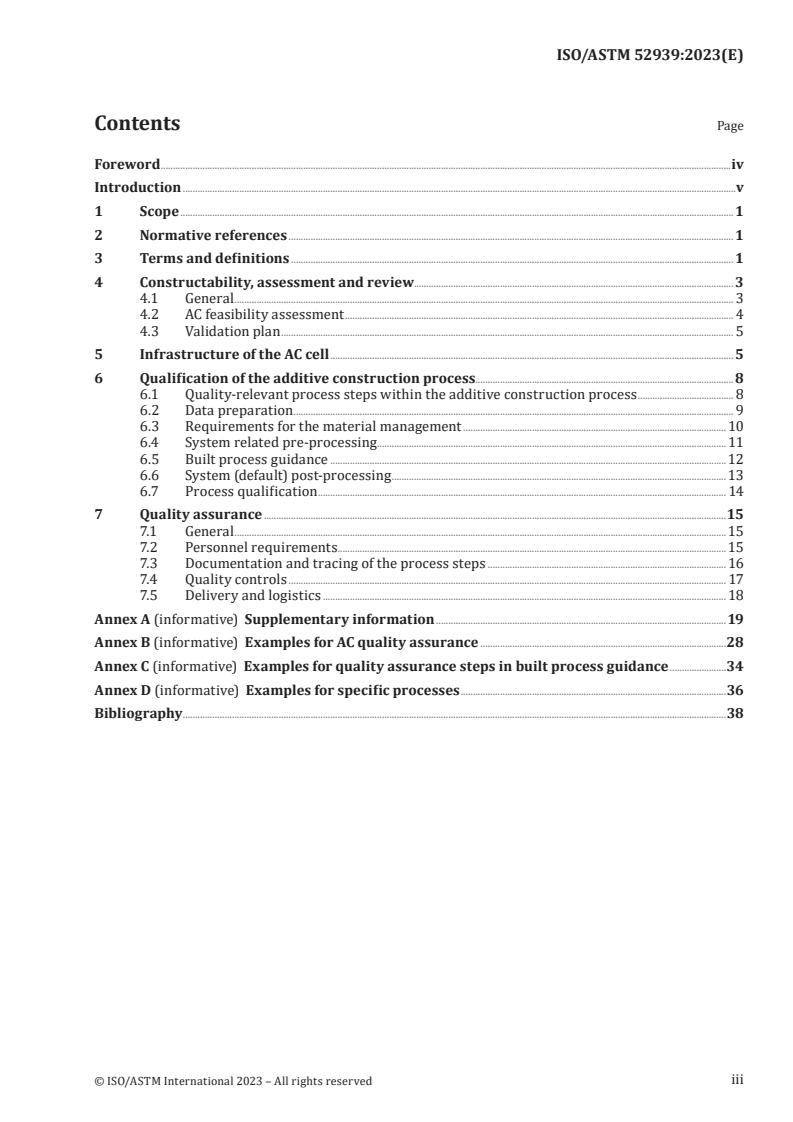
Contents Page
Foreword .iv
Introduction .v
1 Scope . 1
2 Normative references . 1
3 Terms and definitions . 1
4 Constructability, assessment and review. 3
4.1 General . 3
4.2 AC feasibility assessment . 4
4.3 Validation plan . 5
5 Infrastructure of the AC cell . 5
6 Qualification of the additive construction process. 8
6.1 Quality-relevant process steps within the additive construction process . 8
6.2 Data preparation . 9
6.3 Requirements for the material management . 10
6.4 System related pre-processing. 11
6.5 Built process guidance .12
6.6 System (default) post-processing . 13
6.7 Process qualification . 14
7 Quality assurance .15
7.1 General . 15
7.2 Personnel requirements . .15
7.3 Documentation and tracing of the process steps . 16
7.4 Quality controls . 17
7.5 Delivery and logistics . 18
Annex A (informative) Supplementary information .19
Annex B (informative) Examples for AC quality assurance .28
Annex C (informative) Examples for quality assurance steps in built process guidance .34
Annex D (informative) Examples for specific processes .36
Bibliography .38
iii
© ISO/ASTM International 2023 – All rights reserved
Foreword
ISO (the International Organization for Standardization) is a worldwide federation of national standards
bodies (ISO member bodies). The work of preparing International Standards is normally carried out
through ISO technical committees. Each member body interested in a subject for which a technical
committee has been established has the right to be represented on that committee. International
organizations, governmental and non-governmental, in liaison with ISO, also take part in the work.
ISO collaborates closely with the International Electrotechnical Commission (IEC) on all matters of
electrotechnical standardization.
The procedures used to develop this document and those intended for its further maintenance are
described in the ISO/IEC Directives, Part 1. In particular, the different approval criteria needed for the
different types of ISO document should be noted. This document was drafted in accordance with the
editorial rules of the ISO/IEC Directives, Part 2 (see www.iso.org/directives).
ISO draws attention to the possibility that the implementation of this document may involve the use
of (a) patent(s). ISO takes no position concerning the evidence, validity or applicability of any claimed
patent rights in respect thereof. As of the date of publication of this document, ISO had not received
notice of (a) patent(s) which may be required to implement this document. However, implementers are
cautioned that this may not represent the latest information, which may be obtained from the patent
database available at www.iso.org/patents. ISO shall not be held responsible for identifying any or all
such patent rights.
Any trade name used in this document is information given for the convenience of users and does not
constitute an endorsement.
For an explanation of the voluntary nature of standards, the meaning of ISO specific terms and
expressions related to conformity assessment, as well as information about ISO's adherence to
the World Trade Organization (WTO) principles in the Technical Barriers to Trade (TBT), see
www.iso.org/iso/foreword.html.
This document was prepared by Technical Committee ISO/TC 261, Additive manufacturing, in
cooperation with ASTM Committee F42, Additive Manufacturing Technologies, on the basis of a
partnership agreement between ISO and ASTM International with the aim to create a common set of
ISO/ASTM standards on Additive Manufacturing and in collaboration with the European Committee for
Standardization (CEN) Technical Committee CEN/TC 438, Additive manufacturing, in accordance with
the Agreement on technical cooperation between ISO and CEN (Vienna Agreement).
Any feedback or questions on this document should be directed to the user’s national standards body. A
complete listing of these bodies can be found at www.iso.org/members.html.
iv
© ISO/ASTM International 2023 – All rights reserved
Introduction
The construction sector is increasingly facing challenges with respect to labour shortages, project delays,
increased lead times, excessive material use, large amounts of waste and adverse CO footprint impacts.
Furthermore, from a market perspective, the global construction demand is increasing especially as the
housing crisis continues and infrastructure projects (whether new or sustaining existing structures)
are on the increase. Additive construction (AC) also known as additive manufacturing for construction
(AMC) and 3D construction printing (3DCP) has the potential to address these issues directly.
Of late, AC has made great strides. Printed elements could potentially prove to be more durable,
more sustainable, more eco-friendly, cheaper (en masse), and faster to deliver than conventional
construction approaches. However, without AC standards, approval, certification, and risk mitigation
are unattainable.
The purpose of this document is to outline the requirements necessary as a basis for production and
delivery of high quality additively manufactured structures (residential or infrastructure) in the
construction sector.
Important steps of the AC process are specified. These steps will be controlled and monitored to
ensure high quality printed structures for on-site or off-site use. This document is not intended to be
technology- or material-specific, and therefore sub-processes are applicable depending on the approach
used. However, it should be noted that printed element(s) should be approved by a locally certified
engineer and adhere to both local and regional specifications and requirements.
v
© ISO/ASTM International 2023 – All rights reserved
INTERNATIONAL STANDARD ISO/ASTM 52939:2023(E)
Additive manufacturing for construction — Qualification
principles — Structural and infrastructure elements
1 Scope
This document specifies quality assurance requirements for additive construction (AC) concerning
building and construction projects in which additive manufacturing techniques are used for
construction. The requirements are independent of the material(s) and process category used.
This document does not apply to metals.
This document specifies the criteria for additive construction processes, quality-relevant
characteristics, and factors along AC system operations. It further specifies activities and sequences
within an AC cell (additive construction site) and project.
This document applies to all additive manufacturing technologies in building and construction (load
bearing and non-load bearing), structural and infrastructure building elements for residential and
commercial applications and follows an approach oriented to the process.
This document does not cover environmental, health and safety aspects that apply to printing facility
setup, material handling, operating of robotic equipment, and packing of equipment and/or elements for
shipping but material supplier guidelines, robotic solution operating guidelines, and local and regional
requirements are applicable.
This document does not cover design approvals, material properties characterization and testing.
2 Normative references
The following documents are referred to in the text in such a way that some or all of their content
constitutes requirements of this document. For dated references, only the edition cited applies. For
undated references, the latest edition of the referenced document (including any amendments) applies.
ISO/ASTM 52900, Additive manufacturing — General principles — Fundamentals and vocabulary
ISO/ASTM 52950, Additive manufacturing — General principles — Overview of data processing
3 Terms and definitions
For the purposes of this document, the terms and definitions given in ISO/ASTM 52900 and the
following apply.
ISO and IEC maintain terminology databases for use in standardization at the following addresses:
— ISO Online browsing platform: available at https:// www .iso .org/ obp
— IEC Electropedia: available at https:// www .electropedia .org/
3.1
additive manufacturing for construction
AMC
process to join materials to make structural and non-structural elements/components and systems
from 3D model data usually by depositing material layer upon layer as opposed to subtractive and
formative manufacturing methodologies
© ISO/ASTM International 2023 – All rights reserved
3.2
additive construction
AC
term to describe all relevant disciplines and knowledge for the construction segment using additive
manufacturing process categories
Note 1 to entry: The use of the technologies covers all relevant construction sectors, for example large scale real
estate projects, entire buildings and building elements, civil infrastructure, and disaster relief.
Note 2 to entry: AC describes all relevant knowledge disciplines, for example: architecture, engineering,
structural engineering, materials engineering, robot operator, project management, construction management,
facility management, etc.
Note 3 to entry: Other terms used interchangeably are: Digital Construction (DC), Construction 4.0, Advanced
Manufacturing in Construction (AMC), Construction 3D Printing (C3DP) and 3D Construction Printing (3DCP).
Note 4 to entry: Building materials include:
— cementitious variations such as concrete and mortar, polymer modified pastes,
— composite materials.
Note 5 to entry: Intrinsic to the current definition is a high degree of robotic automation, a reduced degree of
human intervention during the construction process, and minimal waste due to as-needed material delivery
systems.
Note 6 to entry: As of this writing in 2023, the field of AC is rapidly evolving, and novel materials and methods are
very likely to become included in this definition.
Note 7 to entry: AC is used on-site or off-site (e.g. modular factory-based production).
3.3
layer deposition
application of a single layer
3.4
AC cell
printing solution deployed on site for in-situ printing (includes material mixing and placement systems)
3.5
material deposition device
numerically controlled assembly, including mixing and delivery mechanisms for raw materials, binders,
and additives; places the mixture based on a digital simulation entered in the assembly’s electronic
programs, without the need for direct human intervention or for using moulds
3.6
physical production
physical totality of the build space, elements located on the build space, and production related support
structures and plant in the build space of the system
3.7
virtual production run
computer/digital simulation of the physical production (3.7) run (print file)
EXAMPLE Printing simulation.
3.8
dry production run
process of running the build program with no materials to verify the first layer toolpath and other
critical points of the program; and can be part of calibration process
© ISO/ASTM International 2023 – All rights reserved
3.9
construction process
digital and physical AC operations, from setup of the robot through completion of the final printed
element, including quality assurance testing and verification
3.10
mechanical, electrical and plumbing
MEP
building systems required for heating, ventilation, and air conditioning; electrical power and
communication supply; and water supply and sewage removal, respectively
3.11
printed element
construction 3D printed component, whether constructed on-site (in-situ) or off-site, that gets
incorporated into a building or structure, as a complete infrastructure component
EXAMPLE Walls, columns, beams, etc.
3.12
printability
ability of the material to be easily delivered to the print head, processed by the print head, e.g.
extrudability (3.13), and meet consistent layer shape stability, buildability (3.14) requirements, and if
applicable pumpability (3.15)
3.13
extrudability
ability of the material to smoothly be ejected through the printing nozzle without inducing any blockage
of the conduits or significant damage to the material quality
3.14
buildability
ability of a print to preserve vertical and lateral stability under increasing loads coming from
superposed/subsequent layers with controlled deformation
3.15
pumpability
material paste criterion that is related to the concrete extrusion and workability, as it is important to
ensure that the materials have a continuous easy-flowing behaviour from the source to the printing
material deposition device/nozzle
Note 1 to entry: Pumpability ensures the materials can be pumped easily and continuously without creating
clogging issues inside the delivery system.
4 Constructability, assessment and review
4.1 General
The AC element requirements shall be specified and verified before the data preparation. The results
shall be transferred in a definite sequence with associated production specifications including
specific requirements in respect to the quality control (for load and non-load bearing elements). It is
recommended that any asset monitoring and/or management be based on locally applicable standards/
codes/regulations which could be based on numerical verification analysis.
If the production request is incomplete (for example missing technical drawing) or an initial
commissioning is associated with restrictions, the customer shall be notified to correct the problem.
Figure 1 shows the individual steps for checking the feasibility and qualification phase as a pre-requisite
for the serial production with AC.
© ISO/ASTM International 2023 – All rights reserved
Figure 1 — Steps involved in verification of AC element requirement
4.2 AC feasibility assessment
AC feasibility, including AC element requirements, shall be evaluated by suitable personnel (e.g.
technology experts or instructed persons, obtaining relevant permits from local authorities, classified
and registered as required by authorities having jurisdiction and proven to have designed and
accomplished successfully a specific number of 3D printed elements (e.g. 5) with the same construction
process and comparable dimensions and complexity).
The necessary production competence is only available in the direct AC environment. It is important
to include all element requirements in the feasibility check. The evaluation shall include the following
steps:
a) Design check: the process-relevant design directives should be consulted to evaluate the design’s
AC feasibility and comply with national, regional, and local codes. In addition, process-relevant AC
restrictions such as minimum wall thicknesses and reinforcement requirements shall also be taken
into consideration.
b) Environmental check: for the environmental dimension, material selection and design stages are
regarded as crucial to the sustainability performance of a built element throughout its life cycle.
It is important to perform a sustainability assessment of the building material or the building
product itself, in accordance with ISO 21930 and ISO 14001 following a cradle-to-grave approach
of a life cycle analysis (LCA) and track macro-indicators, for both internal use and to elaborate
Environmental Product Declarations (EPDs) of building products after validation. Environmental
checks/studies shall be done in compliance with all national, regional, and local requirements.
Core indicators to use are:
— global warming potential (CO equivalent emissions);
— greenhouse gas (GHG) emissions that have a potential impact on the climate.
Other relevant indicators can be:
— Pollution potential: freshwater resources that have a potential impact on the depletion of
freshwater resources (in case no metallic material will be used in the paste mix design, using
other than freshwater, such as sea water, or treated water may be envisaged in the process,
based on the usage of the printed element, and its interaction/exposure to end users).
— Fossil fuel depletion potential (oil equivalent): consumption of non-renewable raw materials
and non-renewable primary energy.
— Ozone depletion potential (CFC-11 to air): release of gases that have a potential impact on the
stratospheric ozone layer.
© ISO/ASTM International 2023 – All rights reserved
— Amount of waste generated by type: total volume of non-hazardous and hazardous wastes that
has a potential impact on the generation of waste for disposal
— Acidification potential (SO to air) - potential impact on the acidification of land and water
resources.
— Freshwater eutrophication potential (P to freshwater): potential impact on the eutrophication
of water bodies.
c) AC process: it is also necessary for qualified engineers to check whether the desired element, and
element properties to be attained, are AC feasible with the process parameters already qualified, or
whether adaptations are necessary to attain AC feasibility. AC specific process category risks also
need to be evaluated by qualified engineers to achieve dedicated component requirements. Refer to
Table A.1 for specific processes and materials.
d) Further processing: if a further (semi-)automated manufacturing step occurs, it is necessary
to check whether the design is appropriate for this, if auxiliaries cannot be used. If subtractive
or finishing processes are then carried out to attain the required manufacturing tolerances,
corresponding design details shall be provided as early as the data processing, if necessary.
e) Check of dimensions/tolerances: the tolerances specified in the design shall be attainable in the
selected AC process. Post-treatment shall be considered before the start of the AC process.
EXAMPLE 1 Any special considerations for reinforcement and/or MEP integration, starting, stopping, or
skipping in the AC process.
f) Material/material properties: AC feasibility shall be considered beyond the selected technology,
depending on the material, material mix design, and over the entire AC process. The specified
material properties shall be incorporated here. Local standard tolerances for fire resistance, load/
compressive strength, tension, shrinkage, creep, and resistance to environmental effects such as
moisture, cyclic freezing, and ultraviolet (UV) radiation etc. should be followed.
EXAMPLE 2 Materials that exhibit different AC constraints.
An individual element evaluation shall then be conducted to define the necessary measures for quality
assurance. Based on the method for quality assurance already implemented as well as the risk analysis
for the relevant application, it is necessary to check whether separate measures for element-related
quality control are necessary (see 7.4).
4.3 Validation plan
The requirements of the direct manufacturing environment include the qualification plan for the series
element. The prerequisite is qualification of the material for a definite AC process. A qualification plan
shall be formulated for the elements and associated test methods according to the relevant work and/or
procedural steps as specified by the customer. The element(s) production is validated in a stage process
(see A.2 or ISO/ASTM 52901). Each phase is successfully completed upon signing by suitable personnel.
The methodical recording of the element requirements can be derived, for example, from
ISO/ASTM 52901. This makes it possible to derive which validations can be necessary beyond this
document.
5 Infrastructure of the AC cell
The following requirements are relevant for the infrastructure of the AC cell:
a) Equipment: Environmental, Health and Safety (EHS) checks and management should comply
with existing local and regional statutory on-site and off-site standards for all equipment. Some
examples are listed below:
— EN 12001;
© ISO/ASTM International 2023 – All rights reserved
— EN 12629-1;
— ISO 4413;
— ISO 4144;
— ISO 12100;
— ISO 13849-1;
— ISO 13849-2;
— ISO 13850;
— ISO 13854;
— ISO 13857;
— ISO 14118;
— ISO 14119;
— ISO 14120;
— EN 60204-1;
— ISO 10218-1;
— ISO 10218-2;
— EN 60204-1.
b) Safety at work: a safe working environment with consideration of the statutory regulations shall
be ensured. This includes personnel instruction concerning the occupational safety measures and
equipment.
The users of this document should refer to appropriate safety management guidance and local
legislation and regulation to gain a full understanding of specific requirements.
The following is a summary of some of the safety management aspects AC should consider.
1) Safety legislation holds operators to account for the protection of their employees, the public
and the environment in relation to their industrial activities. While legislation and regulations
vary in each country or region, the basic principles of safety management are common and
should be common practice for all AC companies.
2) Operators shall possess safety management arrangements that identify responsible and
accountable persons within their organization. The safety management arrangements will also
detail the processes in place to ensure that safety is achieved for all operations of the company
and considering all hazards that are associated with AC. Safety management arrangements
should be proportionate to risk and complexity of the operation.
3) The central aim of safety management is to identify all foreseeable hazards and reduce risks
to a level that is tolerable and as low as reasonably practicable or achievable. Risk control
measures are used to achieve this in various ways across the safety discipline.
4) As the operator of robotic AC equipment and associated machinery and materials, operator
shall consider and ensure the safety of all aspects of operation including, but not limited to:
— the printing location, factory or site-based;
— the machinery being used and interfaces between machinery;
— emergency and accident arrangements and response including first aid requirements;
© ISO/ASTM International 2023 – All rights reserved
— safety signage;
— safe handling and storage of materials;
— construction site safety requirements and PPE requirements;
— process warnings and cautions;
— installation and use of barriers and guards;
— adequate safety training and provision of adequate safety information;
— safety discipline and safety culture;
— duty of care for workers;
— reporting near misses;
— learning from experience;
— consideration of public safety;
— keeping auditable records for safety decisions.
c) System installation: the AC system shall be installed by qualified personnel (see 7.2). Evidence of
installed conditions shall be documented (e.g. service report, final acceptance report, reports on
modification to the system, designation of the machine type including version status of the software
components and, if applicable, version status of the hardware components, machine identification
number). All staff delivering the product to be deemed appropriately trained with maintained and
retained record as part of a quality management system (QMS) with the process steps recorded.
d) Maintenance: all maintenance activities shall be completed and documented.
The machine installation and maintenance refer to systems of the process control as well as all
devices relating to systems and parts [e.g. material storage, mixer, pump, UV system (if applicable)].
e) Production environment: system manufacturer specifications shall be adopted with respect to
ambient and installation conditions.
f) IT infrastructure: for an AC factory setup, ensure security of the server landscape, provision of
the IT hardware, safety and archiving systems, etc. (e.g. according to ISO/IEC 27001) as outlined in
the following non exhaustive list shall be followed:
— floor load capacity and evenness of the ground, absence of vibration;
— extensive availability, minimum distance to neighbouring systems and equipment;
— controlled or permissible temperature, humidity, light conditions, air particle components;—
cleanliness of the AC environment;
— logged installation conditions and qualification of the production system;
— logs covering all other quality-relevant influencing factors regarding the function of a system.
The AC management system ensures that the correct steps occur in the qualified sequence with the
corresponding parameters. This includes planning the machine capacity utilization and material
stock corresponding to a specified minimum level. A system for planning the bottlenecks shall be
demonstrated.
© ISO/ASTM International 2023 – All rights reserved
6 Qualification of the additive construction process
6.1 Quality-relevant process steps within the additive construction process
It is recommended that a quality management system (e.g. ISO 9001) is in place when the AC element
manufacturer applies this document. Additionally, this document can be used to establish a quality
management system specifically relevant to AC technology.
In order to ensure high quality within an AC cell, the complete process chain (see 6.2 to 6.7) of the
production process and personnel requirements (see 7.2) shall be considered.
The relevant areas of the process chain are shown in Figure 2. These comprise:
— Quality assurance: preventive measures that ensure the required element quality over the entire
process chain (see Annex B for a proposed approach for AC quality assurance);
— Data preparation: digital processing occurring before additive construction (see A.3);
— Material management: material flows occurring before and during the printing process (see B.3);
— System related pre-processing: manual activities occurring in the immediate environment of the
printing system and serving to initiate the controlling of the process (see A.3);
— Process guidance (build cycle): complete machine cycle in which elements are produced additively
(see A.3);
— Default post-processing: activities occurring in the environment of the production system and
performed downstream of the process control (see A.1);
— Element specific post-processing: activities on the element after the process guidance (see Annex A,
Annex B and Annex C).
Figure 2 — Quality assured process in AC on-site or off-site
The assurance of the element quality requires comprehensive specification of the production process
(Figure 2):
a) Quality-relevant characteristics as well as test methods and intervals for monitoring each
individual process outlined in Figure 1 should be detailed;
b) Work equipment and any applicable ambient conditions required for and during the printing
process shall be in place;
c) System-related maintenance and servicing activities; (see Table D.1 for specific process examples)
should be taken into account;
© ISO/ASTM International 2023 – All rights reserved
d) Qualification measures for determining relevant input variables (e.g. material properties) and
resultant output variables, which are derived from a combination of the previously specified
characteristics over the entire process should be defined;
e) Defining the measurement, geometric dimensioning, and tolerancing regarding AC usage shall be
specified by application specificity and/or based on user requirements (see Annex B).
6.2 Data preparation
Figure 3 — Data preparation steps
Data structure principles of ISO/ASTM 52950 shall be applied. The definitions of ISO/ASTM 52900:2021,
3.4 shall be followed.
If technically applicable, the following process steps from Figure 3 shall be specified and their testing
and documentation defined:
a) Data check: an inspection regarding error-free, process ability of the 3D data shall be completed.
If errors are found, a data repair shall be carried out with close collaboration and approval of the
engineering team especially if any geometric modification is required;
If applicable, documentation of the file format (e.g. STL, AMF) conversion (tessellation) parameters
is required.
b) Adjustment for element geometries: allowances for temporary support (e.g. overhangs) and
MEP integration if applicable. 3D data changes are allowed as they relate to element changes if all
adaptations are documented in comprehensible and verifiable form (this requires version control
of the modified data set), and proper approvals are sought and agreed upon prior to changes being
made.
Slice data generation/machine code (e.g. G-code): conversion into machine-specific slice data
with complete process parameters based on the approach and material.
In case of software updates, input and output data should be used to check that the generated data
corresponds to the referenced output data.
The parameters for the data conversion shall be specified and complied with in the corresponding
process description, under the consideration of the key quality assurance characteristics of the
particular AC process category used.
c) Simulation of additive construction process: virtual production run to predict printability and
print performance based on the geometry, material, and AC process categories/characteristics (see
Table D.1 for specific examples).
Furthermore, a mock-up for a complex part of the element to be 3D printed should be constructed to
demonstrate that the element is printable, and that the material is flowable, extrudable, buildable,
pumpable, and that the extruded material’s open time (the period of time in which the workability
is consistent within certain tolerances acceptable for the process) is all as designed, to achieve
required shape within allowable tolerances.
© ISO/ASTM International 2023 – All rights reserved
d) Data archiving: unique versioned archive of the production run (or for reference to as “as built/as
built digital model” drawings). Archiving duration as specified for the relevant application/sector.
6.3 Requirements for the material management
Figure 4 — Elements of material management
Special material handling considerations should be taken into account, as it is also necessary to define
the specification of essential parameters and, if applicable, associated test methods, which ensure the
suitability of a material and material mix design for the respective printing process. Follow local codes
and regulations under the authority having jurisdiction. Figure 4 depicts the elements of material
management.
Consideration should be made for any “supporting material” such as binder or glue products; for
material handling (storing and mixing) and delivering (pumping and printing). Furthermore, it should
be noted that printed material at the head/nozzle/extruder is different from material at the mixer/
material delivery area (see Table D.1 for specific process examples).
To ensure the required properties of the material, the following process steps shall be specified, and
their testing and documentation defined:
a) Transportation: should adhere to supplier recommendations;
b) Incoming quality control: labelling of incoming material with batch testing of raw material as
directed by the material supplier; (see Table D.1 for specific process examples)
c) Charge control: a traceable material and material mix design history shall be compiled,
documented, and saved;
d) Storage: suitable storage conditions (at least monitoring of moisture (as applicable) and
temperature) should follow suppliers’ recommendations. Consideration should also apply to on-site
ready-mix production and delivery systems (see Annex B);
e) Preparation for process guidance: if applicable, adaptation of the material composition for the
process control (see Annex C and Table D.1 for specific process examples);
f) Fresh properties in-process control/testing (automatic or manual)/monitoring: parameter
control, parameter tests (example, Flow and Slump tests), and probes, can be part of the quality
monitoring plan. Appropriate testing of materials and site ground conditions shall be carried out
with documentation retained to ensure traceability.
g) Management complying with local regulations: AC technology specific, AC material specific,
environmental aspects, etc.
© ISO/ASTM International 2023 – All rights reserved
6.4 System related pre-processing
Figure 5 — Elements of system-related process preparation
If technically applicable, the following process steps (see Figure 5) shall be specified, and their testing
and documentation defined:
a) System preparation: restoration of the initial machine state for the following production run:
1) The preparatory steps shall be followed as indicated by the manufacturer (inspection and
testing procedures including those related to un-packing/setup of equipment for on-site
printing if applicable). See 7.2 for personnel duties;
2) Cleaning: cleaning processes shall be carried out according to manufacturer instructions. (See
Table D.1 for specific process examples).
b) Setup for production run:
1) slab or base for print (ensure tolerance requirements are met per printer supplier
recommendations, see Table D.1 for specific process examples);
2) system and process materials, requirements for production, dry production run verification
in-line with manufacturers requirements (could include verification that slab/base is level as
applicable);
3) dry run material delivery system set up;
4) stop/start procedures based on material and printer specific recommendations;
5) specify build cycle parameters;
6) environmental controls;
7) hoarding, fencing, or any structures to surround and/or control access, weather, foreign
deleterious materials such as dust, wind borne contaminants (leaves, grass, sands, etc.),
ambient temperature and moisture, also if there are any noise abatement or controlling
structures;
8) safety within the cell;
9) definition of vibration limits natural and by ambient (see Table D.1 for specific process
examples);
10) recycling and waste control (ISO 21930 and ISO 14001).
© ISO/ASTM International 2023 – All rights reserved
6.5 Built process guidance
Figure 6 — Elements of the process guidance
The requirements of the printing environment include system monitoring during operation.
The following process steps (see Figure 6) shall be specified and their testing and documentation
defined (see Annex C for a proposed quality assurance approach in built process guidance):
a) System operation: starting and executing the production run:
1) the operating steps indicated by the manufacturer shall be observed;
2) printer start: work instructions shall be followed;
3) placement of reinforcement (rebar, metal wire, etc.) should be incorporated based on the
required performance tolerances;
4) MEP integration (as applicable) shall be incorporated as per the required design parameters:
— any stop/start activities for mechanical, electrical, and plumbing integration and/or
reinforcement placement should follow system providers’ documented practices.
5) logging the production run:
— all stop/start activities shall be documented;
— dataset of the manufacturing batch (geometry, number, layer thickness, exposure strategy,
etc.);
— process parameters (e.g. feed rate, nozzle cleaning steps, material supply or layer
deposition, calibration, print speed, layer time, extrusion rate; see Table D.1 for specific
process examples);
— record environmental conditions during printing (e.g. ambient temperature, humidity,
wind speed);
— printability can be defined by flow of material which can be measured by a power
consumption of a pump;
NOTE Possibly, buildability has an extra definition status of the components (conveying rate, print
head status, axis positioning, etc.);
— material and machine data (serial number, etc.).
b) Production run monitoring: a manual or automated monitoring plan should be in place (e.g.
technology/application probe taking, start/stop document, materials content, visual inspection,
NDT). This may include but is not limited to:
1) collecting material sample (manually, semi-automated, automated; see Table D.1 for specific
process examples);
© ISO/ASTM International 2023 – All rights reserved
2) recording and evaluation of the production run via imaging methods: the recorded data enable
the analysis of errors or the tracing of part defects to process deviations (one-dimensional
time of flight distance measurement sensor, with a defined accuracy depending on the printed
element dimensions (for example 1 mm), may be used and attached to the nozzle, to measure
the distance between the nozzle to the substrate. The measurement data can be continuously
transmitted back to the control system which adjusts the nozzle position accordingly. The
nozzle sensor can also measure the dimensions of the printed filament. The print quality may
be determined through an algorithm which measures the width of the extruded filament
and compares it with the target filament width to detect over-extrusion or under-extrusion
conditions. The used feedback control system should be able to automatically adjusts the
material deposition rate in order to achieve the desired dimensions of the printed layer);
3) layer error analysis (partially real time-controlled) to detect an irregular material placement
on the build surface (after each layer) can be integrated in the quality assurance;
4) layer defect analysis needs to be performed and in compliance with well-defined specifications;
5) interlayer time gap is measured according to defined specifications;
6) interval of height/time is measured according to defined specifications;
7) design specifications like wall tie, reinforcement shall be monitored;
8) verification of the printed layer shall be free of surface defects including any discontinuity due
to excessive stiffness and inadequate cohesion between successive layers;
9) dimension conformity and dimension consistency per material being used and conducted by
certified operator. This is done by the print layer and below factors tha
...
NORME ISO/ASTM
INTERNATIONALE 52939
Première édition
2023-12
Fabrication additive pour la
construction — Principes de
qualification — Éléments de structure
et d'infrastructure
Additive manufacturing for construction — Qualification principles
— Structural and infrastructure elements
Numéro de référence
© ISO/ASTM International 2023
DOCUMENT PROTÉGÉ PAR COPYRIGHT
© ISO/ASTM International 2023
Tous droits réservés. Sauf prescription différente ou nécessité dans le contexte de sa mise en œuvre, aucune partie de cette
publication ne peut être reproduite ni utilisée sous quelque forme que ce soit et par aucun procédé, électronique ou mécanique,
y compris la photocopie, ou la diffusion sur l’internet ou un intranet, sans autorisation écrite soit de l’ISO à l’adresse ci-après,
soit d’un organisme membre de l’ISO dans le pays du demandeur. Aux États-Unis, les demandes doivent être adressées à ASTM
International.
ISO copyright office ASTM International
Case postale 401 • Ch. de Blandonnet 8 100 Barr Harbor Drive, PO Box C700
CH-1214 Vernier, Genève West Conshohocken, PA 19428-2959, USA
Tél.: +41 22 749 01 11 Tél.: +610 832 9634
Fax: +610 832 9635
E-mail: copyright@iso.org E-mail: khooper@astm.org
Web: www.iso.org Web: www.astm.org
Publié en Suisse
ii
© ISO/ASTM International 2023 – Tous droits réservés
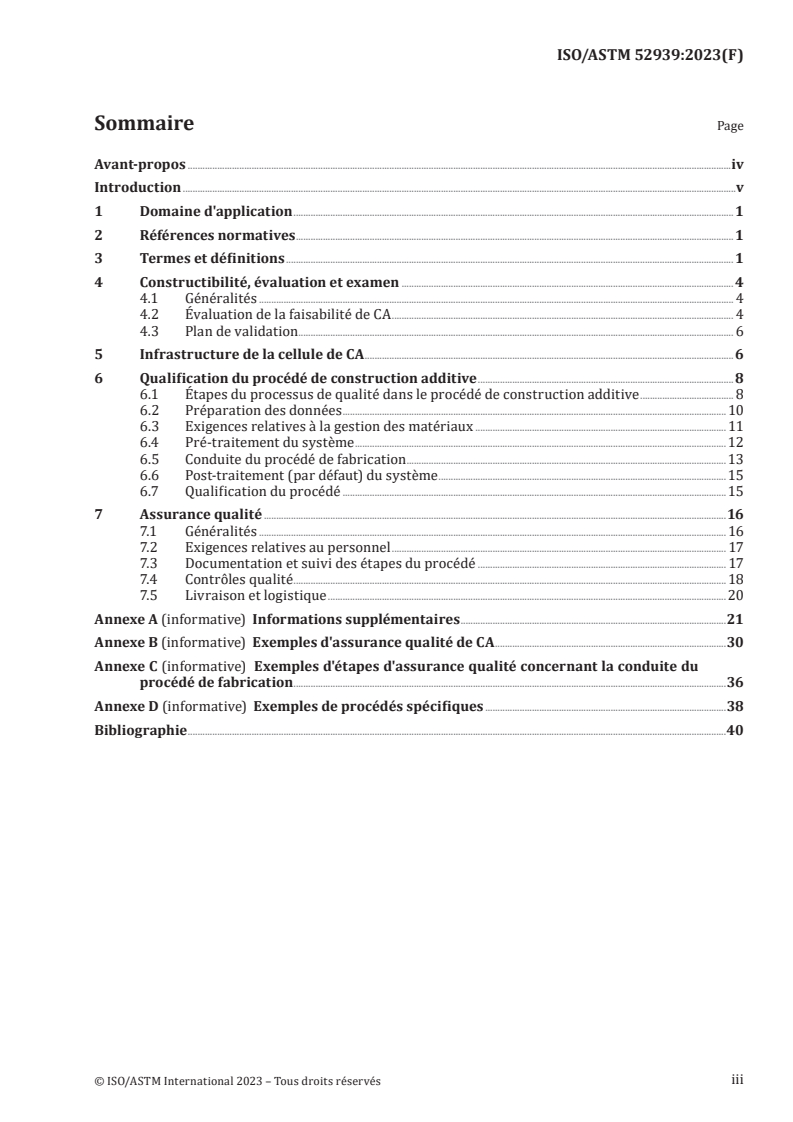
Sommaire Page
Avant-propos .iv
Introduction .v
1 Domaine d'application .1
2 Références normatives .1
3 Termes et définitions . 1
4 Constructibilité, évaluation et examen . 4
4.1 Généralités . 4
4.2 Évaluation de la faisabilité de CA . 4
4.3 Plan de validation . 6
5 Infrastructure de la cellule de CA .6
6 Qualification du procédé de construction additive . 8
6.1 Étapes du processus de qualité dans le procédé de construction additive . 8
6.2 Préparation des données . 10
6.3 Exigences relatives à la gestion des matériaux . 11
6.4 Pré-traitement du système . 12
6.5 Conduite du procédé de fabrication . 13
6.6 Post-traitement (par défaut) du système . 15
6.7 Qualification du procédé .15
7 Assurance qualité .16
7.1 Généralités . 16
7.2 Exigences relatives au personnel . 17
7.3 Documentation et suivi des étapes du procédé . 17
7.4 Contrôles qualité . 18
7.5 Livraison et logistique . 20
Annexe A (informative) Informations supplémentaires .21
Annexe B (informative) Exemples d'assurance qualité de CA .30
Annexe C (informative) Exemples d'étapes d'assurance qualité concernant la conduite du
procédé de fabrication .36
Annexe D (informative) Exemples de procédés spécifiques .38
Bibliographie .40
iii
© ISO/ASTM International 2023 – Tous droits réservés
Avant-propos
L'ISO (Organisation internationale de normalisation) est une fédération mondiale d'organismes
nationaux de normalisation (comités membres de l'ISO). L'élaboration des Normes internationales est
en général confiée aux comités techniques de l'ISO. Chaque comité membre intéressé par une étude
a le droit de faire partie du comité technique créé à cet effet. Les organisations internationales,
gouvernementales et non gouvernementales, en liaison avec l'ISO participent également aux travaux.
L'ISO collabore étroitement avec la Commission électrotechnique internationale (IEC) en ce qui
concerne la normalisation électrotechnique.
Les procédures utilisées pour élaborer le présent document et celles destinées à sa mise à jour sont
décrites dans les Directives ISO/IEC, Partie 1. Il convient, en particulier de prendre note des différents
critères d'approbation requis pour les différents types de document ISO. Le présent document a
été rédigé conformément aux règles de rédaction données dans les Directives ISO/IEC, Partie 2
(voir www.iso.org/directives).
L’ISO attire l’attention sur le fait que la mise en application du présent document peut entraîner
l’utilisation d’un ou de plusieurs brevets. L’ISO ne prend pas position quant à la preuve, à la validité
et à l’applicabilité de tout droit de brevet revendiqué à cet égard. À la date de publication du présent
document, l’ISO n'avait pas reçu notification qu’un ou plusieurs brevets pouvaient être nécessaires à sa
mise en application. Toutefois, il y a lieu d’avertir les responsables de la mise en application du présent
document que des informations plus récentes sont susceptibles de figurer dans la base de données de
brevets, disponible à l'adresse www.iso.org/brevets. L’ISO ne saurait être tenue pour responsable de ne
pas avoir identifié tout ou partie de tels droits de propriété.
Les appellations commerciales éventuellement mentionnées dans le présent document sont données
pour information, par souci de commodité, à l'intention des utilisateurs et ne sauraient constituer un
engagement.
Pour une explication de la nature volontaire des normes, la signification des termes et expressions
spécifiques de l'ISO liés à l'évaluation de la conformité, ou pour toute information au sujet de l'adhésion
de l'ISO aux principes de l'Organisation mondiale du commerce (OMC) concernant les Obstacles
techniques au commerce (OTC), voir www.iso.org/iso/fr/avant-propos.
Le présent document a été élaboré par le Comité technique l'ISO/TC 261, Fabrication additive, en
coopération avec l'ASTM F 42, Technologies de fabrication additive, dans le cadre d'un accord de
partenariat entre l'ISO et ASTM International dans le but de créer un ensemble commun de normes ISO/
ASTM sur la fabrication additive et en collaboration avec le Comité technique CEN/TC 438 Fabrication
additive du Comité européen de normalisation (CEN), conformément à l’Accord de coopération technique
entre l’ISO et le CEN (Accord de Vienne).
Il convient que tout retour d'information ou toute question sur le présent document soit adressé à
l'organisme national de normalisation de l'utilisateur. Une liste exhaustive desdits organismes se
trouve à l'adresse https://www.iso.org/fr/members.html.
iv
© ISO/ASTM International 2023 – Tous droits réservés
Introduction
Le secteur de la construction fait face à un nombre croissant de défis: pénurie de main d'œuvre, délais
toujours plus courts accordés aux projets, allongement des délais d'exécution, utilisation des matériaux
en quantité excessive, quantités importantes de déchets et impacts néfastes de l'empreinte carbone. En
outre, du point de vue du marché, la demande mondiale de construction augmente, notamment en raison
de la crise du logement et de la multiplication des projets d'infrastructure (qu'il s'agisse de nouvelles
structures ou du maintien de structures existantes). La construction additive (CA), également connue
sous le nom de fabrication additive pour la construction (FAC) ou d'impression pour la construction en
3D (3DCP) renferme le potentiel nécessaire pour répondre de manière directe à ces problématiques.
Dernièrement, la CA a réalisé des progrès considérables. Les éléments imprimés pourraient s'avérer
plus durables, plus viables, plus écologiques, moins chers (en masse) et plus rapides à mettre en œuvre
que les méthodes de construction traditionnelles. Cependant, en l'absence de normes de CA, toute
approbation, certification et atténuation des risques est impossible.
Le présent document a vocation à mettre en évidence les exigences nécessaires sur lesquelles s'appuient
la production et la distribution de structures créées par fabrication additive de grande qualité
(bâtiments résidentiels ou infrastructures) dans le secteur de la construction.
Les étapes importantes du procédé de CA sont spécifiées. Ces étapes seront contrôlées et surveillées
afin d'assurer la qualité des structures imprimées utilisées sur site ou hors site. Le présent document
n'a pas vocation à traiter spécifiquement d'une technologie ou d'un matériau donné; par conséquent,
les sous-procédés à appliquer dépendent de l'approche retenue. Il convient cependant de noter qu'il
est recommandé de faire approuver le ou les éléments imprimés par un ingénieur certifié localement,
et faire en sorte que le ou les éléments imprimés respectent les spécifications et exigences locales et
régionales.
v
© ISO/ASTM International 2023 – Tous droits réservés
NORME INTERNATIONALE ISO/ASTM 52939:2023(F)
Fabrication additive pour la construction — Principes de
qualification — Éléments de structure et d'infrastructure
1 Domaine d'application
Le présent document spécifie les exigences d'assurance qualité applicables à la construction additive
(CA) pour des projets dans le domaine du bâtiment et de la construction, et impliquant des techniques
de fabrication additive. Les exigences ne dépendent pas du ou des matériaux ni de la catégorie de
procédé utilisés.
Le présent document ne s'applique pas aux métaux.
Le présent document spécifie les critères pour les procédés de construction additive, les caractéristiques
significatives pour la qualité et les facteurs liés aux opérations du système de CA. Il spécifie en outre les
activités et séquences mises en place au sein d'une cellule de CA (site de construction additive) et d'un
projet de CA.
Le présent document s'applique à l'ensemble des technologies de fabrication additive dans le domaine
du bâtiment et de la construction (avec ou sans charge), concernant des éléments de construction
structurels et d'infrastructure de nature résidentielle ou commerciale; il développe une approche
orientée processus.
Le présent document ne couvre pas les aspects relatifs à l'environnement, à la santé et à la sécurité
applicables au réglage de l'installation d'impression, à la manipulation des matériaux, au fonctionnement
de l'équipement robotisé, et à l'emballage de l'équipement et/ou des éléments pour livraison; cependant,
les recommandations du fournisseur de matériaux, les instructions d'utilisation des solutions
robotiques et les exigences locales et régionales le prescrivent.
Le présent document ne traite pas de l'approbation de conception, de la caractérisation des propriétés
des matériaux ni des essais.
2 Références normatives
Les documents suivants cités dans le texte constituent, pour tout ou partie de leur contenu, des
exigences du présent document. Pour les références datées, seule l'édition citée s'applique. Pour les
références non datées, la dernière édition du document de référence s'applique (y compris les éventuels
amendements).
ISO/ASTM 52900, Fabrication additive — Principes généraux — Fondamentaux et vocabulaire
ISO/ASTM 52950, Fabrication additive — Principes généraux — Vue d'ensemble des échanges de données
3 Termes et définitions
Pour les besoins du présent document, les termes et définitions donnés dans l'ISO/ASTM 52900 ainsi
que les suivants s'appliquent.
L'ISO et l'IEC tiennent à jour des bases de données terminologiques destinées à être utilisées en
normalisation, consultables aux adresses suivantes:
— ISO Online browsing platform: disponible à l'adresse https:// www .iso .org/ obp
— IEC Electropedia: disponible à l'adresse https:// www .electropedia .org/
© ISO/ASTM International 2023 – Tous droits réservés
3.1
fabrication additive pour la construction
FAC
procédé permettant d'assembler des matériaux pour fabriquer des éléments/composants structurels et
non structurels et des systèmes à partir de données de modèle 3D, généralement par dépôt de matériaux
couche par couche, par opposition aux méthodes de fabrication soustractive et formative
3.2
construction additive
CA
terme décrivant l'ensemble des disciplines et des savoirs pertinents pour le segment du secteur de la
construction qui s'appuie sur des catégories de procédé de fabrication additive
Note 1 à l'article: L'utilisation de ces technologies couvre tous les secteurs de la construction pertinentes, p. ex.
les projets immobiliers de grande ampleur, la création de bâtiments complets et d'éléments de bâtiments, les
infrastructures civiles et la réparation des sinistres.
Note 2 à l'article: CA décrit toutes les disciplines des connaissances pertinentes, par exemple: architecture,
ingénierie, ingénierie structurelle, ingénierie des matériaux, opérateur de robot, gestion de projet, gestion de la
construction, gestion des installations, etc.
Note 3 à l'article: Les autres termes suivants sont utilisés de manière interchangeable: Construction numérique
(CN), Construction 4.0, Fabrication avancée dans la construction (FAC), Impression 3D pour la construction
(C3DP) et Impression pour la construction en 3D (3DCP).
Note 4 à l'article: Les matériaux de construction sont notamment:
— des variations du ciment, par exemple du béton et du mortier ou des pâtes polymères modifiées,
— des matériaux composites.
Note 5 à l'article: Une forte automatisation basée sur des robots, un degré d'intervention humaine réduit au cours
de la construction, et une quantité minime de déchets grâce aux systèmes de distribution du matériau en fonction
des besoins sont des caractéristiques intrinsèques de la présente définition.
Note 6 à l'article: Au moment la rédaction du présent document, en 2023, le domaine de la CA évolue rapidement;
il est très probable que de nouveaux matériaux et de nouvelles méthodes soient inclus à cette définition à l'avenir.
Note 7 à l'article: La CA peut se faire sur site ou en dehors (p. ex. production modulaire en usine).
3.3
dépôt de couche
application d'une seule couche
3.4
cellule de CA
solution d'impression déployée sur site pour l'impression in situ (comprend les systèmes de mélange et
de placement des matériaux)
3.5
dispositif de dépôt des matériaux
dispositif contrôlé numériquement, intégrant des mécanismes de mélange et de distribution de
matériaux bruts, de liants et d'additifs; dépose le mélange à partir d'une simulation numérique saisie
dans les programmes électroniques du dispositif sans nécessité d'intervention humaine ou de recours
à des moules
3.6
production physique
intégralité physique de l'espace de fabrication, des éléments situés dans l'espace de fabrication et des
structures et équipements de support liés à la production situés dans l'espace de construction du
système
© ISO/ASTM International 2023 – Tous droits réservés
3.7
cycle de production virtuel
simulation numérique/par ordinateur du cycle de production physique (3.7) (fichier d'impression)
EXEMPLE Simulation d'impression.
3.8
cycle de production à blanc
procédé consistant à exécuter le programme de fabrication sans matériaux pour vérifier la trajectoire
d'outil de la première couche et d'autres points critiques du programme; peut faire partie du procédé
d'étalonnage
3.9
procédé de construction
opérations de CA numériques et physiques, de la configuration du robot à l'achèvement de l'élément
imprimé final, y compris les essais d'assurance qualité et la vérification
3.10
mécanique, électricité et plomberie
MEP
systèmes requis pour assurer le chauffage, la ventilation et l'air conditionné, l'alimentation en électricité
et les communications, l'alimentation en eau et l'évacuation des eaux usées
3.11
élément imprimé
composant de construction imprimé en 3D, qu'il soit construit sur site (in situ) ou non, et qui est intégré
à un bâtiment ou à une structure en tant que composant d'une infrastructure complète
EXEMPLE Murs, colonnes, poutres, etc.
3.12
imprimabilité
capacité du matériau à être aisément transmis à la tête d'impression, traité par celle-ci (p. ex.,
extrudabilité (3.13), et à assurer la stabilité de la forme de la couche, le respect des exigences de
constructivité (3.14) et, le cas échéant, la pompabilité (3.15)
3.13
extrudabilité
capacité du matériau à être éjecté en douceur via la buse d'impression sans provoquer de blocage des
conduits ou de dommages significatifs de la qualité du matériau
3.14
constructibilité
capacité d'une impression à préserver la stabilité verticale et latérale sous des charges croissantes
provenant des couches superposées/successives avec une déformation contrôlée
3.15
pompabilité
critère relatif au matériau pâteux, lié à l'extrusion et à la maniabilité du béton; il importe de s'assurer
que les matériaux affichent en continu un comportement d'écoulement aisé, depuis la source jusqu'au
dispositif/à la buse de dépôt du matériau d'impression
Note 1 à l'article: La pompabilité garantit que les matériaux puissent être pompés aisément et en continu, sans
générer d'obstructions à l'intérieur du système de distribution.
© ISO/ASTM International 2023 – Tous droits réservés
4 Constructibilité, évaluation et examen
4.1 Généralités
Les exigences applicables à l'élément de CA doit être spécifiée et exécutée avant la préparation des
données. Les résultats doivent être transférés dans une séquence définie avec les spécifications de
production associées y compris les exigences spécifiques en matière de contrôle de la qualité (pour les
éléments porteurs et non porteurs). Il est recommandé que toute surveillance et/ou gestion des actifs
soient basées sur des normes/codes/réglementations applicables localement qui pourraient s'appuyer
sur une analyse de vérification numérique.
Si la demande de production est incomplète (par exemple, dessin technique manquant) ou si une mise
en œuvre initiale s'accompagne de restrictions, le client doit être prévenu afin de corriger le problème.
La Figure 1 illustre les différentes étapes de vérification de la faisabilité ainsi que la phase de
qualification, pré-requis à la production en série au moyen d'une CA.
Figure 1 — Étapes de vérification des exigences applicables à l'élément de CA
4.2 Évaluation de la faisabilité de CA
La faisabilité de CA, y compris les exigences applicables aux éléments de CA, doit être évaluée par des
personnes compétentes (p. ex. experts en technologie ou personnes formées, ayant obtenu les permis
idoines de la part des autorités compétentes localement, classifiées et enregistrées conformément
aux instructions par les autorités compétentes et ayant conçu et réalisé avec succès un nombre
donné d'éléments imprimés en 3D (p. ex. 5) avec le même procédé de construction, et présentant des
dimensions et un niveau de complexité comparable).
La compétence de production nécessaire n'est disponible que dans l'environnement de CA direct. Il est
important d'inclure toutes les exigences relatives aux éléments dans la vérification de la faisabilité.
L'évaluation doit comporter les étapes suivantes:
a) Contrôle de conception: il convient de consulter les directives de conception pertinentes pour
le procédé afin d'évaluer la faisabilité CA de la conception et la conformité aux réglementations
nationales, régionales et locales. De plus, des restrictions de CA applicables au procédé, par
exemple des exigences d'épaisseur des parois et de renforcement, doivent également être prises en
considération.
b) Contrôle environnemental: du point de vue de l'environnement, les étapes de sélection des
matériaux et de conception sont considérées comme essentielles pour assurer la durabilité
d'un élément construit tout au long de son cycle de vie. Il importe de réaliser une évaluation de
durabilité du matériau de construction ou du produit de la construction lui-même, conformément
à l'ISO 21930 et à l'ISO 14001, sur la base d'une analyse du cycle de vie (ACV) complète et d'assurer
un suivi de macro-indicateurs, aussi bien pour un usage interne que pour élaborer des déclarations
© ISO/ASTM International 2023 – Tous droits réservés
environnementales de produit (DEP) pour les produits de construction après validation. Les
contrôles et études de l'environnement doivent être réalisés dans le respect de l'ensemble des
exigences nationales, régionales et locales.
Les indicateurs de base à utiliser sont:
— le potentiel de réchauffement global (émissions en équivalent CO );
— les émissions de gaz à effet (GES) de serre ayant un impact potentiel sur le climat.
Autres indicateurs utiles admis:
— Potentiel de pollution: ressources d'eau douce susceptibles d'avoir un impact sur l'épuisement
des ressources d'eau douce (lorsque la composition du mélange pâteux ne contient aucun
matériau métallique, l'utilisation l'eau de mer ou d'eau traitée peut être envisagée dans le cadre
du procédé, en fonction de l'utilisation de l'élément imprimé et de ses interactions avec/de son
exposition aux utilisateurs finals).
— Potentiel d'épuisement du carburant fossile (équivalent pétrole): consommation de matériaux
bruts non renouvelables et d'énergie primaire non renouvelable.
— Potentiel de déplétion ozonique (CFC-11 dans l'air): dégagement de gaz ayant un impact potentiel
sur la couche d'ozone stratosphérique.
— Quantité de déchets générée par type: volume total de déchets dangereux et non dangereux
ayant un impact potentiel sur la génération de déchets à éliminer.
— Potentiel d'acidification (SO dans l'air) - impact potentiel sur l'acidification des terrains et des
ressources en eau.
— Potentiel d'eutrophisation de l'eau douce (P dans l'eau douce): impact potentiel de l'eutrophisation
des étendues d'eau.
c) Procédé de CA: il est également nécessaire que des ingénieurs qualifiés vérifient si l'élément
souhaité et les propriétés à atteindre sont faisables par CA à partir des paramètres du procédé
déjà qualifiés, ou si des adaptations sont nécessaires pour assurer la faisabilité. Les risques liés à
la catégorie de procédé propre à la CA doivent également être évalués par des ingénieurs qualifiés
afin de respecter les exigences dédiées aux composants. Voir procédés et matériaux spécifiques
dans le Tableau A.1.
d) Traitement ultérieur: dans le cas où une autre étape de fabrication (semi-)automatique intervient,
il est nécessaire de vérifier si la conception est appropriée pour cela, si aucun auxiliaire ne peut
être utilisé. Si des procédés soustractifs ou de finition sont ensuite appliqués afin d'obtenir les
tolérances de fabrication requises, les détails de conception correspondants doivent être fournis
dès le traitement des données, si nécessaire.
e) Vérification des dimensions/tolérances: les tolérances spécifiées dans la conception doivent
être réalisables dans le cadre du procédé de CA sélectionné. Le post-traitement doit être envisagé
en amont du procédé de CA.
EXEMPLE 1 Toutes considérations spéciales relatives au renforcement et/ou à l'intégration MEP, au
démarrage, à l'arrêt ou à l'omission dans le cadre du procédé de CA.
f) Matériau/propriétés du matériau: La faisabilité de CA doit être envisagée, au-delà de la
technologie sélectionnée, selon le matériau, la composition du mélange et sur l'ensemble du procédé
de CA. Les propriétés du matériau spécifiées doivent être incorporées ici. Il convient de respecter
les tolérances normatives locales en matière de résistance au feu, de résistance à la charge/à la
compression, de tension, de rétrécissement, de fluage, de résistance aux effets de l'environnement –
tels que l'humidité, les cycles de gel et les rayonnements ultraviolets (UV), etc.
EXEMPLE 2 Matériaux qui présentent différentes contraintes de CA.
© ISO/ASTM International 2023 – Tous droits réservés
Une évaluation individuelle de l'élément doit ensuite être menée afin de définir les mesures d'assurance
qualité nécessaires. Sur la base de la méthode d'assurance qualité déjà mise en œuvre ainsi que de
l'analyse des risques pour l'application concernée, il est nécessaire de vérifier si des mesures distinctes
pour le contrôle qualité des éléments sont nécessaires (voir 7.4).
4.3 Plan de validation
Les exigences de l'environnement direct de fabrication comprennent le plan de qualification de l'élément
de série. La condition préalable est la qualification du matériau pour un procédé de CA défini. Un plan
de qualification doit être formulé pour les éléments et les méthodes d'essai associées selon les étapes de
travail et/ou de mode opératoire pertinentes spécifiées par le client. La production du ou des éléments
fait l'objet d'un processus de validation par étapes (voir A.2 ou ISO/ASTM 52901). Chaque phase est
terminée avec succès lorsqu'elle est signée par le personnel compétent.
L'enregistrement méthodique des exigences relatives aux éléments peut dériver de l'ISO/ASTM 52901
par exemple. Cela permet de déduire les validations pouvant être nécessaires au-delà du présent
document.
5 Infrastructure de la cellule de CA
Les exigences suivantes concernent l'infrastructure de la cellule de CA:
a) Équipement: Il convient que les vérifications et la gestion de l'environnement, de la santé et de la
sécurité (HSE) respectent les normes légales locales et régionales existantes sur site et hors site,
pour l'ensemble des équipements. Quelques exemples sont énumérés ci-dessous:
— EN 12001;
— EN 12629-1;
— ISO 4413;
— ISO 4144;
— ISO 12100;
— ISO 13849-1;
— ISO 13849-2;
— ISO 13850;
— ISO 13854;
— ISO 13857;
— ISO 14118;
— ISO 14119;
— ISO 14120;
— EN 60204-1;
— ISO 10218-1;
— ISO 10218-2;
— EN 60204-1.
© ISO/ASTM International 2023 – Tous droits réservés
b) Sécurité au travail: un environnement de travail sûr, tenant compte des réglementations légales,
doit être garanti. Cela inclut la formation du personnel concernant les mesures et l'équipement de
sécurité au travail.
Il convient que les utilisateurs du présent document se réfèrent aux lignes directrices de gestion
de la sécurité appropriées ainsi qu'à la législation et aux réglementations locales afin de bien
comprendre les exigences spécifiques applicables.
Ci-après une synthèse (non exhaustive) des aspects de gestion de la sécurité qu'il convient de
prendre en compte dans le cadre de la CA.
1) La législation sur la sécurité oblige les opérateurs à rendre compte de la protection de leurs
salariés, du public et de l'environnement dans le cadre de leurs activités industrielles. Même si
la législation et les réglementations varient dans chaque pays ou région, les principes de base
de la gestion de la sécurité sont communs et il convient qu'ils constituent une pratique courante
pour toutes les entreprises de CA.
2) Les opérateurs doivent posséder des dispositions de gestion de la sécurité identifiant les
personnes responsables au sein de leur organisation. Les dispositions en matière de gestion
de la sécurité détaillent également les procédés en place pour assurer la sécurité de toutes les
opérations de l'entreprise, en tenant compte de tous les phénomènes dangereux associés à la
CA. Il convient que les dispositions en matière de gestion de la sécurité soient proportionnées
au risque et à la complexité de l'opération.
3) L'objectif principal de la gestion de la sécurité est d'identifier tous les phénomènes dangereux
prévisibles et de réduire les risques à un niveau tolérable et aussi faible que raisonnablement
praticable ou réalisable. Les mesures de contrôle des risques sont utilisées à cette fin de
diverses manières dans le cadre de la discipline de sécurité.
4) L'opérateur d'un équipement de CA robotisé ainsi que des machines et matériaux associés, doit
envisager et assurer la sécurité de l'ensemble des aspects de leur fonctionnement, notamment,
mais sans s'y limiter:
— l'emplacement d'impression (en usine ou sur site);
— les machines utilisées et les interfaces entre elles;
— les dispositions et de réponse en cas d'accident, y compris en matière de premiers secours;
— la signalétique de sécurité;
— la manipulation et le stockage des matériaux en sécurité;
— les exigences de sécurité sur le site de construction et les EPI exigés;
— les avertissements et mises en garde liés au procédé;
— l'installation et l'utilisation de barrières et de protections;
— une formation de sécurité adéquate et la fourniture d'informations de sécurité adéquates;
— une discipline et une culture de la sécurité;
— une obligation de diligence vis-à-vis des travailleurs;
— le signalement des quasi-accidents;
— les leçons tirées de l'expérience;
— la prise en compte de la sécurité du public;
— la conservation de registres auditables des décisions de sécurité.
© ISO/ASTM International 2023 – Tous droits réservés
c) Installation du système: le système de CA doit être installé par du personnel qualifié (voir 7.2). Des
éléments de preuve des conditions d'installation doivent être conservés (p. ex. rapport de service,
rapport d'acceptation final, rapports sur les modifications apportées au système, désignation du
type de machine mentionnant la version des composants logiciels et, le cas échéant, la version
des composants matériels, numéro d'identification de la machine, etc.). L'ensemble du personnel
chargé de livrer le produit doit être considéré comme disposant d'une formation adéquate, et les
rapports sont gérés et conservés dans le cadre du système de management de la qualité (SMQ) avec
enregistrement des étapes du procédé.
d) Maintenance: toutes les activités de maintenance doivent être achevées et documentées.
L'installation et la maintenance de la machine désignent les systèmes de contrôle du procédé ainsi
que les dispositifs liés aux systèmes et à leurs pièces [p. ex., stockage des matériaux, mélangeur,
pompe, système UV (le cas échéant)].
e) Environnement de production: les spécifications du fabricant du système concernant les
conditions ambiantes et les conditions d'installation doivent être respectées.
f) Infrastructure informatique: pour configurer l'installation de CA et assurer la sécurité de
l'environnement de serveur, les dispositions suivantes en matière de matériel informatique et de
systèmes de sécurité, d'archivage, etc. (p. ex. conformément à l'ISO/IEC 27001) indiquées ci-dessous
(liste non exhaustive) doivent être appliquées:
— capacité de charge et planéité au niveau du sol, absence de vibration;
— disponibilité complète, distance minimale avec les systèmes et équipements environnants;
— température, humidité, luminosité et composition particulaire de l'air contrôlés ou admissibles;
— propreté de l'environnement de CA;
— journalisation des conditions d'installation et de la qualification du système de production;
— journaux consignant l'ensemble des autres facteurs influant sur la qualité et concernant le
fonctionnement d'un système.
Le système de gestion de la CA garantit que les étapes correctes se déroulent dans la séquence qualifiée
avec les paramètres correspondants. Cela inclut la planification de l'utilisation des capacités de la
machine et du stock de matériau à un niveau minimum spécifié. Un système de planification des goulets
d'étranglement doit être démontré.
6 Qualification du procédé de construction additive
6.1 Étapes du processus de qualité dans le procédé de construction additive
Il est recommandé qu'un système de management de la qualité (p. ex. ISO 9001) soit en place lorsque
le fabricant d'élément de CA applique le présent document. De surcroît, le présent document peut
être utilisé pour créer un système de management de la qualité pertinent spécifiquement pour les
technologies de CA.
Afin d'assurer une qualité élevée au sein d'une cellule de CA, la chaîne complète (voir 6.2 à 6.7) du
procédé de production et les exigences en matière de personnel (voir 7.2) doivent être prises en compte.
Les domaines pertinents de la chaîne de procédés sont présentés à la Figure 2. Ils comprennent:
— Assurance qualité: mesures préventives garantissant la qualité requise pour l'élément sur l'ensemble
de la chaîne de procédé (voir l'approche d'assurance qualité de la CA proposée dans l'Annexe B);
— Préparation des données: traitement numérique précédant la construction additive (A.3);
© ISO/ASTM International 2023 – Tous droits réservés
— Gestion des matériaux: écoulements de matériau avant et pendant le processus d'impression
(voir B.3);
— Pré-traitement du système: activités manuelles survenant dans l'environnement immédiat du
système d'impression et servant à initier le contrôle du procédé (voir A.3);
— Conduite du procédé (cycle de fabrication): cycle complet de la machine, durant lequel les éléments
sont construits de manière additive (voir A.3);
— Post-traitement par défaut: activités survenant dans l'environnement du système de production et
réalisées en aval du contrôle du procédé (voir A.1);
— Post-traitement spécifique à l'élément: activités concernant l'élément, immédiatement après la
conduite du procédé (voir Annexe A, Annexe B et Annexe C).
Figure 2 — Garantie de qualité du procédé de CA sur site et hors site
L'assurance de la qualité de l'élément exige une spécification complète du procédé de production
(Figure 2):
a) il convient de détailler les caractéristiques pertinentes du point de vue de la qualité, les méthodes
d'essai et les intervalles de surveillance de chaque procédé mises en évidence à la Figure 1;
b) l'équipement de travail et toutes les conditions ambiantes nécessaires avant et pendant le processus
d'impression doivent être en place;
c) il convient de tenir compte des activités de maintenance et de service du système (voir exemples de
procédés spécifiques dans le Tableau D.1);
d) il convient d'établir des mesures de qualification permettant de déterminer les variables d'entrée
pertinentes (p. ex., propriétés du matériau) et les variables de sortie en résultant, qui sont dérivées
d'une combinaison de caractéristiques précédemment spécifiées au cours de la totalité du procédé;
e) les mesures, le dimensionnement géométrique et le tolérancement nécessaires à la CA doivent être
spécifiés en fonction de l'application et/ou des exigences des utilisateurs (voir Annexe B).
© ISO/ASTM International 2023 – Tous droits réservés
6.2 Préparation des données
Figure 3 — Étapes de préparation des données
Les principes de structure de données de l'ISO/ASTM 52950 doivent être appliqués. Les définitions
fournies dans l'ISO/ASTM 52900:2021, 3.4 doivent être respectées.
Si elles sont techniquement applicables, les étapes suivantes du processus de la Figure 3 doivent être
spécifiées et leurs essais et documentation définis:
a) Vérification des données: une inspection doit être menée sur les données 3D afin de s'assurer
qu'elles sont exemptes d'erreur et applicables au procédé. Si des erreurs sont détectées, une
réparation des données doit être menée en étroite collaboration et avec l'approbation de l'équipe
d'ingénierie, en particulier si une modification géométrique est exigée.
Le cas échéant, les paramètres de conversion (pavage) du format de fichier (p. ex. STL, AMF)
doivent être consignés.
b) Ajustement de la géométrie des éléments: tolérances pour les supports temporaires
(p. ex., surplombs) et intégration MEP le cas échéant. Les modifications des données 3D sont
autorisées en ce qui concerne les changements d'éléments si toutes les adaptations sont
documentées sous une forme compréhensible et vérifiable (ce qui nécessite un contrôle de version
de l'ensemble de données modifié), et que les approbations en bonne et due forme sont demandées
et acceptées avant d'effectuer les modifications.
Génération/programmation (p. ex. code G) des données de couche: conversion en données de
couche spécifiques à la machine, avec paramètres complets du procédé et basé sur l'approche et le
matériau.
En cas de mise à jour logicielle, il convient d'utiliser les données d'entrée et de sortie pour vérifier
que les données générées correspondent aux données de sortie référencées.
Les paramètres de conversion des données doivent être spécifiés et appliqués dans la description
correspondante du procédé, en tenant compte des caractéristiques essentielles de l'assurance
qualité pour la catégorie de procédé de CA utilisée.
c) Simulation du procédé de construction additive: cycle de production virtuel visant à anticiper
l'imprimabilité et les performances d'impression à partir de la géométrie, du matériau ainsi que des
catégories/caractéristiques de procédé de CA (voir exemples spécifiques dans le Tableau D.1).
De surcroît, il convient de fabriquer une maquette de toute partie complexe de l'élément à imprimer
en 3D, de manière à démontrer que ledit élément est bien imprimable, que le matériau est apte
à l'écoulement, extrudable, constructible et pompable, et que le temps d'ouverture du matériau
extrudé (c.-à-d. la période durant laquelle sa maniabilité respecte les tolérances acceptables pour
le procédé) est tel que conçu, de manière à obtenir la forme requise dans la limite des tolérances
admissibles.
d) Archivage des données: archive unique versionnée du cycle de production (ou pour référence,
en qualité de dessins/modèles numériques «conformes à l'exécution»). Durée d'archivage telle que
spécifiée pour l'application/le secteur concerné.
© ISO/ASTM International 2023 – Tous droits réservés
6.3 Exigences relatives à la gestion des matériaux
Figure 4 — Éléments de gestion des matériaux
Il convient de tenir compte de considérations spécifiques concernant la manipulation des matériaux; il
est également nécessaire de spécifier les paramètres essentiels ainsi que, le cas échéant, les méthodes
d'essai associées, qui garantissent qu'un matériau et une composition du mélange de matériaux donnés
sont appropriés pour le processus d'impression en question. Respecter les codes et les règlementations
locaux de l'autorité compétente. La Figure 4 présente les éléments de gestion des matériaux.
Il convient de tenir compte de tout «matériau de support», tel que les produits liants ou les colles, ainsi
que de la manipulation (stockage et mélange) et de la livraison (pompage et impression) des matériaux.
De surcroît, il convient de noter que le matériau d'impression observé au niveau de la tête/de la buse/de
l'extrudeuse est différent du matériau observé au niveau du mélangeur/de la zone de distribution (voir
exemples de procédés spécifiques dans le Tableau D.1).
Pour atteindre les propriétés exigées du matériau, les étapes suivantes du procédé doivent être
spécifiées, et leurs essais et leur documentation définis:
a) Transport: il convient de respecter les recommandations du fournisseur;
b) Contrôle qualité en entrée: étiquetage des matériaux entrants avec essais en lots des matériaux
bruts conformément aux instructions de leur fournisseur (voir des exemples de procédés
spécifiques dans le Tableau D.1);
c) Contrôle de charge: un historique de traçabilité du matériau et de la composition du mélange de
matériaux doit être constitué, consigné et enregistré;
d) Stockage: il convient de mettre en place des conditions de stockage appropriées (a minima, une
surveillance de l'humidité – le cas échéant – et de la température) conformes aux recommandations
des fournisseurs. Il convient également d'appliquer ces considérations aux systèmes de production
et de distribution du mélange prêt à l'emploi sur site (voir Annexe B);
e) Préparation de la conduite du procédé: le cas échéant, adaptation de la composition du matériau
à des fins de contrôle du processus (voir exemples de procédés spécifiques dans l'Annexe C et dans
le Tableau D.1);
f) Contrôle/essais (automatique ou manuel)/surveillance des propriétés à l'état frais en cours
de processus: le contrôle des paramètres, les essais des paramètres (p. ex. essais d'écoulement et
d'affaissement) et les sondes peuvent être intégrés à un plan de surveillance de la qualité. Les essais
appropriés sur les matériaux et les conditions du sol du site doivent être menés en conservant une
documentation, à des fins de traçabilité.
g) Gestion conforme aux réglementations locales: aspects propres à la technologie de CA, aux
matériaux de CA, aspects environnementaux, etc.
© ISO/ASTM International 2023 – Tous droits réservé
...