

ISO/TS 19163-2:2020
(Main)Geographic information — Content components and encoding rules for imagery and gridded data — Part 2: Implementation schema
General Information
- Abstract
This document specifies an implementation schema based on the content models for geographic imagery and gridded thematic data defined in the ISO/TS 19163-1. This document defines a structure that is suitable for binding content components and specific encoding formats. It also provides an implementation schema for binding a concrete, implementable, conformance-testable coverage structure as defined in ISO 19123-2.
- Status
- Published
- Publication Date
- 05-Jul-2020
- Technical Committee
- ISO/TC 211 - Geographic information/Geomatics
- Drafting Committee
- ISO/TC 211/WG 6 - Imagery
- Current Stage
- 9092 - International Standard to be revised
- Start Date
- 22-Feb-2024
- Completion Date
- 29-Aug-2026
Buy Documents


ISO/TS 19163-2:2020 - Geographic information — Content components and encoding rules for imagery and gridded data — Part 2: Implementation schema Released:7/6/2020


ISO/TS 19163-2:2020 - Geographic information — Content components and encoding rules for imagery and gridded data — Part 2: Implementation schema/6/2020
Overview
ISO/TS 19163-2:2020 specifies an implementation schema for geographic imagery and gridded thematic data. Building on the content models in ISO/TS 19163-1, this Technical Specification defines a concrete, GML-based structure and binding rules that allow the logical UML models to be mapped to real-world encodings (XML/GML and other file formats). It provides a conformance-testable coverage structure consistent with ISO 19123-2, enabling interoperable delivery and exchange of imagery and gridded data.
Key topics and requirements
- Implementation schema (GML-based): A GML application schema that implements the ISO/TS 19163-1 conceptual model for imagery and gridded data.
- UML → XML mapping: Rules and mappings following ISO 19118 and ISO/TS 19139-1 for transforming UML classes, attributes and associations into XML Schema (XSD).
- Encoding rules and bindings: Defined encoding rules for types such as ImageryAndGriddedData, Georectified, Georeferenceable, ThematicGriddedData (categorical and numerical), and subtypes. The document shows how to bind content components to specific encodings and data formats.
- XML Schema requirements class: Normative use of W3C XML Schema; namespaces and target namespace conventions (e.g., gmi, gmd, gml, cis, gmlcov).
- Conformance classes: Two conformance classes - schema implementation and binding rules - with requirements verified by the Abstract Test Suite (Annex A).
- Interoperability considerations: Guidance for mapping to coverage models (ISO 19123) and compatibility with GML Application Schema for Coverages (GMLCOV) and Coverage Implementation Schema (CIS).
Applications and who should use it
- GIS and remote sensing software developers - implement interoperable I/O using GML and coverage encodings.
- Data integrators and catalog managers - bind content components to encodings for distribution (GeoTIFF, JPEG2000, NetCDF, GMLJP2).
- Standards and QA teams - establish conformance tests and validate schema implementations against the Abstract Test Suite.
- Data producers (satellite, airborne, sensor networks) - ensure imagery and gridded products follow a consistent, machine-readable structure for downstream use.
- System architects - design workflows that require precise bindings between logical metadata models and physical file formats.
Related standards
- ISO/TS 19163-1:2016 - Content model for imagery and gridded data (logical UML).
- ISO 19123-2 - Coverage structure and domain-range model for coverages.
- ISO 19118, ISO/TS 19139-1 - UML-to-XML conversion and XML Schema mapping rules.
- OGC GML / GMLCOV / CIS - GML and coverage application schemas referenced for implementation.
ISO/TS 19163-2:2020 is essential for anyone implementing interoperable encoding and delivery of imagery and gridded data, enabling consistent bindings between metadata/content models and practical file formats used across GIS, remote sensing, and earth observation systems.
Relations
- Effective Date
- 06-Jun-2022
Buy Documents
ISO/TS 19163-2:2020 - Geographic information — Content components and encoding rules for imagery and gridded data — Part 2: Implementation schema Released:7/6/2020
ISO/TS 19163-2:2020 - Geographic information — Content components and encoding rules for imagery and gridded data — Part 2: Implementation schema/6/2020
Get Certified
Connect with accredited certification bodies for this standard

BSI Group
BSI (British Standards Institution) is the business standards company that helps organizations make excellence a habit.

NYCE
Mexican standards and certification body.
Sponsored listings
Frequently Asked Questions
ISO/TS 19163-2:2020 is a technical specification published by the International Organization for Standardization (ISO). Its full title is "Geographic information — Content components and encoding rules for imagery and gridded data — Part 2: Implementation schema". This standard covers: This document specifies an implementation schema based on the content models for geographic imagery and gridded thematic data defined in the ISO/TS 19163-1. This document defines a structure that is suitable for binding content components and specific encoding formats. It also provides an implementation schema for binding a concrete, implementable, conformance-testable coverage structure as defined in ISO 19123-2.
This document specifies an implementation schema based on the content models for geographic imagery and gridded thematic data defined in the ISO/TS 19163-1. This document defines a structure that is suitable for binding content components and specific encoding formats. It also provides an implementation schema for binding a concrete, implementable, conformance-testable coverage structure as defined in ISO 19123-2.
ISO/TS 19163-2:2020 is classified under the following ICS (International Classification for Standards) categories: 35.240.70 - IT applications in science. The ICS classification helps identify the subject area and facilitates finding related standards.
ISO/TS 19163-2:2020 has the following relationships with other standards: It is inter standard links to ISO 12736-1:2023. Understanding these relationships helps ensure you are using the most current and applicable version of the standard.
ISO/TS 19163-2:2020 is available in PDF format for immediate download after purchase. The document can be added to your cart and obtained through the secure checkout process. Digital delivery ensures instant access to the complete standard document.
Standards Content (Sample)
TECHNICAL ISO/TS
SPECIFICATION 19163-2
First edition
2020-07
Geographic information — Content
components and encoding rules for
imagery and gridded data —
Part 2:
Implementation schema
Information géographique — Composantes de contenu et règles de
codage pour l'imagerie et les données maillées —
Partie 2: Schéma d'implémentation
Reference number
©
ISO 2020
© ISO 2020
All rights reserved. Unless otherwise specified, or required in the context of its implementation, no part of this publication may
be reproduced or utilized otherwise in any form or by any means, electronic or mechanical, including photocopying, or posting
on the internet or an intranet, without prior written permission. Permission can be requested from either ISO at the address
below or ISO’s member body in the country of the requester.
ISO copyright office
CP 401 • Ch. de Blandonnet 8
CH-1214 Vernier, Geneva
Phone: +41 22 749 01 11
Email: copyright@iso.org
Website: www.iso.org
Published in Switzerland
ii © ISO 2020 – All rights reserved
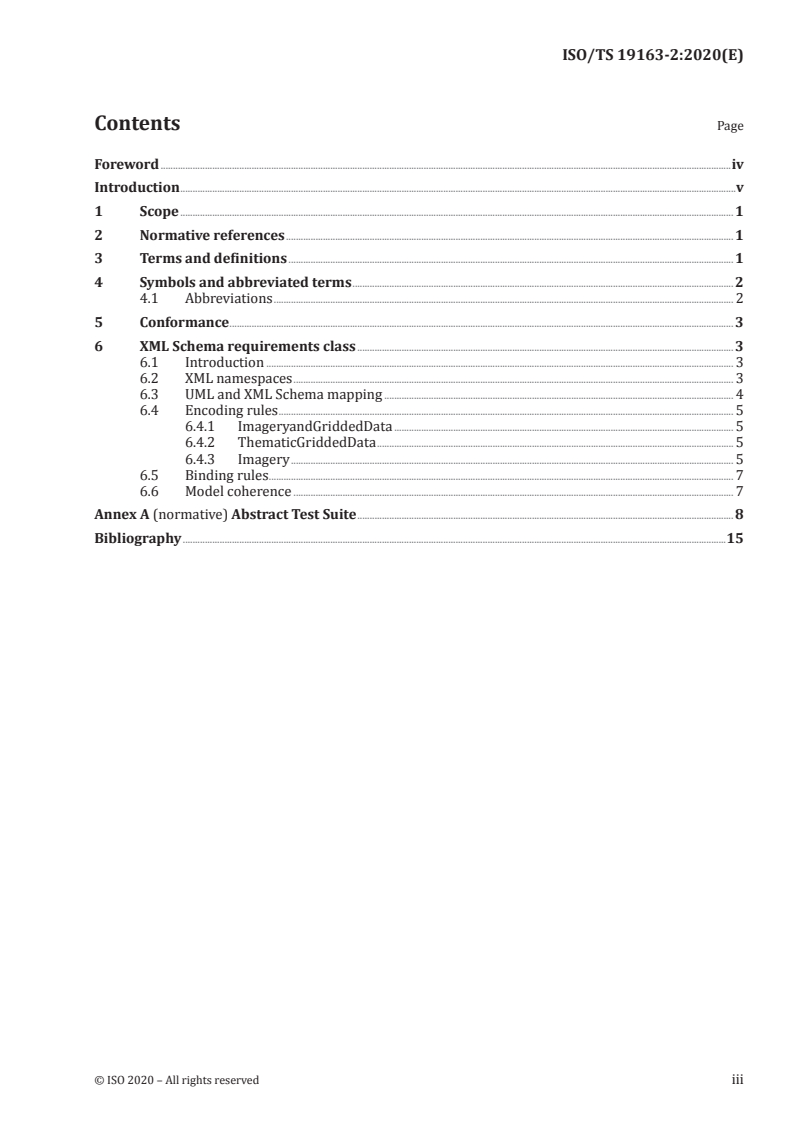
Contents Page
Foreword .iv
Introduction .v
1 Scope . 1
2 Normative references . 1
3 Terms and definitions . 1
4 Symbols and abbreviated terms . 2
4.1 Abbreviations . 2
5 Conformance . 3
6 XML Schema requirements class . 3
6.1 Introduction . 3
6.2 XML namespaces . 3
6.3 UML and XML Schema mapping . 4
6.4 Encoding rules . 5
6.4.1 ImageryandGriddedData . 5
6.4.2 ThematicGriddedData . 5
6.4.3 Imagery . 5
6.5 Binding rules . 7
6.6 Model coherence . 7
Annex A (normative) Abstract Test Suite . 8
Bibliography .15
Foreword
ISO (the International Organization for Standardization) is a worldwide federation of national standards
bodies (ISO member bodies). The work of preparing International Standards is normally carried out
through ISO technical committees. Each member body interested in a subject for which a technical
committee has been established has the right to be represented on that committee. International
organizations, governmental and non-governmental, in liaison with ISO, also take part in the work.
ISO collaborates closely with the International Electrotechnical Commission (IEC) on all matters of
electrotechnical standardization.
The procedures used to develop this document and those intended for its further maintenance are
described in the ISO/IEC Directives, Part 1. In particular, the different approval criteria needed for the
different types of ISO documents should be noted. This document was drafted in accordance with the
editorial rules of the ISO/IEC Directives, Part 2 (see www .iso .org/ directives).
Attention is drawn to the possibility that some of the elements of this document may be the subject of
patent rights. ISO shall not be held responsible for identifying any or all such patent rights. Details of
any patent rights identified during the development of the document will be in the Introduction and/or
on the ISO list of patent declarations received (see www .iso .org/ patents).
Any trade name used in this document is information given for the convenience of users and does not
constitute an endorsement.
For an explanation of the voluntary nature of standards, the meaning of ISO specific terms and
expressions related to conformity assessment, as well as information about ISO's adherence to the
World Trade Organization (WTO) principles in the Technical Barriers to Trade (TBT), see www .iso .org/
iso/ foreword .html.
This document was prepared by Technical Committee ISO/TC 211, Geographic information/Geomatics.
Any feedback or questions on this document should be directed to the user’s national standards body. A
complete listing of these bodies can be found at www .iso .org/ members .html.
iv © ISO 2020 – All rights reserved
Introduction
Geographic imagery and gridded thematic data are widely used in the geospatial community and
related fields. Over the past two decades, several standards of geographic images have been developed
by ISO/TC 211. ISO 19123 defines a conceptual schema for the spatial characteristics of coverages and
defines the relationship between the domain of coverages and an associated attribute range. Multiple
types of coverages are defined in ISO 19123, including raster, triangulated irregular network, point,
curve and polygon coverages.
Although ISO/TS 19163-1 specifies logical data structures and the rules for encoding the content
components in the structures, it is not an implementation schema. Without a concrete implementation
structure, the specified UML cannot be mapped to the encodings used in various data formats, such as
JPEG2000, GeoTIFF, NetCDF, and GMLJP2.
This part of ISO 19163 proposes a GML-based implementation schema of ISO/TS 19163-1 as a binding
between the content components and specific encoding formats.
This document conforms to the coverage structure defined in ISO 19123-2.
TECHNICAL SPECIFICATION ISO/TS 19163-2:2020(E)
Geographic information — Content components and
encoding rules for imagery and gridded data —
Part 2:
Implementation schema
1 Scope
This document specifies an implementation schema based on the content models for geographic
imagery and gridded thematic data defined in the ISO/TS 19163-1.
This document defines a structure that is suitable for binding content components and specific
encoding formats. It also provides an implementation schema for binding a concrete, implementable,
conformance-testable coverage structure as defined in ISO 19123-2.
2 Normative references
The following documents are referred to in the text in such a way that some or all of their content
constitutes requirements of this document. For dated references, only the edition cited applies. For
undated references, the latest edition of the referenced document (including any amendments) applies.
ISO/TS 19163-1:2016, Geographic information — Content components and encoding rules for imagery and
gridded data — Part 1: Content model
3 Terms and definitions
For the purposes of this document, the following terms and definitions apply.
ISO and IEC maintain terminological databases for use in standardization at the following addresses:
— ISO Online browsing platform: available at https:// www .iso .org/ obp
— IEC Electropedia: available at http:// www .electropedia .org/
3.1
binding
specification of a mapping relating the information defined in a content model (data and metadata) to
the data format that carries that information
[SOURCE: ISO/TS 19163-1:2016, 4.2]
3.2
conversion rule
rule for converting instances in the input data structure to instances in the output data structure
[SOURCE: ISO 19118:2011, 4.7]
3.3
document
well-formed data object
3.4
encoding rule
identifiable collection of conversion rules (3.2) that define the encoding for a particular data structure
EXAMPLE XML, ISO 10303-21, ISO/IEC 8211.
Note 1 to entry: An encoding rule specifies the types of data to be converted as well as the syntax, structure and
codes used in the resulting data structure.
[SOURCE: ISO 19118:2011, 4.14]
3.5
grid
network composed of two or more sets of curves in which the members of each set intersect the
members of the other sets in an algorithmic way
[SOURCE: ISO 19123:2005, 4.1.23]
3.6
gridded data
data whose attribute values are associated with positions on a grid (3.5) coordinate system
[SOURCE: ISO 19115-2:2019, 3.16, modified — Note 1 to entry has been removed.]
3.7
imagery
representation of phenomena as images produced by electronic and/or optical techniques
Note 1 to entry: The term imagery is often used colloquially with various meanings in different contexts. It is
often used to describe any set of gridded, point set or other form of coverage data that can be portrayed.
[SOURCE: ISO 19101-2:2018, 3.14, modified — Note 1 to entry has been added.]
3.8
namespace
collection of names, identified by a URI reference, which are used in XML documents (3.3) as element
names and attribute names
[SOURCE: W3C XML]
3.9
schema document
XML document (3.3) containing schema component definitions and declarations
Note 1 to entry: The W3C XML Schema provides an XML interchange format for schema information. A single
schema document provides descriptions of components associated with a single XML namespace (3.8), but
several documents may describe components in the same schema, i.e. the same target namespace.
[SOURCE: ISO 19136-1:2020, 3.1.54]
4 Symbols and abbreviated terms
4.1 Abbreviations
CIS Coverage Implementation Schema
CRS Coordinate Reference System
GML Geography Markup Language
2 © ISO 2020 – All rights reserved
GMLCOV GML Application Schema for Coverages
SWE Sensor Web Enablement
UML Unified Modeling Language
URI Unique Resource Identifier
XML eXtensible Markup Language
XSD XML Schema Definition
5 Conformance
This document defines two classes of conformance: schema implementation and binding rules. Any
product claiming conformance with one of these classes shall pass all the requirements described in
the corresponding abstract test suite in Annex A.
Requirements and conformance test URIs defined in this document are relative to https:// standards
.isotc211 .org/ iso19163/ -2/ 1
6 XML Schema requirements class
6.1 Introduction
The normative parts of this document use the W3C XML Schema language to describe the grammar of
conformant XML data instances. XML Schema is a rich language with many capabilities and subtleties.
While a reader who is unfamiliar with XML Schema may be able to follow the description in a general
fashion, this document is not intended to serve as an introduction to XML Schema. In order to have a
full understanding of this document, it is necessary for the reader to have a reasonable knowledge of
XML Schema.
This XML Schema implementation of ISO/TS 19163-1 follows the general rules defined in ISO 19118 and
ISO/TS 19139-1 for transforming UML models to XML Schema. ISO 19118 specifies conversion rules for
transforming data from an input data structure to an output data structure. ISO/TS 19139-1 provides
the details on how to convert UML classes, attributes, associations, aggregations and compositions into
XML elements.
6.2 XML namespaces
UML diagrams and XML code fragments adhere to the namespace conventions shown in Table 1. The
namespace prefixes used in this document are not normative and are merely chosen for convenience.
They may appear in examples without being formally declared and have no semantic significance. The
namespaces to which the prefixes correspond are normative.
All components defined or declared in this document use the same target namespace of https:// www
.isotc211 .org/ xsd/ gmi.
Table 1 — Namespace mapping conventions
Prefix Namespace URI Description
Geographic Metadata for imagery
gmi https:// www .isotc211 .org/ 2005/ gmi
and gridded data
Geographic MetaData extensible
gmd https:// www .isotc211 .org/ 2005/ gmd
markup language
Geographic Common extensible
gco https:// www .isotc211 .org/ 2005/ gco
markup language
Table 1 (continued)
Prefix Namespace URI Description
gmx https:// www .isotc211 .org/ 2005/ gmx Geographic Metadata XML Schema
Geographic Spatial Schema
gss https:// www .isotc211 .org/ 2005/ gss
extensible markup language
Geographic Spatial Referencing
gsr https:// www .isotc211 .org/ 2005/ gsr
extensible markup
Geographic Temporal Schema
gts https:// www .isotc211 .org/ 2005/ gts
extensible markup
gml http:// www .opengis .net/ gml/ 3 .2 GML 3.2.1
swe http:// www .opengis .net/ swe/ 2 .0 SWE Common 2.0
GML Application Schema for
gmlcov http:// www .opengis .net/ gmlcov/ 1 .0
Coverages 1.0
http://s chemas. opengis. net/g mlcov/g mlcovrgrid/ ReferenceableGridCoverage
gmlcovrgrid
1 .0/ Extension 1.0
cis http:// www .opengis .net/ cis/ 1 .0 Coverage Implementation Schema 1.0
NOTE 1 CIS 1.0 is a derived work based on OGC GMLCOV 1.0. The two documents are functionally equivalent.
NOTE 2 ReferenceableGridCoverage Extension provides a set of referenceable grid elements for use as sub-
elements of ReferenceableGridCoverage, via an extension GMLCOVRGRID of GMLCOV 1.0.
6.3 UML and XML Schema mapping
This XML Schema document shall implement the UML conceptual schema defined in ISO/TS 19163-1.
The schema mapping between UML and XML is listed in Table 2.
Table 2 — UML and XML Schema mapping
XML Schema UML conceptual schema
IE_ImageryAndGriddedData
ImageandGriddedData.xsd IE_Georectified
IE_Georeferenceable
IE_ThematicGriddedData
ThematicGriddedData.xsd IE_CategoricalGriddedData
IE_NumericalGriddedData
IE_Imagery
IE_SyntheticImage
IE_FusedImage
IE_SimulatedImage
IE_OpticalImage
Imagery.xsd
IE_MicrowaveData
IE_ActiveMWData
IE_SARData
IE_PassiveMWData
IE_RadiometerData
4 © ISO 2020 – All rights reserved
6.4 Encoding rules
6.4.1 ImageryandGriddedData
Requirement 1 /req/gmi/ImageandGriddedData: An ImageandGriddedData shall be an
implementation of ISO/TS 19163-1 IE_ImageryAndGriddedData, including either IE_Georectified or IE_
Georeferenceable.
IE_ImageryAndGriddedData is the topmost class defined in ISO/TS 19163-1, which is a subclass of CV_
Coverage defined in ISO/TS 19123.
NOTE More than one subtype of ImageryandGriddedData can be added to the xsd in the same mechanism if
it conforms to ISO/TS 19163-1.
Requirement 2 /req/gmi/Georectified: A Georectified shall be an implementation of ISO/TS 19163-1
IE_Georectified.
IE_Georectified specifies the source of geolocations and the model used for geometric correction. The
attribute checkPoints specifies the format and source of ground control points used as check points in
a georectified image. More spatial attributes about the check points and other attributes are inherited
from MD_Georectified as defined in ISO 19115-1.
Requirement 3 /req/gmi/Georeferenceable: A Georeferenceable shall be an implementation of
ISO/TS 19163-1 IE_Georeferenceable associated to SD_SensorModel.
1)
Dependency: SD_SensorModel class defined in ISO/TS 19130-3 .
Geolocation information of georeferenceable data defines the geometric correction models. More
spatial attributes about georeferenceable data are inherited from MD_Georeferenceable as defined in
ISO 19115-1.
6.4.2 ThematicGriddedData
Requirement 4 /req/gmi/ThematicGriddedData: A ThematicGriddedData shall be an implementation
of ISO/TS 19163-1 IE_ThematicGriddedData that is a subtype of IE_ImageryAndGriddedData.
IE_ThematicGriddedData contains the common characteristics of thematic gridded data. There are
two sub-types of thematic gridded data, categorical and numerical, which are specified with IE_
CategoricalGriddedData class and IE_NumericalGriddedData class.
Requirement 5 /req/gmi/CategoricalGriddedData: A CategoricalGriddedData shall be
an implementation of ISO/TS 19163-1 IE_CategoricalGriddedData that is a subtype of IE_
ThematicGriddedData.
IE_CategoricalGriddedData specifies the number of categories of a categorical data layer, the description
on the classification to produce the categorical data, and the number of bits for recording each value.
Requirement 6 /req/gmi/NumericalGriddedData: A NumericalGriddedData shall be
an implementation of ISO/TS 19163-1 IE_NumericalGriddedData that is a subtype of IE_
ThematicGriddedData.
IE_NumericalGriddedData specifies the meaning of the numerical gridded data with the attribute
valueDescription and inherits the information about the maximum and minimum value, units,
bitsPerValue and so on.
6.4.3 Imagery
Requirement 7 /req/gmi/Imagery: An Imagery shall be an implementation of ISO/TS 19163-1 IE_
Imagery that is a subtype of IE_ImageryAndGriddedData.
1) Under preparation. Stage at the time of publication: ISO/CD TS 19130-3:2020.
Imagery is a kind of coverage whose attribute values are num
...
TECHNICAL ISO/TS
SPECIFICATION 19163-2
First edition
2020-07
Geographic information — Content
components and encoding rules for
imagery and gridded data —
Part 2:
Implementation schema
Information géographique — Composantes de contenu et règles de
codage pour l'imagerie et les données maillées —
Partie 2: Schéma d'implémentation
Reference number
©
ISO 2020
© ISO 2020
All rights reserved. Unless otherwise specified, or required in the context of its implementation, no part of this publication may
be reproduced or utilized otherwise in any form or by any means, electronic or mechanical, including photocopying, or posting
on the internet or an intranet, without prior written permission. Permission can be requested from either ISO at the address
below or ISO’s member body in the country of the requester.
ISO copyright office
CP 401 • Ch. de Blandonnet 8
CH-1214 Vernier, Geneva
Phone: +41 22 749 01 11
Email: copyright@iso.org
Website: www.iso.org
Published in Switzerland
ii © ISO 2020 – All rights reserved
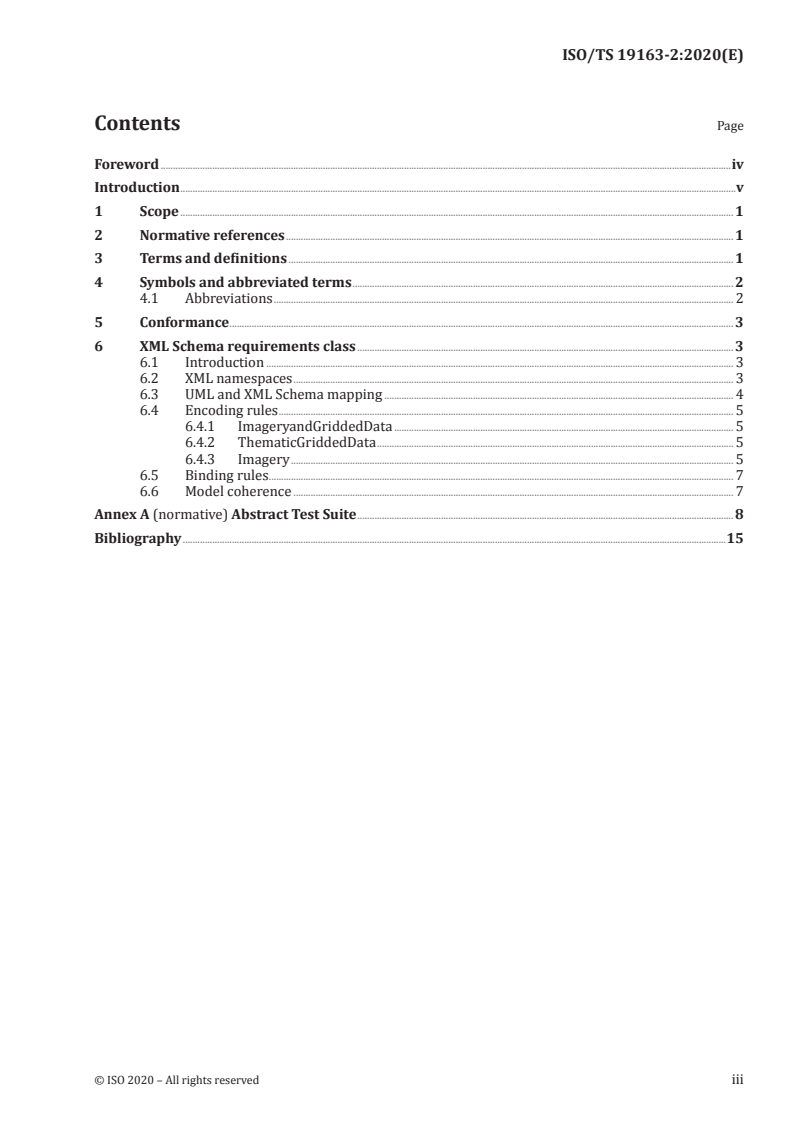
Contents Page
Foreword .iv
Introduction .v
1 Scope . 1
2 Normative references . 1
3 Terms and definitions . 1
4 Symbols and abbreviated terms . 2
4.1 Abbreviations . 2
5 Conformance . 3
6 XML Schema requirements class . 3
6.1 Introduction . 3
6.2 XML namespaces . 3
6.3 UML and XML Schema mapping . 4
6.4 Encoding rules . 5
6.4.1 ImageryandGriddedData . 5
6.4.2 ThematicGriddedData . 5
6.4.3 Imagery . 5
6.5 Binding rules . 7
6.6 Model coherence . 7
Annex A (normative) Abstract Test Suite . 8
Bibliography .15
Foreword
ISO (the International Organization for Standardization) is a worldwide federation of national standards
bodies (ISO member bodies). The work of preparing International Standards is normally carried out
through ISO technical committees. Each member body interested in a subject for which a technical
committee has been established has the right to be represented on that committee. International
organizations, governmental and non-governmental, in liaison with ISO, also take part in the work.
ISO collaborates closely with the International Electrotechnical Commission (IEC) on all matters of
electrotechnical standardization.
The procedures used to develop this document and those intended for its further maintenance are
described in the ISO/IEC Directives, Part 1. In particular, the different approval criteria needed for the
different types of ISO documents should be noted. This document was drafted in accordance with the
editorial rules of the ISO/IEC Directives, Part 2 (see www .iso .org/ directives).
Attention is drawn to the possibility that some of the elements of this document may be the subject of
patent rights. ISO shall not be held responsible for identifying any or all such patent rights. Details of
any patent rights identified during the development of the document will be in the Introduction and/or
on the ISO list of patent declarations received (see www .iso .org/ patents).
Any trade name used in this document is information given for the convenience of users and does not
constitute an endorsement.
For an explanation of the voluntary nature of standards, the meaning of ISO specific terms and
expressions related to conformity assessment, as well as information about ISO's adherence to the
World Trade Organization (WTO) principles in the Technical Barriers to Trade (TBT), see www .iso .org/
iso/ foreword .html.
This document was prepared by Technical Committee ISO/TC 211, Geographic information/Geomatics.
Any feedback or questions on this document should be directed to the user’s national standards body. A
complete listing of these bodies can be found at www .iso .org/ members .html.
iv © ISO 2020 – All rights reserved
Introduction
Geographic imagery and gridded thematic data are widely used in the geospatial community and
related fields. Over the past two decades, several standards of geographic images have been developed
by ISO/TC 211. ISO 19123 defines a conceptual schema for the spatial characteristics of coverages and
defines the relationship between the domain of coverages and an associated attribute range. Multiple
types of coverages are defined in ISO 19123, including raster, triangulated irregular network, point,
curve and polygon coverages.
Although ISO/TS 19163-1 specifies logical data structures and the rules for encoding the content
components in the structures, it is not an implementation schema. Without a concrete implementation
structure, the specified UML cannot be mapped to the encodings used in various data formats, such as
JPEG2000, GeoTIFF, NetCDF, and GMLJP2.
This part of ISO 19163 proposes a GML-based implementation schema of ISO/TS 19163-1 as a binding
between the content components and specific encoding formats.
This document conforms to the coverage structure defined in ISO 19123-2.
TECHNICAL SPECIFICATION ISO/TS 19163-2:2020(E)
Geographic information — Content components and
encoding rules for imagery and gridded data —
Part 2:
Implementation schema
1 Scope
This document specifies an implementation schema based on the content models for geographic
imagery and gridded thematic data defined in the ISO/TS 19163-1.
This document defines a structure that is suitable for binding content components and specific
encoding formats. It also provides an implementation schema for binding a concrete, implementable,
conformance-testable coverage structure as defined in ISO 19123-2.
2 Normative references
The following documents are referred to in the text in such a way that some or all of their content
constitutes requirements of this document. For dated references, only the edition cited applies. For
undated references, the latest edition of the referenced document (including any amendments) applies.
ISO/TS 19163-1:2016, Geographic information — Content components and encoding rules for imagery and
gridded data — Part 1: Content model
3 Terms and definitions
For the purposes of this document, the following terms and definitions apply.
ISO and IEC maintain terminological databases for use in standardization at the following addresses:
— ISO Online browsing platform: available at https:// www .iso .org/ obp
— IEC Electropedia: available at http:// www .electropedia .org/
3.1
binding
specification of a mapping relating the information defined in a content model (data and metadata) to
the data format that carries that information
[SOURCE: ISO/TS 19163-1:2016, 4.2]
3.2
conversion rule
rule for converting instances in the input data structure to instances in the output data structure
[SOURCE: ISO 19118:2011, 4.7]
3.3
document
well-formed data object
3.4
encoding rule
identifiable collection of conversion rules (3.2) that define the encoding for a particular data structure
EXAMPLE XML, ISO 10303-21, ISO/IEC 8211.
Note 1 to entry: An encoding rule specifies the types of data to be converted as well as the syntax, structure and
codes used in the resulting data structure.
[SOURCE: ISO 19118:2011, 4.14]
3.5
grid
network composed of two or more sets of curves in which the members of each set intersect the
members of the other sets in an algorithmic way
[SOURCE: ISO 19123:2005, 4.1.23]
3.6
gridded data
data whose attribute values are associated with positions on a grid (3.5) coordinate system
[SOURCE: ISO 19115-2:2019, 3.16, modified — Note 1 to entry has been removed.]
3.7
imagery
representation of phenomena as images produced by electronic and/or optical techniques
Note 1 to entry: The term imagery is often used colloquially with various meanings in different contexts. It is
often used to describe any set of gridded, point set or other form of coverage data that can be portrayed.
[SOURCE: ISO 19101-2:2018, 3.14, modified — Note 1 to entry has been added.]
3.8
namespace
collection of names, identified by a URI reference, which are used in XML documents (3.3) as element
names and attribute names
[SOURCE: W3C XML]
3.9
schema document
XML document (3.3) containing schema component definitions and declarations
Note 1 to entry: The W3C XML Schema provides an XML interchange format for schema information. A single
schema document provides descriptions of components associated with a single XML namespace (3.8), but
several documents may describe components in the same schema, i.e. the same target namespace.
[SOURCE: ISO 19136-1:2020, 3.1.54]
4 Symbols and abbreviated terms
4.1 Abbreviations
CIS Coverage Implementation Schema
CRS Coordinate Reference System
GML Geography Markup Language
2 © ISO 2020 – All rights reserved
GMLCOV GML Application Schema for Coverages
SWE Sensor Web Enablement
UML Unified Modeling Language
URI Unique Resource Identifier
XML eXtensible Markup Language
XSD XML Schema Definition
5 Conformance
This document defines two classes of conformance: schema implementation and binding rules. Any
product claiming conformance with one of these classes shall pass all the requirements described in
the corresponding abstract test suite in Annex A.
Requirements and conformance test URIs defined in this document are relative to https:// standards
.isotc211 .org/ iso19163/ -2/ 1
6 XML Schema requirements class
6.1 Introduction
The normative parts of this document use the W3C XML Schema language to describe the grammar of
conformant XML data instances. XML Schema is a rich language with many capabilities and subtleties.
While a reader who is unfamiliar with XML Schema may be able to follow the description in a general
fashion, this document is not intended to serve as an introduction to XML Schema. In order to have a
full understanding of this document, it is necessary for the reader to have a reasonable knowledge of
XML Schema.
This XML Schema implementation of ISO/TS 19163-1 follows the general rules defined in ISO 19118 and
ISO/TS 19139-1 for transforming UML models to XML Schema. ISO 19118 specifies conversion rules for
transforming data from an input data structure to an output data structure. ISO/TS 19139-1 provides
the details on how to convert UML classes, attributes, associations, aggregations and compositions into
XML elements.
6.2 XML namespaces
UML diagrams and XML code fragments adhere to the namespace conventions shown in Table 1. The
namespace prefixes used in this document are not normative and are merely chosen for convenience.
They may appear in examples without being formally declared and have no semantic significance. The
namespaces to which the prefixes correspond are normative.
All components defined or declared in this document use the same target namespace of https:// www
.isotc211 .org/ xsd/ gmi.
Table 1 — Namespace mapping conventions
Prefix Namespace URI Description
Geographic Metadata for imagery
gmi https:// www .isotc211 .org/ 2005/ gmi
and gridded data
Geographic MetaData extensible
gmd https:// www .isotc211 .org/ 2005/ gmd
markup language
Geographic Common extensible
gco https:// www .isotc211 .org/ 2005/ gco
markup language
Table 1 (continued)
Prefix Namespace URI Description
gmx https:// www .isotc211 .org/ 2005/ gmx Geographic Metadata XML Schema
Geographic Spatial Schema
gss https:// www .isotc211 .org/ 2005/ gss
extensible markup language
Geographic Spatial Referencing
gsr https:// www .isotc211 .org/ 2005/ gsr
extensible markup
Geographic Temporal Schema
gts https:// www .isotc211 .org/ 2005/ gts
extensible markup
gml http:// www .opengis .net/ gml/ 3 .2 GML 3.2.1
swe http:// www .opengis .net/ swe/ 2 .0 SWE Common 2.0
GML Application Schema for
gmlcov http:// www .opengis .net/ gmlcov/ 1 .0
Coverages 1.0
http://s chemas. opengis. net/g mlcov/g mlcovrgrid/ ReferenceableGridCoverage
gmlcovrgrid
1 .0/ Extension 1.0
cis http:// www .opengis .net/ cis/ 1 .0 Coverage Implementation Schema 1.0
NOTE 1 CIS 1.0 is a derived work based on OGC GMLCOV 1.0. The two documents are functionally equivalent.
NOTE 2 ReferenceableGridCoverage Extension provides a set of referenceable grid elements for use as sub-
elements of ReferenceableGridCoverage, via an extension GMLCOVRGRID of GMLCOV 1.0.
6.3 UML and XML Schema mapping
This XML Schema document shall implement the UML conceptual schema defined in ISO/TS 19163-1.
The schema mapping between UML and XML is listed in Table 2.
Table 2 — UML and XML Schema mapping
XML Schema UML conceptual schema
IE_ImageryAndGriddedData
ImageandGriddedData.xsd IE_Georectified
IE_Georeferenceable
IE_ThematicGriddedData
ThematicGriddedData.xsd IE_CategoricalGriddedData
IE_NumericalGriddedData
IE_Imagery
IE_SyntheticImage
IE_FusedImage
IE_SimulatedImage
IE_OpticalImage
Imagery.xsd
IE_MicrowaveData
IE_ActiveMWData
IE_SARData
IE_PassiveMWData
IE_RadiometerData
4 © ISO 2020 – All rights reserved
6.4 Encoding rules
6.4.1 ImageryandGriddedData
Requirement 1 /req/gmi/ImageandGriddedData: An ImageandGriddedData shall be an
implementation of ISO/TS 19163-1 IE_ImageryAndGriddedData, including either IE_Georectified or IE_
Georeferenceable.
IE_ImageryAndGriddedData is the topmost class defined in ISO/TS 19163-1, which is a subclass of CV_
Coverage defined in ISO/TS 19123.
NOTE More than one subtype of ImageryandGriddedData can be added to the xsd in the same mechanism if
it conforms to ISO/TS 19163-1.
Requirement 2 /req/gmi/Georectified: A Georectified shall be an implementation of ISO/TS 19163-1
IE_Georectified.
IE_Georectified specifies the source of geolocations and the model used for geometric correction. The
attribute checkPoints specifies the format and source of ground control points used as check points in
a georectified image. More spatial attributes about the check points and other attributes are inherited
from MD_Georectified as defined in ISO 19115-1.
Requirement 3 /req/gmi/Georeferenceable: A Georeferenceable shall be an implementation of
ISO/TS 19163-1 IE_Georeferenceable associated to SD_SensorModel.
1)
Dependency: SD_SensorModel class defined in ISO/TS 19130-3 .
Geolocation information of georeferenceable data defines the geometric correction models. More
spatial attributes about georeferenceable data are inherited from MD_Georeferenceable as defined in
ISO 19115-1.
6.4.2 ThematicGriddedData
Requirement 4 /req/gmi/ThematicGriddedData: A ThematicGriddedData shall be an implementation
of ISO/TS 19163-1 IE_ThematicGriddedData that is a subtype of IE_ImageryAndGriddedData.
IE_ThematicGriddedData contains the common characteristics of thematic gridded data. There are
two sub-types of thematic gridded data, categorical and numerical, which are specified with IE_
CategoricalGriddedData class and IE_NumericalGriddedData class.
Requirement 5 /req/gmi/CategoricalGriddedData: A CategoricalGriddedData shall be
an implementation of ISO/TS 19163-1 IE_CategoricalGriddedData that is a subtype of IE_
ThematicGriddedData.
IE_CategoricalGriddedData specifies the number of categories of a categorical data layer, the description
on the classification to produce the categorical data, and the number of bits for recording each value.
Requirement 6 /req/gmi/NumericalGriddedData: A NumericalGriddedData shall be
an implementation of ISO/TS 19163-1 IE_NumericalGriddedData that is a subtype of IE_
ThematicGriddedData.
IE_NumericalGriddedData specifies the meaning of the numerical gridded data with the attribute
valueDescription and inherits the information about the maximum and minimum value, units,
bitsPerValue and so on.
6.4.3 Imagery
Requirement 7 /req/gmi/Imagery: An Imagery shall be an implementation of ISO/TS 19163-1 IE_
Imagery that is a subtype of IE_ImageryAndGriddedData.
1) Under preparation. Stage at the time of publication: ISO/CD TS 19130-3:2020.
Imagery is a kind of coverage whose attribute values are num
...