


ISO/IEC 9075-4:1999/Cor 1:2000
(Corrigendum)Information technology — Database languages — SQL — Part 4: Persistent Stored Modules (SQL/PSM) — Technical Corrigendum 1
Information technology — Database languages — SQL — Part 4: Persistent Stored Modules (SQL/PSM) — Technical Corrigendum 1
Technologies de l'information — Langages de base de données — SQL — Partie 4: Modules stockés persistants (SQL/PSM) — Rectificatif technique 1
General Information
- Status
- Withdrawn
- Publication Date
- 20-Dec-2000
- Withdrawal Date
- 20-Dec-2000
- Technical Committee
- ISO/IEC JTC 1/SC 32 - Data management and interchange
- Drafting Committee
- ISO/IEC JTC 1/SC 32/WG 3 - Database language
- Current Stage
- 9599 - Withdrawal of International Standard
- Start Date
- 05-Jun-2003
- Completion Date
- 12-Feb-2026
Relations
- Effective Date
- 06-Jun-2022
- Effective Date
- 15-Apr-2008
- Effective Date
- 15-Apr-2008
Get Certified
Connect with accredited certification bodies for this standard

BSI Group
BSI (British Standards Institution) is the business standards company that helps organizations make excellence a habit.

NYCE
Mexican standards and certification body.
Sponsored listings
Frequently Asked Questions
ISO/IEC 9075-4:1999/Cor 1:2000 is a standard published by the International Organization for Standardization (ISO). Its full title is "Information technology — Database languages — SQL — Part 4: Persistent Stored Modules (SQL/PSM) — Technical Corrigendum 1". This standard covers: Information technology — Database languages — SQL — Part 4: Persistent Stored Modules (SQL/PSM) — Technical Corrigendum 1
Information technology — Database languages — SQL — Part 4: Persistent Stored Modules (SQL/PSM) — Technical Corrigendum 1
ISO/IEC 9075-4:1999/Cor 1:2000 is classified under the following ICS (International Classification for Standards) categories: 35.060 - Languages used in information technology. The ICS classification helps identify the subject area and facilitates finding related standards.
ISO/IEC 9075-4:1999/Cor 1:2000 has the following relationships with other standards: It is inter standard links to ISO/IEC 9075-4:1999, ISO/IEC 9075-4:1999/Cor 2:2003; is excused to ISO/IEC 9075-4:1999. Understanding these relationships helps ensure you are using the most current and applicable version of the standard.
ISO/IEC 9075-4:1999/Cor 1:2000 is available in PDF format for immediate download after purchase. The document can be added to your cart and obtained through the secure checkout process. Digital delivery ensures instant access to the complete standard document.
Standards Content (Sample)
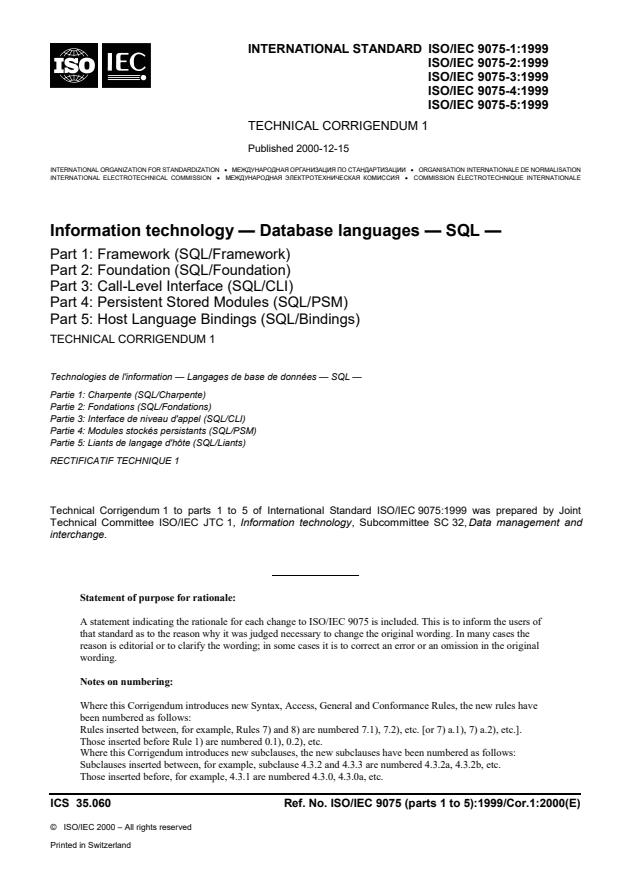
INTERNATIONAL STANDARD ISO/IEC 9075-1:1999
ISO/IEC 9075-2:1999
ISO/IEC 9075-3:1999
ISO/IEC 9075-4:1999
ISO/IEC 9075-5:1999
TECHNICAL CORRIGENDUM 1
Published 2000-12-15
INTERNATIONAL ORGANIZATION FOR STANDARDIZATION � МЕЖДУНАРОДНАЯОРГАНИЗАЦИЯПОСТАНДАРТИЗАЦИИ � ORGANISATION INTERNATIONALE DE NORMALISATION
INTERNATIONAL ELECTROTECHNICAL COMMISSION � МЕЖДУНАРОДНАЯ ЭЛЕКТРОТЕХНИЧЕСКАЯ КОМИССИЯ � COMMISSION ÉLECTROTECHNIQUE INTERNATIONALE
Information technology — Database languages — SQL —
Part 1: Framework (SQL/Framework)
Part 2: Foundation (SQL/Foundation)
Part 3: Call-Level Interface (SQL/CLI)
Part 4: Persistent Stored Modules (SQL/PSM)
Part 5: Host Language Bindings (SQL/Bindings)
TECHNICAL CORRIGENDUM 1
Technologies de l'information — Langages de base de données — SQL —
Partie 1: Charpente (SQL/Charpente)
Partie 2: Fondations (SQL/Fondations)
Partie 3: Interface de niveau d'appel (SQL/CLI)
Partie 4: Modules stockés persistants (SQL/PSM)
Partie 5: Liants de langage d'hôte (SQL/Liants)
RECTIFICATIF TECHNIQUE 1
Technical Corrigendum 1 to parts 1 to 5 of International Standard ISO/IEC 9075:1999 was prepared by Joint
Technical Committee ISO/IEC JTC 1, Information technology, Subcommittee SC 32, Data management and
interchange.
Statement of purpose for rationale:
A statement indicating the rationale for each change to ISO/IEC 9075 is included. This is to inform the users of
that standard as to the reason why it was judged necessary to change the original wording. In many cases the
reason is editorial or to clarify the wording; in some cases it is to correct an error or an omission in the original
wording.
Notes on numbering:
Where this Corrigendum introduces new Syntax, Access, General and Conformance Rules, the new rules have
been numbered as follows:
Rules inserted between, for example, Rules 7) and 8) are numbered 7.1), 7.2), etc. [or 7) a.1), 7) a.2), etc.].
Those inserted before Rule 1) are numbered 0.1), 0.2), etc.
Where this Corrigendum introduces new subclauses, the new subclauses have been numbered as follows:
Subclauses inserted between, for example, subclause 4.3.2 and 4.3.3 are numbered 4.3.2a, 4.3.2b, etc.
Those inserted before, for example, 4.3.1 are numbered 4.3.0, 4.3.0a, etc.
ICS 35.060 Ref. No. ISO/IEC 9075 (parts 1 to 5):1999/Cor.1:2000(E)
© ISO/IEC 2000 – All rights reserved
Printed in Switzerland
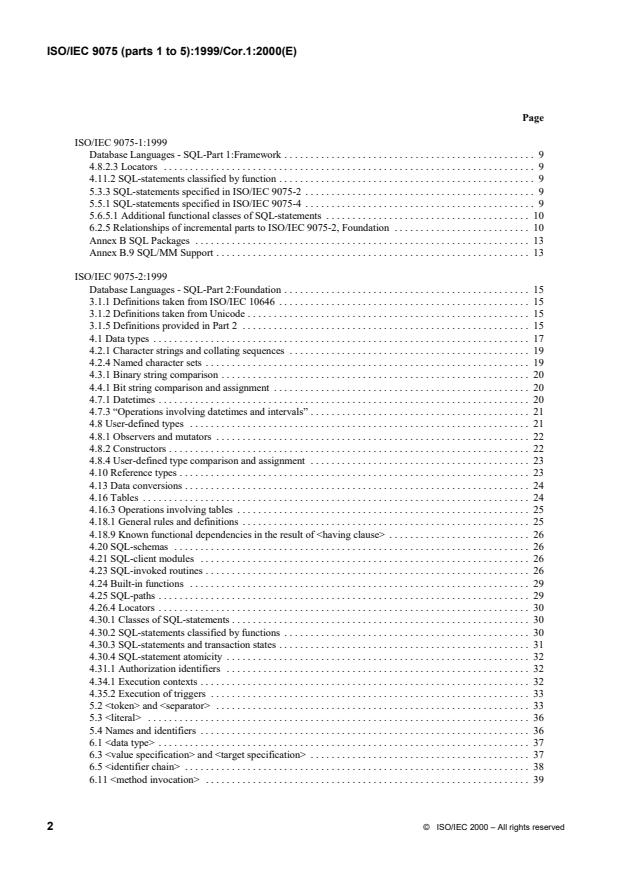
ISO/IEC 9075 (parts 1 to 5):1999/Cor.1:2000(E)
Page
ISO/IEC 9075-1:1999
Database Languages - SQL-Part 1:Framework . 9
4.8.2.3 Locators . 9
4.11.2 SQL-statements classified by function . 9
5.3.3 SQL-statements specified in ISO/IEC 9075-2 . 9
5.5.1 SQL-statements specified in ISO/IEC 9075-4 . 9
5.6.5.1 Additional functional classes of SQL-statements . 10
6.2.5 Relationships of incremental parts to ISO/IEC 9075-2, Foundation . 10
Annex B SQL Packages . 13
Annex B.9 SQL/MM Support . 13
ISO/IEC 9075-2:1999
Database Languages - SQL-Part 2:Foundation . 15
3.1.1 Definitions taken from ISO/IEC 10646 . 15
3.1.2 Definitions taken from Unicode . 15
3.1.5 Definitions provided in Part 2 . 15
4.1 Data types . 17
4.2.1 Character strings and collating sequences . 19
4.2.4 Named character sets . 19
4.3.1 Binary string comparison . 20
4.4.1 Bit string comparison and assignment . 20
4.7.1 Datetimes . 20
4.7.3 “Operations involving datetimes and intervals” . 21
4.8 User-defined types . 21
4.8.1 Observers and mutators . 22
4.8.2 Constructors . 22
4.8.4 User-defined type comparison and assignment . 23
4.10 Reference types . 23
4.13 Data conversions . 24
4.16 Tables . 24
4.16.3 Operations involving tables . 25
4.18.1 General rules and definitions . 25
4.18.9 Known functional dependencies in the result of . 26
4.20 SQL-schemas . 26
4.21 SQL-client modules . 26
4.23 SQL-invoked routines . 26
4.24 Built-in functions . 29
4.25 SQL-paths . 29
4.26.4 Locators . 30
4.30.1 Classes of SQL-statements . 30
4.30.2 SQL-statements classified by functions . 30
4.30.3 SQL-statements and transaction states . 31
4.30.4 SQL-statement atomicity . 32
4.31.1 Authorization identifiers . 32
4.34.1 Execution contexts . 32
4.35.2 Execution of triggers . 33
5.2 and . 33
5.3 . 36
5.4 Names and identifiers . 36
6.1 . 37
6.3 and . 37
6.5 . 38
6.11 . 39
2 © ISO/IEC 2000 – All rights reserved
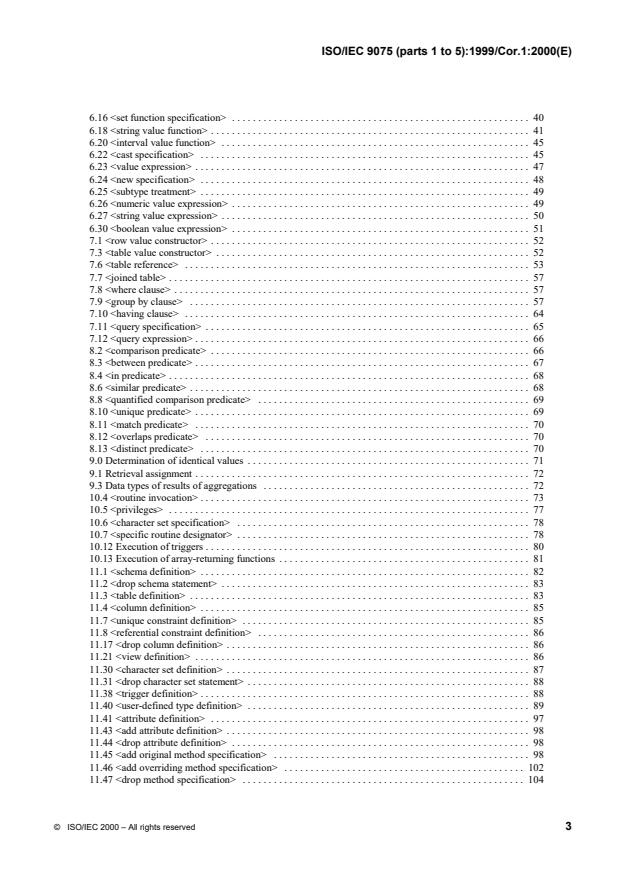
ISO/IEC 9075 (parts 1 to 5):1999/Cor.1:2000(E)
6.16 . 40
6.18 . 41
6.20 . 45
6.22 . 45
6.23 . 47
6.24 . 48
6.25 . 49
6.26 . 49
6.27 . 50
6.30 . 51
7.1 . 52
7.3 . 52
7.6
7.7 . 57
7.8 . 57
7.9 . 57
7.10 . 64
7.11 . 65
7.12 . 66
8.2 . 66
8.3 . 67
8.4 . 68
8.6 . 68
8.8 . 69
8.10 . 69
8.11 . 70
8.12 . 70
8.13 . 70
9.0 Determination of identical values . 71
9.1 Retrieval assignment . 72
9.3 Data types of results of aggregations . 72
10.4 . 73
10.5 . 77
10.6 . 78
10.7 . 78
10.12 Execution of triggers . 80
10.13 Execution of array-returning functions . 81
11.1 . 82
11.2 . 83
11.3
11.4 . 85
11.7 . 85
11.8 . 86
11.17 . 86
11.21 . 86
11.30 . 87
11.31 . 88
11.38 . 88
11.40 . 89
11.41 . 97
11.43 . 98
11.44 . 98
11.45 . 98
11.46 . 102
11.47 . 104
© ISO/IEC 2000 – All rights reserved 3
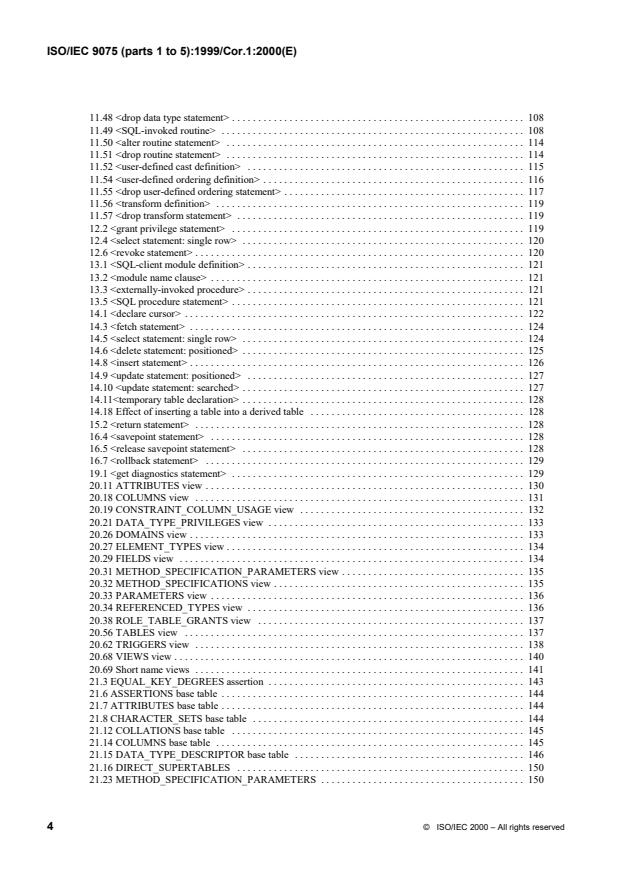
ISO/IEC 9075 (parts 1 to 5):1999/Cor.1:2000(E)
11.48 . 108
11.49 . 108
11.50 . 114
11.51 . 114
11.52 . 115
11.54 . 116
11.55 . 117
11.56 . 119
11.57 . 119
12.2 . 119
12.4 . 120
12.6 . 120
13.1 . 121
13.2 . 121
13.3 . 121
13.5 . 121
14.1 . 122
14.3 . 124
14.5 . 124
14.6 . 125
14.8 . 126
14.9 . 127
14.10 . 127
14.11 . 128
14.18 Effect of inserting a table into a derived table . 128
15.2 . 128
16.4 . 128
16.5 . 128
16.7 . 129
19.1 . 129
20.11 ATTRIBUTES view . 130
20.18 COLUMNS view . 131
20.19 CONSTRAINT_COLUMN_USAGE view . 132
20.21 DATA_TYPE_PRIVILEGES view . 133
20.26 DOMAINS view . 133
20.27 ELEMENT_TYPES view . 134
20.29 FIELDS view . 134
20.31 METHOD_SPECIFICATION_PARAMETERS view . 135
20.32 METHOD_SPECIFICATIONS view . 135
20.33 PARAMETERS view . 136
20.34 REFERENCED_TYPES view . 136
20.38 ROLE_TABLE_GRANTS view . 137
20.56 TABLES view . 137
20.62 TRIGGERS view . 138
20.68 VIEWS view . 140
20.69 Short name views . 141
21.3 EQUAL_KEY_DEGREES assertion . 143
21.6 ASSERTIONS base table . 144
21.7 ATTRIBUTES base table . 144
21.8 CHARACTER_SETS base table . 144
21.12 COLLATIONS base table . 145
21.14 COLUMNS base table . 145
21.15 DATA_TYPE_DESCRIPTOR base table . 146
21.16 DIRECT_SUPERTABLES . 150
21.23 METHOD_SPECIFICATION_PARAMETERS . 150
4 © ISO/IEC 2000 – All rights reserved
ISO/IEC 9075 (parts 1 to 5):1999/Cor.1:2000(E)
21.24 METHOD_SPECIFICATIONS base table . 151
21.25 PARAMETERS base table . 152
21.33 ROUTINES base table . 152
21.34 SCHEMATA base table . 152
21.35 SQL_FEATURES base table . 153
21.36 SQL_IMPLEMENTATION_INFO base table . 153
21.38 SQL_SIZING base table . 153
21.39 SQL_SIZING_PROFILES base table. 154
21.43 TABLES base table . 154
21.44 TRANSFORMS base table . 155
21.45 TRANSLATIONS base table . 155
21.47 TRIGGER_COLUMN_USAGE base table . 155
21.49 TRIGGERS base table . 156
21.52 USER_DEFINED_TYPES base table . 157
21.56 VIEWS base table . 158
22.1 SQLSTATE . 158
22.3 SQL Multimedia and Application Package SQLSTATE Subclasses . 158
23.1 General conformance requirements . 158
Annex A SQL conformance summary . 158
Annex B Implementation-defined elements . 164
Annex C Implementation-dependent elements . 165
Annex E Incompatibilities with ISO/IEC 9075:1992 and ISO/IEC 9075-4:1996 . 166
Annex F SQL feature and package taxonomy . 167
ISO/IEC 9075-3:1999
Database Languages - SQL-Part 3:Call Level Interface . 169
3.1.1.Definitions provided in Part 3 . 169
3.3.2.1 Clause, subclause and table relationships . 169
4.4.5 Connection attributes . 170
5.1 . 170
5.3 Description of CLI item descriptor areas . 170
5.5 Implicit DESCRIBE USING clause . 171
5.11 Deferred parameter check . 171
5.13 Description of CLI item descriptor areas . 171
5.14 Other tables associated with CLI . 172
5.15 Data type correspondences . 173
6.5 BindCol . 174
6.6 BindParameter . 174
6.9 ColAttribute . 174
6.10 ColumnPrivileges . 175
6.11 Columns . 175
6.12 Connect . 175
6.14 DataSources . 176
6.15 DescribeCol . 176
6.17 EndTran . 177
6.18 Error . 178
6.19 ExecDirect . 178
6.21 Fetch . 178
6.22 FetchScroll . 179
6.23 ForeignKeys . 179
6.28 GetConnectAttr . 180
6.29 GetCursorName . 180
6.30 GetData . 180
6.32 GetDescRec . 180
6.34 GetDiagRec . 181
© ISO/IEC 2000 – All rights reserved 5
ISO/IEC 9075 (parts 1 to 5):1999/Cor.1:2000(E)
6.36 GetFeatureInfo . 181
6.40 GetParamData . 181
6.50 Prepare . 182
6.51 PrimaryKeys . 182
6.54 SetConnectAttr . 182
6.55 SetCursorName . 182
6.56 SetDescField . 183
6.60 SpecialColumns . 183
6.62 TablePrivileges . 183
6.63 Tables . 184
A.1 C header file SQLCLI.H . 184
A.2 COBOL library item SQLCLI . 185
ISO/IEC 9075-4:1999
Database Languages - SQL-Part 4:Persistent Stored Modules . 187
3.3.2.1 Clause, Subclause, and Table relationships . 187
4.8 Cursors . 187
4.10 SQL-statements . 187
4.10.1 SQL-statements classified by function . 188
5.1 and . 188
6.2 . 188
9.18 . 189
11.2 . 189
12.2 . 189
13.1 . 190
13.6 . 190
13.7 . 190
15.1 . 191
16.1 . 191
16.3 . 191
17.2 MODULE_PRIVILEGES view . 191
17.4 MODULES view . 192
Annex A SQL Conformance Summary . 192
Annex E Incompatibilities with ISO/IEC 9075:1992 . 193
Annex F SQL Feature Taxonomy . 193
ISO/IEC 9075-5:1999
Database Languages - SQL-Part 5:Bindings . 195
4.6.1 Classes of SQL-statements . 195
4.6.4 Embeddable SQL-statement . 195
4.6.5 Preparable and immediately executable SQL-statements . 195
4.6.6 Directly executable SQL-statements . 196
5.1 and . 196
10.5 . 197
11.2 Calls to an . 197
11.3 . 197
12.0 . 197
12.1 . 198
12.2 . 198
14.3 . 199
15.1 Description of SQL descriptor areas . 199
15.6 . 199
15.8 . 200
15.13 . 200
15.14 . 200
6 © ISO/IEC 2000 – All rights reserved
ISO/IEC 9075 (parts 1 to 5):1999/Cor.1:2000(E)
16.1 . 201
16.3 . 203
16.4 . 204
16.5 . 204
16.6 . 205
16.7 . 206
16.8 . 206
16.9 . 207
19.1 . 208
20.1 SQLSTATE . 208
Annex A SQL Conformance Summary . 209
Annex E Incompatibilities with ISO/IEC 9075:1992 . 211
© ISO/IEC 2000 – All rights reserved 7
ISO/IEC 9075 (parts 1 to 5):1999/Cor.1:2000(E)
8 © ISO/IEC 2000 – All rights reserved
ISO/IEC 9075 (parts 1 to 5):1999/Cor.1:2000(E)
ISO/IEC 9075-1:1999
Database Languages - SQL-Part 1:Framework
4.8.2.3 Locators
1. Rationale: Correct the specification of which locators are marked invalid when an SQL-transaction ends.
th
Replace the 8 paragraph with:
A non-holdable locator remains valid until the end of the SQL-transaction in which it was generated, unless it
is explicitly made invalid by the execution of a or a that
specifies a is executed before the end of that SQL-transaction if the locator was generated
subsequent to the establishment of the savepoint identified by the .
th
Replace 9 paragraph with:
A holdable locator may remain valid beyond the end of the SQL-transaction in which it is generated. A
holdable locator becomes invalid whenever a identifying that locator is executed or
the SQL-transaction in which it is generated or any subsequent SQL-transaction is rolled back. All locators
remaining valid at the end of an SQL-session are marked invalid when that SQL-session terminates.
4.11.2 SQL-statements classified by function
1. Rationale: Correct the classification of SQL-statements.
st
Add a list element to the 1 paragraph:
— SQL-dynamic statements, which support the preparation and execution of dynamically generated
SQL-statements, and obtaining information about them.
5.3.3 SQL-statements specified in ISO/IEC 9075-2
1. Rationale: Correct the classification of SQL-statements.
th st
Replace the 4 bullet of the 1 paragraph with:
— Two SQL-control statements (CALL and RETURN), which can be used to invoke a procedure and
specify a value to be returned by a function.
5.5.1 SQL-statements specified in ISO/IEC 9075-4
1. Rationale: Correct the classification of SQL-statements.
st st
Replace the 1 bullet of the 1 paragraph with:
— Additional SQL-control statements which may be used to control the execution of an SQL routine.
© ISO/IEC 2000 – All rights reserved 9
ISO/IEC 9075 (parts 1 to 5):1999/Cor.1:2000(E)
2. Rationale: Correct the classification of SQL-statements.
nd st
Delete the 2 bullet from the 1 paragraph
3. Rationale: Correct the classification of SQL-statements.
rd st
Replace the 3 bullet of the 1 paragraph with:
— Additional SQL-diagnostics statements, which may be used to signal exceptions.
4. Rationale: Correct the classification of SQL-statements.
st
Add the following bullets to the 1 paragraph:
— SQL-control declaration statements which may be used to declare variables and exception handlers.
— Additional SQL-schema statements, which may be used to create and drop modules.
5.6.5.1 Additional functional classes of SQL-statements
1. Rationale: Correct the classification of SQL-statements.
st
Replace the bullet of the 1 paragraph with:
— SQL-dynamic statements, which support the preparation and execution of dynamically generated
SQL-statements, and obtaining information about them.
2. Rationale: Correct the classification of SQL-statements.
nd
Replace the 2 paragraph with:
A number of SQL-data statements are also added, most of which contain the word "dynamic" in their names.
They are not to be confused with SQL-dynamic statements.
6.2.5 Relationships of incremental parts to ISO/IEC 9075-2, Foundation
1. Rationale: To permit the modification of Parts 1, 3 and 10 as well as Parts 2 and 5 in other Parts, since
Part 1 needs to be updated by the Conformance clauses of other Parts and Parts 3 and 10 are analogous
in functionality to Part 5.
Replace the entire Subclause with:
6.2.5 Relationships of incremental parts within ISO/IEC 9075
Parts of ISO/IEC 9075 other than this part of ISO/IEC 9075 and ISO/IEC 9075-2 depend on ISO/IEC 9075-
1, ISO/IEC 9075-2 and its Technical Corrigenda and are referenced as incremental parts. Each incremental
part is to be used as though it were merged with the text of ISO/IEC 9075. This Subclause describes the
conventions used to specify the merger.
The merger described also accounts for the Technical Corrigenda that have been published to correct
ISO/IEC 9075. This accommodation is typically indicated by the presence of a phrase like “in the Technical
Corrigenda” or “in the TC”.
10 © ISO/IEC 2000 – All rights reserved
ISO/IEC 9075 (parts 1 to 5):1999/Cor.1:2000(E)
6.2.5.1 New and modified Clauses, Subclauses, and Annexes
Where a Clause (other than Clause 1, “Scope”, and Clause 2, “Normative references”), Subclause, or Annex
in any incremental part of ISO/IEC 9075 has a name identical to a Clause, Subclause, or Annex in ISO/IEC
9075-1, ISO/IEC 9075-2, ISO/IEC 9075-3, ISO/IEC 9075-5 or ISO/IEC 9075-10 (unless the incremental
part is itself ISO/IEC 9075-3, ISO/IEC 9075-5 or ISO/IEC 9075-10), it supplements the Clause, Subclause,
or Annex, respectively, in ISO/IEC 9075-1 and/or ISO/IEC 9075-2 and/or ISO/IEC 9075-3 and/or ISO/IEC
9075-5 and/or ISO/IEC 9075-10, regardless of whether or not the number or letter of the Clause, Subclause,
or Annex corresponds. It typically does so by adding or replacing paragraphs, Format items, or Rules.
In each incremental part, Table 1, "Clause, Subclause, and Table relationships", identifies the relationships
between each Clause, Subclause, and Annex in that incremental part and the corresponding Clause,
Subclause, or Annex in ISO/IEC 9075-1 and/or ISO/IEC 9075-2 and/or ISO/IEC 9075-3 and/or ISO/IEC
9075-5 and/or ISO/IEC 9075-10.
Where a Clause, Subclause, or Annex in an incremental part has a name that is not identical to the name of
some Clause, Subclause, or Annex in ISO/IEC 9075-1 and/or ISO/IEC 9075-2 and/or ISO/IEC 9075-3
and/or ISO/IEC 9075-5 and/or ISO/IEC 9075-10, it provides language specification particular to that part. A
Subclause that is part of a Clause or Subclause identified as new is inherently new and is not marked.
The Clauses, Subclauses, and Annexes in each incremental part appear in the order in which they are
intended to appear in the merged document. In the absence of other explicit instructions regarding its
placement, any new Clause, Subclause, or Annex is to be positioned as follows: Locate the prior Clause,
Subclause, or Annex in ISO/IEC 9075-1 and/or ISO/IEC 9075-2 and/or ISO/IEC 9075-3 and/or ISO/IEC
9075-5 and/or ISO/IEC 9075-10 whose name is identical to the name of a corresponding Clause, Subclause,
or Annex that appears in the incremental part of ISO/IEC 9075. The new Clause, Subclause, or Annex shall
immediately follow that Clause, Subclause, or Annex. If there are multiple new Clauses, Subclauses, or
Annexes with no intervening Clause, Subclause, or Annex that modifies an existing Clause, Subclause, or
Annex, then those new Clauses, Subclauses, or Annexes appear in order, following the prior Clause,
Subclause, or Annex whose name was matched.
When an incremental part performs a modification to the Clause, Subclause, or Annex in ISO/IEC 9075-1
and/or ISO/IEC 9075-2 and/or ISO/IEC 9075-3 and/or ISO/IEC 9075-5 and/or ISO/IEC 9075-10, then the
modifications are applied in the following sequence:
1) All modifications to ISO/IEC 9075-1 from the incremental part.
2) All modifications to ISO/IEC 9075-3 from the incremental part.
3) All modifications to ISO/IEC 9075-5 from the incremental part.
4) All modifications to ISO/IEC 9075-10 from the incremental part.
5) All modifications to ISO/IEC 9075-2 from ISO/IEC 9075-3, including all modifications that were
added, augmented, or replaced as a result of step 2.
6) All modifications to ISO/IEC 9075-2 from ISO/IEC 9075-5, including all modifications that were
added, augmented, or replaced as a result of step 2.
7) All modifications to ISO/IEC 9075-2 from ISO/IEC 9075-10, including all modifications that were
added, augmented, or replaced as a result of step 2.
8) All modifications to ISO/IEC 9075-2 from the incremental part. Note that modifications in this third
step may augment or replace modifications applied as a result of steps 2, 3 and 4.
Modifications to ISO/IEC 9075-1 and/or ISO/IEC 9075-2 and/or ISO/IEC 9075-3 and/or ISO/IEC 9075-5
and/or ISO/IEC 9075-10 by more than one incremental part do not interact. The modifications made by an
incremental part only have influence on the language specification of that part and those specifications are
not influenced by modifications made by any other incremental part.
© ISO/IEC 2000 – All rights reserved 11
ISO/IEC 9075 (parts 1 to 5):1999/Cor.1:2000(E)
6.2.5.2 New and modified Format items
In a modified Subclause, a Format item that defines a BNF non-terminal symbol (that is, the BNF non-
terminal symbol appears on the left-hand side of the ::= mark) either modifies a Format item whose definition
appears in ISO/IEC 9075-2 and/or ISO/IEC 9075-3 and/or ISO/IEC 9075-5 and/or ISO/IEC 9075-10, or
replaces a Format item whose definition appears in ISO/IEC 9075-2 and/or ISO/IEC 9075-3 and/or ISO/IEC
9075-5 and/or ISO/IEC 9075-10, or defines a new Format item that does not have a definition at all in
ISO/IEC 9075-2 and/or ISO/IEC 9075-3 and/or ISO/IEC 9075-5 and/or ISO/IEC 9075-10. Those Format
items in the incremental part that modify a Format item whose definition appears in ISO/IEC 9075-2 and/or
ISO/IEC 9075-3 and/or ISO/IEC 9075-5 and/or ISO/IEC 9075-10 are identified by the existence of a
“Format comment” such as:
::=
!! All alternatives from ISO/IEC 9075-2
|
By contrast, Format items that completely replace Format items in ISO/IEC 9075-2 and/or ISO/IEC 9075-3
and/or ISO/IEC 9075-5 and/or ISO/IEC 9075-10 have BNF non-terminal symbols identical to BNF non-
terminal symbols of Format items in ISO/IEC 9075-2 and/or ISO/IEC 9075-3 and/or ISO/IEC 9075-5 and/or
ISO/IEC 9075-10, but do not state that they include any alternatives from ISO/IEC 9075-2 and/or ISO/IEC
9075-5 and/or ISO/IEC 9075-10.
New Format items that have no correspondence to any Format item in ISO/IEC 9075-2 and/or ISO/IEC
9075-3 and/or ISO/IEC 9075-5 and/or ISO/IEC 9075-10 are not distinguished in the incremental part.
Format items in new Subclauses are unmarked.
6.2.5.3 New and modified paragraphs and rules
In modified Subclauses, each paragraph or Rule is marked to indicate whether it is a modification of a
paragraph or Rule in ISO/IEC 9075-1, ISO/IEC 9075-2, ISO/IEC 9075-3, ISO/IEC 9075-5 or ISO/IEC
9075-10 or is a new paragraph or Rule added by this incremental part.
Modifications of paragraphs or Rules in ISO/IEC 9075-2 are identified by the inclusion of an indicative
phrase enclosed in a box.
Replace the 5th paragraph means that the following text is to replace the fifth paragraph of the
corresponding Subclause in ISO/IEC 9075-2.
means that the following text is to replace Syntax Rule 6)b)ii) of the corresponding
Replace SR6) b) ii)
Subclause in ISO/IEC 9075-2.
means that the following text is to extend or enhance Syntax Rule 3). In most instances,
Augments SR3)
the augmentation is the addition of a new alternative meant to support new syntax. New paragraphs or Rules
in an incremental part is marked to indicate where it is to be inserted.
means that the following text is to be read as though it were inserted
Insert before 2nd paragraph
immediately before the second paragraph of the corresponding Subclause in ISO/IEC 9075-2.
means that the following text is to be read as though it were inserted immediately
Insert before GR4)
before General Rule 4) of the corresponding Subclause in ISO/IEC 9075-2.
If no specific insertion point is indicated, as in Insert this paragraph or Insert this GR , then the
following text is to be read as though it were appended at the end of the appropriate section (the General
Rules, for example) of the corresponding Subclause in ISO/IEC 9075-2.
12 © ISO/IEC 2000 – All rights reserved
ISO/IEC 9075 (parts 1 to 5):1999/Cor.1:2000(E)
Modifications of paragraphs or Rules in ISO/IEC 9075-1 and/or ISO/IEC 9075-3 and/or ISO/IEC 9075-5
and/or ISO/IEC 9075-10 are identified in the same way as for modifications of ISO/IEC 9075-2, except that
“in Part 1”, “in Part 3 ”, “in Part 5 ” or “in Part 10” is appended to the indicative phrase, as appropriate.
In such indications, “SR” is used to mean “Syntax Rule”, “AR” is used to mean “Access Rule”, “GR” is used
to mean “General Rule”, and “CR” is used to mean “Conformance Rule”. “Desc.” is used to mean
“Description” and “Func.” is used to mean “Function”.
All paragraphs, Format items, and Rules in new Clauses or Subclauses are also new and are therefore
unmarked.
6.2.5.4 New and modified tables
If the name of a table in an incremental part is identical to that of a table in ISO/IEC 9075-1 and/or ISO/IEC
9075-2 and/or ISO/IEC 9075-3 and/or ISO/IEC 9075-5 and/or ISO/IEC 9075-10, then the table supplements
the table in ISO/IEC 9075-1 and/or ISO/IEC 9075-2 and/or ISO/IEC 9075-3 and/or ISO/IEC 9075-5 and/or
ISO/IEC 9075-10, typically by adding or replacing one or more table entries; otherwise, it is a new table.
In each incremental part, there is a table, Table 1, "Clause, Subclause, and Table relationships", that
identifies the relationships between tables in that incremental part and the corresponding tables in ISO/IEC
9075-1 and/or ISO/IEC 9075-2 and/or ISO/IEC 9075-3 and/or ISO/IEC 9075-5 and/or ISO/IEC 9075-10.
The rows in modified tables are generally new rows to be effectively inserted into the corresponding table in
ISO/IEC 9075-1 and/or ISO/IEC 9075-2 and/or ISO/IEC 9075-3 and/or ISO/IEC 9075-5 and/or ISO/IEC
9075-10, though in rare cases a row already in a table in ISO/IEC 9075-1 and/or ISO/IEC 9075-2 and/or
ISO/IEC 9075-3 and/or ISO/IEC 9075-5 and/or ISO/IEC 9075-10 is effectively replaced by a row in the
table in the incremental part. Such replacement is required wherever the value in the first column of the
corresponding table is the same.
Annex B SQL Packages
1. Rationale: Withdraw the package called “OLAP facilities”, which is being superseded by the package
called “OLAP” as defined in Amendment 1 of ISO/IEC 9075:1999.
In Table 2 — SQL Packages, delete line 3:
Delete the entire Annex B.3, “OLAP facilities”.
Annex B.9 SQL/MM Support
1. Rationale: The package "SQL/MM support" is no longer needed since it is now defined explicitly in
ISO/IEC 13249-1.
Delete the entire Annex B.9, "SQL/MM support".
© ISO/IEC 2000 – All rights reserved 13
ISO/IEC 9075 (parts 1 to 5):1999/Cor.1:2000(E)
14 © ISO/IEC 2000 – All rights reserved
ISO/IEC 9075 (parts 1 to 5):1999/Cor.1:2000(E)
ISO/IEC 9075-2:1999
Database Languages - SQL-Part 2:Foundation
3.1.1 Definitions taken from ISO/IEC 10646
1. Rationale: Remove unused definitions.
Replace the Subclause with:
This part of ISO/IEC 9075 makes use of the following terms defined in ISO/IEC 10646:
a) character
3.1.2 Definitions taken from Unicode
1. Rationale: Remove unused definitions.
Replace the Subclause with:
This part of ISO/IEC 9075 makes use of the following terms defined in The Unicode Standard:
a) control character
3.1.5 Definitions provided in Part 2
1. Rationale: Clarify the definition of “assignment”
Replace item b) with:
b) assignment: The operation whose effect is to ensure that the value at a site T (known as the target) is
identical to a given value S (known as the source). Assignment is frequently indicated by the use of
the phrase “T is set to S” or “the value of T is set to S”.
2. Rationale: Clarify the definition of “comparable”
Replace item i) with:
i) comparable (of a pair of values): Capable of being compared, according to the rules of Subclause 8.2
“”. In most, but not all, cases the values of a data type can be compared one
with another. For the specification of comparability of individual data types, see Su
...
Questions, Comments and Discussion
Ask us and Technical Secretary will try to provide an answer. You can facilitate discussion about the standard in here.
Loading comments...